
Life, 1906-01-04 · page 31 of 48
Life — January 4, 1906 — page 31: what you’re looking at
What you’re looking at
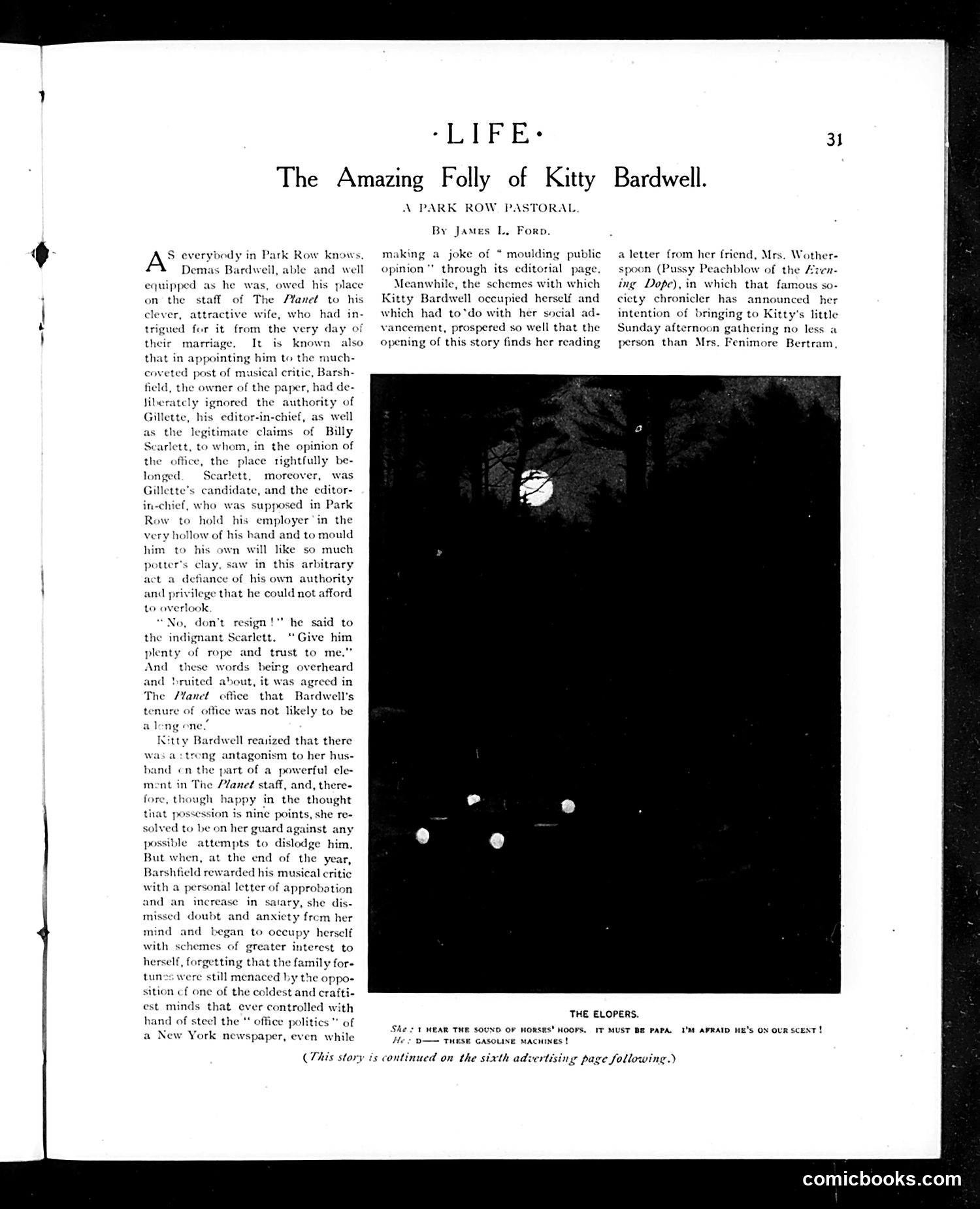
This page presents a serialized satirical story about newspaper office politics in early 20th-century New York (specifically at a publication called "The Planet" on "Park Row," the newspaper district). The narrative mocks Kitty Bardwell, whose social ambitions and scheming have distracted her from protecting her husband Demas's job security. Though she successfully intrigued to get him hired as music critic, she's now preoccupied with social advancement—notably arranging for a society chronicler to bring the prestigious Mrs. Fenimore Bertram to her Sunday gathering. The text suggests she's forgotten that powerful enemies in the newspaper office still threaten her husband's position. The small cartoon below, captioned "The Elopers," appears unrelated—showing a couple fleeing, with the woman hearing "horses' hoops" (her father approaching) while the man curses "gasoline machines" (automobiles), likely commentary on modern courtship and pursuit. The satire targets both newspaper workplace machinations and the vanities of social climbing among the middle class.
📄 Transcribed text from this page (OCR, searchable)
Machine-transcribed from the original scan — historical spelling and the odd misread are preserved.
rs ‘-LIFE- The Amazing Folly of Kitty Bardwell. A everybody in Park Row knows, Demas Bardwell, able and well equipped as he was, owed his place on the staff of The /lanet to his clever, ctive wife, who had in- trigued for it from the very day of t marriage. It is known also that in appointing him to the much- 1 post of musical critic, Barsh- the owner of the paper, had de- y ignored the authority of Gillette, his editor-in-chief, as well legitimate claims of Billy to whom, in the opinion of Gillette's candidate, and the editor- in-chief, who was supposed in Park Row to hold his employer ’in the very hollow of his hand and to mould him to his own will like so much stter’s cl is arbitrary t a defiance of his own authority nd privilege that he could not afford overlook. “No, don't resign!" he said to the indignant rlett. “Give him plenty of rope and trust to me." And these words being overheard nd bruited out, it was agreed in ne /tanet office that Bardwell's tenure of office was not likely to be aleng one! ty Bardwell rez . saw in I zed that there was a: trong antagonism to her hus- band cn the part of a powerful cle ment in The lane? staff, and, there- fore, though happy in the thought t possession is nine points, she re- solved to be on her guard against any possible attempts to dislodge him, But when, at the end of the year, Barshfield rewarded his musical critic with a personal letter of approbation and an increase in sata she dis- missed doubt and anxiety from her mind and began to occupy herseli with schemes of greater interest to hersel: forgetting that the family for- tunes were still menaced by the oppo- sition cf one of the coldest and crafti- est minds that ever controlled with hand of steel the ‘‘ office politics" of a New York newspaper, even while A PARK ROW PASTORAL. By James L, Foro. making a joke of * moulding public opinion’ through its editorial pa; Meanwhile, the schemes with which Kitty Bardwell occupied herself and which had to‘do with her social ad- vancement, prospered so well that the opening of this story finds her reading aletter from her friend, Mrs. Wother- spoon (Pussy Peachblow of the /ven- ing Dope), in which that famous so- ciety chronicler has announced her intention of bringing to Kitty's little Sunday afternoon gathering no less 3 person than Mrs, Fenimore Bertram, THE ELOPERS. She: 1 MBAR THE SOUND OF HORSES’ HOOPS, IT MUST BE PAPA. 1M AFRAID HE'S ON OUR SCENT! He > D—= THESE GASOLINE MACHINES | (This story is continued on the sixth advertising page following.) comicbooks.com