
Life, 1906-01-04 · page 30 of 48
Life — January 4, 1906 — page 30: what you’re looking at
What you’re looking at
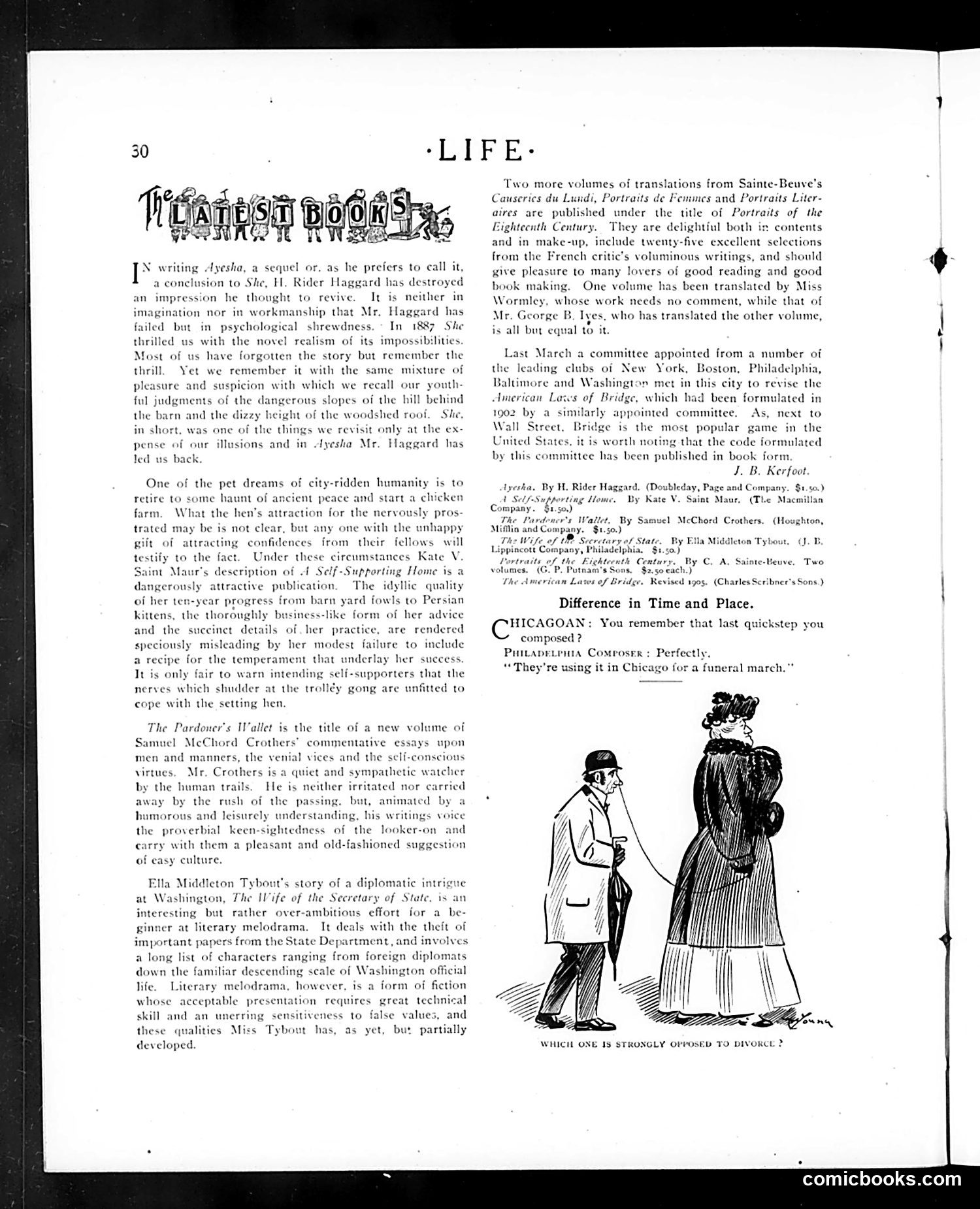
This page contains book reviews and a single cartoon titled "Which One Is Strongly Opposed to Divorce?" **The Cartoon:** The illustration shows a man and woman in period dress (appears to be early 1900s), with the woman towering over the man. The caption asks which figure opposes divorce. The joke is visual satire about gender dynamics—likely mocking either the man's apparent weakness/submission to his wife, or satirizing contemporary debates about women's rights and marriage. The humor depends on viewers' assumptions about which gender would traditionally oppose divorce. **The Reviews:** The page discusses several books: H. Rider Haggard's sequel *Ayesha*, works about self-supporting farms, Samuel McChord Crothers' essay collection, and Ella Middleton Tybout's Washington political thriller. The tone is literary criticism typical of Life magazine's cultural commentary for educated readers. The specific political/social references are unclear without additional context about these authors' prominence at the time.
📄 Transcribed text from this page (OCR, searchable)
Machine-transcribed from the original scan — historical spelling and the odd misread are preserved.
a sequel or, as he prefers to call it, I’ writing Ayesha a conclusion to She, H. Rider Haggard has destroyed an impression he thought to revive. It is neither in imagination nor in workmanship that Mr, Haggard has failed but in psychological shrewdness. © In 1887 She thrilled us with the novel realism of its impossibilities. Most of us have forgotten the story but remember the thrill. Yet we remember it with the same mixture of pleasure and suspicion with which we recall our youth- ful judgments of the dangerous slopes of the hill behind the barn and the dizzy height of the woodshed roof. She, he thir ly at th pense of our illusions and in slyesha Mr. Haggard has led us back in short, was one of ex: s we revisit ¢ One of the pet dreams of city-ridden humanity is to retire to some haunt of ancient peace and start farm. What the hen’s attraction for the nervously pros- trated may be is not clear, but any one with the unhappy gift of attracting confidences from their fellows will testify to the fact. Under these circumstances Kate V Saint Maur's description of «1 Self-Supporting Home is a dangerously attractive publication. The idyllic quality ersian ‘d fowls to kittens, the thoroughly business-like form of her advice and the succinct details of, her practice, are rendered of her ten-year progress from barn speciously misleading by her modest failure to include a recipe for the temperament that underlay her success. It is only fair to warn intending seli-supporters that the nerves which shudder at the trolley cope with the setting hen gong are unfitted to The Pardoner’s Wallet is the title of a new volume of Samuel McC men and ma ord Crothers’ commentative essays upon ners, the venial vices and the seli-conscious virtues. Mr. Crothers is a quiet and sympathetic watcher by the human trails, He is neither irritated nor carried away by the rush of the passing, but, animated by a humorous and leisurely understanding, his writings voice the proverbial keen-sightedness of the looker-on and carry with them a pleasant and old-fashioned suggestion of easy culture. Ella Middleton Tybout’s story of a diplomatic intrigue at Washington, The Iife of the Secretary of State, is an interesting but rather over-ambitious effort for a be- ginner at literary melodrama. It deals with the theft of important papers from the State Department, and involves a long list of characters ranging from foreign diplomats down the familiar descending scale of Washington of ficial life. Literary melodrama, however, is a form of fiction whose acceptable presentation requires great technical skill and an unerring sensitiveness to false values, and these qualities Miss Tybout has, as yet, but partially developed. ‘LDP E+ Two more volumes of translations from Sainte-Beuve's Causerics du Lundi, Portraits de Femmes and Portraits Liter- aires are published under the title of Portraits of the Eighteenth Century. They are delightful both in contents and in make-up, include twenty-five ¢ from the French critic's voluminous w xcellent selections tings, and should give pleasure to many lovers of good reading and good book making. One volume has been translated by Miss Wormley, whose work needs no comment, while that of Mr. George B. Iyes, who has translated the other volume, is all but equal to it. Last March a committee appointed from a number of the leading clubs of New York, Boston, Philadelphia, Baltimore and Washington met in this city to revise the American Laws of Bridge, which had been formulated in 1902 by a similarly appointed committee. As, next to Wall Street, Bridge is the most popular game in the United States, it is worth noting that the code formulated by this committee has been published in book form J. B. Kerfoot By Samuel McChord Crothers. $1.50.) tary of State. Py Fila Middleton Tybout. (J. B. Lippincott C hiladelphia, $1.50.) Portraits Eighteenth Century. By C. A, Sai volumes. (G. P. Putnam's Sons, $2.50 each.) The American Laws of Bridge, Revised 1905. (Charles Scribner's Sons.) (Houghton, euve, Two Difference in Time and Place. HICAGOAN: You remember that last q composed ? Pittapenenta Cosrosrr : Perfectly. They're using it in Chicago for a funeral march.” ckstep you WHICH ONE 18 STRONGLY OPPOSED TO DIVORCE ? rn comicbooks.com