
A complete issue · 58 pages · 1903
Life — December 10, 1903
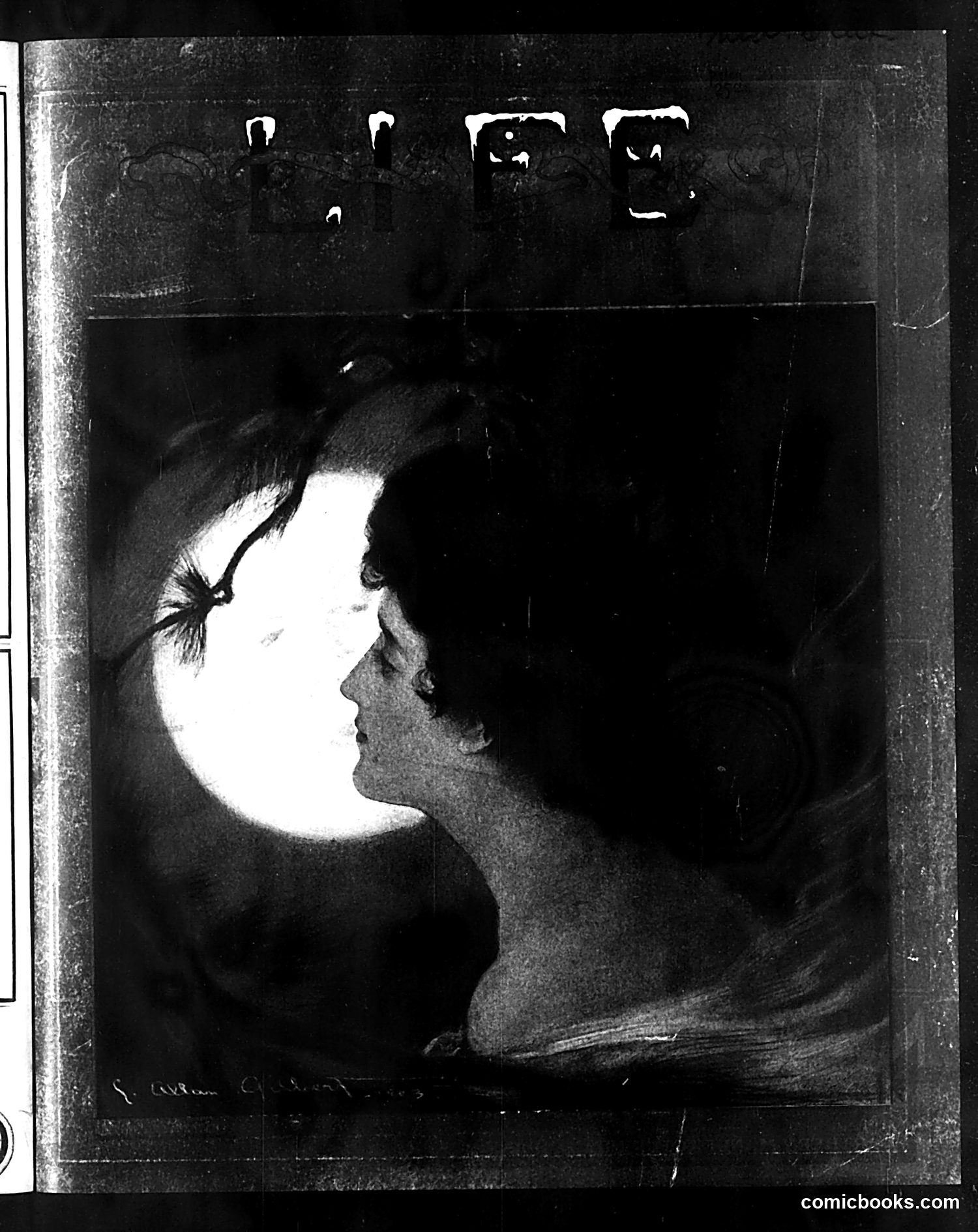
This appears to be a striking silhouette artwork rather than a political cartoon. The image shows a profile of a person gazing at or near a large glowing circular form (likely the moon). The composition is dramatically lit with strong contrast between the dark figure and the bright circular element. Without clearer OCR text or additional context from the page, I cannot definitively identify the specific figure, date, or satirical intent. The artistic style suggests early-to-mid 20th century, and the romantic/contemplative mood might reflect cultural themes of that era, but I cannot assert what specific political or social commentary this represents without more information. The page header text at top is illegible in this reproduction.
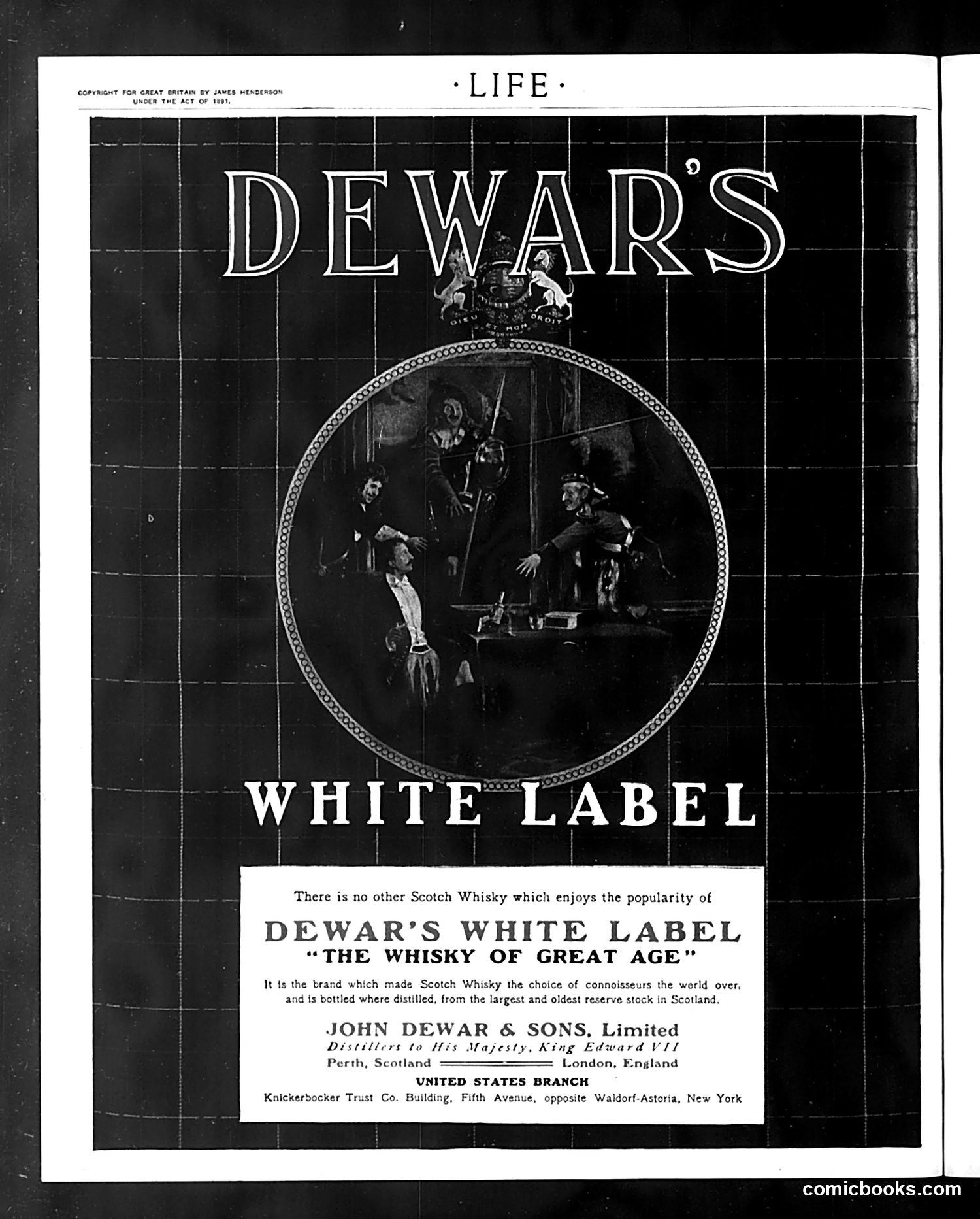
This is a **Dewar's Whisky advertisement**, not political satire or editorial cartooning. The page shows a circular vignette illustration depicting what appears to be a historical scene—possibly a royal court or formal gathering with figures in period dress and regalia—though the specific historical moment is unclear from the image alone. The advertisement's tagline, "The Whisky of Great Age," plays on the product's reputation and the illustrated scene's apparent historical significance. The company emphasizes Dewar's status as the preferred Scotch whisky among "connoisseurs the world over" and highlights its Scottish heritage and royal patronage ("Distillers to His Majesty, King Edward VII"). This is straightforward commercial advertising rather than satirical content.
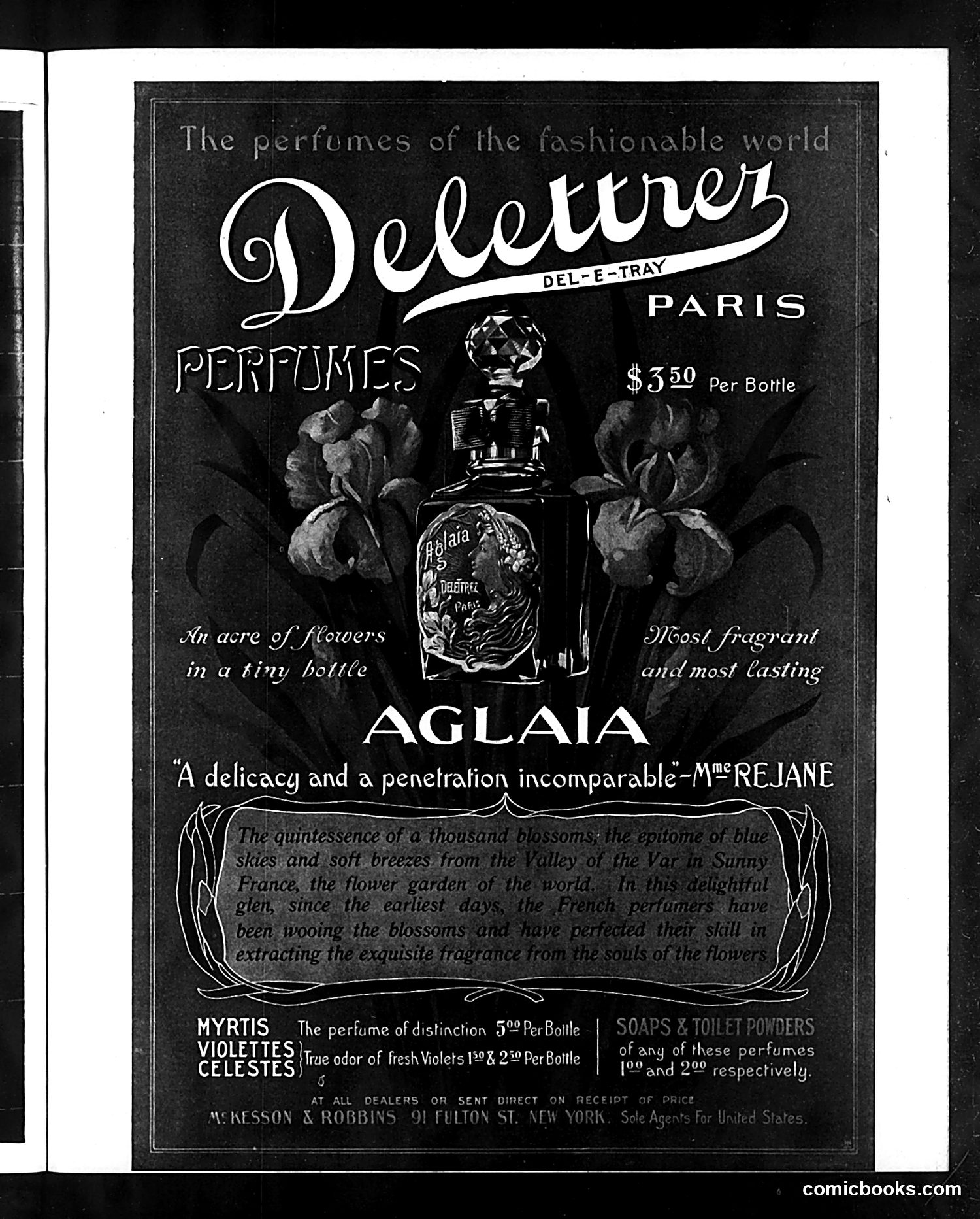
This page is **not a cartoon or satirical content** — it's a vintage advertisement for Delettrez perfumes from Paris, likely from the early 20th century. The ad promotes "Aglaia," a fragrance described as containing "an acre of flowers in a tiny bottle." It features a decorative central perfume bottle flanked by iris flowers, positioning the product as luxurious and exotic. The ad emphasizes French perfume-making tradition, referencing the "Valley of the Var in Sunny France" as the source of botanical ingredients. Additional perfumes listed (Myrtis, Violettes, Celestes) are offered alongside soaps and toilet powders. The distributor, M. Kesson & Robbins in New York, served as sole U.S. agents. This represents early advertising targeting fashionable, affluent American consumers.
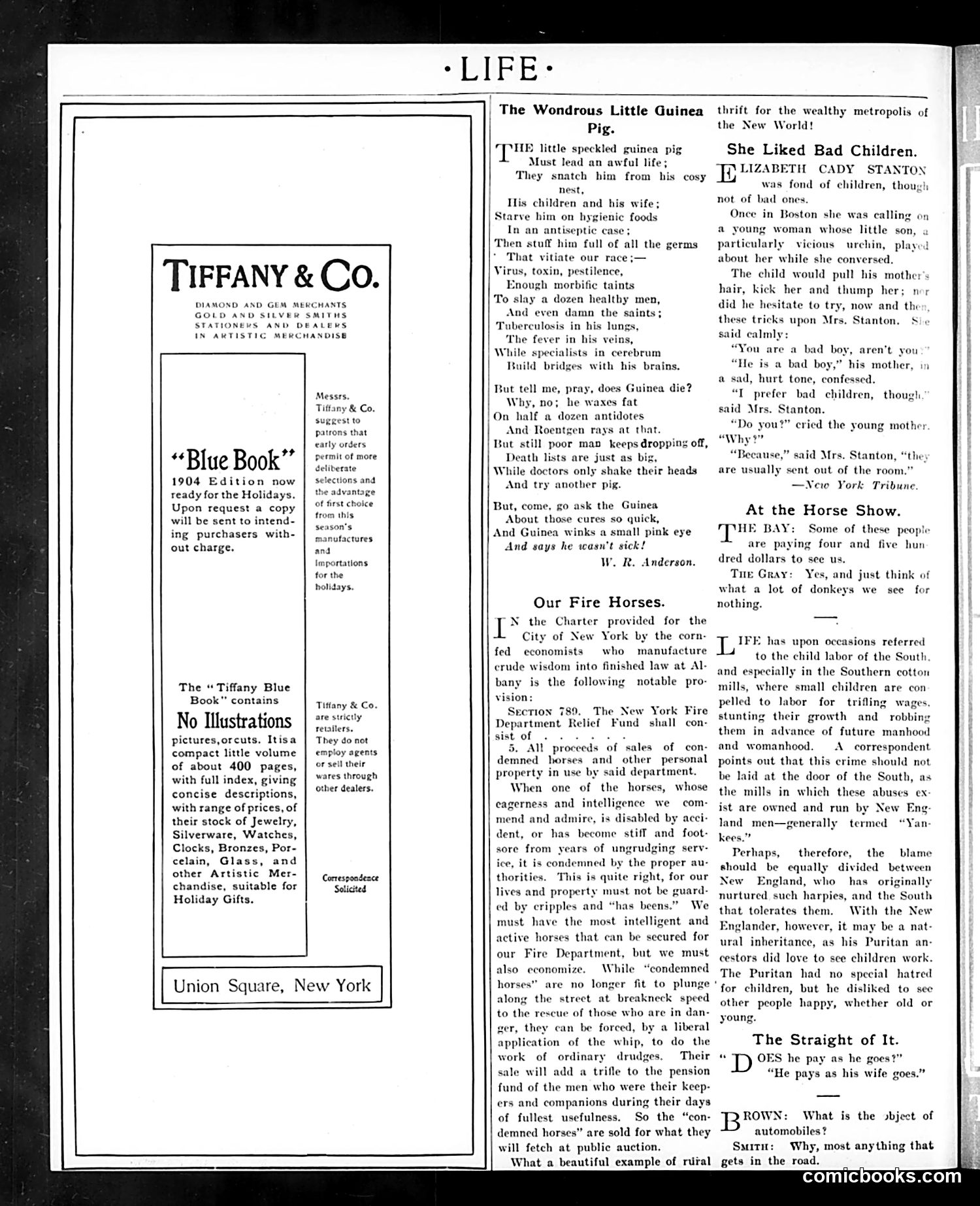
This Life magazine page is primarily **advertising and miscellaneous content** rather than political satire. The left side features a **Tiffany & Co. advertisement** for their "Blue Book" (1904 edition), a luxury catalog of jewelry, silverware, and decorative arts. The right side contains several brief **humorous anecdotes and jokes**: - "The Wondrous Little Guinea Pig" - a satirical poem about a sickly guinea pig (likely mocking pseudo-scientific medical claims) - "She Liked Bad Children" - a story about Elizabeth Cady Stanton's fondness for misbehaving children - "At the Horse Show," "Our Fire Horses," and "The Straight of It" - short comedic pieces about everyday urban topics The page represents **typical early 1900s Life magazine content**: mixing high-end advertising with light social humor targeting educated, affluent readers.
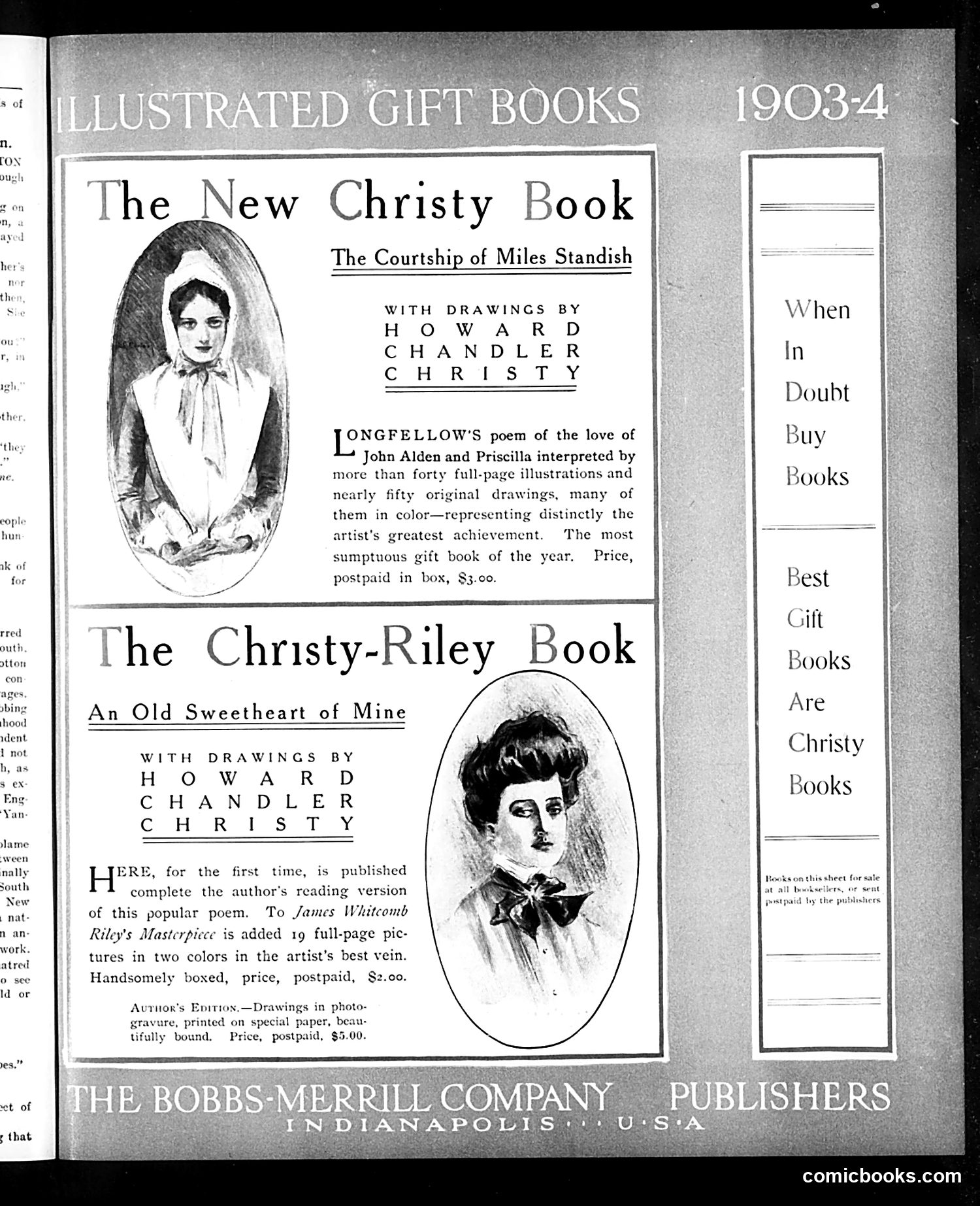
This page is primarily **advertising**, not satire or political commentary. It showcases illustrated gift books published by The Bobbs-Merrill Company in Indianapolis circa 1903-1904. Two books are featured: 1. **The New Christy Book** — illustrations by Howard Chandler Christy of Longfellow's poem about John Alden and Priscilla, priced at $3.00 2. **The Christy-Riley Book** — "An Old Sweetheart of Mine," featuring 19 full-page illustrations, priced at $2.00 standard edition or $5.00 for a deluxe author's edition The oval-framed portraits are decorative illustrations accompanying these literary works, not satirical caricatures. The right margin advertises Christy Books as "Best Gift Books," appealing to early-1900s consumers seeking illustrated literary gifts.
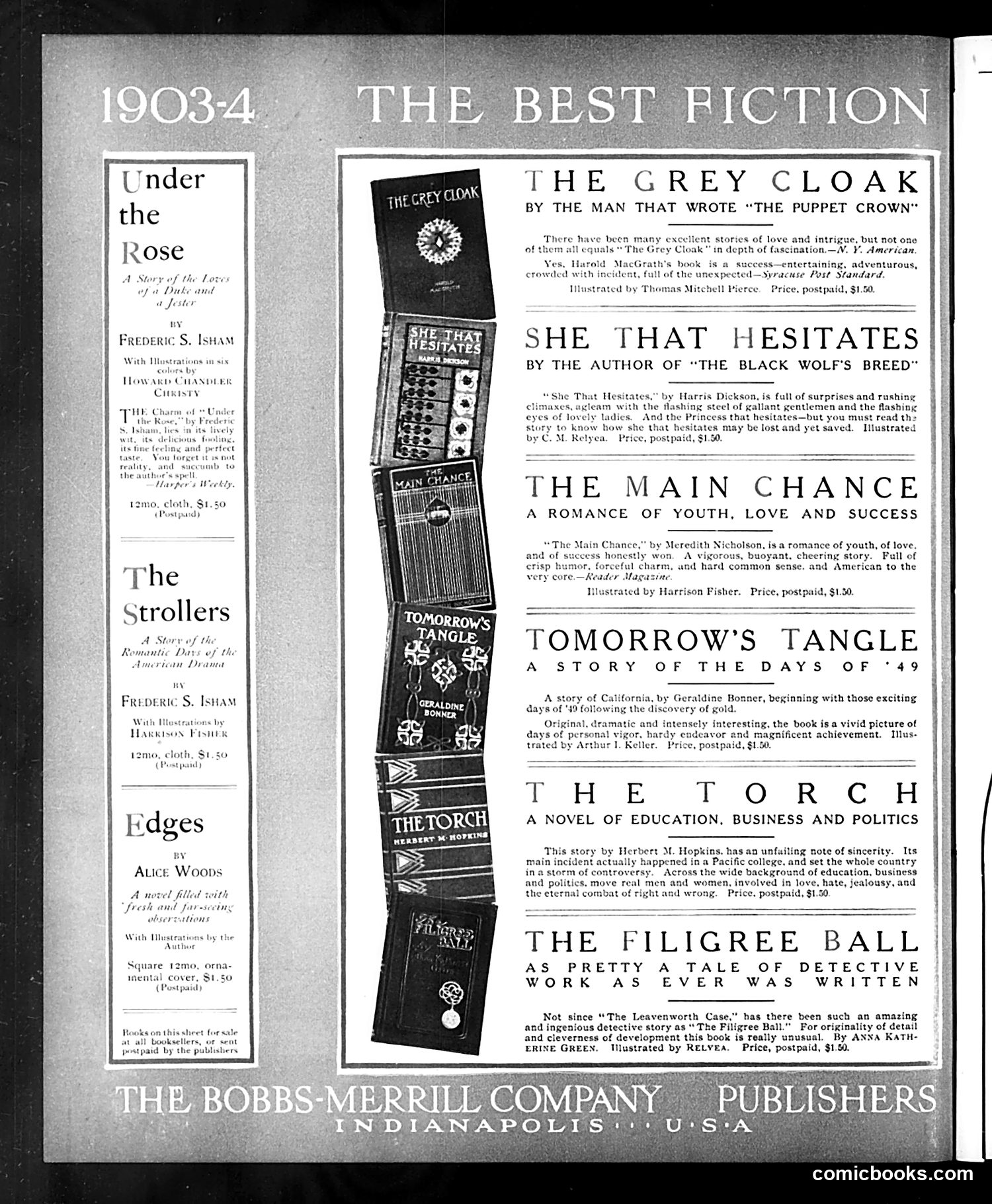
This page is primarily **advertising, not political satire**. It's a 1903-4 book advertisement from The Bobbs-Merrill Company Publishers (Indianapolis). The left column advertises three books by Frederic S. Isham: "Under the Rose," "The Strollers," and "Edges" by Alice Woods. The right side features "The Best Fiction"—six novels with decorative spine images stacked vertically. These include "The Grey Cloak," "She That Hesitates," "The Main Chance," "Tomorrow's Tangle," "The Torch," and "The Filigree Ball." Each book receives brief promotional descriptions emphasizing plot appeal and illustrations. No political cartoon or satirical content appears here—this is straightforward commercial publishing promotion typical of early 20th-century magazine advertising.
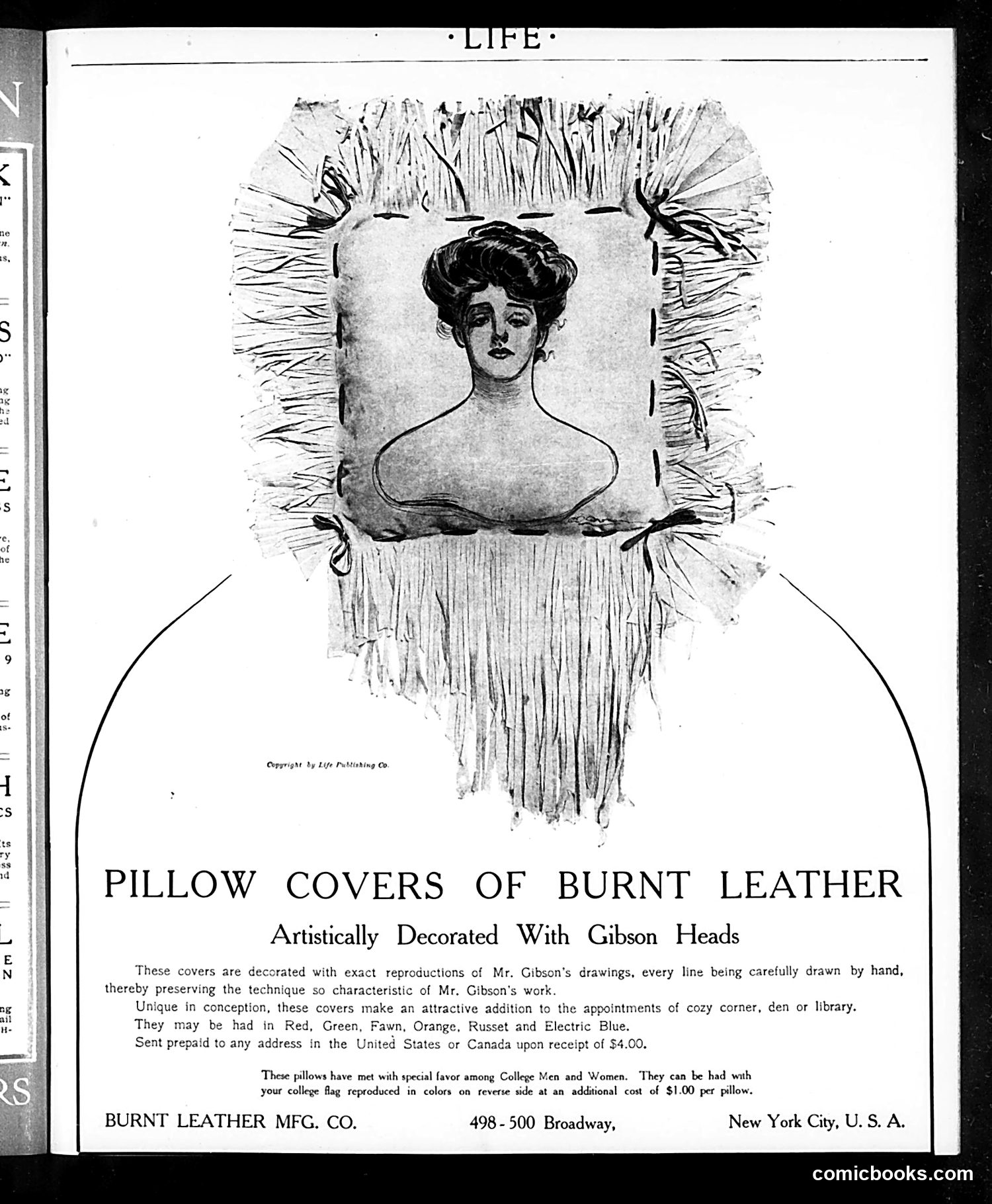
This is primarily an **advertisement**, not editorial content or satire. It promotes "Pillow Covers of Burnt Leather Artistically Decorated With Gibson Heads." The image shows a stylized portrait of a woman's head and shoulders in the distinctive Art Nouveau style characteristic of **Charles Dana Gibson's illustrations**. Gibson was famous for depicting the "Gibson Girl"—an idealized, elegant American woman that became a cultural icon in the early 1900s. The ad markets decorative pillows featuring Gibson's artwork, available in various colors, priced at $4.00. It notes these were particularly popular with college students, with an option to add college flags for an additional $1.00. There is no political satire here—this is simply a commercial product advertisement leveraging the popularity of Gibson's artistic style.
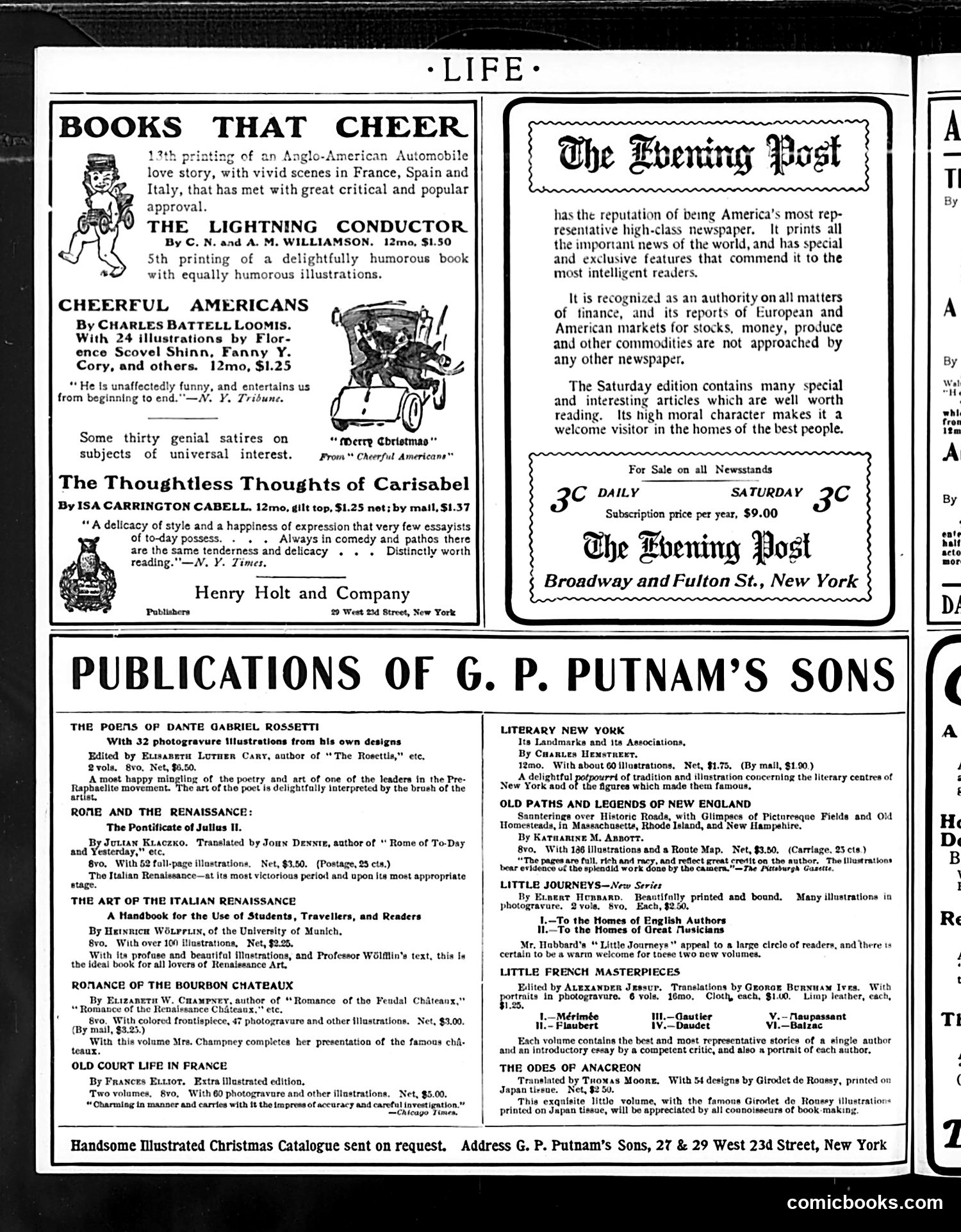
This page is **primarily advertising and book notices**, not political satire or comics. The upper left contains book advertisements from publisher Henry Holt and Company, promoting titles like "The Lightning Conductor" and "Cheerful Americans" — lighthearted works typical of the era. The center features a substantial advertisement for *The Evening Post* newspaper, emphasizing its reputation as "America's most representative high-class newspaper" with authority on financial matters. The lower half showcases G.P. Putnam's Sons publishing catalog, listing illustrated literary works including volumes on Dante, the Italian Renaissance, and French masterpieces. The small cartoon visible ("Merry Christmas" from "Cheerful Americans") appears to be a decorative illustration rather than political commentary. This is essentially a **trade publication page** for books and newspapers from the early 20th century.
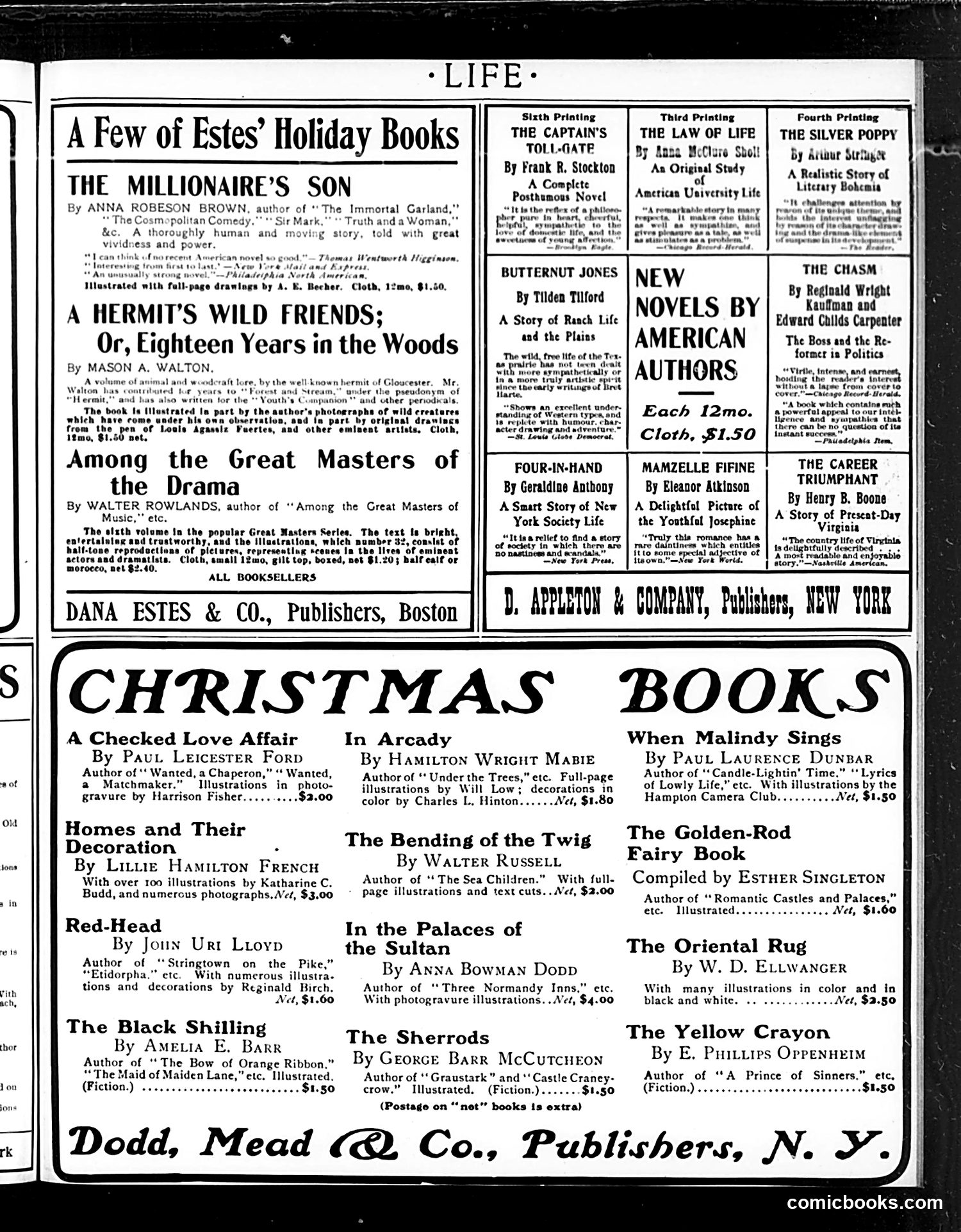
This page is primarily **advertising for books**, not a political cartoon. It contains: 1. **Top section**: Holiday book advertisements from Dana Estes & Co. (Boston) and D. Appleton & Company (New York), promoting novels by American authors like Anna Robeson Brown and Walter Rowlands. 2. **Bottom section**: A "Christmas Books" advertisement from Dodd, Mead & Co. (New York), listing illustrated gift books including titles like *Red-Head*, *The Black Shilling*, and *The Golden-Rod Fairy Book*. The page reflects early 20th-century publishing and holiday consumer culture, with emphasis on beautifully illustrated editions suitable as Christmas gifts. There are no political cartoons or satirical commentary visible—this is a straightforward commercial advertisement section of *Life* magazine.
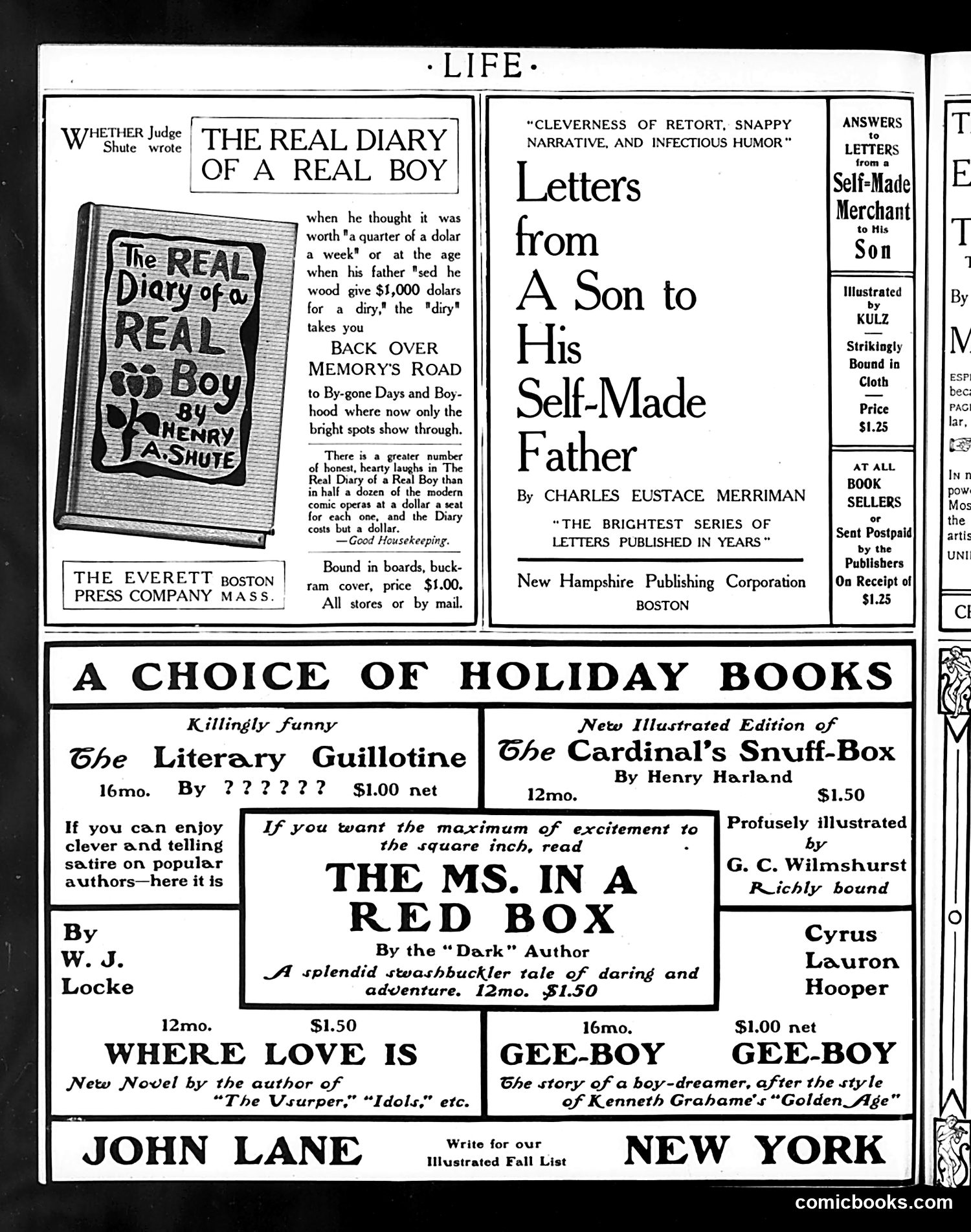
This page is primarily **book advertising**, not political satire or editorial cartooning. It features promotions for several books from the early 20th century, including: - *The Real Diary of a Real Boy* by Henry A. Shute—presented as humorous memoir material - *Letters from a Son to His Self-Made Father* by Charles Eustace Merriman - Holiday book selections like *The Literary Guillotine*, *The Cardinal's Snuff-Box*, and *The MS. in a Red Box* The advertisements use period marketing language emphasizing humor, illustration quality, and moral instruction—typical of how publishers positioned books for middle-class readers. There is **no political cartoon content** visible. The page represents commercial publishing rather than editorial commentary.
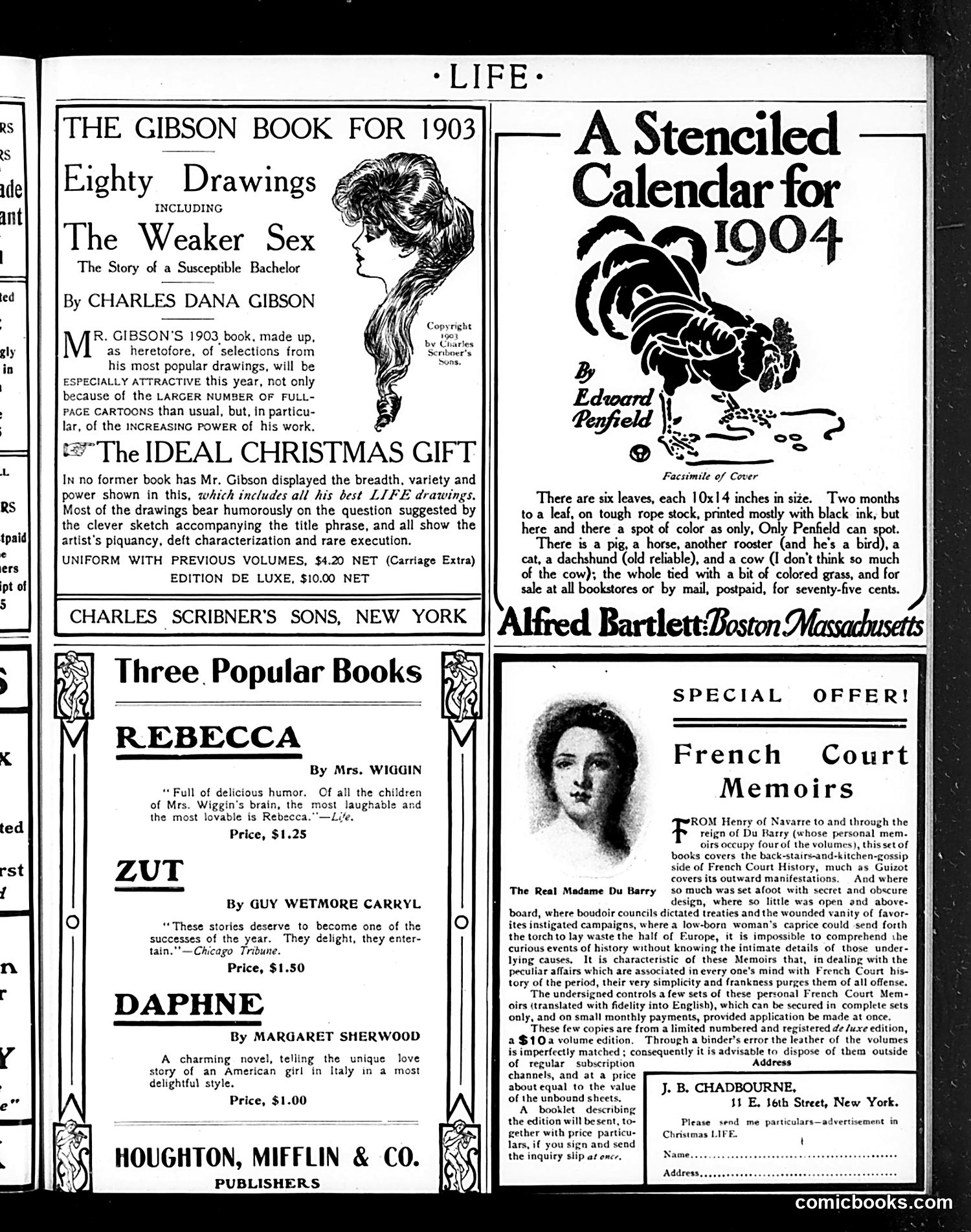
This page is primarily **advertising and book promotions** rather than satirical content. The main items are: 1. **Gibson Book advertisement** (top left): Promotes Charles Dana Gibson's 1903 drawing collection featuring "The Weaker Sex," depicting women. Gibson was famous for his idealized illustrations of fashionable women ("Gibson Girls"). 2. **Calendar advertisement** (top right): Edward Penfield's 1904 stenciled calendar featuring decorative imagery. 3. **Book promotions** (bottom): Three popular novels advertised: *Rebecca* by Mrs. Wiggin, *Zut* by Guy Wetmore Carryl, and *Daphne* by Margaret Sherwood, plus *French Court Memoirs*. 4. **Special offer**: J.B. Chadbourne advertises French Court Memoirs volumes. The page reflects early 1900s popular literature and visual culture rather than political satire.
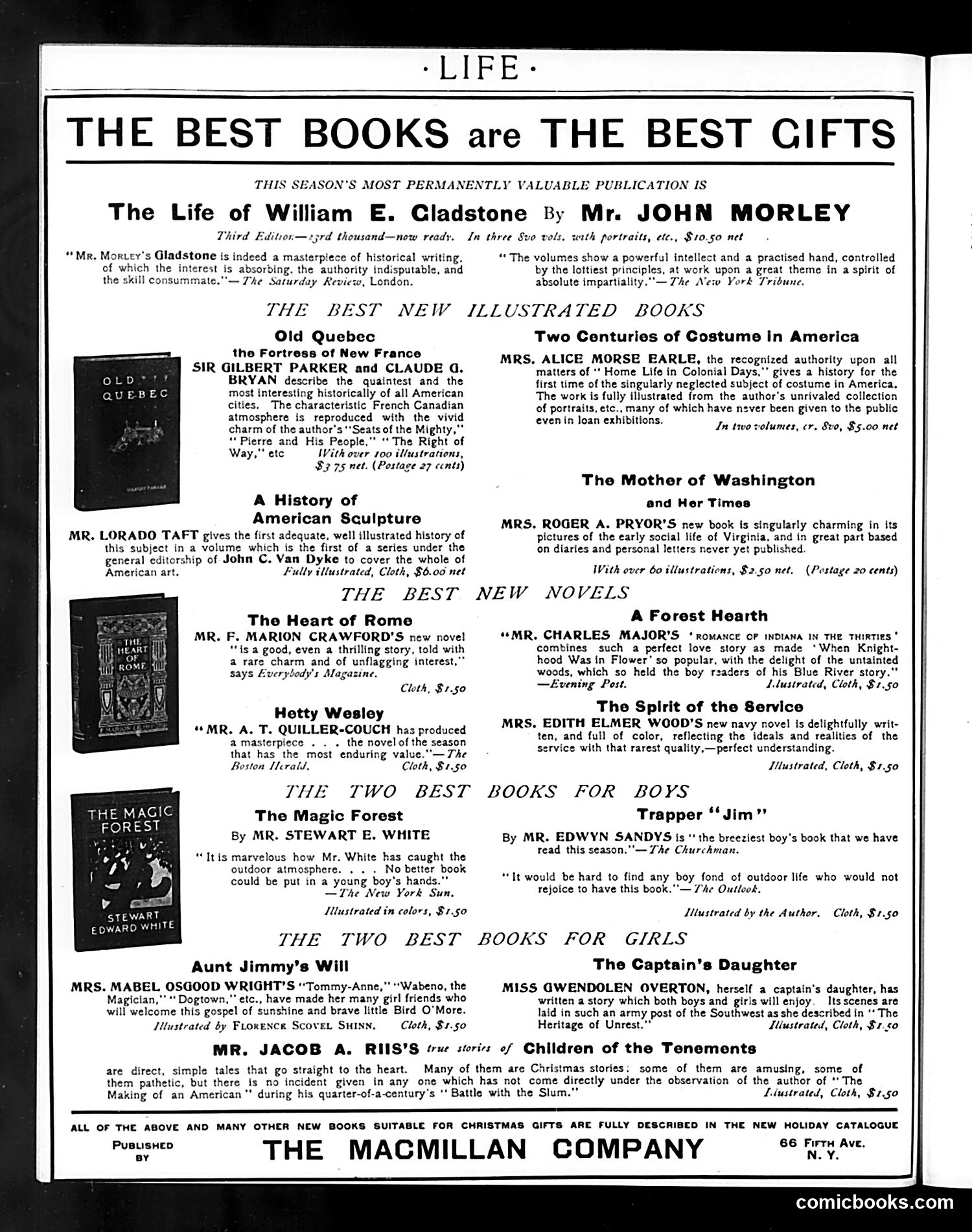
This is **not a cartoon page** but rather a **book advertisement section** from Life magazine. It promotes holiday gift books through the Macmillan Company publisher. The page advertises literary works including John Morley's biography of William E. Gladstone (a British political figure), illustrated histories like "Old Quebec" and "A History of American Sculpture," and novels such as "The Heart of Rome" and "Hotty Wesley." There are also sections highlighting "the two best books for boys" (*The Magic Forest*, *Trapper "Jim"*) and "the two best books for girls" (*Aunt Jimmy's Will*, *The Captain's Daughter*). The tagline "The Best Books Are the Best Gifts" frames this as seasonal holiday shopping content rather than satirical editorial material.
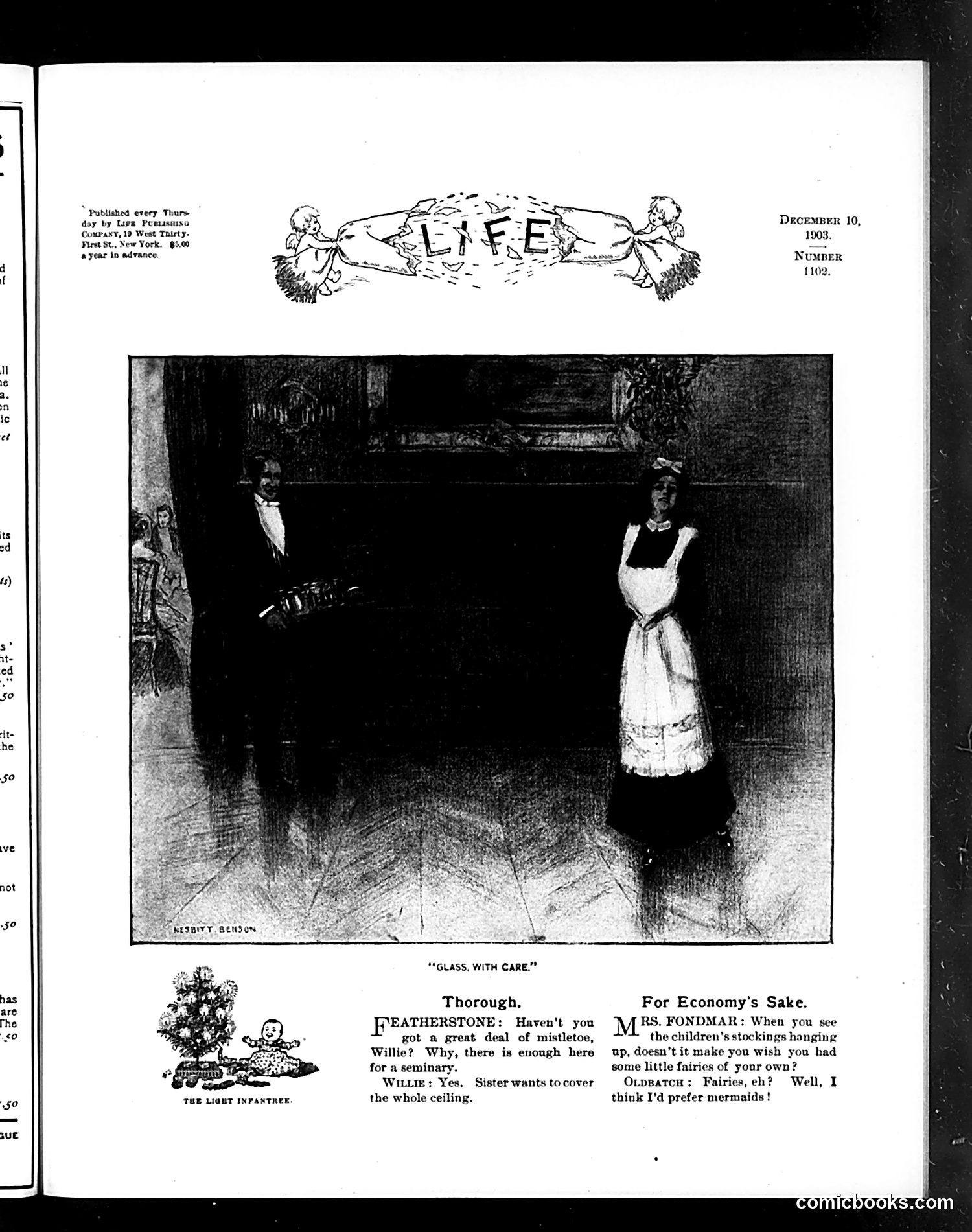
This page features two domestic humor cartoons typical of early 1900s Life magazine satire. **Top image**: Shows servants or household staff in what appears to be an elegant interior, illustrating the caption "Glass, With Care"—likely commenting on the careful handling of valuable household items or the fragility of domestic arrangements. **Bottom cartoons**: Two brief joke exchanges about holiday season economics: 1. **"Thorough"**: A character notes excessive mistletoe decoration, suggesting the sister plans absurdly thorough coverage. The humor lies in the exaggeration of a modest holiday tradition. 2. **"For Economy's Sake"**: Mrs. Fondmar romanticizes having fairies to fill children's Christmas stockings (avoiding expense), while Oldpatch quips he'd prefer mermaids instead—a nonsensical rejoinder that deflates her sentimental wish-fulfillment. These represent genteel, middle-class domestic humor typical of Life's editorial content—poking gentle fun at household management, holiday customs, and romantic notions about avoiding holiday expenses.
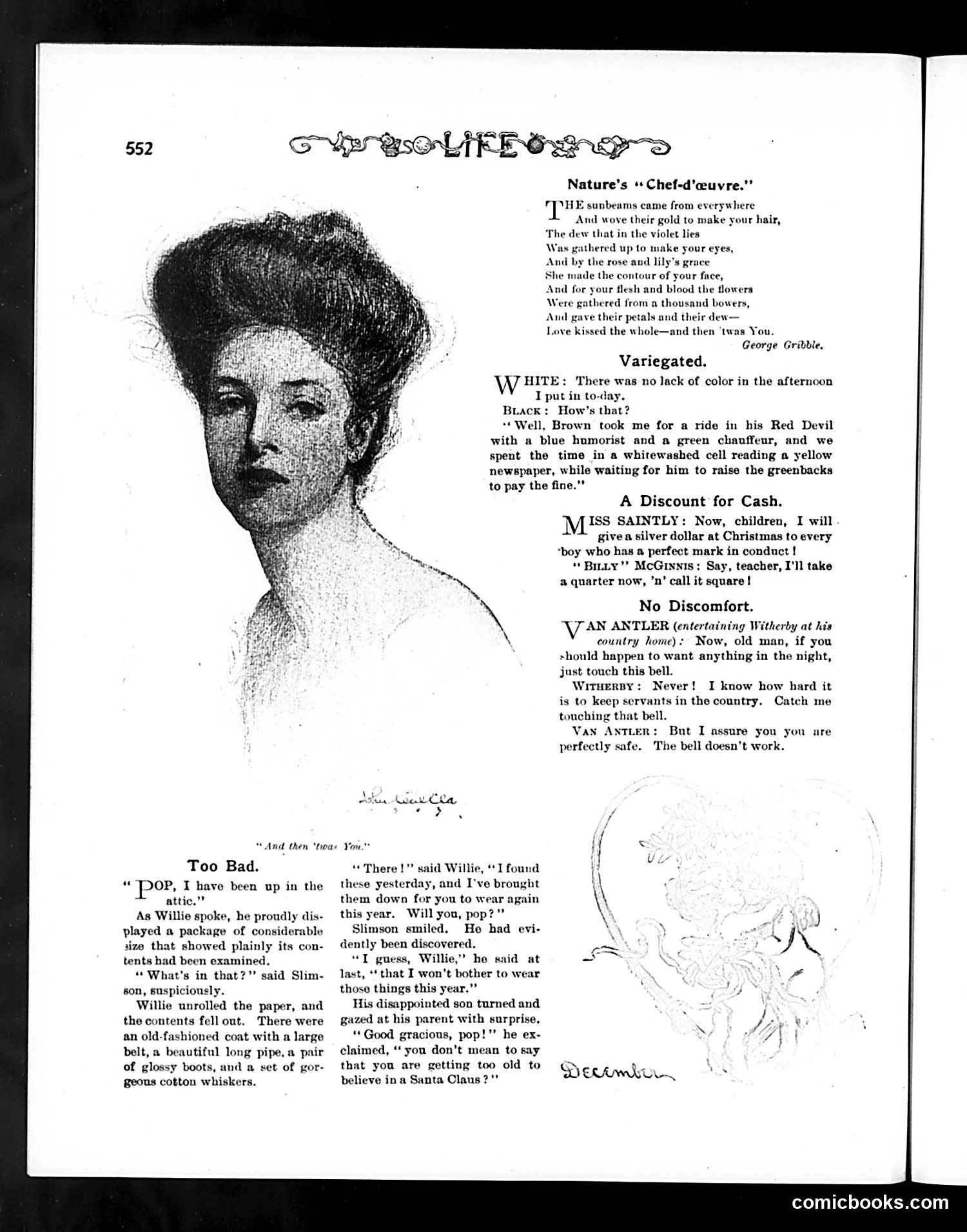
This page contains several humorous sketches and anecdotes typical of early 20th-century American satirical humor: **"Nature's Chef-d'oeuvre"** pairs a portrait sketch with George Gribble's sentimental poem about female beauty as nature's masterpiece. **"Variegated"** jokes about color—a person describes riding in Brown's "Red Devil" with a "blue humorist" and "green chauffeur," ending in a "whitewashed cell" reading a "yellow newspaper." The humor derives from the absurdist color descriptions applied to mundane circumstances. **"Too Bad"** shows a father discovered keeping old Santa Claus costume pieces (coat, pipe, whiskers, boots) in the attic. His son Willie, disappointed, asks if the father is "getting too old to believe in Santa Claus"—ironically reversing the usual parent-child dynamic about childhood belief. The remaining sketches are brief comedic dialogues about classroom conduct (a student negotiating payment), and a guest's humorous refusal to ring a country house's non-functional bell. The page reflects genteel domestic humor aimed at middle-class readers.
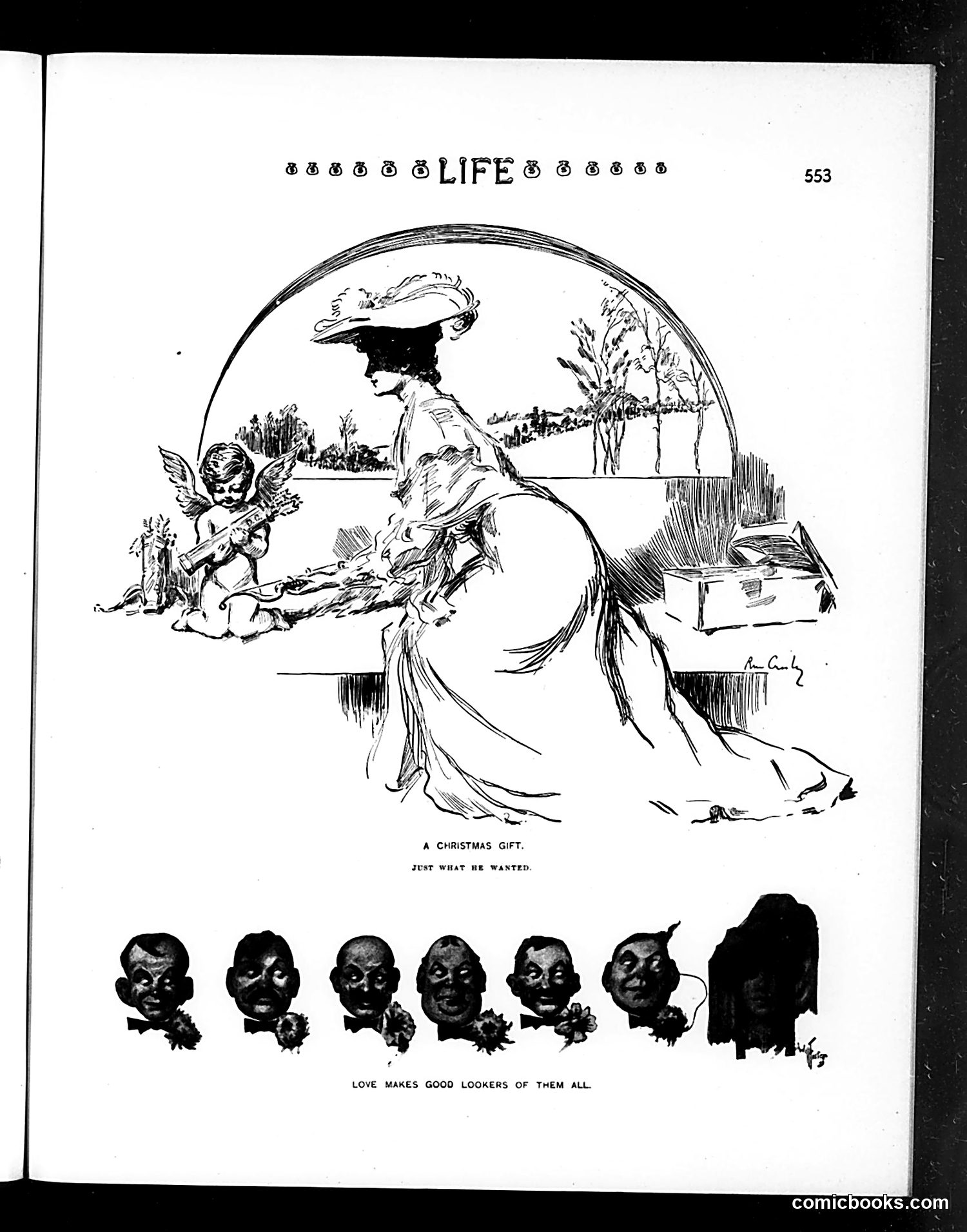
This page contains two distinct cartoons about love and appearance. The upper illustration depicts a fashionable woman in an elegant hat receiving a cherub's gift, with a pastoral landscape behind her. The caption reads "A CHRISTMAS GIFT. JUST WHAT HE WANTED." The lower illustration shows a row of seven male heads with exaggerated, grotesque facial features. The caption states "LOVE MAKES GOOD LOOKERS OF THEM ALL." The satirical point appears to be ironic commentary on romantic idealization: the upper cartoon suggests a woman receives romantic gifts; the lower suggests that love magically transforms even physically unattractive men into handsome ones—or conversely, that women deceive themselves into finding their partners attractive through romantic affection. This plays on the common early-20th-century theme that love blinds people to physical flaws, presented here with humorous visual exaggeration.
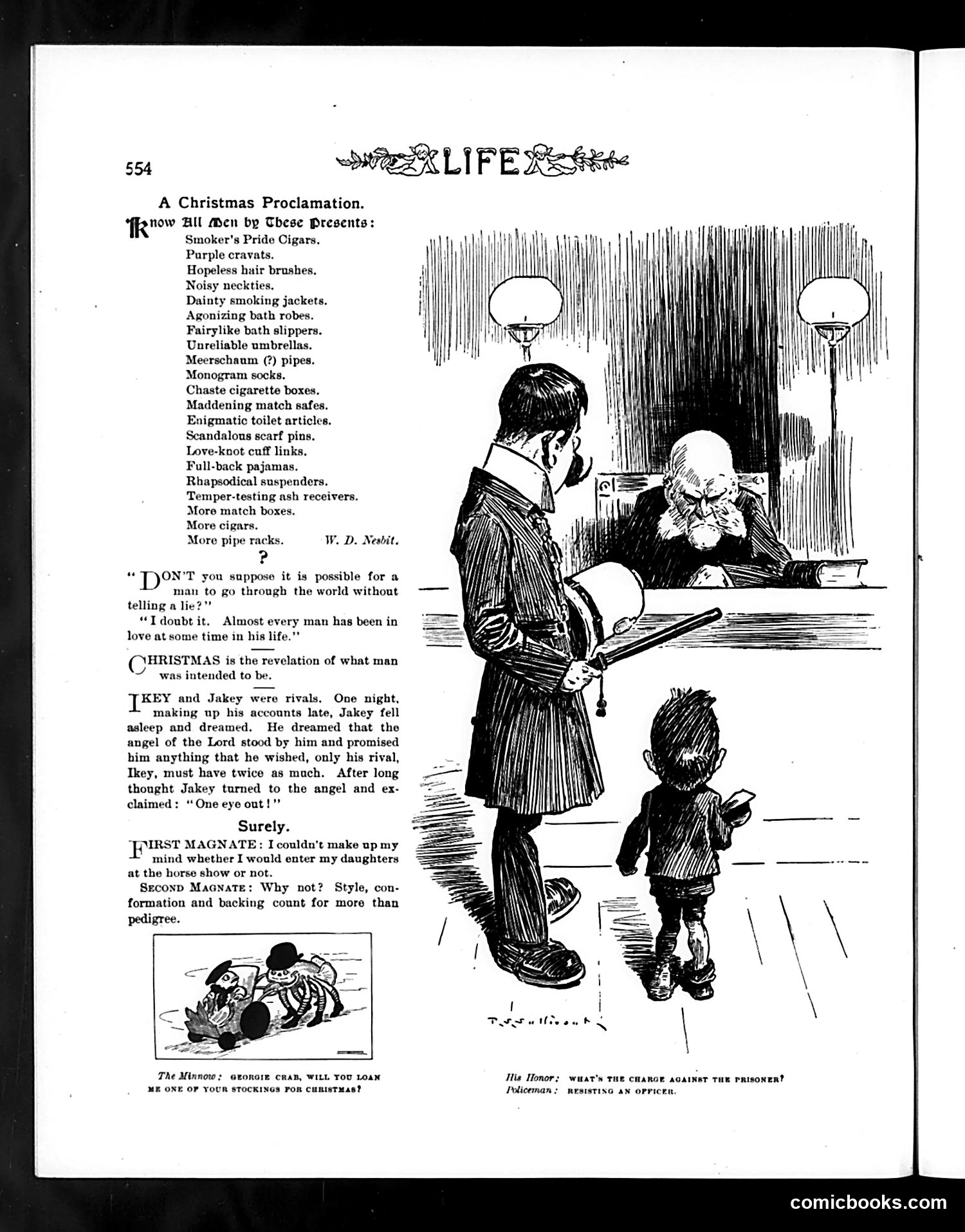
This page satirizes the commercialization and materialism of Christmas gift-giving. The "Proclamation" by W. D. Nesbit mock-solemnly lists impractical, useless, or annoying items—"Agonizing bath robes," "Maddening match safes," "Temper-testing ash receivers"—that men typically received as presents. The joke targets both the obligation to give gifts and the poor quality of typical male Christmas presents. The accompanying anecdotes reinforce this theme: one dialogue questions whether honesty is possible (relating men's lies about love), while another mocks wealthy men's pretensions. A third joke ("One eye out!") shows a poor man asking an angel for wealth, requesting his rival receive *twice* as much—dark humor about accepting inequality. The central illustration depicts gift-giving between an adult and child, visualizing the season's generosity, though the "Proclamation" suggests such gifts are often thoughtless or unwelcome.
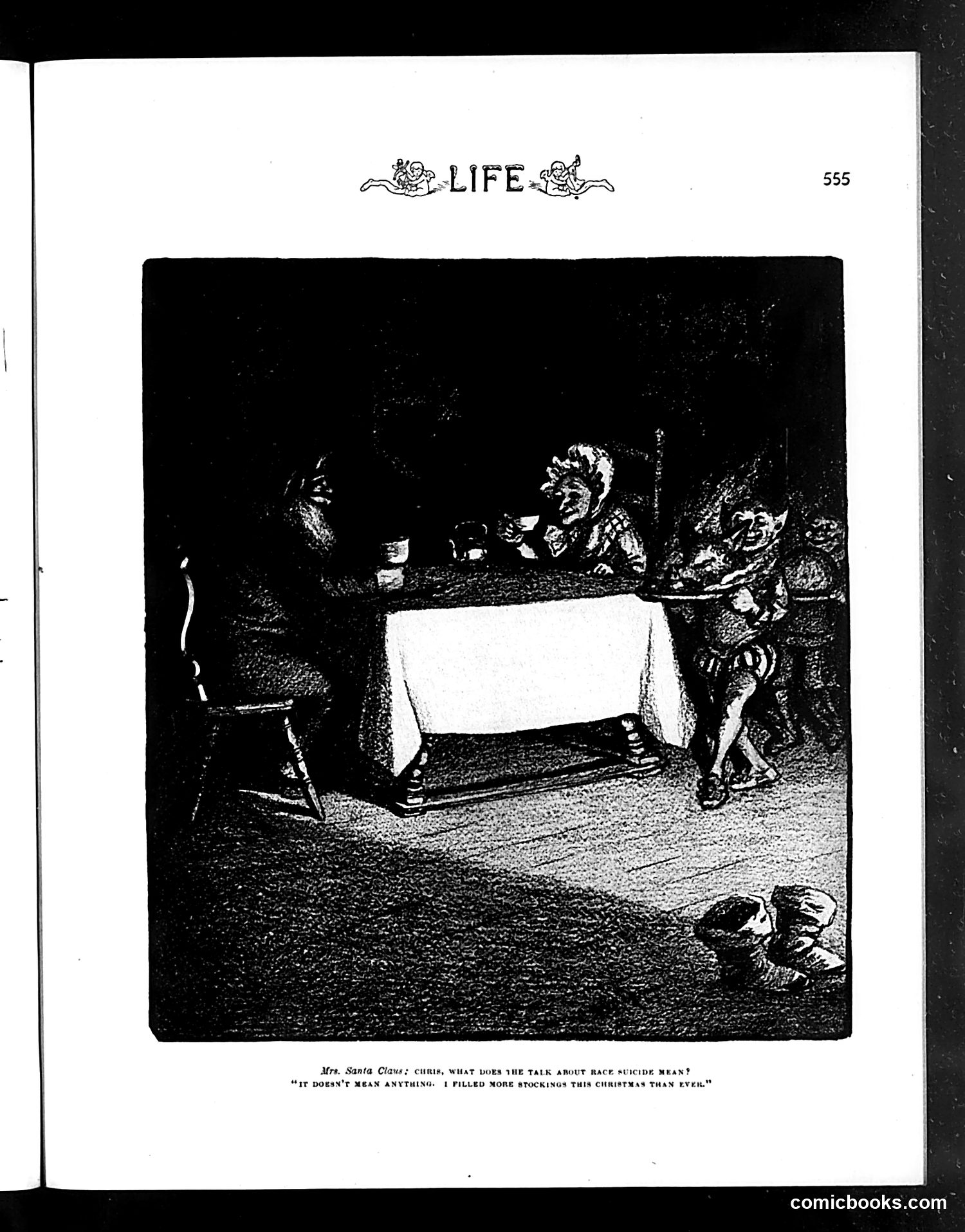
This cartoon satirizes contemporary anxieties about "race suicide"—an early 20th-century concern that native-born Americans (particularly white, middle-class populations) were reproducing at lower rates than immigrants, threatening national demographics. The joke: Mrs. Santa Claus dismisses such worries as meaningless. She counters that she's filled "more stockings this Christmas than ever," suggesting abundant children despite demographic fears. The cartoon uses holiday imagery ironically—Santa's role distributing gifts to children becomes a metaphor for population growth. The satire mocks those promoting race suicide rhetoric as disconnected from reality. By having Mrs. Claus confidently assert increased Christmas activity (implying more children in homes), the cartoonist suggests either the panic is exaggerated or Mrs. Claus represents something beyond typical demographic categories—perhaps America itself as a generative force. The cartoon reflects Life magazine's skeptical, urbane perspective on nativist anxieties of that era.
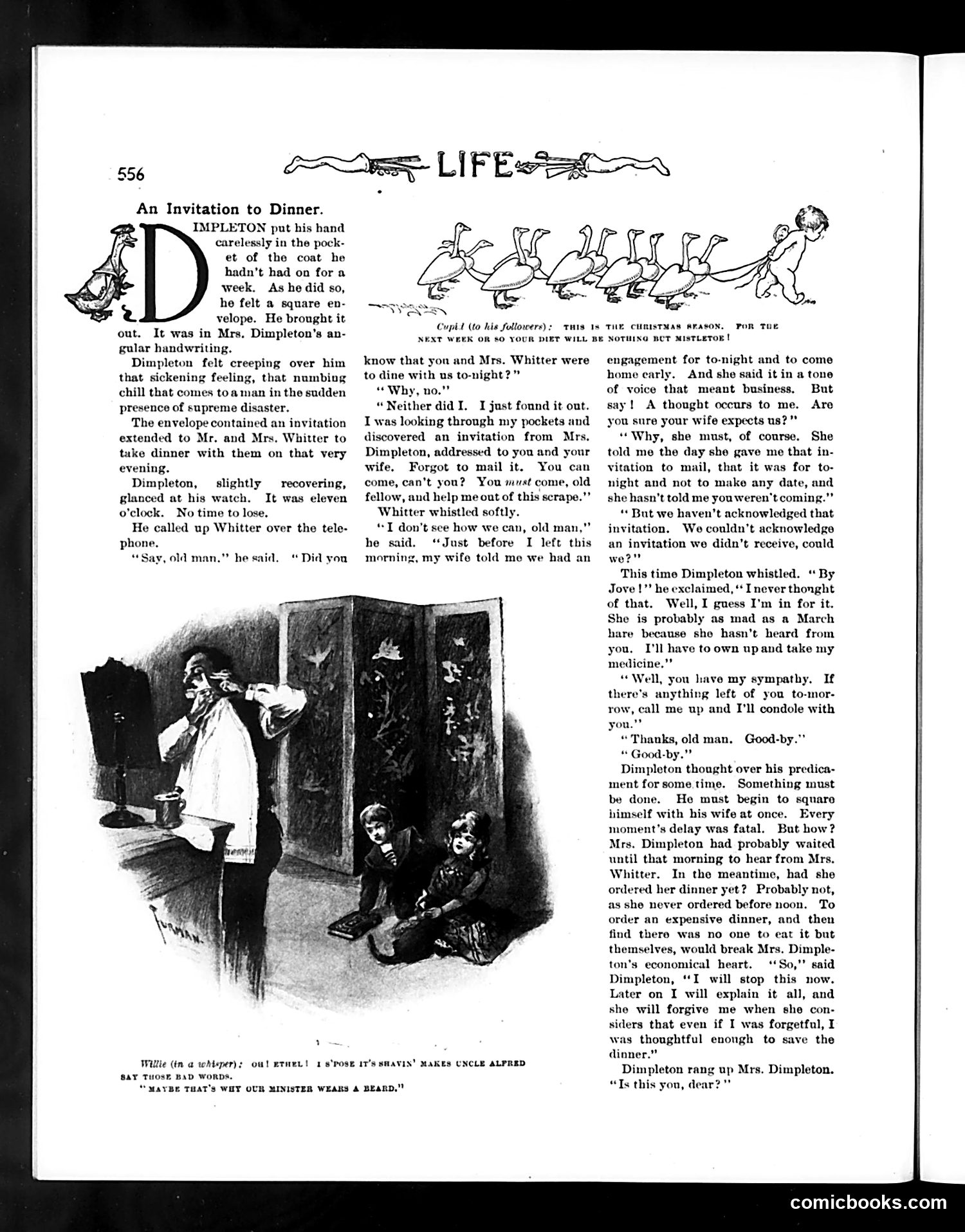
This humorous story satirizes early 20th-century domestic life and marital anxieties. Mr. Dimpleton discovers an unmailed dinner invitation to the Whitters—a social catastrophe that will anger his wife, Mrs. Dimpleton, who expects confirmation of their guests. The satire centers on masculine incompetence: Dimpleton forgot to mail the invitation, then discovers it days later. When he calls Whitter, complications multiply—the Whitters already have conflicting plans. Dimpleton's frantic predicament reflects period anxieties about male forgetfulness and wives' exacting domestic standards. The humor lies in Dimpleton's panicked reasoning: he realizes that canceling the dinner *before* his wife orders expensive food might actually spare her economical heart—presenting his mistake as thoughtfulness rather than negligence. The cartoons depict the chaos of the situation visually. This reflects era-specific gender dynamics where wives managed household entertaining while husbands fumbled social obligations.
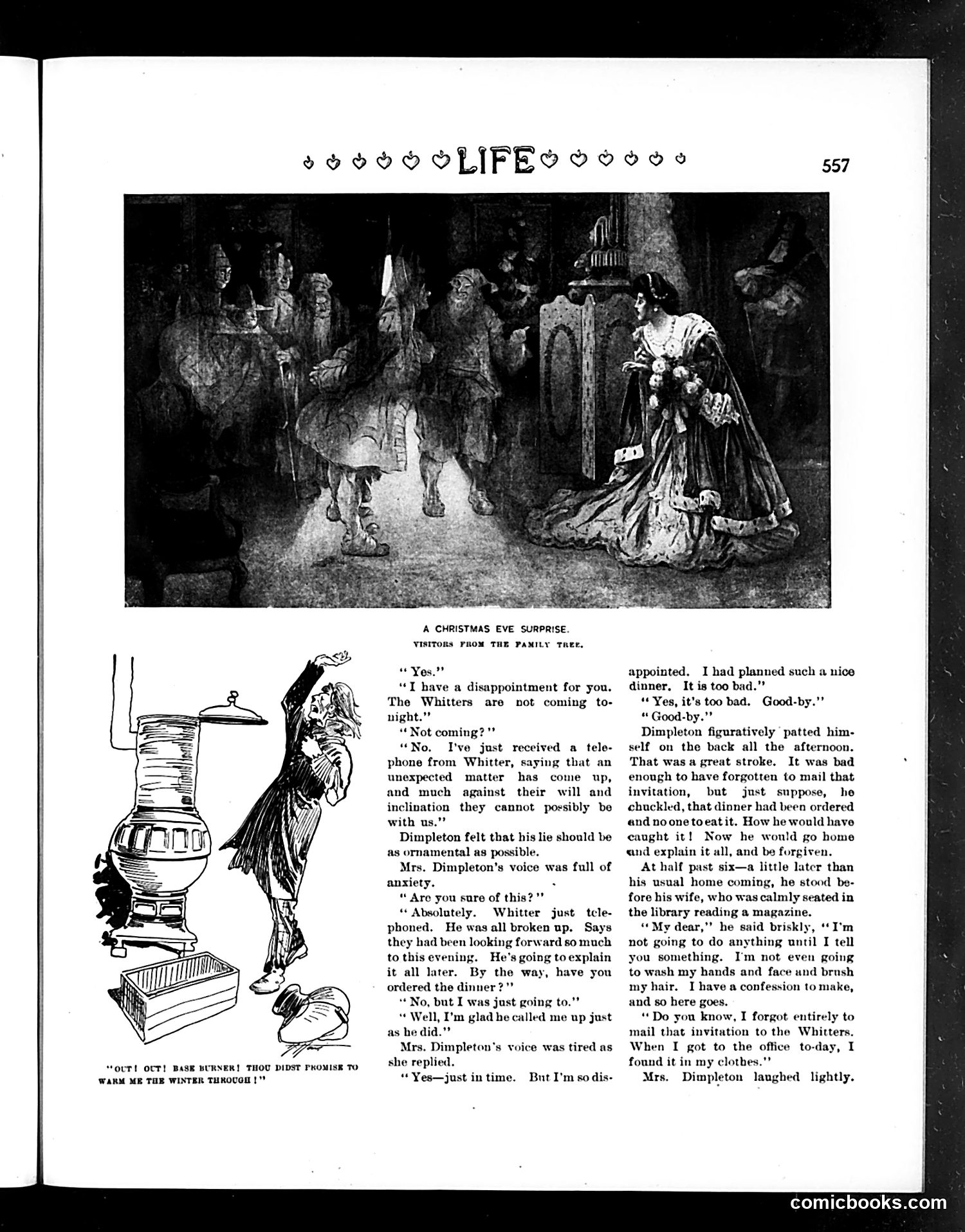
This is a domestic humor story about Mr. Dimpleton, who forgot to mail a dinner invitation to the Whitters. Rather than confess immediately, he lies to his wife, claiming the Whitters called to cancel—a "great stroke" he believes will spare him blame. The joke hinges on Victorian middle-class anxiety about social embarrassment and household management. His wife had already begun dinner preparations; an unmailed invitation would have been humiliating. The sidebar cartoon of a man scolding a malfunctioning stove offers comedic relief on the theme of domestic frustration. The humor lies in Dimpleton's small deception and self-congratulation, followed by his confession at day's end. His wife's light laugh suggests he's forgiven—the story playing on the period's gender dynamics where husbands managed social obligations while wives managed the home.
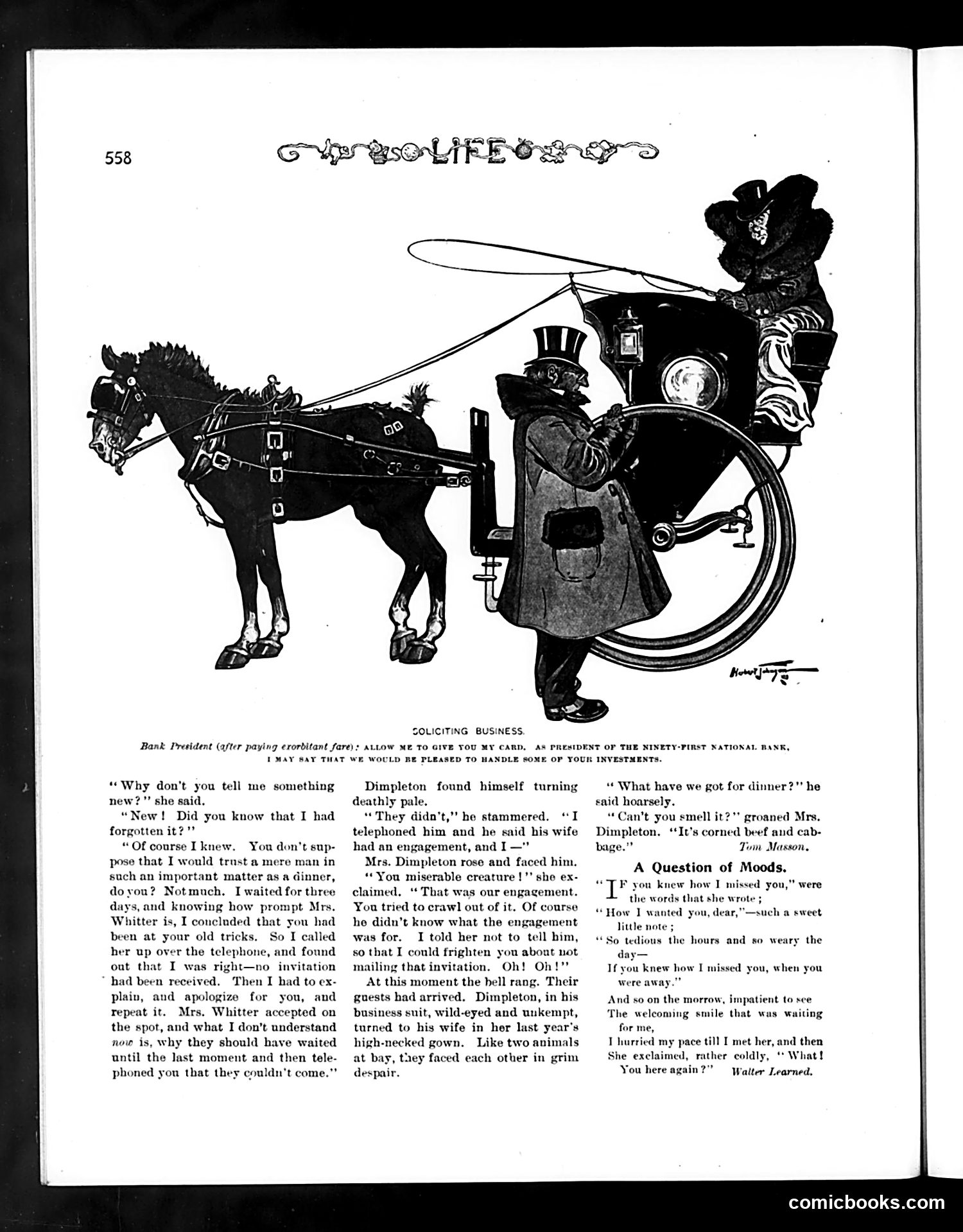
This page contains two separate satirical pieces: **"Soliciting Business"** (top cartoon): A bank president, having paid an exorbitant taxi fare to a driver with an ornate, decorated horse-drawn cab, attempts to drum up business by offering his card. The satire mocks the absurdity of a bank executive pitching investments to a taxi driver—the joke being that he's so desperate for clients he's soliciting random passengers, regardless of their financial standing or likelihood to be a bank customer. **"A Question of Moods"** (bottom text): A domestic comedy about a husband who forgets a dinner invitation and lies about it, claiming the guests had an engagement. His wife, having deliberately withheld this information to test him, catches him in the deception. When guests arrive, they're unprepared (corned beef and cabbage for dinner). The accompanying poem by Walter Learned contrasts romantic longing in a love letter with the wife's cold reception when the suitor finally appears. Both pieces satirize human nature—greed and poor judgment in one, marital deception in the other.
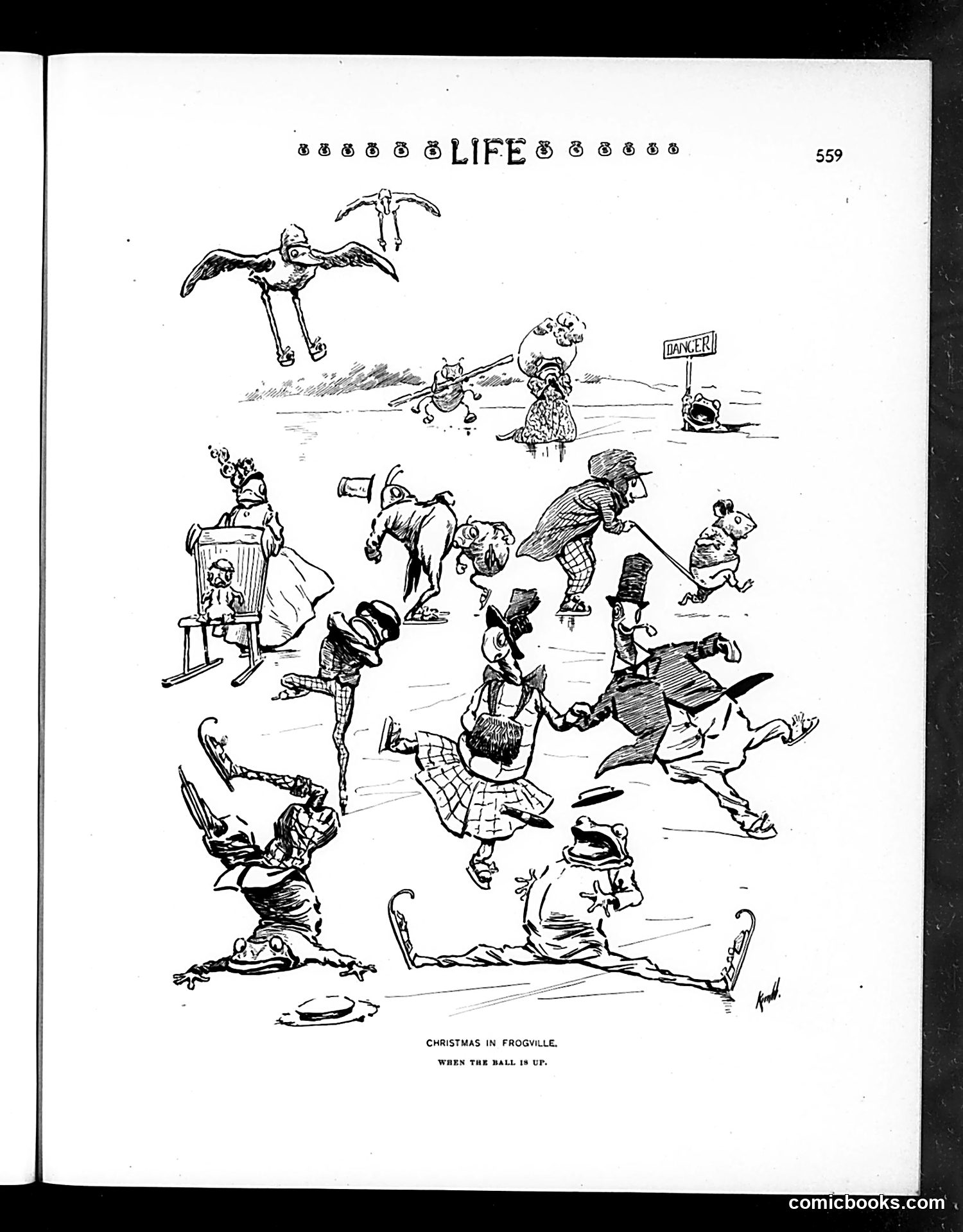
This is a whimsical illustration titled "Christmas in Frogville, When the Ball is Up," depicting anthropomorphized frogs engaged in various Christmas activities and games. The frogs are shown dancing, playing, and celebrating in a chaotic, jovial scene. One frog operates what appears to be a cannon or noise-maker; others dance in formal dress or play games. A sign reading "DANGER" appears in the background. The cartoon appears to be straightforward holiday humor rather than political satire—it's a playful, absurdist take on how frogs might celebrate Christmas if they could. The "Frogville" setting suggests a fictional animal community. The illustration style and "Life" magazine publication indicate this is early 20th-century American entertainment content, using animal characters for lighthearted seasonal amusement rather than social commentary.
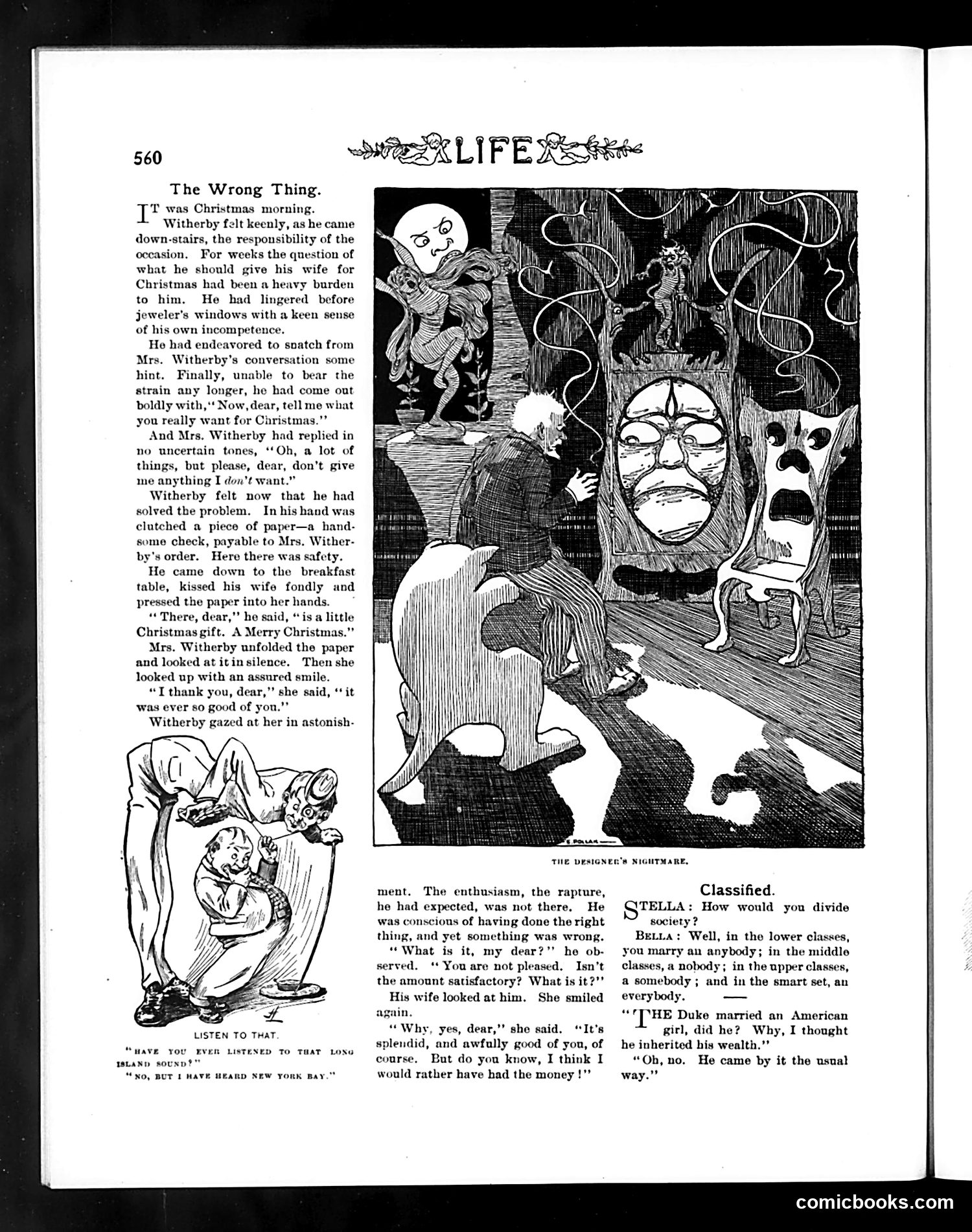
This page presents domestic humor typical of early 20th-century Life magazine. The main story satirizes marital miscommunication: Witherby agonizes over his Christmas gift, finally settling on a check—the "safe" choice—only to have his wife respond with polite disappointment. Her final line delivers the joke: she'd have preferred the *money itself* rather than the sentimental gesture of a personalized check. The satire mocks both his anxiety about gift-giving and her frank materialism disguised as gracious acceptance. The smaller cartoon "Listen to That" features a couple and appears to joke about Long Island Sound versus New York Bay—likely mocking regional pretension or sound quality differences. The "Classified" section offers satirical social commentary on class divisions in marriage eligibility, and a final quip about a Duke marrying an American heiress—suggesting wealthy Americans were marrying into European nobility for status while nobles married Americans for wealth.
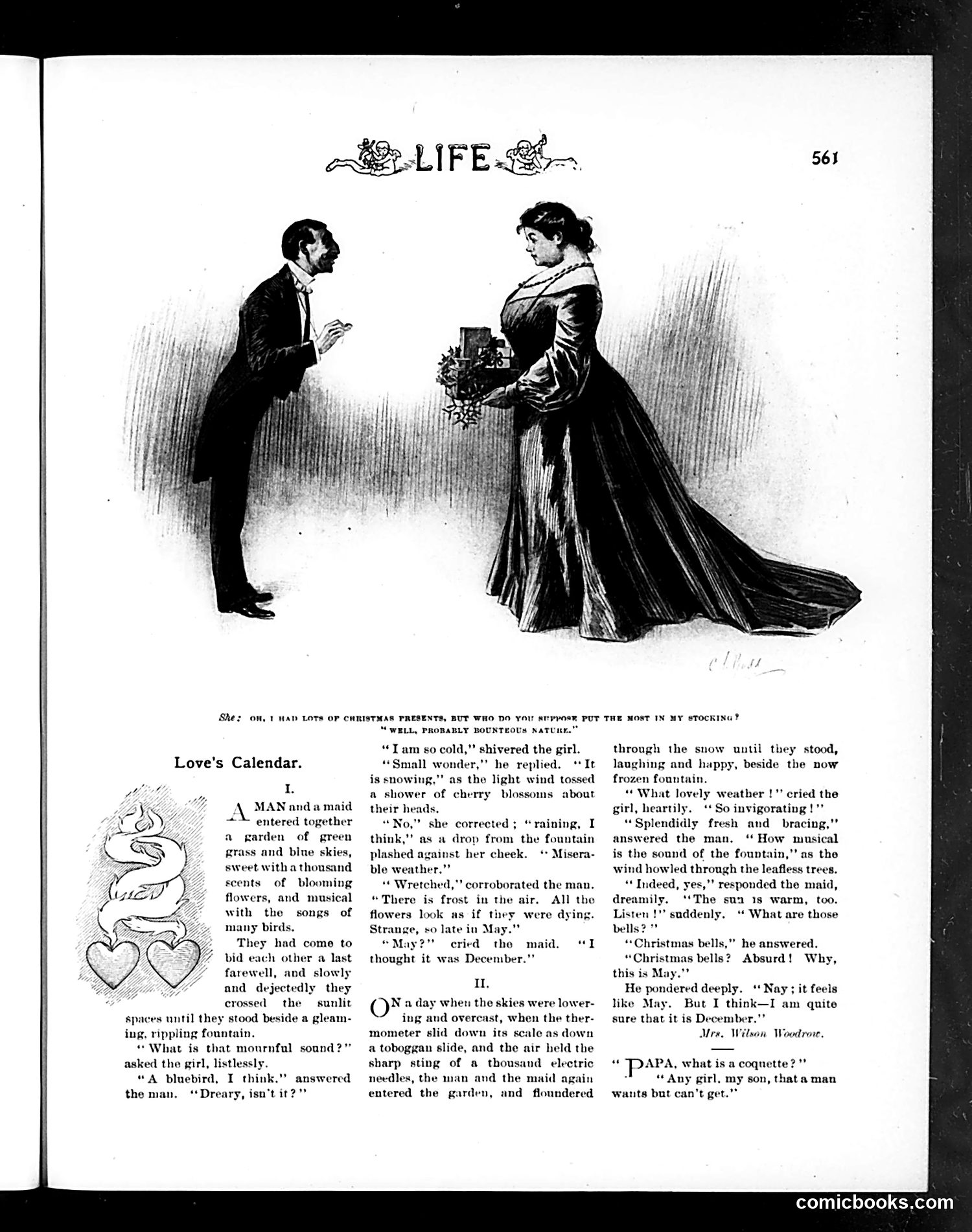
**Top Cartoon:** A man asks a woman what she wants most in her Christmas stocking. She replies "probably bounteous nature"—a witty non-answer that avoids directly naming a gift, playing on the era's social expectation that women should appear modest and uninterested in material goods. **"Love's Calendar":** This longer piece satirizes the disconnect between what lovers *say* and reality. A couple in a beautiful spring garden complains everything is miserable (cold, dreary flowers dying), yet claims it's December. Later, in actual winter snow and freezing cold, they claim it's lovely and warm, insisting it's really May. The joke: love makes people see conditions opposite to reality, or lovers will agree with each other regardless of truth. **Final Joke:** A father defines a coquette as "any girl my son that a man wants but can't get"—mocking both the social game of romantic pursuit and the father's cynical worldview. All three pieces mock romantic pretense and social dishonesty in courtship.
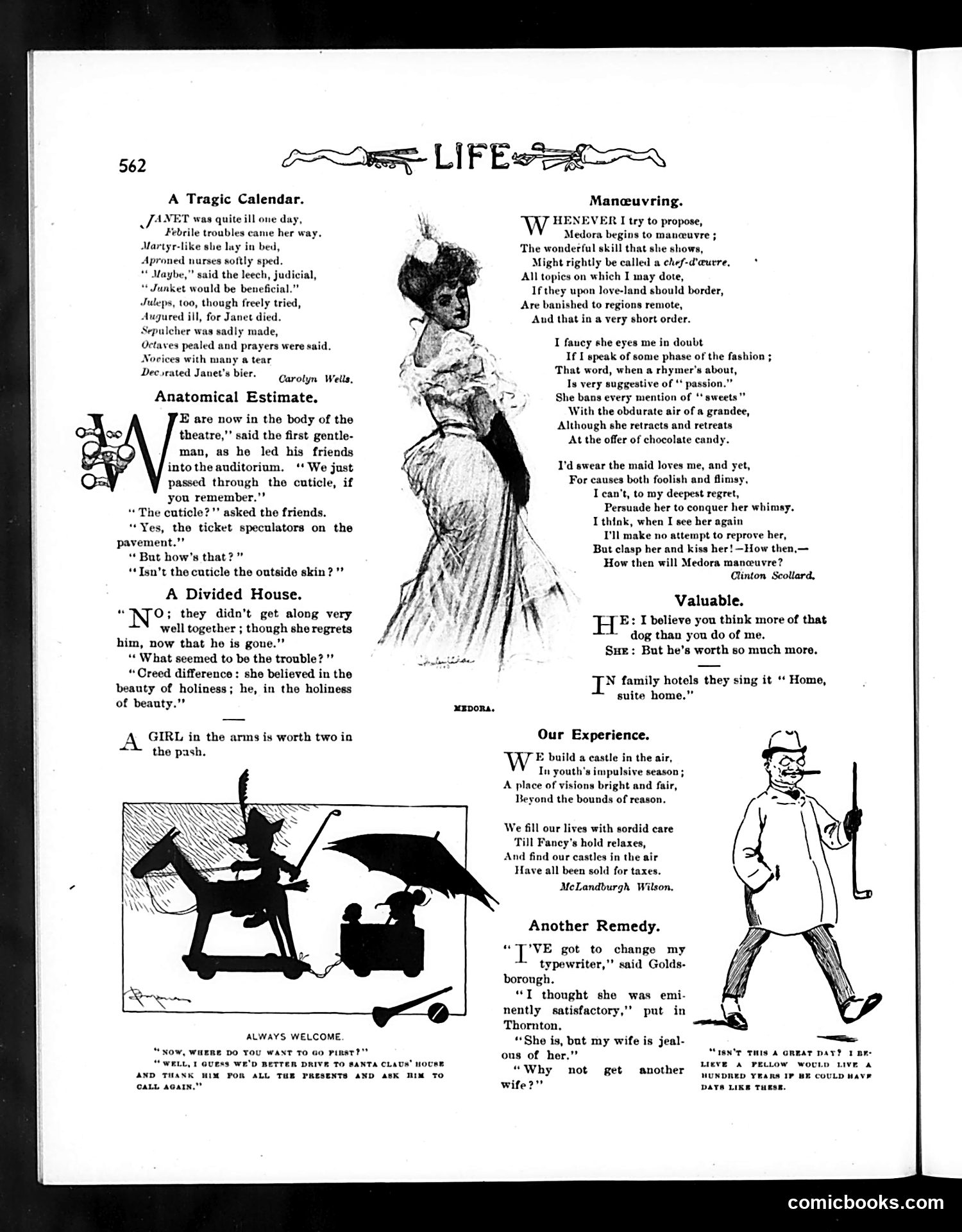
This page from *Life* magazine contains several short humorous pieces targeting early 20th-century social conventions: **"A Tragic Calendar"** by Carolyn Wells is a darkly comic poem using alliteration (each stanza begins with successive letters) to describe a woman's illness and death—poking fun at sentimental Victorian death narratives. **"Anatomical Estimate"** jokes about ticket scalpers ("cuticles") outside theaters, a recognized urban nuisance of the era. **"A Divided House"** satirizes religious hypocrisy through a couple's marital conflict: the wife values "beauty of holiness" (moral appearance) while the husband values "holiness of beauty" (physical attractiveness). **"Maneuvring"** by Clinton Scollard depicts courtship frustration—a suitor's fiancée constantly deflects romantic conversation, yet accepts chocolate candy, revealing her inconsistency. **"Our Experience"** laments how youthful dreams are destroyed by adult financial burdens and taxes. The cartoons and brief jokes mock everyday frustrations: infidelity, materialistic spouses, and workplace annoyances—typical *Life* magazine fare of satirizing middle-class American life.
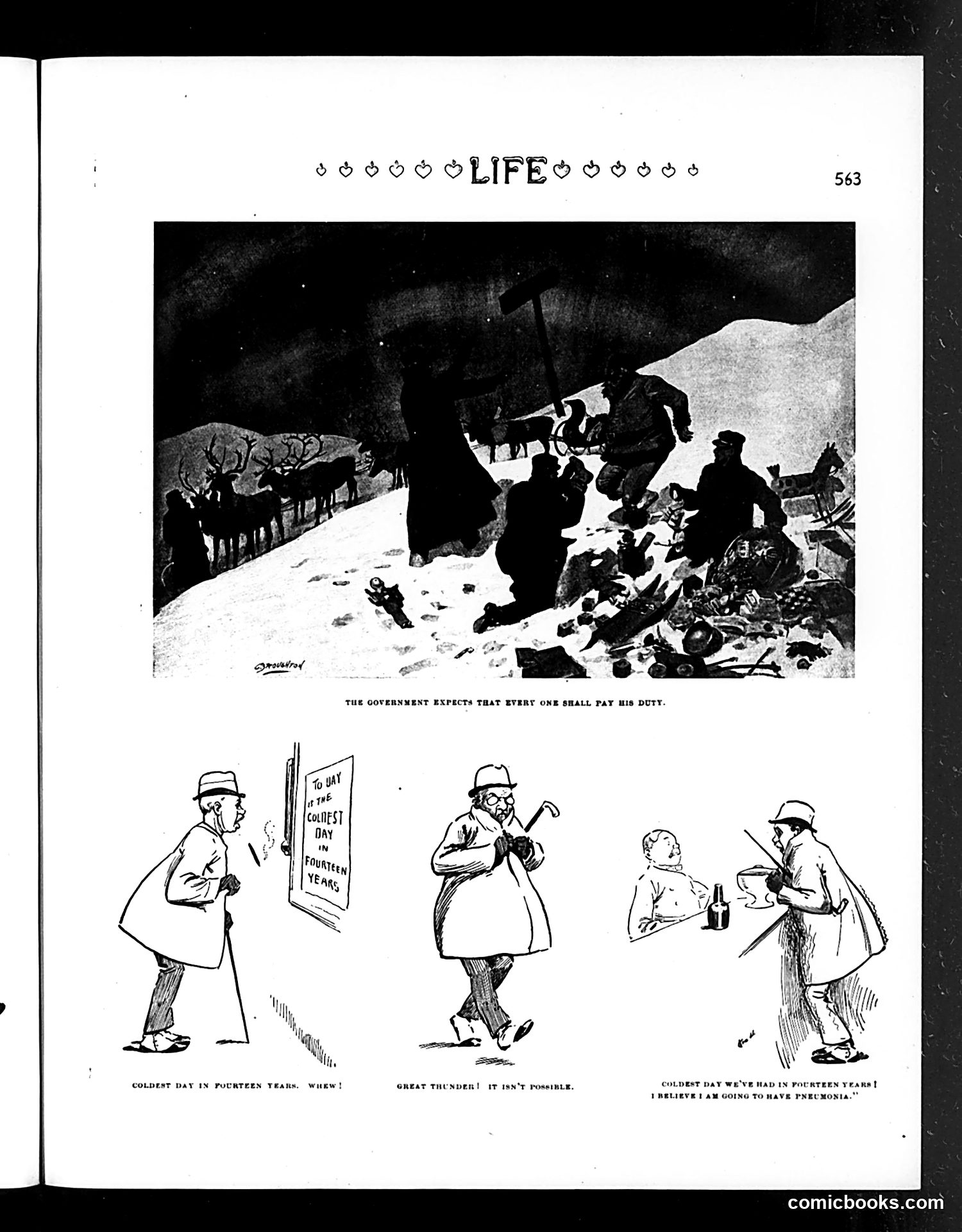
The page contains a photograph showing what appears to be a wartime or emergency scene with many people gathered in snow, and four cartoon panels below satirizing winter weather complaints. The cartoons mock people complaining about cold temperatures. Each panel features a man claiming it's "the coldest day in fourteen years," with slight variations in their reactions—one checking a thermometer, another shivering, a third with a child, and a fourth predicting pneumonia. The satire targets the predictable human tendency to exaggerate weather complaints and claim each winter is the worst on record. The repeated refrain across panels emphasizes how people make identical claims year after year, suggesting either faulty memory or habitual pessimism. The humor relies on recognizing this common conversational pattern among ordinary people experiencing seasonal cold.
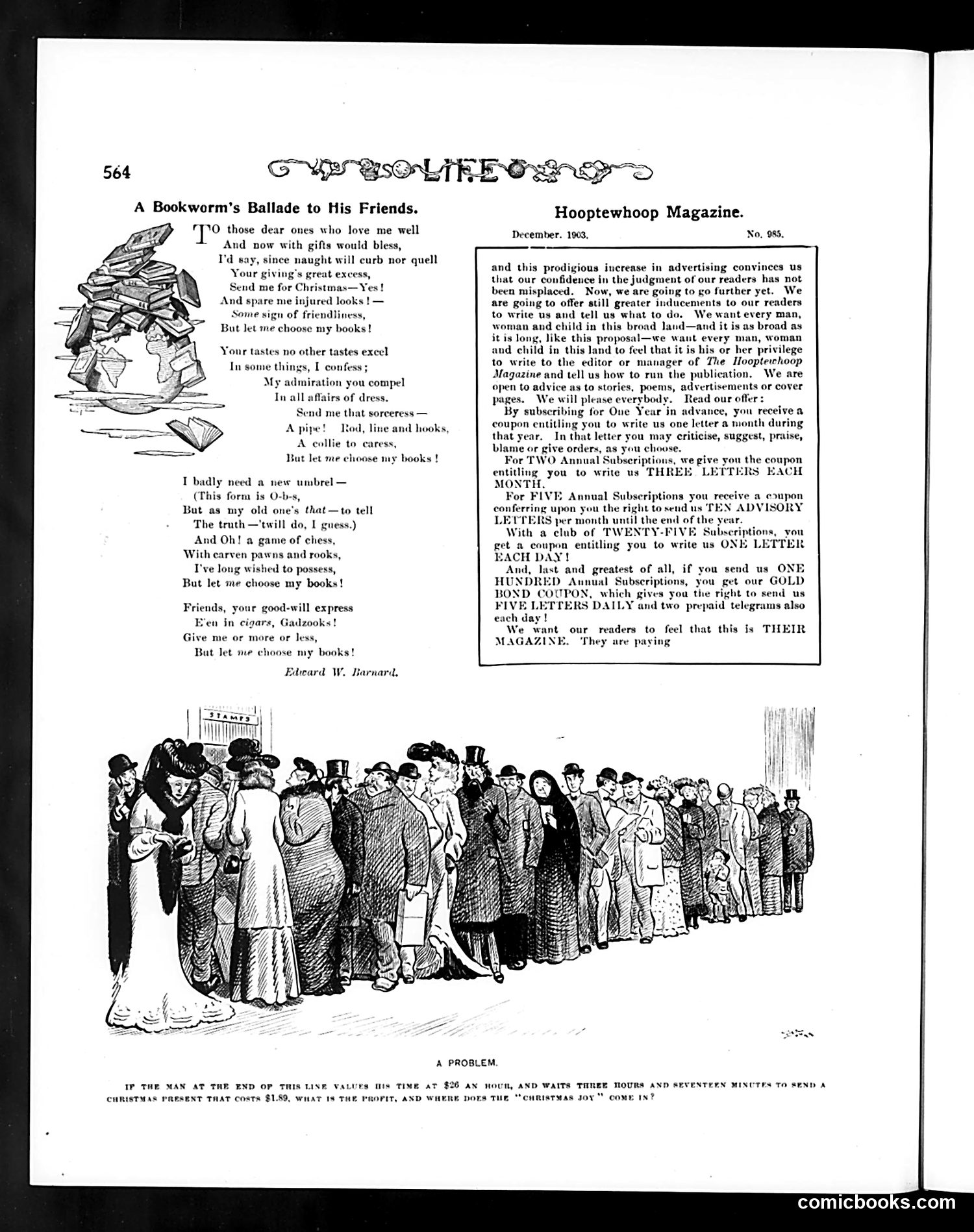
This Life magazine page (December 1903) contains two satirical pieces mocking commercialism and consumer excess: **"A Bookworm's Ballade"** (left): A humorous poem by Edward W. Barnard about gift-giving. The speaker appreciates friends' generosity but insists—repeatedly—on choosing his own books rather than receiving their well-intentioned but unwanted gift selections (pipes, fishing rods, umbrellas, chess sets). **"Hooptewhoop Magazine" advertisement** (right): A parody of magazine subscription schemes. It mockingly promises readers influence over editorial content through increasingly elaborate coupon systems—more letters per month correlate with subscription tiers, climaxing in a "GOLD BOND COUPON" granting five daily letters and telegrams. The satire attacks publishers' false claims that readers control content. **"A Problem"** (bottom): A math puzzle exposing the absurdity of Christmas gift-giving economics—if a man earns $26/hour and waits 3 hours 17 minutes to send a $1.89 gift, where's the "Christmas joy" when time costs exceed the gift's value? Together, these pieces satirize commercialized Christmas and manipulative marketing tactics.
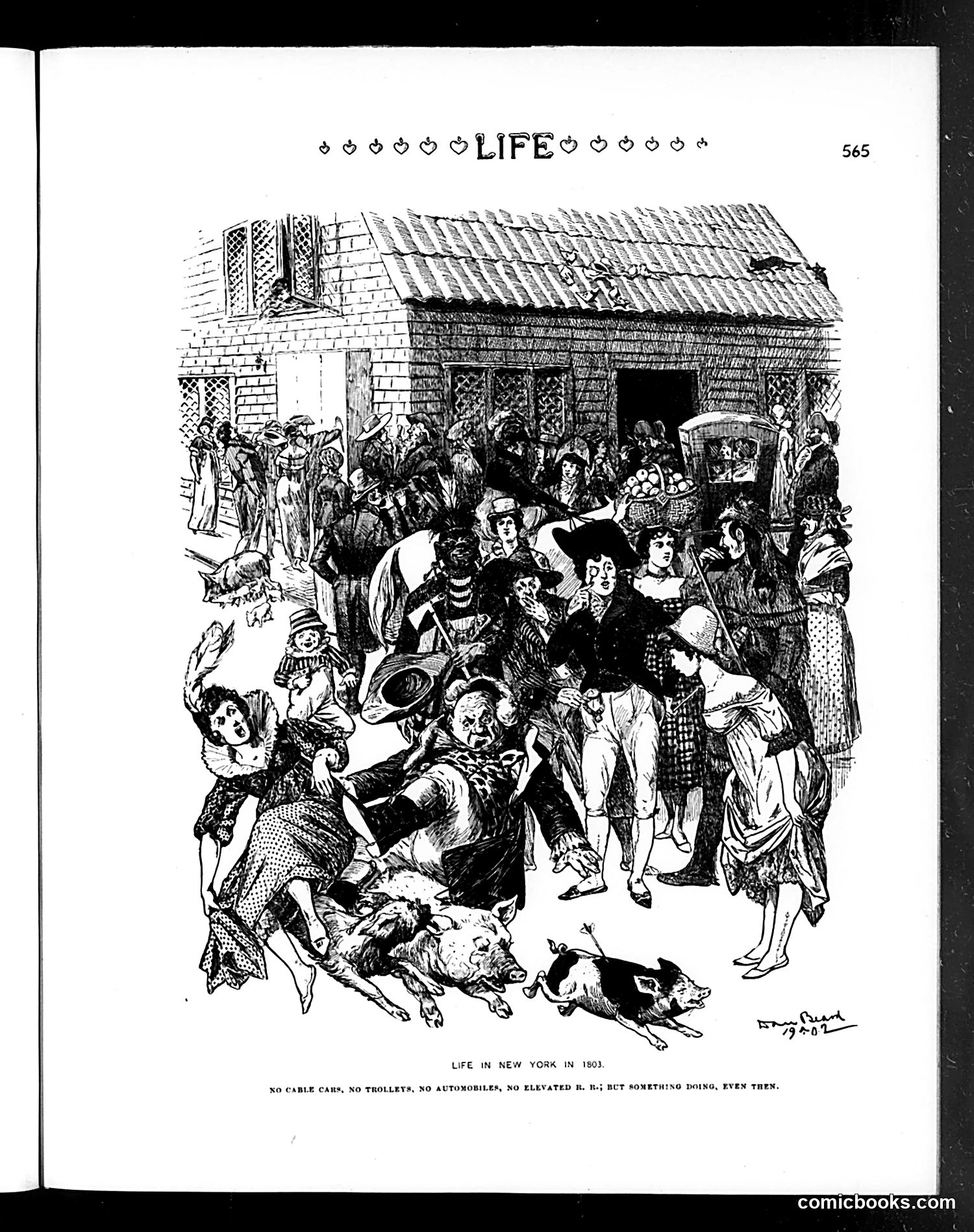
This satirical illustration depicts a chaotic street scene in early 1800s New York City. A large crowd of people in period dress congregates outside a brick building, with animals (dogs and a pig) running through the street. The scene is deliberately crowded and disorderly. The caption's humor lies in its nostalgic irony: it acknowledges that despite the *absence* of modern transportation (cable cars, trolleys, automobiles, elevated railways), the city was still bustling and active—"something doing, even then." The joke targets readers familiar with Life magazine's contemporary (early 1900s) New York, suggesting that urban chaos and activity weren't new inventions. The illustration romanticizes or mocks earlier urban life while implicitly celebrating progress, yet notes that congestion and commotion have always characterized city living, regardless of technology.
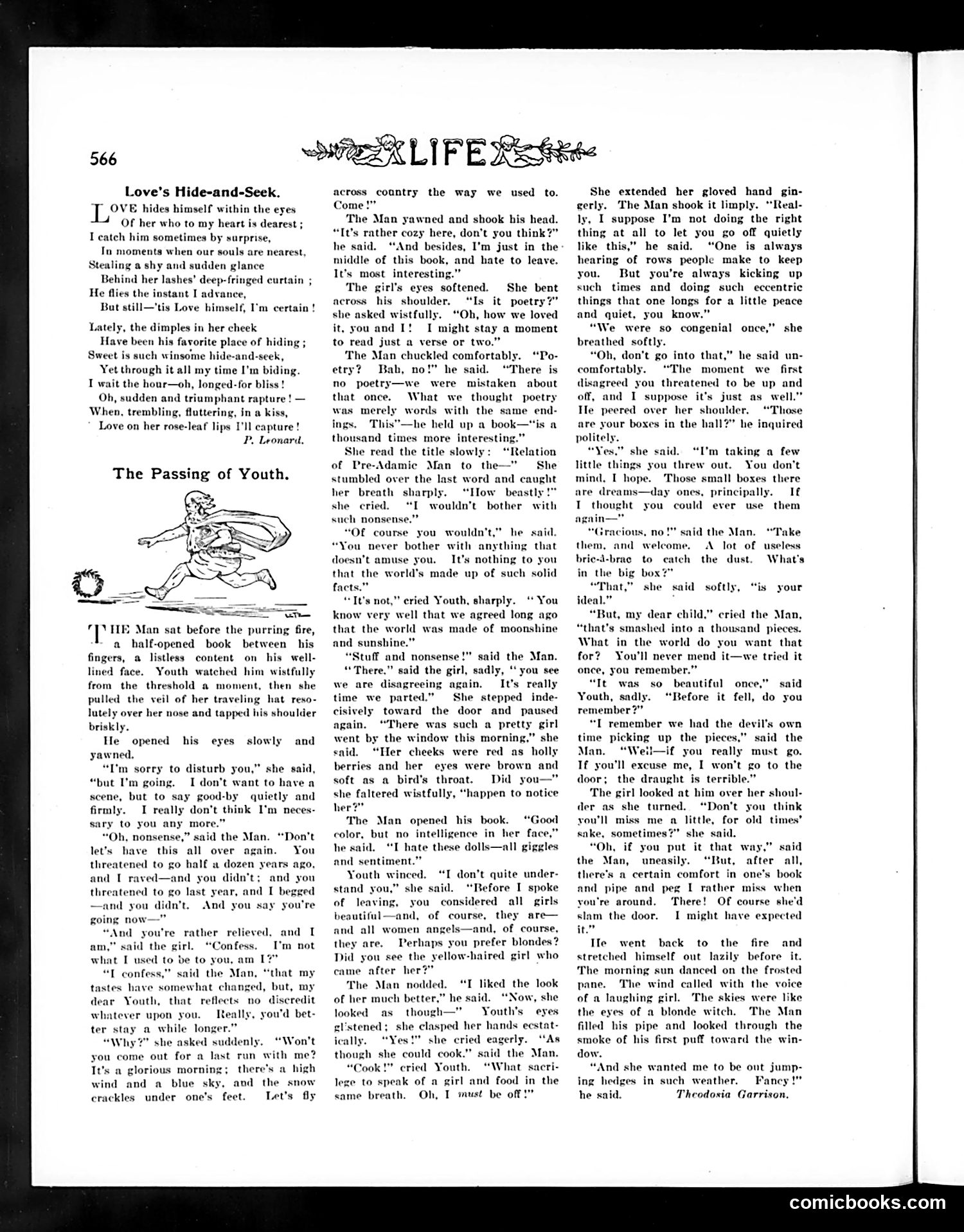
This story depicts an allegorical confrontation between **the Man** (representing middle-aged complacency) and **Youth** (personified as a young woman). **The satire's point:** Youth attempts to leave the Man, having grown incompatible with his settled, intellectualized existence. She represents vitality, spontaneity, and romantic idealism—they once shared wonder in "moonshine and sunshine." He now embodies jaded materialism, preferring a dry book on "Pre-Adamic Man" to outdoor adventures or poetry. **The social critique:** This reflects turn-of-century anxieties about aging, lost passion, and the deadening effects of bourgeois domesticity. The Man's dismissive attitude toward a beautiful young woman he notices reinforces his spiritual decline—he's become immune to beauty itself. The accompanying poem "Love's Hide-and-Seek" provides thematic contrast: idealized romantic yearning versus the story's portrayal of love's practical deterioration over time.
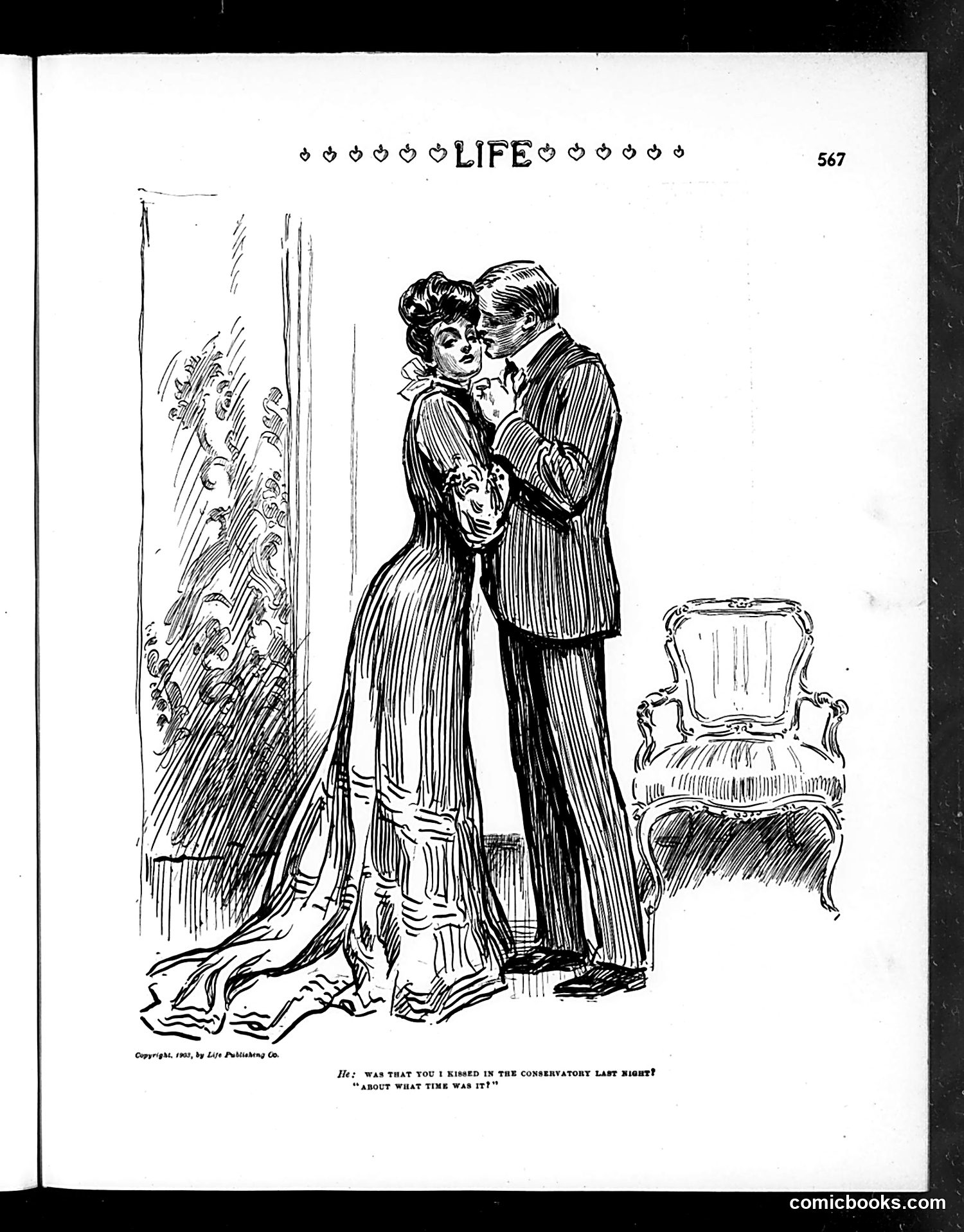
This is a single-panel satirical cartoon from Life magazine (page 567). It depicts a romantic scene: a man in a suit embraces a woman with an elaborate upswept hairstyle and long gown, while a child watches from below. The caption reads: "HE: WAS THAT YOU I KISSED IN THE CONSERVATORY LAST NIGHT? 'ABOUT WHAT TIME WAS IT?'" The joke satirizes infidelity and confused romantic encounters—the man cannot remember which woman he kissed, suggesting he was intimate with multiple women. The woman's evasive response ("about what time") implies she's covering her tracks. The child's presence adds ironic awkwardness to the adult misbehavior. This reflects early 20th-century satirical humor targeting wealthy, sophisticated society's romantic indiscretions.
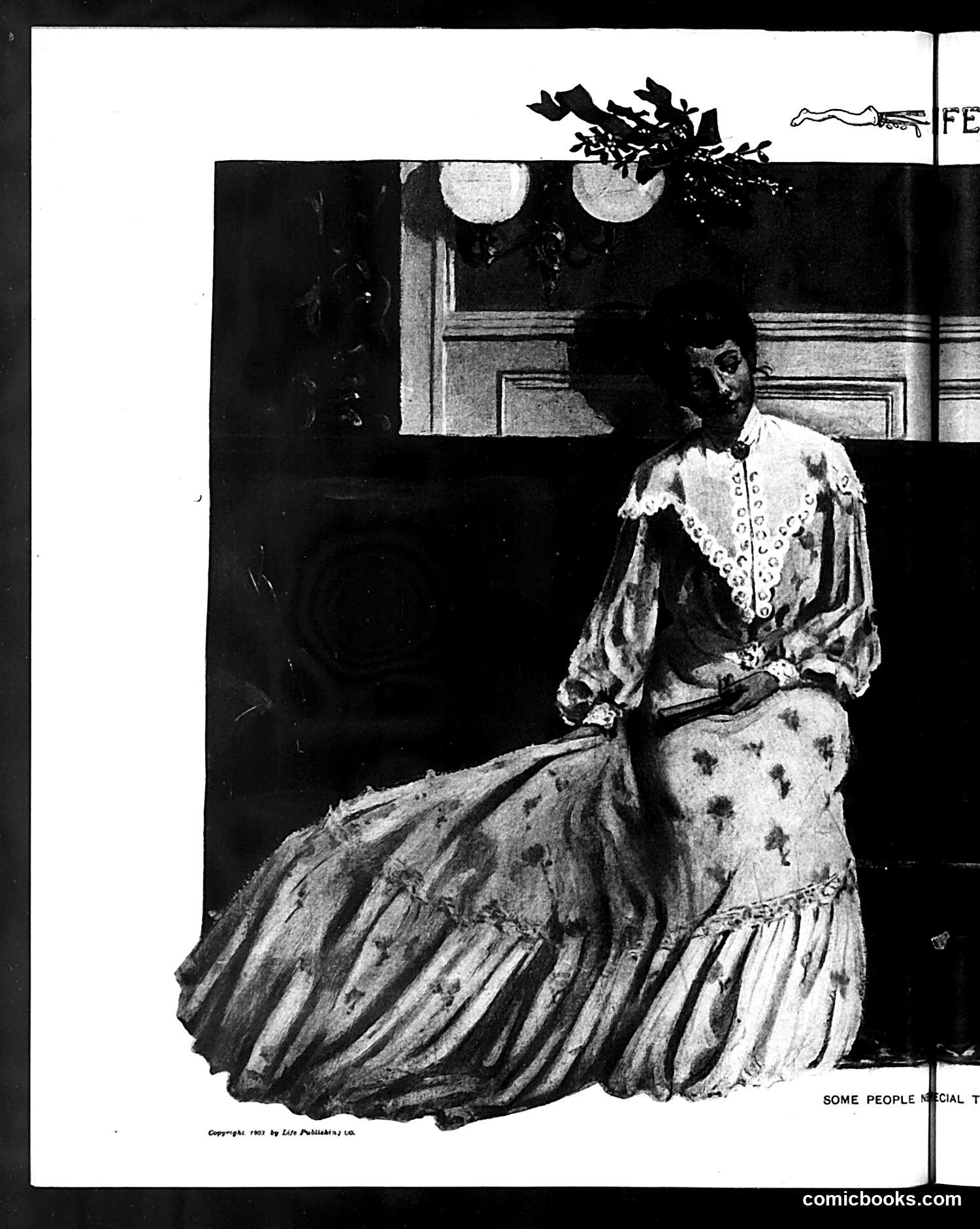
This appears to be a satirical illustration from Life magazine's 1901 issue. The image shows a woman in an interior setting, wearing an elaborate, heavily pleated skirt with decorative patterns and a lace-trimmed blouse with puffy sleeves—fashionable upper-class attire of the period. The partially visible caption "SOME PEOPLE MECIAL" (likely "SOME PEOPLE MEDICAL" with OCR error) suggests social satire, though the complete text is cut off. The illustration likely critiques either: - The excesses of wealthy women's fashion - Upper-class pretension or behavior - Medical or pseudo-medical trends among society women Without the full caption visible, the specific target of satire remains unclear, but the formal dress and domestic setting suggest commentary on elite women's social practices or vanity.
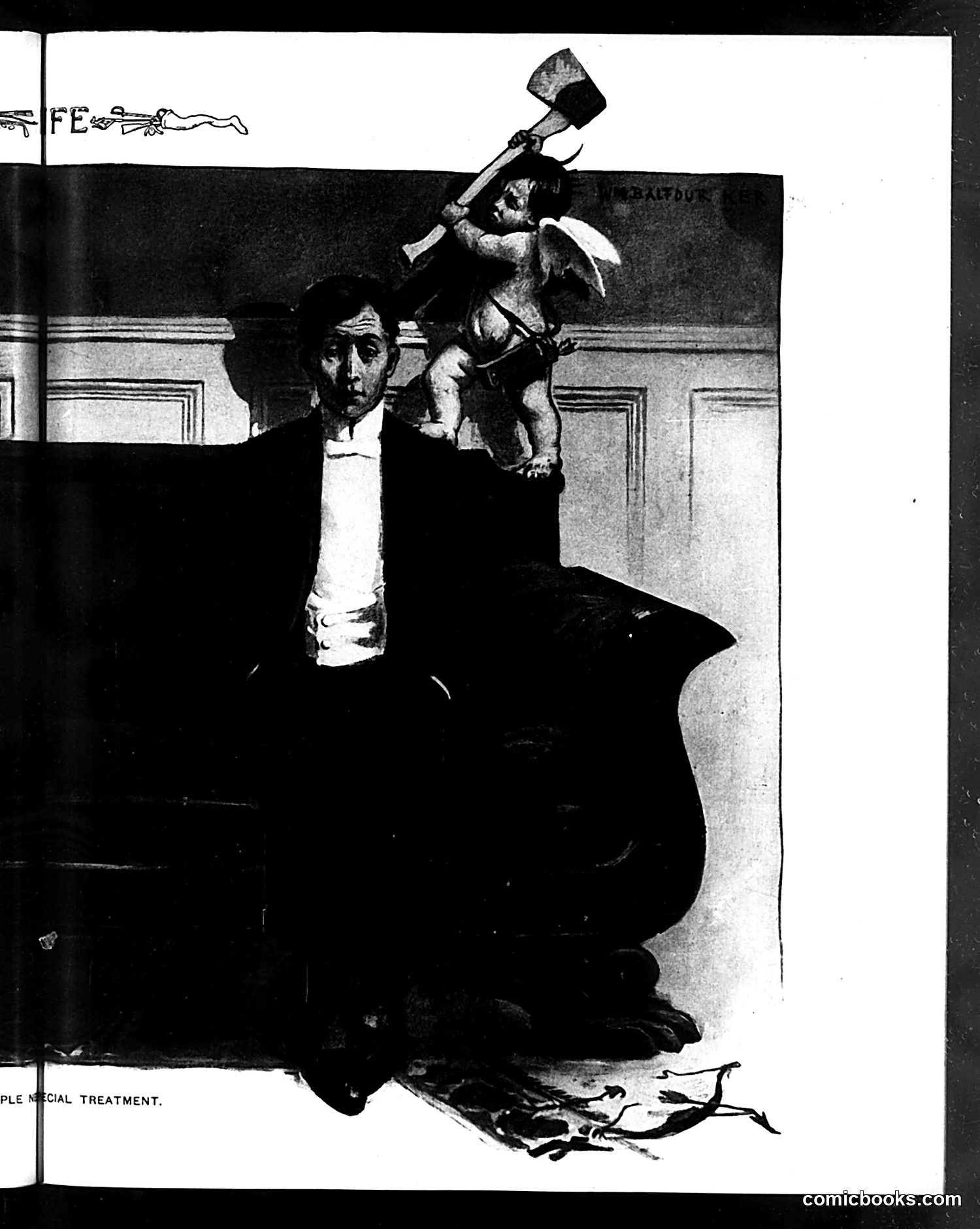
This appears to be a satirical cartoon from *Life* magazine depicting a man in formal attire (suit and white shirt) kneeling or crouching, while a cherub or cherubic figure perches on his shoulders wielding an axe or hatchet overhead. The caption reads "AMPLE SPECIAL TREATMENT." The image likely satirizes favoritism or preferential treatment given to a particular person or group—the "ample special treatment" being administered (suggested by the raised weapon) appears ironic or critical. The formal dress suggests the subject is a person of status or authority. Without additional context about the publication date or clearer identification, the specific target of this satire remains unclear, though it critiques unequal or excessive privileges.
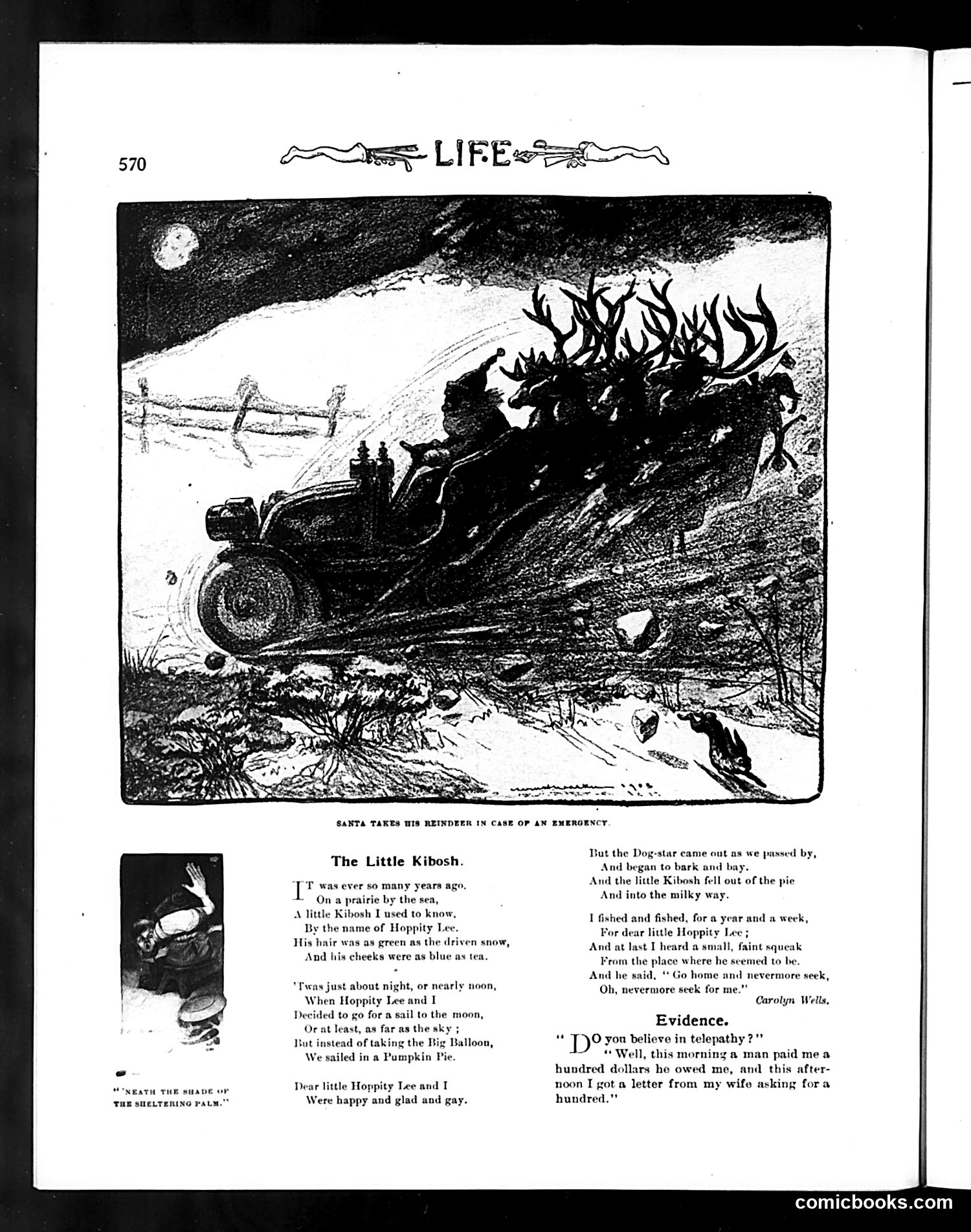
The main illustration depicts a humorous Christmas scene: Santa's sleigh is pulled by reindeer at high speed down a snowy hill, with the caption "Santa Takes His Reindeer in Case of an Emergency." This is a visual gag—the image suggests Santa is commandeering his reindeer for urgent, non-holiday purposes, treating them as an emergency vehicle. Below are two separate pieces: "The Little Kibosh" is a whimsical nonsense poem by Carolyn Wells featuring absurdist imagery (sailing to the moon in a pumpkin pie, a green-haired creature named Hoppity Lee). It parodies sentimental children's verse through deliberate nonsense. "Evidence" is a brief joke about telepathy: a man receives unexpected payment he was owed, then simultaneously receives a bill request from his wife—implying they're somehow mentally connected or the universe balances itself out. The humor relies on coincidental timing and marital finance dynamics.
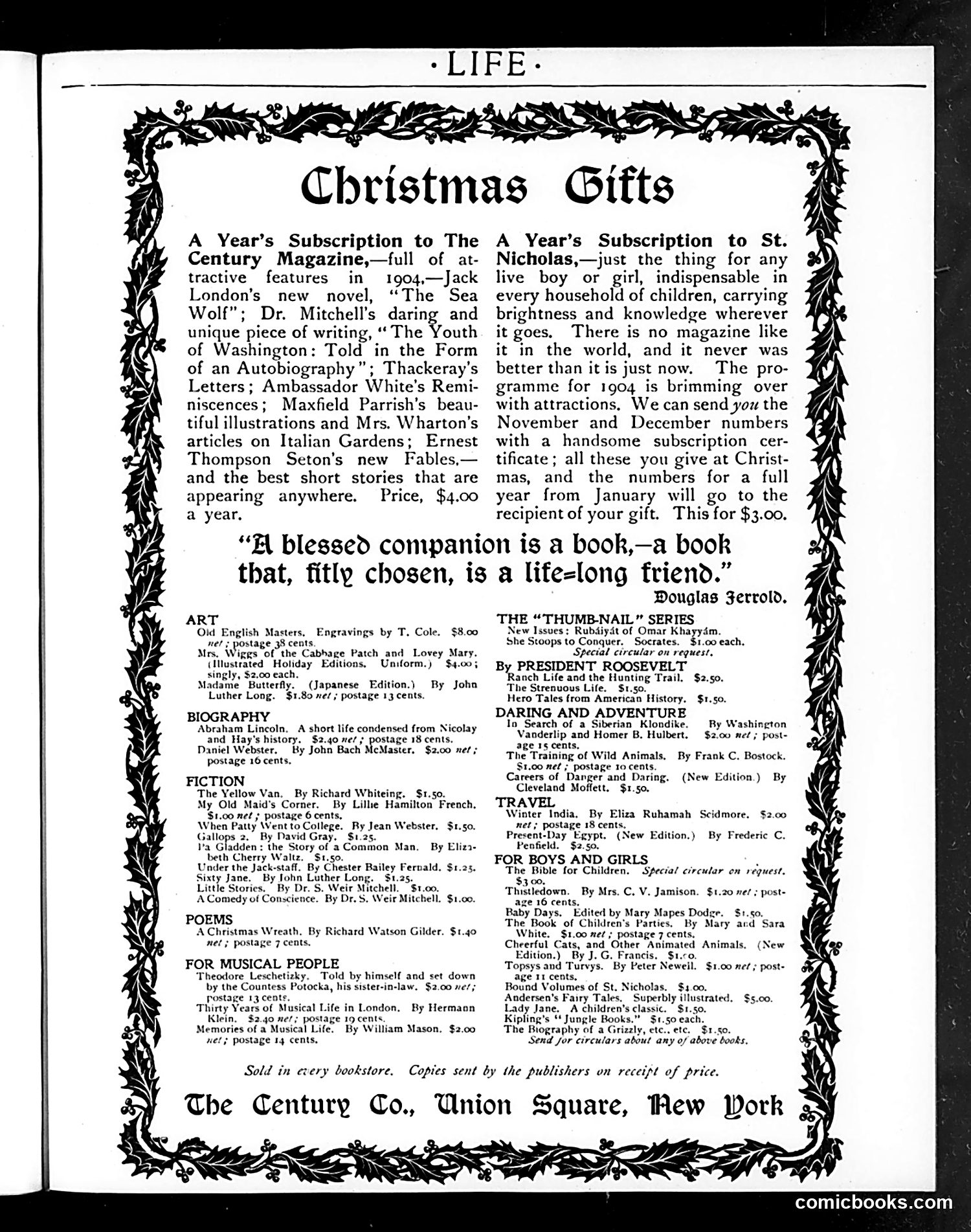
This page is primarily a **book advertisement** from The Century Co., a major New York publisher, rather than political satire or cartooning. It's a catalog of gift recommendations for the 1904 holiday season. The page promotes magazine subscriptions (Century Magazine and St. Nicholas) and lists books across categories: art, biography, fiction, poetry, music, adventure, travel, and children's literature. Featured authors include Jack London ("The Sea Wolf"), Edith Wharton, Ernest Thompson Seton, and Theodore Roosevelt (whose "Ranch Life and the Hunting Trail" is highlighted). The decorative border and the Douglas Jerrold quote about books as companions establish a literary, genteel tone appropriate for upscale gift-giving. There is **no political cartoon or satire present**—this is a straightforward commercial announcement typical of Life magazine's advertising section circa 1904.
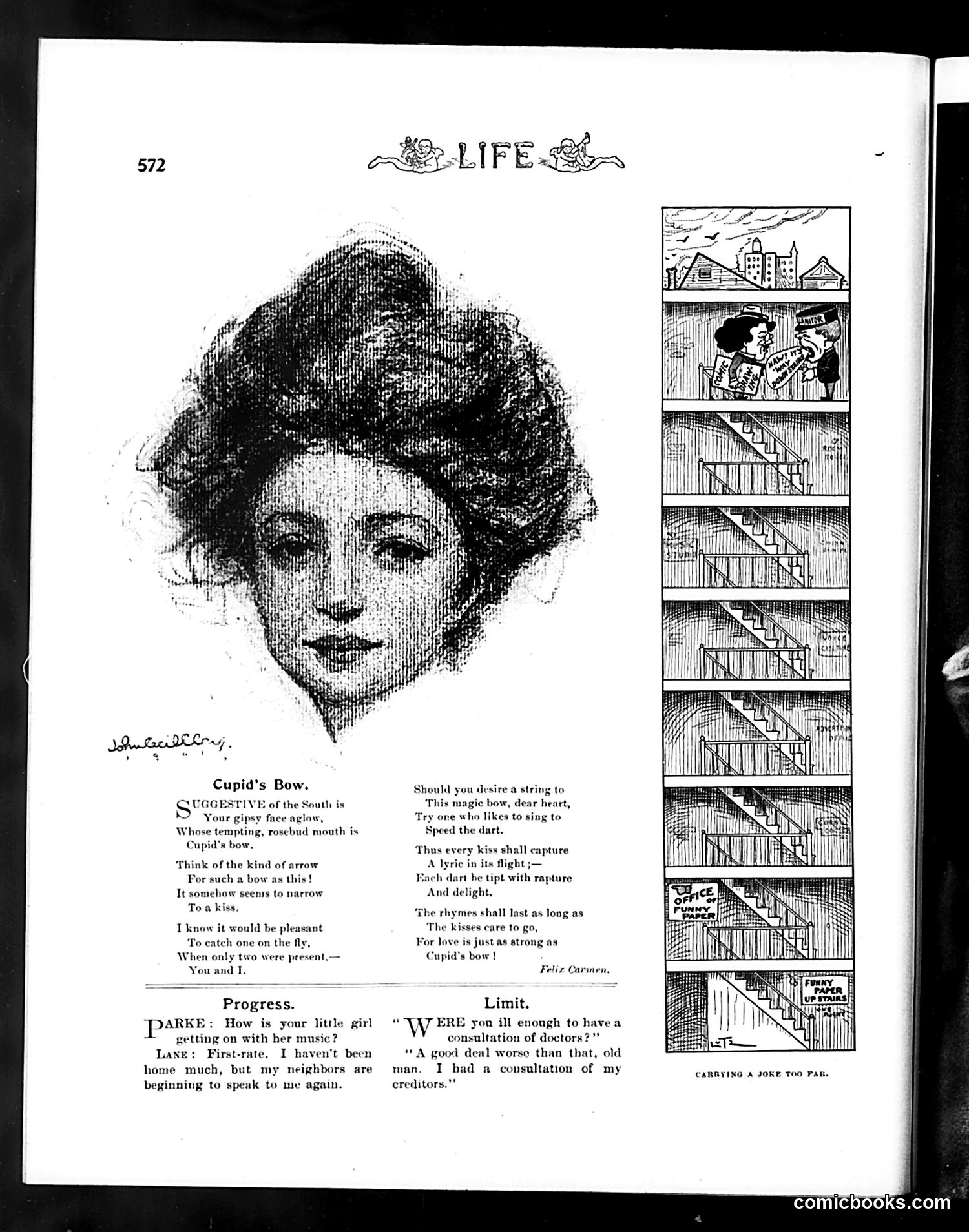
This page contains three distinct pieces of humor typical of early 20th-century Life magazine: **"Cupid's Bow"** (top): A romantic poem with illustration praising a woman's lips, compared to Cupid's bow (the archer's weapon). The metaphor playfully suggests her mouth/kiss is as effective as Cupid's arrow at striking hearts. This is sentimental verse rather than satire. **"Progress"** (middle): A brief joke where a man mentions his daughter's music lessons have improved his social standing—his neighbors finally speak to him again. The implication is that her constant practicing previously made him a neighborhood nuisance. The humor lies in the ironic "progress": the daughter improved musically while the father's reputation improved through *less* practice. **"Limit"** (bottom): A joke about consulting doctors versus creditors. A man says a creditors' meeting was worse than doctors' consultations, suggesting financial ruin is more serious than illness. **Right side comic strip**: Titled "Carrying a Joke Too Far," appears to show a multi-panel narrative (unclear without clearer text) involving stairs and what seems to be slapstick mishap.
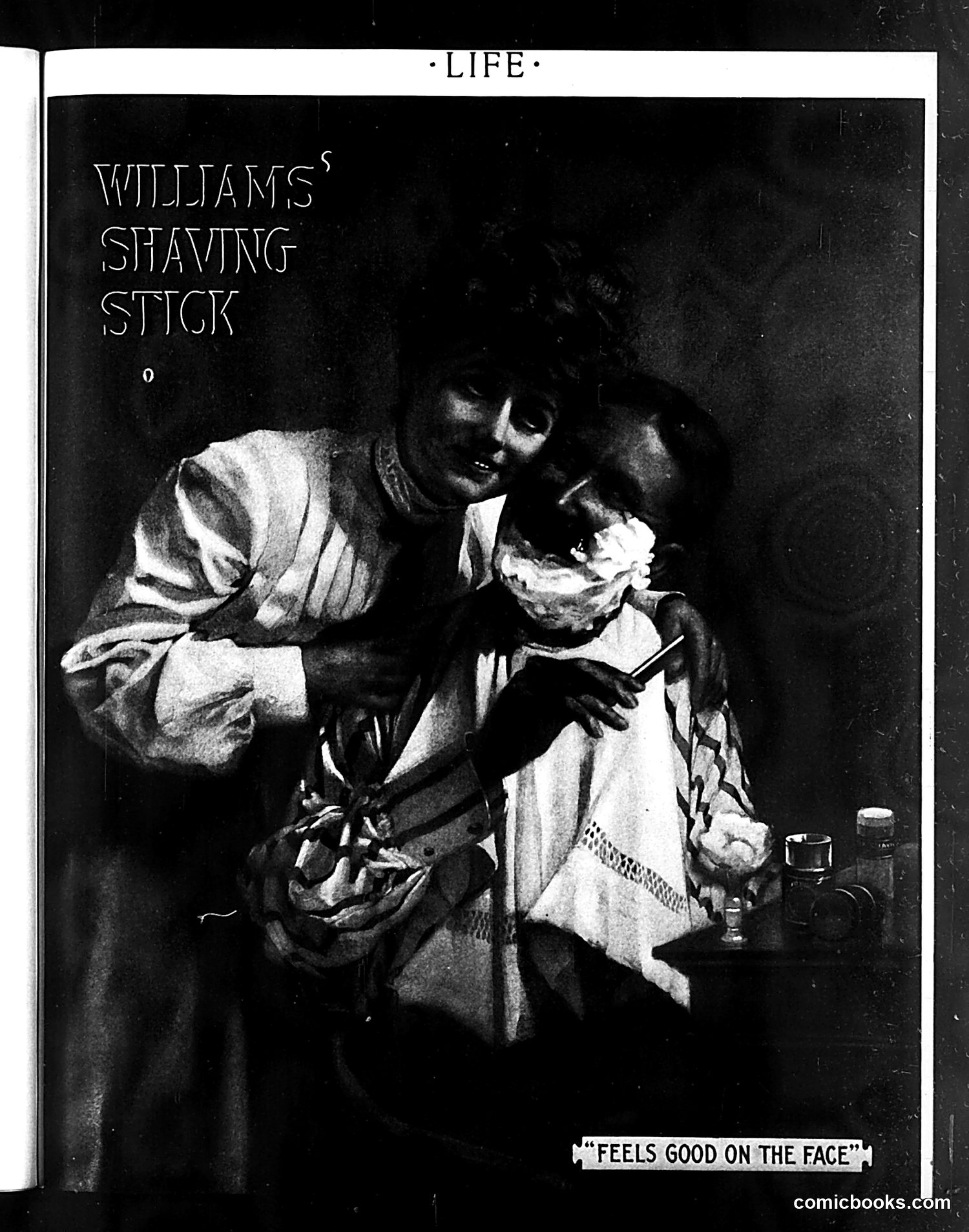
This appears to be an advertisement for Williams' shaving products, specifically showcasing their shaving stick. The image shows a barber applying lather to a customer's face, with the tagline "Feels Good on the Face" emphasizing the product's comfort during use. The humor or appeal lies in the tactile sensation being promoted—the smoothness and pleasant feel of the shaving cream application. This was typical early 20th-century advertising that emphasized sensory comfort as a selling point for grooming products. The "LIFE" magazine context suggests this ran alongside other satirical content, but this particular page functions as a straightforward product advertisement rather than political satire or social commentary. It represents vintage marketing focused on masculine grooming routines.
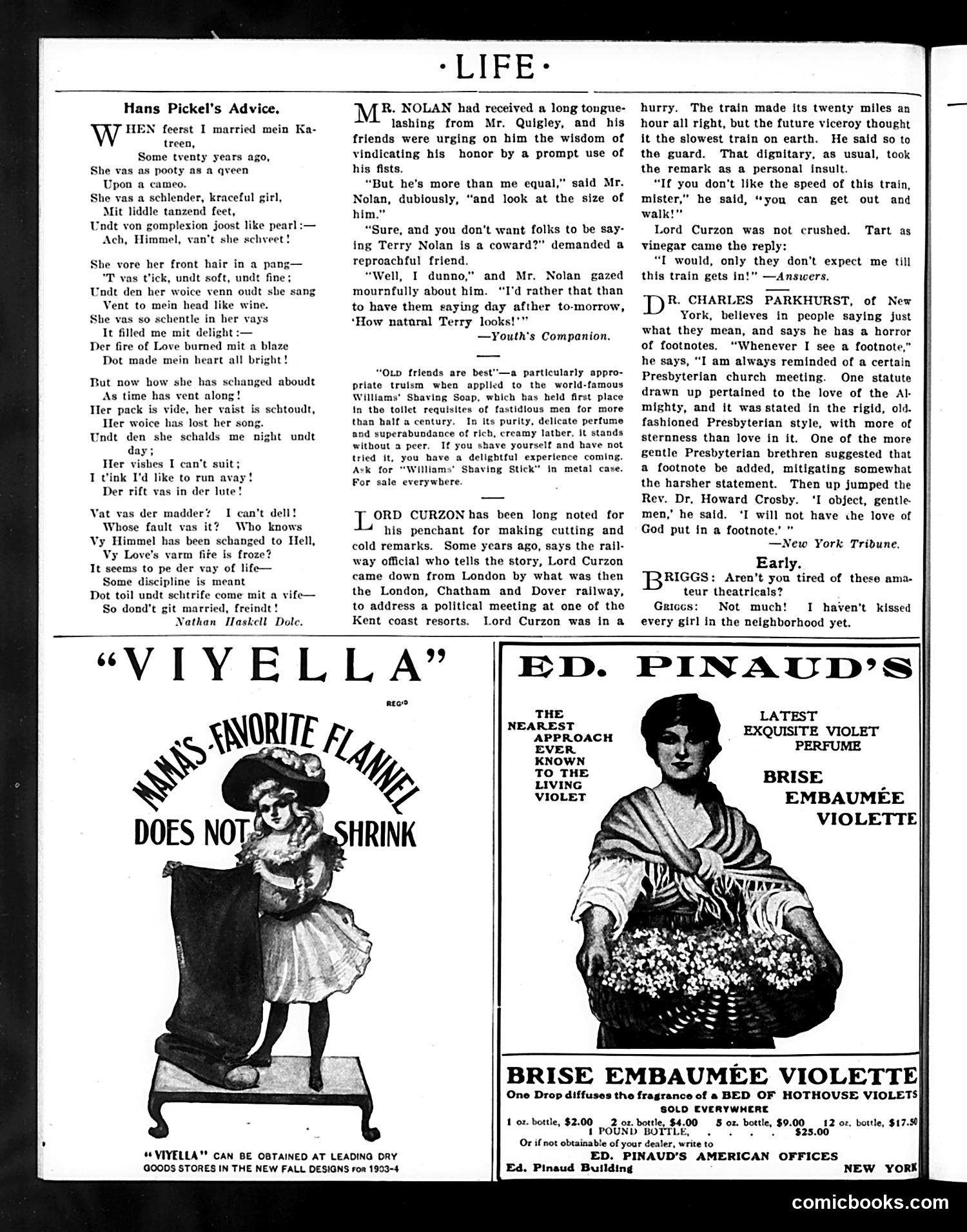
This page contains three distinct humor pieces from an early 1900s *Life* magazine: 1. **"Hans Pickel's Advice"**: A dialect poem in exaggerated German-immigrant accent about a man whose wife has aged poorly over twenty years—she's gained weight, lost her beauty and voice, and nags constantly. The joke relies on period stereotypes of German immigrants and the misogynistic premise that a woman's value diminishes with age. 2. **Anecdotes about public figures**: Brief humorous stories about Terry Nolan (avoiding a fight with a larger opponent), Lord Curzon (a British politician known for cutting remarks, later Viceroy of India), and Dr. Charles Parkhurst (a New York minister). These mock their personalities through reported witticisms. 3. **Advertisements**: For Vivella flannel and Ed. Pinaud's violet perfume—period products marketed with illustrations. The satire assumes readers recognize these public figures and find immigrant dialects inherently comic—humor strategies that don't translate well today.
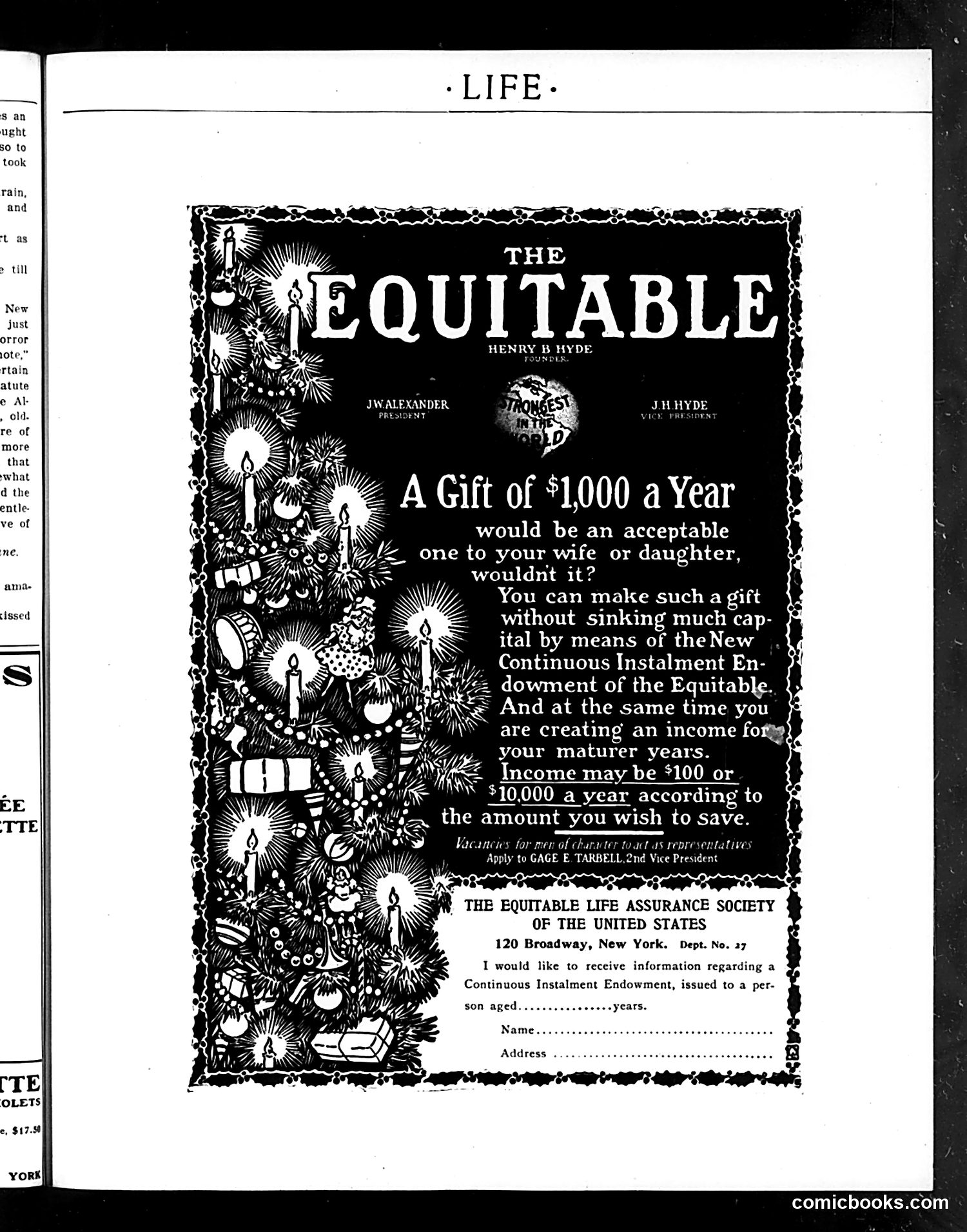
This is a **life insurance advertisement** from The Equitable Life Assurance Society, not political satire or a cartoon. The decorative border features candles and ornamental designs suggesting gift-giving or memorial occasions. The ad pitches a financial product to male readers: a "Continuous Instalment Endowment" allowing them to gift $1,000 annually to wives or daughters without depleting capital. The appeal combines **paternalism with financial prudence**—framing life insurance as both generous provision for female dependents and smart wealth-building for the donor's retirement years. The language ("would be an acceptable one to your wife or daughter") reflects early 20th-century assumptions about gender roles: husbands controlling finances and providing for dependent women. The ad positions insurance as simultaneously a gift and an investment vehicle, addressing upper-middle-class male readers concerned with legacy and financial security.
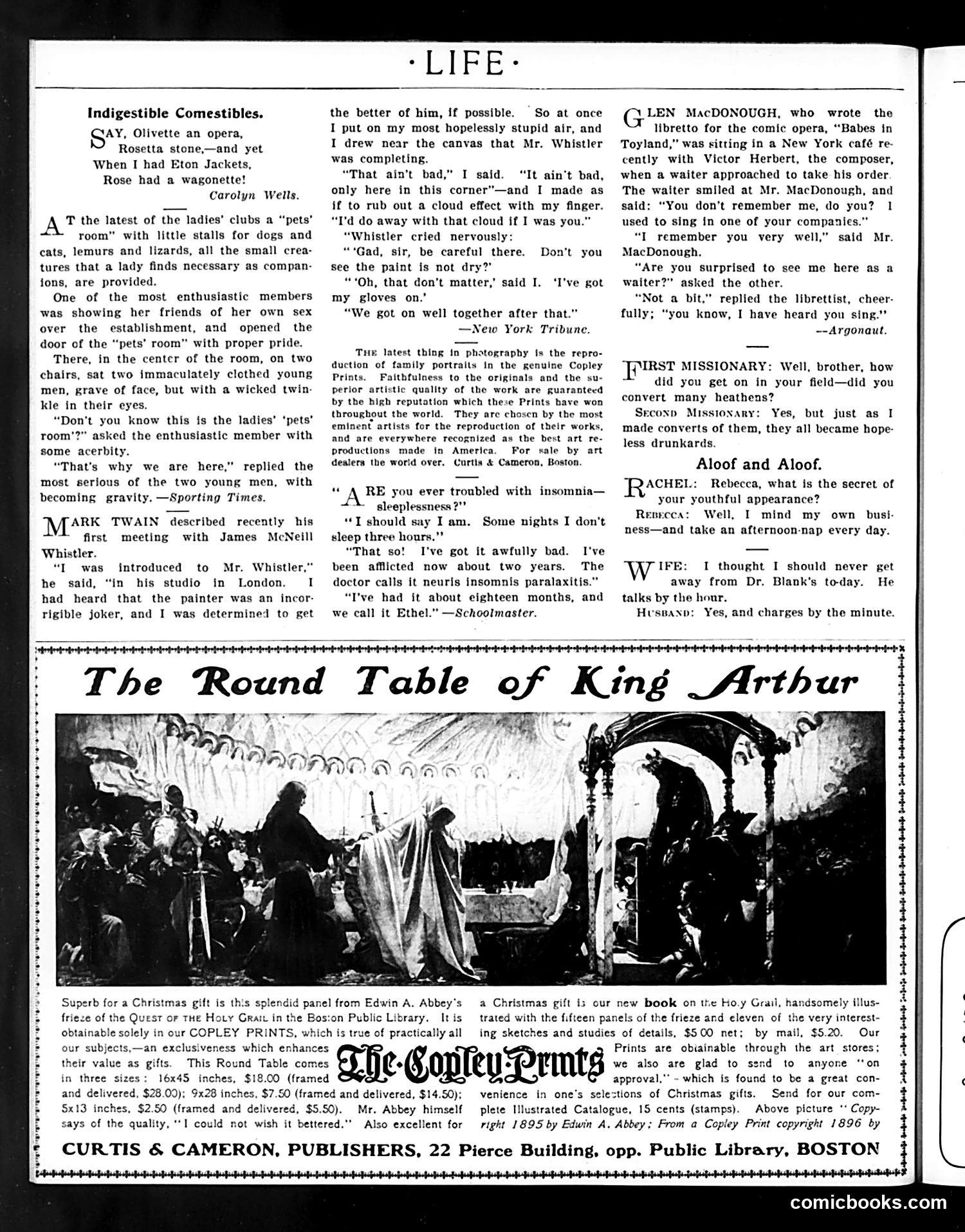
This page contains several short humorous pieces typical of Life's satirical style: **"Indigestible Comestibles"** presents a joke about a women's club's "pets' room" where two young men are discovered sitting as if they were animals on display. The humor plays on the double meaning of "pets"—the club members treat attractive young men as decorative objects, subverting expectations that the room contains only animals. **The Mark Twain anecdote** recounts Twain pretending to be foolishly critical of painter James McNeill Whistler's work, feigning ignorance to test the famously temperamental artist. Whistler reacts nervously, and Twain's mock stupidity becomes a bonding moment—humor through absurdist role-play. **Other brief jokes** address insomnia and marital complaints, using wordplay and exaggeration for comedic effect. The page also advertises **Copley Prints** reproductions of Edwin Abbey's religious artwork, marketed as Christmas gifts. Overall, the content reflects turn-of-the-century American humor emphasizing clever social observations, mild gender dynamics jokes, and celebrity anecdotes.
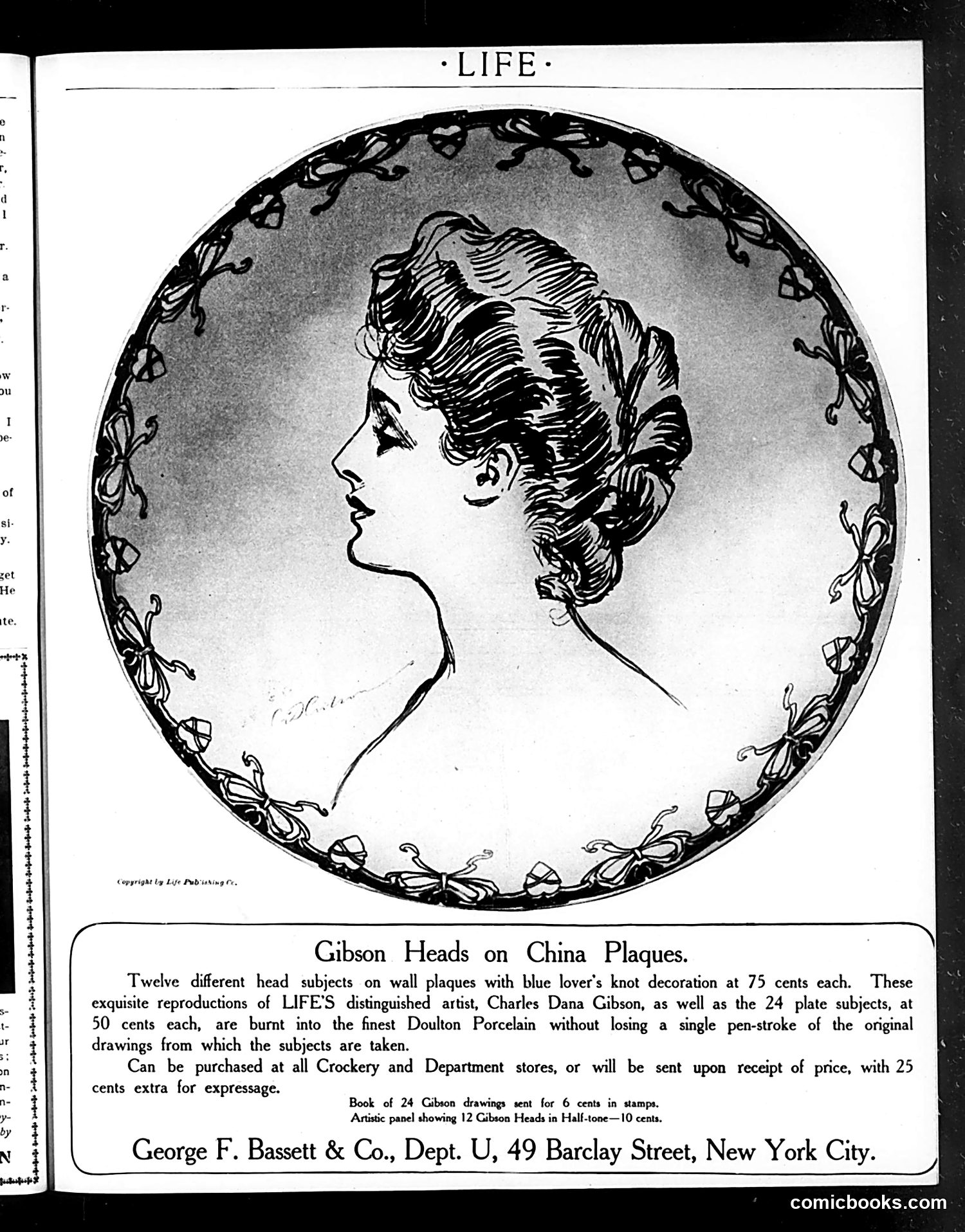
This page is primarily an **advertisement**, not a political cartoon. It promotes decorative porcelain plaques featuring the "Gibson Girl"—iconic illustrations by Charles Dana Gibson, a renowned artist for *Life* magazine. The advertisement sells two product lines: twelve different head designs at 75 cents each, and twenty-four plate subjects at 50 cents each. These were produced by burning Gibson's original pen drawings onto Doulton Porcelain dinnerware without losing detail. The single illustrated head shown exemplifies Gibson's style: a fashionable woman in profile with wavy hair, representing the idealized "Gibson Girl" aesthetic that dominated American popular culture in the early 1900s. This look—elegant, refined, aspirational—appealed to middle-class consumers. Rather than satire, this is **straightforward commercial marketing**, leveraging Gibson's artistic fame and *Life* magazine's prestige to sell home décor. The products were available at department and crockery stores, or by mail order.
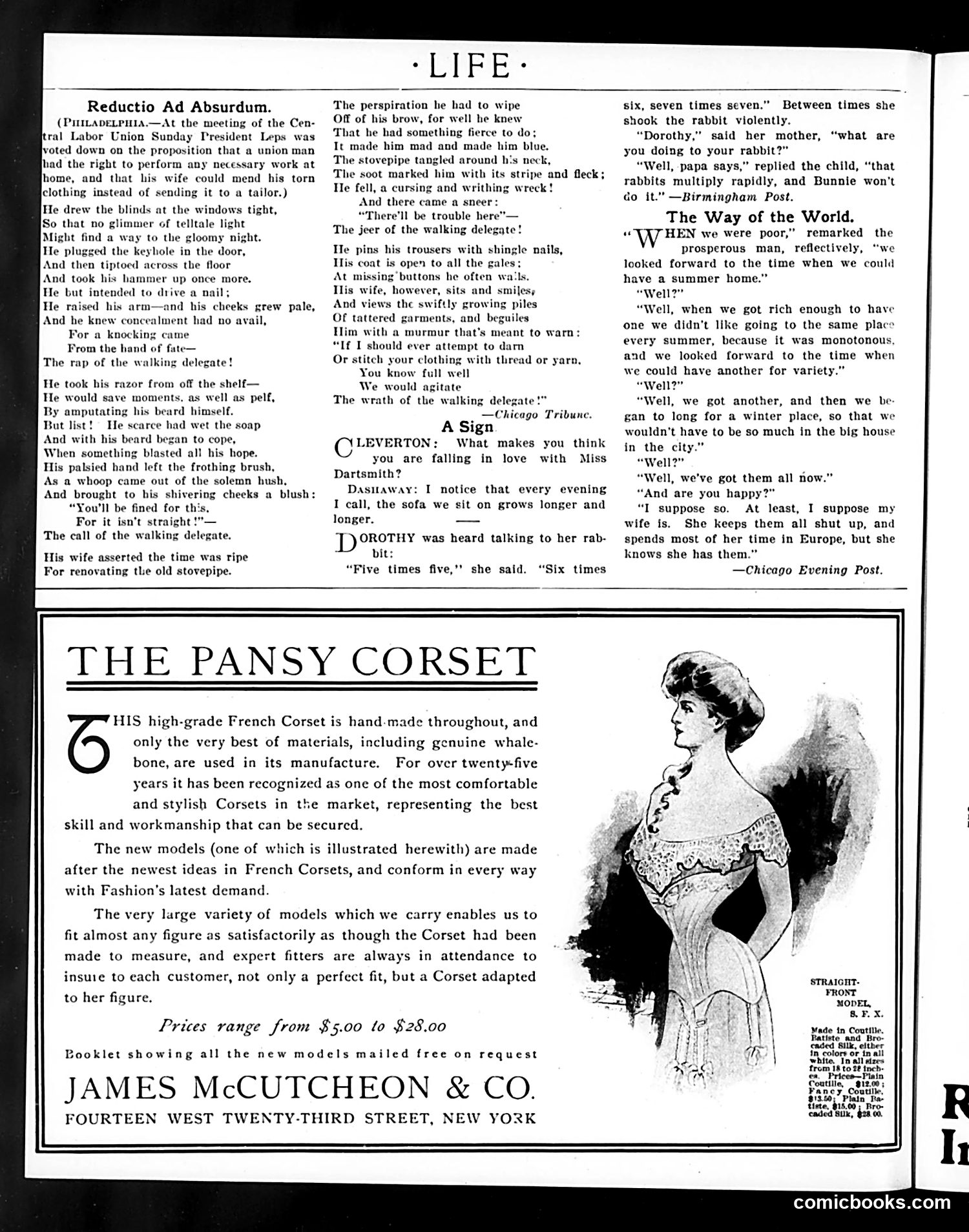
**Main Cartoon: "Reductio Ad Absurdum"** This satirizes labor union overreach, specifically a Philadelphia Central Labor Union decision prohibiting members from performing household work at home (like mending clothes or home repairs). The cartoon depicts a husband unable to perform basic domestic tasks without fear of union fines, enforced by a menacing "walking delegate" (union representative) who appears at every attempt—whether the man tries to hammer a nail, shave, or fix a stovepipe. The absurdist humor lies in showing how union rules, taken to their logical extreme, would paralyze ordinary home maintenance. **Secondary Humor Pieces:** "A Sign" jokes about courtship customs (the sofa grows longer when visiting), while "The Way of the World" satirizes wealthy accumulation—the rich man buys summer homes, then winter homes, then more properties, only to spend time avoiding them in Europe. **Also Featured:** A Pansy Corset advertisement (typical period fashion advertising). The page primarily mocks labor union rigidity as absurd overregulation of private life.
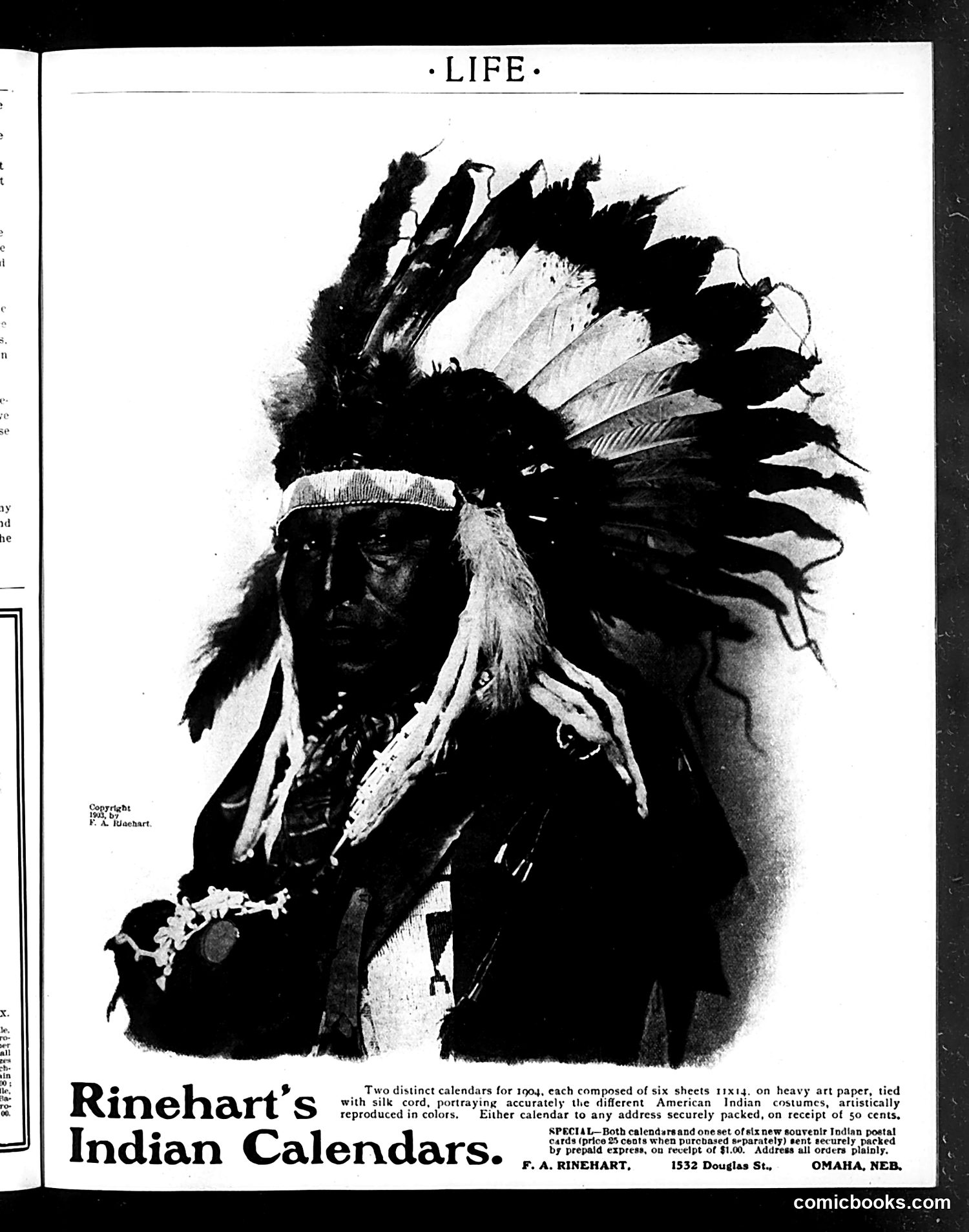
This is primarily a **commercial advertisement**, not satire. It promotes F.A. Rinehart's 1904 calendars featuring Native American imagery. The page displays a portrait photograph of a Native American man wearing an elaborate feathered headdress and traditional clothing. The advertisement emphasizes that the calendars portray "accurately the different American Indian costumes, artistically reproduced in colors." **Historical context**: This reflects early 1900s attitudes toward Native Americans—treating indigenous cultures as aesthetic subjects for commercial products rather than as contemporary peoples. The framing as "souvenir" items exemplifies how Native imagery was commodified during this era. The advertisement offers two calendar options at 50 cents each, or both calendars plus six postal cards for $1.00, shipped from Omaha, Nebraska. There is **no satirical intent visible**—this is straightforward product marketing typical of the period, though modern readers would recognize it as problematic cultural appropriation.
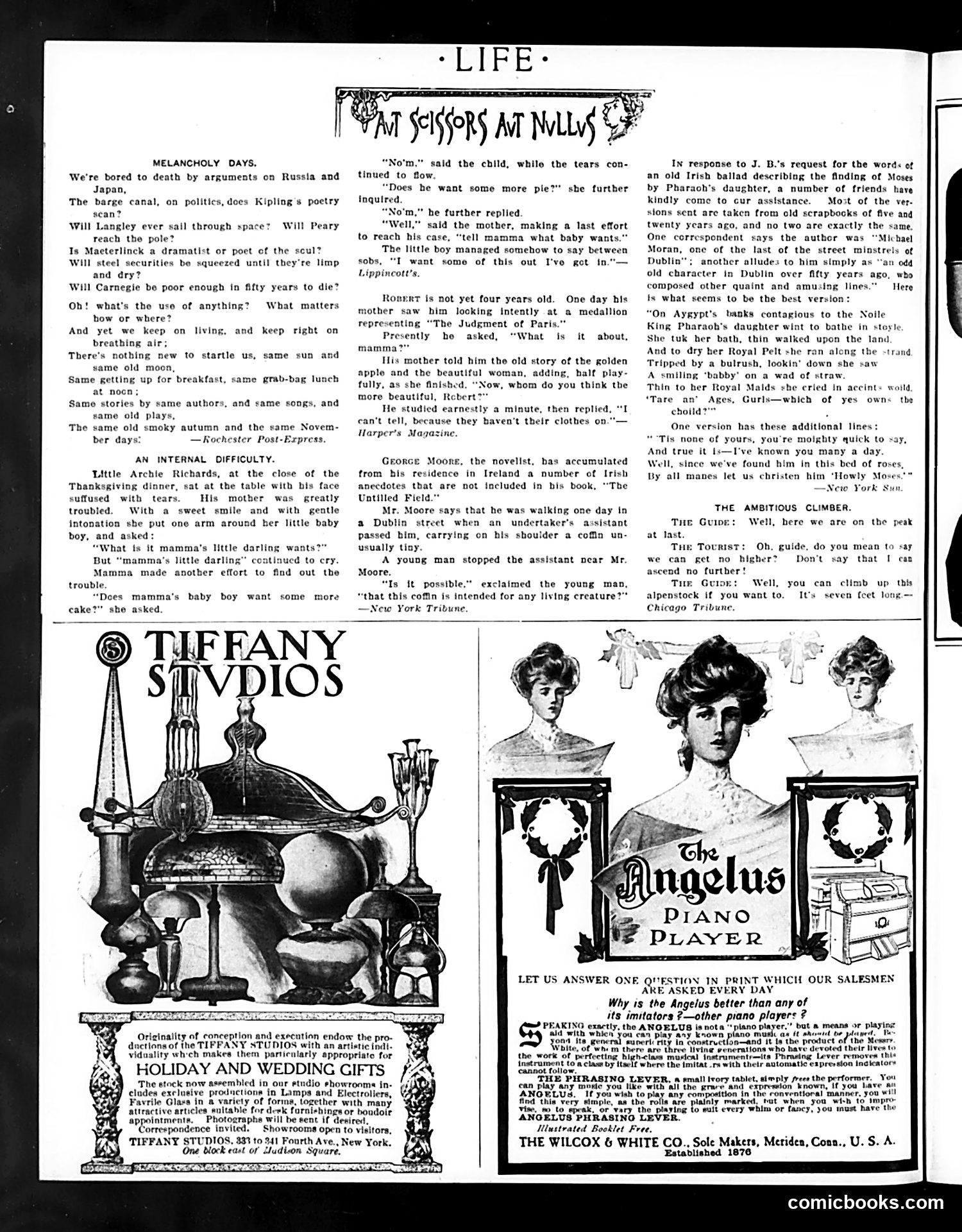
This page from *Life* magazine (a satirical publication) contains primarily **humorous short pieces and advertisements** rather than political cartoons. The main content includes: **"Melancholy Days"**: A poem expressing fin-de-siècle ennui—boredom with contemporary debates (Russia-Japan conflict, politics, technological speculation about space travel and the North Pole). It captures the Belle Époque mood of exhaustion with current events. **Three brief humorous anecdotes** about children: - A boy unable to express his stomach discomfort - Robert's innocent observation about the Judgment of Paris nude figures - An Irish undertaker's assistant carrying an unusually small coffin **Advertisements** for Tiffany Studios (luxury goods) and "The Angelus Piano Player" dominate the lower half. The humor relies on innocent childhood observations that reveal unspoken adult truths—typical of early 1900s family magazine comedy. The overall tone reflects genteel, upper-class American readership concerns and tastes.
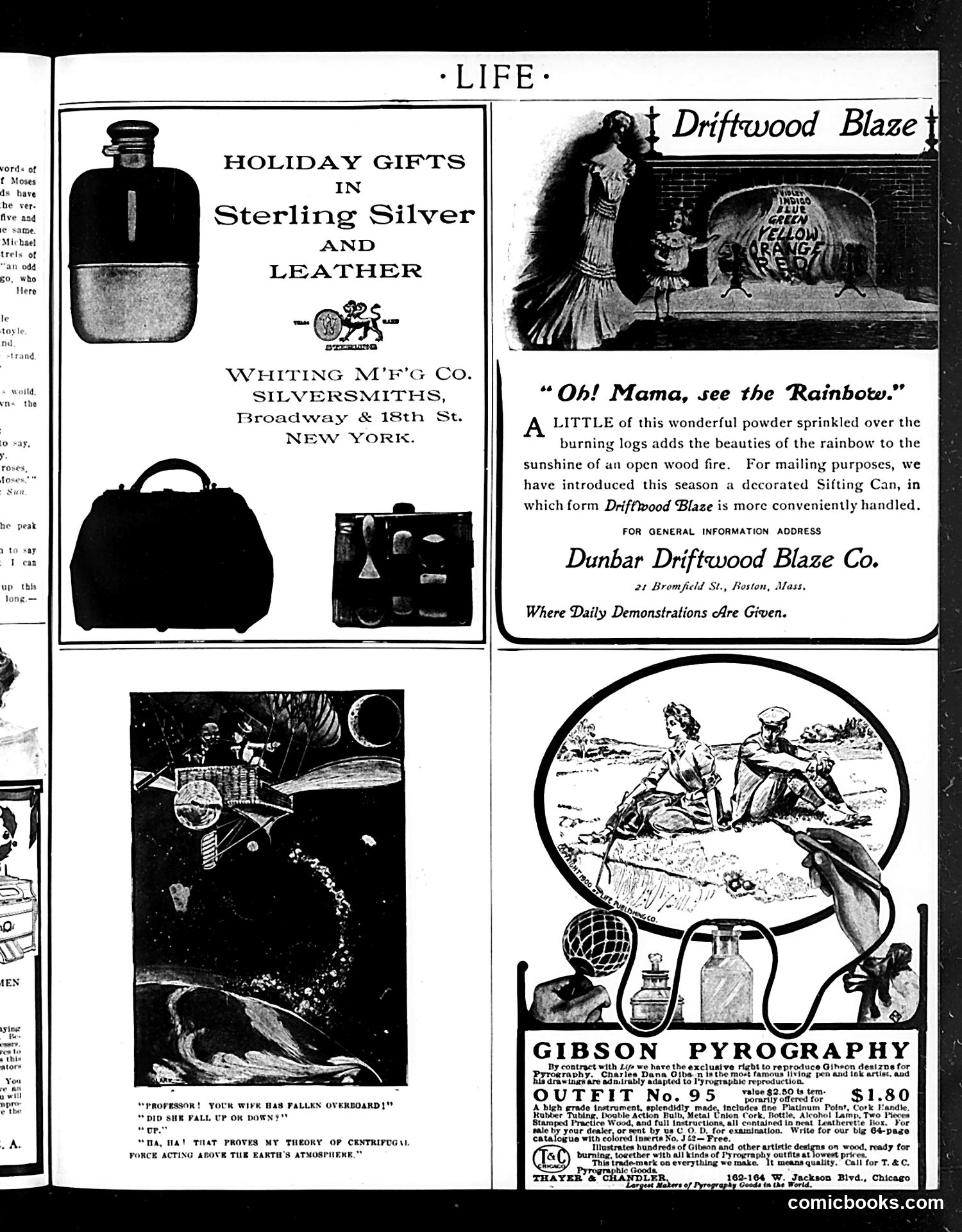
This page contains primarily **advertisements** interspersed with one cartoon. The main cartoon (lower left) depicts a physics professor and his wife, with the caption "Professor! Your wife has fallen overboard! Did she fall up or down?" followed by "Ha! Ha! That proves my theory of centrifugal force acting above the earth's atmosphere." The joke relies on **early 20th-century scientific misunderstanding**: the professor absurdly suggests his wife might fall *upward* rather than downward, using pseudo-scientific logic about centrifugal force. The satire mocks pedantic academics who apply theoretical physics nonsensically to real situations, treating a domestic accident as an opportunity to demonstrate flawed theories. The remaining content consists of holiday gift advertisements: sterling silver and leather goods from Whiting Manufacturing; Driftwood Blaze colored fire powder; and Gibson Pyrography kits (decorative wood-burning tools). These reflect period consumer goods marketed for holiday purchasing.
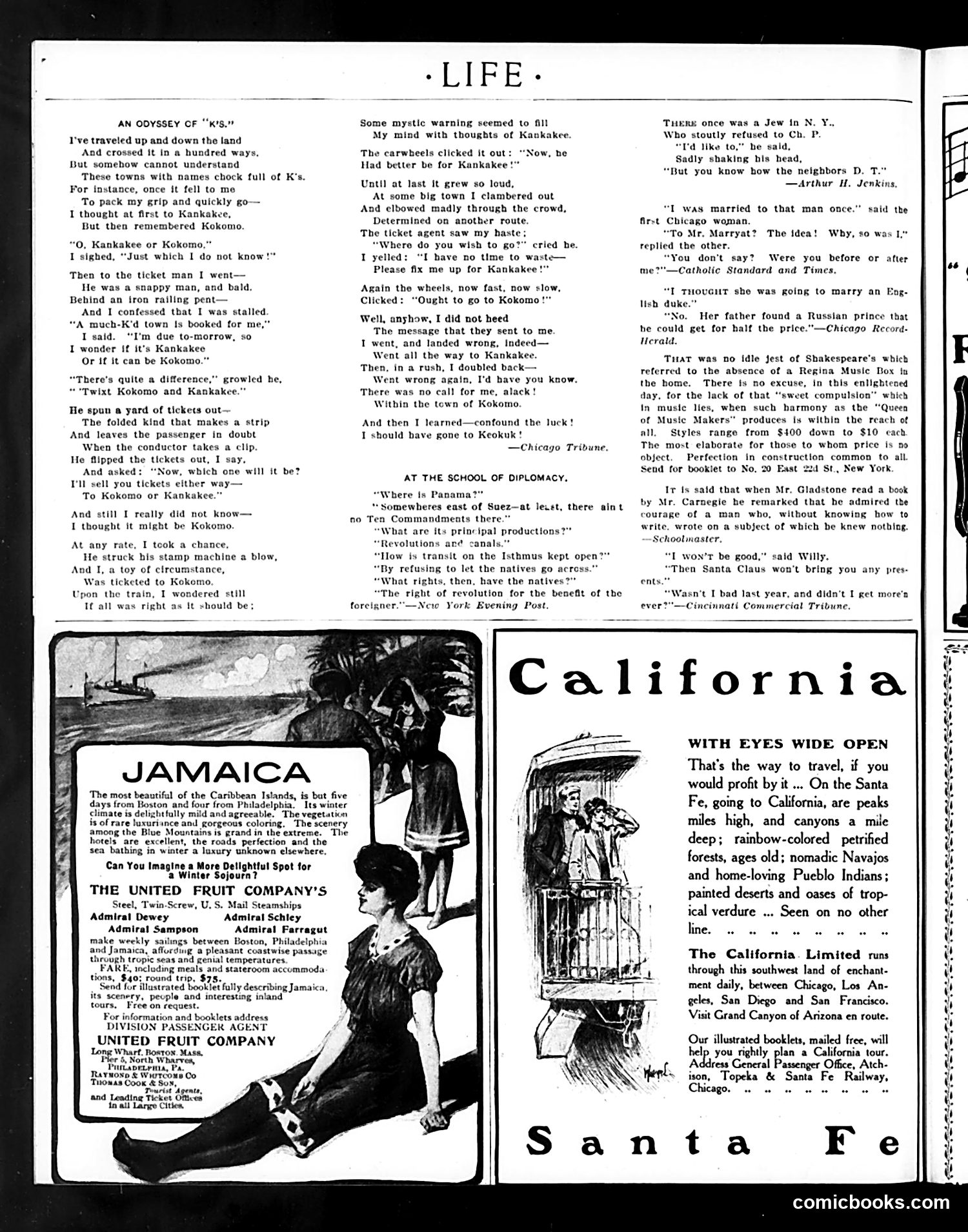
This page contains two distinct pieces: **Main Article: "An Odyssey of K's"** — A humorous poem about a traveler unable to decide between two similarly-named Midwestern towns (Kokomo, Indiana and Kankakee, Illinois). The joke exploits the absurdity of towns sharing the letter "K" and the traveler's indecision, ending when he discovers he was supposed to go to Keokuk (yet another K-town) entirely. It's gentle Americana satire about confusion and chance. **"At the School of Diplomacy"** — A darker political satire depicting a classroom dialogue about Panama. The exchange mocks U.S. imperial attitudes: when asked about Panama's "principal productions," the answer is "revolutions and canals"—suggesting the U.S. views Panama primarily as a canal location and politically unstable. The final line about natives having "the right of revolution for the benefit of the foreigner" is biting criticism of colonial exploitation. The page also contains travel advertisements for Jamaica and California, typical of the magazine's era.
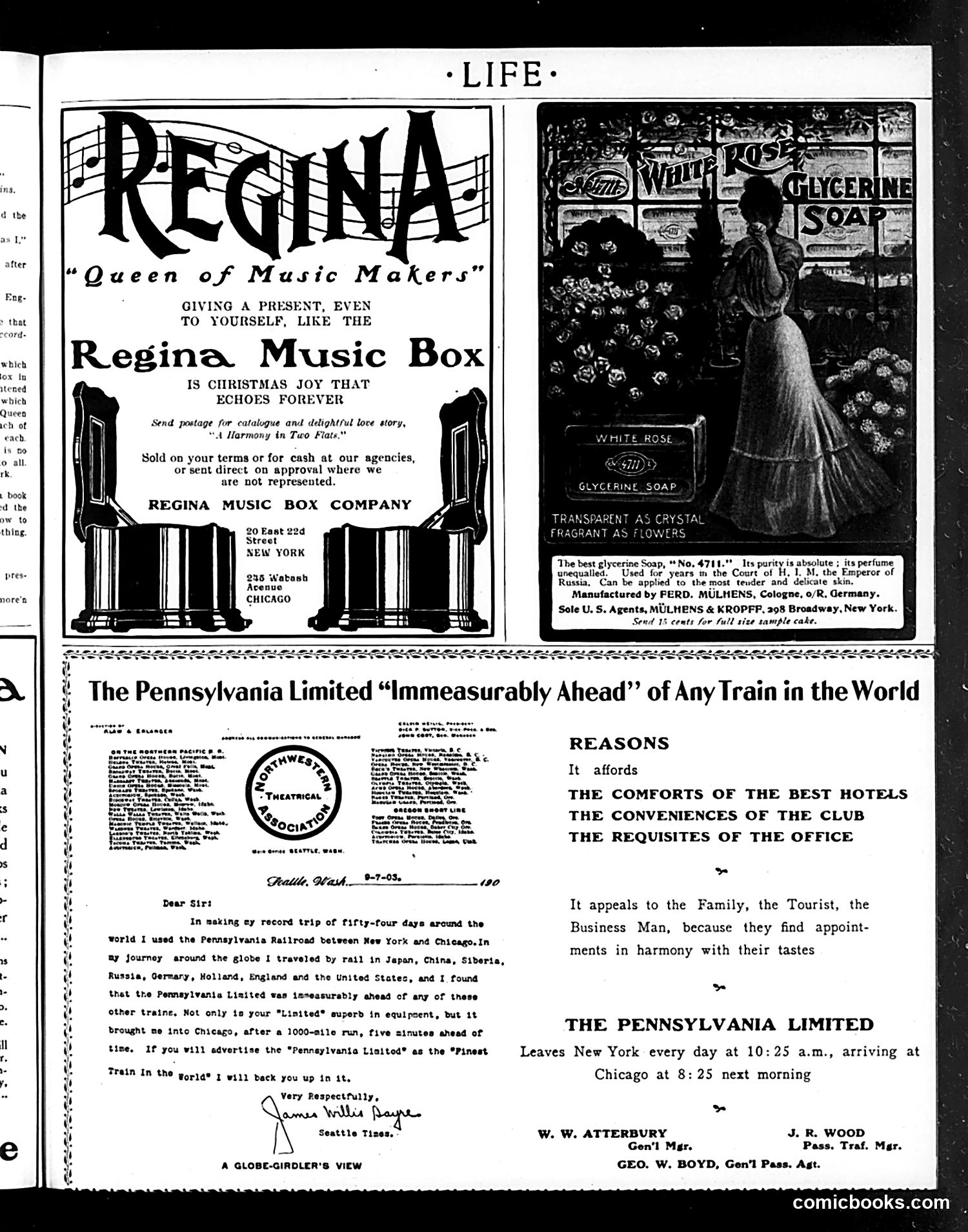
This is primarily an **advertising page**, not satirical content. It contains three distinct advertisements: 1. **Regina Music Box** (top left): A Christmas gift advertisement for mechanical music boxes, emphasizing their ability to provide lasting joy ("Christmas joy that echoes forever"). 2. **White Rose Glycerine Soap** (top right): An advertisement for German-manufactured soap marketed as luxurious and pure, claiming use in the Russian Imperial Court. 3. **Pennsylvania Limited Train** (bottom half): The largest advertisement features a testimonial letter from "James Willis Jayne" of Seattle Times, praising the Pennsylvania Railroad's train service. He claims to have traveled globally by rail and found the Pennsylvania Limited superior to trains in Japan, China, Siberia, Russia, Germany, and England—emphasizing American industrial superiority. The page reflects early 20th-century consumer advertising and American pride in modern transportation technology, with no apparent satirical intent.
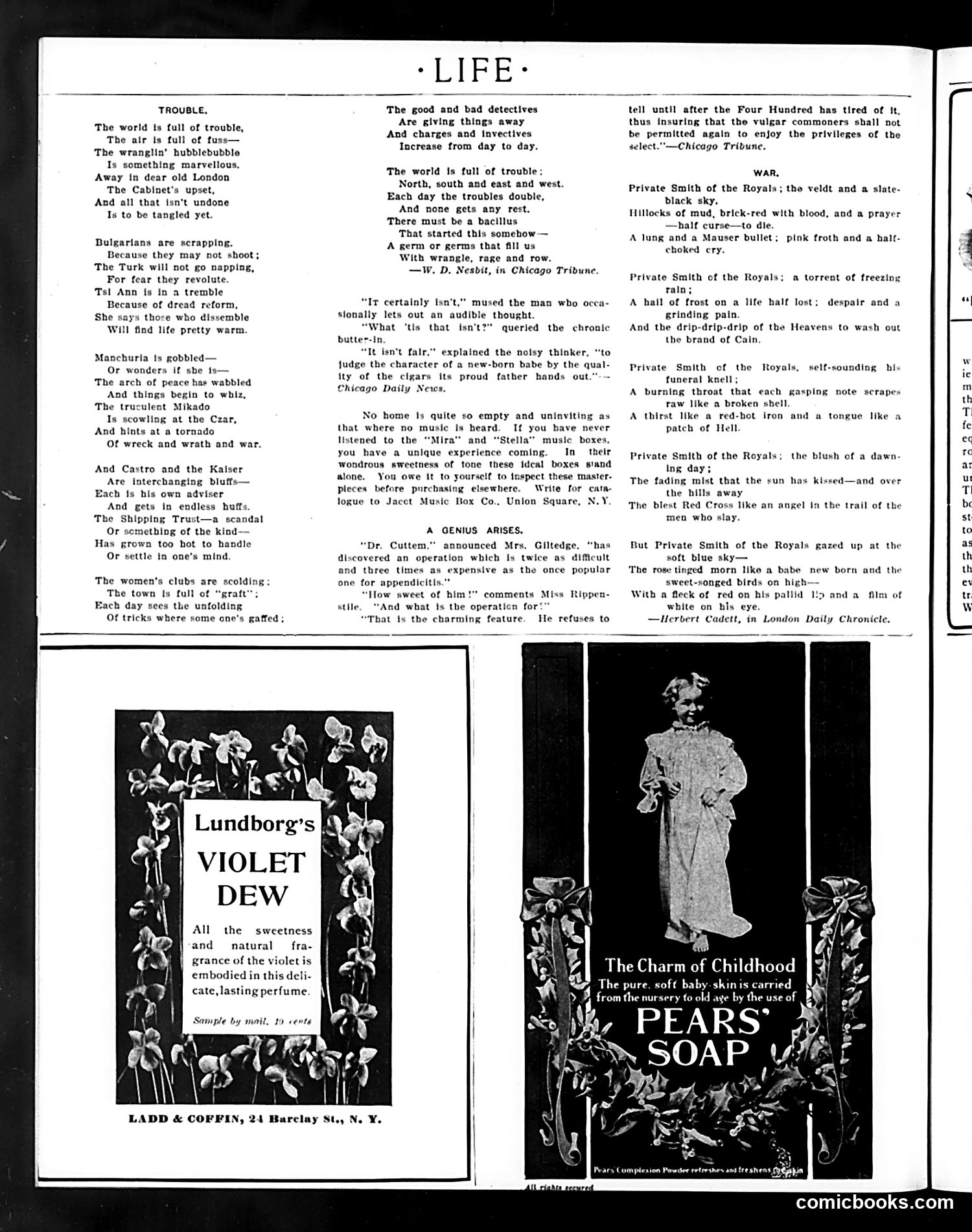
This page contains poetry and satirical commentary on early 1900s political and social troubles. **"Trouble"** (left column) is a humorous poem cataloging contemporary crises: the British Cabinet's instability, the Macedonian conflicts, the Russo-Japanese tensions ("The truculent Mikado / Is scowling at the Czar"), Theodore Roosevelt and the Kaiser's international posturing, monopoly scandals (the "Shipping Trust"), municipal corruption ("graft"), and detective corruption. The poem suggests all these disparate troubles stem from a common "bacillus"—a germ of conflict infecting society broadly. **"War"** (right column) is a stark, poetic depiction of a British soldier ("Private Smith of the Royals") dying on the South African veldt, likely referencing the recent Boer War. The poem contrasts his suffering with the Red Cross's mercy work, ending with an image of death's strange peace. The advertisements below are period products (Lundborg's Violet Dew perfume, Pears' Soap), unrelated to the editorial content.
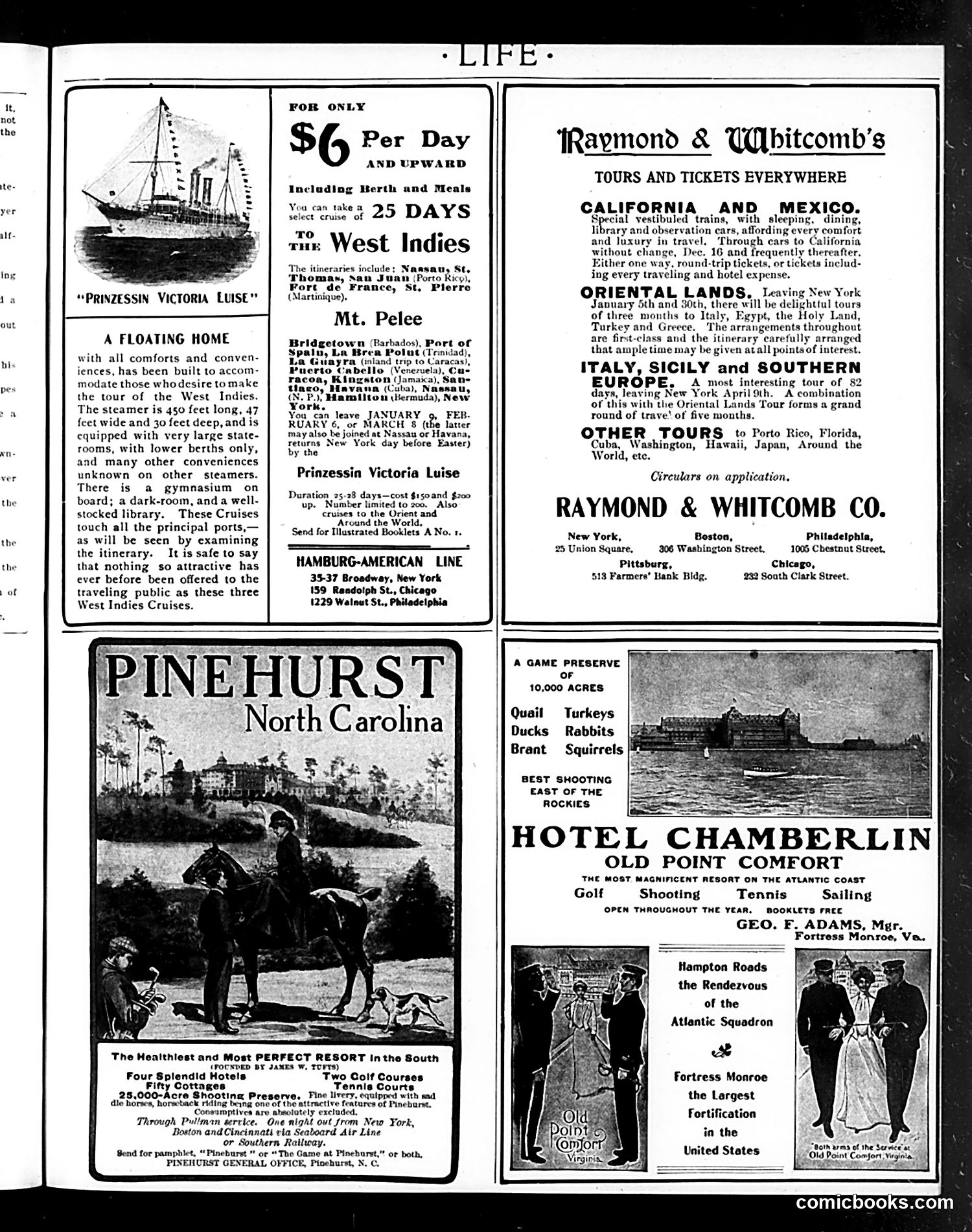
This page is entirely **advertising**, not satirical cartoons. It promotes luxury travel and resort destinations for wealthy Americans. The ads feature: 1. **Prinzessin Victoria Luise** – A German cruise ship offering 25-day West Indies tours for $6/day (all-inclusive), run by Hamburg-American Line 2. **Raymond & Whitcomb** – A tour company advertising trips to California, Mexico, the Orient, Italy, Egypt, and the Holy Land 3. **Pinehurst, North Carolina** – A exclusive resort with golf, shooting preserve, and fine hotels 4. **Hotel Chamberlin** – An Atlantic Coast resort at Old Point Comfort offering golf, sailing, and shooting The underlying appeal across all ads is **leisure travel for the affluent**. These destinations and prices represent Gilded Age luxury tourism, when such extended vacations and ocean cruises were accessible only to the wealthy. There is no satire or political commentary visible on this page.
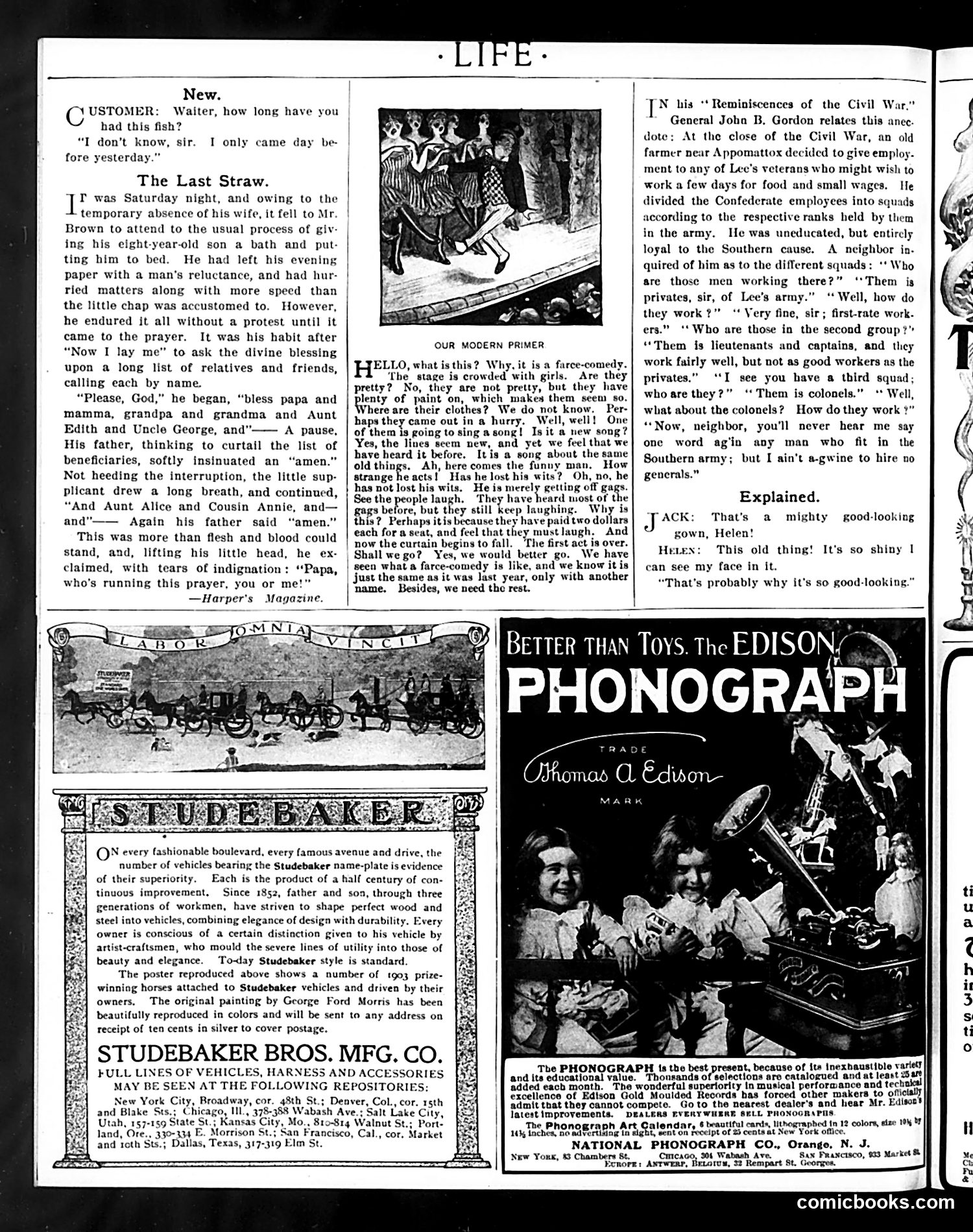
This page contains three distinct pieces of satire: **"The Last Straw"** mocks patriarchal impatience. A father interrupts his son's bedtime prayer to speed things along, but the child indignantly protests: "Who's running this prayer, you or me!" The joke satirizes fathers' reluctance to engage in domestic duties and their assumption of authority even in moments meant for children's devotion. **"Our Modern Primer"** offers dry social commentary on theatrical farce-comedies: cheaply painted actresses, recycled jokes, and audience members laughing because they've paid admission, not because content is genuinely funny. It critiques both the entertainment industry's cynicism and audience complicity. **"Explained"** is a brief flirtation joke where Jack compliments Helen's shiny gown; she downplays it as old, but he suggests its reflective quality lets him admire her face—a genteel compliment playing on vanity and appearance standards. The page also includes advertisements for Studebaker vehicles and Edison phonographs. Overall, the content reflects early-20th-century concerns with gender dynamics, commercial entertainment quality, and courtship rituals.
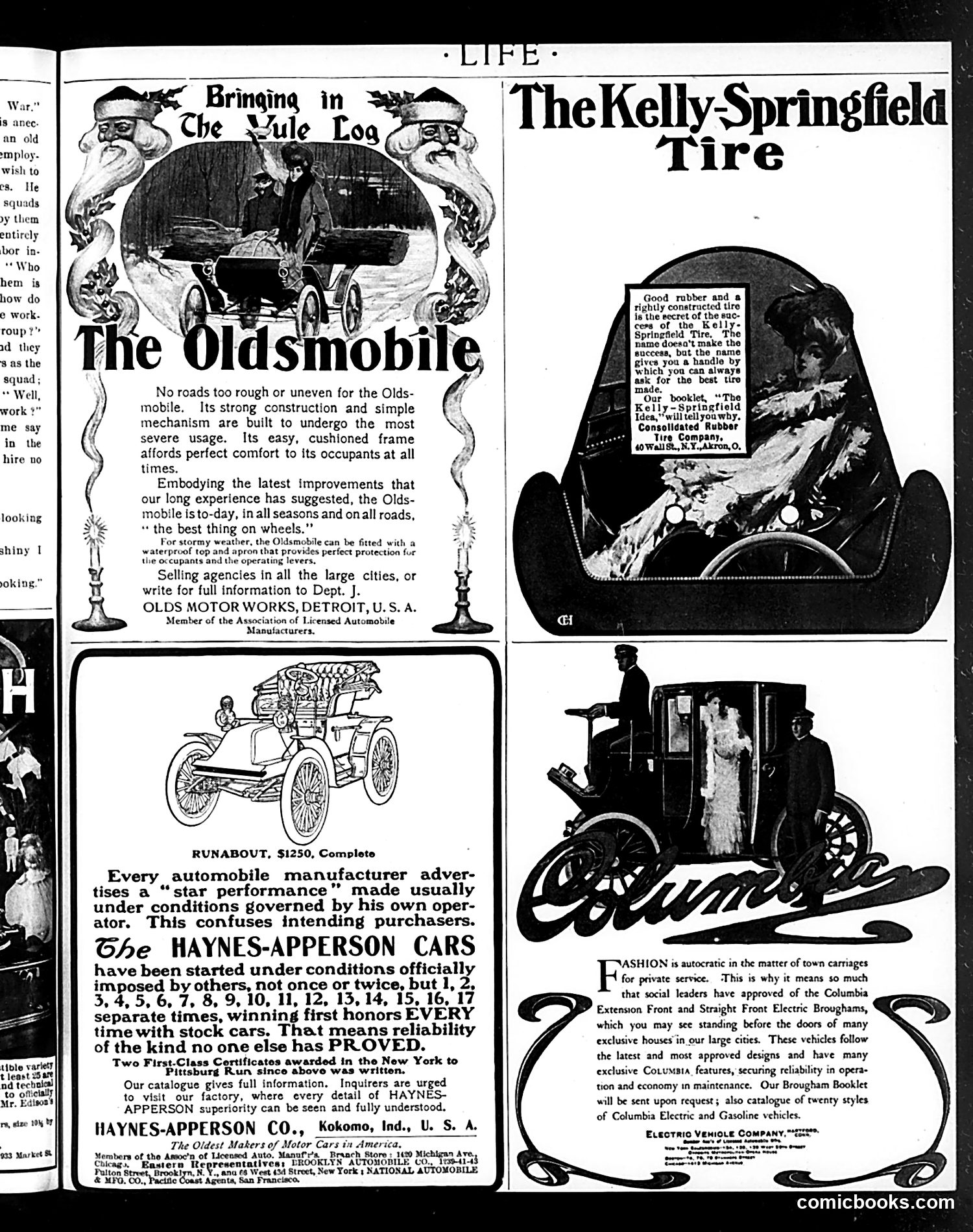
This page is primarily **automobile advertisements** from the early 1900s, not political satire. It contains four car ads: 1. **Oldsmobile** - emphasizes durability on rough roads with comfort 2. **Kelly-Springfield Tire** - promotes quality rubber and tire construction 3. **Haynes-Apperson Cars** - claims reliability by citing official performance tests and racing victories (notably two "First-Class Certificates" from a New York-to-Pittsburgh run) 4. **Columbia Electric Vehicle** - markets luxury electric broughams to wealthy clientele and "social leaders" The only satirical element appears in the Haynes-Apperson text, which **mocks competitors' advertising practices**—criticizing how manufacturers stage performances under their own controlled conditions, then contrasts this with Haynes-Apperson's independently verified reliability record. The decorative header "Bringing in the Yule Log" with Santa figures is seasonal holiday imagery, not commentary. This is essentially a product-focused trade publication page rather than satirical content.
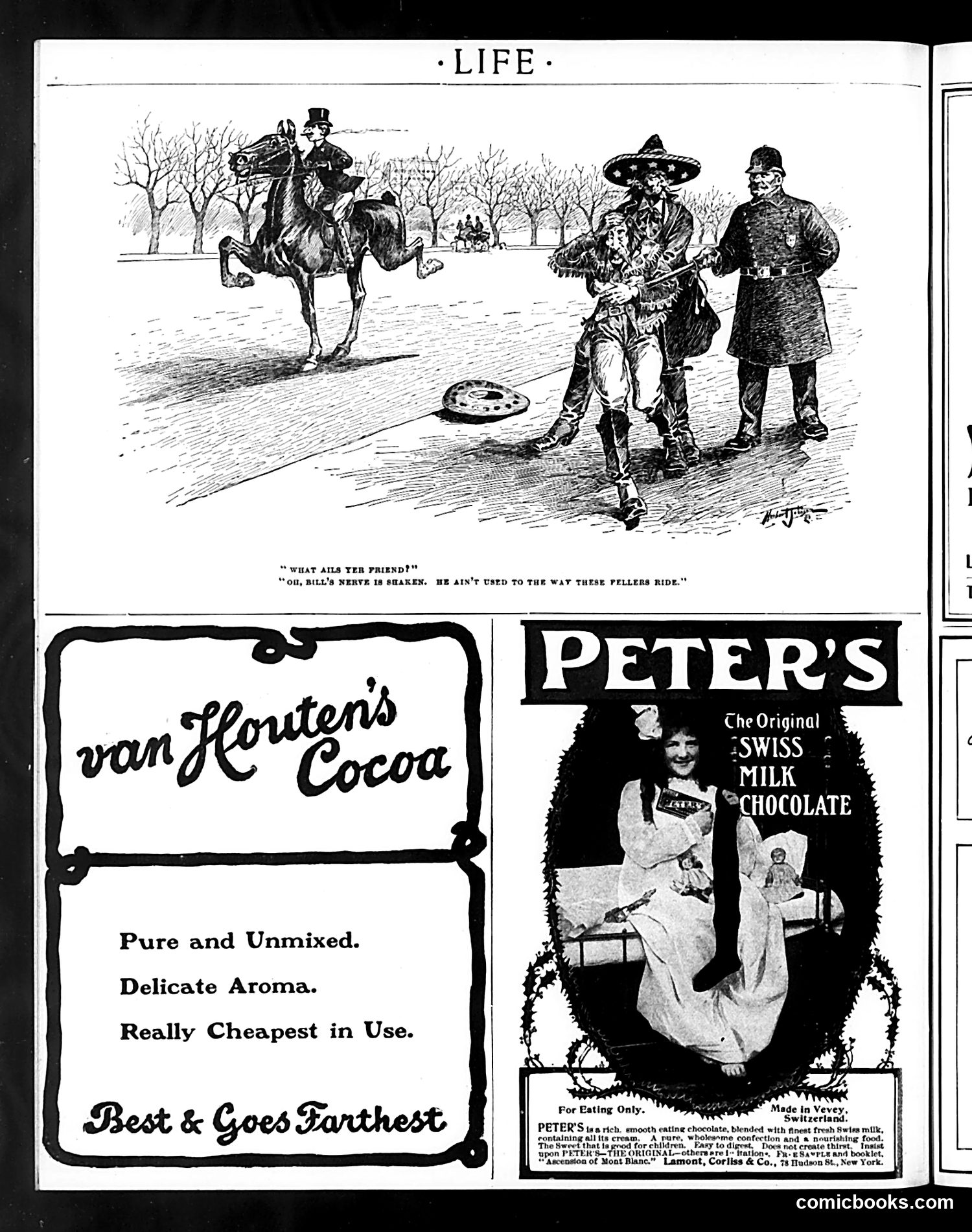
The top cartoon depicts two well-dressed men discussing a nervous friend on horseback. "Bill's nerve is shaken," one explains, "We ain't used to the way these fellers ride." This appears to satirize wealthy or upper-class men unaccustomed to riding alongside working-class or immigrant laborers—likely referencing anxieties about social mixing or the presence of newcomers in traditionally exclusive spaces. The page is otherwise dominated by period advertisements: van Houten's cocoa ("Pure and Unmixed") and Peter's Swiss milk chocolate. These ads are typical Life magazine filler, not editorial content. The cartoon's humor relies on class-consciousness common to early 20th-century American satire, though specific historical context remains unclear without publication date information.
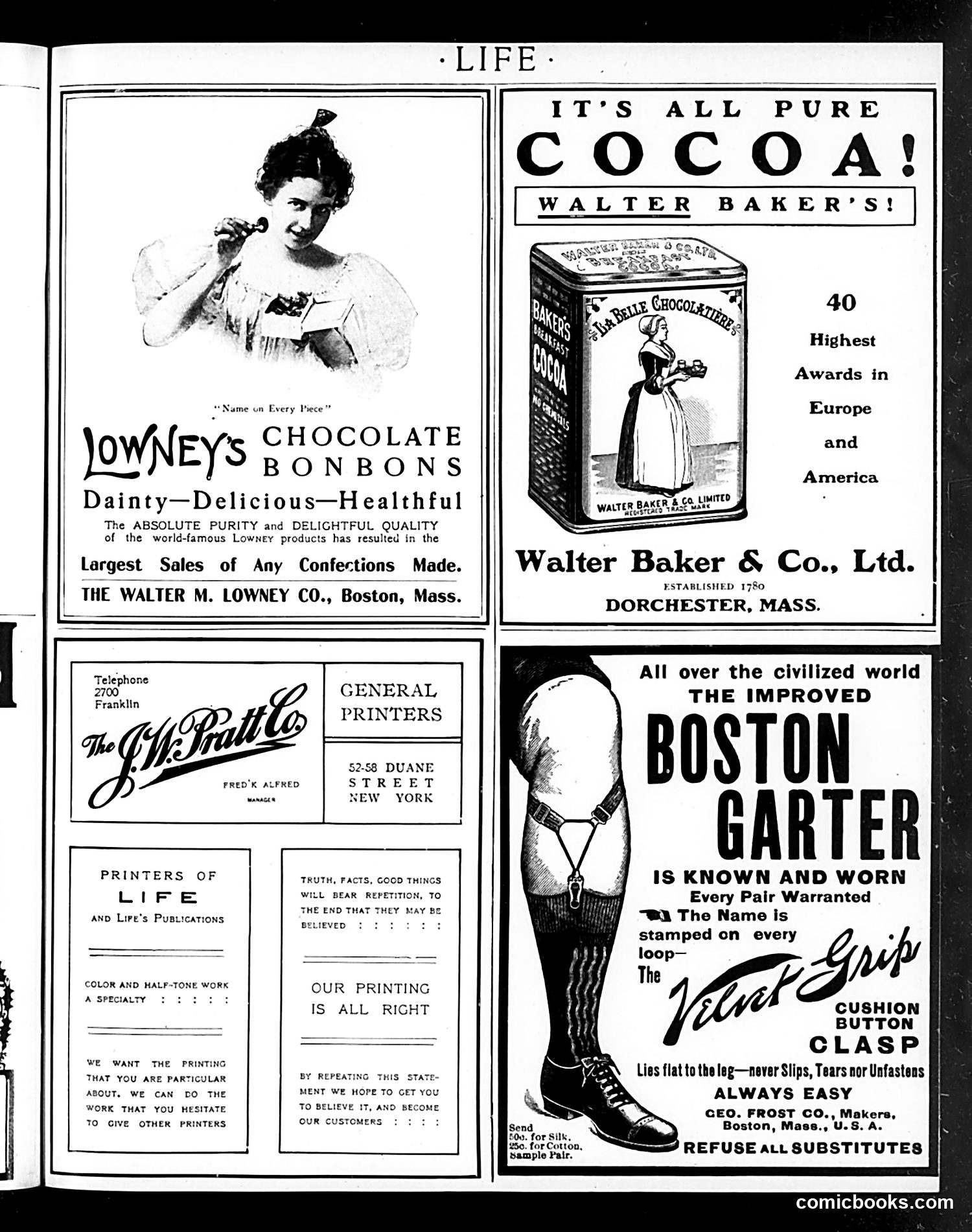
This page is primarily **advertising**, not satire or political commentary. It contains four distinct ads from early 20th-century American companies: 1. **Lowney's Chocolate Bonbons** — emphasizes "absolute purity" and claims largest sales of any confection 2. **Walter Baker & Co. Cocoa** — highlights 40 international awards, established 1780 3. **J.D. Batillo General Printers** — self-promotional ad stressing quality printing work 4. **Boston Garter** — advertises men's garters with "velvet grip" and cushion clasp, emphasizing durability The only visual element is a photograph of a woman in Edwardian dress with a spoon (Lowney's ad) and a detailed drawing of a leg/boot wearing the Boston Garter. There is **no cartoon or satire present**. The page represents typical Life magazine advertising from the early 1900s, showcasing consumer goods with period-appropriate marketing claims about quality and reputation. The ads reflect social context (emphasis on "purity," imported prestige, men's fashion accessories) but contain no satirical commentary.
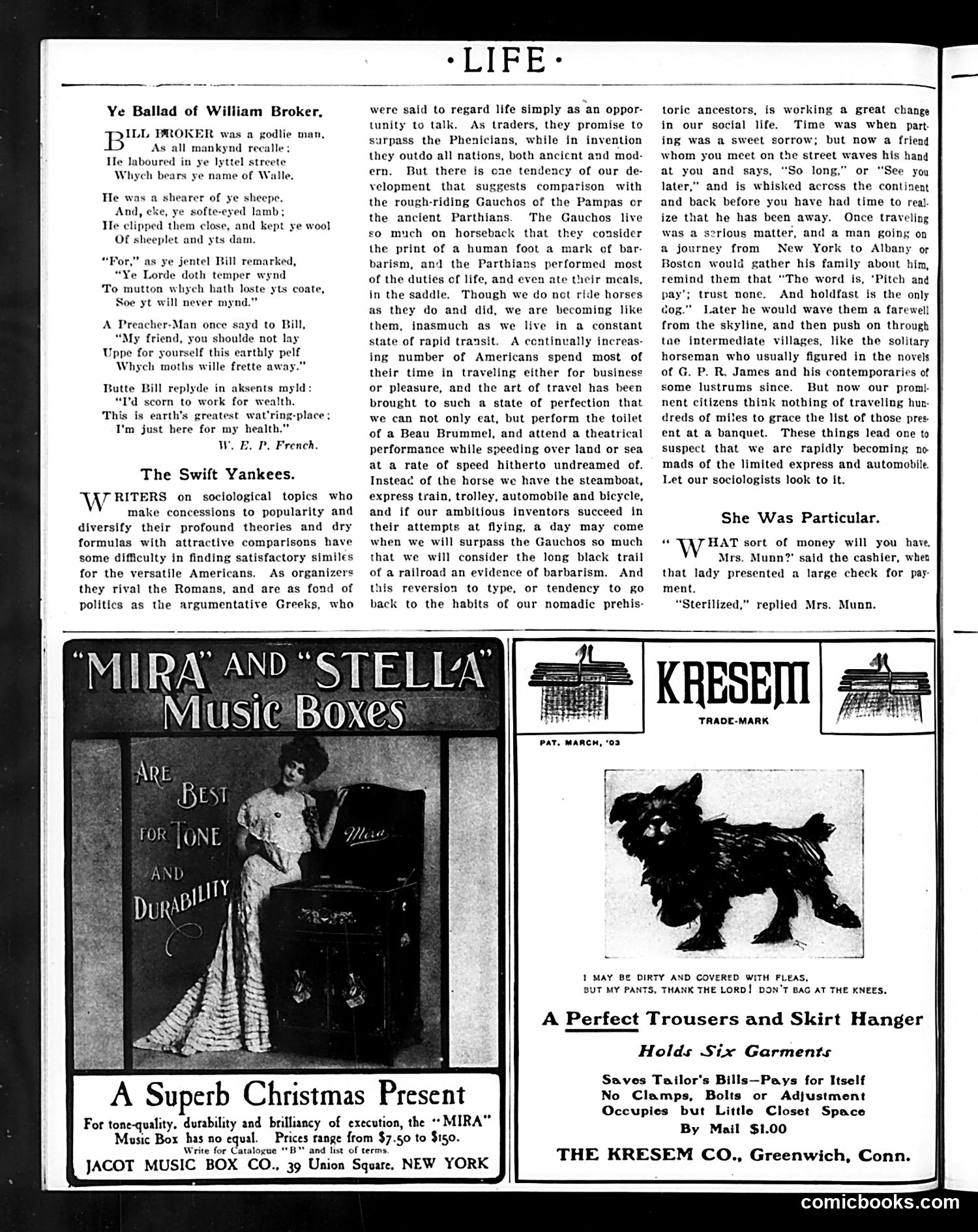
This page contains literary and social commentary rather than political cartoons. **"Ye Ballad of William Broker"** is a mock-archaic poem (written by W.E.P. French) about a sheep shearer who, when a preacher warns him against earthly accumulation, replies he works only "for my health"—a humorous deflation of the preacher's piety and a dig at Americans prioritizing leisure. **"The Swift Yankees"** is a sociological essay comparing Americans to historical nomads (Gauchos, Parthians) who conducted life while traveling. The author observes that Americans increasingly live in "constant state of rapid transit" via trains, trolleys, and automobiles—eating, grooming, and attending theater while moving. The piece suggests this constant mobility represents a reversion to nomadic prehistory, warning that sociologists should study this social transformation. Both pieces use humor and historical analogy to satirize American behavior: worship of wealth versus claimed indifference to it, and modern restlessness masquerading as progress. The advertisements below are unrelated product pitches.
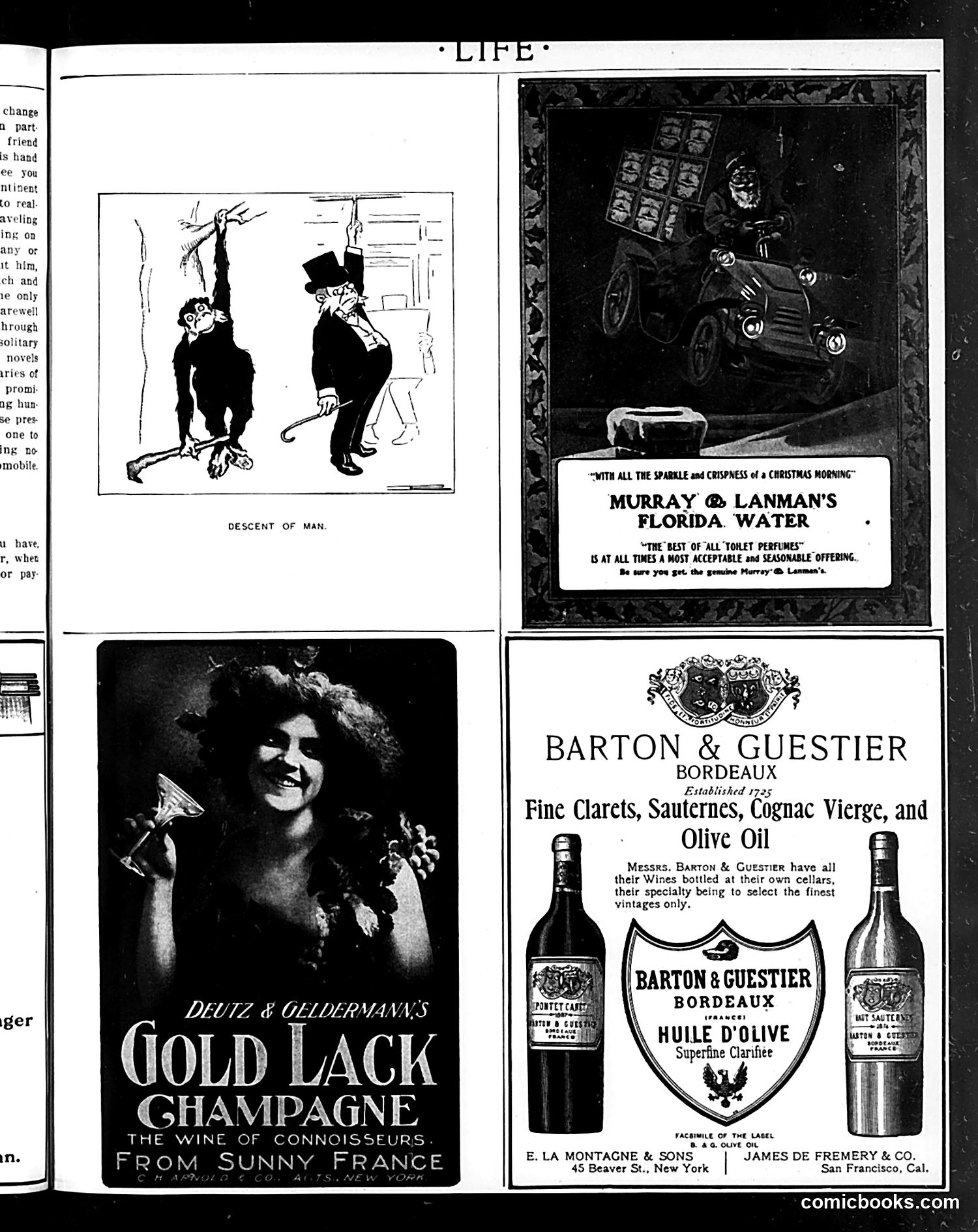
The cartoon titled "Descent of Man" depicts two figures in formal attire (top hats and coats) in increasingly hunched, ape-like postures, appearing to devolve from human to primate form. This is a satirical reference to Darwin's theory of evolution, specifically mocking the controversial idea that humans descended from apes. The joke likely critiques either: - Those who reject evolutionary theory as absurd - Wealthy or pretentious members of society, suggesting their behavior is "uncivilized" or base The surrounding page consists primarily of **period advertisements** for luxury goods (champagne, cognac, olive oil, perfume)—typical of Life magazine's revenue model. These ads are unrelated to the cartoon's social commentary and represent standard magazine content of the era.
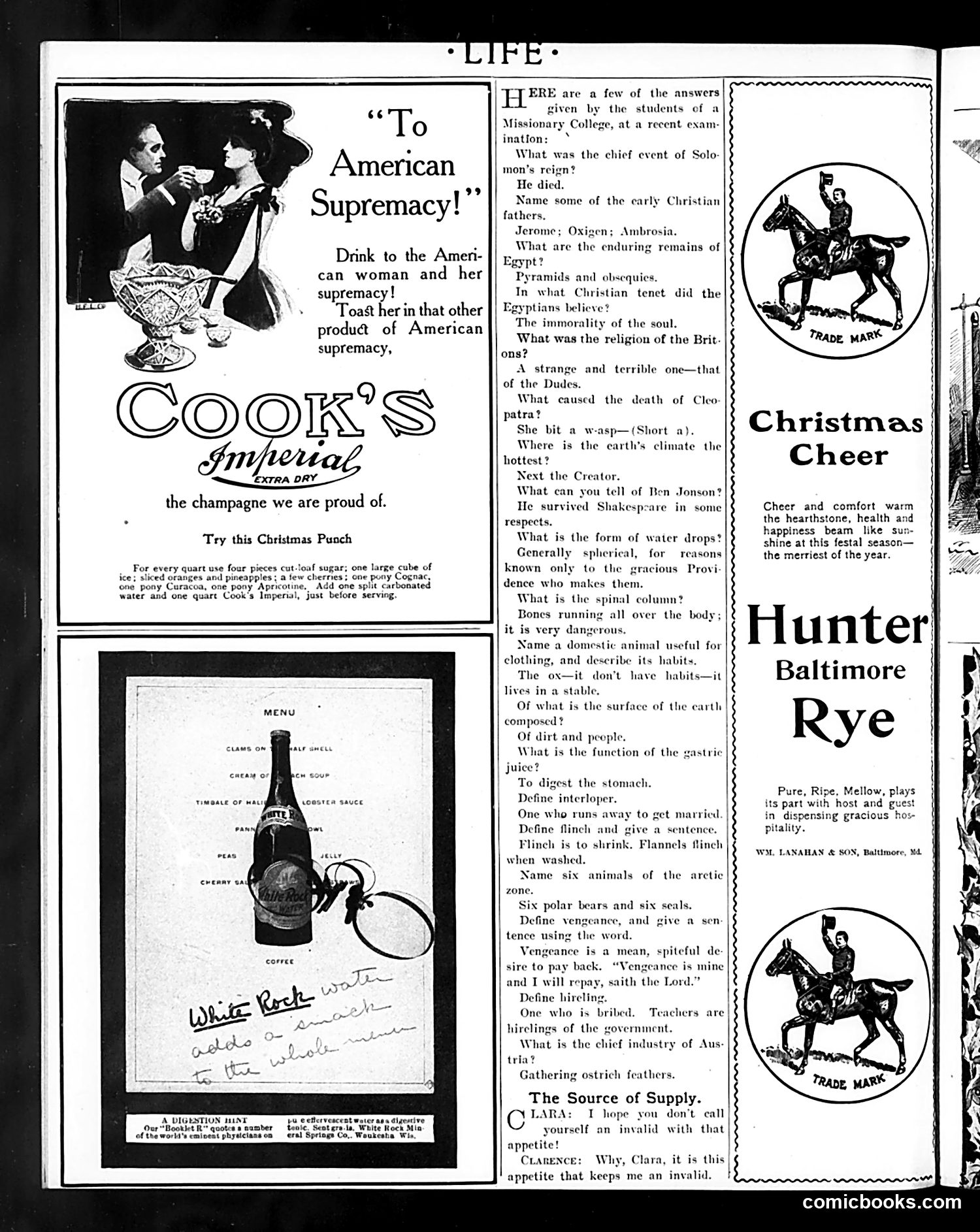
This page combines advertisement with satirical content typical of Life magazine's format. **The Main Cartoon (top left):** A man toasts a woman with champagne, promoting Cook's Imperial champagne as a product of "American supremacy." The joke mocks the era's celebration of American superiority by suggesting even champagne—a French product—represents American achievement. This satirizes American nationalism and consumerism of the early 20th century. **The Exam Answers Section:** Life presents deliberately absurd answers supposedly given by Missionary College students—clearly fictional satire poking fun at education quality and student ignorance. Examples include "He died" for Solomon's chief event, and "The religion of the Britons? That of the Dudes." This mocks both students and perhaps religious education institutions. **The Remaining Content:** Advertisements for Hunter Baltimore Rye whiskey and a brief comic dialogue between Clara and Clarence about appetite and invalidism complete the page—standard period advertising mixed with light humor. The page exemplifies Life's blend of social satire with commercial messaging.
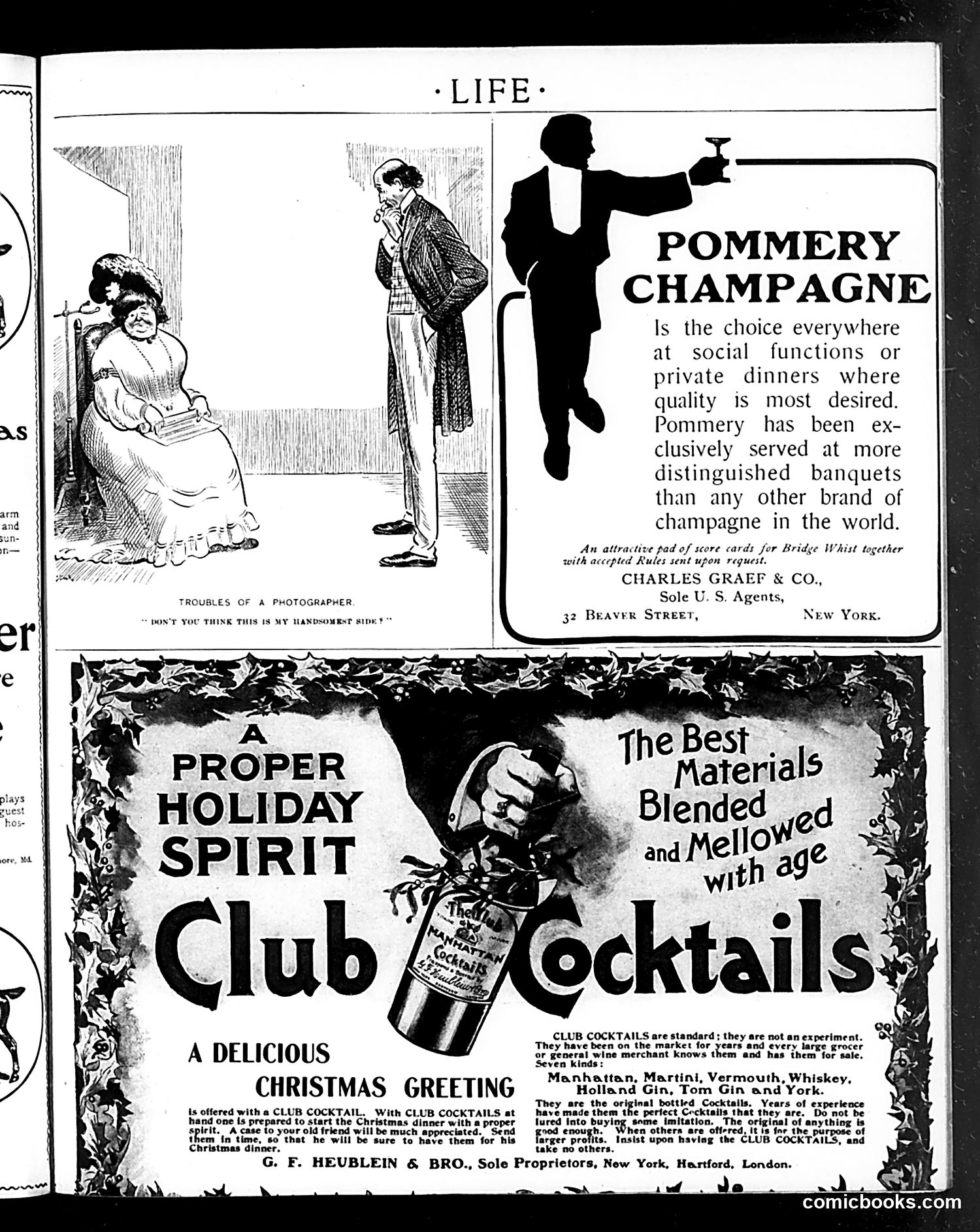
This page is primarily **advertising content** rather than satirical commentary. The main cartoon, titled "Troubles of a Photographer," depicts a domestic scene where a woman seated complains to a thin man, saying "Don't you think this is my handsome side?" — a gentle joke about vanity and photography, likely reflecting early 20th-century attitudes toward portrait photography. The advertisements promote luxury goods appropriate to the era's upper-class social life: Pommery Champagne (emphasizing exclusivity at "distinguished banquets"), Club Cocktails (claiming originality and superiority over imitators), and Bridge Whist score cards. The ads reveal period social customs: formal dinner entertaining, cocktail culture, and card games among the wealthy. The language stresses quality, tradition, and exclusivity—selling status as much as products. No specific political figures or events appear to be referenced; this reflects early 1900s consumer culture and genteel social conventions.
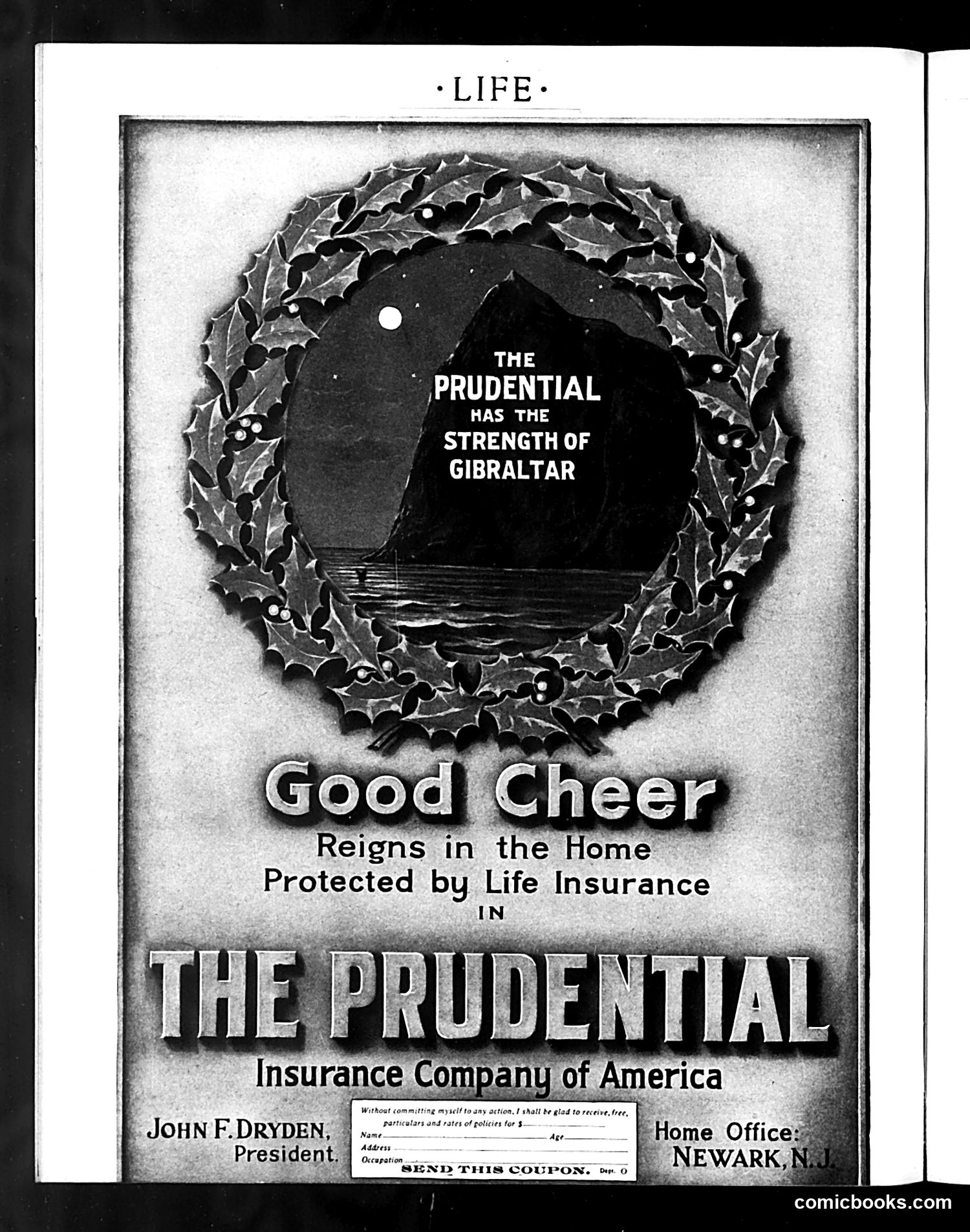
This is primarily an **advertisement** for The Prudential Insurance Company of America, not a political cartoon. The page uses the visual metaphor of a holly wreath framing the Rock of Gibraltar to convey the company's slogan: "The Prudential has the strength of Gibraltar." The ad's message is straightforward: life insurance provides security and "Good Cheer" to the home. The holly wreath suggests seasonal marketing (likely Christmas), while Gibraltar—a famously massive, immovable rock formation—symbolizes stability and strength. The coupon at bottom invited readers to request information about policies. This appears to be early 20th-century insurance marketing employing patriotic and protective imagery to appeal to American families seeking financial security.
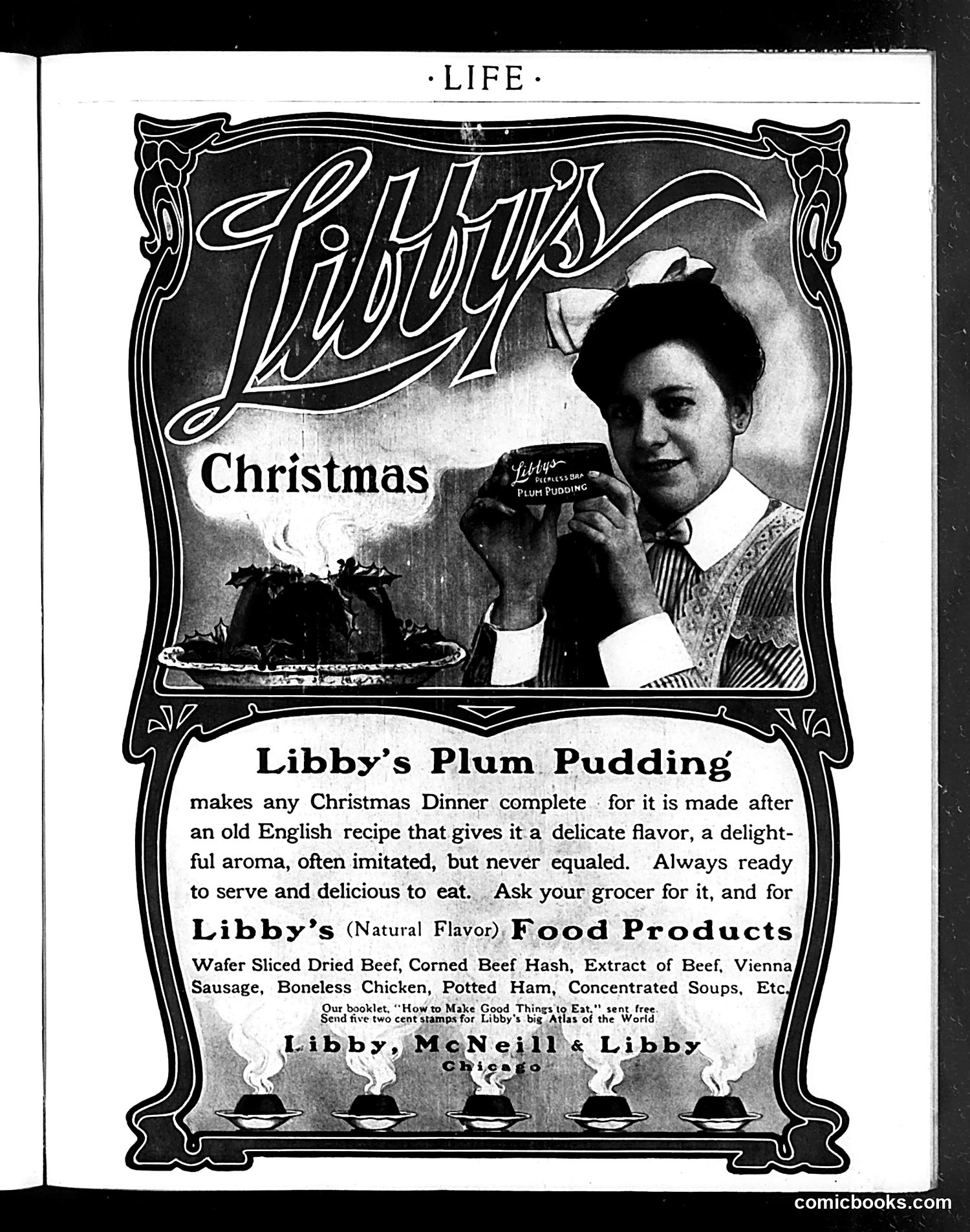
This is a **product advertisement, not political satire**. It promotes Libby's canned plum pudding as an essential Christmas dinner item, marketed to American consumers as an "old English recipe." The image shows a well-dressed man in formal attire holding a Libby's product box, with a plated pudding visible. The ornate Art Nouveau frame and "Life" magazine branding indicate this is from the early 1900s. The appeal relies on **class aspiration and cultural authority**: positioning the product as authentically English (prestigious) while emphasizing convenience—"always ready to serve"—for middle-class American households seeking to replicate formal holiday dining without traditional labor. The text lists Libby's broader canned meat products, with a promotional offer for their "Atlas of the World" booklet to incentivize purchase.
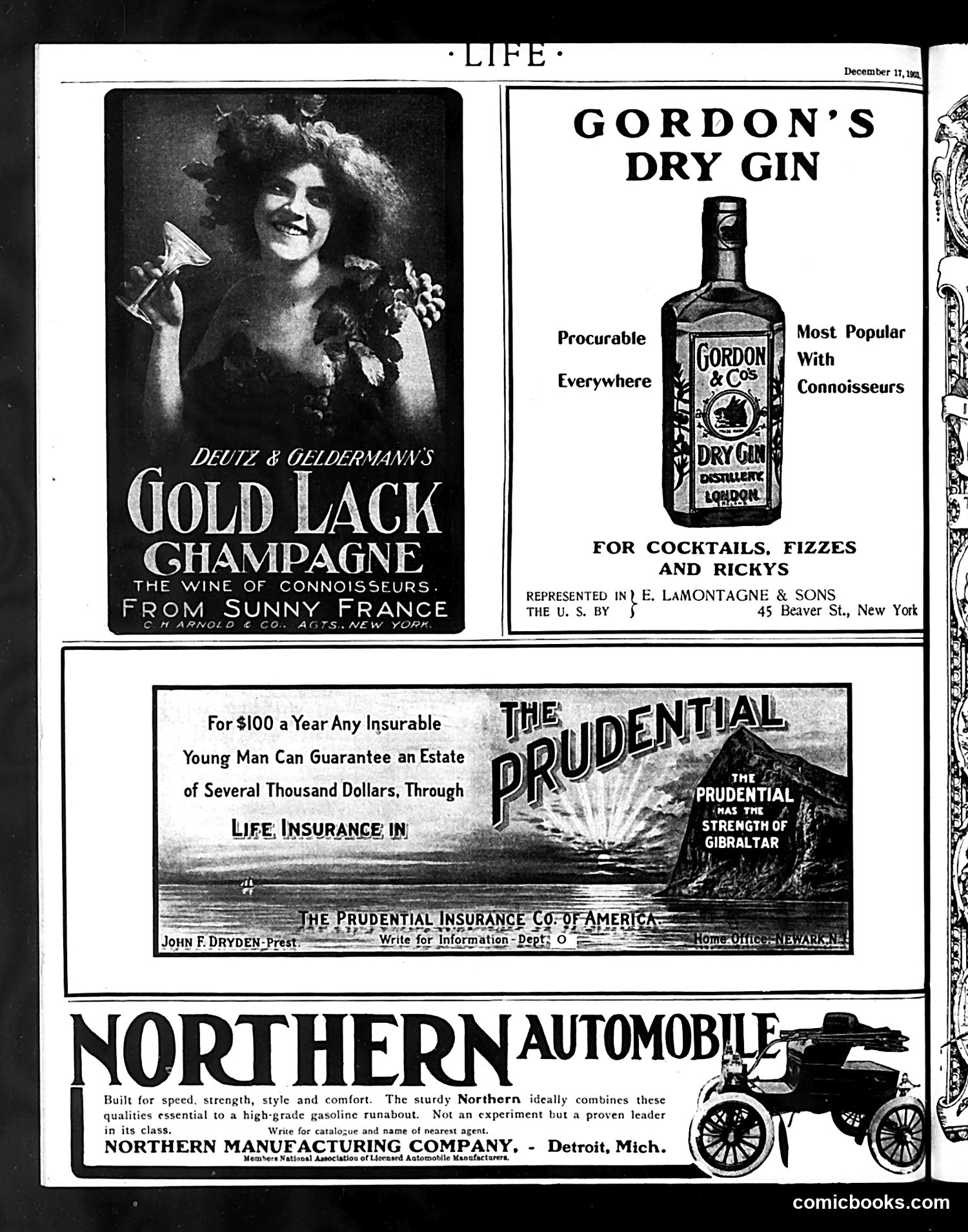
This is primarily a **advertising page**, not editorial satire. It contains four product advertisements typical of the 1920s: 1. **Gold Lack Champagne**: Markets a French champagne as refined luxury for connoisseurs, featuring a smiling woman with a cocktail. 2. **Gordon's Dry Gin**: Promotes gin as suitable for cocktails and mixed drinks—notable because this was during **Prohibition** (1920-1933), yet alcohol advertisements still appeared in magazines, a legal gray area of the era. 3. **Prudential Insurance**: Offers young men affordable life insurance ($100/year) to secure estates—reflecting emerging middle-class financial planning. 4. **Northern Automobile**: Pitches a Detroit-made car emphasizing American manufacturing reliability over European imports. The page reflects 1920s consumer culture and advertising conventions rather than political satire. The champagne and gin ads are particularly striking given contemporary Prohibition laws.