
Life, 1903-12-10 · page 52 of 58
Life — December 10, 1903 — page 52: what you’re looking at
What you’re looking at
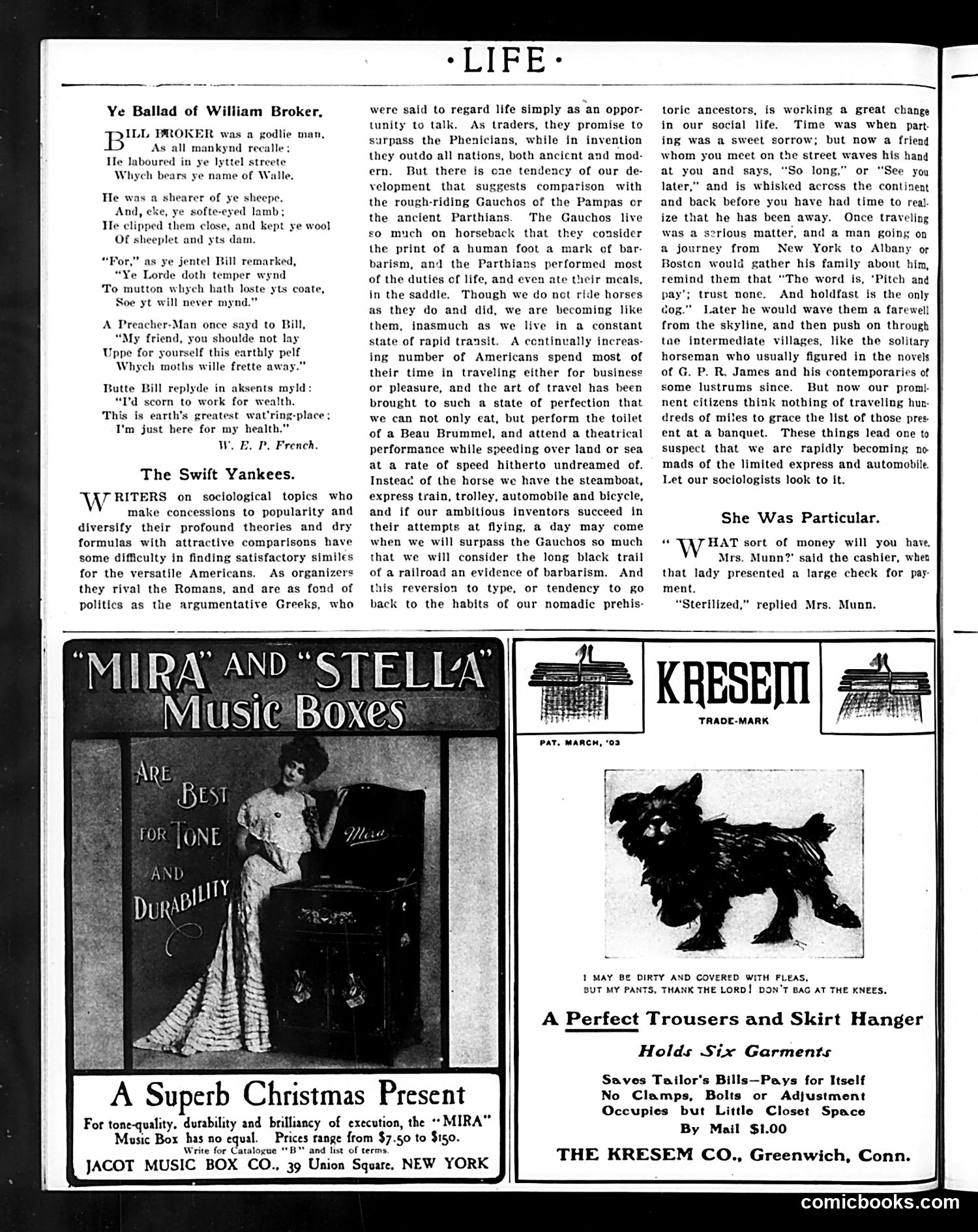
This page contains literary and social commentary rather than political cartoons. **"Ye Ballad of William Broker"** is a mock-archaic poem (written by W.E.P. French) about a sheep shearer who, when a preacher warns him against earthly accumulation, replies he works only "for my health"—a humorous deflation of the preacher's piety and a dig at Americans prioritizing leisure. **"The Swift Yankees"** is a sociological essay comparing Americans to historical nomads (Gauchos, Parthians) who conducted life while traveling. The author observes that Americans increasingly live in "constant state of rapid transit" via trains, trolleys, and automobiles—eating, grooming, and attending theater while moving. The piece suggests this constant mobility represents a reversion to nomadic prehistory, warning that sociologists should study this social transformation. Both pieces use humor and historical analogy to satirize American behavior: worship of wealth versus claimed indifference to it, and modern restlessness masquerading as progress. The advertisements below are unrelated product pitches.
📄 Transcribed text from this page (OCR, searchable)
Machine-transcribed from the original scan — historical spelling and the odd misread are preserved.
“LIFE: Ye Ballad of William Broker, Bu BROKER was a godlie man, As all mankynd recalle ; He laboured in ye lyttel streete Whych bears ye name of Walle. Te was a shearer of ye sheepe, And, eh softe-cyed lamb; He clipped them close, and kept ye wool Of sheeplet and yts dam. “For,” as ye jentel Bill remarked, “Ye Lorde doth temper wynd ‘To mutton whych hath loste yts coate, Soe yt will never mynd.” A Preacher-Man once sayd to Bill, “My friend, you shoulde not lay Uppe for yourself this earthly pelf Whych moths wille frette away.” Butte Bill replyde in aksents myld: “['d scorn to work for wealth. This is earth’s greatest wat'ring-place ; I'm just here for my health.” W. BE. P. French. The Swift Yankees. W RITERS on sociological topics who make concessions to popularity and diversify their profound theories and dry formulas with attractive comparisons have some difficulty in finding satisfactory similes for the versatile Americans. As organizers they rival the Romans, and are as fond of politics as the argumentative Greeks, who were said to regard life simply as ‘an oppor- tunity to talk. As traders, they promise to surpass the Phenicians, while in invention they outdo all nations, both ancient and mod- ern. But there is one tendency of our de- velopment that suggests comparison with the rough-riding Gauchos of the Pampas er the ancient Parthians. The Gauchos live so much on horseback that they consider the print of a human foot a mark of bar- barism, and the Parthians performed most of the duties of life, and even ate their meals, in the saddle. Though we do not ride horses as they do and did, we are becoming like them, inasmuch as we live in a constant state of rapid transit. A ccntinually increas- ing number of Americans spend most of their time in traveling either for business or pleasure, and the art of travel has been brought to such a state of perfection that we can not only eat, but perform the toilet of a Beau Brummel, and attend a theatrical performance while speeding over land or sea at a rate of speed hitherto undreamed of. Insteac of the horse we have the steamboat, express train, trolley, automobile and bicycle, and if our ambitious inventors succeed in their attempts at flying, a day may come when we will surpass the Gauchos so much that we will consider the long black trail of a railroad an evidence of barbarism. And this reversion to type, or tendency to go back to the habits of our nomadic prehis- SE toric ancestors, is working a great change in our social life. Time was when part. ing was a sweet sorrow; but now a friend whom you meet on the street waves his hand at you and says, “So long,” or “See you later,” and is whisked across the continent and back before you have had time to real. ize that he has been away. Once traveling was a serious matter, and a man going on a journey from New York to Albany or Bosten would gather his family about him, remind them that “The word is, ‘Pitch and trust none. And holdfast is the only Later he would wave them a farewell from the skyline, and then push on through tae intermediate villages, like the solitary horseman who usually figured in the novels of G. P. R, James and his contemporaries of some lustrums since. But now our promi nent citizens think nothing of traveling hun- dreds of mites to grace the Hst of those pres. ent at a banquet. These things lead one to suspect that we are rapidly becoming no mads of the limited express and automobile. Let our sociologists look to it. She Was Particular. « Wat sort of money will you have, Mrs. Munn?’ said the cashier, when that lady presented a large check for pay- ment. “Sterilized,” replied Mrs. Munn. “MIRA AND “STELLA MUuSIe Boxes: For tone-quality, durability and brilliancy of execution, the «* MIRA” Prices range from $7.50 to $150. Write for Catalogue **B** and list of terms. JACOT MUSIC BOX CO., 39 Union Square, NEW YORK Music Box has no equal. KRESEJII TRADE-MARK 1 MAY BE DIRTY AND COVERED WITH FLEAS, BUT MY PANTS, THANK THE LORD! DON'T BAG AT THE KNEES, A Perfect Trousers and Skirt Hanger Holds Six Garments Saves Tailor’s Bills—Pays for Itself No Clamps, Occupies but Little Closet Space Bolts or Adjustment By Mail $1.00 THE KRESEM CO., Greenwich, Conn. comicbooks.com