
Life, 1903-12-10 · page 4 of 58
Life — December 10, 1903 — page 4: what you’re looking at
What you’re looking at
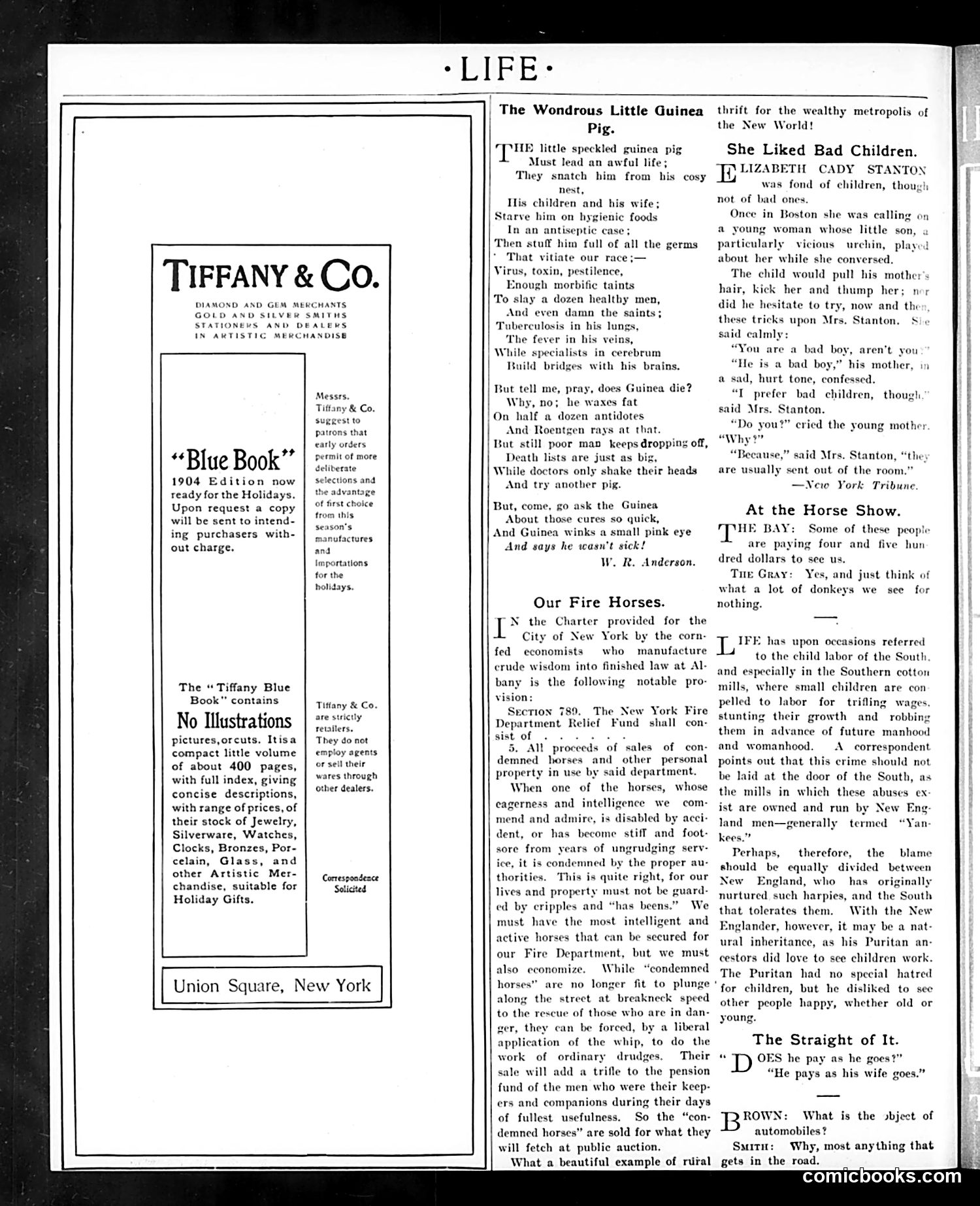
This Life magazine page is primarily **advertising and miscellaneous content** rather than political satire. The left side features a **Tiffany & Co. advertisement** for their "Blue Book" (1904 edition), a luxury catalog of jewelry, silverware, and decorative arts. The right side contains several brief **humorous anecdotes and jokes**: - "The Wondrous Little Guinea Pig" - a satirical poem about a sickly guinea pig (likely mocking pseudo-scientific medical claims) - "She Liked Bad Children" - a story about Elizabeth Cady Stanton's fondness for misbehaving children - "At the Horse Show," "Our Fire Horses," and "The Straight of It" - short comedic pieces about everyday urban topics The page represents **typical early 1900s Life magazine content**: mixing high-end advertising with light social humor targeting educated, affluent readers.
📄 Transcribed text from this page (OCR, searchable)
Machine-transcribed from the original scan — historical spelling and the odd misread are preserved.
LIFE: TIFFANY & Co. DIAMOND AND GEM MERCHANTS, GOLD AND SILVER SMITHS STATIONERS AND DEALERS IN ARTISTIC MERCHANDISB Messrs. Tiffany & Co. suggest to patrons that early orders permit of more deliberate selections and the advantage of first choice from this season's “Blue Book” 1904 Edition now ready for the Holidays. Upon request a copy will be sent to intend- ing purchasers with- | n°), out charge. i Importations for the holidays, The “Tiffany Blue Book" contains Tieden ca No Illustrations | *“"" retailers. pictures,orcuts. Itisa | They donot compact little volume | employ agents of about 400 pages, | or sell their with full index, giving | ‘9rs through concise descriptions, adler: with range of prices, of their stock of Jewelry, Silverware, Watches, Clocks, Bronzes, Por- celain, Glass, and other Artistic Mer- chandise, suitable for Holiday Gifts. Union Squ: New York | The Wondrous Little Guinea | Pig. Tue little speckled guinea pig Must lead an awful life; They snatch him from his cosy nest, Ilis children and his wife; Starve him on hygienic foods In an antiseptic case ; Then stuff him full of all the germs That vitiate our race ;— Virus, toxin, pestilence, Enough morbific taints To slay a dozen healthy men, And even damn the saints; Tuberculosis in his lungs, The fe in his veins, While specialists in cerebrum Build bridges with his brains. But tell me, pray, does Guinea die? Why, no; he waxes fat | On half a dozen antidotes And Roentgen rays at that. But still poor map keeps dropping off, Death lists are just as big, While doctors only shake their heads And try another pig. But, come, go ask the Guinea About those cures so quick, And Guinea winks a small pink eye And says he wasn't sick! W. R. Anderson. Our Fire Horses. I’ the Charter provided for the City of New York by the corn- fed economists who manufacture crude wisdom into finished law at Al- bany is the following notable pro- vision: Section 789. The New York Fire Department Relief Fund shall con- sistof . . 1. 2 se 5. All proceeds of sales of con- demned horses and other personal property in use by said department. When one of the horses, whose eagerness and intelligence we com- is disabled by acci- dent, or has become stiff and foot- sore from years of ungrudging serv- ice, it is e mned by the proper au- thorities. This is quite right, for our lives and property must not be guard- ed by cripples and “has beens.” We must have the most intelligent and active horses that can be secured for our Fire Department, but we must While “condemned mend and admir also economize. horses’ along the street at breakneck speed to the rescue of those who are in dan- ger, they can be forced, b; liberal application of the whip, to do the work of ordinary drudges. Their sale will add a trifle to the pension fund of the men who were their keep- ers and companions during their days of fullest usefulness. So the “con- demned horses” are sold for what they will fetch at public auction. What a beautiful example of rural are no longer fit to. plunge * thrift for the wealthy metropolis of the New World! She Liked Bad Children. JF_LZABETH CADY STANTON was fond of children, thous! not of bad ones. Once in Boston she was calling on a young woman whose little son, « particularly vicious urehin, pla about her while she conversed. The child would pull his moth hai < her and thump her; ner did he hesitate to try, now and thr these tricks upon Mrs, Stanton, Si uu are a bad boy, aren't you } “He is a bad boy,” his mother, in a sad, hurt tone, confessed. “I prefer bad children, though id Mrs. Stanton. “Do you?” cried the young mother “Why?” “Because,” said Mrs. Stanton, “the are usually sent out of the room.” —New York Tribune. At the Horse Show. TPHE BAY: Some of these people are paying four and five hun dred dollars to see us. Tue Gray: Yes, and just think of what a lot of donkeys we see for nothing. IFE has upon occasions referred to the child labor of the South and especially in the Southern cotton mills, where small children are con pelled to labor for trifling wages. stunting their growth and robbing them in advance of future manhood and womanhood. A correspondent points out that this crime should not be laid at the door of the South, the mills in which these abuses ex ist are owned and run by New Eng: land men—generally termed “Yan kees.” Perhaps, therefore, the blame should be equally divided betwee New England, who has originally nurtured such harpies, and the South that tolerates them, With the New Englander, however, it may be a nat- ural inheritance, as his Puritan an- cestors did love to see children work. The Puritan had no special hatred for children, but he disliked to see other people happy, whether old or young. The Straight of It. “pos he pay as he goes?” “He pays as his wife goes.” ROWN: What is the sbject of automobiles? Ssutn: Why, most anything that gets in the road, comicbooks.com