
Life, 1903-12-10 · page 48 of 58
Life — December 10, 1903 — page 48: what you’re looking at
What you’re looking at
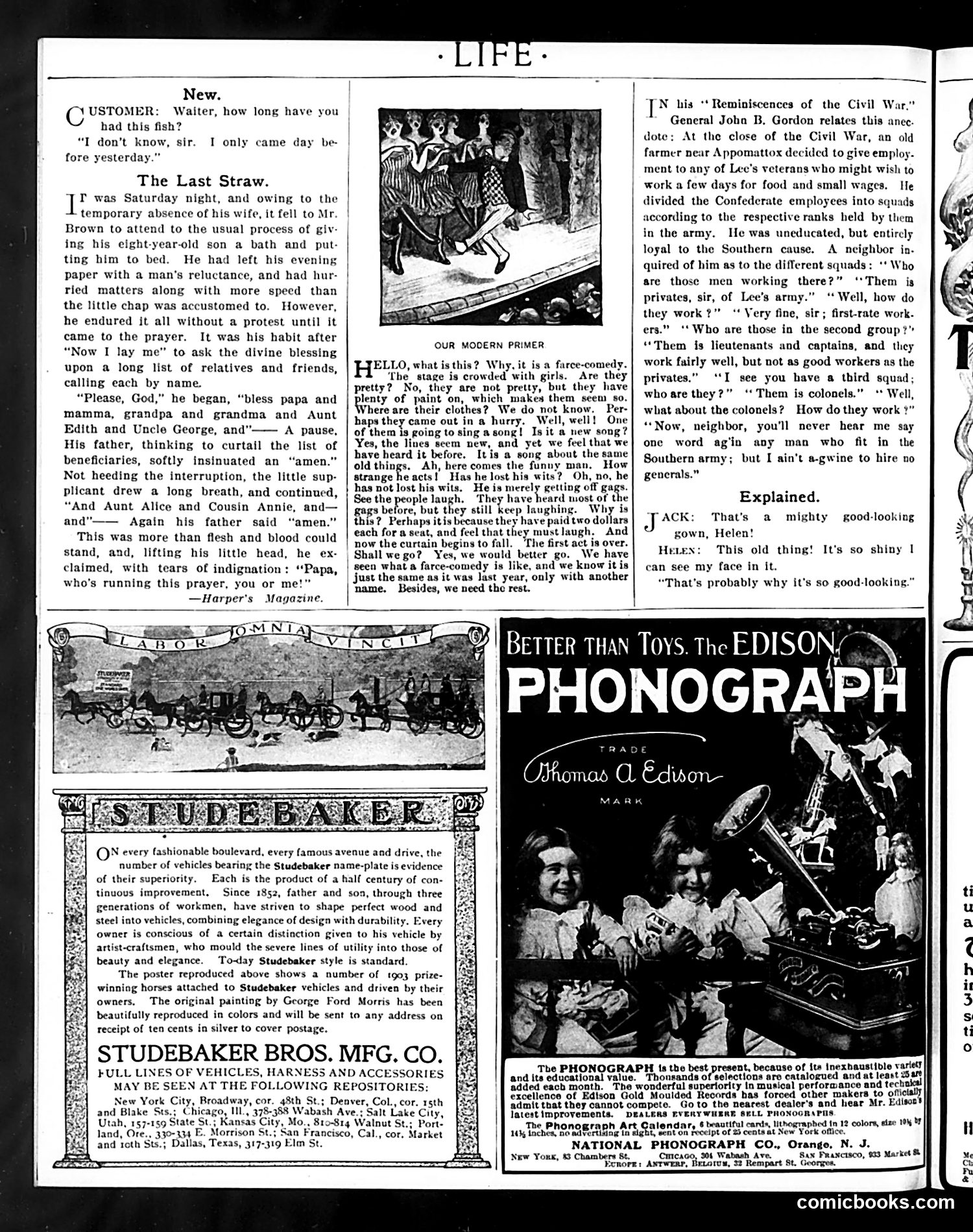
This page contains three distinct pieces of satire: **"The Last Straw"** mocks patriarchal impatience. A father interrupts his son's bedtime prayer to speed things along, but the child indignantly protests: "Who's running this prayer, you or me!" The joke satirizes fathers' reluctance to engage in domestic duties and their assumption of authority even in moments meant for children's devotion. **"Our Modern Primer"** offers dry social commentary on theatrical farce-comedies: cheaply painted actresses, recycled jokes, and audience members laughing because they've paid admission, not because content is genuinely funny. It critiques both the entertainment industry's cynicism and audience complicity. **"Explained"** is a brief flirtation joke where Jack compliments Helen's shiny gown; she downplays it as old, but he suggests its reflective quality lets him admire her face—a genteel compliment playing on vanity and appearance standards. The page also includes advertisements for Studebaker vehicles and Edison phonographs. Overall, the content reflects early-20th-century concerns with gender dynamics, commercial entertainment quality, and courtship rituals.
📄 Transcribed text from this page (OCR, searchable)
Machine-transcribed from the original scan — historical spelling and the odd misread are preserved.
New. C USTOMER: Waiter, how long have you had this fish? “I don’t know, sir. fore yesterday.” The Last Straw. 7 T was Saturday night, and owing to the temporary absence of his wife, it fell to Mr. Brown to attend to the usual process of giv- ing his eight-year-old son a bath and put- ting him to bed. He had left his evening paper with a man’s reluctance, and had hur- ried matters along with more speed than the little chap was accustomed to. However, he endured it all without a protest until it came to the prayer. It was his habit after “Now I lay me” to ask the divine blessing upon a long list of relatives and friends, calling each by name “Please, God,” he began, “bless papa and mamma, grandpa and grandma and Aunt Edith and Uncle George, and”—— A pause, His father, thinking to curtail the list of beneficiaries, softly insinuated an “amen.” Not heeding the interruption, the little sup- plicant drew a long breath, and continued, “And Aunt Alice and Cousin Annie, and— and"—— Again his father said “amen.” This was more than flesh and blood could stand, and, lifting his little head, he ex- claimed, with tears of indignation: “Papa, who's running this prayer, you or me!” I only came day be- | | OUR MODERN PRIMER ‘ELLO, what is this? Why, it is a farce-comedy. ‘The. stage is crowded with girls. Are they pretty? No, they are not pretty, but they have plenty of paint on, which makes them seem so. Vhere are their clothes? We do not know. Per- haps they came out in a hurry. Well, well! One of them is going to sing asong! Is it a new song? Yes, the lines seem new, and yet we feel that we have heard it before. Itvis a song about the same old things. Ah, here comes the funny man, How strange he acts! Has he lost his wits? Oh, no, he has not lost his wits. He is merely getting off gags. See the people laugh, ‘They have heard most of the gags before, but they still keep laughing. Why is this? Perhaps itis because they have paid two dollars each for a seat, and feel that they must laugh. And now the curtain begins to fall. The first act is over. | Shall we go? Yes, we would better go. We have seen what a farce-comedy is like, and we know it is just the same as it was Jast year, only with another N his ** Reminiscences of the Civil War, General John B, Gordon relates this anec. dote; At the close of the Civil War, an old farmer near Appomattox decided to give employ. ment to any of Lee's veterans who might wish to work a few days for food and small wages. He divided the Confederate employees into squads according to the respective ranks held by them in the army. He was uneducated, but entirely loyal to the Southern cause. A neighbor in- quired of him as to the different squads: ** Who are those men working there?” ‘*Them is privates, sir, of Lee’s army.” ‘* Well, how do they work?” ‘‘ Very fine, sir; first-rate work. ers.” ‘*Who are those in the second group?" “Them is lieutenants and captains, and they work fairly well, but not as good workers as the privates.” ‘I see you have a third squad; who are they?” ‘* Them is colonels.” *‘* Well, what about the colonels? How do they work ?” “Now, neighbor, you'll never hear me say one word ag'in any man who fit in the Southern army; but I ain't a-gwine to hire no gencrals.” Explained. J ACK: That's a mighty ~~ gown, Helen! Hetex: This old thing! can see my face in it. “That's probably why it's so good-looking.” good-looking It's so shiny I spMue. ———r name. Besides, we need the rest. —Harper's Magazine. | Pie Tovs. The EDISON/~ PHONOGRAPH — omas CL Edison MARK ON every fashionable boulevard, every famous avenue and drive, the number of vehicles bearing the Studebaker name-plate is evidence of their superiority, Each is the product of a half century of con- tinuous improvement, Since 1852, father and son, through three generations of workmen, have striven to shape perfect wood and steel into vehicles, combining elegance of design with durability. Every owner is conscious of a certain distinction given to his vehicle by artist-craftsmen, who mould the severe lines of utility into those of beauty and elegance. To~lay Studebaker style is standard. The poster reproduced above shows a number of 1903 prize- winning horses attached to Studebaker vehicles and driven by their owners, The original painting by George Ford Morris has been beautifully reproduced in colors and will be sent to any address on receipt of ten cents in silver to cover postage. STUDEBAKER BROS. MFG. CO. FULL LINES OF VEHICLES, HARNESS AND ACCESSORIES MAY BE SEEN AT THE FOLLOWING REPOSITORIES New York City, Broadway, cor. 48th St.; Denver, Col., cor. rgth and Blake Sts; Chicago, IIL.,'378-388 Wabash Ave.; Sait Lake City, Utah, 157-159 State St.; Kansas City, Mo., 810-814 Walnut St.; Port! land, Ore., 330-334 E. Morrison St. Francisco, Cal., cor, Market and roth Sts.; Dallas, Texas, 317-319 Elm St. - ono we ap or The PHONOGRAPH Is the best present, because of its Inexhaustibl and its educational value. Thonsands of selections aro catalogued and at least 25am added each month. ‘The wonderful superiority In musical performance and tech excellence of Edison Gold Moulded Records bas forced other makers to officially admit that they cannot compete. Goto the nearest dealer's and hear Mr. Edison? Tatest Improvements. DEALERS FVERY WHERE SELL PHONOORAPHS pam ie , $ beautiful canis, lithograpbed tn 12 colors, 105 Lace eee Mraighe Sent on foccipt of cents at New York office. NATIONAL PHONOGRAPH CO., Orange. N. J. New Yonk, & Chambers St. Cmcago, 904 Wabash Ave. Bax Francisco, 633 Market & ECnoret , Erratum, 32 Rempart St. Georges. comicbooks.com