
Life, 1903-12-10 · page 28 of 58
Life — December 10, 1903 — page 28: what you’re looking at
What you’re looking at
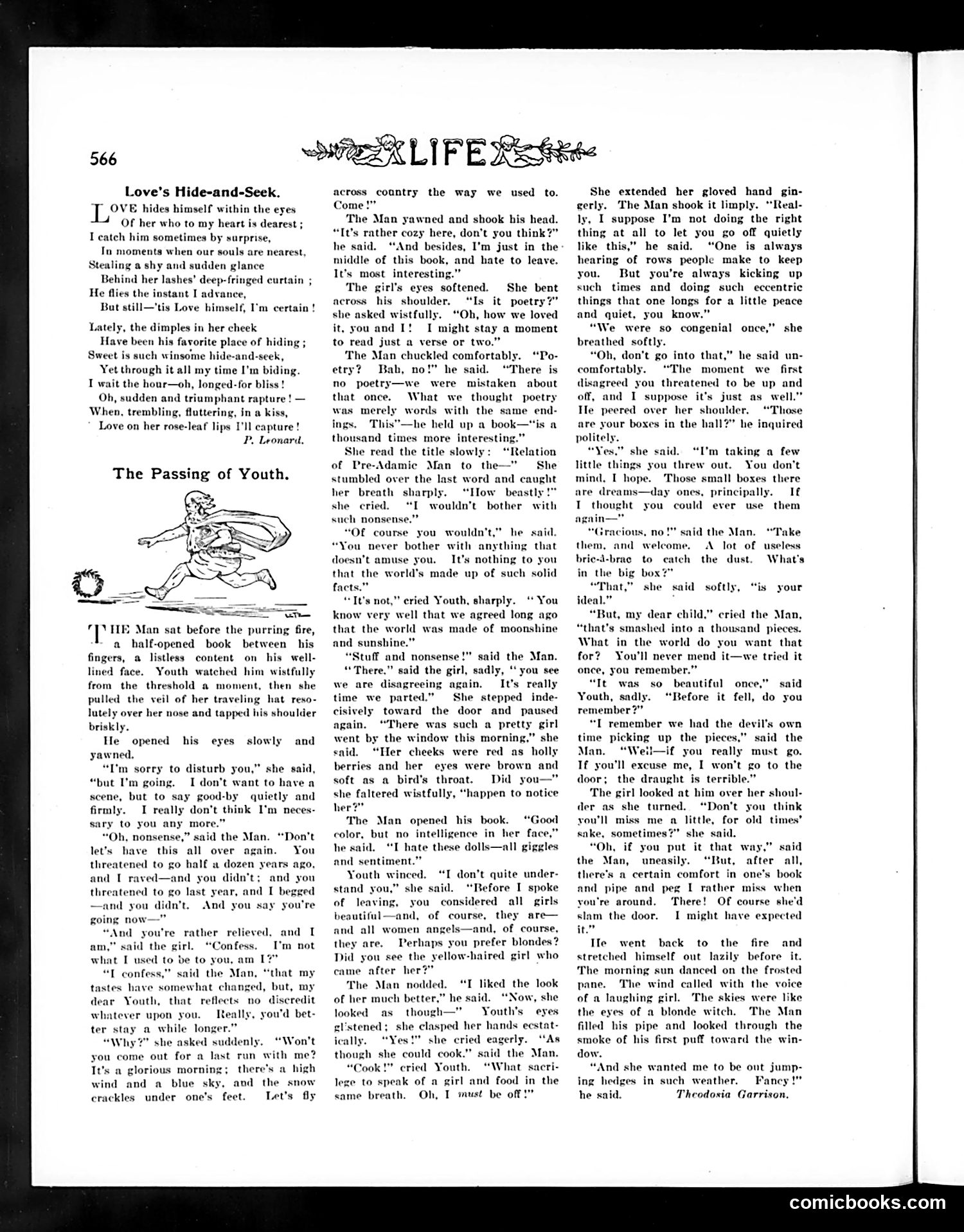
This story depicts an allegorical confrontation between **the Man** (representing middle-aged complacency) and **Youth** (personified as a young woman). **The satire's point:** Youth attempts to leave the Man, having grown incompatible with his settled, intellectualized existence. She represents vitality, spontaneity, and romantic idealism—they once shared wonder in "moonshine and sunshine." He now embodies jaded materialism, preferring a dry book on "Pre-Adamic Man" to outdoor adventures or poetry. **The social critique:** This reflects turn-of-century anxieties about aging, lost passion, and the deadening effects of bourgeois domesticity. The Man's dismissive attitude toward a beautiful young woman he notices reinforces his spiritual decline—he's become immune to beauty itself. The accompanying poem "Love's Hide-and-Seek" provides thematic contrast: idealized romantic yearning versus the story's portrayal of love's practical deterioration over time.
📄 Transcribed text from this page (OCR, searchable)
Machine-transcribed from the original scan — historical spelling and the odd misread are preserved.
566 Love’s Hide-and-Seek. T OVE hides himself within the eyes Of her who to my heart is dearest ; I catch him sometimes by surprise, In moments when our souls are nearest, Stealing a shy and sudden glance Behind her lashes’ deep-fringed curtain ; He flies the instant I advance, But still—'tis Love himself, I'm certain ! Lately, the dimples in her cheek Have been his favorite place of hiding ; Sweet is such winsome hide-and-seek, Yet through it all my time I'm biding. I wait the hour—oh, longed-for bliss ! Ob, sudden and triumphant rapture When, trembling, fluttering, in a kiss, Love on her rose-leaf lips I'll capture ! P, Leonard. The Passing of Youth. T HE Man sat before the purring fire, a half-opened book between his fingers, a listless content on his well- lined face. Youth watched him wistfully from the threshold a moment, then she pulled the veil of her traveling hat reso- lutely over her nose and tapped his shoulder briskly. He opened his yawned, “I'm sorry to disturb you,” she said, “but I'm going. I don’t want to have a scene, but to say good-by quietly and firmly. I really don’t think I'm neces- sary to you any mo “Oh, nonsense,” said the Man. ‘Don’t let's have this all over again. You threatened to go half a dozen years ago, and [ raved—and you didn’t; and you threatened to go last and T begged —and you didn't, And you say you're going now—" “And you're rather relieved, and [ am,” said the girl. I'm not I used to be to you, am “TL confess,” said the Man, “that my tastes have somewhat changed, but, my dear Youth, that reflects no discredit whatever upon you. Really, you'd bet- ter stay a while longer.” “Why?” she asked suddenly, “Won't you come out for t run with me? It’s a glorious morning; there's a high wind and a blue sky, and the snow under one’s fect. Let's fly eyes slowly and Confess. crackles across country the way we used to. Come!” The Man yawned and shook his head. “It's rather cozy here, don’t you think? he said. ‘And besides, I’m just in the middle of this book, and hate to leave. It’s most interesting. The girl's eyes softened. She beni across his shoulder. “Is it poetry? she asked wistfully. “Oh, how we loved it, you and I! I might stay a moment to read just a verse or two.” The Man chuckled comfortably. ‘Po- etry? Bah, no!” he said. There is no poetry—we were mistaken about that once. What we thought poetry was merely words with the same end- ings, This’—he held up a book—‘is a thousand times more interesting.” She read the title slowl, “Relation of Pre-Adamic Man to the—" She stumbled over the last word and caught her breath sharply. “ITow beastly she cried. I wouldn't bother with such nonsense.” “Of course you wouldn't,” “You never bother with anything that doesn’t amuse you. It’s nothing to you that the world’s made up of such solid fact: “It's not,” cried Youth, sharply. ‘ You know very well that we agreed long ago that the world was made of moonshine and sunshine. “Stuff and nonsense!” said the Man. “There.” said the girl, sadly, “ you see we are disagreeing again. It's really time we parted.” She stepped inde- cisively toward the door and paused again. ‘There was such a pretty girl went by the window this morning,” she said. “Her cheeks were red as holly berries and her eyes were brown and soft as a bird's throat. Did you— she faltered wistfully, “happen to notice her?” ‘The Man opened his book. “Good color, but no intelligence in her face, he said. “TI hate these dolls—all giggles and sentiment.” Youth winced. he said. “[ don’t quite under- stand you,” she said. “Before I spoke of leaving, you considered all girls beautiful—and, of course, they are— and all women angels—and, of course, they are. Perhaps you prefer blondes? Did you see the yellow-haired girl who came after her?” The Man nodded. “I liked the look of her much better,” he said. “Now, she looked as though—" Youth's eyes gl’stened; she clasped her hands ecstat- ally. “Yes!” she cried eagerly. “As though she could cook.” said the Mi “Cook! cried Youth. “What. sact! loge to speak of a girl and food in the same breath. Oh, I must be off!" Dek LIFE Rett She extended her gloved hand gin- gerly. The Man shook it limply. “Real- ly, I suppose I’m not doing the right thing at all to let you go off quietly like this,” he said. “One is always hearing of rows people make to keep you. But you're always kicking up such times and doing such eccentric things that one longs for a little peace and quiet, you know. “We were so congenial once,” she breathed softly. “Oh, don’t go into that,” he said un- comfortably. ‘The moment we first disagreed you threatened to be up and off, and I suppose it's just as well.” Ile peered over her shoulder. “Those are your boxes in the hall?” he inquired polite! “Yes.” she said. “I'm taking a few little things you threw out. You don't mind, I hope. Those small boxes there are dreams—day ones, principally. If I thought you could ever use them again—" Gracious, no!" said the Man. “Take them, and welcome. A lot of useless bric-A-brac to catch the dust. What in the big box? “That,” ideal. But, my dear child,” cried the Man, “that's smashed into a thousand pieces. What in the world do you want that for? You'll never mend it—we tried it once, you remembe: “It was so beautiful Youth, sad! “Before remember ?” “I remember we had the devil's own time picking up the pieces,” said the Man. “Weil—if you really must go. If you'll excuse me, I won't go to the door; the draught is terrible.” The girl looked at him over her shoul- der as she turned. “Don't you think you'll miss me a little, for old times? sake, sometimes?” she sai she said softly, your once,” said fell, do you 2 said the Man, uneasily after all, there's a certain comfort in one’s book and pipe and peg L rather miss when you're around. There! Of course she'd slam the door. I might have expected it Ife went back to the fire and stretched himself out lazily before it. ‘The morning sun danced on the frosted pane. The wind called with the voice of a laughing girl. The skies were like the eyes of a blonde witch. The Man filled his pipe and looked through the smoke of his first puff toward the win- dow. “And she wanted me to be out jump- ing hedges in such weather. Fancy! he said. Theodosia Garrison, comicbooks.com