
Life, 1903-12-10 · page 20 of 58
Life — December 10, 1903 — page 20: what you’re looking at
What you’re looking at
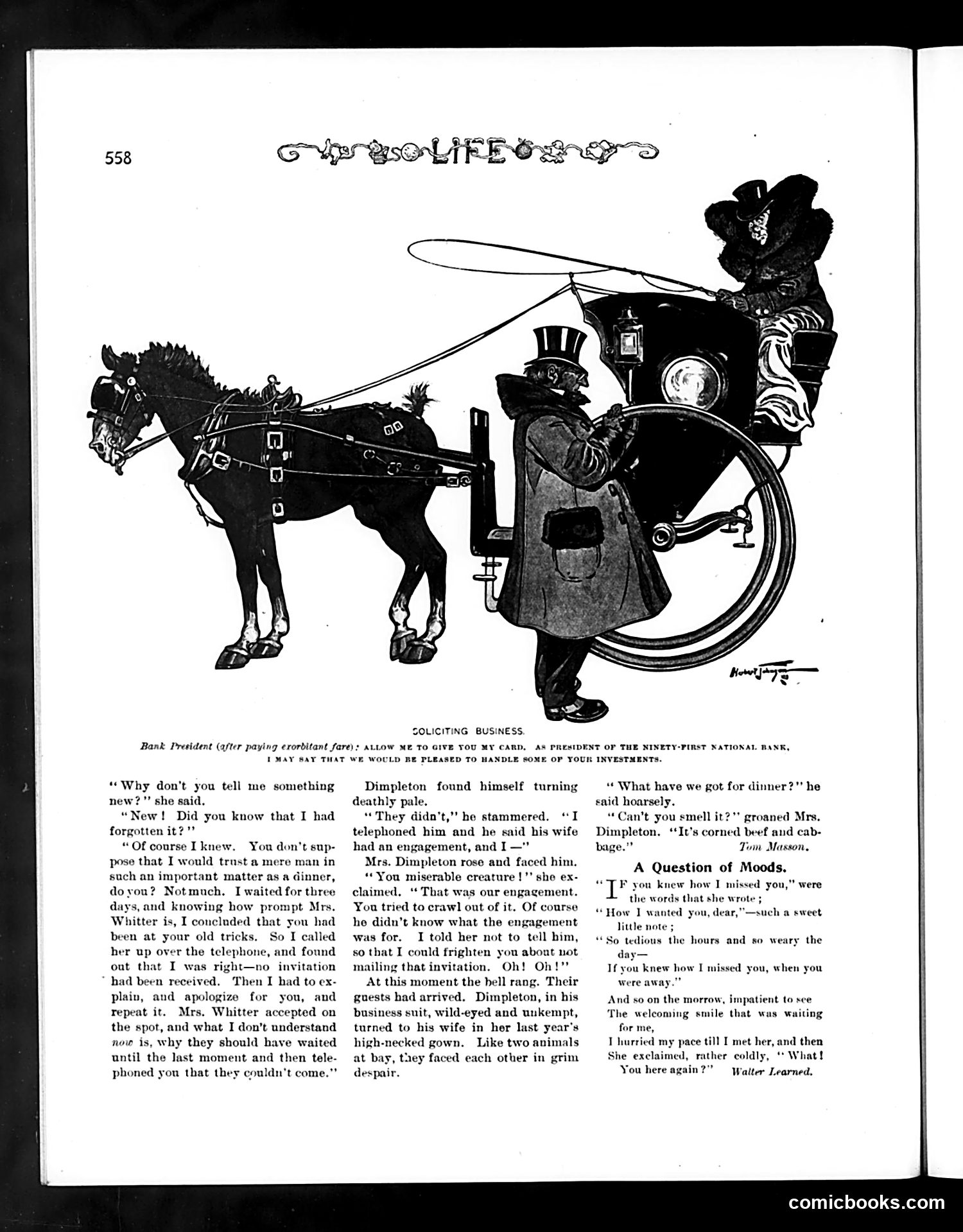
This page contains two separate satirical pieces: **"Soliciting Business"** (top cartoon): A bank president, having paid an exorbitant taxi fare to a driver with an ornate, decorated horse-drawn cab, attempts to drum up business by offering his card. The satire mocks the absurdity of a bank executive pitching investments to a taxi driver—the joke being that he's so desperate for clients he's soliciting random passengers, regardless of their financial standing or likelihood to be a bank customer. **"A Question of Moods"** (bottom text): A domestic comedy about a husband who forgets a dinner invitation and lies about it, claiming the guests had an engagement. His wife, having deliberately withheld this information to test him, catches him in the deception. When guests arrive, they're unprepared (corned beef and cabbage for dinner). The accompanying poem by Walter Learned contrasts romantic longing in a love letter with the wife's cold reception when the suitor finally appears. Both pieces satirize human nature—greed and poor judgment in one, marital deception in the other.
📄 Transcribed text from this page (OCR, searchable)
Machine-transcribed from the original scan — historical spelling and the odd misread are preserved.
oy Bank President (after paying erorbitant fare): SOLICITING BUSINESS. OW ME TO GIVE YOU MY CARD, AS PREMIDENT OP THE NINETY-PIRST NATIONAL. BANK, I MAY SAY THAT WE WOULD BE PLEASED TO HANDLE SOME OP YOUR INVESTMENTS. ““Why don't you tell me something new?"’ she said. “New! Did you know that I had forgotten it?” “Of course Iknew. You don't sup- pose that I would trust a mere man in such an important matter as a dinner, doyou? Notmuch. I waited for three days, and knowing how prompt Mrs. Whitter is, I concluded that you had been at your old tricks. So I called her up over the telephone, and found out that I was right—no invitation had been received. Then I had to ex- plain, and apologize for you, and repeat it. Mrs. Whitter accepted on the spot, and what I don’t understand now is, Why they should have waited until the last moment and then tele- phoned you that they couldn't come.”” Dimpleton found himself turning deathly pale. “They didn’t,” he stammered. “I telephoned him and he said his wife had an engagement, and I —” Mrs. Dimpleton rose and faced him. “*You miserable creature !"' she ex- claimed, ‘ That was our engagement. You tried to crawl out of it. Of course he didn’t know what the engagement was for. I told her not to tell him, so that I could frighten you about not mailing that invitation. Oh! Oh!’" At this moment the bell rang. Their guests had arrived. Dimpleton, in his business suit, wild-eyed and unkempt, turned to his wife in her last year's high-necked gown. Like two animals at bay, they faced each other in grim despair. “What have we got for dinner?" he said hoarsely. “Can't you smell it?" groaned Mrs, Dimpleton, ‘It’s corned beef and cab- Tum Masson, A Question of Moods. wpe you knew how T missed you,” were the words that she wrote ; “How I wanted y little note 5 “So tedious the hours and so weary the day— , dear,” —such a sweet If you knew how I missed you, when you were away.” And so on the morrow, impatient to sce ‘The welcoming smile that was waiting for me, T hurried my pace till I met her, and then She exclaimed, rather coldly, ‘ What! You here again?” — Walter Learned. comicbooks.com