A complete issue · 53 pages · 1938
Judge — July 1938
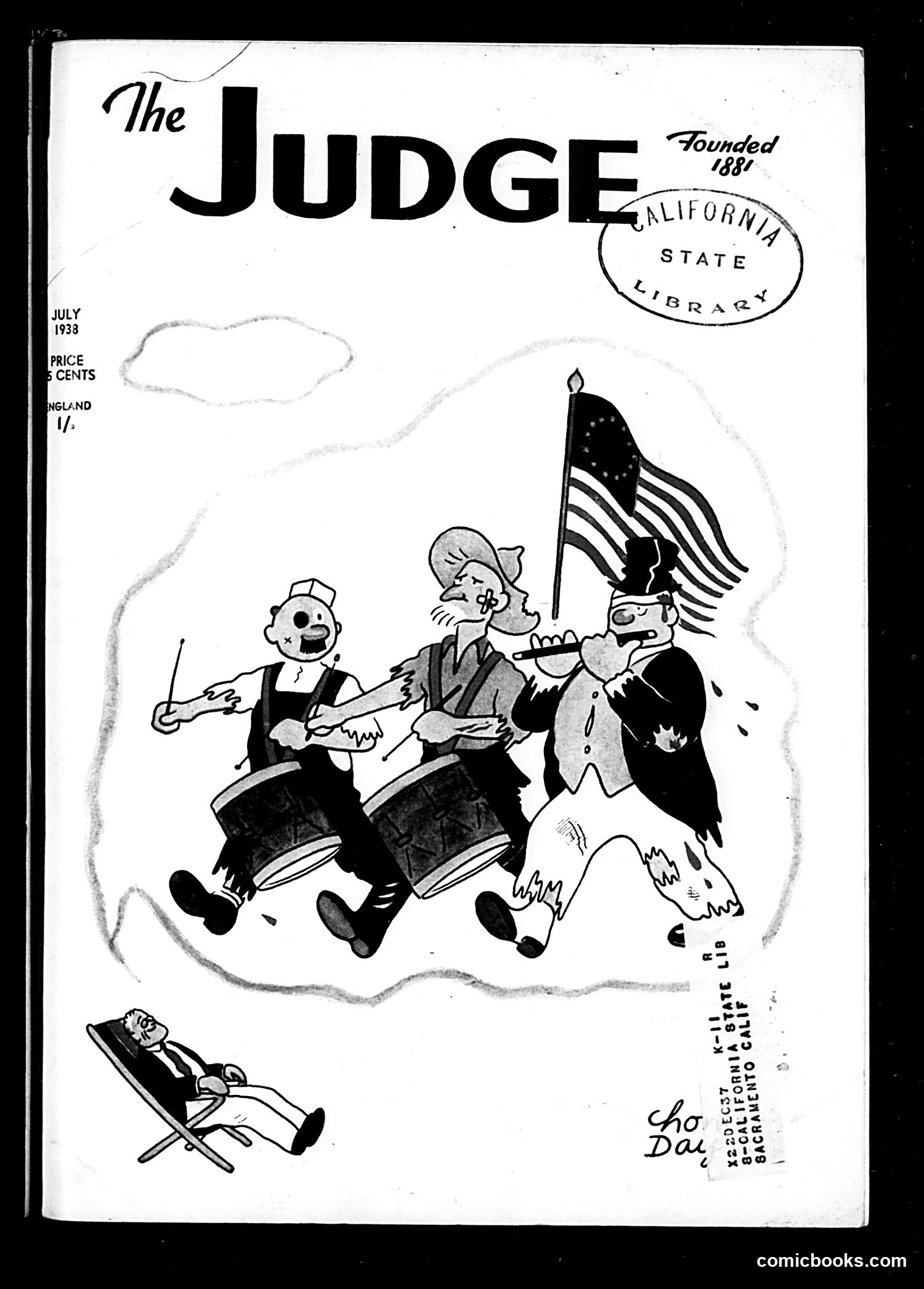
# The Judge Cover - July 1938 This cover depicts three cartoon characters celebrating with an American flag during what appears to be a patriotic moment. The figures seem to represent common American stereotypes of the era—possibly referencing working-class or immigrant archetypes popular in 1930s humor. The central figure weeps while holding the flag, suggesting emotional patriotic fervor. The style is typical of Judge magazine's satirical approach to American life and politics during the Depression era. Without clearer context about specific 1938 events, the exact satirical target remains uncertain. It likely comments on patriotism, national sentiment, or social attitudes of that period, though the specific political reference is unclear from the image alone. The "Cho Dac" signature appears to be the cartoonist's mark.

# Analysis This is primarily an **insurance advertisement**, not editorial satire. The Union Central Life Insurance Company uses anxiety-based marketing to sell life insurance policies. The ad addresses readers directly ("Your Wife! Your Child!") to invoke fear about family vulnerability. It argues that life insurance provides essential financial protection against "seven vital needs" — funeral costs, living expenses, education, and other unforeseen hardships that could devastate dependents. The text emphasizes the company's "Family-needs Forecast" service, which supposedly helps customers visualize future financial gaps and distribute insurance accordingly. While the dramatic language ("Suddenly") and emotional appeals were common 1930s advertising tactics, this represents commercial persuasion rather than political satire. The page demonstrates how insurance companies marketed their products by emphasizing middle-class anxieties about family security during the Depression era.
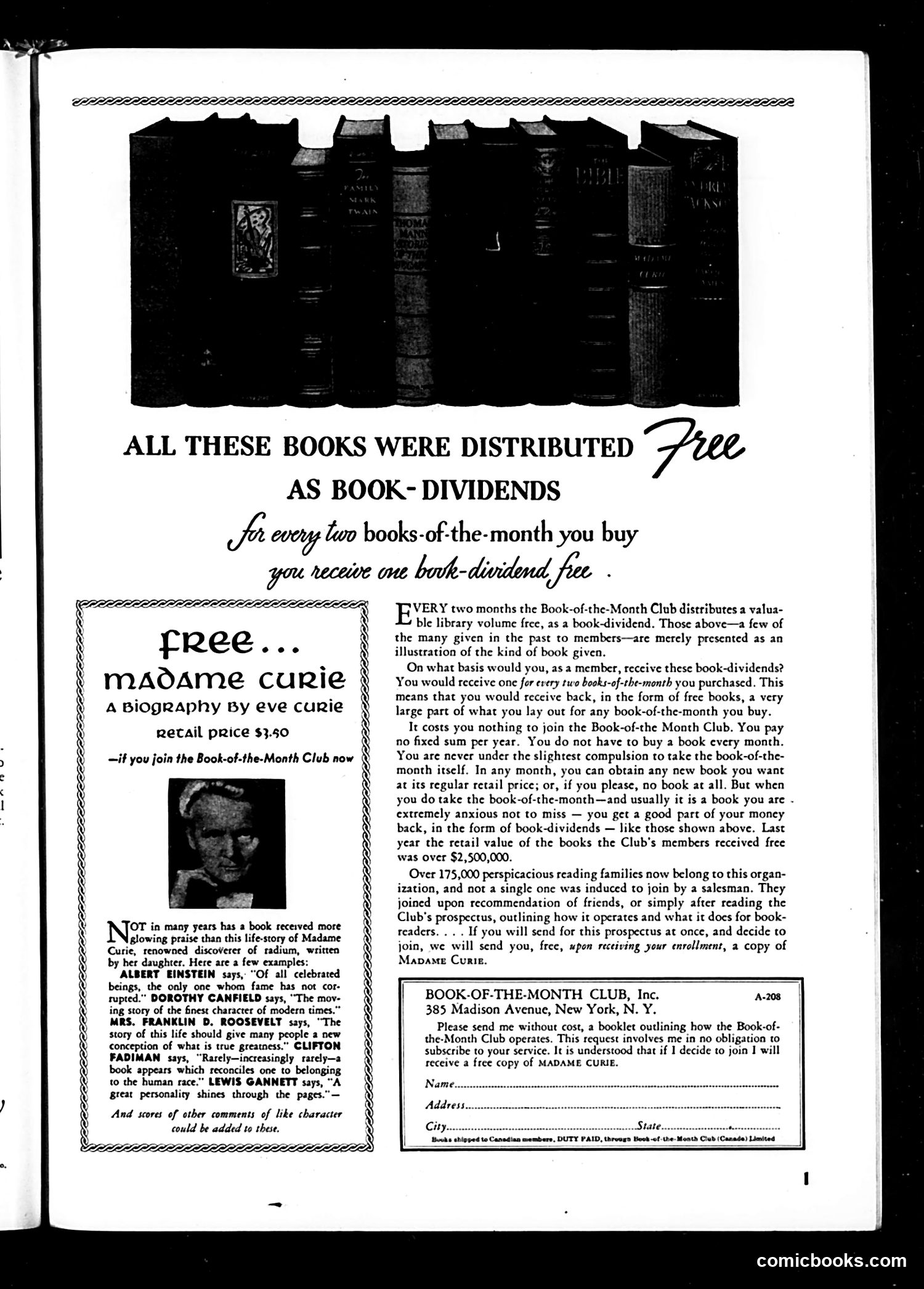
# Analysis This page is primarily **advertising**, not satire or political commentary. It promotes the Book-of-the-Month Club's membership benefits, specifically highlighting their "book-dividend" system where members receive free books with purchases. The left side features a featured selection: **Madame Curie**, a biography by Eve Curie (retail $1.50). The advertisement includes testimonial quotes praising the Club's offerings, attributed to figures like Albert Einstein, Dorothy Canfield, and Clifton Fadiman. The main pitch emphasizes the financial incentive: for every two books purchased, members receive one free. The text claims over 175,000 families belonged to the Club and that members received over $2,500,000 in free books the previous year. There is **no political cartoon or satire** on this page—it is straightforward commercial promotion.
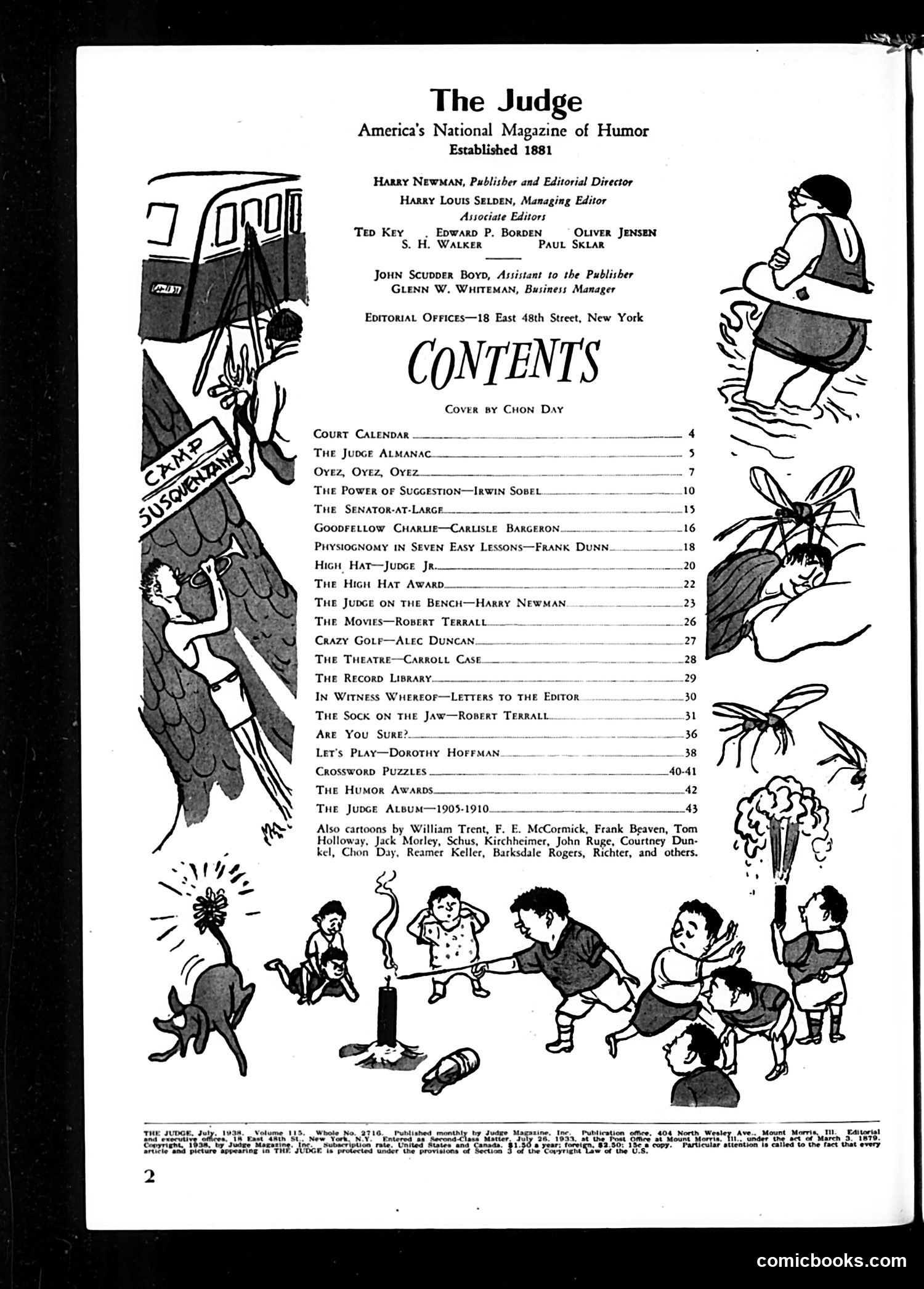
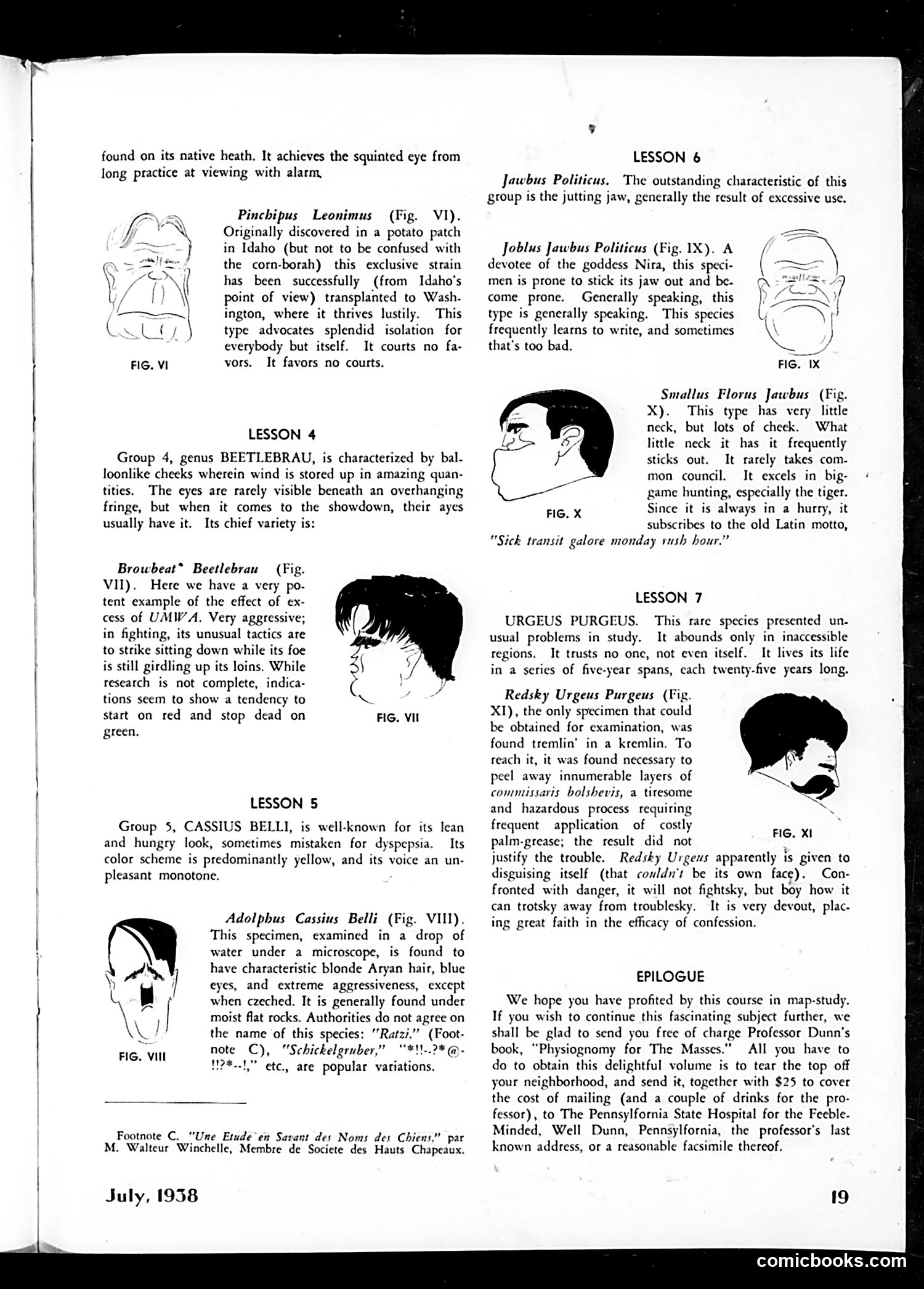
# Contents Page Analysis This is a contents page from *The Judge* magazine (July 1932, Volume 113). It lists humorous articles and cartoons typical of the era's satirical magazine format. The editorial staff and contributing cartoonists are listed at the top. The bottom illustration appears to be a generic comedic scene of children playing with fireworks or firecrackers—a common visual joke topic for the period. Notable article titles suggest the magazine's satirical scope included political commentary ("The Senator-at-Large"), social observation ("Physiognomy in Seven Easy Lessons"), and entertainment criticism ("The Movies," "The Theatre"). Without seeing individual article content, the specific satirical targets remain unclear, though the 1932 date suggests potential commentary on the Great Depression era.
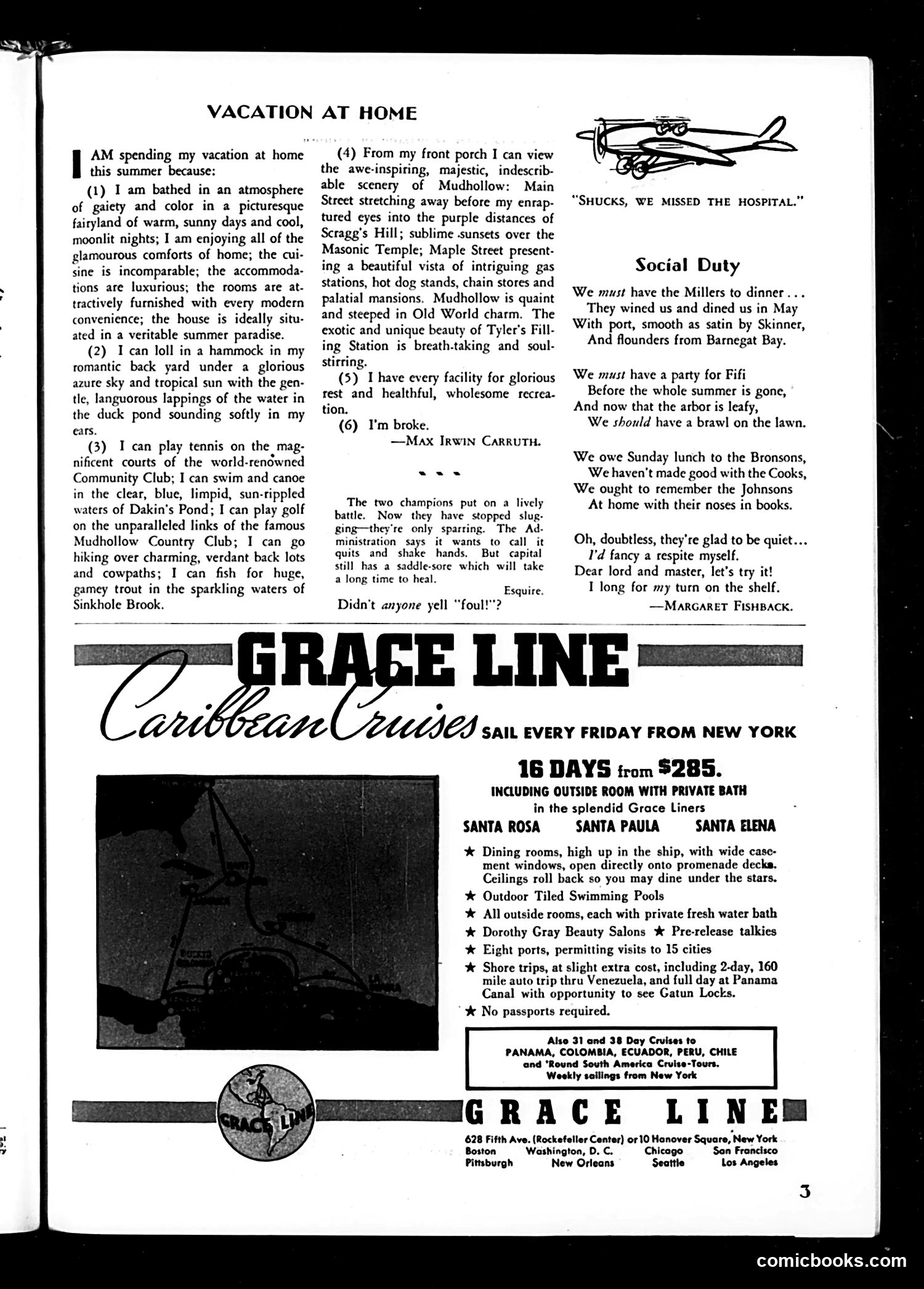
# Analysis This page is primarily **advertising and light humor columns** rather than political satire. The main content consists of: 1. **"Vacation at Home"** - A humorous essay by Max Irwin Carruth listing reasons to vacation domestically (hammocks, tennis, golf, canoeing) rather than travel abroad. The final quip "Didn't *anyone* yell 'fool'?" suggests self-aware irony about staying put. 2. **"Social Duty"** - A verse by Margaret Fishback poking fun at social obligations—dinner parties, lunches with neighbors—that accumulate during summer, ending with the speaker hoping for their turn on "the shelf" (to be left alone). 3. **Grace Line Caribbean Cruises advertisement** - A full-page cruise ship promotion offering 16-day Caribbean voyages from New York. The humor is gentle, domestic, and relatable rather than politically pointed. No caricatures or political figures are present.
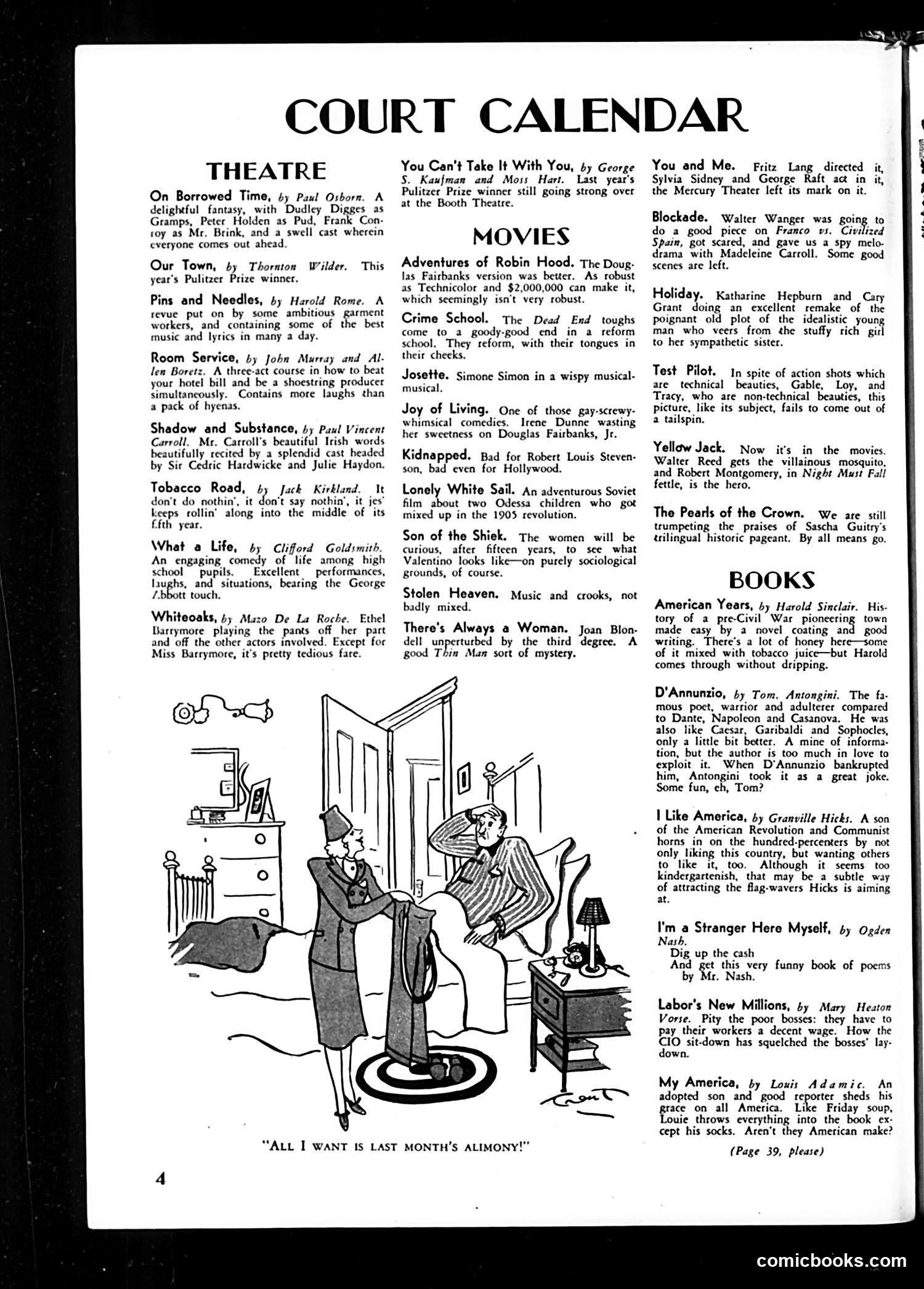
# "Court Calendar" Page Analysis This page from *Judge* magazine contains theater and book reviews alongside a single cartoon captioned "ALL I WANT IS LAST MONTH'S ALIMONY!" The cartoon depicts a domestic dispute: a woman in a dress confronts a man in formal attire inside a bedroom, gesturing emphatically while pointing toward bedroom furniture. The humor targets marital financial disputes—specifically, the woman's demand for alimony payments owed from the previous month. This reflects early-to-mid 20th century anxieties about divorce settlements and alimony obligations. The cartoon satirizes the common domestic complaint of unpaid support, presenting the woman as assertive and the man as apparently evasive. The bedroom setting emphasizes the intimate nature of marriage breakdowns while the financial complaint underscores the material consequences of divorce for women. The page's primary content consists of theater reviews and book recommendations.
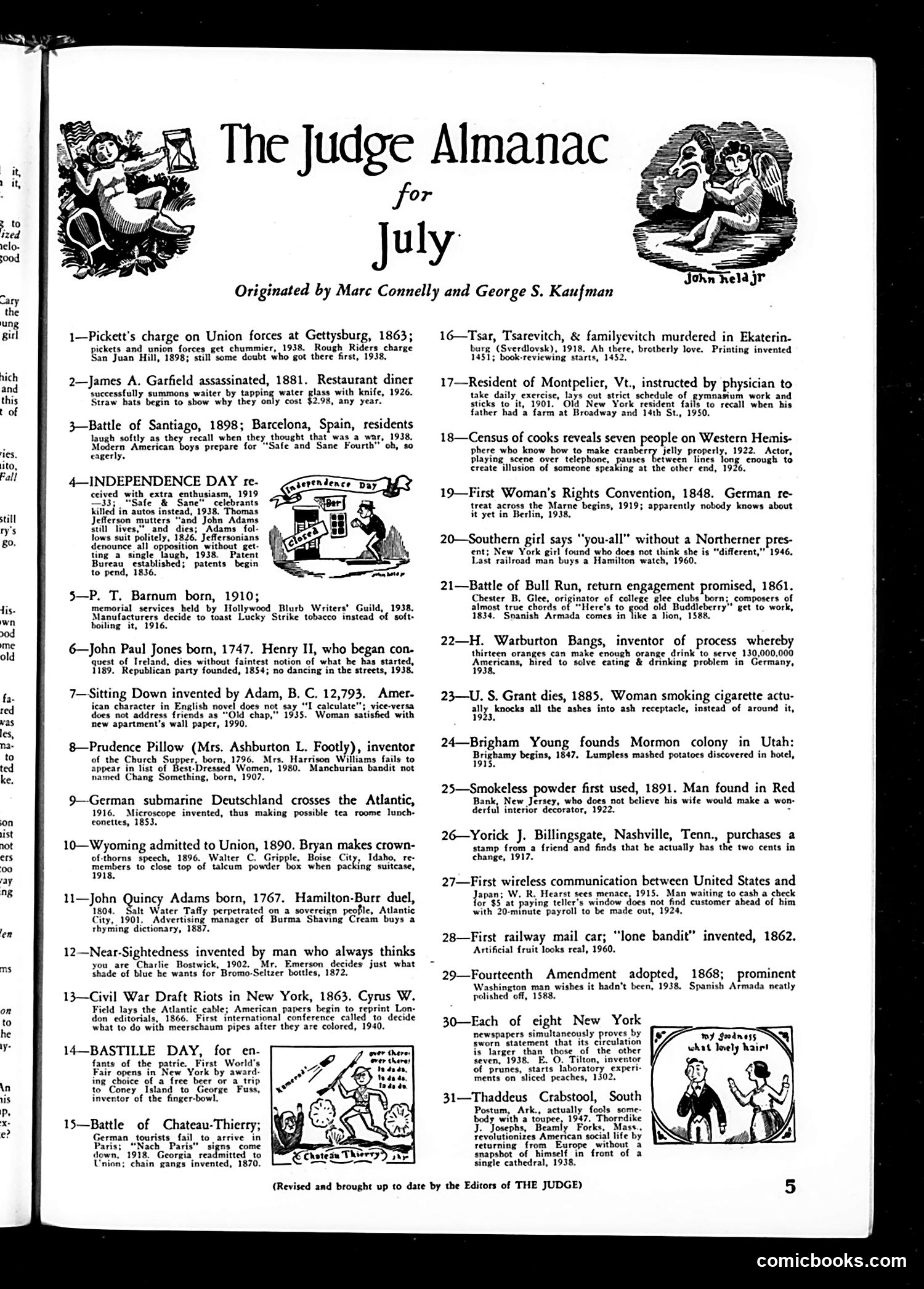
# The Judge Almanac for July This page is primarily an **almanac of historical events and inventions**, not political satire. It lists 31 dated entries for July, ranging from Independence Day trivia to inventions like the submarine, wireless communication, and the railroad mail car. The few accompanying **illustrations** are decorative rather than satirical: - Small vignettes accompany entries on the Bastille Day and Chateau-Thierry (WWI references) - These appear to be generic historical scene drawings, not caricatures The page functions as **educational content disguised as entertainment**—typical of Judge magazine's approach during this period. Rather than sharp political commentary, it offers miscellaneous American history and technological achievements, presented with light humor through the juxtaposition of mundane details (e.g., "Woman smoking cigarette accidentally knocks all the ashes into ash receptacle, instead of around it, 1923").

# Analysis This is a **Bell Telephone System advertisement**, not satire or political commentary. The page features a photograph of a man holding a telephone handset, smiling broadly at the camera. The advertisement uses a testimonial format with the quote "THANKS FOR CALLING" in a speech bubble. The accompanying text praises the telephone's role in connecting people and facilitating business, emphasizing how it makes "life is richer" through dependability and value. This represents a straightforward corporate marketing appeal from Judge magazine's advertising section. Rather than satirizing anything, Bell Telephone is using the magazine's platform to promote the social and practical benefits of telephone service to readers—a common advertising approach of the era for utilities and communication services.
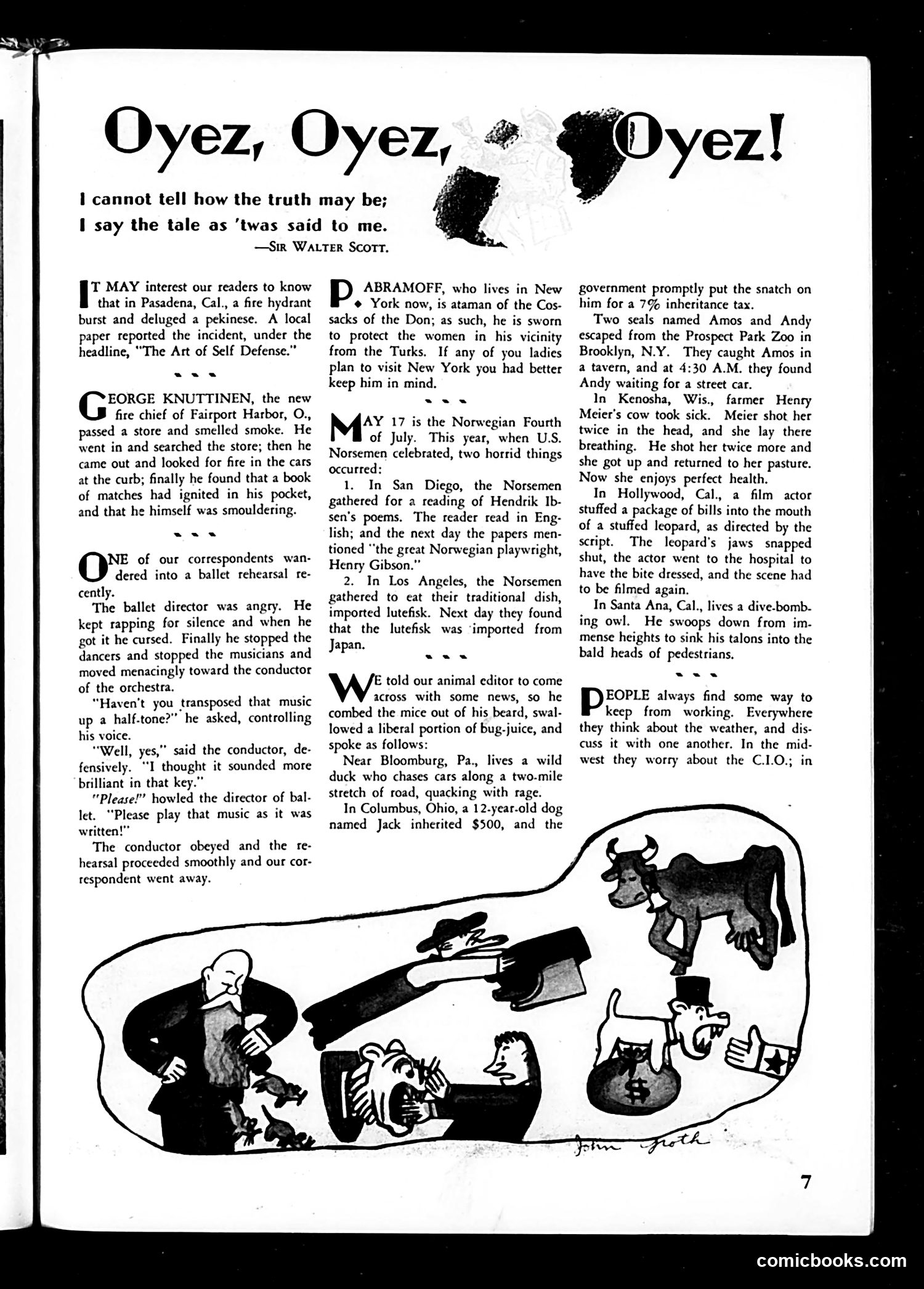
# Analysis of "Oyez, Oyez, Oyez!" Page from Judge Magazine This page collects humorous anecdotes rather than political cartoons. The stories mock various mishaps: - A Pasadena fire chief who found a book while investigating a store fire - George Knuttinen, a harbor chief who smelled smoke and investigated incorrectly - A ballet director stopped during a performance for transposing music - Norwegian Fourth of July celebrations, including incidents in San Diego and Los Angeles - A wild duck in Bloomsburg, PA, and a 12-year-old dog inheriting $500 in Columbus, Ohio The bottom illustration depicts these absurd scenarios. The humor relies on incongruity—the unexpected collision of serious situations (fires, performances) with ridiculous outcomes or details. This reflects Judge's style of satirizing everyday human folly rather than targeting specific political figures or events.
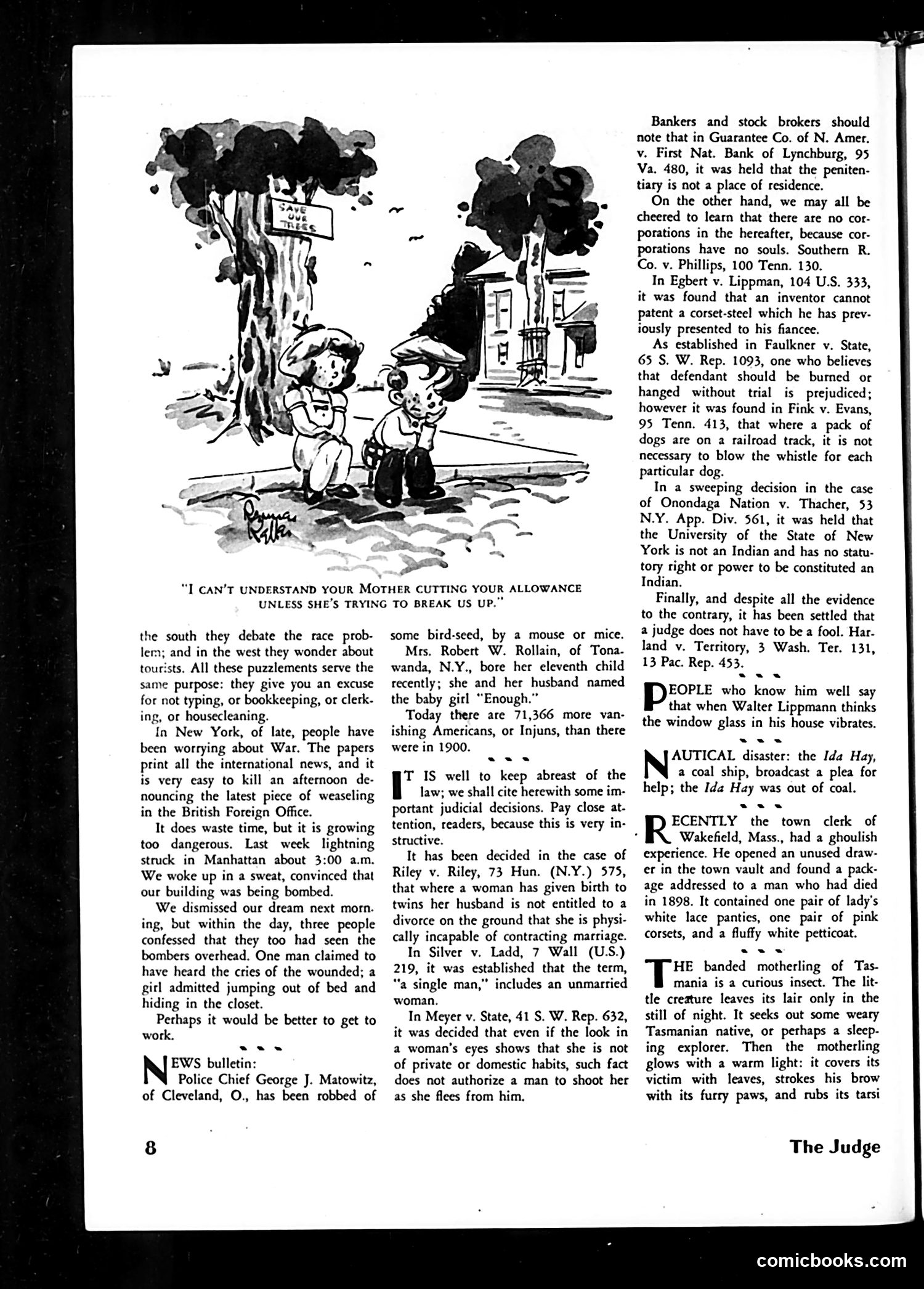
# The Judge Page Analysis ## The Main Cartoon The illustration depicts two young people beneath a tree labeled "LOVE." The boy complains that the girl's mother cutting her allowance seems designed to "break us up"—suggesting parental disapproval of their romance through financial pressure. ## The Satire's Point This is typical romantic comedy satire: the boy interprets economic hardship as a deliberate parental strategy to separate them, missing the more obvious explanation that money is simply tight. It mocks young lovers' tendency to see themselves as the center of their parents' concerns. ## The Surrounding Content The page contains miscellaneous satirical items: absurd "news bulletins" (a police chief robbed by mice; a couple naming their eleventh child "Enough"); and a series of deliberately ridiculous legal case summaries poking fun at judicial logic—such as the ruling that shooting a fleeing woman isn't justified merely because "the look in her eyes" suggests impropriety. This reflects Judge magazine's characteristic irreverent humor targeting social conventions, legal absurdities, and human folly.
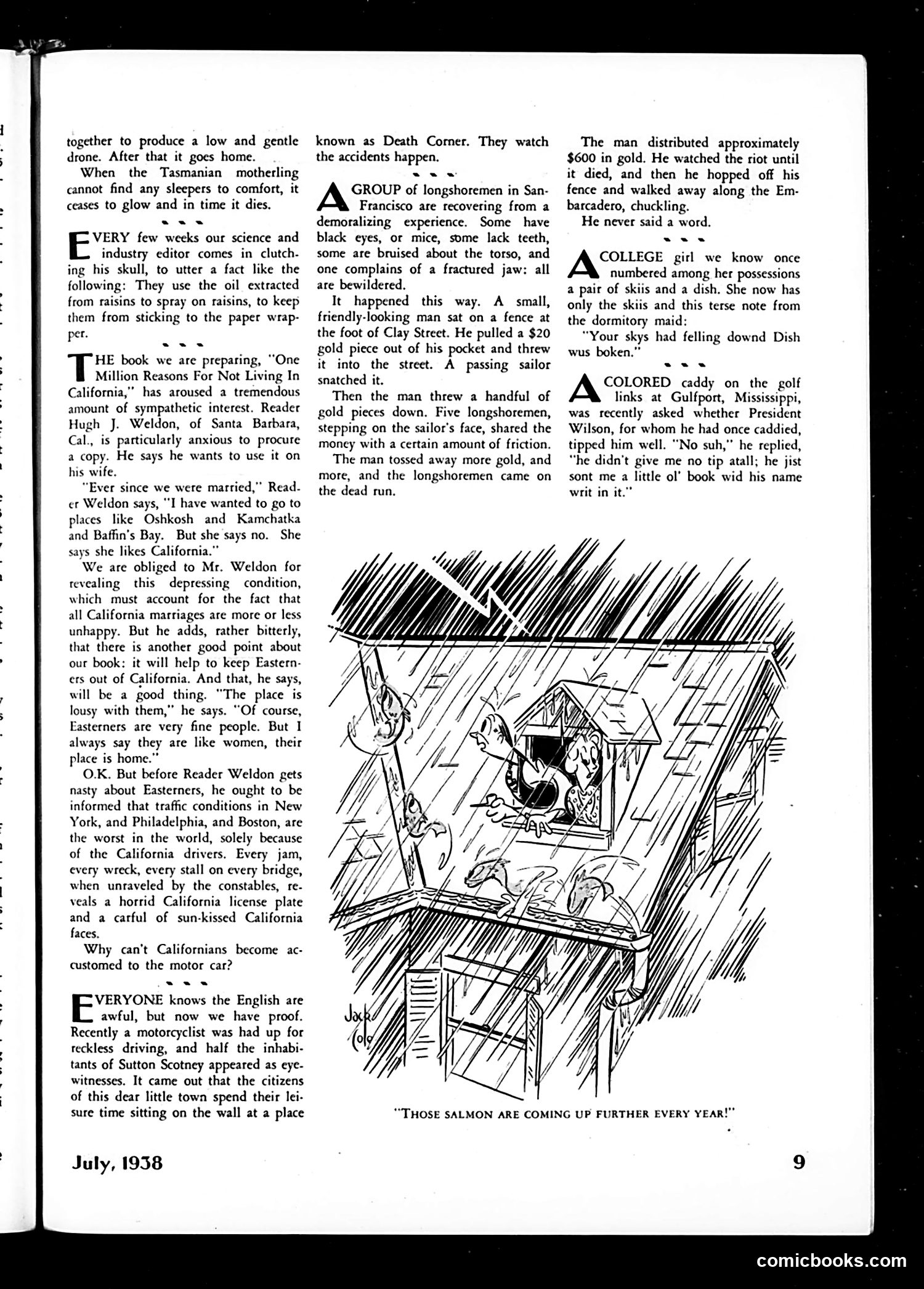
# Judge Magazine Satire Analysis (July 1938) This page contains several humorous anecdotes satirizing American regional and social differences: **California vs. Eastern attitudes**: The longest piece mocks Californians' resistance to leaving their state while blaming them for causing traffic chaos in Eastern cities with reckless driving. The satire suggests California's appeal makes residents provincial, yet ironically, they're terrible drivers who terrorize the East Coast. **San Francisco longshoremen**: A brief comic tale about a mysterious man distributing $600 in gold pieces to cause chaos among dock workers—likely satirizing working-class greed and violence through dark humor. **Social class commentary**: The college girl's note from a maid contains intentional misspellings ("felling," "downd," "wus boken"), mocking lower-class speech patterns, while the golf caddy anecdote about President Wilson appears to mock cheapness among the wealthy. **English eccentricity**: A jab at British culture—villagers gathering at "Death Corner" to watch accidents for entertainment, portraying the English as morbidly peculiar. The illustration shows figures in what appears to be a basement or covered area during rain.
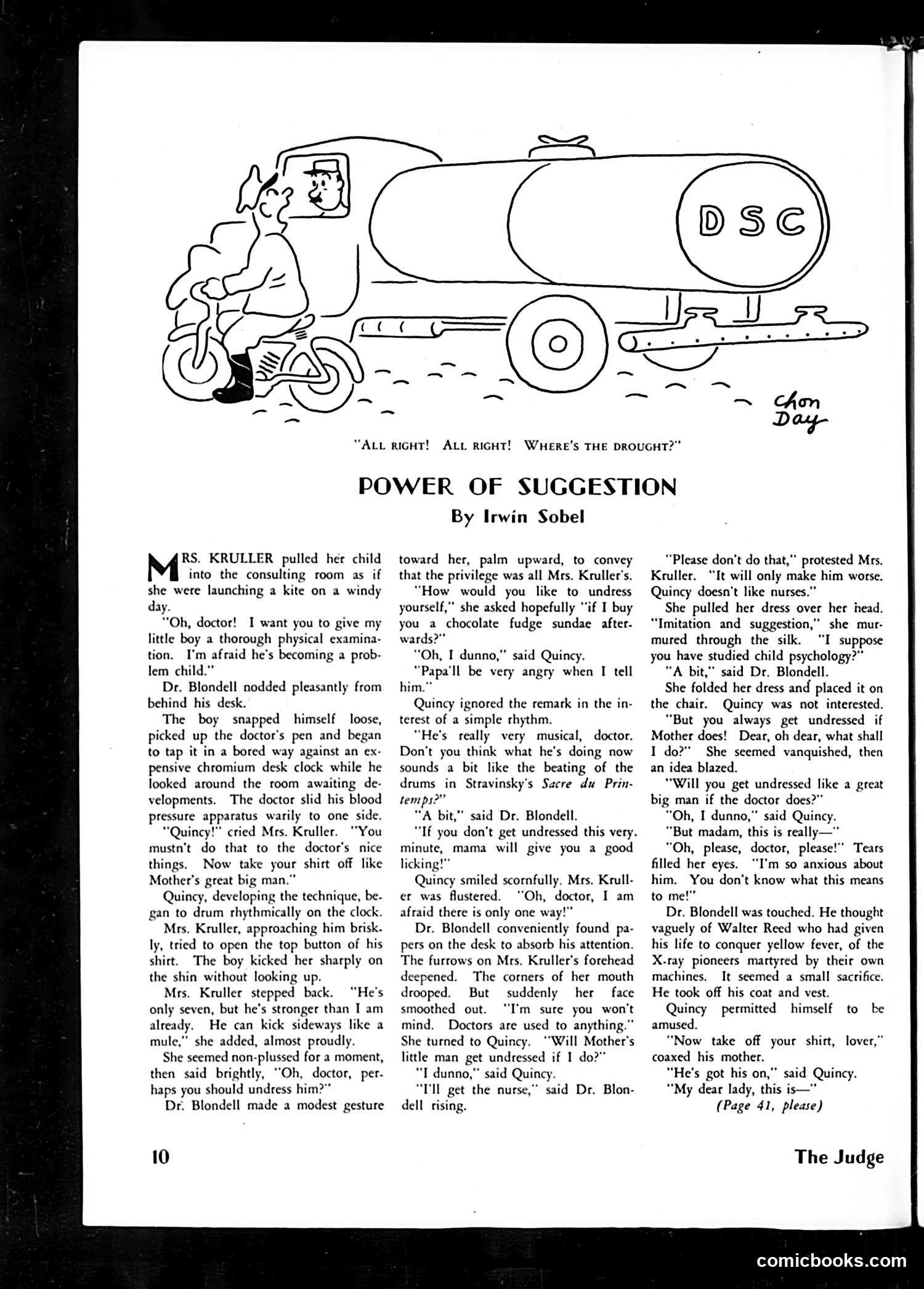
# "Power of Suggestion" - Judge Magazine Cartoon Analysis This story satirizes both permissive parenting and pop psychology trends of the early 20th century. Mrs. Kruller brings her unruly seven-year-old "problem child" Quincy to Dr. Blondell for examination, but the boy is disruptive and defiant—kicking his mother, refusing to undress. Mrs. Kruller repeatedly attempts psychological manipulation: bribing with sundaes, praising his "musical" disruption, threatening punishment. When direct methods fail, she invokes "imitation and suggestion"—stripping herself naked to demonstrate compliance, assuming the child will copy her behavior. The satire targets: (1) pseudoscientific child psychology jargon used to excuse parental ineffectiveness, and (2) the absurd extremes parents will reach based on trendy theories. Dr. Blondell's bemused cooperation—eventually undressing himself—suggests the ridiculousness of adults abandoning common sense for fashionable psychological theory. The joke is that suggestion and imitation fail entirely; Quincy remains unmoved by his now-naked mother and doctor.