
Judge, 1938-07 · page 6 of 53
Judge — July 1938 — page 6: what you’re looking at
What you’re looking at
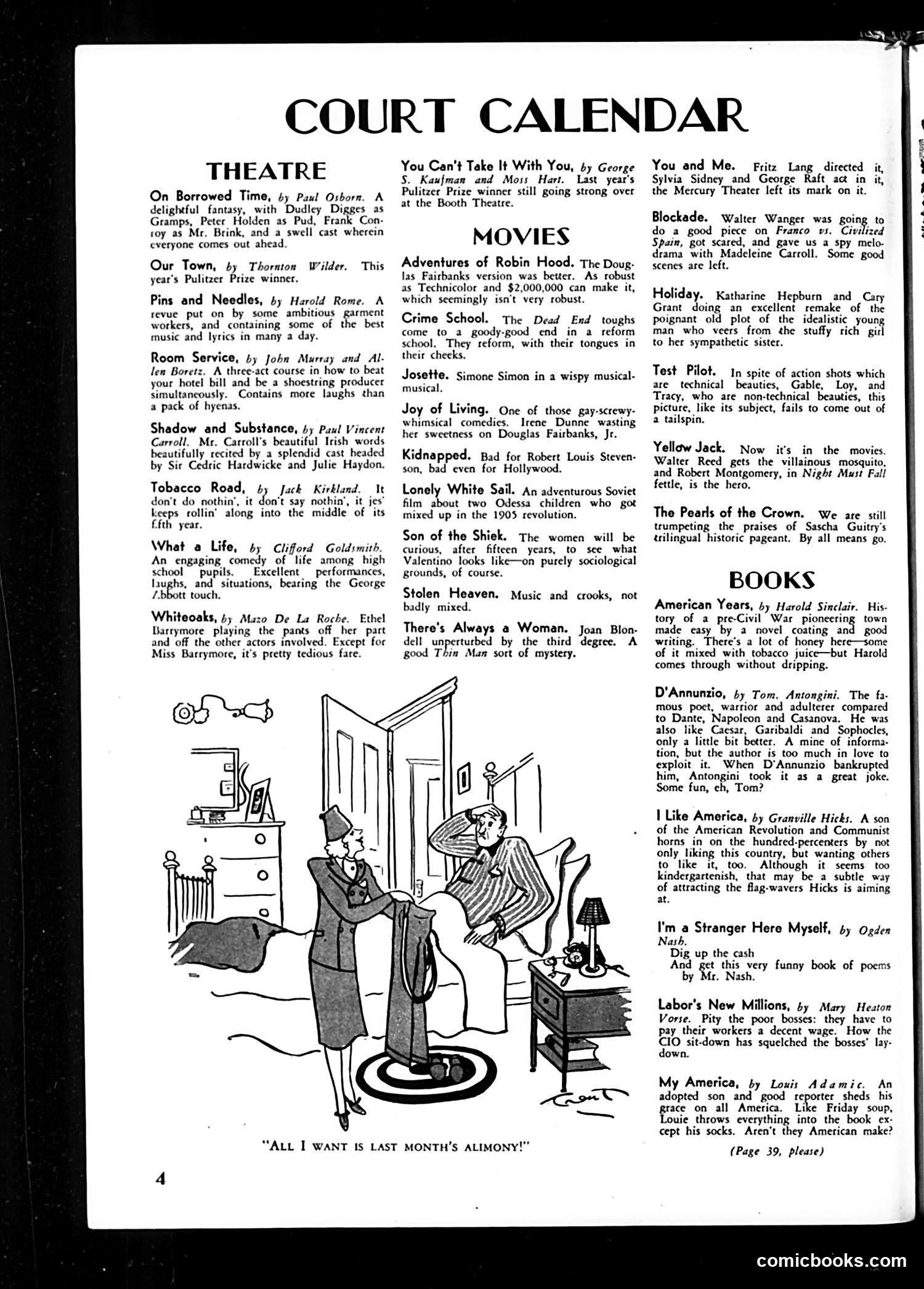
# "Court Calendar" Page Analysis This page from *Judge* magazine contains theater and book reviews alongside a single cartoon captioned "ALL I WANT IS LAST MONTH'S ALIMONY!" The cartoon depicts a domestic dispute: a woman in a dress confronts a man in formal attire inside a bedroom, gesturing emphatically while pointing toward bedroom furniture. The humor targets marital financial disputes—specifically, the woman's demand for alimony payments owed from the previous month. This reflects early-to-mid 20th century anxieties about divorce settlements and alimony obligations. The cartoon satirizes the common domestic complaint of unpaid support, presenting the woman as assertive and the man as apparently evasive. The bedroom setting emphasizes the intimate nature of marriage breakdowns while the financial complaint underscores the material consequences of divorce for women. The page's primary content consists of theater reviews and book recommendations.
📄 Transcribed text from this page (OCR, searchable)
Machine-transcribed from the original scan — historical spelling and the odd misread are preserved.
COURT CALENDAR THEATRE On Borrowed Time, by Pau! Osborn. A delightful fantasy, with Dudley Digges as Gramps, Peter Holden as Pud, Frank Con- roy as Mr. Brink, and a swell cast wherein everyone comes out ahead. Our Town, by Thornton Wilder. year’s Pulitzer Prize winner. This Pins and Needles, 4) Harold Rome. A revue put on by some ambitious garment workers, and containing some of the best music and lyrics in many a day. Room Service, by John Murray and Al- Jen Boretz, A three-act course in how to beat your hotel bill and be a shoestring producer simultaneously. Contains more laughs than a pack of hyenas. Shadow and Substance, by Pau! Vincent Carroll. Mr. Carroll's beautiful Irish words beautifully recited by a splendid cast headed by Sie Cedric Hardwicke and Julie Haydon. Tobacco Road, 4) Jack Kirkland. It don’t do nothin’, it don’t say nothin’, it jes’ keeps rollin’ along into the middle’ of its £fth year. What a Life, 4) Clifford Goldsmith. An engaging comedy of life among high school pupils. Excellent performances, laughs, and situations, bearing the George /bbott touch, Whiteoaks, 4) Mazo De La Roche. Ethel Barrymore playing the pants off her part and off the other actors involved. Except for Miss Barrymore, it's pretty tedious fare. “ALL I WANT Is You Can't Take It With You, by George S. Kaufman and Moss Hart. Last year's Pulitzer Prize winner still going strong over at the Booth Theatre. MOVIES Adventures of Robin Hood. The Doug: las Fairbanks version was better. As robust as Technicolor and $2,000,000 can make it, which seemingly isn't very robust. Crime School. The Dead End toughs come to a goody-good end in a reform school. They reform, with their tongues in their cheeks. Josette. Simone Simon in a wispy musical- musical, Joy of Living. One of those gay-screwy- whimsical comedies. Irene Dunne wasting her sweetness on Douglas Fairbanks, Jr. Kidnapped. Bad for Robert Louis Steven- son, bad even for Hollywood. Lonely White Sail. An adventurous Soviet film about two Odessa children who got mixed up in the 1905 revolution. Son of the Shiek. The women will be curious, after fifteen years, to see what Valentino looks like—on purely sociological grounds, of course. Stolen Heaven. Music and crooks, not badly mixed. There's Always a Woman. Joan Blon- dell unperturbed by the third degree. A good Thin Man sort of mystery. LAST MONTH’S ALIMONY!” You and Me. Fritz Lang directed it, Sylvia Sidney and George Raft act in it, the Mercury Theater left its mark on it. Blockade. Walter Wanger was going to do a good piece on Franco ws. Civilized Spain, got scared, and gave us a spy melo- drama with Madeleine Carroll. Some good scenes are left. Holiday. Katharine Hepburn and Cary Grant doing an excellent remake of the poignant old plot of the idealistic young man who veers from the stuffy rich girl to her sympathetic sister. Test Pilot. In spite of action shots which are technical beauties, Gable, Loy, and Tracy, who are non-technical beauties, this picture, like its subject, fails to come out of a tailspin. Yellow Jack. Now it’s in the movies. Walter Reed gets the villainous mosquito, and Robert Montgomery, in Night Must Fall fettle, is the hero, The Pearls of the Crown. We are still trumpeting the praises of Sascha Guitry’s trilingual historic pageant. By all means go. BOOKS American Years, by Harold Sinclair. His- tory of a pre-Civil War pioneering town made easy by a novel coating and good writing. There’s a lot of honey here—some of it mixed with tobacco juice—but Harold comes through without dripping. D'Annunzio, by Tom. Antongini. The fa- mous poet, warrior and adulterer compared to Dante, Napoleon and Casanova. He was also like Caesar, Garibaldi and Sophocles, only a little bit better. A mine of informa- tion, but the author is too much in love to exploit it. When D'Annunzio bankrupted him, Antongini took it as a great joke. Some fun, ch, Tom? I Like America, by Granville Hicks. A son of the American Revolution and Communist horns in on the hundred-percenters by not only liking this country, but wanting others to like it, too. Although it seems too kindergartenish, that may be a subtle way of attracting the flag-wavers Hicks is aiming at. I'm a Stranger Here Myself, 4, Ogden Nash, Dig up the cash And Ret this very funny book of poems by Mr. Nash. Labor’s New Millions, by Afary Heaton Vorse. Pity the poor bosses: they have to pay their workers a decent wage. How the sie sit-down has squelched the bosses’ lay- lown. My America, by Louis Adamic. An adopted son and good reporter sheds his pace on all America. Like Friday soup, uie throws everything into the book ex- cept his socks. Aren't they American make? (Page 39, please) comicbooks.com