
Judge, 1938-07 · page 17 of 53
Judge — July 1938 — page 17: what you’re looking at
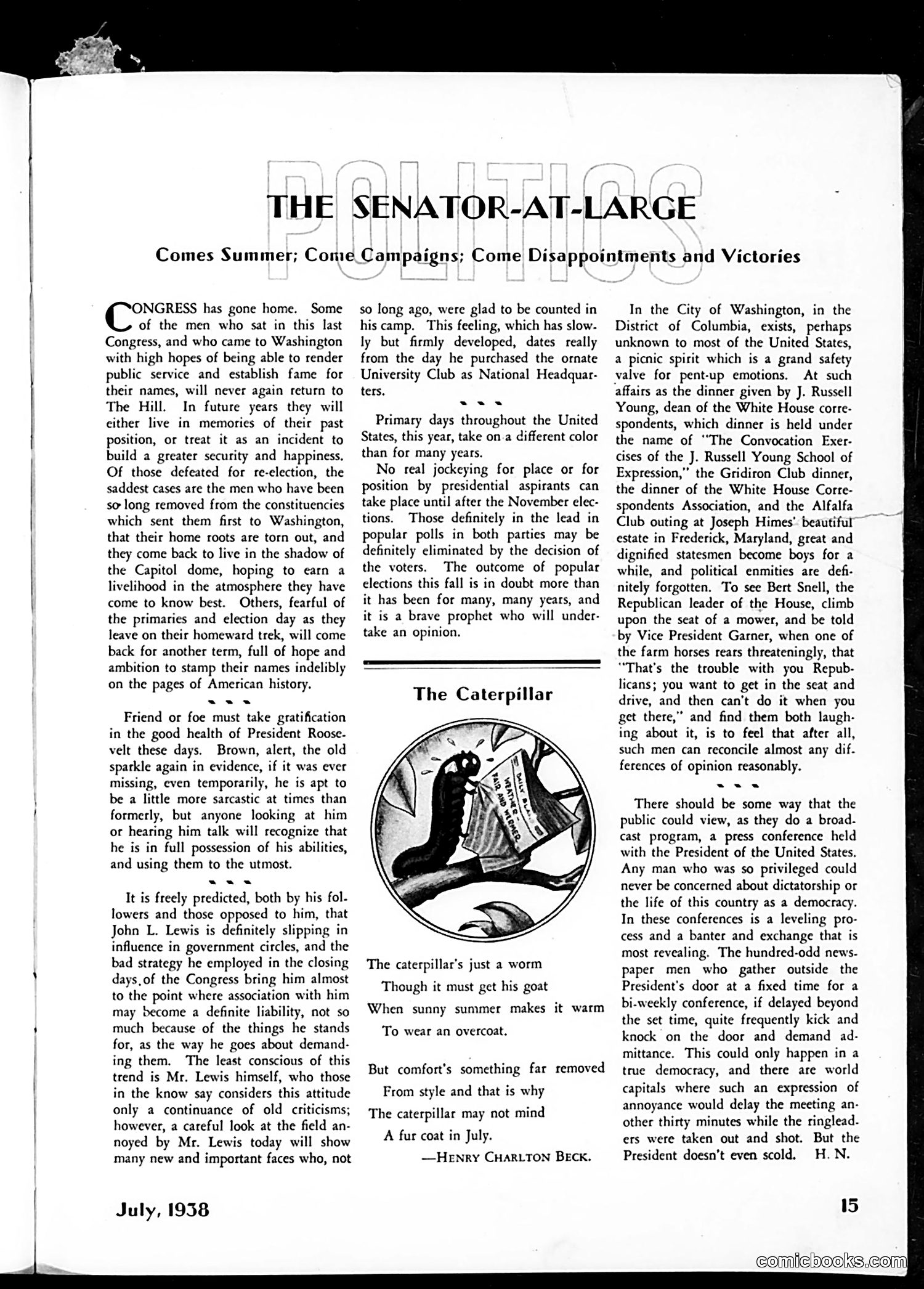
A restored page from Judge, 1938-07. Page through the whole issue in the reader above.
📄 Transcribed text from this page (OCR, searchable)
Machine-transcribed from the original scan — historical spelling and the odd misread are preserved.
THE SENATOR-AT-LARGE Comes Summer; Come Campaigns; Come Disappointments and Victories INGRESS has gone home. Some of the men who sat in this last Congress, and who came to Washington with high hopes of being able to render public service and establish fame for their names, will never again return to The Hill. In future years they will either live in memories of their past position, or treat it as an incident to build a greater security and happiness. Of those defeated for re-election, the saddest cases are the men who have been so long removed from the constituencies which sent them first to Washington, that their home roots are torn out, and they come back to live in the shadow of the Capitol dome, hoping to earn a livelihood in the atmosphere they have come to know best. Others, fearful of the primaries and election day as they leave on their homeward trek, will come back for another term, full of hope and ambition to stamp their names indelibly on the pages of American history. Friend or foe must take gratification in the good health of President Roose- velt these days. Brown, alert, the old sparkle again in evidence, if it was ever missing, even temporarily, he is apt to be a little more sarcastic at times than formerly, but anyone looking at him or hearing him talk will recognize that he is in full possession of his abilities, and using them to the utmost. It is freely predicted, both by his fol- lowers and those opposed to him, that John L. Lewis is definitely slipping in influence in government circles, and the bad strategy he employed in the closing days.of the Congress bring him almost to the point where association with him may become a definite liability, not so much because of the things he stands for, as the way he goes about demand- ing them. The least conscious of this trend is Mr. Lewis himself, who those in the know say considers this attitude only a continuance of old criticisms; however, a careful look at the field an- noyed by Mr. Lewis today will show many new and important faces who, not July, 1938 so long ago, were glad to be counted in his camp. This feeling, which has slow. ly but firmly developed, dates really from the day he purchased the ornate University Club as National Headquar- ters. Primary days throughout the United States, this year, take on.a different color than for many years. No real jockeying for place or for position by presidential aspirants can take place until after the November elec- tions. Those definitely in the lead in popular polls in both parties may be definitely eliminated by the decision of the voters. The outcome of popular elections this fall is in doubt more than it has been for many, many years, and it is a brave prophet who will under- take an opinion. The Caterpillar The caterpillar’s just a worm Though it must get his goat When sunny summer makes it warm To wear an overcoat. But comfort’s something far removed From style and that is why The caterpillar may not mind A fur coat in July. —HENRrY CHARLTON BECK. In the City of Washington, in the District of Columbia, exists, perhaps unknown to most of the United States, a picnic spirit which is a grand safety valve for pent-up emotions. At such affairs as the dinner given by J. Russell Young, dean of the White House corre- spondents, which dinner is held under the name of “The Convocation Exer- cises of the J. Russell Young School of Expression,” the Gridiron Club dinner, the dinner of the White House Corre- spondents Association, and the Alfalfa Club outing at Joseph Himes’. beautiful estate in Frederick, Maryland, great and dignified statesmen become boys for a while, and political enmities are defi- nitely forgotten. To see Bert Snell, the Republican leader of the House, climb upon the seat of a mower, and be told by Vice President Garner, when one of the farm horses rears threateningly, that “That's the trouble with you Repub- licans; you want to get in the seat and drive, and then can’t do it when you get there,” and find them both laugh- ing about it, is to feel that after all, such men can reconcile almost any dif- ferences of opinion reasonably. There should be some way that the public could view, as they do a broad. cast program, a press conference held with the President of the United States. Any man who was so privileged could never be concerned about dictatorship or the life of this country as a democracy. In these conferences is a leveling pro- cess and a banter and exchange that is most revealing. The hundred-odd news- paper men who gather outside the President's door at a fixed time for a bi-weekly conference, if delayed beyond the set time, quite frequently kick and knock on the door and demand ad- mittance. This could only happen in a true democracy, and there are world capitals where such an expression of annoyance would delay the meeting an- other thirty minutes while the ringlead- ers were taken out and shot. But the President doesn’t even scold. H.N. 15 comichooks.com