
Judge, 1938-07 · page 18 of 53
Judge — July 1938 — page 18: what you’re looking at
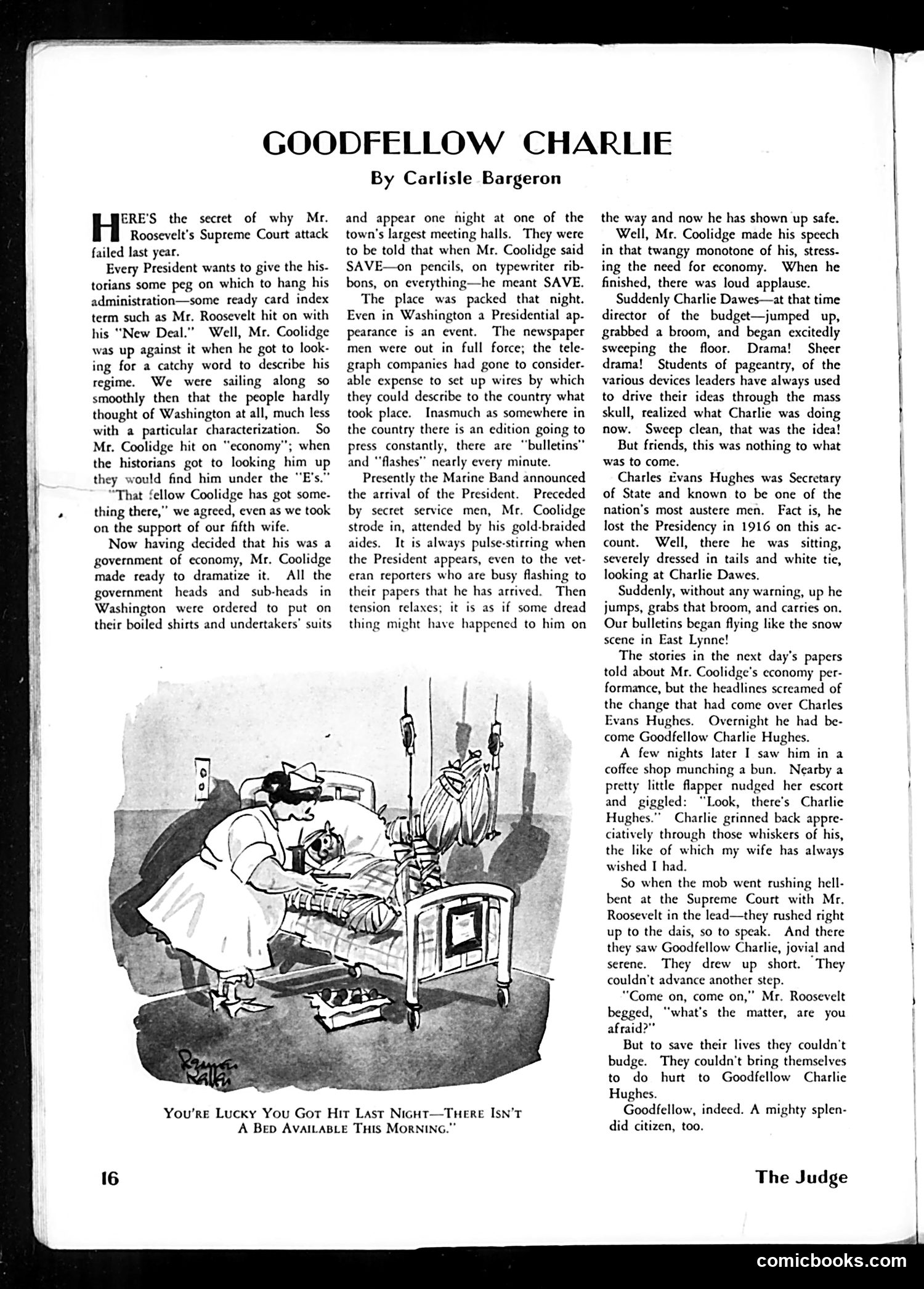
A restored page from Judge, 1938-07. Page through the whole issue in the reader above.
📄 Transcribed text from this page (OCR, searchable)
Machine-transcribed from the original scan — historical spelling and the odd misread are preserved.
ERE'S the secret of why Mr. Roosevelt's Supreme Court attack failed last year. Every President wants to give the his- torians some peg on which to hang his administration—some ready card index term such as Mr. Roosevelt hit on with his “New Deal.” Well, Mr. Coolidge was up against it when he got to look- ing for a catchy word to describe his regime. We were sailing along so smoothly then that the people hardly thought of Washington at all, much less with a particular characterization. So Mr. Coolidge hit on “economy”; when the historians got to looking him up they would find him under the “E's.” “That fellow Coolidge has got some- thing there,” we agreed, even as we took on the support of our fifth wife. Now having decided that his was a government of economy, Mr. Coolidge made ready to dramatize it. All the government heads and sub-heads in Washington were ordered to put on their boiled shirts and undertakers’ suits GOODFELLOW CHARLIE By Carlisle Bargeron and appear one night at one of the town’s largest meeting halls. They were to be told that when Mr. Coolidge said SAVE—on pencils, on typewriter rib- bons, on everything—he meant SAVE. The place was packed that night. Even in Washington a Presidential ap- pearance is an event. The newspaper men were out in full force; the tele- gtaph companies had gone to consider- able expense to set up wires by which they could describe to the country what took place. Inasmuch as somewhere in the country there is an edition going to press constantly, there are “bulletins” and “flashes” nearly every minute. Presently the Marine Band announced the arrival of the President. Preceded by secret service men, Mr. Coolidge strode in, attended by his gold-braided aides. It is always pulse-stirring when the President appears, even to the vet- eran reporters who are busy flashing to their papers that he has arrived. Then tension relaxes; it is as if some dread thing might have happened to him on You’re Lucky You Gor Hit Last NicHt—Tuere Isn’T A Bep AVAILABLE THIS MORNING.” the way and now he has shown up safe. Well, Mr. Coolidge made his speech in that twangy monotone of his, stress- ing the need for economy. When he finished, there was loud applause. Suddenly Charlie Dawes—at that time director of the budget—jumped up, grabbed a broom, and began excitedly sweeping the floor. Drama! Sheer drama! Students of pageantry, of the various devices leaders have always used to drive their ideas through the mass skull, realized what Charlie was doing now. Sweep clean, that was the idea! But friends, this was nothing to what was to come. Charles Evans Hughes was Secretary of State and known to be one of the nation’s most austere men. Fact is, he lost the Presidency in 1916 on this ac- count. Well, there he was sitting, severely dressed in tails and white tie, looking at Charlie Dawes. Suddenly, without any warning, up he jumps, grabs that broom, and carries on. Our bulletins began flying like the snow scene in East Lynne! The stories in the next day's papers told about Mr. Coolidge’s economy per- formance, but the headlines screamed of the change that had come over Charles Evans Hughes. Overnight he had be- come Goodfellow Charlie Hughes. A few nights later I saw him in a coffee shop munching a bun. Nearby a pretty little flapper nudged her escort and giggled: “Look, there's Charlie Hughes.” Charlie grinned back appre- ciatively through those whiskers of his, the like of which my wife has always wished I had. So when the mob went rushing hell- bent at the Supreme Court with Mr. Roosevelt in the lead—they rushed right up to the dais, so to speak. And there they saw Goodfellow Charlie, jovial and serene. They drew up short. They couldn't advance another step. “Come on, come on,” Mr. Roosevelt begged, “what's the matter, are you afraid?” But to save their lives they couldn't budge. They couldn't bring themselves to do hurt to Goodfellow Charlie Hughes. Goodfellow, indeed. A mighty splen- did citizen, too. The Judge comicbooks.com