
Judge, 1938-07 · page 10 of 53
Judge — July 1938 — page 10: what you’re looking at
What you’re looking at
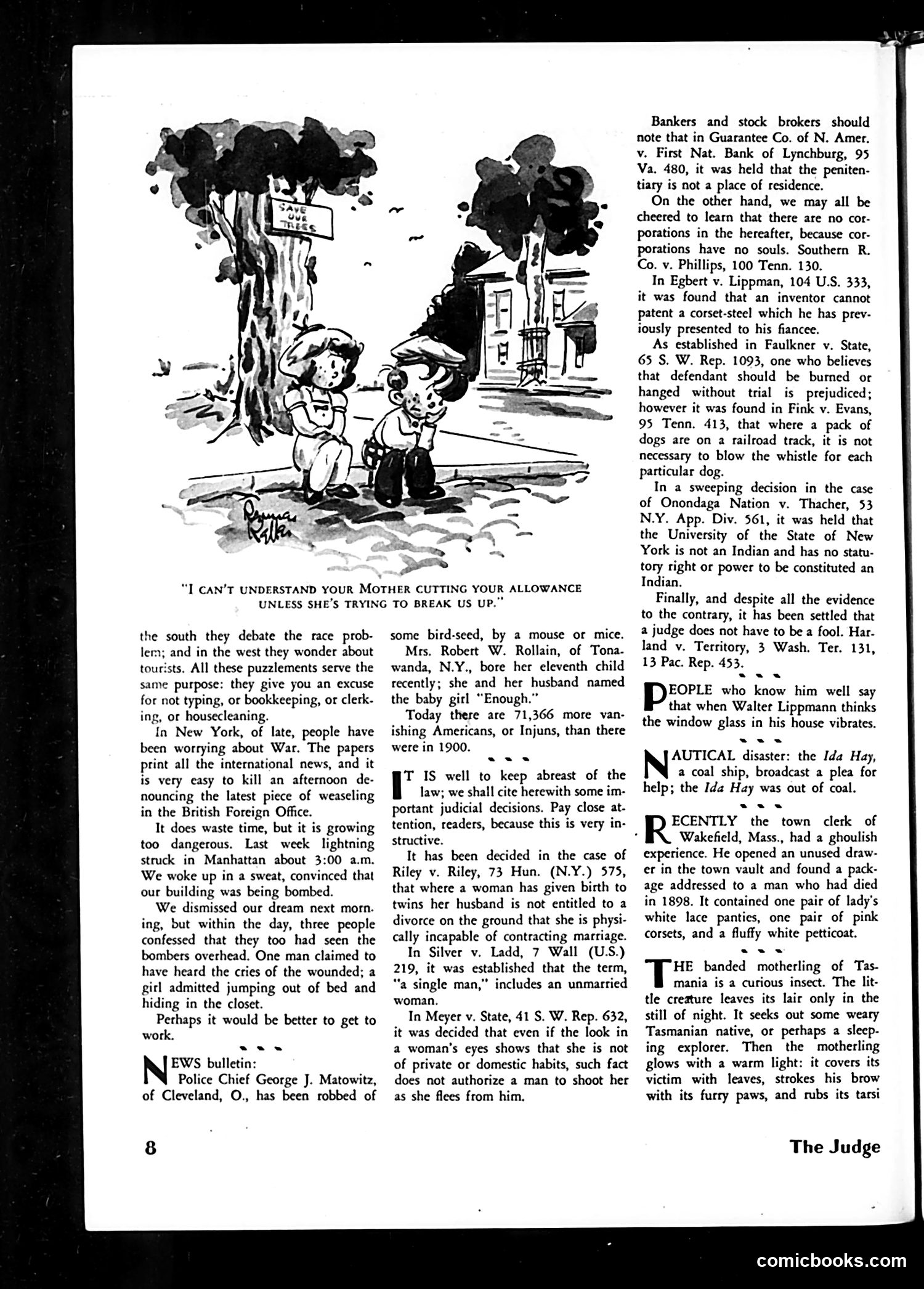
# The Judge Page Analysis ## The Main Cartoon The illustration depicts two young people beneath a tree labeled "LOVE." The boy complains that the girl's mother cutting her allowance seems designed to "break us up"—suggesting parental disapproval of their romance through financial pressure. ## The Satire's Point This is typical romantic comedy satire: the boy interprets economic hardship as a deliberate parental strategy to separate them, missing the more obvious explanation that money is simply tight. It mocks young lovers' tendency to see themselves as the center of their parents' concerns. ## The Surrounding Content The page contains miscellaneous satirical items: absurd "news bulletins" (a police chief robbed by mice; a couple naming their eleventh child "Enough"); and a series of deliberately ridiculous legal case summaries poking fun at judicial logic—such as the ruling that shooting a fleeing woman isn't justified merely because "the look in her eyes" suggests impropriety. This reflects Judge magazine's characteristic irreverent humor targeting social conventions, legal absurdities, and human folly.
📄 Transcribed text from this page (OCR, searchable)
Machine-transcribed from the original scan — historical spelling and the odd misread are preserved.
“I CAN’T UNDERSTAND YOUR MOTHER CUTTING YOUR ALLOWANCE UNLESS SHE’S TRYING TO BREAK US UP.” the south they debate the race prob- ler; and in the west they wonder about tourists. All these puzzlements serve the same purpose: they give you an excuse for not typing, or bookkeeping, or clerk- ing, or housecleaning. In New York, of late, people have been worrying about War. The papers print all the international news, and it is very easy to kill an afternoon de- nouncing the latest piece of weaseling in the British Foreign Office. It does waste time, but it is growing too dangerous. Last week lightning struck in Manhattan about 3:00 a.m. We woke up in a sweat, convinced that our building was being bombed. We dismissed our dream next morn. ing, but within the day, three people confessed that they too had seen the bombers overhead. One man claimed to have heard the cries of the wounded; a gitl admitted jumping out of bed and hiding in the closet. Perhaps it would be better to get to work. EWS bulletin: Police Chief George J. Matowitz, of Cleveland, O., has been robbed of 8 some bird-seed, by a mouse or mice. Mrs. Robert W. Rollain, of Tona- wanda, N.Y., bore her eleventh child recently; she and her husband named the baby girl “Enough.” Today there are 71,366 more van- ishing Americans, or Injuns, than there were in 1900. T IS well to keep abreast of the law; we shall cite herewith some im- portant judicial decisions. Pay close at- tention, readers, because this is very in- structive. It has been decided in the case of Riley v. Riley, 73 Hun. (N.Y.) 575, that where a woman has given birth to twins her husband is not entitled to a divorce on the ground that she is physi- cally incapable of contracting marriage. In Silver v. Ladd, 7 Wall (U.S.) 219, it was established that the term, “a single man,” includes an unmarried woman. In Meyer v. State, 41 S. W. Rep. 632, it was decided that even if the look in a woman's eyes shows that she is not of private or domestic habits, such fact does not authorize a man to shoot her as she flees from him. Bankers and stock brokers should note that in Guarantee Co. of N. Amer. v. First Nat. Bank of Lynchburg, 95 Va. 480, it was held that the peniten- tiary is not a place of residence. On the other hand, we may all be cheered to learn that there are no cor- porations in the hereafter, because cor- porations have no souls. Southern R. Co. v. Phillips, 100 Tenn. 130. In Egbert v. Lippman, 104 U.S. 333, it was found that an inventor cannot patent a corset-steel which he has prev- iously presented to his fiancee. As established in Faulkner v. State, 65 S. W. Rep. 1093, one who believes that defendant should be burned or hanged without trial is prejudiced; however it was found in Fink v. Evans, 95 Tenn. 413, that where a pack of dogs are on a railroad track, it is not necessary to blow the whistle for each particular dog. In a sweeping decision in the case of Onondaga Nation v. Thacher, 53 N.Y. App. Div. 561, it was held that the University of the State of New York is not an Indian and has no statu- tory right or power to be constituted an Indian. Finally, and despite all the evidence to the contrary, it has been settled that a judge does not have to be a fool. Har- land v. Territory, 3 Wash. Ter. 131, 13 Pac. Rep. 453. EOPLE who know him well say that when Walter Lippmann thinks the window glass in his house vibrates. AUTICAL disaster: the Ida Hay, a coal ship, broadcast a plea for help; the Ida Hay was out of coal. ECENTLY the town clerk of Wakefield, Mass., had a ghoulish experience. He opened an unused draw- er in the town vault and found a pack- age addressed to a man who had died in 1898. It contained one pair of lady's white lace panties, one pair of pink corsets, and a fluffy white petticoat. HE banded motherling of Tas- mania is a curious insect. The lit- tle creature leaves its lair only in the still of night. It seeks out some weary Tasmanian native, or perhaps a sleep. ing explorer. Then the motherling glows with a warm light: it covers its victim with leaves, strokes his brow with its furry paws, and rubs its tarsi The Judge comicbooks.com