
A complete issue · 36 pages · 1928
Judge — July 14, 1928
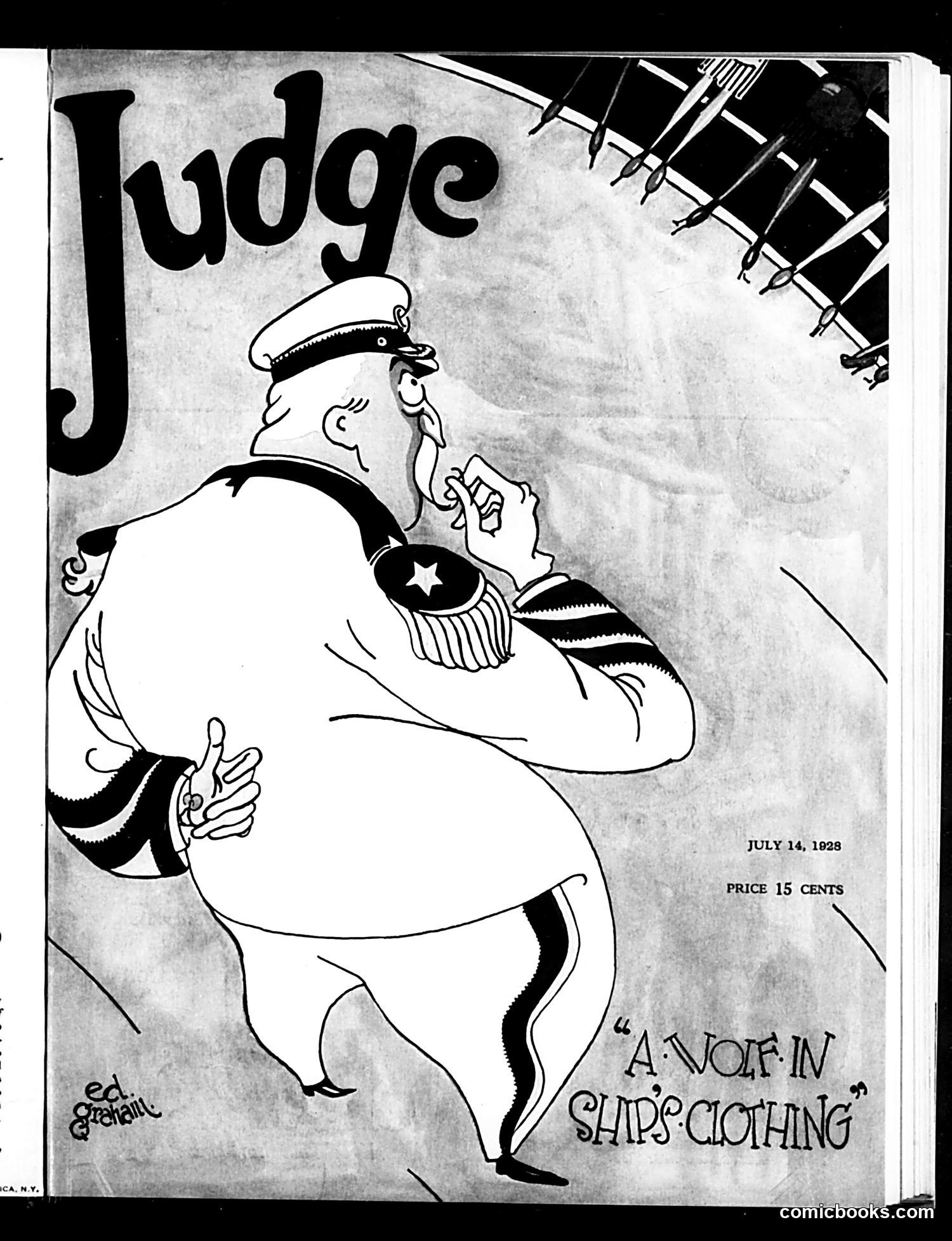
This is a cover for **Judge**, a satirical magazine. The cartoon depicts a rotund military officer in naval dress uniform, labeled "A WOLF IN SHIP'S CLOTHING" — a play on the phrase "wolf in sheep's clothing." The figure appears to be a caricatured naval officer or admiral, drawn with exaggerated corpulence and military insignia including epaulettes and a captain's hat. The joke likely satirizes either: 1. A specific military figure whose public image contradicted private behavior, or 2. General corruption/hypocrisy within naval leadership during the 1920s Without additional historical context, the specific officer and incident referenced remain unclear. The satire hinges on the contrast between official military respectability and hidden impropriety.
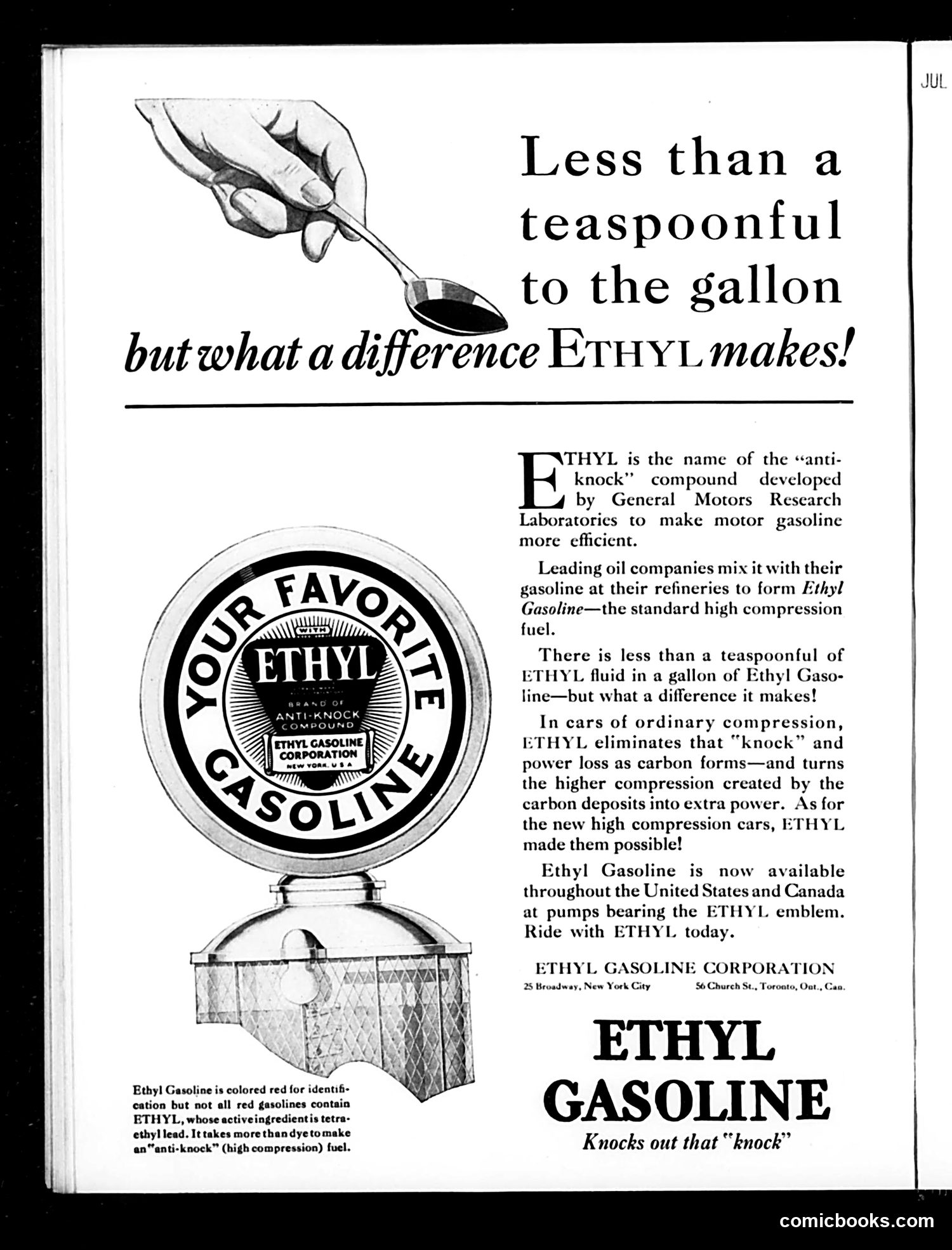
This is **not a satirical cartoon but a straight advertisement** for Ethyl Gasoline, placed in *Judge* magazine. There are no political caricatures or social satire present. The ad promotes Ethyl, an "anti-knock" fuel additive developed by General Motors Research Laboratories. The visual metaphor shows a teaspoon representing the small amount of ethyl compound (less than a teaspoon per gallon) needed to dramatically improve gasoline performance. The advertisement emphasizes that despite the tiny quantity, ethyl eliminates engine "knock" and enables higher compression engines. Ethyl Gasoline was widely available at pumps throughout the U.S. and Canada by this publication date. This represents early automotive fuel marketing targeting consumer performance concerns.
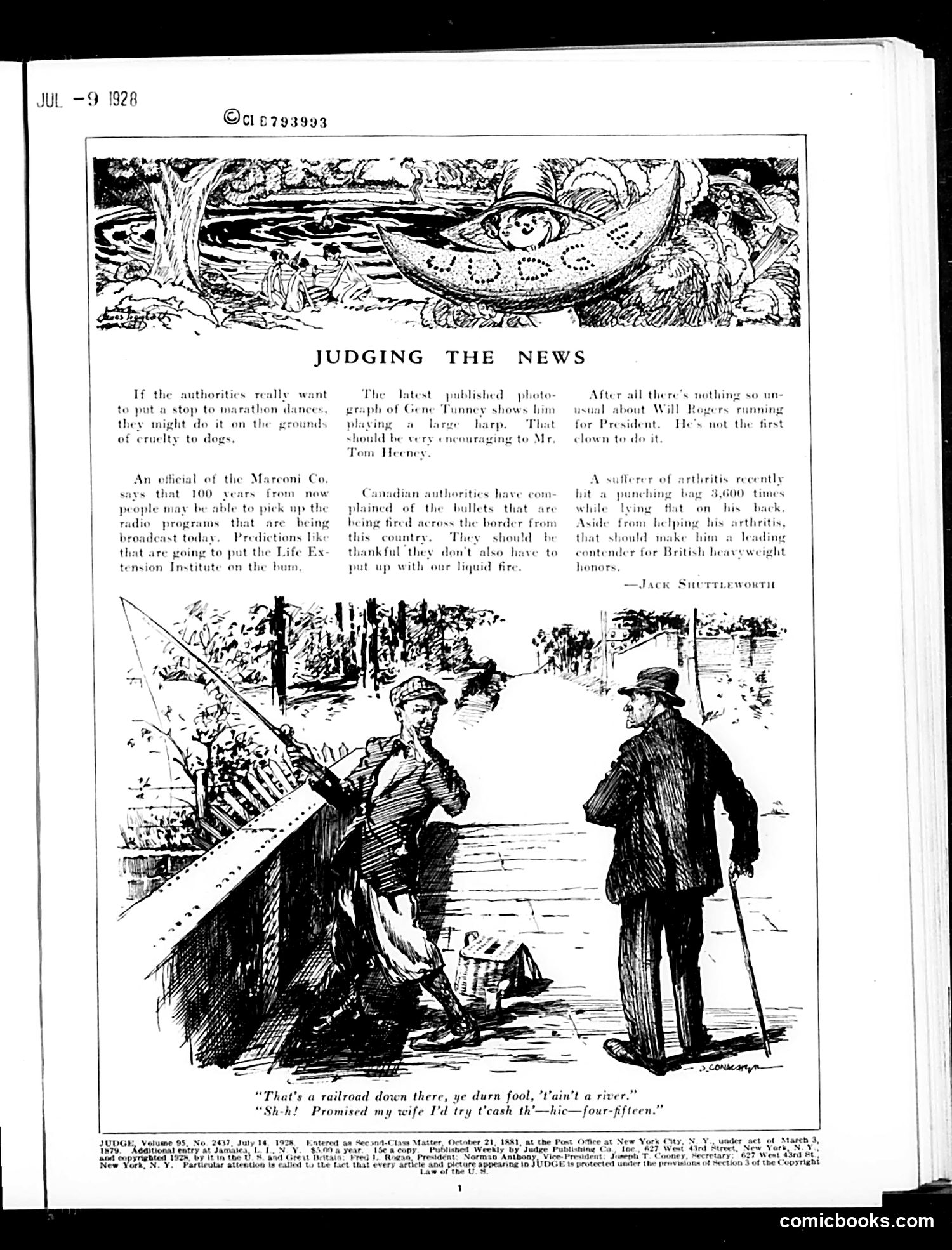
This satirical column contains several brief social commentary items and a cartoon. The main illustration depicts two men on a dock or pier: one seated with a fishing rod, another standing with a cane. The caption reads: "That's a railroad down there, ye darn fool. 'Tain't a river.' Sh-h! Promised my wife I'd try trout th'—he—four-fifteen." The joke appears to mock either fishing enthusiasts' gullibility or someone's deliberately deceptive promise to their spouse about fishing versus some other activity. The reference to a "four-fifteen" (likely a train schedule) suggests the man is actually planning to catch a train rather than fish, contrary to what he told his wife. The surrounding text discusses various news items including Gene Tunney playing harp and complaints about Canadian bullets.
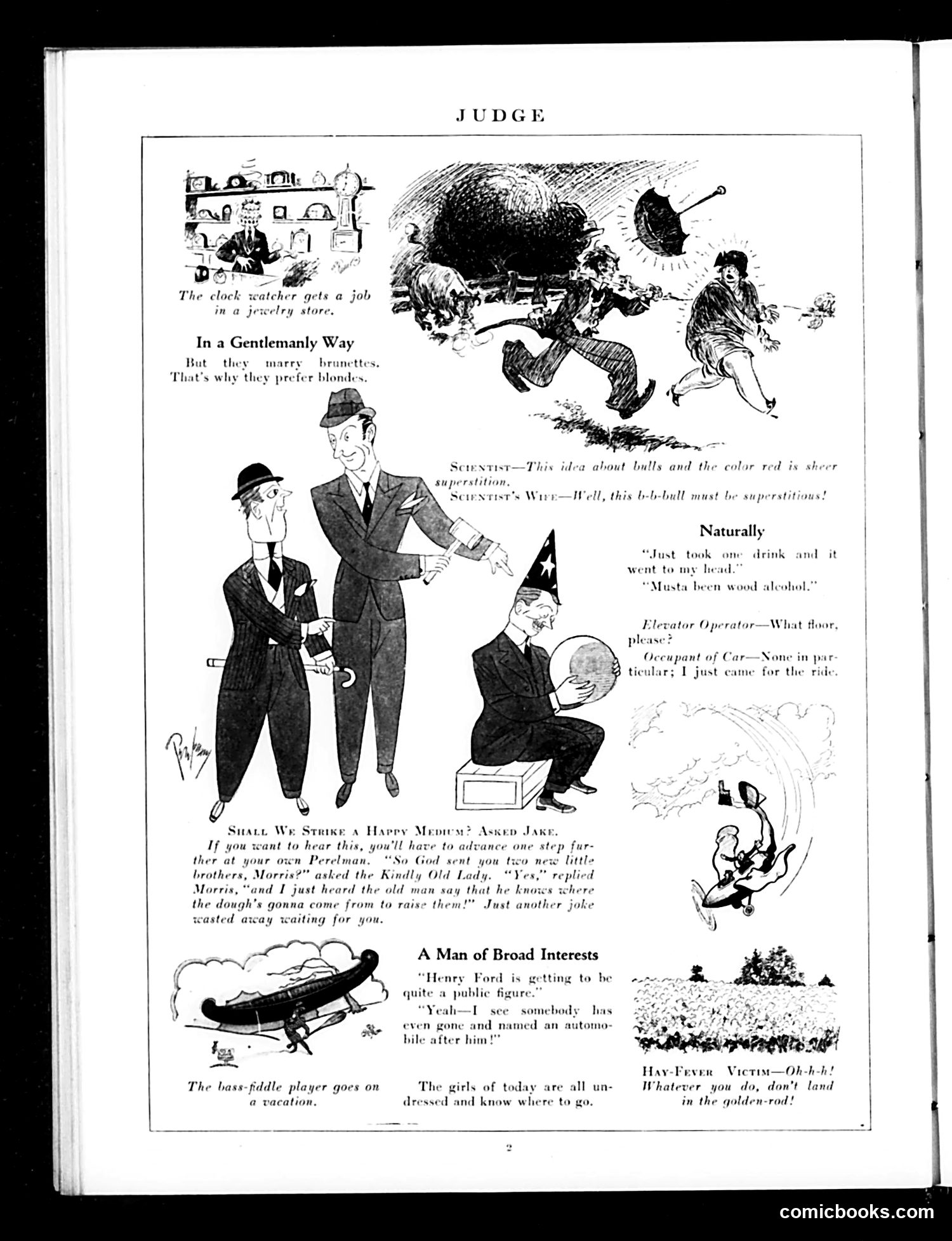
This satirical page from *Judge* magazine contains several short humor pieces mocking contemporary social trends and stereotypes: **"In a Gentlemanly Way"** jokes about gentlemen preferring brunettes to blondes—a commentary on dating preferences of the era. **"Naturally"** depicts a drunk man blaming alcohol for his condition, playing on period anxieties about drinking. **"Shall We Strike a Happy Medium?"** presents a long joke about brothers named Morris, poking fun at Irish immigrant naming conventions and family dynamics. **"A Man of Broad Interests"** satirizes Henry Ford's cultural prominence—someone has named an automobile after him, suggesting his outsized celebrity status in early 20th-century America. The page reflects typical *Judge* content: class-based humor, ethnic stereotypes, and commentary on contemporary public figures and social behaviors.
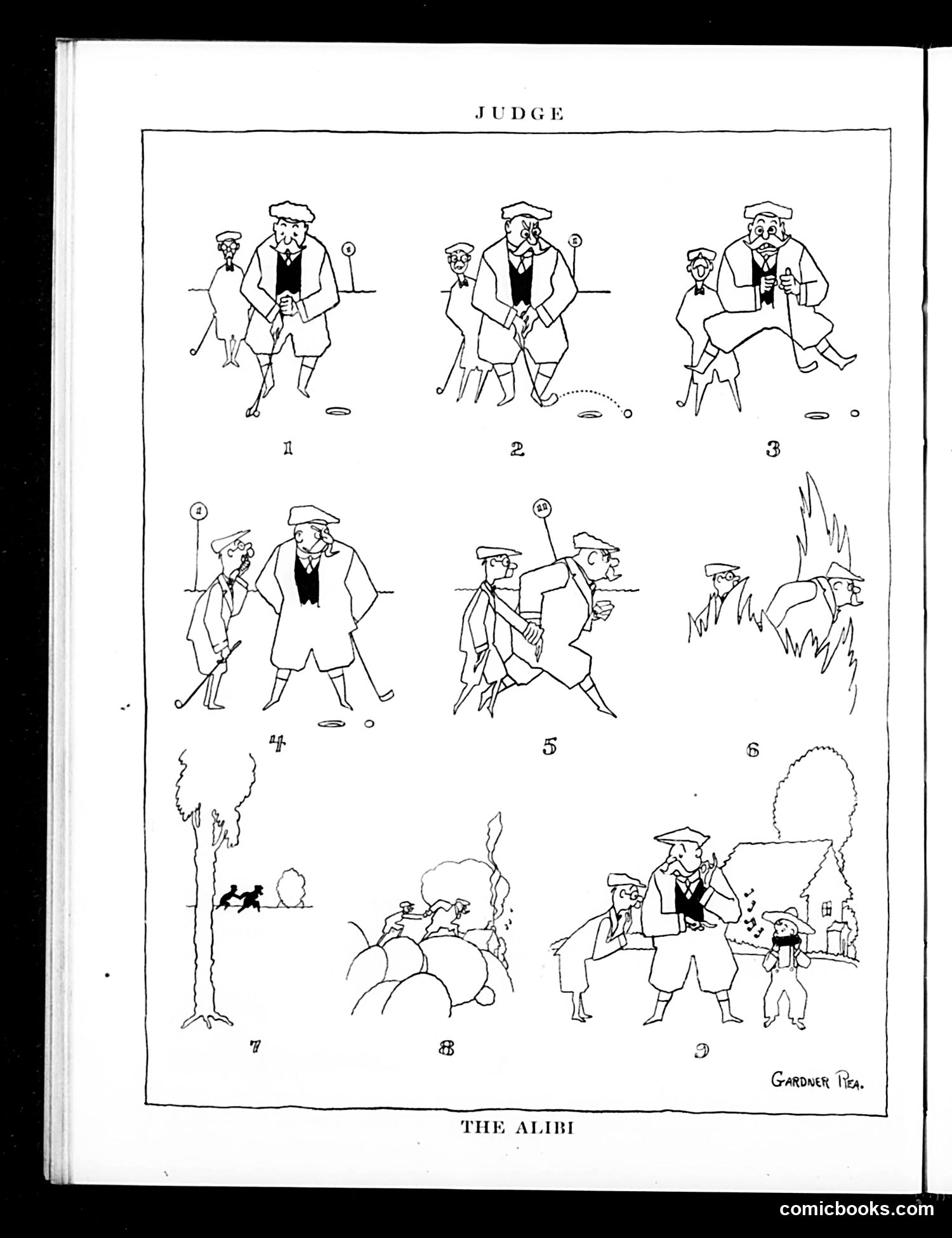
This cartoon by Gardner Rea satirizes a judge's dubious legal reasoning. The sequence depicts a judge building an increasingly implausible defense for a defendant. Panels 1-3 show the judge coaching a small defendant, establishing the lie. Panels 4-5 escalate the absurdity—the judge and defendant appear to be fleeing or creating false witnesses. Panels 6-9 show the "alibi" becoming ridiculous: the defendant is supposedly elsewhere (in flames, on a hill, at a town gathering). The satire targets judicial corruption or incompetence—specifically, judges willing to concoct transparent falsehoods to acquit defendants. The exaggerated scenarios mock both the legal system's potential for abuse and the obvious implausibility of such defenses. The title "The Alibi" underscores the central theme of manufactured innocence.
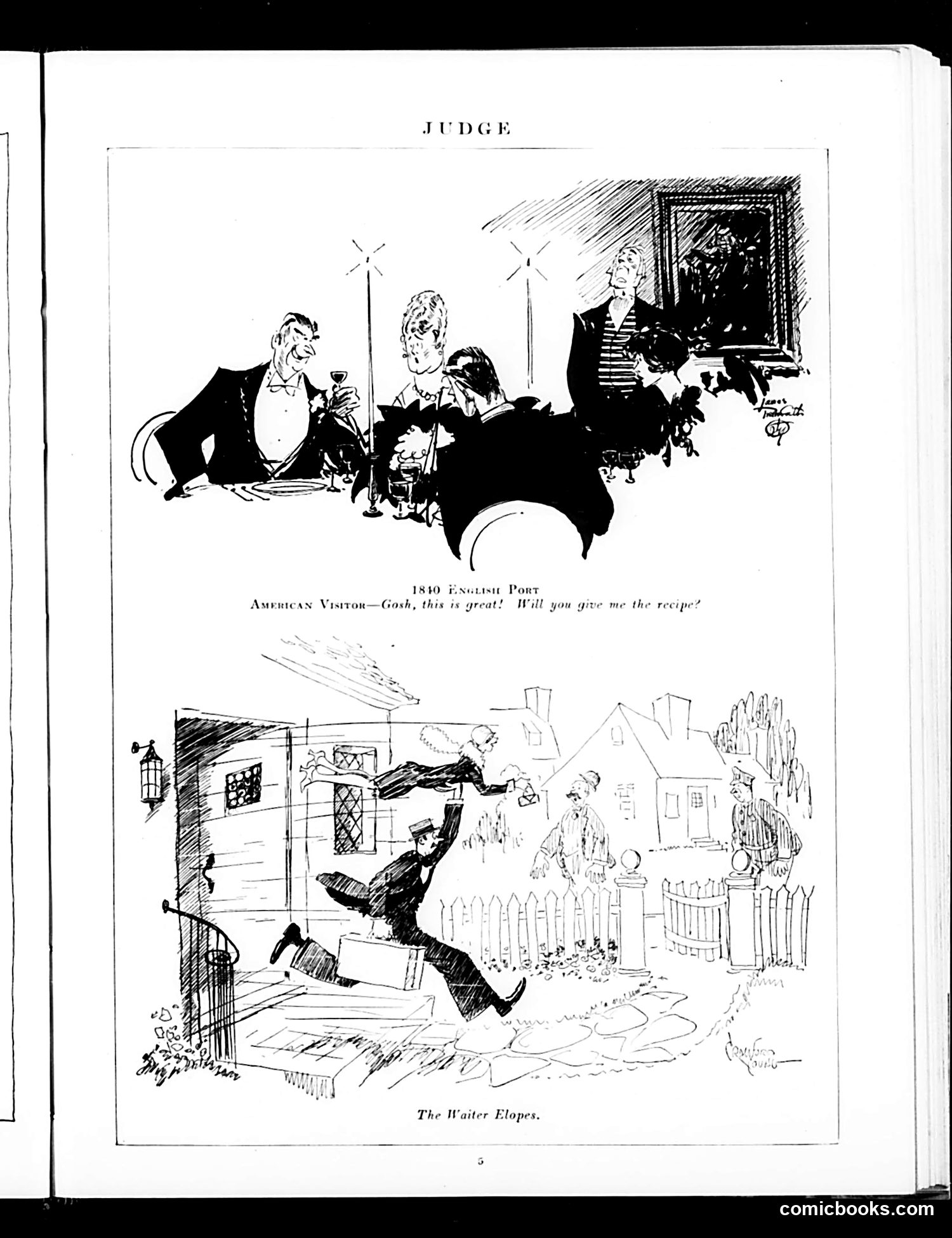
This page contains two cartoons: **Top cartoon ("1849 English Port")**: Depicts an American visitor at an English dinner party asking "Gosh, this is great! Will you give me the recipe?" The satire mocks American materialism and lack of refinement—the visitor reduces sophisticated English cuisine to mere recipe-collecting rather than appreciating culinary artistry. It stereotypes Americans as uncultured and commercially-minded. **Bottom cartoon ("The Waiter Elopes")**: Shows a waiter fleeing a house with belongings, apparently abandoning his position. The exact satirical target is unclear from the image alone, but likely comments on labor instability or servant issues of the era. Both cartoons use exaggerated caricature typical of Judge's satirical style.
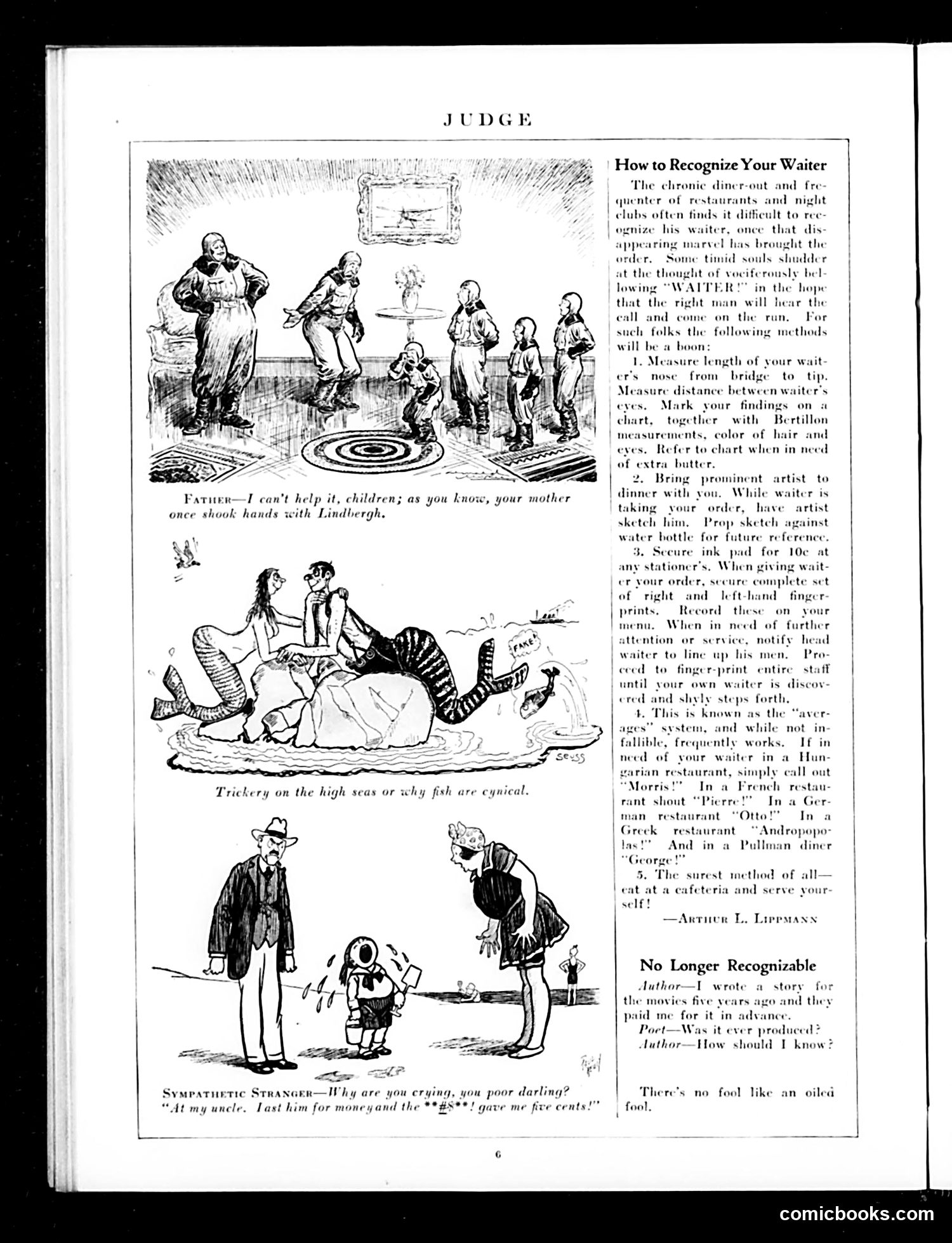
This page from Judge contains humorous satirical pieces about modern restaurant dining and Hollywood's film industry. **"How to Recognize Your Waiter"** mocks the chronic restaurant-goer's difficulty identifying waiters between visits. The satire employs increasingly absurd "methods": measuring the waiter's nose, hiring an artist to sketch him, fingerprinting the entire staff, and finally—the punchline—simply eating at a cafeteria where you serve yourself. The cartoon illustrations show exaggerated dining scenarios. The piece satirizes both the vanity of frequent diners and the impersonal nature of restaurant service. **"No Longer Recognizable"** is a brief joke dialogue between an Author and Poet. The Author laments writing a story for movies five years ago, paid in advance, yet never knowing if it was produced. The Poet's closing remark ("There's no fool like an oiled fool") suggests the author was foolish to accept payment without follow-up—satirizing Hollywood's opacity and the powerlessness of writers in the film industry. Both pieces use humor to critique early 20th-century urban leisure culture and entertainment industry practices.
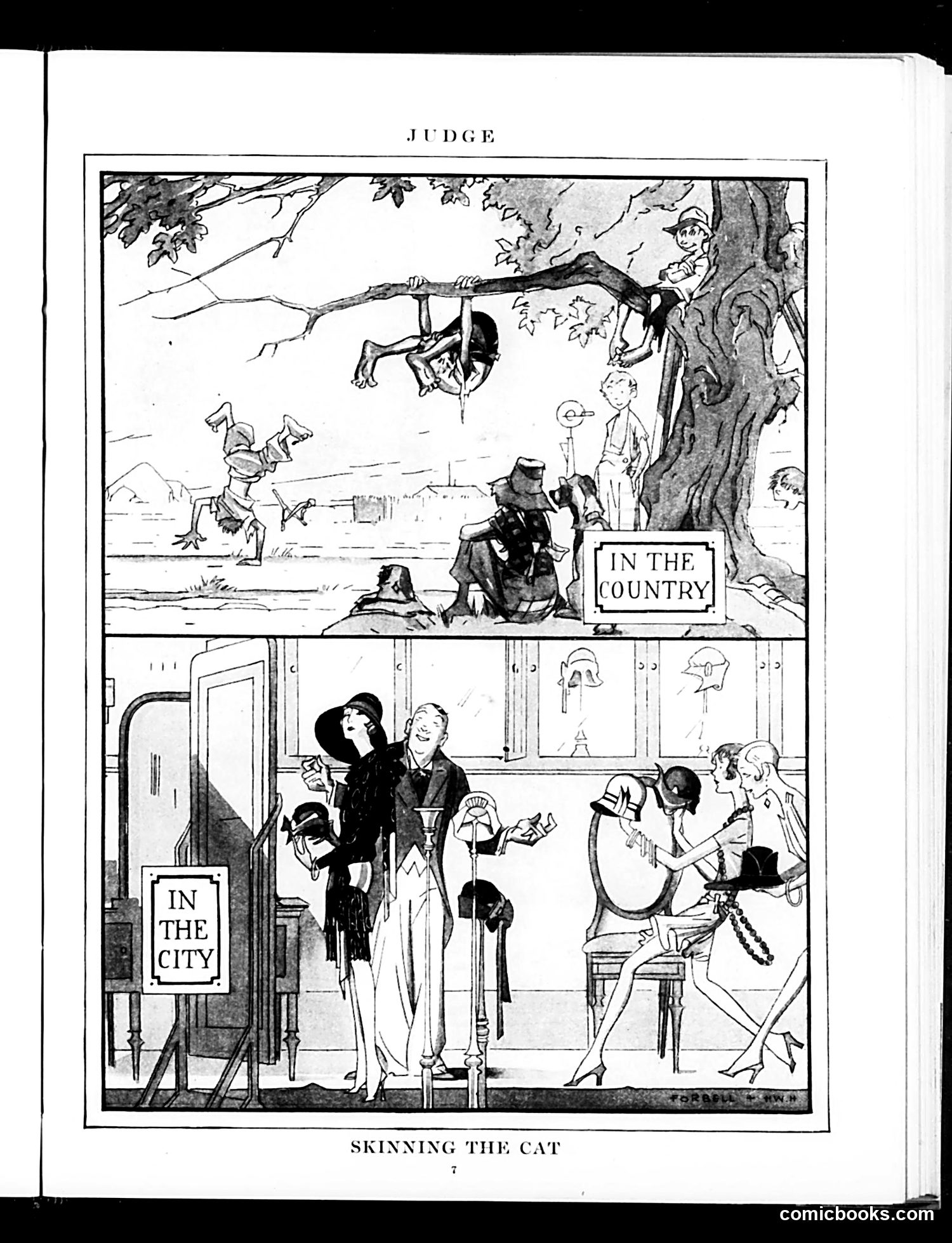
This two-panel comic contrasts urban and rural pastimes. The top panel ("In the Country") shows children engaged in simple outdoor play—swinging from a tree branch, doing handstands, and playing games. The bottom panel ("In the City") depicts well-dressed urbanites in an apartment engaged in more sophisticated entertainment: playing musical instruments and what appears to be dancing or performing. The title "Skinning the Cat"—a period idiom meaning "accomplishing a goal through unconventional means"—suggests the cartoon's point: there are multiple ways to entertain oneself and enjoy life. The satire likely comments on class differences and the contrast between rural simplicity and urban sophistication, or perhaps mocks pretentious city entertainments versus genuine country pleasures. The exact satirical target remains unclear without additional context.
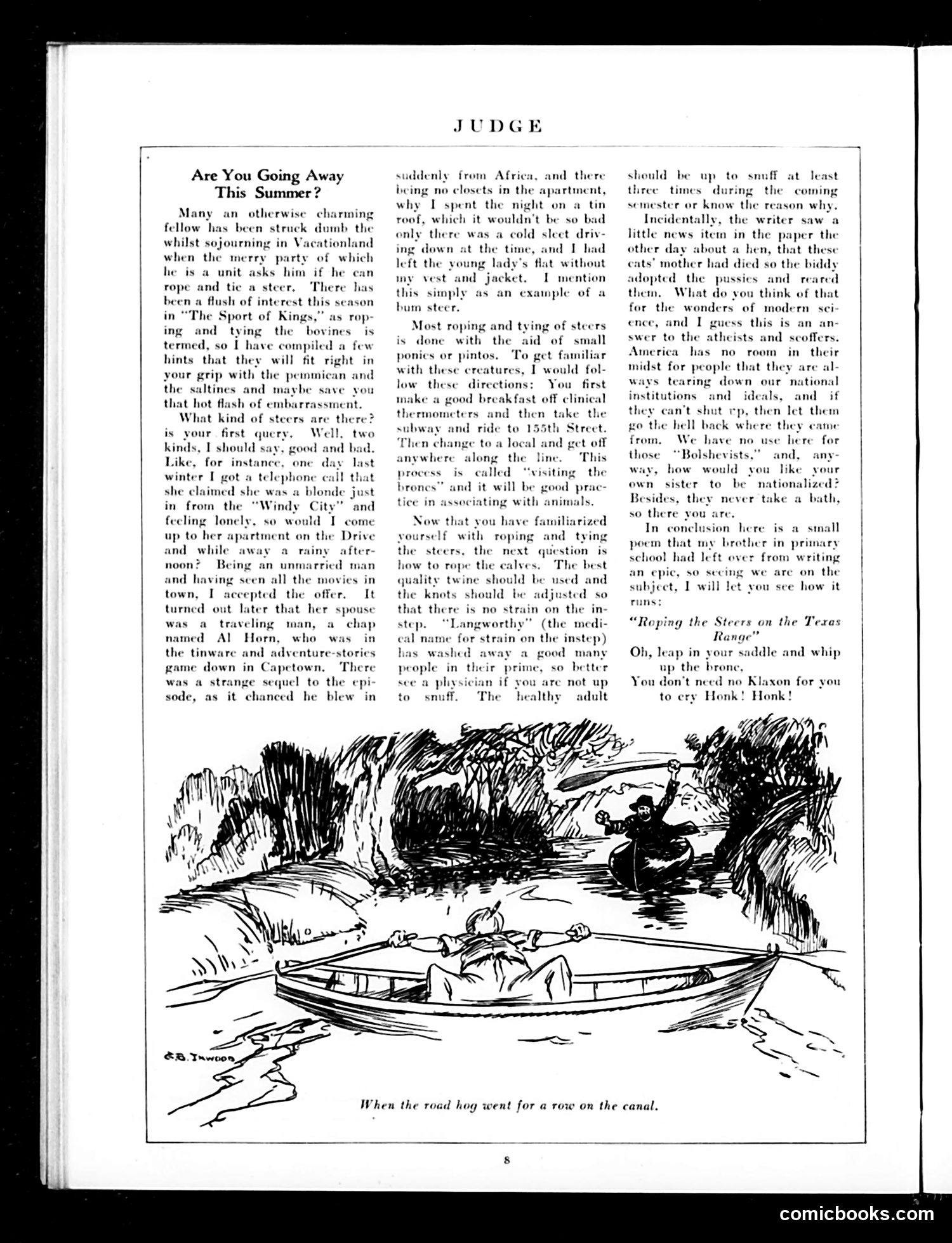
This is a humorous advice column disguised as practical instruction on roping cattle—a trendy "sport of kings" among vacationing urbanites. The author, an unmarried man from the city, offers tongue-in-cheek tips for summer visitors attempting Western ranch activities. The satire targets wealthy leisure-class tourists trying to adopt cowboy culture without genuine knowledge. The extended anecdote about being trapped on a tin roof (after a woman's traveling husband unexpectedly returns from Africa) illustrates the column's real subject: the social embarrassments of city folk attempting unfamiliar pursuits. The cartoon depicts someone actually engaging in canal boating—suggesting genteel summer activities, not Wild West adventures. The concluding political jabs at "Bolshevists" and foreign sympathizers reflect 1920s anti-communist sentiment, oddly injected into what is otherwise lighthearted vacation satire.
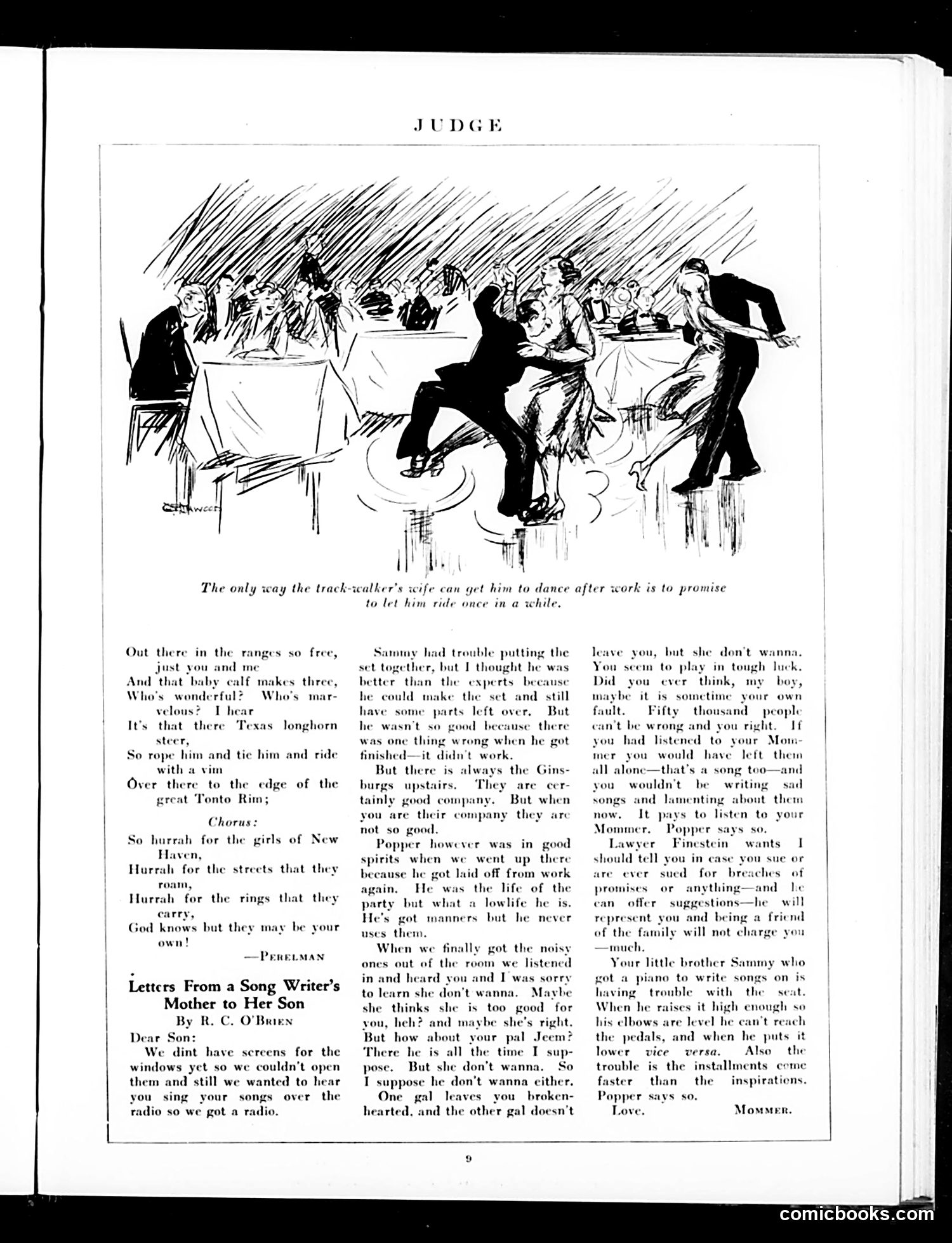
This page contains two separate pieces of satirical humor typical of Judge magazine's output: **Top Cartoon:** A dinner party scene mocking social pretension. The caption jokes that a track-walker's wife can only get him to dance by promising he can "ride once in a while"—satirizing working-class men's desire to escape domestic life, even briefly. **"Letters From a Song Writer's Mother":** A humorous column written as a mother's advice to her son, a radio songwriter. The satire targets several 1920s-30s social types: Sammy the amateur radio enthusiast who can't finish projects; the Ginsburgs (appears to reference Jewish neighbors); Popper, a chronically unemployed man pretending cheerfulness; and various romantic entanglements. The mother's folksy wisdom—"Fifty thousand people can't be wrong and you right"—mocks both maternal clichés and the son's artistic complaints. Mentions of lawyers and breach-of-promise suits reference period anxieties about litigation. Her son's younger brother struggling with piano installments satirizes consumer credit culture. The humor relies on recognizable ethnic stereotypes and working-class domestic situations of the era.
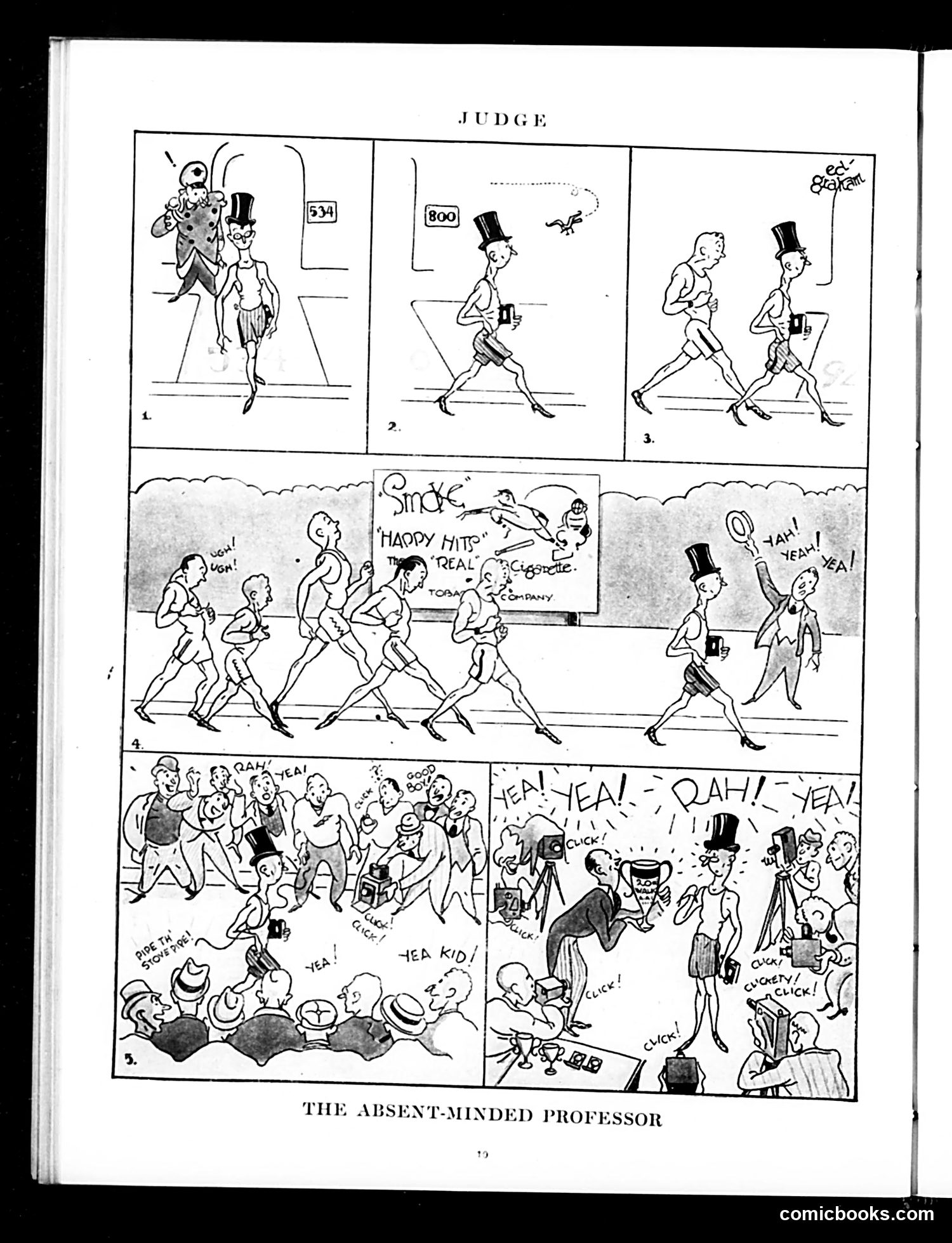
This comic strip satirizes the stereotype of the absent-minded academic. The narrative follows a professor (identifiable by his top hat) who appears distracted or forgetful in panels 1-3, showing him running with what appears to be confusion. Panels 4-6 escalate the joke: the professor's absent-mindedness somehow triggers an increasingly chaotic public spectacle—a foot race becomes a massive crowd scene with cheering spectators. The comic suggests that the professor's distraction or mistake inadvertently sets off a frenzy of public excitement, with crowds shouting "Yea!" and "Click!" (possibly referencing cameras or cigarettes advertised as "Happy Hits"). The humor derives from the contrast between the solitary, confused professor and the massive, enthusiastic mob reaction his actions somehow provoke—a common satirical trope about how minor individual actions can create disproportionate social consequences.
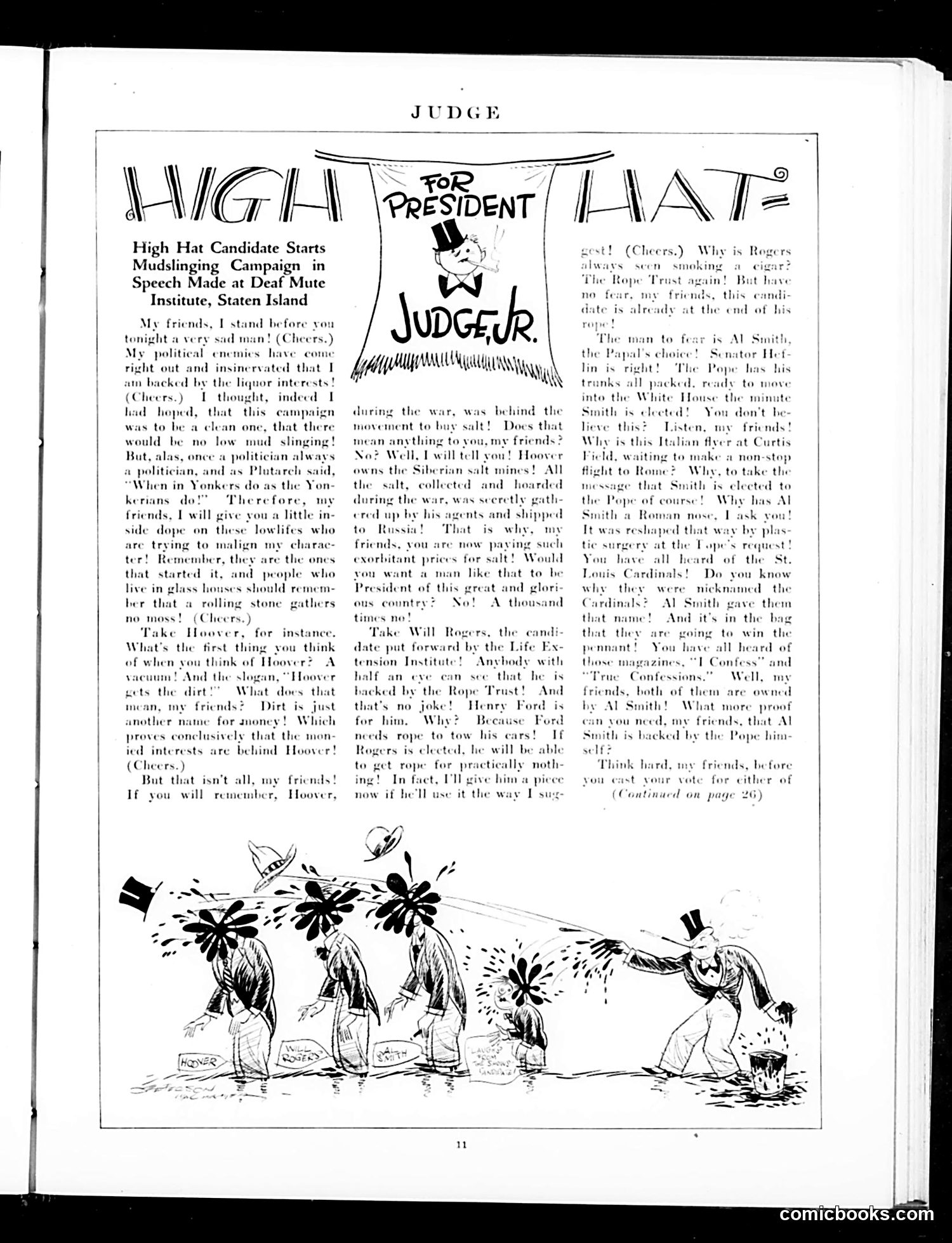
This Judge magazine piece satirizes a mudslinging political speech delivered at a deaf-mute institute—itself absurd, since the audience cannot hear. The speaker makes increasingly ridiculous accusations against political rivals. **Key Targets:** - **Herbert Hoover**: Mocked for "Hoover" vacuum cleaners and accused of owning Siberian salt mines, supposedly profiting from wartime salt hoarding - **Will Rogers**: The Life Extension Institute's candidate, allegedly backed by Henry Ford (who needs rope to tow cars—a nonsensical conspiracy) - **Al Smith**: The main target, attacked as the Pope's choice, with claims the Pope will move into the White House if Smith wins, and that Smith's Roman nose was surgically altered by Vatican orders **The Satire:** The speaker's logic is deliberately absurd—puns, non-sequiturs, and wild accusations—mocking how politicians make baseless character attacks while claiming the moral high ground. The setting at a deaf-mute institute adds ironic commentary: the candidate is literally speaking to those who cannot respond or hold him accountable. This reflects 1920s anti-Catholic sentiment and 1928 presidential campaign anxieties about Smith's religion.
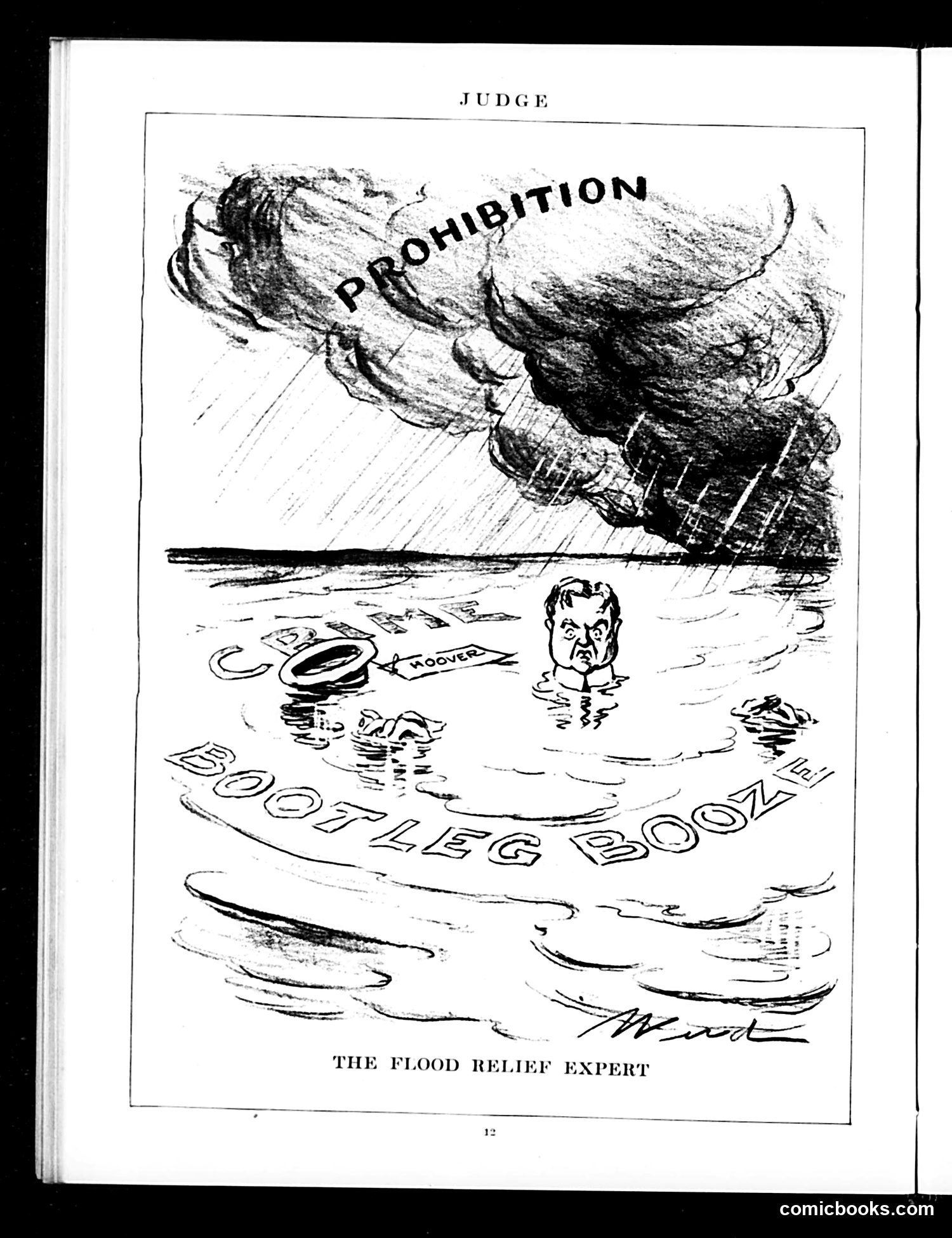
This political cartoon satirizes what appears to be a government official or expert who is drowning amid flood relief efforts. The figure's angry, distressed expression contrasts with the word "PROHIBITION" looming overhead like a storm cloud raining down destruction. Visible items in the water include "BOOTLEG BOOZE" and what appears to be contraband alcohol, suggesting the cartoon critiques how Prohibition enforcement interfered with or complicated flood relief operations. The "Hoover" label (likely referring to President Herbert Hoover) indicates this targets his administration's handling of disaster relief during the Prohibition era. The satire suggests government incompetence: an expert drowning while trying to manage competing priorities of flood response and alcohol prohibition enforcement.
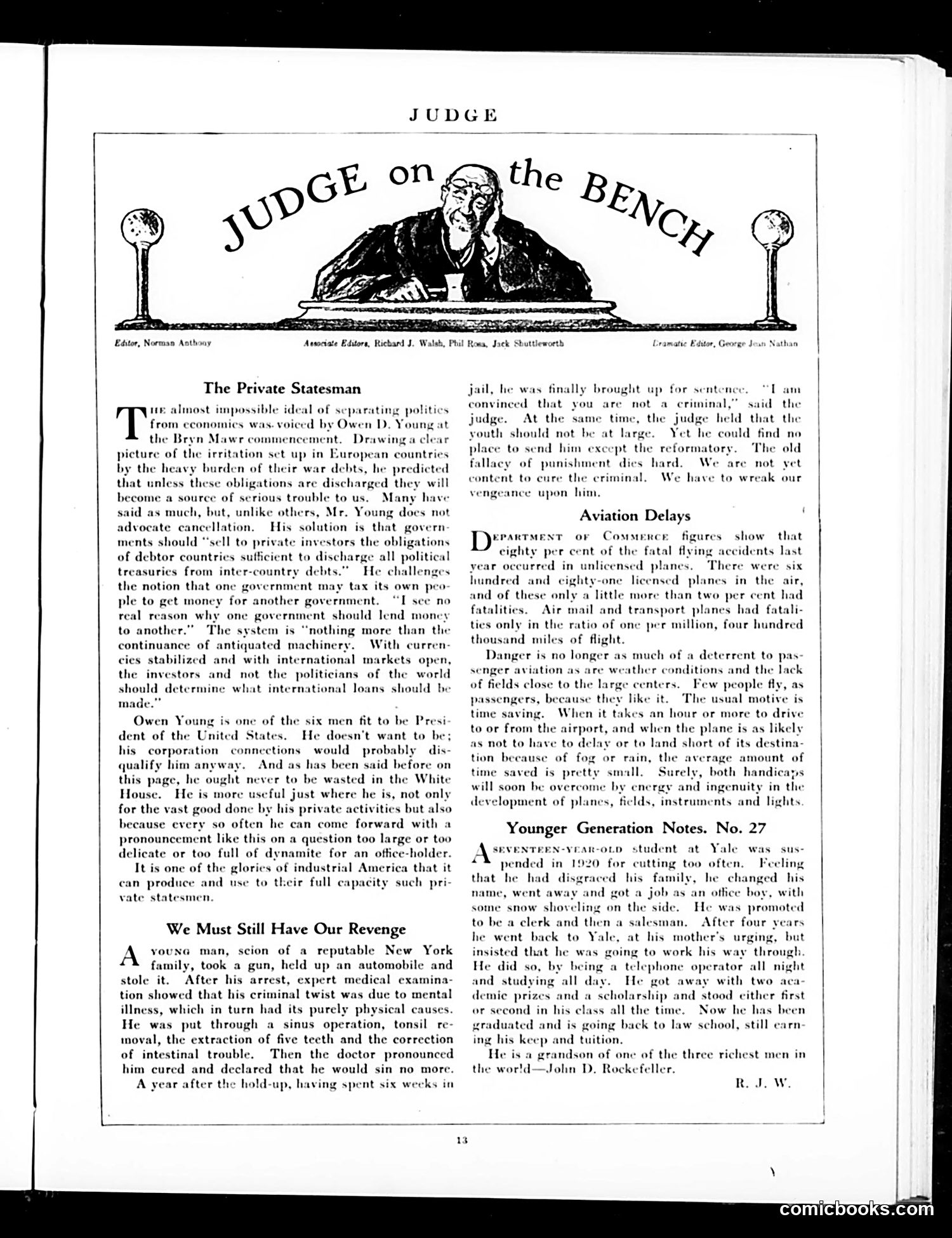
This page from Judge (a satirical American magazine) contains three distinct opinion pieces: **"The Private Statesman"** praises Owen D. Young, a prominent businessman, for publicly advocating that governments should sell war debts to private investors rather than have nations loan money to each other. The satire is gentle—Young is celebrated as a rare "private statesman" whose corporate position allows him to offer bold policy ideas without the political constraints office-holders face. **"We Must Still Have Our Revenge"** critiques outdated criminal justice philosophy. It describes a wealthy young man whose crime stemmed from physical/mental illness, successfully cured through medical treatment, yet society still demands punishment. The piece argues we cling to vengeance rather than accepting that rehabilitation works. **"Aviation Delays"** presents statistics showing licensed aircraft are safer than unlicensed ones, and argues that weather and inconvenient airport locations—not danger itself—deter commercial aviation growth. The header illustration shows a stern judge at the bench, appropriate for a satirical publication called "Judge" that often critiqued legal and social institutions.
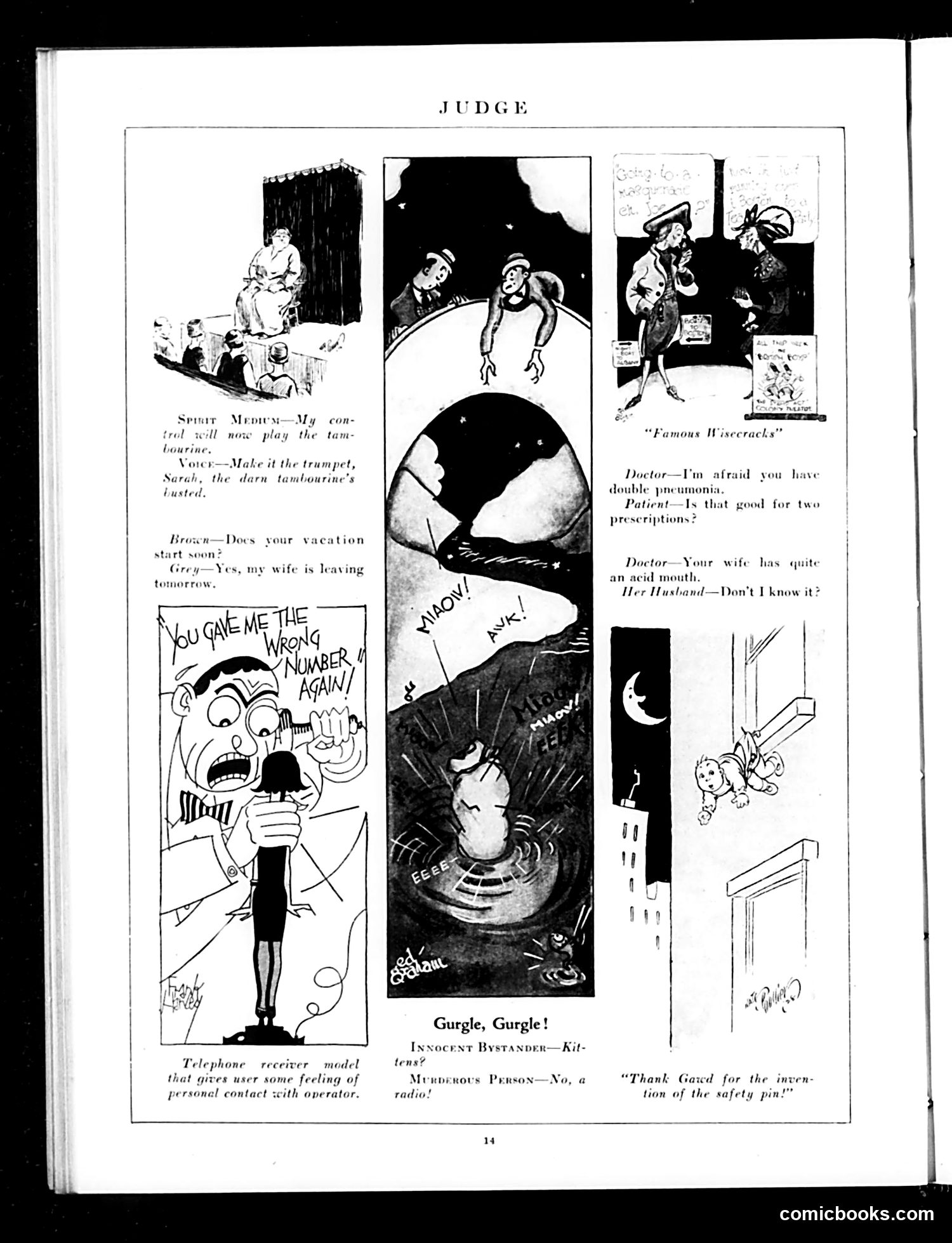
This page from *Judge* (a major American satirical magazine) contains several standalone jokes targeting early 20th-century domestic life and technology: **Top left**: A spirit medium séance joke—the "tambourine's busted," suggesting the supernatural performance is failing. **Middle left**: A husband-wife gag where the husband is relieved his wife is leaving (vacation = marital escape). **Center**: A large cartoon mocking early radio technology—a man mistakes cat sounds for radio reception, suggesting radios were still novel/unreliable enough to confuse listeners. **Right side**: Doctor jokes about pneumonia prescriptions and a wife's "acid mouth" (sharp tongue), representing standard marital humor of the era. **Bottom right**: A safety pin joke celebrating modern conveniences. Overall, these are light domestic satire and technology humor typical of 1920s-30s *Judge*—poking fun at marriage, new inventions, and the awkwardness of emerging technologies rather than targeting specific political figures or events.
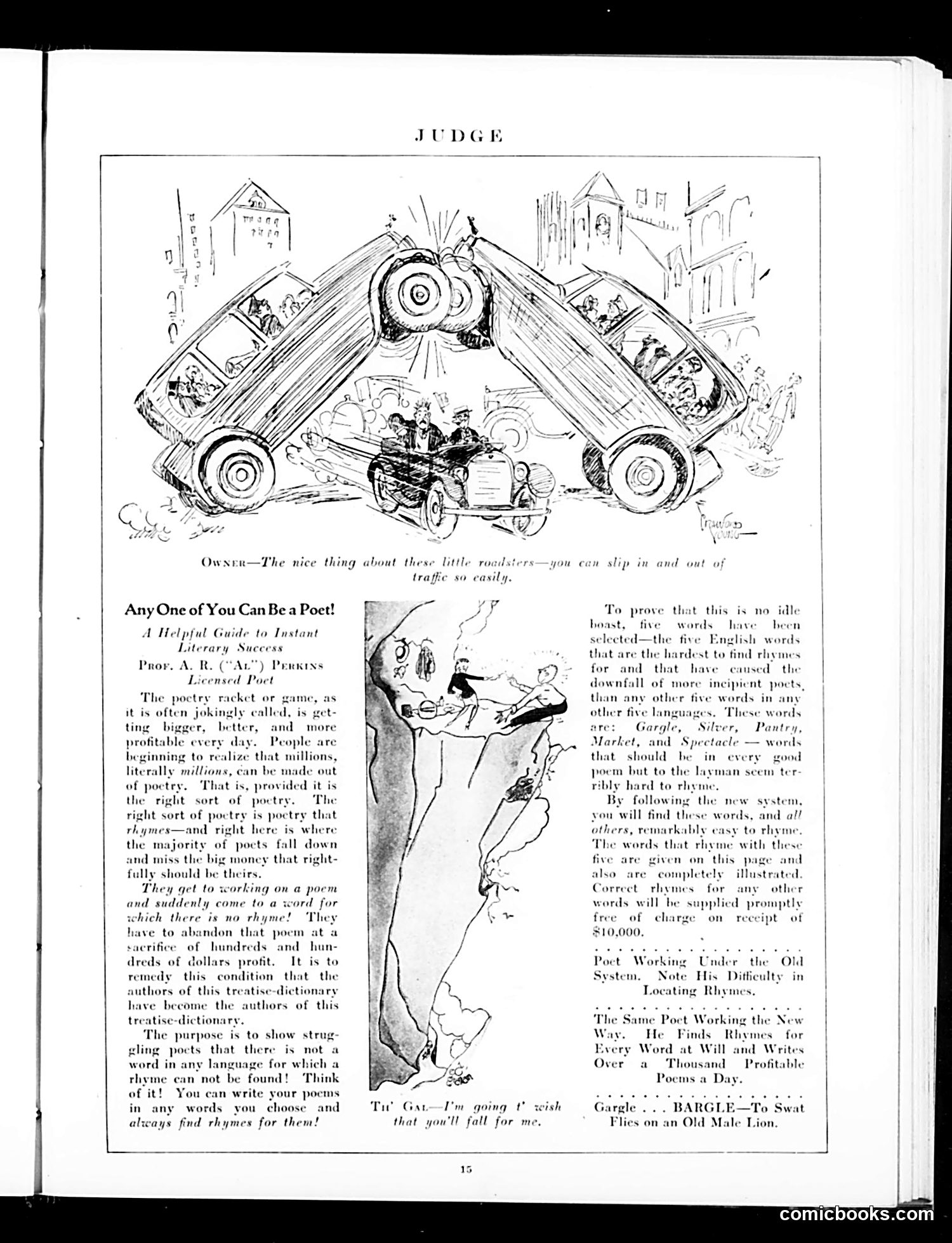
This page satirizes the commercialization of poetry through a fake "instant success" guide. The upper cartoon shows tiny roadsters circling a judge's gavel—likely mocking frivolous automobiles and litigation culture of the era. The main satire is "Any One of You Can Be a Poet!"—a mock instructional piece by "Prof. A. R. 'Cal' Perkins, Licensed Poet." It ridicules get-rich-quick schemes by claiming anyone can write profitable poetry if they simply use rhyming words. The joke targets both: 1. **Aspiring poets** tempted by promises of easy money from verse-writing 2. **Commercial poetry culture** that reduced art to formulaic rhyme-making for profit The contrast between the struggling poet (unable to rhyme difficult words like "gargle" and "silver") and the successful one (writing "a thousand profitable poems a day") satirizes how shallow, mechanistic versification replaces genuine literary craft. The absurd "$10,000" reward for finding rhymes mocks dubious literary contests and schemes common in early 20th-century magazines.
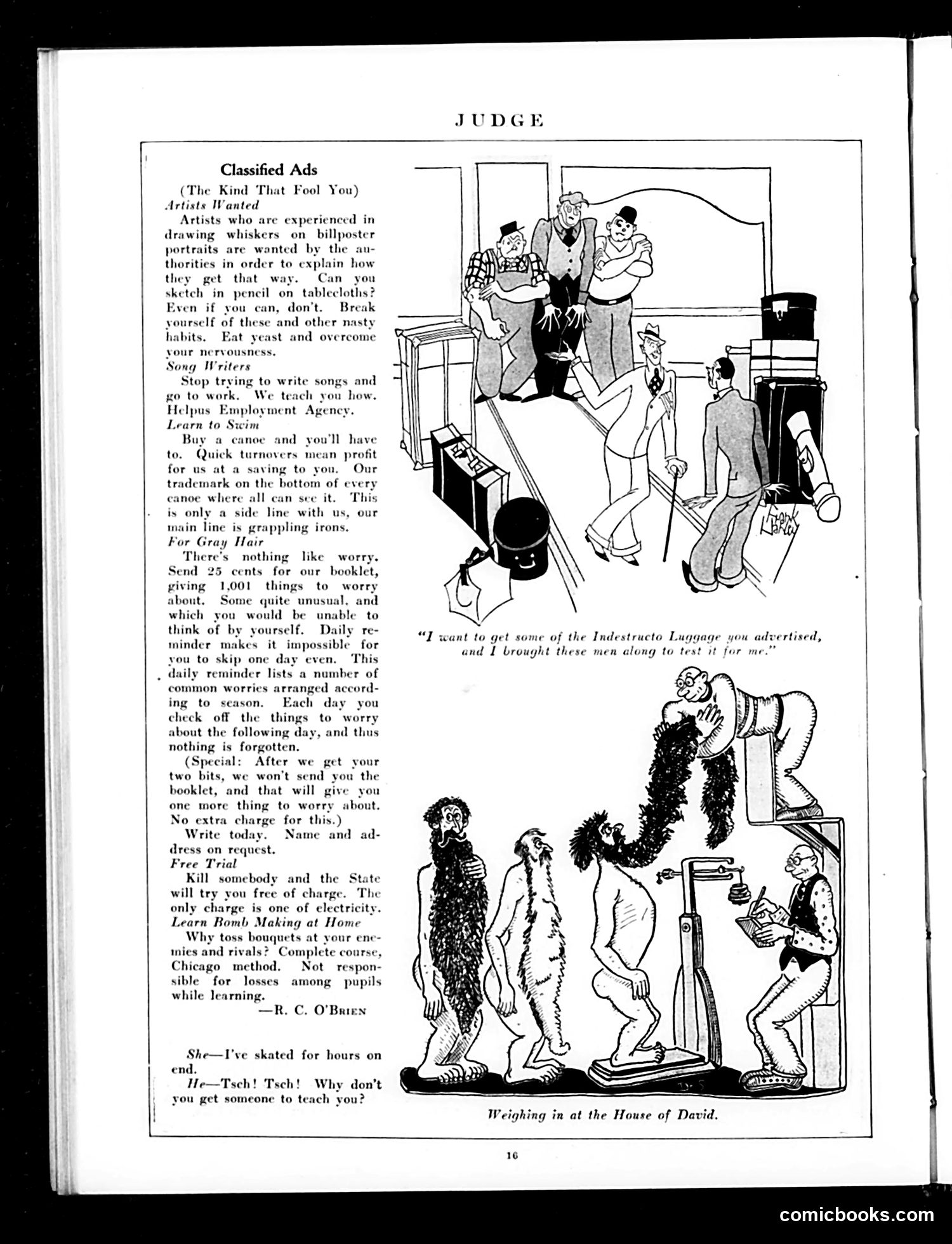
This page parodies classified advertisements through darkly absurdist humor typical of early 20th-century satire. The fake ads mock both commercial exploitation and human folly: **Key satires:** - "Artists Wanted" mocks political vandalism (adding whiskers to billposters—likely defacing public figures) - "Learn to Swim" jokes about a canoe company whose real business is "grappling irons" (retrieving drowned bodies) - "For Gray Hair" sells a worry-list booklet, then deliberately doesn't send it—creating the promised worry - "Bomb Making at Home" references anarchist violence concerns of the era - "Free Trial" darkly plays on electrocution as capital punishment **Top cartoon:** Tests "Indestructo Luggage" by having men throw it violently—visual pun on destructive testing. **Bottom cartoon:** "Weighing at the House of David" depicts figures on a scale, likely mocking a circus sideshow or health fad. The satire targets advertising's manipulative promises and contemporary anxieties about crime, immigration, and industrial dangers.
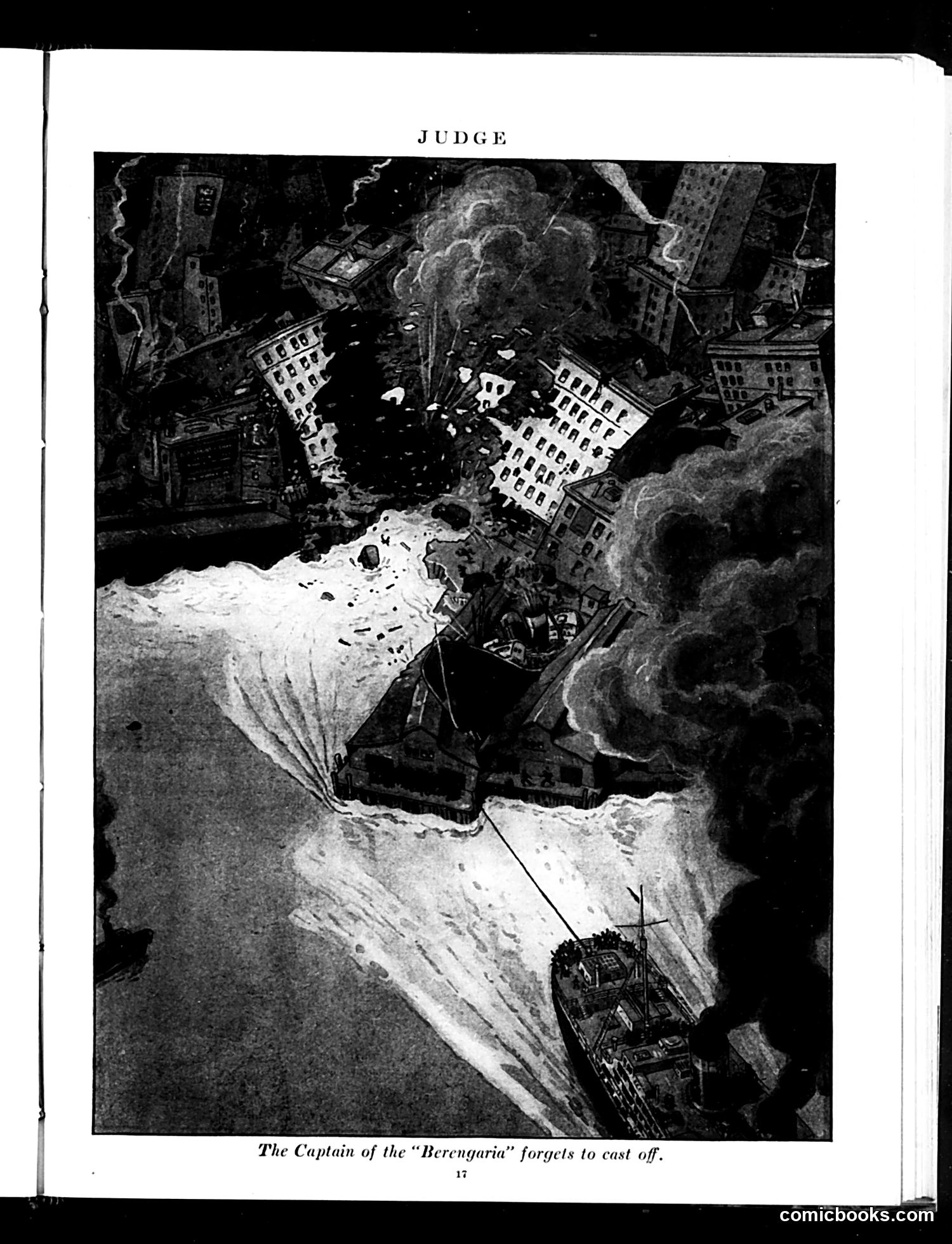
This is a satirical illustration from Judge magazine showing a dramatic maritime scene. The caption reads "The Captain of the 'Berengaria' forgets to cast off." The image depicts a ship's captain amid chaos—buildings are toppling, smoke billows everywhere, and the vessel appears to be crashing into a city rather than departing safely. The "Berengaria" was a real ocean liner operating in this era. The satire criticizes the captain's negligence: by forgetting to cast off (disconnect) the ship's mooring lines before departure, he's caused a catastrophic collision with the docked city infrastructure. The joke portrays incompetence and absent-mindedness at the highest level of command, resulting in destruction. This reflects period anxieties about modern transportation safety and management failures.
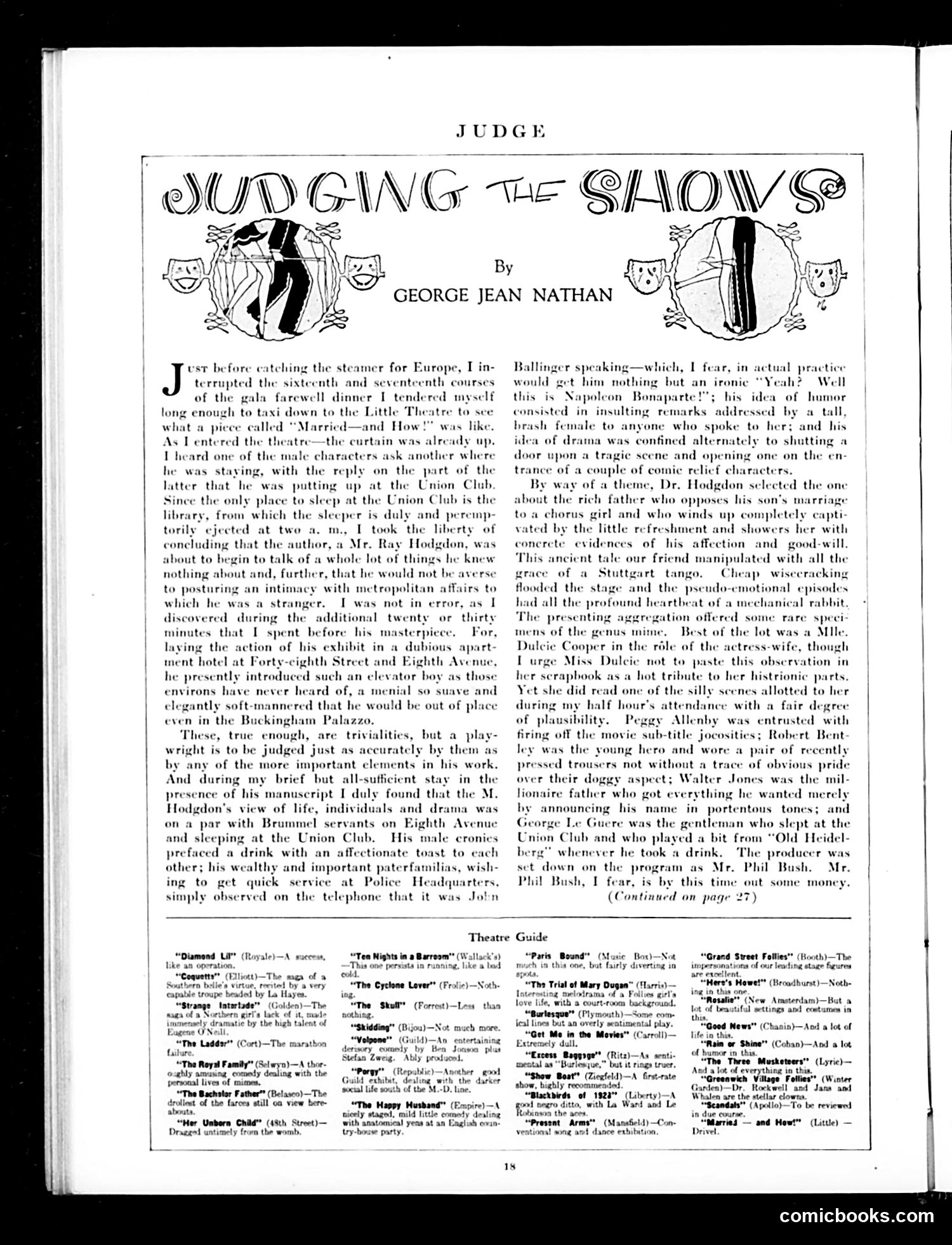
This is primarily a theater review column by George Jean Nathan, a prominent drama critic of the era. The text critiques Ray Hodgdon's play "Married—and How!" performed at the Little Theatre, finding it riddled with inaccuracies about New York City life. Nathan satirizes Hodgdon's ignorance of metropolitan details: the playwright depicts an elevator boy at a shabby apartment hotel as implausibly refined (unsuitable "even in the Buckingham Palazzo"), falsely suggests the Union Club library is a sleeping venue, and misrepresents how wealthy men interact with police. The play's plot—a rich father opposing his son's marriage to a chorus girl, only to be won over—is dismissed as an ancient, manipulated story lacking originality. Nathan's broader point: playwrights must be judged by accuracy in small details, not just major dramatic elements. The review exemplifies early 20th-century theatrical criticism's focus on verisimilitude and social propriety. The page includes a theater guide listing contemporary Broadway productions.
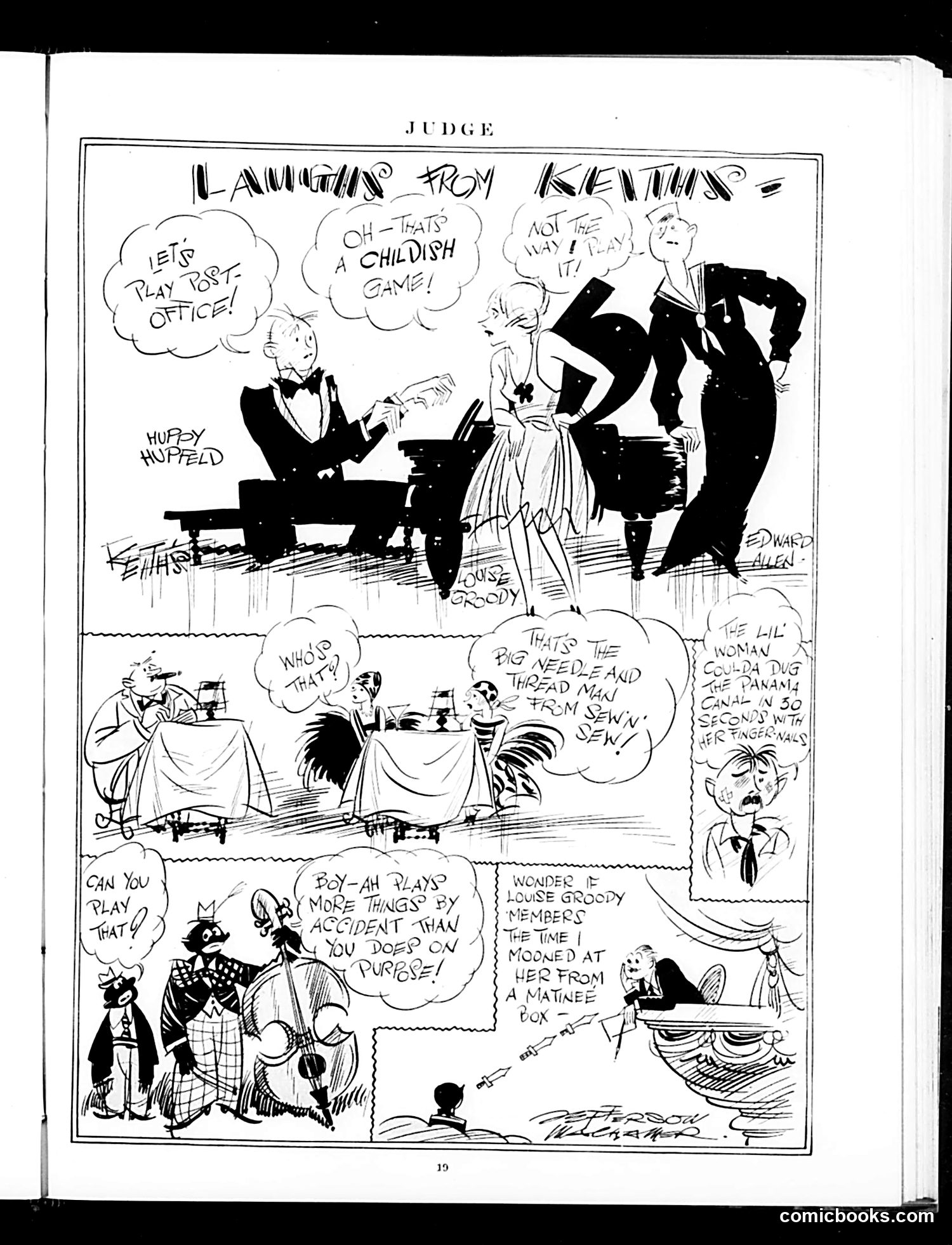
This multi-panel cartoon satirizes **theatrical performances and audience behavior** at Keith's vaudeville circuit venues. The humor centers on the contrast between performers' intentions and actual outcomes. The top panel shows well-dressed patrons at what appears to be a formal entertainment, with characters suggesting they "play post office" (a parlor game) instead—mocking the sophistication of the venue. Subsequent panels feature performers and audience members exchanging increasingly absurd commentary. One character references "Louise Groody," likely a **contemporary theatrical performer** (1920s era), and jokes about inappropriate theater behavior—mooning from boxes, finger-nail related incidents. The satire targets **vaudeville culture's mix of refined pretense and base comedy**, poking fun at both performers' overconfidence and audiences' crude behavior. The cartoonist (signed by Edward Alien) uses rapid-fire, increasingly ridiculous dialogue to mock the contradictions between what theaters claimed to offer versus actual audience conduct.
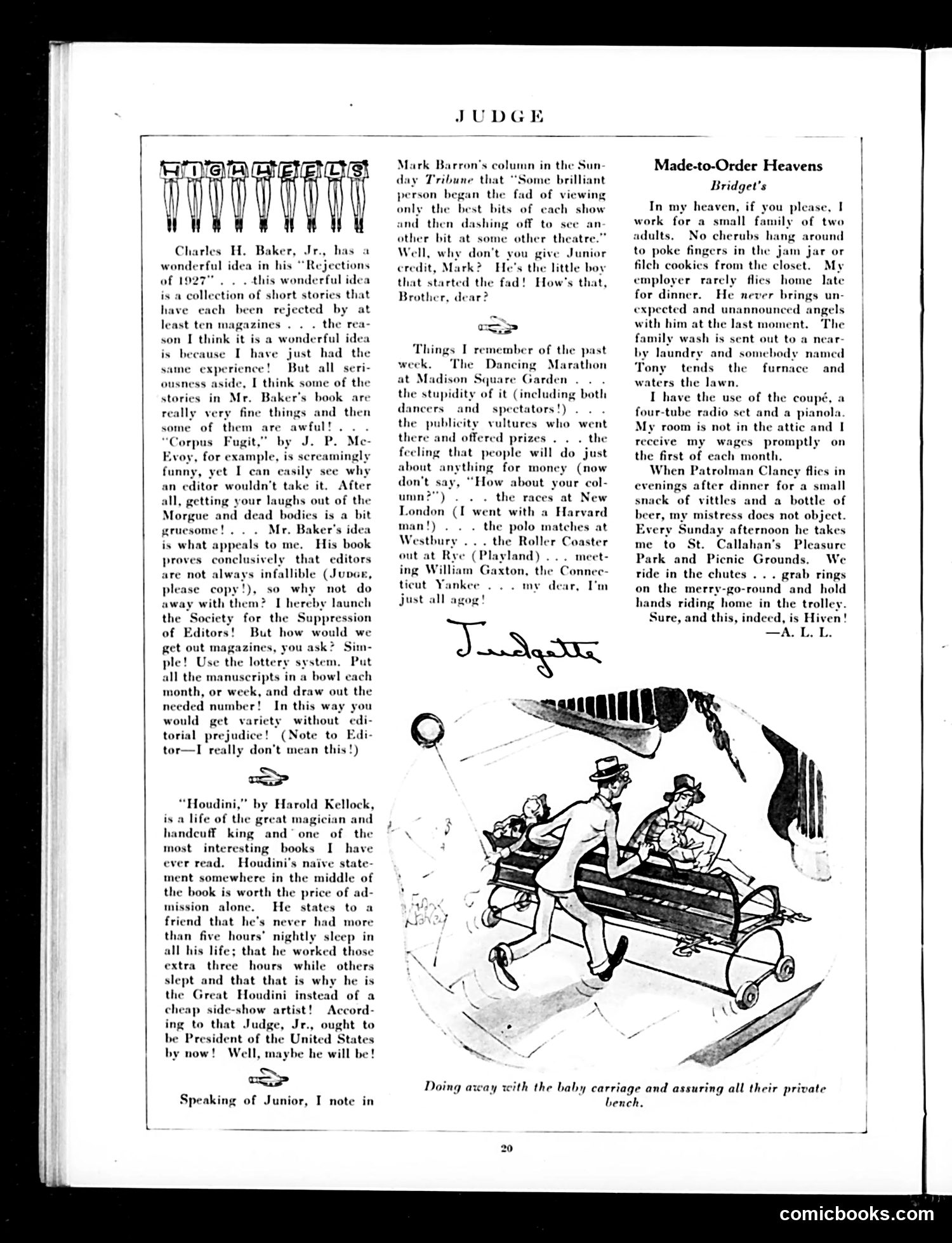
This page from Judge contains editorial commentary and two illustrated pieces reflecting 1920s leisure and labor culture. **Top Section:** The editor reviews Charles H. Baker Jr.'s book "Rejections of 1927" (short stories rejected by magazines) and Harold Kellock's biography of magician Houdini. The editor humorously proposes a "Society for the Suppression of Editors," suggesting editors replace decision-making with a lottery system—satirizing editorial gatekeeping. **"Made-to-Order Heavens" Section:** A domestic worker named Bridget describes her ideal heaven—a modest life with a small household, predictable wages, no unexpected guests, and Sunday leisure time with her boyfriend Patrolman Clancy at an amusement park. This satirizes working-class aspirations of the era, depicting a servant's heaven as simply modest stability and modest recreation rather than wealth or luxury. **Illustration:** Shows people enjoying early 20th-century amusement park attractions (carousel, chutes), capturing period entertainment culture. The page satirizes both editorial pretension and class dynamics of 1920s America.
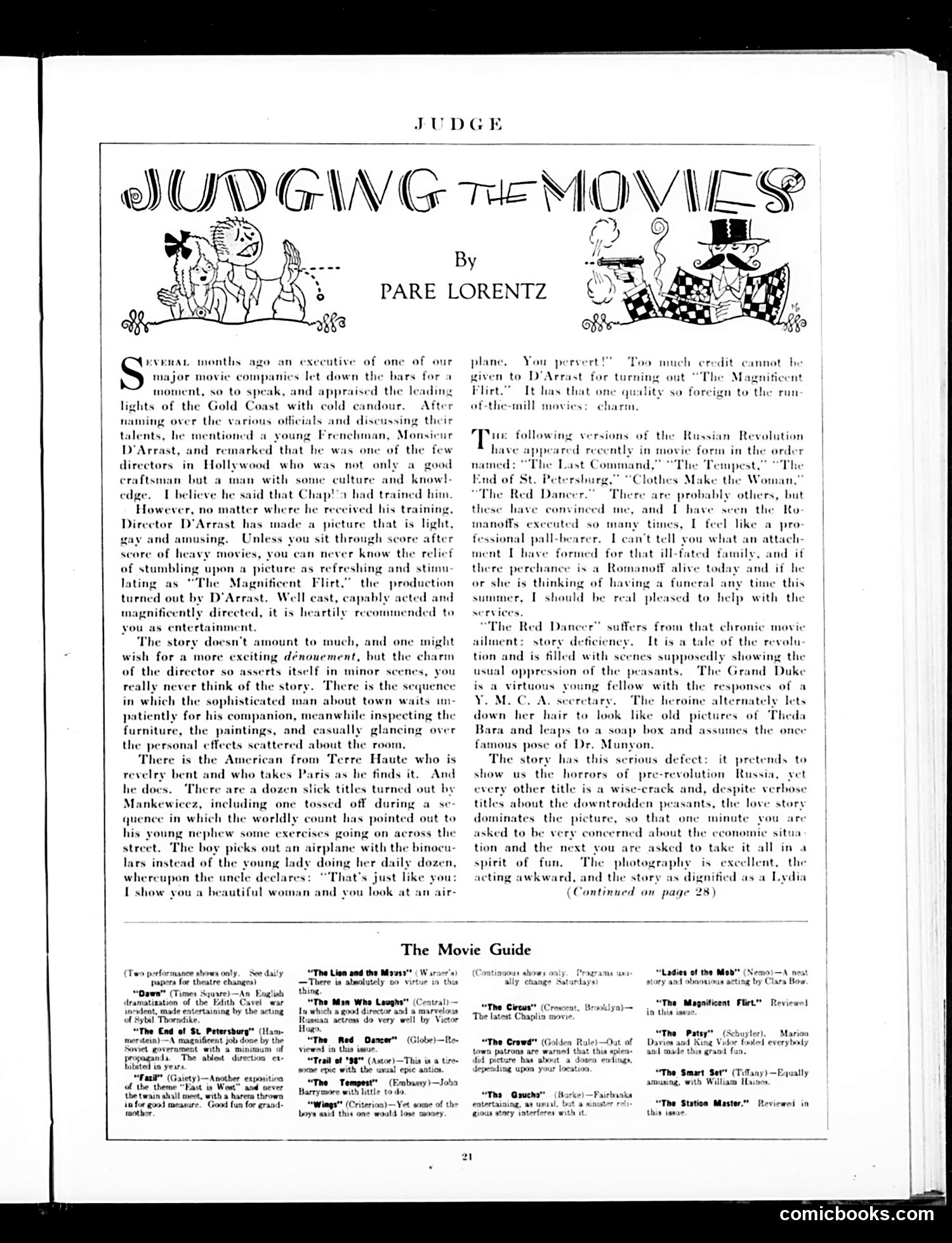
This page reviews several contemporary films, primarily praising director Pare Lorentz's "The Magnificent Flirt." The review critiques a French director, D'Arrast, as cultured and skilled—a refreshing contrast to typical Hollywood fare. The piece satirizes the glut of Russian Revolution films flooding American cinemas ("The Last Command," "The Tempest," "Clothes Make the Woman"). Lorentz mocks their repetitive, propagandistic nature, joking he's emotionally exhausted by repeatedly watching doomed aristocratic families. He suggests if any Romanovs survive, he'd help them plan their funeral—dark humor about the films' obsession with depicting pre-revolutionary nobility's downfall. The broader satire targets Hollywood's trend-chasing: studios churned out nearly identical Russian Revolution pictures, each exploiting the same melodramatic storylines about oppressed peasants and virtuous Grand Dukes. Lorentz criticizes this formulaic approach as creatively bankrupt compared to D'Arrast's thoughtful direction.
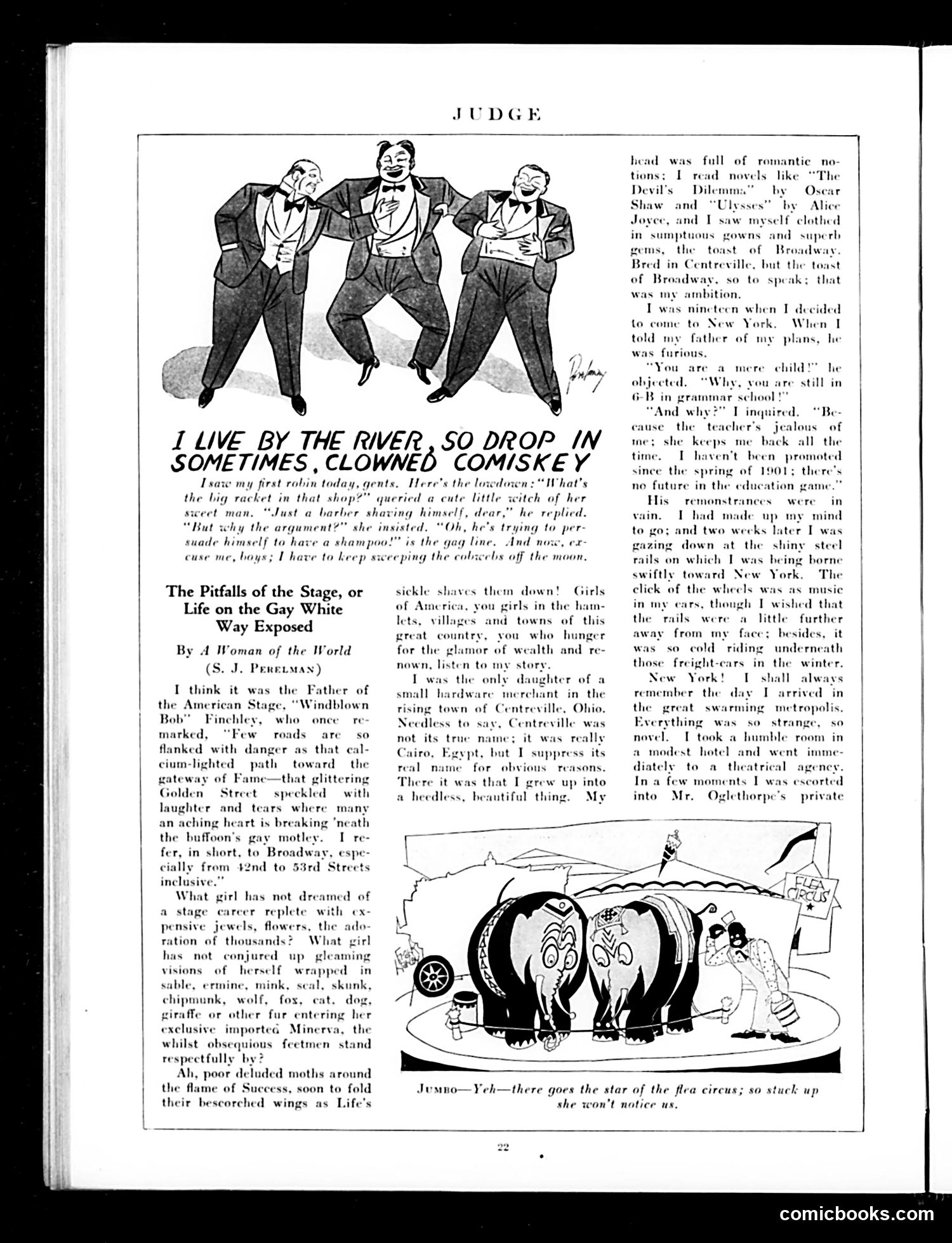
**Top Cartoon: "I Live by the River"** Three men in formal attire dance happily. The joke is a play on words: someone asks about "the big racket in that shop," expecting a serious answer. The punchline reveals it's merely a barber shaving himself, with the gag being his internal argument about whether to get a shampoo. It's a nonsensical joke typical of early 20th-century humor magazines. **Main Article: "The Pitfalls of the Stage"** A first-person account by "a woman of the world" describing her youthful ambitions to become a Broadway actress. She recounts leaving her small Ohio hometown (Centreville) at nineteen despite her father's objections, traveling to New York in a freight car, and discovering the theatrical world's harsh realities. The piece satirizes young women's romanticized fantasies about stage life and glamour. **Bottom Cartoon: "Jumbo"** A circus elephant labeled a "flea circus star" arrogantly ignores onlookers, mocking the pretensions of minor performers who consider themselves important. Both address theatrical ambition and delusion.
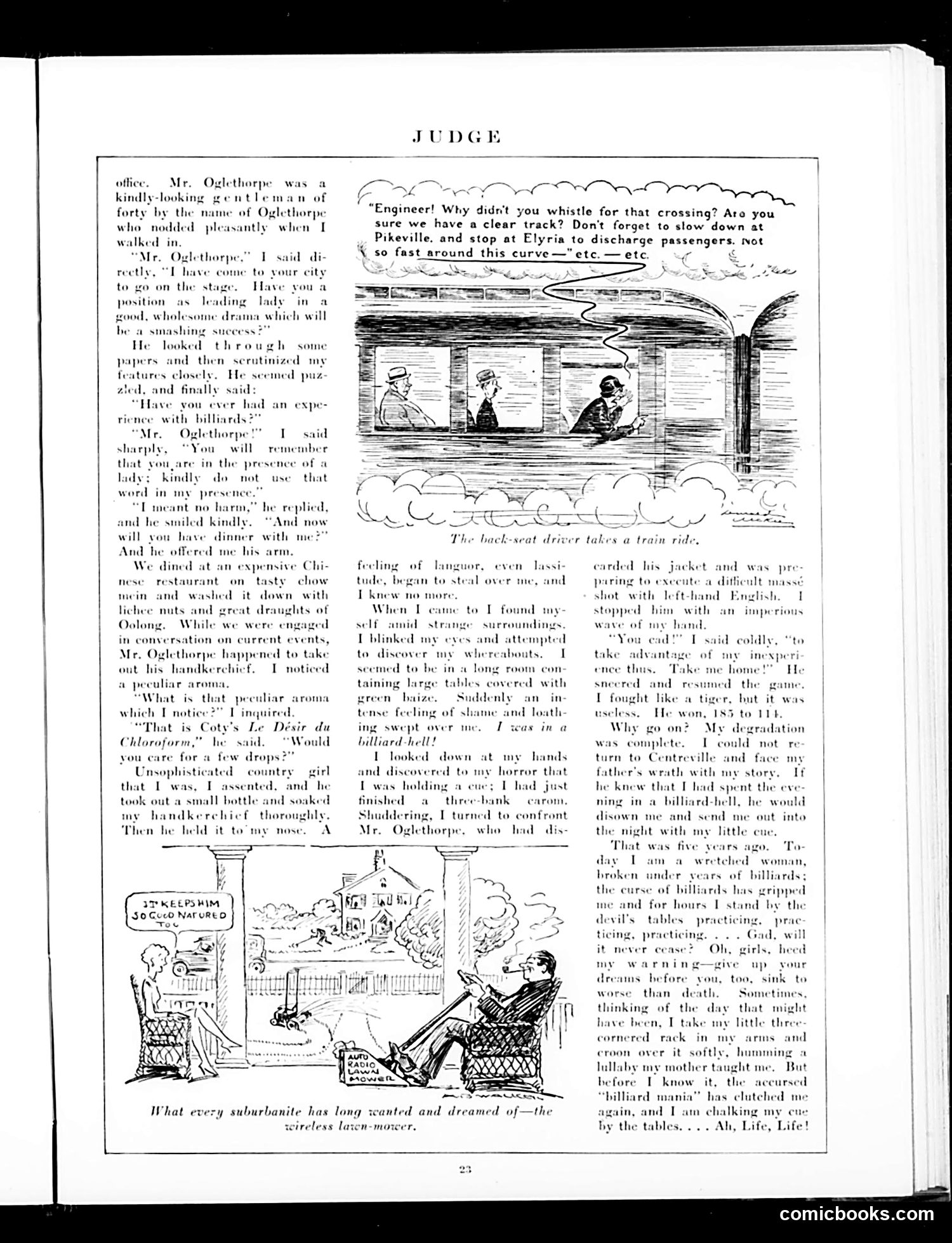
This is a cautionary melodrama mocking overwrought moral panic about billiards. The narrator, an aspiring actress, is lured by a man named Oglethorpe to a billiard hall via chloroform. She's then forced to play pool and becomes addicted, eventually reduced to a broken woman five years later. The satire targets the era's exaggerated fears about "corrupting" leisure activities—billiards were associated with gambling, saloons, and moral decay. The cartoon at bottom shows the fantasy of a "wireless lawn-mower," contrasting mundane suburban life with the sensational dangers supposedly lurking everywhere. The joke lies in treating billiards as catastrophically ruinous as the narrator treats it, parodying temperance-style warnings about social vices. Judge was ridiculing both the genuine dangers people worried about and the hysterical tone of moral crusades against innocent entertainments.
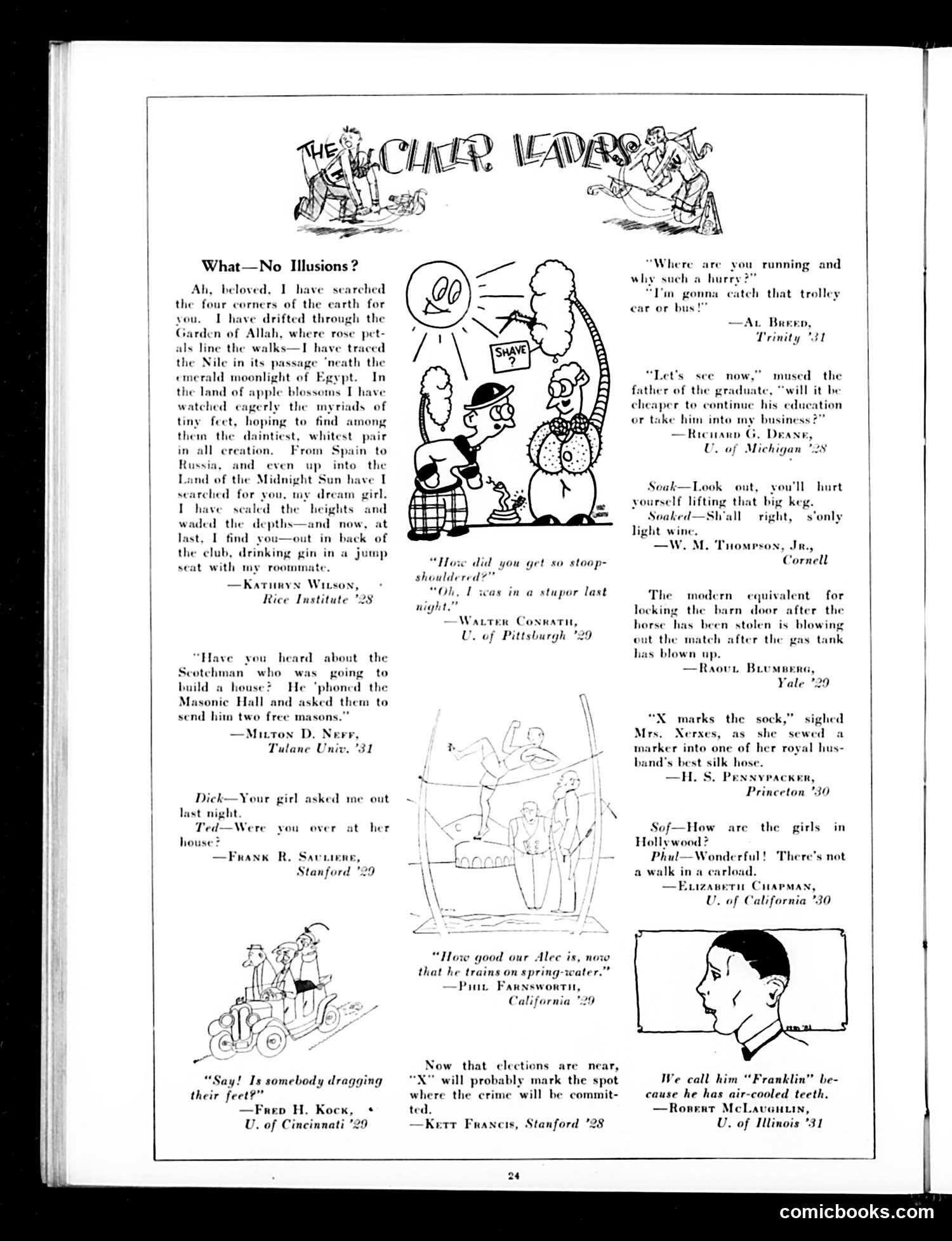
This is a collection of student jokes and witticisms submitted by college students (credited to various universities, circa 1928-1931). The page features: **Main cartoon**: A romantic idealist who claims to have searched the world for his "dream girl" only to find her in a mundane reality—drinking gin in a car with his roommate. The satire mocks romantic pretension deflated by ordinary life. **Other jokes** target 1920s-30s social themes: - Prohibition-era drinking references ("gin," "spring-water training") - Dating rituals ("Were you over at her house?") - Election-year cynicism - Class anxieties (fathers questioning whether to continue sons' education or employ them) - Gender stereotypes (Hollywood girls, wives' domestic duties) The humor is lighthearted college humor typical of the era—puns, observations about courtship and family, and gentle mockery of social conventions. The credited students suggest this was a humor-submission feature popular with collegiate readers of *Judge* magazine.
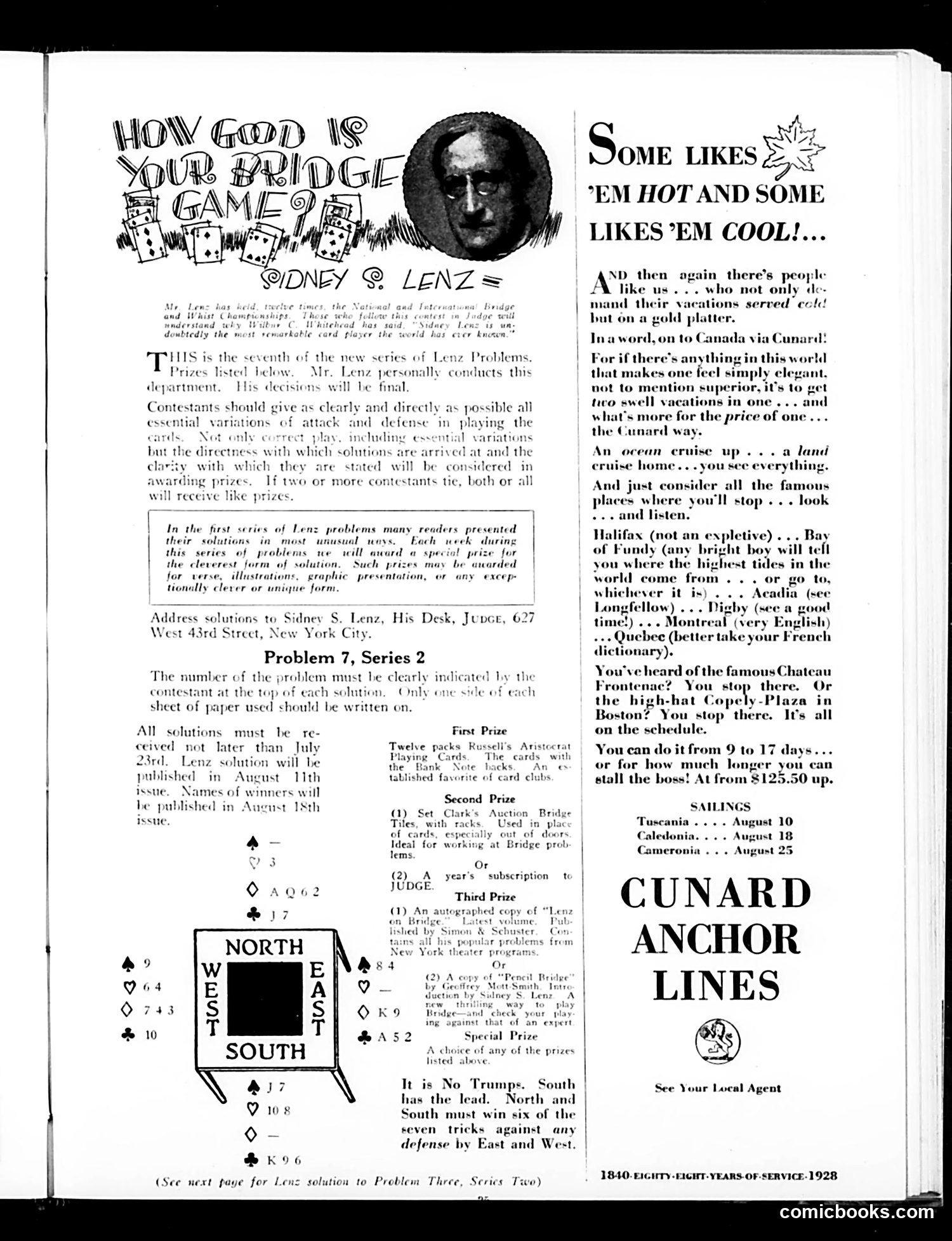
This page primarily contains **advertising and puzzle content** rather than political satire. The main feature is the seventh installment of "Lenz Problems"—a bridge card game puzzle series conducted by Sidney S. Lenz, a prominent bridge expert. Readers submit solutions competing for prizes (card decks, bridge tiles, and subscriptions to Judge magazine). The page includes a bridge hand diagram for solvers to analyze. The small cartoon at top left, captioned "How God Is Your Bridge Game?" by Sidney Q. Lenz, appears to be a lighthearted visual pun introducing the puzzle section. The right side features **Cunard Anchor Lines shipping advertisements** promoting luxury ocean cruises to Canada, emphasizing elegant vacation experiences ("served cold...on a gold platter"). It advertises specific sailings (Tuscania, Caledonia, Cameronia) in August 1928. **Context:** This reflects 1920s leisure culture where bridge was enormously popular among middle and upper classes, and transatlantic cruising represented aspirational luxury travel.
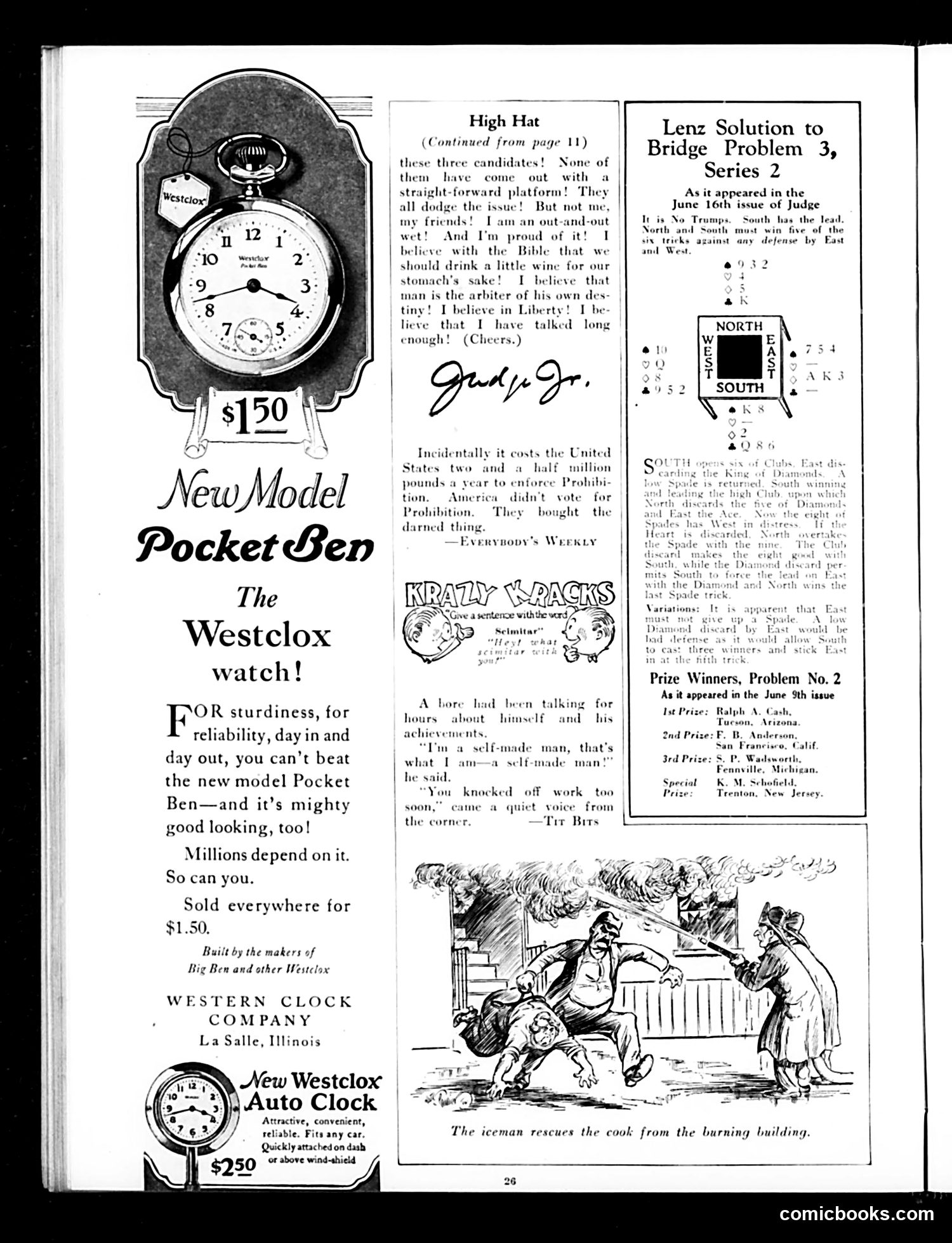
This page mixes **advertisements** with **satirical political commentary**. The "High Hat" column features a fictional politician defending his "wet" stance—support for alcohol consumption—during the Prohibition era (1920-1933). He invokes the Bible and liberty to justify drinking wine, while sarcastically dismissing opponents who "dodge the issue." The humor lies in his contradictory bluster: he claims to believe in personal freedom and self-determination while essentially admitting his position is indefensible. The small joke at bottom—a man claims to be "self-made," but a voice interrupts "You knocked off work too soon"—mocks self-made-man rhetoric as incomplete or dishonest. The remaining content is **product advertising**: Westclox watches and pocket watches, priced at $1.50-$250. There's also a bridge card game puzzle and cartoon illustration unrelated to the political content. The page reflects 1920s debates over Prohibition's enforcement and personal liberty.
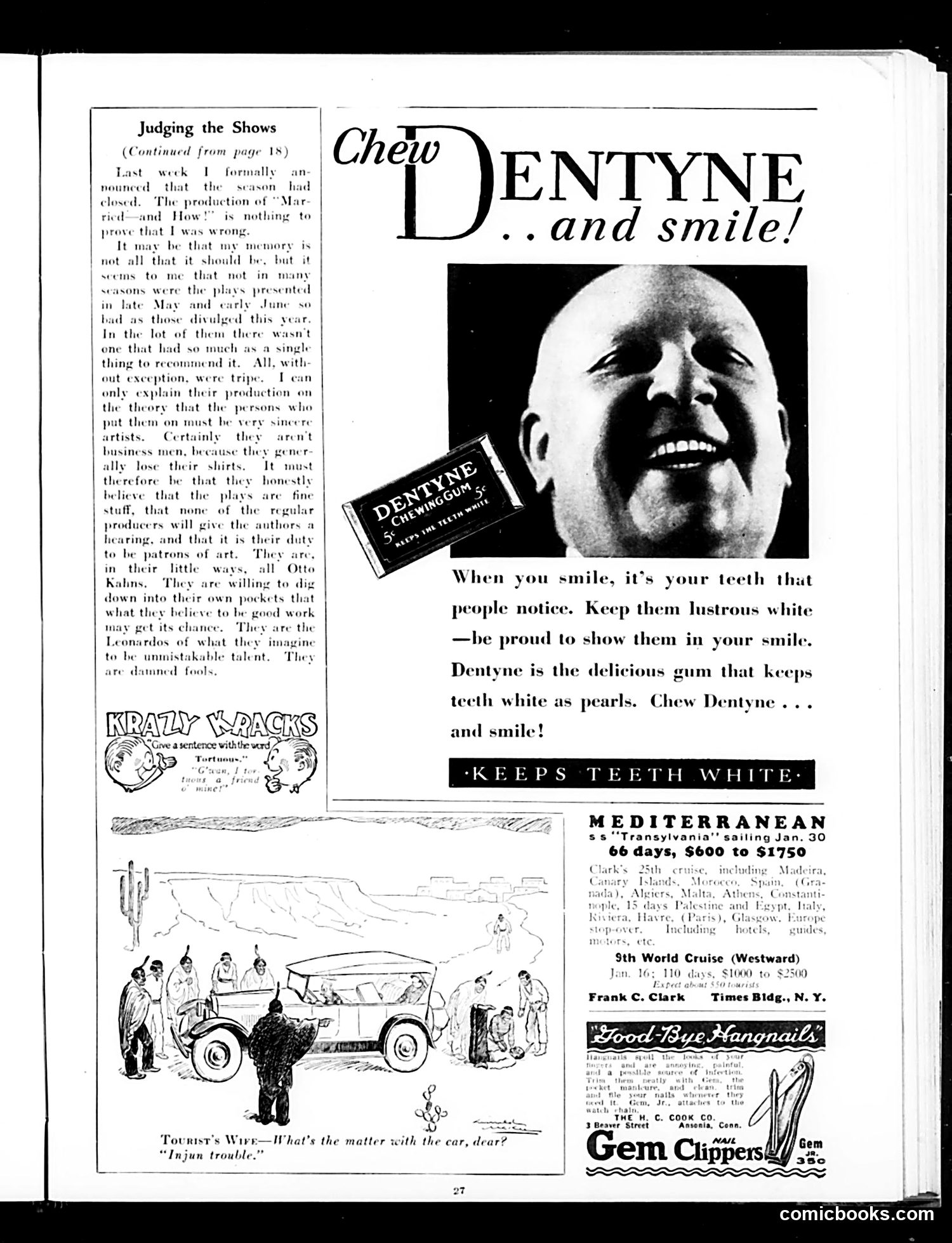
This page mixes editorial content with advertisements typical of 1920s magazines. The main feature is "Judging the Shows," a theater critic's column criticizing Broadway productions from the previous season. The critic argues that despite poor quality, these plays were produced anyway—suggesting their backers are wealthy patrons of the arts willing to lose money funding mediocre work, comparing them to art connoisseur Otto Kahn. The dominant advertisement features Dentyne chewing gum, using a large headshot of a smiling man to emphasize tooth visibility. The pitch: chewing Dentyne keeps teeth white and attractive. Below is a cartoon captioned "Tourist's Wife" showing a car trouble scenario with a stereotypical "Injun trouble" punchline—reflecting the period's casual racist humor toward Native Americans. The page also advertises Mediterranean cruises and nail clippers, representing typical consumer goods marketed to affluent readers of this era.
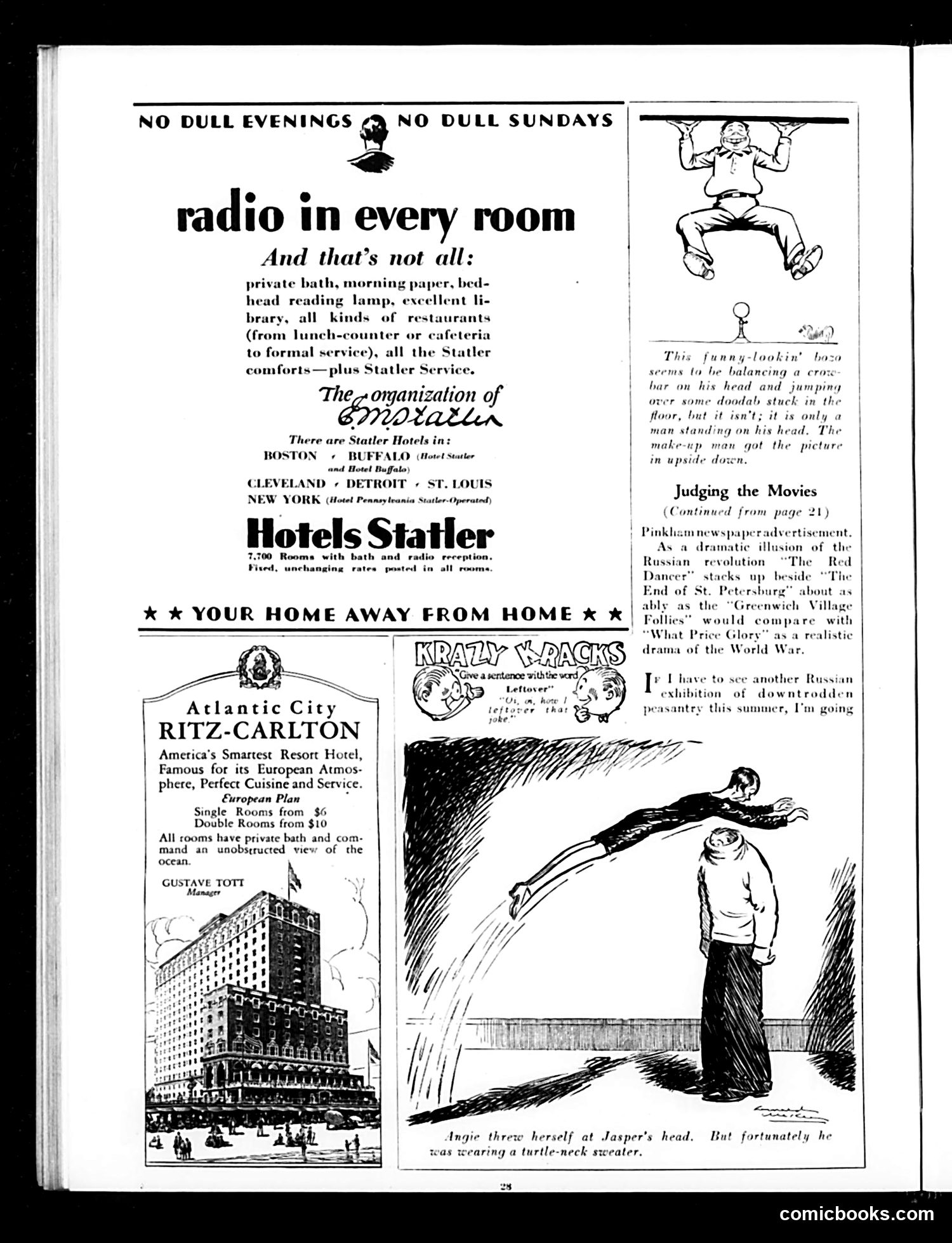
This page is primarily **advertising**, dominated by hotel promotions for the Statler Hotels chain and the Ritz-Carlton in Atlantic City—typical luxury travel ads targeting wealthy readers. The small cartoon in the upper right appears to be a humorous illustration about **acrobatic or physical comedy in film**—showing a figure performing contorted poses. The accompanying caption jokes that what appears to be someone balancing a crossbar on his head while jumping is actually "just a man standing on his head," with the makeup department having printed the picture upside down. This mocks early film technical errors or trick photography mishaps. The "Judging the Movies" column discusses Russian revolutionary films like "The Red Dancer" and "The End of St. Petersburg," comparing them to American war dramas. The writer expresses satirical exhaustion with the glut of Russian peasant-themed cinema, planning to avoid seeing another such film that summer. Overall, this page reflects 1920s concerns: luxury hospitality marketing and commentary on the Soviet film trend then popular in American cinema.
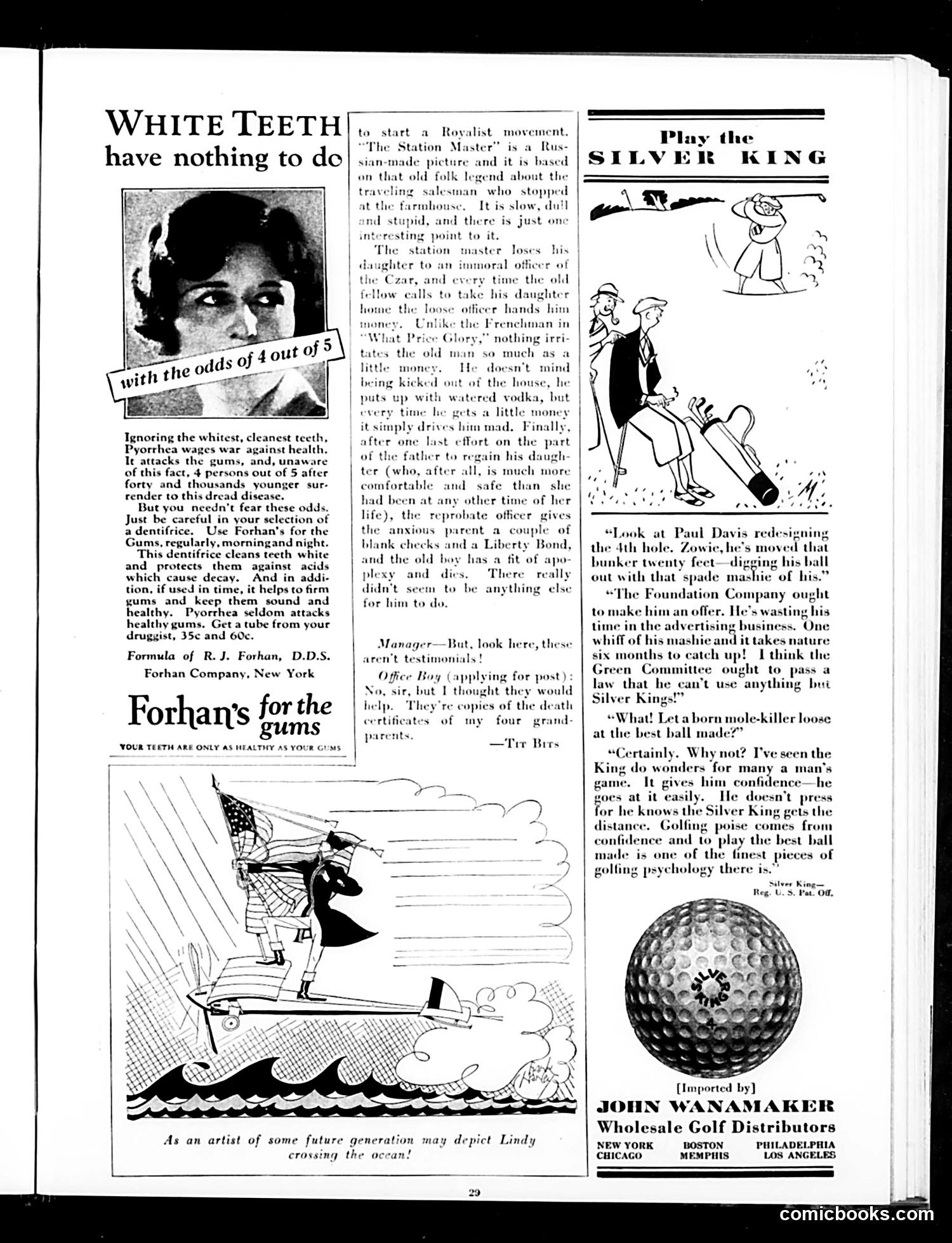
This page contains **primarily advertisements** interspersed with brief satirical content. **Main Advertisement:** Forhan's toothpaste dominates the left side, warning against pyorrhea (gum disease) affecting "4 out of 5" people over 40. The ad uses fear-based marketing typical of early 20th-century patent medicine advertising. **Satirical Content:** A brief movie review mocks "The Station Master," a Russian film about a corrupt officer exploiting a station master's daughter. The review dismisses it as "slow, dull and stupid." **Office Humor:** A short joke about a job applicant submitting fake death certificates as references from his "four grandparents." **Golf Advertisement:** John Wanamaker promotes "Silver King" golf balls, with dialogue joking that a clumsy golfer's poor play would damage the balls. The page reflects early-1920s consumer culture and light satirical humor typical of Judge magazine, blending product endorsements with comedy.
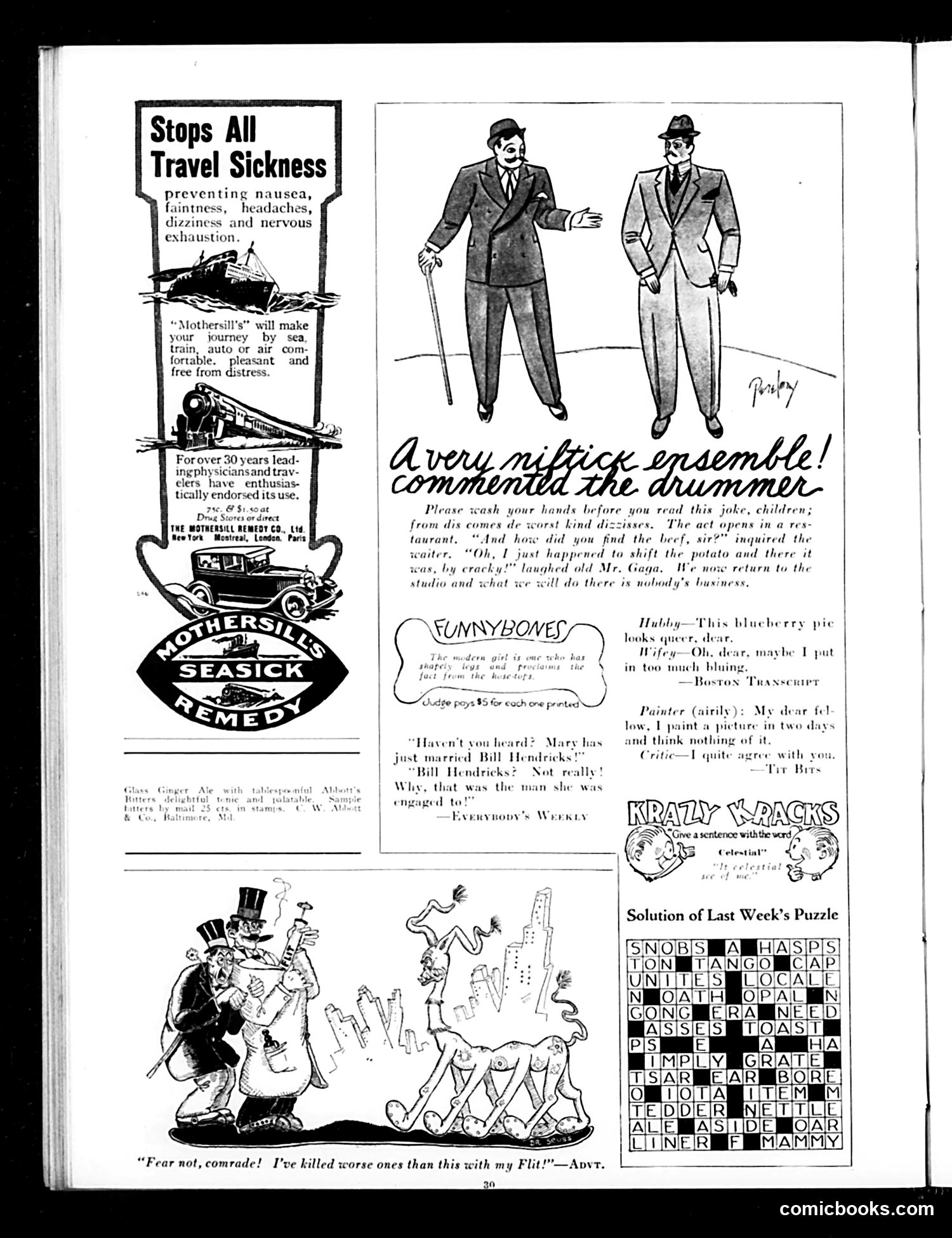
This page mixes advertising with humor content typical of early 20th-century Judge magazine. **The Advertisement** (left side) promotes Mothersill's Seasick Remedy, claiming to prevent travel-related nausea and exhaustion. The endorsement claims "over 30 years" of physician approval—a common advertising tactic of the era. **The Cartoons and Jokes** feature light domestic and social humor: - A "nifty ensemble" joke about two well-dressed men, with a setup about dirty hands and restaurant humor - "Funny Bones" section with brief quips about blueberry pie and a painter's boasting - A cartoon showing a conductor or authority figure with exaggerated features confronting citizens, referencing killing pests "with my Flit!" (Flit was a popular insecticide brand) The humor is gentle, domestic, and advertisement-adjacent—typical of Judge's mix of satirical content and product promotion. The racial or ethnic caricatures in dialogue reflect period conventions (now considered offensive) that were standard in early 20th-century American comedy magazines.
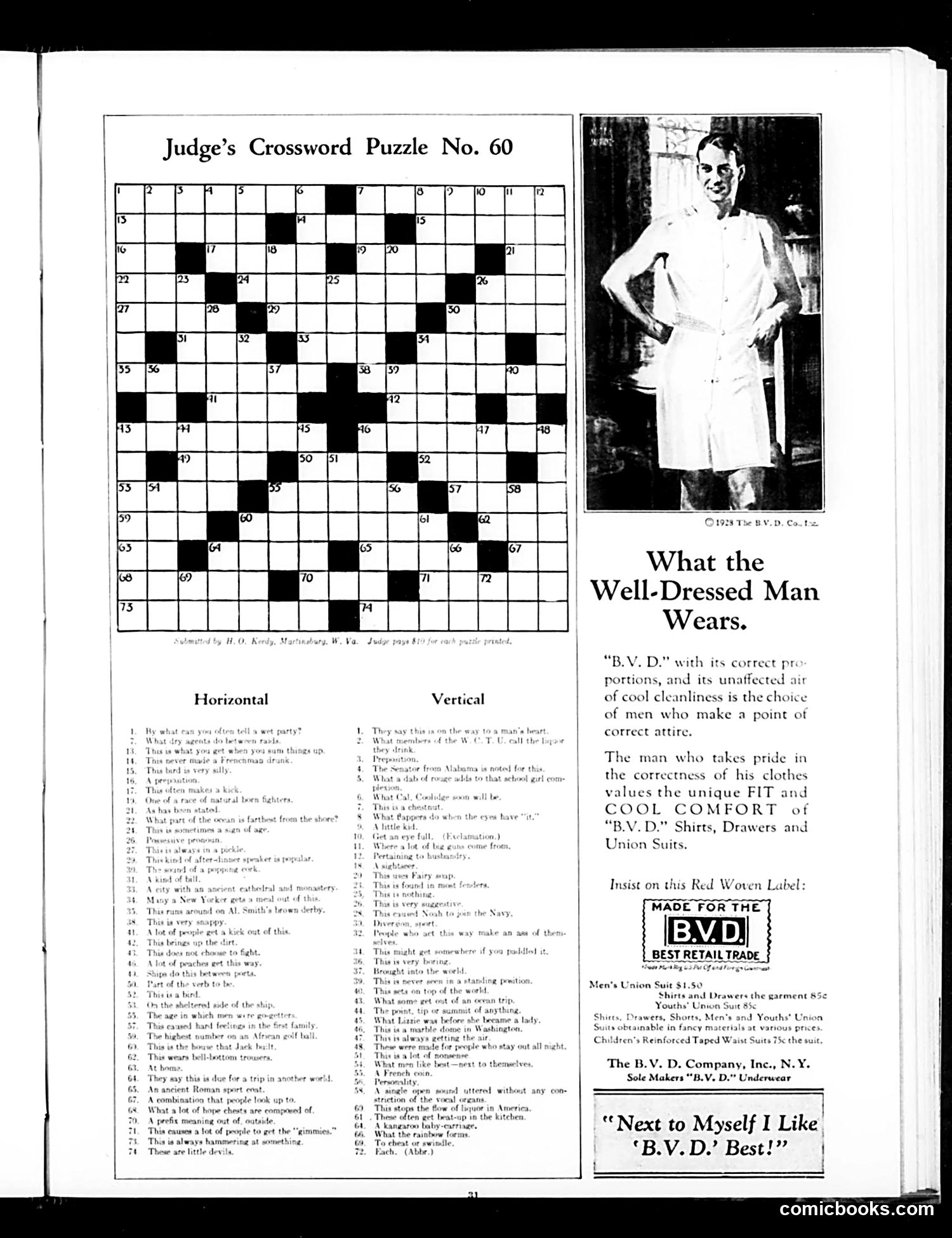
This page is primarily a **crossword puzzle and advertisement**, not political satire. The main content is "Judge's Crossword Puzzle No. 60"—a standard puzzle typical of 1920s magazines. The right side features a full-page **B.V.D. underwear advertisement** from 1928. The advertisement uses aspirational messaging common to the era: a well-dressed man in a white shirt represents masculine propriety and correct attire. The copy emphasizes "fit" and "cool comfort," positioning B.V.D. underwear as essential to a gentleman's wardrobe. The red woven label serves as a brand identifier and quality marker. The quote "Next to Myself I Like 'B.V.D.' Best!" is typical period advertising humor—suggesting the wearer values his undergarments as highly as his own self-worth. There is no political cartoon or satire visible here. This is simply a commercial advertisement inserted into an entertainment magazine, representing 1920s consumer culture and men's fashion marketing standards.
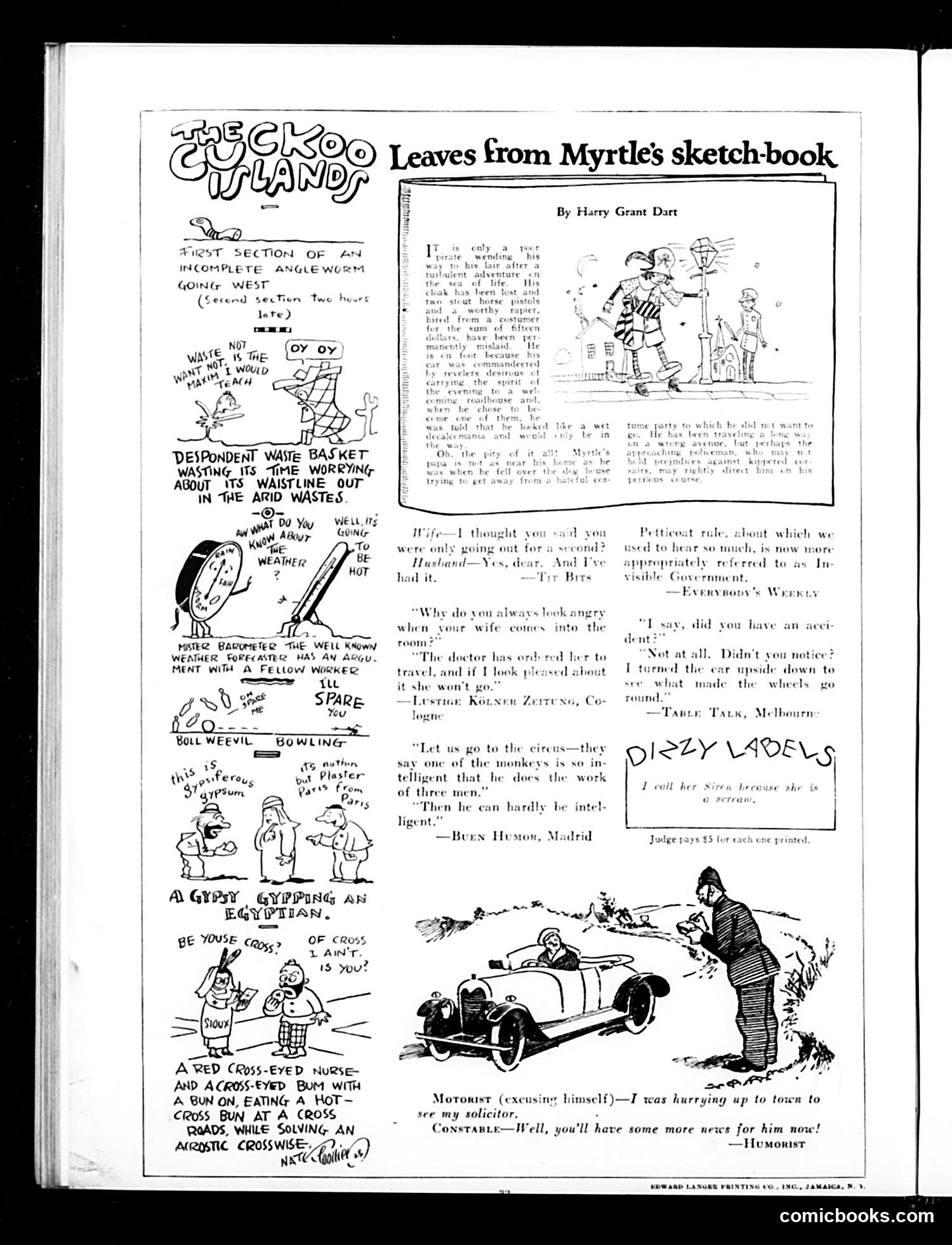
This is a **humor and satire page** from Judge magazine featuring multiple cartoons and jokes targeting early 20th-century social absurdities. **Key content:** 1. **Left side**: Absurdist visual gags—a worm going west, a despondent wastebasket, arguing weather forecasters, gypsies, and a deliberately nonsensical "riddle" about a nurse and bum solving crosswords at crossroads. 2. **Center**: "Leaves from Myrtle's Sketch-book" by Harry Grant Dart—an illustrated joke about a husband refusing to leave home for the doctor, satirizing male stubbornness about medical care. 3. **Right side**: Social commentary including "Petticoat rule" (wives controlling husbands), a circus joke about an unusually intelligent monkey, and a motorist rushing to his solicitor—implying he's caused an accident. The page's title, "Cuckoo Land," signals that all content is deliberately irrational humor. The satire targets domestic relations, masculine anxiety, class pretensions, and social absurdity rather than specific political figures.
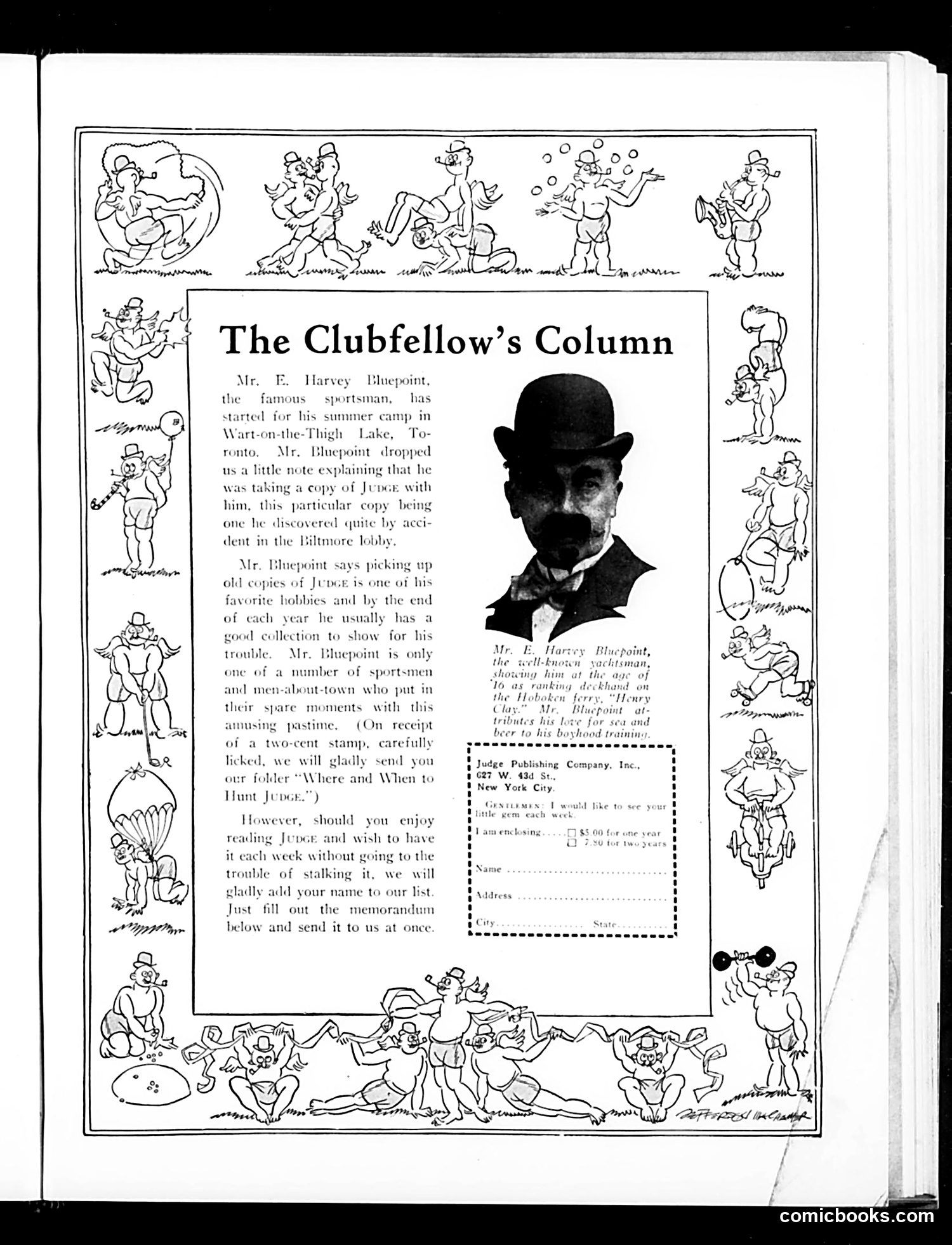
This is a humorous advertisement for *Judge* magazine disguised as a social column. The page mocks wealthy sportsmen and socialites by describing Mr. E. Harvey Bluepoint, a fictitious "famous sportsman," who collects old copies of *Judge* he finds abandoned in upscale locations like the Biltmore Hotel lobby. The joke plays on the magazine's cachet among the leisure class: *Judge* is portrayed as so desirable that gentlemen treat finding back issues like a hobby or sporting pursuit ("hunting" for the magazine). The elaborate border illustrations of absurd, cartoonish figures reinforce the satirical tone. The piece then pivots to a subscription pitch, offering readers a folder titled "Where and When to Hunt Judge"—extending the hunt metaphor—before encouraging subscriptions at the bottom. It's essentially sophisticated in-house advertising leveraging social snobbery and magazine culture.
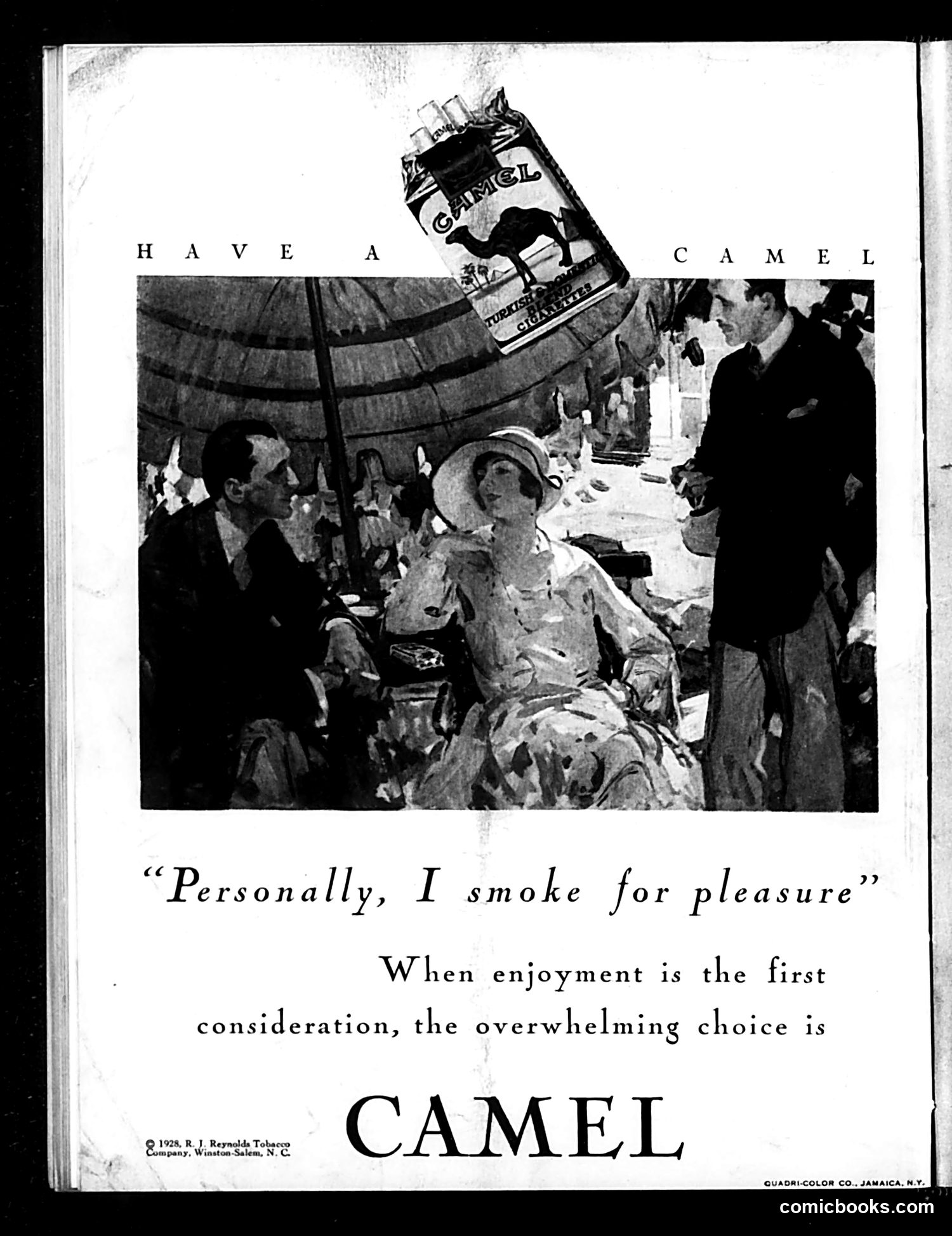
This is a **Camel cigarette advertisement**, not political satire. The page shows a well-dressed woman in an elegant social setting (under an umbrella at what appears to be an upscale event) smoking and conversing with men. The ad's tagline—"Personally, I smoke for pleasure"—positions smoking as a leisure activity for sophisticated enjoyment rather than habit. This reflects 1928 advertising's targeting of women smokers, a relatively new market, by associating cigarettes with elegance, social status, and personal choice. The date (1928) and publisher (R.J. Reynolds) confirm this is a commercial advertisement rather than editorial content, appearing in Judge magazine. There is no political commentary or satire intended.