
Judge, 1928-07-14 · page 15 of 36
Judge — July 14, 1928 — page 15: what you’re looking at
What you’re looking at
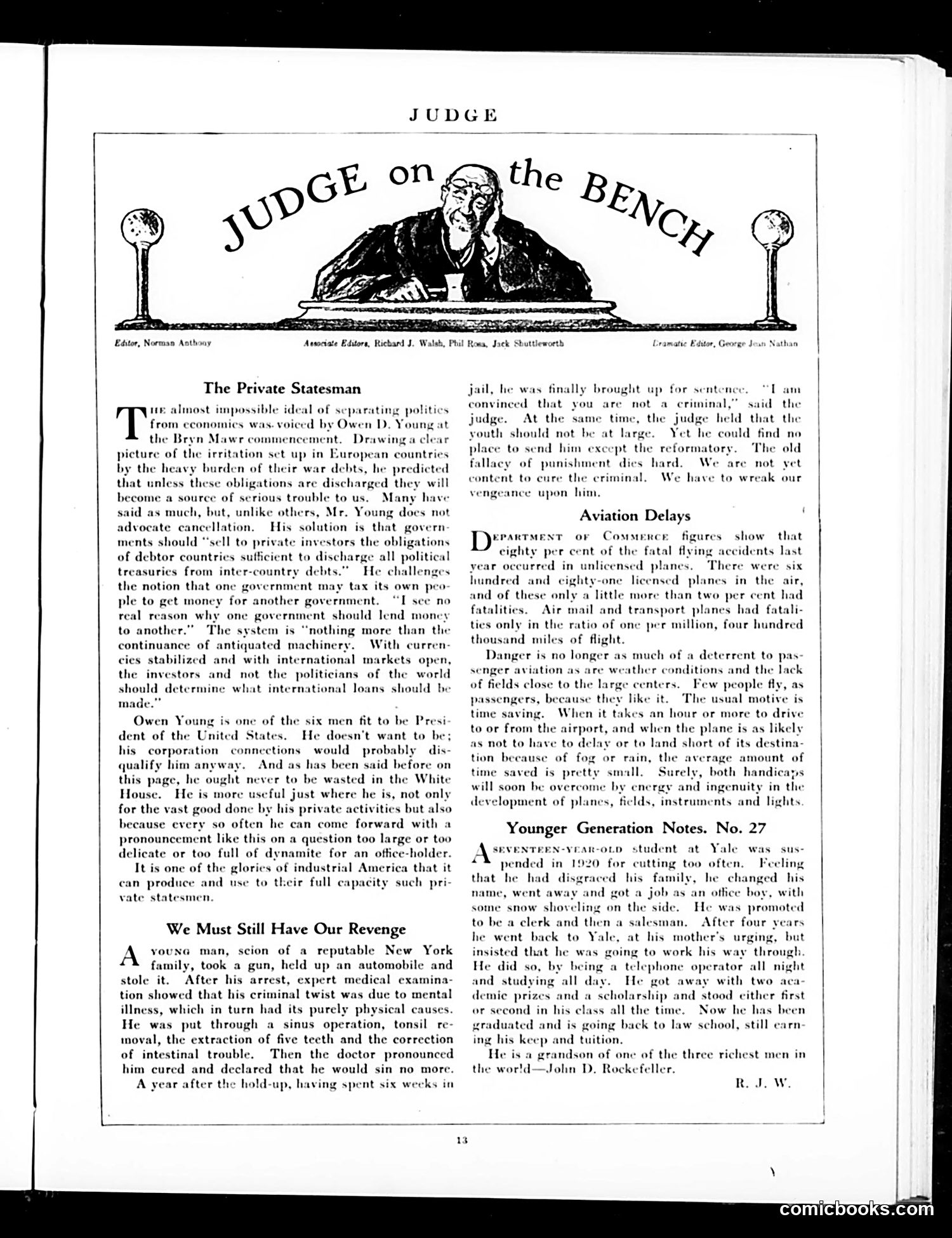
This page from Judge (a satirical American magazine) contains three distinct opinion pieces: **"The Private Statesman"** praises Owen D. Young, a prominent businessman, for publicly advocating that governments should sell war debts to private investors rather than have nations loan money to each other. The satire is gentle—Young is celebrated as a rare "private statesman" whose corporate position allows him to offer bold policy ideas without the political constraints office-holders face. **"We Must Still Have Our Revenge"** critiques outdated criminal justice philosophy. It describes a wealthy young man whose crime stemmed from physical/mental illness, successfully cured through medical treatment, yet society still demands punishment. The piece argues we cling to vengeance rather than accepting that rehabilitation works. **"Aviation Delays"** presents statistics showing licensed aircraft are safer than unlicensed ones, and argues that weather and inconvenient airport locations—not danger itself—deter commercial aviation growth. The header illustration shows a stern judge at the bench, appropriate for a satirical publication called "Judge" that often critiqued legal and social institutions.
📄 Transcribed text from this page (OCR, searchable)
Machine-transcribed from the original scan — historical spelling and the odd misread are preserved.
Editor, Norman Asthoay The Private Statesman He almost impossible ideal of scparating polities I from economics was. voiced by Owen D. Young at the Bryn Mawr commencement. Drawing a clear picture of the irritation sct up in European countries by the heavy burden of their ar debts, he predicted unless the obligations are discharged they will a source of serious trouble to us. Many have s much, but, unlike others, Mr. Young does not Hation. His solution is that govern ments should “sell to private investors the obligations of debtor countries sufficient to discharge all political treasuries from inter-country debts.” He challer the notion that one government may tax its own peo ple to get money for another government. “LT see no real reason why one government should lend money to another.” The system is “nothing more than the continuance of antiquated machinery. With curren- cies stabilized and with international markets open, the investors and not the politicians of the world should determine what international loans should be made.” advocate can Owen Young is one of the six men fit to be Presi dent of the United States. He doesn't want to be; his corporation connections would probably dis- qualify him anyway. And as has been said before on this page, he ought never to be wasted in the White House. He is more useful just where he is, not only for the vast good done by his private activities but also because every so often he can come forward with a pronouncement like this on a question too large or too delicate or too full of dynamite for an office-holder. It is one of the glories of industrial America that it can produce and use to their full capacity such pri- vate statesmen. We Must Still Have Our Revenge A youna man, scion of a reputable New York family, took a gun, held up an automobile and stole it. After his arrest, expert medical examina- tion showed that his criminal twist was due to mental illness, which in turn had its purely physical causes. He was put through a sinus operation, tonsil re- moval, the extraction of five teeth and the correction of intestinal trouble. Then the doctor pronounced him cured and declared that he would sin no more. A year after the hold-up, having spent six weeks in Anwciate Editors, Richart J, Walsh, Phil Rosa, Jack Shuttleworth Cramati jail, he was finally brought up convinced that you are not judge. At the same time, the judg youth should not be at large. Yet he could The old not yet We have to wreak our or sentence. place to send him execpt the reformatory. fallacy of punishment dies hard. V re content to cure the criminal, ance upon him, Av “yerartMent or Commence figures eighty per cent of the fatal flying accidents last year occurred in unlicensed planes. There were six hundred and eighty-one licensed planes in the air, and of these only a little more than two per cent had fatalities. Air mail and transport planes had fatali- ties only in the ratio of one per million, four hundred thousand miles of flight. Danger is no longer as much of a deterrent to pas senger aviation as are weather conditions and the lack of fields close to the large centers. Few people fly, as passengers, because they like it. The usual motive is time saving. When it takes an hour or more to drive to or from the airport, and when the plar as not to have to delay or to land short of its destina- tion because of fog or rain, the : » amount time saved is pretty small. Surely, will soon be overcome by energy and ingenuity in the development of planes, ficlds, instruments and lights tion Delays show that Younger Generation Notes. No. 27 student at Yale 1920 for cutting too often. 1 that he had di d his family, he name, nt away and got a job as an offic some snow shoveling on the side. to be a clerk and then a salesman. After four years he went back to Yale, at his mother’s urging, but insisted that he was going to work his way through. He did so, by being a telephone operator all night and studying all day. He got away with two aca demie pri nd a scholarship and stood cither first or second in his class all the time. Now he has been wraduated and is going back to law school, still earn ing his keep and tuition. He is « the world eNTREN-YEAR-OLD nded in was sus- reling nged his boy, with He was promoted grandson of one of the three richest men in John D, Rockefeller.