
Judge, 1928-07-14 · page 20 of 36
Judge — July 14, 1928 — page 20: what you’re looking at
What you’re looking at
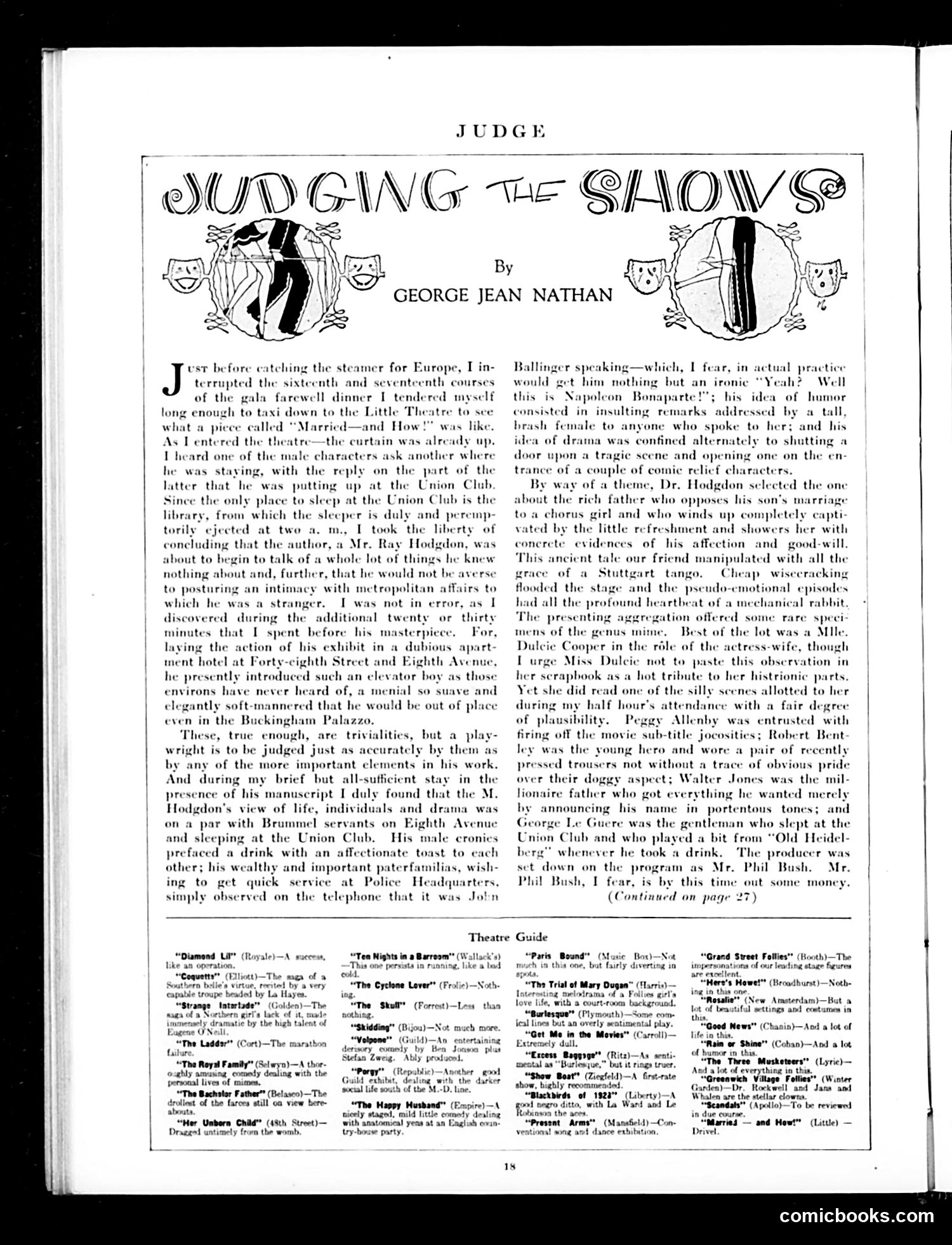
This is primarily a theater review column by George Jean Nathan, a prominent drama critic of the era. The text critiques Ray Hodgdon's play "Married—and How!" performed at the Little Theatre, finding it riddled with inaccuracies about New York City life. Nathan satirizes Hodgdon's ignorance of metropolitan details: the playwright depicts an elevator boy at a shabby apartment hotel as implausibly refined (unsuitable "even in the Buckingham Palazzo"), falsely suggests the Union Club library is a sleeping venue, and misrepresents how wealthy men interact with police. The play's plot—a rich father opposing his son's marriage to a chorus girl, only to be won over—is dismissed as an ancient, manipulated story lacking originality. Nathan's broader point: playwrights must be judged by accuracy in small details, not just major dramatic elements. The review exemplifies early 20th-century theatrical criticism's focus on verisimilitude and social propriety. The page includes a theater guide listing contemporary Broadway productions.
📄 Transcribed text from this page (OCR, searchable)
Machine-transcribed from the original scan — historical spelling and the odd misread are preserved.
r | JUDGE st before catching the steamer for Europe, I in- terrupted the sixteenth and seventeenth courses of the gala farewell dinner [ tendered myself lo nough to taxi down to the Little Theatre to see what a piece called “Married—and How!" was like. As Lentered the theatre—the curtain was already up. I heard one of the male characters ask another where he was staying, with the reply on the part of the latter that he was putting up at the Union Club Since the only place to sleep at the Union Club is the library, from which the sleeper is duly and peremp- torily ejected at two a. m., [ took the liberty of concluding that the author, a Mr. Ray Hodgdon, was about to begin to talk of a whole lot of things he knew nothing about and, further, that he would not be averse to posturing an intimacy with metropolitan affairs to a stranger, I which he v was not in error, as I discovered during the additional twenty or thirty minutes that I spent before his masterpiece. For, laying the action of his exhibit in a dubious apart- ment hotel venue, t Forty-cighth Street and Eighth A he presently introduced such an elevator boy as those environs have never heard of, a menial so suave and elegantly soft-mannered that he would be out of place even in the Buckingham Palazzo. These, true enough, are trivialities, but a play- wright is to be judged just as accurately by them as by any of the more important elements in his work. And during my brief but all-sufficient stay in the presence of his manuscript I duly found that the M. Hodgdon’s view of life, individuals and drama w on a par with Brummel servants on Eighth Avenue and sle at the Union Club. His male cronies pref. drink with an affectionate toast to each other; his wealthy and important paterfamilias, wish- ing to get quick service at Police Headquarters. simply observed on the telephone that it was John | - = = Theatre “Diamond Lil” (Ioyale)—A succes, “Tem Mights in a Barreom'"* (WWallack’s) like an operat This one persists in running, like a lad mn cold “The Cyclone Lover”? (Frolic) —Noth- ing “The Skull” Strange tntertade”* saga of a Northern girl's lac ie by the high tale me | (Forrest)—Less than t)—The marathon Stefan Zweig. Ably prod “Porgy” (Republic) —An Guild exhibit, dealing social Life south of the MD. line, “The Happy Husband” (F nicely staged, mild little comedy with anatomical yens at an Eaglah oxin- try-bouse party | _SThe Royal Family" (Selwyn) —A thor- oughly amusing comedy dealing with the personal lives of mimes, “The Bachslor Father” (Belasco) —The lest of the farces still oa view bere- wher good the darker “Her Unborn Child” (48th | Dragged untienely from the treet) — mb x Me SAO By Ballinger speaking—which, I fear, in actual practies would get him nothing but an ironic “Yeah? Well this is Napoleon Bonaparte!"; his idea of humor consisted in insulting remarks addressed by a tall, female to of drama was ¢ brash yone who spoke to her; and. his ntined alternately to shutting door upon a tragic scene and « one on the trance of a couple of comic relief characters. en- By way of a theme, Dr. Hodgdon selected the on about the rich father who opposes his son's marriag to a chorus girl and who winds up completely capti refreshment and showers her with s of his affection and good-will. pur friend manipulated with all the rt tango. Ch » and the pseudo-emotional episodes profound heartbeat of presenting aggre ated by the little concrete evidenc This ancient tale flooded the had all the The mens of the genus mim Pp wisecracking a mechanical rabbit. tion offered some rare speci Best of the lot was a Mlle. Dulcie Cooper in the réle of the actress-wife, though ze Miss Dulcie not to paste this observation in apbook as a hot tribute to her histrionic parts. Yet she did read one of the silly scenes allotted to her during my half hour's attendance with a fair degree of plausibility. Peggy Allenby was entrusted with firing off the sub-title joc Robert Bent ley was the young hero and wore a pair of recently pressed trousers not without a trace of obvious pride over their doggy aspect; V lionaire father who got movie sities ; Jones was the seyiliag he wanted me: veel h. in portentous tones; and George Le Guere was the gentleman who slept at the Union Club and who ed a bit from “Old Heide nnouneing his nat berg” whenever he took a drink. ‘The producer ws set down on the program as Mr. Phil Bush. Mr. Phil Bush, I fear, is by this time out some money. (Continued on pag ) Guide “Paris Bound” (Music Box)—Not hin this one, but fairly diverting in “Grand Street Follies” (Hooth)—The imp ing atage fares are excellent “Here's Howe!” (Broadhurst)—Noth- this one, josalie”? (New Ameterda: beautiful settings and co tneciit, Ted ef Mary Dugan (Faris) — 2 ovelcr ait love life, with a court-room back “Burlesque” (Ply fines but an overly "Good News” (Ch life in thi {Raia or Shine’ (Coban)—Aod a lot of burmor in this “The Three Musketeers’ (Lyric)— And d a lot of everything in this, wich Vi Follies” (Winter Garden)—Dr. Rockwell and Jans and Whalen are the stellar clowns. “Scandals” (Apollo)—To be reviewed prMarriad — and How (Little) — Deivel And a lot of show, highly recommen: “Blackbirds of 1922" (Liberty) —A ith La Ward and Le (Mansfeld) —Con- lance exhitntion comicbooks.com