
A complete issue · 36 pages · 1926
Judge — December 11, 1926
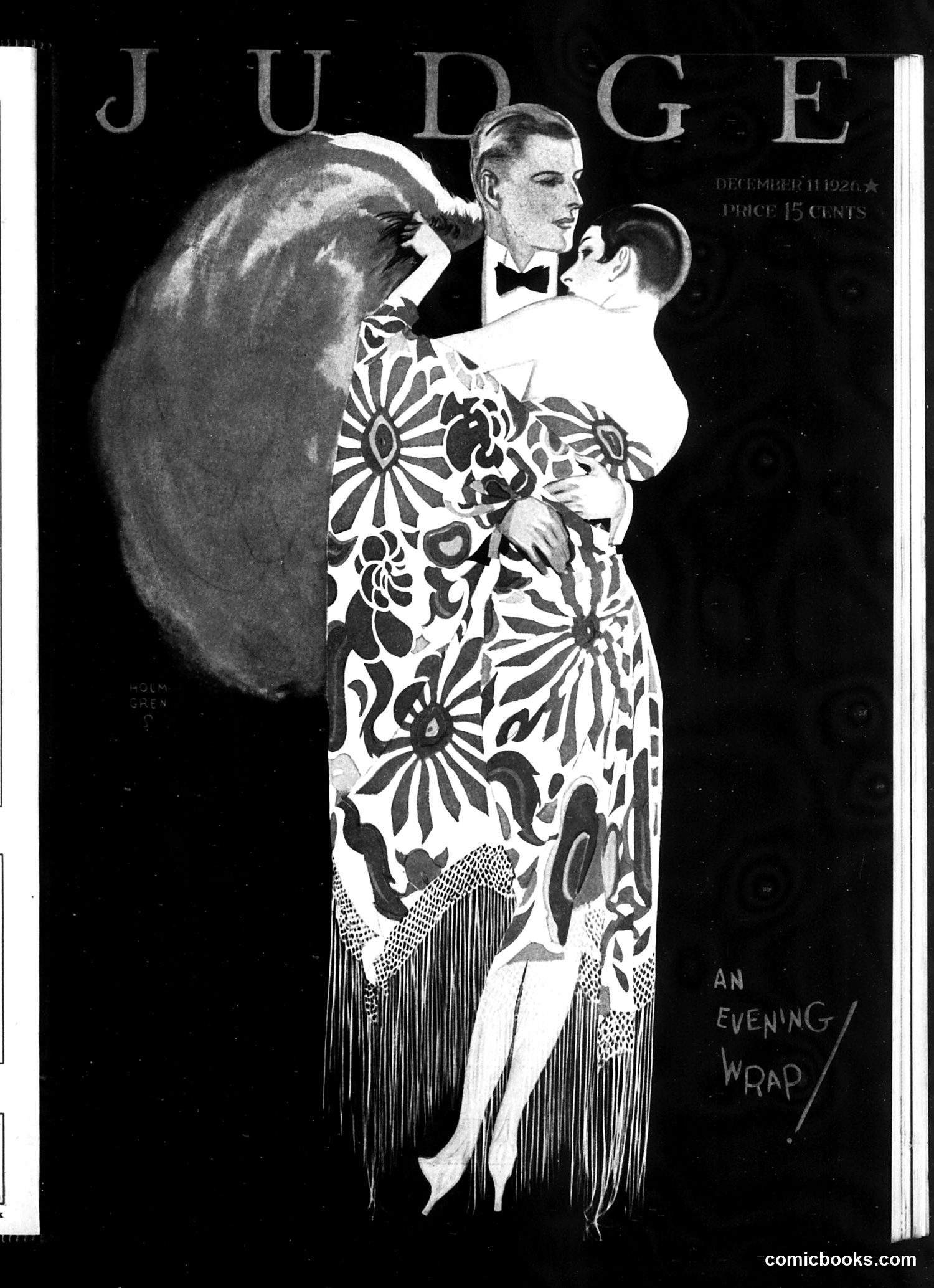
**December 11, 1926** This is a fashion-focused cover titled "An Evening Wrap," depicting a well-dressed man in formal attire (tuxedo) admiring a woman's elaborate evening garment. The woman wears a striking, patterned wrap or shawl with bold floral designs and long fringe—characteristic of 1920s haute couture. The satire likely mocks either: 1. The absurd expense/impracticality of haute couture fashions during the Jazz Age 2. Male vanity or women's fashion obsession in the Roaring Twenties 3. The theatrical presentation of high fashion The large, dramatic circular element behind the figures (possibly representing a fan or design element) emphasizes the wrap's exaggerated proportions. The illustration style is typical of Judge's sophisticated, art deco-influenced satirical humor targeting upper-class fashion trends.
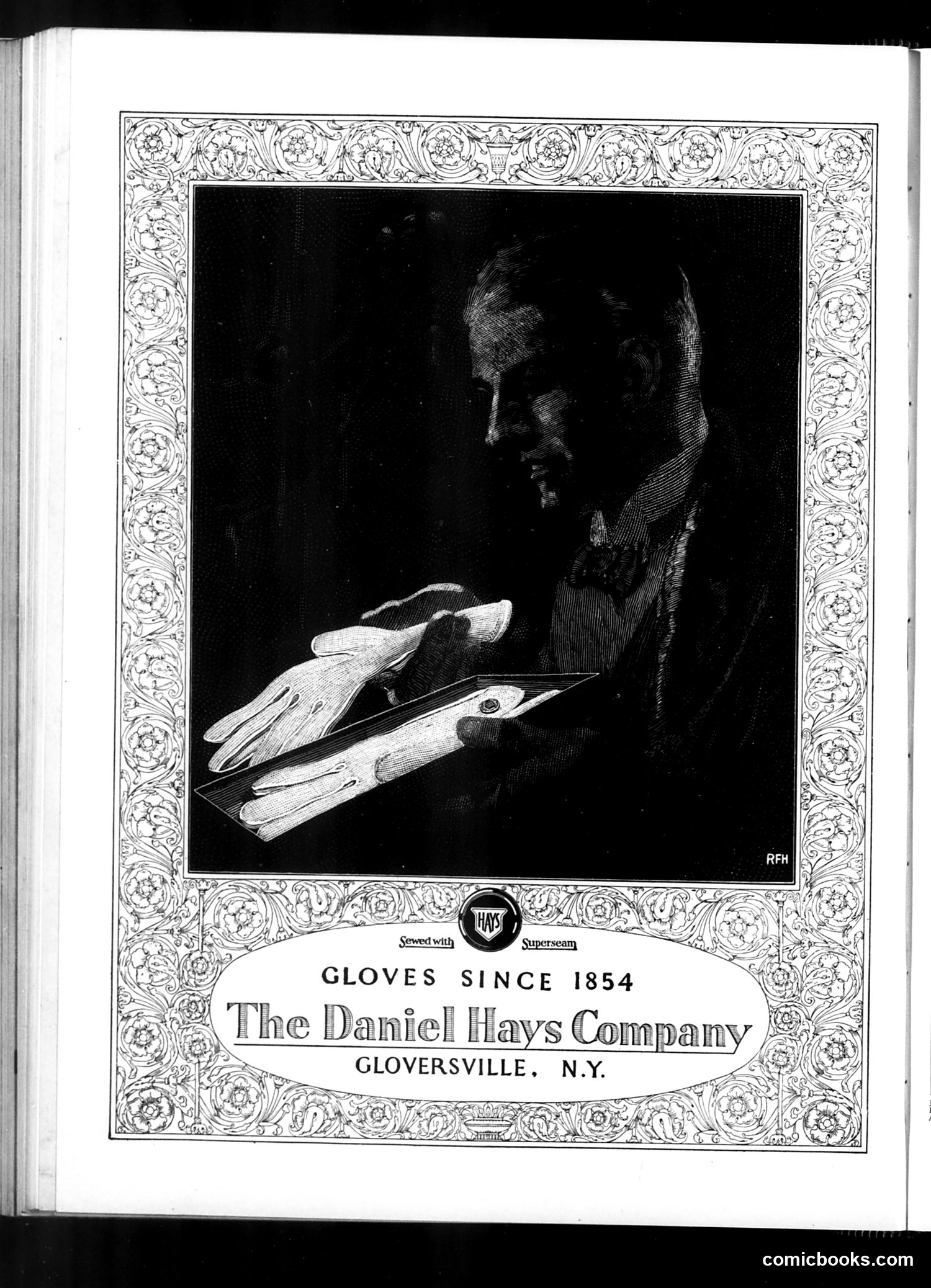
This page is primarily **an advertisement**, not a political cartoon. It features an ornate decorative border framing a black-and-white photograph of a man in formal attire examining a pair of gloves. The ad promotes **The Daniel Hays Company** of Gloversville, New York, emphasizing "GLOVES SINCE 1854." The tagline notes the gloves are "Sewed with Superseam." The photograph showcases the product's quality through careful inspection by what appears to be a craftsman or quality-control specialist, a common advertising technique meant to convey attention to detail and craftsmanship. This is a vintage commercial advertisement rather than satirical content typical of Judge magazine's editorial pages.
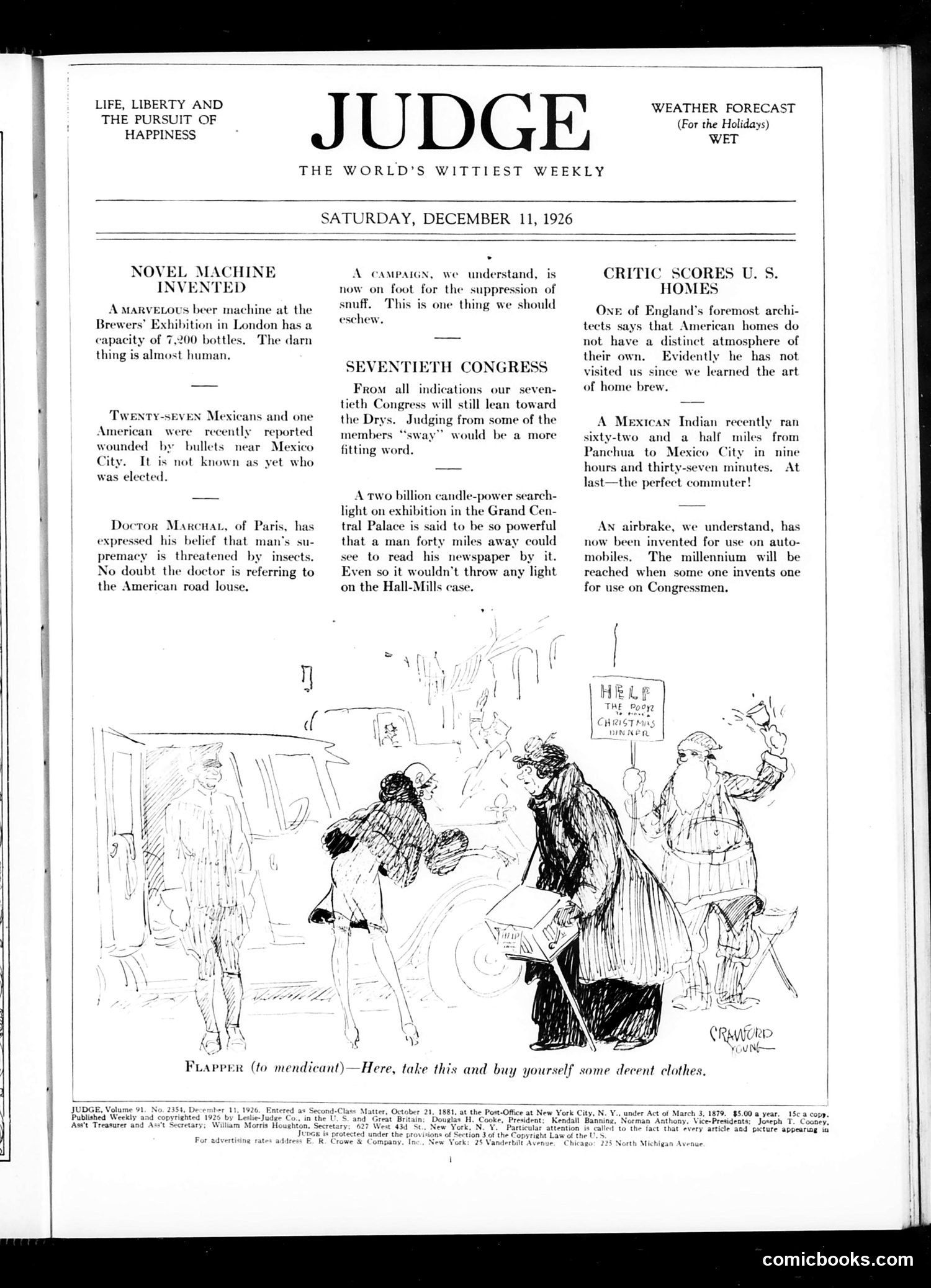
The main cartoon titled "Flapper (lo mendicant)" depicts a scantily-clad young woman (a "flapper"—1920s slang for modern, liberated women) addressing poorly-dressed figures, saying "Here, take this and buy yourself some decent clothes." The satire inverts typical charity: instead of the poor helping the destitute, a flapper—stereotyped as frivolous and underdressed—offers charity to beggars. The joke critiques 1920s youth culture, particularly women's shortened skirts and revealing fashions that shocked conservatives. By showing a scantily-clad woman lecturing others about proper dress, the cartoonist mocks the perceived hypocrisy and moral decline represented by flappers, who challenged Victorian norms.
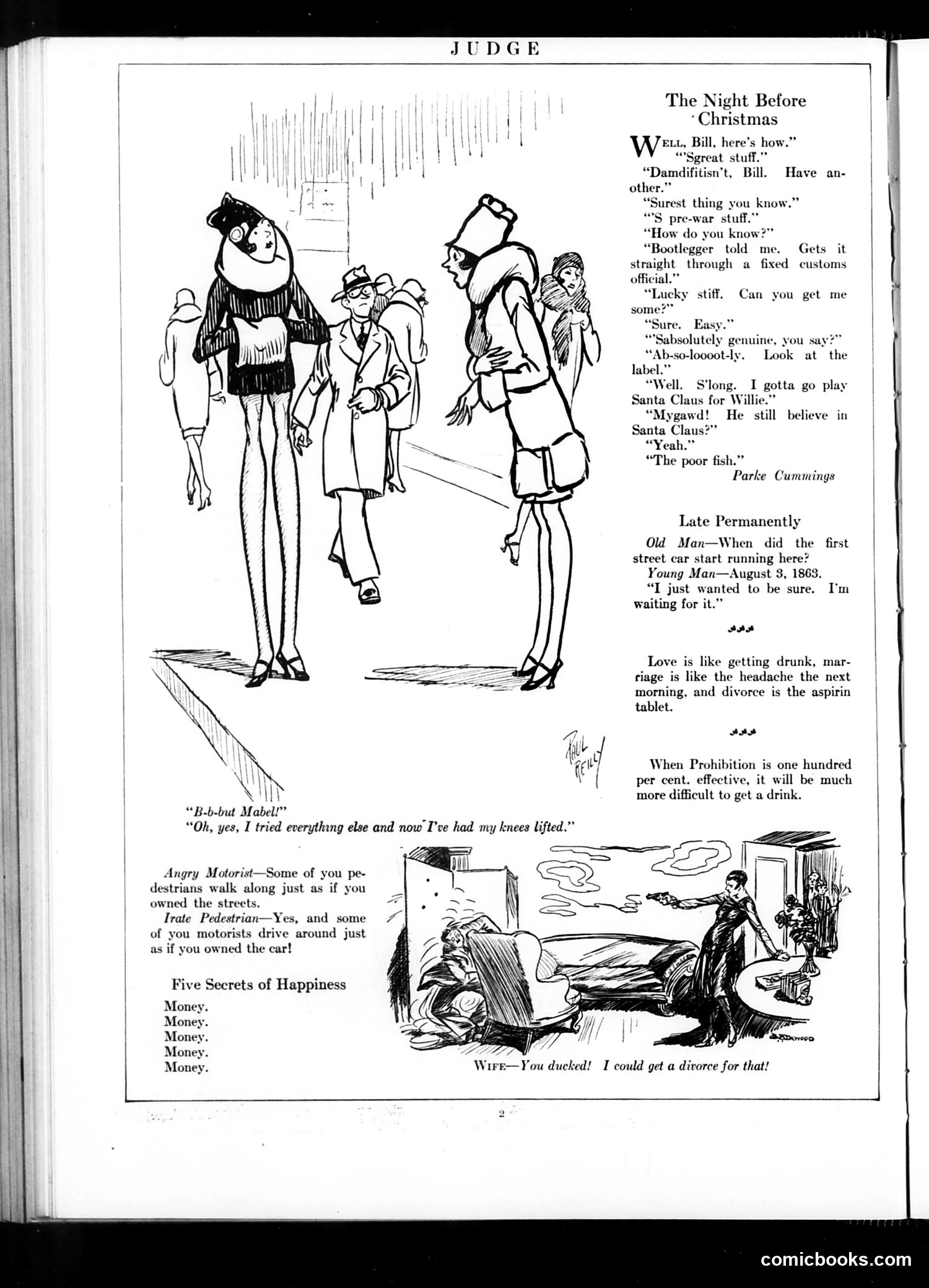
This page contains multiple satirical sketches typical of Judge magazine's humor. **"The Night Before Christmas"** (top): A dialogue between characters discussing bootleg liquor procurement during Prohibition, with crude jokes about obtaining "lucky stiff" alcohol through customs officials. The humor relies on Prohibition-era black market references. **"Late Permanently"**: A brief joke about streetcars, likely referencing their prevalence in early 1900s cities. **Bottom cartoon**: Depicts a domestic dispute where a wife threatens divorce over her husband's infidelity ("You ducked!"). The satire reflects anxieties about changing marriage dynamics and women's increasing legal rights to divorce. **"Five Secrets of Happiness"**: A cynical list simply repeating "Money" five times, satirizing materialist American values. The page exemplifies Judge's satirical approach to Prohibition, gender relations, and consumerism.
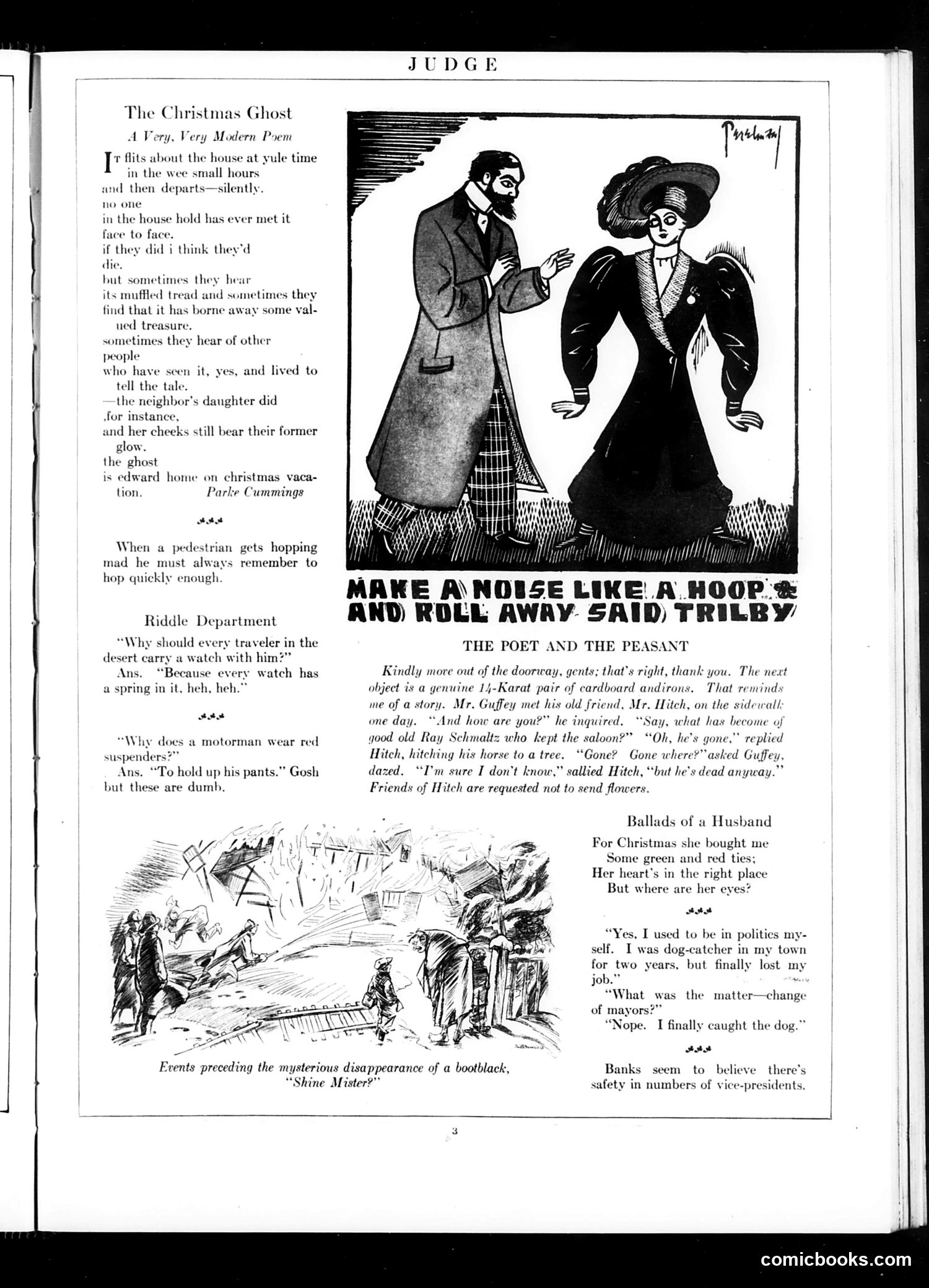
The main cartoon titled "Make a Noise Like a Hoop and Roll Away, Said Trilby" depicts a man and woman in period dress, though the specific figures and satirical target remain unclear from the image alone. Below are sketches illustrating "Shine Mister?"—apparently depicting a bootblack's mysterious disappearance, likely social commentary on street labor or urban life. The page includes "The Poet and the Peasant," a story snippet about characters named Guffey and Hitch, and several brief humor pieces in the "Riddle Department." "Ballads of a Husband" offers domestic comedy about Christmas gifts and a man's career change from politics to dog-catching. The overall content reflects typical Judge magazine fare: satirical poetry, riddles, and social observation presented through both visual and textual humor.
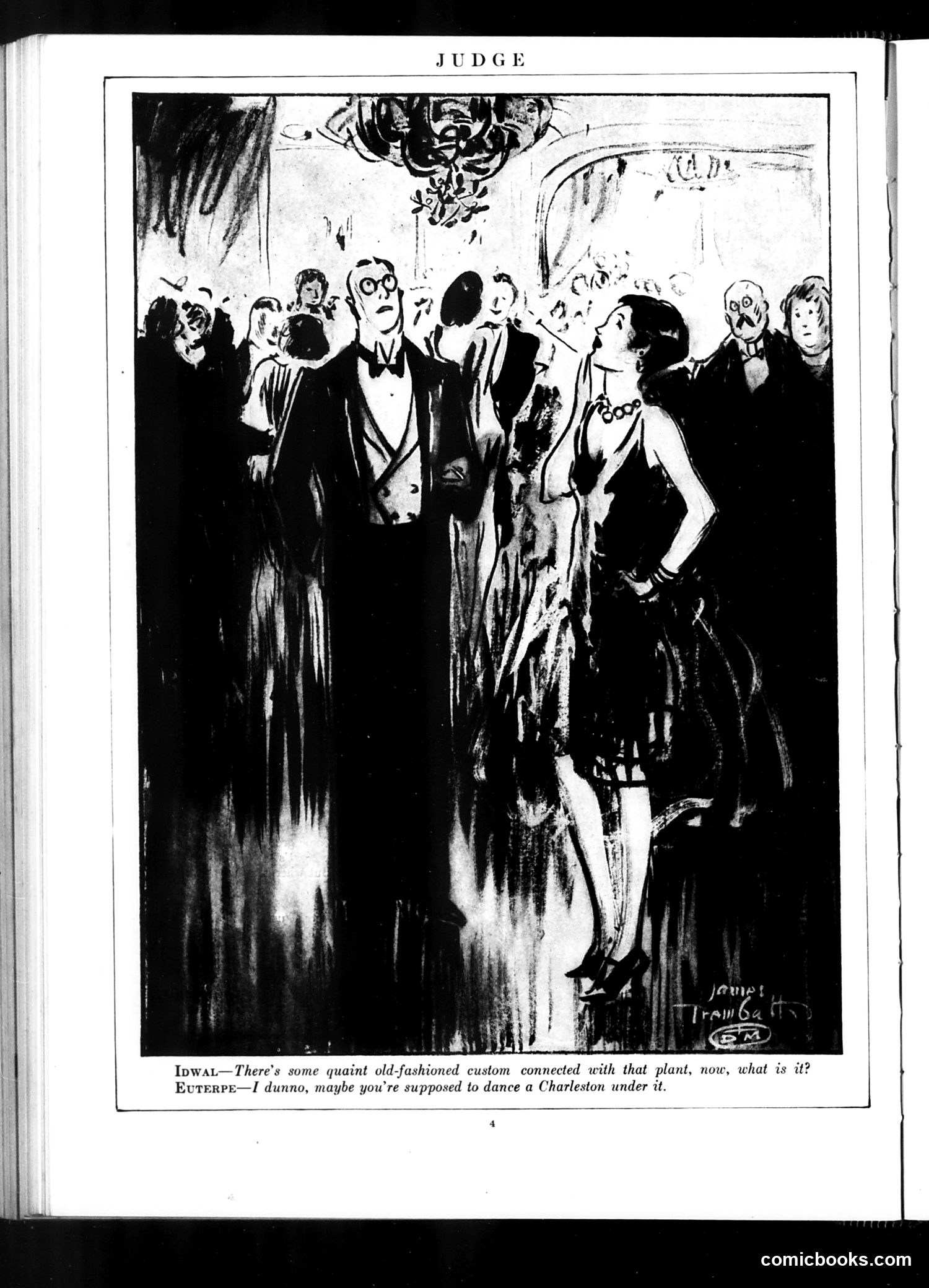
This cartoon satirizes early 20th-century social customs and the Jazz Age. The scene depicts a formal gathering where two men discuss a potted plant. One character (Iowal) mentions an "old-fashioned custom" associated with the plant, while the other (Euterpe) jokes that "you're supposed to dance a Charleston under it." The humor targets the clash between Victorian propriety and modern 1920s behavior. The plant likely references mistletoe—traditionally associated with kissing at Christmas—representing old conventions. By substituting the Charleston (a then-scandalous dance) for kissing, the cartoon mocks how younger generations were abandoning Victorian customs for wilder modern entertainments. The formal dress contrasts with the suggestion of uninhibited dancing, amplifying the generational cultural divide Judge's audience would have recognized.
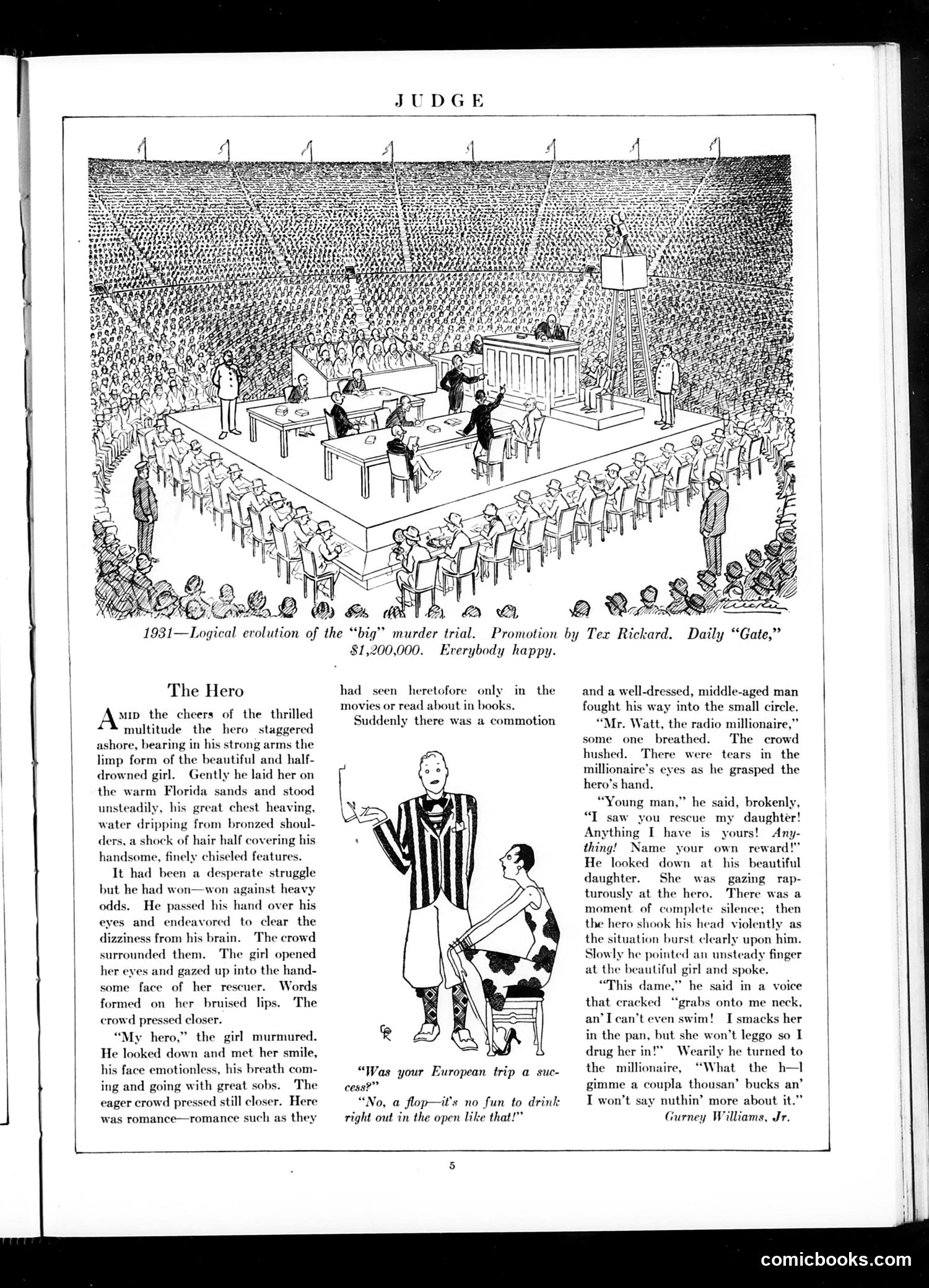
This page satirizes a sensational 1931 murder trial (the " chi" murder case, per the caption). The large illustration depicts a courtroom scene with massive crowds—depicting how such trials became public spectacles with intense media coverage. The accompanying story "The Hero" mocks how the public romanticizes criminals and trial participants. A young man rescues a millionaire's drowning daughter, and the grateful father offers reward money. However, the "hero" dismissively rejects the offer, claiming he "can't even swim" and merely assaulted the girl. The satire suggests the public creates false heroic narratives around ordinary or dubious figures when trials and rescue stories capture attention. The piece critiques both sensationalized justice and celebrity culture's distortion of reality.
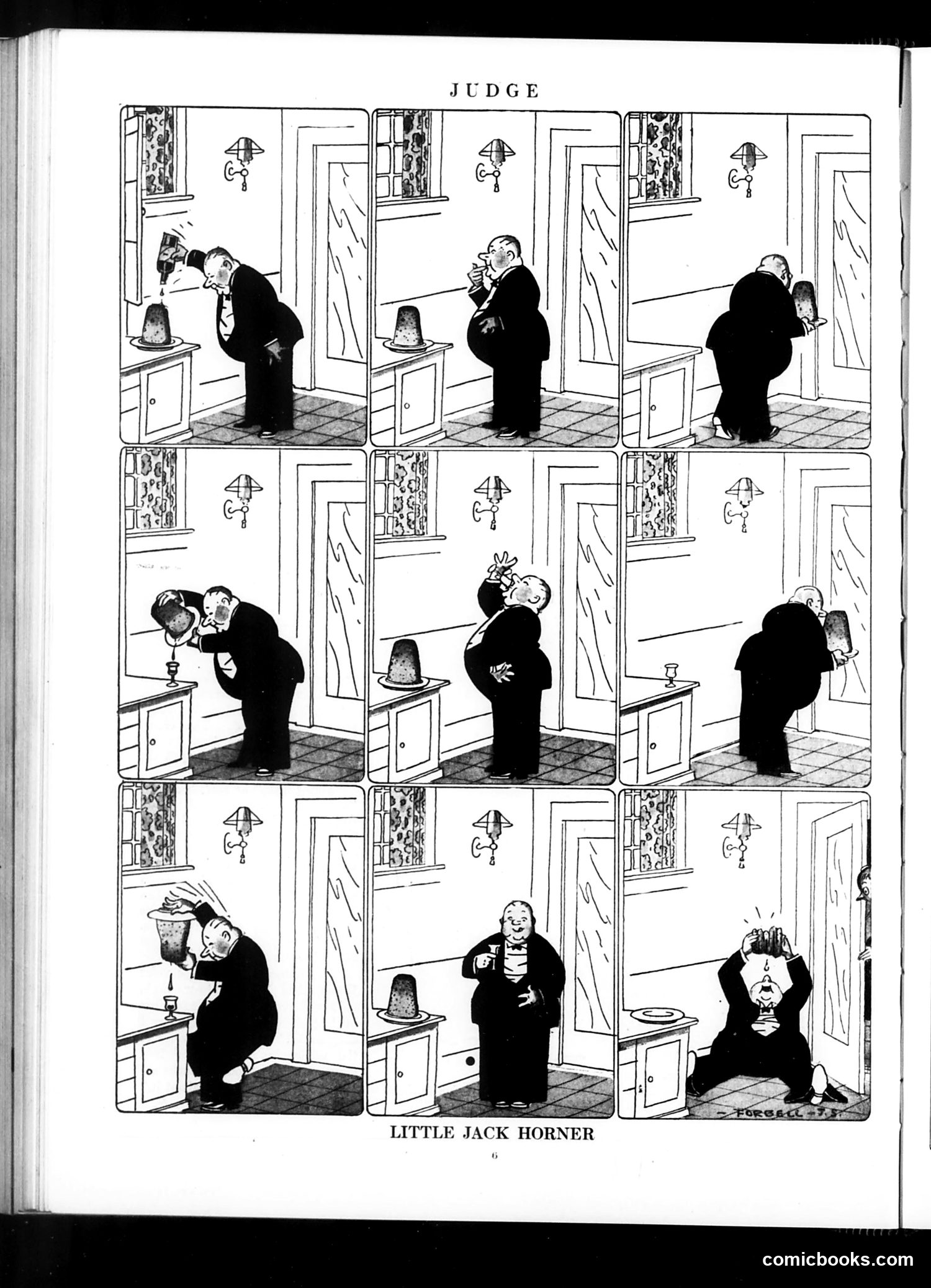
This satirical comic strip appears to depict a rotund judge character repeatedly looking into or examining a hat—likely referencing the nursery rhyme "Little Jack Horner" who "put in his thumb and pulled out a plum." The repetitive panels suggest the judge keeps reaching into the hat, each time appearing to extract something (represented by the darkened hand/object). The final panel shows the judge with a satisfied or triumphant expression. The satire likely critiques judicial corruption or self-serving behavior—the judge repeatedly helping himself, much like Jack Horner taking the plum. The "hat" may symbolize public funds, bribes, or court resources that judges could improperly access. Without additional context or visible date, the specific historical reference remains unclear, but the theme addresses judicial ethics or corruption common to satirical commentary in *Judge* magazine's era.
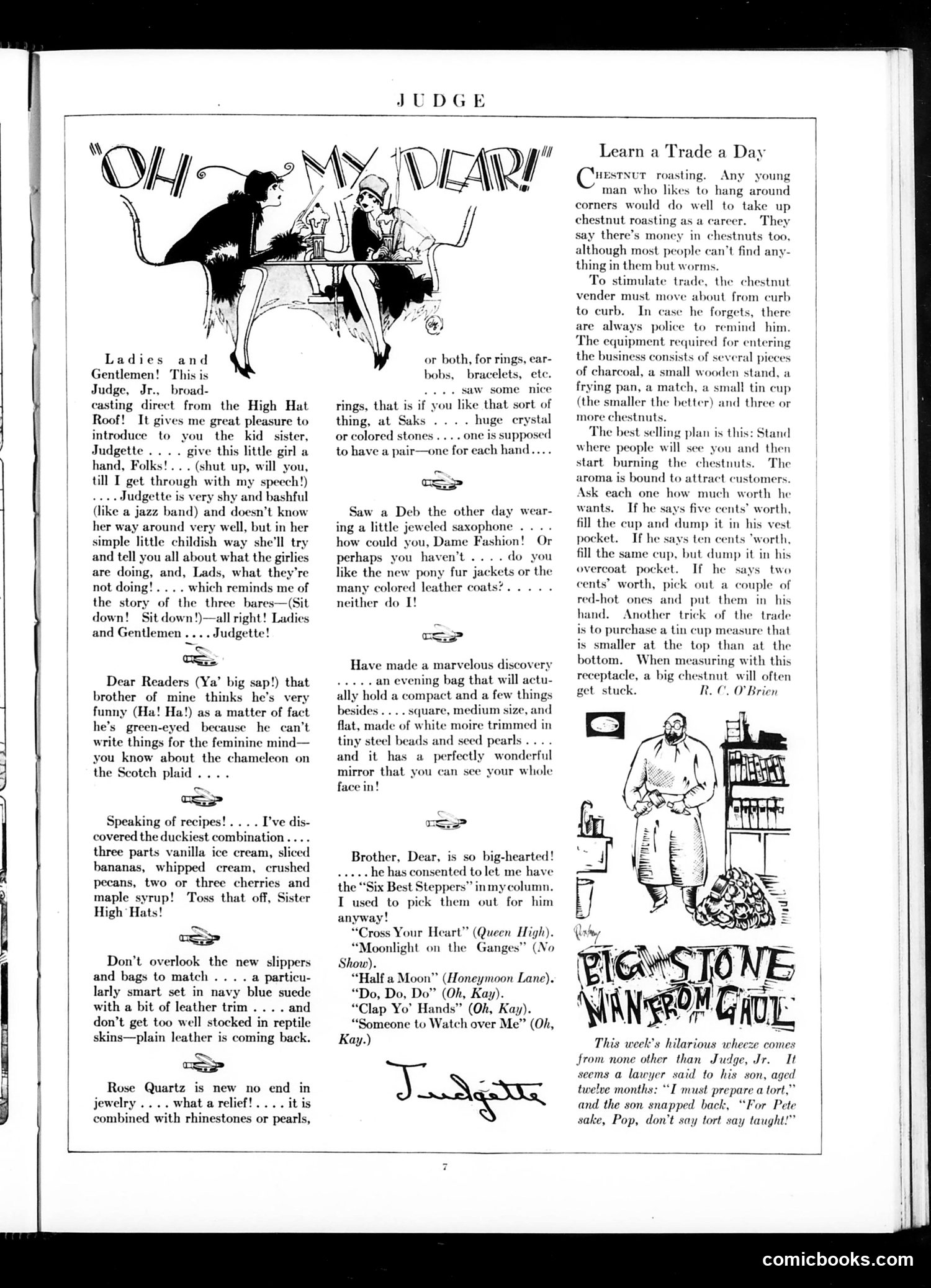
This page features "Judgette," a female persona introduced as Judge magazine's new women's columnist. The masthead cartoon shows a flapper-style woman and man at what appears to be a rooftop venue, introducing this new voice to readers. The content reflects 1920s women's interests: fashion (slippers, leather coats, rose quartz jewelry), recipes (an ice cream concoction), and popular Broadway songs of the era ("Cross Your Heart," "Do, Do, Do," "Clap Yo' Hands"). The "Learn a Trade a Day" segment satirizes street vendors—specifically chestnut roasters—with dark humor about their business practices (dumping chestnuts into customers' pockets rather than proper bags, implying short-changing). The page is primarily lifestyle/entertainment content rather than political satire. It captures Jazz Age consumer culture and emerging women's media voices, while the vendor joke mocks petty street-level commerce.
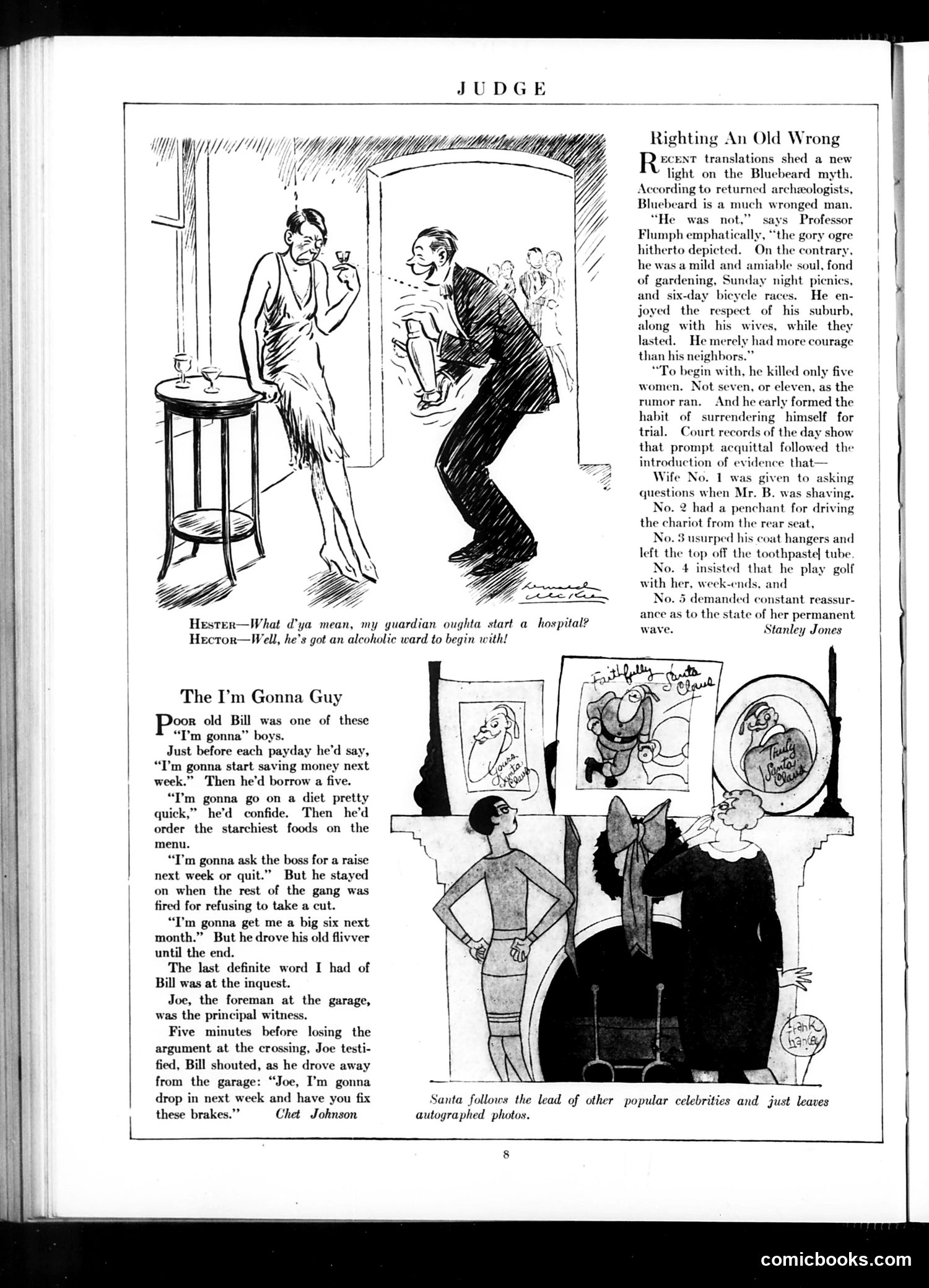
This page contains three satirical pieces: **"Righting An Old Wrong"** (top right) humorously "corrects" the Bluebeard legend based on supposed new archaeological translations. The satire defends Bluebeard as mild-mannered and merely defensive—he killed only five women (not seven or eleven) and surrendered for trial. The joke's twist: his wives' actual offenses (asking questions while he shaves, driving from the rear seat, stealing coat hangers, demanding golf outings, requiring reassurance about her permanent wave) justify his actions. This mocks both historical myth-making and contemporary marital complaints. **"The I'm Gonna Guy"** (bottom left) by Chet Johnson satirizes procrastination and empty promises. Poor Bill constantly says "I'm gonna" (save money, diet, ask for a raise) but never follows through—until his final "I'm gonna fix these brakes," which ironically precedes his fatal accident at a railroad crossing. The joke critiques habitual postponement with tragic irony. **"Hester-Hector" dialogue** (top left) is a brief joke about a guardian needing to start a hospital because he's an "alcoholic ward"—he drinks excessively.
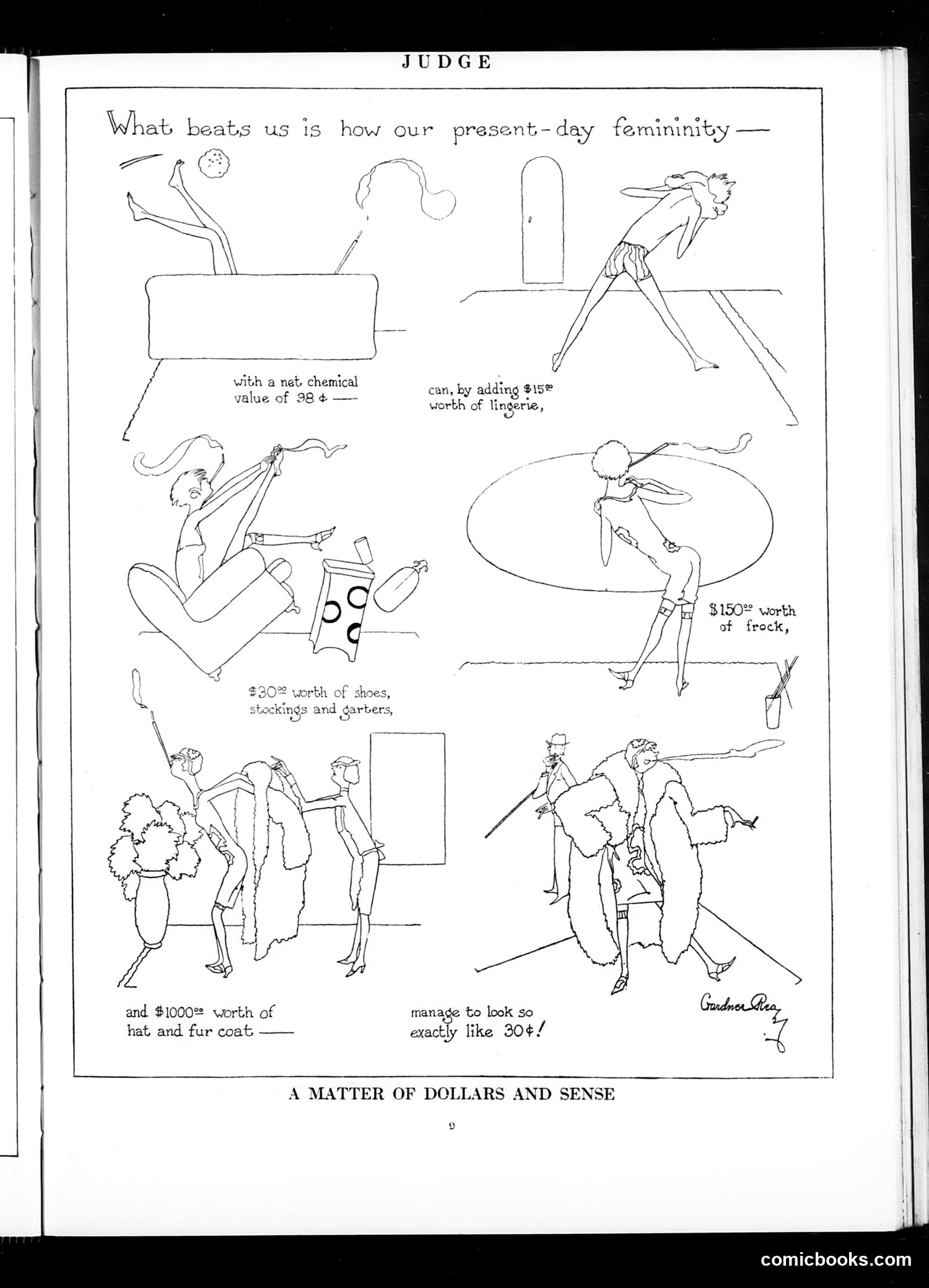
This satirical cartoon critiques the economics of women's fashion and appearance in the early 20th century. The joke presents a mathematical absurdity: a woman's natural body has a "chemical value" of 98 cents, yet by adding clothing and accessories—lingerie ($15), a dress ($150), shoes/stockings ($1000 worth of hat and fur coat)—she manages to look "exactly like 30¢!" The satire targets the contradiction in consumer culture: massive expenditures on fashion supposedly create an appearance that looks cheap or inferior. The cartoon mocks both the artificiality of femininity (reducing women to chemical components and purchasable goods) and the illogic of fashion economics. Various illustrated vignettes show women in different poses wearing these expensive items, emphasizing the absurdity that such investment produces unremarkable results. The title "A Matter of Dollars and Sense" plays on "dollars and cents," suggesting the whole system lacks sense.
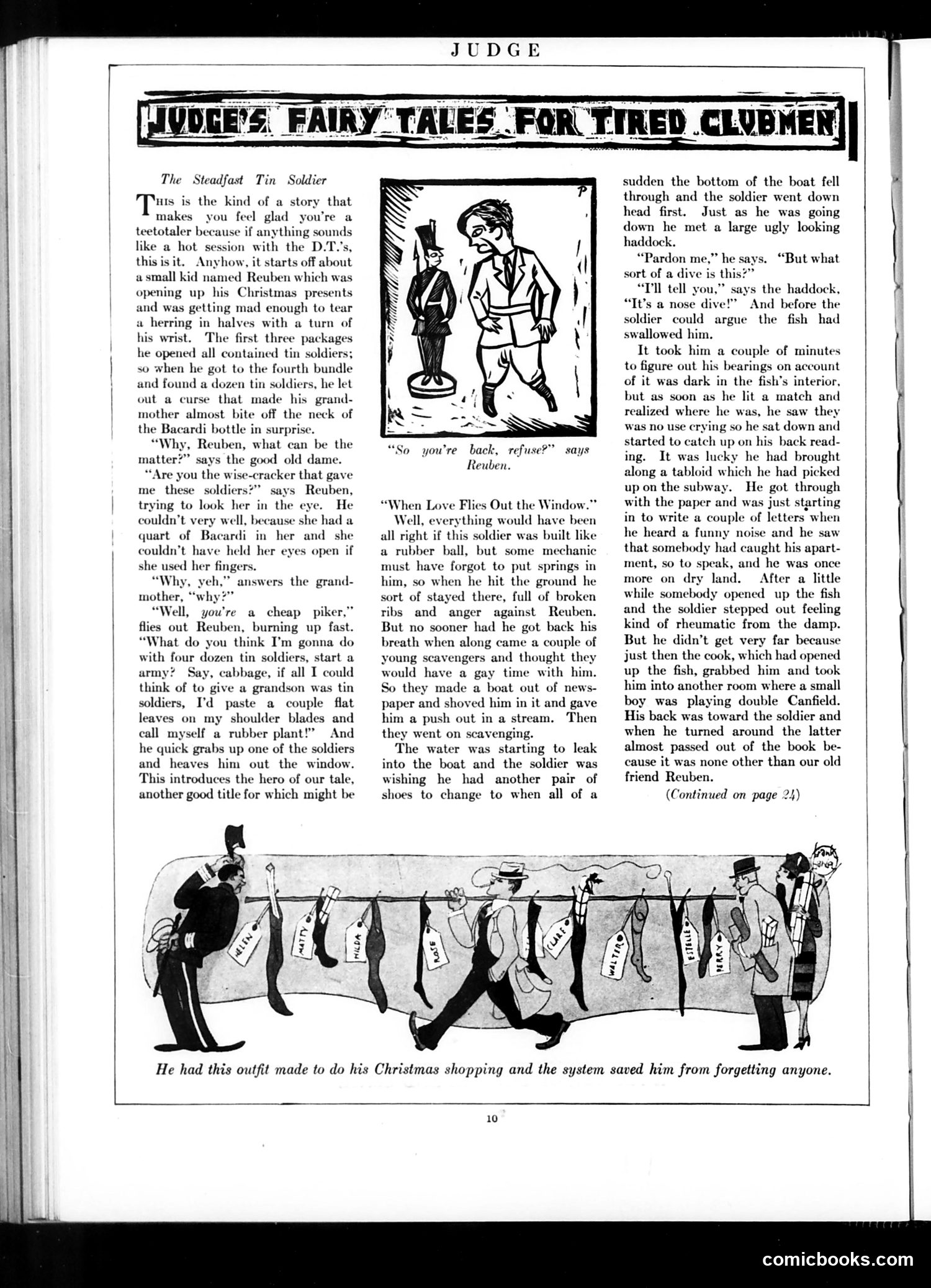
This is a humorous story parody of Hans Christian Andersen's fairy tale, adapted for a American audience dealing with Prohibition-era anxieties. The narrative follows a tin soldier thrown from a window by an ungrateful boy named Reuben, who survives increasingly absurd adventures (scavengers, a stream, being swallowed by a fish) before mysteriously reappearing. The satire targets several things: an ungrateful child disrespecting his grandmother, the boy's crude language ("What do you think I'm gonna do with four dozen tin soldiers, start a army?"), and consumerism through excessive Christmas gifts. The grandmother's drinking habit ("a quart of Bacardi") is presented as comedic, reflecting contemporary attitudes toward alcohol despite (or because of) Prohibition. The bottom cartoon shows a man with laundry tagged with names—a system for Christmas shopping organization. The satire mocks both consumer excess and attempts to systematize domestic life. The humor relies on absurdist situations and period-specific references modern readers would miss without context about gift-giving culture and Prohibition-era sensibilities.
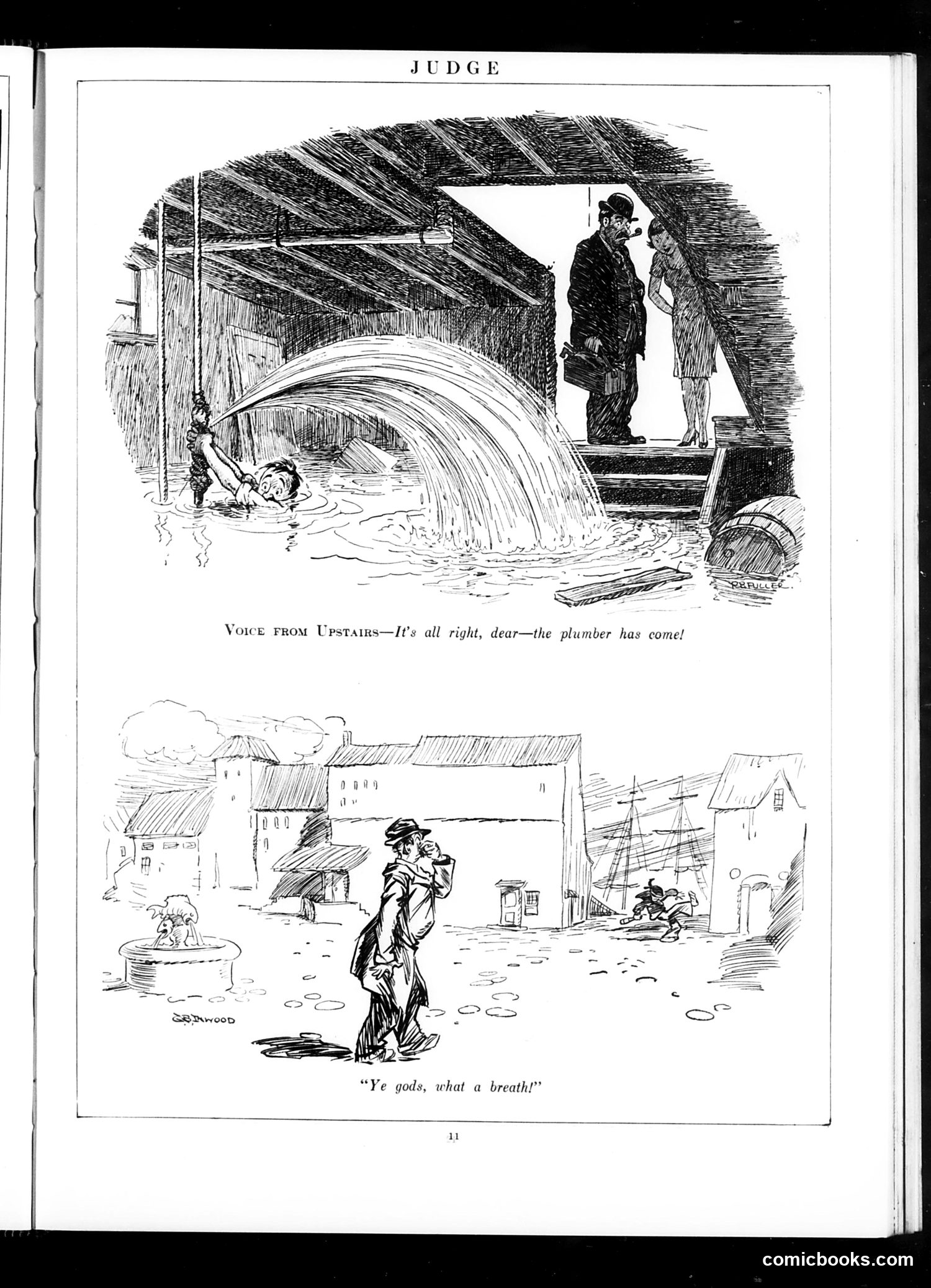
**Top cartoon:** A flooded basement with a well-dressed man and woman observing from above. A voice from upstairs announces "the plumber has come," suggesting false hope that the disaster will be fixed. The satire targets either incompetent plumbers or the absurdity of expecting a tradesman to resolve catastrophic flooding—likely mocking both poor urban sanitation and overconfident service providers. **Bottom cartoon:** Labeled "Ye gods, what a breath!", shows a figure recoiling in disgust at a dockside scene. The satirical target appears unclear—possibly critiquing working-class conditions, sailors, or dock workers' hygiene. The exaggerated reaction suggests the cartoon mocks contemporary social prejudices or class attitudes toward laborers. Both employ visual hyperbole characteristic of Judge's working-class and domestic humor.
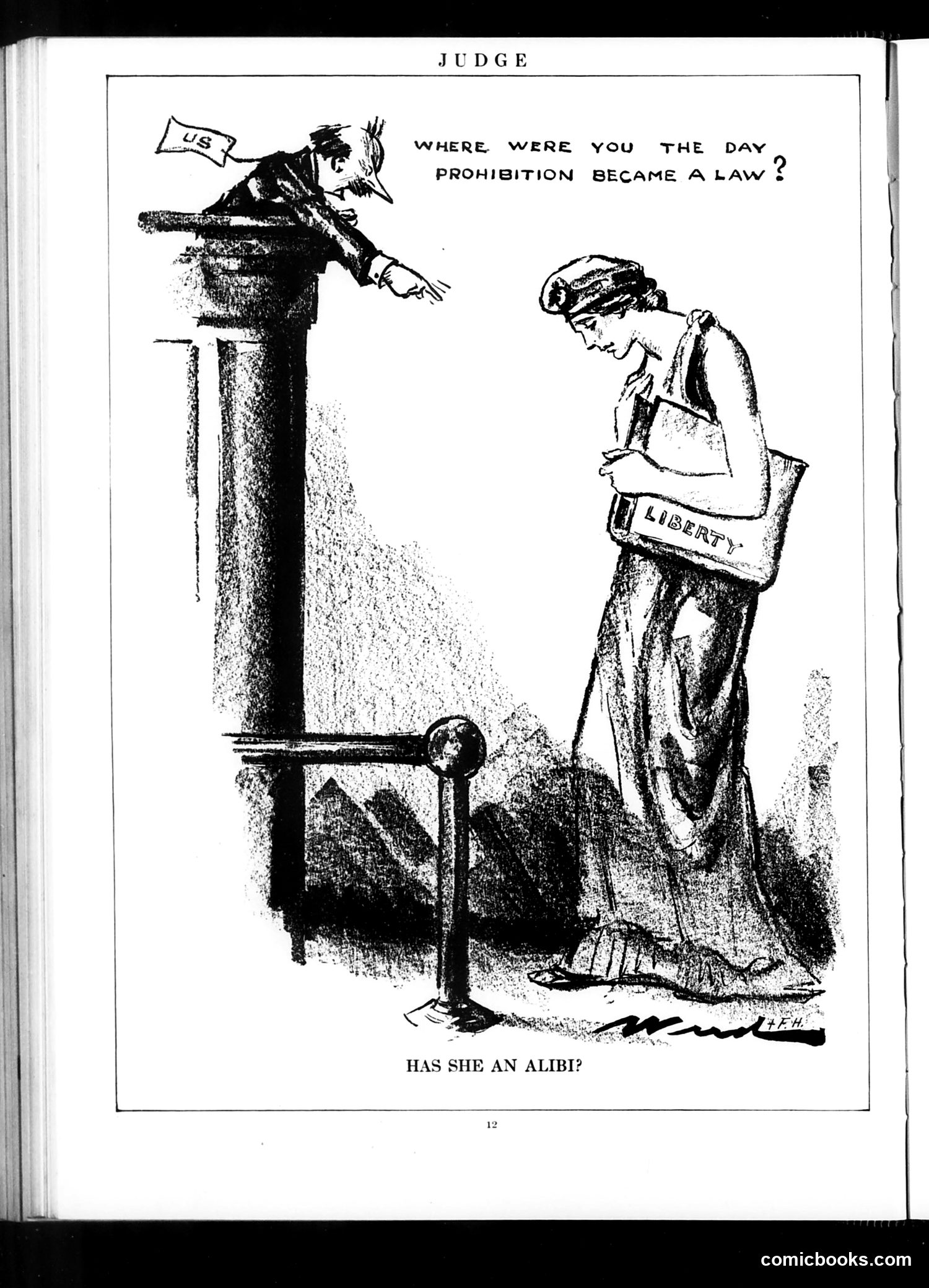
This Judge magazine cartoon satirizes Prohibition's implementation by interrogating "Liberty" (personified as a woman wearing a liberty cap and labeled "LIBERTY") about her whereabouts when Prohibition became law. A judge perched on a tall bench demands to know: "Where were you the day Prohibition became a law?" and asks "Has she an alibi?" The satire suggests that Liberty was absent or complicit during Prohibition's passage—implying the law violated American freedoms. The cartoon criticizes Prohibition as fundamentally un-American, incompatible with liberty itself. By treating Liberty as a suspect requiring an alibi, the cartoonist mocks the government's restriction of personal choice, suggesting Prohibition represented a failure to protect constitutional freedoms.
This page contains two opinion pieces about the 1920s Harvard-Princeton football rivalry, framed around Princeton's victory. **"Harvard-Princeton"** argues that Princeton's superior "college spirit"—emotional solidarity and institutional loyalty—explains both its football success and the antagonism between the schools. The piece suggests Harvard, as a larger, more intellectually mature institution, has lost this fervent spirit, while Princeton's smaller, cloistered environment has preserved it. This fundamental difference creates mutual disdain: Harvard patronizes Princeton as unsophisticated; Princeton struts as the victor. **"Who Made It a Sin?"** defends gambling against religious condemnation. The author notes the Bible contains no explicit prohibition of gambling, suggesting it was once considered innocent recreation. The piece questions why American religious leaders condemn it so fiercely—apparently referencing contemporary debates over betting and sports gambling. Together, these pieces reflect 1920s concerns about college culture, institutional identity, and the tension between traditional morality and modern recreation.
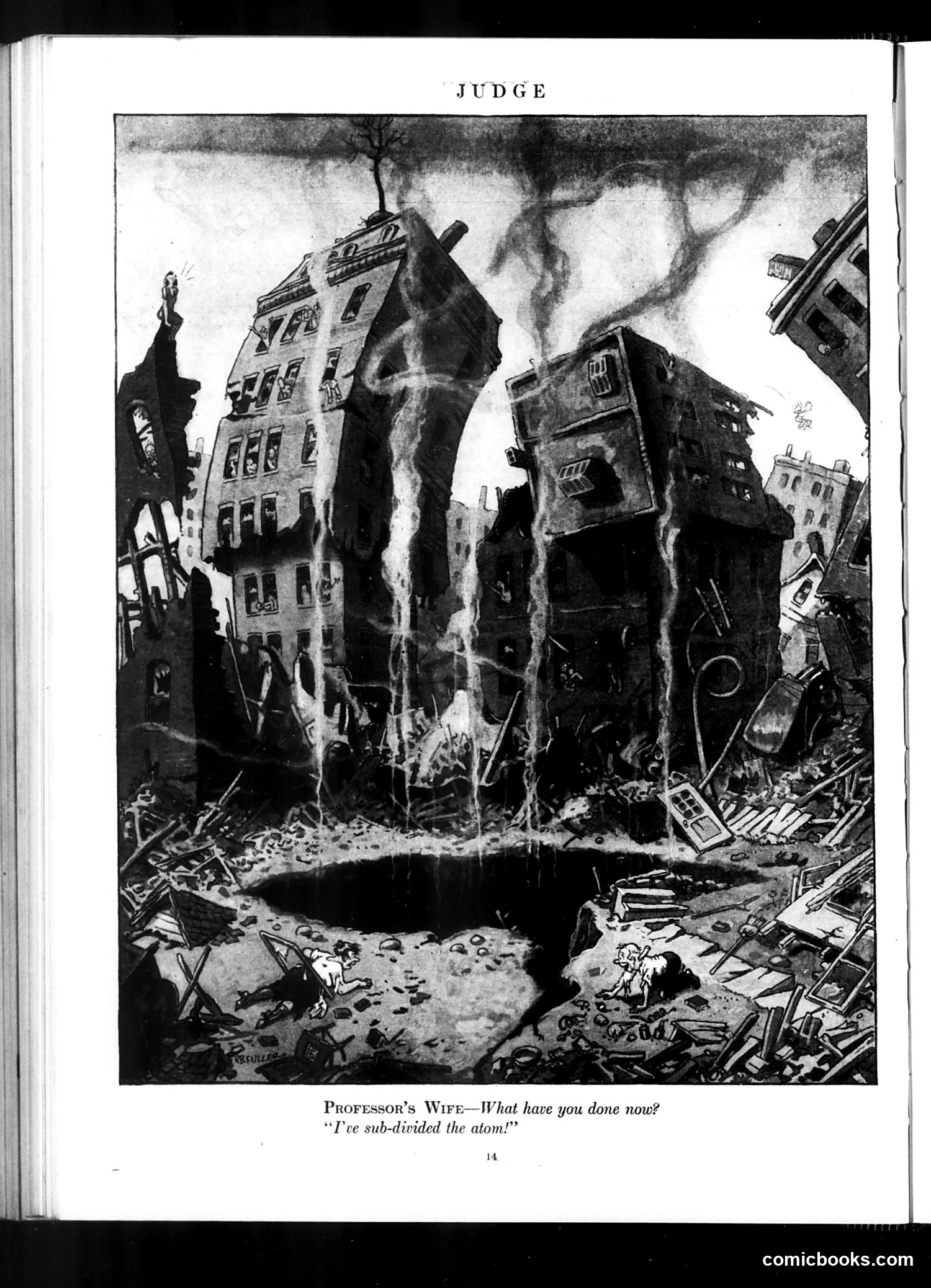
This satirical cartoon depicts massive urban destruction—collapsed buildings, fires, and a crater—with the caption showing a Professor's Wife asking what he's done, and his response: "I've sub-divided the atom!" The satire targets early 20th-century scientific anxiety about atomic physics. The joke plays on the term "sub-divided the atom" (splitting atoms), suggesting that theoretical nuclear science could cause catastrophic destruction if weaponized. This reflects contemporary fears about uncontrolled scientific advancement and its potential consequences. The exaggerated devastation—entire city blocks obliterated—illustrates the satirist's anxiety about atomic energy as an existential threat, decades before nuclear weapons actually existed. It's both humorous (the casually devastating accomplishment) and darkly prophetic, mocking scientific hubris while expressing public concern about where modern physics might lead.
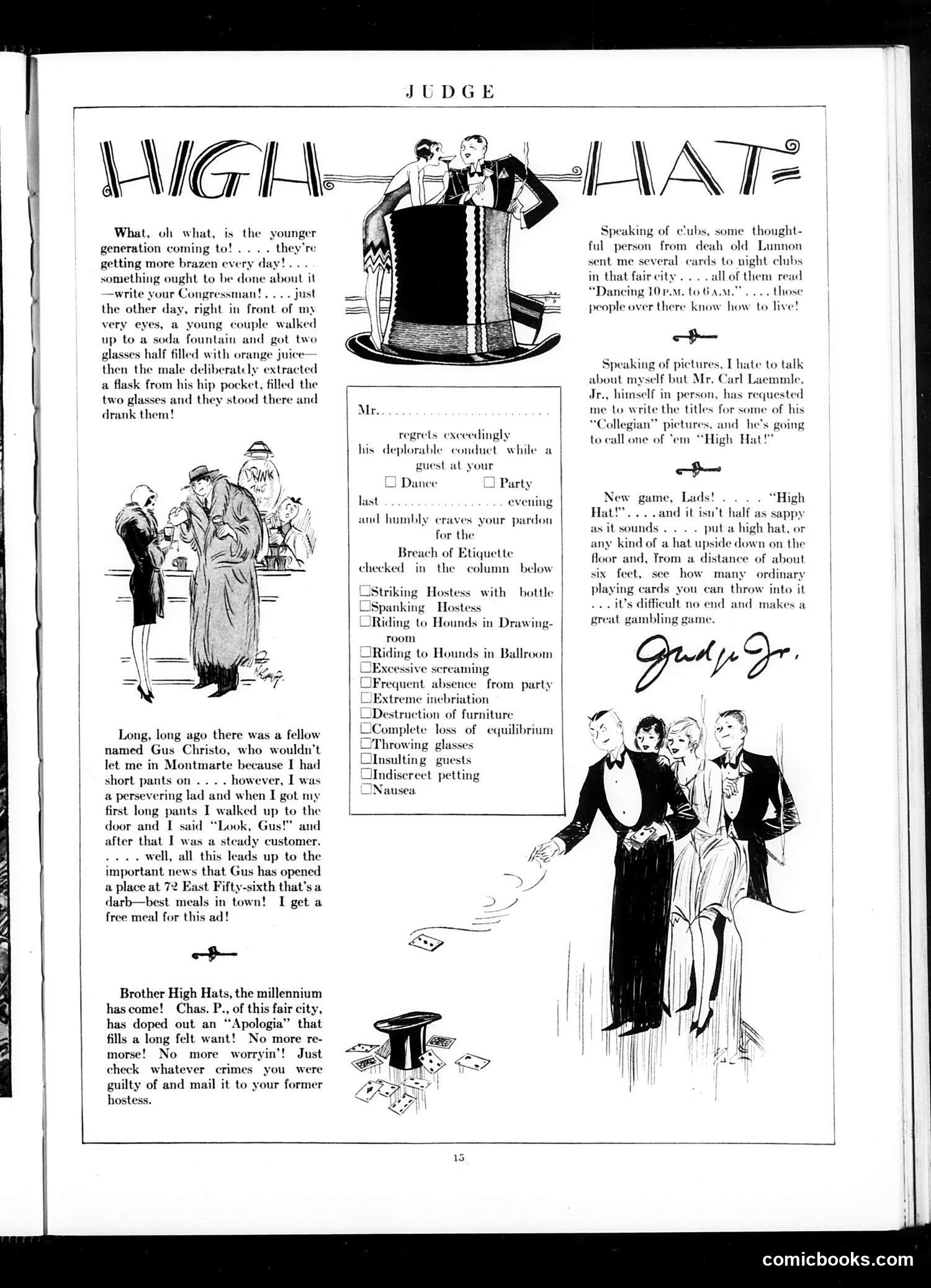
This *Judge* humor page satirizes 1920s social anxieties about youth morality and changing manners. **The main satire**: The opening anecdote mocks pearl-clutching adults who view young people as dangerously "brazen"—the shocking example being a couple spiking orange juice with hidden flask liquor. This references Prohibition-era hypocrisy. **The "Apologia" section** parodies etiquette by offering a fill-in-the-blank apology card for guests to mail hosts after misbehaving. Checkboxes list various infractions (striking hostess, destruction of furniture, "extreme inebriation") with dark humor suggesting such bad behavior was common enough to warrant pre-printed excuses. **Secondary jokes** include references to nightlife in London and a plug for Carl Laemmle Jr.'s film studio using "High Hat" as a title—the page concludes with instructions for a drinking game involving a toppled hat. The overall tone is cynical about generational decline and social propriety during the Jazz Age.
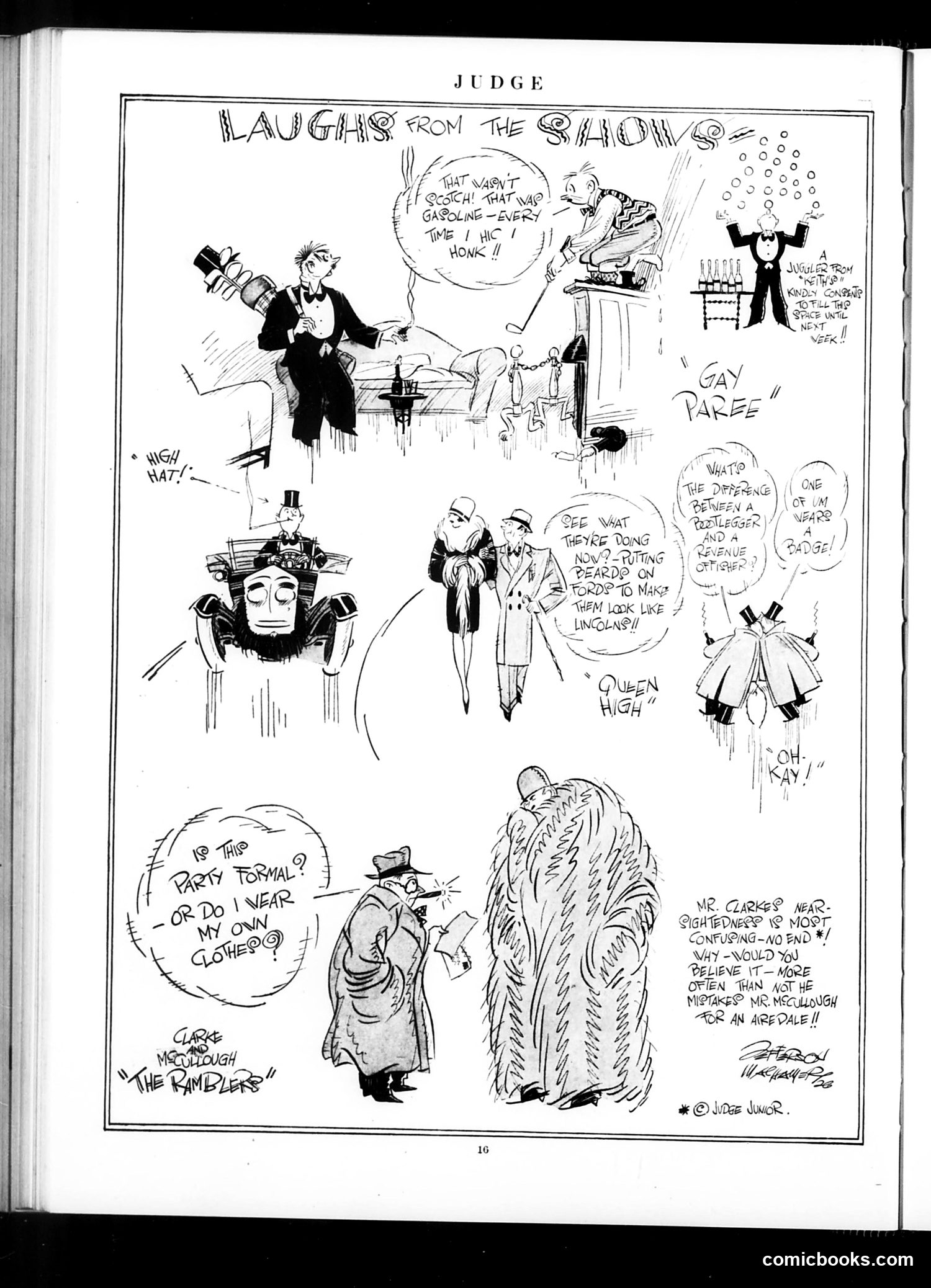
This Judge magazine page satirizes a "Gay Paree" (Parisian) themed party and related social confusion. The cartoon mocks several targets: **Main figures/references:** - Characters in formal wear and disguises attending a costume party - "Clarke" and "The Rambler" (likely Judge contributors or public figures) discussing party attire and facial hair - References to Lincoln-style beards being used as disguises **The satire's points:** The humor centers on party-goers trying to create disguises by adding fake beards, with one character asking whether to wear party costume or own clothes. The final panel suggests someone (Mr. McCullough) is frequently mistaken for an Airedale dog—implying his appearance is dog-like or that the beard disguise is so poor it's absurd. The overall joke appears to target the ridiculousness of costume party disguises and perhaps social pretension around Parisian-themed events, which were fashionable American entertainment in the early 20th century.
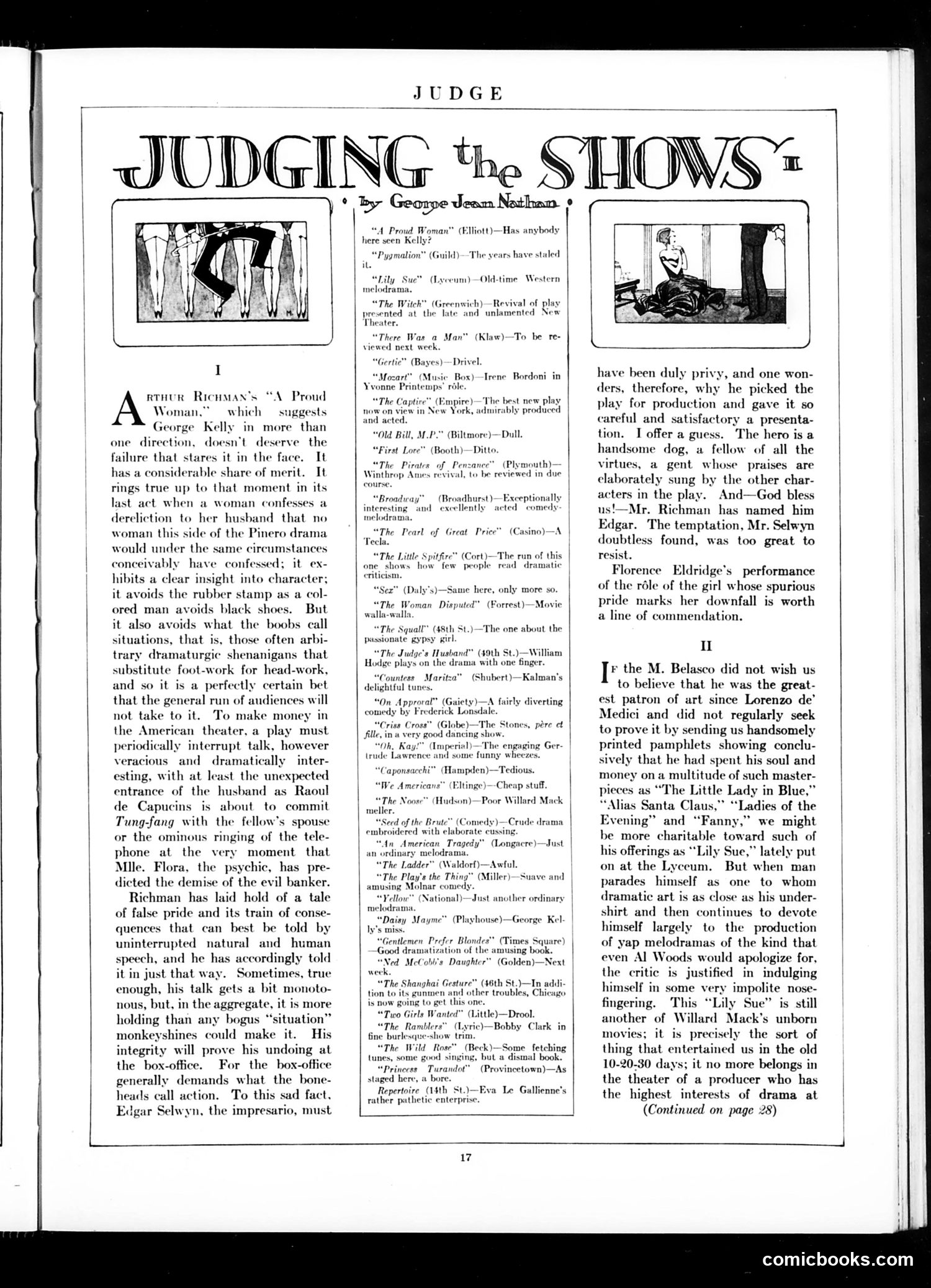
This page is a theater review column by George Jean Nathan covering Broadway productions. The two images appear to illustrate scenes from plays under discussion—likely "A Proud Woman" and another production—though they're not clearly labeled. Nathan critiques Arthur Richman's "A Proud Woman," praising its realistic dialogue and character insight but predicting commercial failure because American audiences demand melodramatic "situations" (contrived plot devices, unexpected entrances, convenient phone calls) rather than intelligent conversation. He argues this integrity will "prove his undoing at the box-office." The column then lists dozens of current Broadway shows with brief, often dismissive judgments: "Dull," "Drivel," "Tedious," "Awful," "Crude drama." "The Captive" receives rare praise as "the best new play now on view in New York." This reflects 1920s theater culture and Nathan's famous caustic reviewing style—championing artistic merit while lamenting popular taste's preference for commercial gimmickry.
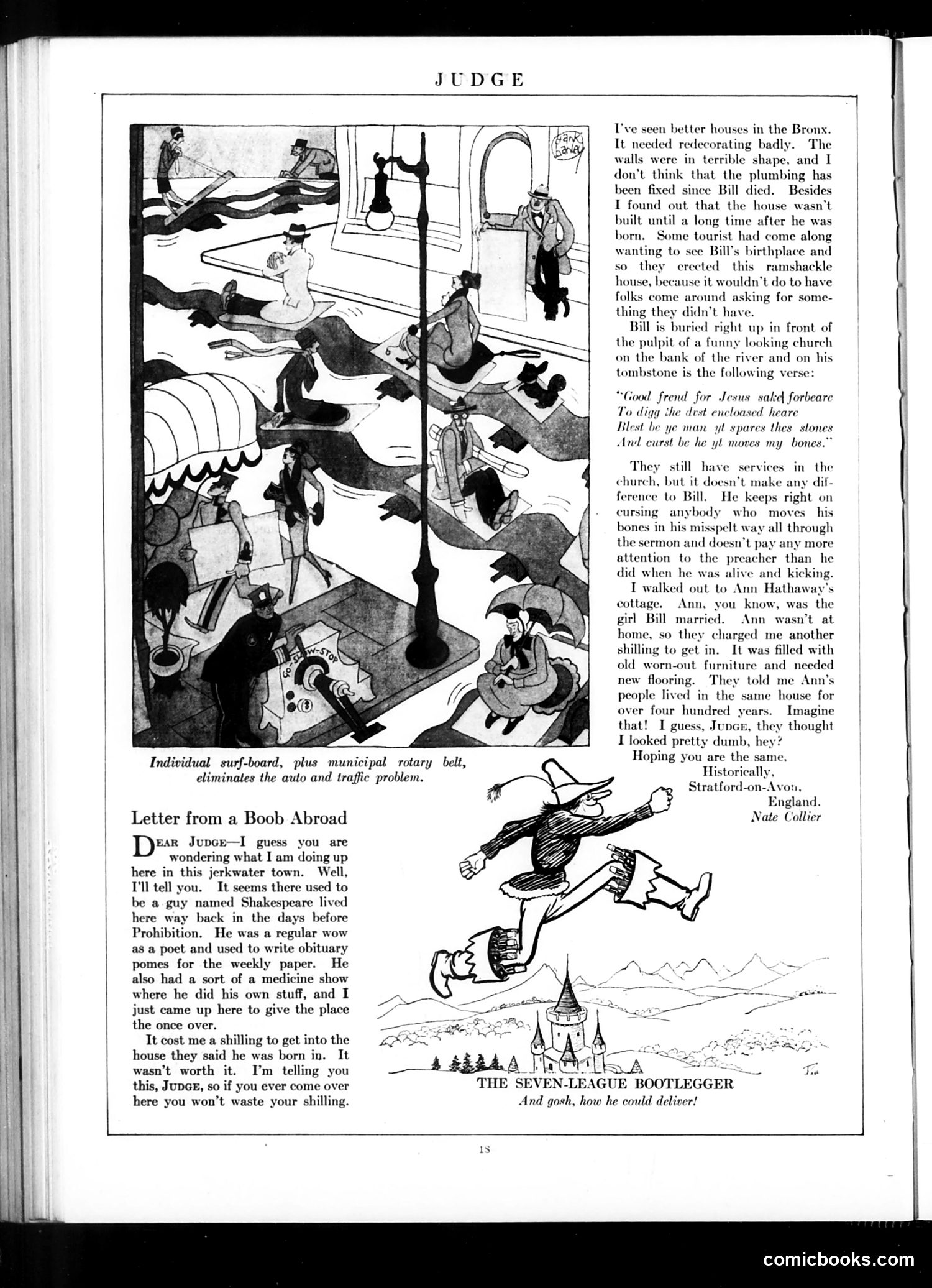
This page contains two satirical pieces mocking American tourists and Prohibition-era bootlegging. **"Letter from a Boob Abroad"** is a humorous letter from an American visitor to Stratford-upon-Avon, England—Shakespeare's birthplace. The writer dismissively compares Shakespeare's modest cottage to "better houses in the Bronx," complains about the entrance fee ("a shilling"), and notes that the celebrated birthplace was actually built long after Shakespeare was born. The satire targets American tourists' cultural ignorance and commercialized shrine-tourism. The reference to "Bill" (Shakespeare) "cursing anybody who moves his bones" plays on his actual tombstone curse. **"The Seven-League Bootlegger"** (cartoon below) satirizes Prohibition-era illegal alcohol smuggling. "Seven-league boots" reference a fairy-tale magical device for rapid travel; here it mocks a bootlegger's ability to evade law enforcement while delivering contraband liquor. The cartoon suggests bootleggers operated so efficiently they seemed superhuman. Both pieces reflect 1920s American anxieties: tourist kitsch-ification of history and the widespread defiance of Prohibition laws.
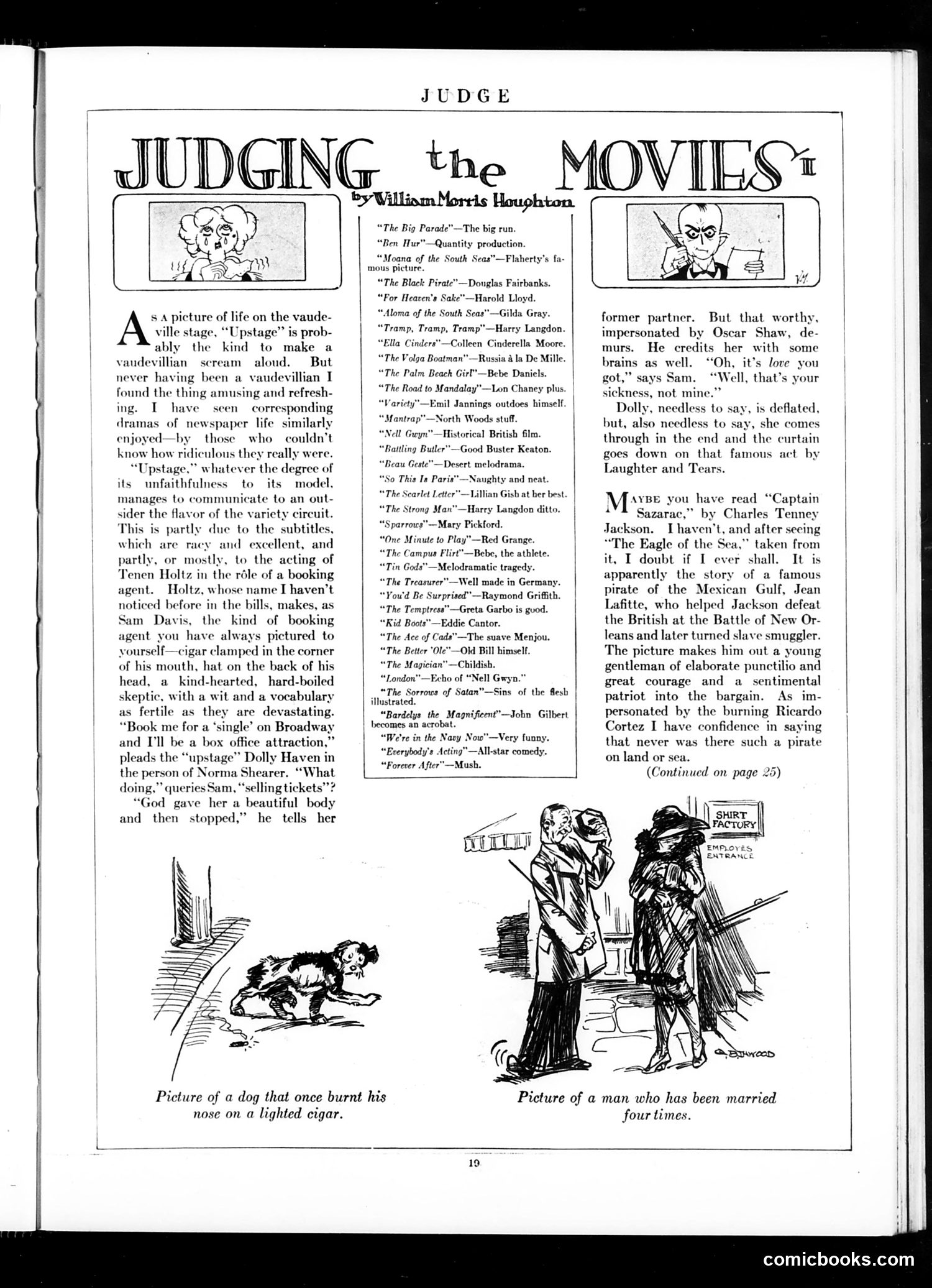
This page reviews recent films by William Morris Houghton. The main review discusses "Upstage," a vaudeville-themed movie starring Norma Shearer and actor Tenen Holtz. Houghton praises Holtz's performance as a cynical but good-hearted booking agent—a character type anyone would recognize: cigar-chomping, quick-witted, world-weary. The satire lies in the agent's deflating response to Shearer's ingénue character: when she claims her beauty guarantees success, he quips that "God gave her a beautiful body and then stopped"—suggesting she lacks talent. The page also lists contemporary 1920s films with brief characterizations (many featuring silent-era stars like Harold Lloyd, Buster Keaton, and Mary Pickford). Two cartoon illustrations show absurdist humor: a dog that burned its nose on a cigar, and a repeatedly-married man—visual jokes unrelated to film criticism.
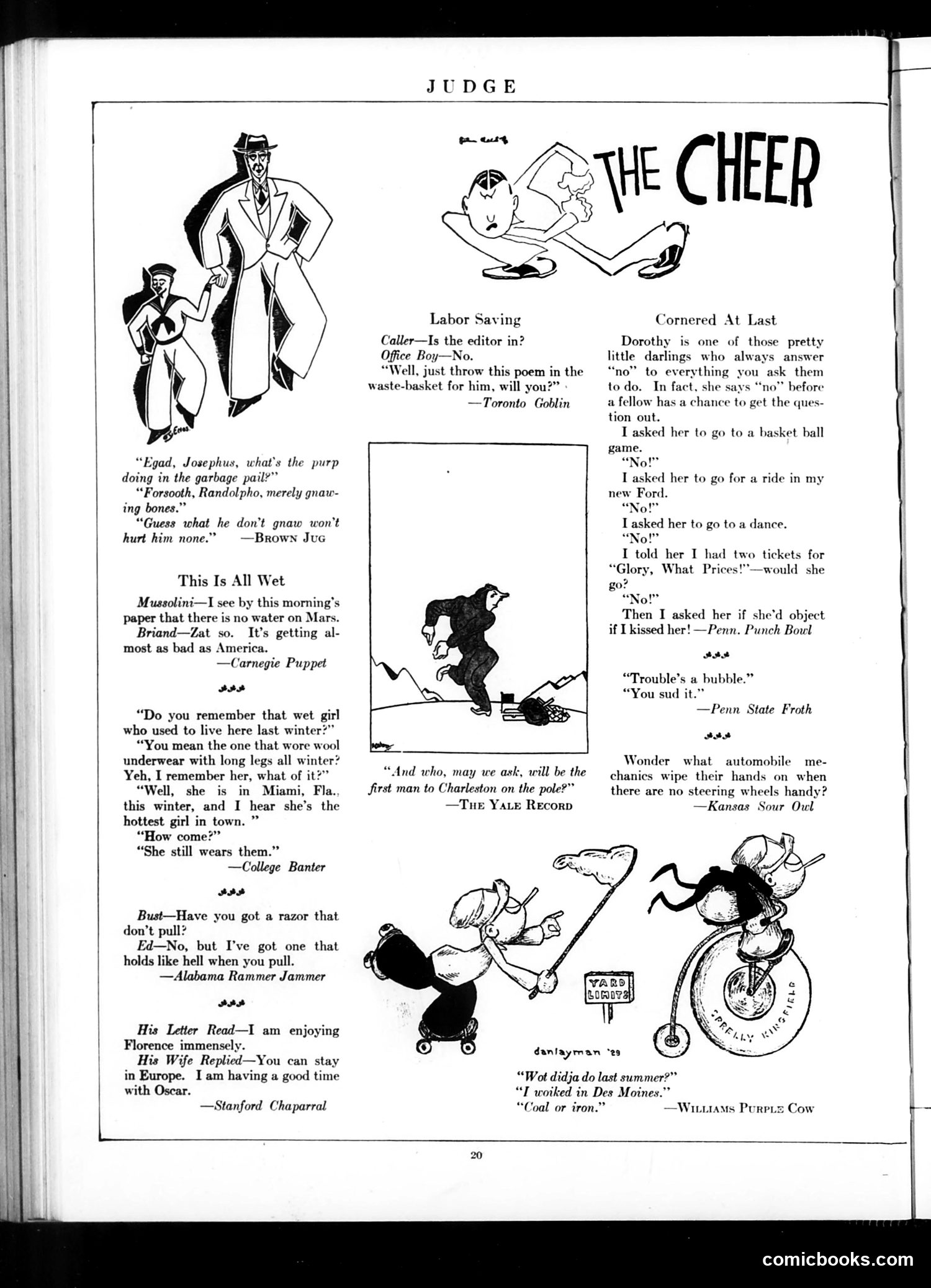
This is a humor compilation page featuring jokes and cartoons from college and university publications of the 1920s-early 1930s era. **Key references:** - **"This Is All Wet"** mocks political figures: Mussolini and Briand (French Premier) discussing Mars having no water, sarcastically comparing it to America's drought conditions—likely referencing Prohibition era water shortages or general social problems. - **"Charleston on the pole"** references the Charleston dance craze of the 1920s; the joke asks who'll first Charleston atop a flagpole (an actual 1920s stunt fad). - **"Cornered at Last"** satirizes the "modern girl" who constantly refuses dates and activities—a common Jazz Age trope about changing female social behavior. The cartoons show slapstick figures (roller-skating, motorcycling) typical of period comic illustration. The humor reflects 1920s collegiate culture, Prohibition anxieties, and contemporary social anxieties about changing gender roles and youth behavior.
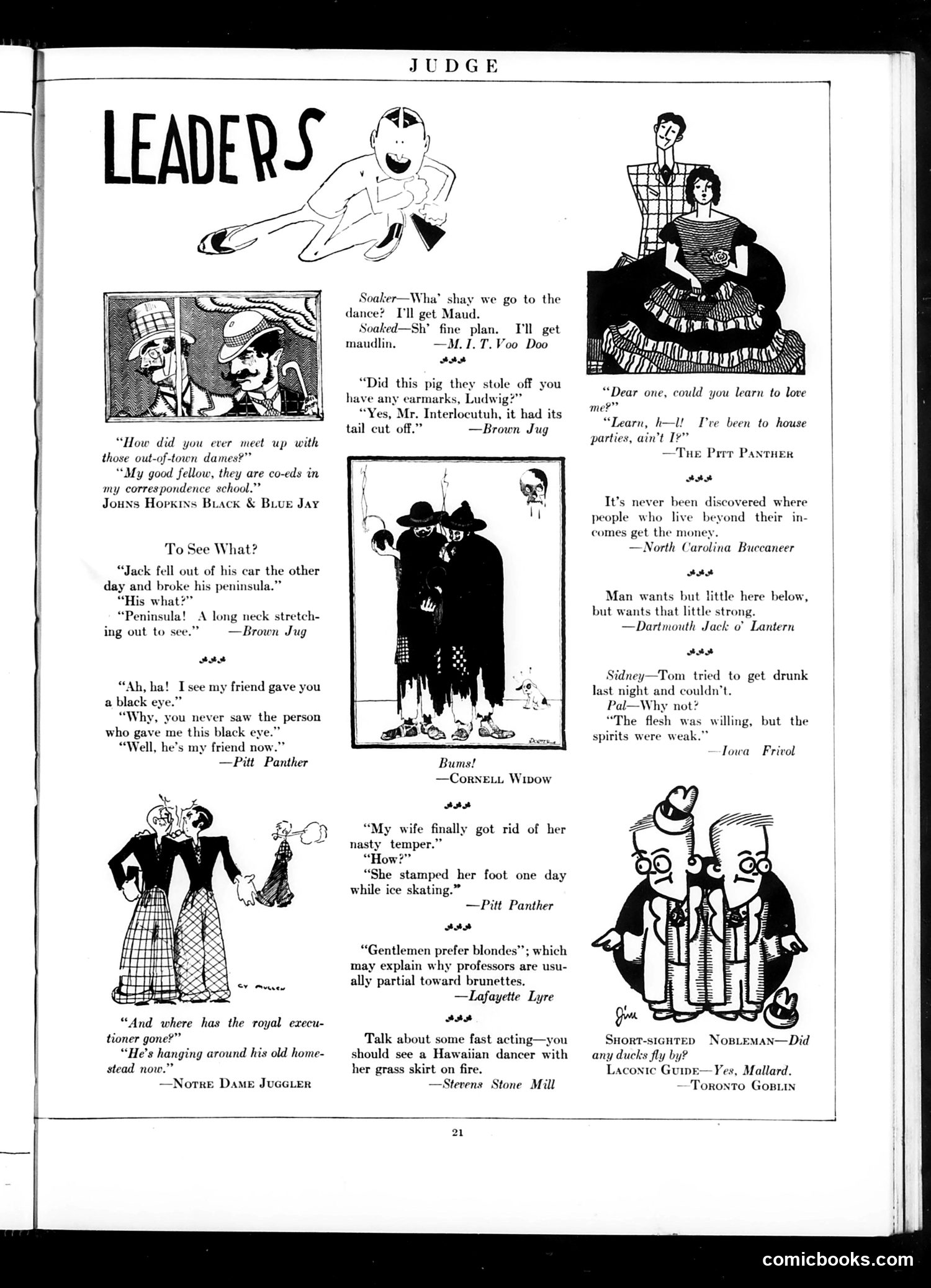
This page collects humorous one-liners and jokes sourced from college newspaper humor columns (Johns Hopkins, MIT, Pitt Panther, etc.). The satire targets early 20th-century social behaviors and attitudes: **Key themes:** - **College culture**: References to correspondence schools, fraternities, and campus life reflect American higher education's expansion - **Gender and courtship**: Multiple jokes about pursuing women ("co-eds," "maud"), reflecting period dating anxieties - **Alcohol**: Prohibition-era humor appears throughout (getting drunk, "maudlin," spirits/flesh wordplay) - **Class commentary**: Jokes about living beyond means and wealth management suggest economic anxiety - **Stereotypes**: A Hawaiian dancer joke and brief caricatures reflect period racial attitudes typical of Judge's humor The cartoons show stylized figures in period dress. The overall page mocks collegiate pretension, romantic mishaps, and social climbers through ribald, often crude jokes—typical of 1920s-era satirical magazines aimed at adult readers seeking edgy humor about modern life.
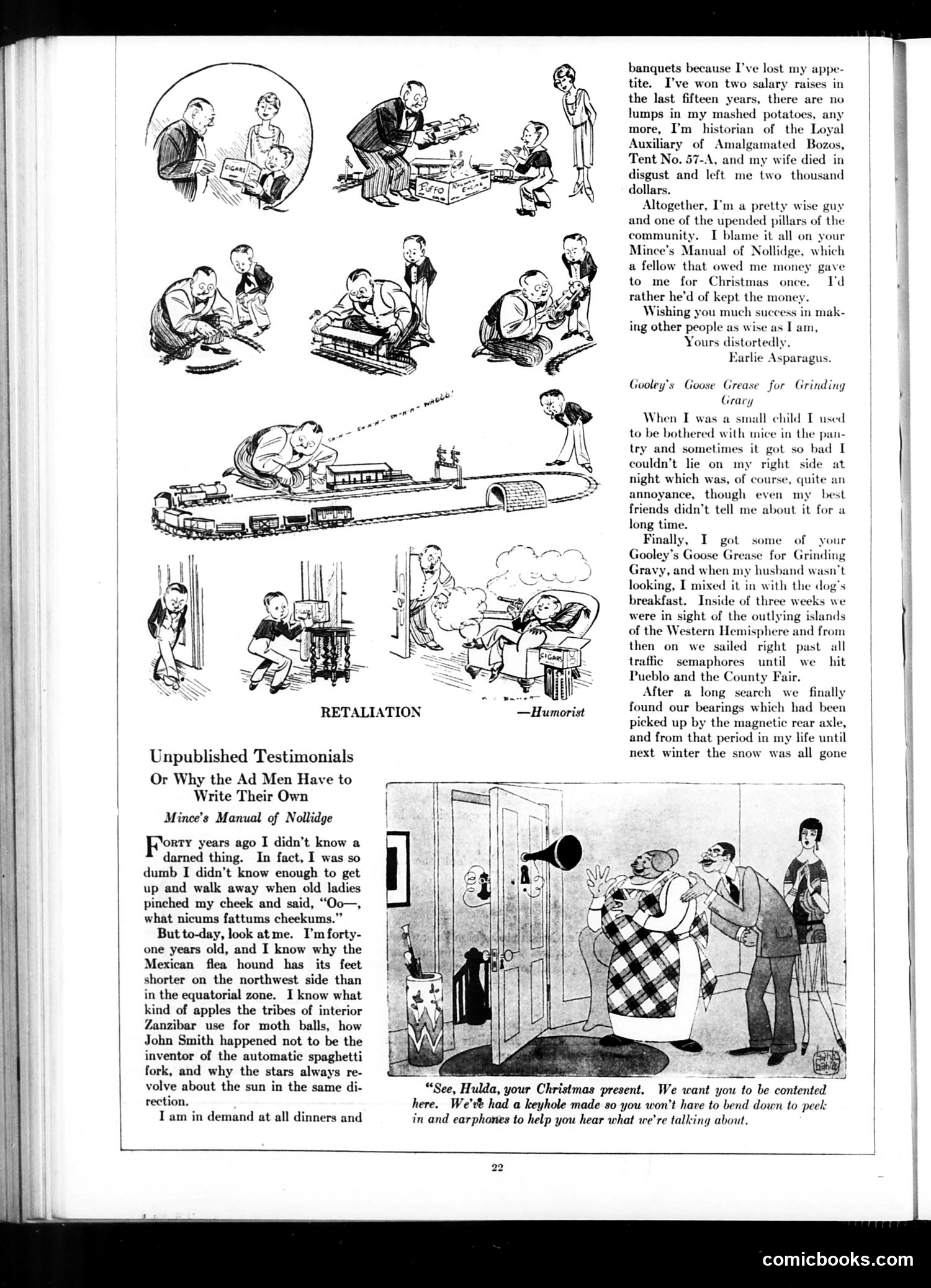
This page satirizes the advertising industry's practice of publishing fabricated customer testimonials. The heading "Unpublished Testimonials: Or Why the Ad Men Have to Write Their Own" explicitly explains the joke: advertisers cannot get genuine customers to endorse products, so they invent absurd, obviously fake ones instead. The two mock testimonials are deliberately nonsensical. "Earlie Asparagus" claims that reading "Mince's Manual of Nollidge" made him implausibly wise about obscure facts (Mexican flea anatomy, Zanzibari pest control), while simultaneously becoming miserable (lost wife, salary stagnation, digestive troubles). The second testimonial about "Gooley's Goose Grease" describes mixing it into dog food, which inexplicably results in sailing around the Western Hemisphere. The bottom cartoon shows a family presenting someone with a keyhole and earphones as a Christmas gift—another nonsensical product pitched with deadpan earnestness. The satire targets how advertisers cynically manufacture credibility through fake testimonials when no real customer would honestly praise their products.
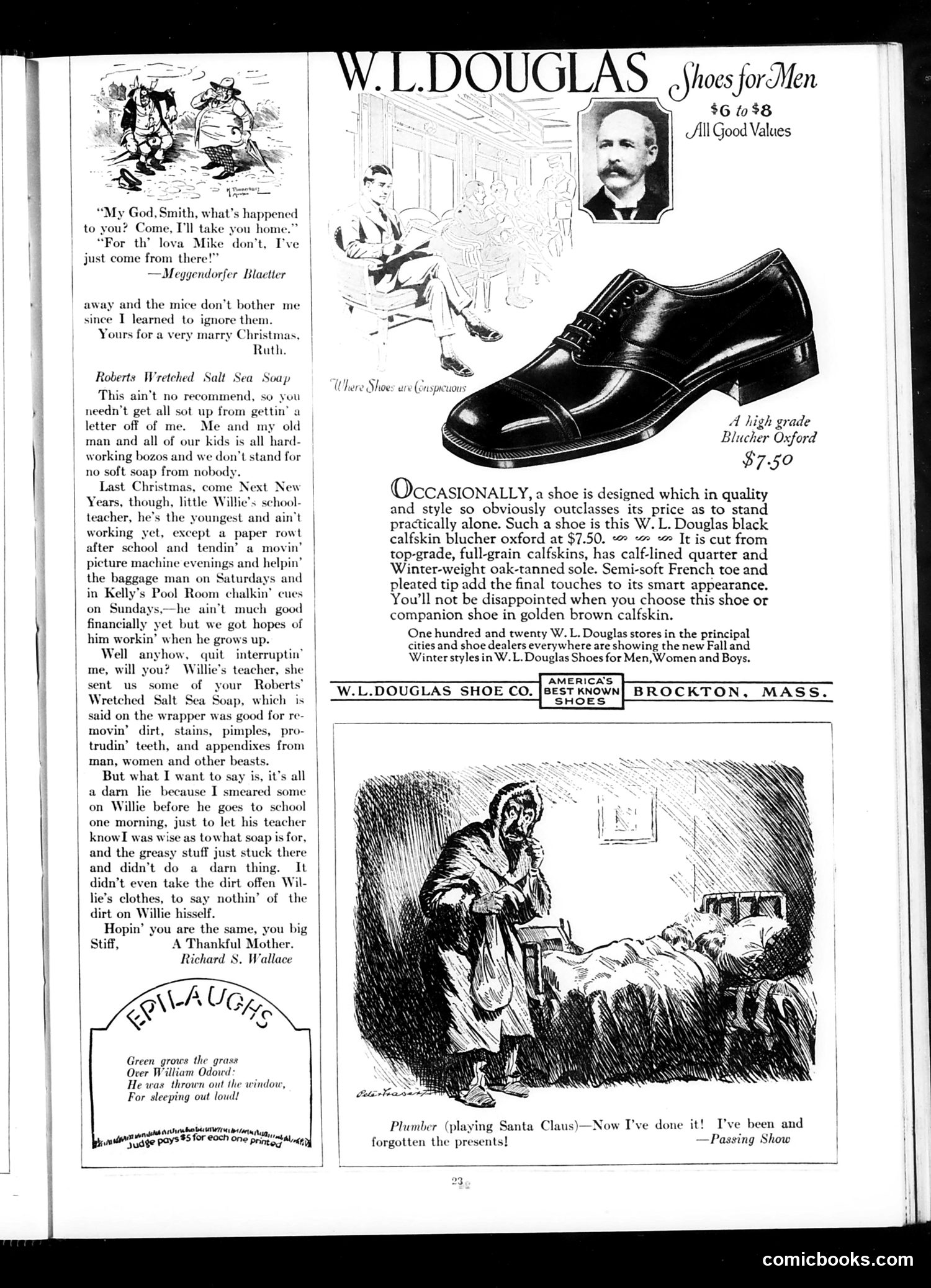
This Judge magazine page contains satirical humor pieces and advertisements typical of the era. **Left column**: Humorous letters mocking product claims. "Roberts Wretched Salt Sea Soap" is a fictional product advertised as removing dirt, stains, pimples, protruding teeth, and appendixes—obviously absurd claims. A working-class mother writes that the soap failed to clean her son Willie before school, sarcastically praising the company while detailing the product's uselessness. This satirizes exaggerated advertising claims common in the period. **Bottom cartoon**: A plumber dressed as Santa Claus realizes he's forgotten to buy Christmas presents—a relatable domestic mishap joke about holiday stress. **Right page**: A genuine W.L. Douglas shoe advertisement for men's shoes ($6-$8), featuring a portrait and product details about a blucher oxford at $7.50. The satire targets both inflated product advertising and middle-class holiday anxieties.
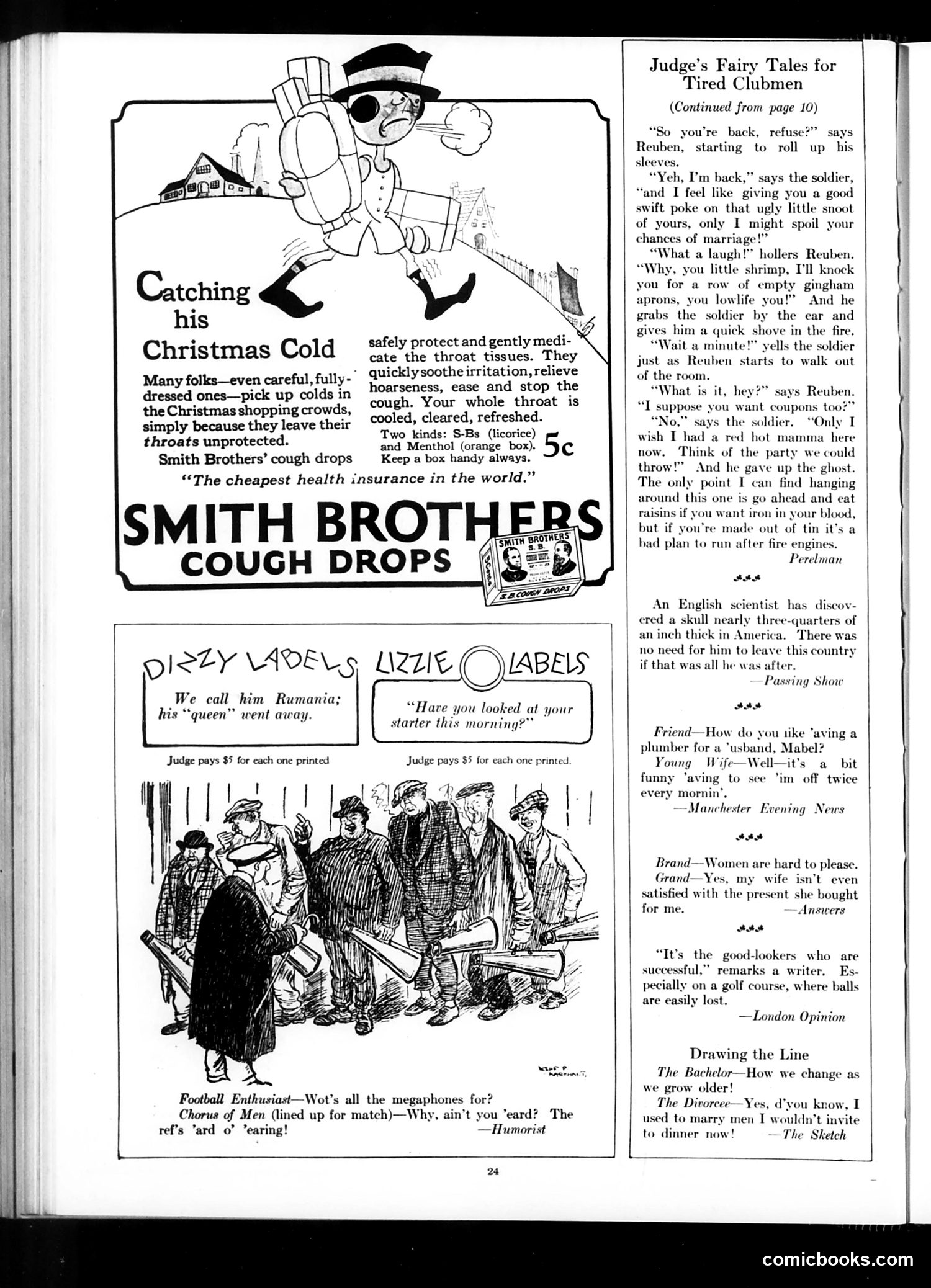
This page from *Judge* magazine contains multiple satirical pieces typical of early 20th-century American humor: **Main Advertisement:** Smith Brothers cough drops, marketed as "cheapest health insurance," uses Christmas shopping crowds as a health angle—typical patent medicine advertising of the era. **Visual Cartoons:** - "Dizzy Labels" and "Lizzie Labels" are crude ethnic/national stereotypes (Romania reference suggests xenophobic humor common to the period) - A football scene mocking a referee's hearing difficulties uses working-class British dialect humor - A "Fairy Tales for Tired Clubmen" serial story depicts crude domestic violence (a soldier getting shoved into a fire), presented as comic entertainment **Social Context:** The humor assumes readers find ethnic mockery, marital conflict, and physical comedy amusing. References to "good-lookers" succeeding and divorce jokes reflect period attitudes about gender and relationships. The page is primarily **advertising and filler humor**—reflecting *Judge*'s role as entertainment for male readers, with heavy reliance on stereotypes and crude slapstick now considered offensive.
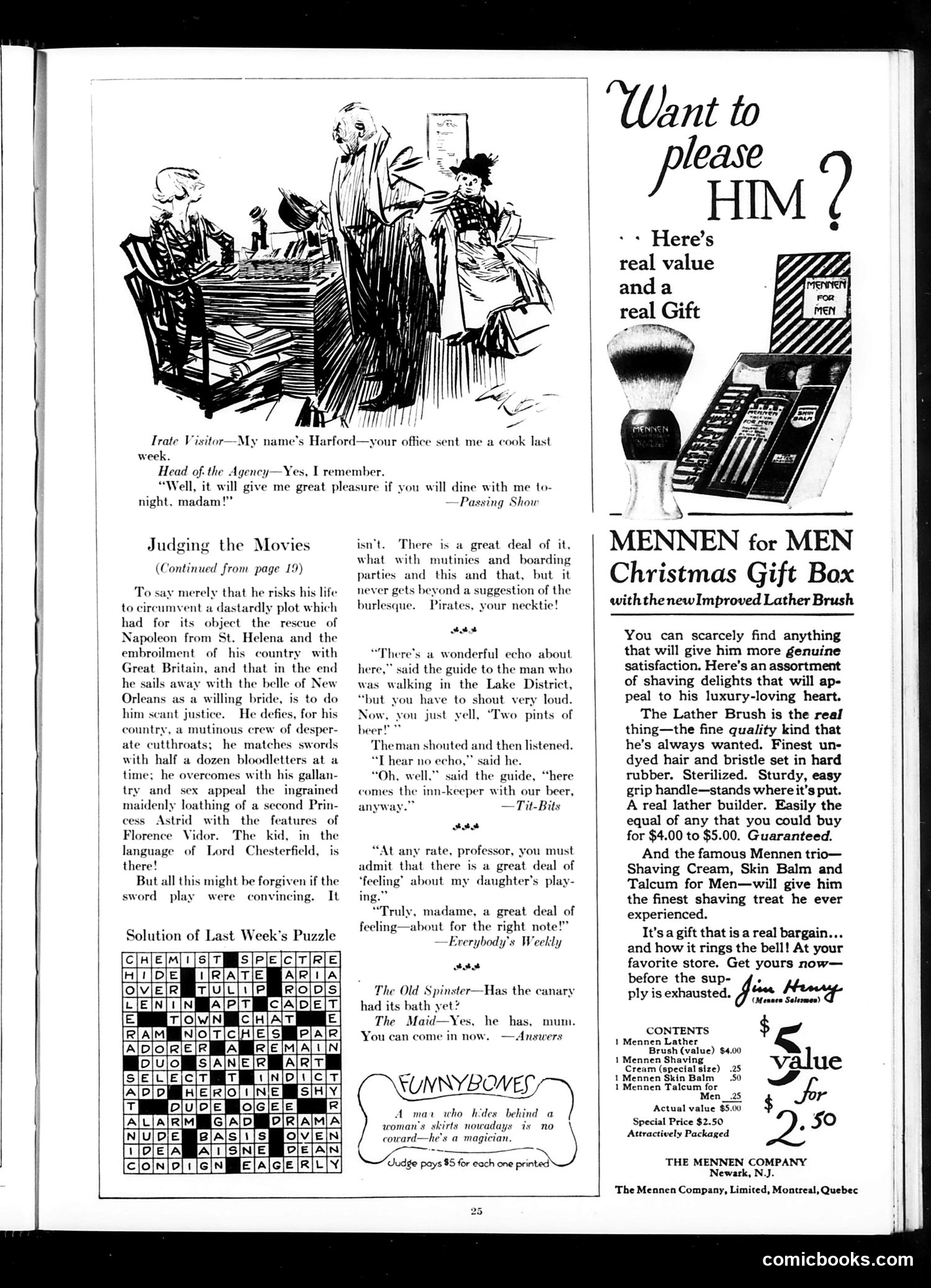
This is primarily a **magazine page mixing humor content with advertising** (circa 1920s Judge magazine). The cartoons are brief social jokes: 1. **"Irate Visitor"** (top left): A man complains to an employment agency that the cook they sent him is now flirting with him—he's sarcastically asking the agency head to dinner as payback. The joke: the cook is using her position to advance socially. 2. **"Judging the Movies"**: A film review criticizing a pirate movie for unconvincing sword fights and over-the-top melodrama—standard entertainment criticism. 3. **"Funny Bones"** (bottom): A quip about a man hiding behind women's skirts being a magician, not cowardly—playing on the phrase "it's no coward" and sleight-of-hand wordplay. The bulk of the page is a **Mennen grooming products advertisement** targeting men with gift-box sets for Christmas, emphasizing quality and value at $2.50. The page reflects 1920s social attitudes about gender roles and class, alongside period consumer advertising.
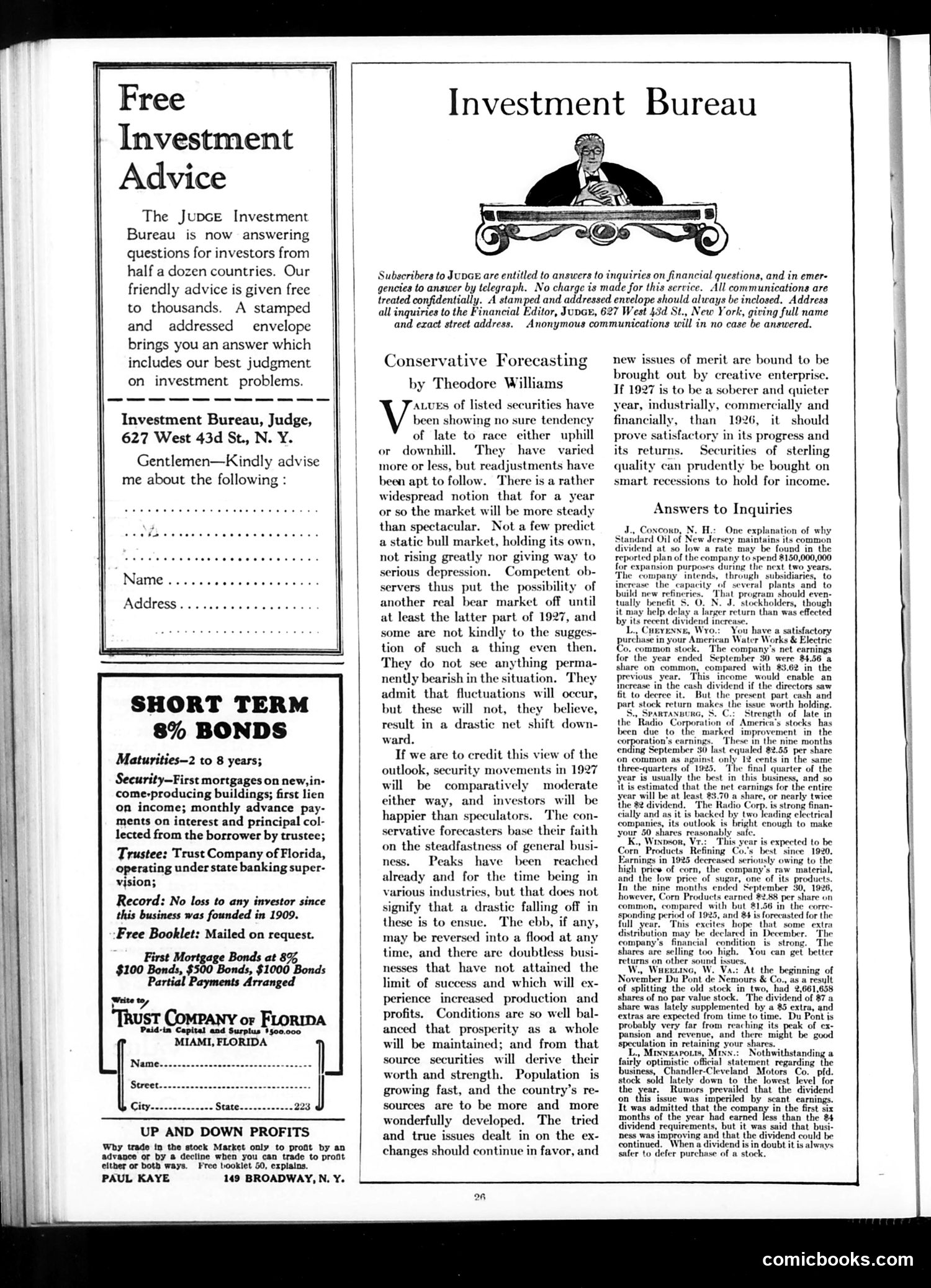
This page is primarily **advertising and financial advice**, not satire. It features Judge's investment bureau offering free stock advice to readers, alongside several financial product advertisements (bonds, mortgage investments, stock trading guides). The only cartoon element is a small illustration of a bespectacled man (labeled "Investment Bureau") at the top right, depicted as a trustworthy "judge" figure dispensing wisdom—a visual pun on the magazine's name. The main editorial content is Theodore Williams's "Conservative Forecasting" column predicting steady, moderate market performance in 1927, with no dramatic crashes expected. This reflects 1920s optimism before the October 1929 crash. The page itself is not satirical; rather, it represents Judge's commercial side, offering legitimate financial services to its readers during the prosperous Jazz Age.
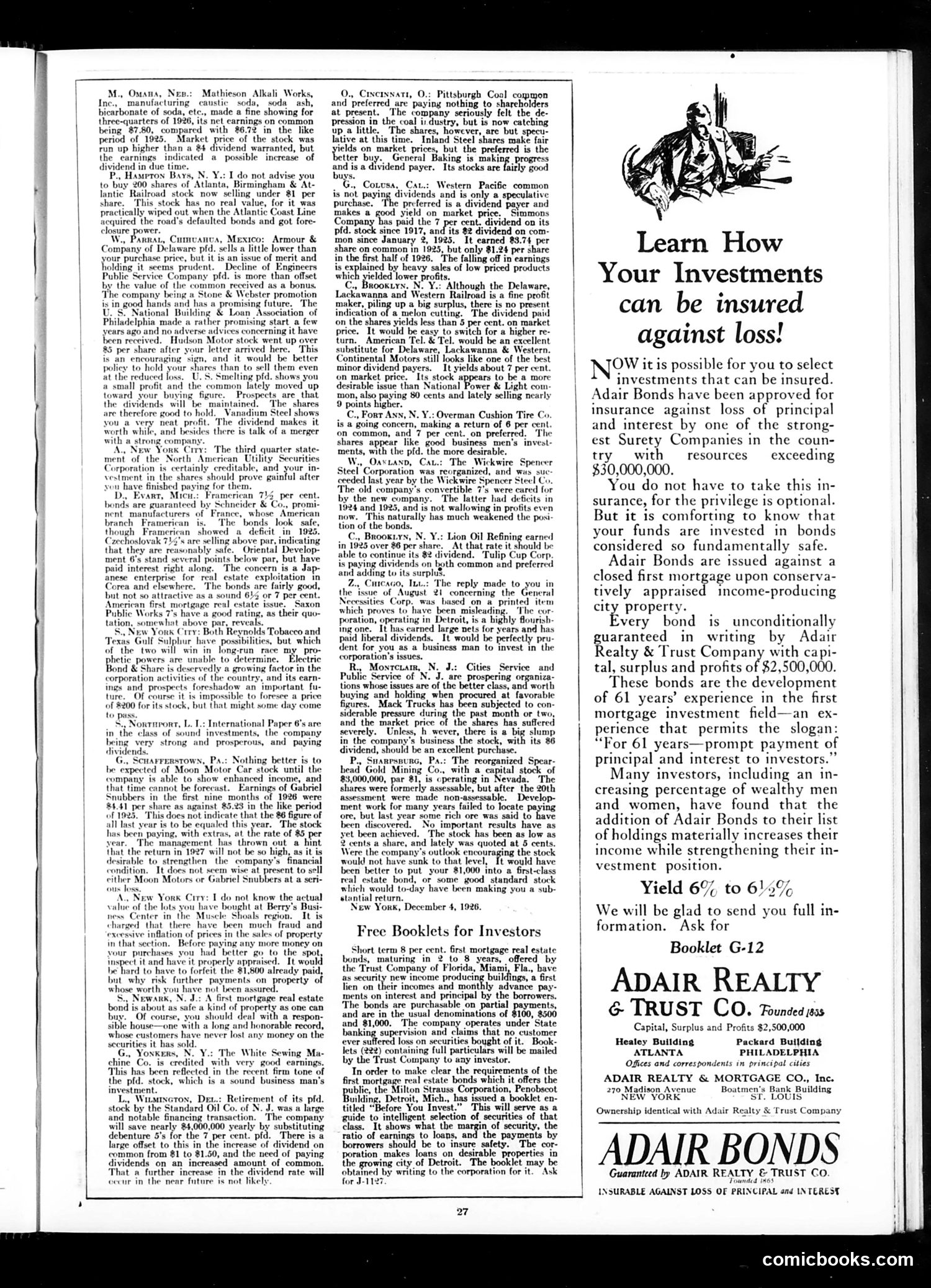
This page is primarily a **financial advice column** with a large **insurance advertisement** for Adair Bonds on the right side. The advertisement pitches investment bonds "insured against loss" of principal and interest, marketed as safer than stocks. It emphasizes Adair Realty & Trust Company's 61 years of experience in real estate mortgages and claims their bonds appeal to wealthy investors seeking income with security. The left column contains Q&A financial advice from readers about various stocks and bonds—typical of investment guidance columns in 1920s financial publications. Letters discuss companies like Mathieson Alkali Works, Birmingham & Atlantic railroad stock, and real estate bonds. The satire or humor, if present, is subtle or implicit in how aggressively the "insured bonds" are promoted as safe havens—a pitch that would prove tragically ironic given the stock market crash coming just months after this December 1928 publication date. The timing makes this advertisement historically poignant rather than satirical.
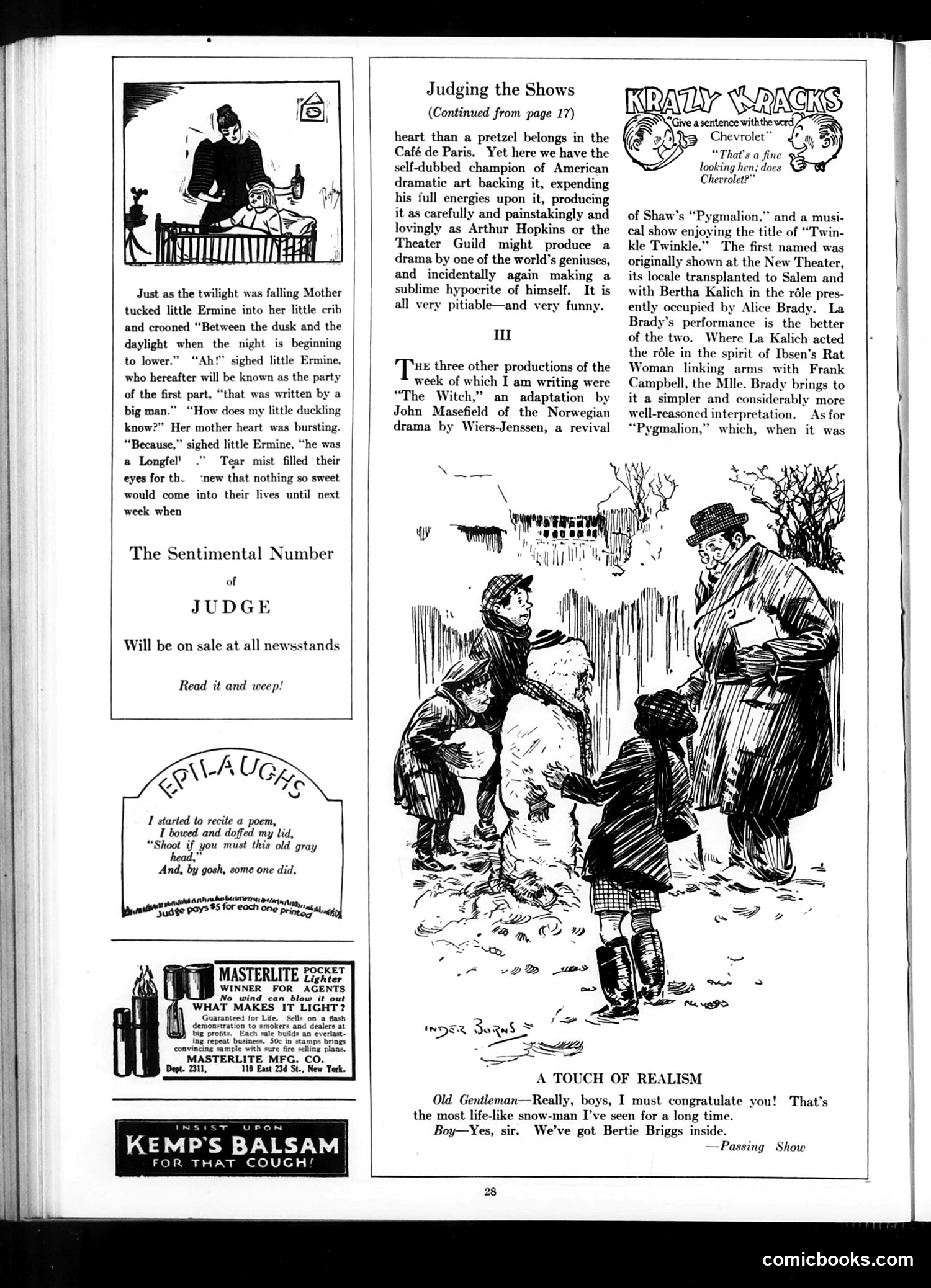
This page contains theater reviews and period advertisements. The main content discusses three stage productions: an adaptation of a Norwegian drama called "The Witch," a revival of Shaw's "Pygmalion," and a musical titled "Twinkle Twinkle." The reviewer compares actresses La Kalich and Alice Brady in their respective roles, favoring Brady's "simpler and considerably more well-reasoned interpretation." The page includes vintage advertisements for Masterlite lighters, Kemp's Balsam cough remedy, and what appears to be a Chevrolet car ad. At the bottom, a cartoon titled "A Touch of Realism" depicts a boy explaining to an old gentleman that their lifelike snowman contains a boy named Bertie Briggs inside—a simple visual joke about the snowman's remarkable realism actually being achieved by hiding a real child within it.
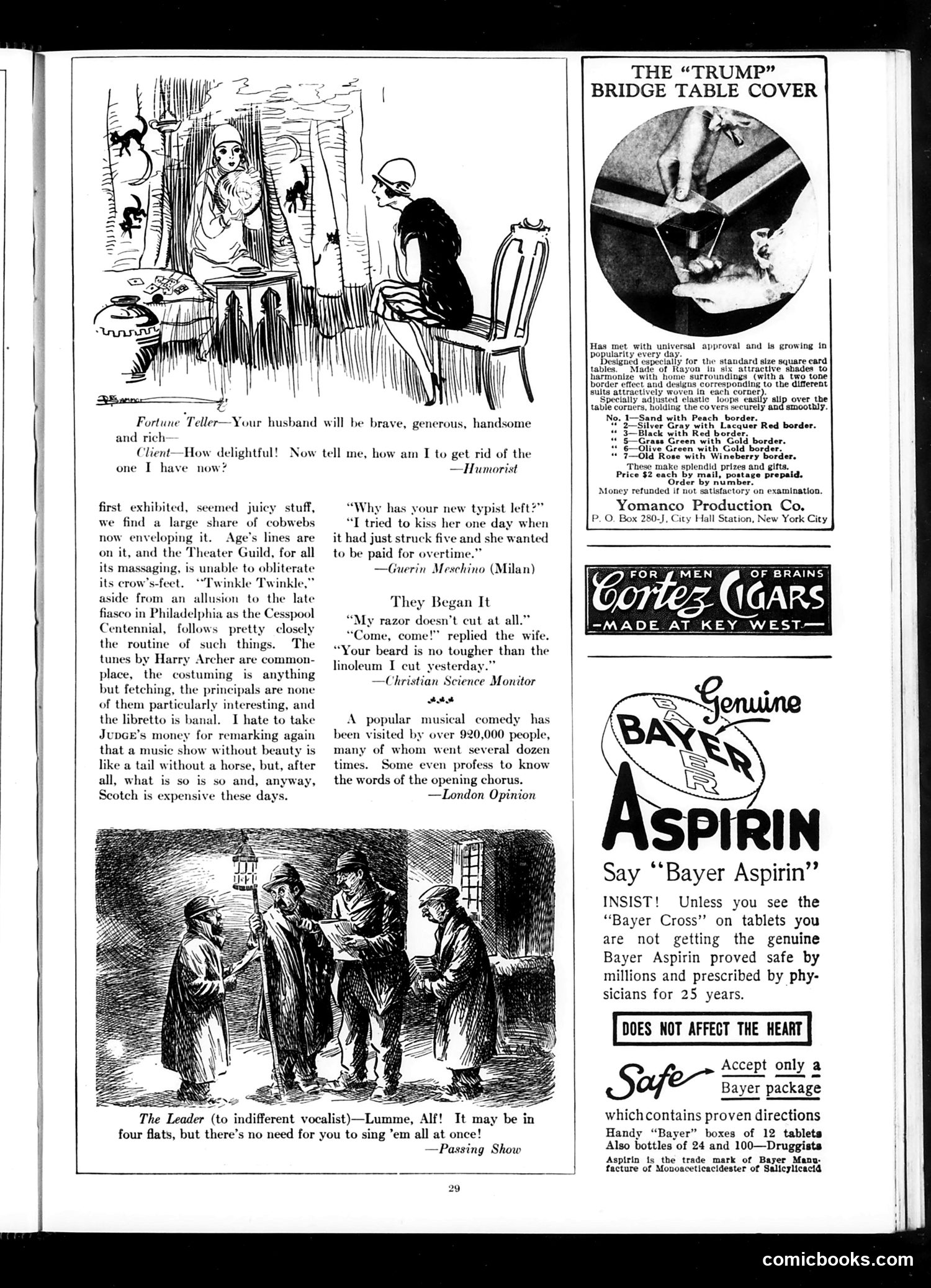
This page from Judge (a satirical weekly) contains several short humor pieces and advertisements typical of the 1920s era. **The Cartoons/Jokes:** - A fortune teller's exchange mocking marital disappointment - A musical conductor frustrated with a vocalist who can't handle multiple flats - Workplace humor about a typist demanding overtime pay after a boss's unwanted kiss attempt - Marital quips about razors and household items (linoleum) - Commentary on a popular musical comedy's 920,000+ attendees **The Satire:** These pieces reflect period attitudes toward workplace relations, marriage dynamics, and entertainment criticism—often with casual sexism and workplace impropriety presented as humor. **Advertisements:** The right side features product ads (bridge table covers, Cortez cigars, Bayer Aspirin) typical of 1920s magazine monetization. The Bayer Aspirin ad notably emphasizes the "Bayer Cross" trademark, suggesting counterfeit concerns were already an issue. The page is primarily entertainment and advertising rather than political commentary.
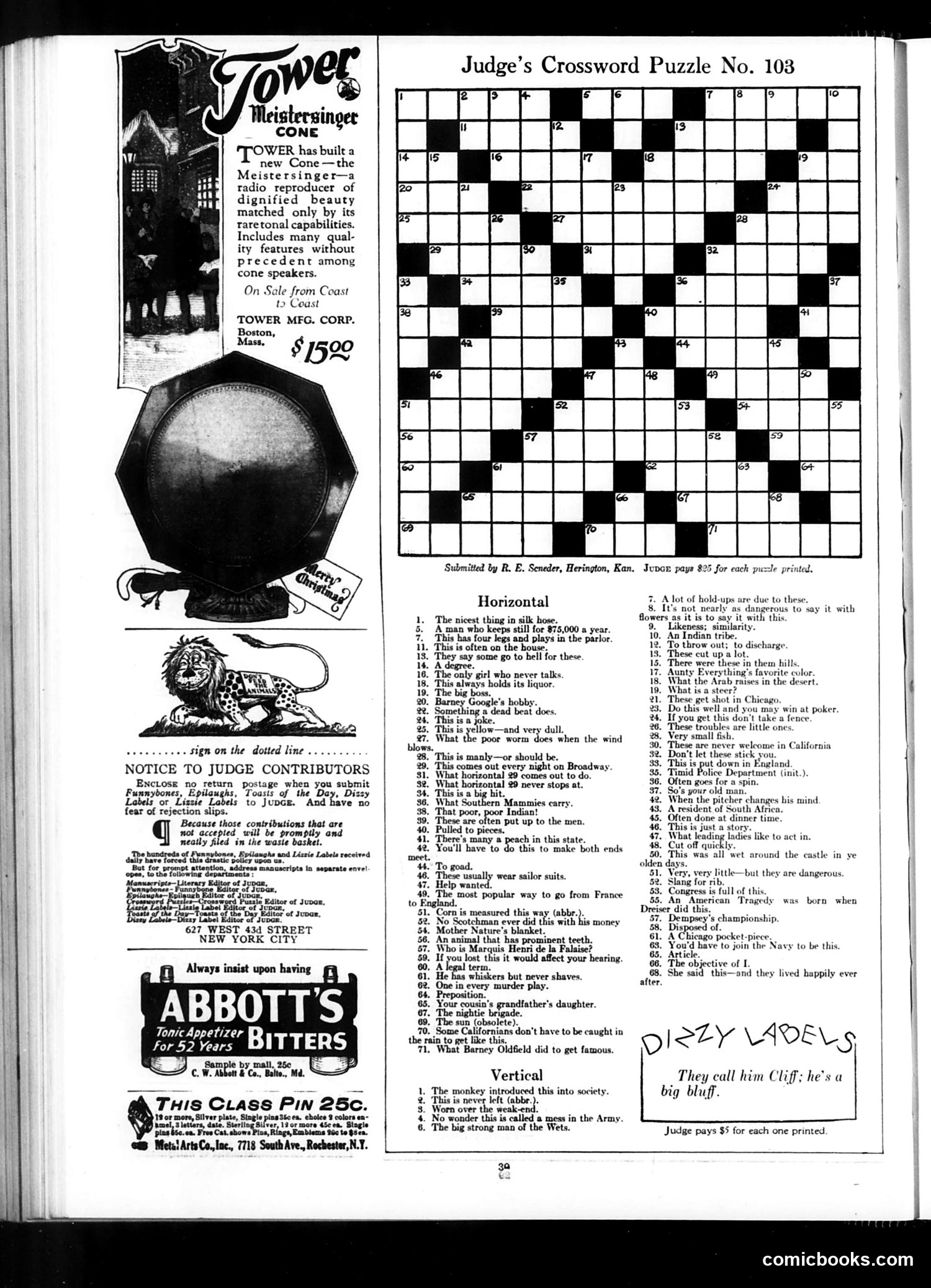
This page is primarily a **crossword puzzle** (No. 103) submitted by R.E. Scouder of Herington, Kansas, with advertising and contributor notices. The main satirical content is a **mock "Notice to Judge Contributors"** that humorously warns submitters: their rejected work won't be returned—it will be "promptly and neatly filed in the waste basket." This is self-deprecating humor about the magazine's high rejection rate for submitted jokes, puns ("Funnybones, Epilaughs"), and humorous labels. The page also includes period advertisements (Tower radio speakers, Abbott's Bitters tonic, class pins) typical of 1920s-era Judge magazine. **The crossword clues** reference contemporary culture: Barney Google (a popular comic strip character), Harry Oldfield (likely a speed racer), and various 1920s-era social references ("the nightie brigade," Prohibition-era humor about liquor). The small cartoon at bottom right showing "Cliff" as "a big bluff" appears unrelated to the puzzle's main content.
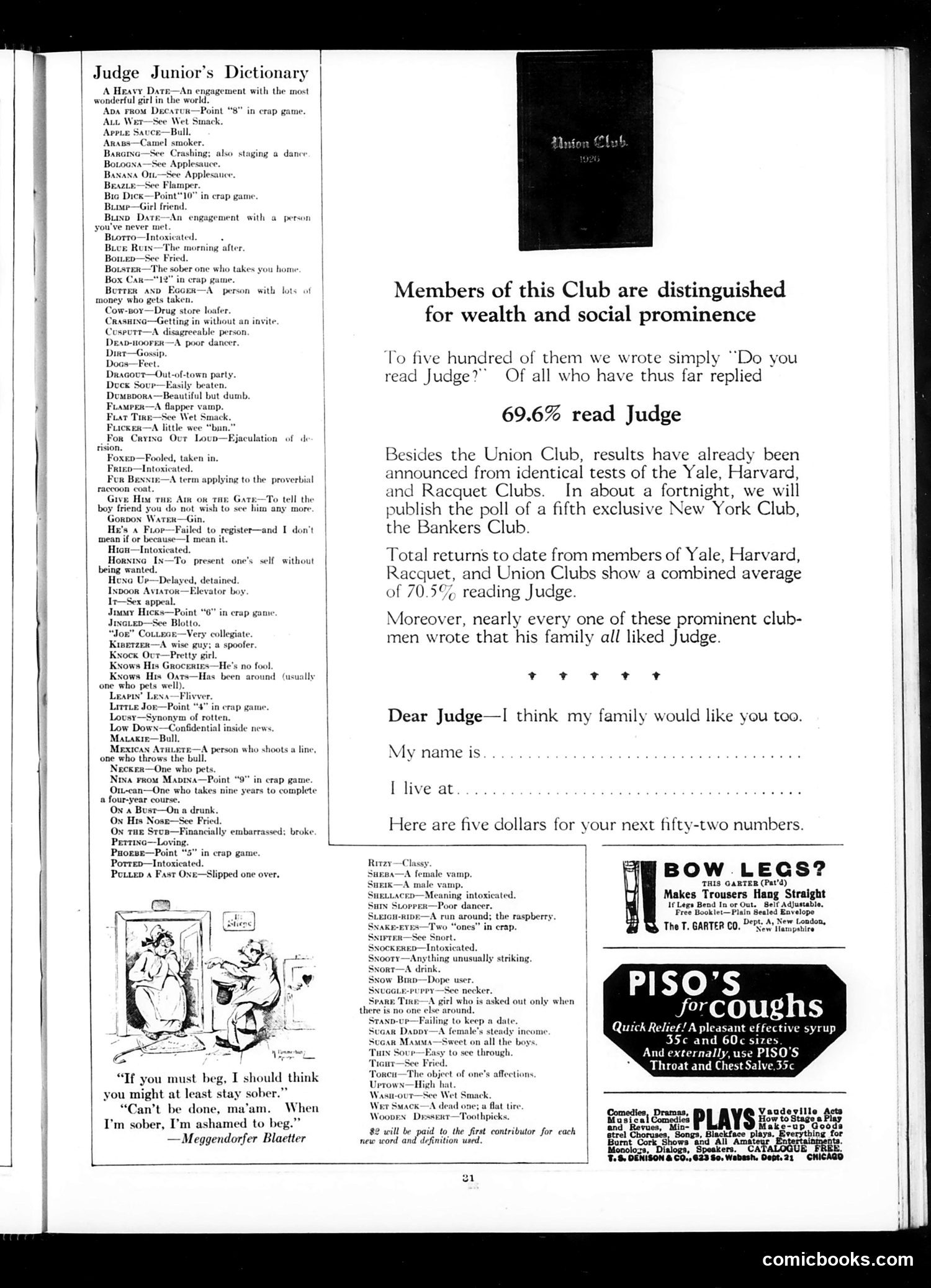
This page presents **Judge Junior's Dictionary**, a satirical slang glossary mocking 1920s youth culture and high society. The left column defines period slang terms—many referencing Jazz Age behaviors like petting ("Os HER Nose"), drinking ("Fried," "Intoxicated"), and flirtation ("Knock Out"—pretty girl). The crude cartoon below shows a beggar refusing sobriety, suggesting mockery of both poverty and drunkenness. The right side shifts to advertisement: Judge magazine boasts that **69.6% of wealthy Union Club members read it**, with similar results from Yale, Harvard, and Racquet Clubs. This is aspirational marketing—positioning Judge as the publication of the elite. The invitation for readers to subscribe ("five dollars for your next fifty-two numbers") targets these affluent clubmen. The satire works bidirectionally: the dictionary mocks youth slang as frivolous, while the club survey implies Judge's sophisticated audience appreciates such mockery. It's both *of* and *for* the wealthy classes being satirized.
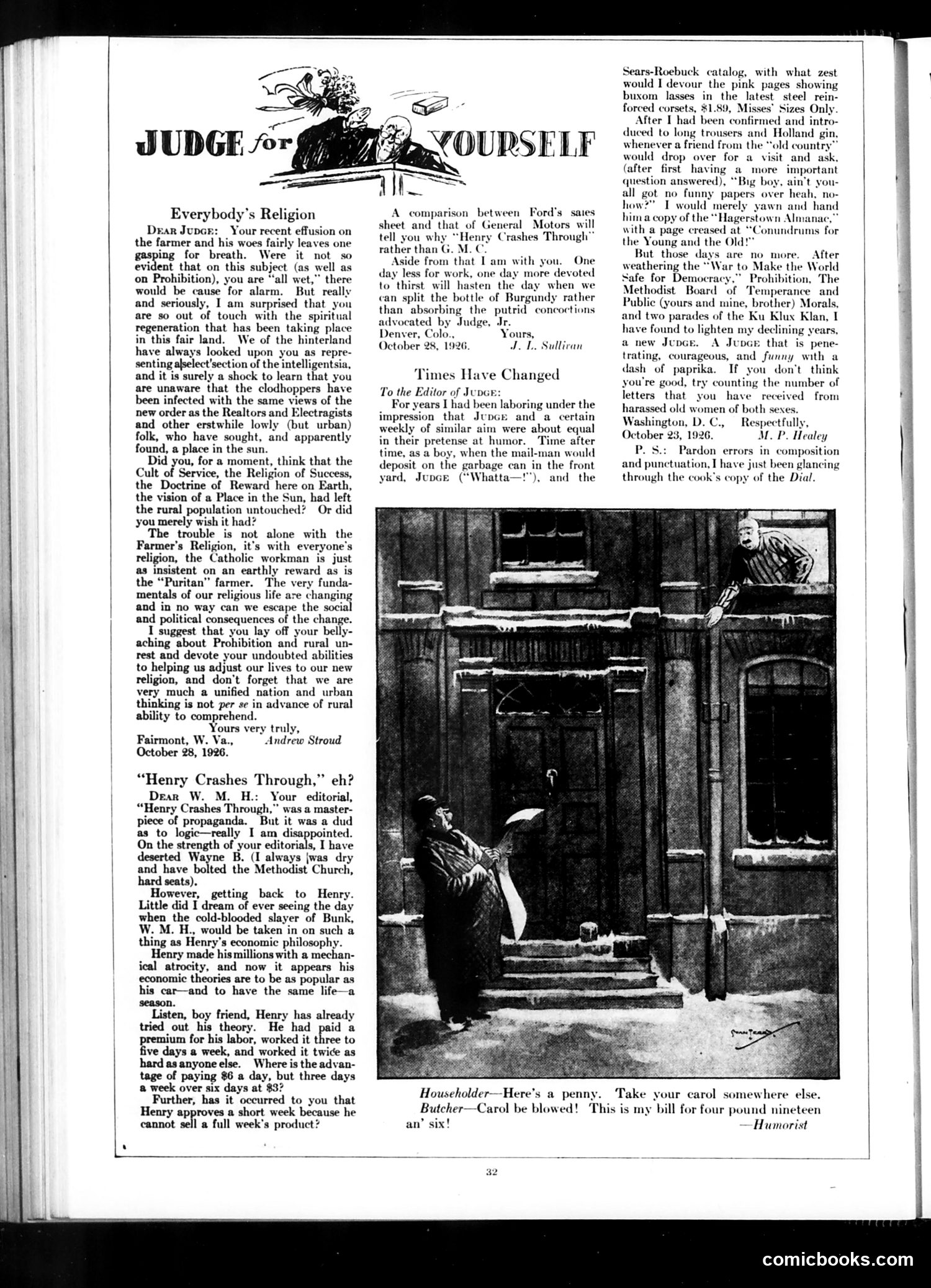
This page contains letters to the editor of *Judge* magazine (circa 1926) debating contemporary issues. **Main Topics:** 1. **"Everybody's Religion"** - A farmer defends rural America against Judge's criticism, arguing that rural people have adopted modern "success theology" and consumer values just like urbanites. He challenges Judge's urban bias and suggests both city and country folk share the same materialistic worldview. 2. **"Henry Crashes Through"** - Letters debate Henry Ford's economic theories, specifically his famous $5 minimum wage and five-day workweek. One correspondent sarcastically argues Ford only supports shorter weeks because he can't sell full week's production, not from philanthropic motives. **The Cartoon** shows a butcher charging a customer for meat, with the customer (householder) offering only a penny—illustrating economic hardship or the gap between wages and costs. The broader context: Post-WWI American debates over labor, wages, rural versus urban values, and whether business innovation (Ford) was genuinely progressive or merely profit-driven.
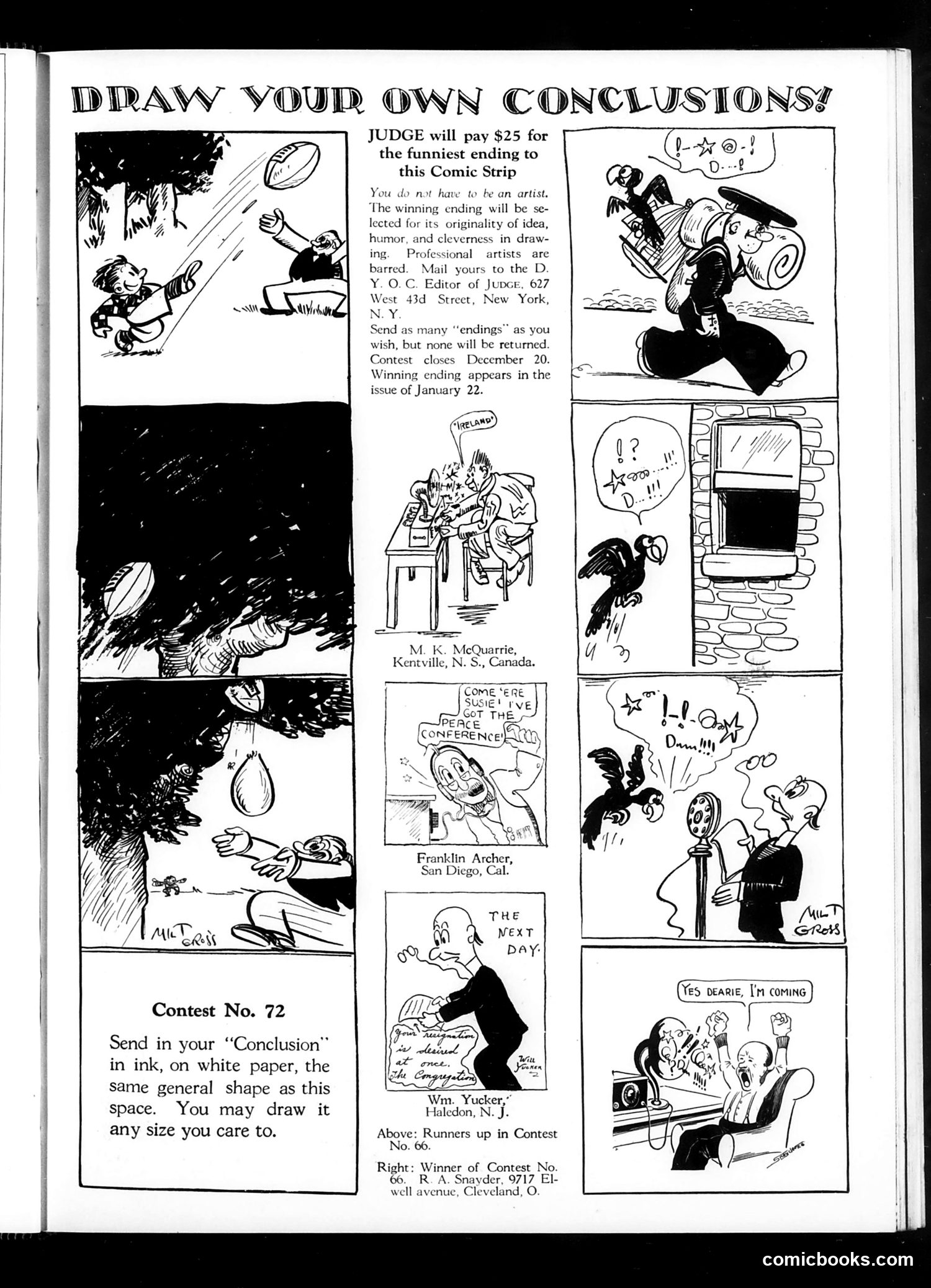
This page showcases **Contest No. 72**, a reader-submission competition where Judge magazine invited non-professional artists to complete a comic strip's ending for a $25 prize. The left side displays an incomplete three-panel strip (artist signed "MICT") showing someone attempting to catch a football under a tree, with increasingly chaotic results—establishing a setup without resolution. The right side displays **previous contest winners and runners-up** from Contest No. 66, showing various humorous "conclusions" to an earlier prompt: someone at a desk, a witch flying into a window, a magician's act, and a dinner party scene. This was a participatory feature common to Judge—a humor magazine dependent on satirical cartoons. Rather than pure satire, this particular page is primarily a **contest announcement and showcase**, inviting reader creativity while demonstrating the magazine's editorial standards for wit and visual comedy. The appeal lay in readers matching professional cartoonists' comedic timing.
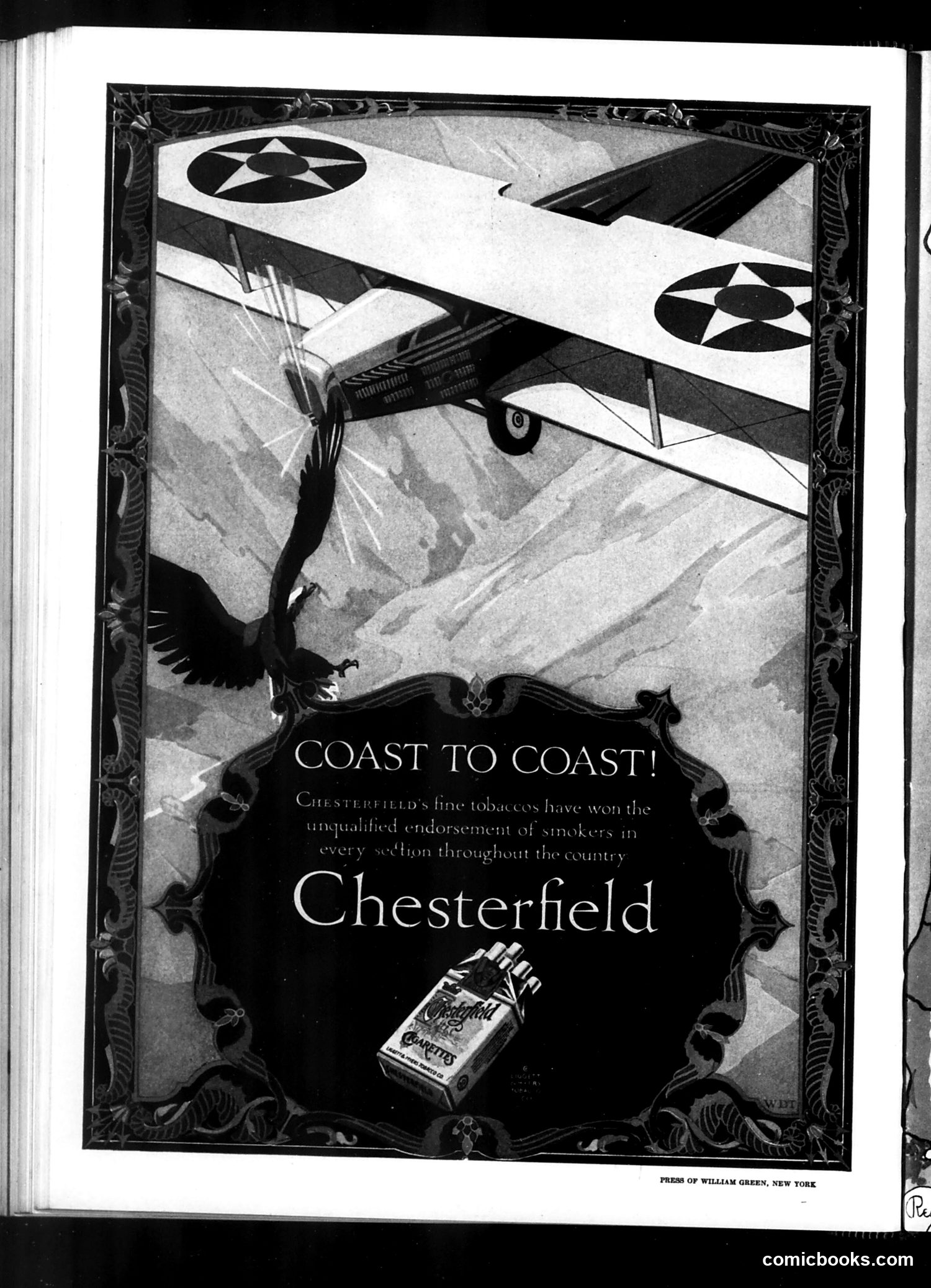
This is a **cigarette advertisement**, not political satire. The page features an airplane with U.S. military markings (the star insignia visible on wings) flying over American terrain, promoting Chesterfield cigarettes. The "COAST TO COAST!" headline suggests nationwide distribution and appeal. The advertisement claims Chesterfield tobacco has "won the unqualified endorsement of smokers in every section throughout the country." The airplane imagery likely appeals to modernity and progress—aviation was still relatively novel and exciting in the era this appears from. The military plane may also evoke patriotic associations. This is straightforward mid-twentieth-century product advertising using aspirational imagery, not satirical commentary. No political figures or social satire are present.