
Judge, 1926-12-11 · page 15 of 36
Judge — December 11, 1926 — page 15: what you’re looking at
What you’re looking at
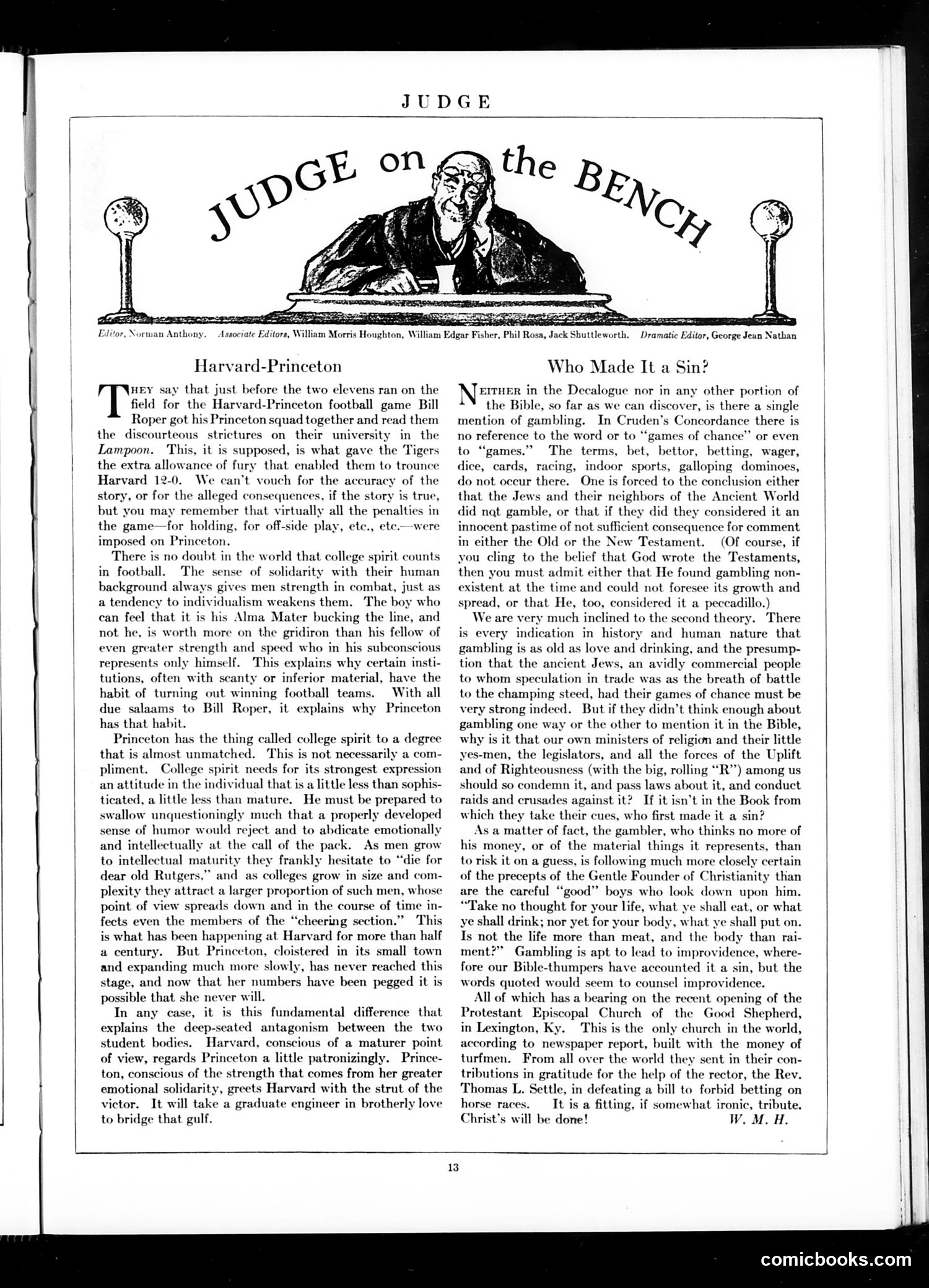
This page contains two opinion pieces about the 1920s Harvard-Princeton football rivalry, framed around Princeton's victory. **"Harvard-Princeton"** argues that Princeton's superior "college spirit"—emotional solidarity and institutional loyalty—explains both its football success and the antagonism between the schools. The piece suggests Harvard, as a larger, more intellectually mature institution, has lost this fervent spirit, while Princeton's smaller, cloistered environment has preserved it. This fundamental difference creates mutual disdain: Harvard patronizes Princeton as unsophisticated; Princeton struts as the victor. **"Who Made It a Sin?"** defends gambling against religious condemnation. The author notes the Bible contains no explicit prohibition of gambling, suggesting it was once considered innocent recreation. The piece questions why American religious leaders condemn it so fiercely—apparently referencing contemporary debates over betting and sports gambling. Together, these pieces reflect 1920s concerns about college culture, institutional identity, and the tension between traditional morality and modern recreation.
📄 Transcribed text from this page (OCR, searchable)
Machine-transcribed from the original scan — historical spelling and the odd misread are preserved.
JUD GE Editor, Norman Anth Harvard-Princeton HEY say that just before the two elevens ran on the field for the Harvard-Princeton football game Bill Roper got his Princeton squad together and read them the discourteous strictures on their university in the Lampoon. This, it is supposed, is what gave the Tigers the extra allowance of fury that enabled them to trounce Harvard 12-0. We can’t vouch for the accuracy of the story, or for the alleged consequences, if the story is true, but you may remember that virtually all the penalties in the game—for holding, for off-side ple imposed on Princeton. y, etc., etc.—were There is no doubt in the world that college spirit counts in football. The sense of solidarity with their human background always gives men strength in combat, just as a tendency to individualism weakens them. The boy who can feel that it is his Alma Mater bucking the line, and not he, is worth more on the gridiron than his fellow of even greater strength and speed who in his subconscious represents only himself. This explains why certain insti- tutions, often with scanty or inferior material, have the habit of turning out winning football teams. With all due salaams to Bill Roper, it explains why Princeton has that habit. Princeton has the thing called college spirit to a degree that is almost unmatched. This is not necessarily a com- pliment. College spirit needs for its strongest expression an attitude in the individual that is a little less than sophis- ticated, a little less than mature. He must be prepared to swallow unquestioningly much that a properly developed sense of humor would reject and to abdicate emotionally and intellectually at the call of the pack. As men grow to intellectual maturity they frankly hesitate to “die for dear old Rutgers,” and as colleges grow in size and com- plexity they attract a larger proportion of such men, whose point of view spreads down and in the course of time in- fects even the members of the “cheering section.” This is what has been happening at Harvard for more than half a century. But Princeton, cloistered in its small town and expanding much more slowly, has never reached this stage, and now that her numbers have been pegged it is possible that she never will. In any case, it is this fundamental difference that explains the deep-seated antagonism between the two student bodies. Harvard, conscious of a maturer point of view, regards Princeton a little patronizingly. Prince- ton, conscious of the strength that comes from her greater emotional solidarity, greets Harvard with the strut of the victor. It will take a graduate engineer in brotherly love to bridge that gulf. t, Phil Rosa, Jack Shuttleworth. Dramatic Editor, George Jean Nathan Who Made It a Sin? Neer in the Decalogue nor in any other portion of + the Bible, so far as we can discover, is there a single mention of gambling. In Cruden’s Concordance there is no reference to the word or to “‘games of chance’’ or even to “game: The terms, bet, bettor, betting, wager, dice, cards, racing, indoor sports, galloping dominoes, do not occur there. One is forced to the conclusion either that the Jews and their neighbors of the Ancient World did nat gamble, or that if they did they considered it an innocent pastime of not sufficient consequence for comment in either the Old or the New Testament. (Of course, if you cling to the belief that God wrote the Testaments, then you must admit either that He found gambling non- existent at the time and could not foresee its growth and spread, or that He, too, considered it a peccadillo.) We are very much inclined to the second theory. There is every indication in history and human nature that gambling is as old as love and drinking, and the presump- tion that the ancient Jews, an avidly commercial people to whom speculation in trade was as the breath of battle to the champing steed, had their games of chance must be very strong indeed. But if they didn’t think enough about gambling one way or the other to mention it in the Bible, why is it that our own ministers of religion and their little ‘s-men, the legislators, and all the forces of the Uplift nd of Righteousness (with the big, rolling “R’”) among us should so condemn it, and pass laws about it, and conduct raids and crusades against it? If it isn’t in the Book from which they take their cues, who first made it a sin? As a matter of fact, the gambler, who thinks no more of his money, or of the material things it represents, than to risk it on a guess, is following much more closely certain of the precepts of the Gentle Founder of Christianity than are the careful “good” boys who look down upon him. “Take no thought for your life, what ye shall eat, or what ye shall drink; nor yet for your body, what ye shall put on. Is not the life more than meat, and the body than rai- ment?” Gambling is apt to lead to improvidence, where- fore our Bible-thumpers have accounted it a sin, but the words quoted would seem to counsel improvidence. All of which has a bearing on the recent opening of the Protestant Episcopal Church of the Good Shepherd, in Lexington, Ky. This is the only church in the world, according to newspaper report, built with the money of turfmen. From all over the world they sent in their con- tributions in gratitude for the help of the rector, the Rev. Thomas L. Settle, in defeating a bill to forbid betting on horse races. It is a fitting, if somewhat ironic, tribute. Christ's will be done! W. M. H. 13 comicbooks.com