
Judge, 1926-12-11 · page 21 of 36
Judge — December 11, 1926 — page 21: what you’re looking at
What you’re looking at
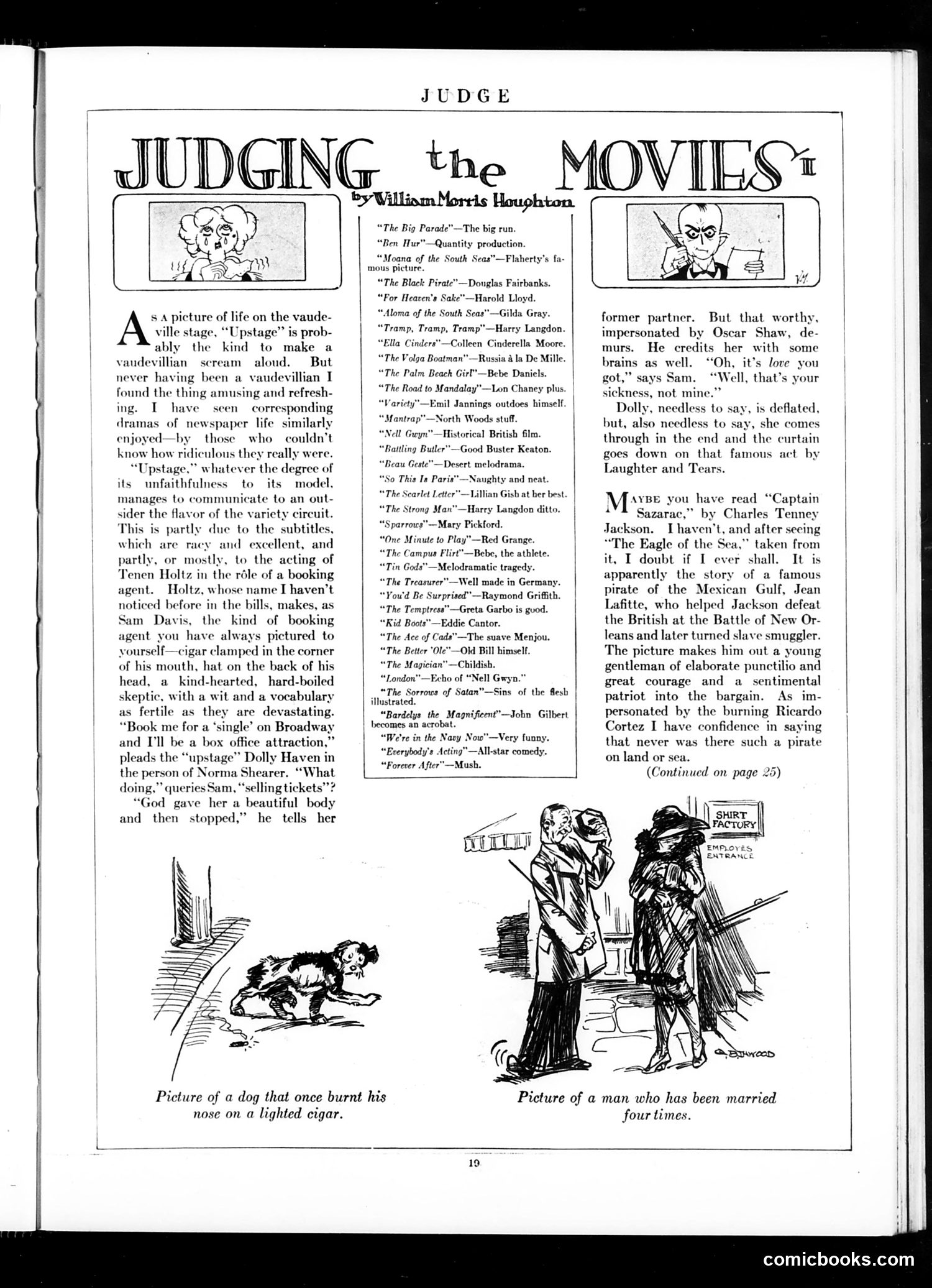
This page reviews recent films by William Morris Houghton. The main review discusses "Upstage," a vaudeville-themed movie starring Norma Shearer and actor Tenen Holtz. Houghton praises Holtz's performance as a cynical but good-hearted booking agent—a character type anyone would recognize: cigar-chomping, quick-witted, world-weary. The satire lies in the agent's deflating response to Shearer's ingénue character: when she claims her beauty guarantees success, he quips that "God gave her a beautiful body and then stopped"—suggesting she lacks talent. The page also lists contemporary 1920s films with brief characterizations (many featuring silent-era stars like Harold Lloyd, Buster Keaton, and Mary Pickford). Two cartoon illustrations show absurdist humor: a dog that burned its nose on a cigar, and a repeatedly-married man—visual jokes unrelated to film criticism.
📄 Transcribed text from this page (OCR, searchable)
Machine-transcribed from the original scan — historical spelling and the odd misread are preserved.
Pacencansi ee sonnets JUDGE A picture of life on the vaude- ville stage, “Upstage” is prob- ably the kind to make a vaudevillian scream aloud. — But never having been a vaudevillian I found the thing amusing and refresh- ing. I have corresponding dramas of newspaper life similarly enjoyed—by who couldn't know how ridiculous they really were. “Upstag its unfaithfulness to its manages to communicate to a sider the flavor of the variet This is partly due to the subtitles, which are racy and excellent, and partly, or mostly, to the acting of Tenen Holtz in the réle of a booking agent. Holtz, whose name I haven’t noticed before in the bills, makes, as Sam Davis, the kind of booking agent you have always pictured to yourself—cigar clamped in the corner of his mouth, hat on the back of his head, a kind-hearted, hard-boiled skeptic, with a wit and a vocabulary as fertile as they are devastating. “Book me for a ‘single’ on Broadway and I'll be a box office attraction,” pleads the “upstage” Dolly Haven in the person of Norma Shearer. “What doing,” queries Sam, “selling tickets”? “God gave her a beautiful body and then stopped,” he tells her those whatever the degree of model, Picture of a dog that once burnt his nose on a lighted cigar. “The Big Parade"—The big run. “Ben Hur"—Quantity production. “Moana of the South Seas"—Flaherty’s fa- picture. “The Black Pirate”—Douglas Fairbanks. “For Heaven's Sake"—Harold Lloyd. “Aloma of the South Seas"—Gilda Gray. “Tramp, Tramp, Tramp"—Harry Langdon. “Ella Cinders"—Colleen Cinderella Moore. me “The Palm Beach Girl"—Bebe Daniels. “The Road to Mandalay"—Lon Chaney plus. “Varicty"—Emil Jannings outdoes himself, rth Woods stuff. “Nell Gwyn" —Historical British film. “Battling Butler” —Good Buster Keaton. “Beau Geste"—Desert melodrama. “So This Ie Paris" ghty and neat. “The Strong Man”—Harry Langdon ditto. “Sparrows"—Mary Pickford. “One Minute to Play"—Red Grange. “The Campus Flirt"—Bebe, the athlete. “Tin Gods" —Melodramatic tragedy. “The Treasurer”—Well made in Germany. “You'd Be Surprised” —Raymond Griffith. “The Temptress" —Greta Garbo is guod. “Kid Boots"—Eddie Cantor. “The Ace of Cads"—The suave Menjou. “The Better ‘Ole”—Old Bill himselt. “The Magician —Childish. “London” —Echo of “Nell Gwyn.” illustrated. “Bardelys the Magnifieent”—Jobn Gilbert | becomes an acrobat. | “We're in the Nary Now"—Very funny. “Exerybody's Acting” —All-star comedy. “Forever After" —Mush. “The Volga Boatman” —Russia a la De Mille. “The Scarlet Letter" —Lillian Gish at her best. | “The Sorrows of Satan”—Sins of the flesh | JUDGING te MOVIES* | former partner. But that worthy, impersonated by Oscar Shaw, de- murs. He credits her with some brains as well. “Oh, it’s love you got,” s Sam. “Well, that sickness, not mine.” Dolly, needless to say, is deflated, but, also needless to say, she comes through in the end and the curtain goes down on that famous act by Laughter and Tears. your Meee you have read “Captain 2 Sazarac,”” by Charles Tenney Jackson. I haven't, and after seeing “The Eagle of the Sea,” taken from it, I doubt if I ever shall. It is apparently the story of a famous pirate of the Mexican Gulf, Jean Lafitte, who helped Jackson defeat the British at the Battle of New Or- leans and later turned slave smuggler. The picture makes him out a young gentleman of elaborate punctilio and great courage and a_ sentimental patriot into the bargain. As im- personated by the burning Ric Cortez I have confidence in g that never was there such a pirate on land or sea. (Continued on page 25) RL EMPLovES, Q extRANce Picture of a man who has been married four times. comicbooks.com