
Judge, 1926-12-11 · page 19 of 36
Judge — December 11, 1926 — page 19: what you’re looking at
What you’re looking at
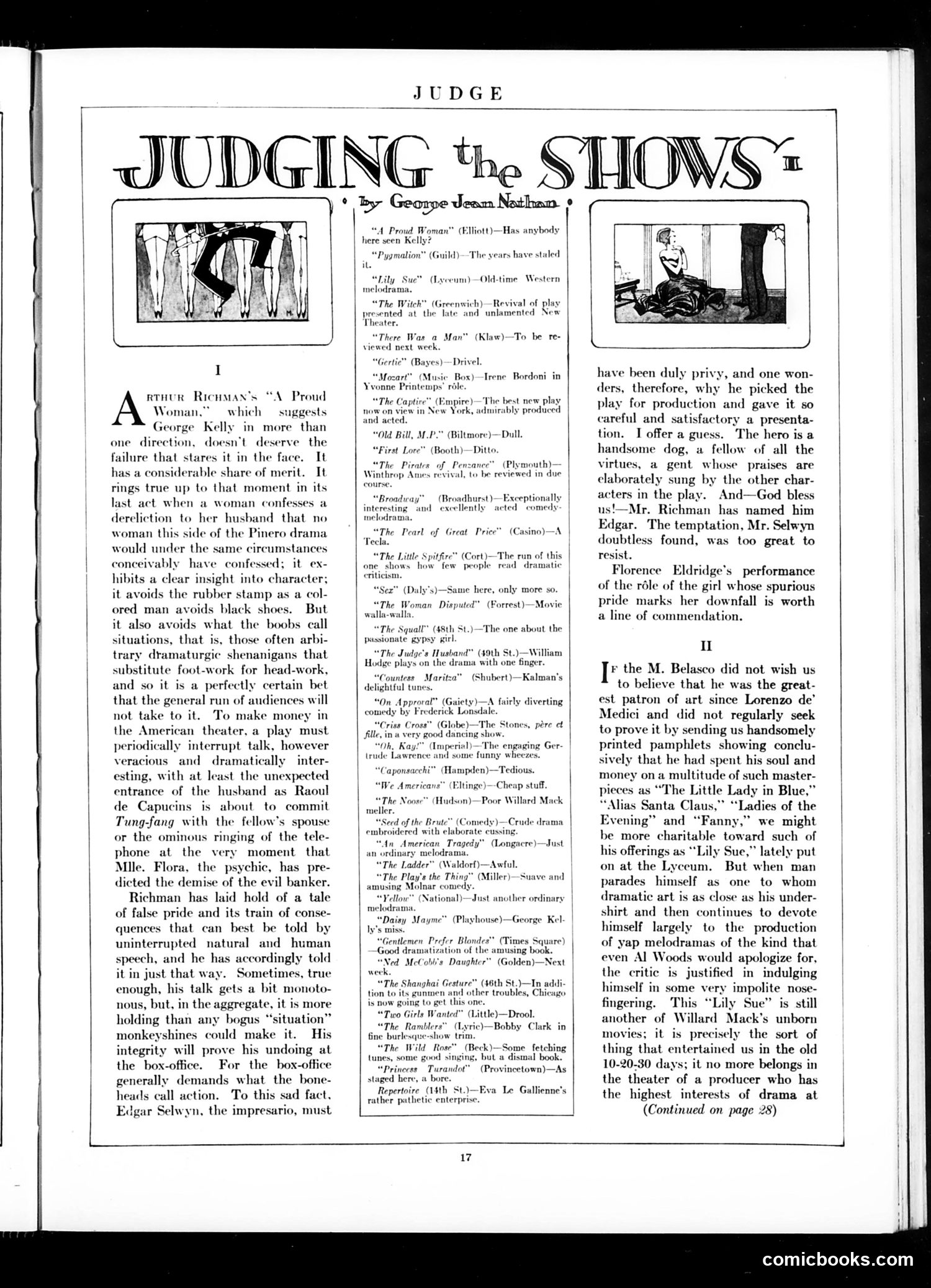
This page is a theater review column by George Jean Nathan covering Broadway productions. The two images appear to illustrate scenes from plays under discussion—likely "A Proud Woman" and another production—though they're not clearly labeled. Nathan critiques Arthur Richman's "A Proud Woman," praising its realistic dialogue and character insight but predicting commercial failure because American audiences demand melodramatic "situations" (contrived plot devices, unexpected entrances, convenient phone calls) rather than intelligent conversation. He argues this integrity will "prove his undoing at the box-office." The column then lists dozens of current Broadway shows with brief, often dismissive judgments: "Dull," "Drivel," "Tedious," "Awful," "Crude drama." "The Captive" receives rare praise as "the best new play now on view in New York." This reflects 1920s theater culture and Nathan's famous caustic reviewing style—championing artistic merit while lamenting popular taste's preference for commercial gimmickry.
📄 Transcribed text from this page (OCR, searchable)
Machine-transcribed from the original scan — historical spelling and the odd misread are preserved.
JUDGING ‘he SHO * by Geonpe Jeam Nathan ¢ rtHuR Ricuman’s “A Proud Woman,” which — suggests George Kelly in’ more than one direction, doesn’t deserve the stares it in the face. It prable share of merit. It rings true up to that moment in its last act when a woman confesses a dereliction to her husband that no woman this side of the Pinero drama failure t has a consic would under the same circumstances conceivably have confessed; it ex hibits a clear insight into character; it avoids the rubber stamp as a col- ored man avoids black shoes. But avoids what the boobs call situations, that is, those often arbi- trary dramaturgic shenanigans that substitute foot-work for head-work, and so it is a perfectly certain bet that the general run of audiences will not take to it. To make money in the American theater, a play must periodically interrupt talk, however veracious and dramatically _inter- esting, with at least the unexpected entrance of the husband as Raoul de Capucins is about to commit Tung-fang with the fellow’s spouse or the ominous ringing of the tele- phone at the very moment that Mlle. Flora, the psychic, has pre- dicted the demise of the evil banker. Richman has laid hold of a tale of false pride and its train of cons quences that can best be told by uninterrupted natural and human speech, and he has accordingly told it in just that way. Sometimes, true enough, his talk gets a bit monoto- nous, but, in the aggregate, it is more holding than any bogus “situation” monkeyshines could make it. His integrity will prove his undoing at For the box-office generally demands what the bone- heads call action. To this sad fact, Edgar Selwyn, the impresario, must JUDGE “A Proud Woman" (Elliott)—Has anybody I here seen Kelly “Pygmalion” (C rs have stuled it. “Lily Sue™ melodrama, “The Witch” (Greenwich)—Revival of play presented at the late and unlamented New Theater. “There Was a Man™ viewed next week. “Gertie” (Bayes) —Drivel “M rt” (Musie Box) Yvonne Printemps’ rale “The Captire” (Empire)—The best new play now on view in New York, admirably produced d acted. 1d) The y (Lyceum) —Old-time Western (Klaw)—To be ree Irene Bordoni in Nd Bill, M.P.” (Biltmore)—Dull. “First Lore” (Booth) —Ditto. “The Pirates of Penzance” (Plymouth) Winthrop Ames revival, to be reviewed in due course. Broadway” — (Broadhurst) —Excepti interesting and excellently acted comedy melodrama, “The Pearl of Great Price” Tecla. “The Little Spitfire” one shows how few criticism. (Casino)—A ‘The run o! read di (Cort) people ex” (Daly’s)—Same here, “The Woman Disputed” walla-walla “The Squall” (48th St.)—The one about the passionate gypsy girl “The July's Husband” (39th St.)-—William Hodge plays on the fama woth ane Anger Kalman’s only more so (Forrest) —Movie “Countess. Maritza” (Shubert) delightful tunes. ‘On Approval” (Guiety)—A f comedy by Frederick Lonsdale (Globe)—The Stones, pére ct ly diverting Crise Cross” fille, in « very good dancing show “Oh, Kay!" (Imperial)—The engaging Ger- trude Lawrence funny wheezes. F “Caponsacchi mpden) Ehin, Hudson), Tedious. “We Americans’ meller. “Seed of the Brute” (Comedy) —Crude drama embroidered with elaborate cussing, “An American Tragedy’ an ordinary melodr “The Ladder” (Waldort)—Awful. “The Play's the Thing” (Miller) amusing Molnar cons “Yellow” (Ni melod: “Daisy Mayme" ly's miss. “Gentlemen Prefer Blondes” (Times Square Good dramatization of the amusing book. ‘ed McCobh's Daughter (Golden)— Cheap stuff. Poor Willard Mack (Longacre) —Just Suave and (Playhouse)—George Kel. xt The Shanghai Gesture” (46th St.)—In addi tion to its gunmen and other troubles, Chic is now going to g “Two Girls Wanted” (1 “The Ramblers” (Lyric ¢ burlesque-show trim. “The Wild Rose” es, some good sin “Princess Turandot” staged here, a bore. Repertoire (14th St.)— rather pathetic enterprise. tle)—Drool. Bobby Clark in (Beck)—Some fetching , but a dismal book. (Provincetown)—As her ordinary. | have been duly privy, and one won- ders, therefore, why he picked the play for production and gave it so careful and satisfactory a presenta- tion. I offer a guess. The hero is a handsome dog, a fellow of all the virtues, a gent whose praises are elaborately sung by the other char- acters in the play. And—God bless us!—Mr. Richman has named him Edgar. The temptation, Mr. Selwyn doubtless found, was too great to resist. Florence Eldridge’s performance of the réle of the girl whose spurious pride marks her downfall is worth a line of commendation. Il F the M. Belasco did not wish us to believe that he was the great- est patron of art since Lorenzo de’ Medici and did not regularly seek to prove it by sending us handsomely printed pamphlets showing conclu- sively that he had spent his soul and money ona multitude of such master. pieces as “The Little Lady in Blu “Alias Santa Claus,” “Ladies of the Evening” and “Fanny,” we might be more charitable toward such of his offerings as “Lily Sue,” lately put on at the Lyceum. But when man parades himself as one to whom dramatic art is as close as his under- shirt and then continues to devote himself largely to the production of yap melodramas of the kind that even Al Woods would apologize for, the critic justified in indulging himself in s y impolite nose- fingering. Thi: uily Sue” is still another of Willard Mack's unborn movies; it is precisely the sort of thing that entertained us in the old 10-20-30 days; it no more belongs in the theater of a producer who has the highest interests of drama at (Continued on page 28) 17 comicbooks.com