
A complete issue · 36 pages · 1926
Judge — March 27, 1926
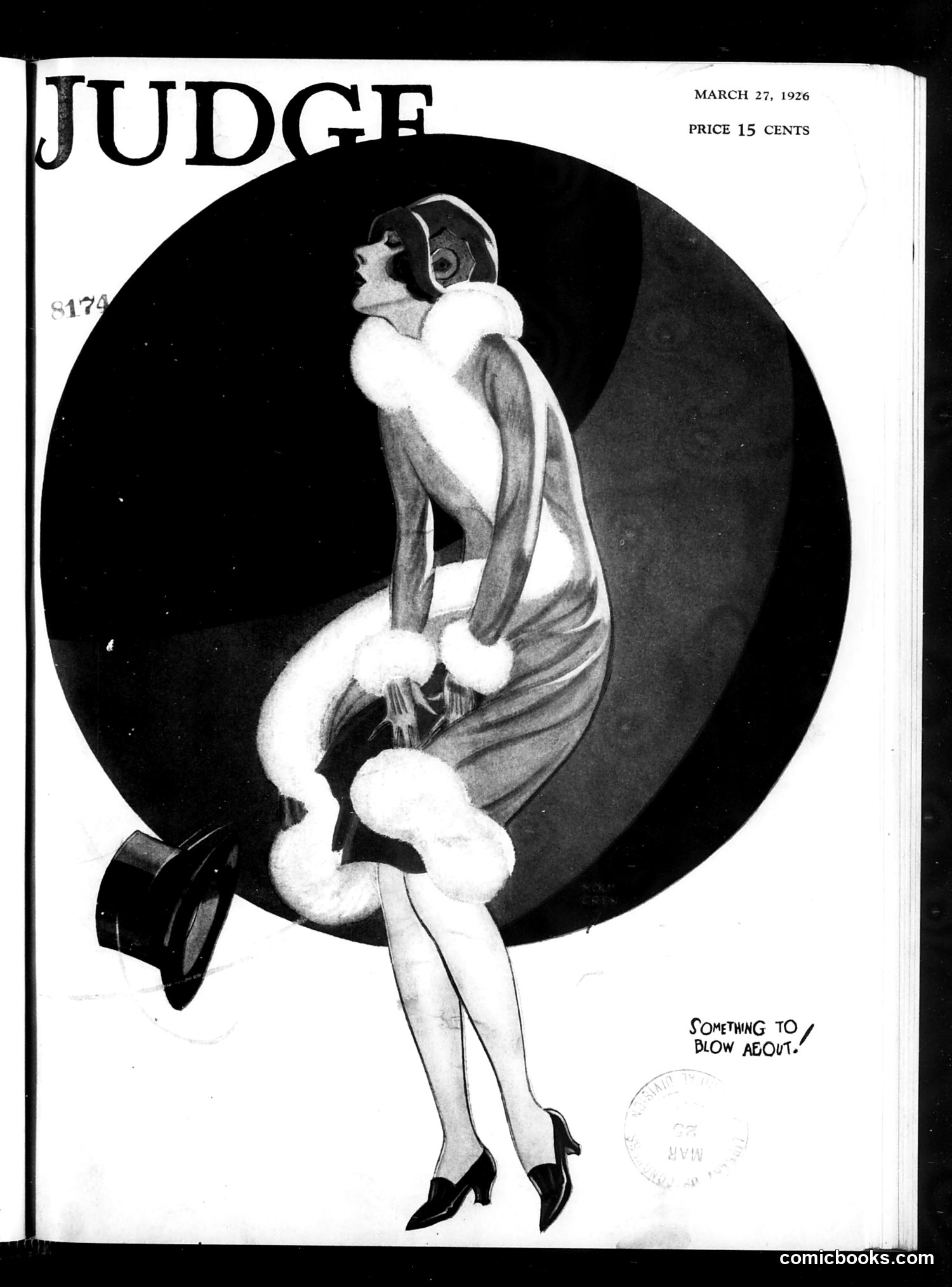
This is a cover illustration showing a fashionably dressed woman in 1920s attire—headphones, fur-trimmed garments, and high heels—in a dynamic pose. The caption reads "Something to Blow About!" The cartoon appears to be satirizing the newfound enthusiasm for radio technology in the mid-1920s. The woman's excited pose and the headphones suggest the public's fascination with this emerging mass medium. The phrase "Something to Blow About" is a pun: radio broadcasts were transmitted through the air, and the woman's enthusiasm about this technology gives her "something to blow about"—or boast about. This reflects Judge's typical 1920s humor targeting modern social trends and technological adoption among the leisure class.
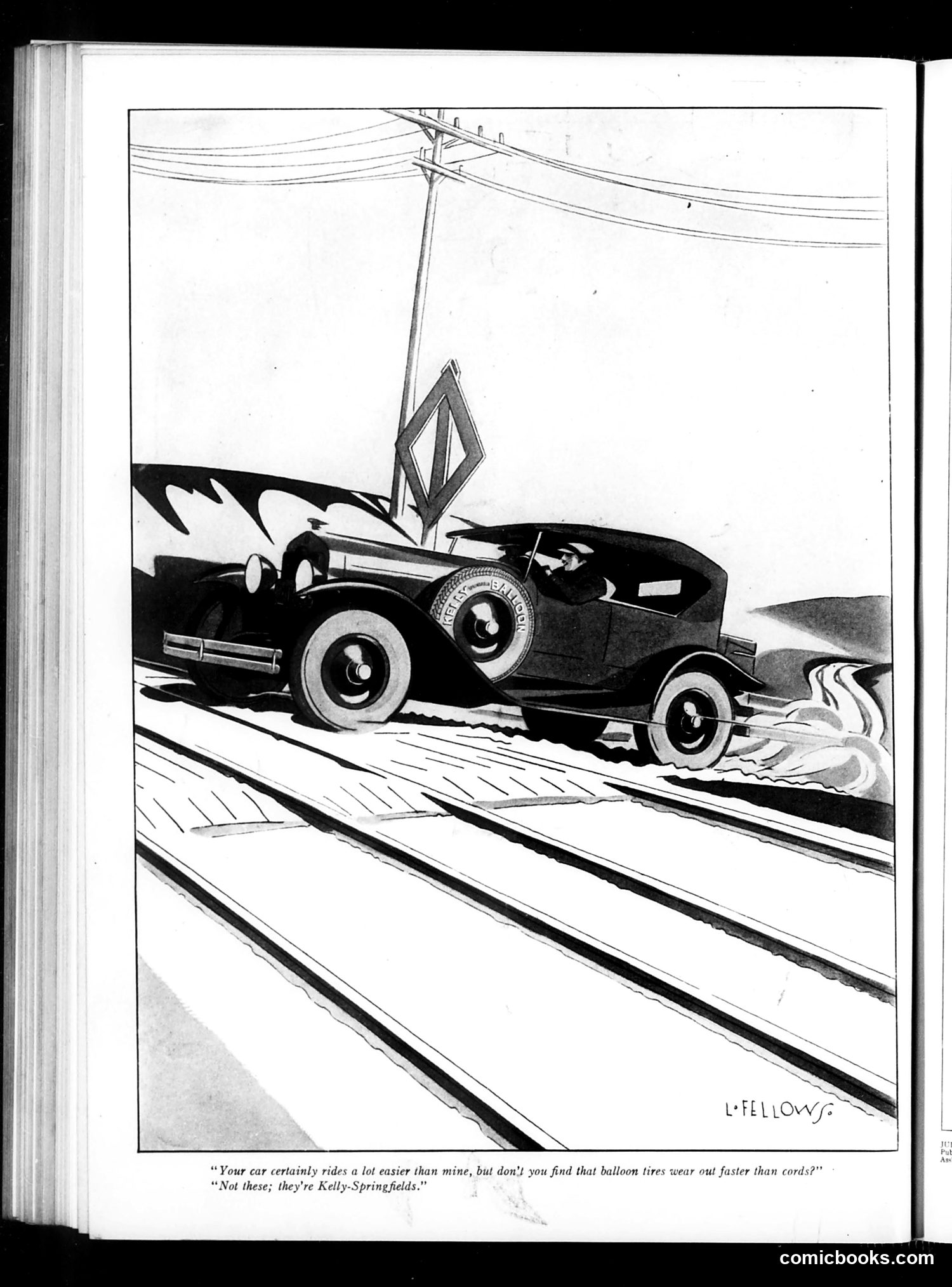
This Judge magazine cartoon depicts two automobiles on a road beneath power lines. The foreground vehicle has balloon tires, which the driver credits to "Kelly-Springfields"—a tire brand reference. The joke centers on tire technology: the first driver compliments the second's car for riding smoothly despite balloon tires wearing out quickly (compared to cords—the older tire construction standard). The response humorously claims the tires are actually Kelly-Springfields, implying their superior quality resists wear better than typical balloon tires. This is essentially **product advertising disguised as humor**—promoting Kelly-Springfield tires' durability and ride quality to Judge's readers during the automobile boom era. The casual dialogue makes the sales pitch feel like friendly conversation rather than explicit advertising.
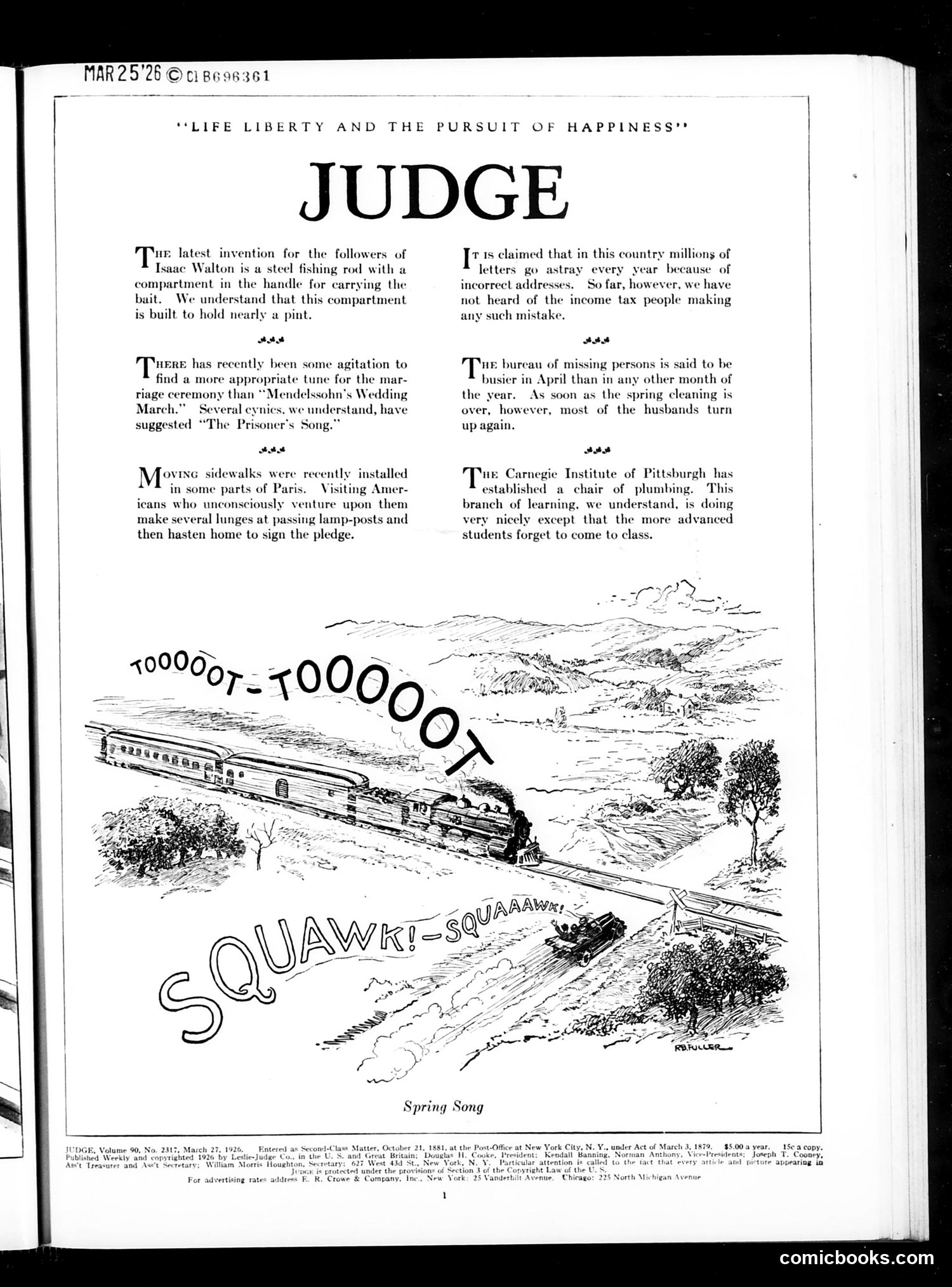
This page contains brief satirical commentary items rather than a single political cartoon. The main illustration, titled "Spring Song," depicts a steam locomotive and automobile colliding or passing dangerously close, with sound effects ("TOOOT-TOOOOOT" and "SQUAWK-SQUAAAWK!") emphasizing the noise and chaos. The humor appears to satirize the friction between modern transportation modes—trains versus automobiles—during the 1920s era when cars were rapidly proliferating. The brief text items above address unrelated topics: Isaac Walton fishing, marriage ceremony music selection, Parisian sidewalks, missing persons statistics, and a Pittsburgh plumbing institute. The cartoon's joke is straightforward: the comedic collision of old (rail) versus new (automotive) technology.
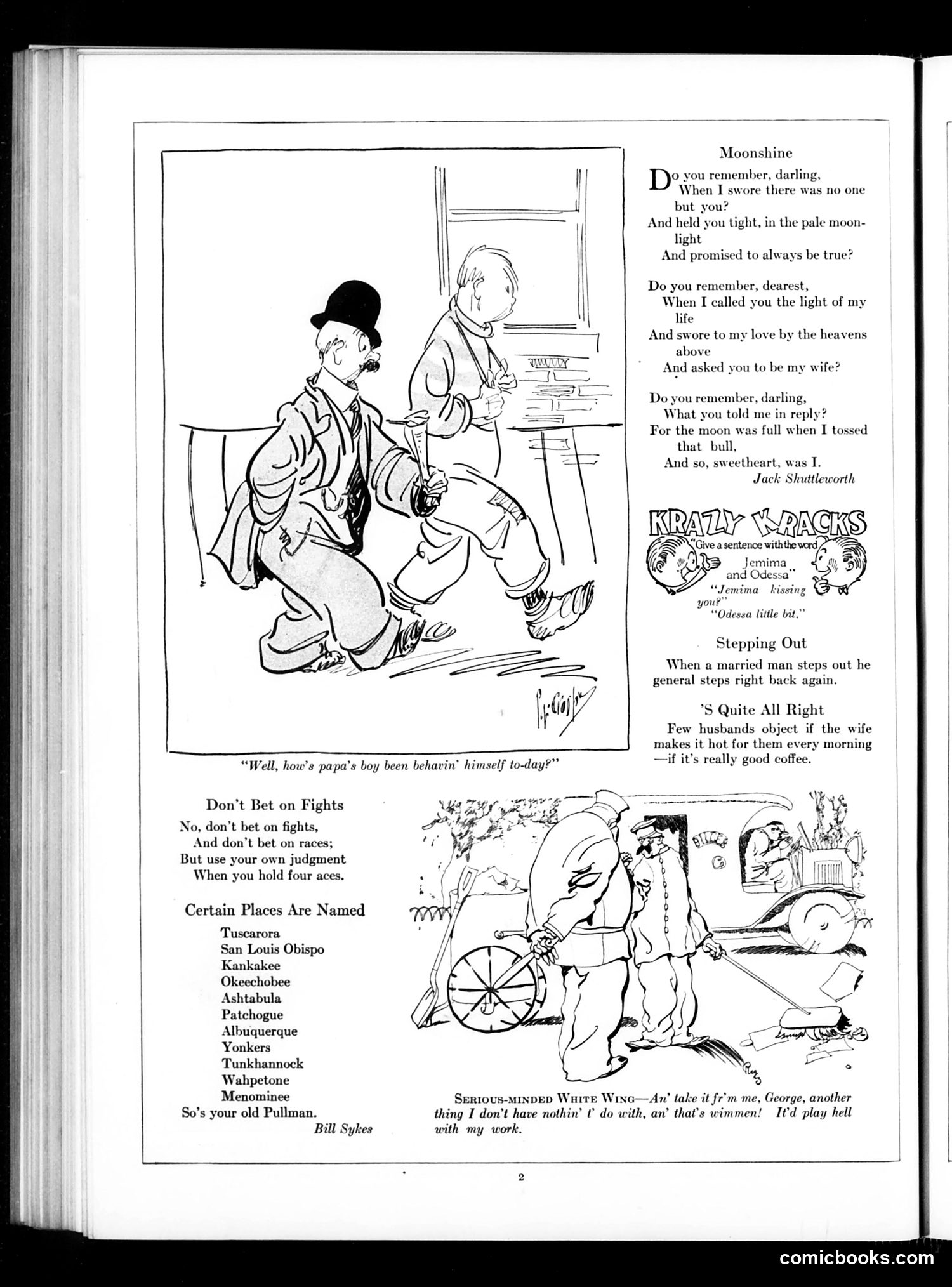
This page contains several pieces of light satirical humor rather than pointed political commentary: **Top cartoon**: Shows two men in bowler hats; the caption "Well, how's papa's boy been behavin' himself to-day?" suggests gentle mockery of an adult man being treated like a child by another. **"Don't Bet on Fights"** and **"Certain Places Are Named"**: These are humorous verses by Bill Sykes and Jack Shuttleworth, using clever wordplay (Native American place names; advice against gambling). **"Krazy Jacks"** and **"Stepping Out"**: Brief joke segments about marriage and domestic humor. **Bottom cartoon**: Features a woman with a bicycle and appears to reference "white wing" street cleaners—depicting a female street sweeper, likely satirizing early women's entry into previously male-dominated labor roles. The page emphasizes domestic humor and workplace satire rather than electoral politics.
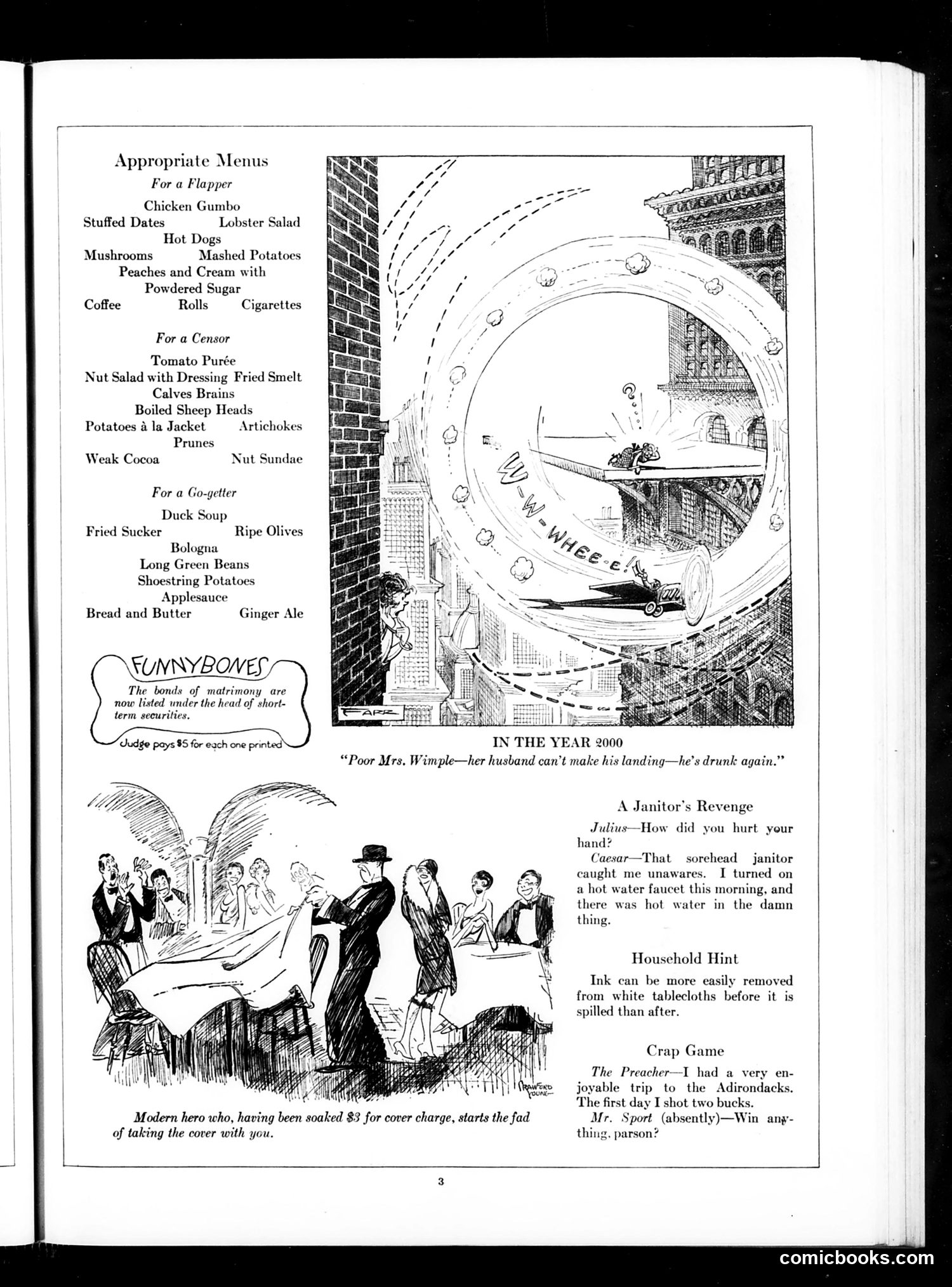
This page contains primarily **humorous content and advertisements** rather than political satire. The main cartoon depicts a "Modern hero" who has been "soaked $3 for cover charge" at what appears to be a nightclub or restaurant, now trying to recover that cost by charging others at his table. The page includes: - **Menu suggestions** for different social occasions (flapper, censor, go-getter) - **"Funny Bones"** section with brief jokes - **A futuristic vision** labeled "In the Year 2000" showing aerial traffic - **Household hints and humor** sections The satire appears gentle—mocking nouveau riche behavior and the emerging consumer culture of the 1920s rather than targeting specific political figures. The overall tone emphasizes social comedy over political commentary.
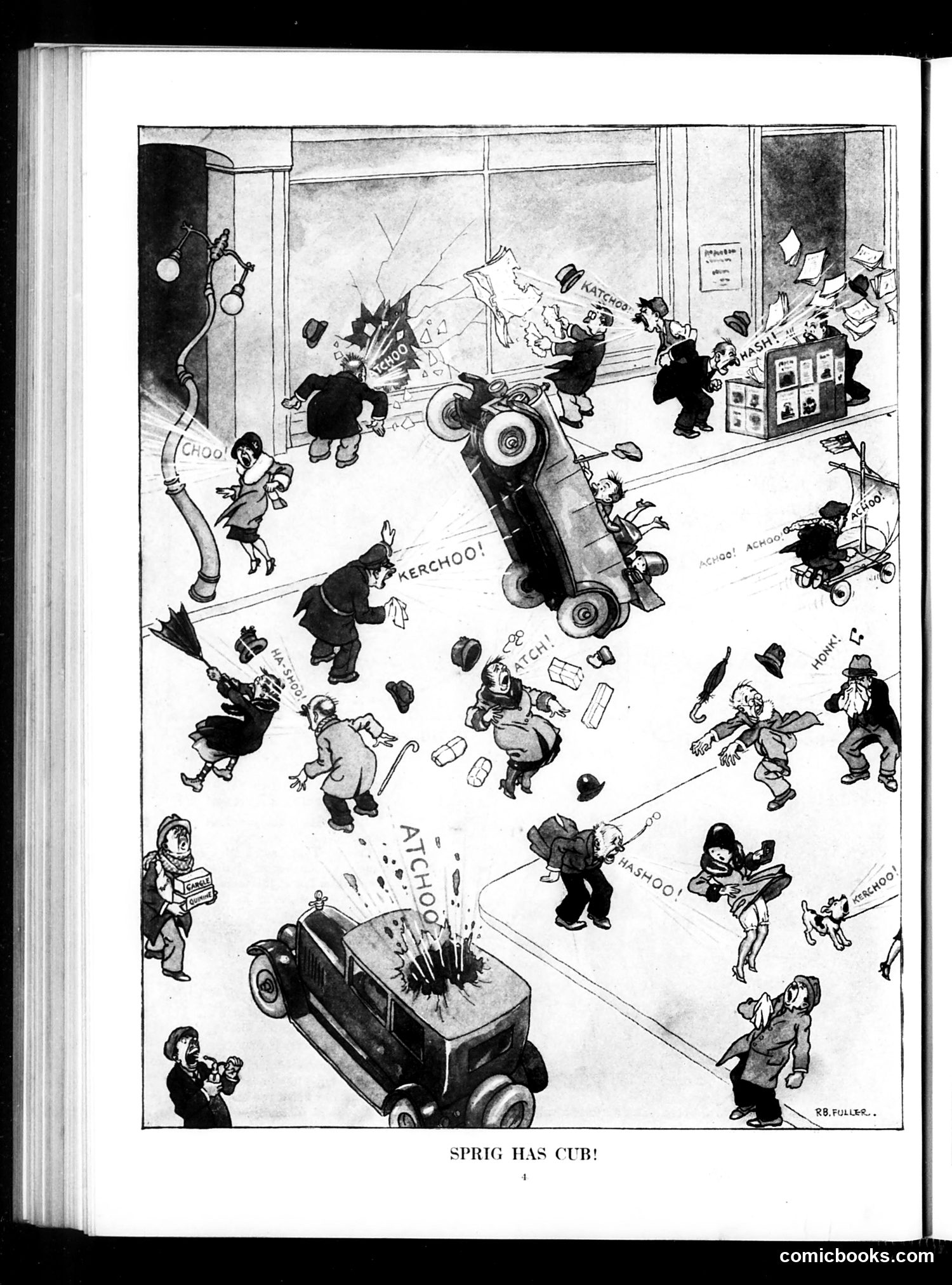
This is a satirical cartoon depicting chaos in an urban street scene, likely from the early 20th century. The title "Spring Has Cub!" appears to be a pun—playing on "spring has come" while suggesting young troublemakers ("cubs") are causing mayhem. The cartoon shows multiple automobiles colliding and careening dangerously through a street near a school building, with pedestrians and children scattering in panic. Various figures carry signs reading "SCHOOL" and "KERCHOO!" (suggesting collision sounds). The satire likely critiques reckless automobile driving in urban areas and the danger posed to pedestrians and schoolchildren. The chaotic composition emphasizes how cars represented a new, uncontrolled threat to public safety in rapidly modernizing cities. This reflects early automotive-era safety concerns that became a major public issue.
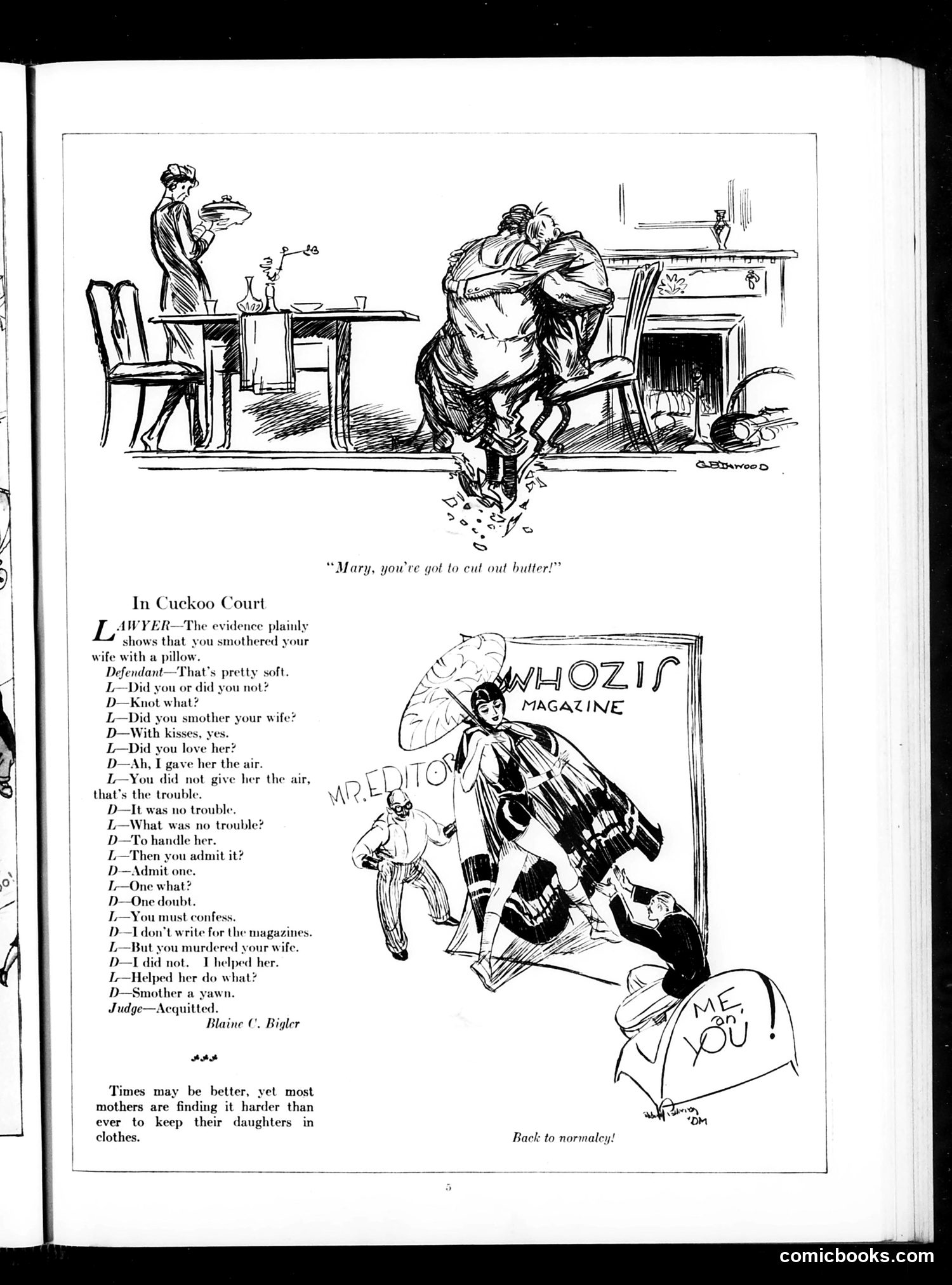
This page contains two distinct pieces of satire: **Top cartoon** ("Mary, you've got to cut out butter!"): Shows a domestic scene where a husband criticizes his wife's use of butter, likely referencing wartime or economic rationing concerns that made luxury foods scarce or expensive. **Bottom section** ("In Cuckoo Court"): A humorous court transcript where a defendant is accused of "smothering" his wife with affection. The absurdist dialogue plays on the double meaning—the lawyer argues the husband gave his wife "air" (romantic attention), not literal smothering. The judge ultimately acquits. This satirizes both overly literal legal reasoning and marital dynamics. **Right cartoon**: Shows domestic chaos with a woman reading *Whozis Magazine*, suggesting women's frivolous reading habits distract them from household duties—a common anti-feminist trope of the era. The page overall mocks domestic life and gender roles through humor.
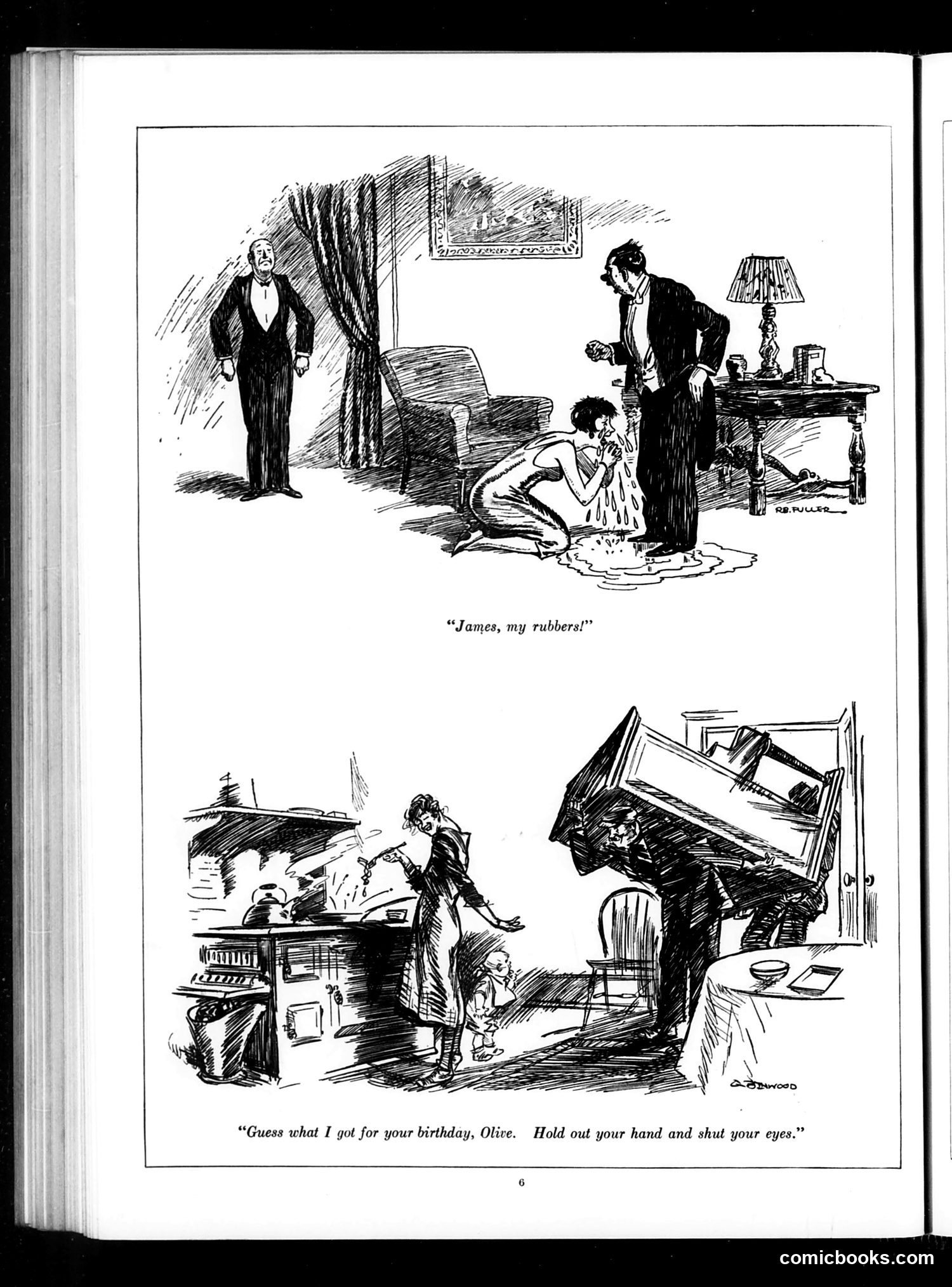
This page contains two separate cartoon jokes from Judge magazine. **Top cartoon:** A woman on the floor appears to be flooded or wet, exclaiming "James, my rubbers!" while a man stands nearby. The joke plays on the double meaning of "rubbers"—likely referring to rubber boots or galoshes (footwear) that have gone missing, creating an embarrassing misunderstanding for modern ears. **Bottom cartoon:** A man presents a birthday "gift" to a child named Olive by having her close her eyes and hold out her hand. He's apparently dumping furniture or household items on her—the humor derives from the absurdity of giving such useless objects as birthday presents, likely satirizing either cheap gift-giving or parental negligence. Both are domestic humor sketches typical of early 20th-century American comic magazines, relying on wordplay and situational awkwardness.
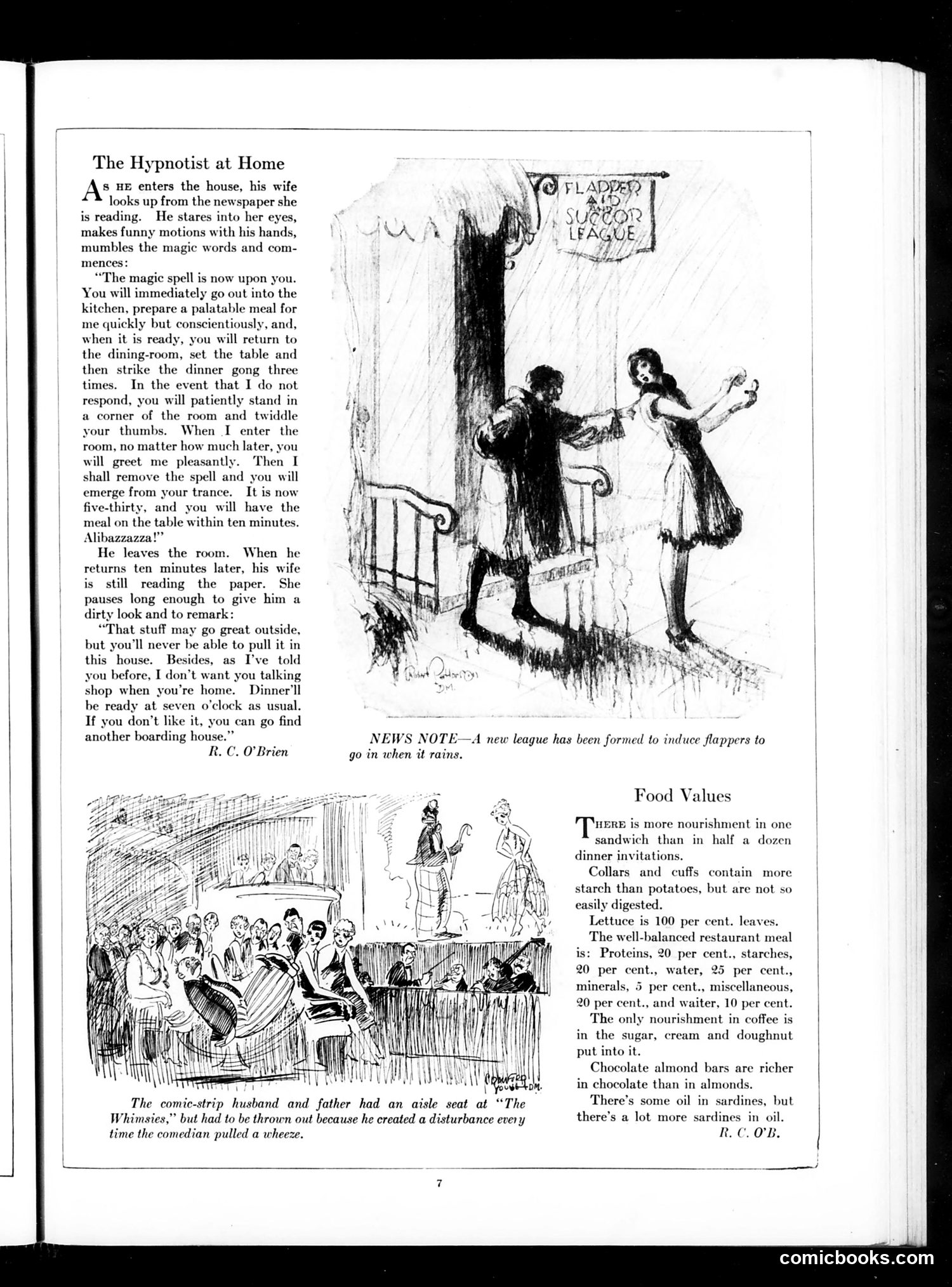
This satirical piece mocks the early 20th-century fad of stage hypnotism. A husband attempts to "hypnotize" his wife into becoming an obedient domestic servant—cooking dinner, setting the table, and greeting him pleasantly on command. The joke's punch line: it doesn't work. His wife, still reading the newspaper, dismisses his theatrics and sarcastically tells him dinner will be ready "at seven o'clock as usual," then threatens he can find another boarding house if he doesn't like it. The satire targets both the pseudo-scientific pretensions of hypnotism and the reality of marital power dynamics. Rather than the submissive, controllable woman the husband fantasizes about, he faces a wife who refuses to be impressed or manipulated by his performance. The humor relies on the gap between male expectation and female autonomy—a pointed commentary on gender relations for Judge's readers.
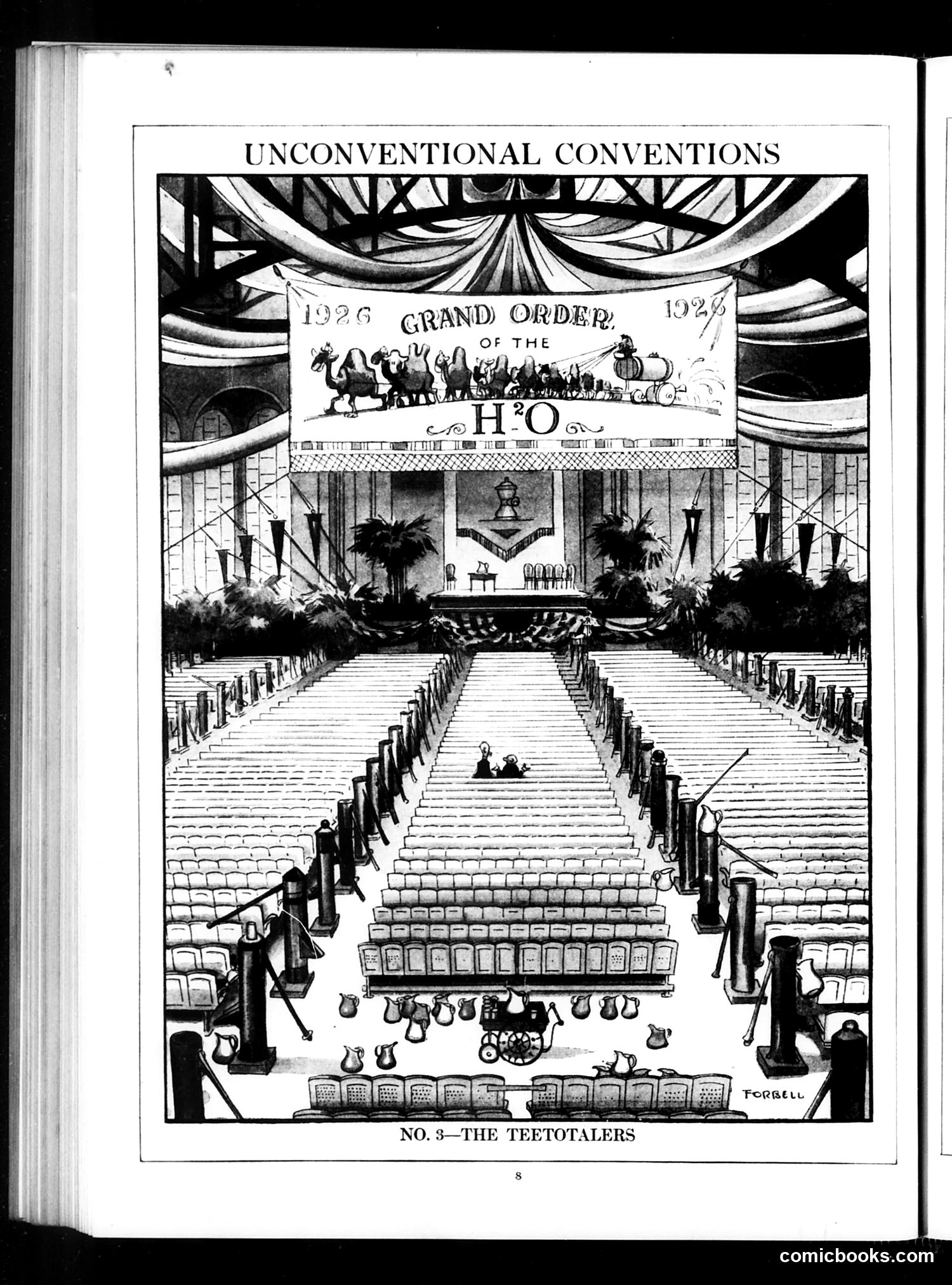
This illustration depicts a 1926 convention hall for "The Teetotalers," a fraternal organization with the acronym "H.O." The grand banner shows various figures, likely representing different temperance or prohibition-related characters. The satire targets America's Prohibition era (1920-1933). The "teetotalers"—people who abstain from alcohol—are shown holding an elaborate, formal convention, complete with decorative draping, palm plants, and ceremonial staging. The presence of what appear to be teapots or kettles scattered on the floor suggests a humorous commentary on the absurdity or pretension of the temperance movement during Prohibition. The cartoon mocks the self-importance and elaborate pageantry surrounding Prohibition enforcement and temperance activism during this contentious period.
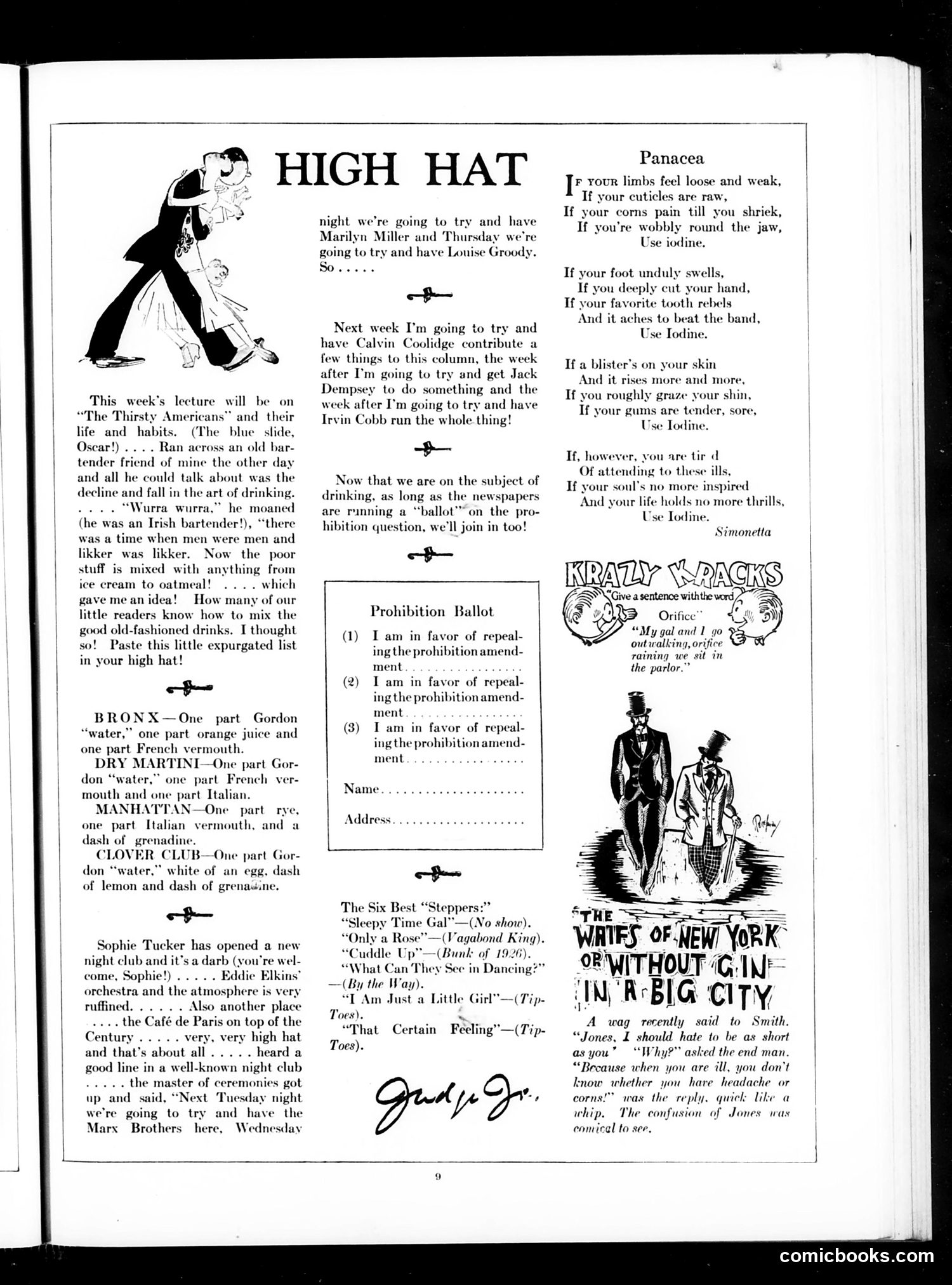
This page satirizes Prohibition-era America (likely mid-1920s). The "High Hat" column mocks the decline of cocktail-mixing craftsmanship under Prohibition, listing pre-Prohibition drink recipes with ironic "Gordon 'water'" substitutions—a transparent reference to bootleg gin. The author jokes about inviting celebrities (Calvin Coolidge, Jack Dempsey, Marilyn Miller) to contribute, satirizing celebrity culture. The central "Prohibition Ballot" is the key satire: it presents three identical options all favoring repeal of Prohibition, mocking how the ballot is rigged or one-sided. This reflects genuine contemporary debate about ending the 18th Amendment. The "Panacea" poem humorously suggests iodine as cure-all for minor ailments, culminating in the dark joke that iodine is the solution if you're tired of life itself—dark comedy about despair. "Krazy Wacks" contains a mild joke about a girl going "outing" and "sitting in the parlor" during rain. The page reflects Jazz Age cynicism about Prohibition's failure and the period's social anxieties.
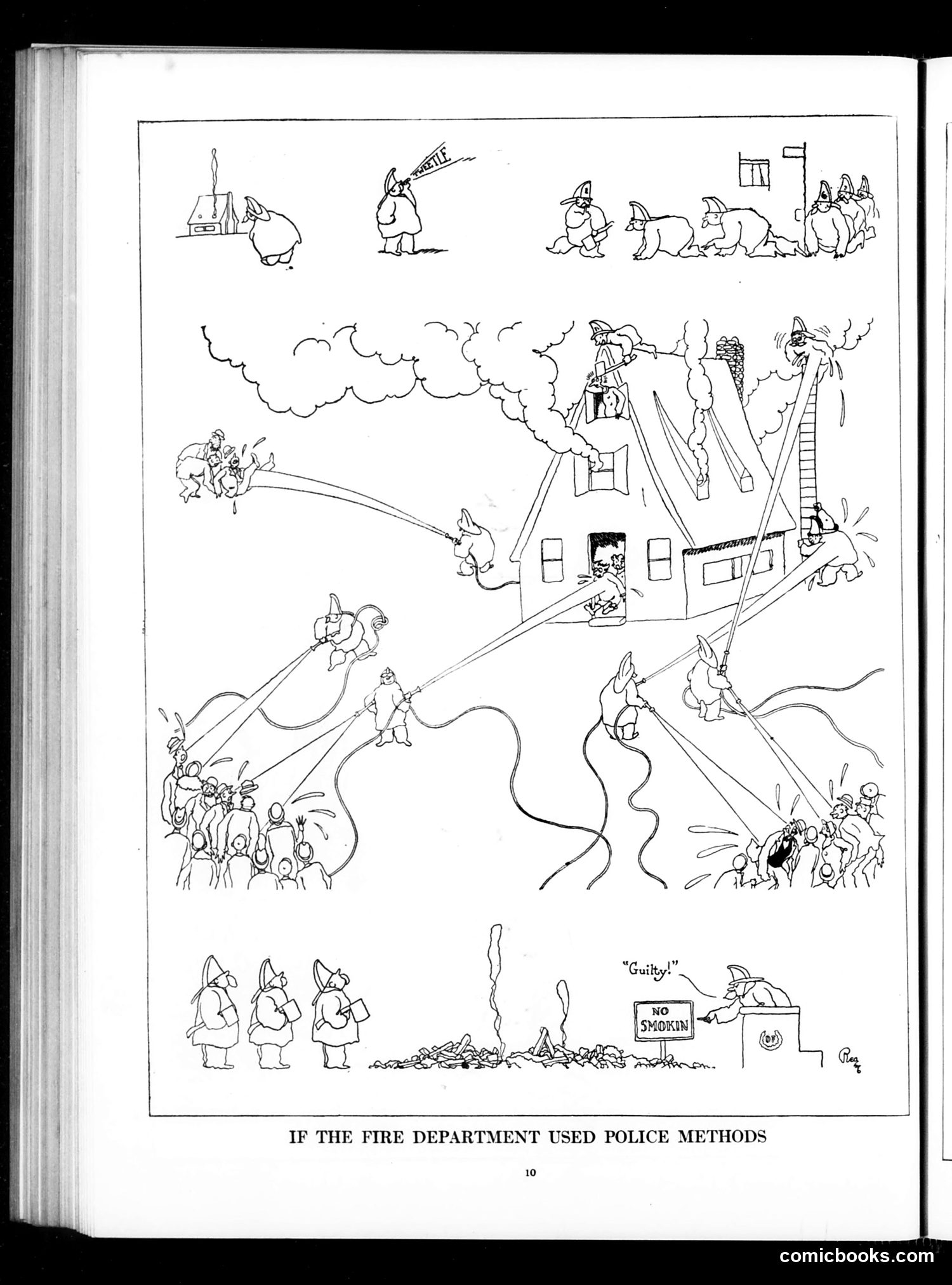
This satirical cartoon compares hypothetical aggressive fire department tactics to actual police practices of the era. The top panel shows firefighters conducting a routine, orderly operation. The main illustration depicts chaos: firefighters employ interrogation techniques, use ropes to restrain and question suspects, and generally treat fire response like criminal investigation—complete with a "No Smoking" sign and someone saying "Guilty!" The bottom shows three figures (likely fire chiefs or officials) looking disapproving at the misconduct. The satire critiques police methods as overly aggressive and inappropriate—so absurd that applying them to firefighting becomes obviously ridiculous. This reflects contemporary concerns about police conduct and suggests such tactics are inherently unsuitable for public service work requiring public cooperation.
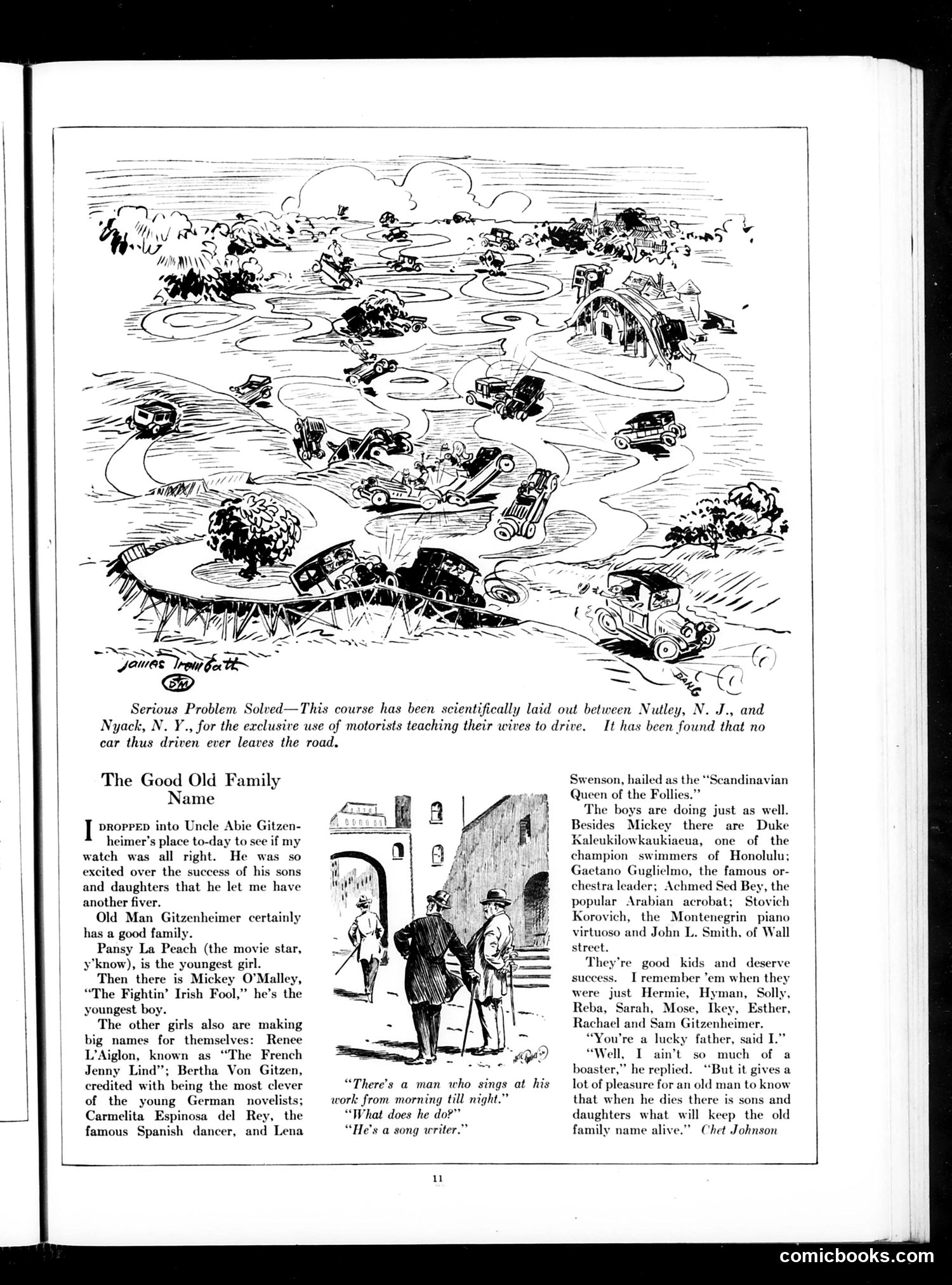
This piece satirizes American assimilation and ethnic identity through humor. Uncle Abie Gitzenheimer is a Jewish immigrant who has children with conspicuously diverse adopted names: Irish (Mickey O'Malley), French (Renee L'Aiglon), German (Bertha Von Gitzen), Spanish (Carmelita Espinosa), Hawaiian (Duke Kaleukilowkaukiaeua), Italian (Gaetano Guglielmo), Arab (Achmed Sed Bey), Serbian (Stovich Korovich), and Anglo (John L. Smith). The joke satirizes how immigrant families adopted non-Jewish identities to succeed in American entertainment and society. Gitzenheimer ironically boasts that his children—originally named "Hermie, Hyman, Solly, Reba, Sarah, Mos, Rachael"—will "keep the old family name alive" despite abandoning it entirely. The satire mocks both assimilationist pressures and the father's obliviousness to his children's complete cultural transformation. The top cartoon mocks newly-licensed female drivers (an emerging social phenomenon) as reckless dangers to roads.
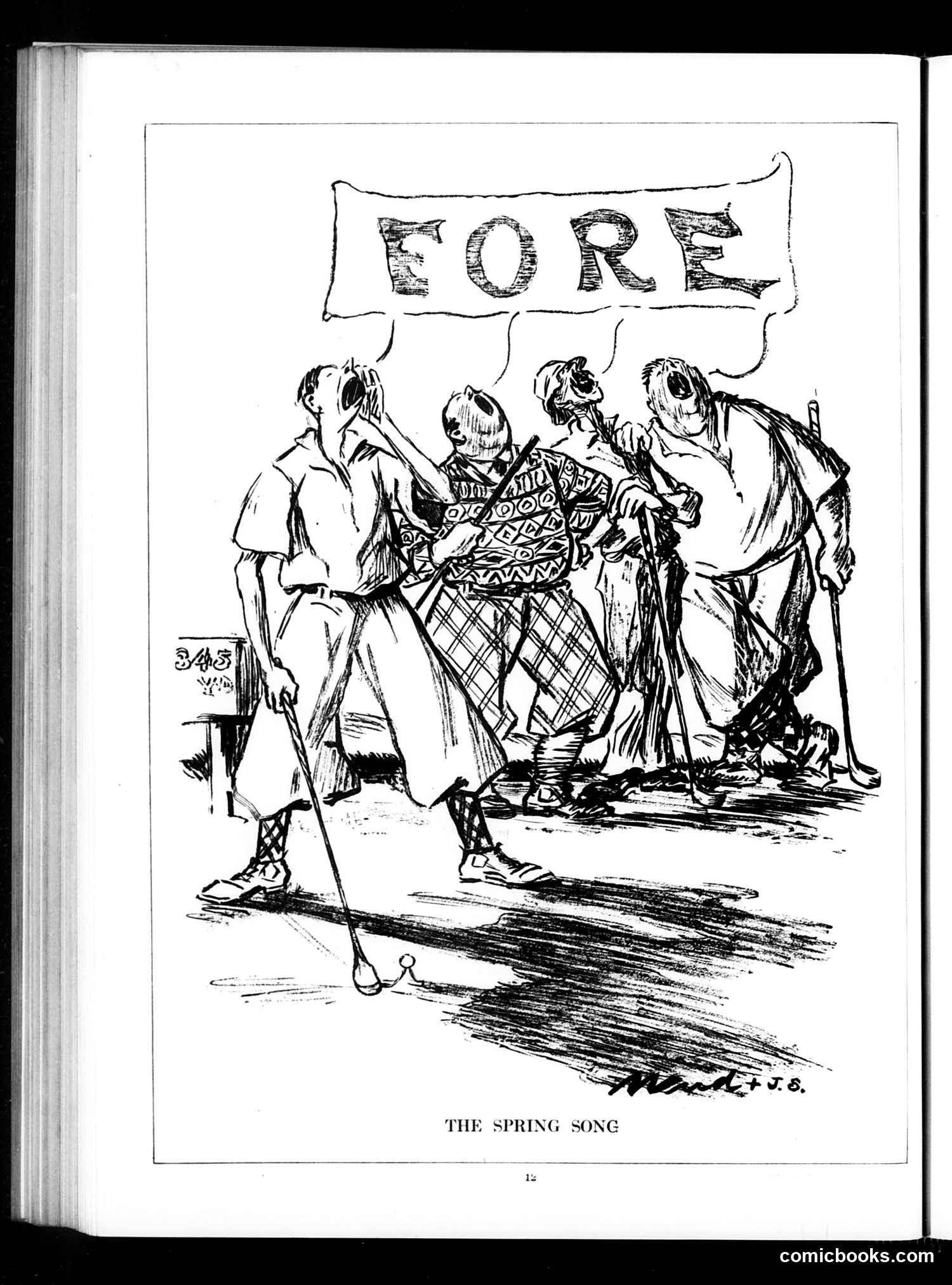
This illustration depicts a group of figures gathered beneath a banner reading "FORE" (likely "FORE!" the golf warning cry). The central figure appears to be a Scottish Highlander in traditional dress, surrounded by what seem to be golfers or sportsmen in period attire. The title "The Spring Song" suggests this is seasonal commentary, likely satirizing spring activities—particularly golf, which was becoming increasingly popular among affluent Americans in the early 20th century. The Scottish figure may reference golf's Scottish origins. The cartoon likely mocks the obsession with golf among the wealthy or upper classes as spring arrives, treating it as a quasi-religious pursuit worthy of ceremonial celebration. Without additional context, the specific identity of the central figure remains unclear.
This editorial attacks Bishop William Manning (identifiable from context) for advocating stricter divorce laws and Prohibition enforcement. The satire argues that Manning, like other clergy, inappropriately uses legislation to enforce morality rather than persuasion within his religious authority. The cartoon critiques the bishop's reasoning as contradictory: he claims "wide open" divorce courts cause divorce, but the editorial counters that social and economic changes—particularly women's emancipation—drive divorce demand. Making divorce legally difficult (like Canada's stricter laws) won't prevent it, just as Prohibition didn't stop drinking; people will evade restrictive laws. The piece advocates that bishops should persuade congregants *morally* rather than lobby for legal coercion. It reflects 1920s debates over church-state separation, women's independence, and whether legislation can enforce social values—all remain contemporary concerns.
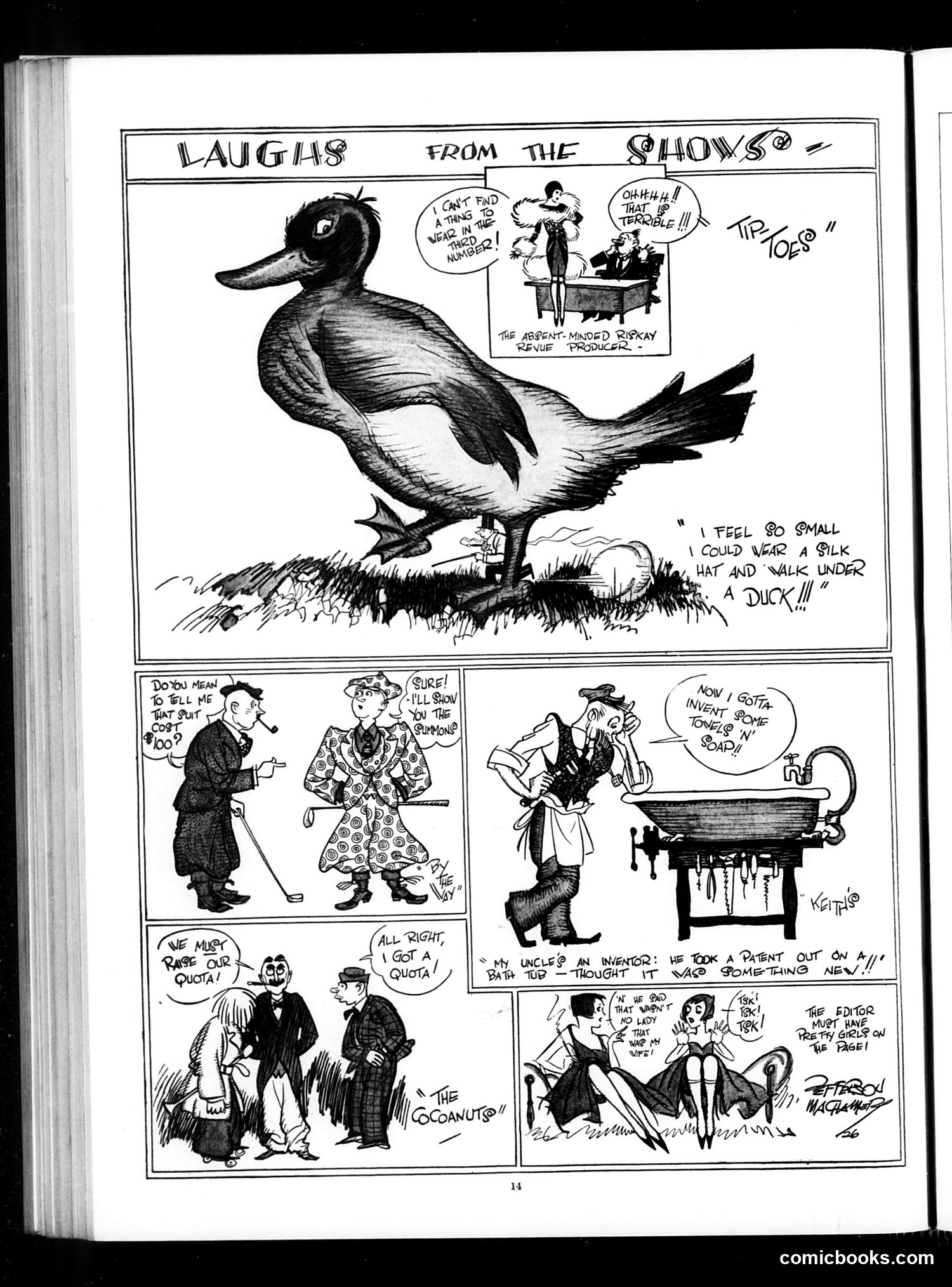
This page presents theatrical humor from Judge magazine, satirizing Broadway productions and show business personalities. The top panel mocks an "absent-minded rickshaw producer" with a duck—likely poking fun at theatrical absurdity and eccentric producers. The lower panels joke about various show business scenarios: a man trying to sell golf clubs, someone bragging about inventing "forked potatoes" (claiming novelty for something mundane), and references to quotas and producers' concerns. The final panel references "pretty girls on the stage"—a common Judge trope satirizing theatrical shows' reliance on chorus girls for appeal. The humor targets theatrical pretension, producers' grandiosity, and the entertainment industry's tendency toward exaggeration and dubious "inventions." These are insider Broadway jokes for Judge's urban, sophisticated readership familiar with New York theater culture.
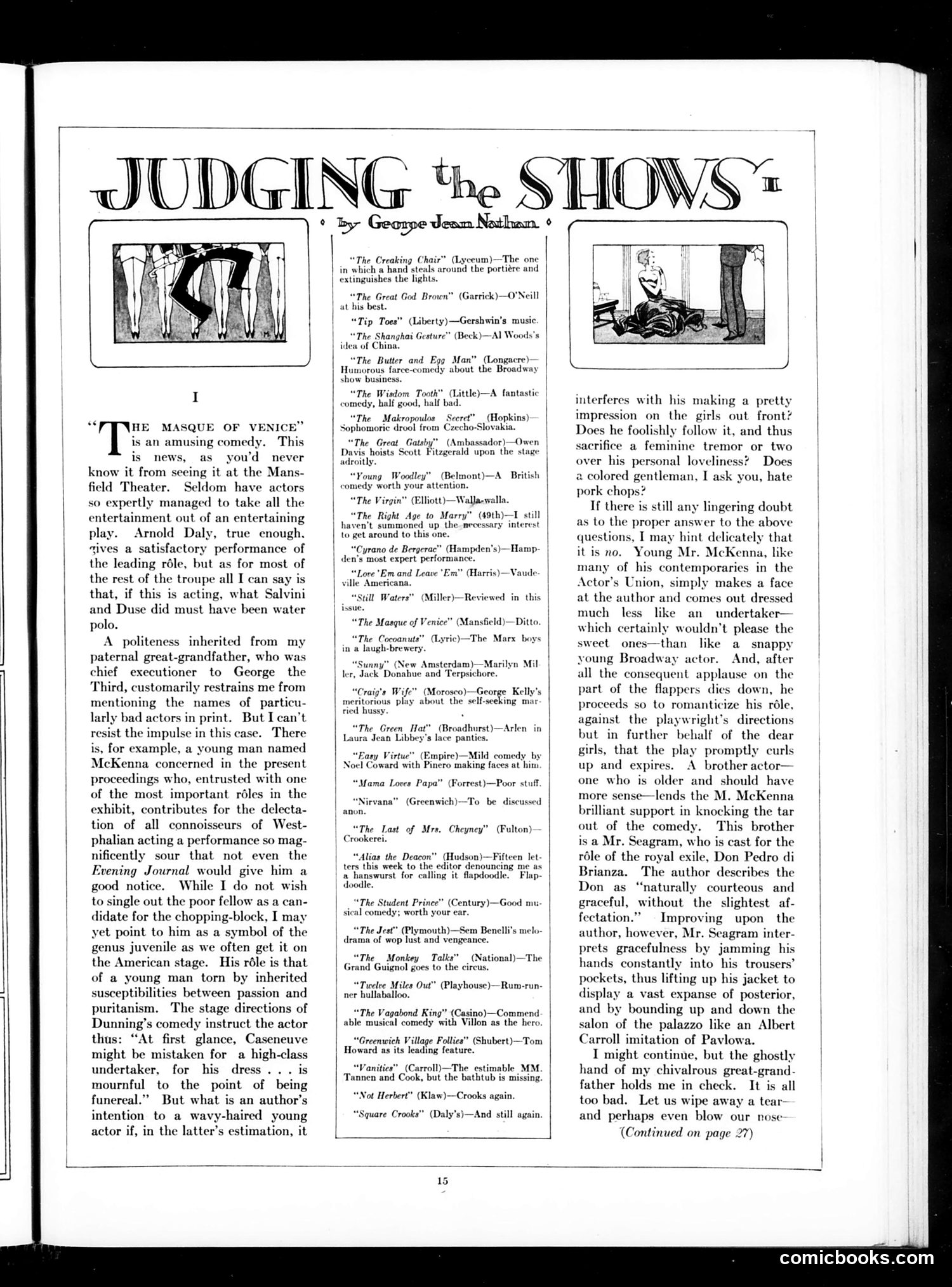
This page features theater criticism by George Jean Nathan, a prominent drama critic. The two small photographs show scenes from plays under review. The main article critiques "The Masque of Venice" at the Mansfield Theater, particularly attacking the performance of an actor named McKenna. Nathan uses scathing language—comparing the troupe's work unfavorably to famous actors Salvini and Duse, and sarcastically suggesting McKenna's bad acting symbolizes typical mediocre young actors on the American stage. The bulk of the page is Nathan's rapid-fire review column of current Broadway shows, offering brief, often cutting assessments of various productions (ranging from "The Great Gatsby" to "The Vagabond King"). His tone alternates between witty praise and dismissive criticism. **Context for modern readers:** This reflects early 1920s theatrical culture and Nathan's influential role as a sharp-tongued arbiter of theatrical taste in American popular magazines.
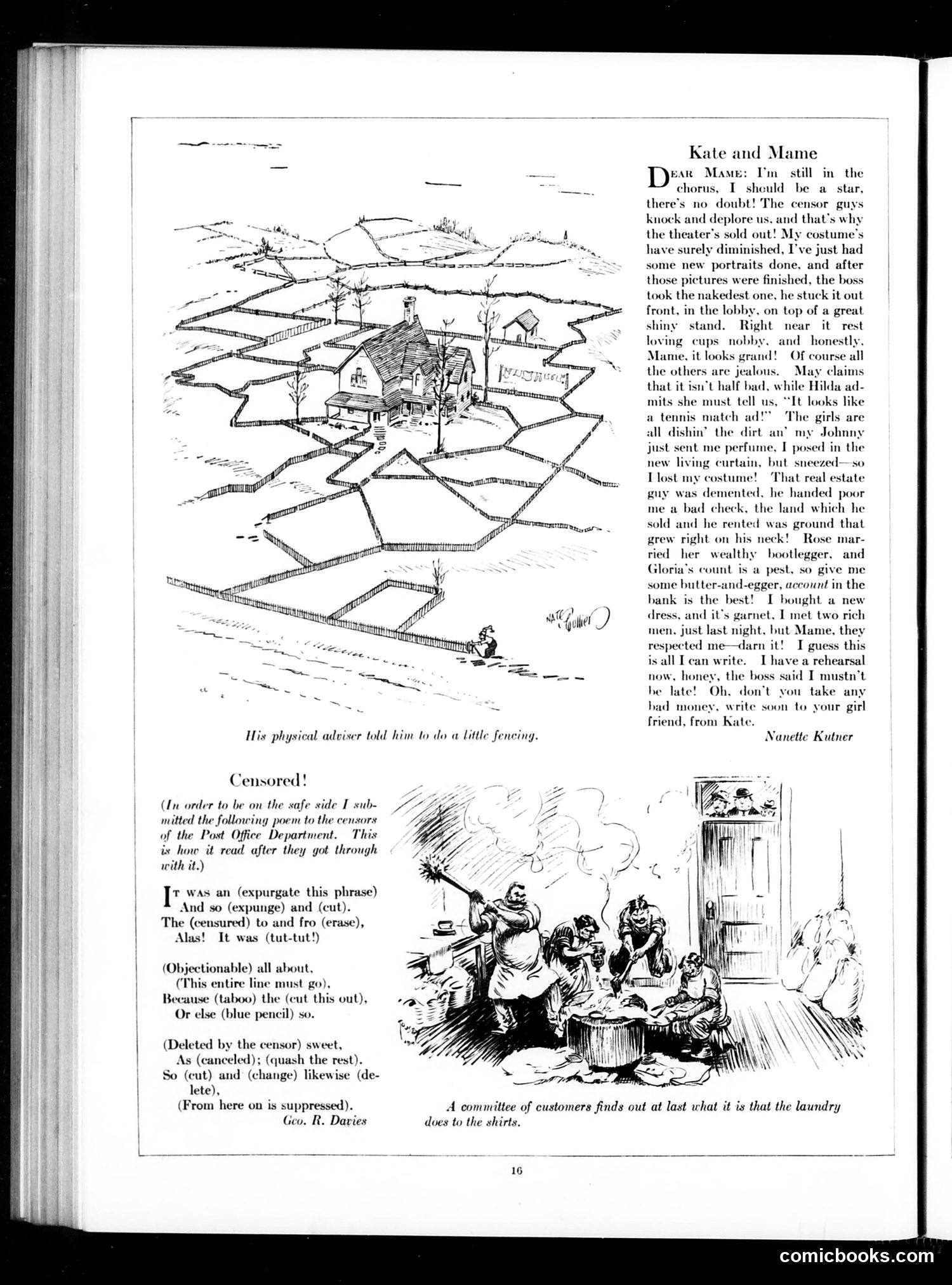
This page contains two satirical pieces from Judge magazine: **"Kate and Mame"** (top): A letter from a chorus girl complaining about theatrical censorship. She notes censors "knock and deplore us" yet the theater remains "sold out"—satirizing how moral objections paradoxically drive attendance. Her gripes about lost costumes, bad checks, and jealous rivals mock the theatrical world's dramatic absurdities. **"Censored!"** (bottom): Geo. R. Davies submits a poem to Post Office censors, then shows it "after they got through with it"—almost nothing remains but blank spaces and "(censored)" notations. This mocks heavy-handed government censorship of mail, which was a genuine concern of the era. The accompanying cartoon shows a laundry committee discovering what happens to shirts, a visual pun on the censoring process destroying content. Both pieces satirize censorship—theatrical and governmental—by showing how aggressive suppression becomes absurd and self-defeating.
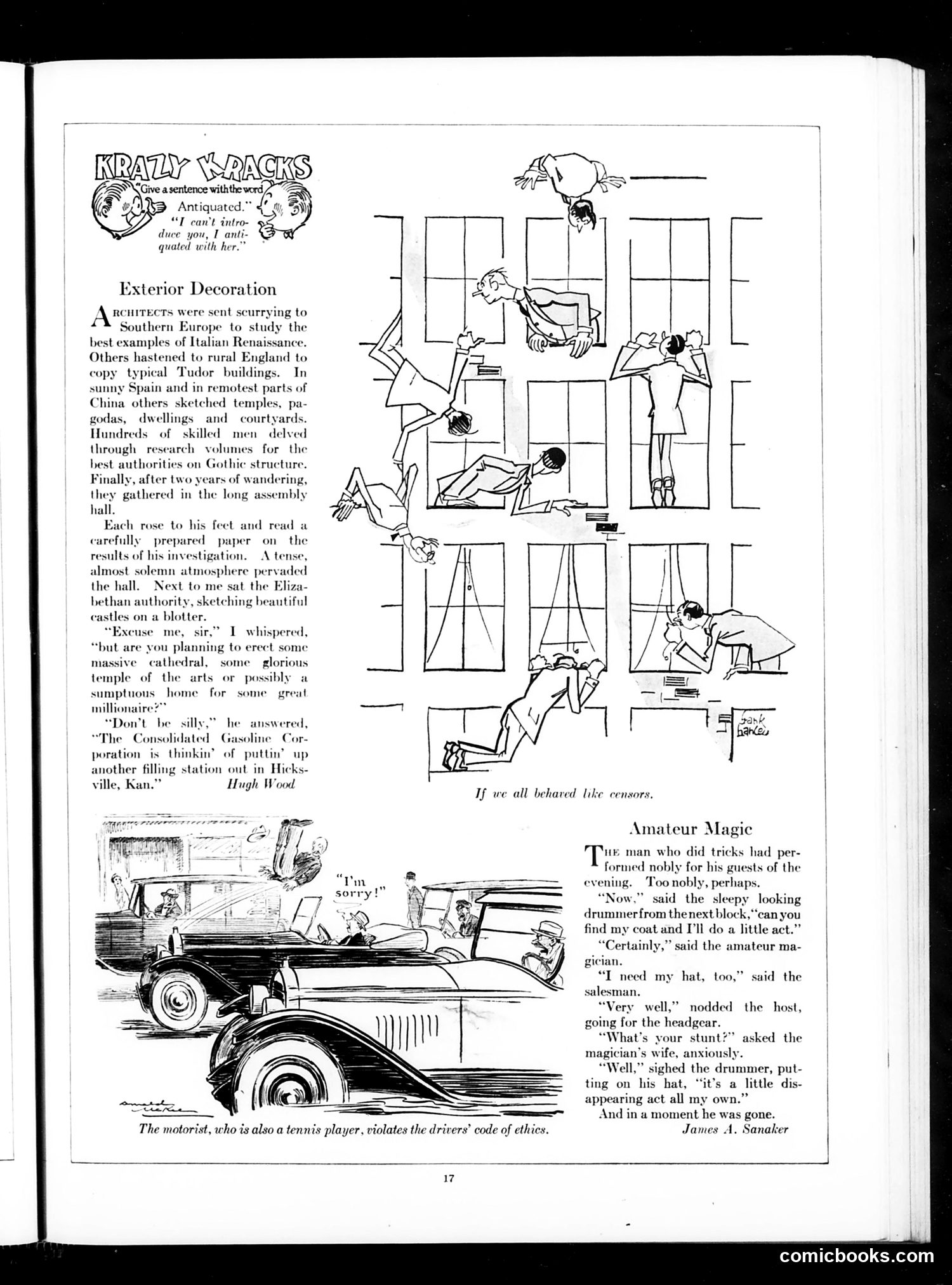
This page contains three satirical pieces: **"Exterior Decoration"** (top left): Mocks architectural pretension. Architects spend two years researching Italian Renaissance, Tudor, Chinese temples, and Gothic structures—only to apply all this scholarly effort to designing a *gas station* in rural Kansas. The satire targets the absurdity of applying grandiose architectural ambition to mundane commercial structures. **"If we all behaved like censors"** (top right): A visual gag showing building decorators working in awkward, constrained positions—apparently illustrating how ridiculous overzealous censorship becomes when applied rigidly. **"Amateur Magic"** (bottom): A guest performer's "disappearing act" involves him literally leaving the party after being asked to retrieve his own coat and hat. The joke plays on the term "disappearing act"—he performs magic by vanishing as a guest, avoiding further obligation to entertain. All three pieces use ironic deflation of expectations: grand efforts yield petty results, and professional language masks ordinary human behavior.
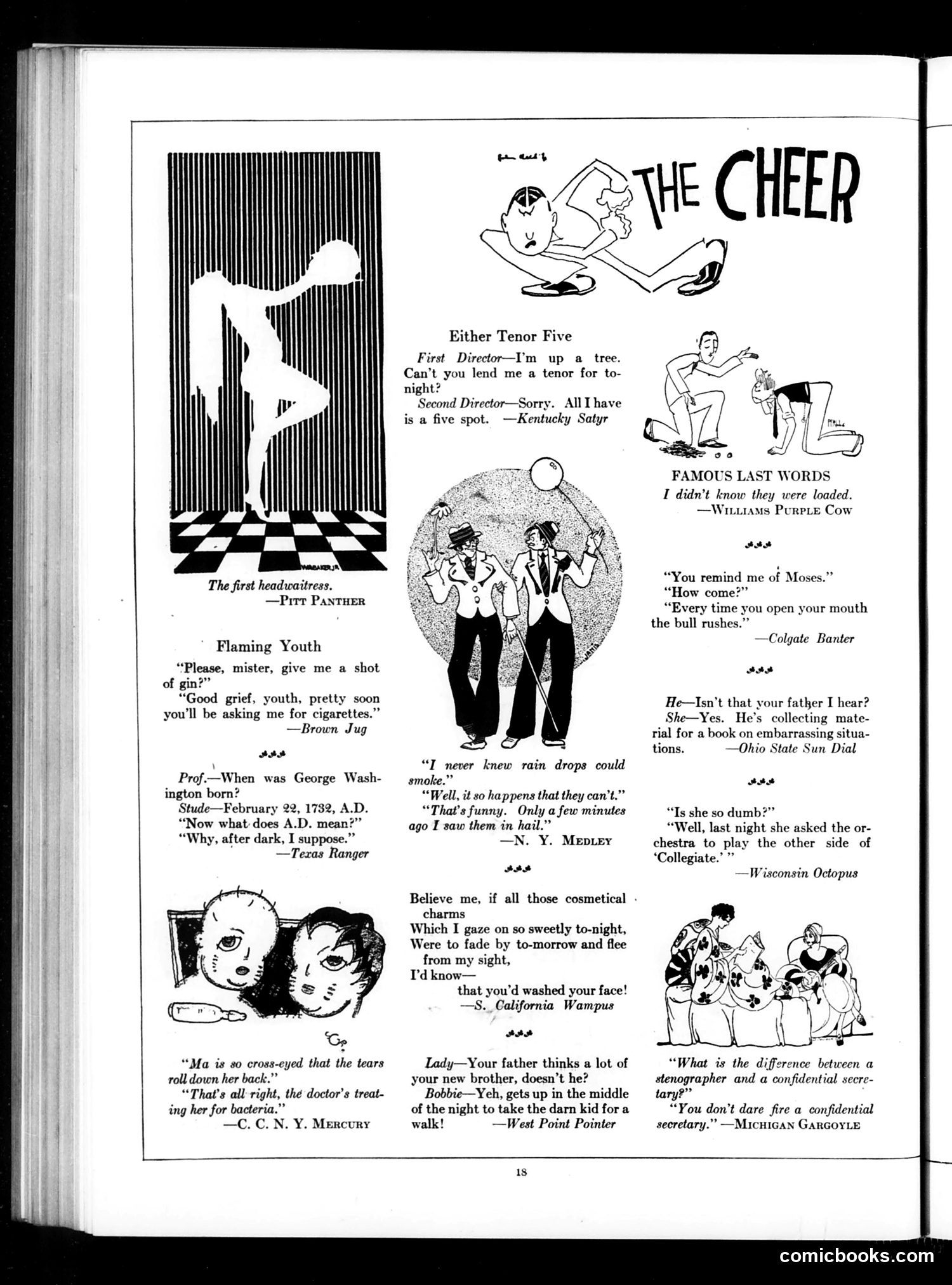
This is a collection of short jokes and quips from various college and military publications, typical of 1920s humor. The page satirizes contemporary social anxieties: **"Flaming Youth"** mocks concerns about young people's moral decay—a father horrified that a youth wants gin, soon expecting cigarette requests. **The Professor joke** plays on student ignorance: "A.D." means "after dark" rather than "Anno Domini." **Gender and relationship humor** includes jokes about cross-eyed mothers, cosmetics fading after washing faces, and a father losing sleep with a new baby. **"Famous Last Words"** presents dark humor about accidental shootings ("didn't know they were loaded"). The illustrations show flapper-era figures and physical comedy. The credited sources (various college humor magazines like *Kentucky Satyr*, *Ohio State Sun Dial*, *Wisconsin Octopus*) indicate this was a compilation of collegiate wit from the era, reflecting 1920s preoccupations: youth rebellion, dating, gender relations, and modern anxieties about changing social norms.
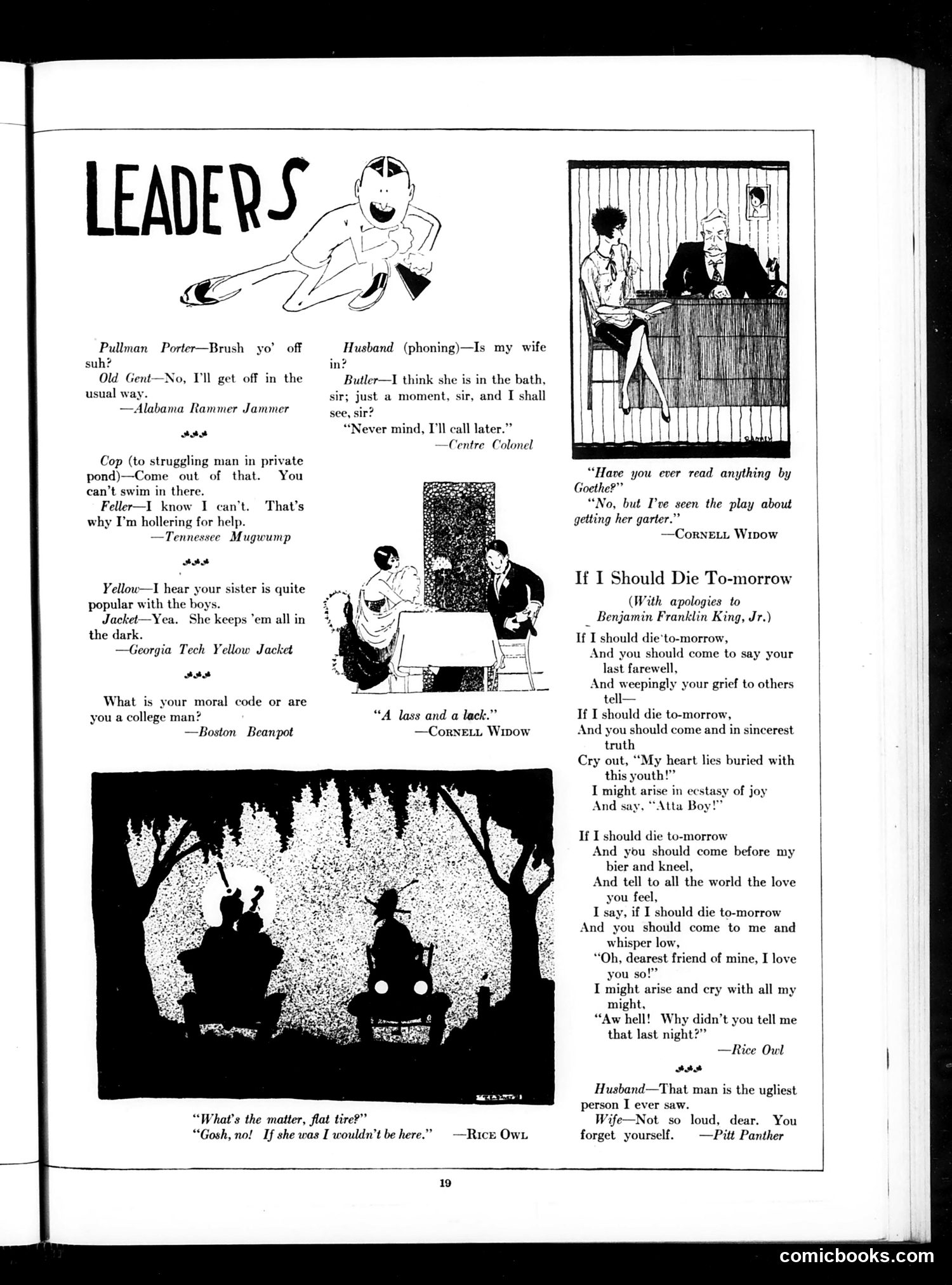
This page from *Judge* contains brief humorous quips and illustrated jokes typical of early 20th-century American satirical magazines. Most entries are college humor submitted by university publications (Alabama, Tennessee, Georgia Tech, Cornell, Rice, Boston, Pitt). The jokes rely on racial dialect humor ("Brush yo' off," Pullman porter), gender stereotypes (women keeping boys "in the dark"), and crude innuendo (the Goethe/garter joke). The main illustrated cartoons show: a man drowning in a pond while a cop prevents rescue; a couple in what appears to be an office or formal setting; and a silhouetted nighttime scene. The poem "If I Should Die To-morrow" parodies sentimental Victorian death poetry by inverting it—the speaker wants recognition while alive, complaining posthumously: "Why didn't you tell me that last night?" The humor is juvenilia, relying heavily on double meanings, regional caricature, and inversion of expectations rather than sophisticated satire.
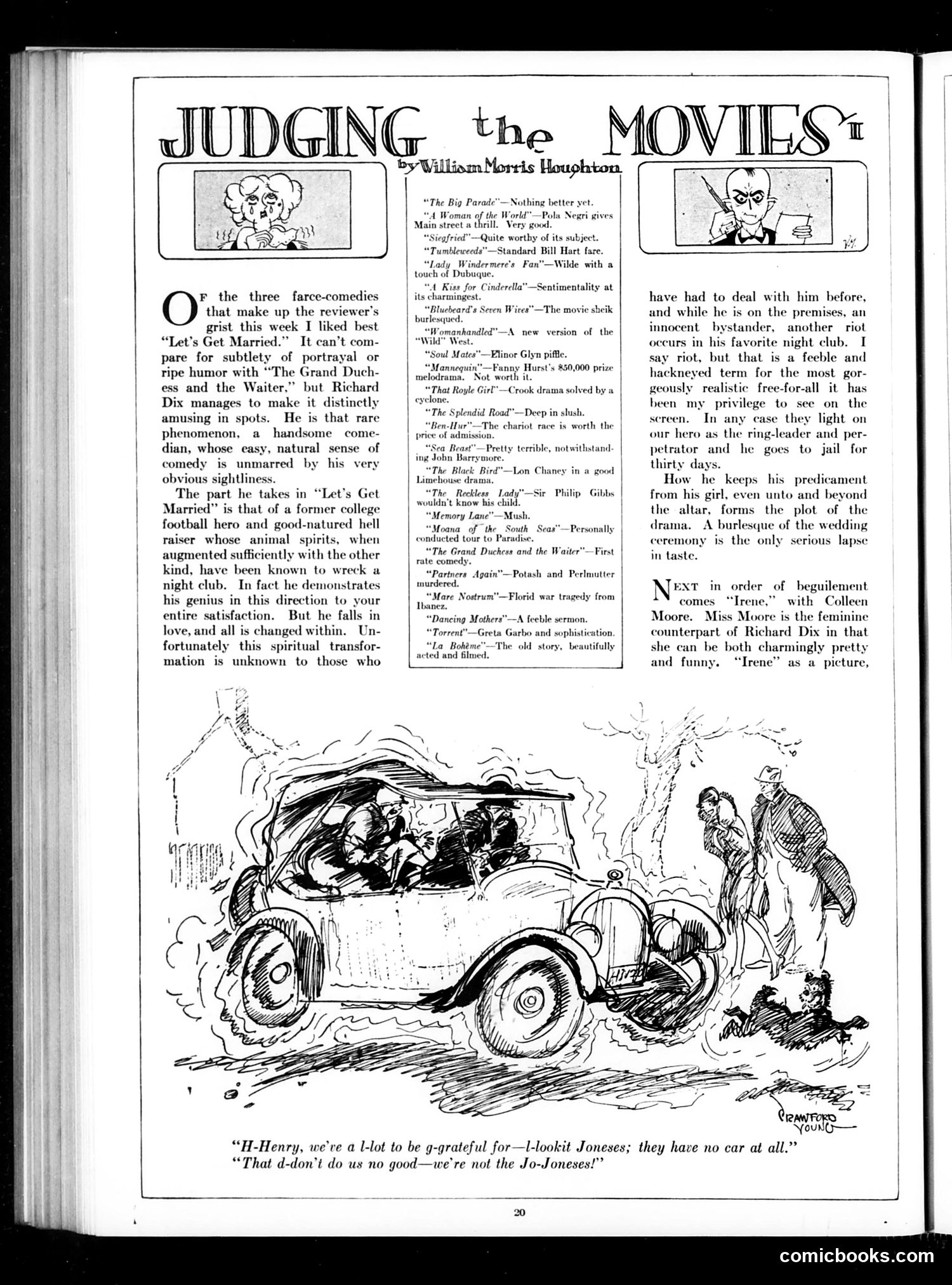
This is a film critic's column by William Morris Houghton reviewing current silent movies. The page lists brief reviews of popular films including "The Big Parade," "Siegfried," and "Lady Windermere's Fan"—all contemporary releases audiences would recognize. The main article praises actor Richard Dix in "Let's Get Married," describing his character as a former college football player and hell-raiser who wrecks a night club but reforms when he falls in love. The critic notes Dix is rare: an attractive leading man with genuine comedic timing. The cartoon below depicts a car accident with the caption joking about envying neighbors' wealth—"they have no car at all" becomes a backhanded complaint, suggesting the speaker regrets owning their accident-prone vehicle. This reflects 1920s anxieties about new automobile technology and conspicuous consumption during the Jazz Age boom.
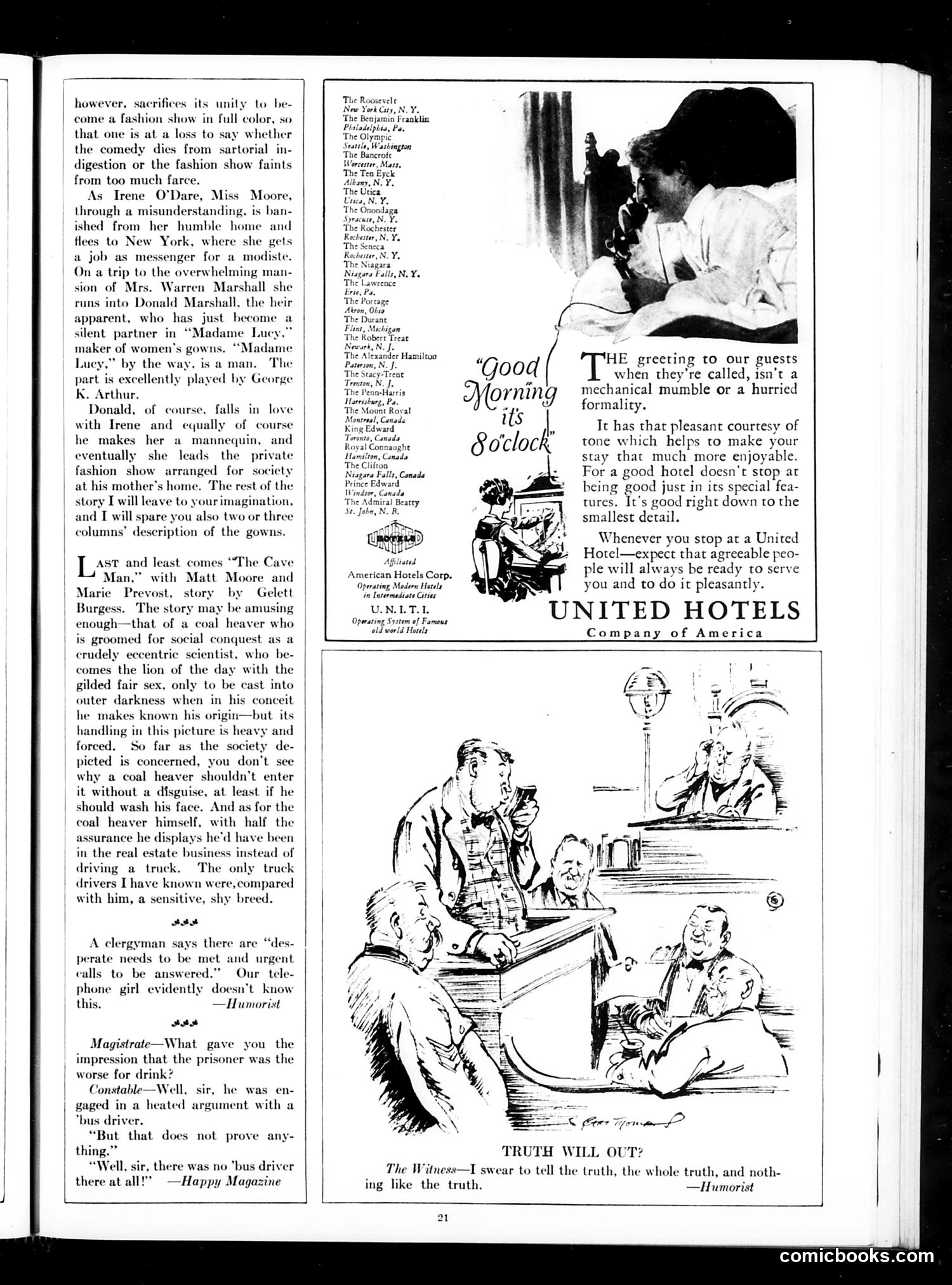
This page contains film reviews and humor items typical of Judge's satirical content, plus a United Hotels advertisement. **The Reviews**: Critics discuss two movies—one starring Irene Moore as a working-class messenger who enters high society through fashion design, and another with Matt Moore and Marie Prevost about a coal miner groomed as a fake scientist-socialite. The satire mocks both films' implausibility: why would genuine society accept such transparent disguises? The reviewer finds the social logic lazy. **The Humor Items**: Brief jokes satirize modern life—a clergyman complains phone operators don't understand "urgent calls," but the operator apparently doesn't prioritize clergy; a constable proves a drunk was arguing with a nonexistent bus driver (absurdist logic); a witness swears to tell "nothing like the truth" (ironic commentary on courtroom perjury). **The Advertisement**: United Hotels touts attentive morning greetings and courteous service "right down to the smallest detail"—selling hospitality as genuine human warmth rather than mechanical efficiency. The page reflects 1920s concerns about class mobility, authenticity in social performance, and modern institutional service.
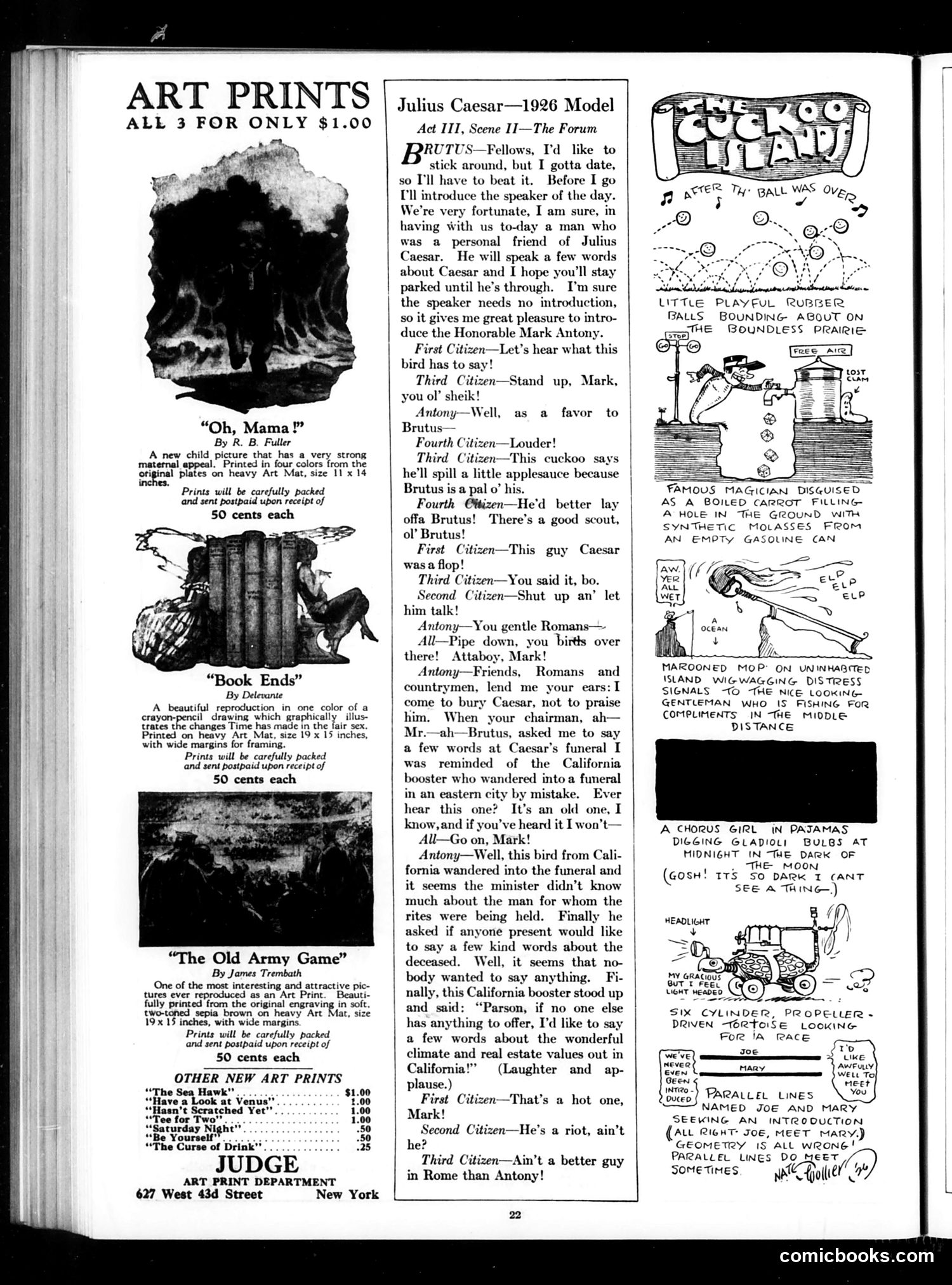
This page combines advertisement and satire. The left side promotes art prints for sale through Judge's print department—sentimental domestic scenes like "Oh, Mama!" and "Book Ends." The main content is a comedic modernization of Shakespeare's *Julius Caesar*. The 1926 "Model" reimagines Mark Antony's famous funeral oration in contemporary American vernacular, with 1920s slang ("date," "sheik," "bo," "riot"). Brutus is portrayed as a casual acquaintance making excuses to leave early—deflating the tragedy into everyday banality. The satire works by contrasting Shakespeare's rhetorical grandeur with mundane modern speech patterns and casual indifference. Antony's digression into a California real-estate booster's joke further trivializes the momentous assassination, suggesting contemporary America's commercial culture supplants classical dignity. The right-side cartoons appear to be humorous visual non-sequiturs typical of Judge's style—absurdist scenarios with minimal captions.
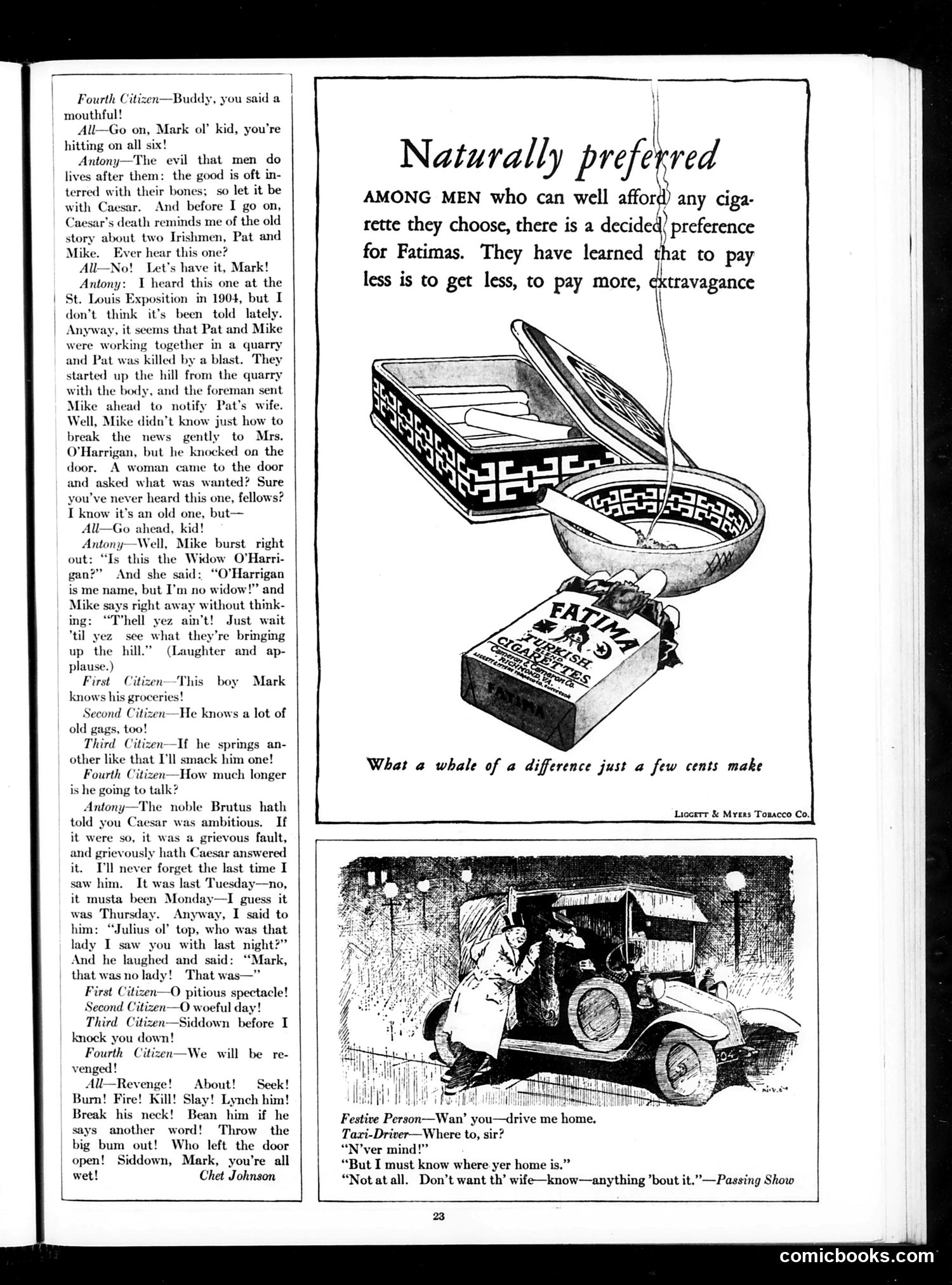
This page contains two distinct elements: **Left side:** A comedic sketch satirizing Shakespeare's *Julius Caesar*. "Antony" performs Mark Antony's funeral oration, but constantly interrupts himself with Irish vaudeville jokes (like the "Widow O'Harrigan" story). The crowd grows increasingly annoyed, shifting from appreciative to hostile. The satire mocks how audiences will tolerate tedious storytelling if framed as classical theater, while simultaneously poking fun at Irish stereotypes popular in early 1900s American entertainment. **Right side:** A Fatimas cigarette advertisement claiming that discerning wealthy men "naturally prefer" this brand, implying quality correlates with price. Below it, a taxi driver joke plays on infidelity—a passenger avoids giving his home address because his wife shouldn't know where he's been. Both are period advertising and humor common to Judge's commercial content.
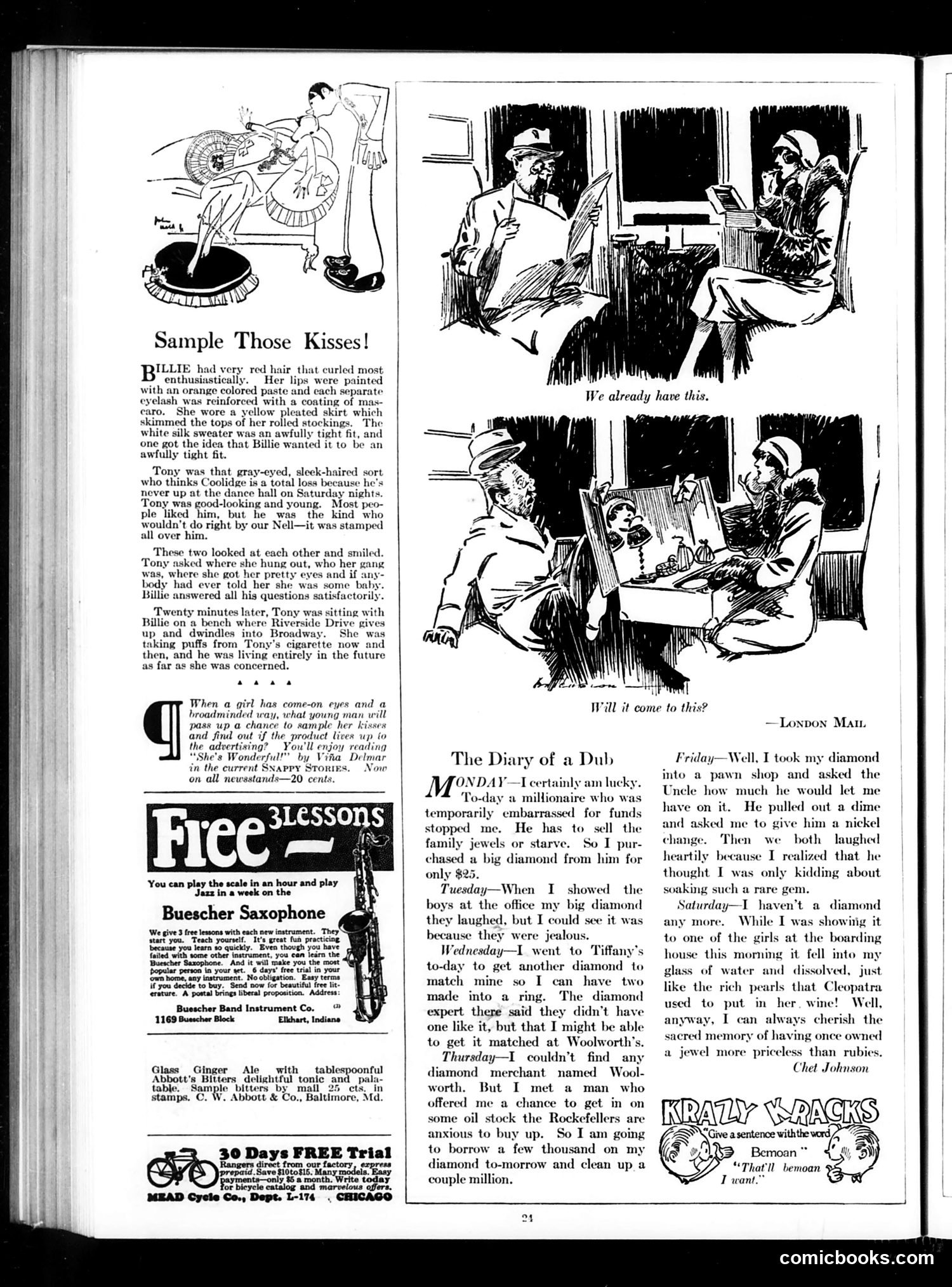
**Top Left Cartoon ("Sample Those Kisses!"):** A satirical story about Billie, a flashy young woman with heavily made-up eyes, rolled stockings, and tight clothing, and Tony, a slick young man. The narrative warns that Tony is the type "who wouldn't do right by our Nell"—a reference to seduction without marriage, a major social concern of the 1920s. The satire targets both the "modern girl" aesthetic and the predatory young man, implying their superficial attraction will lead to moral compromise. **Right Panel ("Will it come to this?"):** Shows scenes of a woman (likely Billie) meeting with what appears to be an older man, perhaps suggesting the financial desperation or transactional relationships that result from such encounters. The caption warns of consequences. **"The Diary of a Dub":** A humorous con-artist tale about a gullible man duped into buying a fake diamond for $25, then repeatedly scammed with increasingly absurd schemes (matching diamonds at Woolworth's, oil stock). The joke ridicules easy marks and inflation-era financial speculation.
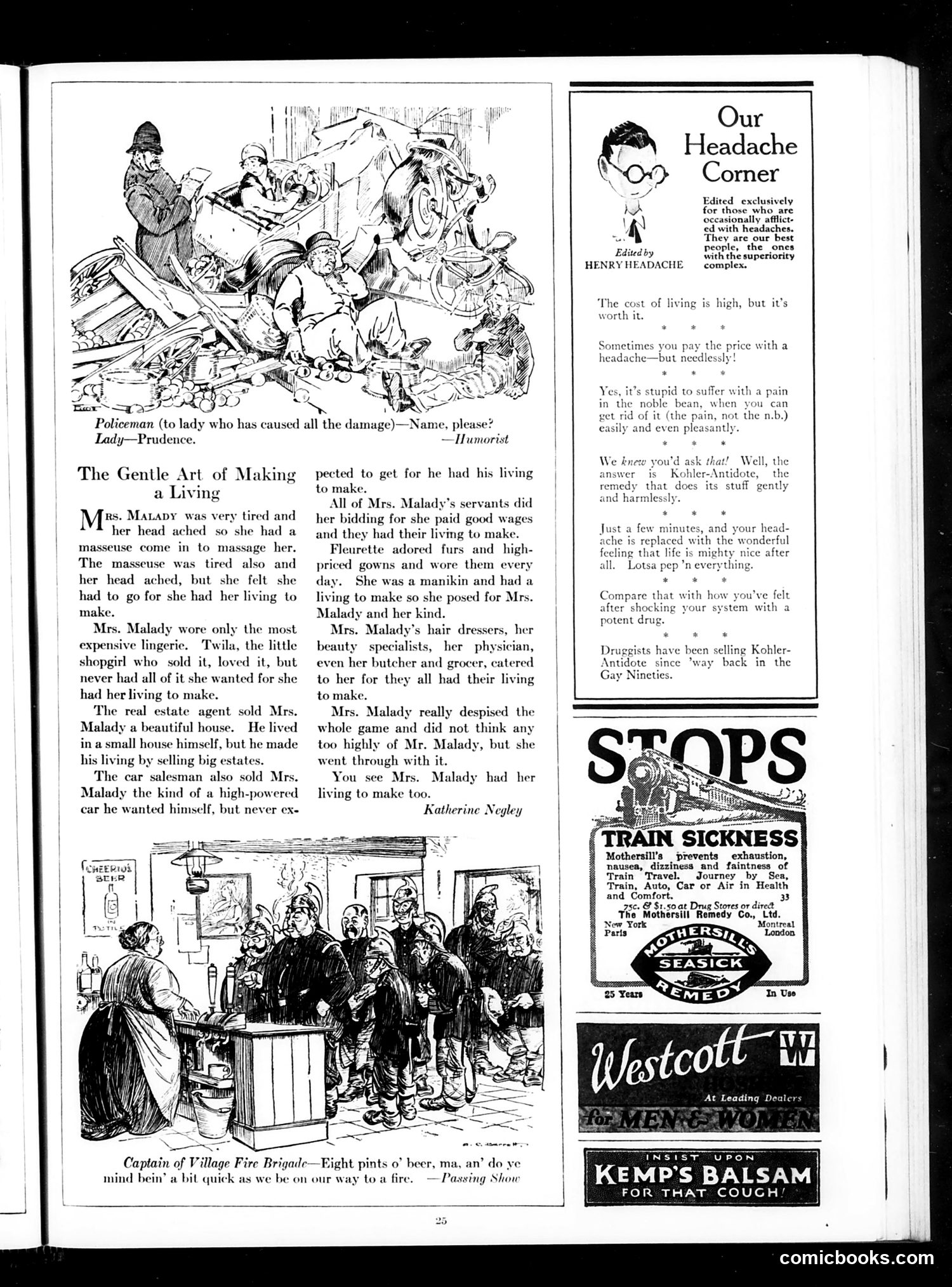
This satirical story critiques early 20th-century economic inequality and the desperation of working people. Mrs. Malady, a wealthy woman, employs numerous service providers—a masseuse, shopgirl, real estate agent, car salesman, servants, fashion model, hairdresser, physician, butcher, and grocer. The repeated refrain "they all had their living to make" emphasizes that each person, regardless of their own preferences or exhaustion, must serve the wealthy to survive economically. The satire's point: Mrs. Malady herself "despised the whole game" and "did not think any too highly of Mr. Malady," yet she perpetuates the system anyway because she too "had her living to make." Everyone—rich and poor—is trapped in an economic machine. The accompanying cartoons satirize class dynamics and social obligation, illustrating how the cost of living forces participation in an unfair system.
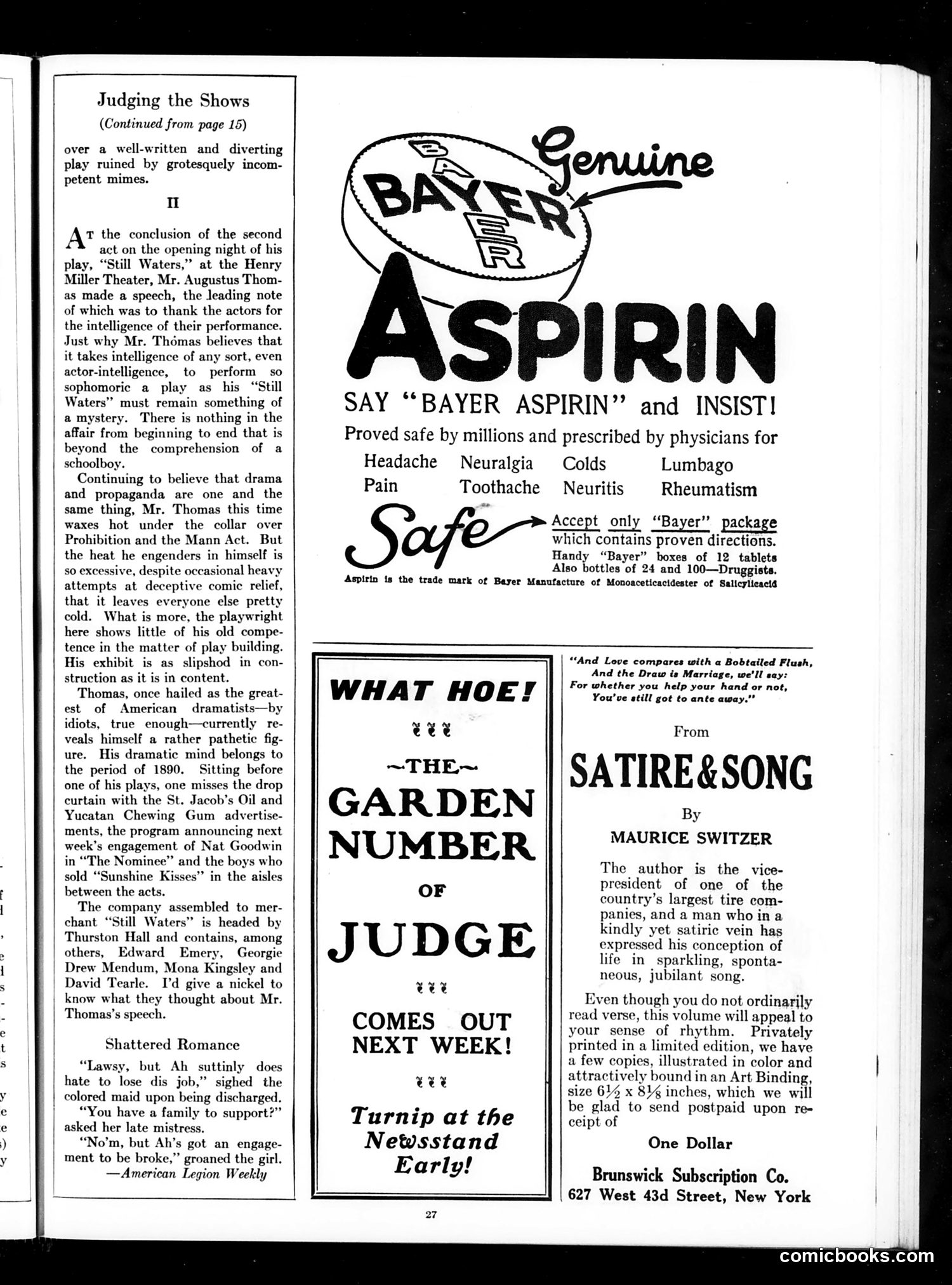
This page primarily contains **theater criticism and advertising** rather than political cartoons. The main article critiques playwright **Augustus Thomas** and his play "Still Waters," currently at the Henry Miller Theater. The critic harshly dismisses Thomas as an outdated dramatist (belonging to "the period of 1890") whose work is intellectually shallow and poorly constructed. Thomas had made a post-show speech thanking his actors for their "intelligence," which the critic finds absurd given the play's simplistic content. The reviewer particularly mocks Thomas's heavy-handed treatment of contemporary issues like Prohibition and the Mann Act, finding the overall production amateurish. The page is dominated by **commercial advertisements**—notably a large Bayer Aspirin ad and promotions for books and subscriptions. A brief joke about a discharged maid appears at the bottom. The humor is **theatrical and social commentary** rather than political satire—the joke targets artistic pretension and outdated dramatic conventions rather than political figures or movements.
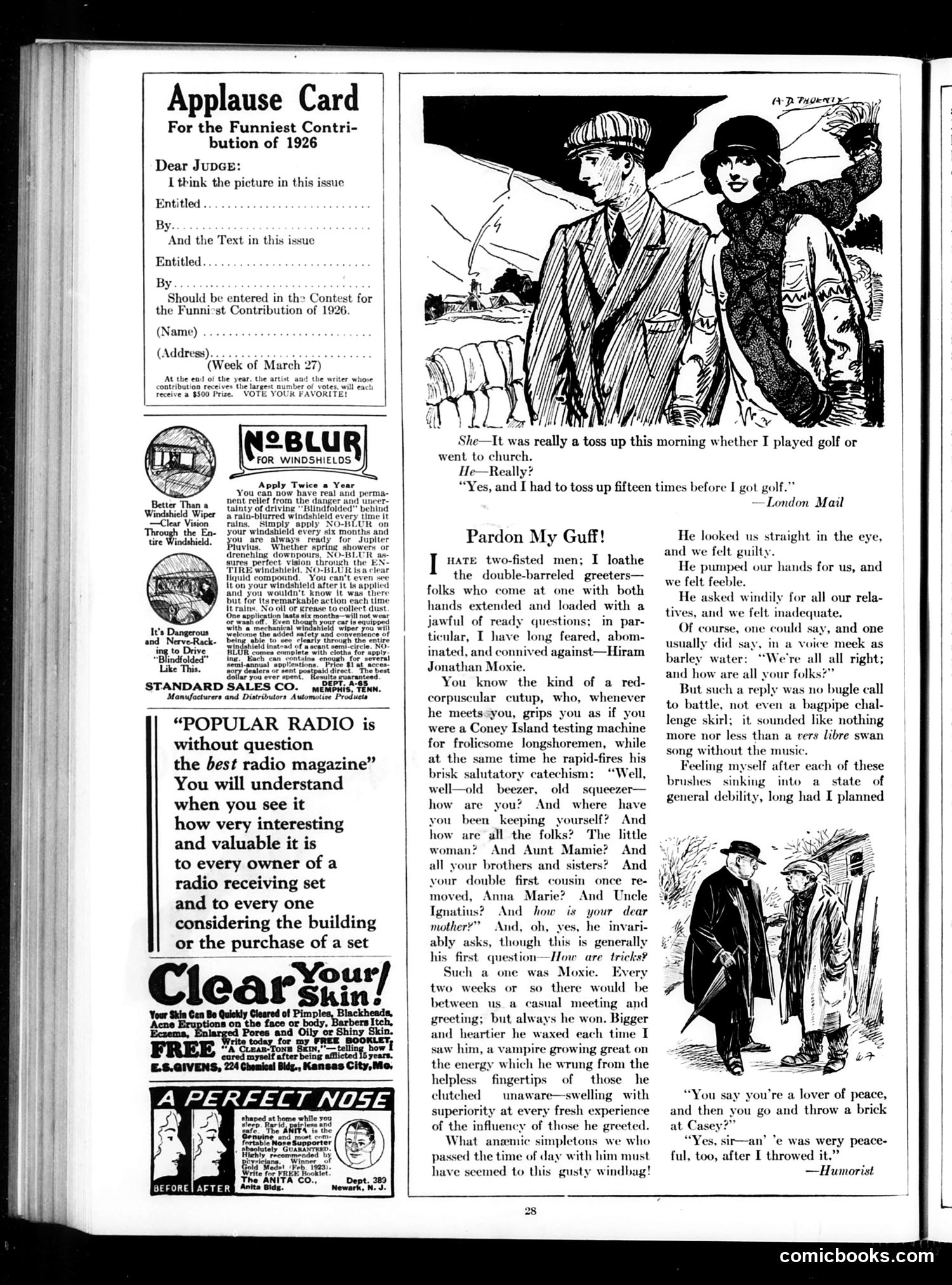
This page contains humor pieces and advertisements typical of 1926 Judge magazine. The main satirical content is "Pardon My Guff!"—a complaint about an obnoxious personality type: the aggressively gregarious man (named Hiram Jonathan Moxie) who buttonholes acquaintances with enthusiastic handshakes and rapid-fire questions about their entire family. The joke targets early-20th-century social anxiety around forced friendliness and overeager networking. Moxie's relentless cheerfulness—asking "How are tricks?" and inquiring about distant relatives—is portrayed as vampiric energy-draining rather than charming. The narrator describes feeling "feeble" and "inadequate" afterward. The cartoon illustrating this shows two figures encountering a jovial man, visualizing the social discomfort described in the text. The page also includes an "Applause Card" for readers to vote on favorite contributions, and period advertisements (windshield wipers, radio magazine, skin treatments, nose correction).
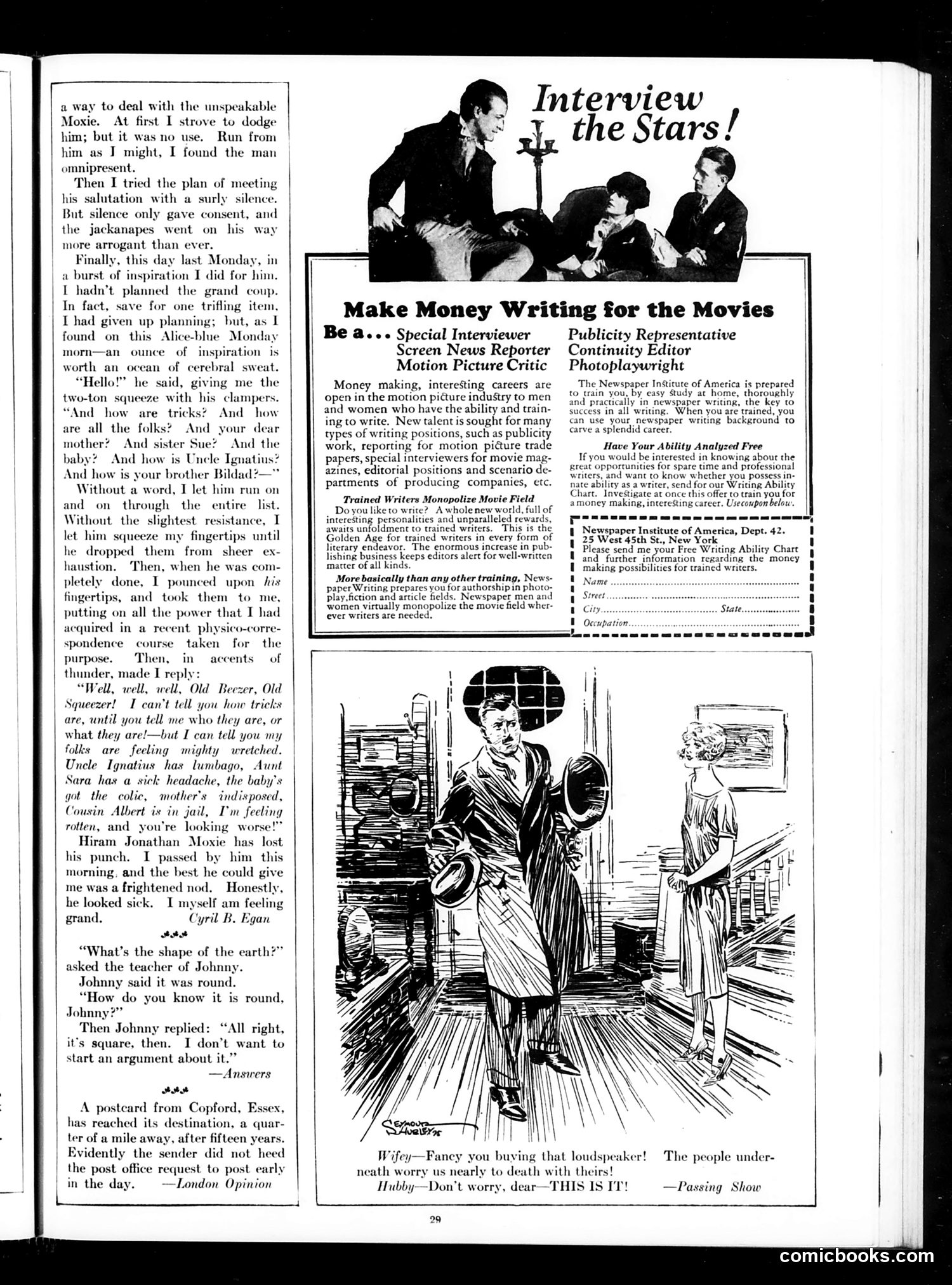
This page combines humor, advice, and advertising typical of early 20th-century American magazines. **Left column**: A comedic anecdote by Cyril B. Egan about dealing with an annoyingly gregarious man named "Hiram Jonathan Moxie" who relentlessly greets people with aggressive handshake "squeezes" and intrusive questions about their families. The narrator defeats him through silent tolerance followed by an equally exhausting counter-squeeze and litany of family complaints. The humor relies on physical comedy and the absurdity of social one-upmanship—a relatable frustration with overly familiar acquaintances. **Center/Right**: An advertisement for the "Newspaper Institute of America," promoting writing careers in the emerging motion picture industry. It emphasizes that newspaper training is the pathway to movie industry jobs in publicity, screenplay writing, and criticism. **Bottom**: A cartoon and unrelated brief anecdotes (Johnny's geometry debate; a lost postcard). The satire is gentle social commentary on American manners and persistence rather than political critique.
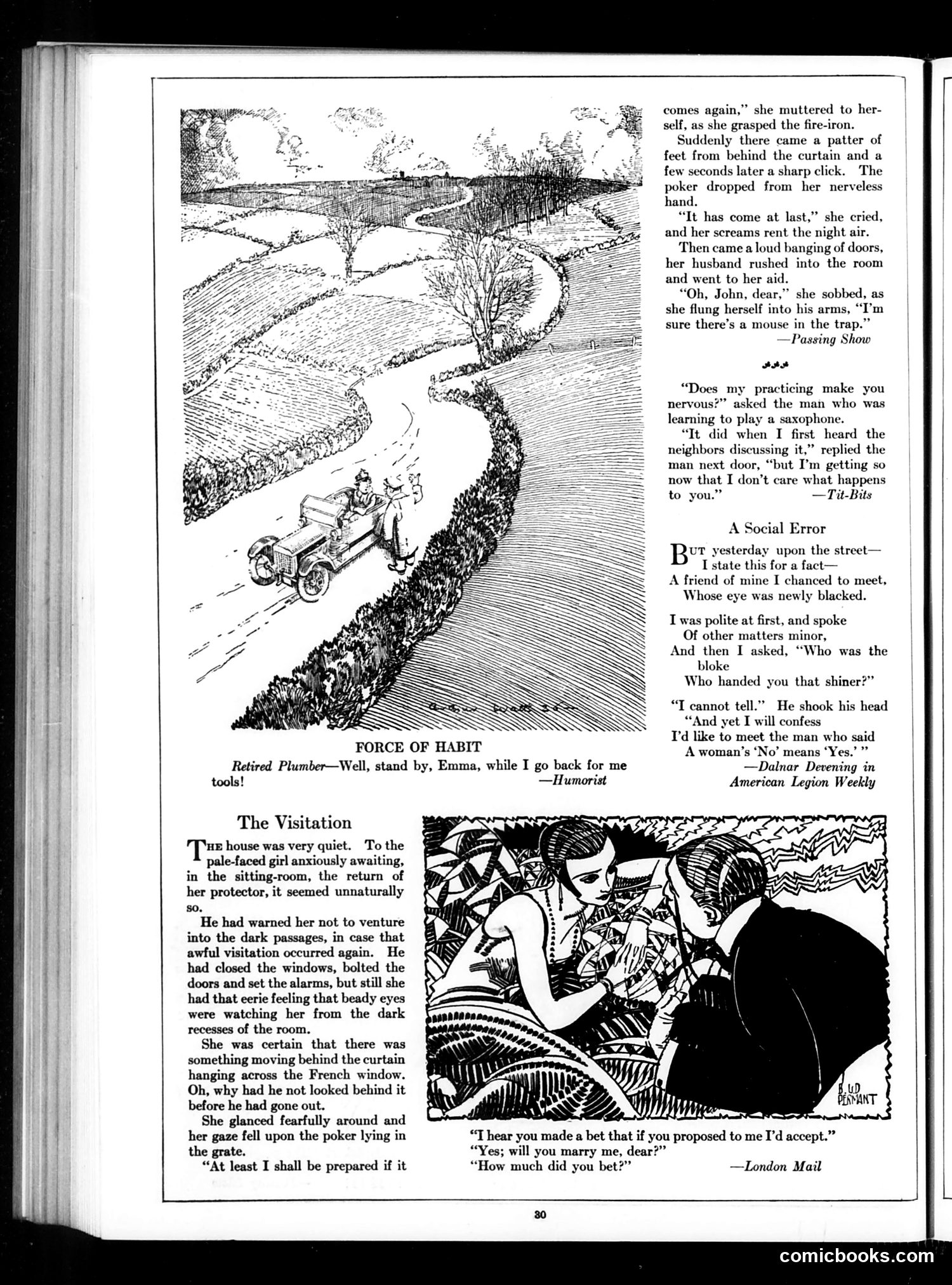
This page contains multiple humorous anecdotes and illustrations typical of early-20th-century satirical magazines. **"Force of Habit"**: A retired plumber tells his wife Emma to stand by while he retrieves tools—a domestic joke about husbands' bossy nature persisting from their working days. **"A Social Error"**: A poem mocking social awkwardness. The speaker politely avoids asking his friend directly about his black eye, then ironically learns the friend wants to meet whoever said "a woman's 'No' means 'Yes'"—satirizing both masculine rudeness and courtship misconceptions. **"The Visitation"**: A gothic-tinged story about a frightened woman hearing noises, preparing to defend herself with a poker—only to discover it's a mouse in a trap. This mocks overwrought feminine anxiety and dramatic overreaction to minor domestic problems. **The saxophonist joke**: Neighbors initially annoyed by someone learning saxophone; the player jokes they've become desensitized ("I don't care what happens to you")—humor about noise complaints and adaptation to irritation.
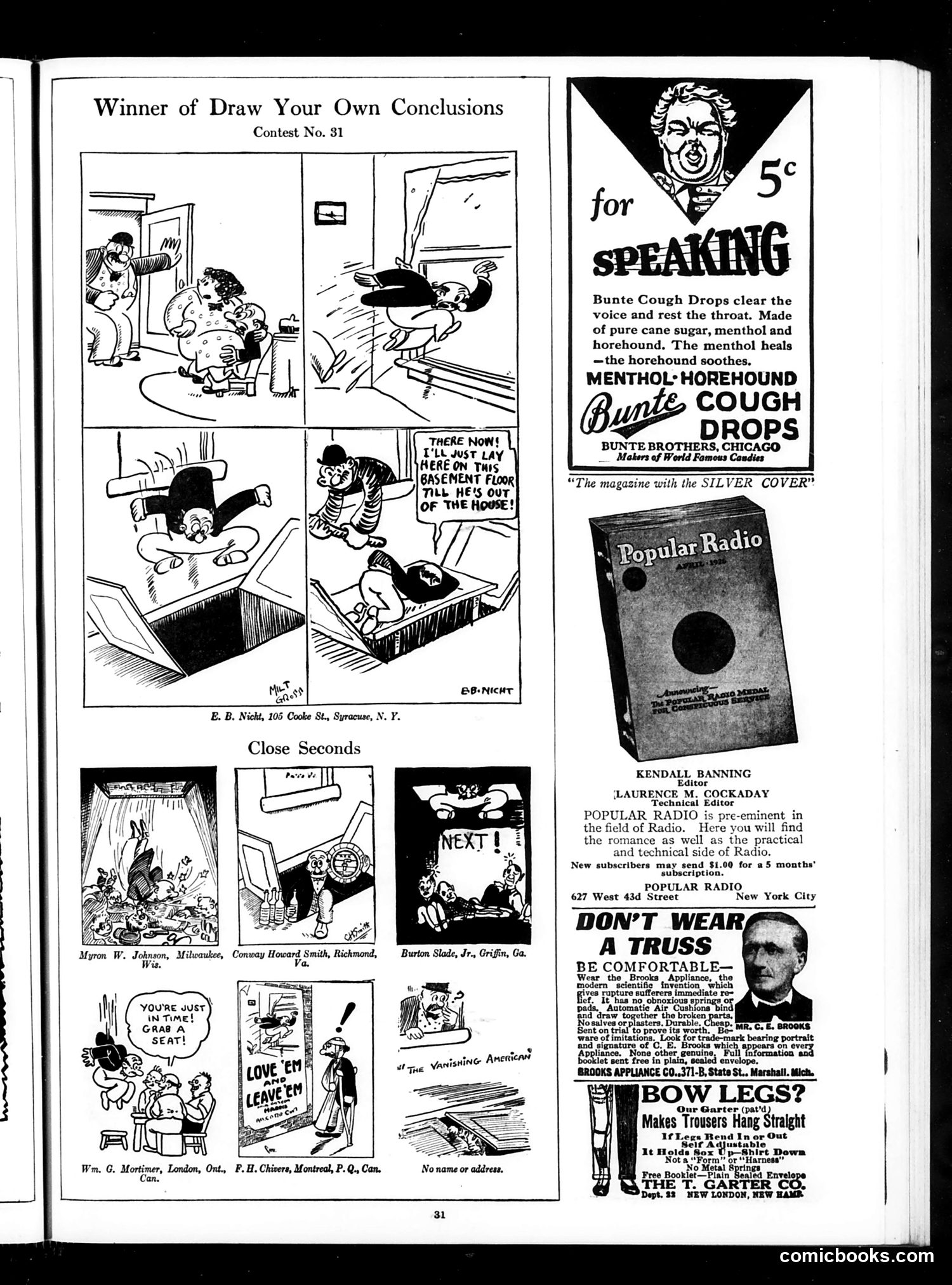
This page contains a contest-winning comic strip titled "Draw Your Own Conclusions" (Contest No. 31) by E.B. Nicht, depicting slapstick domestic humor. The four-panel strip shows a father attempting to discipline or manage children in a basement, with physical comedy involving furniture and the children hiding or escaping. Below that, "Close Seconds" showcases other contest entries—various single-panel gags involving everyday situations and wordplay typical of 1920s-30s humor. The page is primarily **advertising**, however. It features period medical devices and products: Bunte Cough Drops, Popular Radio magazine, a truss (hernia support garment), and a bow-legs correction garter. These ads reflect common health anxieties of the era and the era's unregulated patent-medicine marketing. The ads employ testimonial-style language emphasizing comfort and discreet use—suggesting these were products people felt embarrassed purchasing. The overall effect captures how satirical magazines of this period subsidized humor content through unconventional advertising.
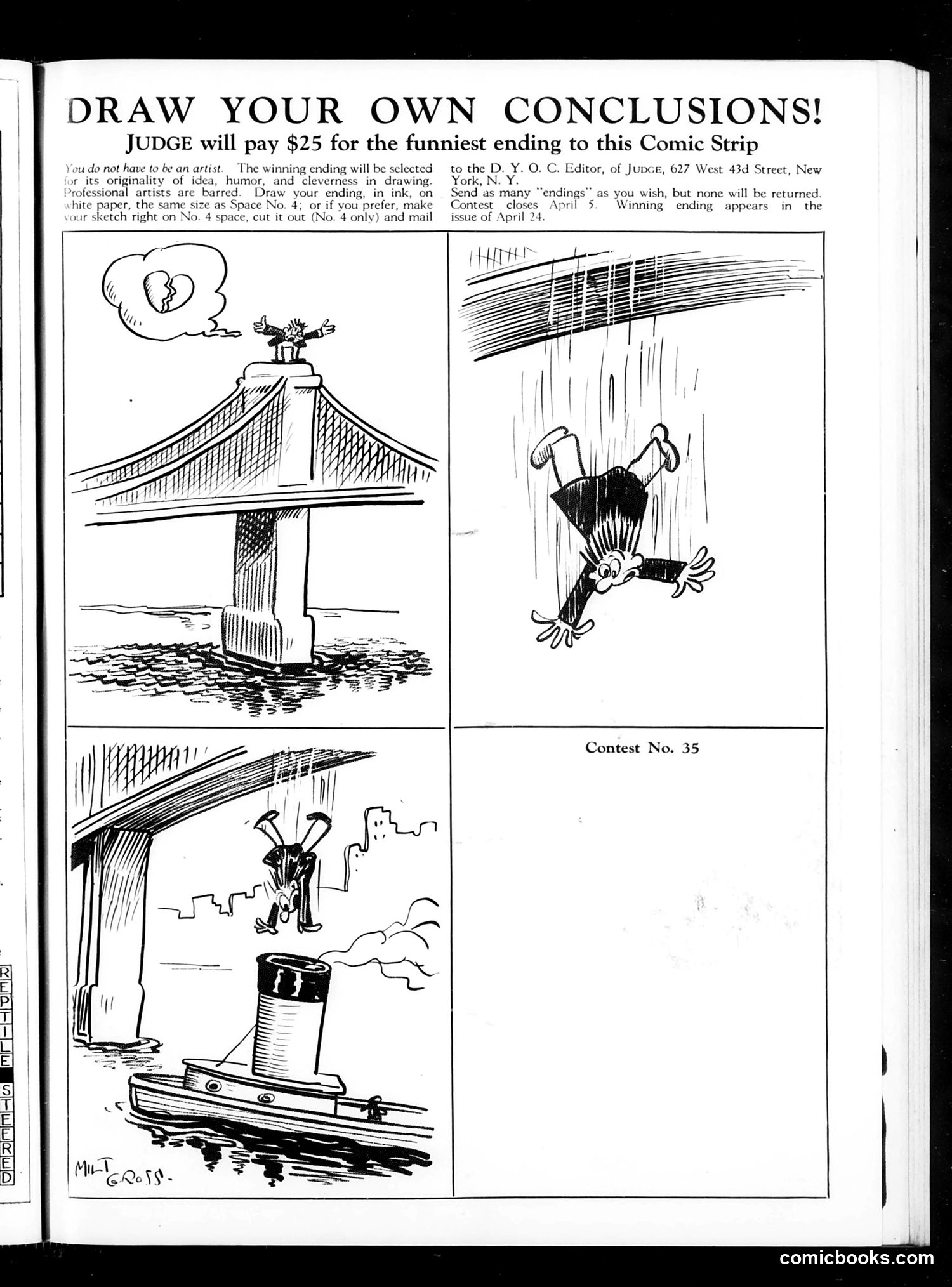
This is a reader-participation contest from Judge magazine, offering $25 for the funniest ending to an incomplete comic strip. The three existing panels establish a darkly humorous scenario: Panel 1 shows a small figure atop a large bridge or monument structure. Panel 2 depicts the figure falling headfirst through the air. Panel 3 shows the figure clinging to a boat's smokestack in water below, with a city skyline visible. The implicit joke concerns suicide—the figure appears to attempt jumping from the bridge but survives by landing in water. Readers are invited to supply humorous conclusions to this potentially tragic setup. The contest reflects early-20th-century satirical magazine humor that often found comedy in dark or morbid situations. Contestants could submit entries by April 5, with the winning ending published April 24.
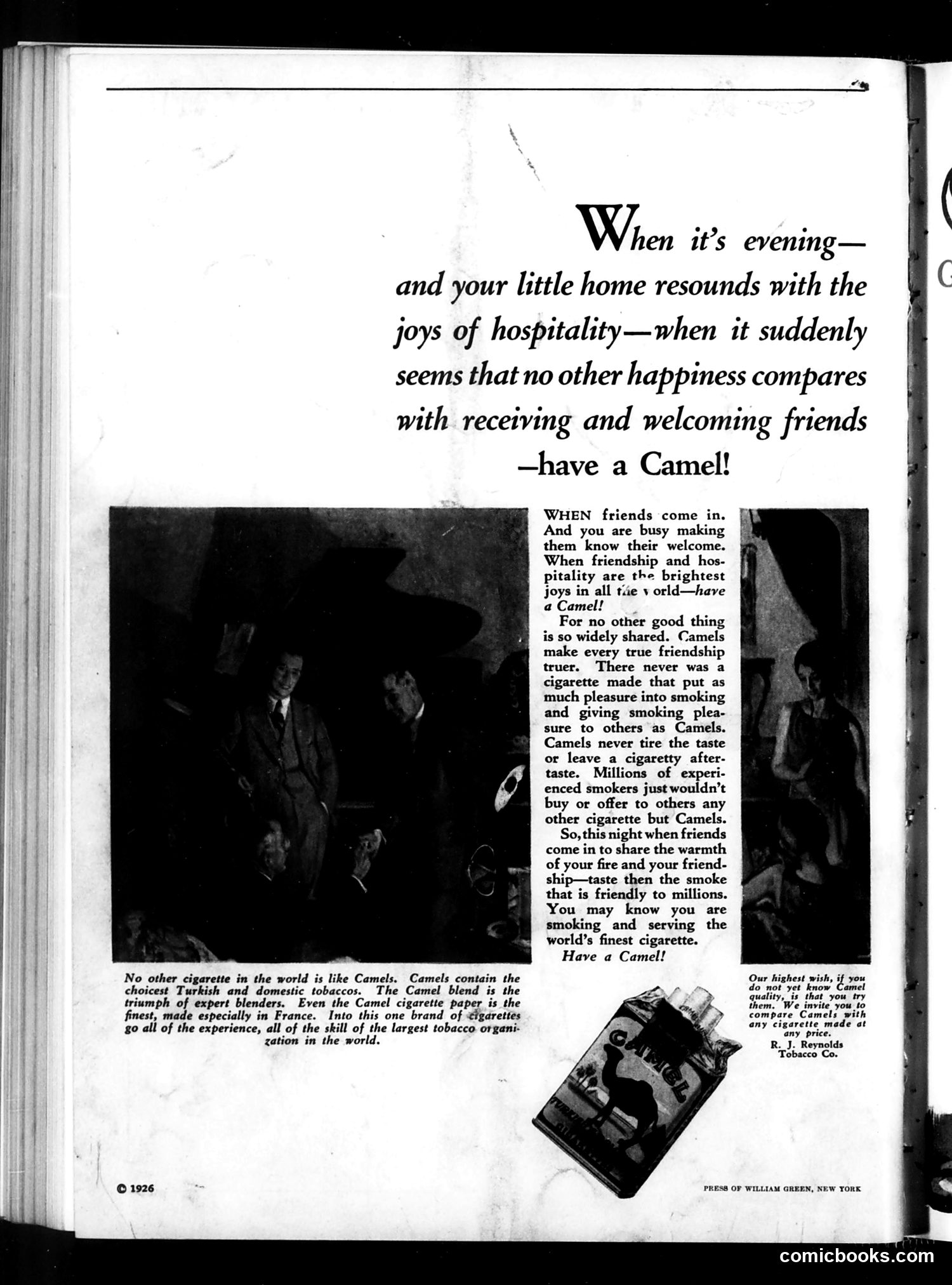
This is **not satire or political commentary**—it's a straightforward cigarette advertisement from R.J. Reynolds Tobacco Co., appearing in Judge magazine in 1926. The page depicts a social scene of friends gathering in someone's home during evening hours. The central image shows men in formal attire socializing indoors, establishing a context of genteel hospitality and friendship. The advertisement's pitch equates smoking Camel cigarettes with social refinement and genuine friendship. It claims Camels are superior because they don't tire the taste and are what "millions of experienced smokers" choose to offer guests—positioning the cigarette as a marker of good taste and hospitality. The text emphasizes Camel's "choicest Turkish and domestic tobaccos" and French cigarette paper as proof of quality. By modern standards, this represents the pre-health-warning era when cigarettes were openly marketed as social lubricants and status symbols tied to friendship and entertaining—practices now illegal or heavily restricted.