
Judge, 1926-03-27 · page 15 of 36
Judge — March 27, 1926 — page 15: what you’re looking at
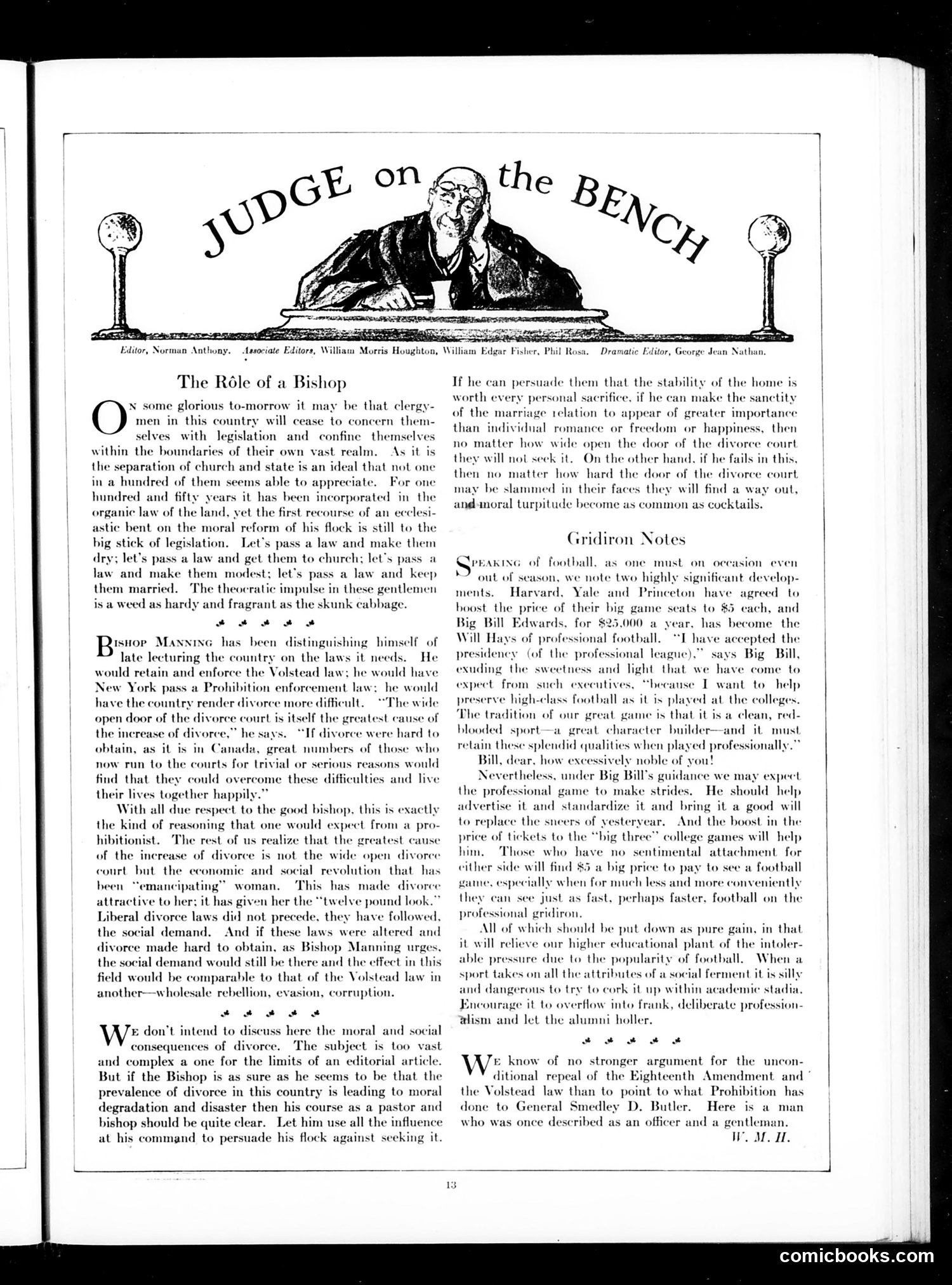
What you’re looking at
This editorial attacks Bishop William Manning (identifiable from context) for advocating stricter divorce laws and Prohibition enforcement. The satire argues that Manning, like other clergy, inappropriately uses legislation to enforce morality rather than persuasion within his religious authority. The cartoon critiques the bishop's reasoning as contradictory: he claims "wide open" divorce courts cause divorce, but the editorial counters that social and economic changes—particularly women's emancipation—drive divorce demand. Making divorce legally difficult (like Canada's stricter laws) won't prevent it, just as Prohibition didn't stop drinking; people will evade restrictive laws. The piece advocates that bishops should persuade congregants *morally* rather than lobby for legal coercion. It reflects 1920s debates over church-state separation, women's independence, and whether legislation can enforce social values—all remain contemporary concerns.
📄 Transcribed text from this page (OCR, searchable)
Machine-transcribed from the original scan — historical spelling and the odd misread are preserved.
Editor, No The Role of a Bishop N some glorious to-morrow it may be that clergy- O men in this country will cease to concern them- selves with legislation and confine themselves within the boundaries of their own vast realm. As it is the separation of church and state is an ideal that not one in a hundred of them seems able to appreciate. F hundred and fifty organic law of the ‘or one vars it has heen incorporated in the land, yet the first recourse of an ecclesi- astic bent on the moral reform of his flock is still to the hig stick of legislation. Let's pass a law and make them dry; let’s pass a law and get them to church; let's pass a law and make them modest; let's pass a law and keep them married. The theocratic impulse in these gentlemen is a weed as hardy and fragrant as the skunk cabbage. ry Barer ManninG has been distinguishing himself of late lecturing the country on the laws it needs. He would retain and enforce the Volstead law; he would have New York pass a Prohibition enforcement law; he would have the country render divorce more difficult. *The wide open door of the divorce court is itself the greatest cause of the increase of divorce,” he says. “If divorce were hard to obtain, as it is in Canada, great numbers of those who now run to the courts for trivial or serious reasons would find that they could overcome these difficulties and live their lives together happily.” a * With all due respect to the good bishop, this is exactly the kind of reasoning that one would expect from a pro- hibitionist. The rest of us realize that the greatest cause of the increase of divorce is not the wide open divorce court but the economic and social revolution that has been “emancipating” woman. This has made divori attractive to her; it has given her the “twelve pound look.” Liberal divorce laws did not precede, they have followed, the social demand. And if these laws were altered and divorce made hard to obt Bishop Manning urges, the social demand would still be there and the effect in this field would be comparable to that of the Volstead law in another—wholesale rebellion, evasion, corruption. sos Ws don’t intend to discuss here the moral and social consequences of divorce. The subject is too vast and complex a one for the limits of an editorial article. But if the Bishop is as sure as he seems to be that the prevalence of divorce in this country is leading to moral degradation and disaster then his course as a pastor and bishop should be quite cl Let him use all the influence at his command to persuade his flock against seeking it. 23 n Anthony. Associate Editors, William Morris Houghton, William Ei Fisher, Phil Rosa. Dramatic Editor, George Jean Nathan. If he can persuade them that the stability of the home is worth every personal sacrifice, if he can make the sanctity of the mar ion to appear of greater importance than individual romance or freedom or happiness, then no matter how wide open the door of the divorce court they will not seek it, On the other hand, if he then no matter how Is in this, hard the door of the divorce court may be slammed in their faces they will find a way out, andanoral turpitude become as common as cocktails. Gridiron Notes Greanine of football, as one must on occasion even * out of season, we note two highly significant develop- ments. Harvard, Yale and Princeton boost the price of their big game Big Bill Edwards, for $25.000 a y Will Hays of professional football. presidency have agreed to ach, and ar, has become the I have accepted the (of the professional league),”” says Big Bill, exuding the sweetness and light that we have come to expect from such executives, “because I want to help s to preserve high-class football as it is played at the colleges. The tradition of our great: game is that it is a clean, red- blooded sport—a great character builder—and it must retain these splendid qualities when played professionally.” Bill, dear, how excessively noble of you! Nevertheless, under Big Bill’s guidance we may expect the professional game to make strides. He should help advertise it and standardize it and bring it a good will to replace the sneers of yesteryear. And the boost. in the price of tickets to the “big three” college games will help Those who have no sentimental attachment for cither side will find $5 a big price to pay to see a football game, especially when for much less and more conveniently they can see just as fast, perhaps faster, football on the professional gridiron. him. All of which should be put down as pure gain, in that it will relieve our higher educational plant of the intoler- able pressure due to the popularity of football. When a sport takes on all the attributes of a social ferment it is silly and dangerous to try to cork it up within academic stadia, Encourage it to overflow into frank, deliberate profession- @lism and let the alumni holler. 2 sos WwW: know of no stronger argument for the uncon- ditional repeal of the Eighteenth Amendment and the Volstead law than to point to what Prohibition has done to General Smedley D. Butler. Here is a man who was once described as an officer and a gentleman. W. M. H. +o comicbooks.com