
Judge, 1926-03-27 · page 17 of 36
Judge — March 27, 1926 — page 17: what you’re looking at
What you’re looking at
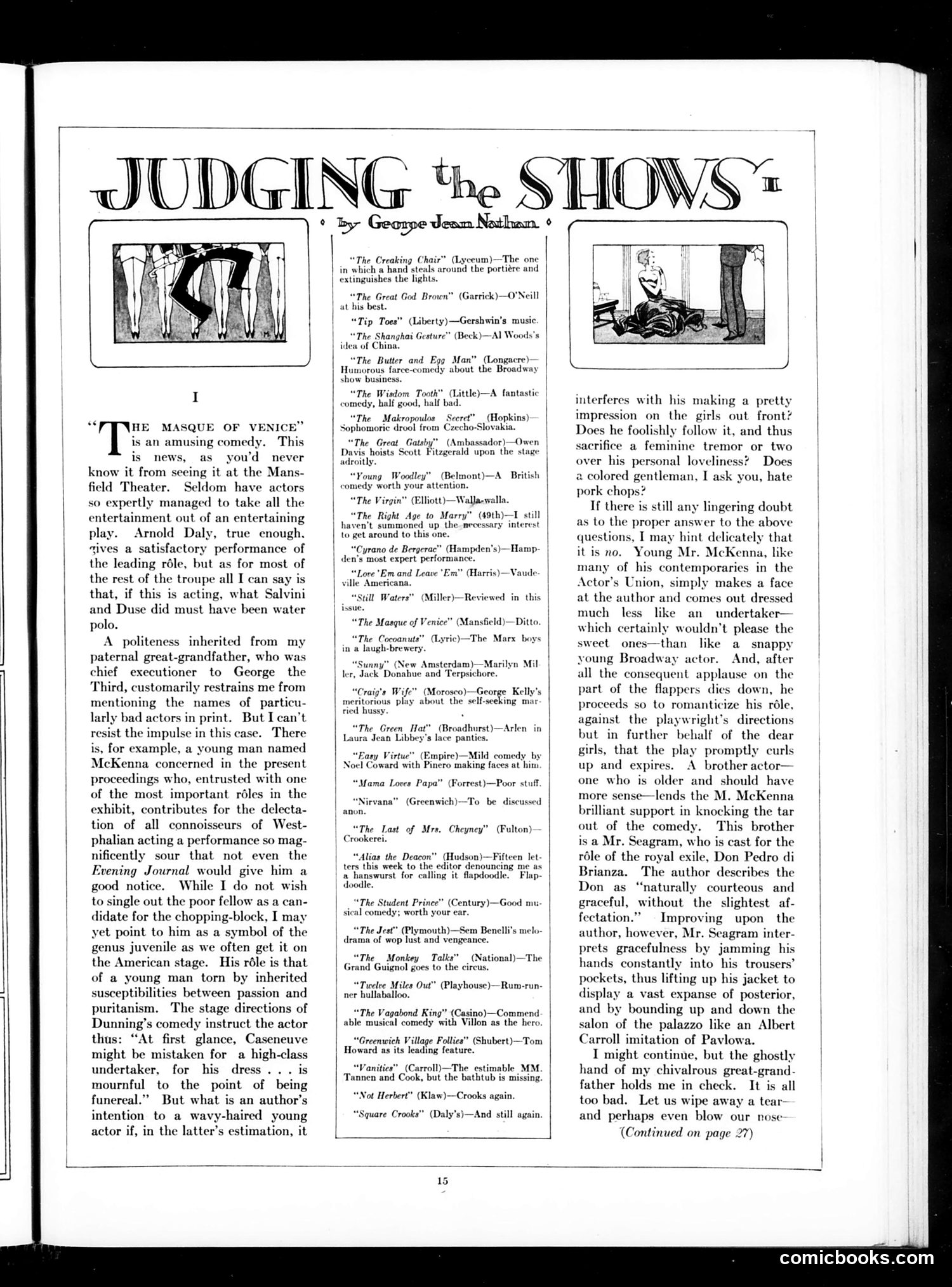
This page features theater criticism by George Jean Nathan, a prominent drama critic. The two small photographs show scenes from plays under review. The main article critiques "The Masque of Venice" at the Mansfield Theater, particularly attacking the performance of an actor named McKenna. Nathan uses scathing language—comparing the troupe's work unfavorably to famous actors Salvini and Duse, and sarcastically suggesting McKenna's bad acting symbolizes typical mediocre young actors on the American stage. The bulk of the page is Nathan's rapid-fire review column of current Broadway shows, offering brief, often cutting assessments of various productions (ranging from "The Great Gatsby" to "The Vagabond King"). His tone alternates between witty praise and dismissive criticism. **Context for modern readers:** This reflects early 1920s theatrical culture and Nathan's influential role as a sharp-tongued arbiter of theatrical taste in American popular magazines.
📄 Transcribed text from this page (OCR, searchable)
Machine-transcribed from the original scan — historical spelling and the odd misread are preserved.
DGING ‘be SHOWS: = HE MASQUE OF VENICE TT an amusing comedy. This news, as you'd never know it from seeing it at the Mans- field Theater. Seldom have actors so expertly managed to take all the entertainment out of an entertaining play. Arnold Daly, true enough. ives a satisfactory performance of the leading réle, but as for most of the rest of the troupe all I can say is that, if this is acting, what Salvini and Duse did must have been water polo. A politeness inherited from my paternal great-grandfather, who w: chief executioner to George the Third, customarily restrains me from mentioning the names of particu- larly bad actors in print. But I can’t resist the impulse in this case. There is, for example, a young man named McKenna concerned in the present proceedings who, entrusted with one of the most important réles in the exhibit, contributes for the delecta- tion of all connoisseurs of West- phalian acting a performance so mag- nificently sour that not even the Evening Journal would give him a good notice. While I do not wish to single out the poor fellow as a can- didate for the chopping-block, I may yet point to him as a symbol of the genus juvenile as we often get it on the American stage. His réle is that of a young man torn by inherited susceptibilities between passion and puritanism. The stage directions of Dunning’s comedy instruct the actor thus: “At first glance, Caseneuve might be mistaken for a high-class undertaker, for his dress .. . is mournful to the point of being funereal.” But what is an author’s intention to a wavy-haired young actor if, in the latter’s estimation, it ¢ by Georpe Jeam Nathan ° “The Creaking Chair im)—The one in which a hand steals around the portidre and | extinguishes the lights. “The Great God Brown” ( | at his best. rick) —O'Neill “Tip Toes” (Liberty)—Gershwin's music s) thai Gesture” (Beck)—Al Woods's | The Butter and Ey Humorous farce-comedy show business. “The Wisdom Tooth" (Little)—A fantastic comedy, half good, half bad. “The Makropoulos Secret” (Hopkins): Sophomoric drool from Czecho-Slovakia. the Great Gatsby" (Ambassador)—Owen s Scott Fitzgerald upon the stage Man” (Longacre) bout the Broadway Young Woodley” comedy worth your attention. “The Virgin" (Elliott) —WalJa-walla. The Right Age to Marry” (49th)—I still | haven't summoned up the mecessary interest to get around to this one (Belmont)—A__ British ‘yrano de Bergerac” (Hampden's)—Hamp. den’s most expert performance. “Lore 'Em and Leave ‘Em" (Harris) —Vaude- ville Americana “Still Waters” (Miller)—Reviewed in this “The Masque of Venice” (Mansfield) —Ditto “The Cocoanuts” (Lyric)—The Marx boys in @ laugh-brewery. “Sunny” (New Amsterdam)—Marilyn Mil ler, Jack Donahue and Terpsichore. raig's W Kelly's meritorious play ‘King mar ried hussy. “The Green Hat" (Broadhurst)—Arlen in an Libbey's lace panties. ‘asy Virtue” (Empire)—Mild comedy by Coward with Pinero making faces at him “Mama Loves Papa” (Forrest)—Poor stuf. “Nirvana” (Greenwich)—To be discussed anon. “The Last of Mrs. Cheyney” (Fulton) Crookerei. “Alias the Deacon” (Hudson)—Fifteen let ters this week to the editor denouncing me as | a hanswurst for calling it flapdoodle. Flap- doodle. (Plymouth)—Sem Benelli’s mel drama of wop lust and vengeance. “The Monkey Talks _(National)—The Grand Guignol goes to the circus. “Twelve Miles Out” (Playhouse)—Rum-run- ner hullaballoo. “The Vagabond King” (Casino)—Commend able musical comedy with Villon as the hero. reenwich Village Follies” (Shubert)—Tom Howard as its leading feature. “Vanities” (Carroll)—The estimable MM. Tannen and Cook, but the bathtub is missing. “Not Herbert” (Klaw)—Crooks again. “Square Crooks" (Daly's)—And still again. interferes with his making a pretty impression on the girls out front? Does he foolishly follow it, and thus sacrifice a feminine tremor or two over his personal loveliness? Does colored gentleman, I ask you, hate pork chops? If there is still any lingering doubt as to the proper answer to the above questions, I may hint delicately that Young Mr. McKenna, like many of his contemporaries in the Actor's Union, simply makes a face at the author and comes out dressed much less like an undertaker— which certainly wouldn't please the sweet ones—than like a snappy young Broadway actor. And, after all the consequent applause on the part of the flappers dies down, he proceeds so to romanticize his réle, against the playwright’s directions but in further behalf of the dear girls, that the play promptly curls up and expires. A brother actor— one who is older and should have more sense—lends the M. McKenna brilliant support in knocking the tar out of the comedy. This brother is a Mr. Seagram, who is cast for the role of the royal exile, Don Pedro di Brianza. The author describes the Don as “naturally courteous and graceful, without the slightest af- fectation.” Improving upon the author, however, Mr. Seagram inter- prets gracefulness by jamming his hands constantly into h ’’ pockets, thus lifting up his jacket to display a vast expanse of posterior, and by bounding up and down the salon of the palazzo like an Albert Carroll imitation of Pavlowa. I might continue, but the ghostly hand of my chivalrous great-grand- father holds me in check. It is all too bad. Let us wipe away a tear and perhaps even blow our nose (Continued on page 27) it is no. comicbooks.com