
Judge, 1926-03-27 · page 22 of 36
Judge — March 27, 1926 — page 22: what you’re looking at
What you’re looking at
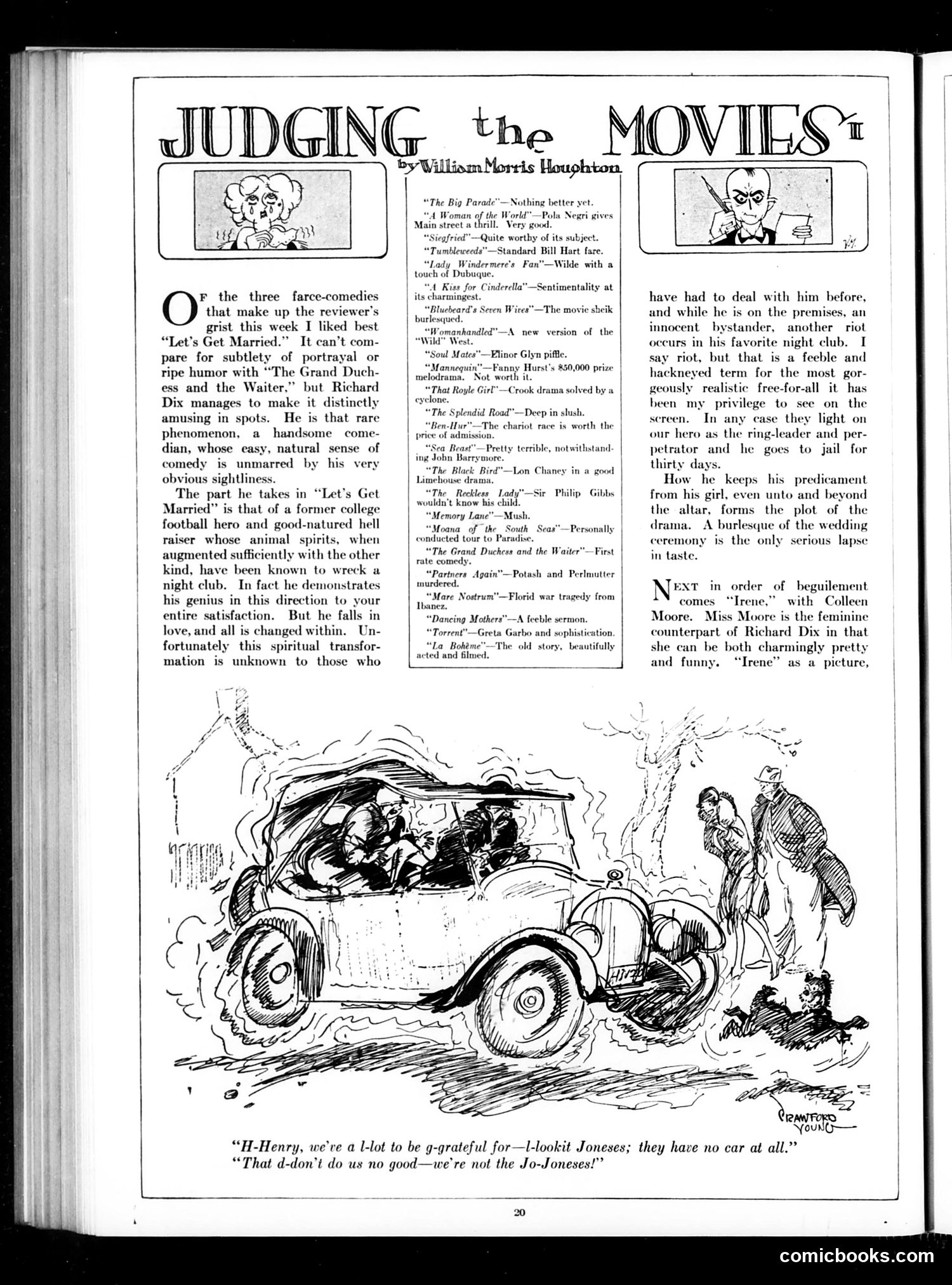
This is a film critic's column by William Morris Houghton reviewing current silent movies. The page lists brief reviews of popular films including "The Big Parade," "Siegfried," and "Lady Windermere's Fan"—all contemporary releases audiences would recognize. The main article praises actor Richard Dix in "Let's Get Married," describing his character as a former college football player and hell-raiser who wrecks a night club but reforms when he falls in love. The critic notes Dix is rare: an attractive leading man with genuine comedic timing. The cartoon below depicts a car accident with the caption joking about envying neighbors' wealth—"they have no car at all" becomes a backhanded complaint, suggesting the speaker regrets owning their accident-prone vehicle. This reflects 1920s anxieties about new automobile technology and conspicuous consumption during the Jazz Age boom.
📄 Transcribed text from this page (OCR, searchable)
Machine-transcribed from the original scan — historical spelling and the odd misread are preserved.
William Morris ha: JUDGING the MOVIES* | F the three farce-comedies that make up the reviewer's grist this week I liked best “Let’s Get Married.” It can’t com- pare for subtlety of portrayal or ripe humor with “The Grand Duch- ess and the Waiter,” but Richard Dix manages to make it distinctly amusing in spots. He is that rare phenomenon, a handsome come- dian, whose easy, natural sense of comedy is unmarred by his very obvious sightliness. The part he takes in “Let’: t Married” is that of a former college football hero and good-natured hell raiser whose animal spirits, when augmented sufficiently with the other kind, have been known to wreck a night club. In fact he demonstrates his genius in this direction to your entire satisfaction. But he falls in love, and all is changed within. Un- fortunately this spiritual transfor- mation is unknown to those who “The Big Parade—Nothing better yet. “A Woman of the W Pola Negri gives Main street a thrill. Very good. “Siegfried” —Quite worthy of its subject. “Tumbleweeds"—Standard Bill Hart fare. “Lady Windermere’s Fan”—Wilde with a touch of Dubuque. iss for Cinderella” —Sentimentality at its charmingest. “Bluebeard’s Seren Wiees”—The movie sheik | burlesqued. “Womanhandled”—A new version of the Soul Mates’ inor Glyn piffle. That Royle Girl” —Crook drama solved by cyclone. “The Splendid Road” —Deep in slush. “The chariot race is worth the | sion. Pretty terrible, notwithstand- | Jobn Barrymore. “The Black Bird”—Lon Chaney in a good Limehouse drama, “The Reckless Lady"—Sir Philip Gibbs | wouldn't know his child. | “Memory Lane” —Mush. “Moana of the South Seas"—Personally. | | conducted tour to Paradise, | “The Grand Duchess and the Waiter”—First | rate comedy. “Partners Again"—Potash and Perlmutter murdered. i Mare Nostrum”—Florid war tragedy from banez. “Dancing Mother “Torrent” ‘A feeble sermon. reta Garbo and sophistication, “La Bohem old story, beautifully acted and film Hurst's 850,000 prize | have had to deal with him before, and while he is on the premises, an innocent bystander, another riot occurs in his favorite night club. I say riot, but that is a feeble and hackneyed term for the most gor- geously realistic free-for-all it has heen my privilege to see on the screen, In any case they light on our hero as the ring-leader and per- petrator and he goes to jail for thirty days. How he keeps his predicament from his girl, even unto and beyond the altar, forms the plot of the drama. A burlesque of the wedding ceremony is the only serious lapse in taste. N T in order of beguilement comes “Irene,” with Colleen Moore. Miss Moore is the feminine counterpart of Richard Dix in that she can be both charmingly pretty and funny. “Irene” as a picture, “H-Henry, we've a l-lot to be g-grateful for—tl-lookit Joneses; they have no car at all.” “That d-don’t do us no good—we're not the Jo-Joneses!” comicbooks.com