
A complete issue · 72 pages · 1924
Judge — September 13, 1924
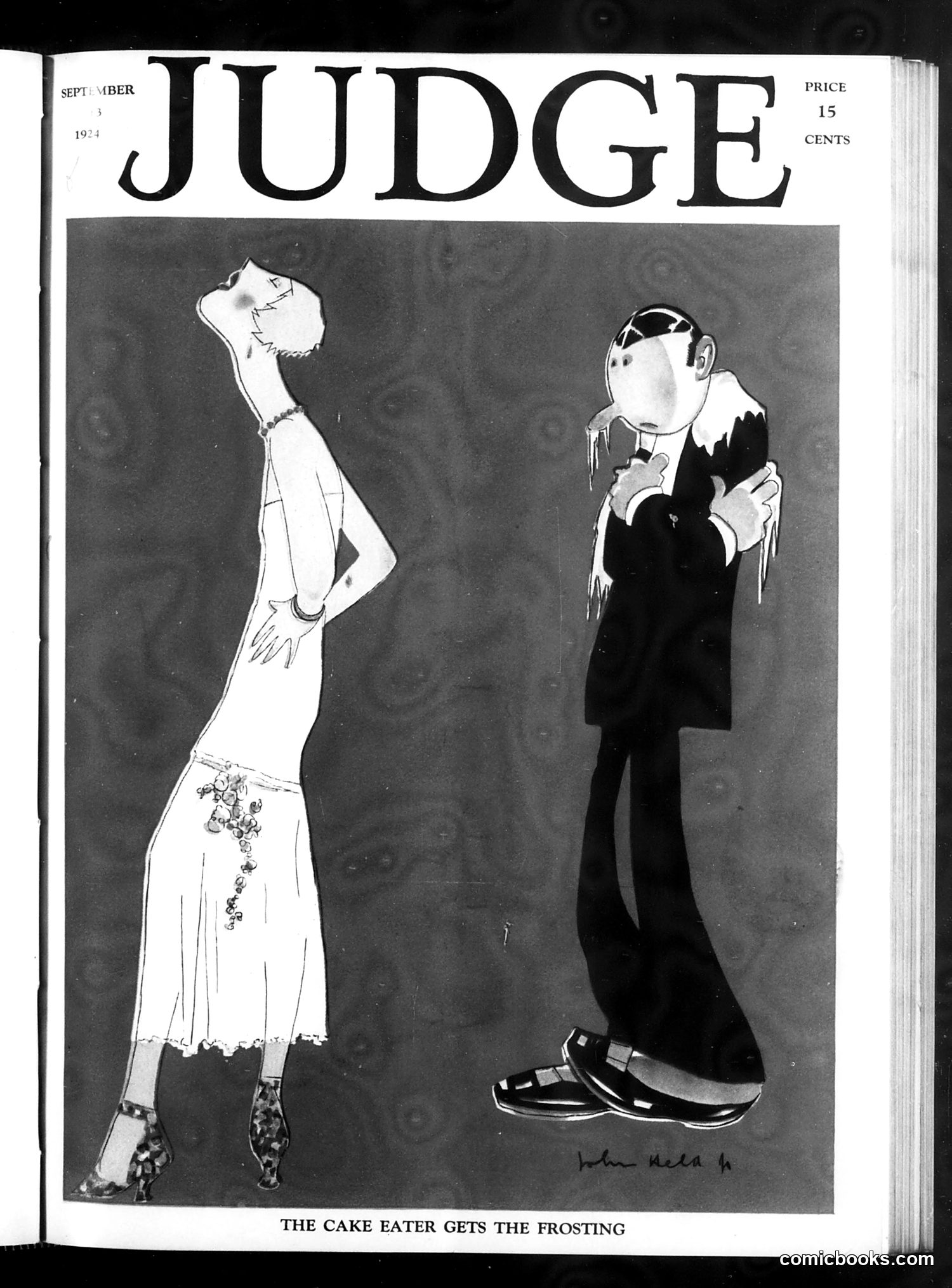
**The Cartoon:** "The Cake Eater Gets the Frosting" This illustration satirizes romantic dynamics of the 1920s. The figure on the left is a fashionably dressed woman in a white dress with decorative details, depicted in an exaggerated, elongated style typical of the era. On the right is a man in formal attire appearing anxious or distressed. **The Satire:** "Cake eater" was 1920s slang for an effeminate or frivolous man, often one who pursued women superficially. The joke suggests that even such seemingly undesirable male types were succeeding romantically ("getting the frosting"—the prize). This reflects contemporary anxiety about changing gender roles and dating customs during the Jazz Age, when traditional courtship norms were shifting.
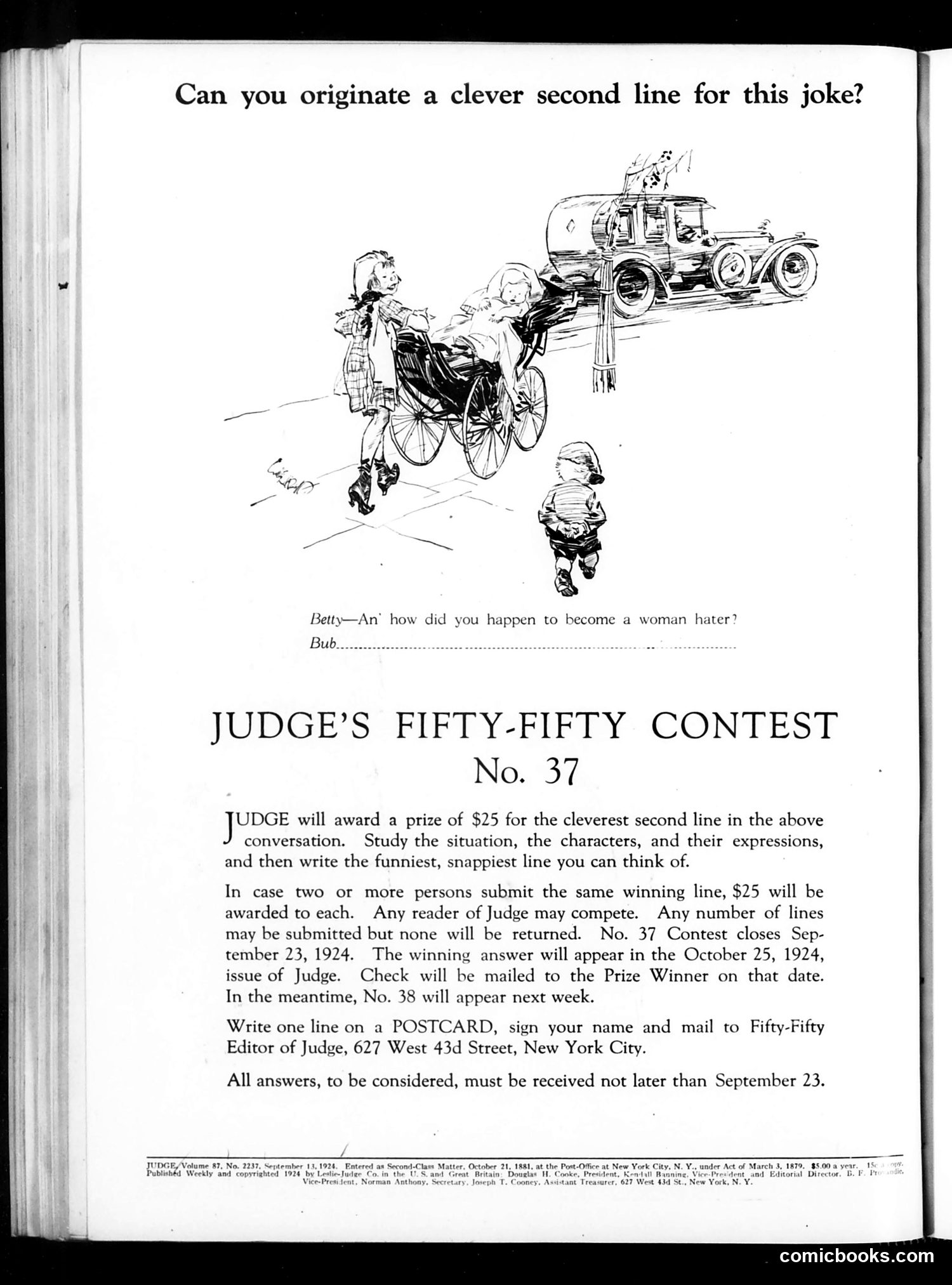
This page features a "Fifty-Fifty Contest" inviting readers to complete a joke. The cartoon depicts a woman driving a car that appears to be speeding or recklessly driven, with a man and child reacting in alarm on the road. The setup joke reads: "Betty—An' how did you happen to become a woman hater?" with "Bob" expected to provide the punchline. The satire targets early 1920s anxieties about women drivers. The cartoon suggests that witnessing reckless female driving would naturally cause men to resent women—a common prejudice of the era. The joke plays on gender stereotypes about women's driving abilities and reflects the social tension surrounding women's increased independence and mobility following women's suffrage (1920). The contest offered a $25 prize for the cleverest response, closing September 23, 1924.
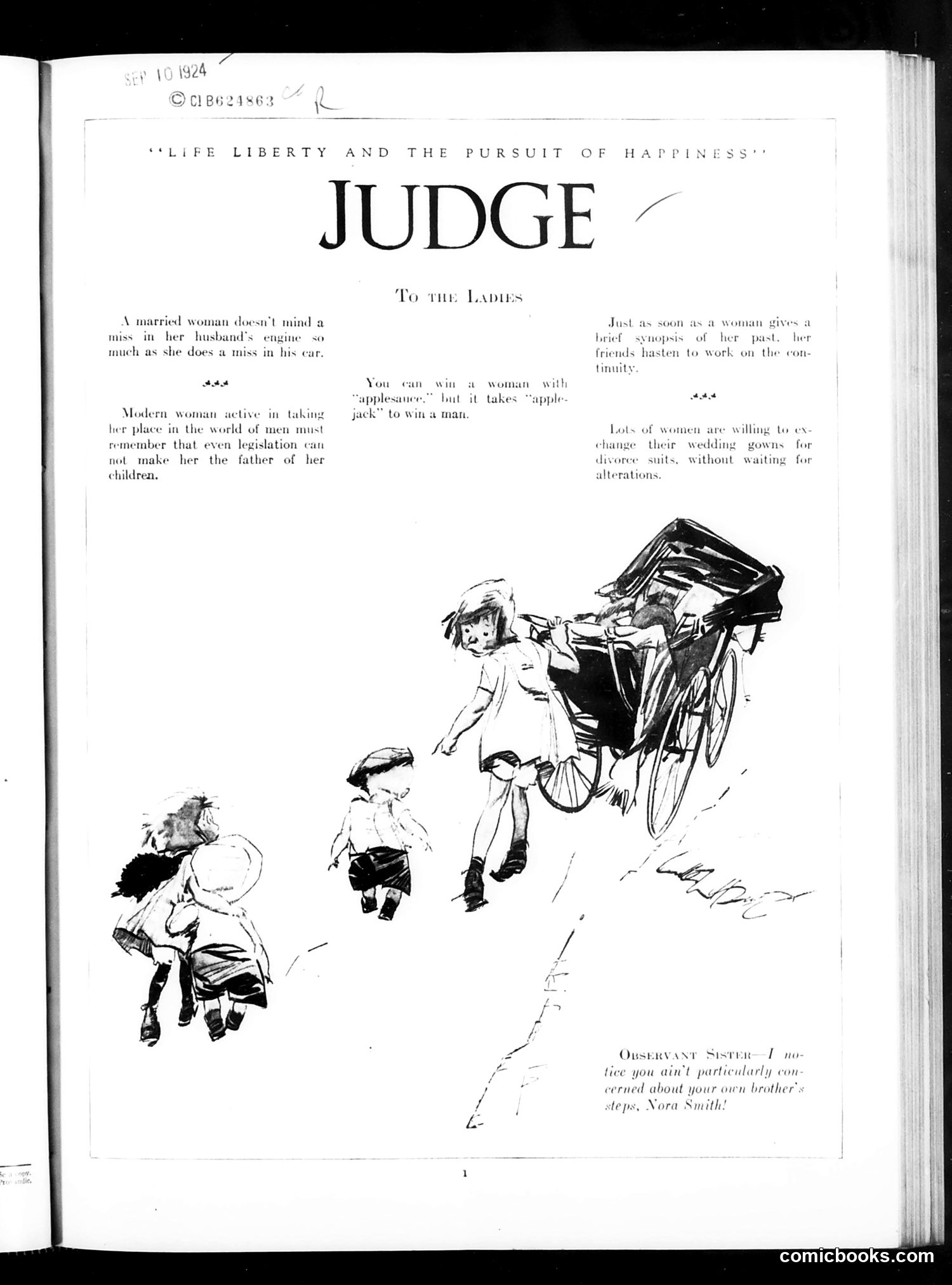
This page from *Judge* magazine satirizes women's roles and modern feminism circa 1924. The header quotes the Declaration of Independence ("Life, Liberty and the Pursuit of Happiness"), framing women's rights discourse. The column "To the Ladies" contains brief satirical quips about modern women and marriage. The accompanying illustration shows a woman energetically pedaling a bicycle laden with children, depicting the burden of motherhood combined with women's newfound independence and mobility. The satire's point appears to be: while women have gained freedom (symbolized by the bicycle), they remain encumbered by domestic responsibilities—children still require supervision and care. The cartoon mocks the tension between feminist aspirations for independence and the practical realities of motherhood, suggesting women cannot truly escape traditional domestic roles despite legal advances.
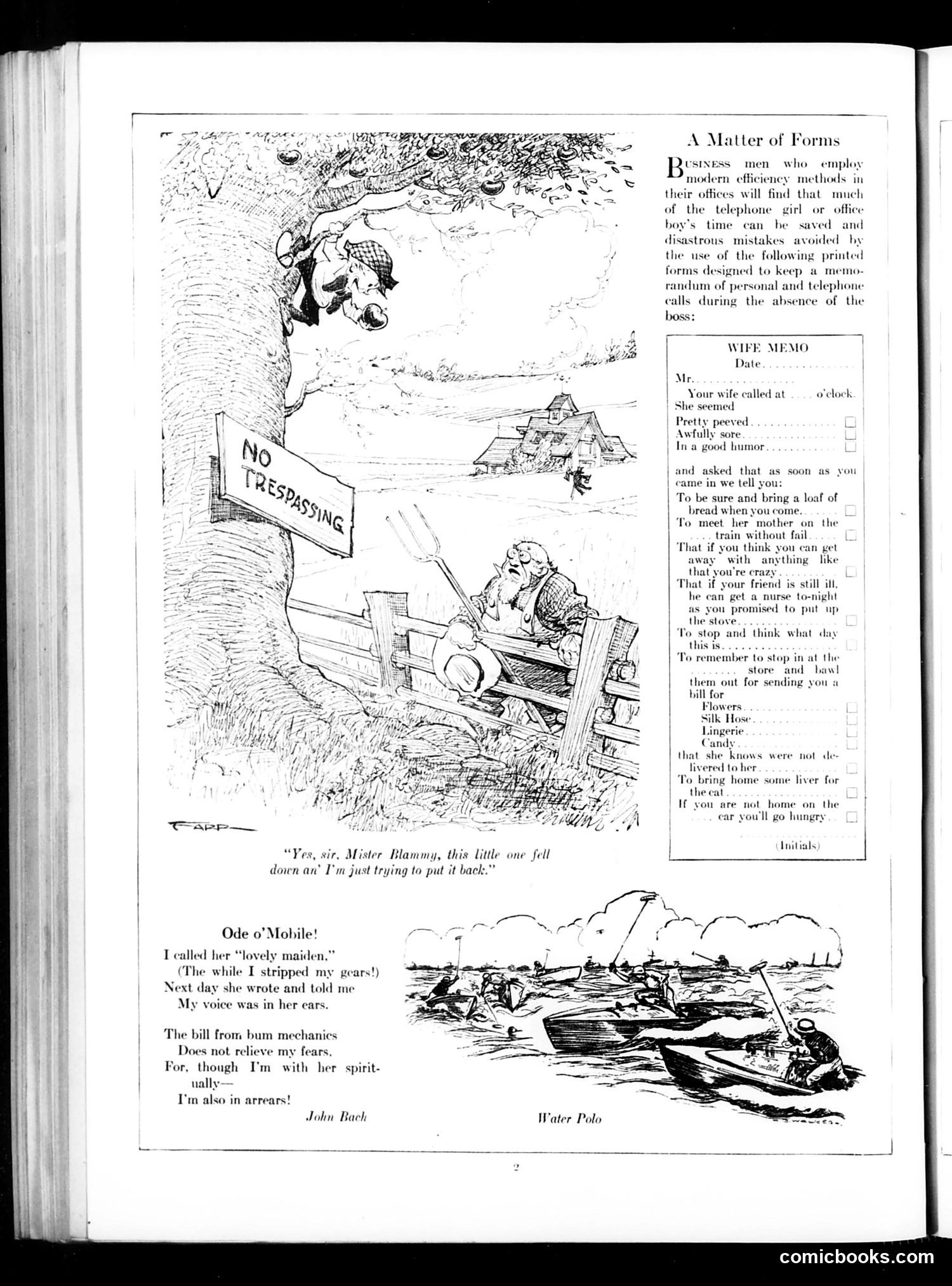
This page contains three distinct items: 1. **Main cartoon** (top): A humorous domestic scene showing a man trespassing on property despite a "No Trespassing" sign. The caption suggests he's retrieving something that fell, with a comedic twist on property rights. 2. **"Wife Memo" form** (right): A practical checklist wives could use to communicate messages to husbands during their absence—covering emergencies (nurse, stove), errands (bread, flowers, silk hose, candy), and reminders. This satirizes the domestic sphere and the need for organized household communication. 3. **"Ode o'Mobile" poem** (bottom left): John Bach's verse about romantic rejection and financial consequences—a man called a woman "lovely maiden," was rejected, received a bill from mechanics, and now faces debt ("in arrears"). 4. **"Water Polo" illustration** (bottom right): A sporting scene. The page reflects early 20th-century humor about marriage, domestic management, and courtship mishaps.
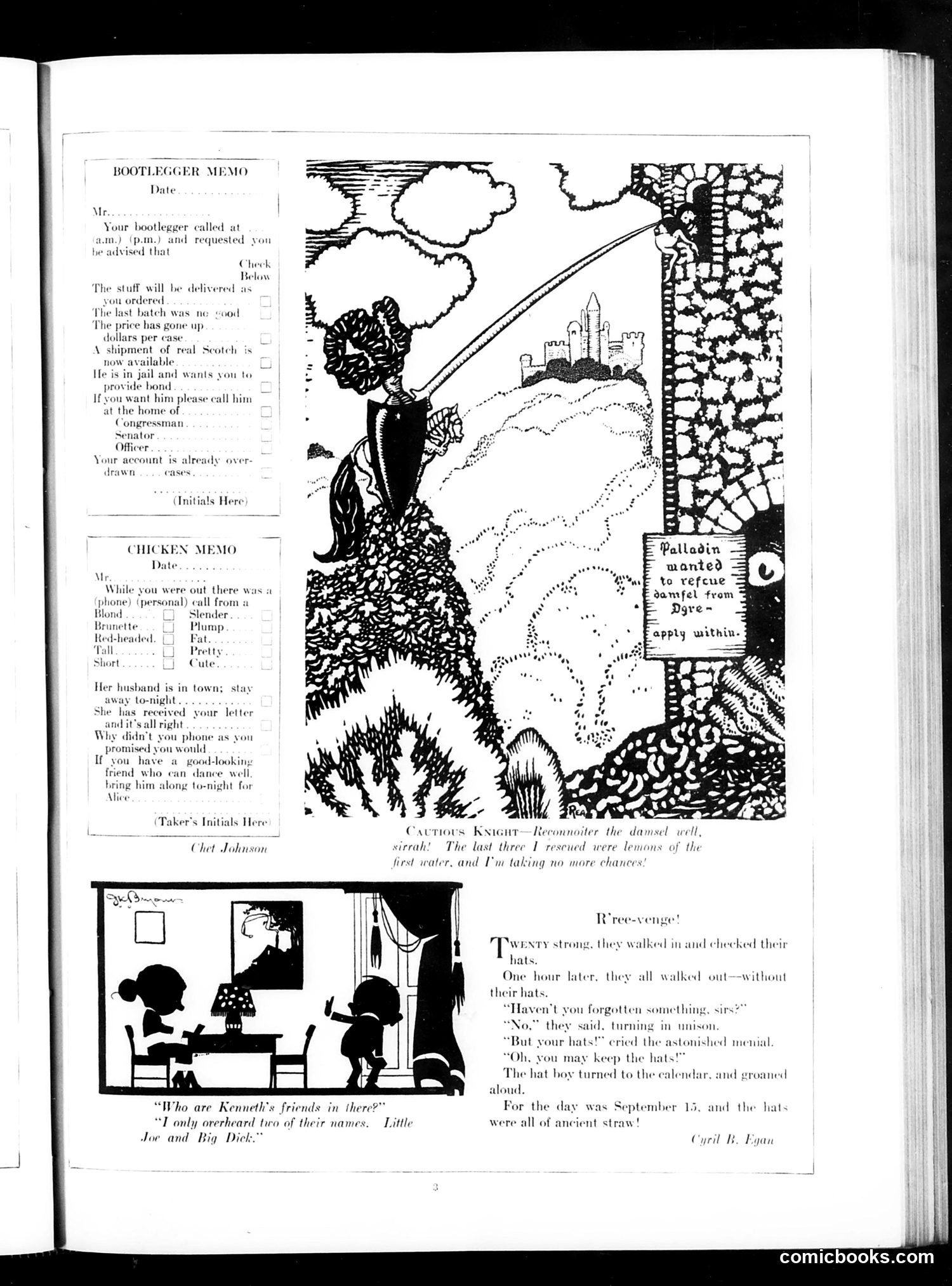
This page contains **three separate humorous pieces** rather than political cartoons: 1. **"Bootlegger Memo"** and **"Chicken Memo"** — satirical office memos from the Prohibition era, poking fun at illegal alcohol distribution and domestic mishaps. 2. **"Cautious Knight"** — an illustrated story about a knight refusing further "chances" after receiving poor water quality, using medieval fantasy as comedic framework. 3. **"Revenge!"** — a silhouette cartoon showing children checking a calendar on September 15th, having retrieved their hats. The joke concerns schoolboys who left straw hats at home over summer, now needing to reclaim them as the school year approaches. The page reflects 1920s-30s domestic humor and Prohibition-era satire typical of Judge magazine's satirical approach to contemporary American life.
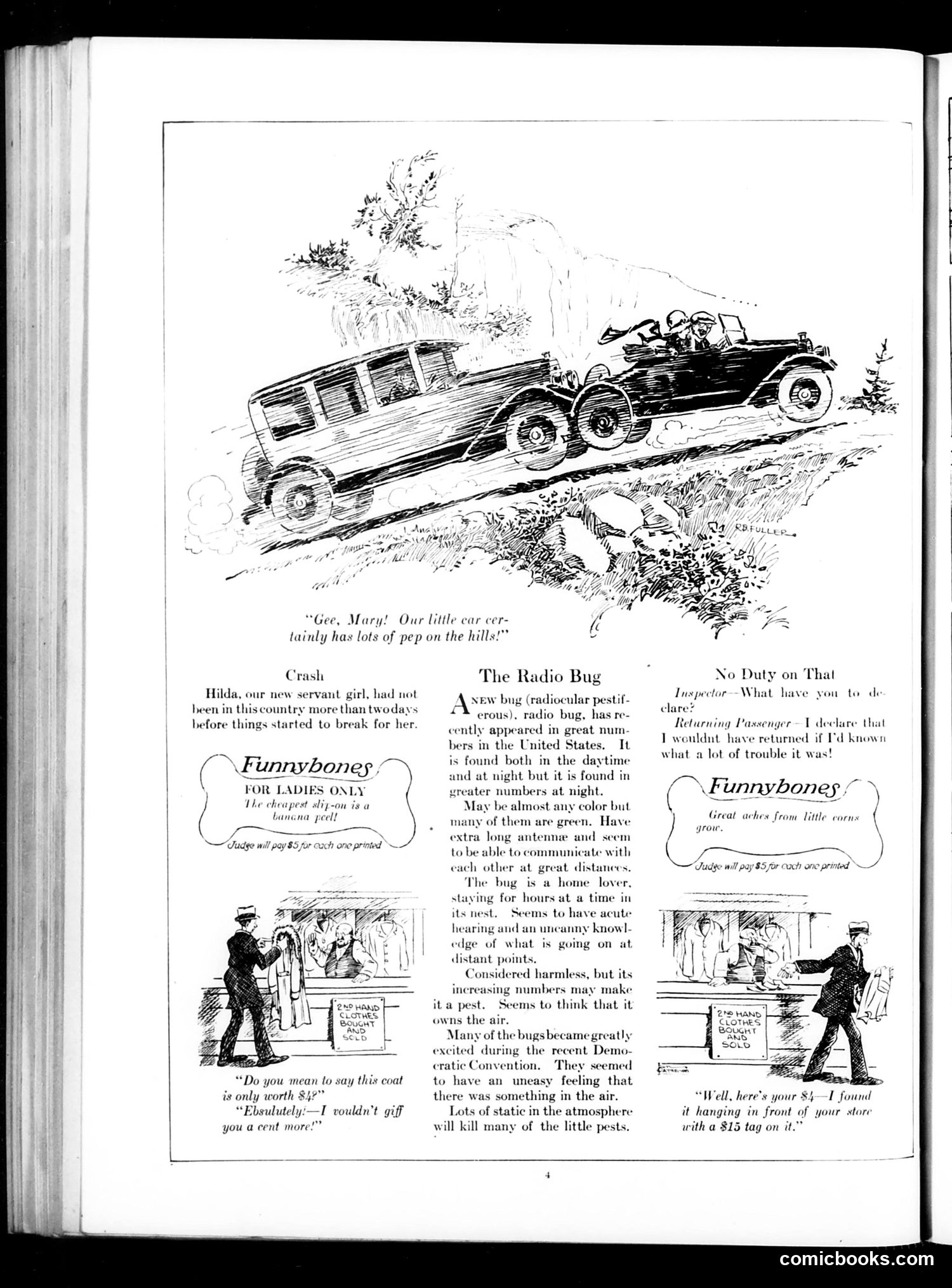
This page contains a mix of humor and light advertisements rather than political satire. The main content includes: **"Crash"** – A cartoon showing two cars on a hillside with the caption "Gee, Mary! Our little car certainly has lots of pep on the hills!" This appears to be automotive humor playing on the word "pep" as the vehicles collide. **"The Radio Bug"** – An article describing a new pest (the radio bug) that has recently appeared in the United States. It's found day and night but more numerous at night, often green, with long antennae. The piece humorously treats radio technology as an invasive species, suggesting people became overly excited about radios during a recent Democratic Convention, with static potentially killing "the little pests." **"Funnybones"** sections provide brief jokes about ladies' clothing and found money, with small accompanying cartoons.
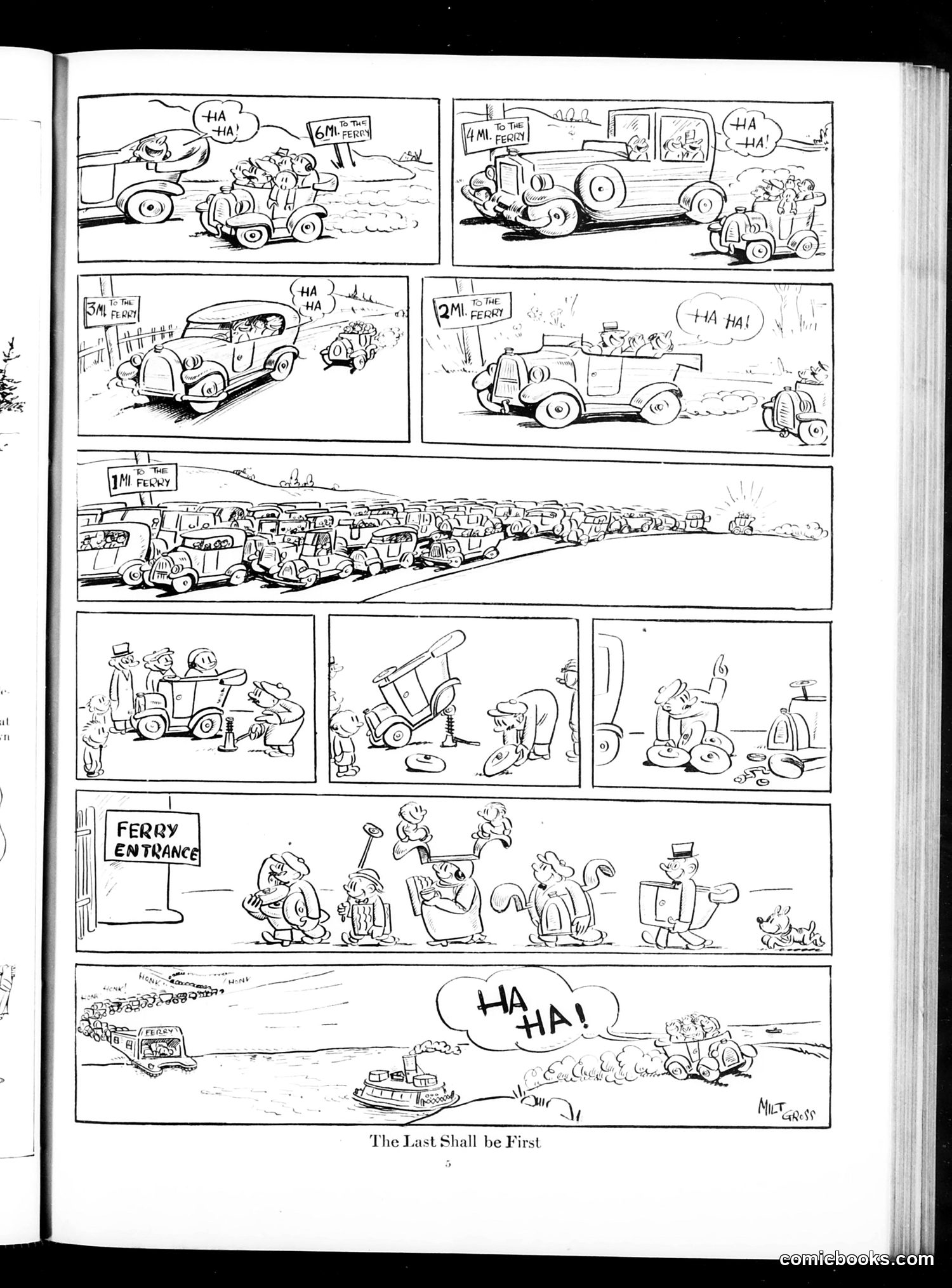
This cartoon satirizes competitive rushing to board a ferry, playing on the biblical phrase "the last shall be first." The narrative shows cars racing to reach the ferry entrance, with drivers increasingly frantic. The joke escalates through panels: individual cars compete aggressively, then massive traffic jams form as everyone rushes simultaneously. By the final panel, the ferry departs while chaotic crowds remain on shore—those who rushed hardest end up last, ironically proving the proverb true. The satire mocks modern impatience and the counterproductive nature of competitive scrambling. During the automobile age when this was published, ferry travel was common, and crowded boarding situations were familiar frustrations. The cartoon suggests that aggressive self-interest backfires: the first to race ahead ultimately become the last to board.
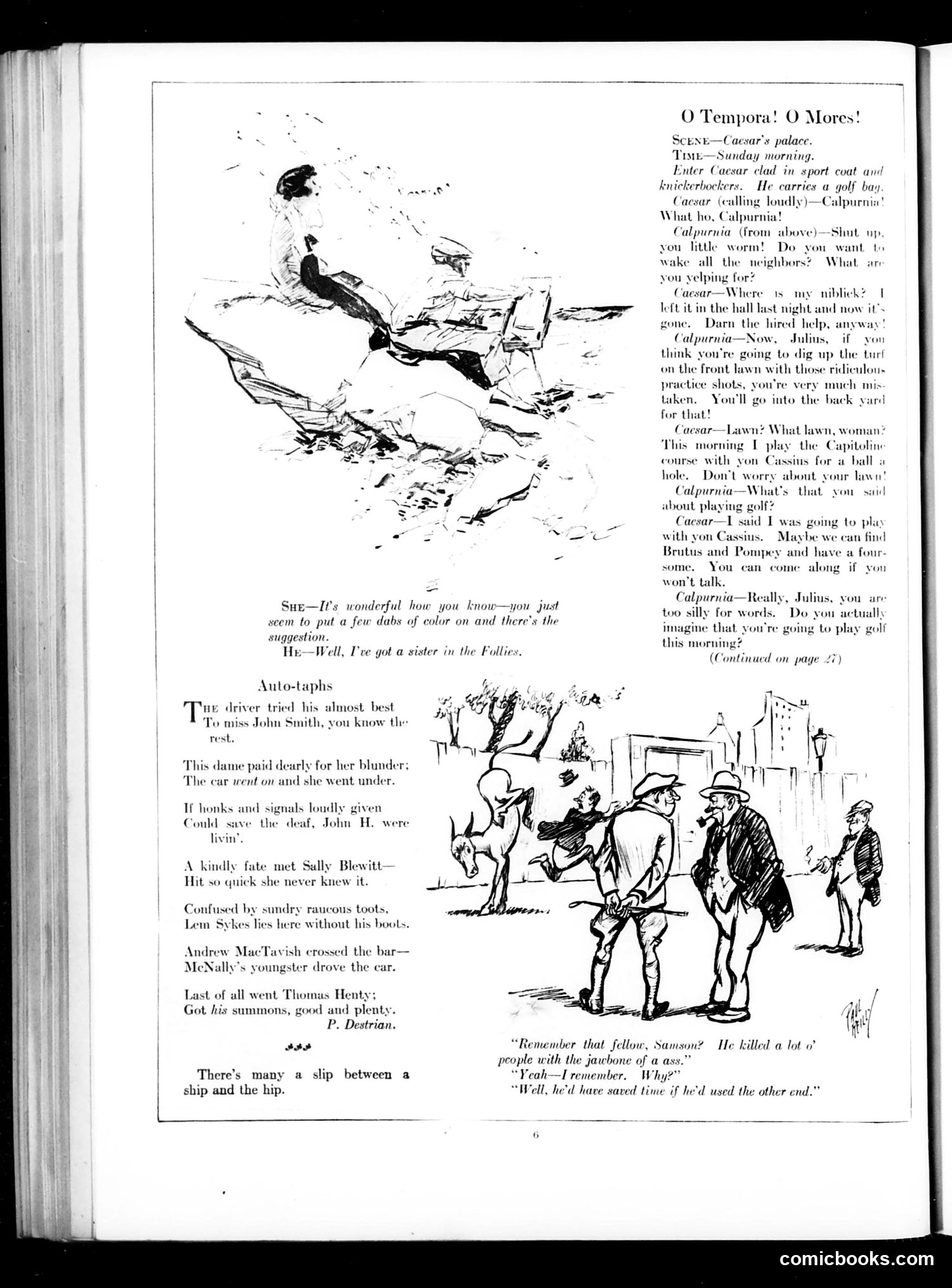
This page contains two distinct satirical pieces: **"O Tempora! O Mores!"** is a sketch mocking Julius Caesar as a modern American golfer. The satire works by anachronism—placing the historical Roman leader in 1920s domestic life, obsessed with golf, irritating his wife Calpurnia, and planning outings with other Roman historical figures (Cassius, Brutus, Pompey). The humor relies on the absurdity of treating ancient Rome as contemporary America, with Caesar behaving like a typical henpecked husband. **"Auto-taphs"** is a darkly comedic section about automobile accident deaths, written as mock epitaphs for various victims killed by cars—a topical concern during the automobile's rise. It's presented as gallows humor about the dangers of modern traffic. The cartoon at bottom shows people reacting to a dog causing chaos in a street scene. The overall page satirizes modern American life through exaggeration and death/accident humor typical of Judge's style.
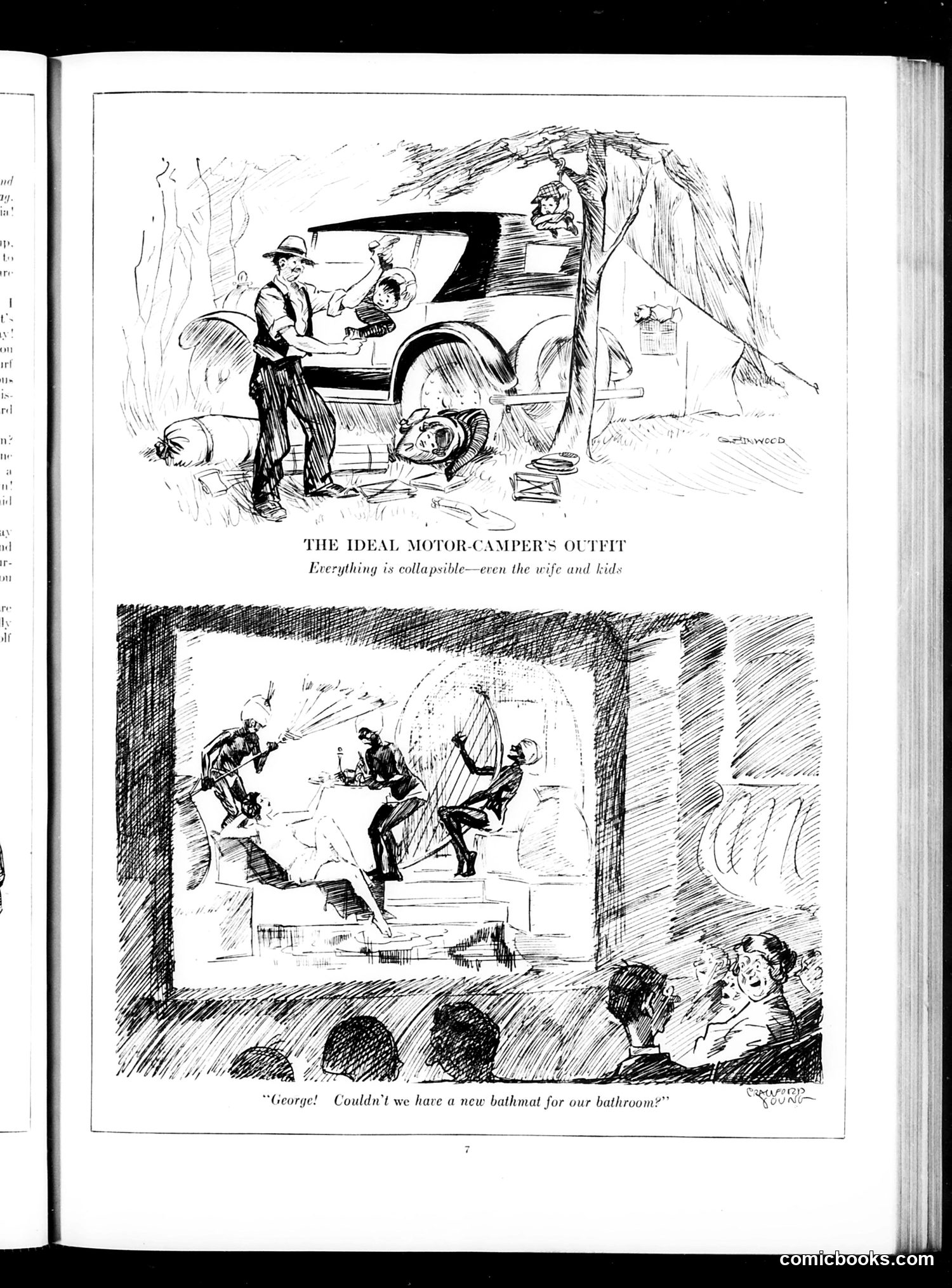
This 1920s satirical cartoon mocks the motor-camping trend and marital dynamics of the era. The top panel shows a family crammed into a collapsible camping vehicle with children literally folded up—the joke is that everything, "even the wife and kids," collapses to fit this compact automobile. The bottom panel depicts a theatrical performance visible through a window, with the caption "'George! Couldn't we have a new bathmat for our bathroom?'" This suggests the wife is performing theatrical complaints to her husband, sarcastically implying that instead of worrying about home luxuries like a new bathmat, families should be content with cramped motor-camping conditions. The satire targets both the impracticality of early camping vehicles and the era's domestic gender dynamics—mocking wives' supposed materialism while normalizing cramped, uncomfortable family travel.
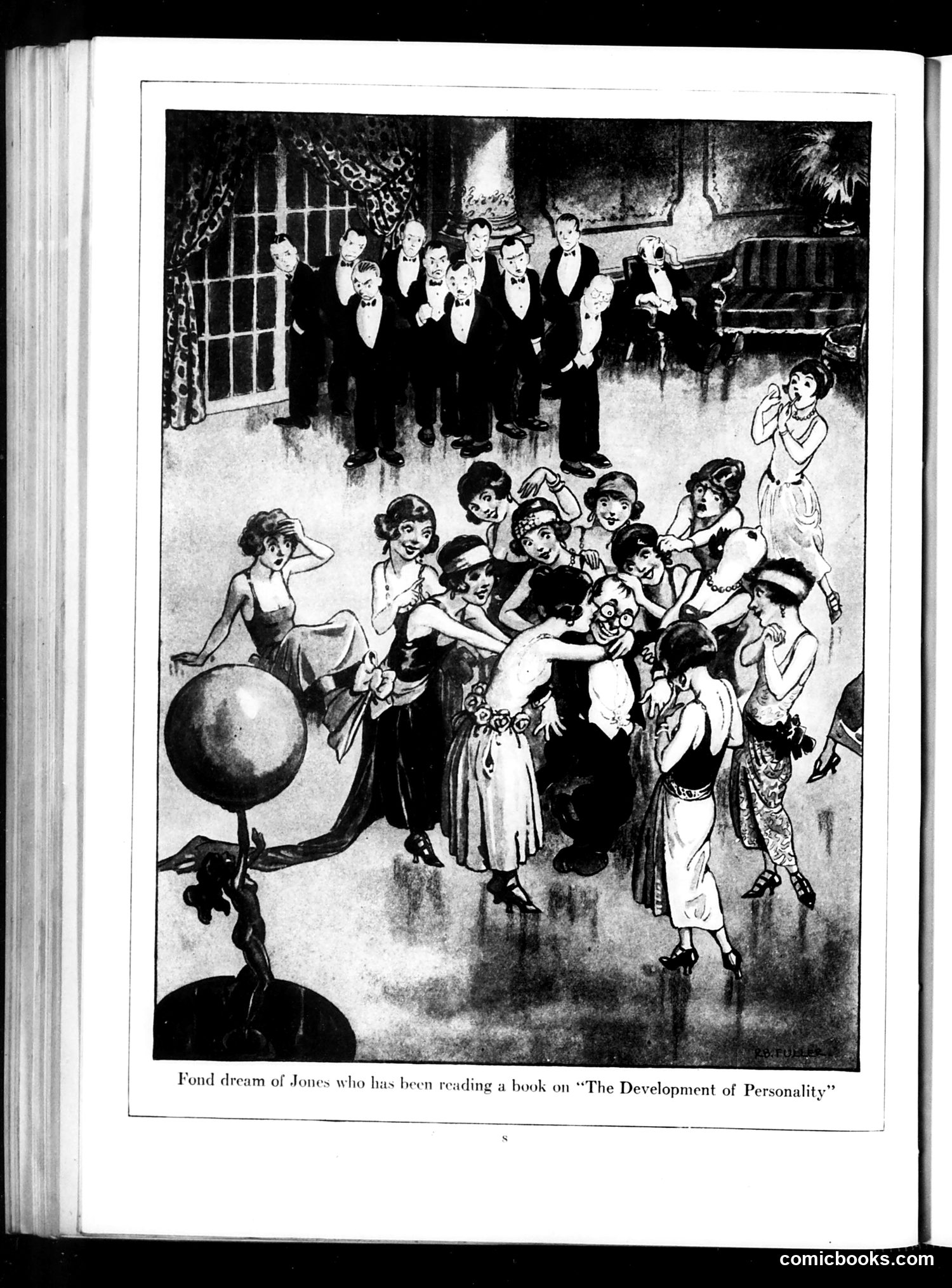
This illustration satirizes a character named Jones who has been reading "The Development of Personality" — likely a psychology or self-help book popular in the early 20th century. The cartoon depicts his "fond dream" as a fantasy where he imagines himself at the center of an elaborate party or social gathering, surrounded by numerous attractive women in various states of admiration and attention. The satire mocks the gap between self-help book aspirations and reality: Jones fantasizes that reading about personality development will transform him into a magnetic, desirable social figure. The formal-dressed men observing from above may represent authority figures or his actual social circle, emphasizing the contrast between his daydream and his true social standing. The joke targets both self-improvement culture and male vanity.
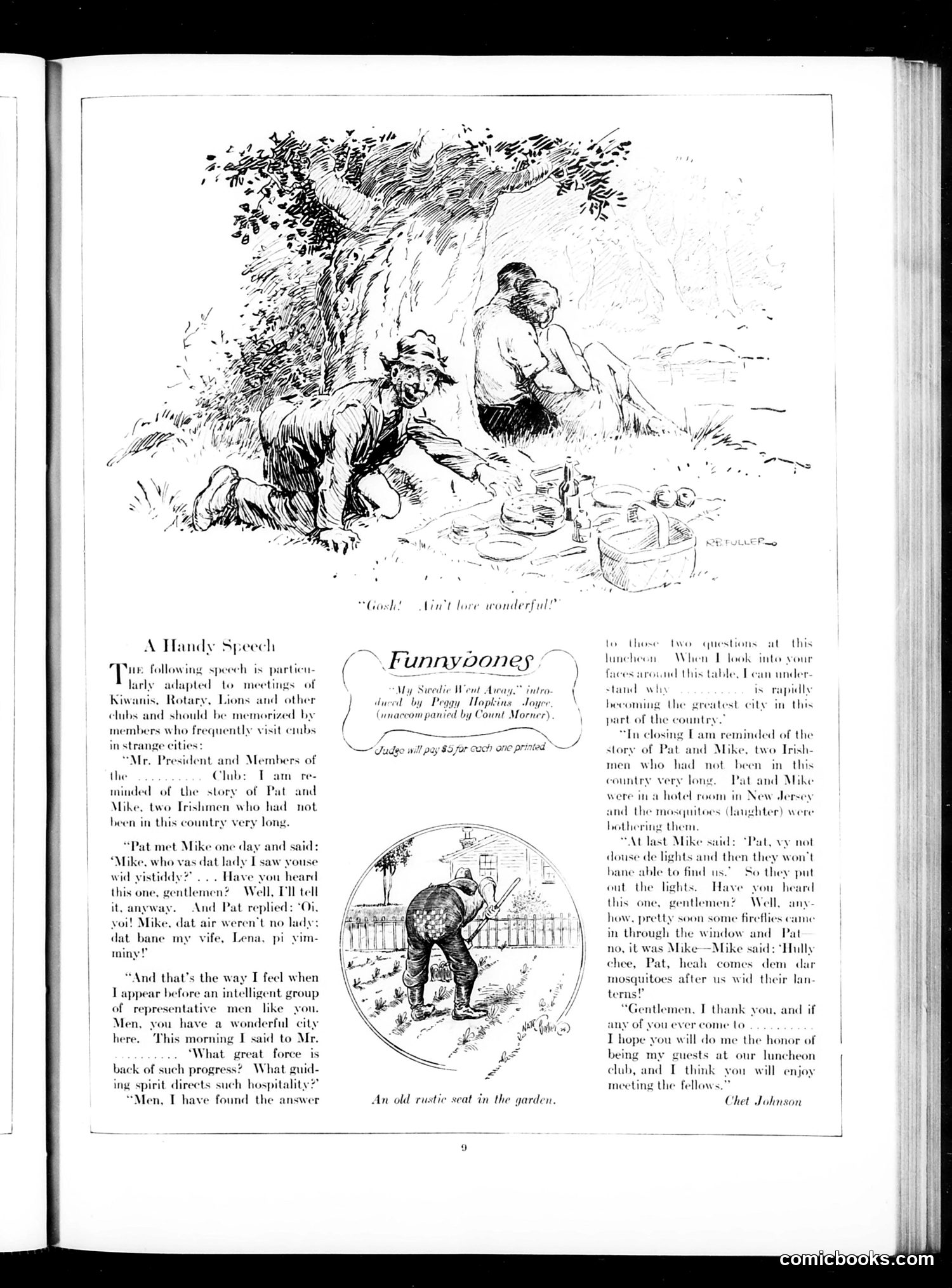
This page satirizes the formulaic speeches given by visiting speakers at service club meetings (Kiwanis, Rotary, Lions). The satire is in the text itself, not the cartoons. The joke is that speakers use a standard template: open with an Irish dialect joke ("Pat and Mike"), flatter the local audience by praising their city's progress and hospitality, ask rhetorical questions about what drives their success, then answer by pointing to the audience themselves, and close with another Irish dialect joke (the fireflies/mosquitoes bit). The cartoons above and below illustrate the outdoor/social club setting but don't appear to be directly satirical. The text's humor depends on readers recognizing how predictable and formulaic these speeches are—the same structure and even the same ethnic jokes repeated endlessly at different clubs. The byline "Chet Johnson" attributes the satire. This captures mid-20th-century American club culture and its reliance on clichéd speaking formulas.
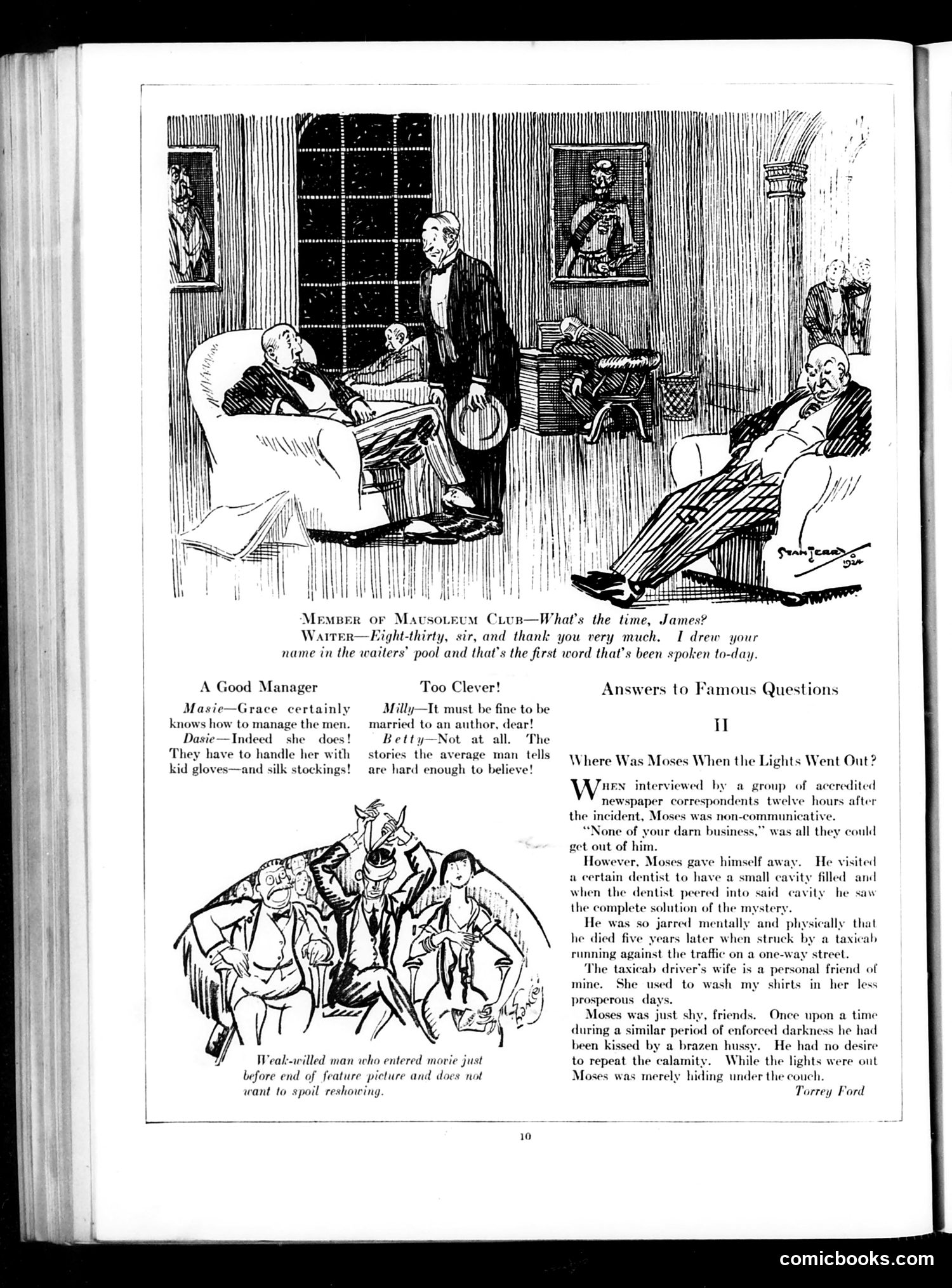
This page contains three unrelated humor pieces typical of early 20th-century Judge magazine: **Top cartoon**: A club waiter observes that a member hasn't spoken to him all day—their only interaction was asking the time. The joke satirizes the social distance between wealthy club members and service staff, suggesting the member's silence reflects the class barrier between them. **Middle section**: Two brief dialogue jokes about marriage and managing men. These are generic domestic humor with no specific political content—standard period comedy about marital dynamics and gender relations. **"Where Was Moses When the Lights Went Out?"**: A humorous essay parodying the famous riddle. The author creates an absurd explanation: Moses was hiding under a couch to avoid unwanted romantic advances (having been "kissed by a brazen hussy" during a previous blackout). The piece satirizes both the riddle itself and overwrought journalistic investigation, with increasingly ridiculous plot tangents that undermine the "mystery." No specific political figures or events are referenced. This is straightforward period social satire and wordplay.
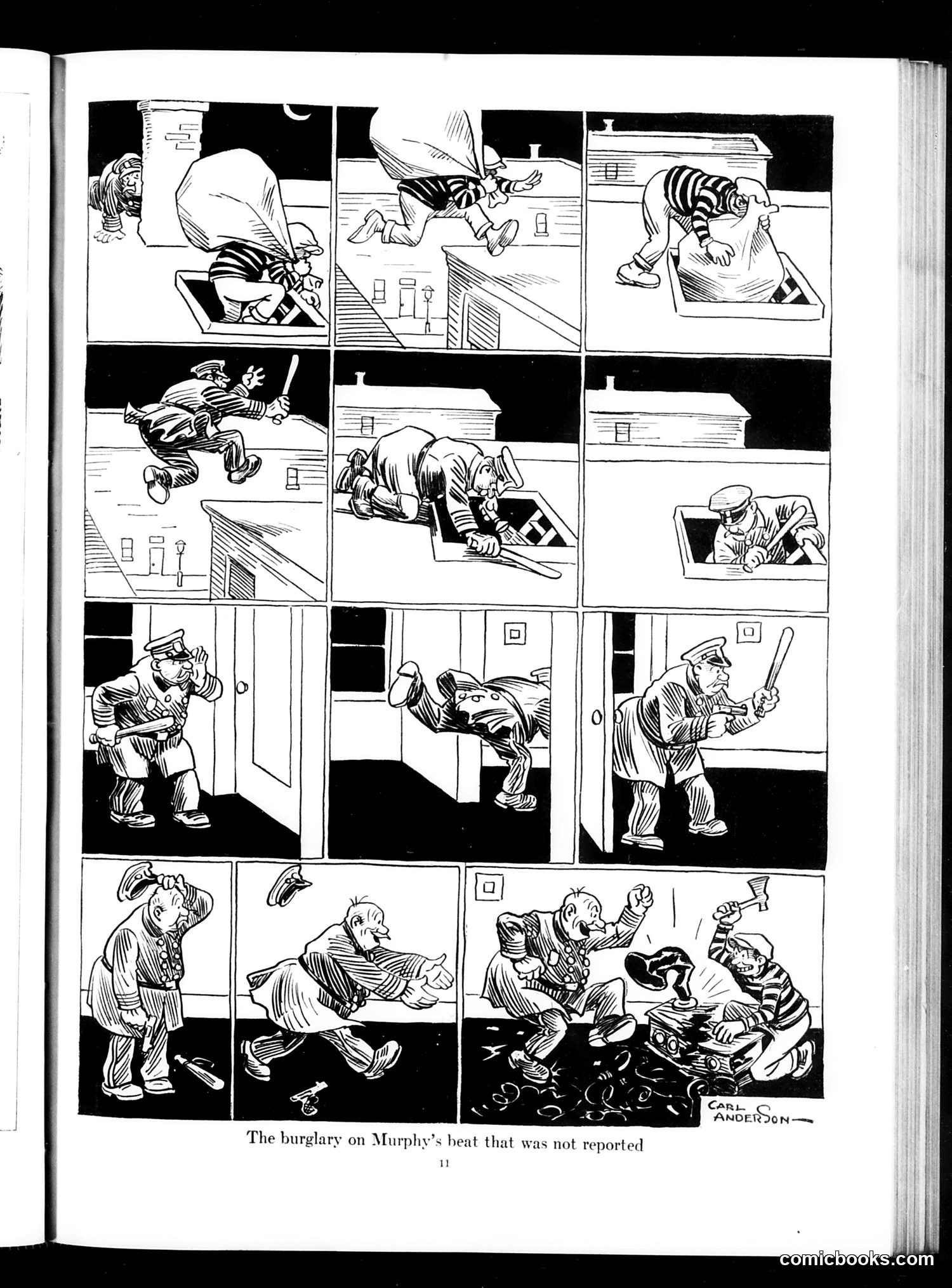
This Carl Anderson cartoon satirizes police corruption and negligence. A uniformed officer (identified as "Murphy" by the caption) witnesses a burglary in progress on his patrol beat but fails to report it—the cartoon's central joke. The sequence shows: burglars breaking into a residential building, the officer discovering them, and rather than arresting them or calling for help, Murphy appears to join them or ignore the crime entirely. The final panel shows Murphy with the burglars, suggesting complicity or a shared understanding. The satire targets police dereliction of duty and possible bribery or collusion between law enforcement and criminals—a common Progressive-era critique of urban police forces accused of overlooking crimes committed by connected parties.
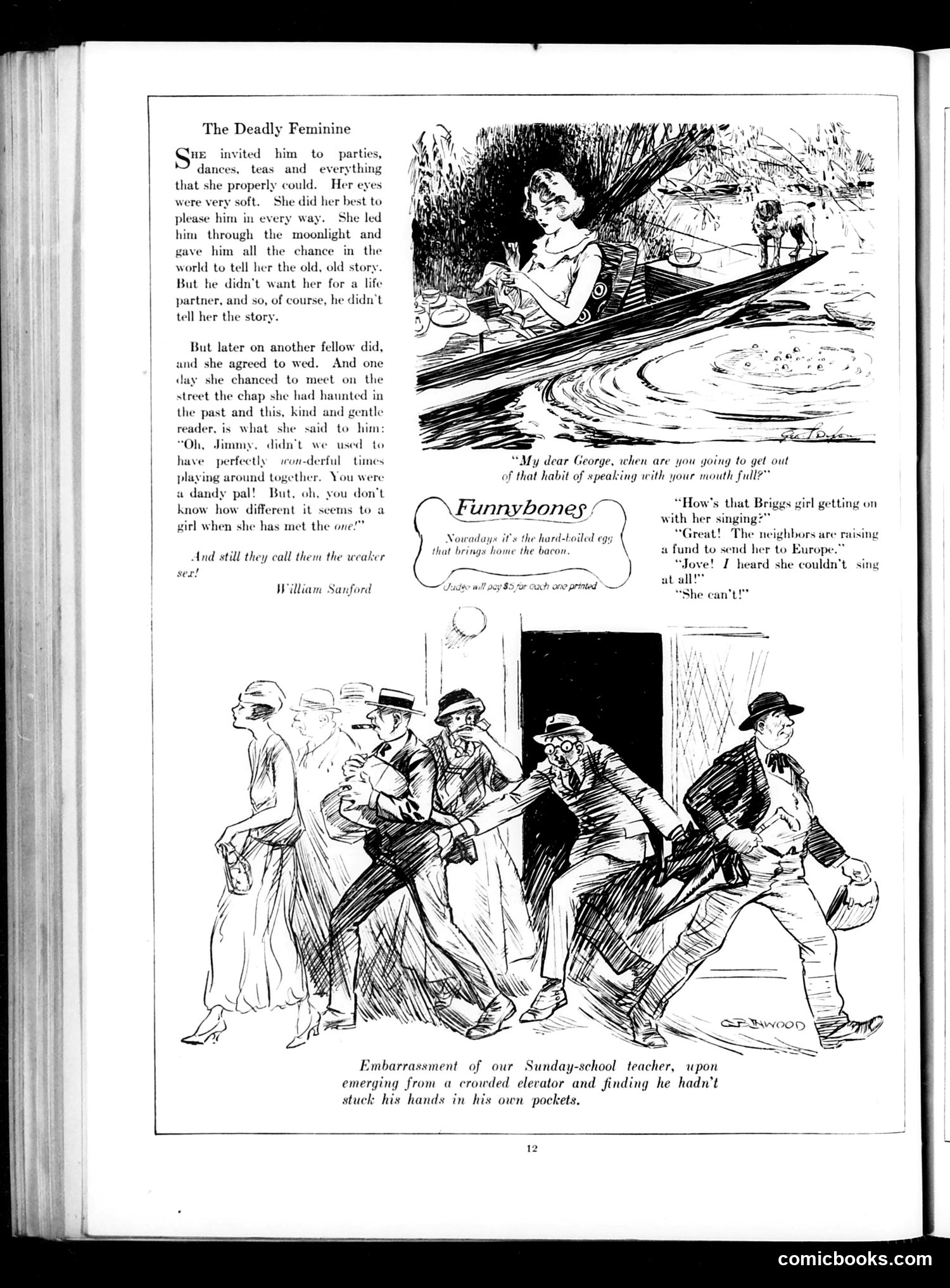
This page contains three separate satirical pieces mocking social behavior: **"The Deadly Feminine"** (top): A story about a woman who pursued a man romantically, he rejected her, she married another man, and later confronts her former suitor—boasting about her marriage. The satire targets women who use courtship as manipulation and men who fail to recognize romantic interest. **"Funnybones"** (middle): A joke about a woman with such poor singing ability that neighbors are raising funds to send her away to Europe—a backhanded insult presented as generosity. This satirizes both bad amateur singers and polite society's indirect methods of discouraging unwanted talent. **Bottom cartoon**: Depicts a Sunday-school teacher emerging from a crowded elevator with his hands *not* in his own pockets—implying he was pickpocketing or groping passengers. The humor derives from the hypocrisy of a morality instructor behaving criminally, and the ironic "embarrassment" of being caught. All three pieces mock social pretense and behavioral hypocrisy.
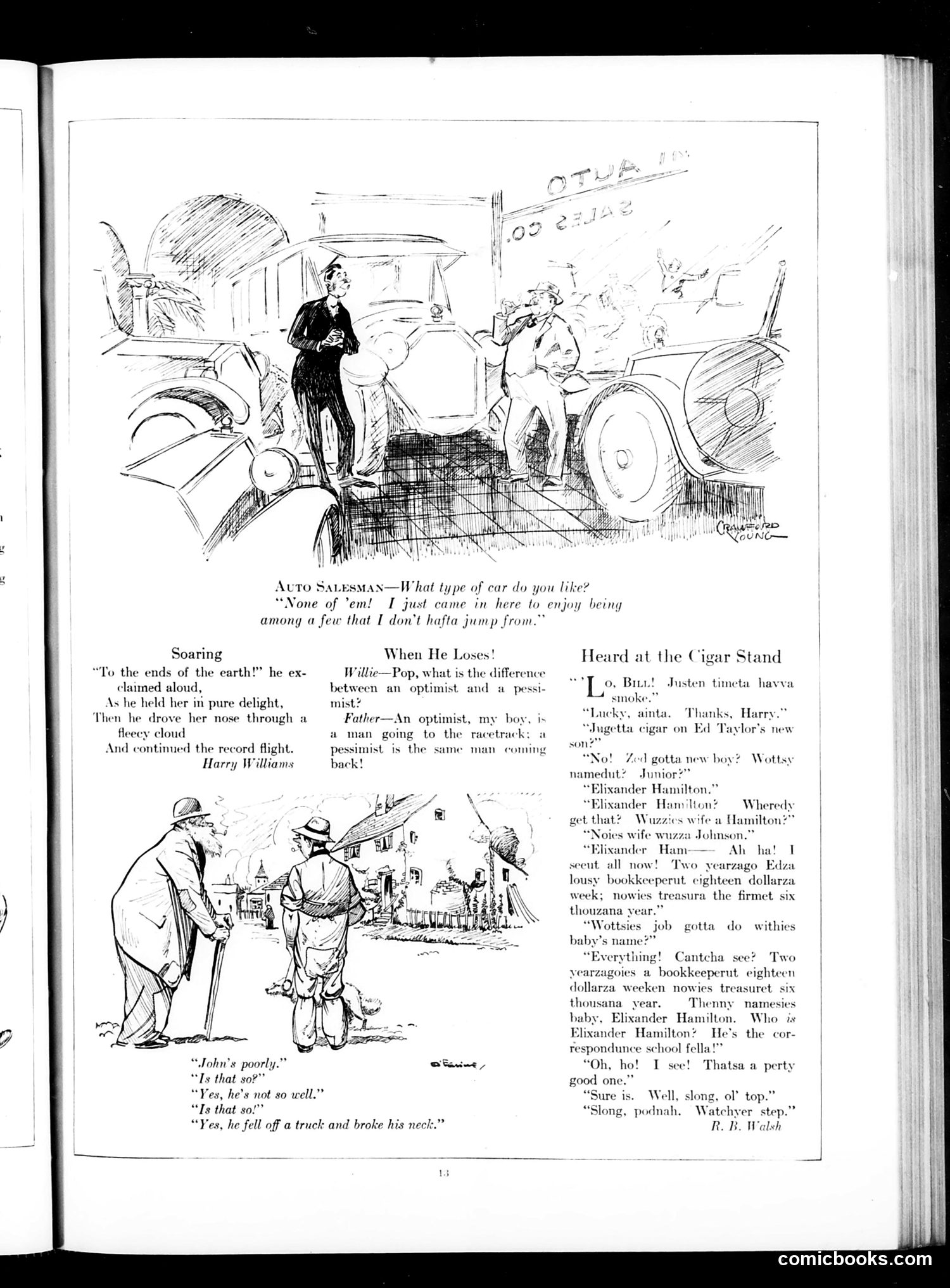
This Judge magazine page contains three separate humorous sketches satirizing early 1920s American life: **Top cartoon**: An auto salesman's pitch fails because customers are wary of cars' unreliability—they break down so frequently that occupants must "jump from" them. The joke mocks the automobile industry's poor quality and safety record during this era. **Middle sketches**: Two brief gags—one romantic, one about economic optimism versus pessimism. The pessimist/optimist joke plays on wealth: an optimist gambles at the racetrack; a pessimist is the "same man coming back" (having lost money). **Bottom section "Heard at the Cigar Stand"**: Extended dialogue in exaggerated immigrant dialect humor (common in period comedy). A man named Ed Taylor advanced from an $18/week bookkeeper to earning $6,000 yearly, so he named his baby "Alexander Hamilton" (the Founding Father associated with finance and banking). The joke ridicules both pretentious naming practices and the shallow reasoning behind them. The dialects and immigrant stereotyping reflect the casual ethnic humor acceptable in 1920s publications.
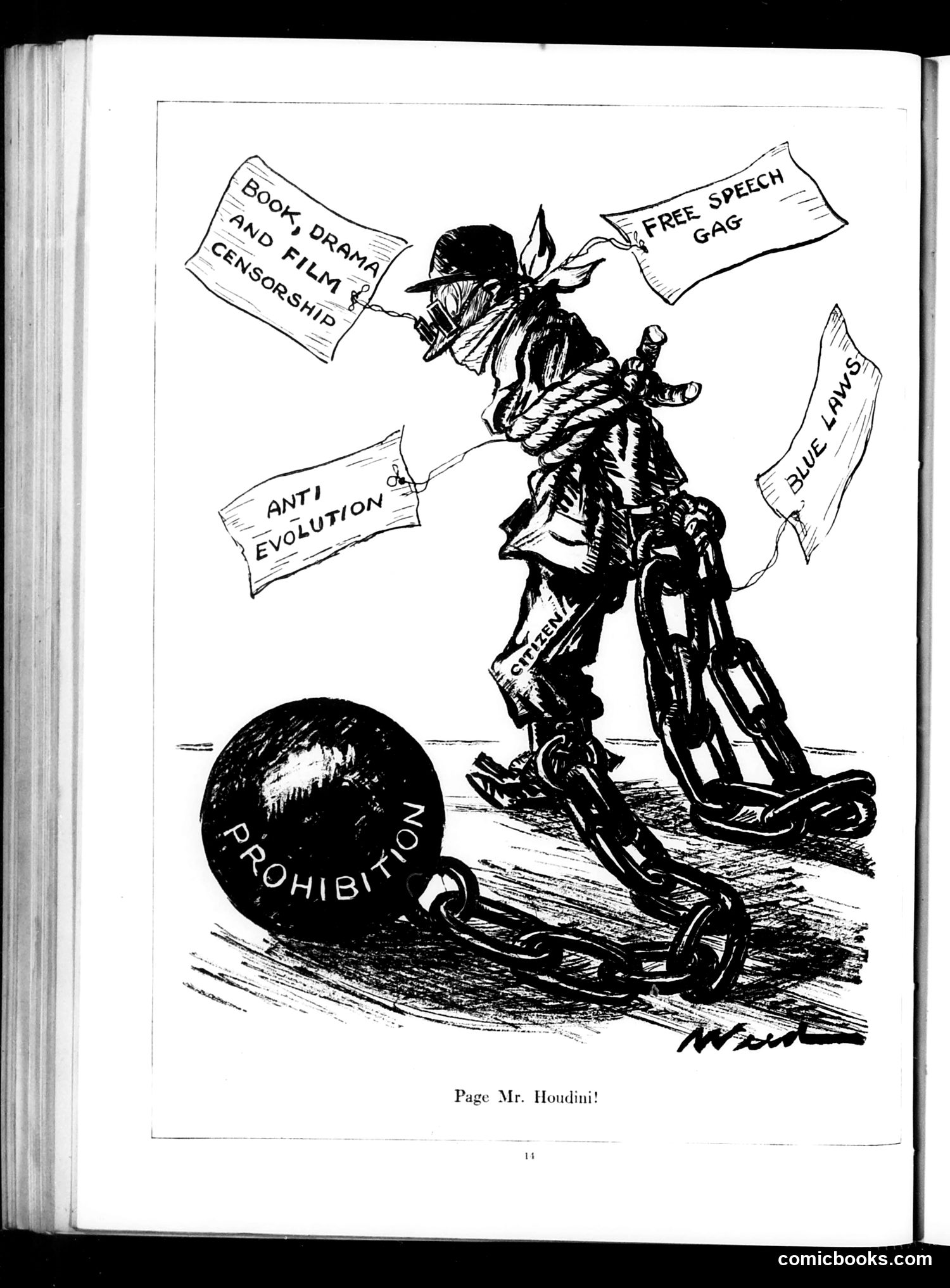
This cartoon depicts a figure juggling various censorship and restriction issues while chained to a ball labeled "Prohibition." The floating banners reference: - Book, Drama, and Film Censorship - Free Speech Gag - Blue Laws - Anti-Evolution The caption "Page Mr. Houdini!" suggests the figure should escape these constraints as the famous escape artist Houdini would. The cartoon satirizes early 20th-century American moral restrictions and censorship efforts—Prohibition (the alcohol ban), religious opposition to evolution teaching, obscenity laws affecting books and films, and various "blue laws" limiting freedoms. The juggling imagery implies these restrictions are multiplying and increasingly difficult to manage. The cartoonist argues these censorship efforts have become an overwhelming, oppressive burden on American society.
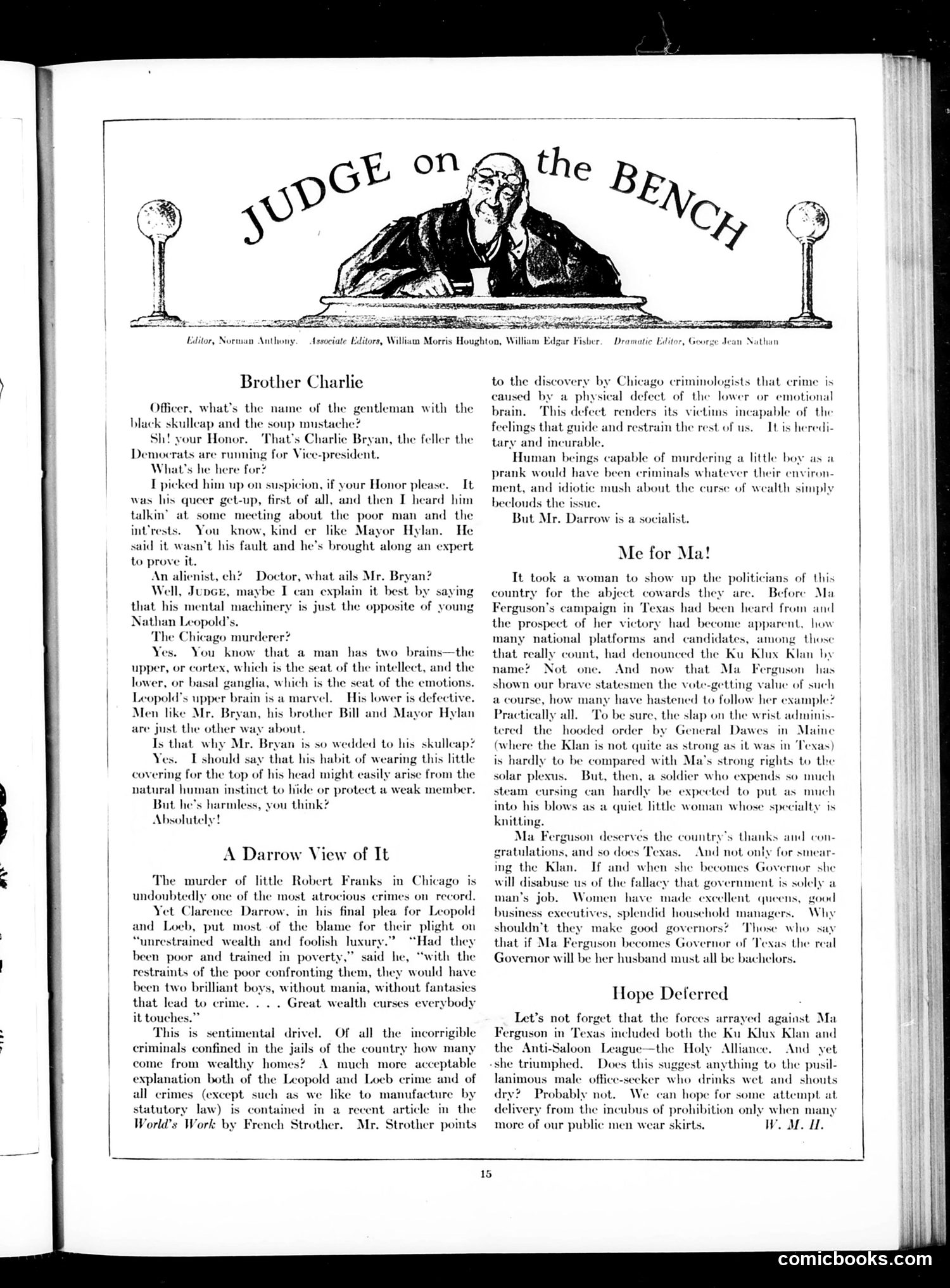
This page satirizes American politics circa the early 1920s through two main pieces: **"Brother Charlie"** mocks William Jennings Bryan (Democratic Vice-Presidential candidate), comparing his intellect unfavorably to Leopold and Loeb, the notorious Chicago murderers. The joke: Bryan's emotional brain dominates his rational one—the opposite of Leopold's imbalance. His skull cap humorously "protects" his weak upper brain. **"A Darrow View of It"** attacks defense attorney Clarence Darrow's argument that poverty, not wealth, caused Leopold and Loeb's crime. Judge rejects Darrow's "sentimental drivel," countering that criminology proves crime stems from physical brain defects, not socioeconomic conditions. The editorial dismisses Darrow as a socialist using excuses. **"Me for Ma!"** praises "Ma" Ferguson, Texas Governor candidate, for forcing politicians to publicly denounce the Ku Klux Klan—something they'd cowardly avoided until her campaign made it politically expedient. The page reflects Judge's conservative stance against socialism and sympathy for eugenics-era criminology.
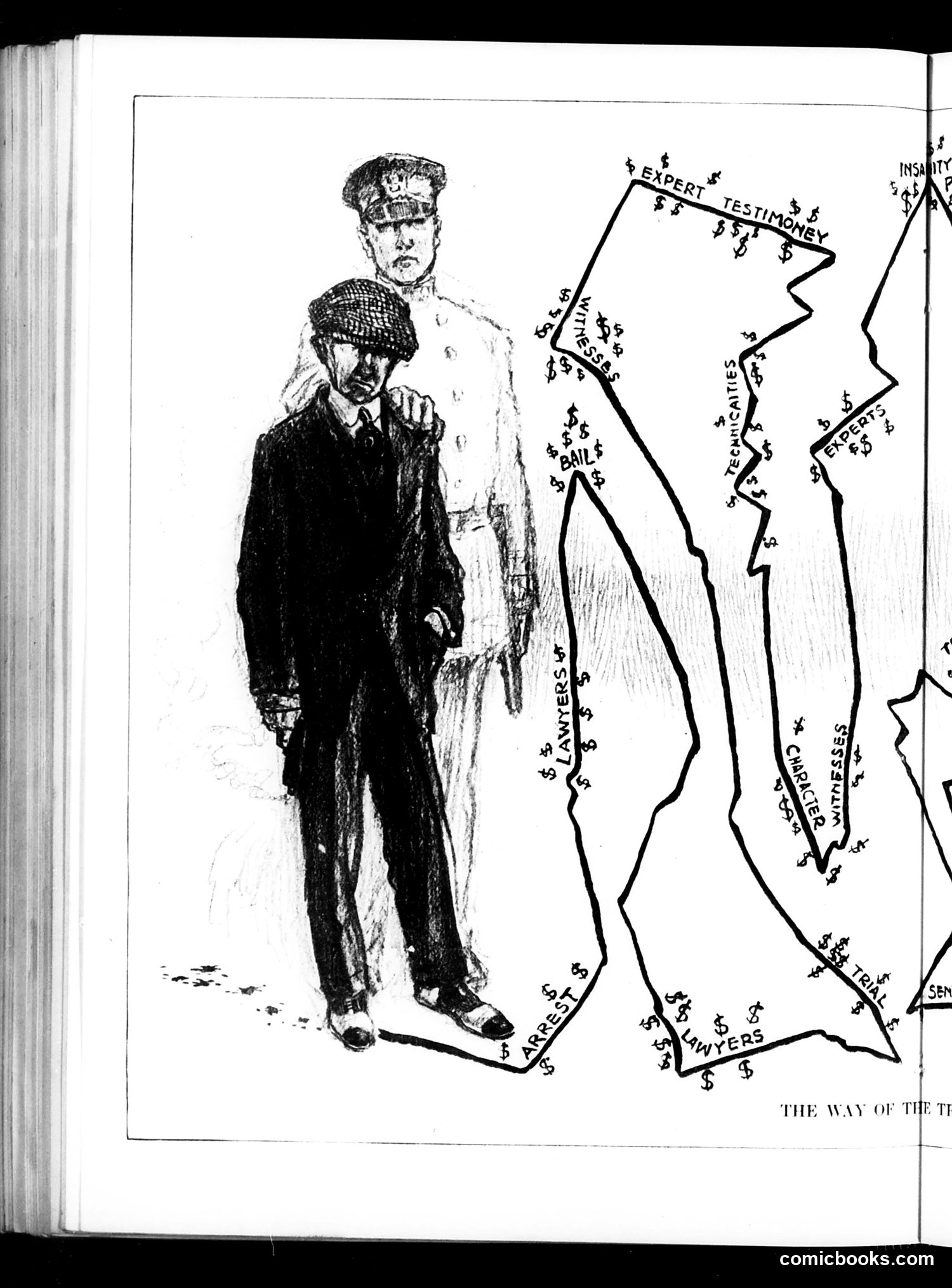
This appears to be a satirical cartoon depicting a poor or working-class man being pursued or trapped by various expenses and professional costs. The jagged, spiky outlines surrounding the figure are labeled with terms like "LAWYERS," "DOCTORS," "EXPERT TESTIMONY," "BAIL," "WITNESSES," and "INSANITY" — each marked with dollar signs to emphasize escalating costs. The cartoon likely critiques the legal and judicial system's financial burden on ordinary citizens, particularly those entangled in criminal proceedings or civil litigation. The small figure's vulnerable posture contrasts with the enormous, menacing silhouette of mounting expenses closing in around him. Without a clear publication date visible, the specific legal case or scandal being referenced is unclear. However, the satire targets how legal processes drain the working poor through fees for lawyers, expert witnesses, bail, and other court-related expenses — a timeless critique of justice system accessibility.
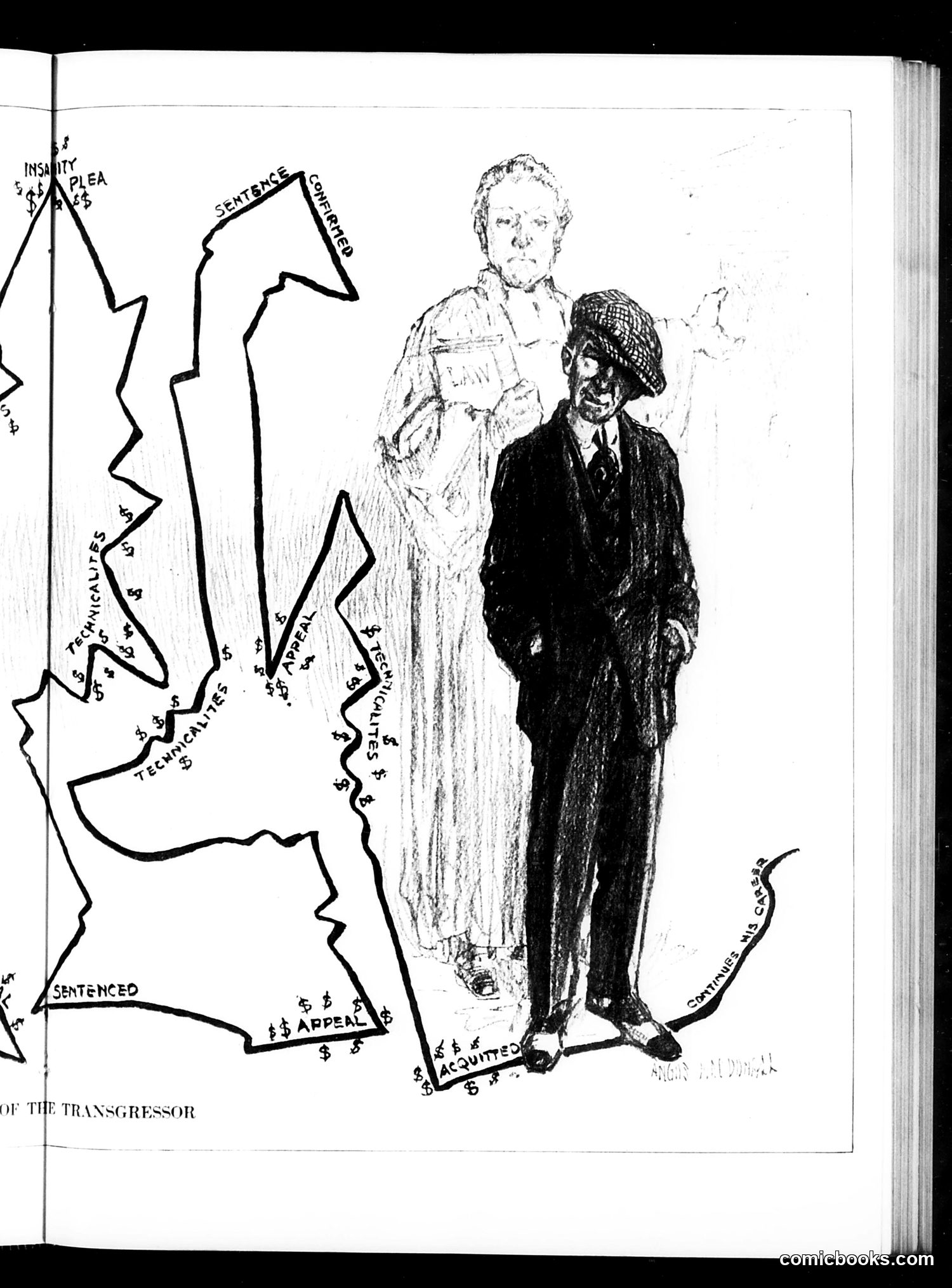
This Judge magazine cartoon depicts the legal journey of "the transgressor" through the American justice system. The diagram on the left traces a path through various stages: "Insanity Plea," "Sentence," "Convicted," "Sentenced," "Appeal," and "Acquitted"—marked with dollar signs, suggesting the expensive cost of legal proceedings. The figure on the right shows a man in working-class attire (cap, worn coat) standing before a ghostly, semi-transparent figure of a judge or authority figure looming above him. The satire critiques how wealthy defendants could navigate the legal system through costly appeals and various legal strategies, while poorer individuals faced harsher, more direct justice. The contrast between the solid, material figure below and the ethereal judge above reinforces the disconnect between ordinary people and the legal establishment.
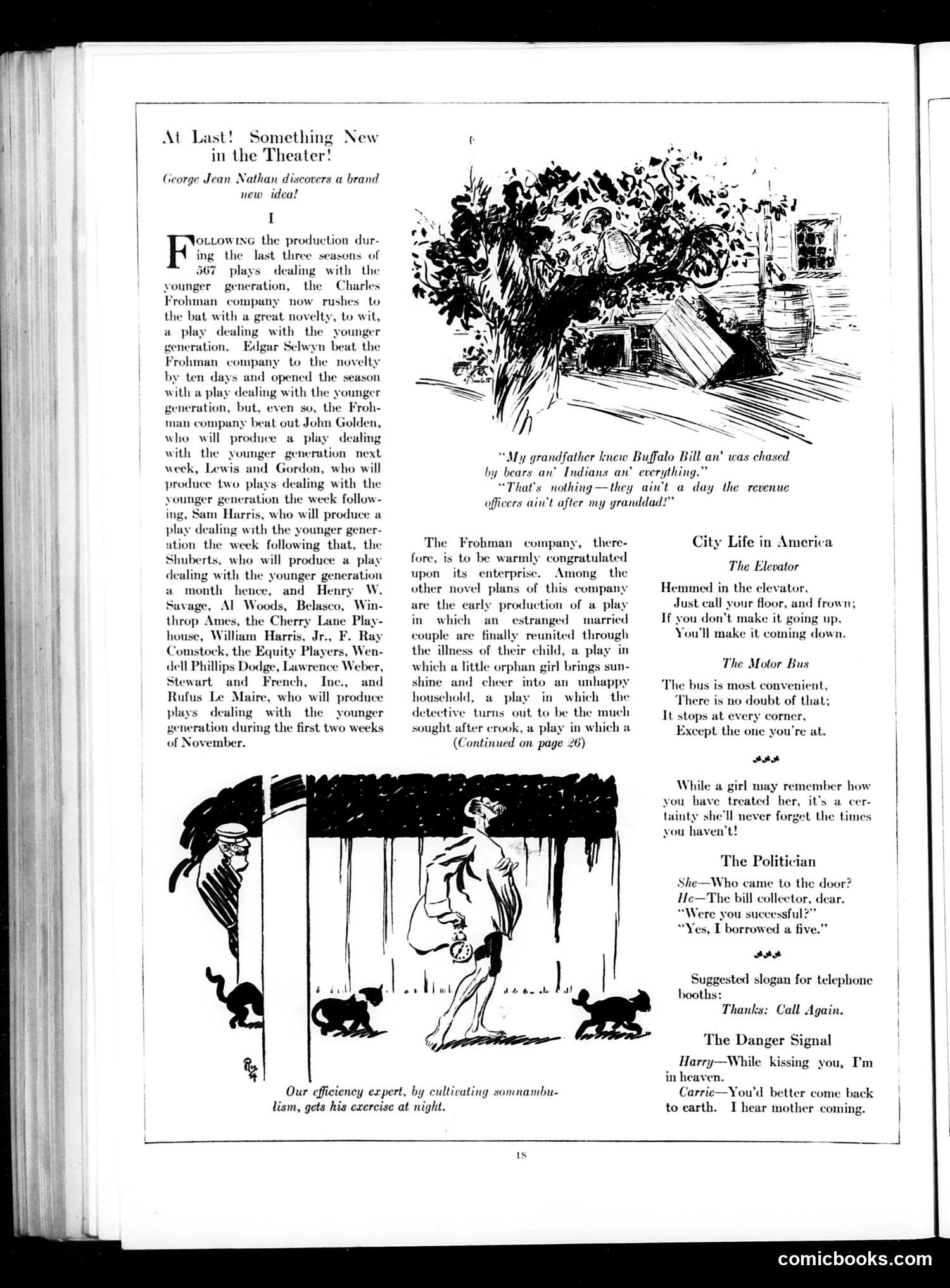
This page satirizes the theatrical world's creative bankruptcy. Drama critic George Jean Nathan (identified in the subtitle) mocks how Broadway producers—the Frohman company chief among them—claim novelty while recycling identical plots. The text lists numerous producers all rushing to stage plays about "the younger generation," revealing an absurd, industry-wide creative failure masquerading as innovation. The secondary joke catalogs other "novel" Frohman productions: estranged couples reunited by a child's illness, orphans bringing cheer to sad homes, detectives revealed as criminals—all tired theatrical clichés presented as fresh ideas. The lower cartoons offer unrelated social humor: an "efficiency expert" exercising while sleepwalking, and brief vignettes mocking modern urban life (elevators, buses, romance interrupted by bill collectors). The page satirizes both theatrical mediocrity and Nathan's role exposing it—he "discovers" what any honest observer would recognize: that Broadway produces not innovation but predictable repetition dressed as novelty.
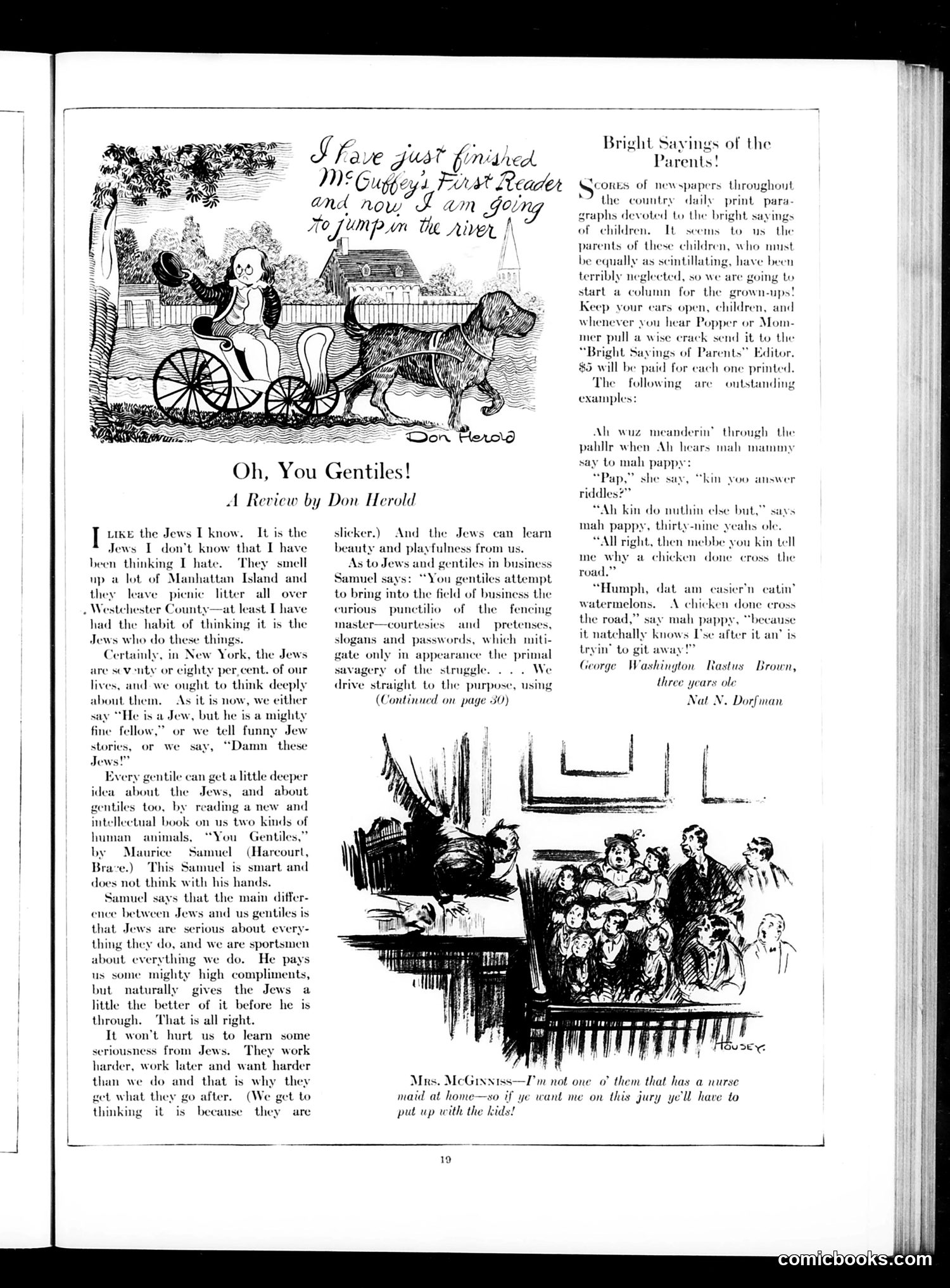
This page reviews Maurice Samuel's 1924 book **"You Gentiles,"** which analyzes differences between Jewish and gentile American character. Herold summarizes Samuel's central thesis: Jews are serious and purposeful in all endeavors, while gentiles are sportsmen who mask ruthlessness with courtesy and social pretense. Herold accepts this flattering assessment, noting Jews "work harder" and deserve admiration—though he admits gentiles could learn seriousness from them. The cartoon below (by Housé) shows Mrs. McGinnis excusing herself from jury duty because she lacks household help and must manage her children—a joke about a woman's domestic obligations overriding civic duty, typical of era attitudes toward women's roles. The page reflects 1920s Jewish-gentile relations discourse in New York, where both communities competed socially and economically.
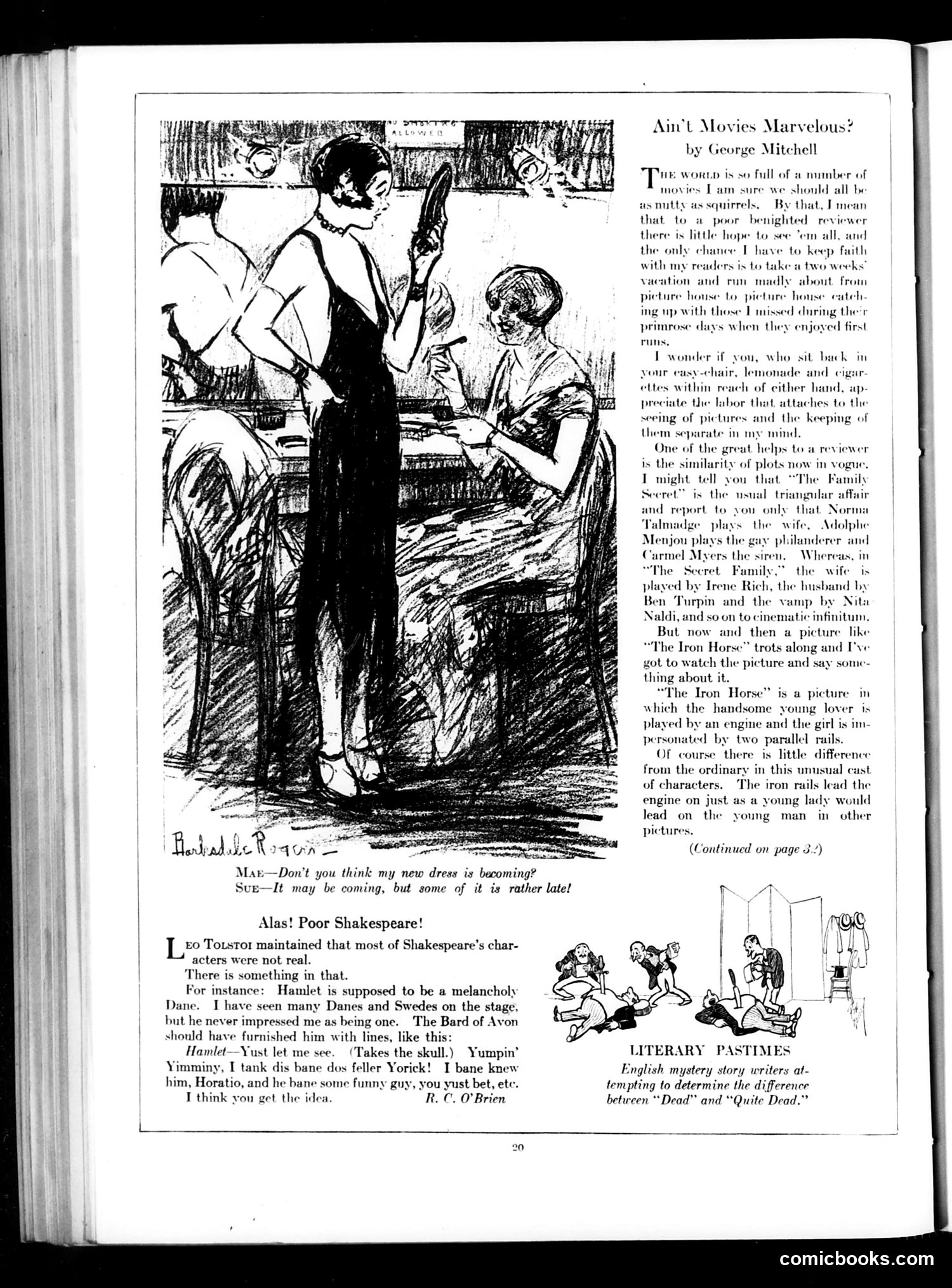
This page contains three separate pieces of humor from Judge magazine: **The Fashion Cartoon** (top): A woman asks if her new dress is "becoming." Her friend replies it may be coming, but "some of it is rather late"—a joke about the dress's incomplete or delayed arrival/fit. **"Alas! Poor Shakespeare!"** (middle): R.C. O'Brien satirizes Leo Tolstoy's claim that Shakespeare's characters weren't realistic by imagining Hamlet rewritten with a Scandinavian accent and colloquial speech ("Yumpin' Yimminy, I tank dis bane..."). The joke mocks both pretentious literary criticism and ethnic stereotypes of Danes/Swedes popular in early 20th-century American humor. **"Ain't Movies Marvelous?"** (bottom): George Mitchell humorously complains about reviewing countless similar films with identical love-triangle plots, then praises "The Iron Horse" for its absurdist twist: the lovers are literally a locomotive and railroad tracks. The satire targets both repetitive silent-film narratives and the era's sentimental melodrama conventions.
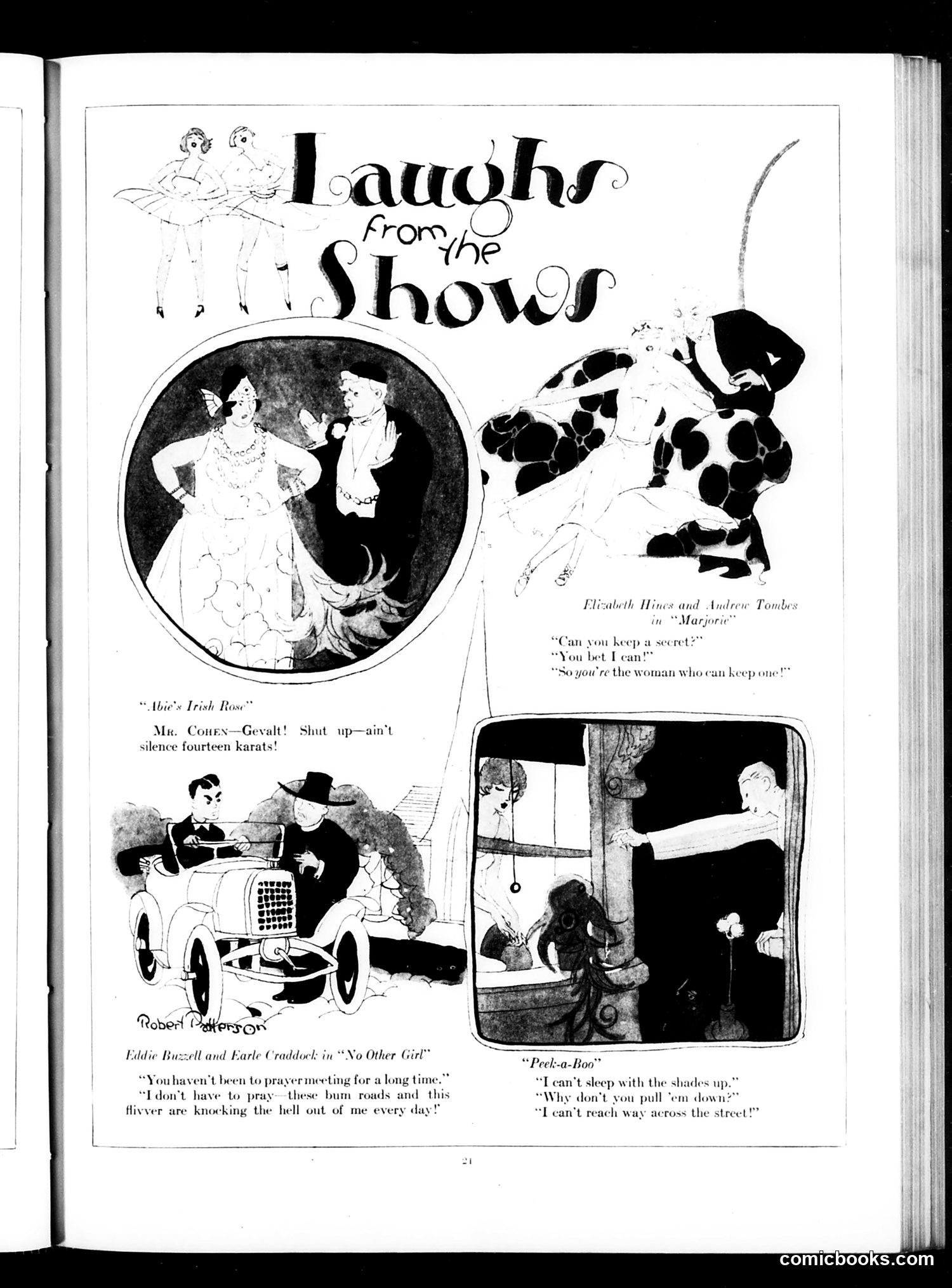
This Judge magazine page presents humorous scenes from contemporary theatrical productions and films. The page features four separate comedic vignettes: 1. **"Abie's Irish Rose"** — A dialogue between characters with Yiddish-inflected speech ("Gevalt!"), reflecting the play's ethnic humor popular in 1920s entertainment. 2. **"Marjorie"** — A scene about keeping secrets, featuring performers Elizabeth Hines and Andrew Tombes. 3. **"No Other Girl"** — A joke about prayer meetings and automobiles ("flivvers"), satirizing how cars damage roads and drivers' comfort. 4. **"Peek-a-Boo"** — A domestic comedy about window shades, with a neighbor unable to reach across the street to adjust them. These represent typical entertainment fare of the era—vaudeville-influenced comedies mixing ethnic stereotypes, domestic situations, and slapstick humor for middle-class audiences.
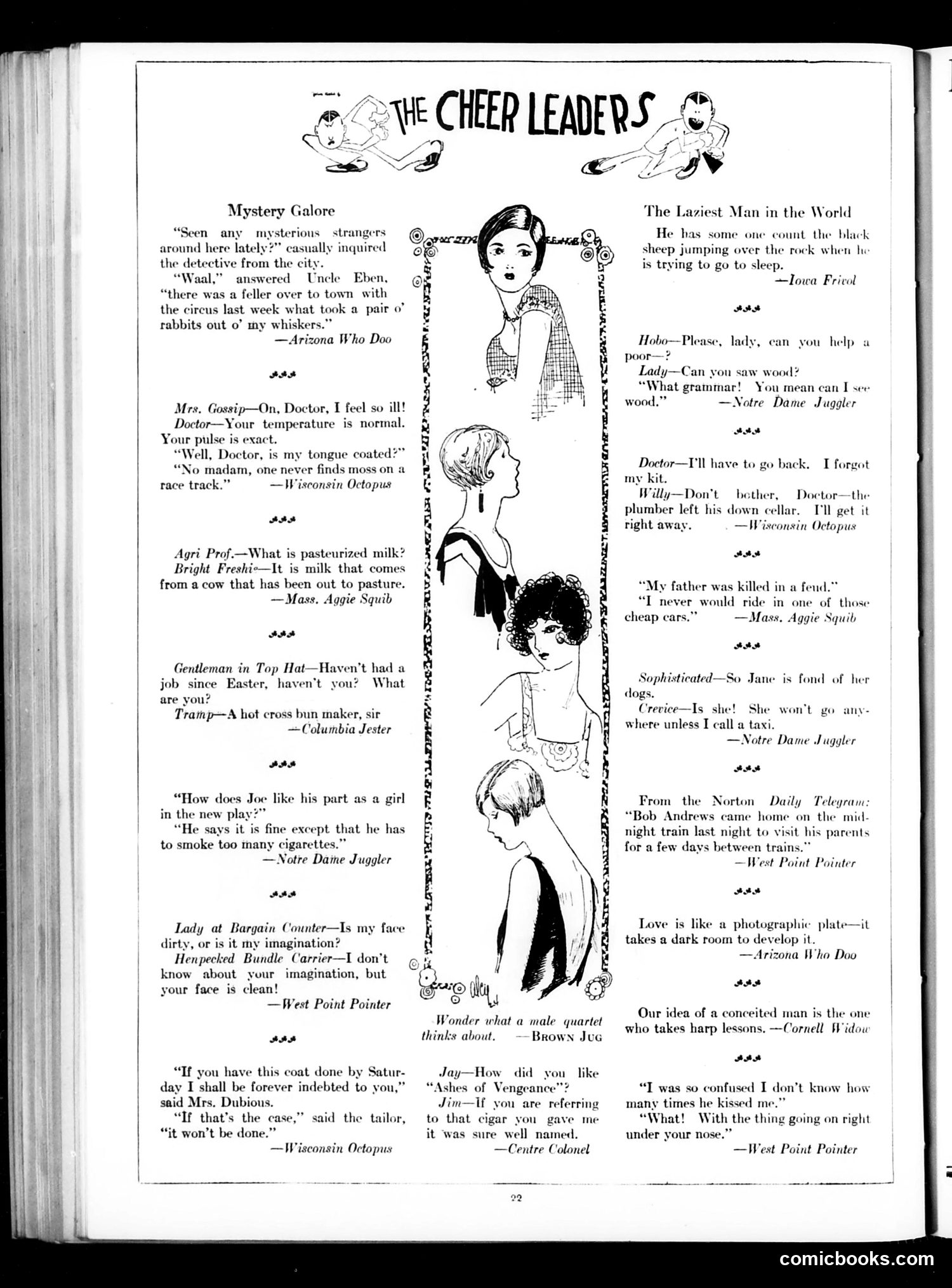
This page collects short jokes and quips from college humor magazines (Notre Dame Juggler, Wisconsin Octopus, West Point Pointer, etc.), arranged around illustrations of flappers and fashionable 1920s figures. The humor relies on wordplay and absurdist logic typical of college comedy: a student mistakes "pasteurized milk" for milk from a cow at pasture; a tramp claims to be a "hot cross bun maker" (joking he's been unemployed since Easter); a woman's question about grammar is corrected pedantically. Several jokes mock social pretension and male behavior—a "sophisticated" woman so snobbish she won't travel without calling a taxi; a man so lazy someone counts sheep *for* him. Others use double entendres: "takes a dark room to develop it" (photography/romance); confusion about how many times someone was kissed during a car drive. The page reflects 1920s college culture: irreverent, focused on dating/courtship anxieties, and gently satirizing both rural simplicity ("Uncle Eben") and urban affectation. The cartoons are decorative rather than satirical—the humor is purely verbal.
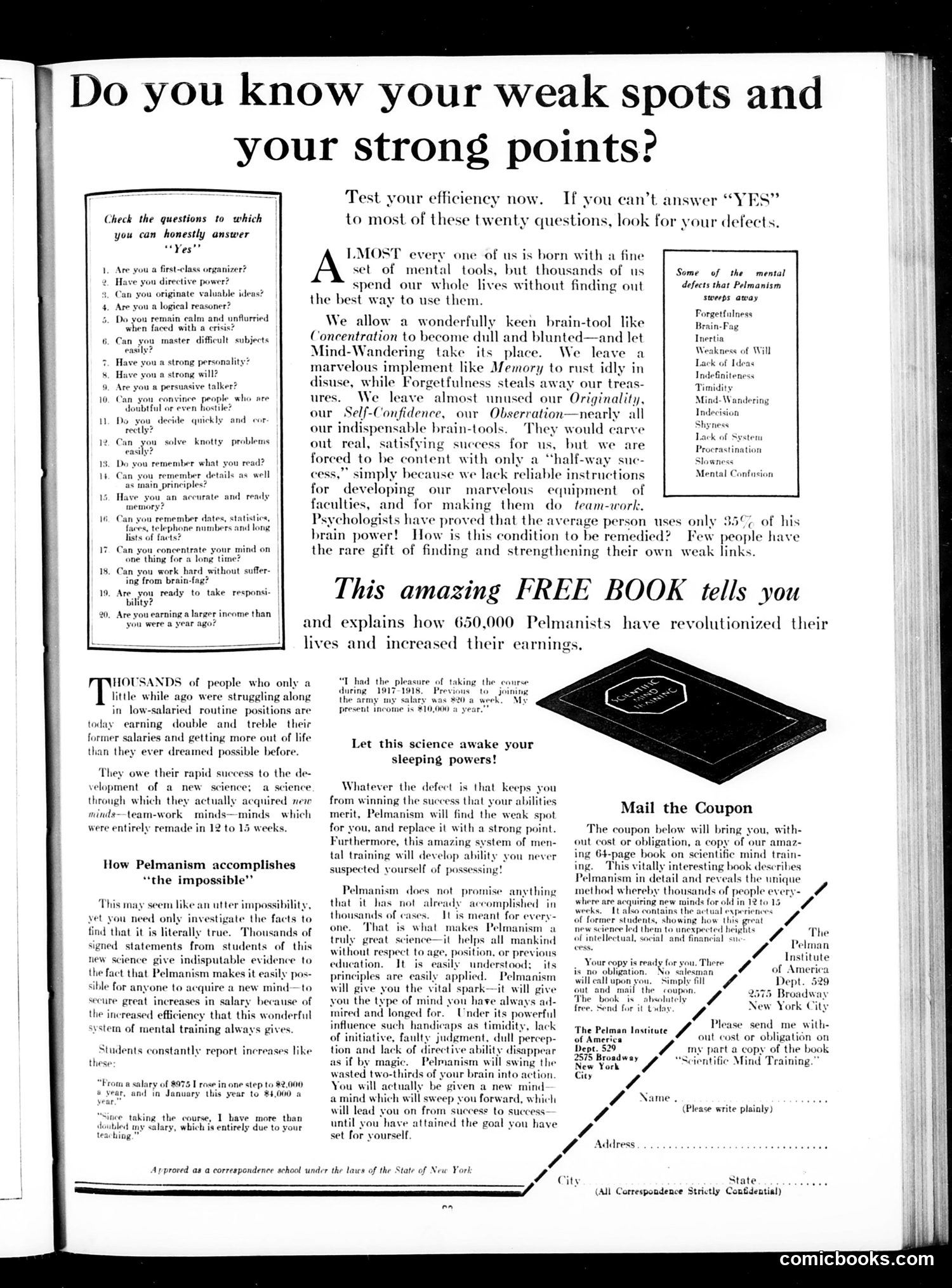
This page is primarily **advertising for "Pelmanism,"** a self-improvement system popular in the early 20th century. It's not a political cartoon but rather a magazine advertisement disguised as educational content. The setup uses a self-diagnostic questionnaire (20 yes/no questions about mental abilities) to make readers feel inadequate, then offers Pelmanism as the solution. The text claims the average person uses only 35% of brain power and promises that 650,000 "Pelmanists" have revolutionized their lives and earnings through mental training completed in "12 to 15 weeks." The sidebar lists "mental defects" Pelmanism claims to cure: forgetfulness, brain fog, weakness of will, procrastination, etc. This exemplifies **early 20th-century self-help marketing**—using pseudoscientific claims and testimonials to sell a correspondence course. The "science" framing and success stories are typical of the era's unregulated mail-order education industry. Judge magazine's inclusion suggests it was accepted advertising rather than satire.
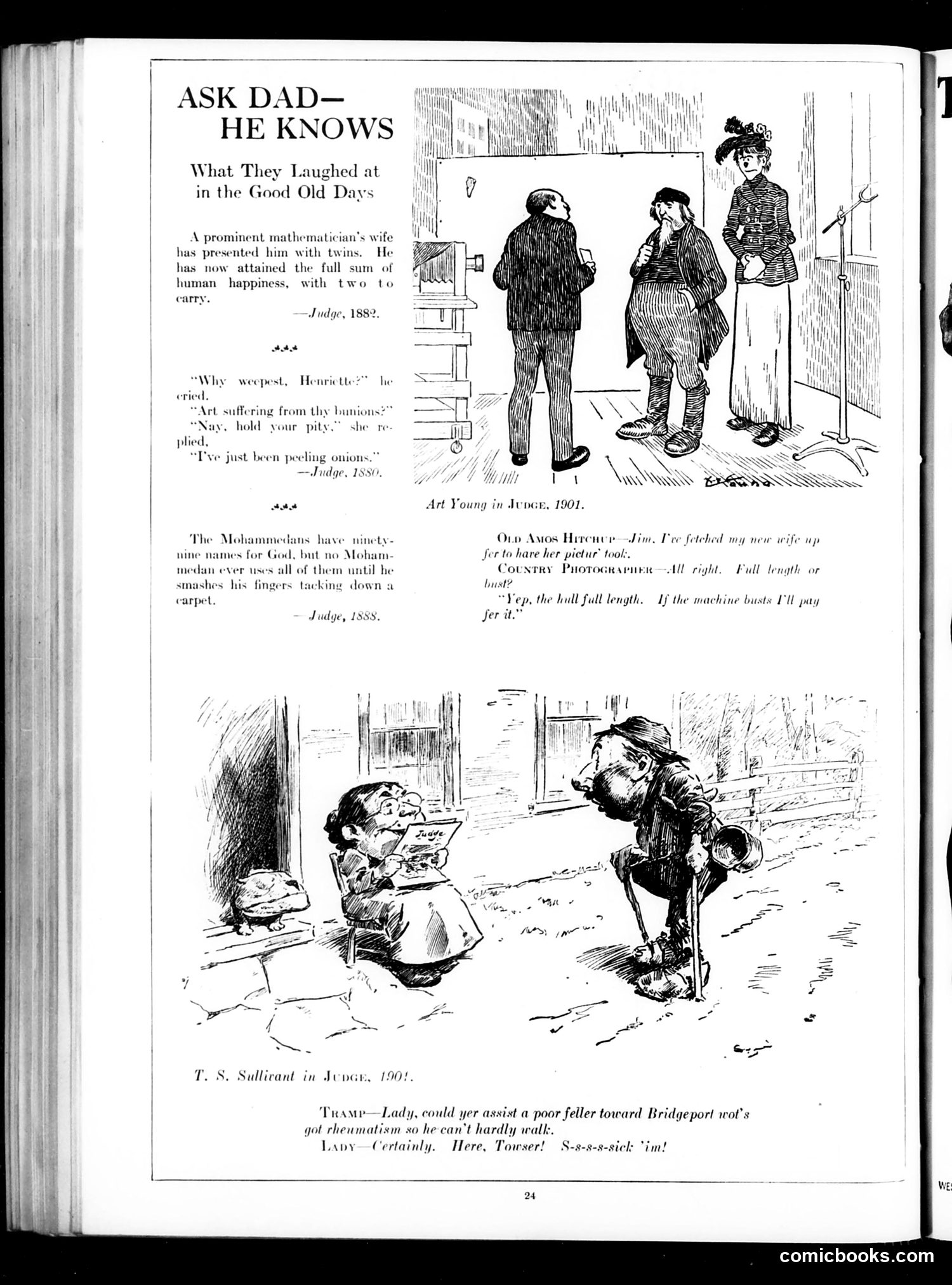
This page collects brief humorous anecdotes and cartoons from Judge's archives, labeled "Ask Dad—He Knows," presenting old jokes for nostalgic amusement. The jokes reflect period attitudes: 1. **Twins joke (1882)**: Mocks women's domestic labor—a mathematician's happiness comes from having "two to carry" (children), reducing women to child-bearers. 2. **Bunions/onions joke**: Plays on class stereotypes, depicting a woman's physical suffering as comedic fodder. 3. **Muslim names for God**: Ethnic/religious stereotyping, suggesting Muslims invoke God only when angry (smashing fingers with carpets). 4. **Photography joke**: Rural dialect humor, mocking working-class people's unfamiliarity with technology. 5. **Tramp cartoon**: A homeless man asks a woman for assistance toward Bridgeport; she responds by siccing her dog on him—presented as humor. This reflects callous Victorian attitudes toward poverty and vagrancy. The page exemplifies how Judge satirized through caricature, ethnic stereotyping, and class mockery—humor that reveals period prejudices rather than punching up at power.
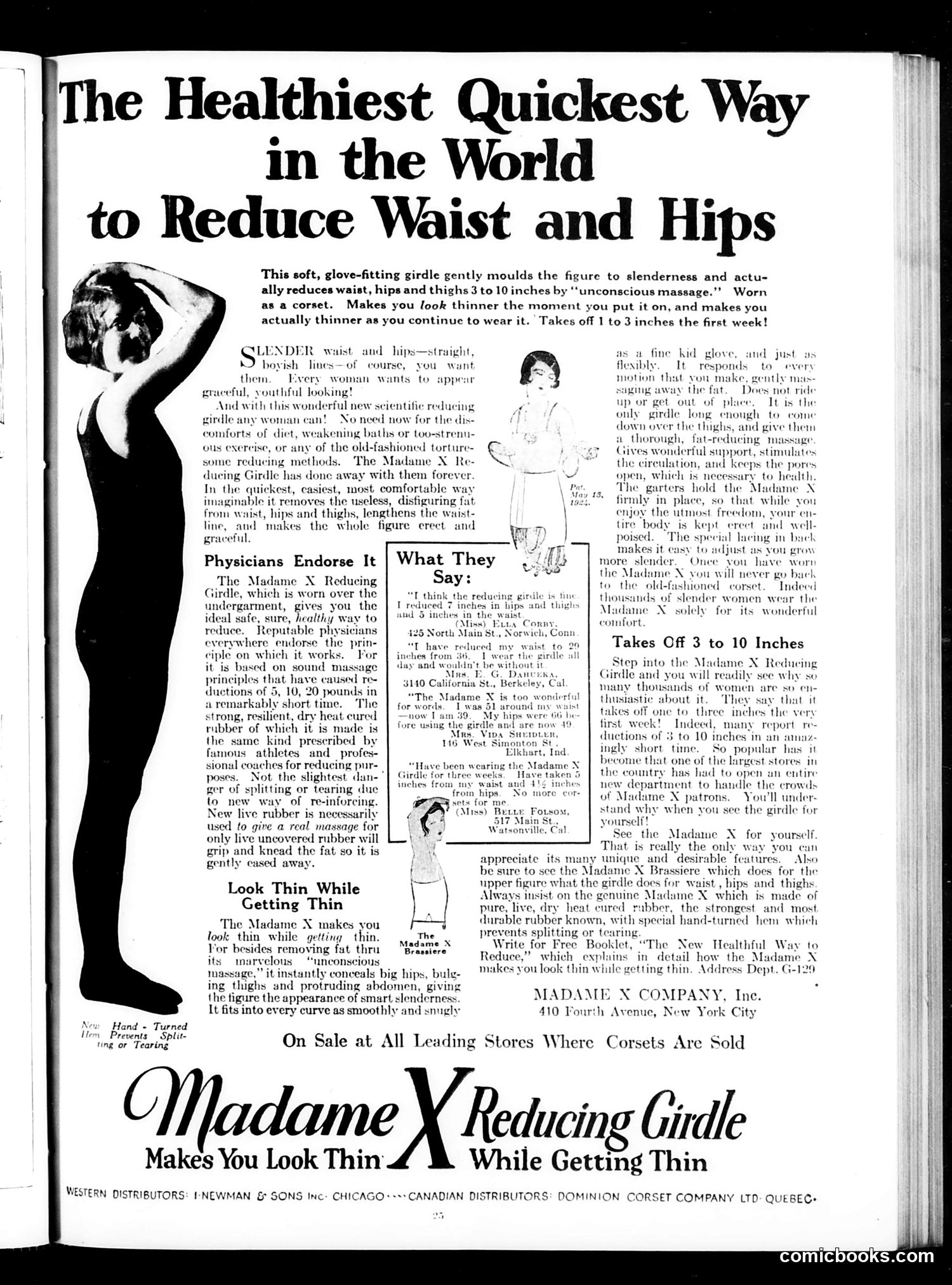
This is a full-page advertisement for the "Madame X Reducing Girdle," a women's undergarment marketed as a weight-loss solution. Rather than satire, this is a genuine commercial promoting a corset-like device that claims to reduce waist and hip measurements by 3-10 inches through "unconscious massage." The page includes testimonials from supposed users and endorsements from unnamed physicians. It exemplifies early 20th-century beauty standards prioritizing extreme thinness and the marketing of dubious medical devices to women. The claims—that wearing a girdle while doing nothing else produces actual fat loss—reflect the era's pseudoscientific approach to weight reduction. To modern readers, this represents a striking historical artifact of how aggressively companies marketed unrealistic body-shaping solutions to women, often with unsubstantiated health claims that would violate today's advertising regulations.
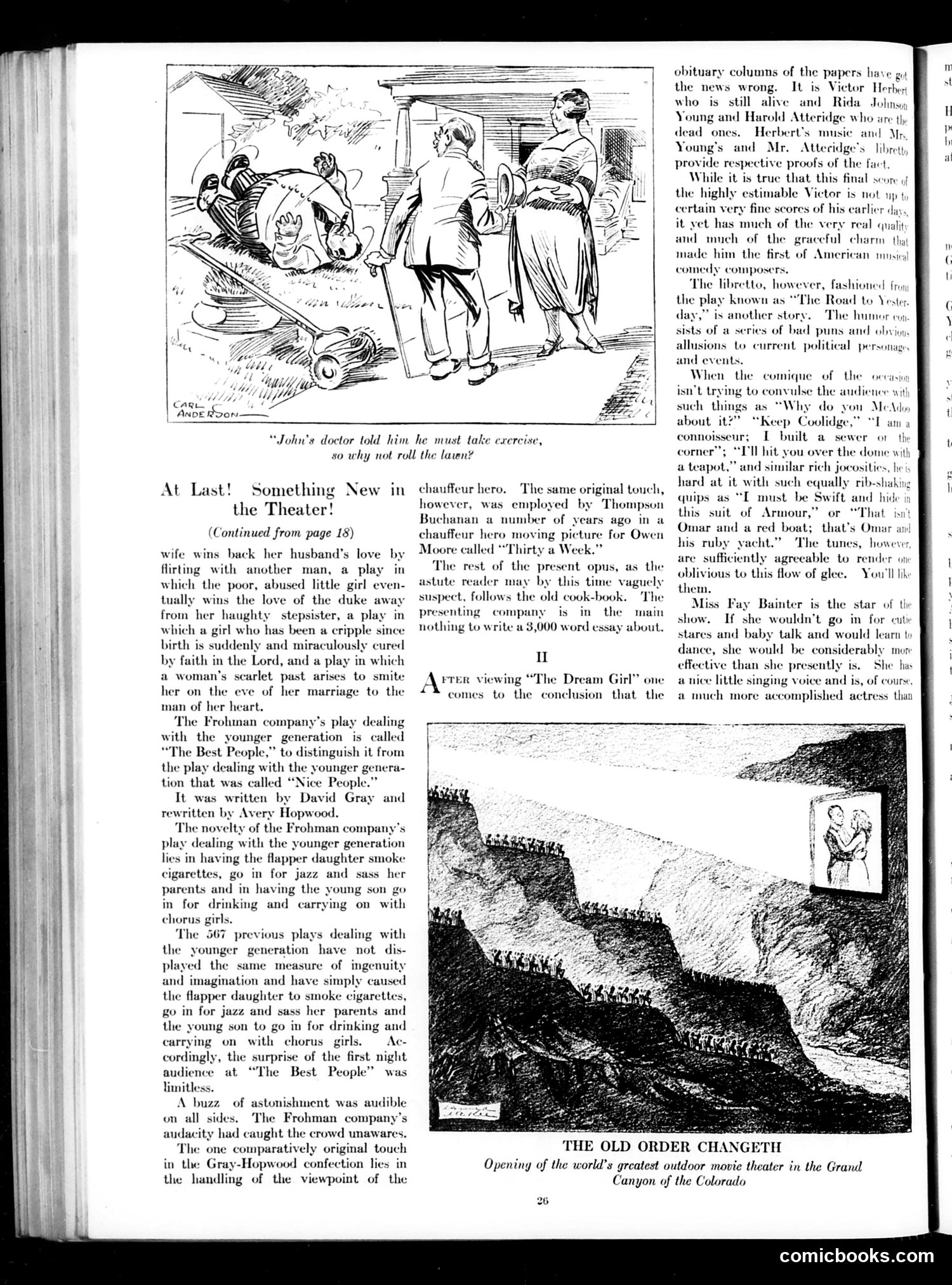
The single cartoon on this page depicts a man in formal dress standing beside a woman, watching another man operating a manual lawn roller. The joke plays on a common domestic scenario: a doctor has prescribed exercise, so the husband suggests rolling the lawn—but the cartoon suggests he's avoiding the work himself by having someone else (likely a servant or laborer) do it. The humor is gentle domestic satire, mocking husbands who find clever excuses to delegate physically demanding tasks while claiming to follow doctor's orders. It reflects early 20th-century class assumptions about hired labor and the leisured classes avoiding exertion. The accompanying article discusses theatrical productions, particularly the Frohman company's "The Best People" and Victor Herbert's "The Dream Girl," critiquing their predictable plots and derivative humor about flappers and jazz-age youth.
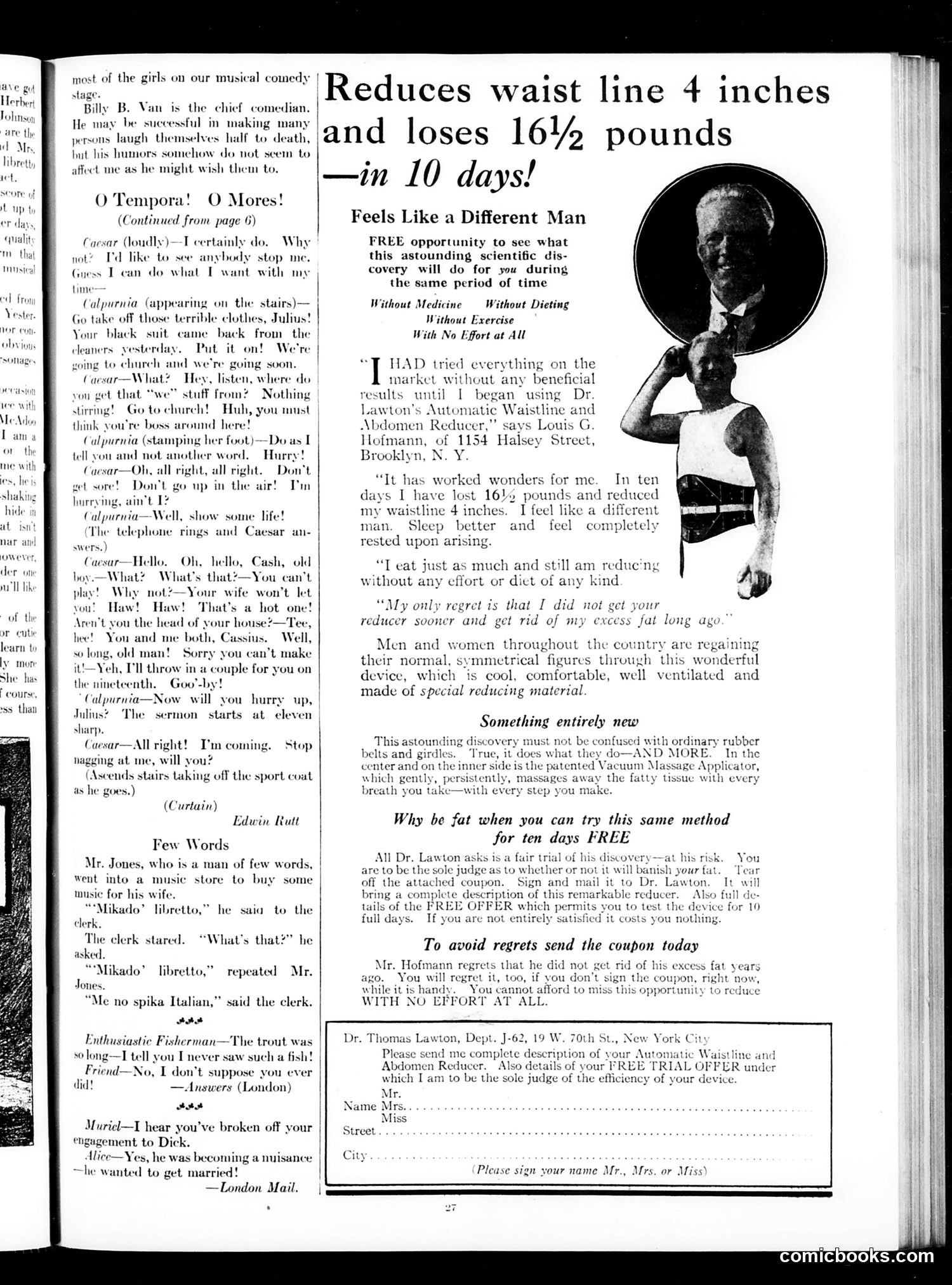
This page contains two distinct elements: a satirical sketch and a weight-loss device advertisement. **The Sketch**: "O Tempora! O Mores!" (a Latin phrase meaning "Oh the times! Oh the customs!") depicts a domestic quarrel between Caesar and Calpurnia. The satire mocks modern American marriage dynamics by casting them in classical Roman terms—a husband resists his wife's authority, then admits to a friend that his wife controls him. The humor lies in exposing the gap between male pretense of dominance and actual domestic reality. The classical framing underscores how timeless this marital power struggle is. **The Advertisement**: The right column advertises Dr. Lawton's "Automatic Waistline and Abdomen Reducer"—a mechanical device claiming to reduce waistline 4 inches and lose 16½ pounds in 10 days "without medicine, dieting, or exercise." This represents early 20th-century weight-loss pseudoscience, targeting insecure readers with exaggerated promises using testimonials.
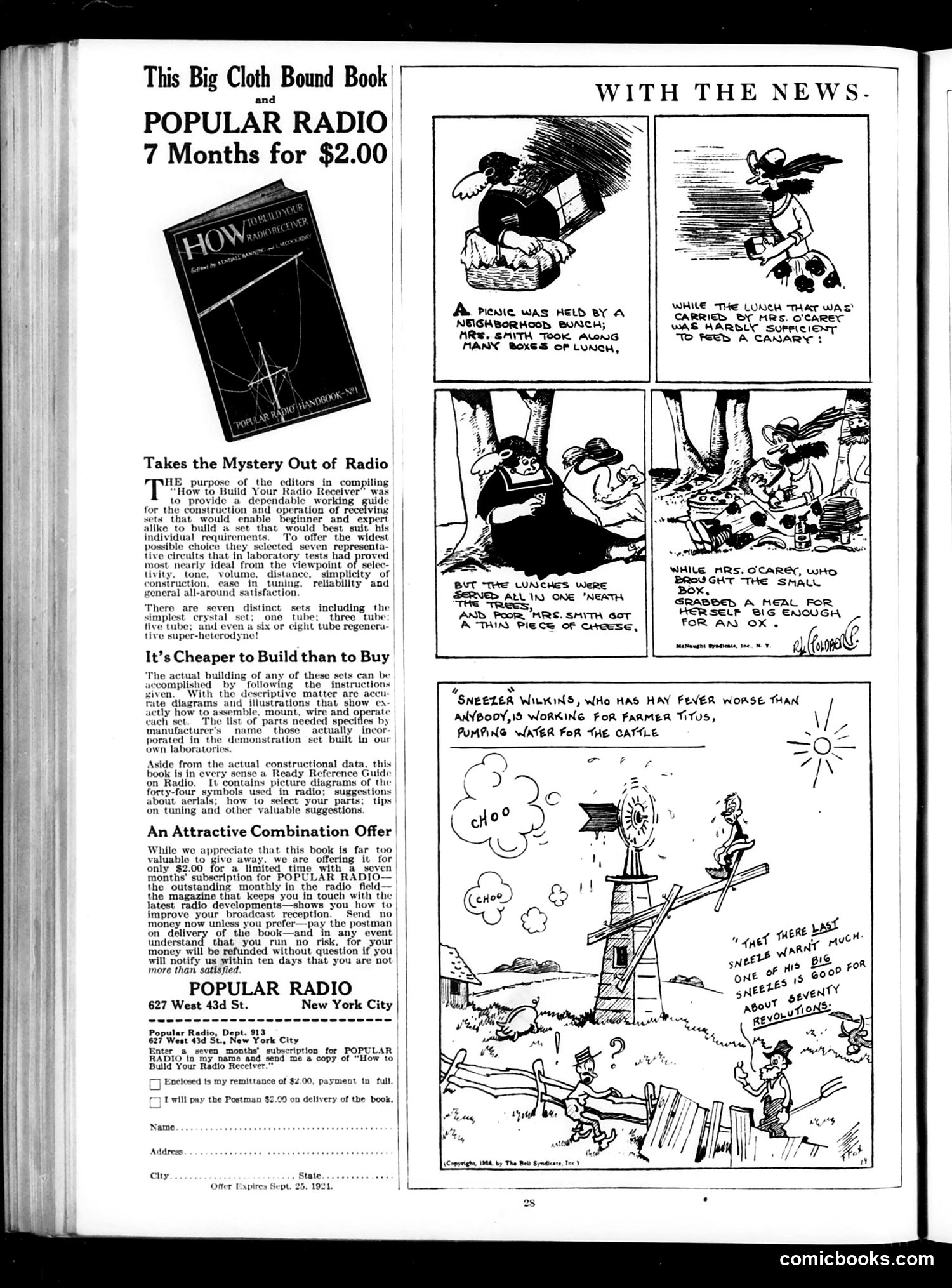
This page is primarily **advertising for Popular Radio magazine and a how-to book**, not political satire. The left side promotes a cloth-bound book on building radio receivers, offered as a subscription incentive for $2.00 (seven months). The right side contains two unrelated **humorous comic strips**: 1. **"With the News"** (top): A joke about a neighborhood picnic where Mrs. Smith brings many lunch boxes but only gets cheese, while Mrs. O'Carey's single small box contains enough food for an ox. The humor relies on exaggeration and irony about portion sizes. 2. **"Sneezer Wilkins"** (bottom): A comic about a farm worker with severe hay fever ("worse than anybody") pumping water for cattle. The visual gag shows him sneezing constantly ("CHOO"), with text claiming "there last / Sneezer wanted much / One of his big sneezes / Is good for / Any and twenty / Revolutionaries." Both strips are mild domestic humor typical of 1920s Judge magazine—no political commentary or social satire appears present on this page.
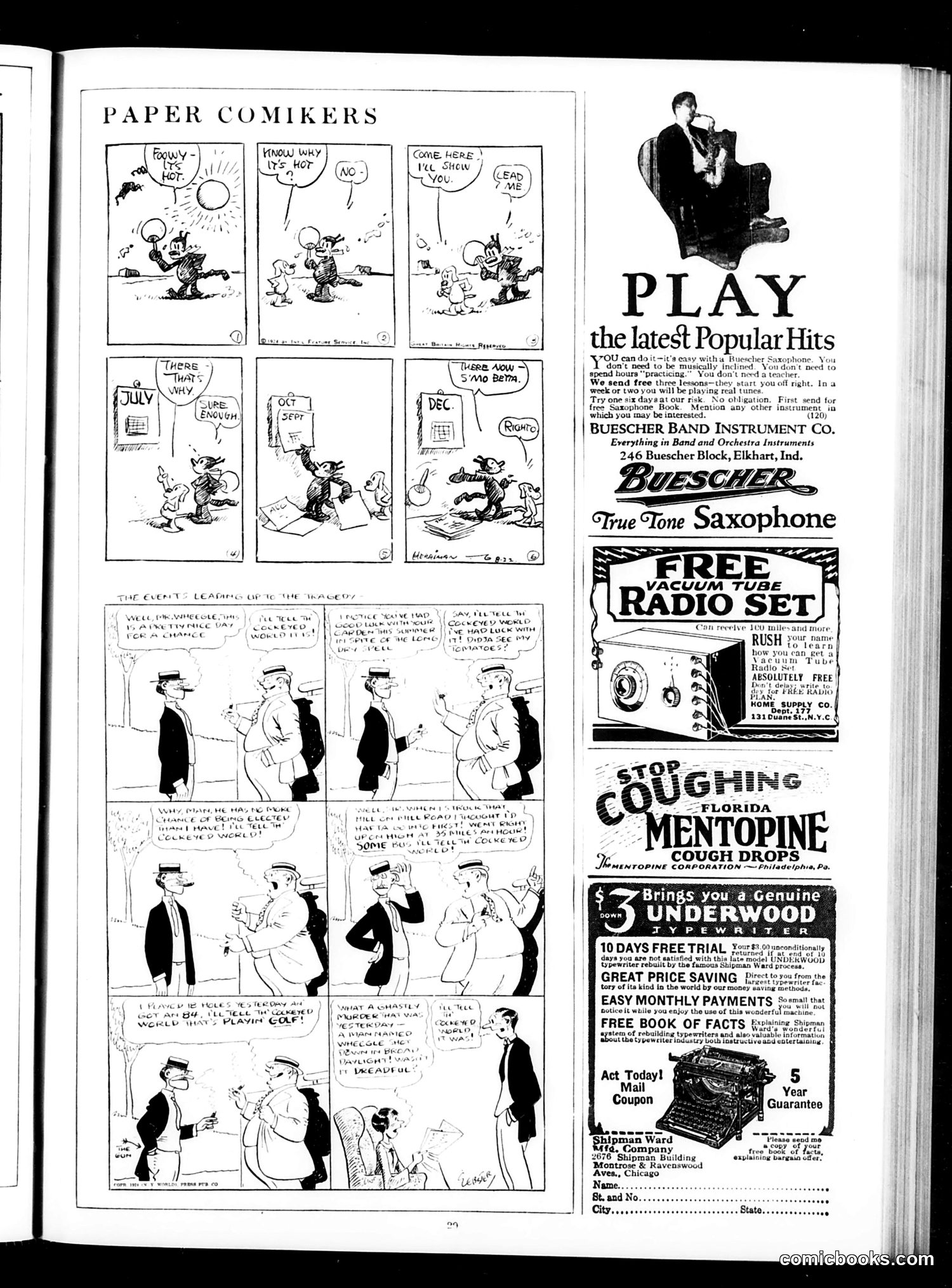
This page contains two unrelated elements: **Left side: Comic strip** titled "Paper Comikers" (likely a pun on "paper comics"). The strip appears to be a humorous narrative about characters across months (July, October, December visible), depicting interpersonal situations—possibly workplace or romantic scenarios involving men in formal dress and other figures. The dialogue is largely illegible in this reproduction, making specific plot details unclear. **Right side: Advertisements** dominating the page, including: - Buescher saxophone instruction - Free vacuum tube radio set offer - Mentopine cough drops - Underwood typewriter promotion The page is primarily **commercial advertising space** rather than editorial content, which was typical for Judge magazine. Without clearer text legibility, the comic's specific satirical point remains difficult to determine with certainty.
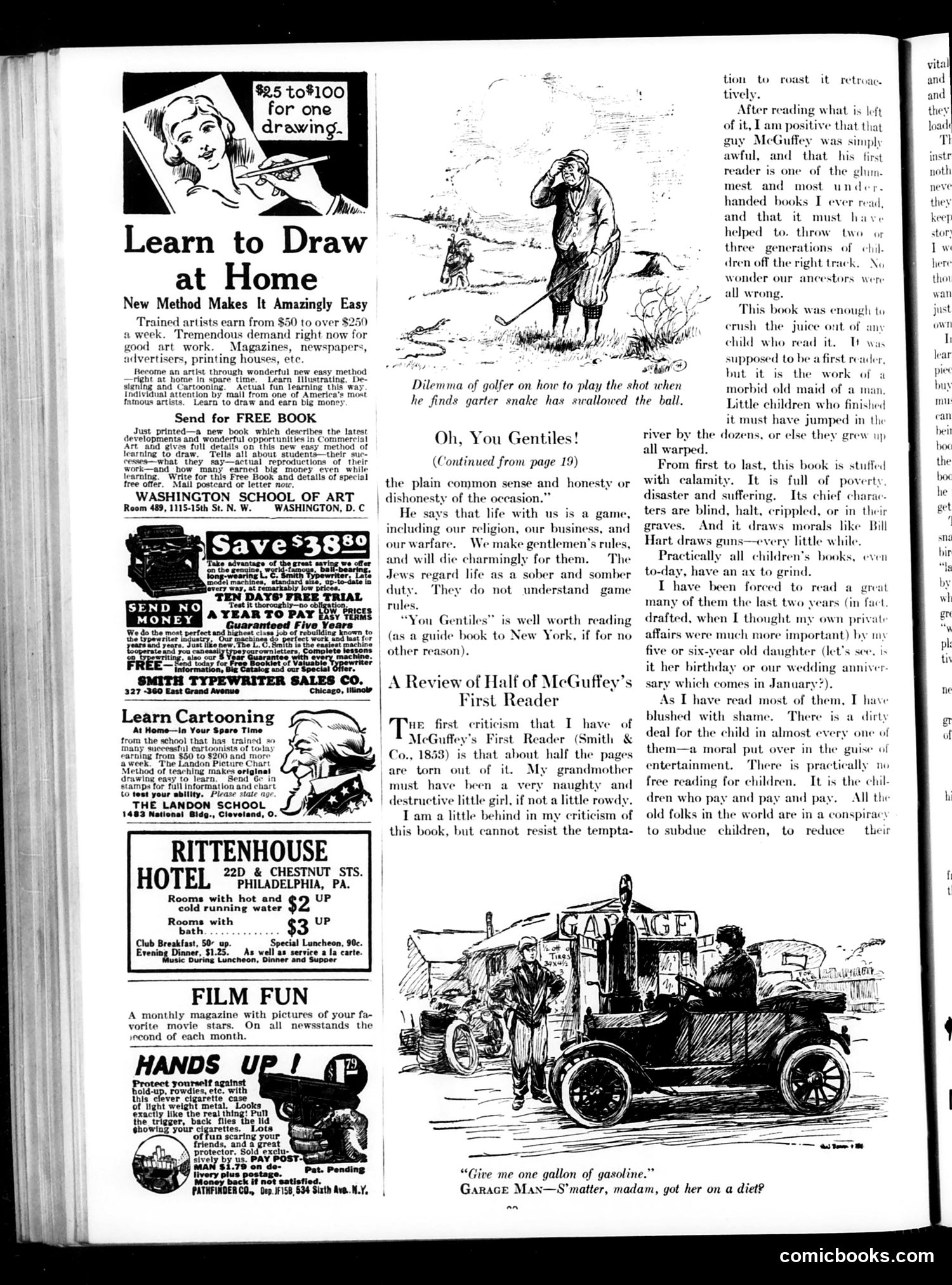
This page is primarily **advertising and book reviews** rather than political satire. The main content includes: **Advertisements:** Multiple "Learn at Home" vocational ads (drawing, cartooning, typewriter sales) typical of early 20th-century magazines targeting working-class readers seeking self-improvement. **Cartoon:** A single illustrated joke shows a golfer whose ball has been swallowed by a garter snake—a simple visual gag with no political meaning. **Book Review:** The substantive editorial content critiques "Half of McGuffey's First Reader" (an 1853 children's textbook) and the book "You Gentiles." The reviewer sarcastically attacks McGuffey's moralistic, grim pedagogy as psychologically damaging to children, and praises "You Gentiles" for its frank cultural observations about Jewish-Christian differences. **Context:** Judge was satirical, but this particular page demonstrates the magazine's broader role as a vehicle for advertising, entertainment, and cultural commentary rather than exclusively political cartooning.
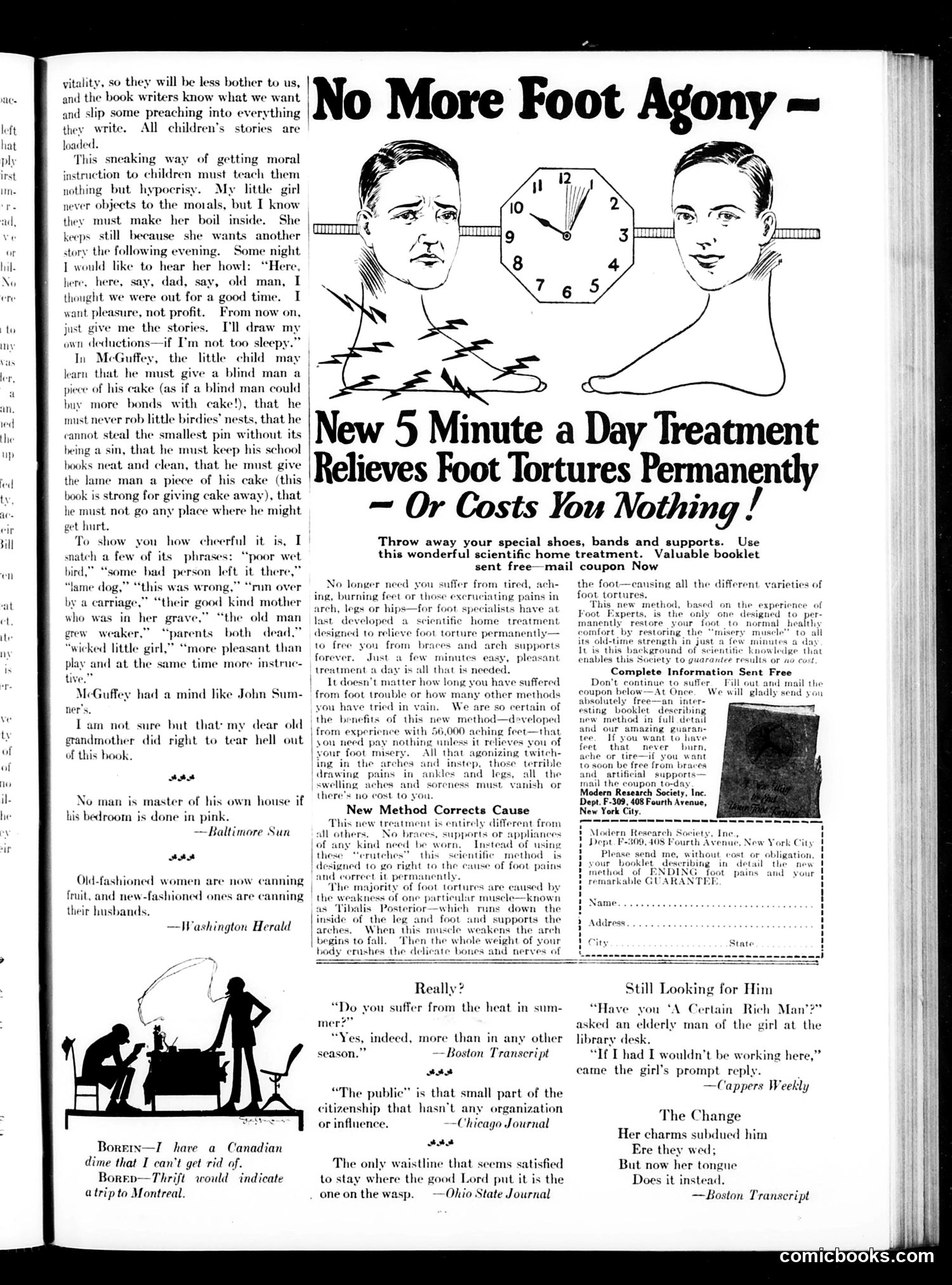
This page mixes editorial content with advertising. The main editorial piece critiques moral instruction in children's literature—specifically McGuffey Readers—arguing that sneaking moralizing into stories teaches hypocrisy rather than genuine values. The author complains these books are filled with depressing cautionary tales (dead parents, accidents, theft) designed to frighten children into obedience. The dominant feature is a full-page advertisement for a mail-order foot-pain treatment claiming to cure arch problems permanently or cost nothing. It promises results from treating the "tibialis posterior" muscle through a home method. Below are various short jokes and satirical quotes from newspapers about minor social observations (women canning, heat in summer, satisfied waistlines). The page reflects early 20th-century American culture: concerns about children's education, mail-order medical remedies, and newspaper humor traditions.
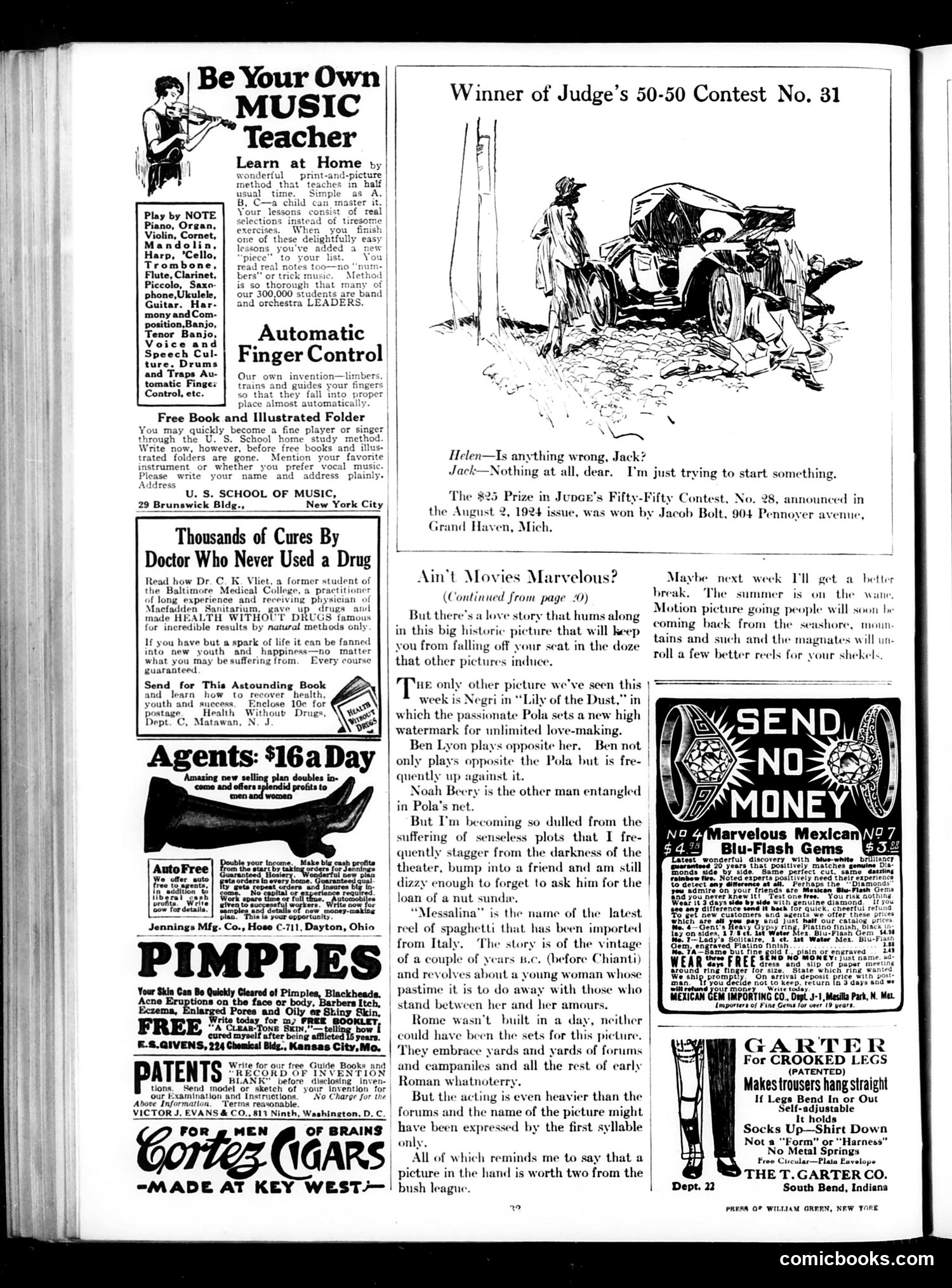
This page is primarily **advertising**, with a small contest-winning cartoon at the top right. **The Main Cartoon:** Shows a man and woman examining a broken-down automobile stuck against a pole. Helen asks Jack if something is wrong; Jack replies he's "just trying to start something." The joke is a double entendre—he's pretending to try starting the car's engine while implying romantic interest, which the car trouble conveniently interrupts. **The Context:** This reflects 1920s anxieties about automobiles as sites of unsupervised courtship. Cars represented newfound freedom for young couples, and parents worried about what happened in parked vehicles—a major social concern of the era. **Note:** The page is dated August 2, 1924, and primarily features mail-order advertisements for music lessons, patent services, medical treatments, and consumer goods—typical of Judge's revenue model.
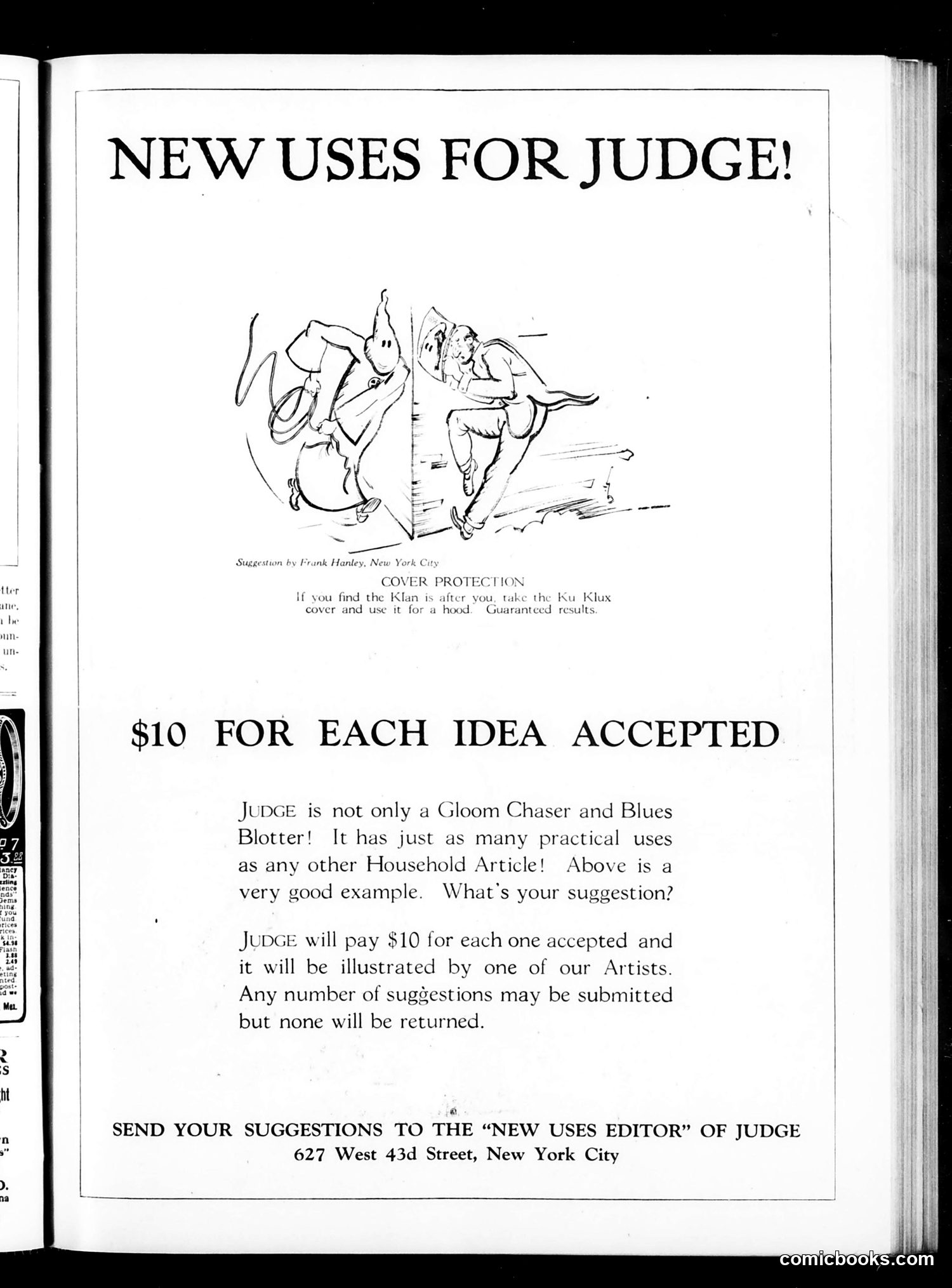
This is a satirical advertisement soliciting reader contributions. The cartoon depicts someone using a *Judge* magazine cover as protection against the Ku Klux Klan—specifically, suggesting the magazine's cover could serve as a makeshift KKK hood to disguise oneself. The joke is dark anti-Klan satire: it mocks both the Klan's prevalence as a threat and the magazine's perceived ineffectiveness, implying *Judge* is so worthless that its only practical use would be impersonating a Klansman to escape persecution. The magazine invites readers to suggest other "practical uses" for *Judge*, paying $10 per accepted idea. This reflects the 1920s resurgence of the KKK as a visible social menace, and *Judge*'s editorial stance mocking racist organizations through absurdist humor. The advertisement is simultaneously promoting reader engagement while delivering pointed political commentary about anti-Black terrorism.
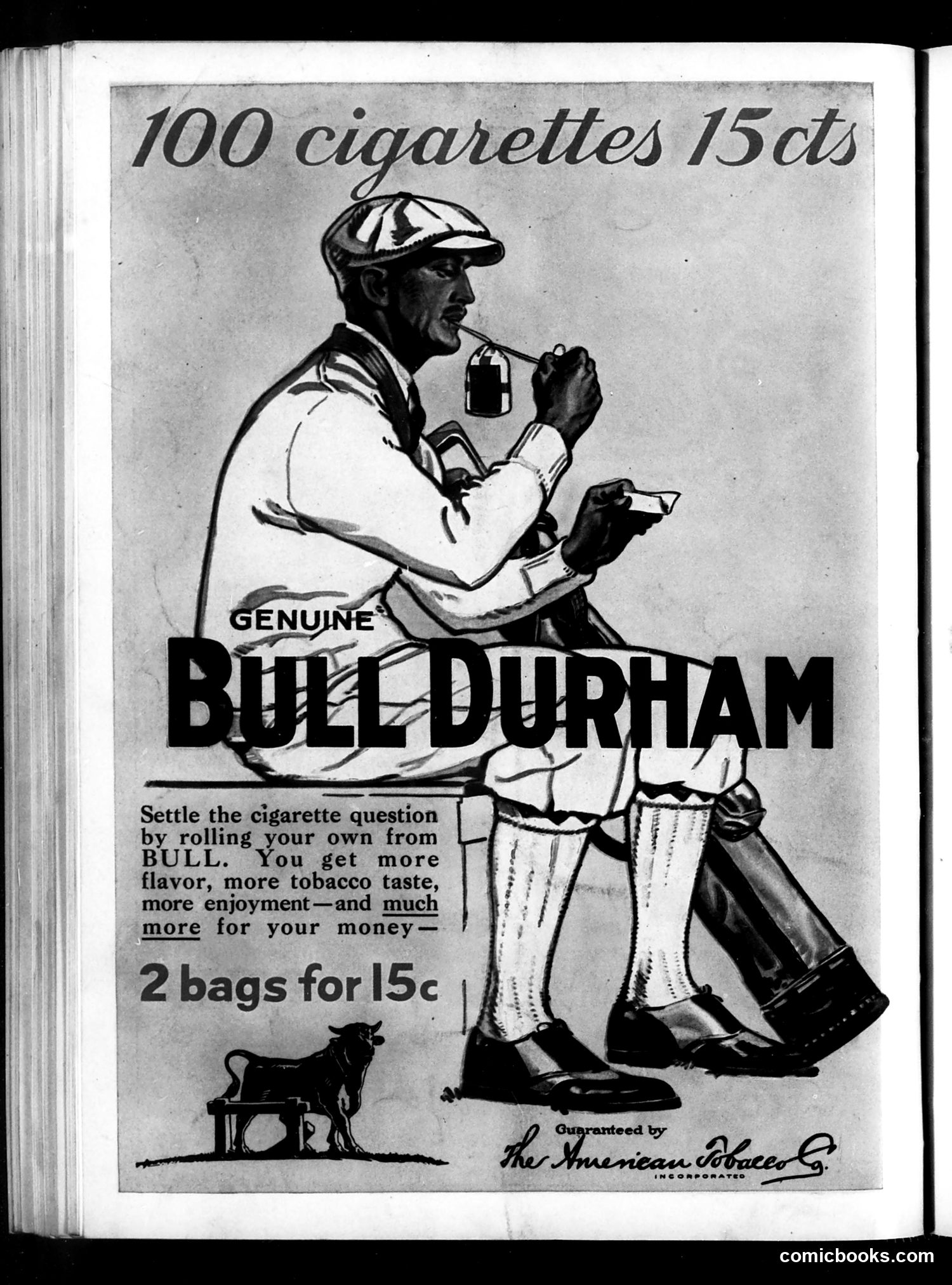
This is a **cigarette advertisement**, not political satire. The page promotes "Bull Durham" rolling tobacco—a product where consumers manually roll their own cigarettes using loose tobacco and rolling papers. The advertisement features a man in working-class attire (cap, suspenders) holding rolling supplies. The appeal targets budget-conscious smokers: for 15 cents, you get two bags of tobacco to roll multiple cigarettes, offering "more flavor, more tobacco taste, more enjoyment—and much more for your money" than pre-made cigarettes. The small bull logo (bottom left) reinforces the brand name. This represents early 20th-century consumer marketing normalizing tobacco use without health warnings, which were not legally required at the time.
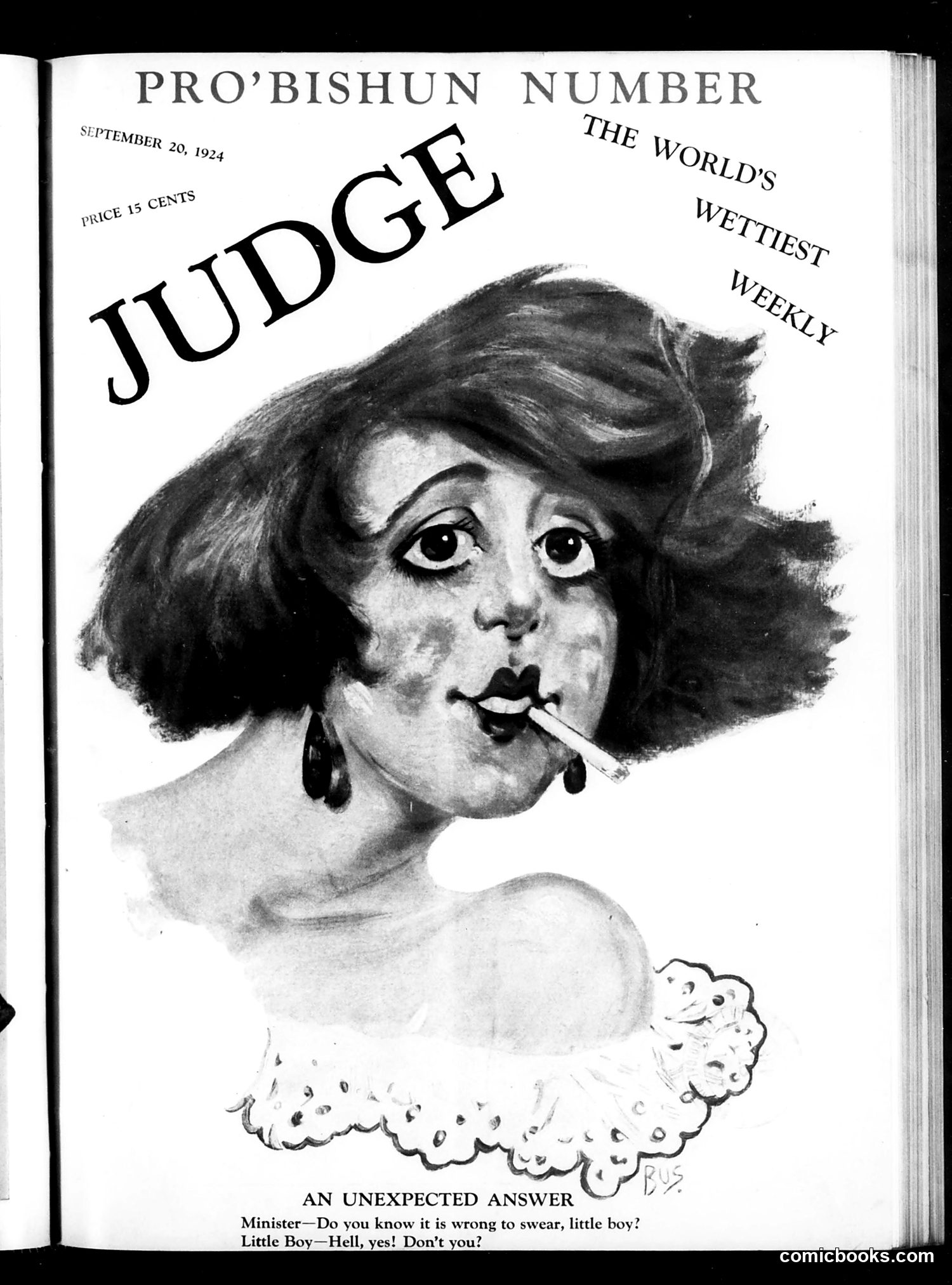
This is a "Pro'bishun" (Prohibition) issue of Judge magazine from September 1924, during America's alcohol ban (1920-1933). The cover features a caricatured woman with bobbed hair and a cigarette—stereotypical imagery of the "modern woman" or "flapper" of the 1920s, presented as morally questionable. The cartoon below satirizes moral hypocrisy. A minister lectures a boy about swearing, but the boy's crude response—"Hell, yes! Don't you?"—exposes the adult's own profanity and hypocrisy. The joke targets the gap between preached morality and actual behavior, a common theme during Prohibition when many authorities who advocated for moral reform themselves violated the law or lacked moral authority. The title page thus ironically presents both the flapper and this moral contradiction as Prohibition-era social concerns.
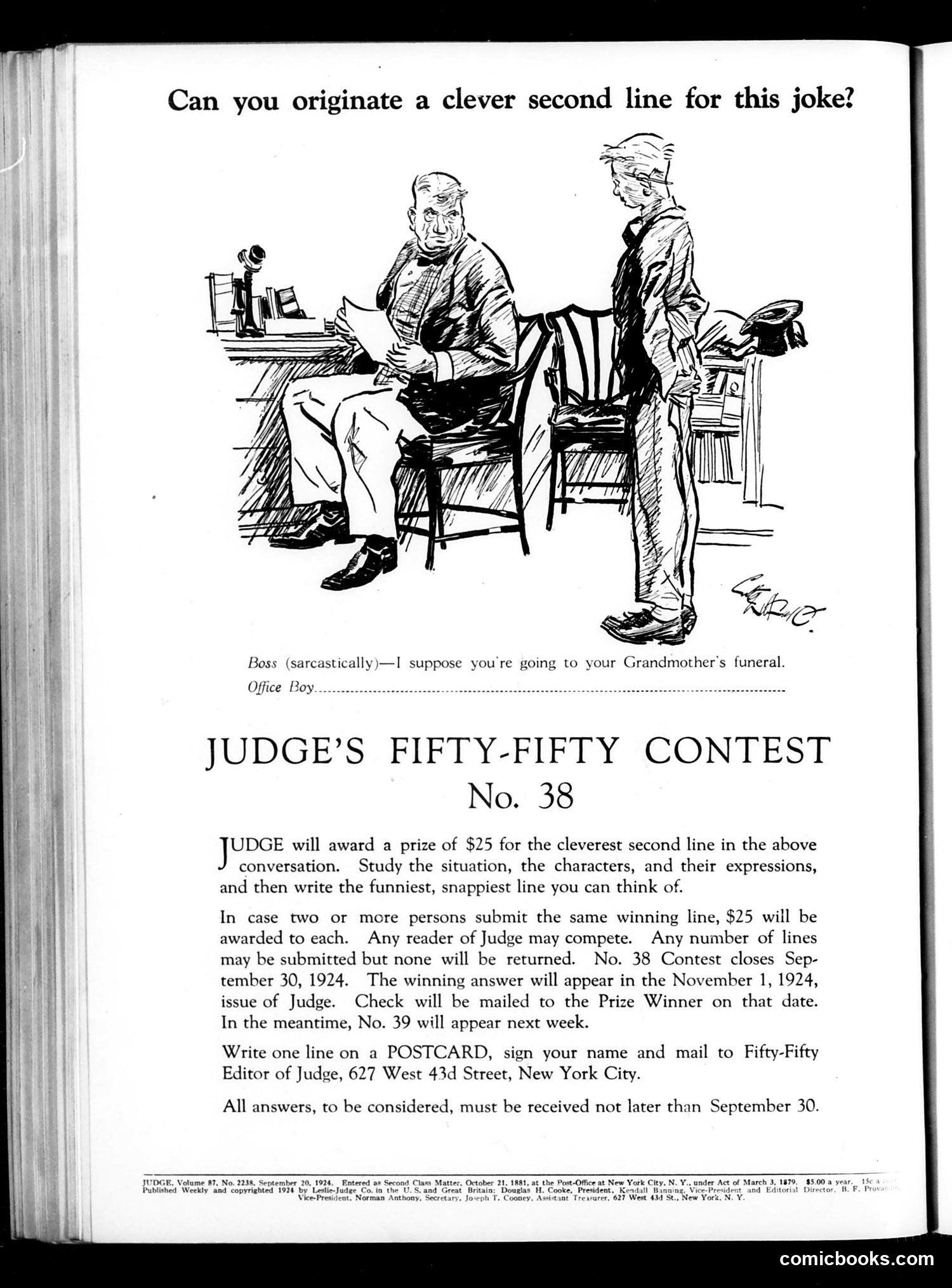
This page presents a reader-participation humor contest. The setup shows a boss sarcastically confronting an office boy who's apparently skipping work, saying "I suppose you're going to your Grandmother's funeral"—implying the boy frequently uses this excuse. Readers were invited to submit a clever one-liner as the office boy's response, competing for a $25 prize. The humor relies on workplace dynamics typical of 1920s office culture: the power imbalance between boss and subordinate, and the well-worn excuse of attending a funeral to leave work. The contest reflects Judge magazine's interactive approach to humor—rather than providing the punchline, they crowdsourced it from readers. The September 30, 1924 deadline and November 1 publication date show this was a recurring feature ("No. 38" indicates many previous contests).
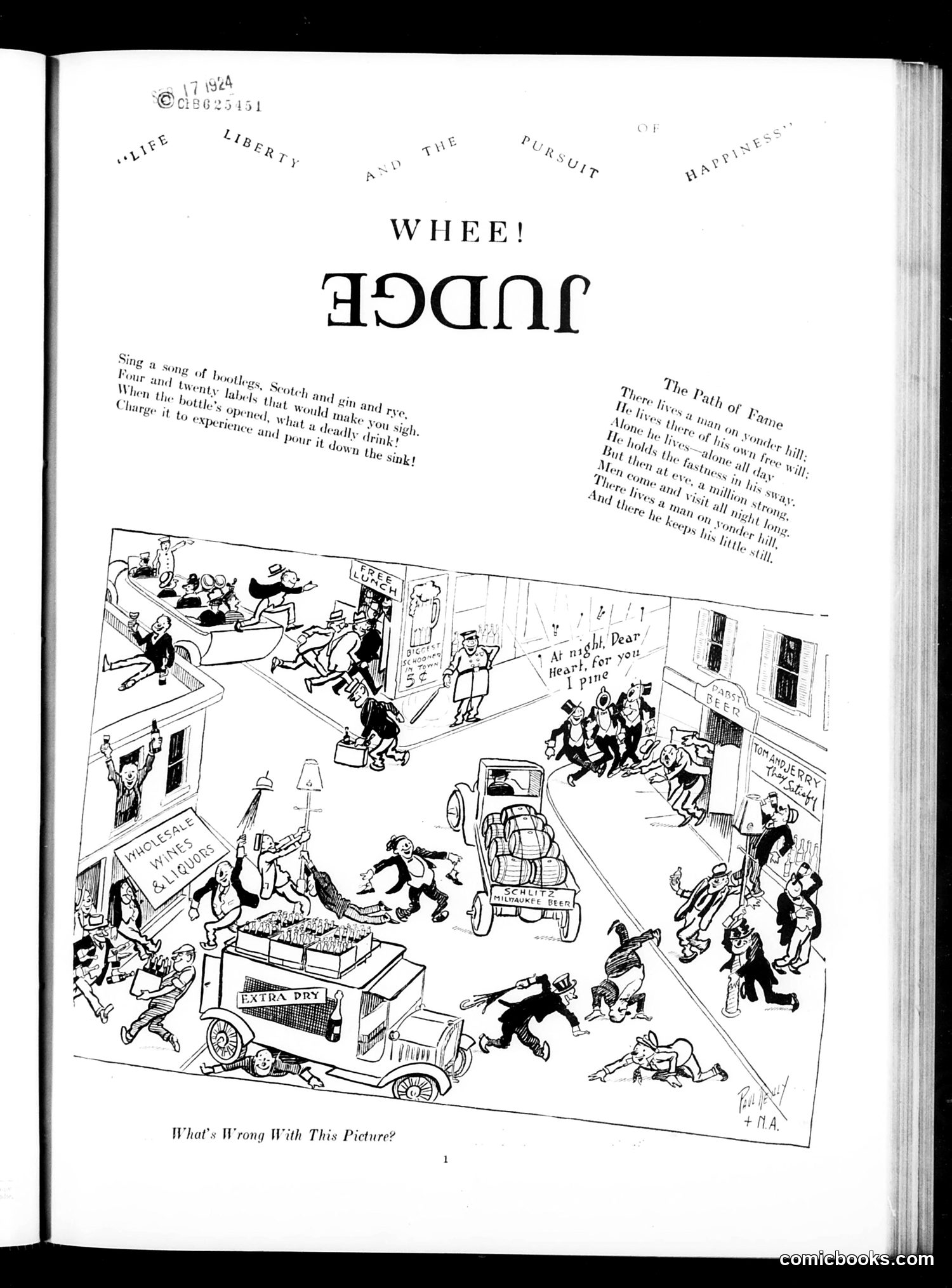
This is a visual puzzle page titled "What's Wrong With This Picture?" depicting a chaotic street scene full of people engaged in various absurd activities—figures falling, jumping, riding in vehicles, and generally behaving in exaggerated, comedic ways. The page header references "Life, Liberty and the Pursuit of Happiness" (from the Declaration of Independence), suggesting satirical commentary on American freedom and behavior. The poem "Whee! Freed" celebrates indulgence and drinking ("Scotch and gin and rye"). The puzzle invites readers to identify what's illogical or inappropriate in the scene. Visible are references to alcohol ("Schlitz Milwaukee Beer"), suggesting the satire concerns Prohibition-era drinking and social chaos. The overall tone mocks uninhibited American excess and lawlessness, likely critiquing post-Prohibition culture or general social disorder of the era.
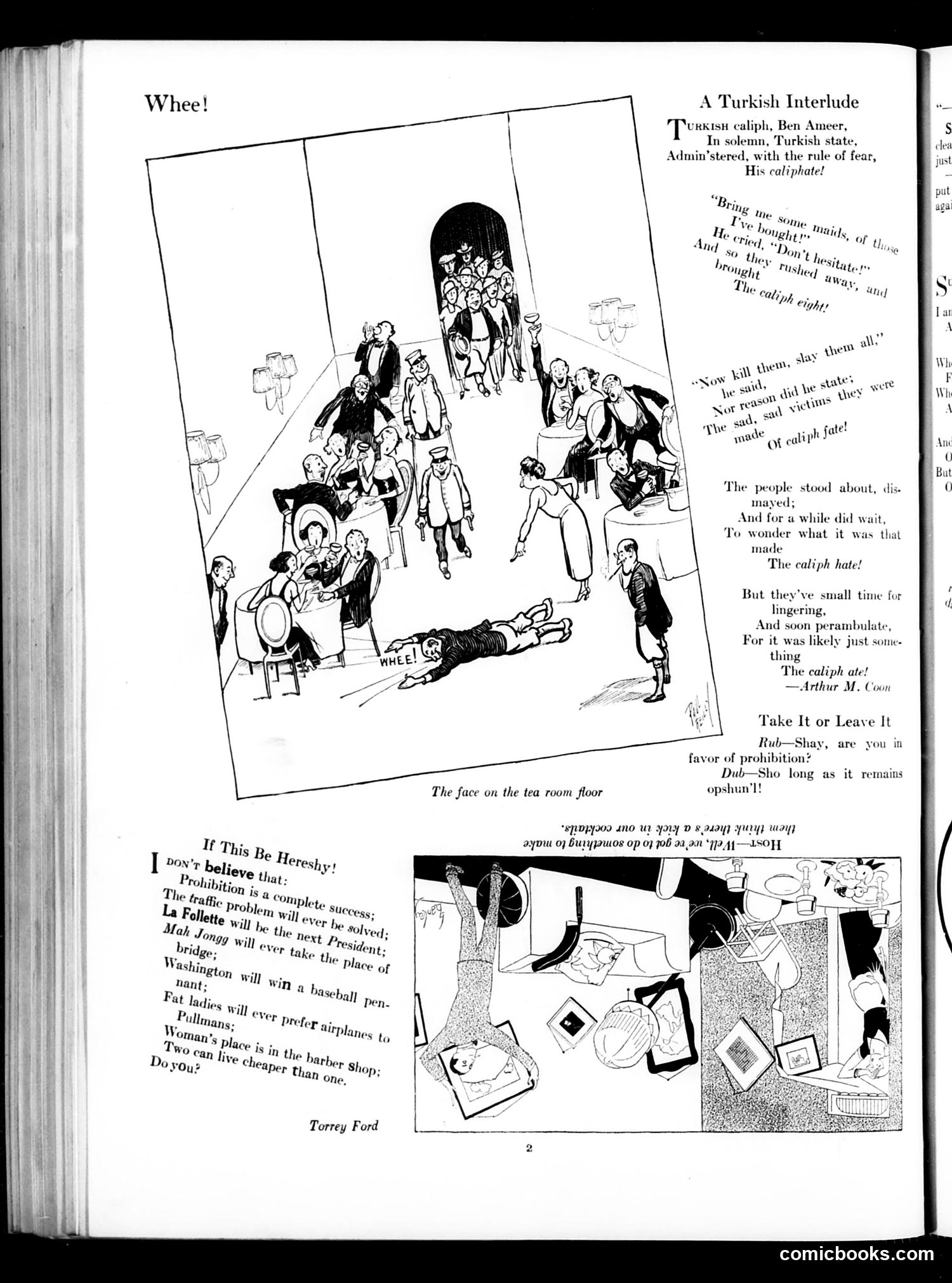
This page contains three satirical pieces from Judge magazine: **"A Turkish Interlude"** (top): A poem mocking a Turkish caliph (Ottoman ruler) administering harsh rule through fear. The joke's punchline suggests the caliph's cruelty stems from indigestion—"something / The caliph ate!"—deflating the authority figure through absurdist humor. This reflects early-20th-century American stereotypes about Ottoman governance. **"If This Be Heresy!"** (bottom left): A list of provocative statements attributed to "Terrey Ford," likely satirizing conservative political positions of the era (prohibition, women's roles, baseball, etc.). It's unclear whether Ford was a real figure or fictional. **"Take It or Leave It"** (bottom right): A brief dialogue joke playing on the word "optional"—a character won't support prohibition unless it remains voluntary, making a pun on the slurred phrase "shun'l" (optional). The page emphasizes period humor relying on ethnic caricature, wordplay, and political commentary typical of 1920s American satire magazines.
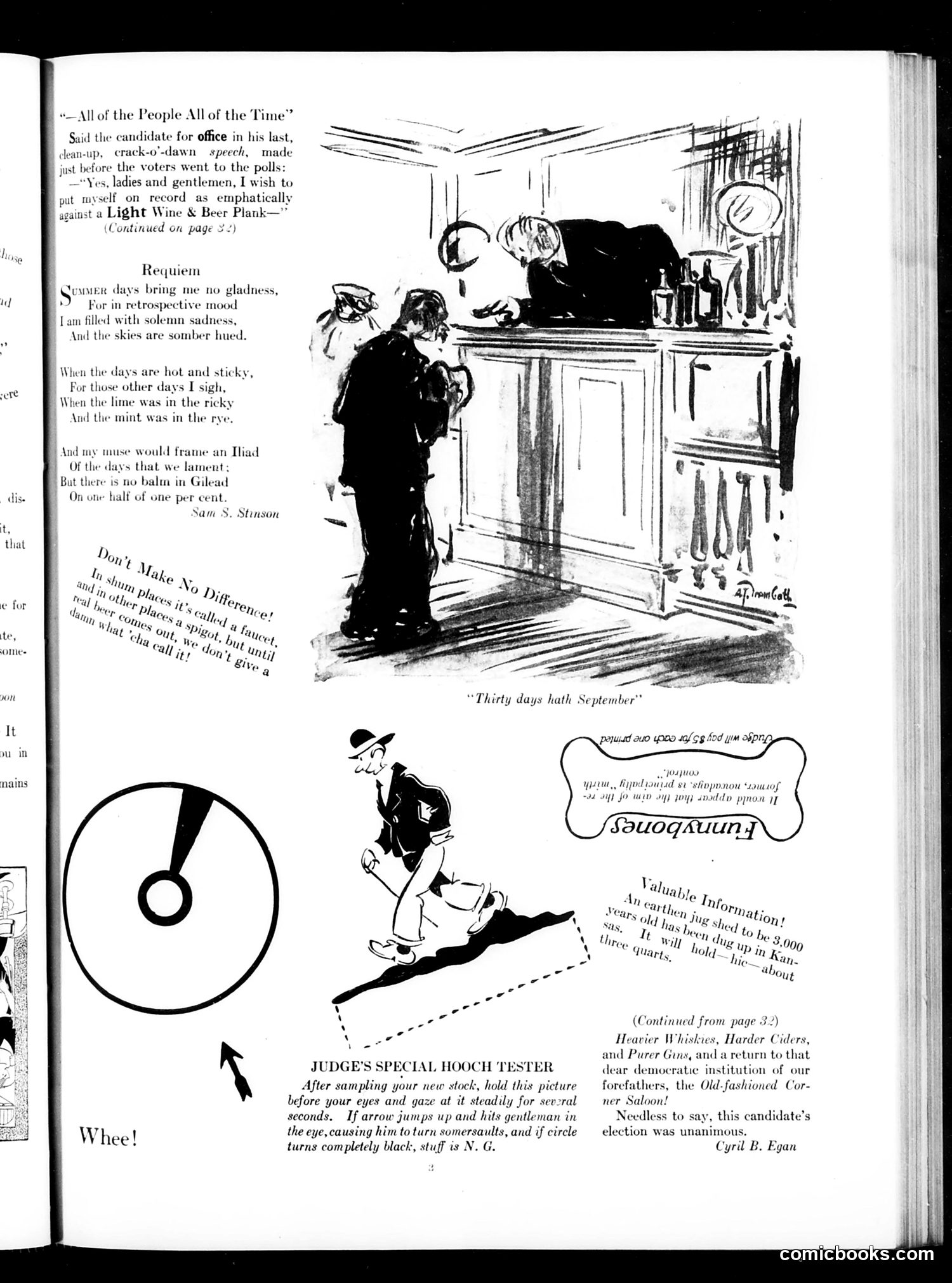
This page satirizes Prohibition-era politics and hypocrisy. The main cartoon shows a political candidate claiming to oppose "a Light Wine & Beer Plank" (support for moderate alcohol legalization), positioning himself as strict on Prohibition during his campaign speech—the classic "all things to all people" promise referenced in the opening quote. The accompanying poems and cartoons mock Prohibition nostalgia. The "Requiem" laments pre-Prohibition drinking culture ("when the lime was in the ricky / And the mint was in the rye"), while the "Judge's Special Hooch Tester" cartoon parodies makeshift alcohol testing methods, implying that people were still drinking illegal liquor despite the ban. The "Valuable Information" segment sarcastically celebrates the candidate's unanimous election, suggesting his anti-alcohol stance was purely performative—designed to satisfy voters while the actual drinking culture persisted underground. The satire targets both politicians' empty campaign promises and the futility of Prohibition enforcement.
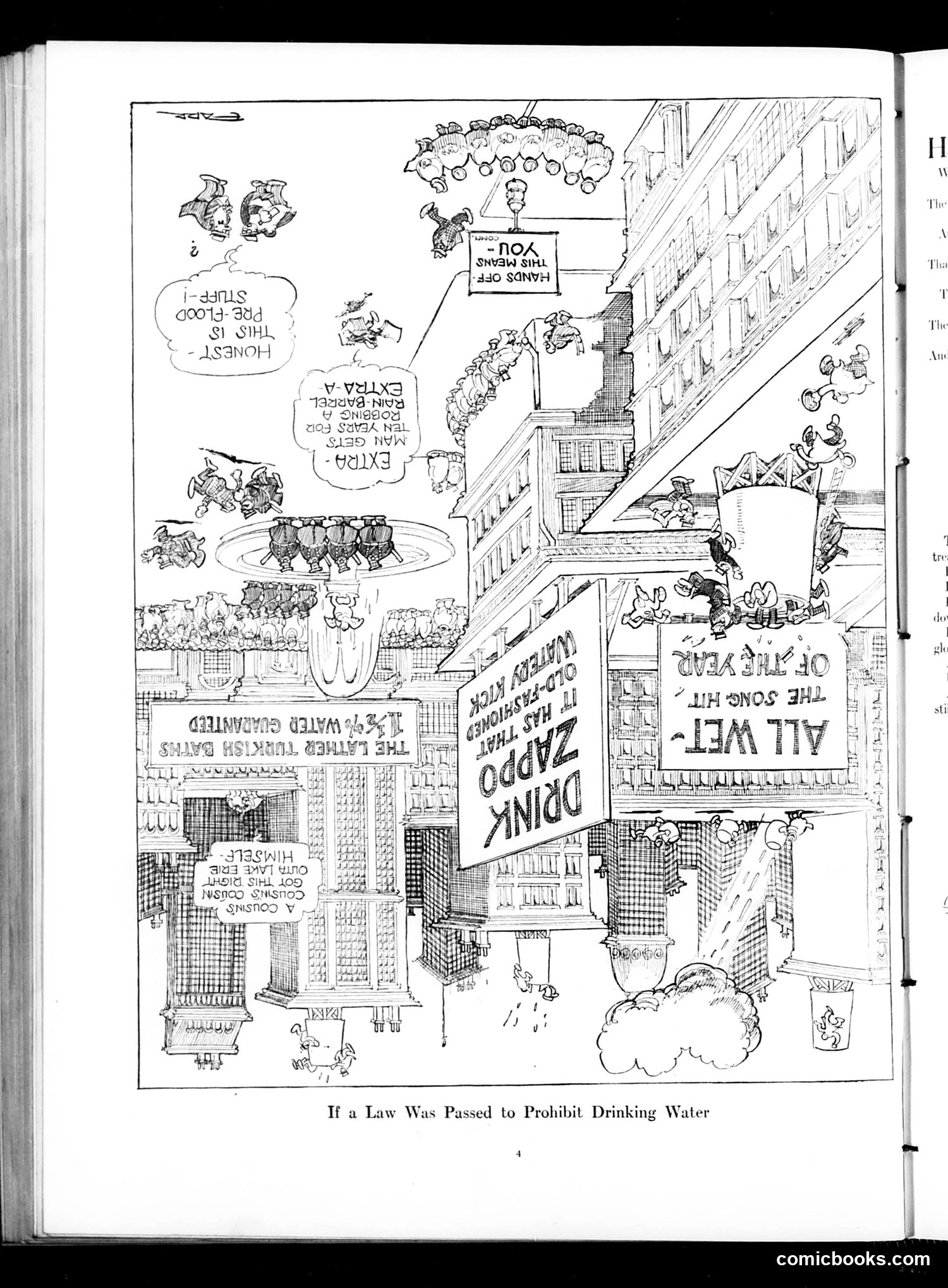
This is a satirical cartoon critiquing Prohibition (the ban on alcohol, 1920-1933). The cartoon imagines an absurd parallel: what if water—essential to life—were prohibited instead of alcohol? The illustration depicts urban chaos with signs reading "DRINK DINK" (appearing to reference illegal drinking establishments) and shows people gathering illicitly to consume water, mimicking the speakeasies and bootlegging that flourished under Prohibition. The crowded, confused scene with multiple storefronts and hidden activities parodies how Prohibition created underground criminal enterprises rather than eliminating drinking. The satire's point: prohibiting a basic human necessity would be ridiculous and unenforceable—a direct jab at Prohibition itself. By substituting water for alcohol, the cartoonist highlights the absurdity of trying to legislate away something people fundamentally need or desire, suggesting Prohibition was equally futile and counterproductive.
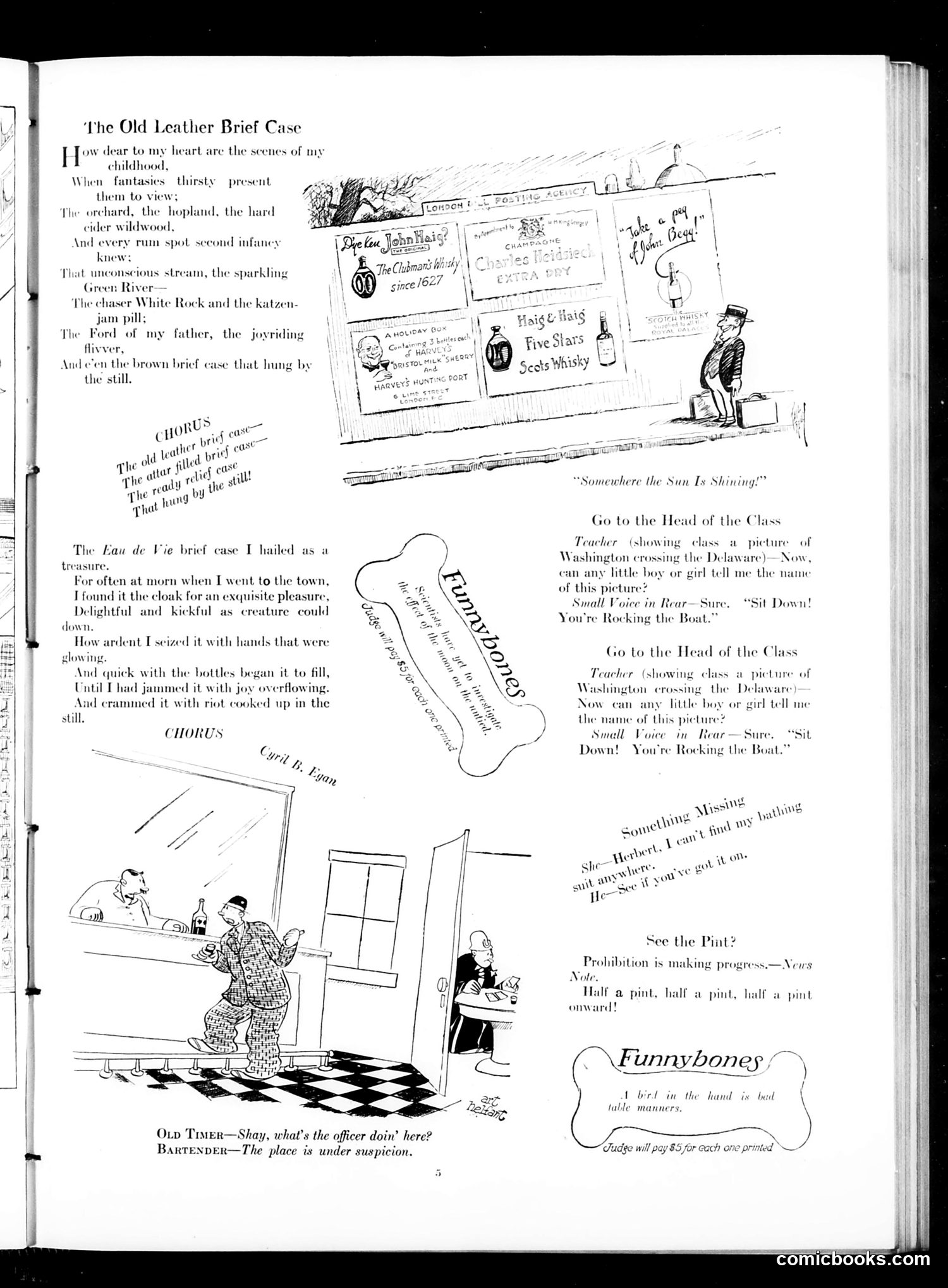
This page satirizes **Prohibition** (the ban on alcohol sales, 1920-1933). The title poem nostalgically describes using a leather brief case to smuggle homemade liquor ("Eau de Vie") from illegal stills into town—a common practice during Prohibition. The cartoon below shows a bartender and patron discovering police surveillance ("the place is under suspicion"), depicting the cat-and-mouse game between bootleggers and law enforcement. The "Go to the Head of the Class" jokes mock Americans' casual disregard for the law: children reinterpret famous patriotic images through a modern lens of Prohibition-era lawbreaking ("Sit Down! You're Rocking the Boat" replaces Washington Crossing the Delaware). The final item, "See the Pint?" with its reference to "Half a pint...onward!" (parodying Tennyson's "Charge of the Light Brigade") continues the mockery—suggesting Prohibition is failing and alcohol consumption continues unabated despite the ban.
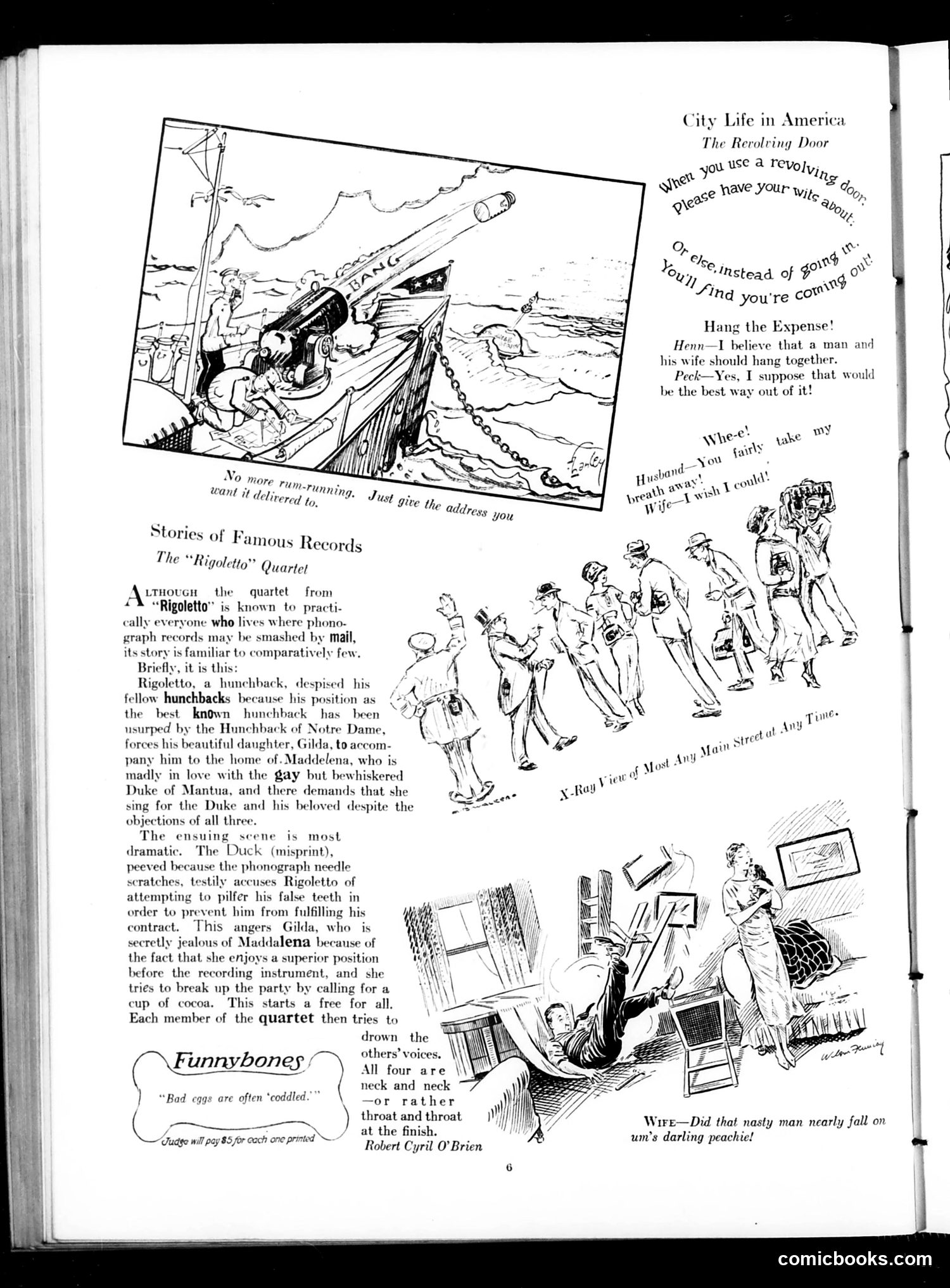
This page contains two unrelated pieces of early 20th-century humor: **"The Revolving Door"** (top): A marital humor cartoon where a husband uses a revolving door to escape his wife, then re-enters via the same door. The joke plays on the phrase "revolving door"—suggesting marriage as cyclical entrapment. The dialogue about "hanging the expense" is a dark pun on spouses "hanging together." **"The Rigoletto Quartet"** (bottom): A satirical piece mocking the famous opera quartet from Verdi's *Rigoletto*. The humor deliberately misrepresents the plot with absurdist details (calling the Duke a "Duck," mentioning false teeth and cocoa). It ridicules both the opera itself and the pretentiousness of phonograph record owners who play classical music. The final illustration shows domestic chaos—another marital comedy trope of the era. Both segments are typical Judge magazine fare: slapstick domestic comedy and mockery of "cultured" entertainment, aimed at middle-class American readers.
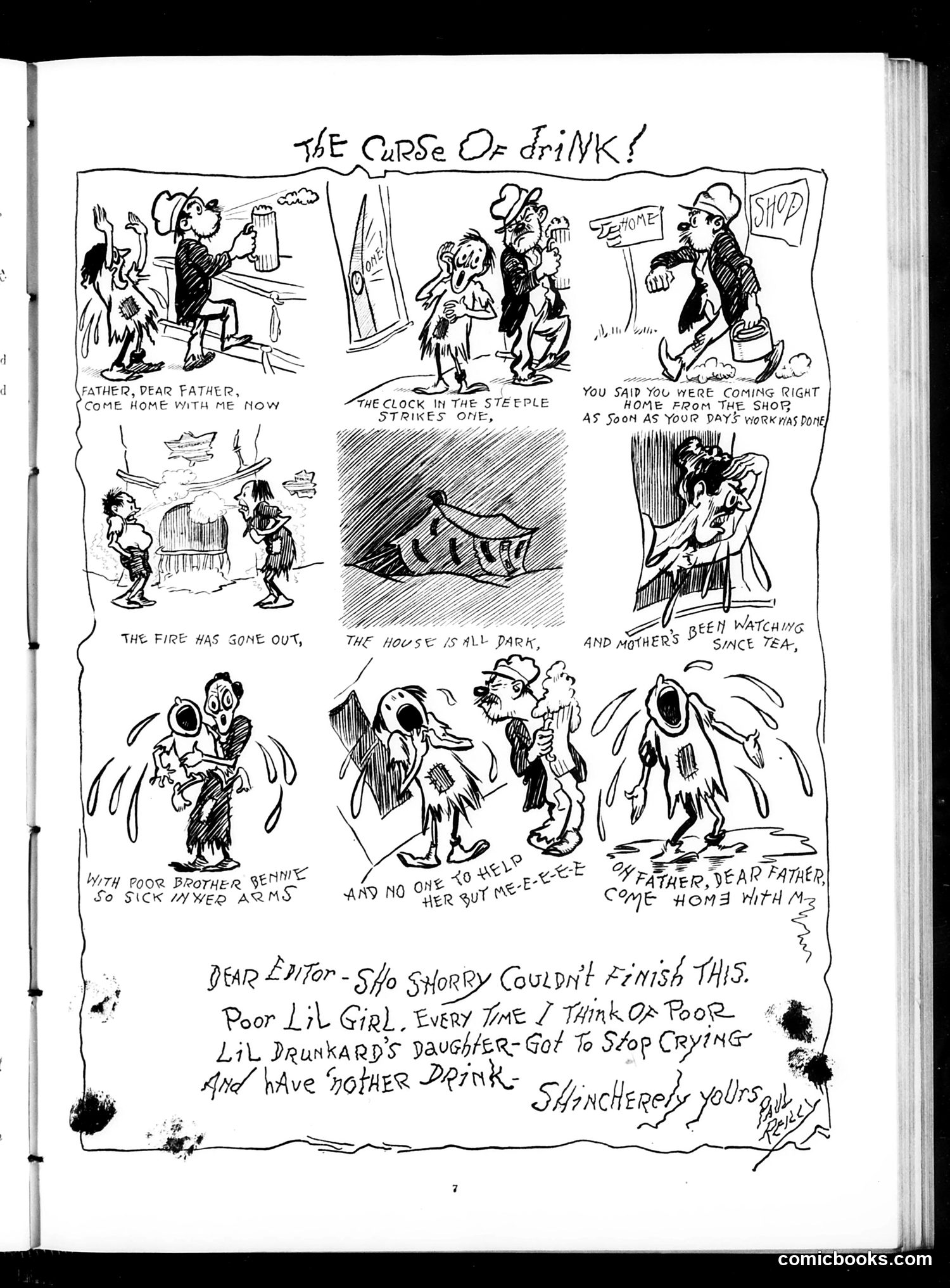
This satirical comic strip depicts the consequences of alcoholism on a working-class family. The narrative follows a father's broken promises: he pledges to return home from work promptly, but instead frequents bars. The strip shows the resulting domestic collapse—the fire goes out, the house grows cold and dark, the mother watches anxiously, and the children suffer. One child becomes ill while in another's arms. The letter at the bottom, from a reader, reinforces the moral: a drunkard's daughter must "stop crying" and prevent her mother from drinking to cope with despair. The satire targets alcohol's destructive social effects, a common Progressive-era concern. The "curse" is portrayed as a cycle of poverty, neglect, and desperation affecting entire families—particularly women and children left vulnerable. This reflects early-20th-century temperance advocacy, which blamed alcohol for working-class misery and family breakdown.
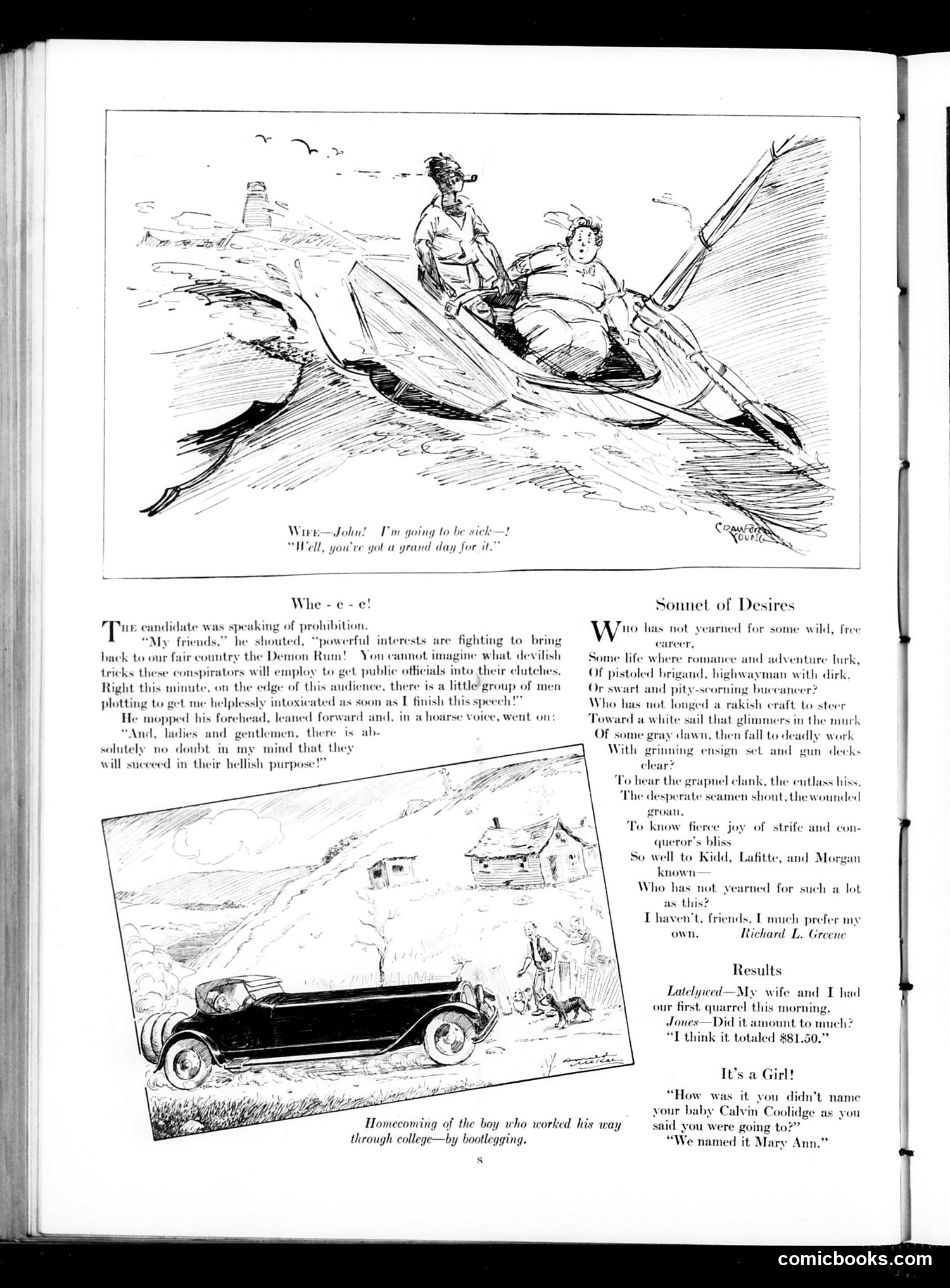
This page contains **three separate satirical pieces** from Judge magazine: **Top cartoon**: A couple in a rowboat; the wife says she's going to be sick, and the husband cheerfully replies "you've got a grand day for it"—a joke about seasickness and obliviousness. **Middle section**: A **Prohibition-era political cartoon**. A prohibition candidate denounces "the Demon Rum" and claims conspirators will try to intoxicate him, while simultaneously a lower cartoon shows a car captioned "bootlegging"—the satire being that the candidate's moral panic about alcohol was hypocritical, as illegal bootlegging was rampant and often normalized even among respectable people. **Right side**: A poem satirizing romantic adventure fantasies (pirate ships, brigands), followed by short joke sections: a newlywed couple's "$81.50 quarrel" (expensive divorce/separation joke), and a gag about parents naming their baby something ordinary instead of "Calvin Coolidge" (mocking the then-president's stiffness). The unifying theme: American hypocrisy and moral contradictions during the Prohibition era.
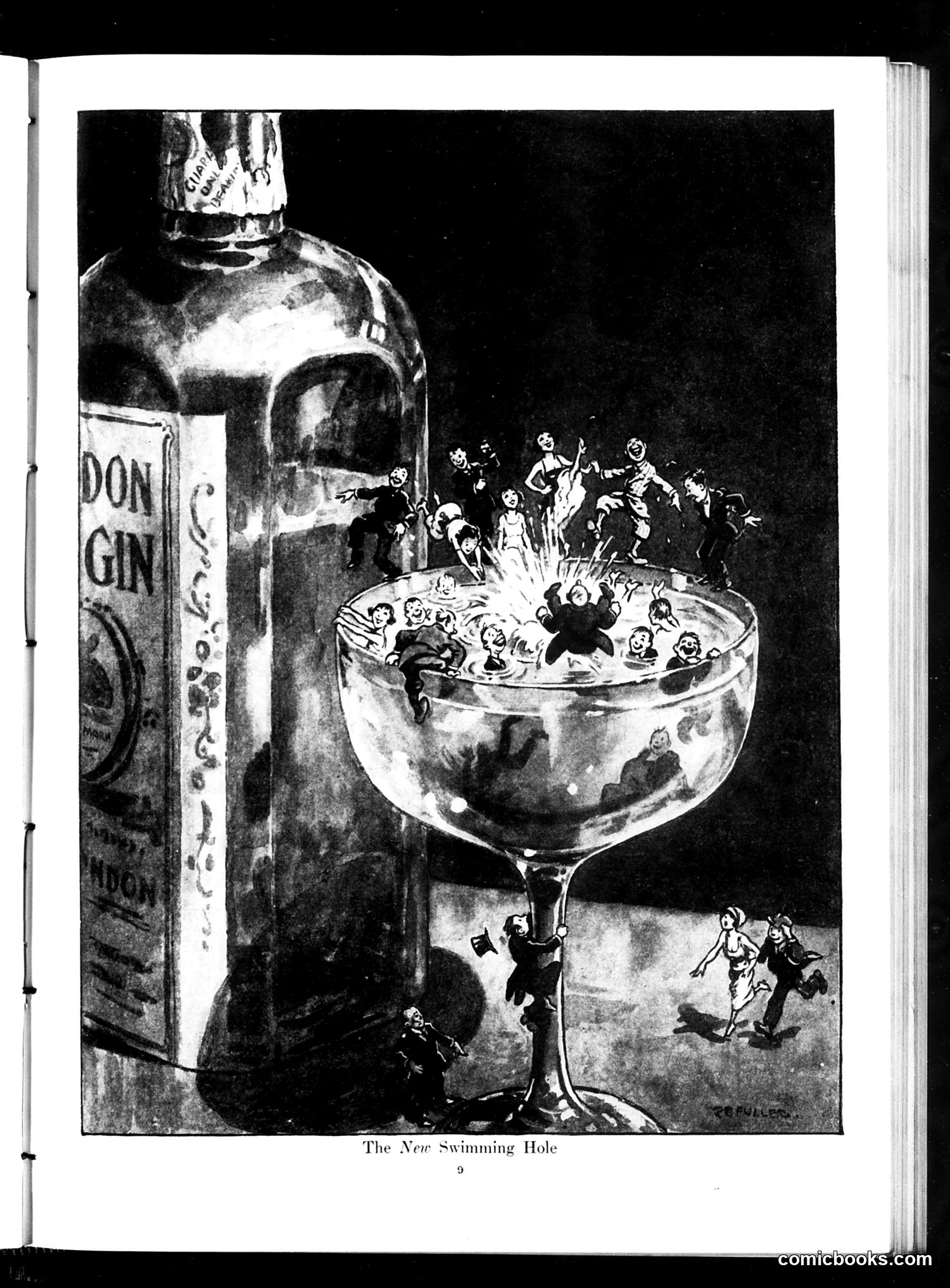
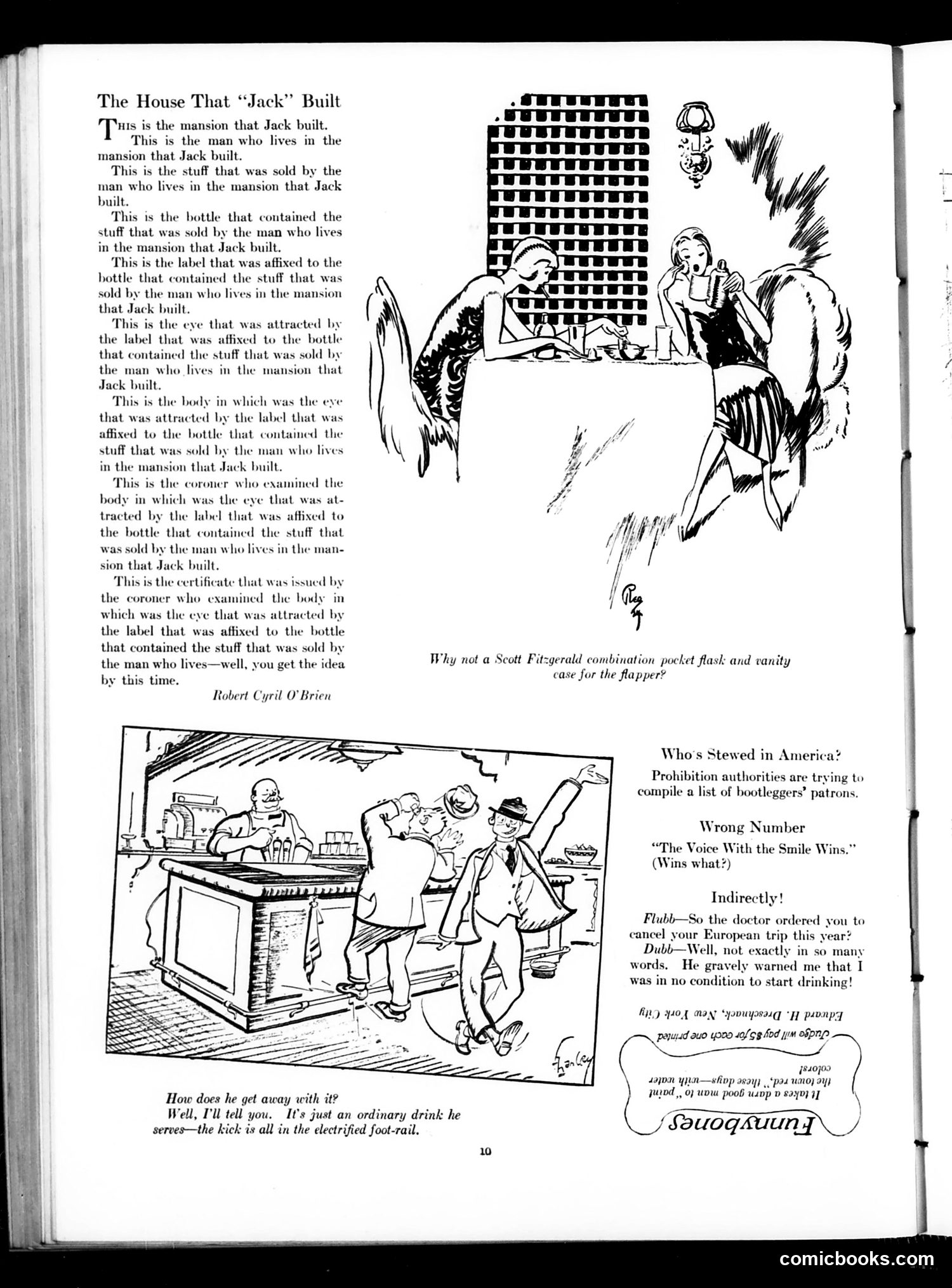
This satirical poem parodies the nursery rhyme to critique Prohibition-era bootlegging. "Jack" appears to be a generic bootlegger who sells alcohol illegally, builds wealth from it, and—through a dark chain of causation—his product leads to a customer's death, requiring a coroner's examination and death certificate. The joke escalates absurdly: each stanza adds another link in the chain, mimicking the original nursery rhyme's cumulative structure. The accompanying cartoon shows a speakeasy bartender explaining that his "ordinary drink" is safe—"the kick is all in the electrified foot-rail," a darkly humorous reference to electrocution. The lower cartoons reference Prohibition enforcement efforts and joke about doctors warning patients against drinking during Prohibition, inverting typical medical advice. The satire targets both bootleggers' deadly products and the absurdities of Prohibition enforcement.
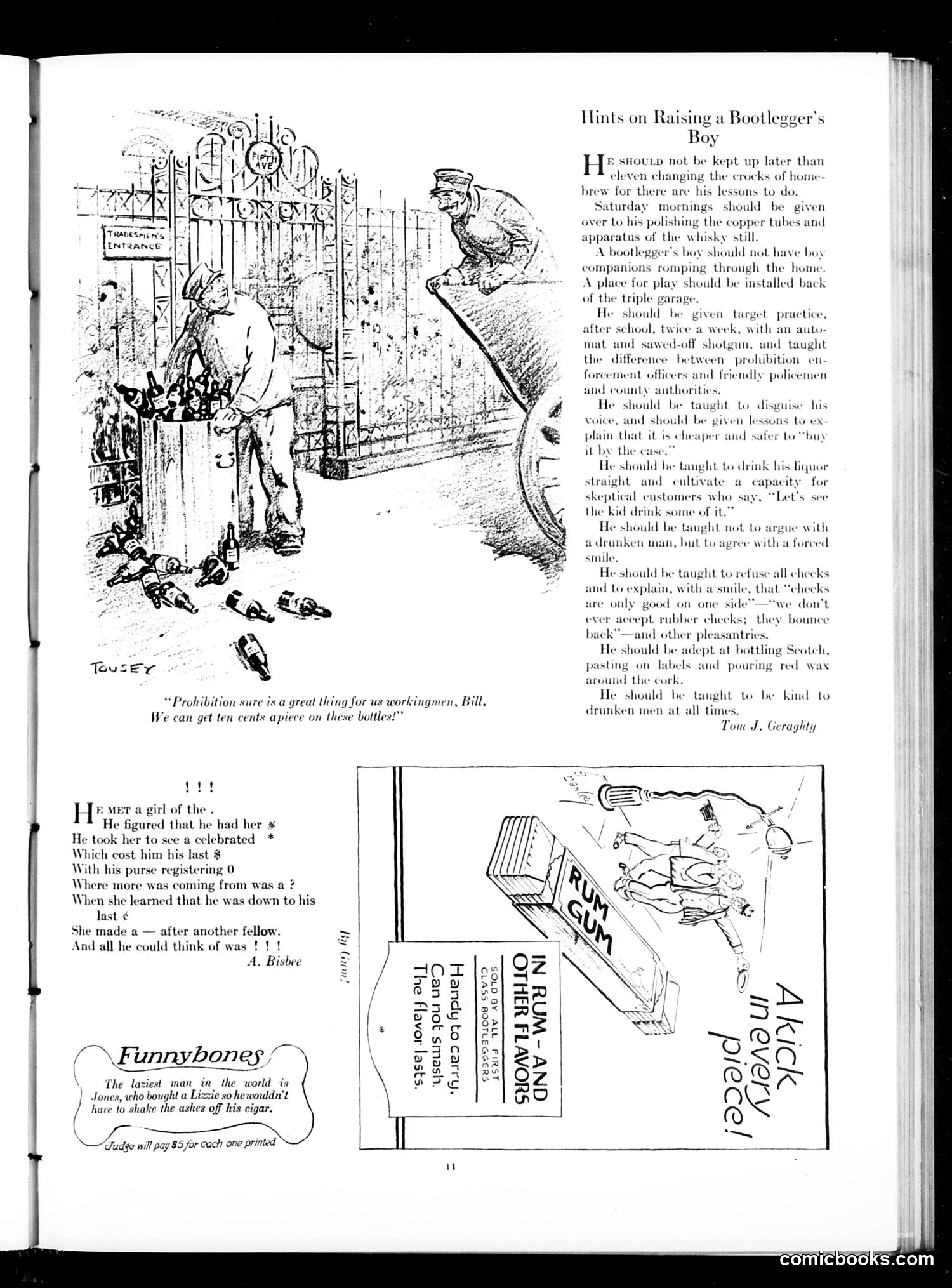
This page satirizes **Prohibition** (the 1920-1933 ban on alcohol). The main cartoon shows a working man celebrating that prohibition has created a profitable black market—he can now sell empty liquor bottles for ten cents each, turning waste into income. The accompanying article, "Hints on Raising a Bootlegger's Boy," is savage satire. It mock-seriously outlines how to raise a child in the illegal liquor trade: polishing still equipment, target practice with shotguns, disguising one's voice from federal agents, bribing police, and bottling counterfeit scotch. The humor lies in treating organized crime as normal child-rearing. The piece satirizes how Prohibition had normalized bootlegging throughout American society—criminals, corrupt officials, and ordinary workers all profited from illegal alcohol production and sales. Rather than eliminating drinking, the law created an underground economy where even children were recruited. The minor jokes and verse below are unrelated filler common to magazine pages of this era.
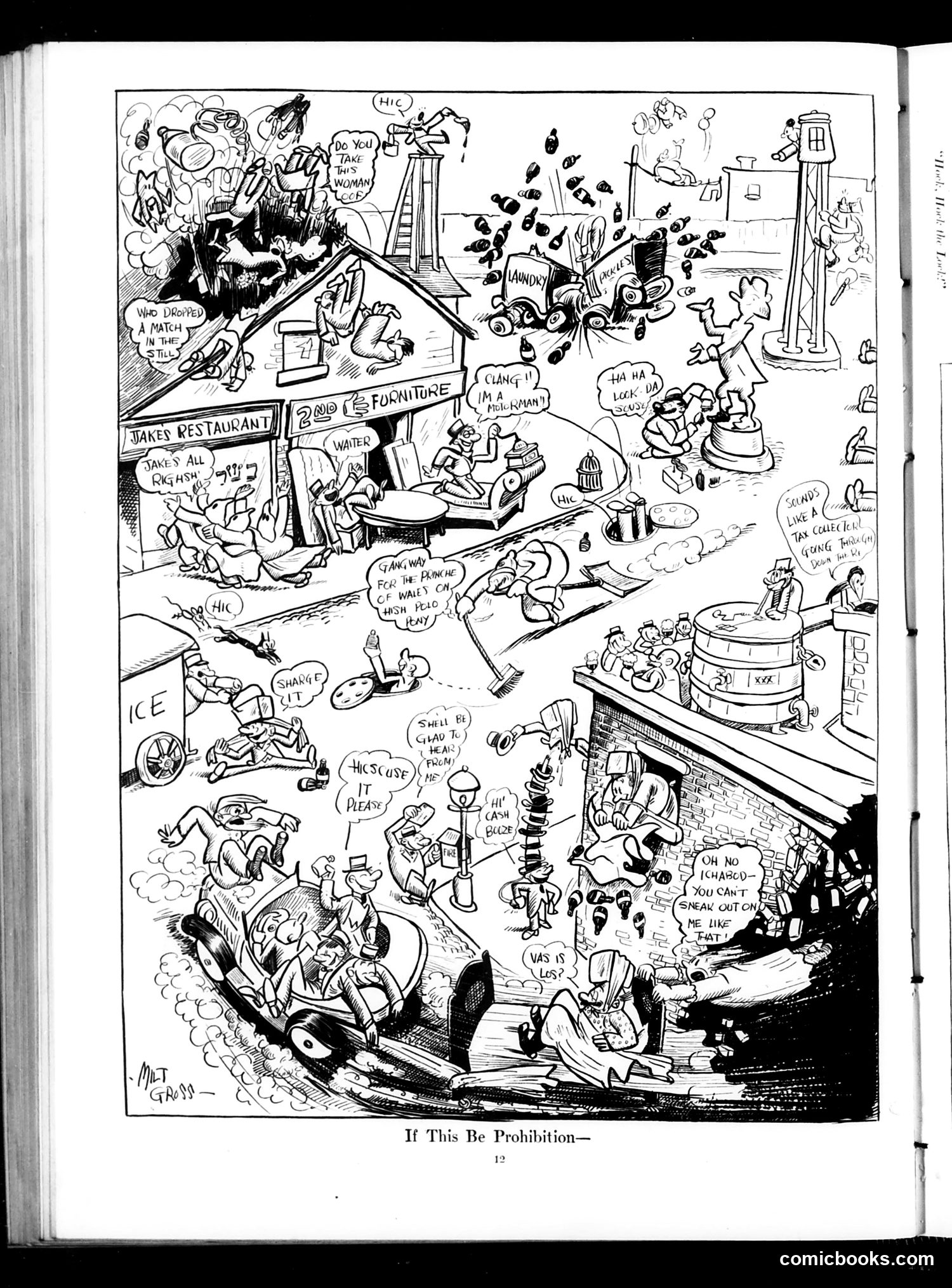
This satirical cartoon depicts the chaos and unintended consequences of Prohibition (likely early 1920s America). The scene shows a street in complete disorder with: - **Jake's Restaurant** serving alcohol illegally - Multiple characters engaged in drinking, violence, and lawlessness - Police and authorities seemingly overwhelmed or complicit - Various vehicles and contraband scattered about The cartoon's central message is that Prohibition created not sobriety, but rather organized crime, speakeasies, violence, and social disorder. The title sarcastically questions whether this chaotic scene represents the promised benefits of alcohol prohibition. The satire critiques the policy's failure to eliminate drinking—instead fostering corruption, bootlegging operations, and criminal enterprise throughout American society.
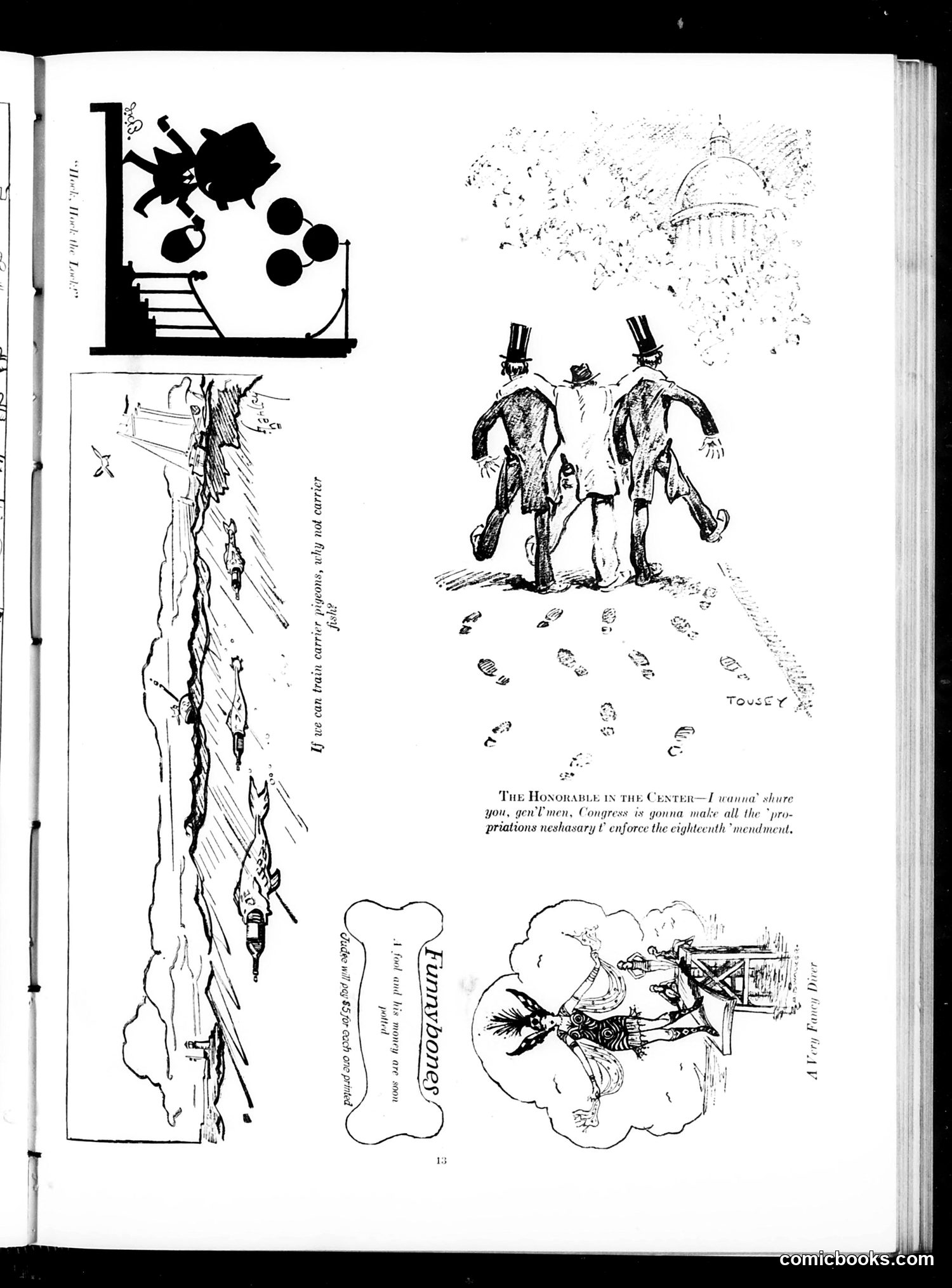
This page satirizes enforcement of Prohibition (the Eighteenth Amendment). The central cartoon depicts three well-dressed men in top hats—representing Congressional politicians or leaders—making grandiose promises about enforcing alcohol prohibition. The scattered footprints around them suggest their words leave little trace or impact. The joke targets the gap between political rhetoric and actual enforcement. "The Honorable in the Center" claims Congress will fund necessary appropriations to enforce prohibition, but the cartoon implies this is hollow posturing—the politicians are all talk. The bottom vignette labeled "A Very Fancy Diver" (unclear what this references specifically) and the top illustration appear to support the mockery of governmental incompetence or hypocrisy regarding Prohibition enforcement. Overall, Judge ridicules politicians' empty promises about implementing the unpopular Eighteenth Amendment.
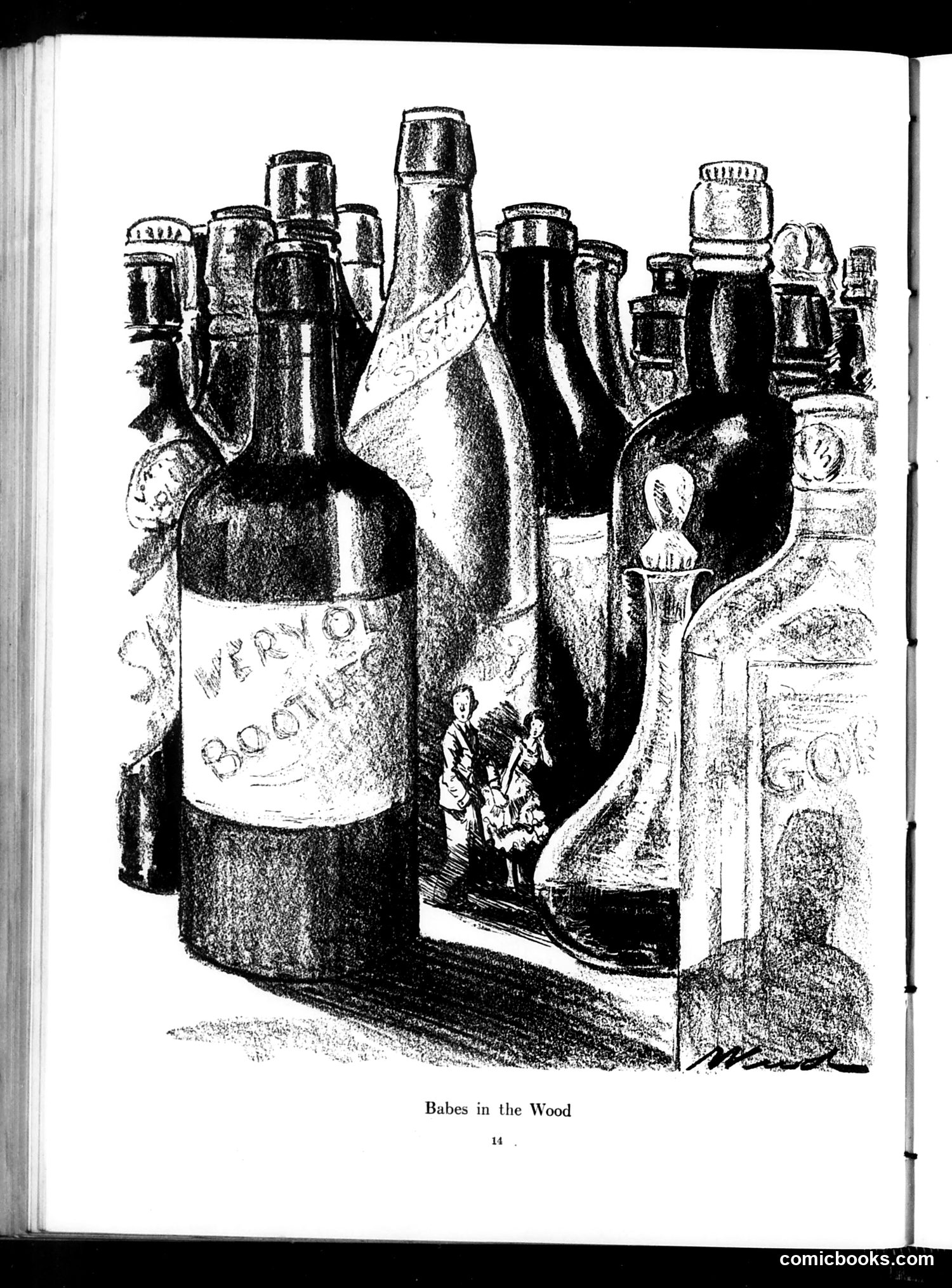
This cartoon depicts two small human figures dwarfed among enormous bottles, creating a visual pun on the fairy tale "Babes in the Wood." The bottles appear labeled (though text is partially unclear), with "DOCOTILE" or similar visible on the leftmost bottle. The satire likely comments on Prohibition-era alcohol consumption or the dangers of the liquor industry. By literalizing "babes in the wood" as tiny humans lost among towering bottles, the cartoonist suggests vulnerability to alcohol's pervasive influence in American society. The helpless scale emphasizes how the liquor trade dwarfs or endangers ordinary citizens. The style and Judge magazine context (early-to-mid 20th century) confirms this addresses either Prohibition advocacy or post-Prohibition concerns about widespread drinking culture.
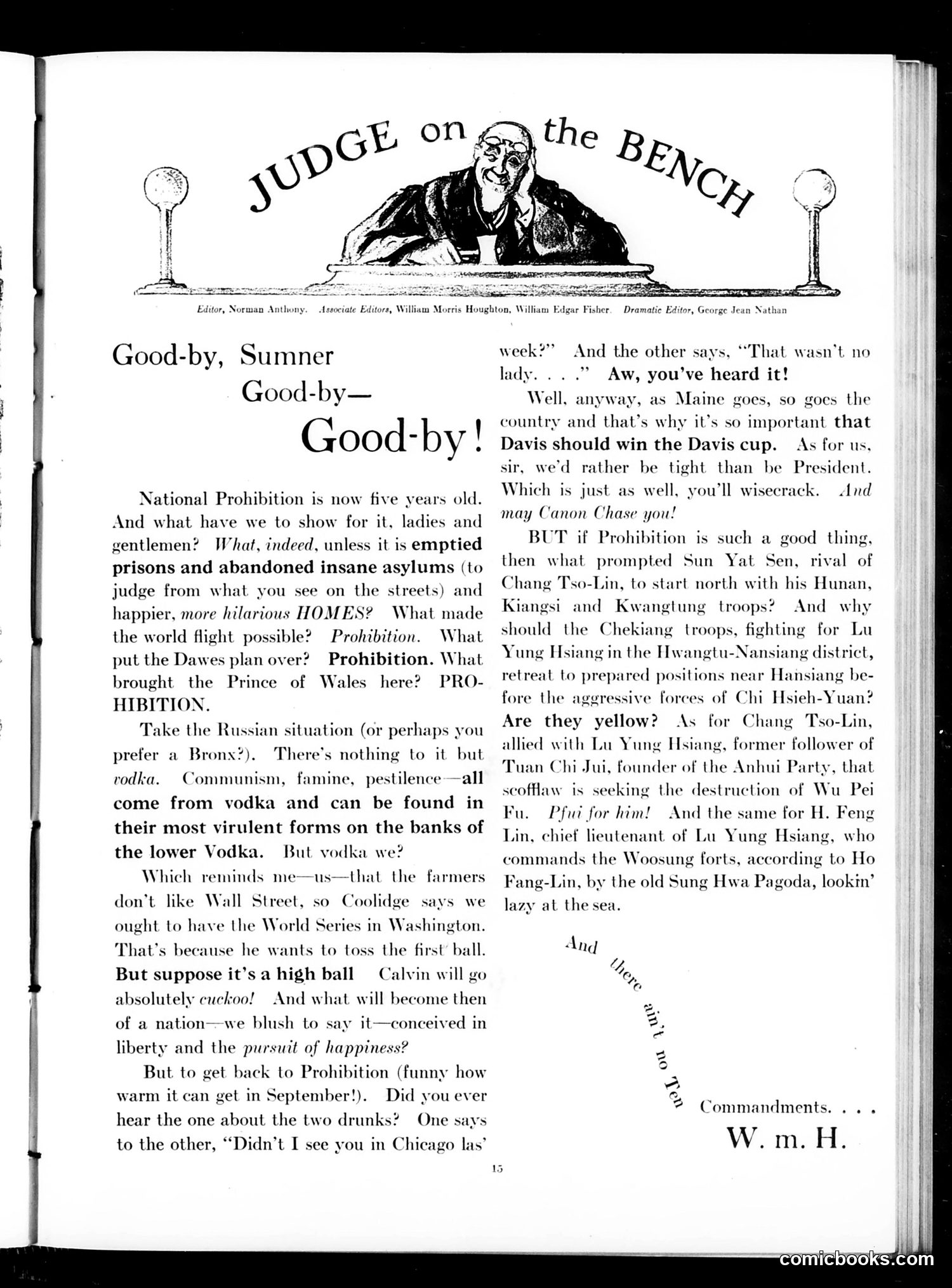
This editorial column satirizes **Prohibition** (five years in effect by the article's date) by mocking its claimed successes. The writer argues Prohibition hasn't emptied prisons or improved homes—the opposite appears true based on street observations. The piece employs mock-logic to blame Prohibition's absence elsewhere for world problems: vodka causes Russian communism and famine; lack of alcohol regulation explains why President Coolidge wants the World Series in Washington (implying he wants to drink at the opening). A drunk joke follows. The column then pivots to **Chinese warlord conflicts** (Chi Hsieh-Yuan, Lu Yung Hsiang, Wu Pei Fu and others fighting for territorial control), asking sarcastically why these violent upheavals occur if Prohibition is beneficial—suggesting the satire extends globally. The tone throughout is cynical: the writer prefers being "tight" (drunk) to being President, mocking Prohibition's moral claims while implying widespread secret drinking persists regardless.
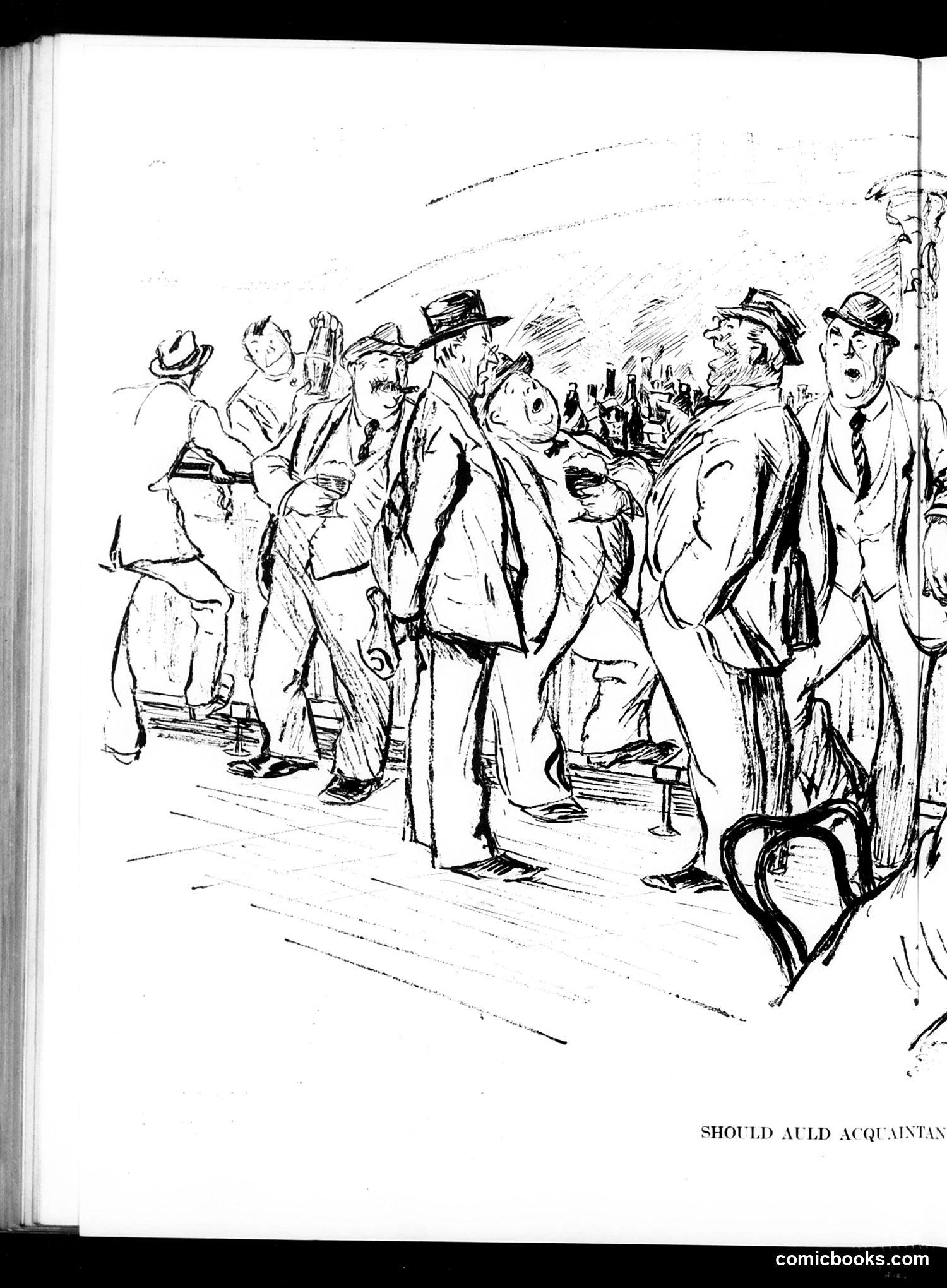
This political cartoon depicts a group of men in suits and hats gathered together, apparently greeting or acknowledging each other. The title references the Scottish song "Auld Lang Syne" ("should old acquaintance be forgot"), traditionally sung at farewells and New Year's celebrations. The cartoon appears to satirize politicians or public figures reconnecting or reconciling—possibly after an election, scandal, or political shift. The casual, sociable gathering suggests ironic commentary on how former rivals or opponents maintain cordial relationships despite their public disagreements, or how political enemies conveniently "remember" old friendships when circumstances demand it. Without additional context or visible attribution, the specific historical moment remains unclear, though the style suggests early-to-mid 20th century Judge magazine content.
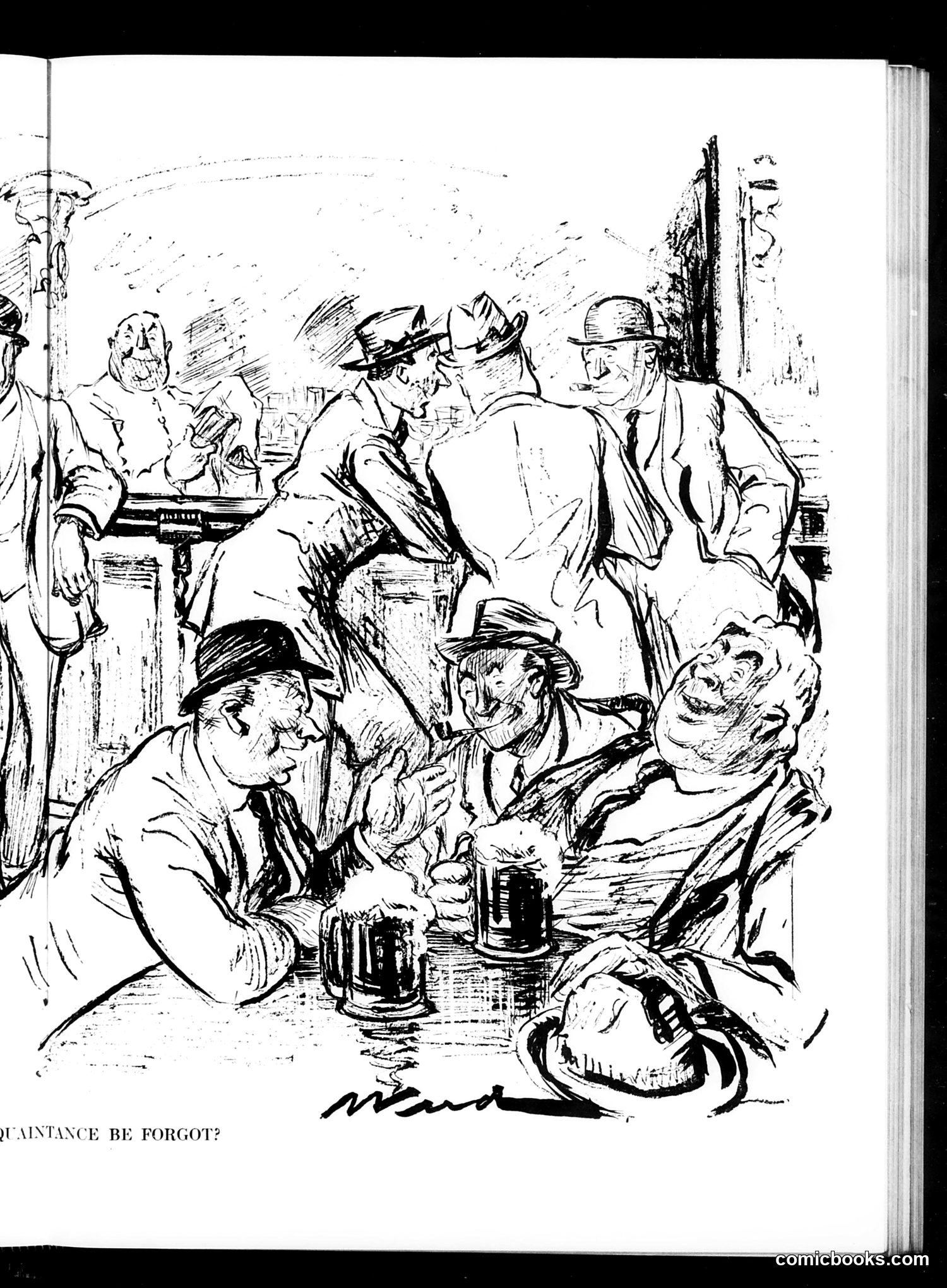
This cartoon depicts a social gathering of working-class men drinking together, with the caption "ACQUAINTANCE BE FORGOT?" — a play on the song "Auld Lang Syne" about remembering old friendships. The satire appears to mock or comment on camaraderie among laborers or immigrants, suggested by their casual dress and gathering in what seems to be a tavern or drinking establishment. The exaggerated facial features and caricatured style were typical of Judge magazine's approach to depicting working-class or immigrant subjects. Without additional context about the specific issue date, the exact political target remains unclear—whether this criticizes immigrant communities, labor solidarity, drinking culture, or American assimilation. The tone suggests satirical skepticism about genuine bonds of friendship among this social class.
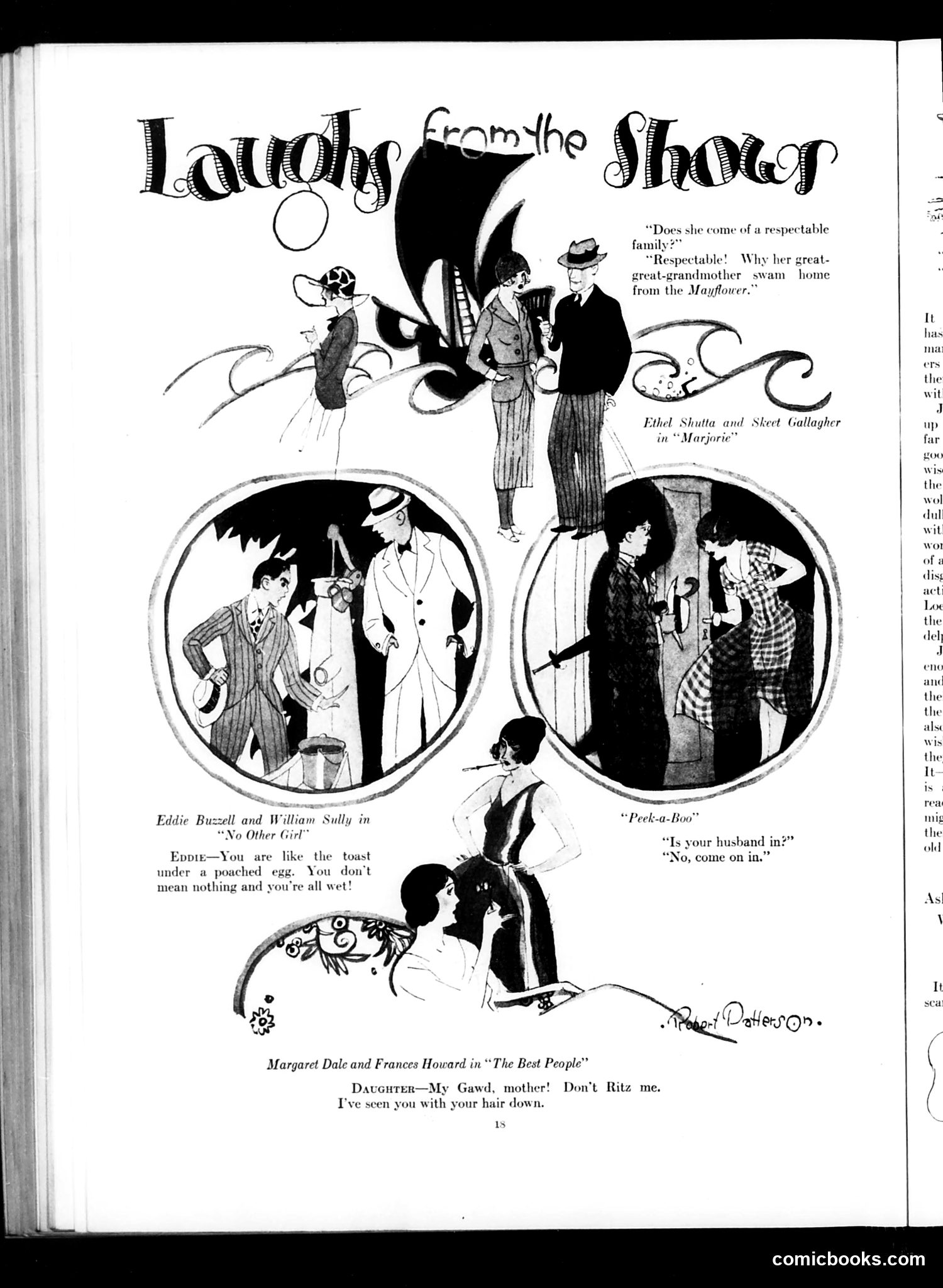
This page showcases comedic moments from contemporary theatrical productions, featuring dialogue and scenes from plays like "Marjorie," "No Other Girl," "Peek-a-Boo," and "The Best People." The humor derives from period comedy tropes: witty insults (the "toast under a poached egg" quip mocking someone as worthless), embarrassing family secrets (the Mayflower jest about humble ancestry), and marital mishaps (a wife inviting someone in while the husband is absent). The title "Laughs from the Shower" likely references theatrical curtain calls or dressing-room scenes. The illustration style and named actors (Ethel Shutta, Margaret Dale, Frances Howard, etc.) indicate these are promotional materials for Broadway productions, using dialogue excerpts as entertainment commentary. The satire targets upper-class pretensions and domestic comedy conventions popular in early 20th-century American theater rather than political issues.
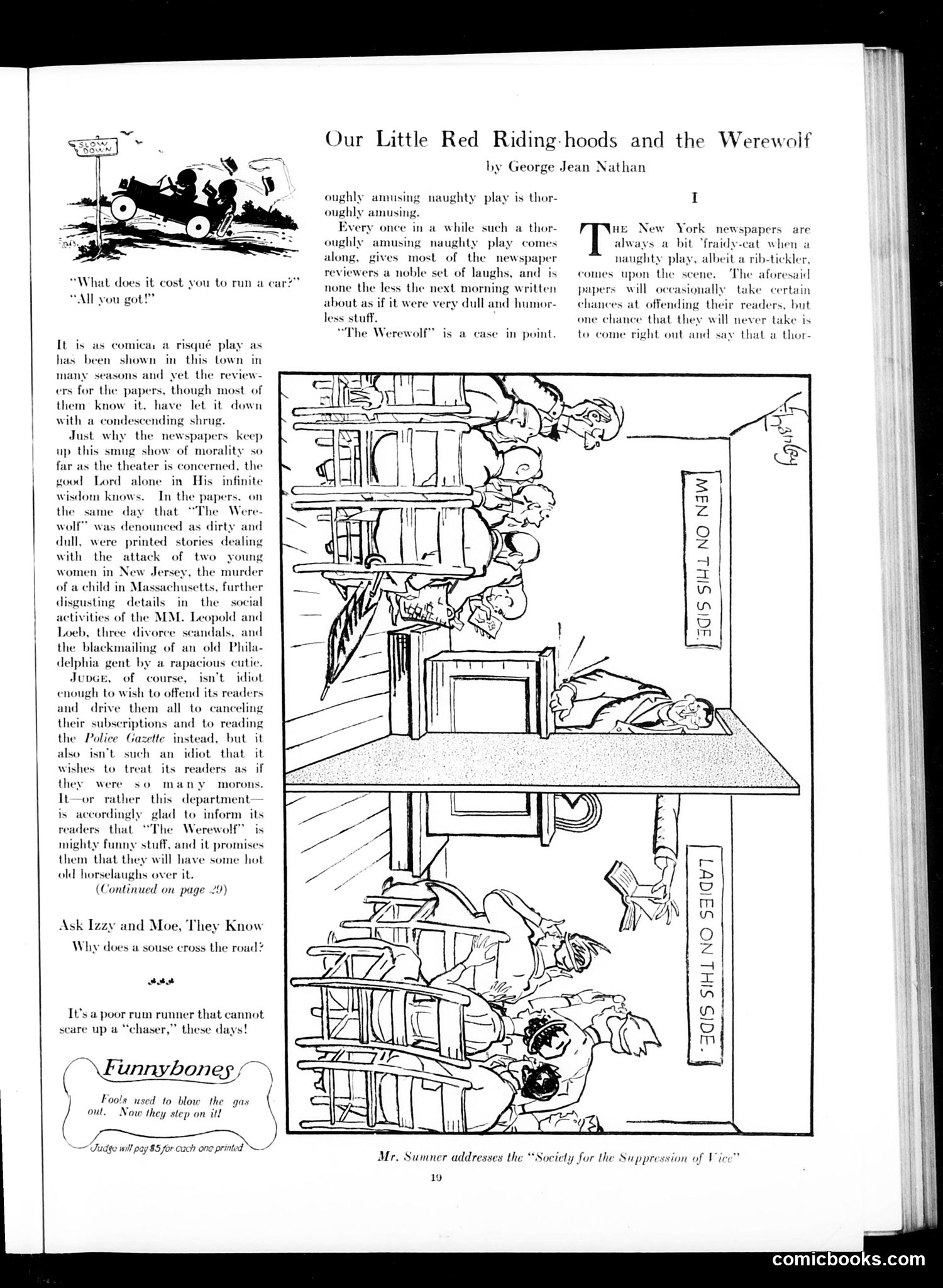
This 1920s Judge satire critiques hypocrisy in newspaper moral gatekeeping. The main article by George Jean Nathan argues that New York papers condemn risqué theatrical productions like "The Werewolf" as immoral, yet simultaneously print salacious crime stories—including attacks on women, the Leopold and Loeb murder case, divorce scandals, and blackmail—all while maintaining a sanctimonious posture about decency. The illustration depicts "Mr. Sumner" (likely Anthony Comstock or similar vice-crusader) addressing the "Society for the Suppression of Vice," a real organization that policed morality. Nathan's point: newspapers selectively enforce morality—they'll publicly shame theater as "dirty and dull" while profiting from readers' appetite for sensational crime reporting. The lower cartoon gags reference Prohibition-era bootleggers ("rum runners," "chasers"), adding period context. The satire exposes what modern readers would call double standards and performative morality by gatekeeping institutions.
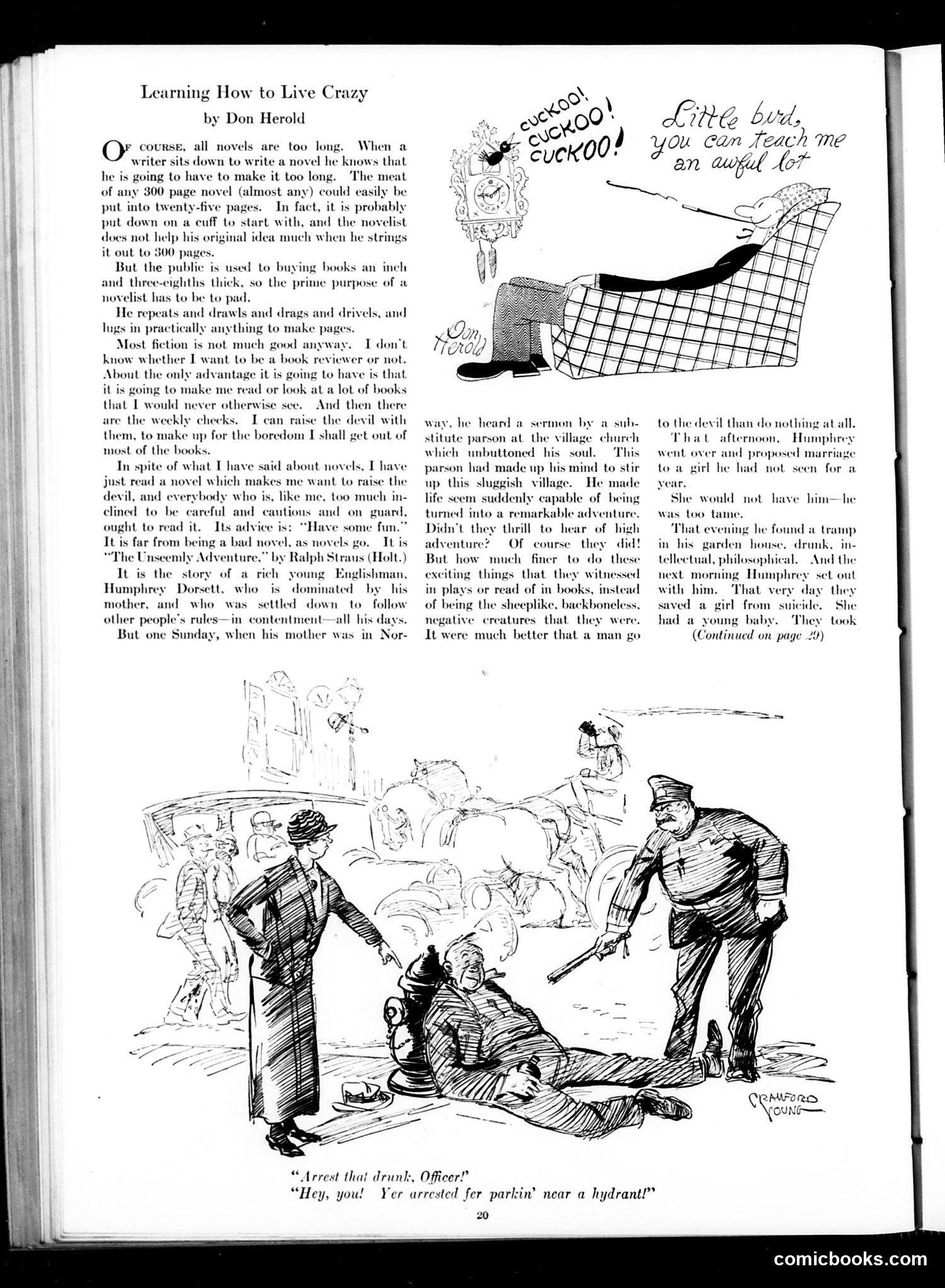
This is a humorous essay critiquing novel-writing practices, accompanied by an unrelated cartoon about police conduct. **The Essay's Point:** Herold satirizes novelists for padding their work unnecessarily. He argues that most 300-page novels could compress into 25 pages, but publishers expect thick books, forcing writers to "repeat and drawl and drag and drivels." He reviews Ralph Straus's *The Unseemly Adventure*, praising it for encouraging readers to abandon cautious conformity and actually *live* adventurously rather than merely reading about adventure vicariously. The protagonist Humphrey breaks free from his domineering mother's rules and seeks genuine experience. **The Cartoon:** Shows a police officer arresting a drunk man near a fire hydrant while saying "Arrest that drunk, Officer!" / "Hey, you! Yer arrested fer parkin' near a hydrant!" The joke appears to mock police priorities or bureaucratic absurdity—an officer arresting someone for both drunkenness *and* improper parking, highlighting petty enforcement. The essay's theme of breaking free from conformist rules ironically complements the cartoon's critique of rigid authority.
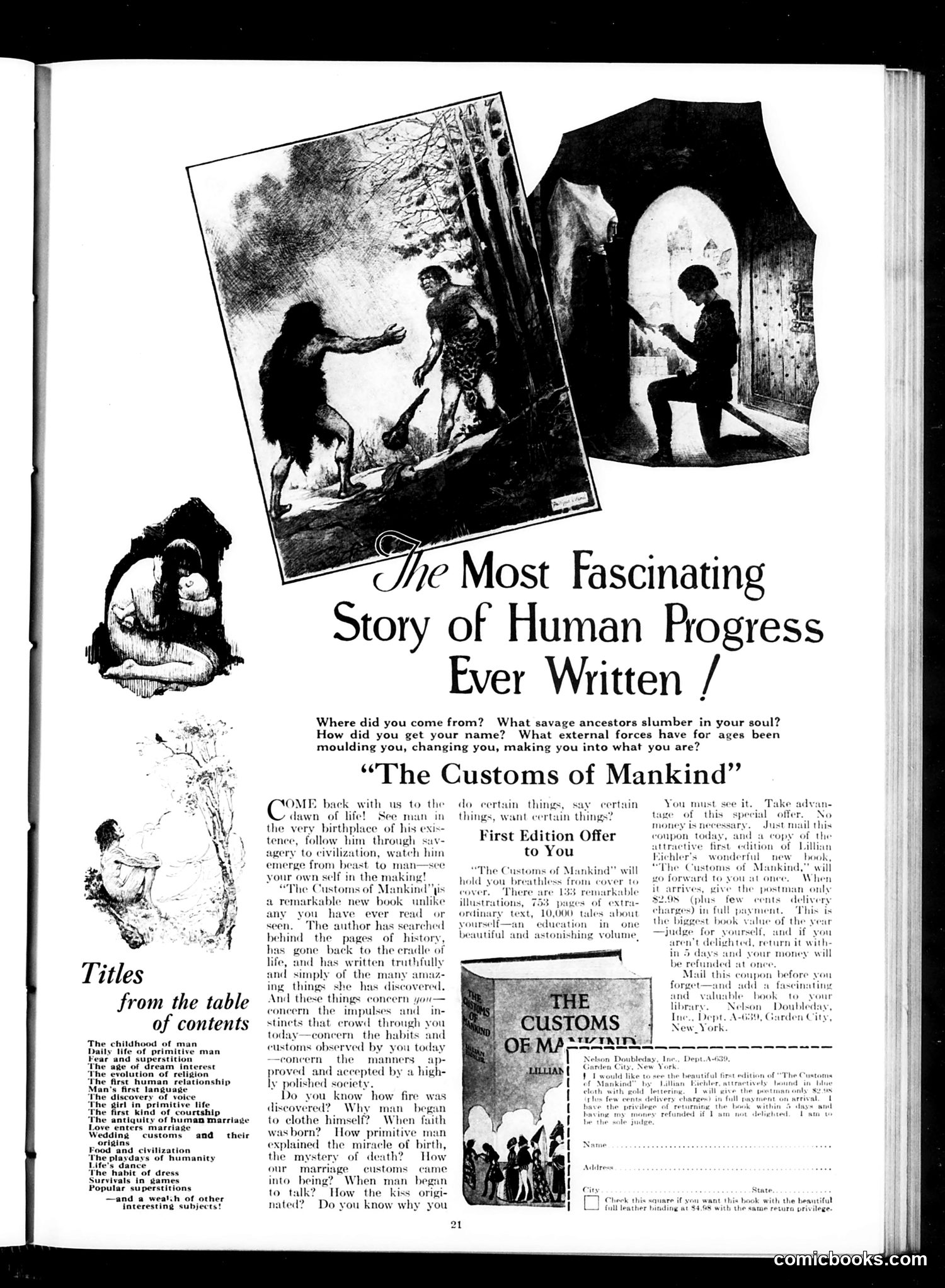
This is primarily **advertising content**, not political satire. The page promotes *"The Customs of Mankind"* by Lillian Eichler—a non-fiction book about anthropology and human cultural evolution. The imagery shows primitive humans progressing toward civilization (left to right: cave dwellers, outdoor scenes, domestic interiors), visualizing the book's thesis about human advancement. The rhetorical questions ("Where did you come from? What savage ancestors slumber in your soul?") reflect early 20th-century fascination with evolutionary theory and anthropology—presenting these as exciting, revelatory subjects. The table of contents lists chapters on marriage customs, religion, language origins, and dress—typical of popular anthropological works of that era. The "First Edition Offer" promotes bulk mail delivery at $2.98. While *Judge* was satirical, this particular page is a straightforward book advertisement exploiting contemporary intellectual interests in evolutionary progress and "primitive" societies—a common marketing strategy of the 1920s-1930s.
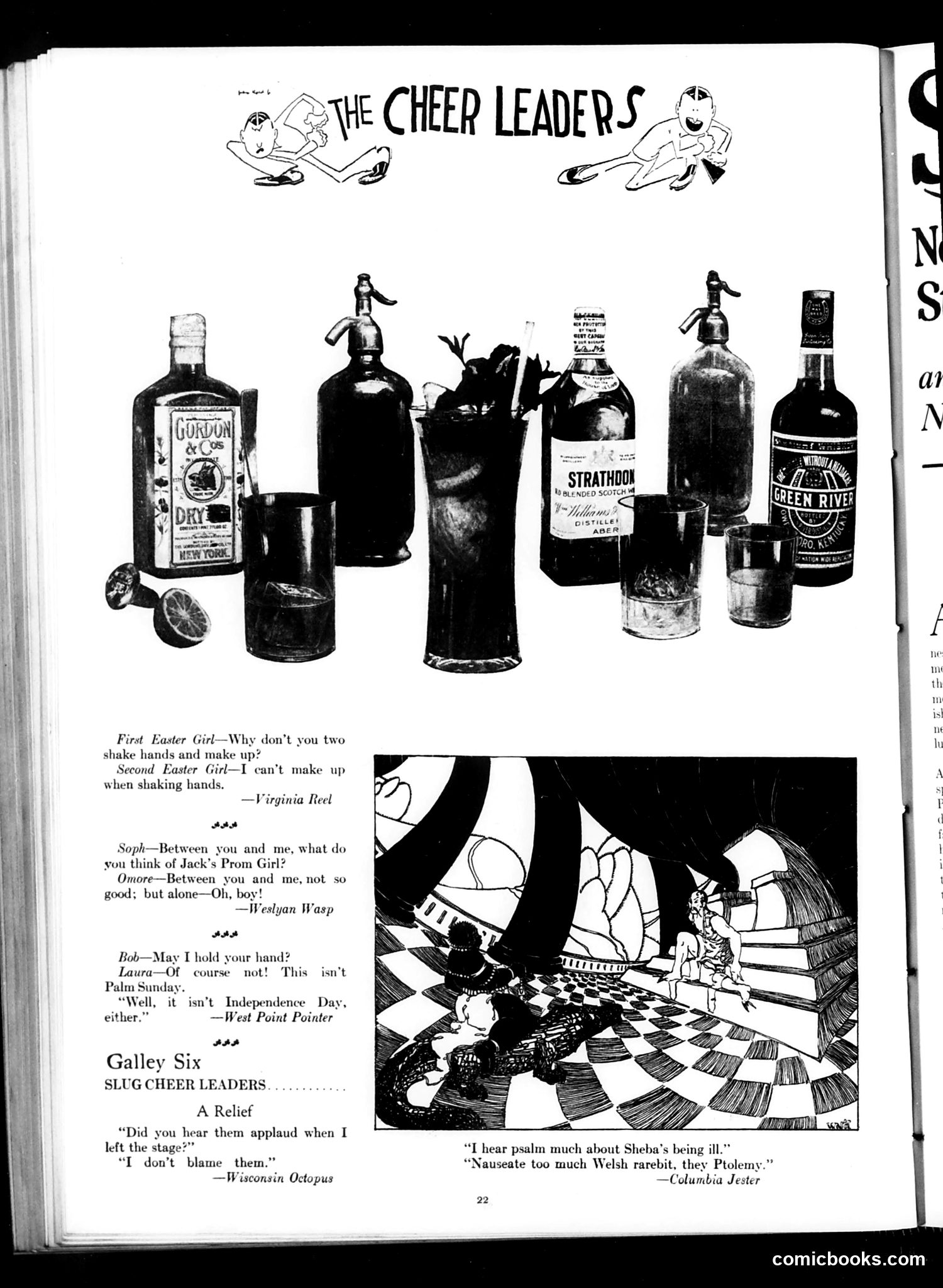
This is a humorous feature mixing liquor advertising with college humor jokes. The top displays various alcohol bottles—Gordon's gin, Strathdon scotch, and others—branded as "cheer leaders," a pun playing on alcohol's role in social merriment. Below are brief comedic exchanges from college newspapers (Virginia Reel, Wesleyan Wasp, West Point Pointer, etc.), typical of Judge's "Galley Six" humor section. The jokes target college social dynamics: awkward romantic moments between students, flirtation etiquette, and relationship confusion. The bottom cartoon shows students drinking, with quips about theatrical applause and Welsh rarebit (a cheese dish), poking fun at college life and digestive complaints. The page reflects Prohibition-era America (though Judge was anti-Prohibition), where alcohol advertising still appeared openly in magazines. The humor is mild, dating-focused banter typical of 1920s college culture.
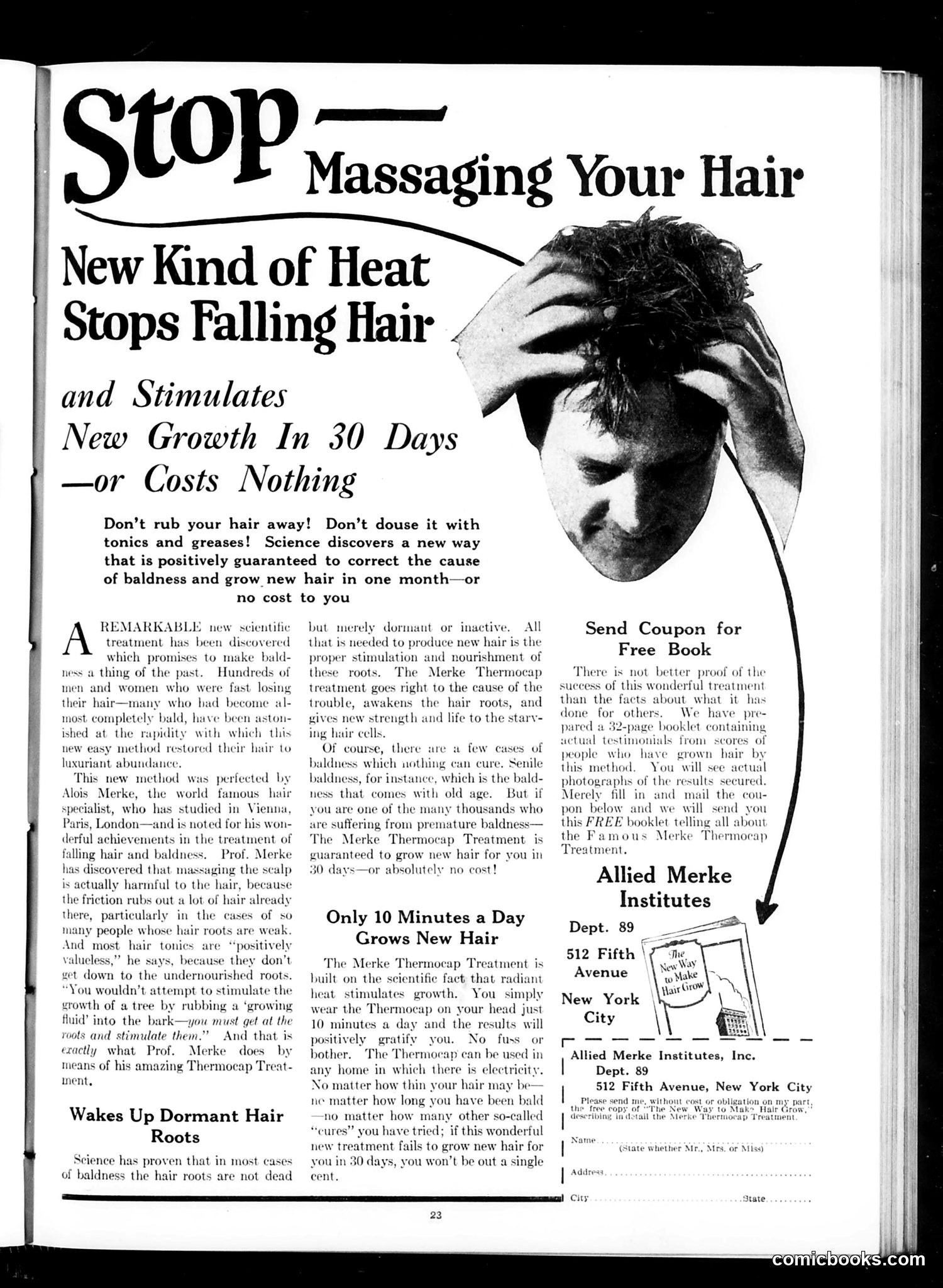
This is not a cartoon or satire, but rather a **full-page advertisement** for the "Merke Thermocap Treatment," a baldness cure marketed by Allied Merke Institutes in New York City. The ad promotes a heat-based device claimed to stimulate dormant hair roots and produce new hair growth in 30 days—"or costs nothing." It appeals to men experiencing hair loss by attacking competing treatments (massage, tonics, greases) as ineffective or harmful, while positioning the Thermocap as scientifically superior. The pitch includes testimonial claims, a free booklet offer, and a coupon for interested readers. The photograph shows a man massaging his scalp—visually demonstrating the "problem" the treatment supposedly solves. For modern readers: this exemplifies early 20th-century **patent medicine advertising**—making grand medical claims with minimal regulation. The "guaranteed results or free" offer and appeal to science without evidence are classic persuasion tactics of that era's largely unregulated health product market.
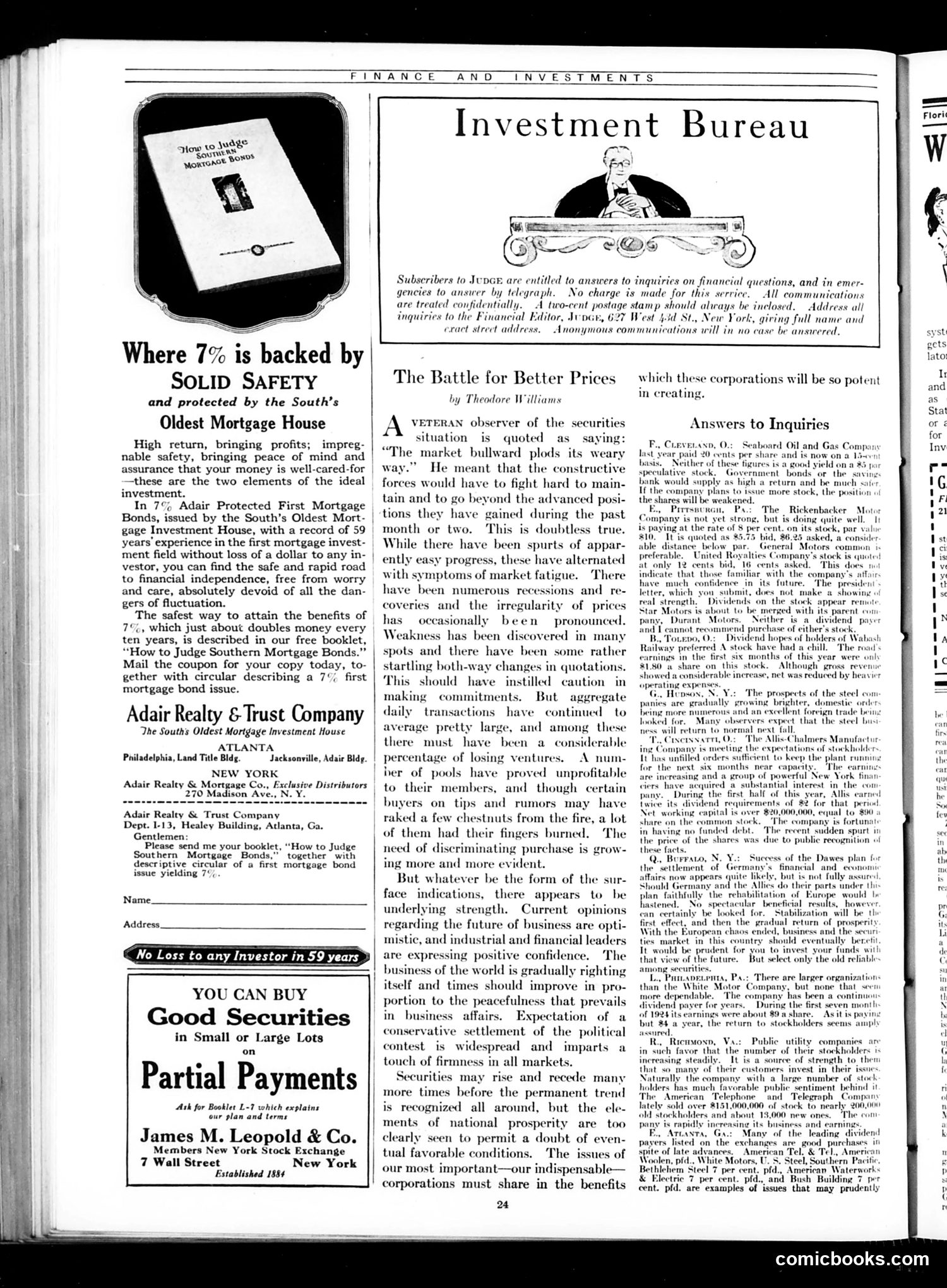
This page is primarily **financial advertising** from the 1920s, not political satire. The "Investment Bureau" header and multiple bond/securities ads dominate the layout. The article "The Battle for Better Prices" by Theodore Williams discusses stock market volatility—describing cautious optimism about business recovery despite recent price fluctuations and losses. Williams warns investors about "discriminating purchase" needs while noting underlying market strength and positive sentiment about political settlement (likely post-WWI). The advertising emphasizes safety: Adair Realty promotes 7% mortgage bonds backed by 59 years without investor losses, while Leopold & Co. offers partial-payment securities plans. These ads reflect the era's booming investment culture before the 1929 crash. **Modern context**: This reflects pre-Depression confidence in financial instruments, promises of steady returns, and marketing strategies targeting middle-class investors seeking wealth-building through bonds rather than stocks.
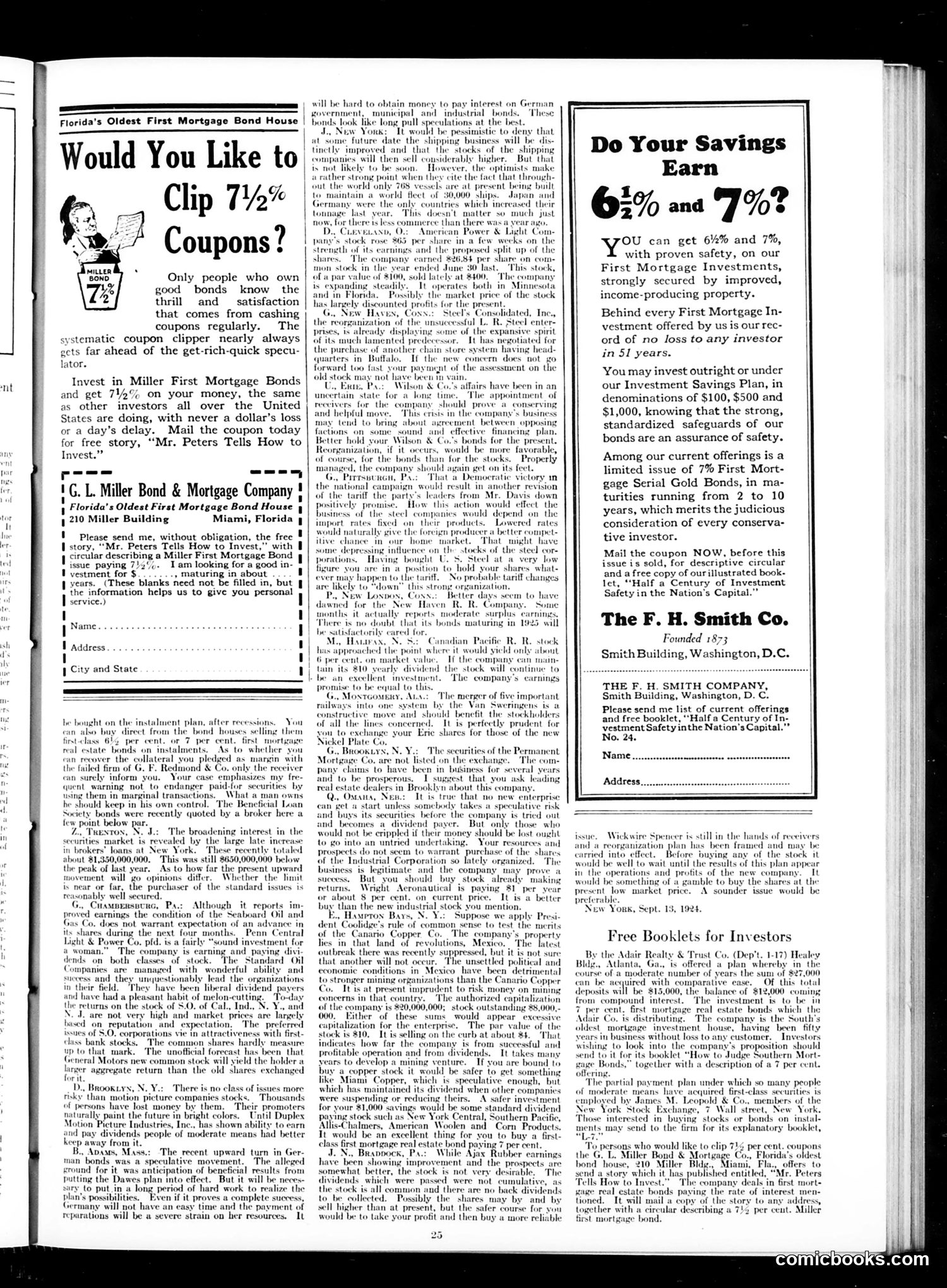
This page is primarily **financial advertising and investment advice**, not political satire. It contains bond investment solicitations from G.L. Miller Bond & Mortgage Company and The F.H. Smith Co., promoting mortgage bonds and savings plans offering 6½-7% returns. The small cartoon at top-left shows a woman with a coupon clipper—a visual pun illustrating the "systematic coupon clipper" investor who regularly cashes bond coupons, presented as a reliable alternative to speculative stock trading. The bulk of the page consists of investment commentary addressing various securities: German bonds (connected to post-WWI Dawes Plan), railroad stocks, oil companies, and motion picture stocks. The tone is cautionary, warning readers against speculative ventures while promoting "standard issues" as safer investments. This reflects 1920s financial culture and pre-1929 crash investment enthusiasm. The content targets middle-class investors seeking steady income through bonds rather than risky stock speculation.
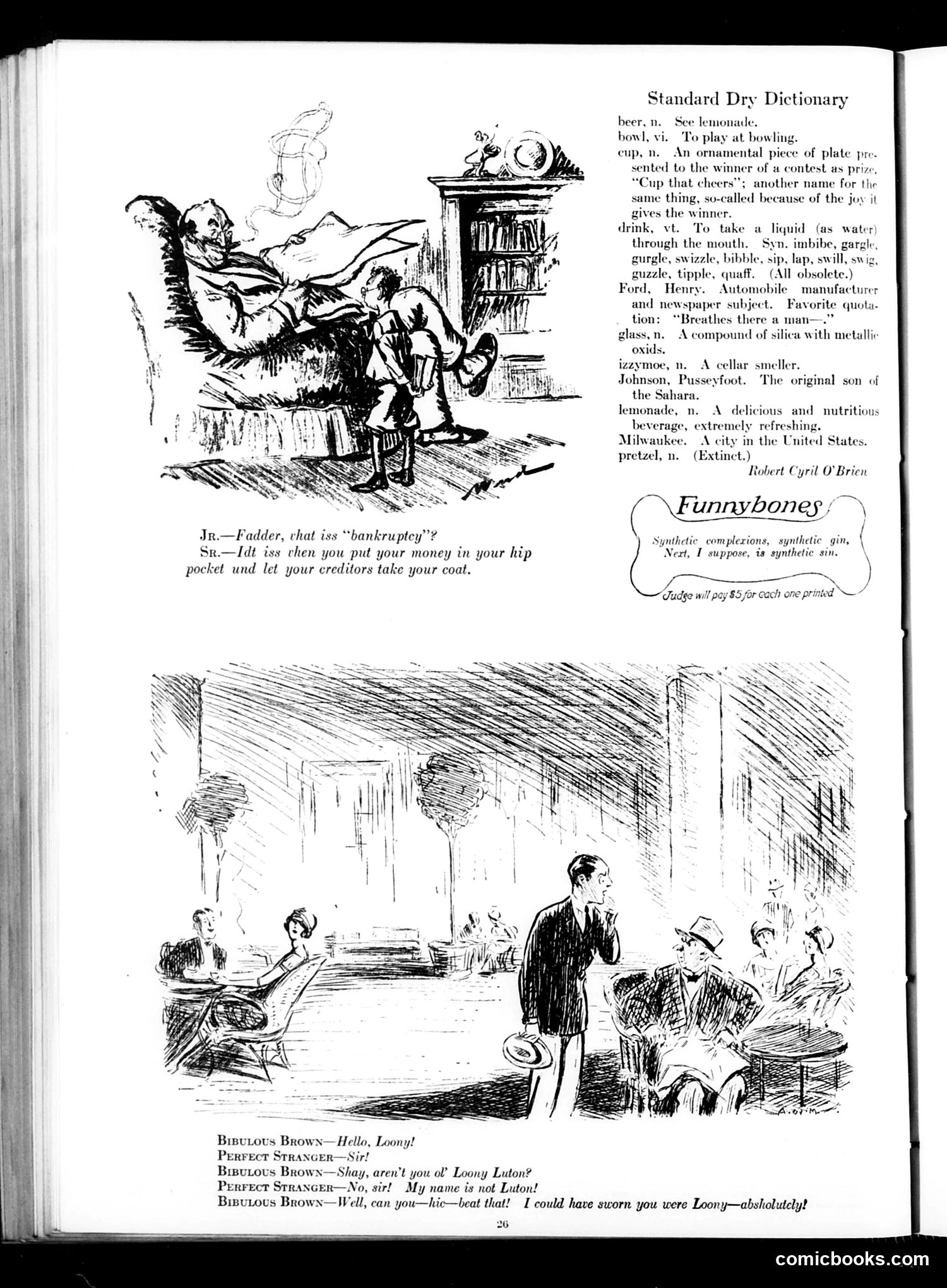
This page contains two distinct pieces of satire: **Top cartoon**: A joke about bankruptcy during the era of financial instability (likely post-WWI or 1920s). The humor relies on Yiddish-accented dialect humor (common in period American comedy) where a father explains bankruptcy as putting money in your pocket while creditors take your coat—meaning financial ruin results in losing everything despite attempts to hide assets. **Bottom cartoon**: "Bibulous Brown" (a drunkard character, suggested by the name and "hic" hiccup) mistakes a sober stranger for someone named "Loony Luton," then claims he could have sworn the person *was* Loony—the joke being the drunk man's unreliable perception and faulty memory. The title "Funnybones" suggests these are humorous character sketches. The dictionary definitions are satirical, redefining common words with jokes (beer defined as "lemonade," drink with multiple slang synonyms marked "obsolete," Ford and Milwaukee given ironic entries).
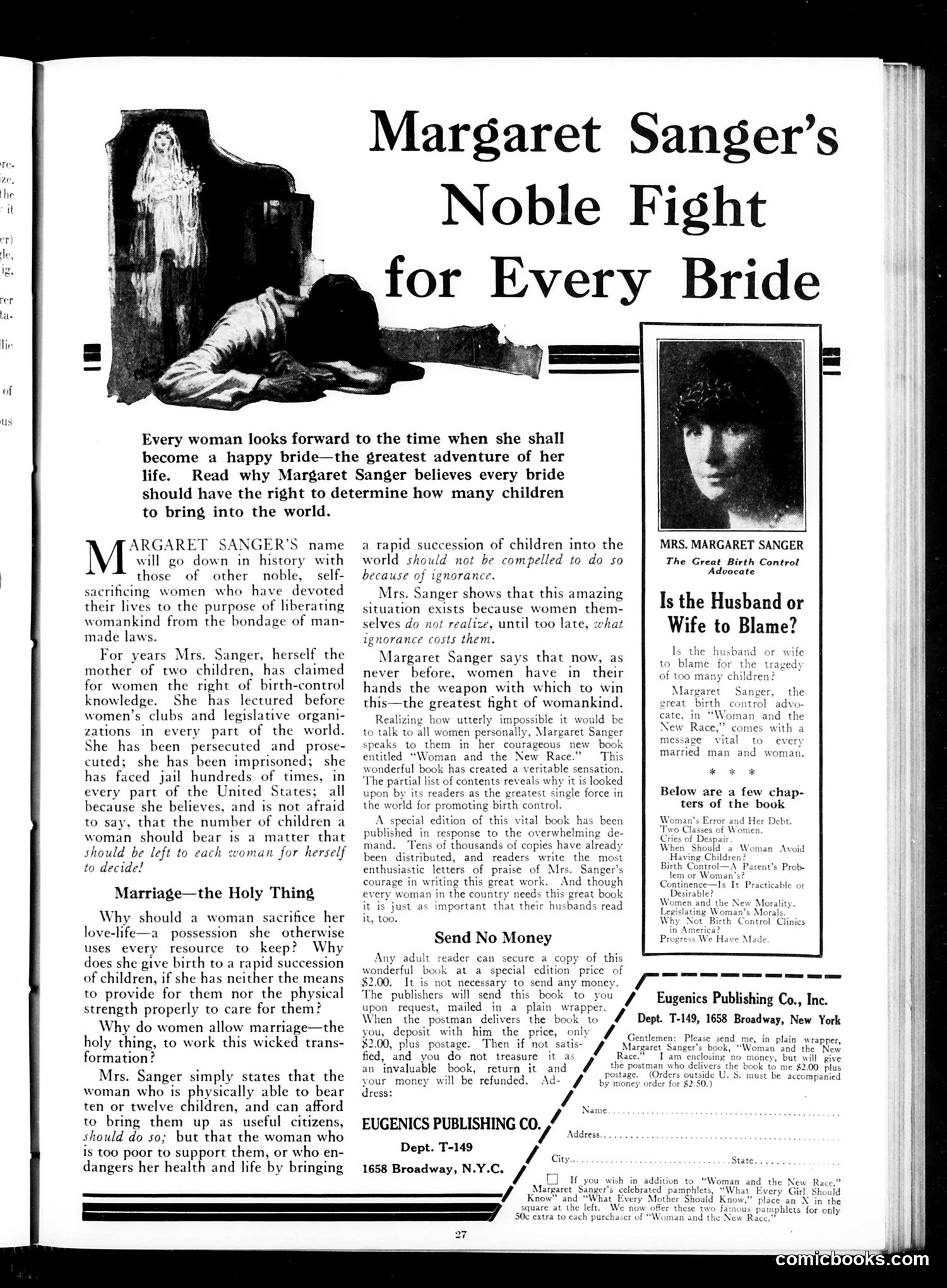
This page is primarily **advertising copy**, not satire. Judge magazine published this promotional material for Margaret Sanger's birth-control advocacy book "Woman and the New Race." The content presents Sanger as a heroic figure who challenged legal restrictions on contraceptive knowledge. The dramatic illustration (woman in distress) symbolizes the hardship of unwanted pregnancies. The text frames birth control as a women's rights issue—specifically, the right to decide family size based on economic means and health. Key context for modern readers: In the 1920s, discussing contraception publicly was radical and often illegal. Sanger faced imprisonment for this advocacy. The page's framing of birth control as liberation from "man-made laws" and marital obligation reflects 1920s feminist arguments. The rhetorical question "Is the Husband or Wife to Blame?" for large families reflects contemporary debates about reproductive responsibility and marital power dynamics—issues still contested today, though the legal landscape has transformed entirely.
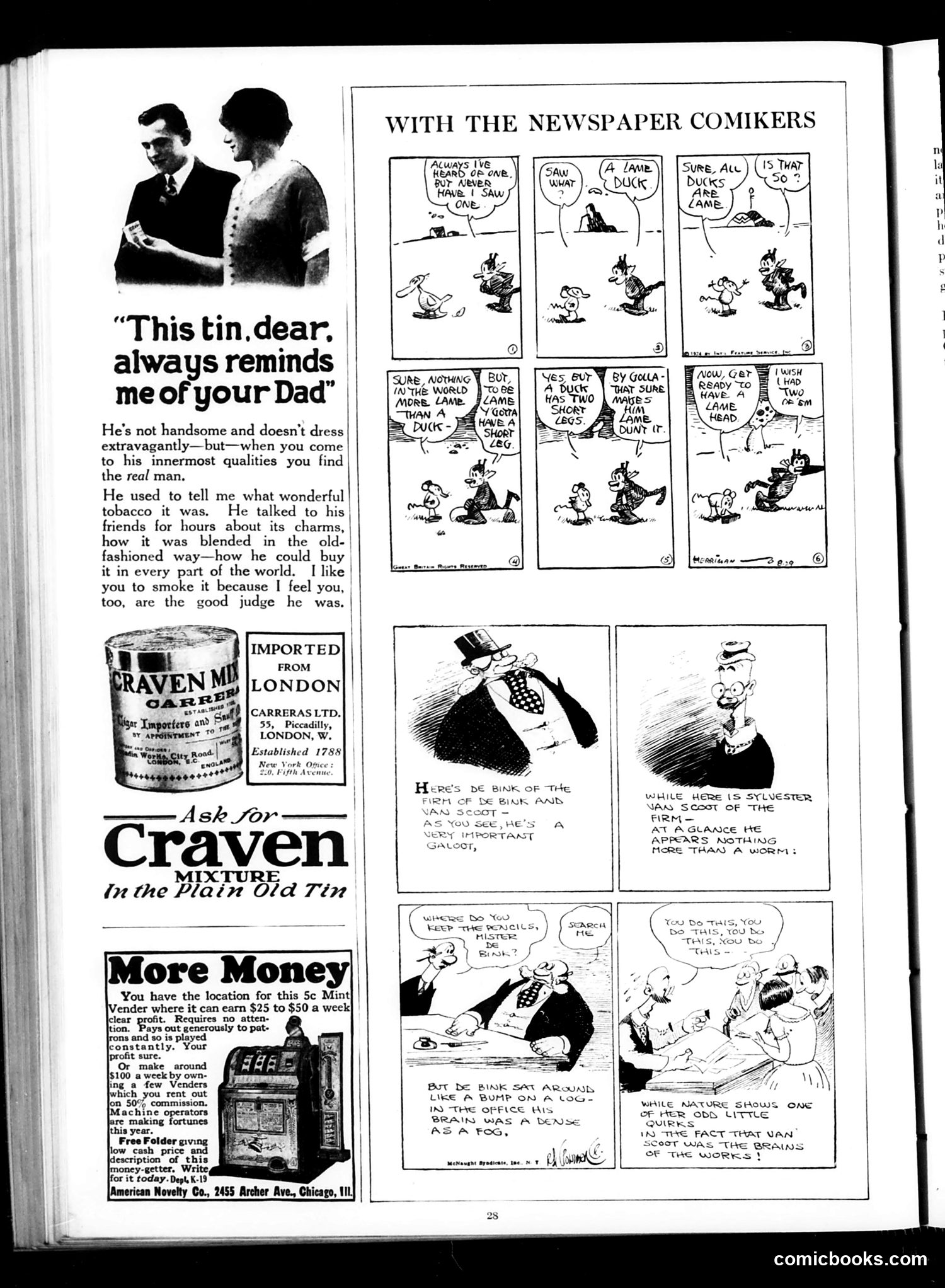
This page combines advertising with satirical comics. The top section is a **tobacco advertisement** for Craven Mixture (imported from London), using nostalgic sentiment—a woman associates the product with her father's character and good judgment. The main cartoon titled **"With the Newspaper Comikers"** appears to be self-referential satire about comic strip creation. It shows newspaper comic characters (ducks and other animals) discussing their own "lameness" and limited plots, with one character noting that despite having "two legs" like humans, the strips remain repetitive. The humor suggests Judge was mocking the predictability of newspaper comic strips. The lower comics show a character named **De Bink**, satirizing office dynamics: an apparently worthless employee ("a bump on a log") who actually possesses all the firm's intelligence, while his more impressive-seeming partner is incompetent. This inverts expectations about appearance versus actual capability. The "More Money" section advertises a mint vending machine business opportunity.
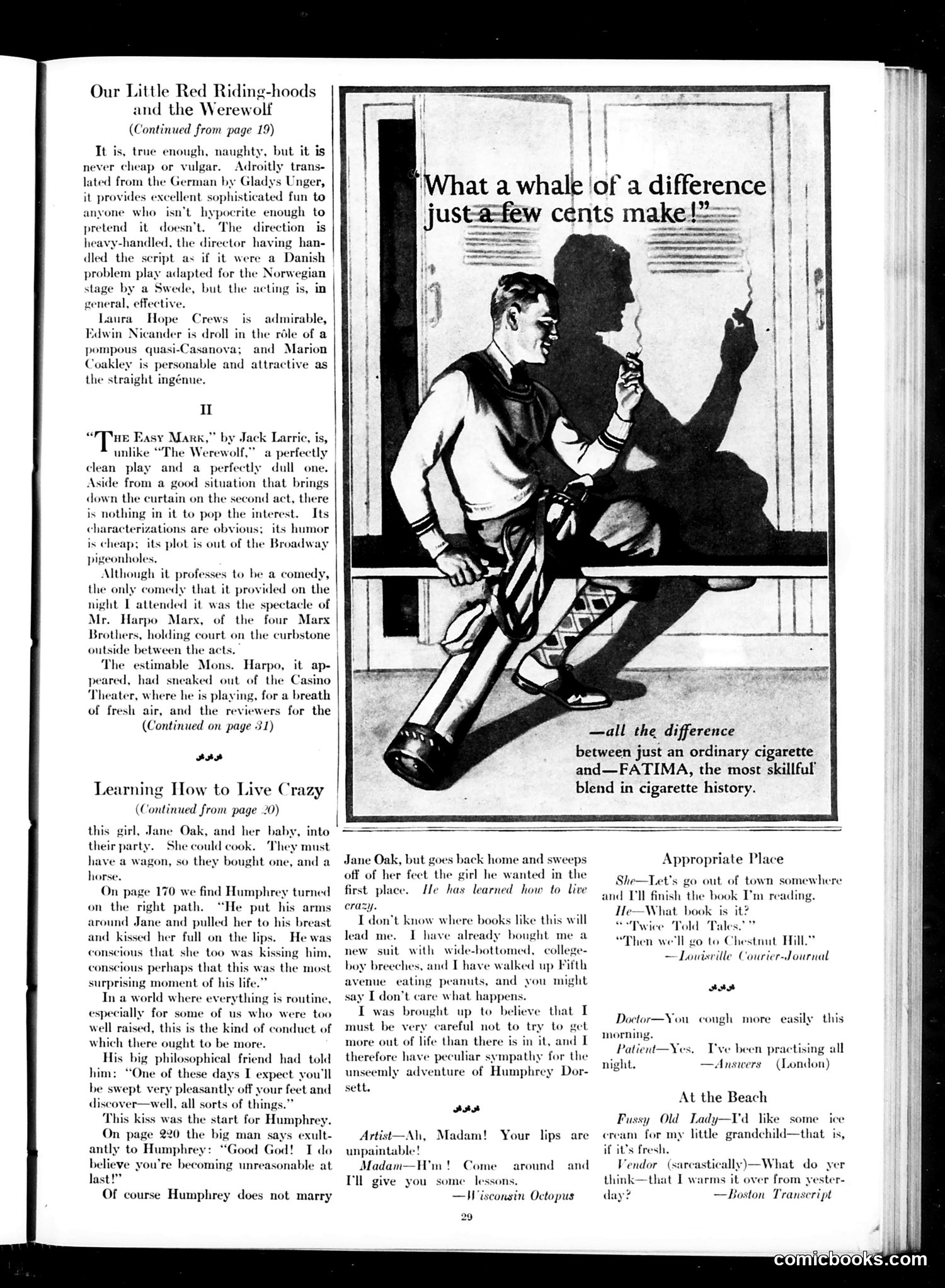
This page contains multiple unrelated articles and advertisements typical of Judge magazine's format. The main visual content is a **Fatima cigarette advertisement** showing a man demonstrating the product to a woman. The ad's tagline—"What a whale of a difference just a few cents make"—is a period marketing claim about cigarette quality. This represents early 20th-century tobacco advertising before health warnings, when such ads appeared routinely in satirical magazines. The textual content includes theater reviews (mentioning Harpo Marx appearing at the Casino Theater) and a serialized story called "Learning How to Live Crazy" about a character named Humphrey who embraces spontaneity. There's also a small artist-model cartoon joke at the bottom, unrelated to broader satire. **No clear political satire is visible on this page**—it's primarily entertainment, advertising, and serialized fiction typical of Judge's middle sections.
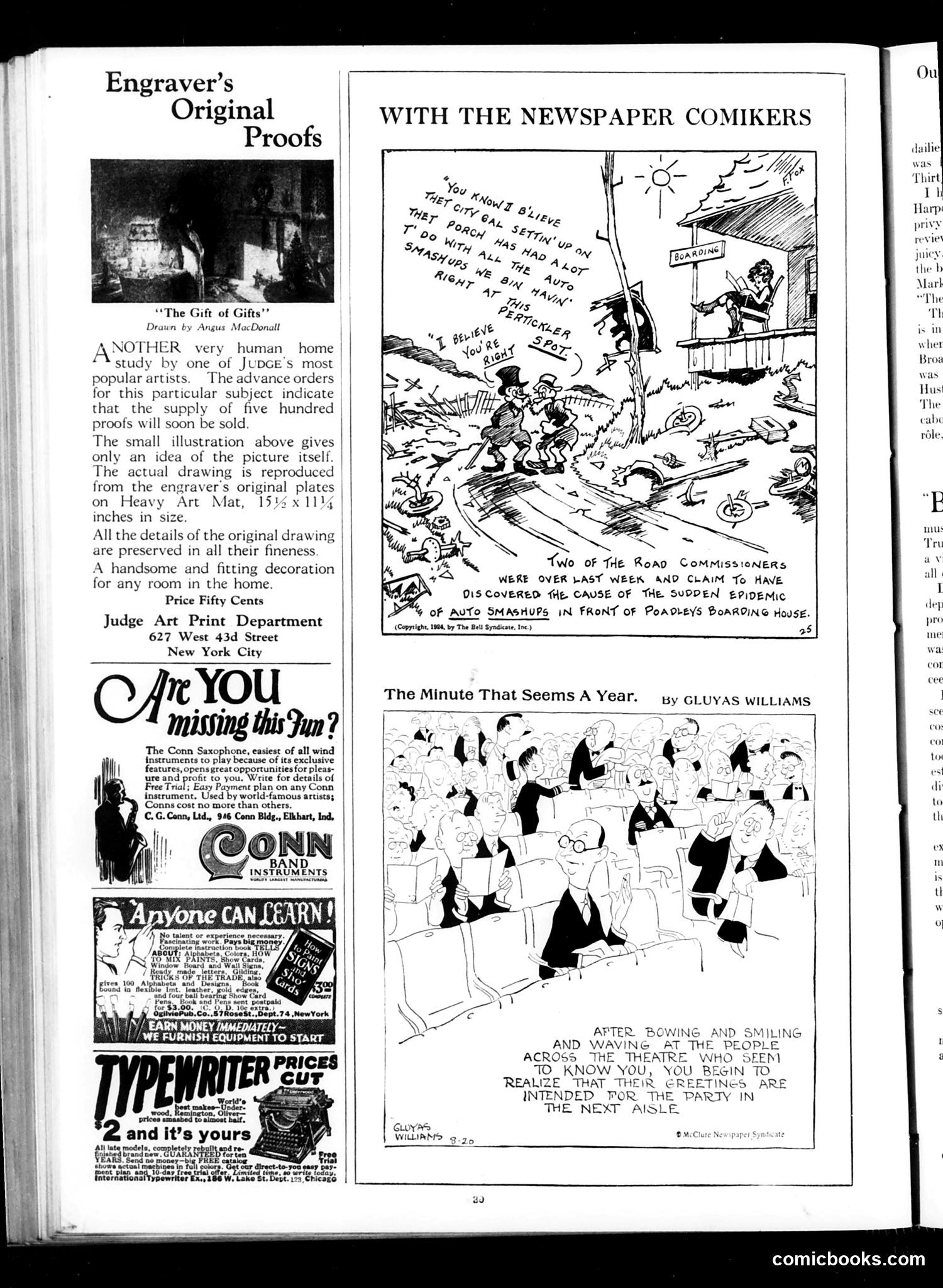
This page contains primarily **advertisements and cartoon features** rather than political satire. The top cartoon "With the Newspaper Comikers" depicts two road commissioners investigating auto crashes outside Roadley's Boarding House. The joke appears to be that the commissioners have discovered the *cause* of accidents (though the specific cause isn't explicitly stated in visible text)—likely implying something humorous about the boarding house itself, possibly related to distracted drivers or road conditions. Below, Gluyas Williams's "The Minute That Seems A Year" satirizes social awkwardness at theaters: after greeting people across the aisle whom you assume know you, you realize those greetings were actually directed at someone *behind* you in the next row. It's gentle social humor about embarrassment and misread social cues. The remainder of the page consists of period advertisements (Conn saxophones, typewriters, art prints, music lessons)—typical Judge magazine filler content.
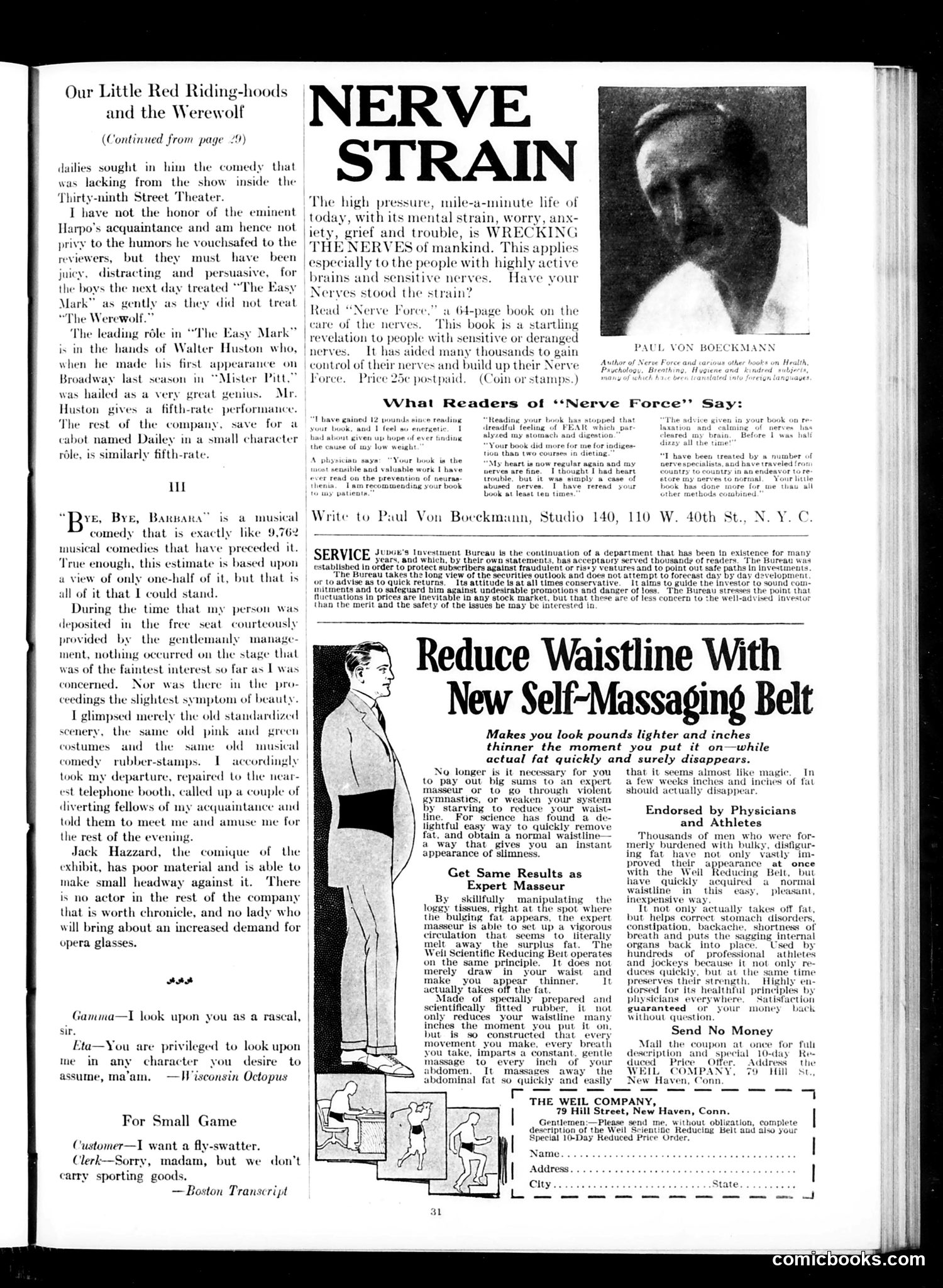
This page mixes theater criticism with period advertising and humor. **Theater Reviews:** The critic savagely pans two Broadway productions—"The Easy Mark" and "Bye, Bye, Barbara"—calling performances "fifth-rate" and complaining of tedious scenery and "rubber-stamp" comedy routines. Walter Huston receives particular criticism despite his previous reputation as a "very great genius." **"Nerve Strain" Advertisement:** The large central feature advertises "Nerve Force," a self-help book (64 pages, 25¢) claiming to cure modern nervousness afflicting "people with highly active brains and sensitive nerves." This reflects early 20th-century anxiety about industrialization's mental health toll. **Waistline Belt Advertisement:** Below depicts a "Self-Massaging Belt" promising instant weight loss without exercise or dieting—typical pseudoscientific marketing of the era. **Humor Sections:** Short joke exchanges mock social pretension ("I look upon you as a rascal"). The page reflects 1920s concerns: theater quality, commercial nervousness as social affliction, and dubious health remedies marketed to anxious consumers.
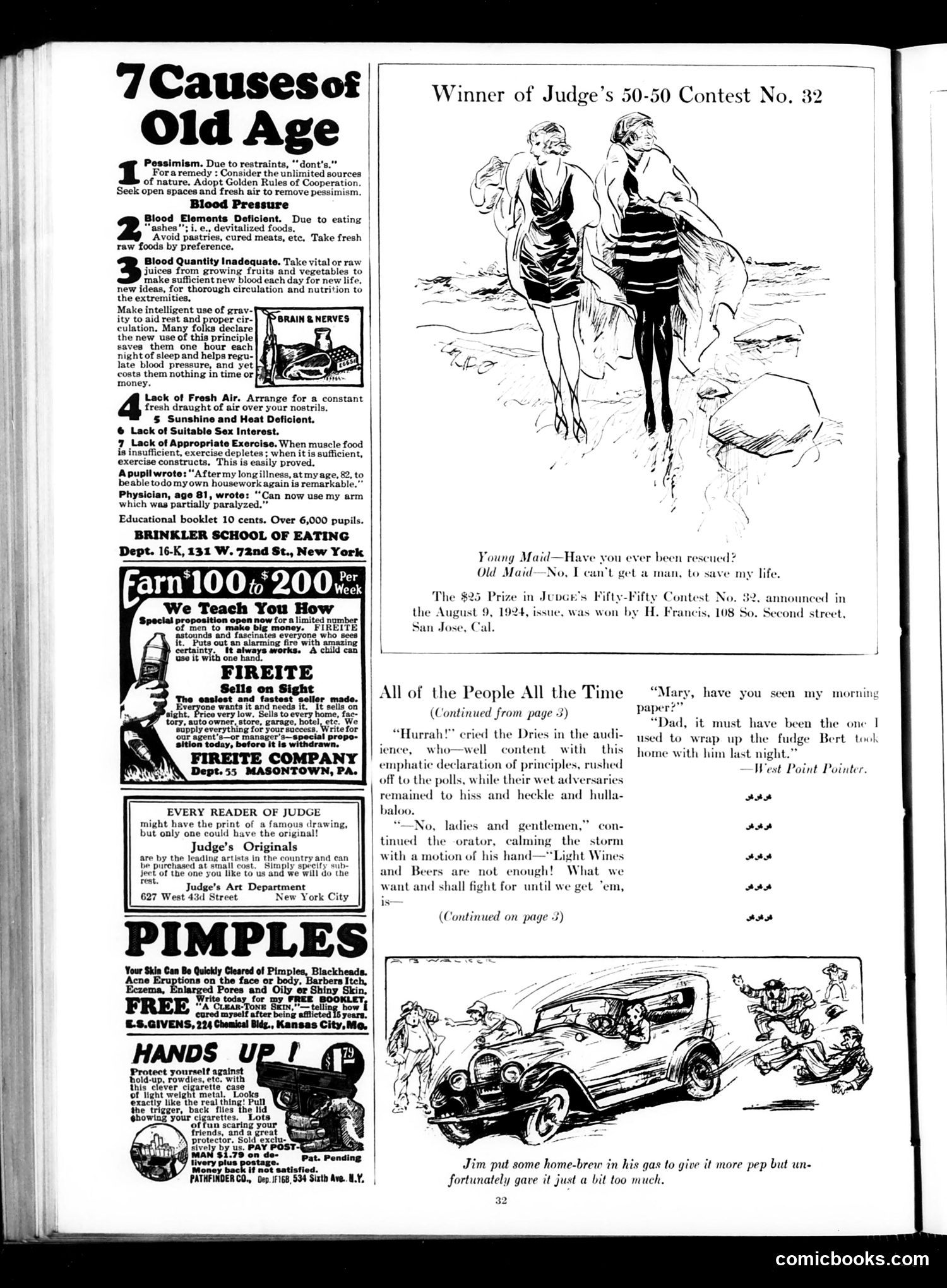
This page is primarily **advertisements and health advice** rather than political satire. The dominant content is "7 Causes of Old Age," a health editorial promoting the Brinkler School of Eating, alongside various product ads (Fireite, pimples treatment, toy guns). The few cartoon elements present are: 1. **"Young Maid" and "Old Maid" sketch** (top right): A lighthearted romantic joke about an unmarried older woman unable to find a partner. 2. **"Jim's home-brew" cartoon** (bottom): References Prohibition-era bootlegging—Jim adds homemade alcohol to his car's gas tank, causing an explosion. This satirizes ordinary citizens' attempts to circumvent Prohibition laws and the dangers of amateur alcohol production. The page reflects 1920s concerns: health fads, Prohibition enforcement, and courtship anxiety. The humor is gentle rather than biting political commentary.
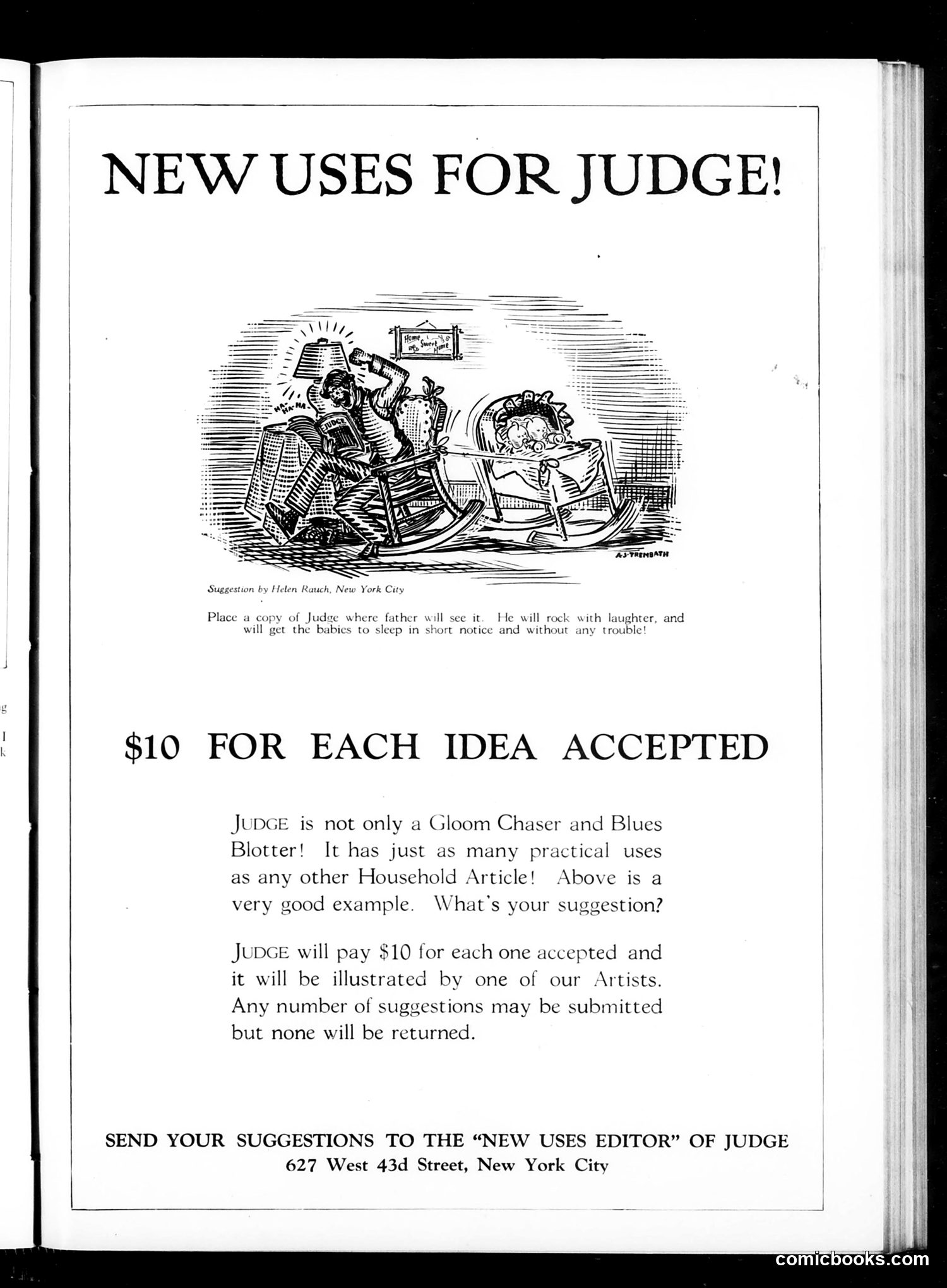
This is an advertisement/contest page from *Judge* magazine soliciting reader submissions. The cartoon illustrates a humorous "new use" for the magazine itself: placing a copy where a father will find it, causing him to laugh so hard he can rock a baby to sleep effortlessly. The joke plays on *Judge's* self-promotion as a humor magazine—implying its comedy is so effective it has practical household applications beyond entertainment. The illustration shows a father reading the magazine while rocking a cradle, with babies already asleep. *Judge* offered $10 per accepted idea (substantial money at the time), which it would then illustrate professionally. This was a reader-engagement strategy that doubled as free content generation. The tone is lighthearted and self-aware about the magazine's comedic purpose.
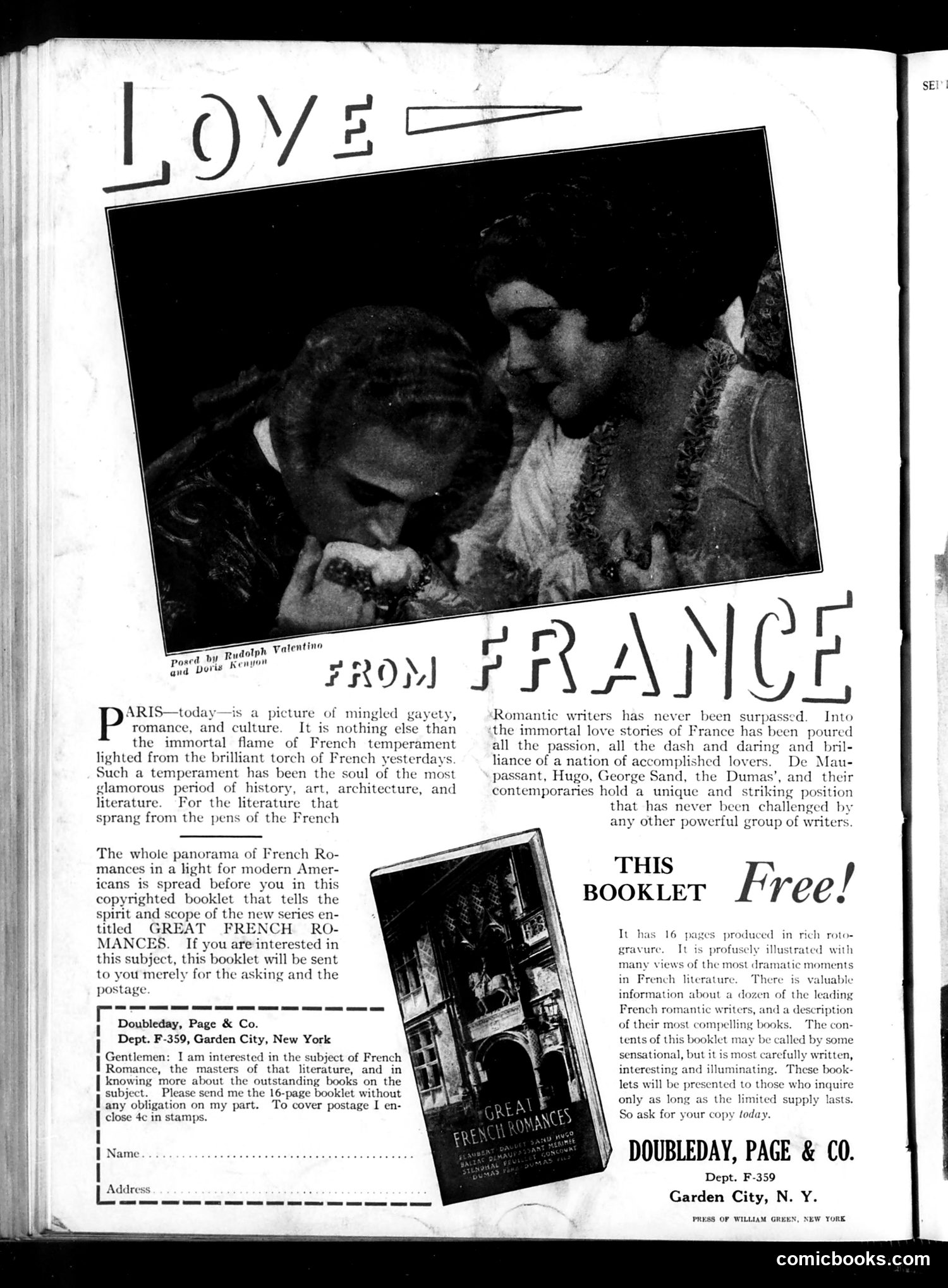
This is primarily a **book advertisement**, not political satire. Doubleday, Page & Co. promotes a 16-page illustrated booklet on "Great French Romances" featuring classic French romantic literature (de Maupassant, Hugo, George Sand, the Dumas). The page's imagery references **Rudolph Valentino**, the famous silent-film heartthrob associated with passionate romantic roles. The photograph credited to him shows two figures in an intimate scene, leveraging his celebrity to sell the booklet by connecting literary French romance to contemporary cinema glamour. The ad emphasizes France's reputation as the source of Western romantic literature and "accomplished lovers," appealing to American readers' fascination with French culture and Continental sophistication during the 1920s. The booklet was offered free (requiring only postage stamps), a common direct-mail marketing technique of the era.