
Judge, 1924-09-13 · page 58 of 72
Judge — September 13, 1924 — page 58: what you’re looking at
What you’re looking at
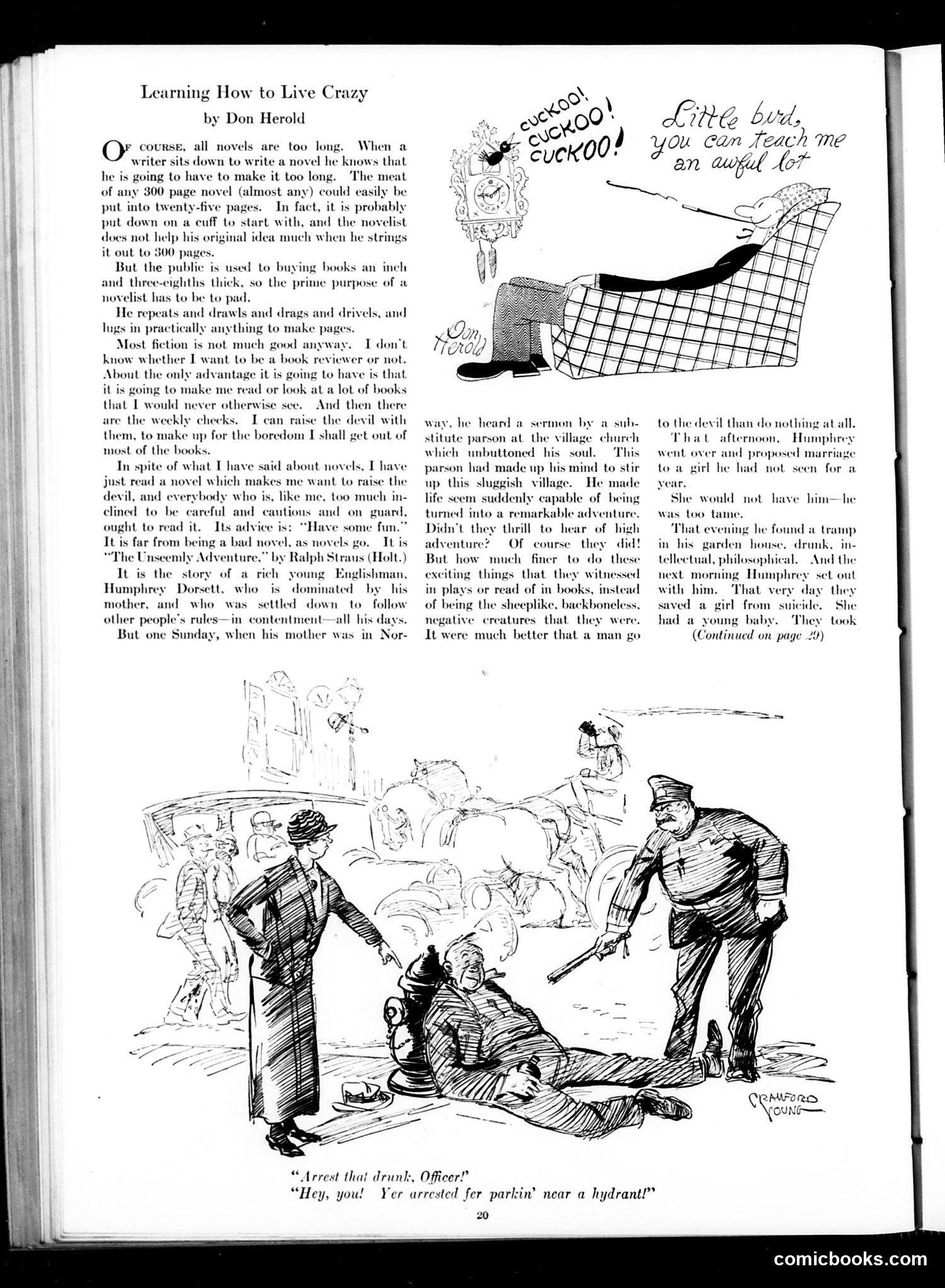
This is a humorous essay critiquing novel-writing practices, accompanied by an unrelated cartoon about police conduct. **The Essay's Point:** Herold satirizes novelists for padding their work unnecessarily. He argues that most 300-page novels could compress into 25 pages, but publishers expect thick books, forcing writers to "repeat and drawl and drag and drivels." He reviews Ralph Straus's *The Unseemly Adventure*, praising it for encouraging readers to abandon cautious conformity and actually *live* adventurously rather than merely reading about adventure vicariously. The protagonist Humphrey breaks free from his domineering mother's rules and seeks genuine experience. **The Cartoon:** Shows a police officer arresting a drunk man near a fire hydrant while saying "Arrest that drunk, Officer!" / "Hey, you! Yer arrested fer parkin' near a hydrant!" The joke appears to mock police priorities or bureaucratic absurdity—an officer arresting someone for both drunkenness *and* improper parking, highlighting petty enforcement. The essay's theme of breaking free from conformist rules ironically complements the cartoon's critique of rigid authority.
📄 Transcribed text from this page (OCR, searchable)
Machine-transcribed from the original scan — historical spelling and the odd misread are preserved.
Learning How to Live Crazy by Don Herold oO course, all novels are too long. When a writer sits down to write a novel he knows t he is going to have to make it too long. The n of any 300 page novel (almost any) could easily be put into twenty-five pages. In fact, it is probably put down on a cuff to start with, and the nove does not help his original idea much when he strings it out to 300 pages. But the public is used to buying books an inch and three-eighths thick, so the prime purpose of a novelist has to be to pad. He repeats and drawls and drags and drivels, and lugs in practically anything to make pages. Most fiction is not much good anyway. I don’t know whether I want to be a book reviewer or not. About the only advantage it is going to have is that it is going to make me read or look at a lot of books: that I would never otherwise And then there are the weekly checks. I can raise the devil with them, to make up for the boredom I shall get out of most of the books. In spite of what T have just read a novel which n devil, and everybody who is, like me, too much in- clined to be careful and cautious and on guard, ought to read it. Its advice is: “Have some fun.” It is far from being a bad novel ©The Unseem id about novels, I have kes me want to raise the as novels go. It is ; by Ralph Straus (Holt.) It is the story of a rich young Englishman, Humphrey Dorsett. who is dominated by his mothe ds who was settled down to follow other people's rules—in contentment—all his dé But one Sunday, when his mother was in Nor- Adventure, “Hey, you! “Arrest that drunk, Officer!’ Yer arrested fer parlin’ near a hydrant!’ way, he heard a sermon by a sub- stitute parson at the village church which unbuttoned his soul. This parson had made up his mind to stir up this sluggish village. He made life seem sudd pable of being turned inte ble adventure. Didn't t thrill to hear of high adventure? Of course they did! But how much finer to do these exciting things that they witnessed in plays or read of in books, instead of being the sheeplike, backboneless, negativ rel It were much better that a man go 20 to the devil than do nothing a That afternoon, Humph went over and proposed marriage to a girl he had not seen for a he would not have him—he too tame. That evening he found a tramp in his garden house, drunk, in- tellectual, philosophical. And the next morning Humphr with him. ‘That ve saved a girl from s had a young baby. ‘They (Continued on page 29) y set out y they comicbooks.com