
Judge, 1924-09-13 · page 44 of 72
Judge — September 13, 1924 — page 44: what you’re looking at
What you’re looking at
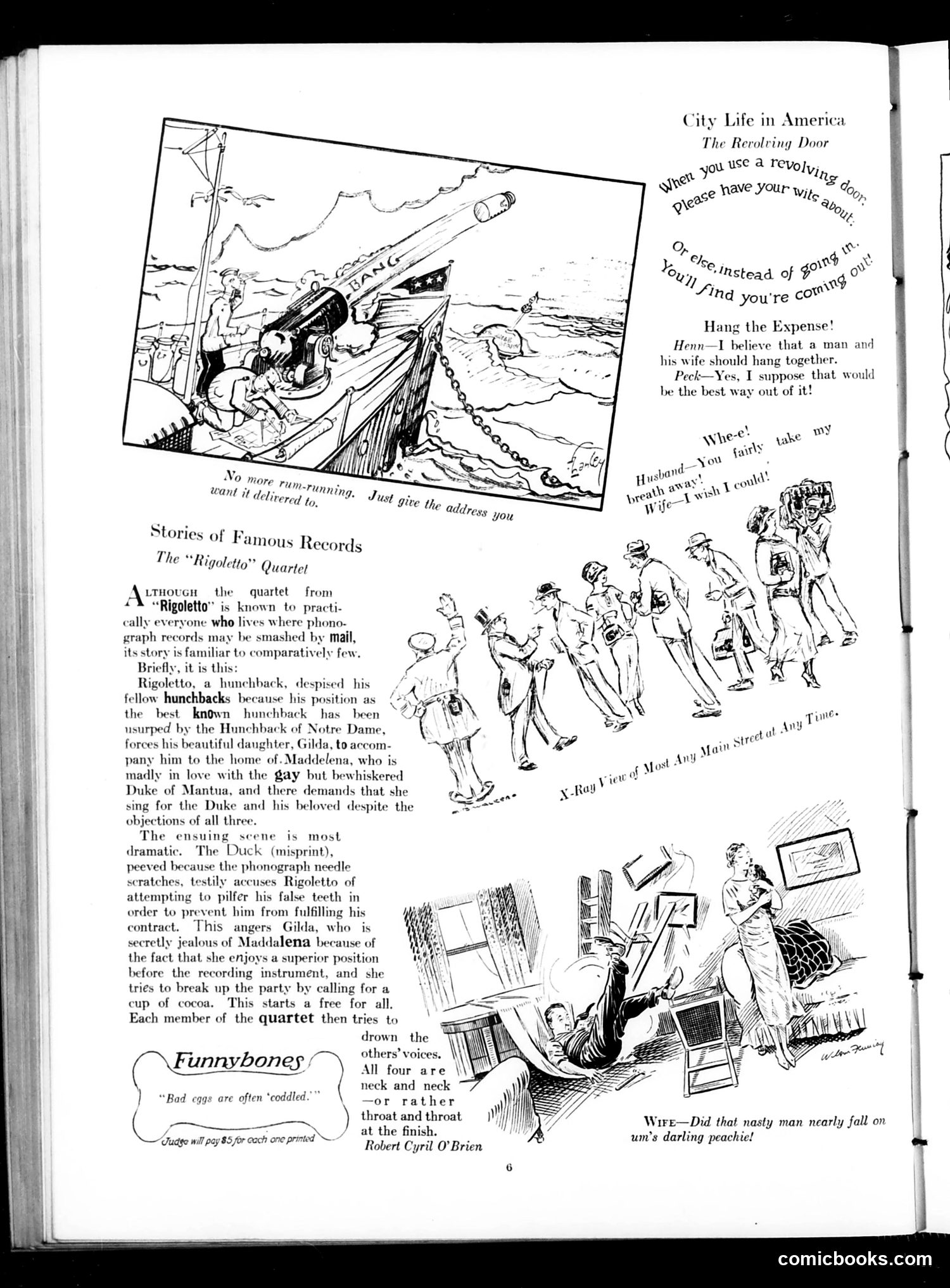
This page contains two unrelated pieces of early 20th-century humor: **"The Revolving Door"** (top): A marital humor cartoon where a husband uses a revolving door to escape his wife, then re-enters via the same door. The joke plays on the phrase "revolving door"—suggesting marriage as cyclical entrapment. The dialogue about "hanging the expense" is a dark pun on spouses "hanging together." **"The Rigoletto Quartet"** (bottom): A satirical piece mocking the famous opera quartet from Verdi's *Rigoletto*. The humor deliberately misrepresents the plot with absurdist details (calling the Duke a "Duck," mentioning false teeth and cocoa). It ridicules both the opera itself and the pretentiousness of phonograph record owners who play classical music. The final illustration shows domestic chaos—another marital comedy trope of the era. Both segments are typical Judge magazine fare: slapstick domestic comedy and mockery of "cultured" entertainment, aimed at middle-class American readers.
📄 Transcribed text from this page (OCR, searchable)
Machine-transcribed from the original scan — historical spelling and the odd misread are preserved.
City Life in America The Revolving Door ou Use 2 Tevojy, ag Qu We eg Have YOur wi, > %, eo" Fa, ced q Ye on we ley 0h Noy, instead of Fg 14; a0 hd you're CO Hang the Expense! Henn—I believe that a man and his wife should hang together. Peck—Yes, I suppose that would be the best way out of it! aoe! oom whe iy tae gaits Yow gusban’ \ nore rum-p : - want it dos, unn i CO Ht delivered jy. "% Tust wea * P . a € the address you " " tories of Famous Records The “Rigoletto” Quartet Avtioucn the quartet from 4% “Rigoletto” is known to practi- cally everyone who lives where phono- graph records may be smashed by mail, its story is familiar to comparatively few. Briefly, it is this: Rigoletto, a hunchback, despised his fellow hunchbacks because his position as the best known hunchback has been usurped by the Hunchback of Notre Dame, forces his beautiful daughter, Gilda, to accom- pany him to the home of.Maddelena, who is madly in love with the gay but bewhiskered Duke of Mant id there demands that she sing for the Duke and his beloved despite the objections of all three. T ensuing scene is most dramatic. The Duck (misprint), peeved because the phonograph needle scratches, testily accuses Rigoletto of attempting to pilfer his false teeth in order to prevent him from fulfilling his contract. This angers Gilda, who is secretly jealous of Maddalena because of the fact that. she enjoys a superior position before the recording instrument, and she tries to break up the party by calling for a | cup of cocoa. This starts a free for all. | Each member of the quartet then tries to drown the | ; others’ voices. ] Funnybones Nite are \ {| vos ( neck and neck | \j } “Bad eggs are often ‘coddled —or rather iil | C ——™ ) ireat ae farost , HII / Wire—Did that nasty man nearly fall on | Gadge mil pay 85 for cach one printed Reba Cyril O'Brien e um’s darling peachie! y & comicbooks.com