
Judge, 1924-09-13 · page 28 of 72
Judge — September 13, 1924 — page 28: what you’re looking at
What you’re looking at
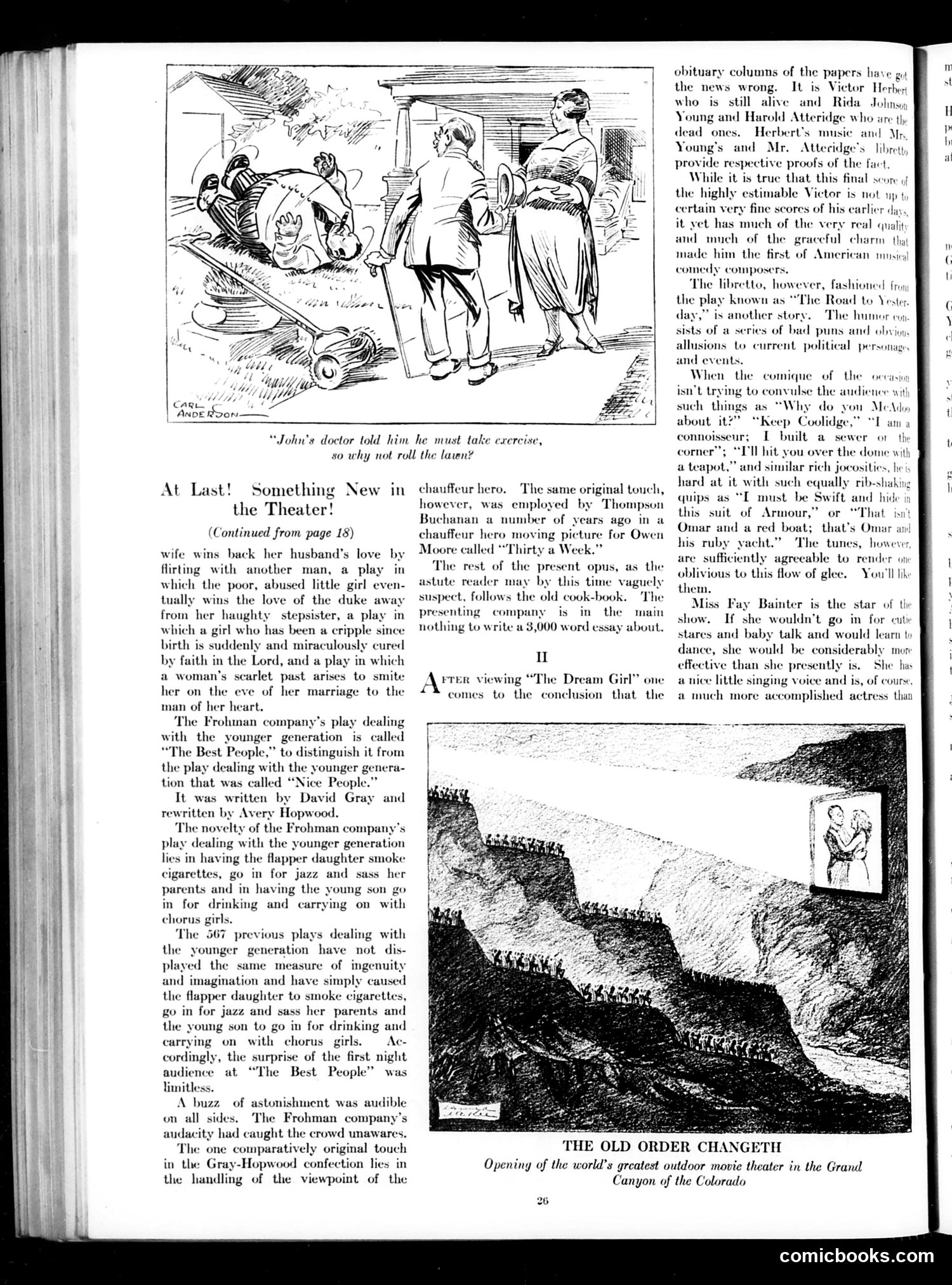
The single cartoon on this page depicts a man in formal dress standing beside a woman, watching another man operating a manual lawn roller. The joke plays on a common domestic scenario: a doctor has prescribed exercise, so the husband suggests rolling the lawn—but the cartoon suggests he's avoiding the work himself by having someone else (likely a servant or laborer) do it. The humor is gentle domestic satire, mocking husbands who find clever excuses to delegate physically demanding tasks while claiming to follow doctor's orders. It reflects early 20th-century class assumptions about hired labor and the leisured classes avoiding exertion. The accompanying article discusses theatrical productions, particularly the Frohman company's "The Best People" and Victor Herbert's "The Dream Girl," critiquing their predictable plots and derivative humor about flappers and jazz-age youth.
📄 Transcribed text from this page (OCR, searchable)
Machine-transcribed from the original scan — historical spelling and the odd misread are preserved.
— Cag C . ANDE Roon—— “John’s doctor told him he must take exercise, so why not roll the lawn? At Last! Something New in the Theater! (Continued from page 18) wife wins back her husband’s love by flirting with another man, a play in which the poor, abused little girl even- tually wins the love of the duke aw from her haughty stepsister, a play in which a girl who has been a cripple since birth is suddenly and miraculously cured by faith in the Lord, and a play in which a woman's scarlet past arises to smite her on the eve of her marriage to the man of her heart. ‘The Frohman company’s play dealing with the younger generation is called “The Best People,” to distinguish it from the play dealing with the younger g tion that was called “Nice People It was written by David Gray and rewritten by Avery Hopwood. The novelty of the Frohman company’s play dealing with the younger generation lies in having the flapper daughter smoke cigarettes, go in for jazz and sass her parents and in having the young son go in for drinking and carrying on with chorus girls. ‘The 567 previous plays dealing with the younger generation have not dis- played the same measure of ingenuity and imagination and have simply caused the flapper daughter to smoke cigarettes, go in for jazz and sass her parents and the young son to go in for drinking and carrying on with chorus girls. Ac- cordingly, the surprise of the first night audience at “The Best People” was limitles A buzz of astonishment was audible on all sides. The Frohman company’s audacity had caught the crowd unawares. The one comparatively original touch in the Gray-Hopwood confection lies in the handling of the viewpoint of the lera- chauffeur hero, The same original touch, however, was employed by Thompson Buchanan a number of years ago in a chauffeur hero moving picture for Owen Moore called ‘Thirty a Week.” The rest of the present opus, as the astute reader may by this time vaguely suspect, follows the old cook-book. The presenting company is in the main nothing to write a 3,000 word essay about. Il ATER viewing “The Dream Girl” one comes to the conclusion that the THE OLD ORDER CHANGETH obituary columns of the papers have guj the news wrong. It is Victor Herber who is still alive and Rida’ Joliny) Young and Harold Atteridge who are tl dead ones. Herbert's musie and My Young's and Mr. Atteridge’s libre, provide respective proofs of the fact While it is true that this final score of the highly estimable Victor is not up { certain very fine scores of his earlier day. it yet has much of the very real qualit and much of the graceful charm tha made him the first of American musics comedy composers. The libretto, however, fashioned fro the play known as “The Road to Yester ’,” is another story. The humor co) puns and obvious allusions to current political pers: and events. When the comique of the occas isn’t trying to convulse the audier such things “Why do you MeAdi about it?” “Keep Coolidge,” “I an connoisseur; IT built a sewer or th “IL hit you over the dome with apot,” and similar rich jocosities at it with such equally rib-sl quips as “LT must be Swift and hid this suit of Armour,” or “That isi’t Omar and a red boat; that’s Omar ai his ruby yacht.” The tunes, however, are sufficiently agreeable to render o1 oblivious to this flow of glee. You'll lik them, Miss Fay show. sists of a series of wit! Bainter is the star of t) If she wouldn't go in for cute stares and baby talk and would learn to dance, she would be considerably 1 effective than she presently is. She has a nice little singing voice and is, of cours, a much more accomplished actress than Opening of the world’s greatest outdoor movie theater in the Grand Canyon of the Colorado 26 comicbooks.com