
A complete issue · 36 pages · 1924
Judge — July 26, 1924
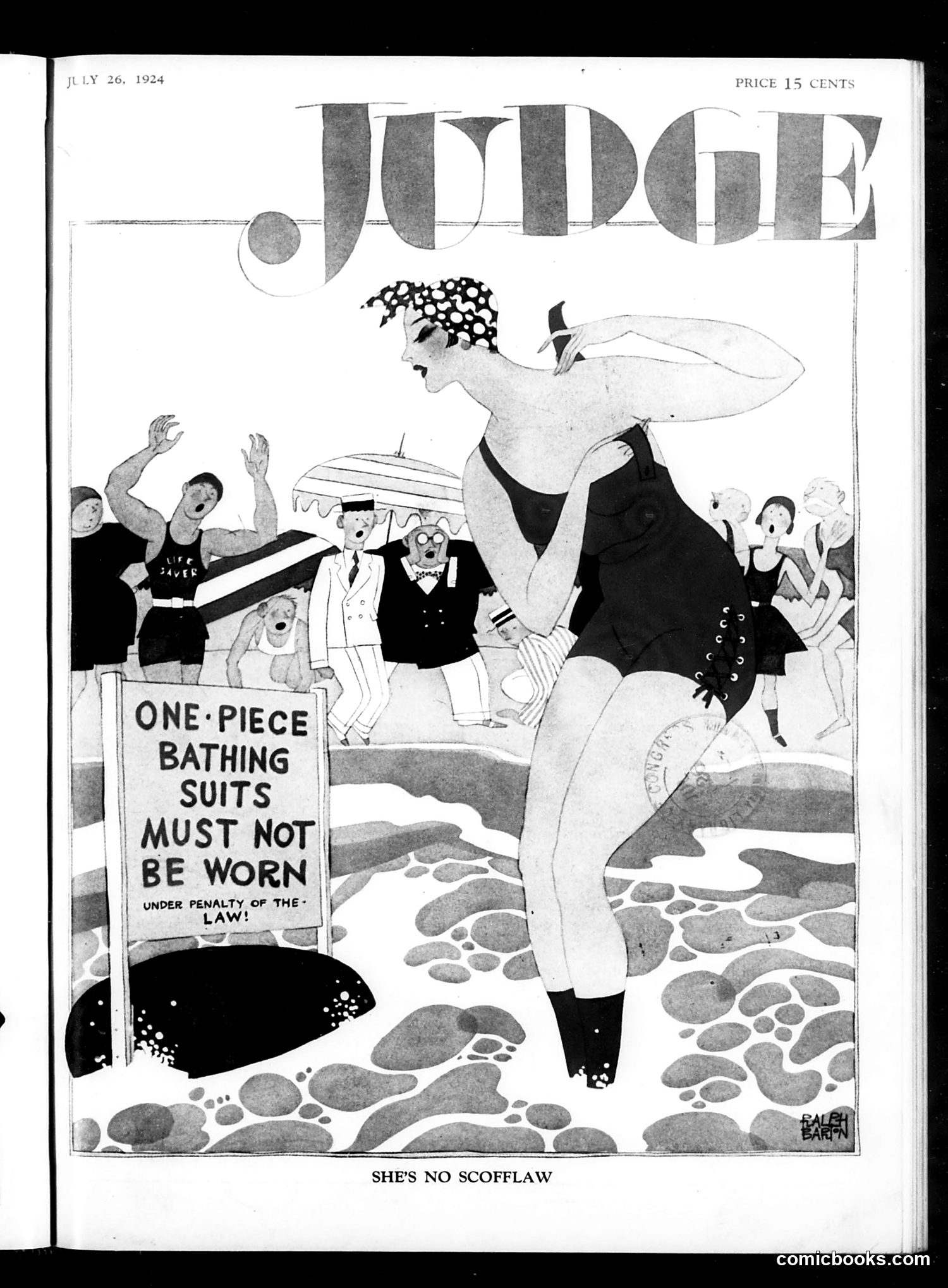
This satirical cover ridicules the enforcement of bathing suit regulations at beaches. A woman in a one-piece bathing suit stands prominently on a beach while shocked onlookers gesture in alarm. A sign reads: "ONE-PIECE BATHING SUITS MUST NOT BE WORN UNDER PENALTY OF THE LAW!" The joke plays on the term "scofflaw"—someone who flouts laws—suggesting the woman is *obeying* the law by wearing the revealing suit. This mocks absurd municipal beach codes of the 1920s that actually *prohibited* one-piece suits as indecent, requiring more coverage. The cartoon satirizes both the ridiculous nature of such puritanical laws and their enforcement during the Jazz Age, when fashion was becoming more liberal and women's clothing less restrictive.
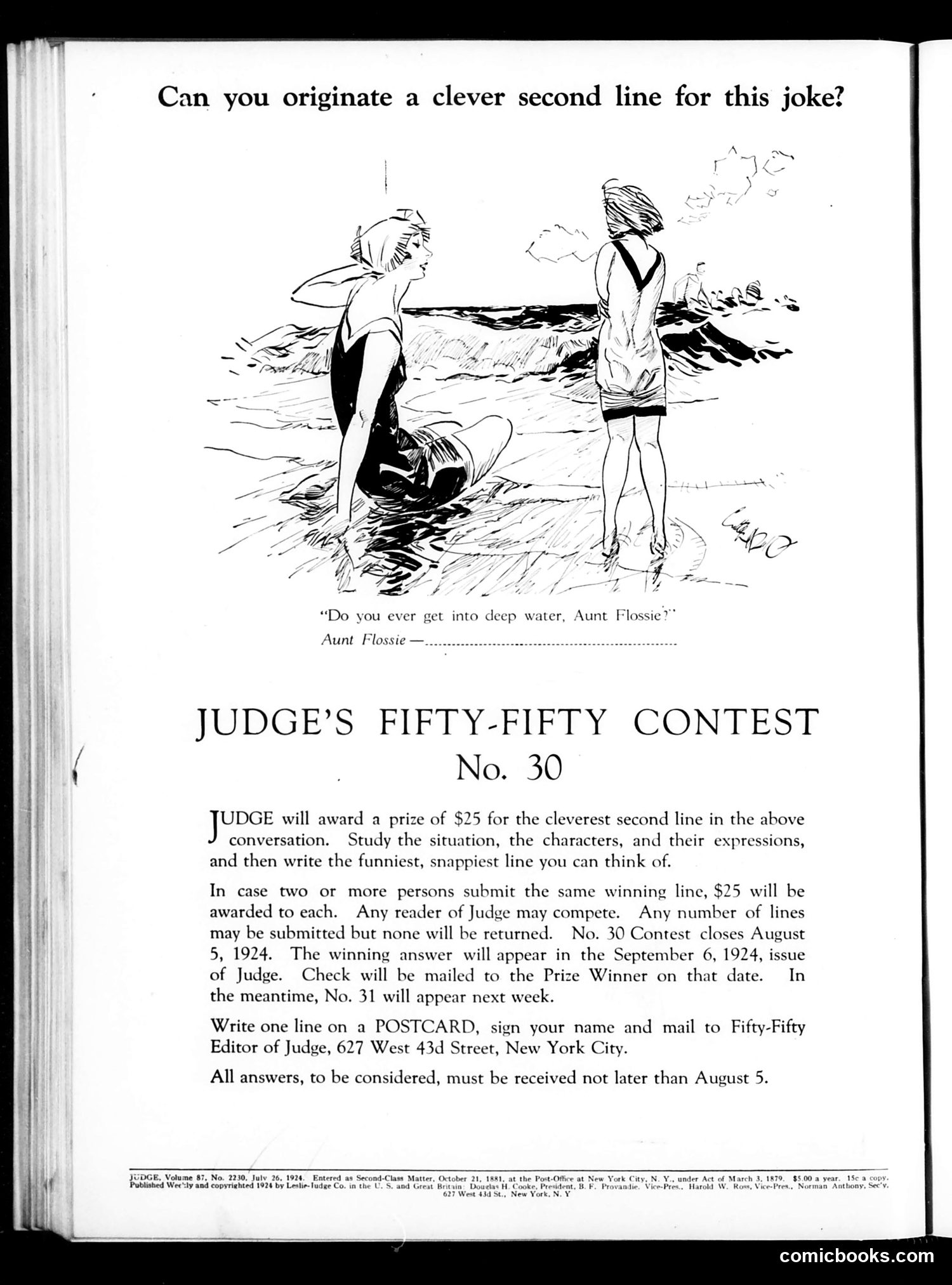
This page presents a humorous contest rather than political satire. The cartoon shows two women at a beach; one (labeled "Aunt Flossie") is wading in shallow water while another stands nearby. The first woman asks, "Do you ever get into deep water, Aunt Flossie?" The joke's setup invites readers to supply a witty second line—presumably a clever retort from Aunt Flossie. The contest offered a $25 prize for the cleverest response, typical of Judge magazine's interactive humor features. This type of participatory contest was common in 1920s publications, engaging readers while generating content. The humor appears to rely on the potential for a sharp or unexpected comeback rather than on specific topical references.
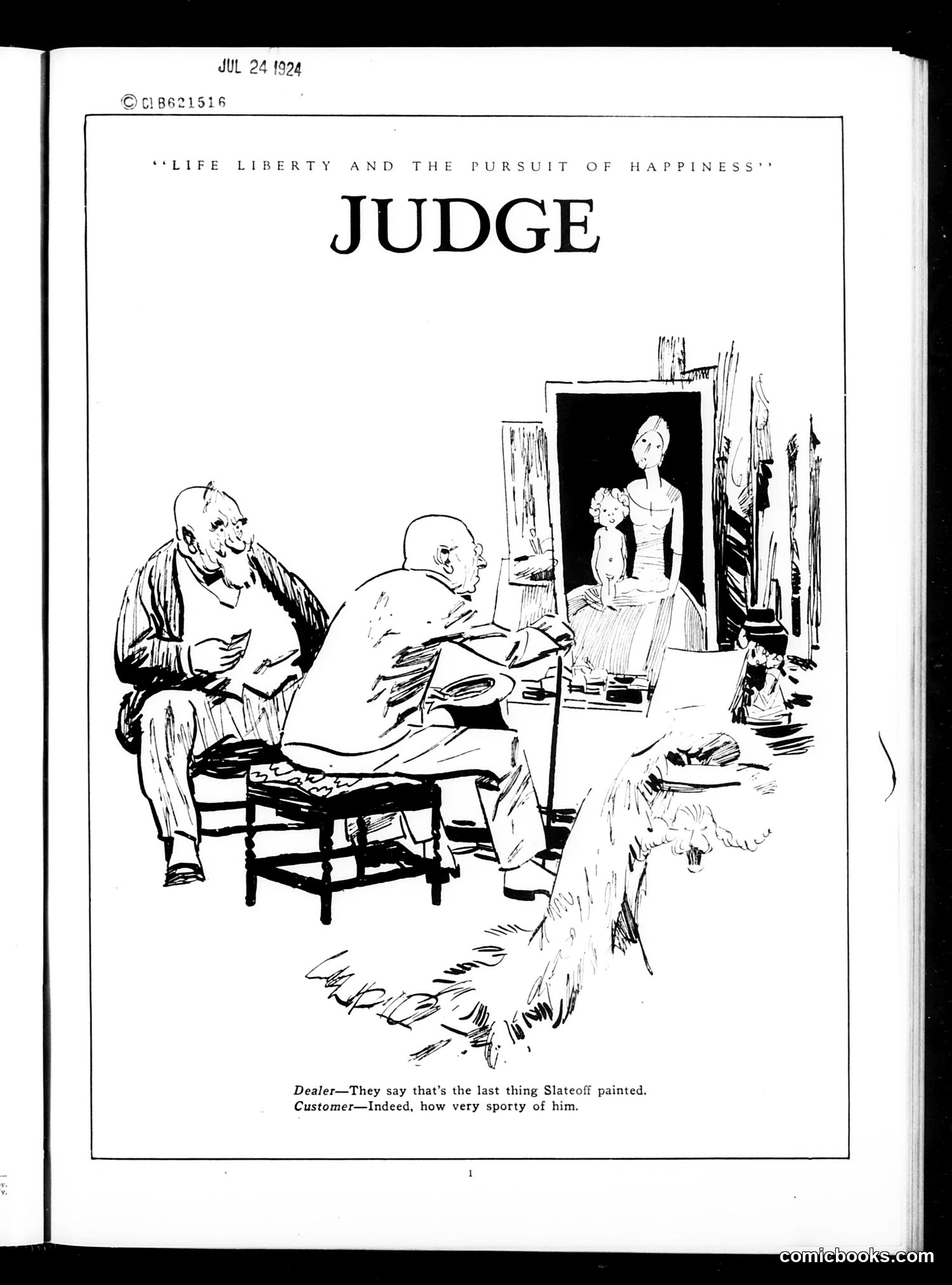
This cartoon satirizes art dealers and their customers. Two men examine a painting while a woman and child stand in a doorway. The dialogue reveals the joke: a dealer tells a customer that this is "the last thing Slateoff painted," and the customer praises it as "very sporty of him." The humor likely plays on either: 1. **Slateoff's death** — making the final painting poignant or darkly comedic 2. **Slateoff abandoning painting** — suggesting the work is notably inferior, yet the customer pretentiously praises it anyway The satire targets art-world pretension: wealthy collectors who uncritically praise artwork for fashionable reasons rather than actual merit. The illustration style and setting reflect 1920s aesthetic concerns about authenticity versus social posturing in high society.
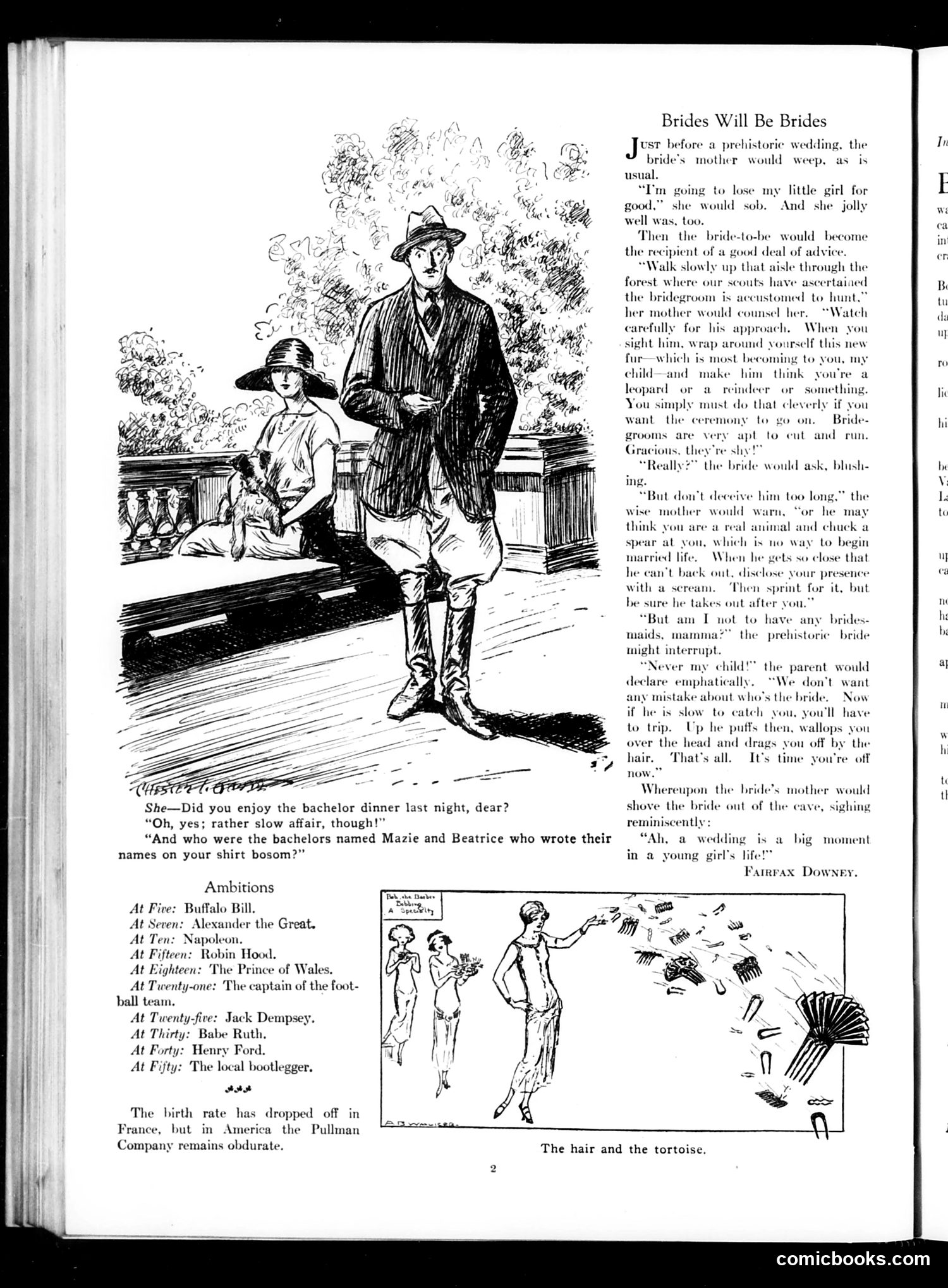
**"Brides Will Be Brides"** is a humorous piece about prehistoric courtship customs. The article imagines a cave-dwelling bride's mother offering practical (if absurd) advice: warn the groom he's marrying a leopard or reindeer, make him think you're slow to catch, don't let him get too close or he'll impale you with a spear. The accompanying illustration shows a man and woman in a forest setting, depicting this primitive scenario. **"Ambitions"** is a list comparing famous historical/contemporary figures at various ages (Buffalo Bill at five, Alexander the Great at seven, etc.). **"The Hair and the Tortoise"** cartoon (lower right) appears to be a visual pun on Aesop's fable, though details are unclear from the image. The page satirizes gender dynamics and courtship through comedic exaggeration.
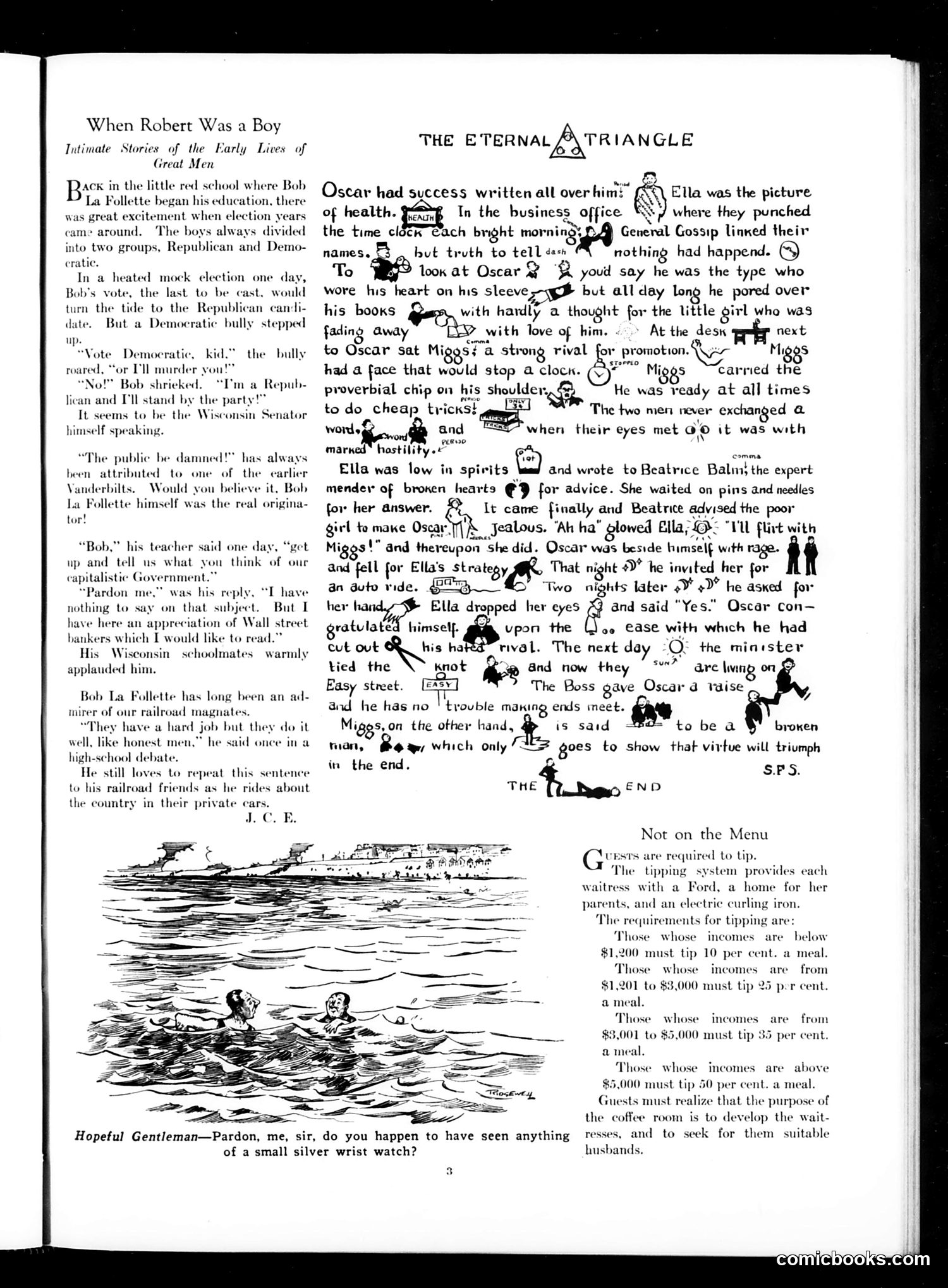
This page contains two distinct pieces: **"The Eternal Triangle"** (right): A satirical story about office romance. Oscar pursues business success while Ella pines for him. Miggs, a rival, uses underhanded tactics to sabotage Oscar. The satire mocks typical melodramatic romantic triangles of the era—specifically how workplace ambition and romantic jealousy create conflict. The moral appears to be that virtue (Oscar's integrity) ultimately triumphs over Miggs's deception, a common Judge theme promoting middle-class values. **Left page**: Features a swimming cartoon captioned "Hopeful Gentleman—Pardon, me, sir, do you happen to have seen anything of a small silver wrist watch?" The joke is straightforward: the swimmer has lost his watch in the water and desperately asks another swimmer, humorously oblivious that his question is absurd in that context.
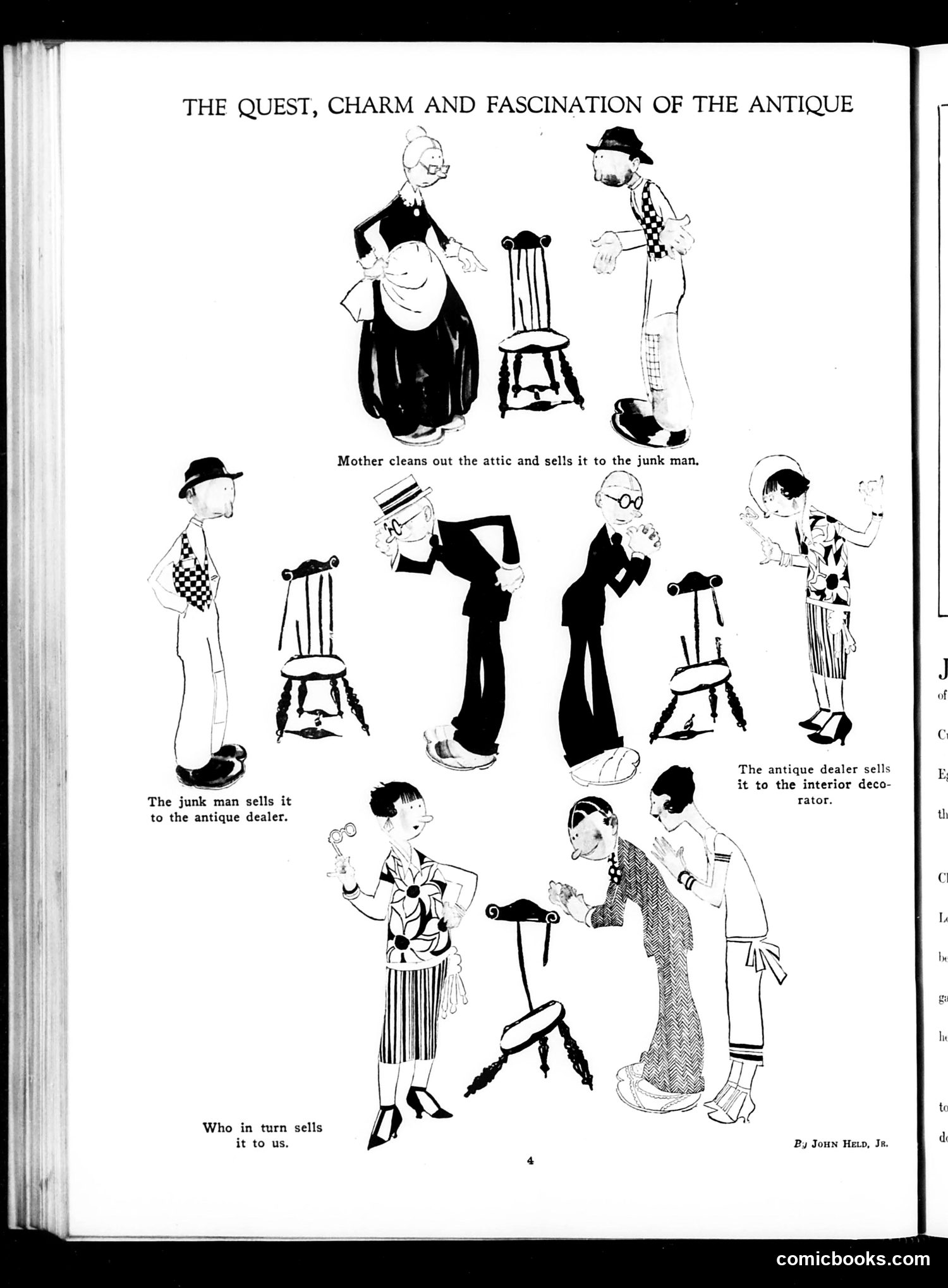
This satirical cartoon by John Held Jr. illustrates the commercial chain for selling antique furniture. It depicts how a single piece—here, an old chair—passes through multiple hands, each person marking it up: 1. A mother sells it from her attic to a junk man 2. The junk man sells it to an antique dealer 3. The antique dealer sells it to an interior decorator 4. The interior decorator sells it to a wealthy consumer The satire mocks the antique trade's inflated prices and the notion that "antique" status justifies tremendous markups. Each middleman profits substantially while the item itself remains unchanged. The cartoon suggests consumers pay premium prices largely for the prestige of "antique" designation rather than genuine value.
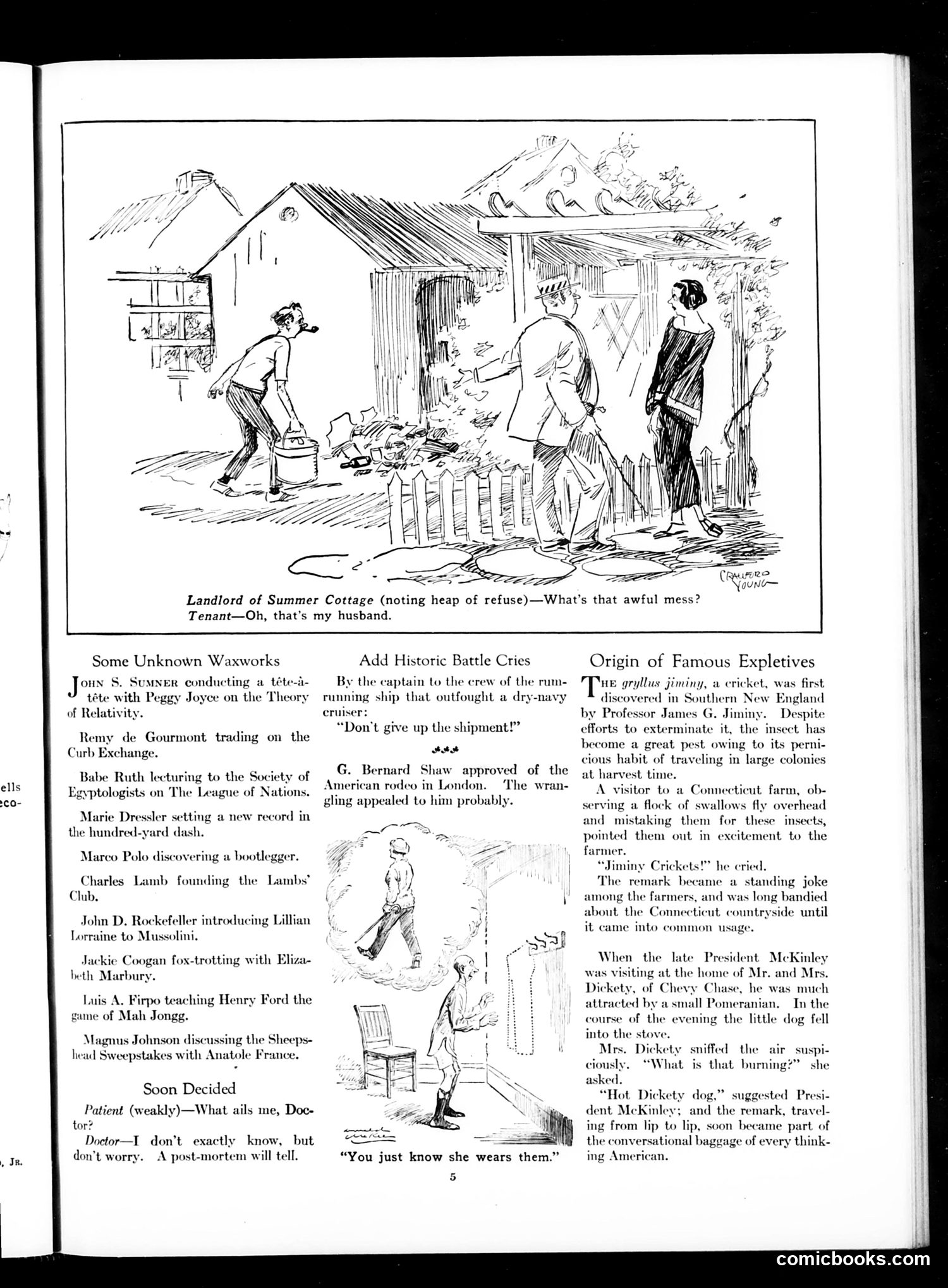
This page from Judge magazine contains several satirical sections mocking contemporary celebrities and absurd scenarios (circa 1920s, based on references): **Top Cartoon:** A landlord discovers refuse at a summer cottage. The tenant explains it's her husband—a joke about marital discord and slovenly husbands. **"Unknown Waxworks":** Absurdist humor imagining ridiculous scenarios: baseball star Babe Ruth lecturing Egyptologists about the League of Nations; bootlegger Marco Polo; actress Marie Dressler breaking sprint records. The joke is pairing famous people with completely inappropriate activities. **"Add Historic Battle Cries":** Parodies famous phrases. One invents "Don't give up the shipment!" for rum-runners (mocking Prohibition-era smuggling). **"Origin of Famous Expletives":** Humorous fake etymologies. "Jiminy Crickets!" supposedly originated from a Connecticut farmer mistaking swallows for pests. "Hot Dickey dog" allegedly came from President McKinley's dog falling in a stove—wordplay generating the exclamation. This is light, nonsensical satire typical of Judge's irreverent humor.
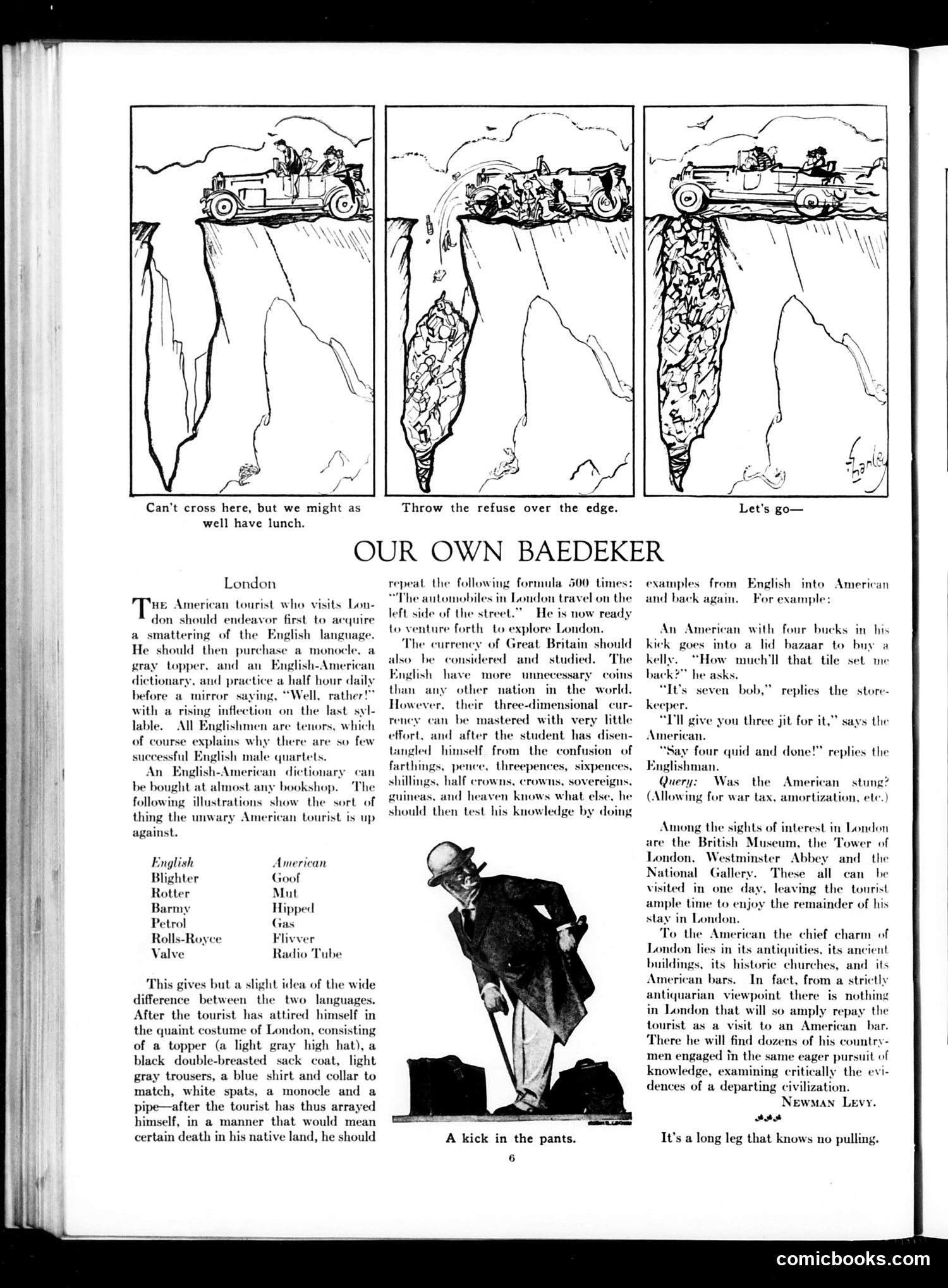
This satirical piece mocks American tourists visiting London in the early 20th century. The three-panel cartoon above shows tourists dumping garbage off a cliff while sightseeing—illustrating their obliviousness and bad manners abroad. The article parodies travel guides (like the famous Baedeker guides) by offering comedic "advice" to American visitors: learn English affectations (monocles, "Well, rather!"), master confusing British currency (farthings, sovereigns), and adopt ridiculous formal dress that would be "certain death" back home. The English-to-American dictionary jokes highlight cultural/linguistic gaps: "blighter" equals "goof," "petrol" means "gas," "Rolls-Royce" is a "flivver." The satirical exchange about purchasing items in British currency mocks Americans' inability to calculate unfamiliar money. The final irony suggests American tourists' main interest in London's "antiquities" is actually finding American bars to congregate in—missing genuine cultural experiences entirely. The satire targets American tourist insularity and superficiality.
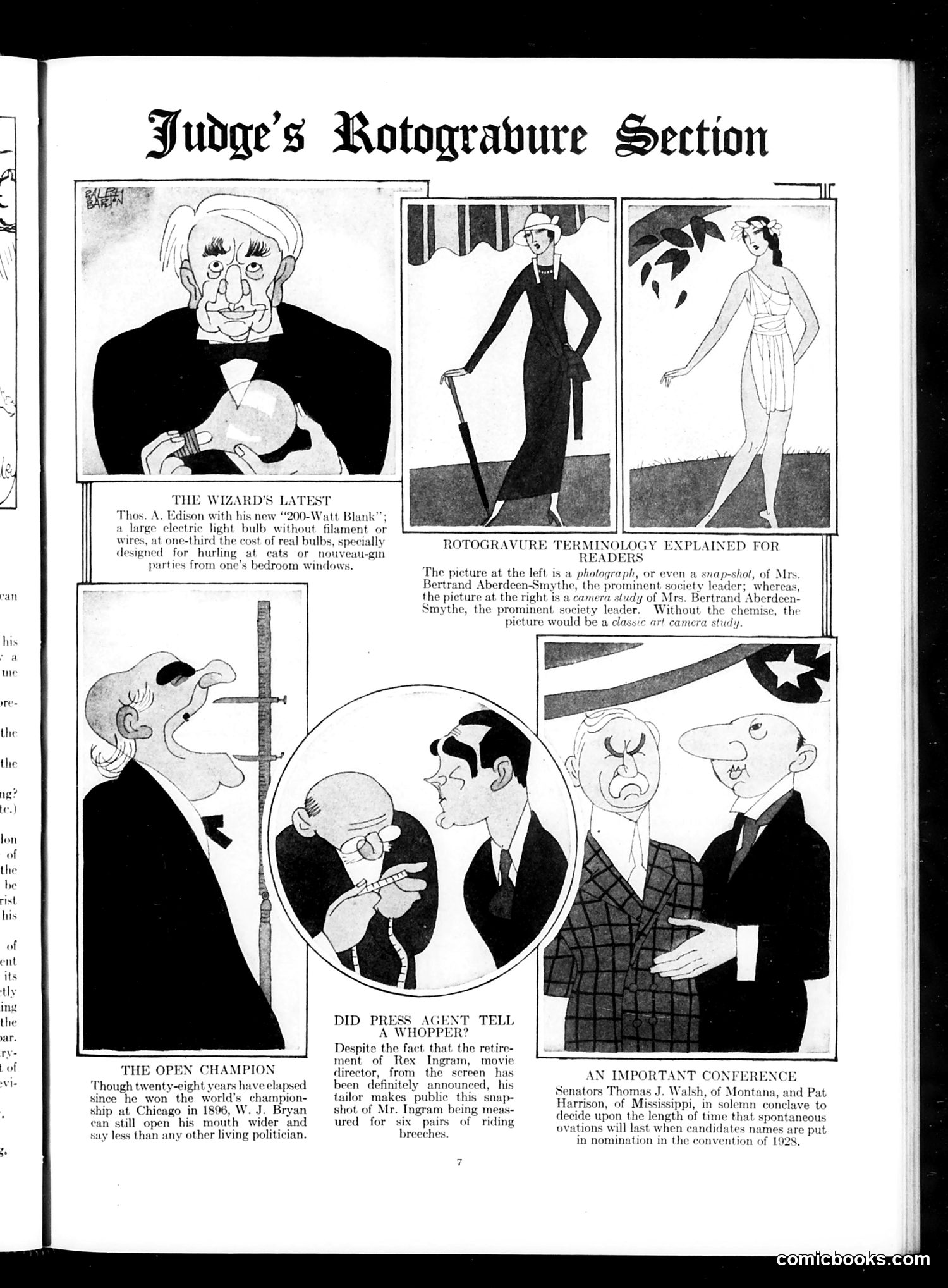
This satirical page mocks several targets: **"The Wizard's Latest"** ridicules Thomas Edison's invention of a filament-less light bulb by suggesting its only practical use is as a weapon to throw at cats or parties—absurd waste of the inventor's genius. **"Rotogravure Terminology"** parodies high-society photography by explaining the distinction between a "photograph" and "camera study" of the same woman (Mrs. Bertrand Aberdeen-Smythe), implying society magazines use pretentious language to disguise identical images. **"Did Press Agent Tell a Whopper?"** questions whether Rex Ingram's announced movie retirement is genuine, given his tailor's public announcement of measuring him for riding breeches—suggesting the actor isn't really leaving. **"The Open Champion"** cruelly caricatures an unnamed politician (W.J. Bryan, based on context) for his wide-open mouth, implying he's a loudmouth. **"An Important Conference"** satirizes senators obsessing over trivial convention logistics while claiming to conduct serious business.
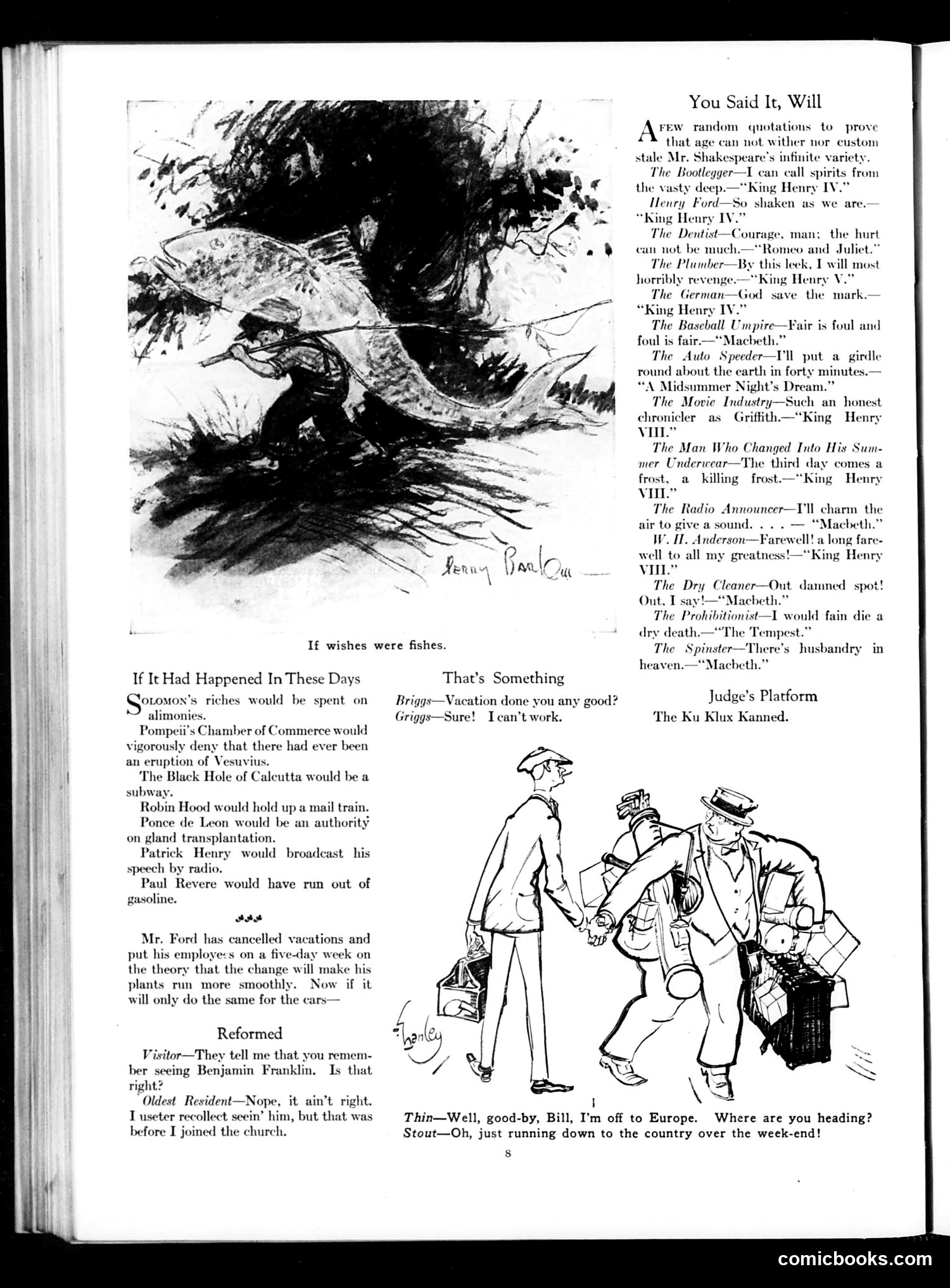
This page uses Shakespeare quotations to satirize contemporary (1920s) professions and social types. Each profession is matched with an apt Shakespearean line, creating humor through incongruity—for example, a bootlegger (during Prohibition) quotes "I can call spirits from the vasty deep," and a baseball umpire uses "Fair is foul and foul is fair." The lower sections include dated social commentary: "If It Had Happened In These Days" imagines historical events through modern corporate/consumer logic (Solomon spending on alimony, Pompeii's Chamber of Commerce denying eruptions). Henry Ford's five-day work week is satirized as potentially benefiting cars more than workers. The cartoon shows two men discussing weekend plans, with one departing for Europe while the other just goes to the countryside—mocking casual vacation references among the wealthy. The masthead "Judge's Platform: The Ku Klux Kanned" appears to be a separate editorial statement, likely opposing the KKK.
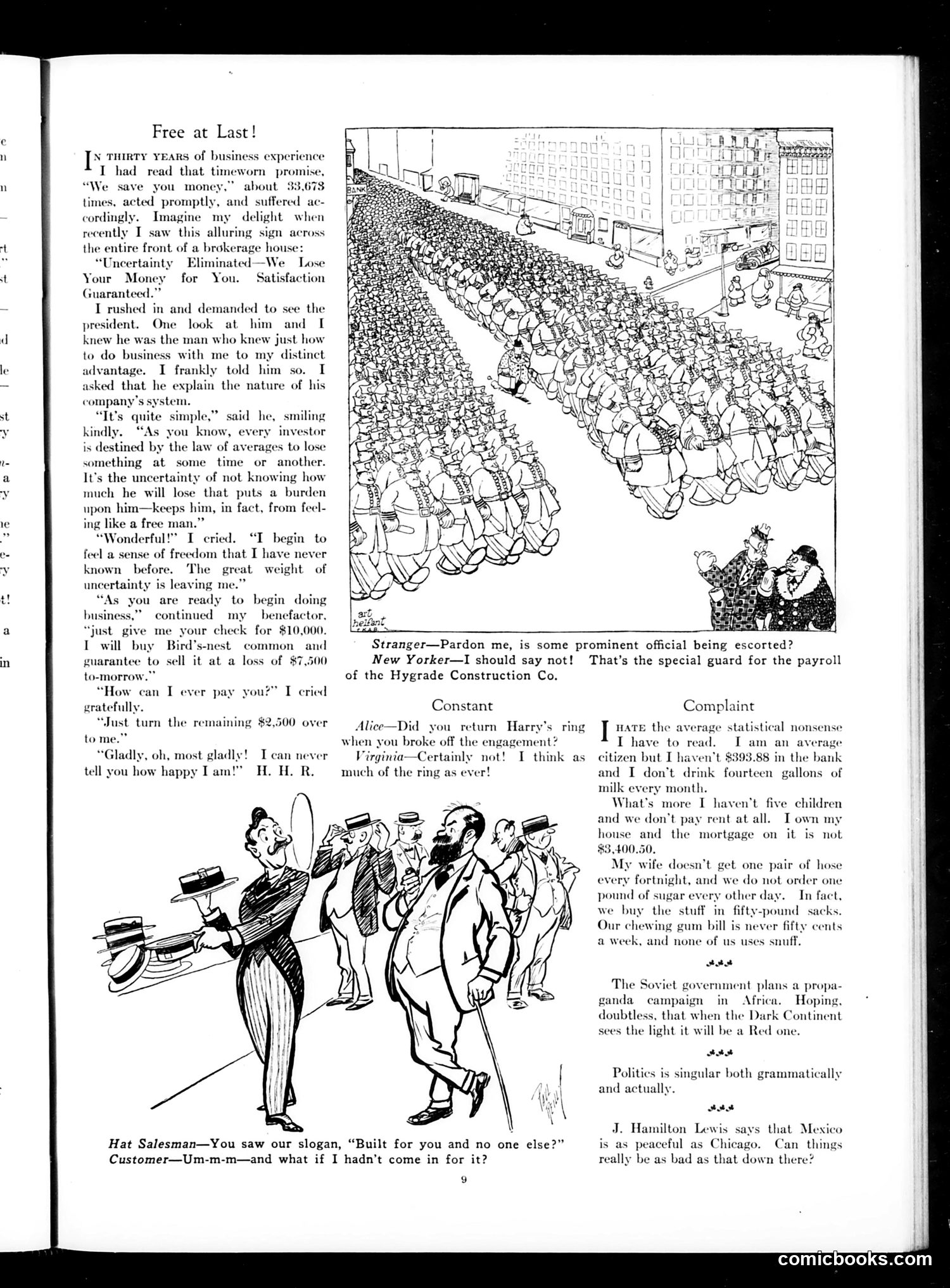
This page satirizes investment fraud and get-rich-quick schemes common in the 1920s. The main cartoon shows a naive businessman being swindled by a broker who promises to "eliminate uncertainty" by guaranteeing losses—then convinces him to hand over $10,000 to buy worthless stock ("Bird's-nest common") with assurances of selling it at a loss tomorrow. The joke: the victim feels "free" believing his anxiety about *not knowing* he'll lose money is worse than actually losing it. The accompanying small cartoons mock contemporary advertising ("built for you and no one else"), broken engagements, and faulty statistics about "average" Americans. The right column contains brief satirical commentary: complaints about misleading statistical claims, jokes about Soviet propaganda in Africa, and a jab at Mexico's stability compared to Chicago's crime. The satire targets both financial charlatans and the gullible public willing to surrender money to eliminate worry.
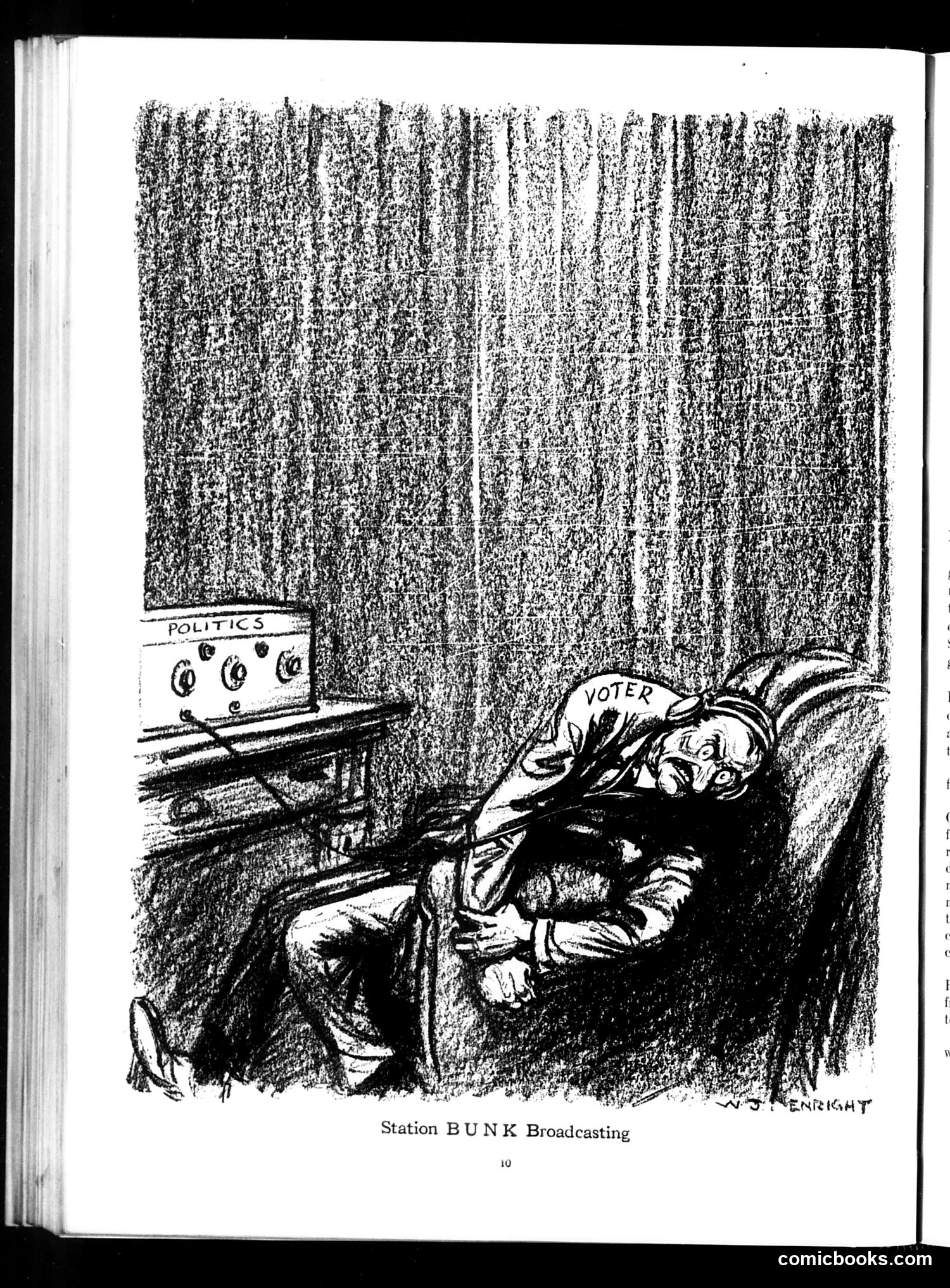
This political cartoon satirizes American political discourse during an election period. A figure labeled "VOTER" sits slumped in a chair, appearing exhausted or overwhelmed while listening to a radio broadcasting "POLITICS." The radio is labeled with dollar signs, suggesting money's influence in political messaging. The cartoon's title "Station BUNK Broadcasting" is a pun—"bunk" meaning nonsense or falsehoods. The artist (signed "Enright") critiques the quality of political communication reaching voters: rather than substantive debate, citizens receive empty rhetoric and financially-motivated propaganda. The voter's defeated posture suggests resignation to this degraded form of political engagement. This reflects early 20th-century concerns about mass media's role in politics.
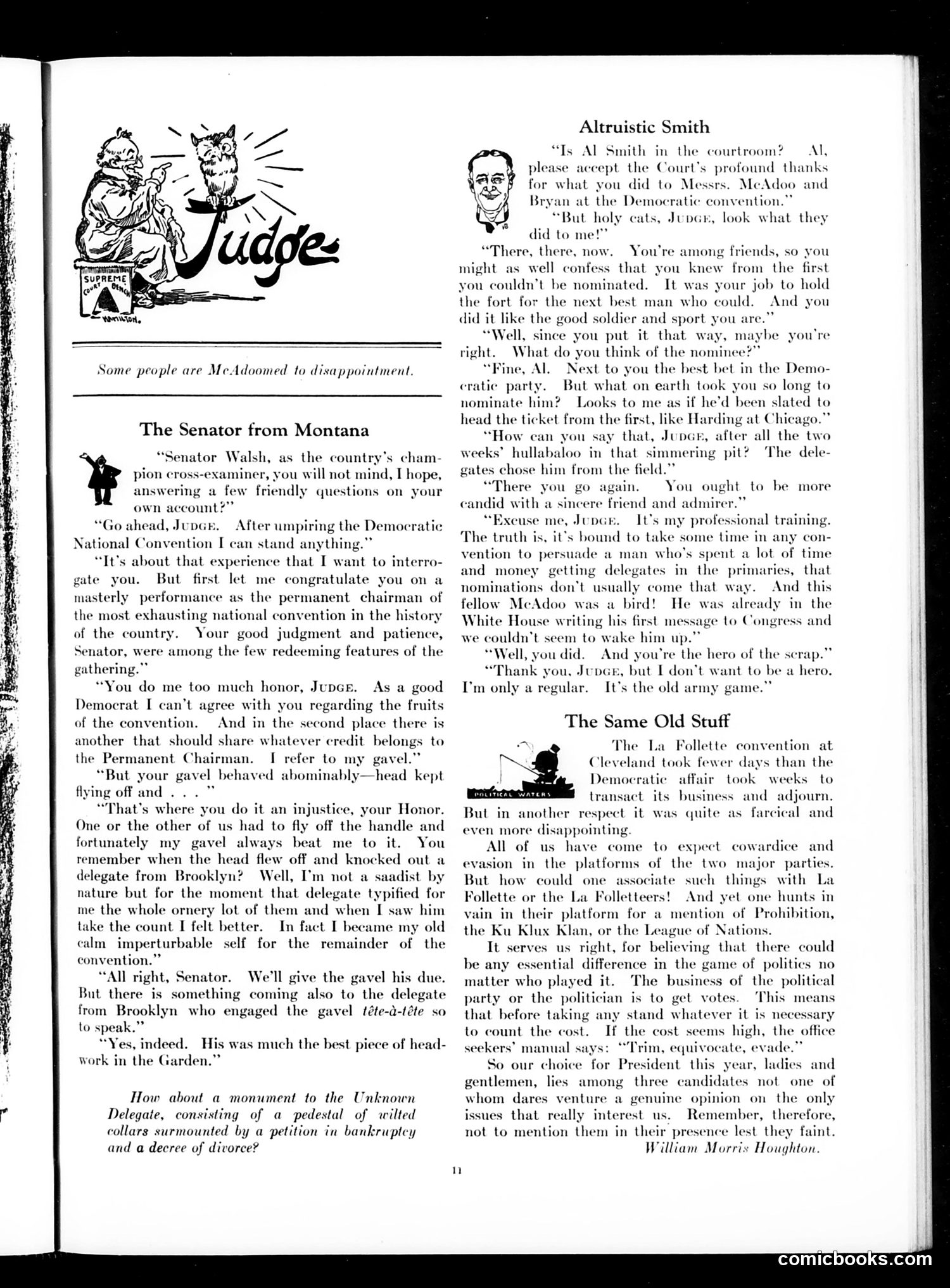
This page satirizes the 1924 Democratic National Convention through two dialogues between "Judge" (the magazine's personified voice) and political figures. **"The Senator from Montana"** mocks Senator Thomas Walsh, who chaired the contentious convention. The joke centers on his gavel literally flying off and hitting a delegate—Judge quips that a monument to this unnamed "Unknown Delegate" should feature "wilted collars surmounted by a petition in bankruptcy and a decree of divorce," implying the delegate's humiliating defeat. **"Altruistic Smith"** features Al Smith discussing his role in the convention. Smith hints that William McAdoo (a leading candidate) was essentially pre-selected despite the lengthy, chaotic nomination process. The satire criticizes the pretense of democratic deliberation when outcomes appear predetermined—a cynical view of convention politics. Both pieces mock the 1924 Democratic Convention as exhausting theater masking backroom deals, with the recurring joke that participants must maintain polite fiction about how nominees are actually chosen.
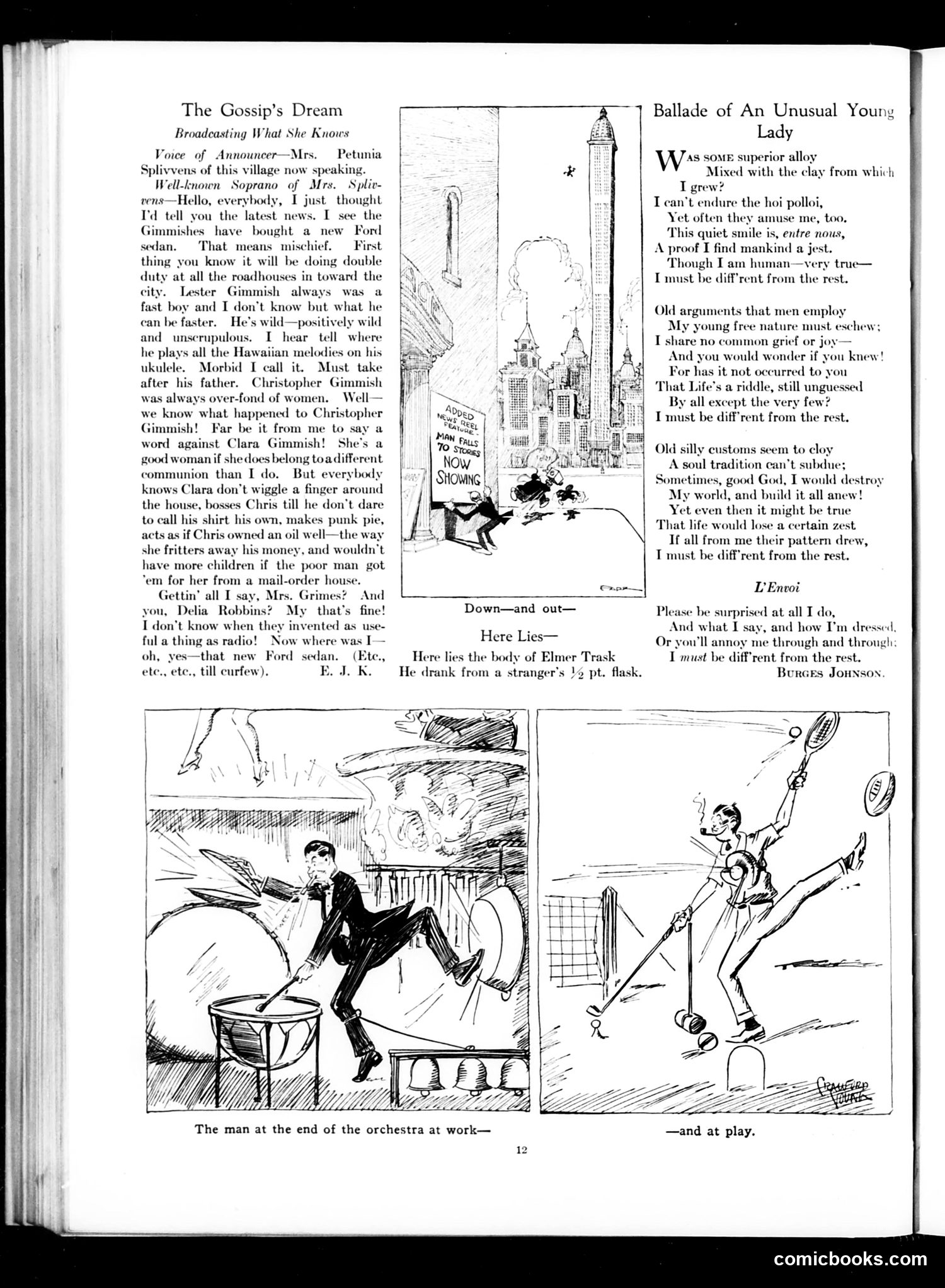
**"The Gossip's Dream"** satirizes radio broadcasting's amplification of small-town gossip. Mrs. Petunia Splivvens, a gossipy woman, uses radio (then a novel technology) to publicly broadcast malicious rumors about her neighbors—particularly the Gimmish family's car purchase and moral character. The satire targets how radio democratizes gossip-spreading: what was once whispered between neighbors now reaches mass audiences. The concluding dark joke about Elmer Trask's death from drinking "a stranger's flask" exemplifies the morbid rumors such broadcasting spreads. **"Ballade of An Unusual Young Lady"** mocks pretentious, self-consciously eccentric youth who affect superiority to "common" people while secretly craving their attention. The speaker claims profound difference from society yet anxiously demands recognition for that difference—exposing the performative contradiction in affected nonconformity. **"The Man at the End of the Orchestra"** contrasts dutiful work (conducting/playing) with carefree play (dancing/sports), likely commenting on work-life balance or youthful restlessness.
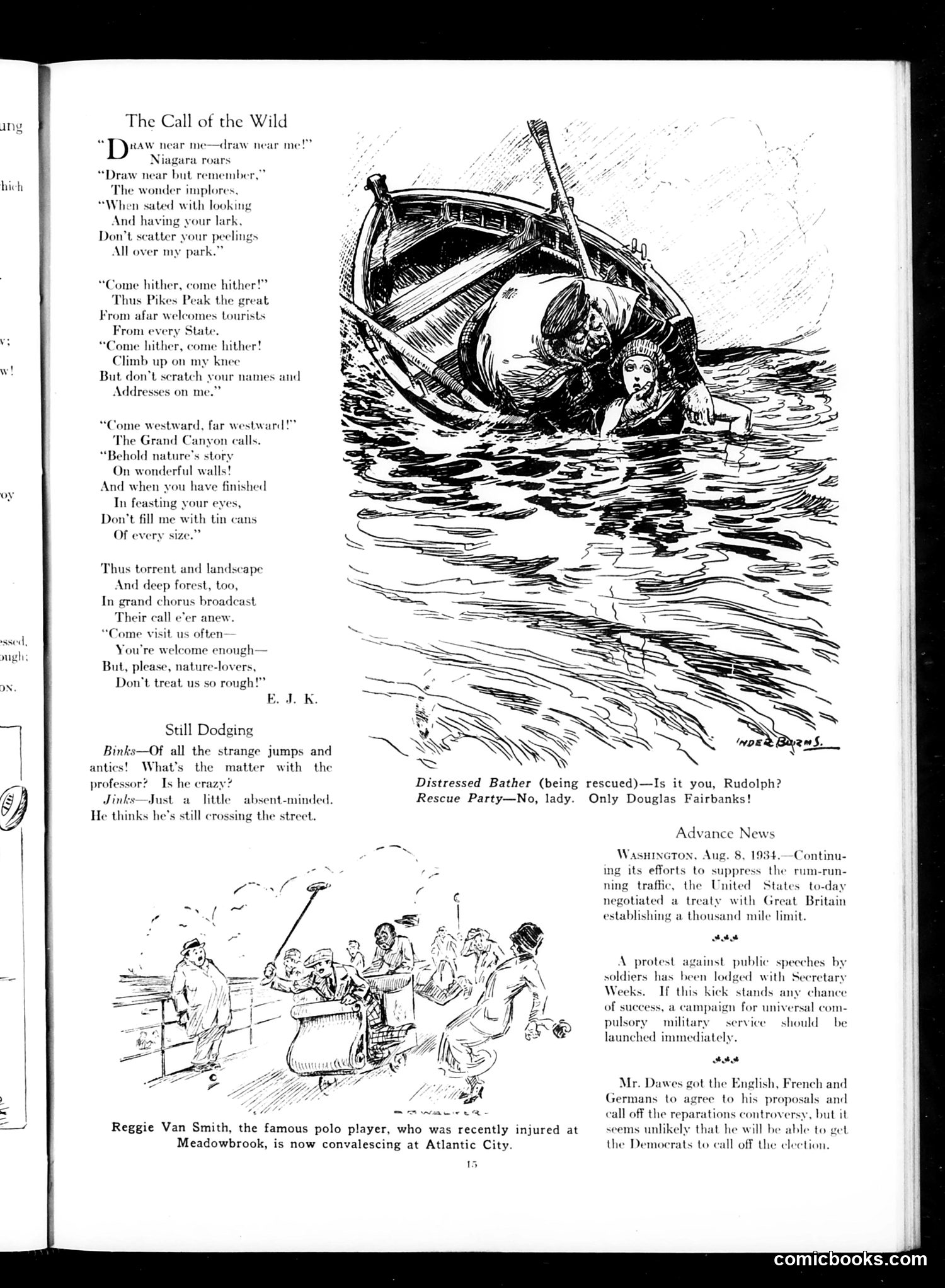
The main cartoon is a satirical poem about American natural landmarks (Niagara Falls, Pike's Peak, Grand Canyon) personified as hosts pleading with tourists to visit—but begging them not to litter or deface the sites. Each natural wonder issues the same complaint: visitors leave behind trash ("tin cans"), carved names and addresses, and peelings, treating the parks roughly despite their welcome. The satire targets American tourists' carelessness and disrespect for nature during an era of growing tourism and national park visitation. It's a gentle but pointed critique of how visitors treat America's natural treasures as dumping grounds rather than sacred spaces worthy of preservation. The smaller cartoon below ("Still Dodging") is an unrelated gag about an absent-minded professor who still thinks he's crossing the street.
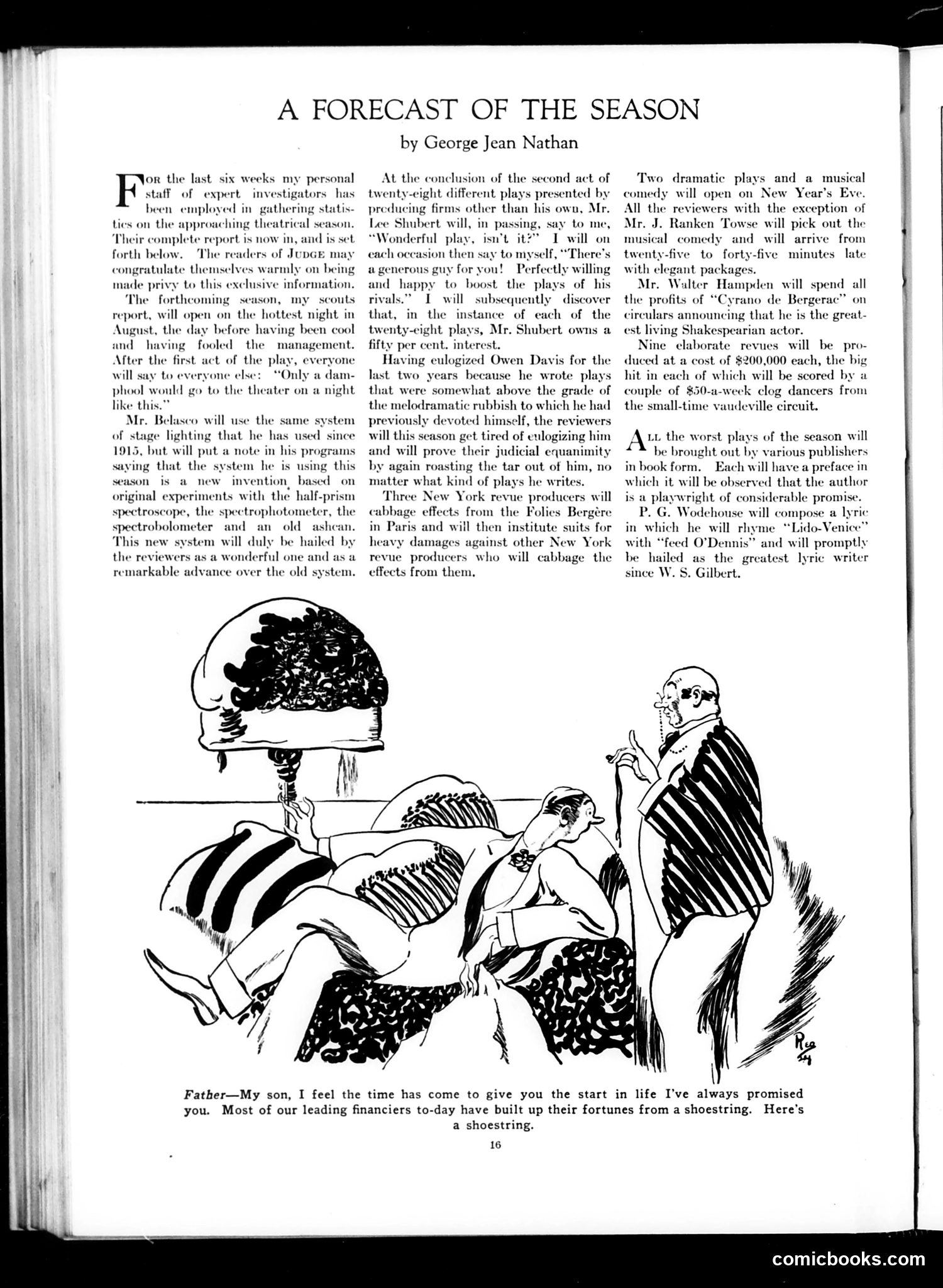
This is theatrical satire targeting 1920s Broadway figures and practices. Nathan—a prominent drama critic—makes insider predictions about the coming theater season: **Key targets:** - **David Belasco**: A famous producer mocked for recycling 1915 stage lighting while claiming it's a new invention using pseudo-scientific equipment ("half-prism spectroscope"). - **Lee Shubert**: Theater magnate who publicly praises rival productions while secretly owning fifty-percent stakes in them—exposing hypocritical generosity. - **Owen Davis**: Playwright previously praised for elevating above melodrama; Nathan predicts reviewers will tire of praise and savage his next work to appear "impartial." - **Broadway producers generally**: Accused of stealing set designs from Paris's Folies Bergère, then suing each other for the same theft. **The bottom cartoon** jokes that wealthy financiers built fortunes from "shoestrings"—a father gives his son a literal shoestring, mocking the cliché.
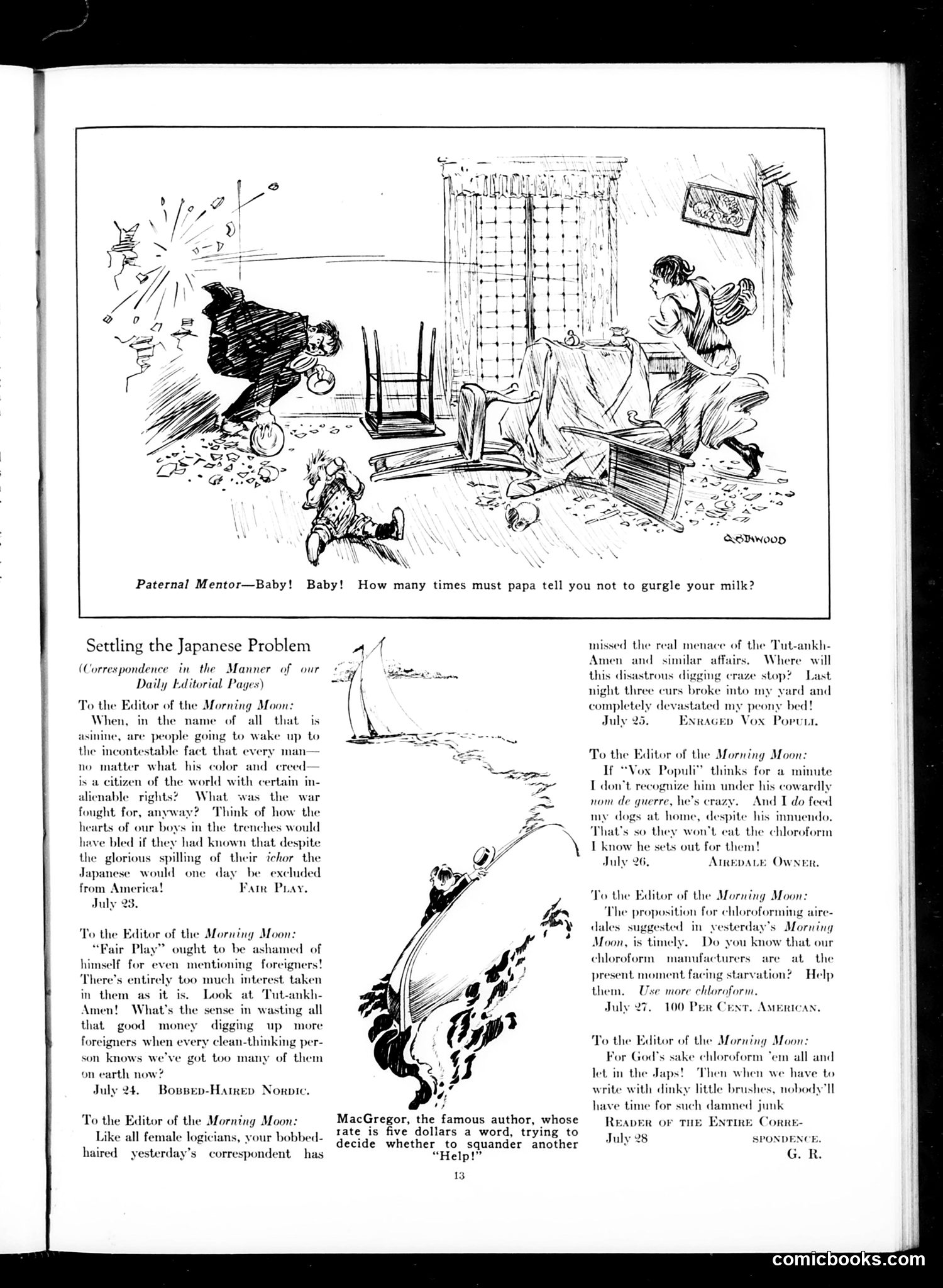
This page satirizes the absurdity of newspaper "letters to the editor" debates. The top cartoon shows chaotic domestic destruction while a parent scolds a baby—a visual metaphor for editorial pages spiraling into nonsense. The main satire follows: letters discuss Japanese immigration exclusion (a real 1920s political issue), but each response deflects to increasingly ridiculous grievances—Tutankhamun excavation, dogs eating peonies, chloroforming Airedales. The final letter suggests chloroforming "all" (presumably the dogs or Americans) to allow Japanese immigration—pure logical absurdity. The joke: editorial pages attract cranks whose pet causes overshadow serious debate. Each writer claims the previous correspondent misses the "real" issue, spiraling into incoherent contradiction. By the end, the Japanese Problem—initially framed as a serious policy matter—becomes a punchline lost in petty grievance theater. Judge mocks both public discourse and reader letters' tendency toward distraction and hysteria.
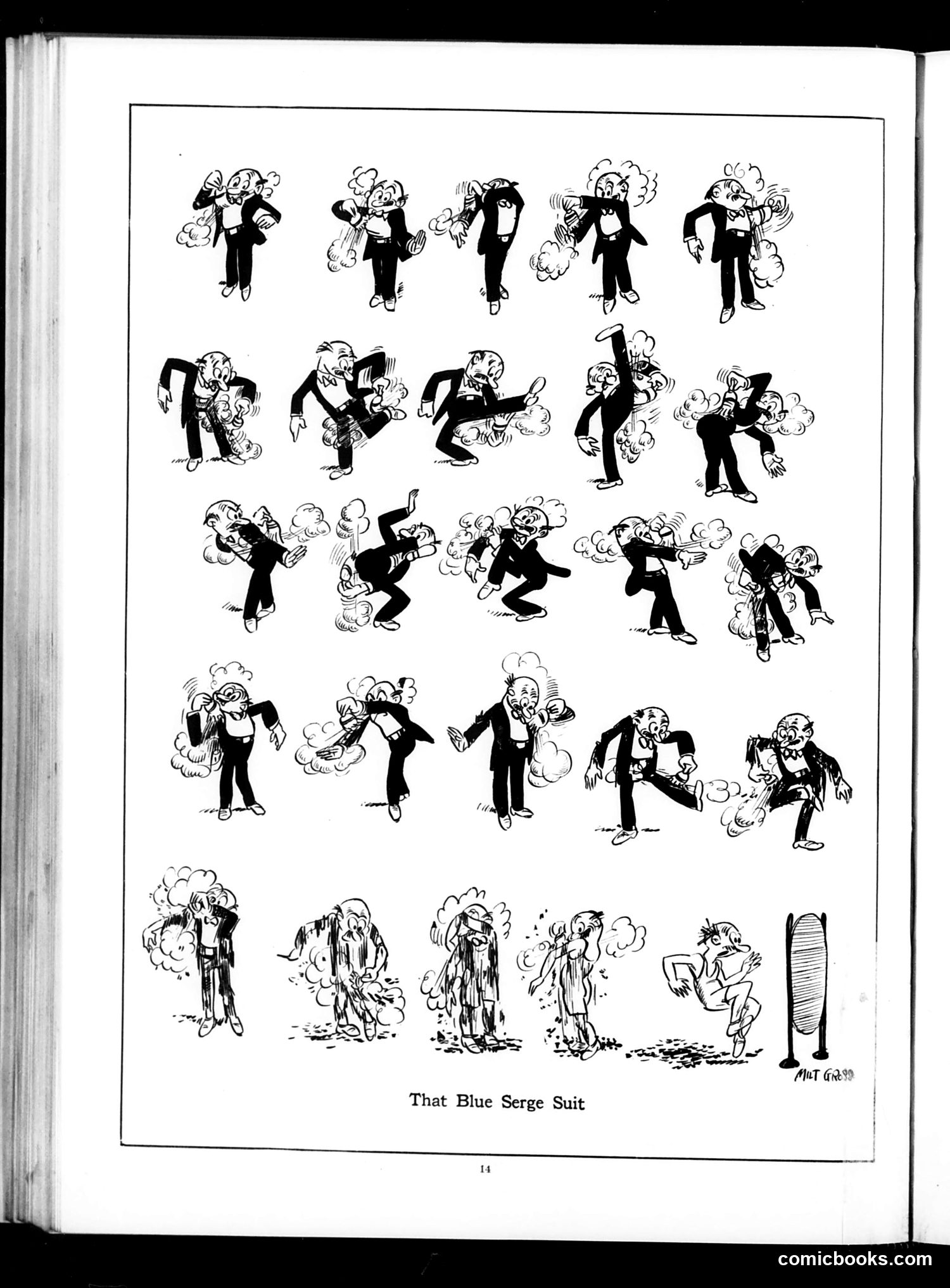
This cartoon depicts a man in a dark suit experiencing progressive deterioration and comedic mishaps across multiple panels. The figure goes from composed to increasingly disheveled—his suit tears, he's surrounded by explosive clouds (suggesting accidents or misfortune), and by the final panels he's nearly destroyed, reduced to a tattered state. The satire likely mocks either: 1. The poor quality/durability of cheap "blue serge" suits (a common working-class garment) 2. Bad luck or incompetence of the wearer 3. Possibly a commentary on a specific public figure or trend The exaggerated visual gags—explosions, tears, physical deterioration—are typical Judge magazine humor. Without additional context about the publication date, the specific target remains unclear.
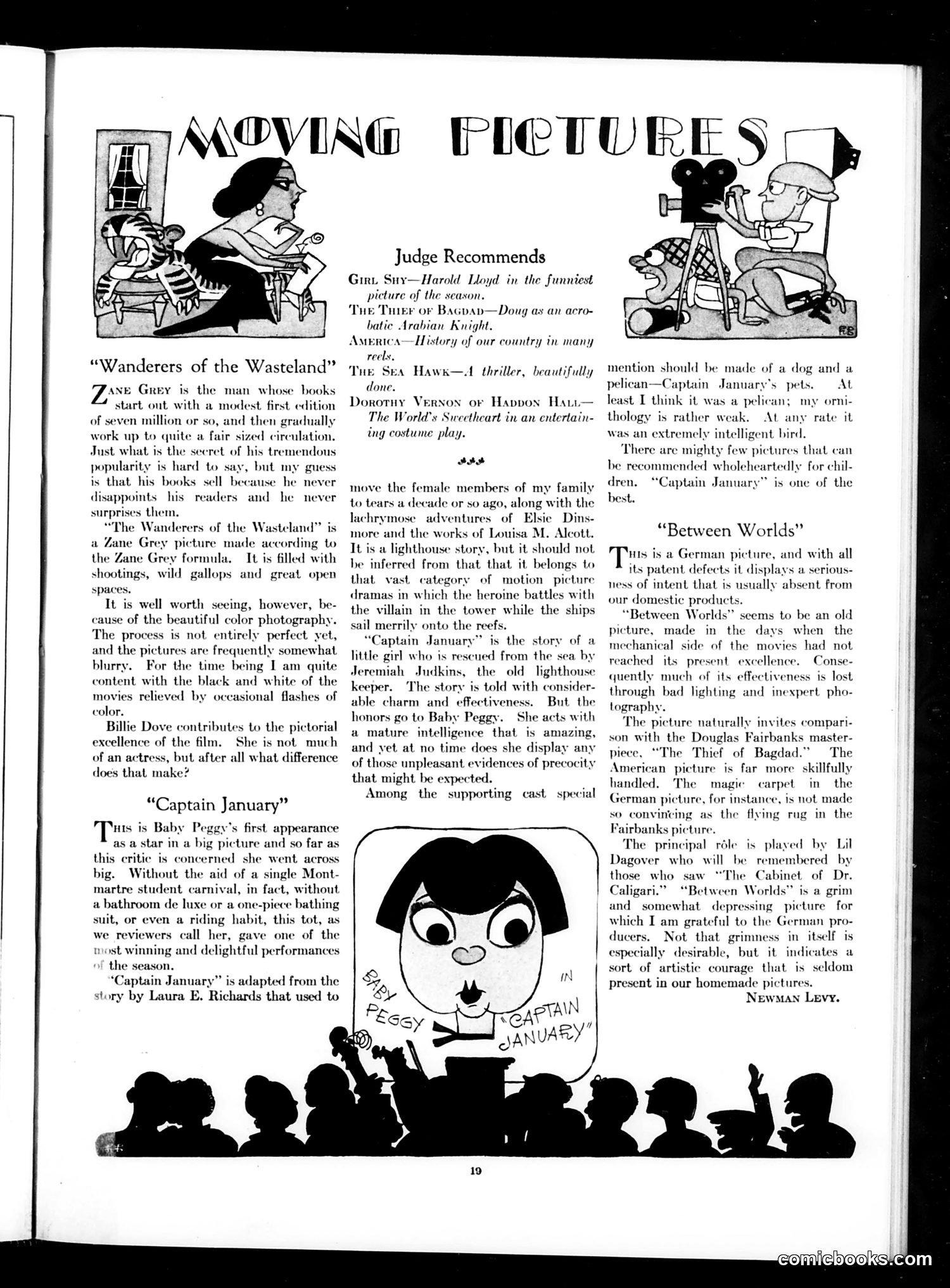
This page contains film reviews from Judge magazine's "Moving Pictures" column. The critic recommends several 1920s films: **"Wanderers of the Wasteland"** — A Zane Grey Western adaptation praised for its early color photography (though noted as somewhat blurry), featuring actress Billie Dove. **"Captain January"** — Baby Peggy's starring debut, adapted from a sentimental 19th-century story about a girl rescued by a lighthouse keeper. The reviewer praises her natural, mature performance without affected "precocity." **"Between Worlds"** — A German film that, despite technical limitations (poor lighting, outdated cinematography), displays serious artistic intent—contrasted unfavorably with American pictures' tendency toward spectacle over substance. The reviewer compares it disadvantageously to Douglas Fairbanks' "Thief of Bagdad." The column also includes Judge's brief "Judge Recommends" section listing other films with comedians Harold Lloyd and Douglas Fairbanks. The satire reflects period attitudes valuing sincere storytelling over technical showiness.
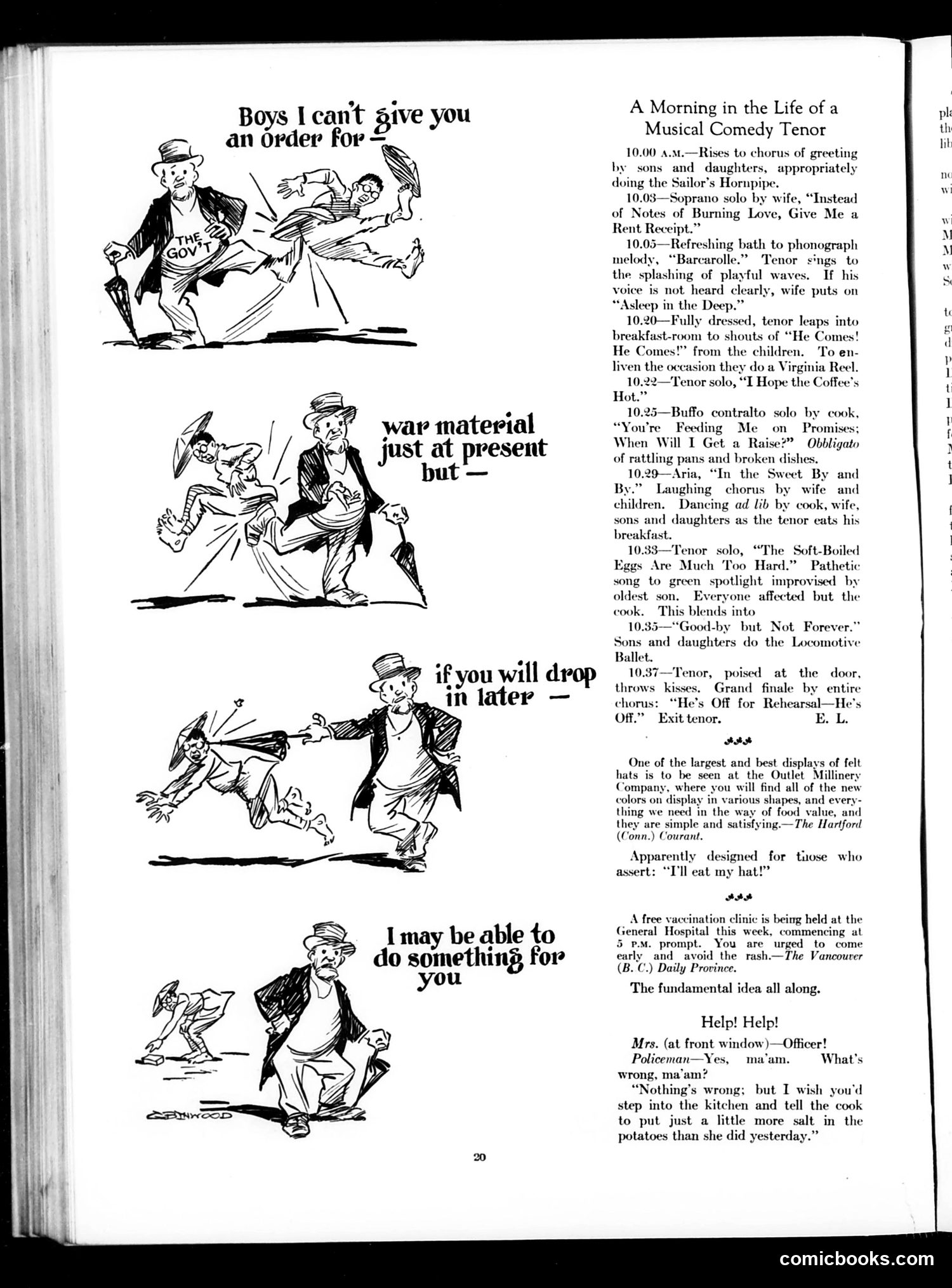
This satirical cartoon mocks wartime rationing and shortages during World War I. The left side shows a government official ("The Gov.") unable to fulfill requests for basic materials—depicted as literally juggling or struggling with supply demands from civilians represented as energetic figures. The right side parodies a musical comedy tenor's morning routine, presented as an elaborate operatic production. This likely satirizes both the frivolous entertainment industry during wartime and the absurdity of maintaining luxury lifestyles when resources are scarce. The overall message: while citizens face real material shortages and rationing restrictions, entertainers and the privileged continue living lavishly. The "fundamental idea all along" suggests ironic commentary on wartime priorities—the government can't provide essentials but manages to keep theatrical productions running. The page also includes period-appropriate advertisements and a humorous vignette about a housewife requesting the policeman tell the cook to add more salt—underscoring domestic frustrations during rationing.
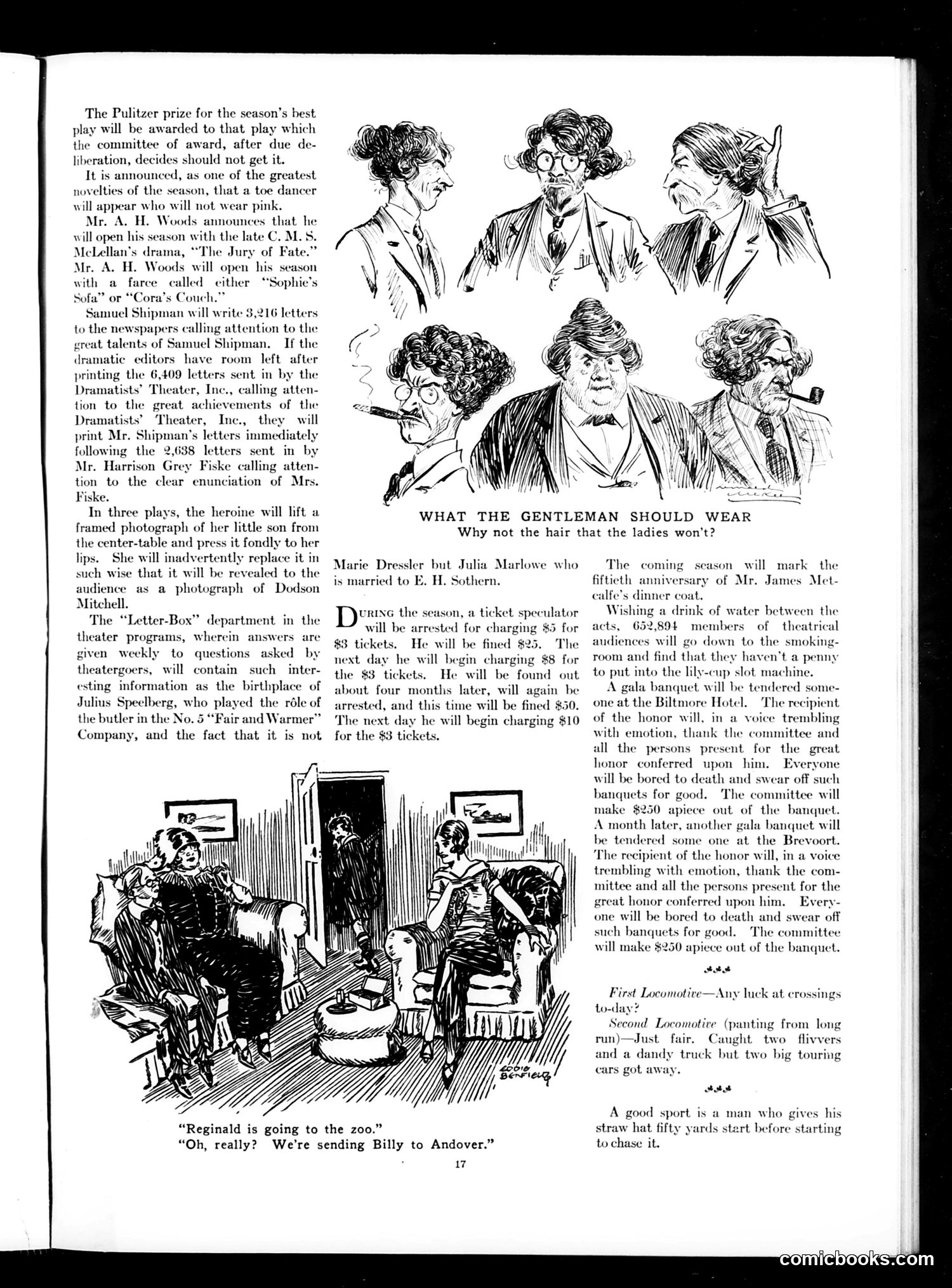
This page satirizes theatrical world pretensions and absurdities of the era. The top section mocks: **Theater Awards & Criticism**: The Pulitzer Prize joke suggests the committee deliberately avoids rewarding deserving plays—a jab at institutional hypocrisy. **Promotional Excess**: Multiple entries ridicule theaters' aggressive marketing, particularly Samuel Shipman and the Dramatists' Theater flooding newspapers with self-promotion letters—thousands of them—rendering the publicity meaningless through sheer volume. **Melodramatic Clichés**: The heroine photographically fondling her son's picture is mocked as overused theatrical sentiment; the joke about accidentally revealing it's "Dodson Mitchell" suggests even these props are fabricated props. **Ticket Scalping**: A speculator arrested for charging $5 markup is fined $25, then immediately resumes at $8, gets caught again, fined $50, then charges $10—satirizing the futility of enforcement against determined profiteering. The cartoon (lower left) depicts theater patrons gossiping: "Reginald is going to the zoo... We're sending Billy to Andover"—mocking upper-class theater audiences' pretentious small talk.
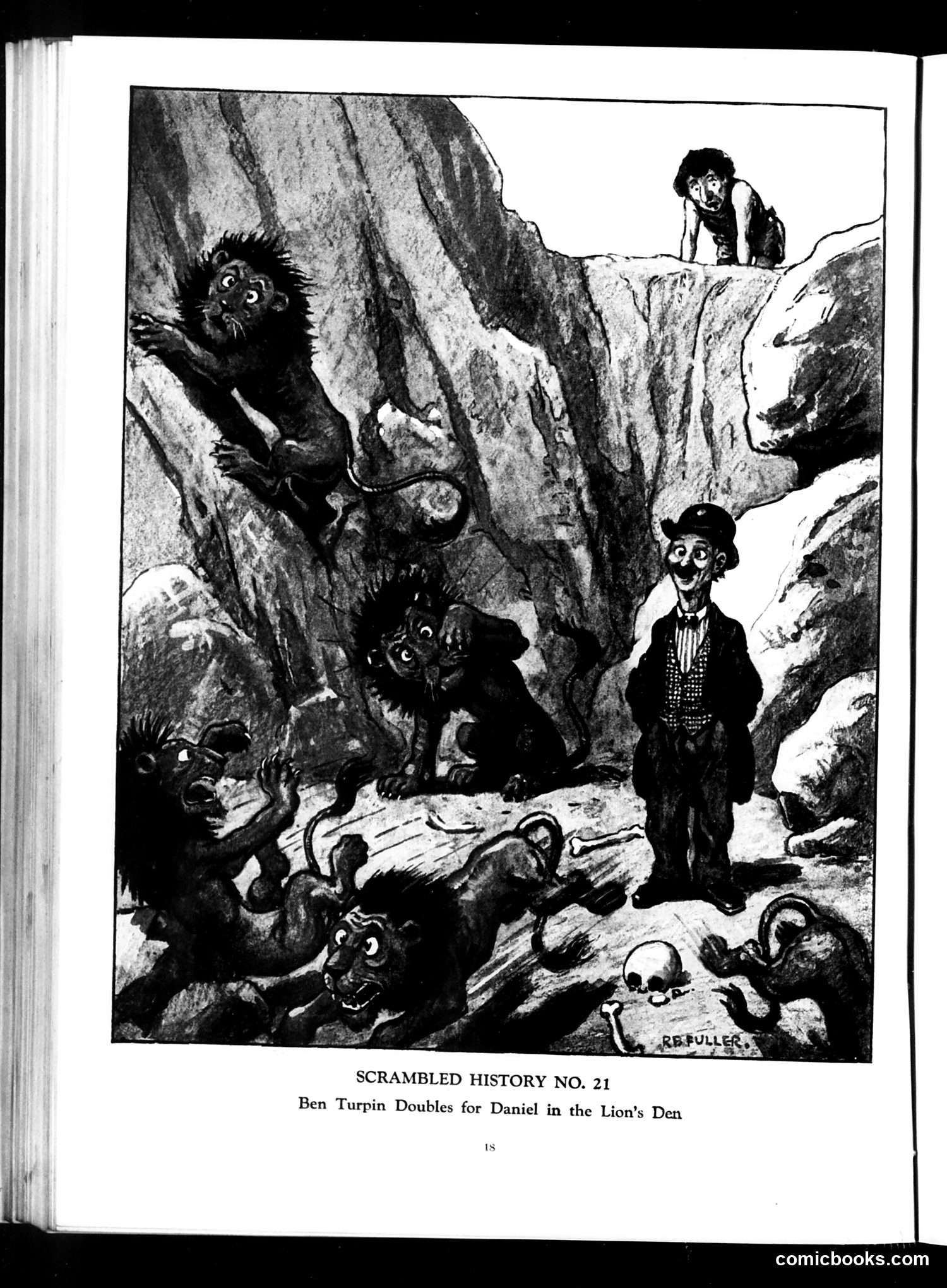
This is a humorous illustration from Judge magazine's "Scrambled History" series, which reimagined historical and biblical events with contemporary twists. The caption references Ben Turpin, a famous silent-film comedian known for his cross-eyed appearance and slapstick roles. The cartoon depicts the biblical story of Daniel in the lion's den, but replaces Daniel with Ben Turpin as the "double" (stand-in). The image shows multiple lions in a rocky cavern with two men—one appearing bewildered in period costume. The joke plays on Turpin's comedic persona: his exaggerated facial expressions would humorously contrast with the serious biblical narrative. The "Scrambled History" format was satirical entertainment that combined popular culture figures with historical/religious stories for comedic effect.
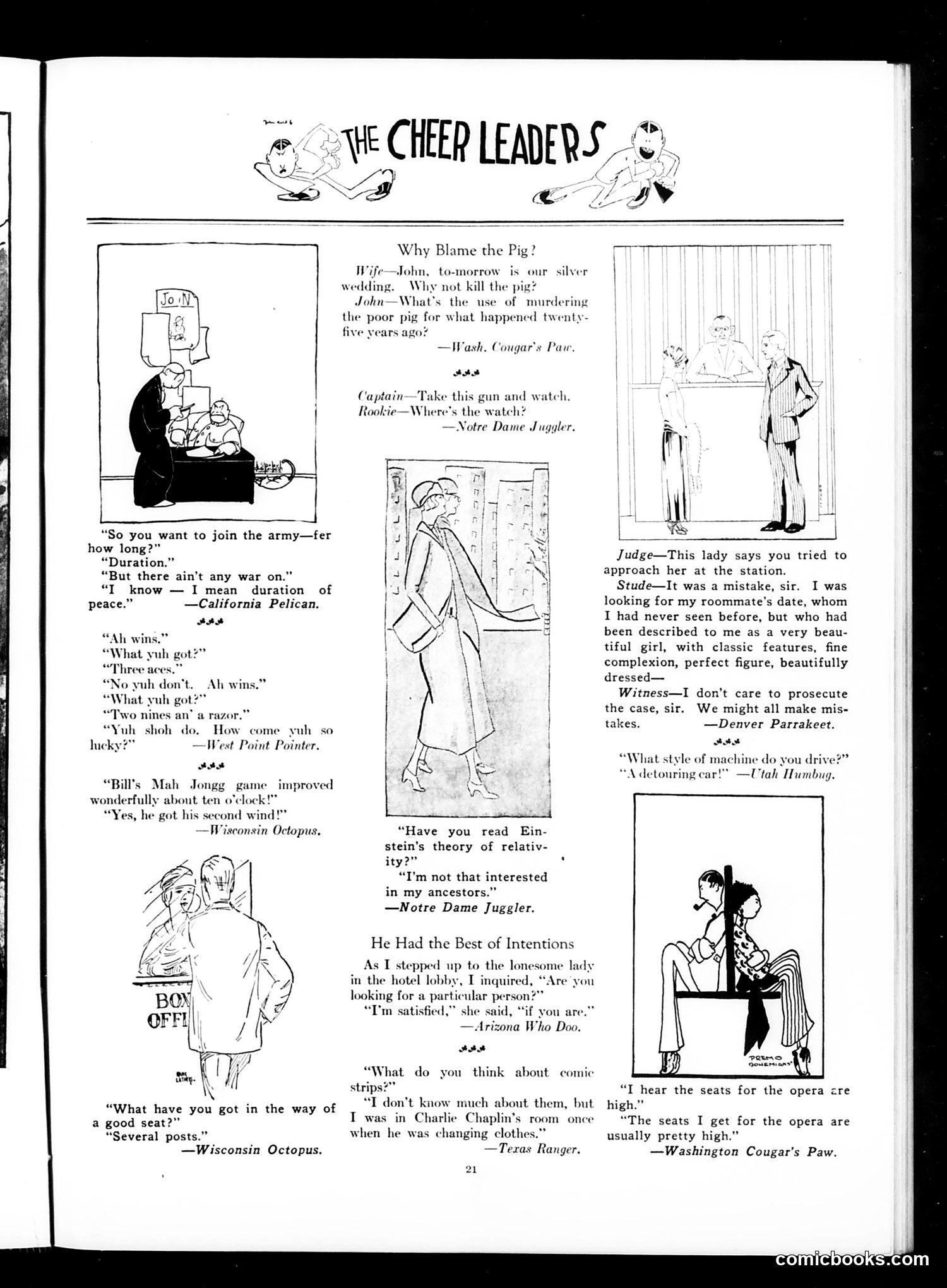
This is a collection of brief jokes and comic vignettes from college humor magazines (indicated by credits like "California Pelican," "Notre Dame Juggler," "Wisconsin Octopus"). The page satirizes early 20th-century social situations and wordplay: **Key themes:** - **Military humor**: A joke about joining the army "for duration"—the recruit means peace will last, not war, suggesting pre-WWI uncertainty - **Racial dialect humor**: Cards games featuring stereotyped African-American speech patterns (standard for the era, now offensive) - **Social mishaps**: A college student mistakenly approaches a woman at a station, thinking she's his roommate's date - **Charlie Chaplin reference**: Contemporary celebrity culture - **Wordplay**: Puns on "watch" (timepiece vs. surveillance), "high" (expensive vs. intoxicated), "duration" The "Cheer Leaders" title frames these as amusing collegiate anecdotes. The humor relies on miscommunication, social awkwardness, and period-specific references rather than narrative complexity.
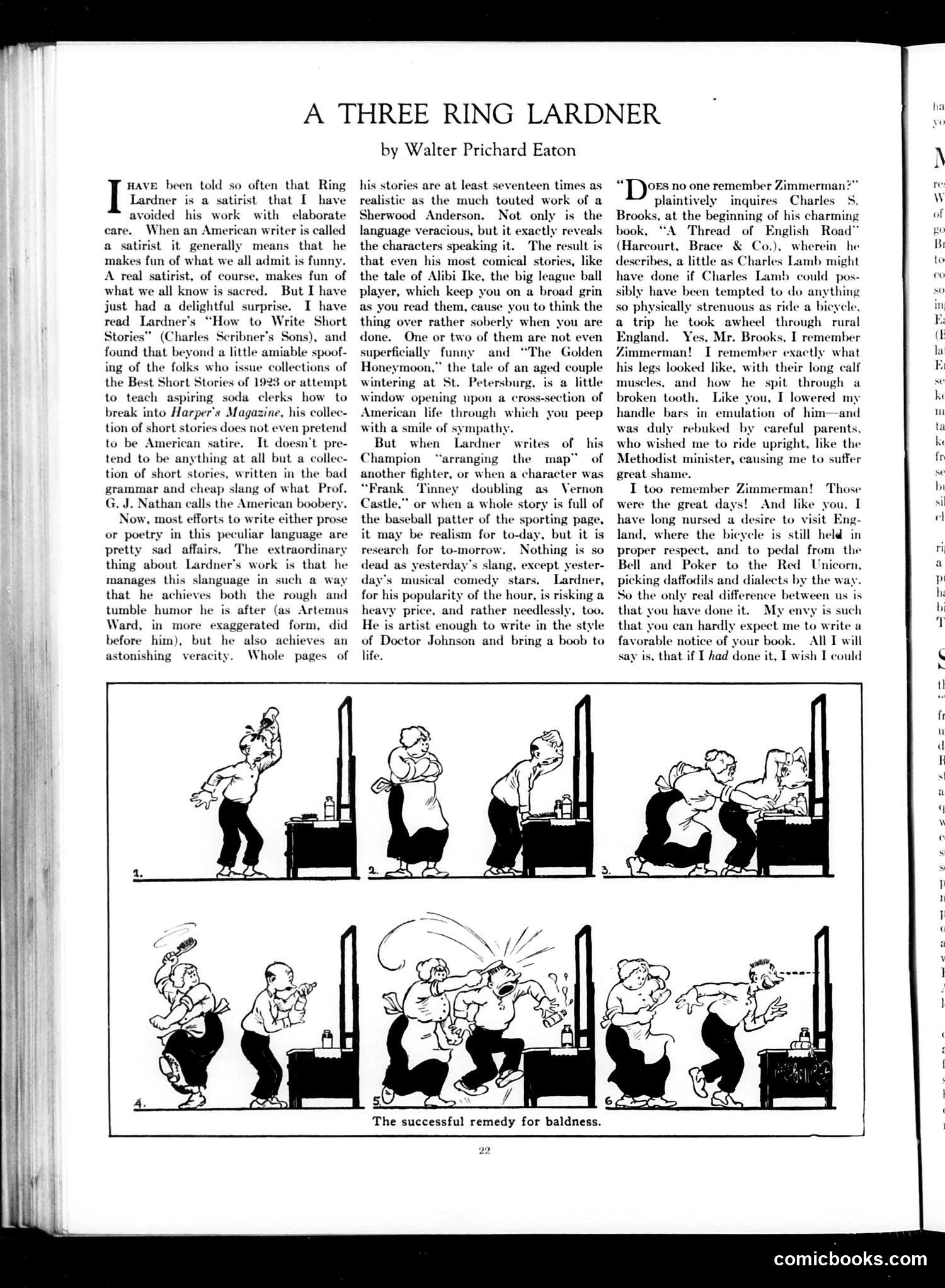
This page contains two book reviews by Walter Prichard Eaton in *Judge* magazine. **On Ring Lardner**: Eaton defends author Ring Lardner against the charge of being merely a satirist. He argues Lardner's short stories achieve genuine realism through authentic American vernacular and slang, revealing character truthfully—even in comic tales. However, Eaton warns that Lardner risks obsolescence by writing in contemporary slang ("yesterday's slang") that will date quickly, unlike timeless prose styles. **On Charles S. Brooks**: Eaton reviews Brooks's travel memoir about cycling through rural England. He nostalgically recalls "Zimmerman" (likely cyclist Artur Zimmerman, a famous 1880s racer), sharing Brooks's fond memories of bicycle culture and the sport's respectability in England versus America. The **cartoon below** titled "The successful remedy for baldness" appears to be slapstick humor about a bald man attempting various absurd hair-restoration methods at a mirror, escalating to comedic violence—typical *Judge* visual humor of the era.
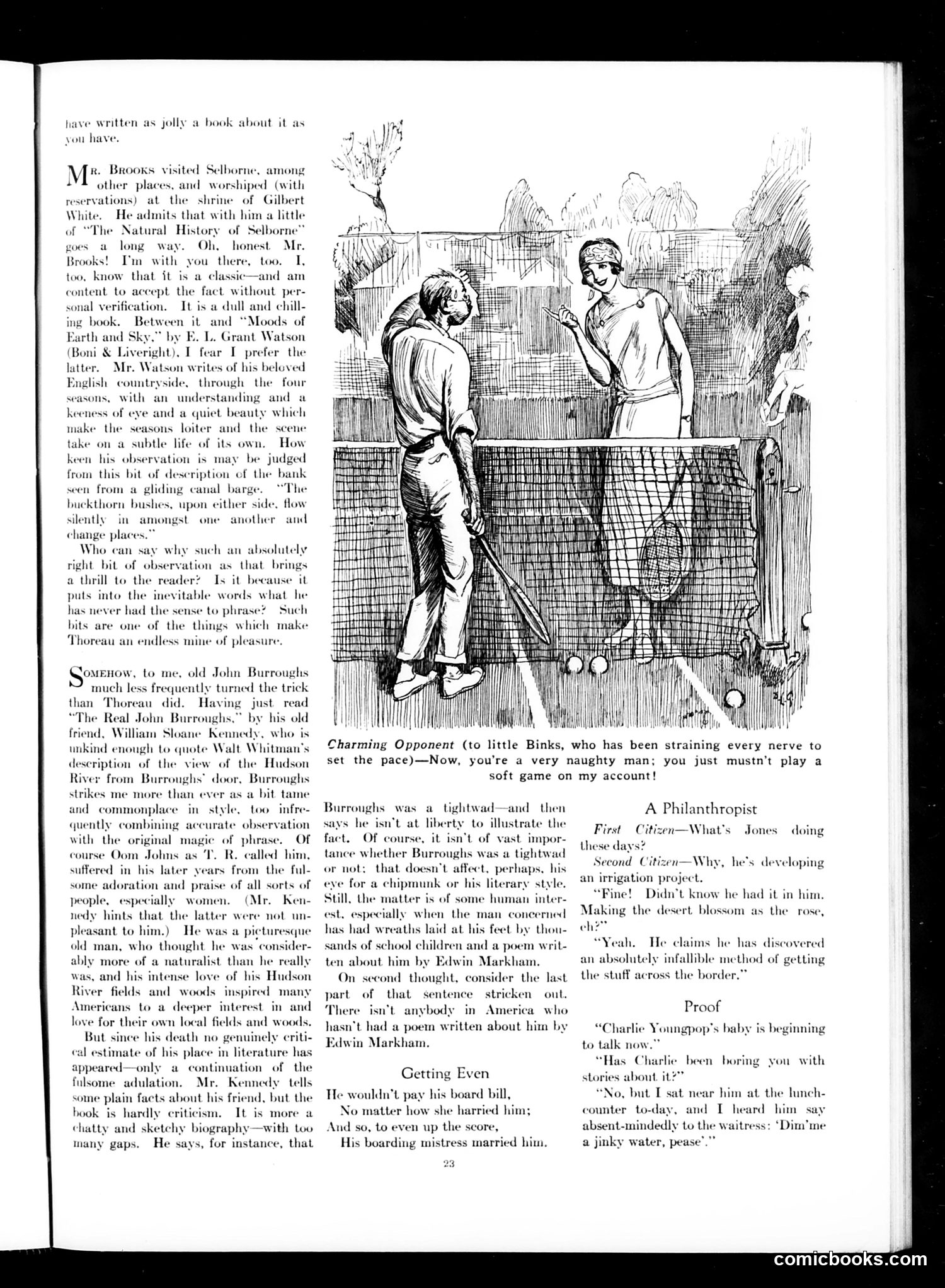
This page contains literary criticism and humorous verse from Judge magazine. The main illustrated cartoon depicts a tennis match between two players—"Charming Opponent" and "little Binks"—with the opponent chiding Binks for playing too cautiously ("you just mustn't play a soft game on my account!"). The satire suggests a critique of false gentility or insincere courtesy in competition. The text discusses naturalist John Burroughs unfavorably, contrasting him with Henry David Thoreau and E.L. Grant Watson. The author criticizes Burroughs as "tame and commonplace," overpraised despite mediocre talent. A minor verse titled "Getting Even" jokes about a woman marrying her deadbeat boarder to settle accounts. The page reflects early-20th-century American literary discourse and period attitudes toward nature writing.
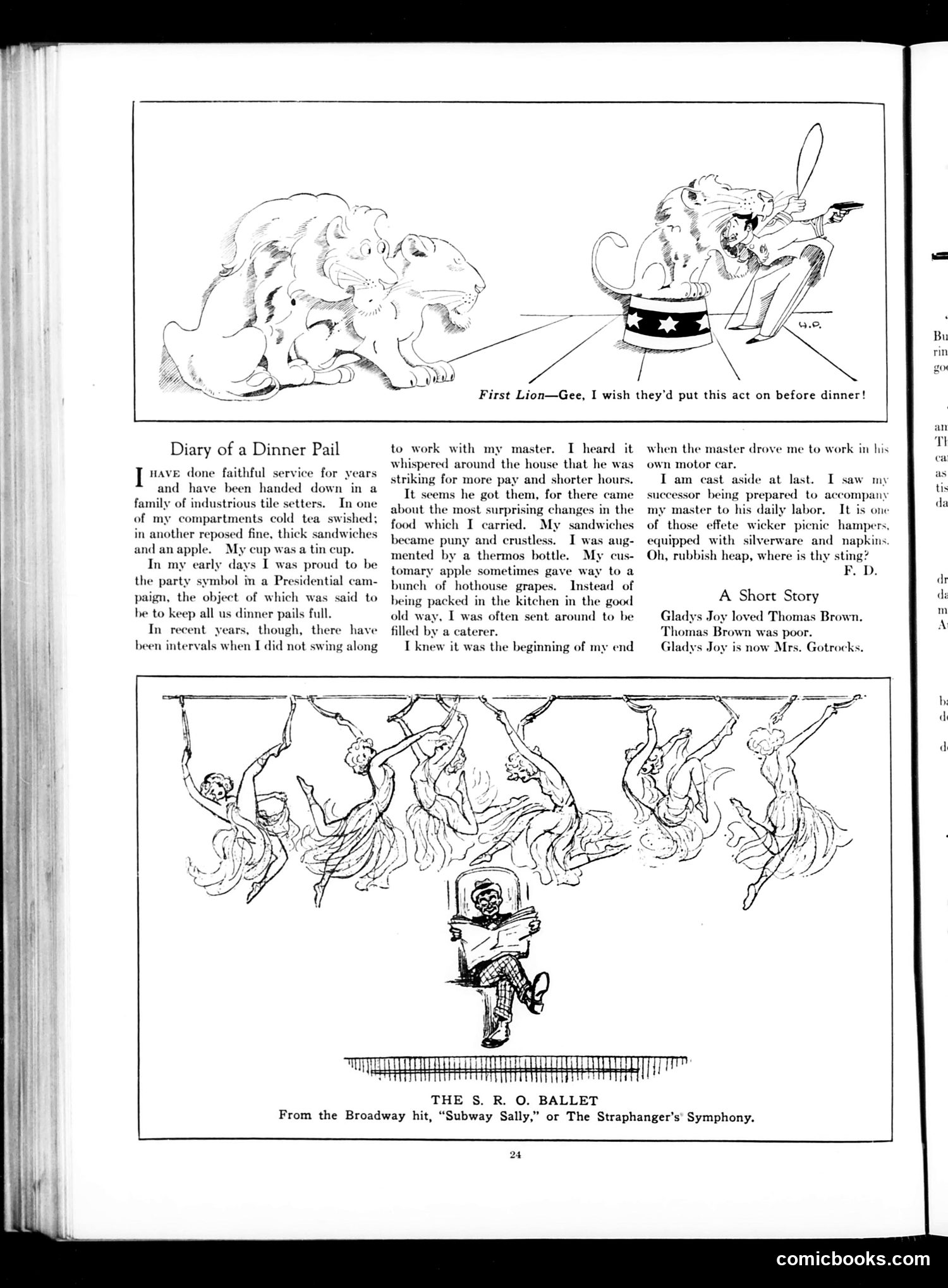
The top cartoon mocks Theodore Roosevelt's 1900 presidential campaign slogan—the "Full Dinner Pail"—which promised workers prosperity. The dinner pail itself narrates how it once symbolized working-class hope but is now obsolete. The satire's point: The worker's conditions have inverted. Rather than remaining a steadfast symbol of full employment, the pail documents how strikes and labor demands (longer hours, better pay) *ironically* improved the worker's life so much that he no longer needs it. He now drives a motor car and carries fancy wicker picnic hampers with silverware instead. This is bitter commentary on labor victories—Judge (a conservative publication) suggests that worker gains have made them "soft" and bourgeois, abandoning the rugged dignity of the honest dinner pail. The lower cartoon, "The S.R.O. Ballet," appears unrelated satirical theater commentary, likely mocking exaggerated dance movements.
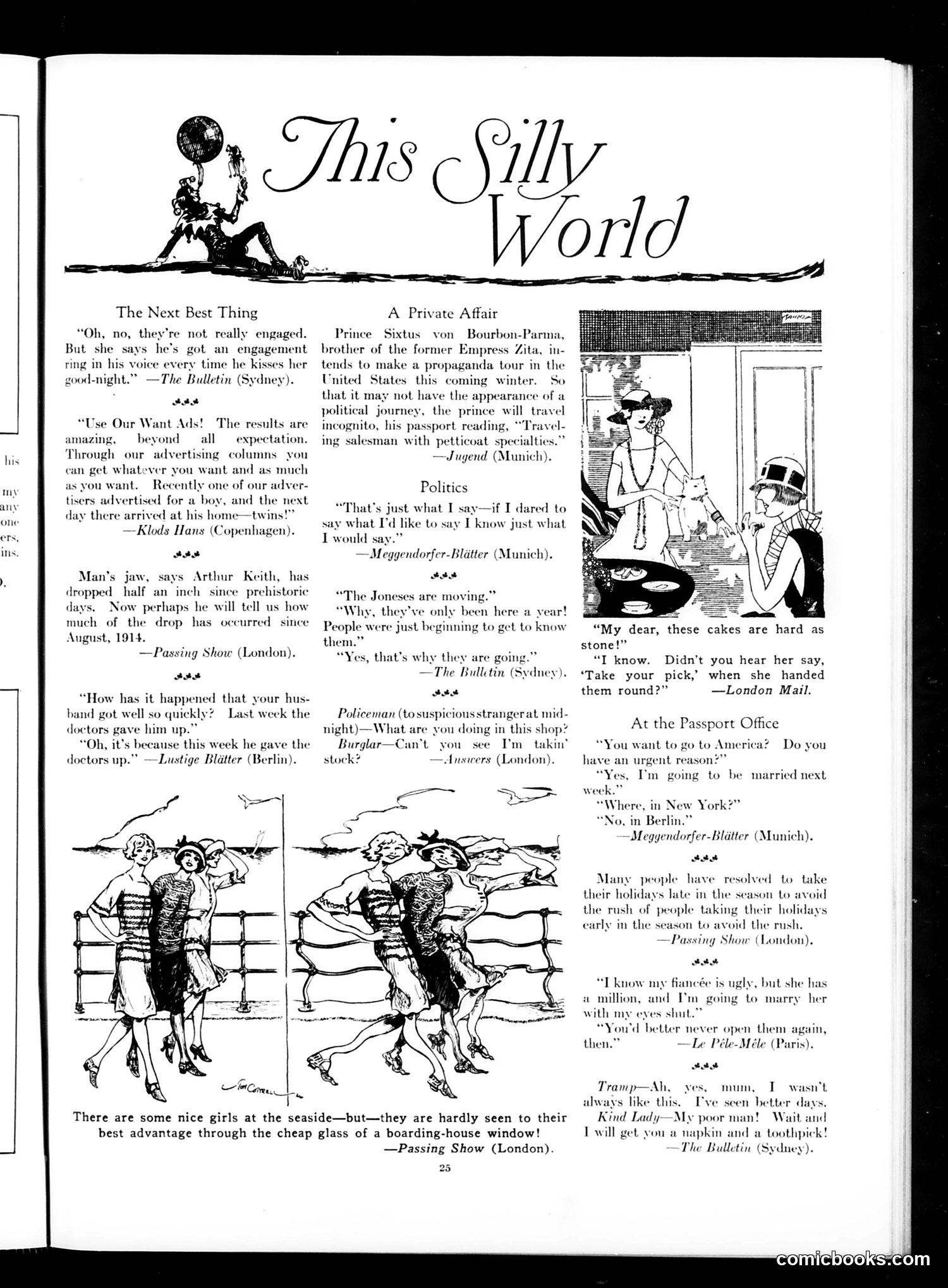
This page collects brief, internationally sourced satirical observations about post-WWI society. Key targets include: **War aftermath**: A joke references August 1914 (WWI's start), sardonically suggesting men's jaws have shrunk since then from stress. **Class and romance**: Multiple quips mock superficial engagement (a woman accepts a man's ring-shaped voice), wealth-based marriage ("I'll marry her with my eyes shut"), and social climbing. **Bureaucracy**: A passport officer suspects a woman fleeing to Berlin to marry is actually dodging—not seeking—marriage, exposing wartime travel suspicions. **Consumer culture**: Fake want-ads promise miraculous results; hard cakes are marketed as "take your pick." The cartoon (two identical panels) appears to show seaside romance hampered by poor window glass—a visual joke about limited perspective. The humor relies on cynicism about engagement, marriage motives, wartime paranoia, and materialism—typical of 1920s satirical magazines reprinting international press commentary.
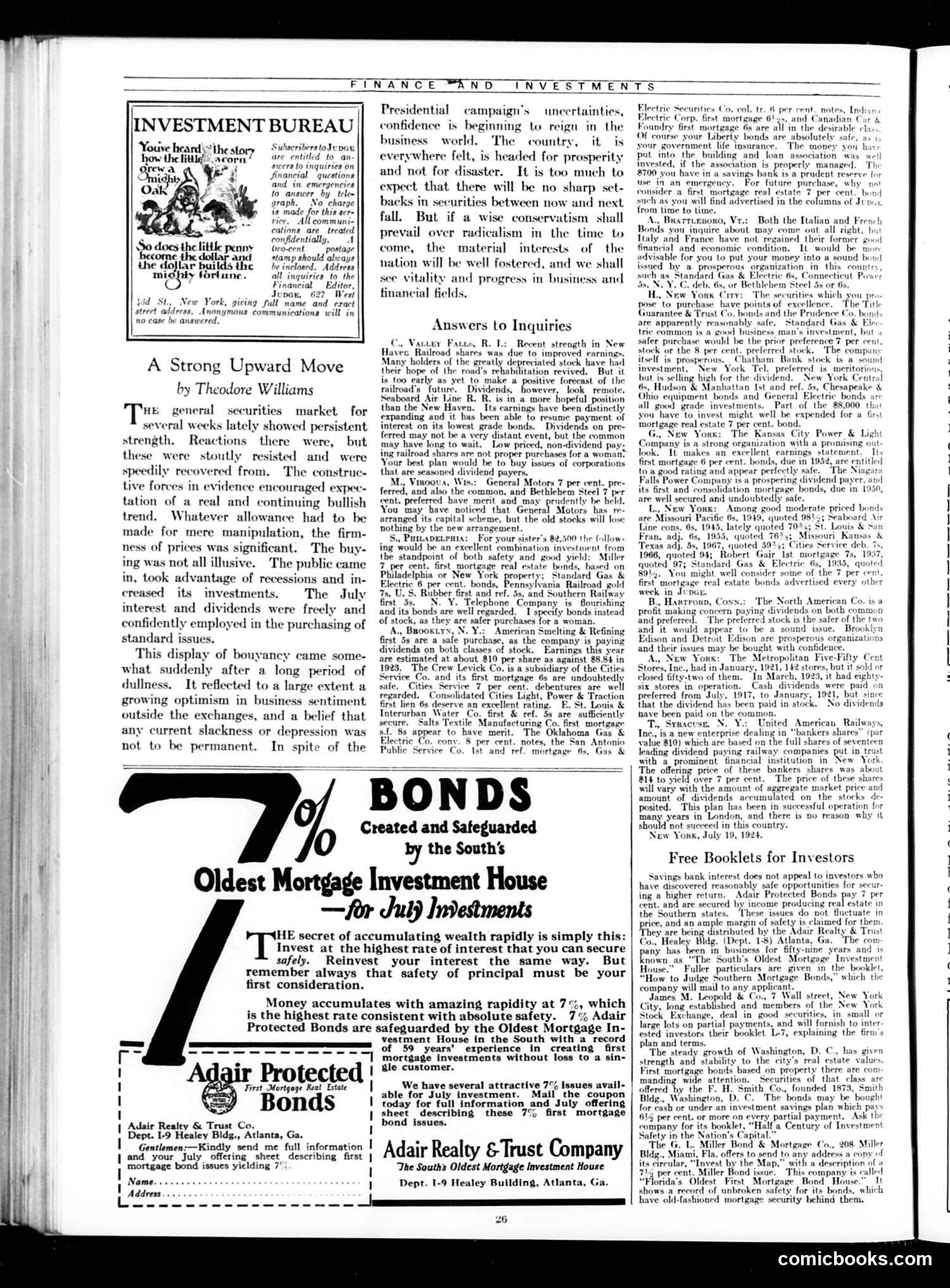
This page is primarily **financial/investment content** rather than political satire. The main elements are: **"Investment Bureau"** (top left): A service column where readers submit financial questions to "the Financial Editor." The mascot shows a penny becoming a dollar, illustrating the saving/investment theme. **"A Strong Upward Move"** (main article): Theodore Williams discusses recent stock market strength and optimism, attributing it partly to growing business confidence despite "Presidential campaign's uncertainties." This likely references an election year (unclear which), suggesting markets were recovering despite political concerns. **"Answers to Inquiries"**: Practical investment advice on specific stocks (New Haven Railroad, General Motors, etc.) and bonds. The **large "7% Bonds"** advertisement dominates the lower half, promoting the Adair Realty & Trust Company's mortgage bonds as safe investments. **Context for modern readers**: This reflects early-20th-century investment culture—direct newspaper advice columns, mortgage bonds as primary investments, and optimism about American industry despite political uncertainty.
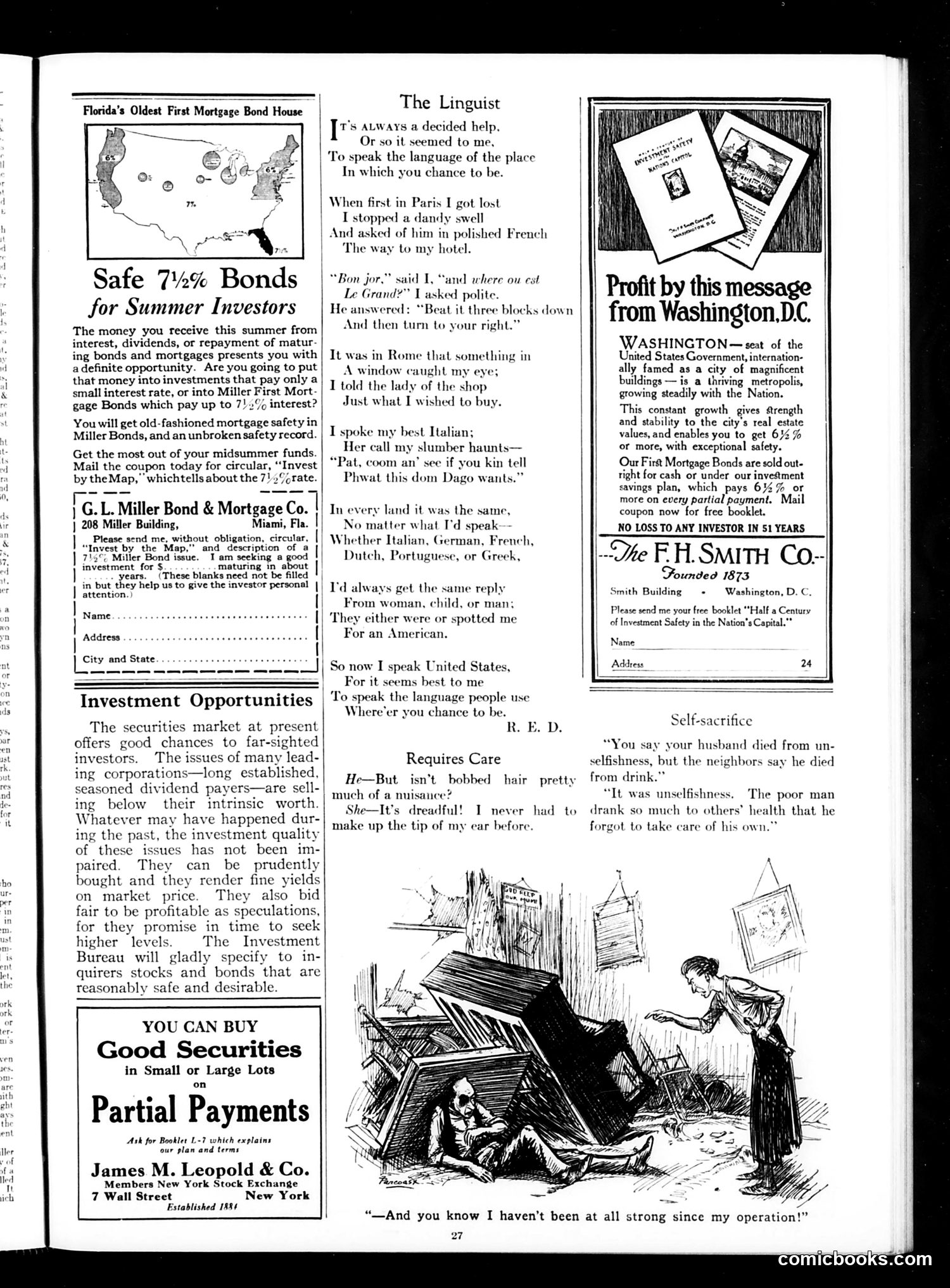
This humorous poem mocks Americans traveling abroad who expect foreigners to understand their language. The narrator attempts French, Italian, German, Portuguese, and Greek while traveling in Paris, Rome, and other European cities. Regardless of which language he carefully attempts, locals respond in English—or, amusingly, in heavily accented English ("Pat, coom an' see if you kin tell / Phwat this dom Dago wants"), revealing they've identified him as American immediately. The satire's point: Americans' assumption that proper pronunciation and effort will bridge language barriers misses the reality that their accent, manner, or appearance marks them unmistakably as American anyway. The poem concludes pragmatically—just speak English, since people will recognize you're American regardless. It gently ribbed American tourists' naive faith in linguistic diplomacy while abroad.
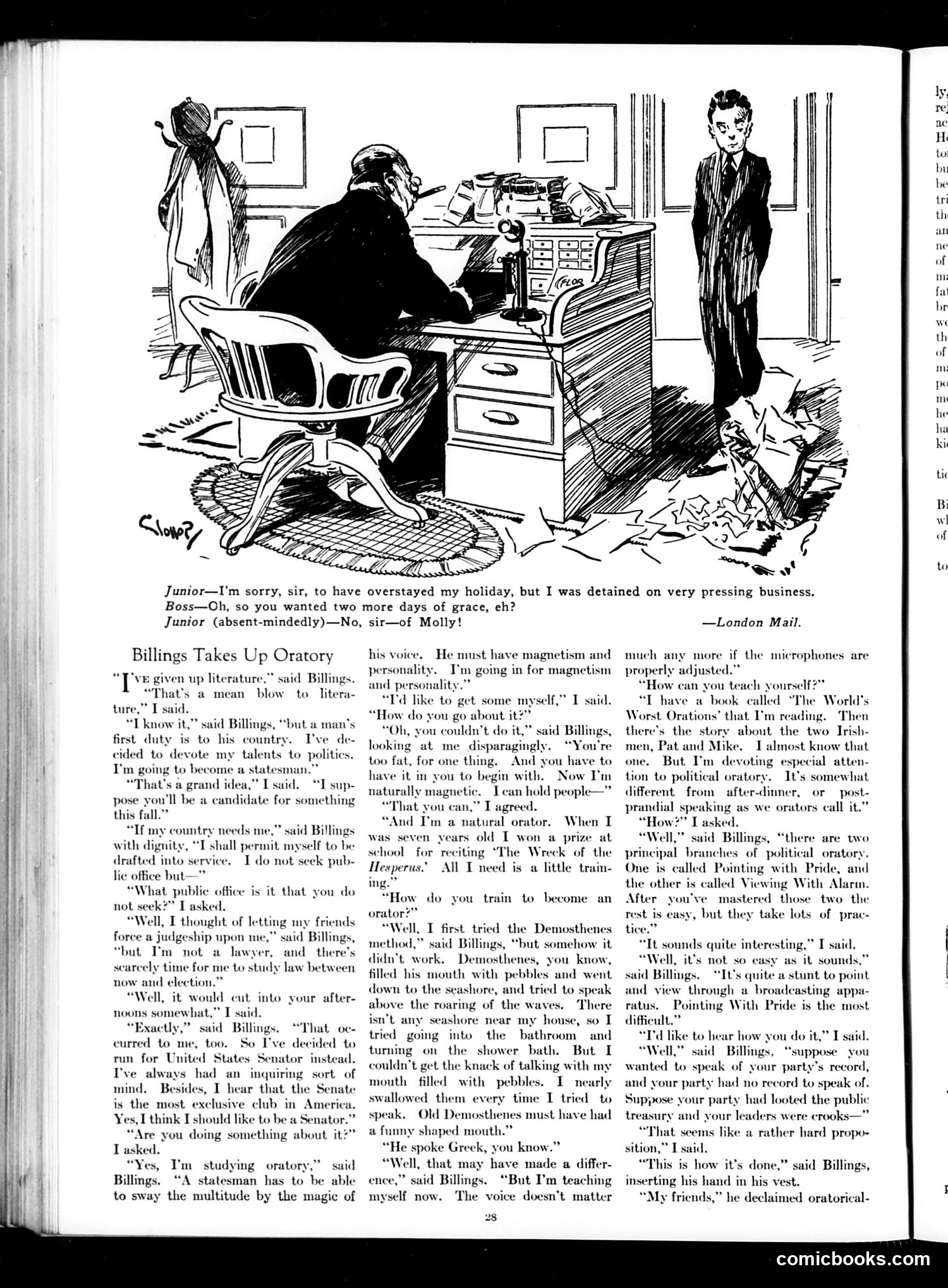
This page contains two satirical pieces about an ambitious but delusional character named Billings. **The Top Cartoon:** A junior employee explains his extended absence by claiming pressing business, then absent-mindedly reveals he meant "Molly" (a woman), not business. The joke mocks young men prioritizing romance over work obligations. **"Billings Takes Up Oratory":** The main text satirizes a pompous would-be politician. Billings decides to run for U.S. Senator, believing success requires only studying oratory and "magnetism." He's comically clueless—attempting the Demosthenes method (speaking with pebbles) in his bathroom shower, claiming to learn political speech from a book of "Worst Orations," and reducing all political rhetoric to two techniques: "Pointing with Pride" and "Viewing With Alarm" (exaggerating achievements and catastrophizing opposition records). The satire targets political humbug and empty oratory of the era, mocking candidates who substitute style and personality for substance, and the formulaic nature of political speeches designed to manipulate rather than inform voters.
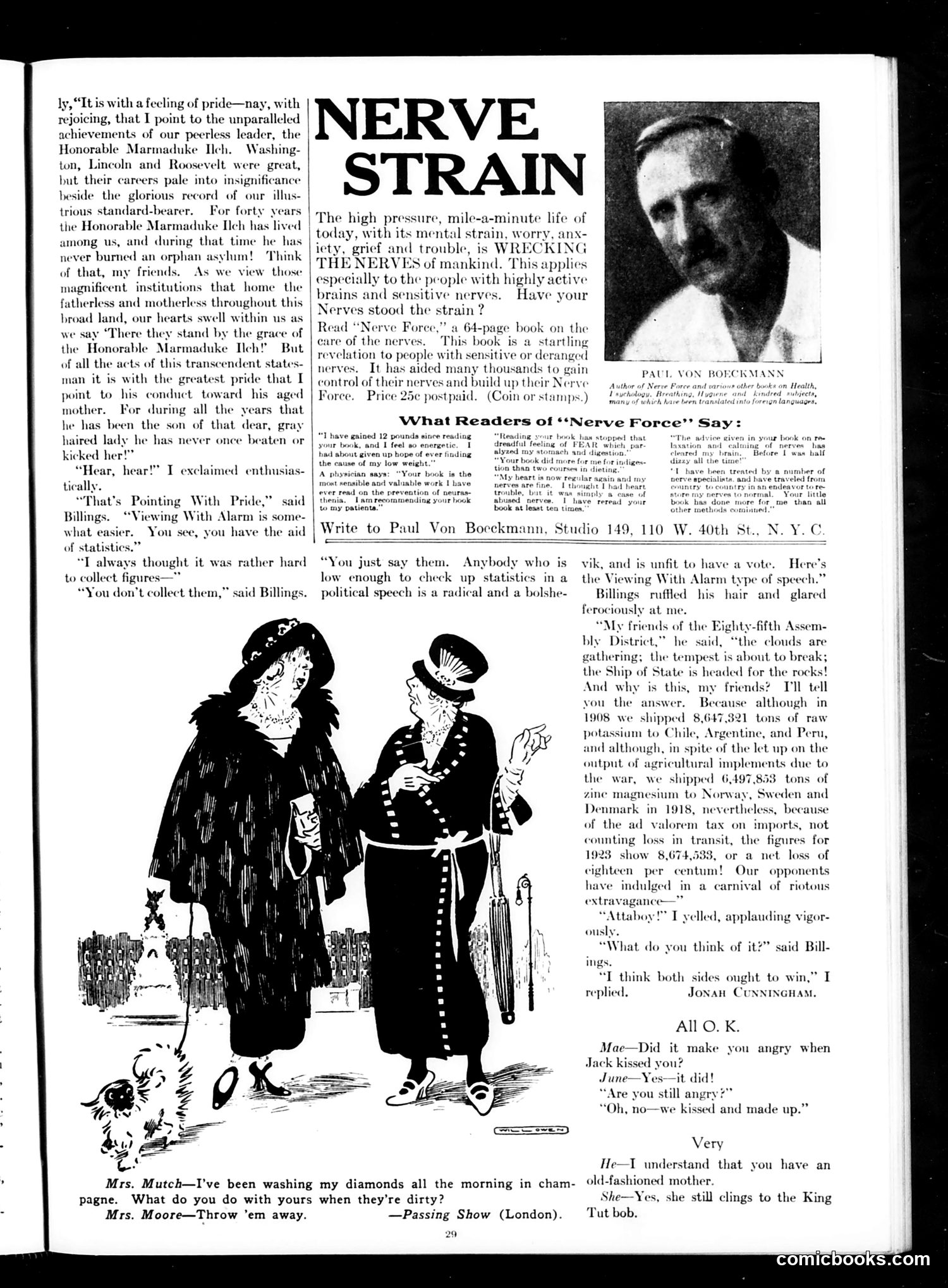
This Judge magazine page contains political satire from the 1920s. The main cartoon depicts a politician ("Pointing With Pride") boasting about his candidate's minimal accomplishments—notably that he's never burned down an orphan asylum or beaten his elderly mother. This mocks political rhetoric that inflates trivial or negative achievements into positive campaigns. The opposing speaker ("Viewing With Alarm") counters by citing confusing statistics about potassium and magnesium shipments to South America during WWI, rendered deliberately nonsensical to satirize how politicians weaponize data. The joke: both rhetorical styles rely on manipulation rather than substance. The cartoon also includes a jab at "radicals and bolsheviks"—those who fact-check political claims—reflecting 1920s anti-communist anxieties. The page also advertises "Nerve Force," a self-help book addressing modern "nerve strain," and includes period humor about wealthy women washing diamonds in champagne.
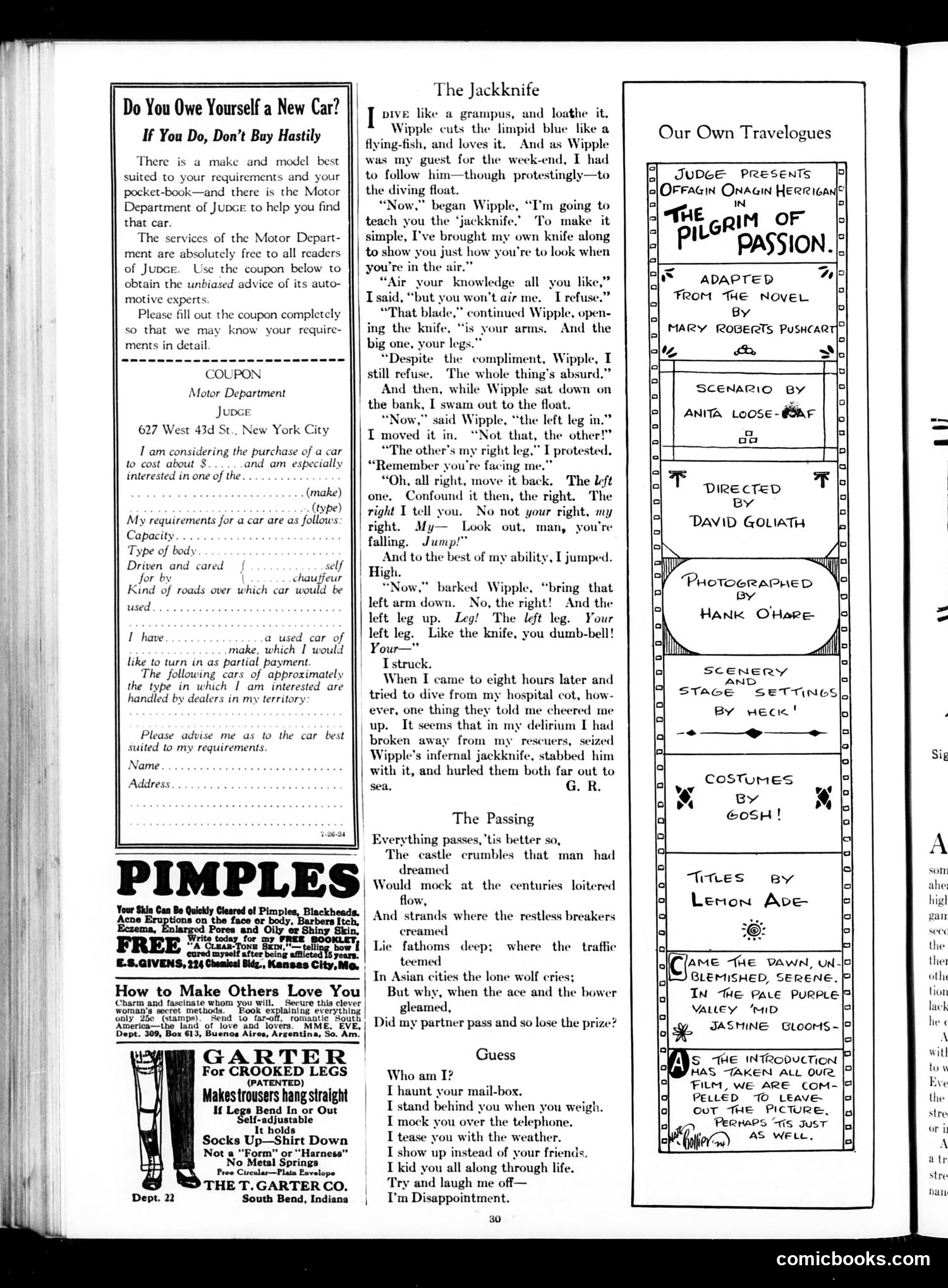
This page contains two main elements: **"The Jackknife"** is a humorous short story about a narrator who reluctantly takes diving lessons from an overbearing friend named Wipple. The satire mocks overly pedantic instruction—Wipple obsessively corrects which leg/arm to move using a jackknife as visual aid, creating absurd confusion. The joke escalates to dark comedy when the narrator, driven mad by the contradictory instructions, stabs Wipple and throws them both into the sea. It's satirizing the gap between simple concepts and needlessly complicated explanations. **The surrounding advertisements** hawk dubious products (skin cream, love charm guides, leg garters, etc.)—typical period mail-order schemes targeting insecurities. **The Motor Department coupon** offers Judge's supposedly "unbiased" automotive advice—itself a light satire on advertising claims. The page reflects early 20th-century magazine culture: mixing humor, practical automotive advice, and increasingly transparent commercialism.
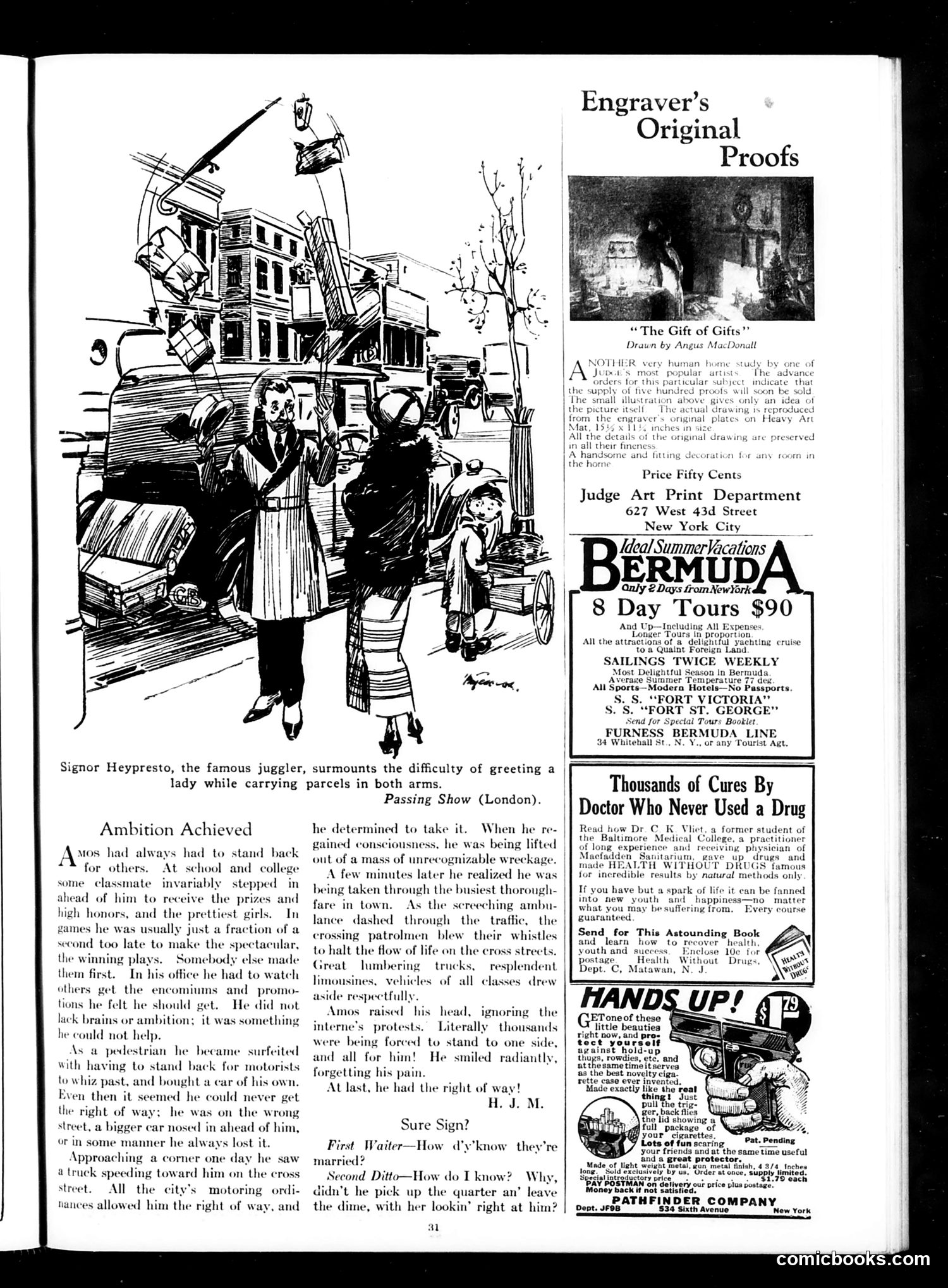
**Main Cartoon ("Ambition Achieved"):** This is a dark satirical story about an underdog named Amos who finally achieves recognition—but only through a traffic accident. After a lifetime of being pushed aside socially and professionally, Amos insists on his legal right-of-way at an intersection. He's hit by a truck. The joke's bitter irony: only when he's a severely injured accident victim being rushed through town in an ambulance do thousands defer to him and clear the streets. He finally has the "right of way"—achieved through near-death. It critiques how society ignores ordinary people's dignity but respects victims and crisis situations. **Secondary Content:** The page also includes advertising (Bermuda vacation tours, health books, novelty cigarette lighters) and a brief comic dialogue about identifying married couples by their cheapness. **Historical Context:** Judge magazine specialized in this kind of satirical social commentary about American class dynamics, ambition, and the frustrations of ordinary working life during the early 20th century.
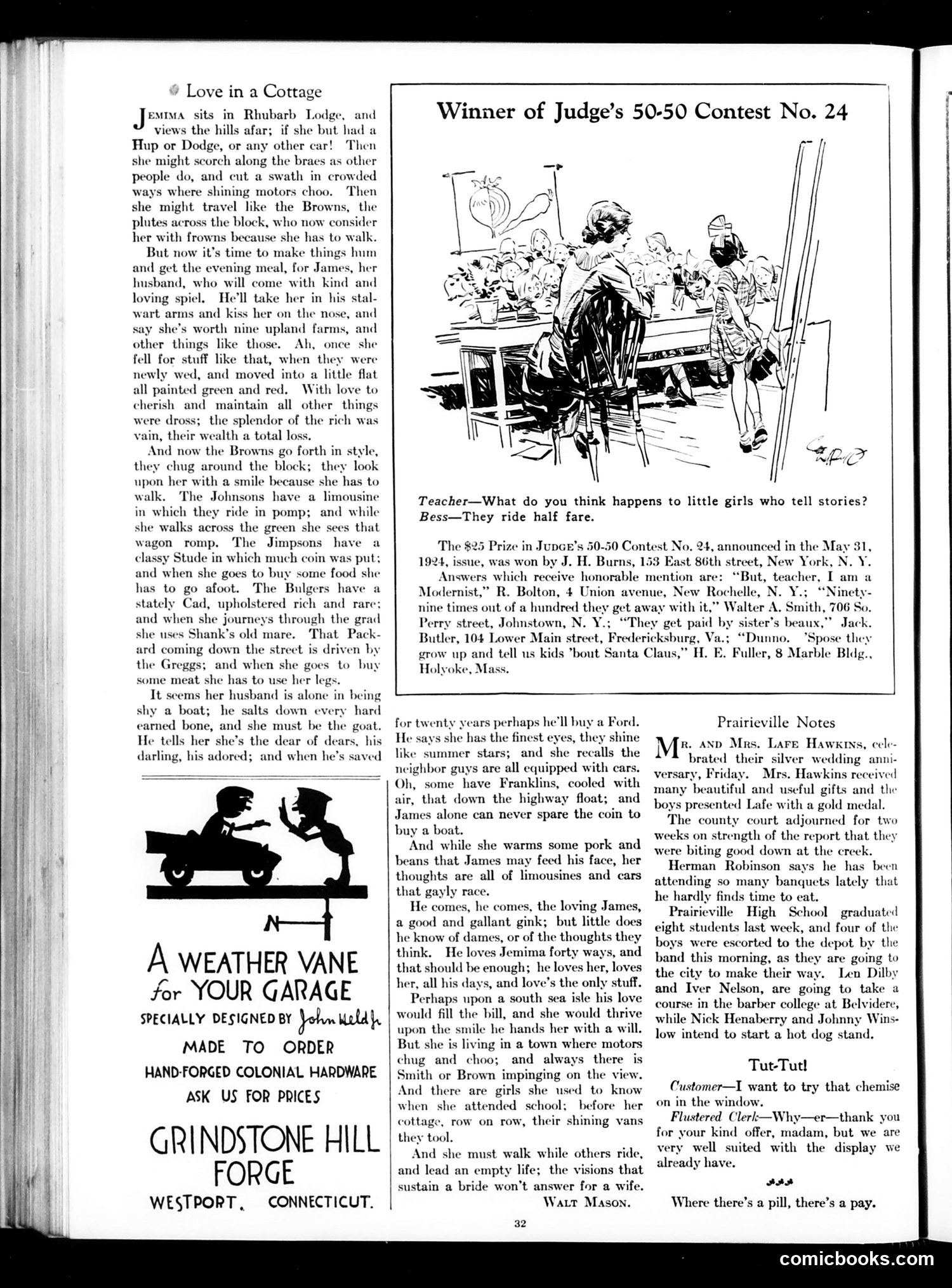
This page contains a satirical poem titled "Love in a Cottage" that critiques consumer culture and automobile envy in 1920s America. The narrative follows Jemima, a poor woman married to James, who walks everywhere while her neighbors—the Browns, Johnsons, Jimpsons, Bulgers, and Greggs—flaunt their automobiles (Hupmobiles, Dodges, Franklins, Cadillacs, Packards). The satire's point: Despite James's romantic devotion and assurances of love, Jemima is miserable because she cannot compete materially with neighbors who own cars. The poem suggests that modern consumer desires have corrupted romantic idealism—love in a cottage isn't enough when everyone else has automobiles. The page also includes a small cartoon showing a couple on a seesaw (labeled "A WEATHER VANE"), an advertisement for handforged colonial hardware weather vanes, and contest-winning joke submissions.
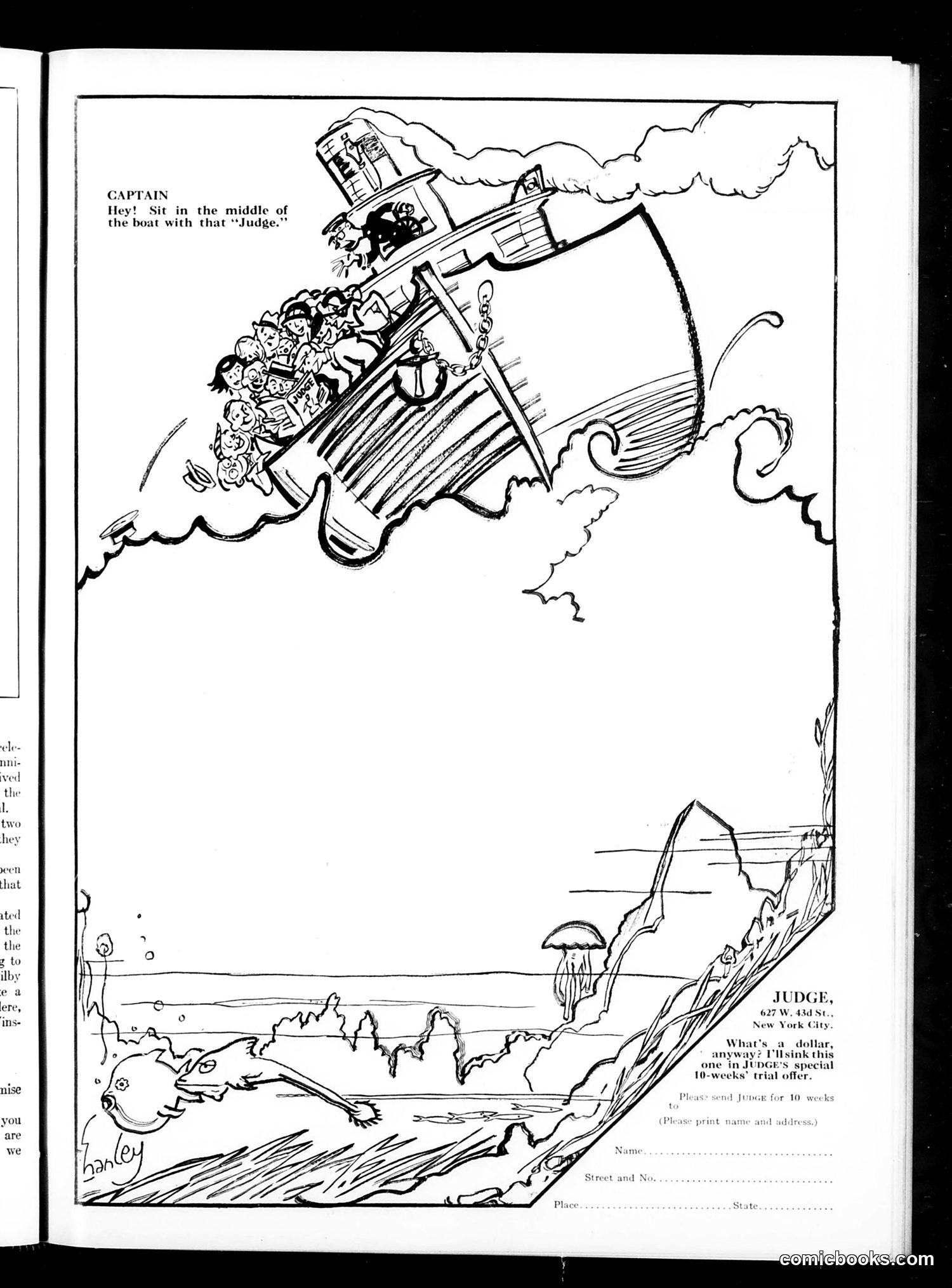
This is a satirical illustration showing a boat full of passengers tilting dangerously, with the Captain ordering someone to sit in the middle with a copy of "Judge" magazine. The joke appears to be about the magazine's weight or importance—humorously suggesting that Judge itself is so substantial or influential that it needs to be positioned centrally to balance the boat and prevent capsizing. The cartoon seems to be self-promotional advertising for Judge magazine, using humor to claim the publication's significance. The maritime setting and "balancing act" metaphor suggest Judge sees itself as essential ballast for American society. Below is an advertisement section encouraging readers to send in a dollar for a 10-week subscription.
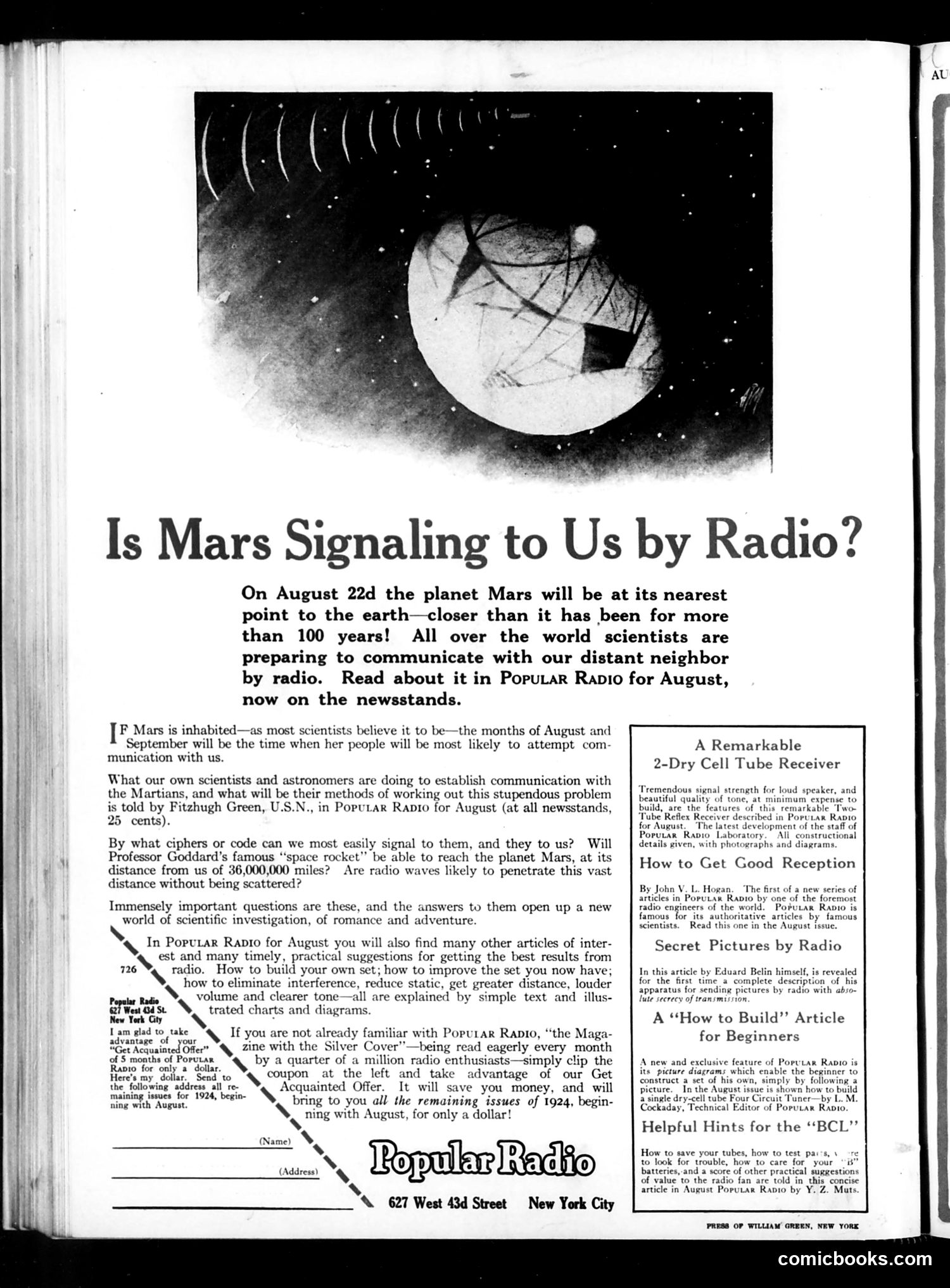
This page is primarily **advertising for Popular Radio magazine**, not a political cartoon. It promotes the August 1924 issue by highlighting a genuinely significant astronomical event: Mars's closest approach to Earth in over 100 years on August 22. The advertisement capitalizes on **real scientific excitement** of the era—scientists worldwide were actually attempting to establish radio contact with Mars, reflecting both genuine astronomical interest and the speculative belief that Mars might be inhabited. This was serious business in the 1920s. The page uses this genuine news hook to sell magazine subscriptions by promising practical radio-building content: how to construct receivers, eliminate static, and improve signal reception. Articles by credible engineers like Fitzhugh Green and L.M. Cockaday add authority. The humor is subtle and implicit: the advertisement exploits readers' wonder about Martian life while selling mundane radio-construction guides—contrasting romantic space-age possibility with practical DIY enthusiasm. There's no explicit satire; the joke is the juxtaposition itself.