
Judge, 1924-07-26 · page 19 of 36
Judge — July 26, 1924 — page 19: what you’re looking at
What you’re looking at
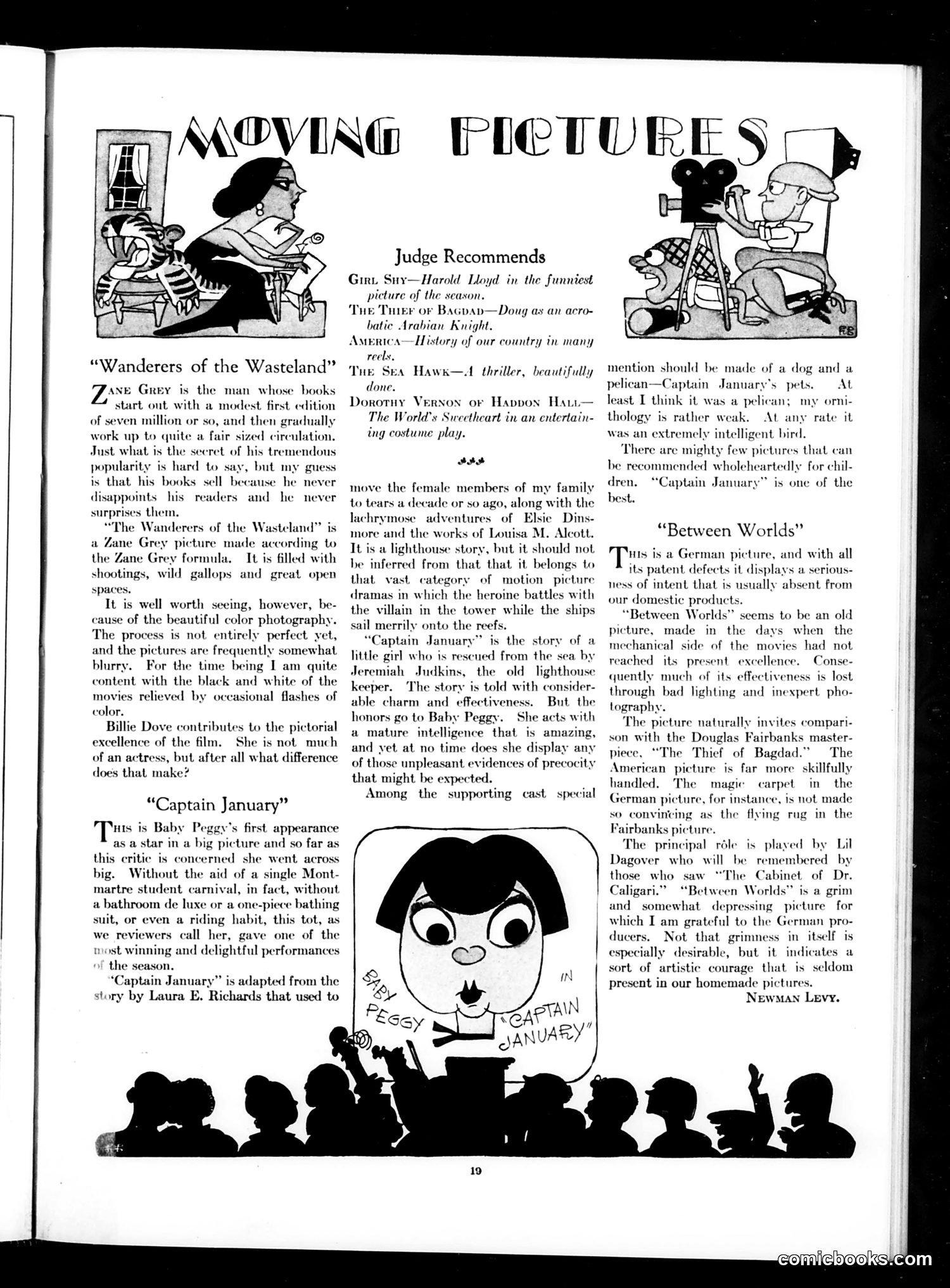
This page contains film reviews from Judge magazine's "Moving Pictures" column. The critic recommends several 1920s films: **"Wanderers of the Wasteland"** — A Zane Grey Western adaptation praised for its early color photography (though noted as somewhat blurry), featuring actress Billie Dove. **"Captain January"** — Baby Peggy's starring debut, adapted from a sentimental 19th-century story about a girl rescued by a lighthouse keeper. The reviewer praises her natural, mature performance without affected "precocity." **"Between Worlds"** — A German film that, despite technical limitations (poor lighting, outdated cinematography), displays serious artistic intent—contrasted unfavorably with American pictures' tendency toward spectacle over substance. The reviewer compares it disadvantageously to Douglas Fairbanks' "Thief of Bagdad." The column also includes Judge's brief "Judge Recommends" section listing other films with comedians Harold Lloyd and Douglas Fairbanks. The satire reflects period attitudes valuing sincere storytelling over technical showiness.
📄 Transcribed text from this page (OCR, searchable)
Machine-transcribed from the original scan — historical spelling and the odd misread are preserved.
“Wanderers of the Wasteland” ane Grey is the man whose books start out with a modest first edition of seven million or so, and then gradually work up to quite a fair sized circulation. Just what is the secret of his tremendous popularity is hard to say, but my guess is that his books sell because he never disappoints his readers and he surprises them. “The Wanderers of the Wasteland” is a Zane Grey picture made according to the Zane Grey formula, It is filled with shootings, wild gallops and great open spaces, never It is well worth seeing, however, be- cause of the beautiful color photography. The process is not entirely perfect yet, and the pictures are frequently somewhat blurry. For the time being I am quite content with the black and white of the movies relieved by occasional flashes of Billie Dove contributes to the pictorial excellence of the film. She is not. much of an actress, but after all what difference does that make? “Captain January” 11s is Baby Peggy's first appearance as a star in a big picture and so far as this critic is concerned she went across big. Without the aid of a single Mont- martre student carnival, in fact, without a bathroom de luxe or a one-piece bathing suit, or even a riding habit, this tot, as we reviewers call her, gave one of the most winning and delightful performances the season. ‘Captain January” is adapted from the story by Laura E. Richards that used to Judge Recommends Girt Suy—Harold Lloyd in the funniest picture of the season. Tue Tuer or BaGbaAv—Doug as an acro- batie Arabian Knight. AMERICA reels. Tne Sea Hawk—A thriller, beautifully done. Dorotuy Vernon or Happon Haui— The World's Sweetheart in an entertain- ing costume play. History of our country in many Cal move the female members of my family to tears a decade or so ago, along with the lachrymose adventures of Elsie Dins- more and the works of Louisa M. Alcott. It is a lighthouse story, but it should not be inferred from that that it belongs to that vast category of motion picture dramas in which the heroine battles with the villain in the tower while the ships sail merrily onto the reefs. “Captain January” is the story of a little girl who is rescued from the sea by Jeremiah Judkins, the old lighthouse keeper. The story is told with consider- able charm and effectiveness. But the honors go to Baby Peggy. She acts with a mature intelligence that is amazing, and yet at no time does she display any of those unpleasant evidences of precocity that might be expected. Among the supporting cast special mention should be made of a dog and a pelican—Captain January’s pets. Al least L think it was a pelican; my orni- thology is rather weak. AL any rate it was an extremely intelligent. bird. There are mighty few pictures that ean be recommended wholeheartedly for chil- dren, “Captain January” best. is one of the “Between Worlds” TT" is a German picture, and with all its patent defects it displays a serious- ness of intent that is usually absent from our domestic products. “Between Worlds” seems to be an old picture, made in the days when the mechanical side of the movies had not reached its present excellence. quently much of its effectiveness is lost through bad lighting and inexpert. pho- tography. The picture naturally invites compari- son with the Douglas Fairbanks master- piece, “The Thief of Bagdad.” The American picture is far more skillfully handled. The magic carpet. in the German picture, for instance, is not made so convincing as the flying rug in the Fairbanks picture. The principal rdle is played by Lil Dagover who will be remembered by those who saw “The Cabinet of Dr. Caligari.” “Between Worlds” is a grim and somewhat depressing picture for which I am grateful to the German pro- ducers. Not that grimness in itself is especially desirable, but it indicates a sort of artistic courage that is seldom present in our homemade pictures. Newman Levy. Conse-