
Judge, 1924-07-26 · page 24 of 36
Judge — July 26, 1924 — page 24: what you’re looking at
What you’re looking at
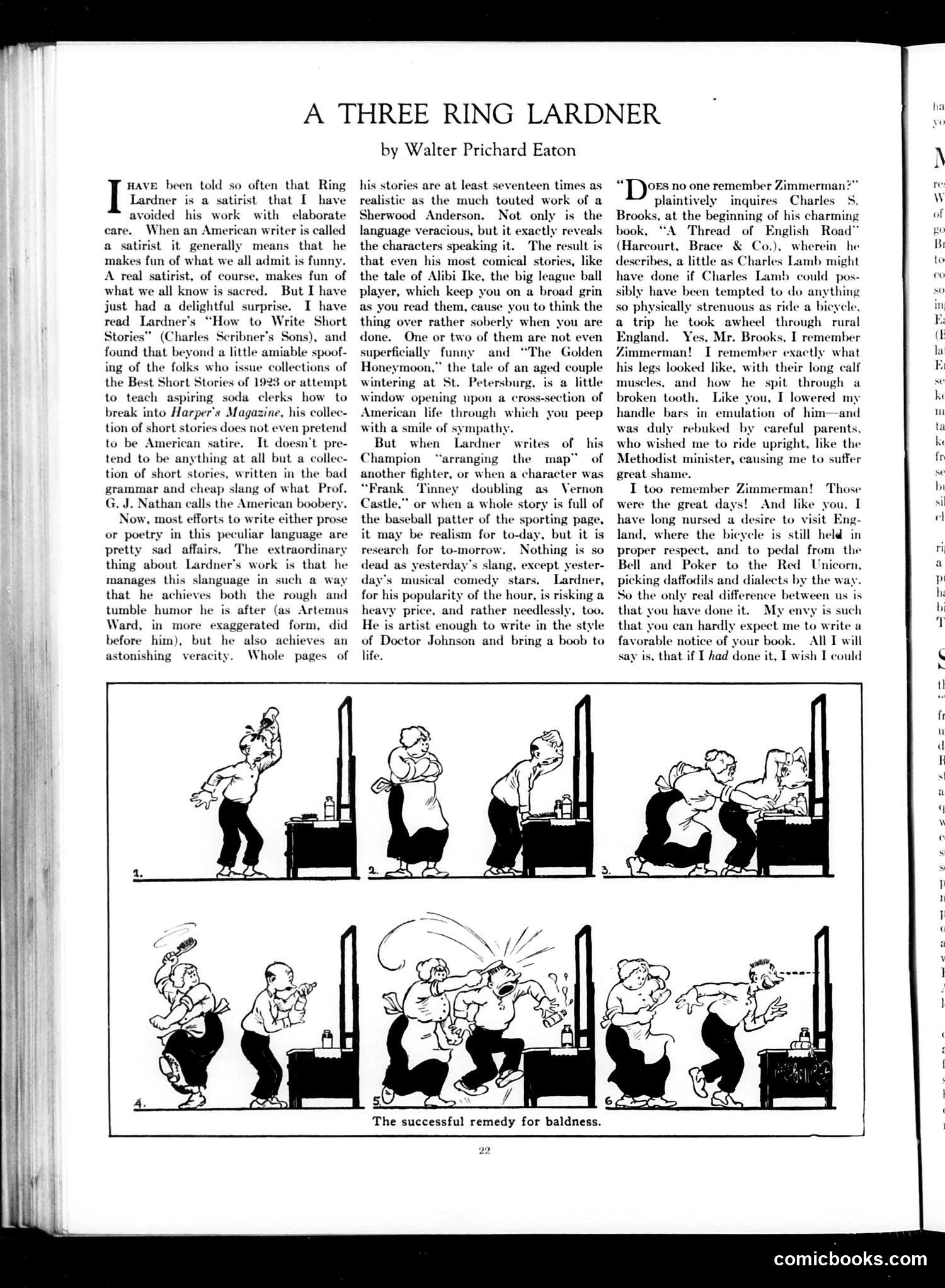
This page contains two book reviews by Walter Prichard Eaton in *Judge* magazine. **On Ring Lardner**: Eaton defends author Ring Lardner against the charge of being merely a satirist. He argues Lardner's short stories achieve genuine realism through authentic American vernacular and slang, revealing character truthfully—even in comic tales. However, Eaton warns that Lardner risks obsolescence by writing in contemporary slang ("yesterday's slang") that will date quickly, unlike timeless prose styles. **On Charles S. Brooks**: Eaton reviews Brooks's travel memoir about cycling through rural England. He nostalgically recalls "Zimmerman" (likely cyclist Artur Zimmerman, a famous 1880s racer), sharing Brooks's fond memories of bicycle culture and the sport's respectability in England versus America. The **cartoon below** titled "The successful remedy for baldness" appears to be slapstick humor about a bald man attempting various absurd hair-restoration methods at a mirror, escalating to comedic violence—typical *Judge* visual humor of the era.
📄 Transcribed text from this page (OCR, searchable)
Machine-transcribed from the original scan — historical spelling and the odd misread are preserved.
HAVE been told so often that Ring Lardner is a satirist that I have avoided his work with elaborate care. When an American writer is called a satirist it generally means that he makes fun of what we all admit is funny. A real satirist, of course, makes fun of what we all know is sacred. But I have just had a delightful surprise. I have read Lardner’s “How to Write Short Stories” (Charles Scribner's Sons), and found that beyond a little amiable spoof- ing of the folks who issue collections of the Best Short Stories of 1928 or attempt to teach aspiring soda clerks how to break into Harper's Magazine, his collec- tion of short stories does not even pretend to be American satire. It doesn't pre- tend to be anything at all but a collec- tion of short stories, written in the bad grammar and cheap slang of what Prof. G. J. Nathan calls the American boobe! Now, most efforts to write either prose or poetry in this peculiar language are pretty sad affairs. The extraordinary thing about Lardner’s work is that he manages this slanguage in such a way that he achieves both the rough and tumble humor he is after (as Artemus Ward, in more exaggerated form, did before him), but he also achieves an astonishing veracity. Whole pages of A THREE RING LARDNER by Walter Prichard Eaton his stories are at least seventeen times as realistic as the much touted work of a Sherwood Anderson. Not only is the language veracious, but it exactly reveals the characters speaking it. The result is that even his most comical stories, like the tale of Alibi Ike, the big league ball player, which keep you on a broad grin as you read them, cause you to think the thing over rather soberly when you are done. One or two of them are not even superficially funny and “The Golden Honeymoon,” the tale of an aged couple wintering at St. Petersburg, is a little window opening upon a cross-section of American life through which you peep with a smile of sympathy. But when Lardner writes of his Champion “arranging the map” of another fighter, or when a character was “Frank ‘Tinney doubling as Vernon Castle,” or when a whole story is full of the baseball patter of the sporting page, it may be realism for to-day, but it is research for to-morrow. Nothing is so dead as yesterday's slang, except yester- day's musical comedy stars. Lardner, for his popularity of the hour, is risking a heavy price, and rather needlessly, too. He is artist enough to write in the style of Doctor Johnson and bring a boob to life. 7 OEs no one remember Zimmerman?” plaintively inquires Charles S. Brooks, at the beginning of his charming book, “A Thread of English Road” (Harcourt, Brace & Co.), wherein he describes, a little as Charles Lamb might have done if Charles Lamb could pos- sibly have been tempted to do anything so physically strenuous as ride a bicycle, a trip he took awheel through rural England. Yes, Mr. Brooks, I remember Zimmerman! I remember exactly what his legs looked like, with their long calf muscles, and how he spit through a broken tooth. Like you, I lowered my handle bars in emulation of him—and was duly rebuked by careful parents, who wished me to ride upright, like the Methodist minister, causing me to suffer great shame. I too remember Zimmerman! Those were the great days! And like you, I have long nursed a desire to visit Eng- land, where the bicycle is still held in proper respect, and to pedal from the Bell and Poker to the Red Unicorn, picking daffodils and dialects by the way. So the only real difference between us is that you have done it. My envy is such that you can hardly expect me to write a favorable notice of your book. All I will say is, that if I kad done it, I wish T could comicbooks.com