
Judge, 1924-07-26 · page 25 of 36
Judge — July 26, 1924 — page 25: what you’re looking at
What you’re looking at
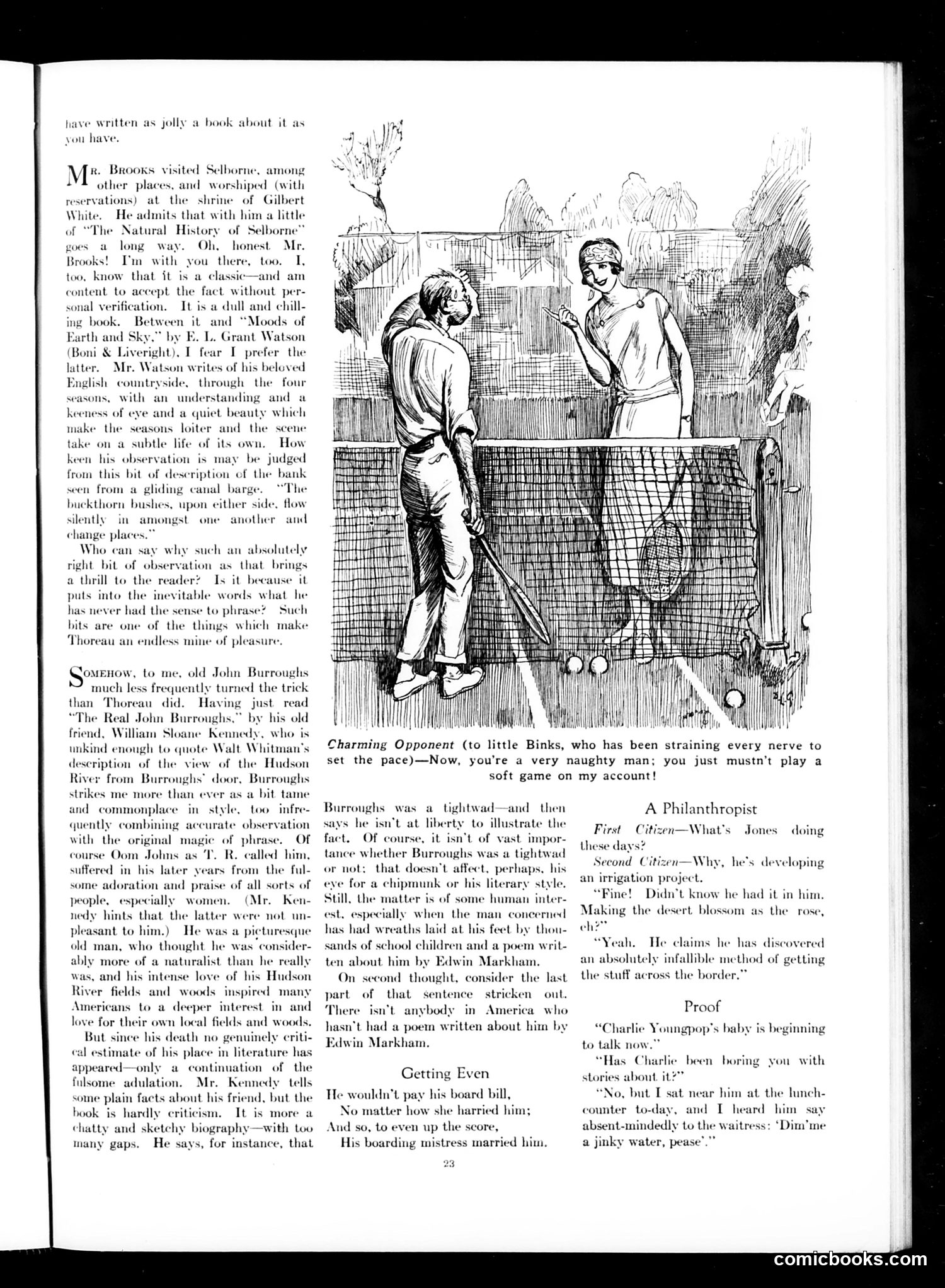
This page contains literary criticism and humorous verse from Judge magazine. The main illustrated cartoon depicts a tennis match between two players—"Charming Opponent" and "little Binks"—with the opponent chiding Binks for playing too cautiously ("you just mustn't play a soft game on my account!"). The satire suggests a critique of false gentility or insincere courtesy in competition. The text discusses naturalist John Burroughs unfavorably, contrasting him with Henry David Thoreau and E.L. Grant Watson. The author criticizes Burroughs as "tame and commonplace," overpraised despite mediocre talent. A minor verse titled "Getting Even" jokes about a woman marrying her deadbeat boarder to settle accounts. The page reflects early-20th-century American literary discourse and period attitudes toward nature writing.
📄 Transcribed text from this page (OCR, searchable)
Machine-transcribed from the original scan — historical spelling and the odd misread are preserved.
have written as jolly a book about it as you have. M* Brooks visited Selborne, 1YE other places, and worshiped (with reservations) at the shrine of Gilbert White. He admits that with him a little of “The Natural History of Selborne™ way. Oh, honest Mr. with you there, too. I, that it is a classie—and am accept the fact without per- tion. It is a dull and chill- ing book. Between it and “Moods of Earth and Sky,” by E. L. Grant Watson (Boni & Liveright), I fear I prefer the latter. Mr. Watson writes of his beloved English countryside, through the four with an understanding and a keeness of eye and a quiet beauty which make the seasons loiter and the scene take on a subtle life How keen his observation is may be judged from this bit of description of the bank seen from a gliding canal barge. “The flow and among goes a long Brooks! I'm too, know content t sonal verifi seasons, of its own. buckthorn bushes, upon either side. silently in amongst’ one another change places.” Who ean say why such right bit of observation as that brings a thrill to the reader? Is it because it puts into the inevitable words what he Such of the things which make Thoreau an endless mine of pleasure. an absolutely has never had the sense to phrase? bits are one SomEHow, to me, old John Burroughs much less frequently turned the trick than Thoreau did. Having just read “The Real John Burroughs.” by his old friend, William Sloane Kennedy, who is unkind enough to quote Walt Whitman's description of the view of the Hudson River from Burroughs’ door, Burroughs strikes me more than ever as a bit tame and commonplace in style, too infre- quently combining accurate observation with the original magic of phrase. Of course Oom Johns as ‘Tl. R. called him, suffered in his later years from the ful- some adoration and praise of all sorts of people, (Mr. Ken- latter were not un- especially women. nedy hints that the pleasant to him.) He was a picturesque old man, who thought he was consider. ably more of a naturalist than he really was, and his intense love of his Hudson River fields and woods inspired many Americans to a deeper interest in’ and love for their own local fields and woods. But since his death no genuinely criti- cal estimate of his place in literature has appeared—only a continuation of the fulsome adulation. Mr. Kennedy tells some plain facts about his friend, but the book is hardly criticism. It chatty and sk many gaps. is more a hy biography —with too He says, for instance, that i fi ue il set the pace)—Now, you're a very naughty man; hay " W Charming Opponent (to little Binks, who has been straining every nerve to > HARM Hl i Hl il HEN WM] i tl Me you just mustn’t play a soft game on my account! Burroughs was a tightwad—and then says he isn’t at liberty: to illustrate the fact. Of course, it isn’t of vast impor- tance whether Burroughs was a tightwad that doesn’t affect, perhaps, his eye for a chipmunk or his literary style. Still, the matter is of some human inter- est. especially when the man concerned has had wreaths laid at his feet by sands of school children and a poem writ- ten about him by Edwin Markham. On second thought, consider the part of that stricken There isn’t America. who or not: thou- last sentence oul, anybody. in hasn't had a poem written about him by Edwin Markham. Getting Even He wouldn't pay his board bill, No matter how she harried him; And so, to even up the score, His boarding mistress married him. A Philanthropist First Citizen—What's these days? Second Citi: an irrigation project. “Fine! Didn't know he had it in him. Making the desert blossom as the eh?” Jones doing i—Why, he's developing ah, He claims he has discovered an absolutely infallible method of getting the stuff across the border.” Proof “Charlie Youngpop’s baby is beginning to talk now.” “Has Charlie stories about. it?” “No, but [ sat near him at the hinch- and I absent-mindedly to the waitress: a jinky water, pease’.”” been boring you with counter to-day, heard him say ‘Dim’me comicbooks.com