
A complete issue · 36 pages · 1923
Judge — December 1, 1923
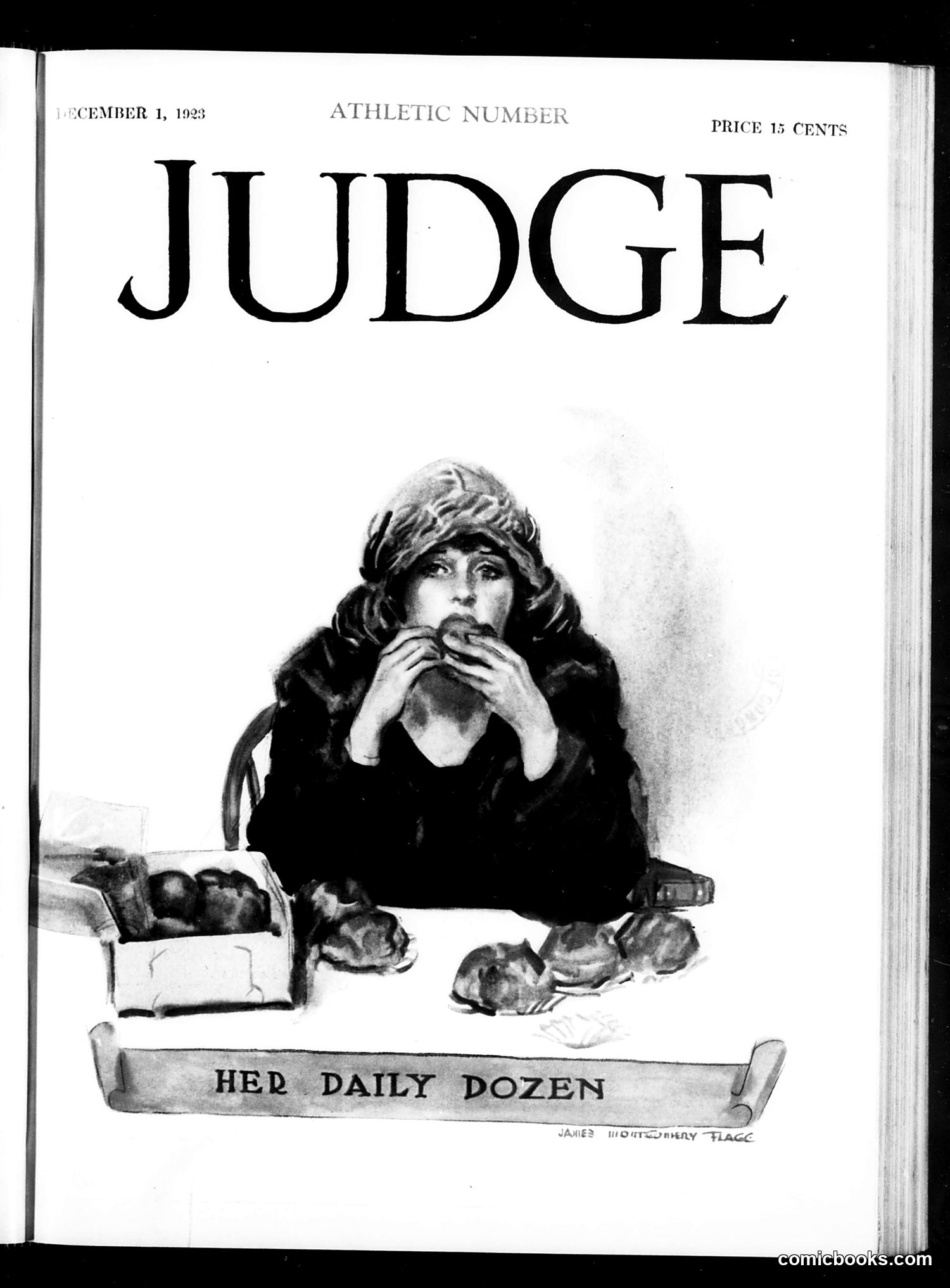
This satire depicts a woman eating donuts, labeled "Her Daily Dozen." The joke plays on the popular 1920s fitness trend called the "Daily Dozen"—a set of twelve simple exercises promoted by fitness expert Walter Camp to improve health and vigor. The cartoon mocks this health craze by suggesting a woman's version substitutes actual exercise with consuming a dozen donuts instead. It's a double joke: both satirizing the fitness fad's popularity and using period-typical gender humor about women's indulgence in sweets versus disciplined exercise. The illustration's style and the magazine's satirical focus suggest this commentary on modern trends, consumerism, and competing notions of health were typical Judge fare during the Jazz Age.
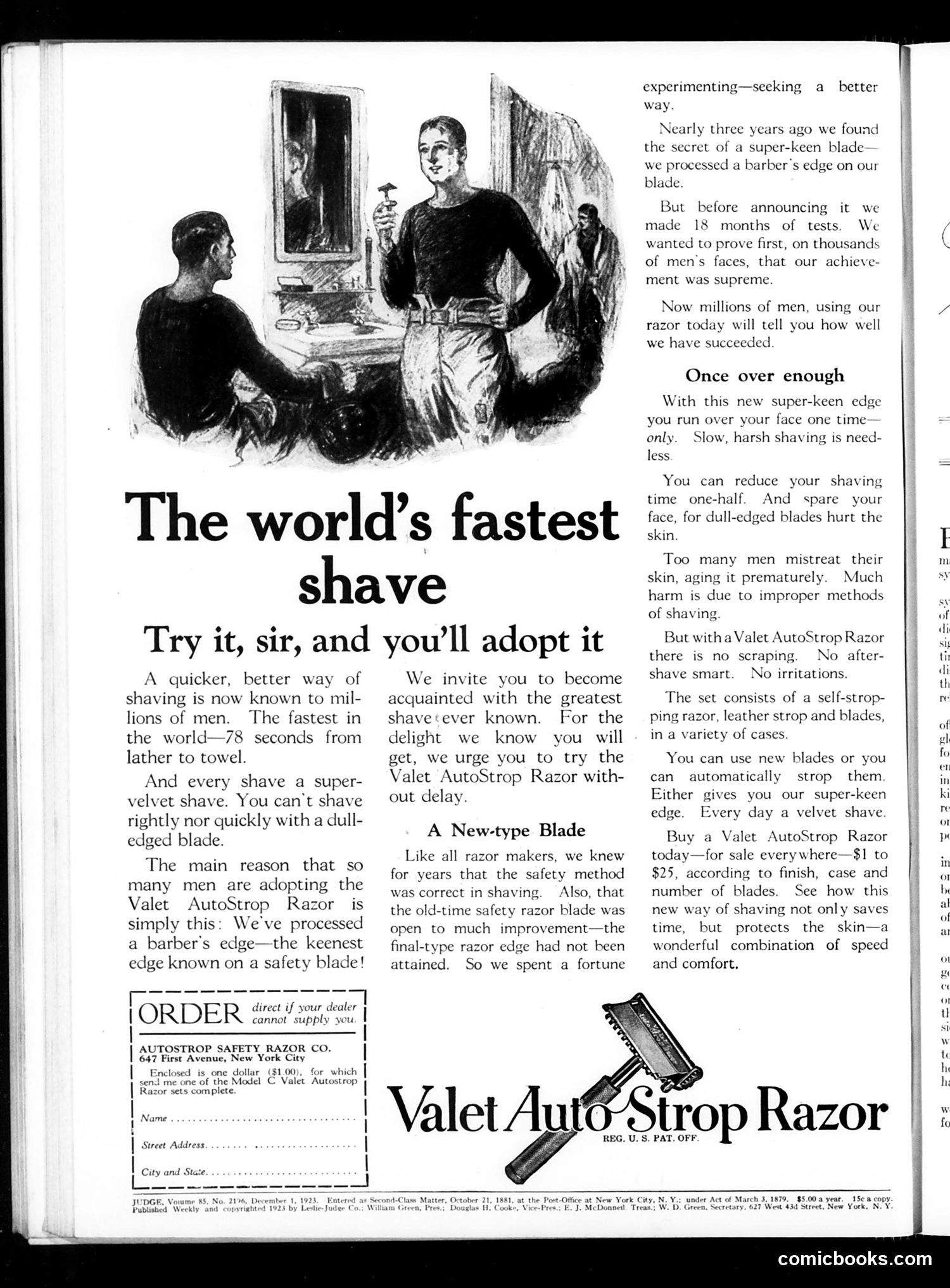
This page is primarily an advertisement for the Valet AutoStrop Razor, not political satire. The illustration shows a barber demonstrating the razor to a customer in a shop setting—a common advertising trope of the era. The "satire" is commercial rather than political: the ad uses hyperbolic language ("world's fastest shave," "super-keen edge") typical of early 20th-century marketing. The headline's imperative tone ("Try it, sir, and you'll adopt it") represents competitive marketing claims rather than social commentary. The order form at bottom indicates this was a direct-response advertisement placed in *Judge* magazine. This reflects how magazines of this period mixed editorial content with extensive advertising to subsidize publication.
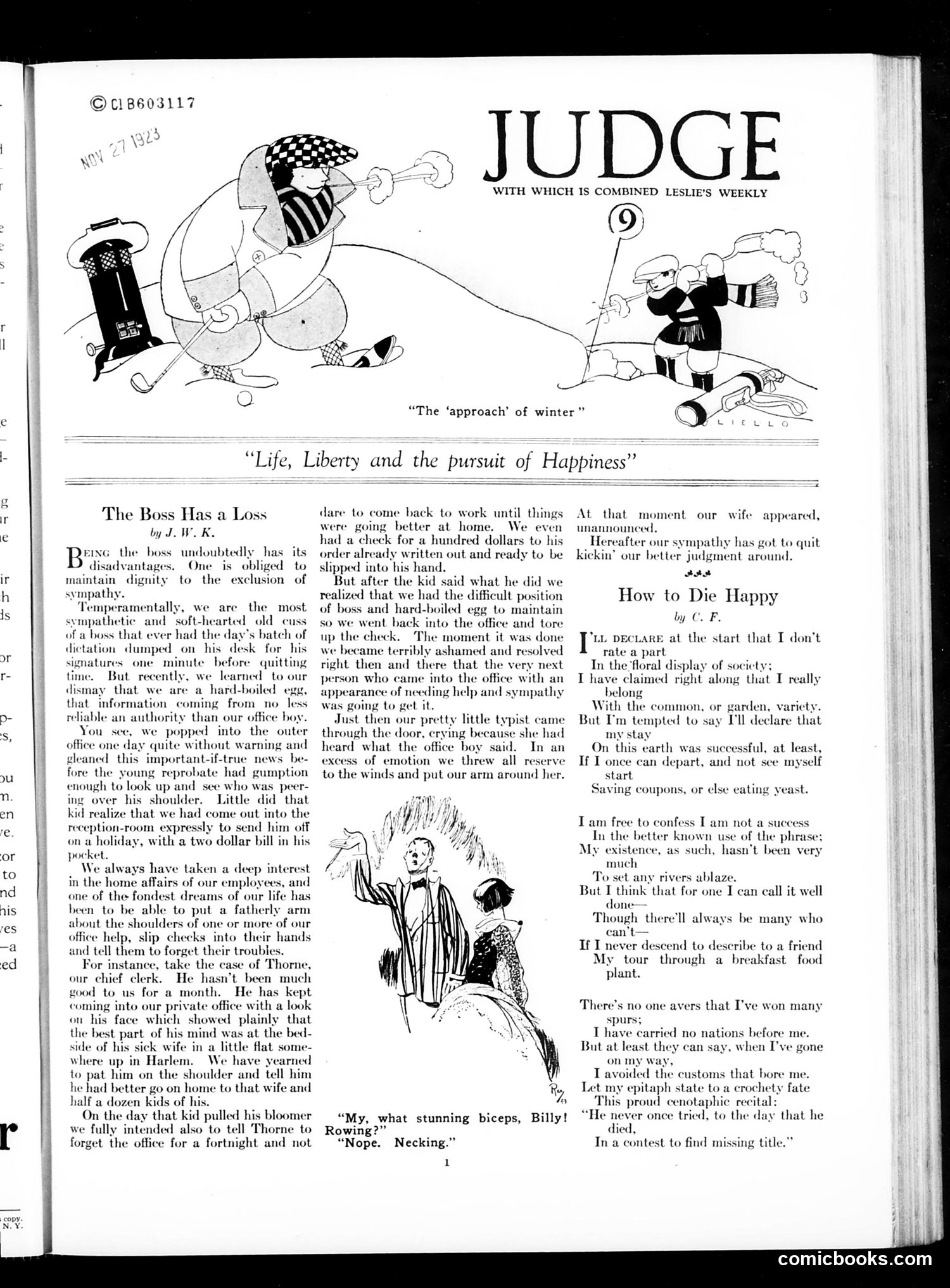
This 1925 Judge magazine page contains two distinct pieces: **"The Boss Has a Loss"** (left) is a humorous office story about workplace sympathy. When the boss's clerk loses money, the office staff unexpectedly rallies around him—suggesting even hard-nosed businessmen have soft hearts. **"How to Die Happy"** (right) is a satirical poem mocking social pretension and material success. The author declares happiness comes not from wealth or status ("I don't rate a part / In the local display of society") but from freedom, variety, and simple pleasures. The accompanying illustration shows a woman gesturing dramatically, emphasizing the poem's ironic tone about rejecting conventional ambitions. The top cartoon, "The approach of winter," depicts ice-fishing scenes—winter recreation imagery typical of Judge's seasonal humor. Together, these pieces reflect 1920s concerns about authenticity versus social climbing.
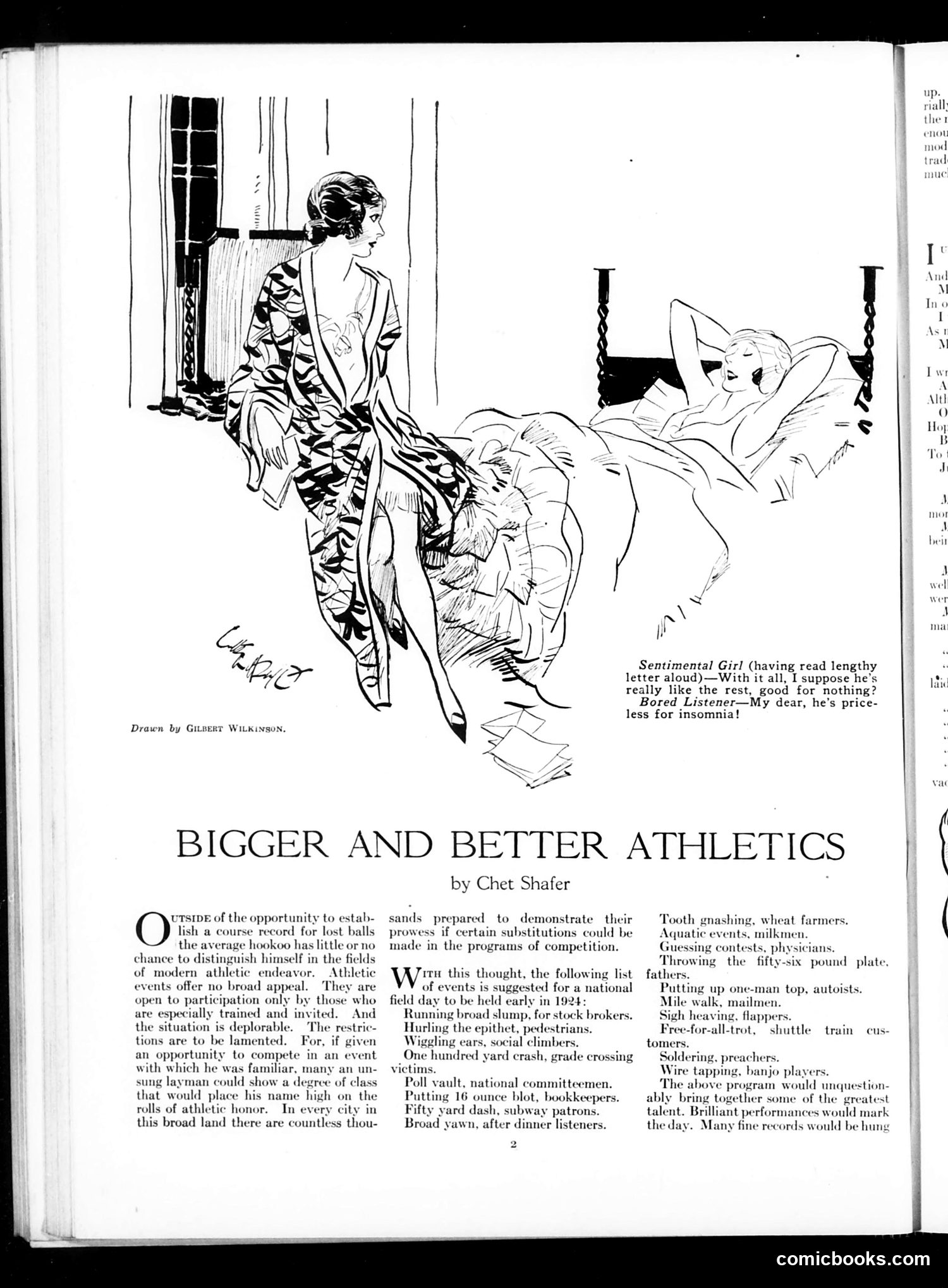
This page features an illustration by Gilbert Wilkinson depicting two figures in a bedroom scene—a woman reading aloud from a letter while a man lies in bed. The accompanying dialogue jokes that the letter's recipient is "priceless for insomnia," suggesting tediously boring correspondence. Below this is an article by Chet Shafer titled "Bigger and Better Athletics," proposing humorous new athletic events for a 1924 national field day. The suggestions are absurdist parodies of legitimate sports—replacing standard competitions with ridiculous activities like "tooth gnashing," "wiggling ears," and "broad yawn, after dinner listeners." The satire mocks both the era's athletic enthusiasm and the growing commercialization of amateur sports by suggesting increasingly absurd "competitions."
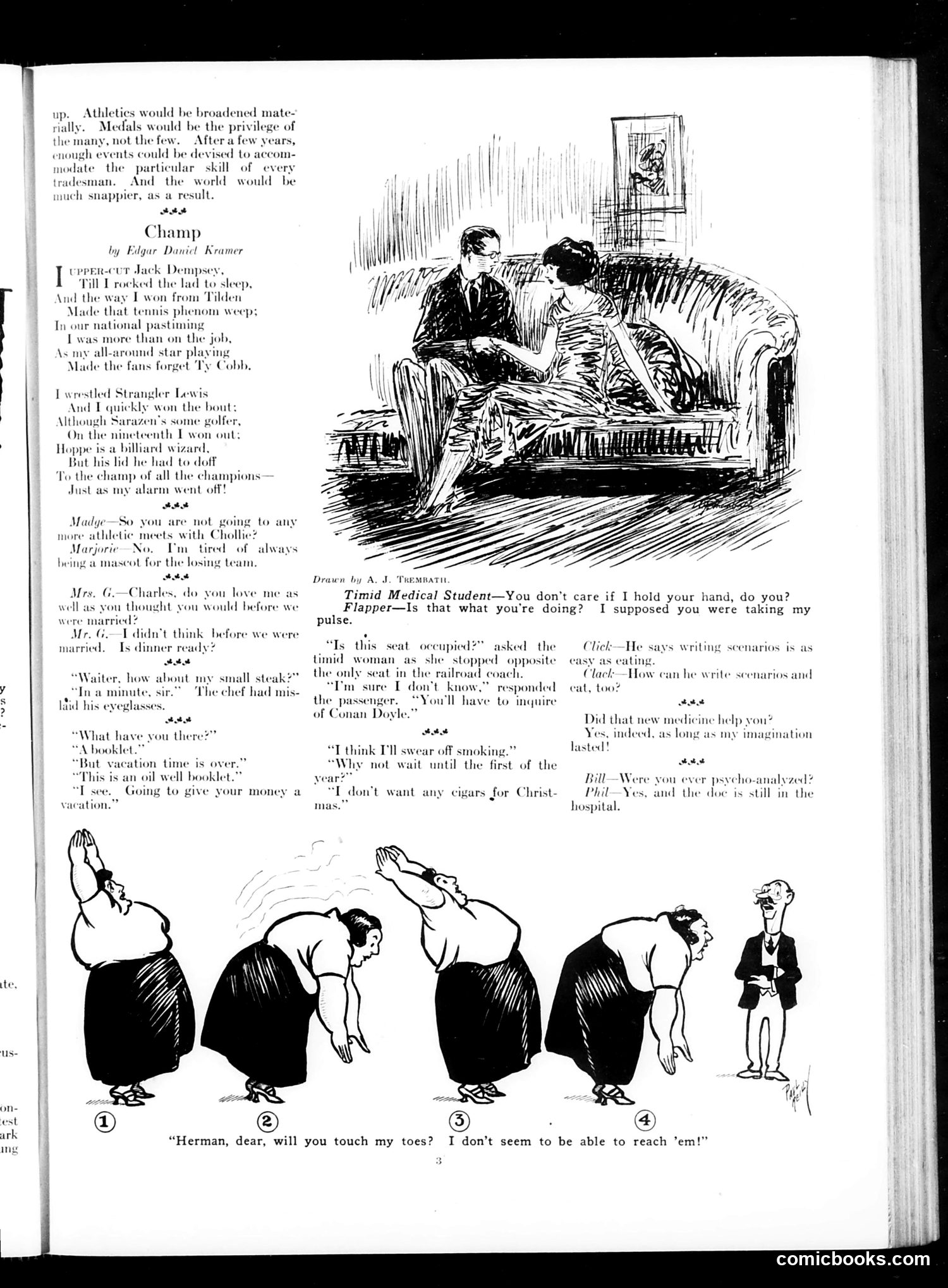
**Upper Section - "Champ" Poem:** This celebrates Jack Dempsey, the heavyweight boxing champion, crediting him with elevating boxing's status and making fans forget Ty Cobb (a baseball star). The poem contrasts Dempsey's athletic achievement with other entertainers. **Bottom Cartoon:** Four panels show a woman attempting to touch her toes in a flexibility exercise, progressively failing. The final panel reveals a thin man (Herman) observing that she "can't reach 'em." This is a body-shaming joke about female weight/body size, common to the era's crude humor standards. **Middle Dialogue Section:** Various brief conversational jokes about dating, marriage, and social situations—typical of Judge's humor format. The page reflects 1920s athletic celebrity culture and period attitudes toward women's bodies.
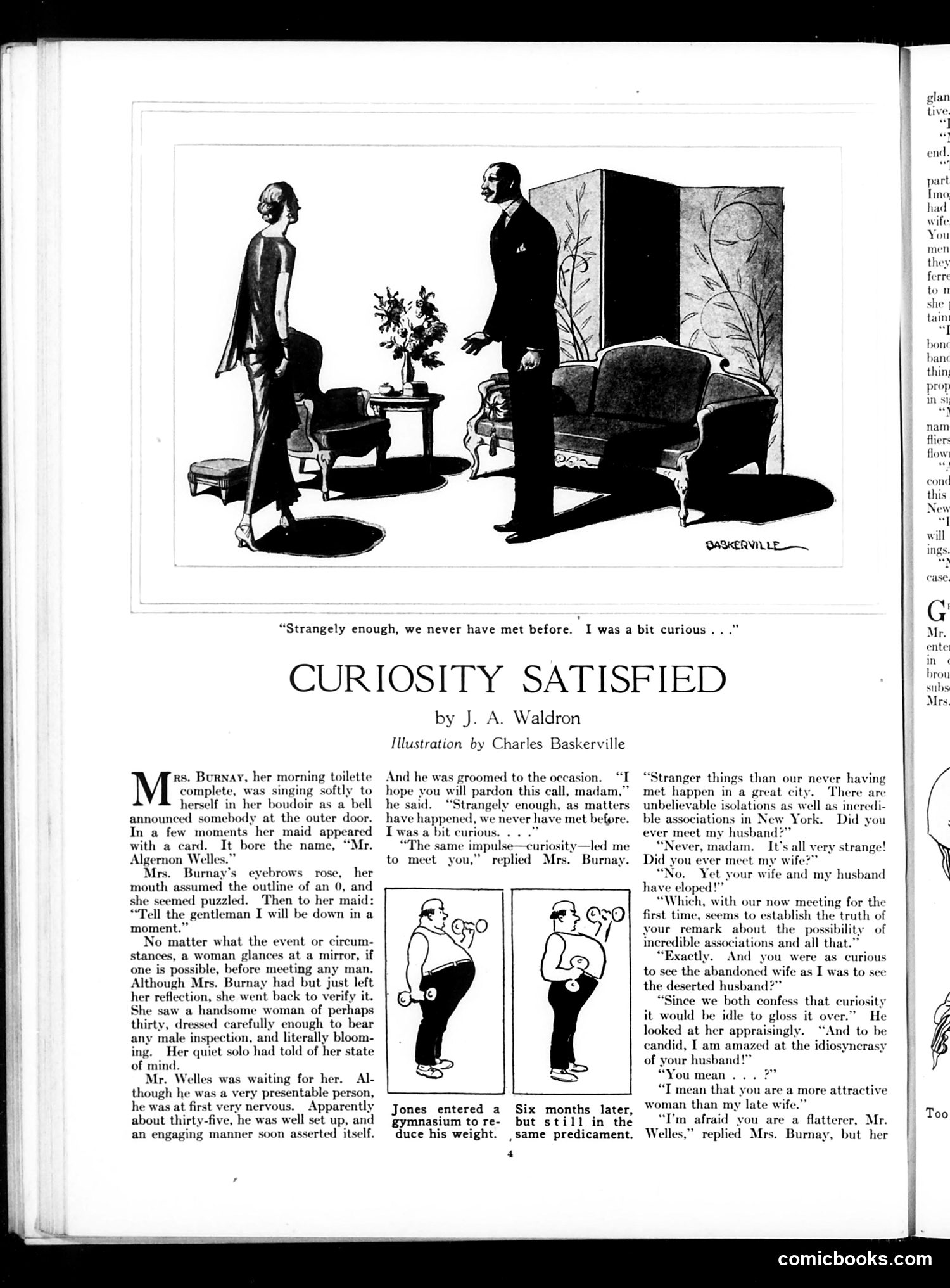
This is a humorous domestic fiction story illustrated by Charles Baskerville, not political satire. The narrative concerns Mrs. Burney, who encounters a well-dressed stranger at her door. Curious about his identity and purpose, she agrees to meet him—suspecting perhaps an affair or scandal. The story plays on the social anxieties of the era: unexpected male visitors, the appearance of impropriety, and mysterious circumstances disrupting domestic life. The stranger's explanation involves a coincidental meeting, establishing the humor through misdirected suspicion. The accompanying illustrations show the awkward social interaction between the parties. The broader theme satirizes how curiosity and imaginative gossip can create drama from innocent situations in urban society.
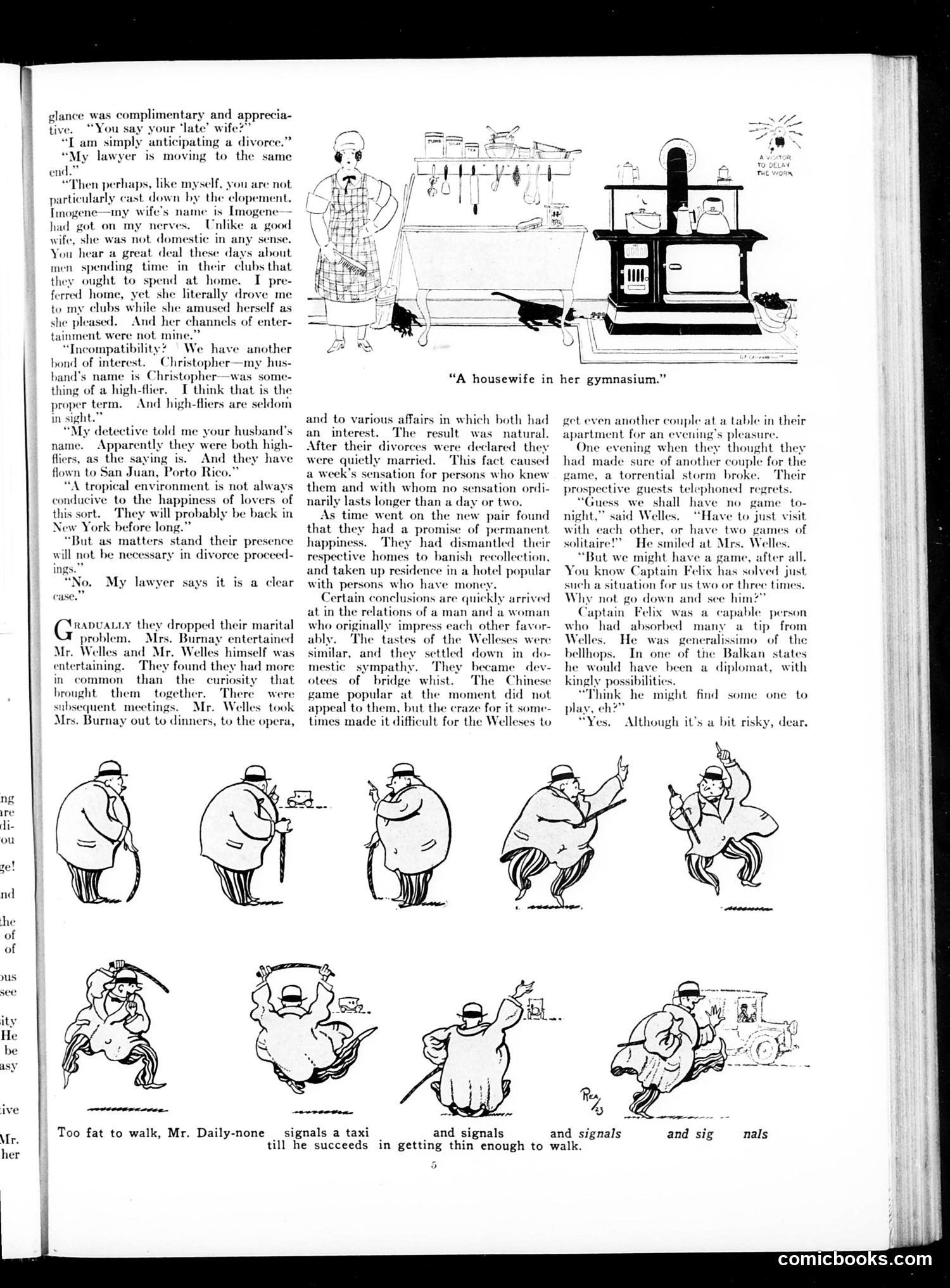
This page satirizes **easy divorce and remarriage among the wealthy leisure class** circa the 1910s-1920s. The text describes two couples—the Burnays and Welleses—who casually divorce their respective spouses (citing incompatibility and infidelity) and remarry each other. The satire targets how quickly scandal fades in society ("sensation for persons who knew them...ordinarily lasts longer than a day or two") and how the newly married couple settles into domestic contentment playing bridge whist. The **bottom cartoon series** mocks **"Mr. Daily-none,"** an overweight man too obese to walk, who must signal taxis repeatedly to move short distances. This appears to be social commentary on excess and physical consequence. The caption **"A housewife in her gymnasium"** (top right) likely satirizes women's new leisure activities and domestic modernity. The overall message: wealth insulates the elite from moral judgment, and their scandals are treated as entertainment rather than genuine moral failures.
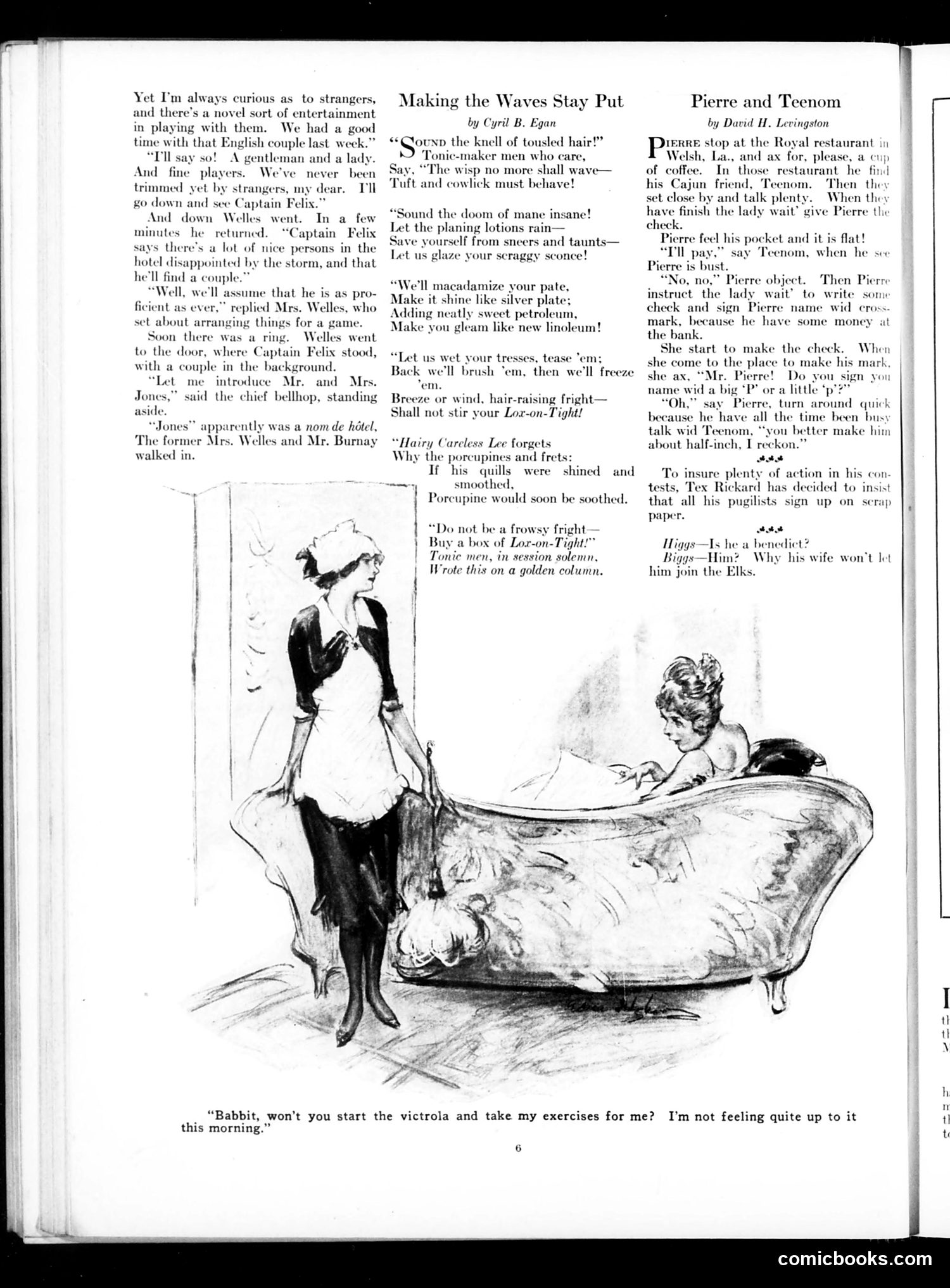
This page contains three separate satirical pieces typical of early 20th-century American humor magazines. **"Making the Waves Stay Put"** mocks hair-care products and advertising, presenting bombastic promotional language ("macadamize your pate," "gleam like new linoleum") for hair tonics that promise to permanently control unruly hair. The satire targets both the exaggerated claims of such products and the overwrought sales rhetoric. **"Pierre and Teenom"** appears to be a dialect humor piece featuring rural/ethnic characters (likely Cajun, based on "Welsh, La."), a common but now-problematic comedic format of the era. It depicts Pierre and Teenom in a restaurant scene involving a money problem and check-signing—the humor depending on character stereotypes and dialect speech patterns. **The bottom cartoon** illustrates a woman lounging while instructing "Rabbit" to start the phonograph and exercise for her—satirizing leisure-class indolence and possibly gender dynamics of the era. All reflect period attitudes toward advertising, ethnicity, and social class now considered dated or offensive.
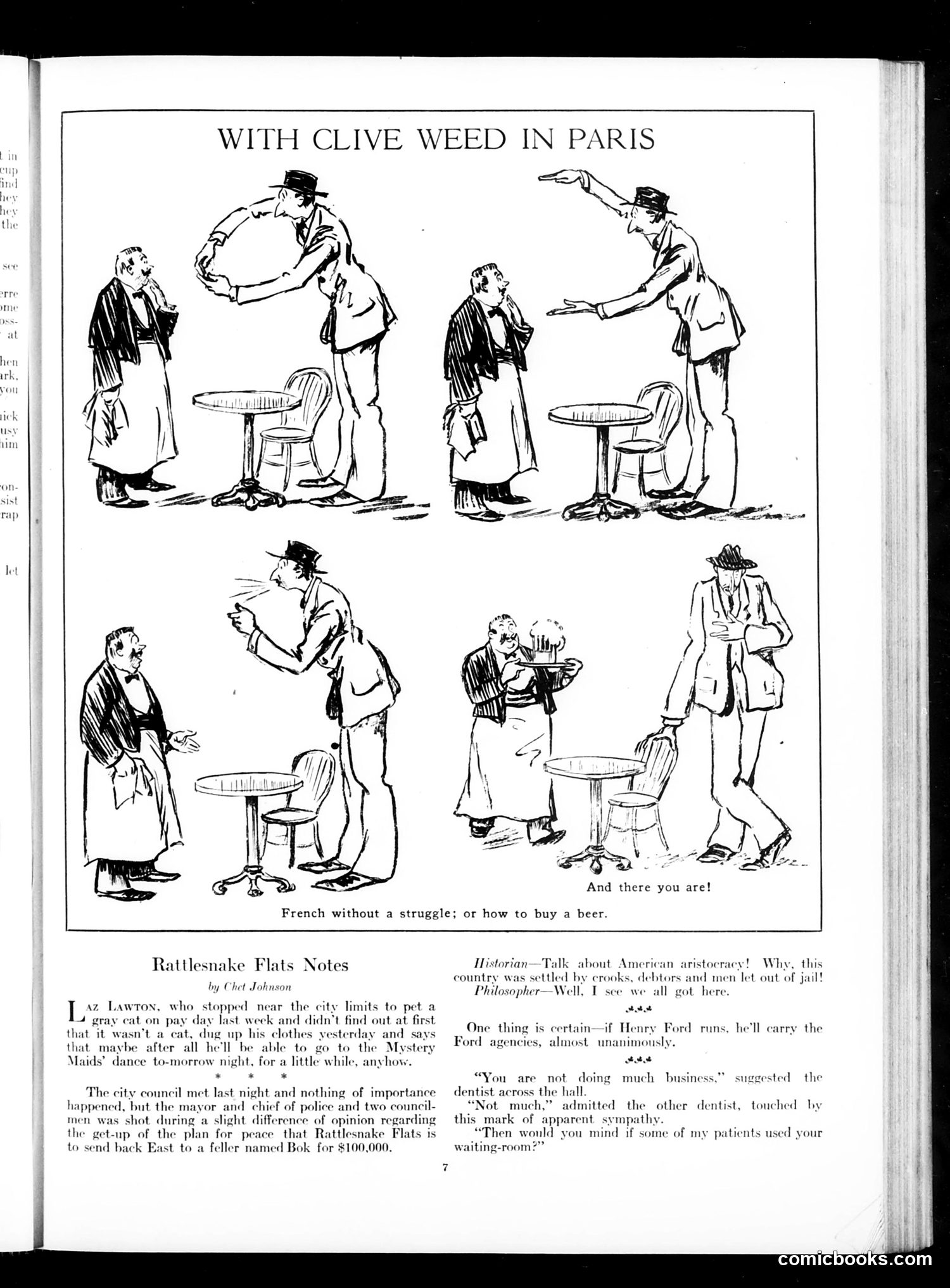
This is a **humorous instructional cartoon** depicting how to order a beer in Paris while speaking French "without a struggle." The four sequential panels show an increasingly exaggerated pantomime: a man first gestures with his hands to a waiter, then points emphatically, then acts out drinking motions, and finally receives his beer. The satire targets **American tourists' linguistic incompetence abroad**—mocking the stereotype that Americans traveling in France resort to physical gestures and charades rather than attempting the language. The caption's ironic phrase "without a struggle" undercuts itself; the cartoon shows considerable struggle. Below, the text includes separate satirical notes about American aristocracy (mocking pretense) and Henry Ford's political power (suggesting Ford dealerships would support him "almost unanimously"). The cartoonist is Chef Johnson. This reflects early 20th-century American anxieties about international travel and cultural sophistication.
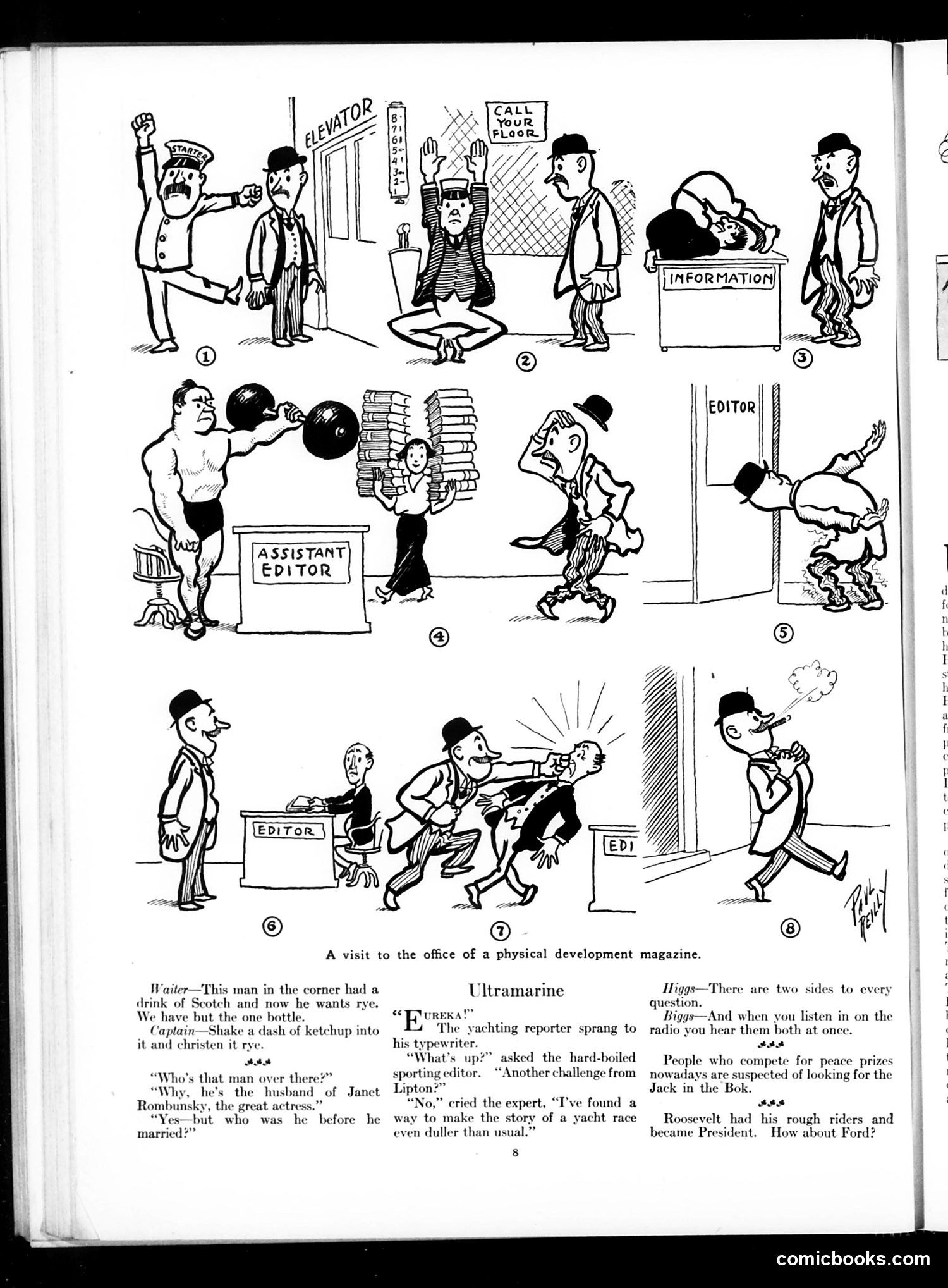
This eight-panel satirical comic mocks the chaos and incompetence at a magazine dedicated to physical fitness. The humor derives from the absurd behavior of staff members—an elevator operator striking dramatic poses, an assistant editor literally juggling heavy weights while managing submissions, and an editor being physically thrown out by visitors. The accompanying text jokes reference contemporary figures: Janet Rombunsky (an actress), Roosevelt's "rough riders," and Ford, likely Henry Ford. The "Ultramarine" and "Eureka" columns contain satirical observations about society's contradictions—mixing drinks poorly, finding hypocrisy in peace-prize seekers, and radio broadcasts presenting both sides of arguments simultaneously. The overall point: magazines promoting physical development are run by chaotic, physically incompetent staff—a visual contradiction underscoring the satire about American business inefficiency and pretense.
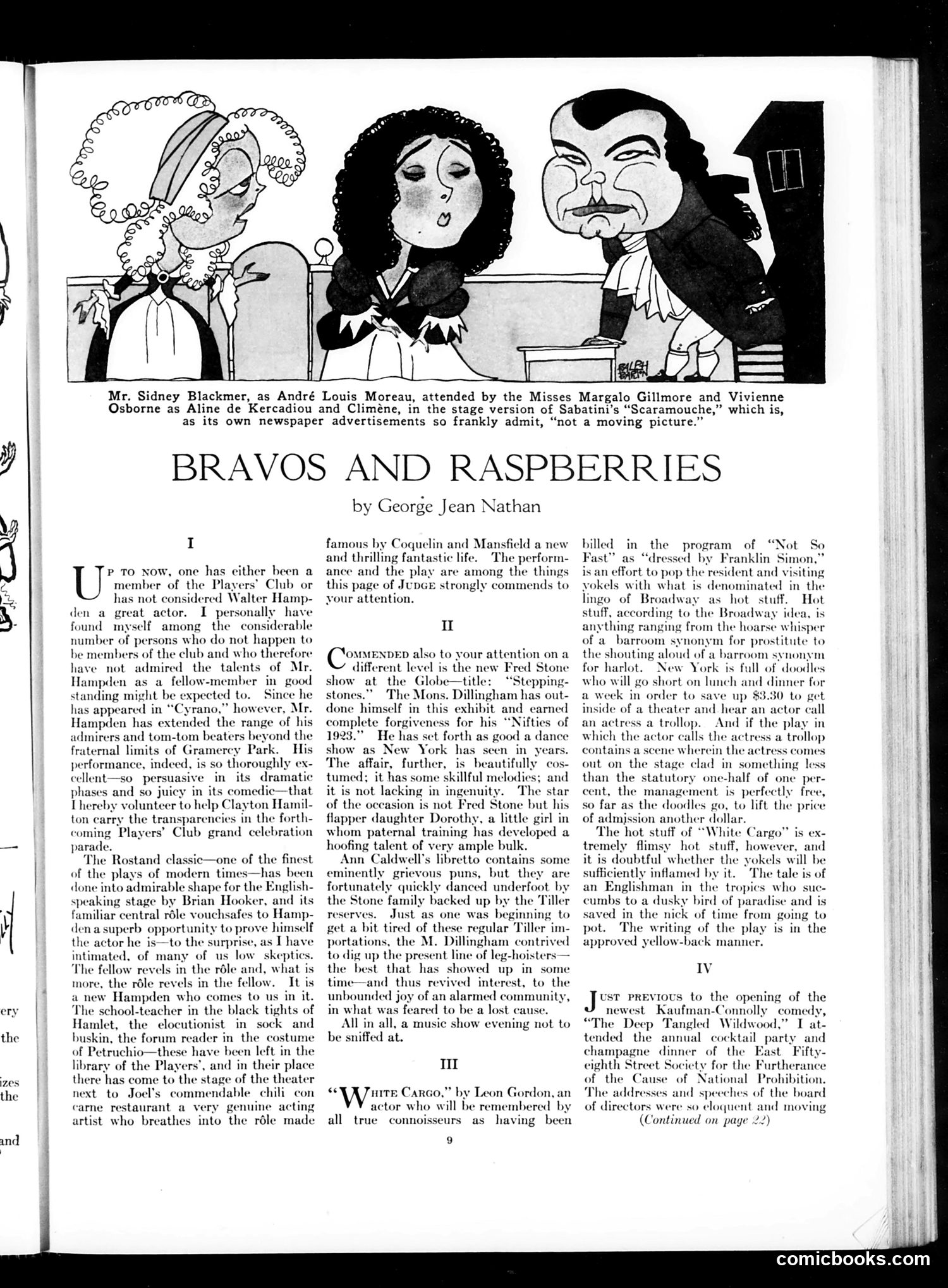
This page reviews theatrical productions from the 1920s. The cartoon at top caricatures **Sidney Blackmer** and actresses **Margalo Gillmore** and **Vivienne Osborne** in the stage adaptation of *Scaramouche*—with a satirical jab that the advertisement ironically admits it's "not a moving picture" (implying stage versions were inferior to or competing with film). The text reviews three shows: 1. **Walter Hampden in *Cyrano de Bergerac***: Nathan praises Hampden's performance, noting this outsider to the exclusive Players' Club has won over even skeptics through genuine artistry. 2. **Fred Stone in *Stepping Stones*** at the Globe: Commended for skillful dancing and choreography, though the real star is Stone's daughter Dorothy, whose "ample bulk" of talent overshadows her father. 3. ***White Cargo*** by Leon Gordon: Dismissed as sensationalist "hot stuff" designed for unsophisticated audiences. The page exemplifies Judge's theatrical criticism—witty, snobbish, and concerned with artistic merit versus commercial pandering.
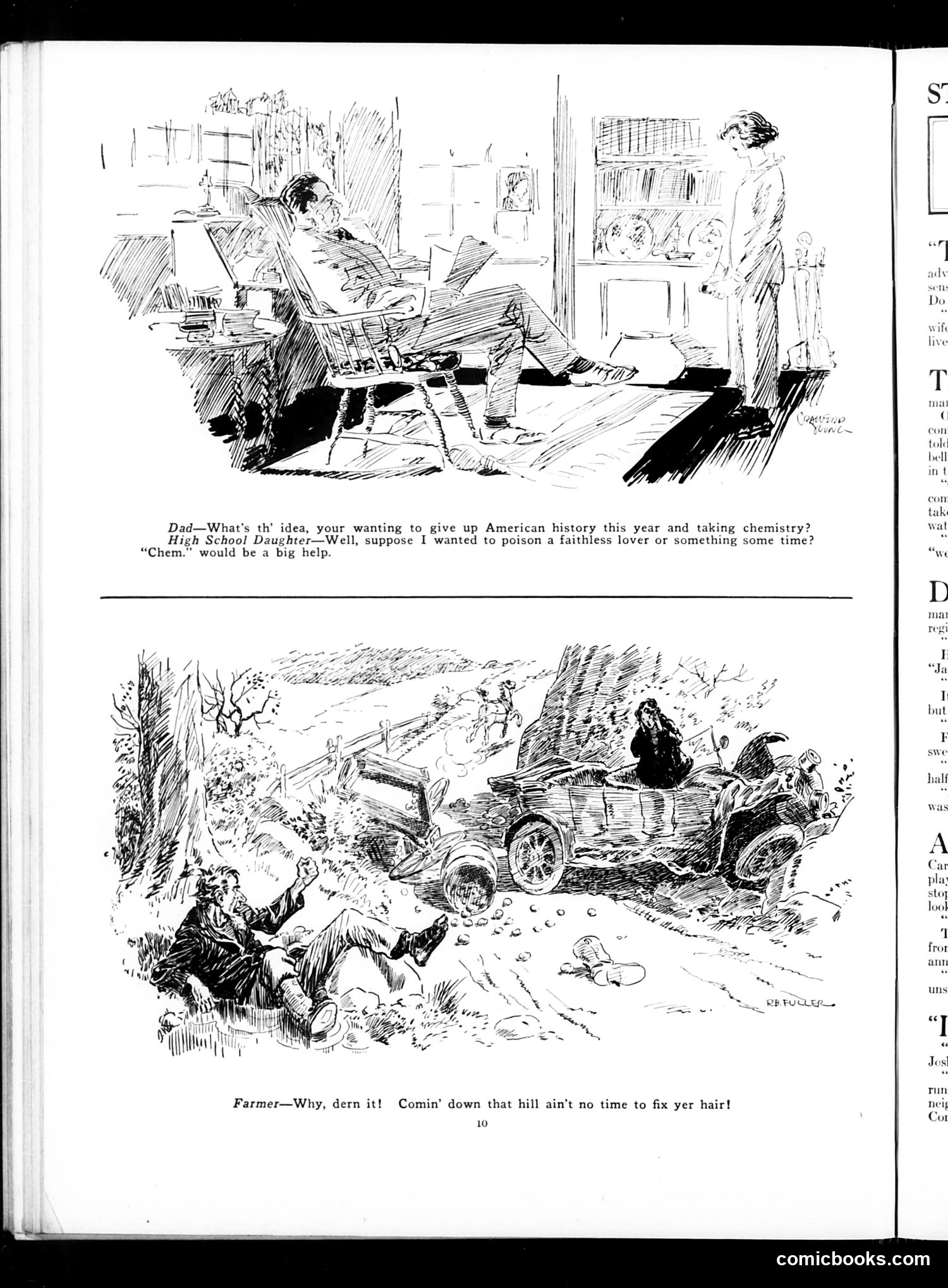
This page contains two satirical comics typical of early 20th-century American humor: **Top cartoon**: A father questions his high school daughter about dropping American history for chemistry. She quips that chemistry would be useful for "poisoning a faithless lover." The joke satirizes young women's romantic anxieties and their practical, if darkly humorous, approach to education—suggesting girls prioritize boyfriend troubles over academic subjects traditionally considered important. **Bottom cartoon**: A farmer shouts at a woman in a car speeding down a hill, telling her this is no time to "fix yer hair." The humor contrasts rural values (safety, practicality) with urban modernity—specifically women's newfound freedom via automobiles and their perceived vanity about appearance, suggesting reckless driving caused by preoccupation with grooming. Both comics mock changing social norms, particularly young women's independence and unconventional priorities in the early automobile age.
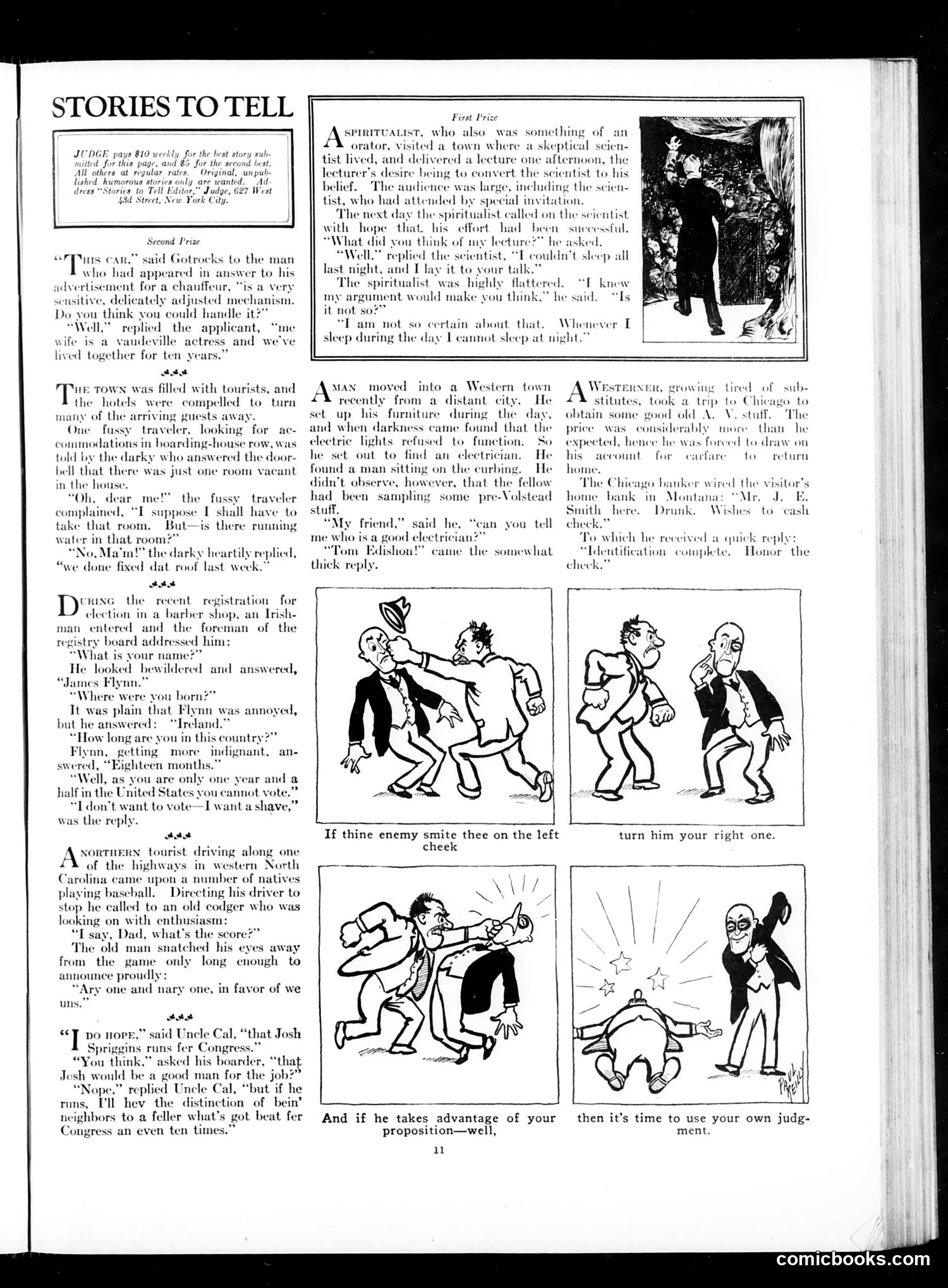
This page from *Judge* magazine contains several short humorous stories exploiting period stereotypes: 1. **The Chauffeur Story**: A wealthy man ("Gotrocks") tests a job applicant's reliability by praising his sensitive car. The applicant's response—that he's managed a vaudeville actress wife for ten years—suggests handling difficult temperaments makes him qualified. 2. **The Racist "Darky" Stories**: Multiple anecdotes mock African American dialect and intelligence (the boarding house keeper claiming a "fixed" roof), and Irish immigrants (the voter registration scene where an Irishman named Flynn confuses voting registration with getting a haircut). 3. **Regional Humor**: Jokes about rural Southerners' grammar ("in favor of we uns") and backwoods naïveté. 4. **Prohibition-Era Reference**: The story about "pre-Volstead stuff" refers to alcohol, illegal under Prohibition (1920-1933). 5. **The Spiritualist Cartoon**: A scientist attends a spiritualist lecture; when the spiritualist asks his opinion, the scientist replies he couldn't sleep—implying the lecture was boring, not spiritually convincing. The illustrations show slapstick violence accompanying biblical references to "turning the other cheek."
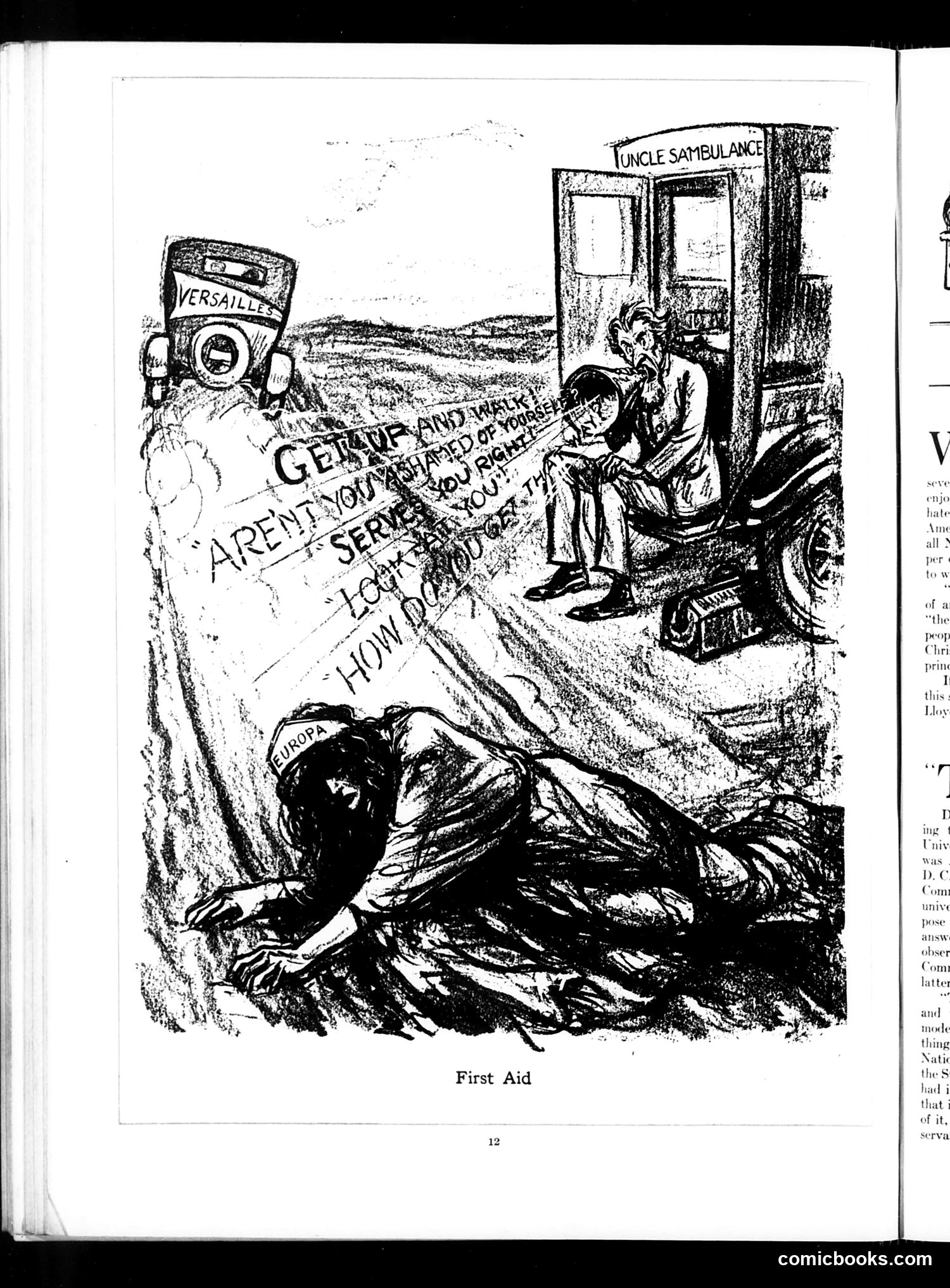
This political cartoon satirizes American neutrality during World War I. The figure labeled "Europa" (Europe) lies wounded on the ground. An ambulance labeled "Uncle Sambulance" arrives, while a man (representing the United States) stands hesitantly at the door marked "Genuine and Careful Service." The text on the ambulance reads: "Aren't you glad of yourself—how do you right yourself?" The satire critiques America's reluctance to enter the war despite European suffering. The "first aid" reference is ironic—the ambulance is present but hesitant to actually help. This reflects the American debate over intervention during the conflict, before the U.S. officially entered in 1917.
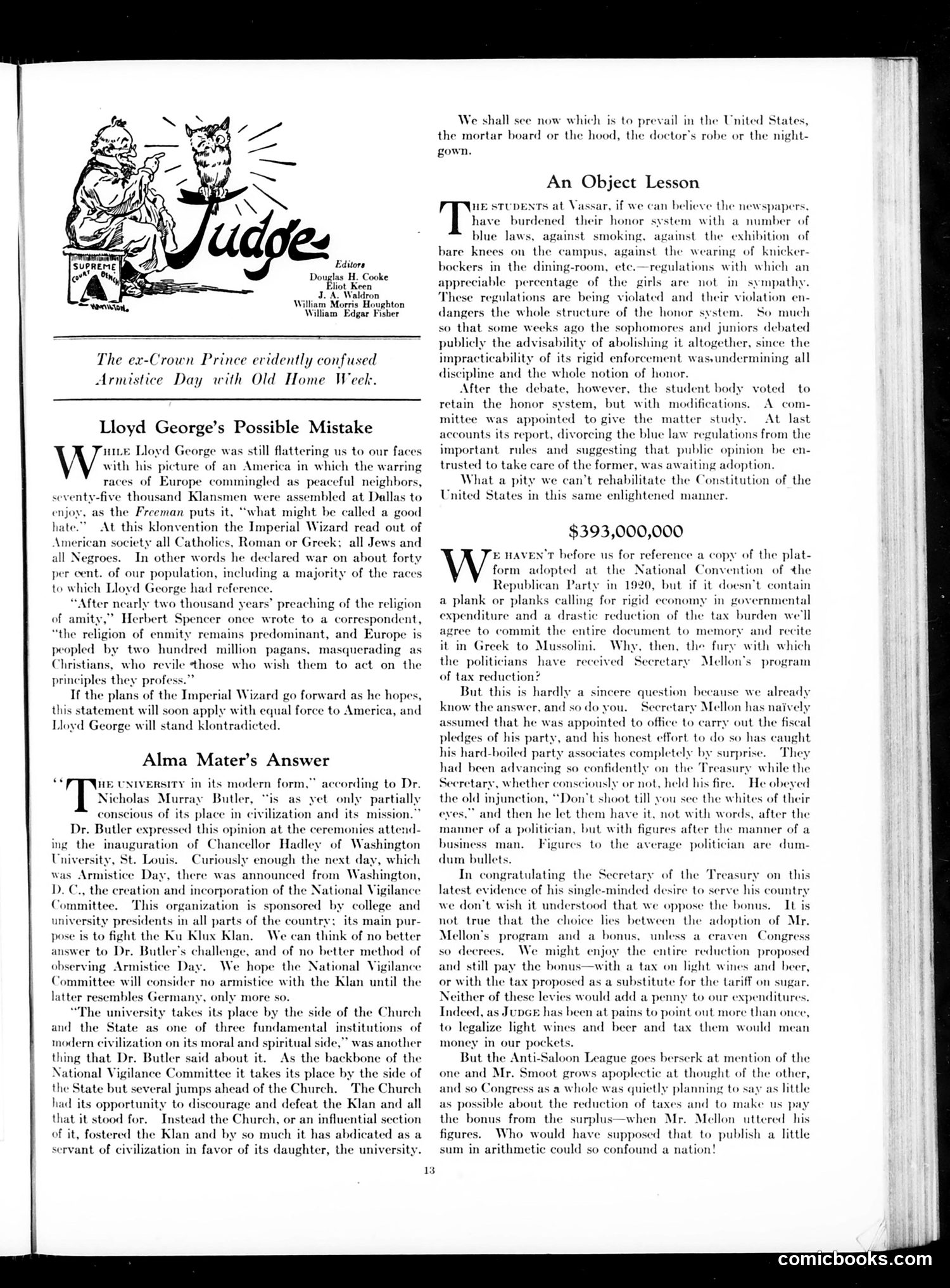
This page contains three political commentaries from the 1920s: **"Lloyd George's Possible Mistake"** criticizes British Prime Minister Lloyd George for praising American peace while the KKK simultaneously held a massive rally in Dallas, explicitly excluding Catholics, Jews, and Black Americans from "American society." The satire highlights the hypocrisy: Lloyd George's vision of harmonious post-WWI nations contradicts the reality of organized American bigotry targeting 40% of the population. **"Alma Mater's Answer"** praises universities for establishing the National Vigilance Committee to fight the KKK, positioning education as civilization's moral defender—surpassing even the Church, which had failed to oppose the Klan. **"An Object Lesson"** (partial) discusses Vassar College's honor system being undermined by students violating strict rules about smoking and dress codes, suggesting rigid regulations weaken rather than strengthen institutional integrity. All three pieces reflect 1920s anxiety about American values: immigration, religious tolerance, institutional authority, and social change.
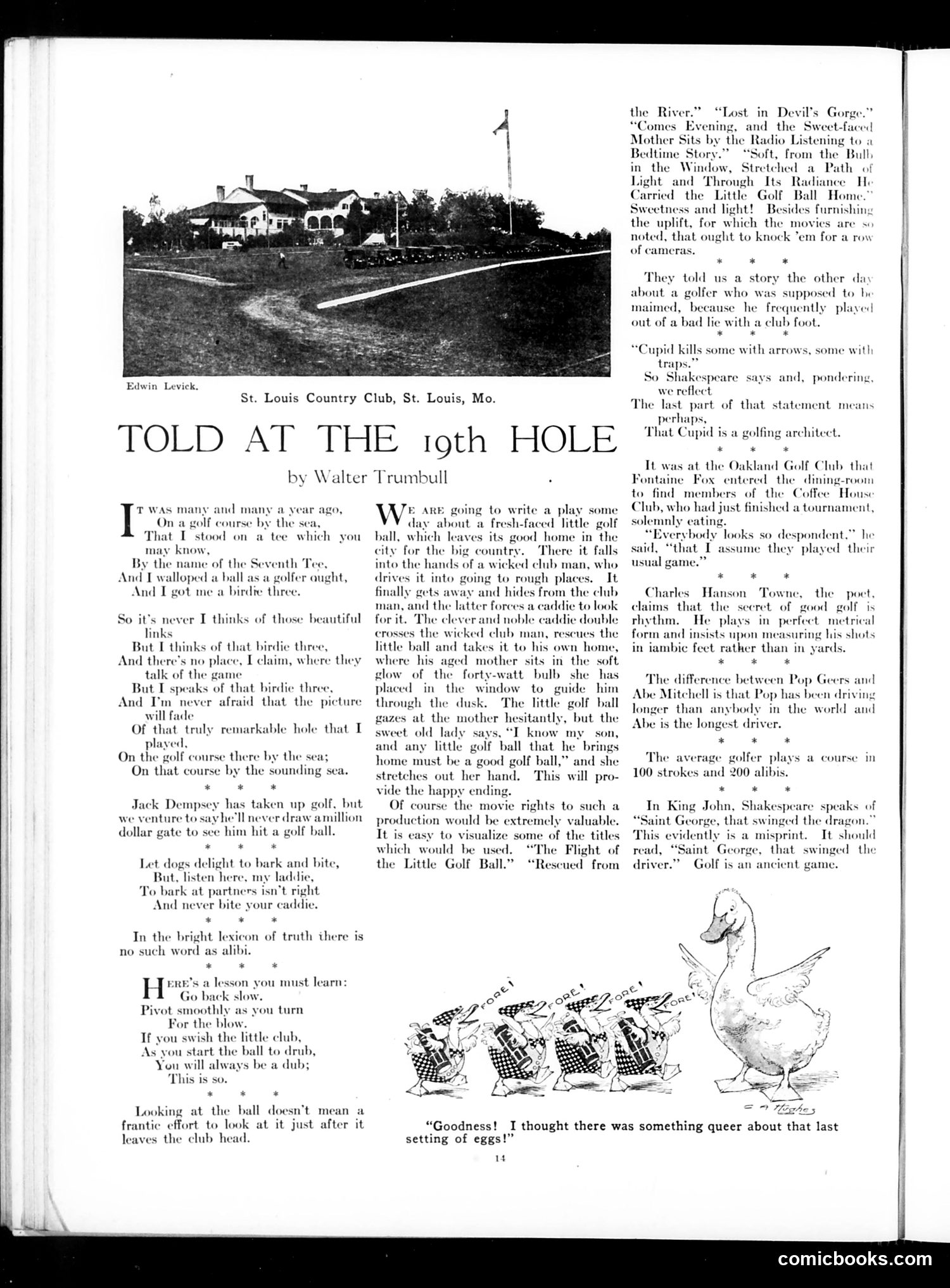
This is a humorous prose and verse piece about golf, not political satire. Walter Trumbull's article consists of golf anecdotes and jokes centered around the 19th hole (the clubhouse, where golfers gather after finishing). The humor is social rather than political: golf etiquette lessons (don't bite your caddie), gentle mockery of golf obsession (a man who won't stop talking about his birdie from years ago), and wordplay involving famous figures. References include poet Charles Hanson Towne's theory that good golf requires "rhythm" measured in "iambic feet," and cartoonist Fontaine Fox's observation about tournament players looking depressed. The small cartoon shows a mother goose with goslings, illustrating a joke about golf balls being "fresh-faced" like eggs—a visual pun on the phrase "setting of eggs." This reflects early 20th-century upper-class leisure culture rather than political commentary.
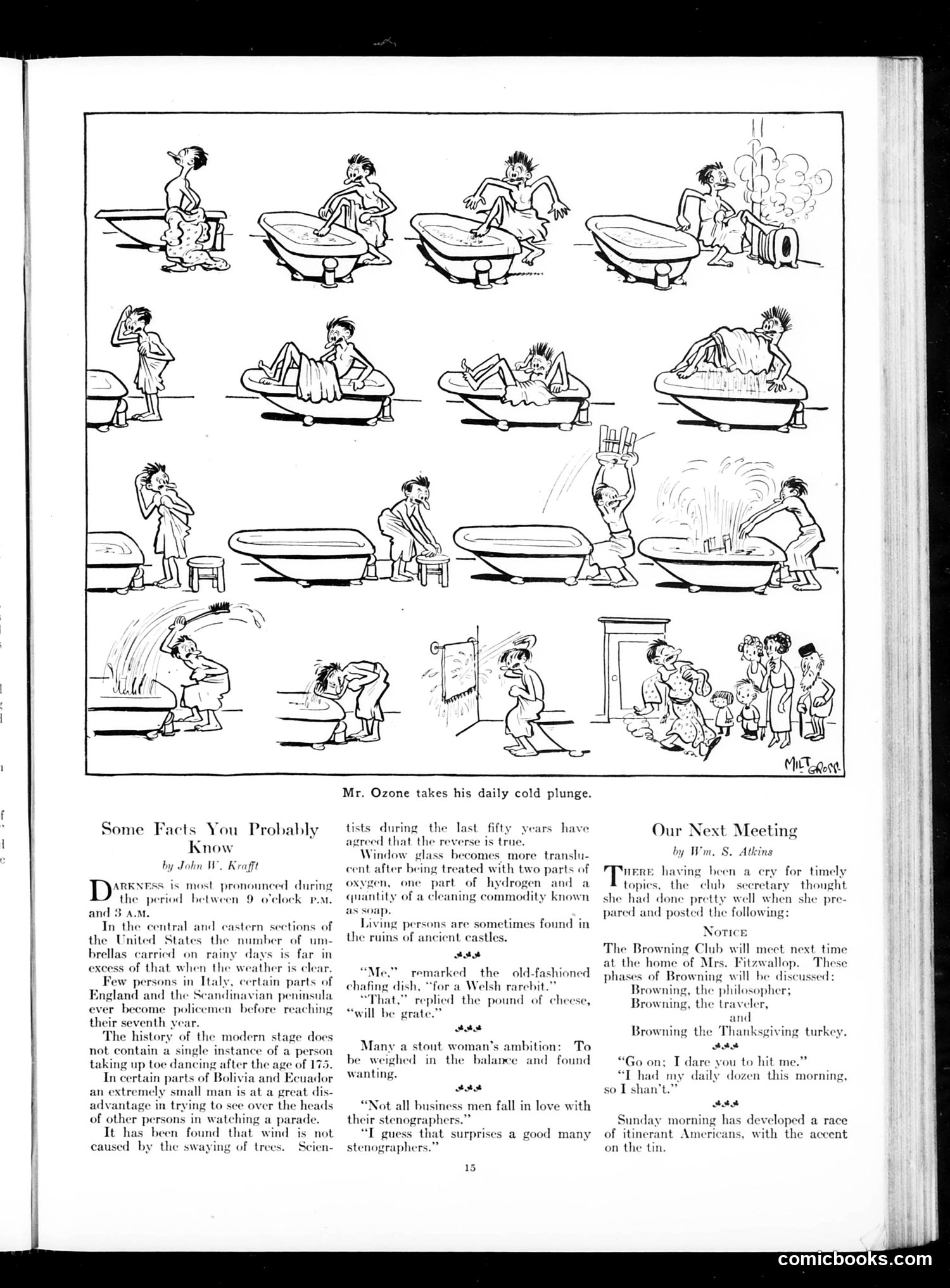
This page contains humor columns and a comic strip rather than political satire. **The Comic Strip** ("Mr. Ozone takes his daily cold plunge"): A sequential visual gag showing a man attempting a cold bath routine, progressively failing—he can't seem to complete the task, ending with his family dragging him away. It's physical comedy about resisting uncomfortable health practices. **The Text Columns** are comedic pieces: - "Some Facts You Probably Know" presents absurd pseudo-scientific observations (e.g., "wind is not caused by swaying trees," umbrellas serve no purpose in clear weather) as mock-serious "facts" - "Our Next Meeting" jokes about a book club's mundane meeting notice that hilariously includes "Browning the Thanksgiving turkey" alongside legitimate Browning scholarship topics - Brief quips mock stenographers, stout women, and Sunday morning routines The page relies on wordplay, non-sequiturs, and gentle social observation rather than pointed political commentary—typical light satirical humor for early-to-mid 20th century American magazines.
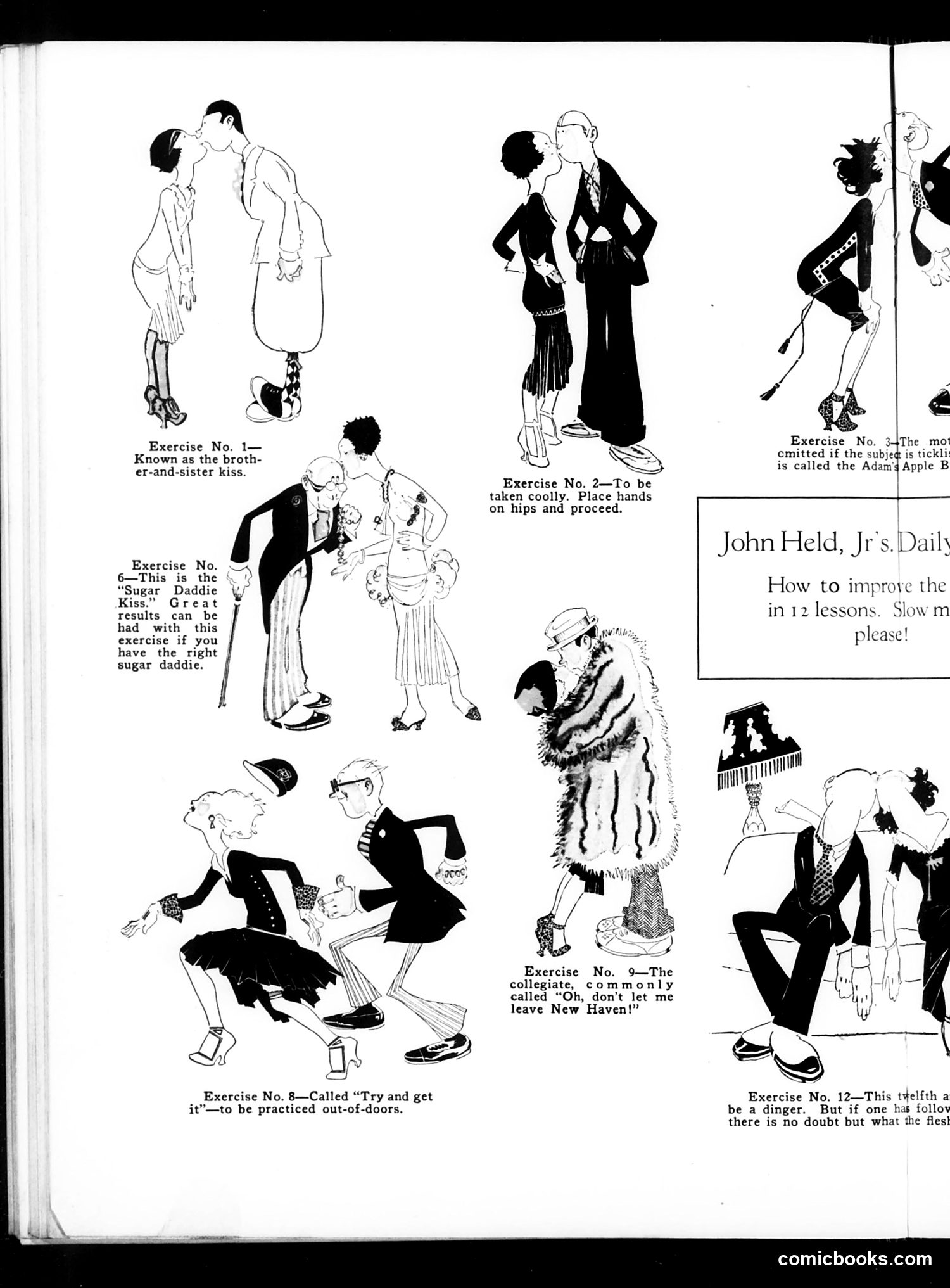
This is a humorous instructional page by John Held Jr., a prominent Jazz Age cartoonist, satirizing 1920s dating and kissing culture. The twelve "exercises" mock contemporary romance through exaggerated scenarios: - Exercise 1 references incestuous intimacy with dark humor - Exercise 6 satirizes "sugar daddy" relationships (older wealthy men supporting younger women) - Exercise 9 jokes about Yale students' reluctance to leave New Haven, likely referencing college romance traditions - Exercise 8 ("Try and get it") mocks the chase dynamic in courtship - Exercise 12 appears incomplete but promises scandalous content The drawings showcase Held's characteristic flapper-era style with stylized figures in period clothing. The satire targets 1920s dating conventions—transactional relationships, college romance, and the sexually liberated "modern" youth culture that scandalized older generations. The tone is lighthearted social commentary on contemporary morality and courtship rituals.
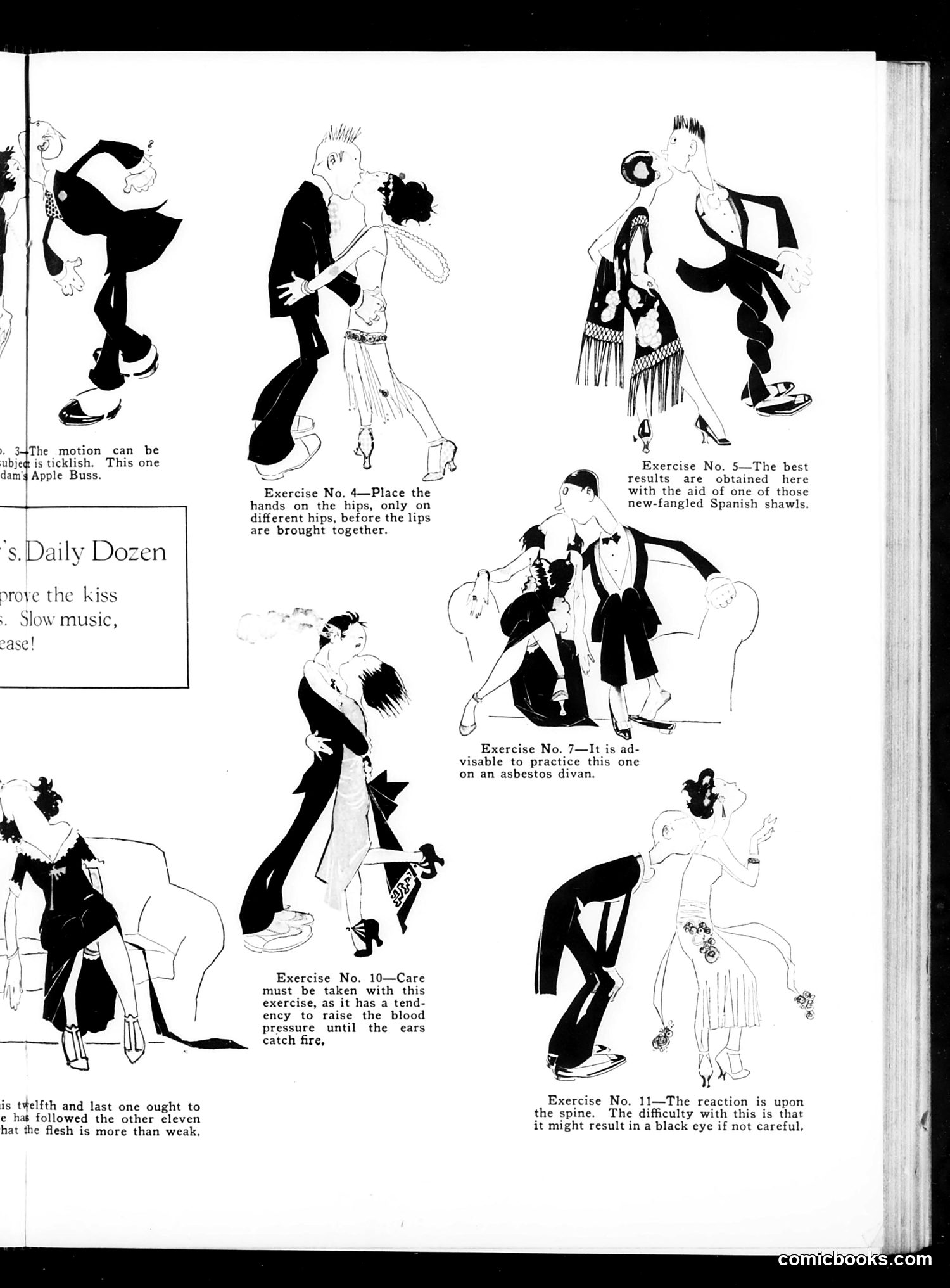
This page satirizes the popular "Daily Dozen" fitness routine (a 1920s exercise craze). Rather than legitimate calisthenics, it presents absurd "exercises" for kissing and romantic physical contact between couples. The humor targets the era's obsession with systematizing everything—even romance and intimacy—into numbered, instructional routines. References to "Spanish shawls," "asbestos divans," and warnings about "black eyes" mock the exercise format's clinical tone while describing increasingly risky or compromising situations. The satirical point: modern life has become so regimented and mechanized that even spontaneous romantic gestures are reduced to formulaic steps. The cartoonist ridicules both the original fitness craze's mechanical approach to health *and* the superficiality of 1920s courtship rituals among the fashionable set depicted here.
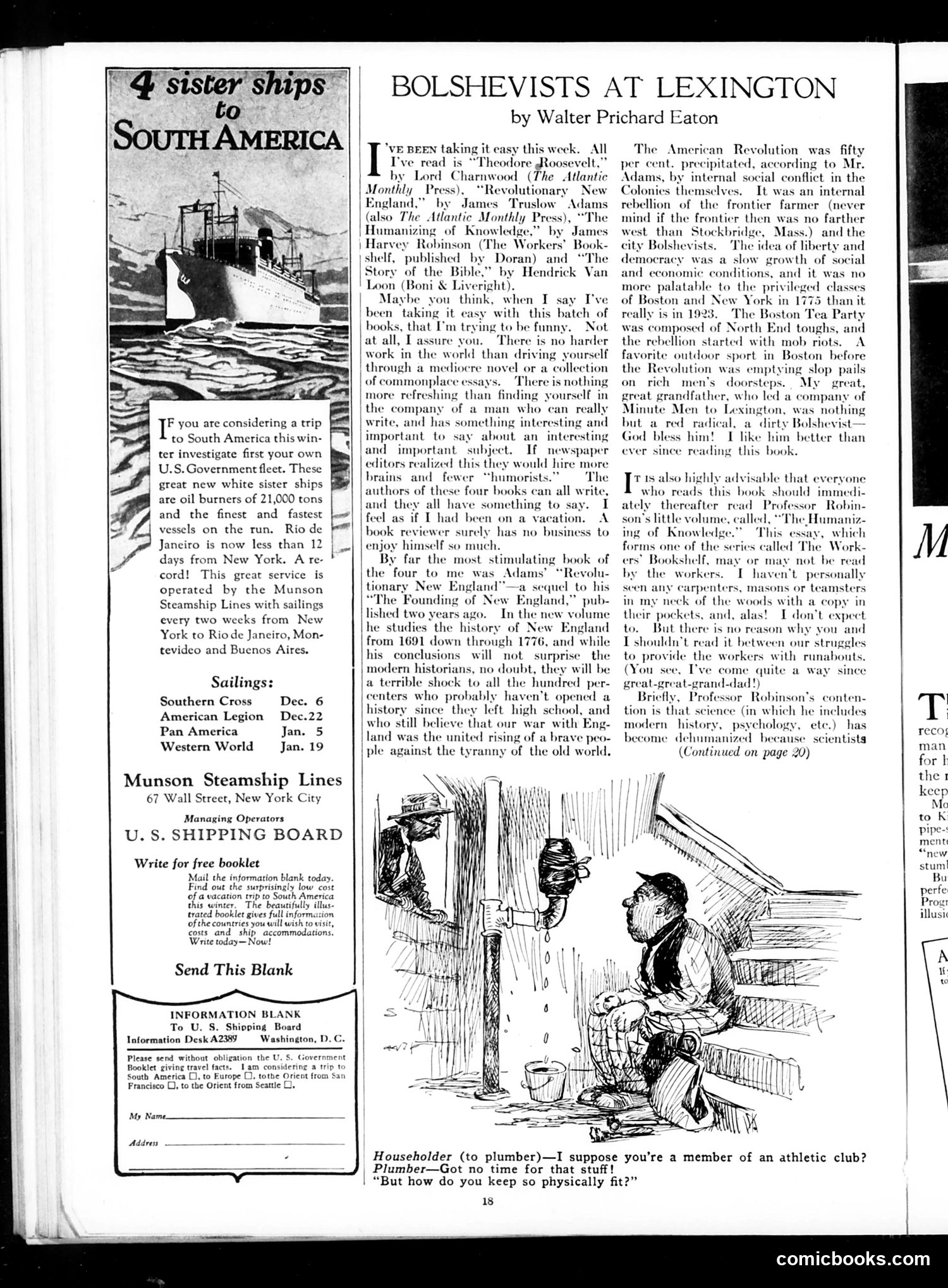
This page contains **two distinct elements**: a shipping advertisement and a book review essay. **The Advertisement** (left side) promotes U.S. government-operated steamships to South America, emphasizing their speed and luxury as tourism draws. **The Essay** (right side) by Walter Prichard Eaton reviews books about American history, particularly James Truslow Adams' *Revolutionary New England*. Eaton's key argument is provocative: the American Revolution wasn't simply colonists unified against British tyranny, but rather an **internal class conflict**. He argues it was a "rebellion of the frontier farmer" against "city Bolshevists" (wealthy urban elites). Eaton draws a parallel to his own time, noting that in 1775—like in the present (post-WWI era)—democracy and liberty were unpopular with Boston and New York's privileged classes. **The cartoon** below shows a plumber refusing an athletic club member's suggestion to join, illustrating working-class dismissal of elite recreational culture. Together, these pieces reflect 1920s anxieties about class conflict and whether America's founding ideals truly represented universal equality or elite interests.
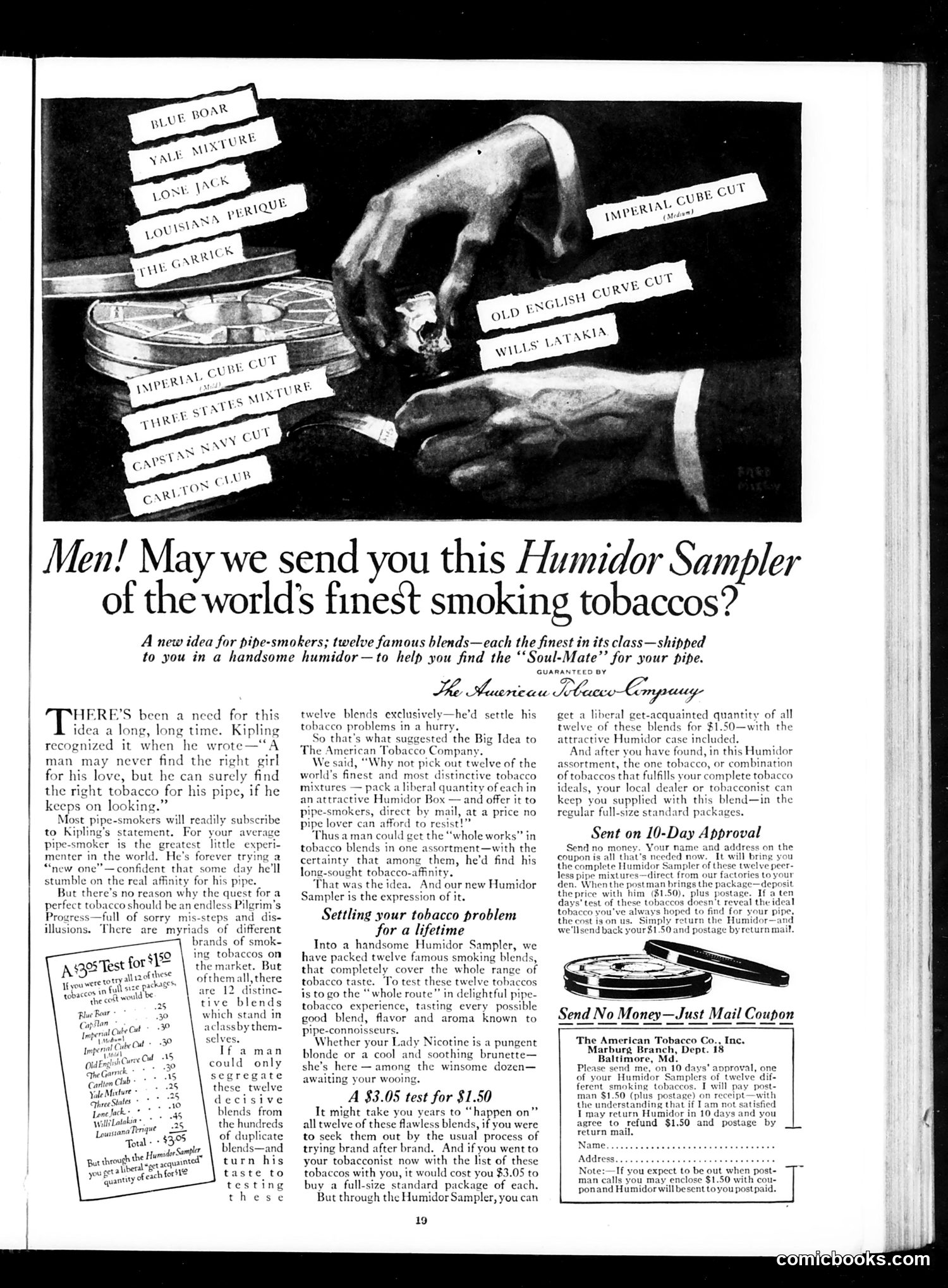
This is a **tobacco advertisement**, not political satire. The American Tobacco Company marketed a "Humidor Sampler"—a mail-order box containing twelve different pipe tobacco blends for $1.50. The ad's central appeal uses a **Kipling quotation** comparing finding "the right tobacco" to finding "the right girl," framing tobacco selection as a romantic quest. The image shows a man's hands examining tobacco samples from the humidor box, emphasizing the sensory experience of selection. The marketing strategy leverages consumer frustration: pipe-smokers endlessly experiment trying different brands. The sampler promises to solve this "problem for a lifetime" by offering twelve representative blends—normally costing $3.05—at a discount with a 10-day trial period. This reflects **early 20th-century mail-order marketing** and aggressive tobacco industry promotion. The gendered language ("Lady Nicotine") and extensive sales copy are typical of period advertising, before modern tobacco regulation.
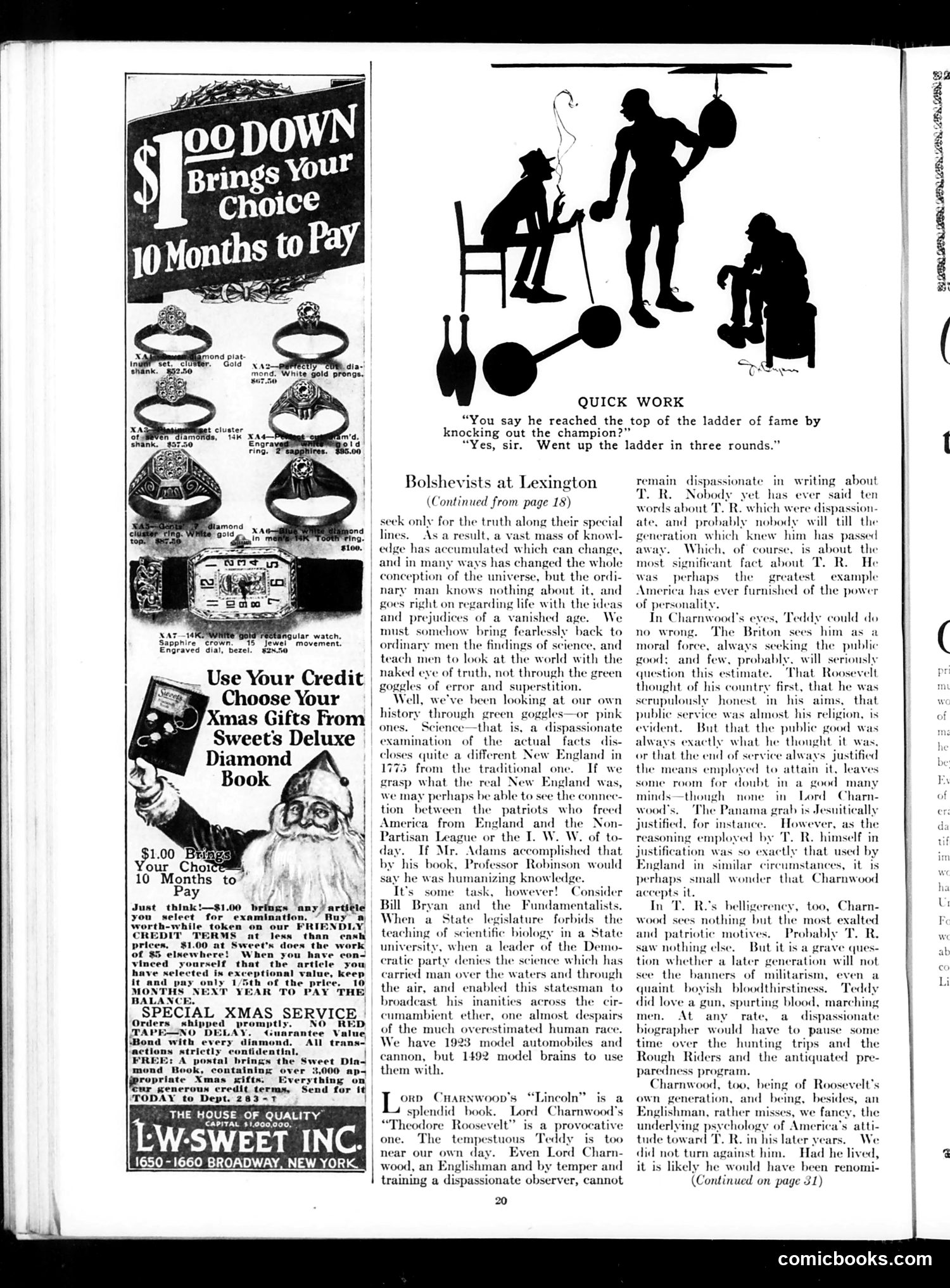
This page contains primarily **advertising and literary commentary**, not political cartoons. The small cartoon at top ("Quick Work") is a simple joke: a man climbs a ladder in "three rounds," punning on boxing terminology—unremarkable humor. The substantive content is a **book review essay titled "Bolshevists at Lexington,"** discussing how Americans cling to outdated beliefs despite scientific progress. The author criticizes William Jennings Bryan and "Fundamentalists" for opposing the teaching of evolutionary biology in universities, comparing their 1920s-era thinking to 1492-era "brains" despite modern technology. The essay also reviews Lord Charnwood's biographies of Lincoln and Theodore Roosevelt, praising Roosevelt's moral intentions while questioning whether his ends justified his means (referencing the Panama Canal seizure as ethically dubious). **Context**: This reflects 1920s American anxieties about science versus religious tradition, and debates over T.R.'s imperialist foreign policy—concerns now historical but the tension between faith and empiricism remains resonant.
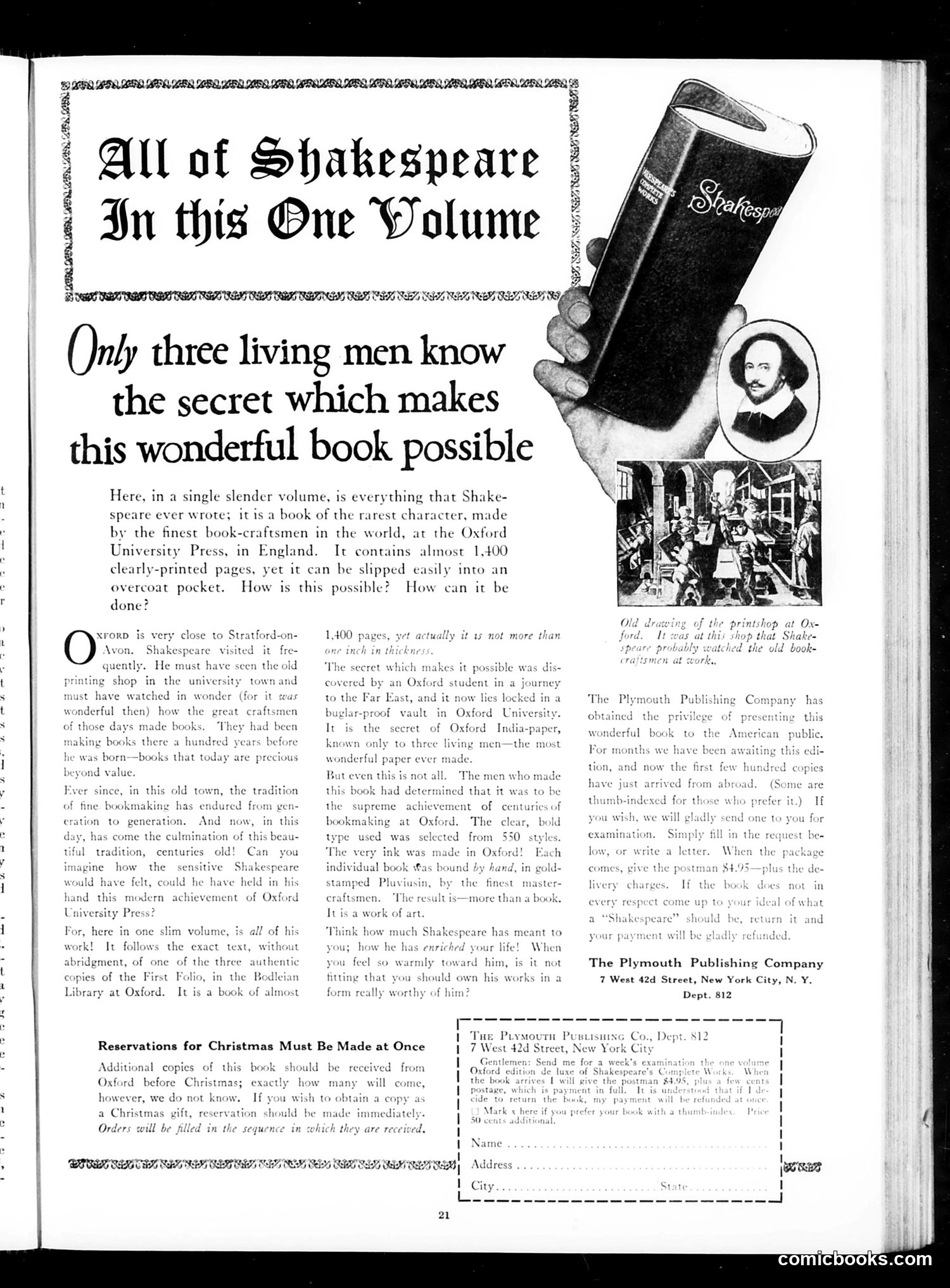
This is primarily a **product advertisement**, not a political cartoon. It promotes a complete Shakespeare collection published by Plymouth Publishing Company/Oxford University Press. The "secret" the headline teases is simply the book's innovative engineering: Oxford's use of thin India paper allows nearly 1,400 pages to fit in a pocket-sized volume. The ad emphasizes the book's rarity and craftsmanship, positioning it as a luxury Christmas gift. The portrait shown is **William Shakespeare** himself (standard historical depiction with period clothing). The accompanying scene appears to be a historical engraving of an **Elizabethan printing shop**, establishing the book's connection to Shakespeare's era and Oxford's prestigious printing tradition. The "three living men" who know the secret are implied to be the Oxford craftsmen responsible for this printing achievement—not a political reference, but a marketing hook suggesting exclusivity. This reflects early 20th-century consumer culture: marketing high-quality, compact books as prestigious gifts for educated readers.
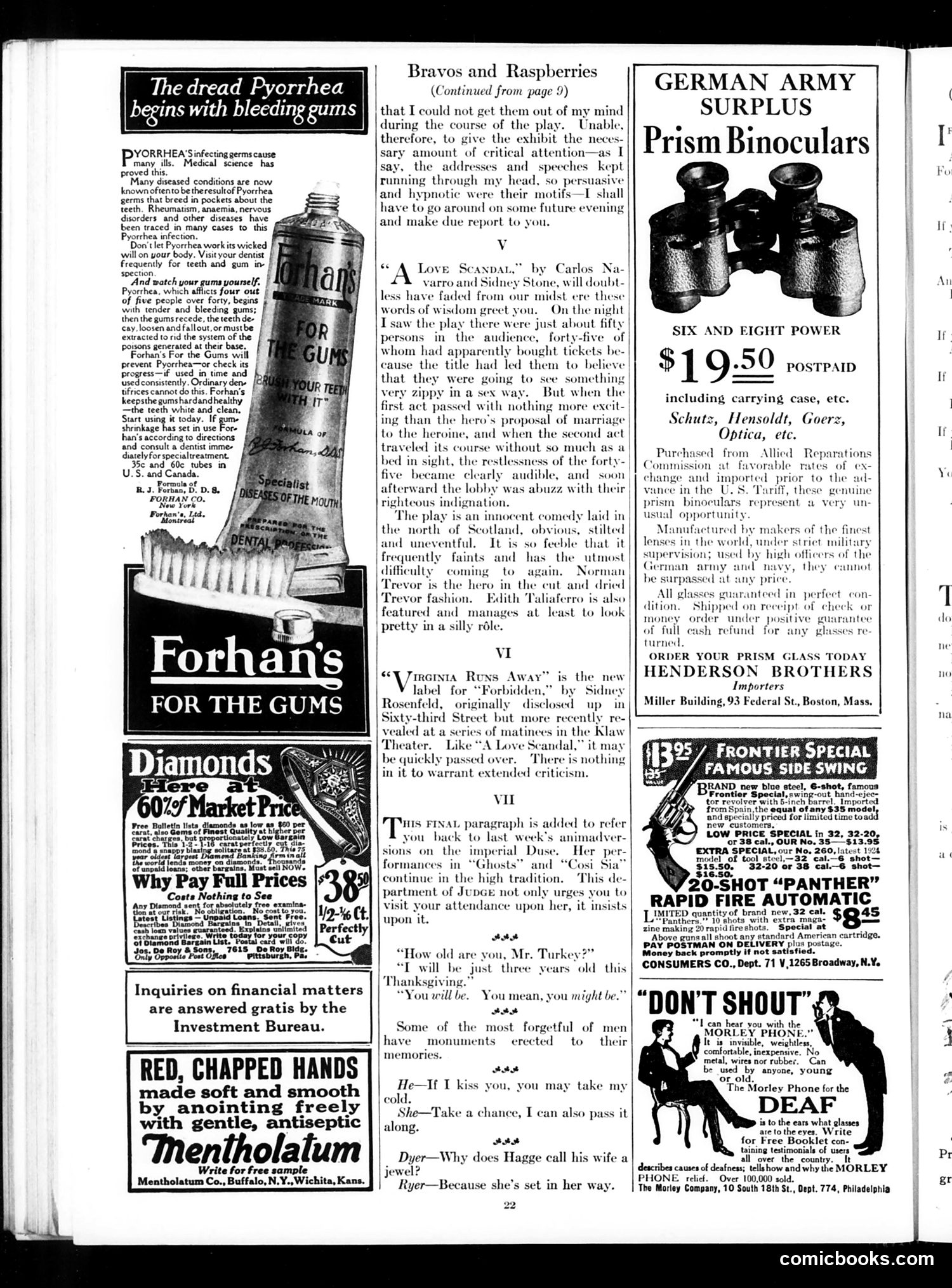
This page is primarily **advertising**, not political satire. The dominant content features commercial ads for consumer products: Forhan's toothpaste (for gum disease/pyorrhea), Mentholatum, diamonds at "60% Market Price," German Army surplus prism binoculars, and various other goods. The editorial content—"Bravos and Raspberries"—is a theater review column critiquing recent Broadway plays. The reviews are dismissive: "A Love Scandal" disappointed audiences expecting sexual content but received instead a Scottish comedy; "Virginia Runs Away" (relabeled "Forbidden") warranted no extended criticism. A brief humor section includes a joke about Mr. Turkey's age ("three years old Thanksgiving"—a dark pun about his fate). The pyorrhea advertisement reflects genuine early-20th-century medical anxiety about gum disease and its supposed systemic health effects—concerns that were partly legitimate but also exaggerated for marketing purposes.
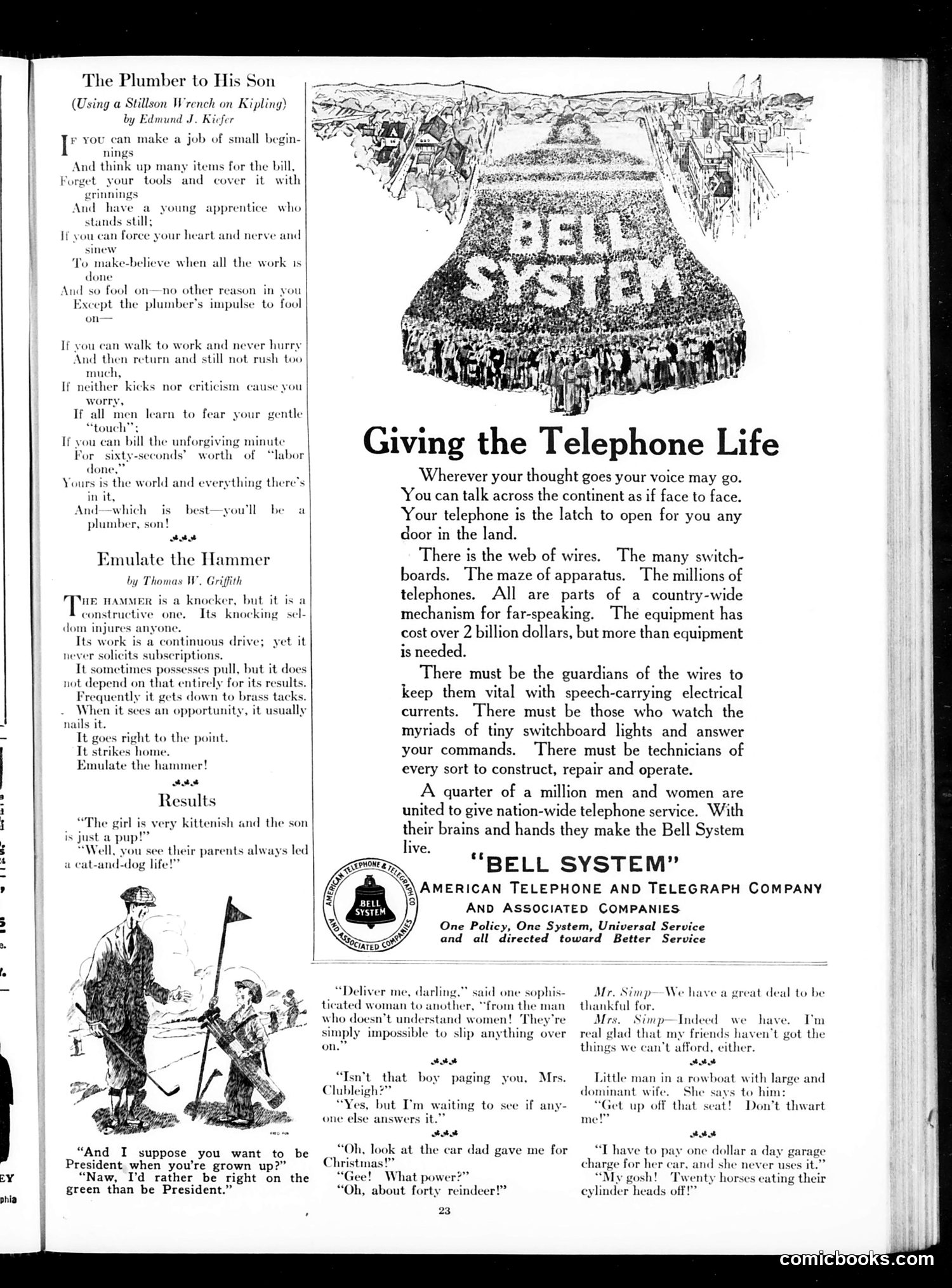
This page contains three distinct pieces of satirical content: **"The Plumber to His Son"** is a parody of Rudyard Kipling's "If—," substituting plumbing trade ethics for Kipling's stoic idealism. The satire mocks both Kipling's grandiose philosophy and working-class tradesmen who inflate bills and cut corners—billing for work not done, keeping apprentices idle for appearance, and manipulating clients ("the unforgiving minute"). It's gentle mockery of manual labor's petty dishonestries. **"Emulate the Hammer"** uses extended metaphor to praise straightforward, results-oriented work—striking home, going to the point—contrasting with presumably more duplicitous professions. **"Giving the Telephone Life"** is *advertising* for Bell System, celebrating telephone infrastructure and the 250,000 workers maintaining it. The accompanying cartoons are unrelated jokes about domestic life and children. The page primarily showcases Judge's satirical verse tradition while incorporating corporate advertising—typical of early 20th-century magazine layouts.
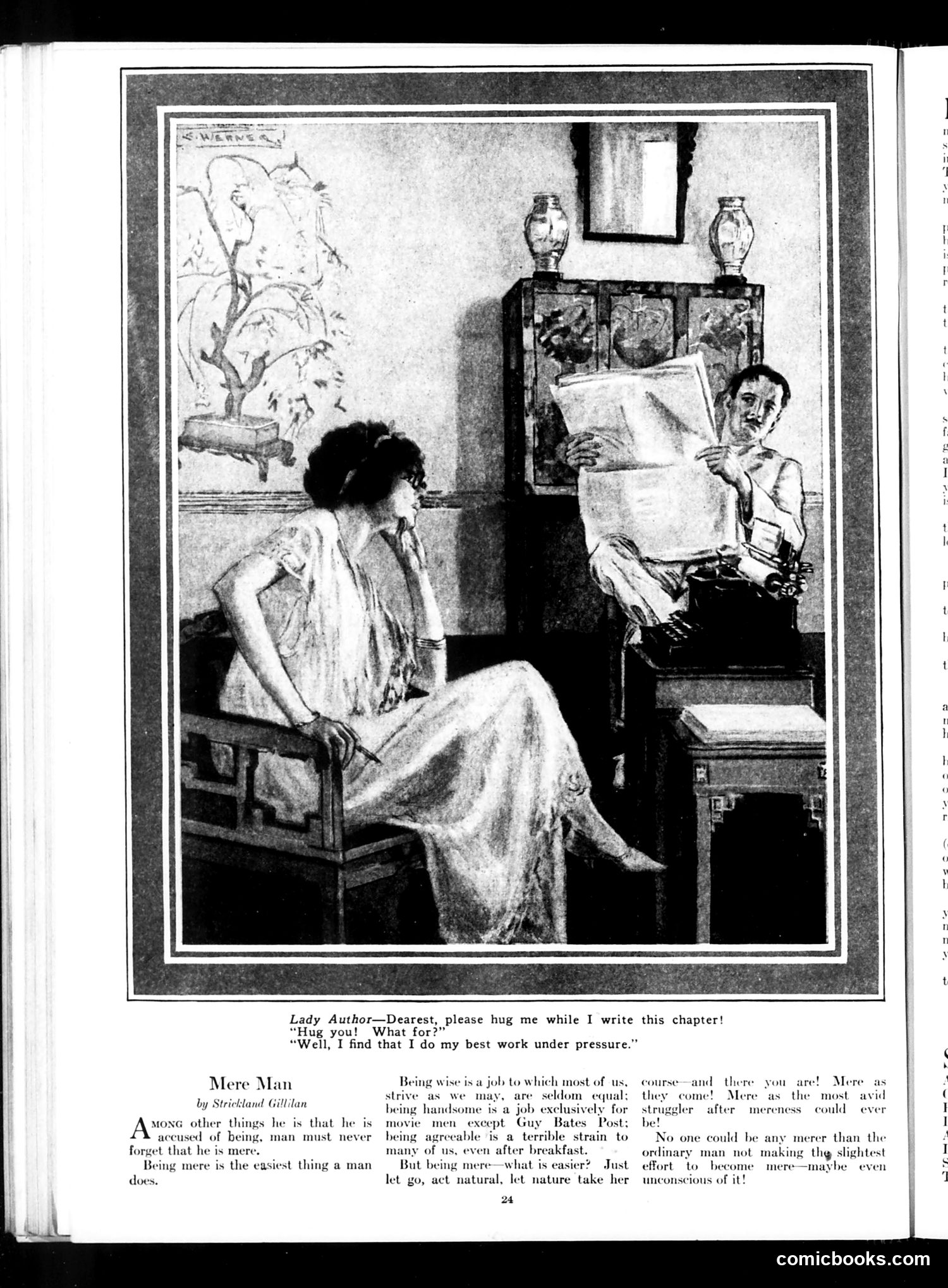
This page satirizes gender dynamics and male passivity in early 20th-century relationships. The top cartoon depicts a woman writer asking her husband to embrace her while she works, claiming she does "best work under pressure"—a double entendre suggesting she needs physical affection/distraction to write. The article below, by Strickland Gillilan, defines "mere man" as a male who is passive, naturally lazy, and requires no effort to remain so. The satire argues that ordinariness in men is effortless—they needn't strive to be "mere" because inaction and lack of ambition come naturally. The broader point mocks male complacency: while women are expected to accomplish multiple roles, men can simply exist without striving. The humor targets masculine passivity as both inevitable and somewhat contemptible, reflecting early 1900s anxieties about gender roles as women increasingly entered the workforce and intellectual spheres.
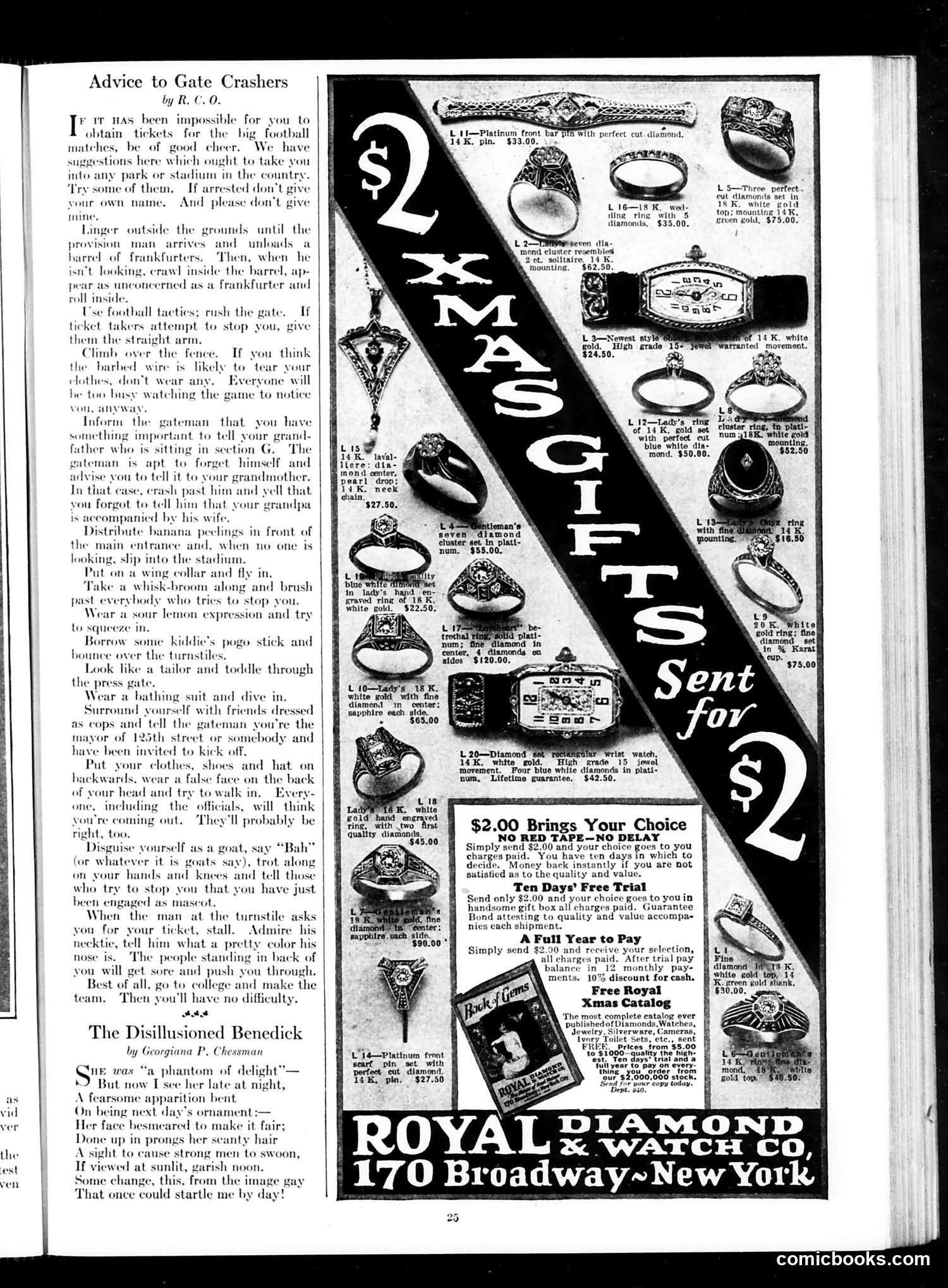
This page contains two distinct elements: **Left side:** A satirical humor column titled "Advice to Gate Crashers" by R.C.O., offering absurd methods to sneak into football games without tickets. The jokes play on 1920s-era social types and slapstick scenarios—hiding in frankfurter barrels, wearing false faces on the back of your head, disguising yourself as a goat, and impersonating the mayor. The humor targets both gate-crashers' desperation and stadium security's gullibility, reflecting Depression-era resourcefulness and working-class attitudes toward rules. **Right side:** A full-page advertisement for Royal Diamond & Watch Co. (170 Broadway, New York) selling jewelry—rings, watches, and brooches with diamonds and gold. The "$2 Gifts Sent for $2" promotion offers a ten-day free trial with no upfront payment, targeting mail-order customers during economically tight times. **Context:** Judge was a satirical magazine; this juxtaposes irreverent working-class humor with high-end luxury advertising—a common editorial strategy of the era.
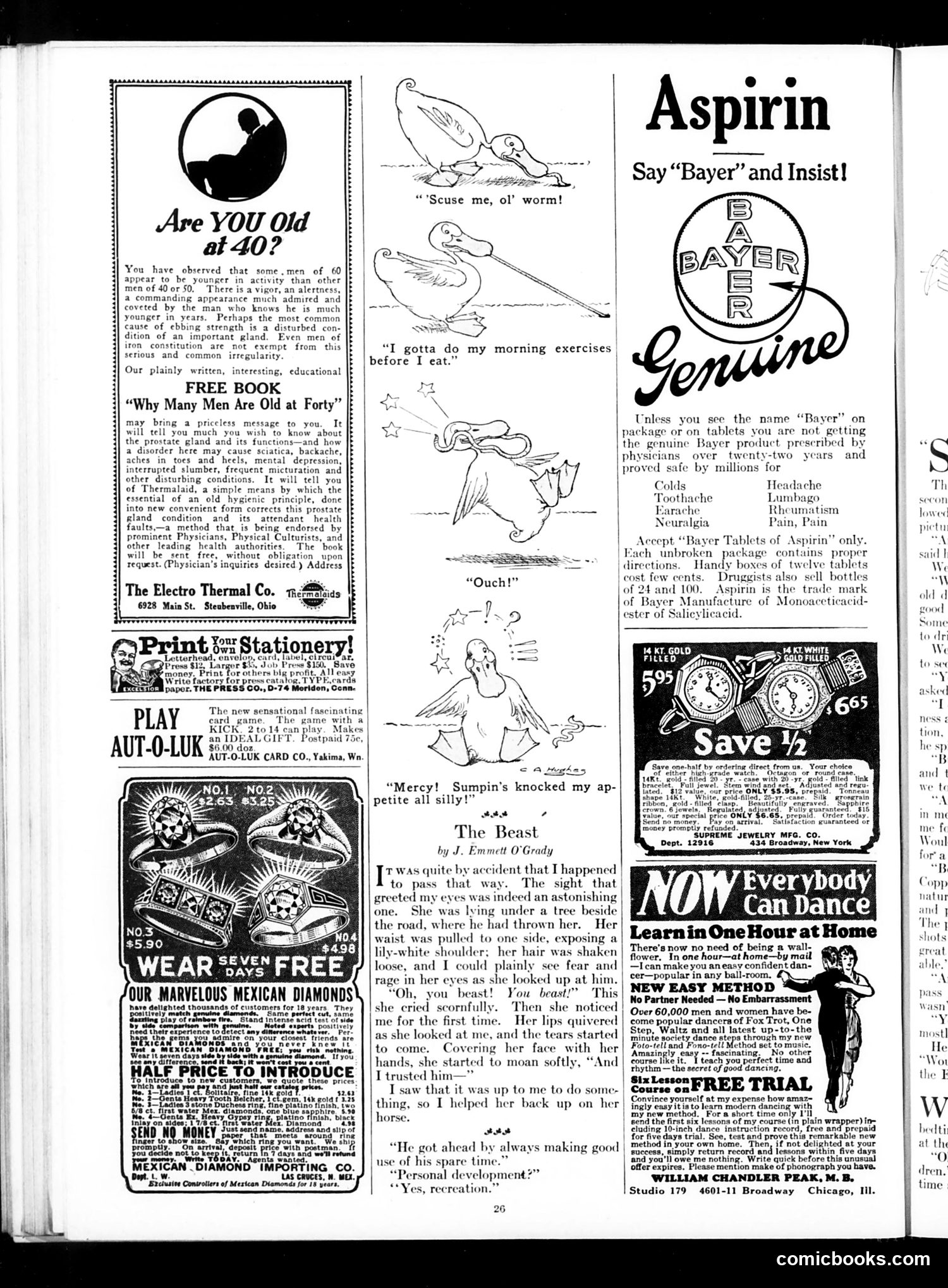
This page consists primarily of **advertisements and short humor pieces**, not political cartoons. The main satirical content includes: - **"The Beast"** by J. Emmett O'Grady: A brief melodramatic story mocking overwrought Victorian romance fiction, featuring a damsel in distress rescued by the narrator - **Exercise cartoons** (center): Humorous illustrations showing a woman doing morning exercises, satirizing the fitness culture trend of the era The advertisements reveal early 20th-century concerns: **Electro Thermal Co.** promotes a "Thermalaid" device claiming to restore vigor to aging men (prostate gland issues); **Bayer Aspirin** advertises its product for various ailments; **dancing lessons** promise social confidence; **"Mexican diamonds"** offer affordable luxury. The humor targets Victorian sentimentality and emerging consumer anxieties about aging, health, and social status. These ads and stories reflect Judge's audience: middle-class men concerned with vitality, modern health remedies, and social advancement.
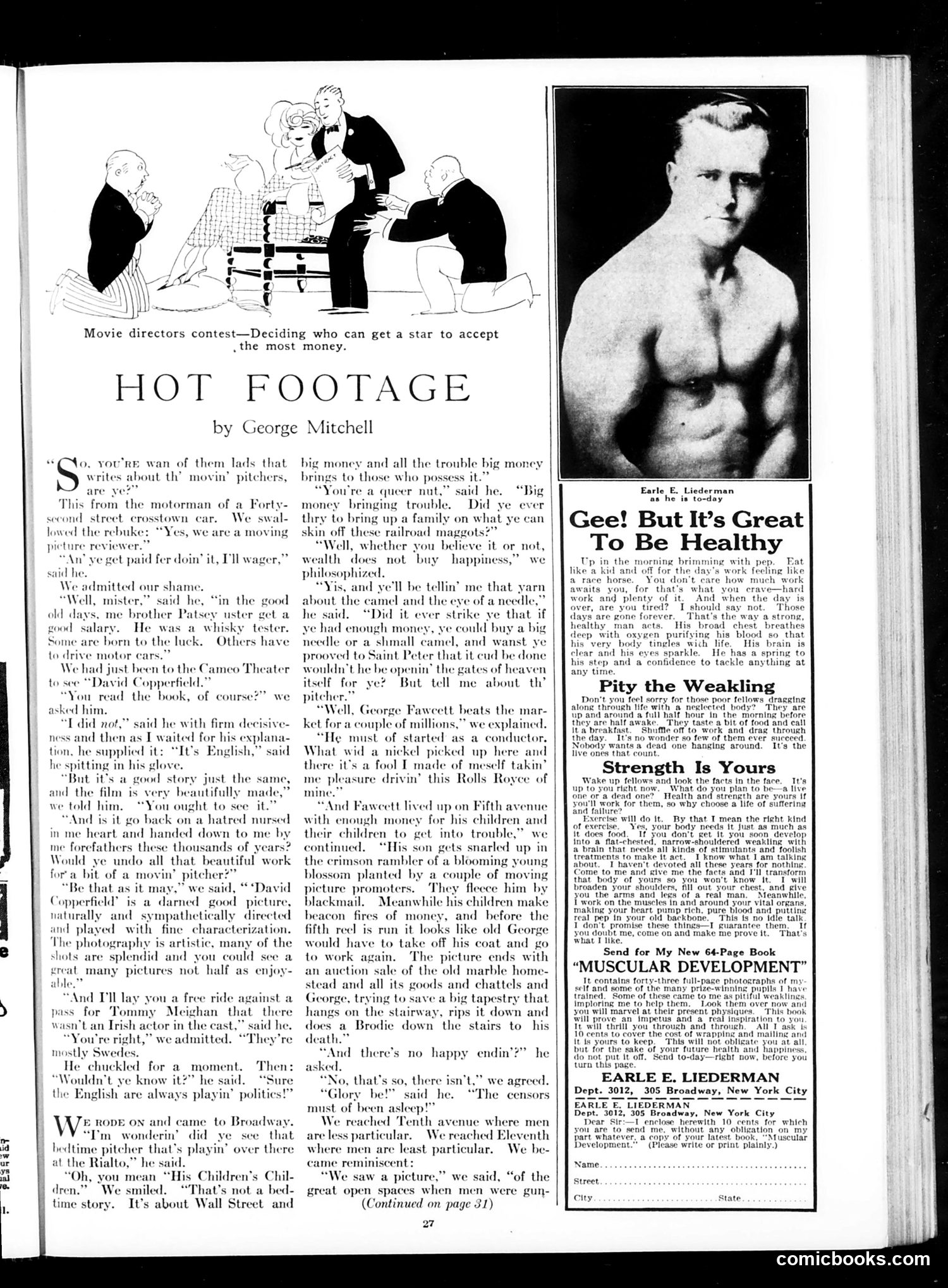
This satirical piece critiques Hollywood's obsession with money and star power. The cartoon depicts movie directors competing to secure actors by offering the highest salaries—the central joke being that financial incentives, not artistic merit, drive casting decisions. The accompanying article is a dialogue between a streetcar motorman and a theater critic discussing recent films. The motorman represents working-class skepticism toward cinema, complaining that movies glorify wealth while depicting its corrupting influence (referencing "His Children's Children," about a railroad magnate whose family squanders inherited money). The satire targets early 1920s film industry values: the motorman notes actors are mostly "Swedes" (immigrants), the industry values money over craft, and movies paradoxically warn against wealth's dangers while celebrating wealthy characters. The phrase "hot footage" sarcastically refers to sensational, commercially-driven filmmaking rather than artistic cinema.
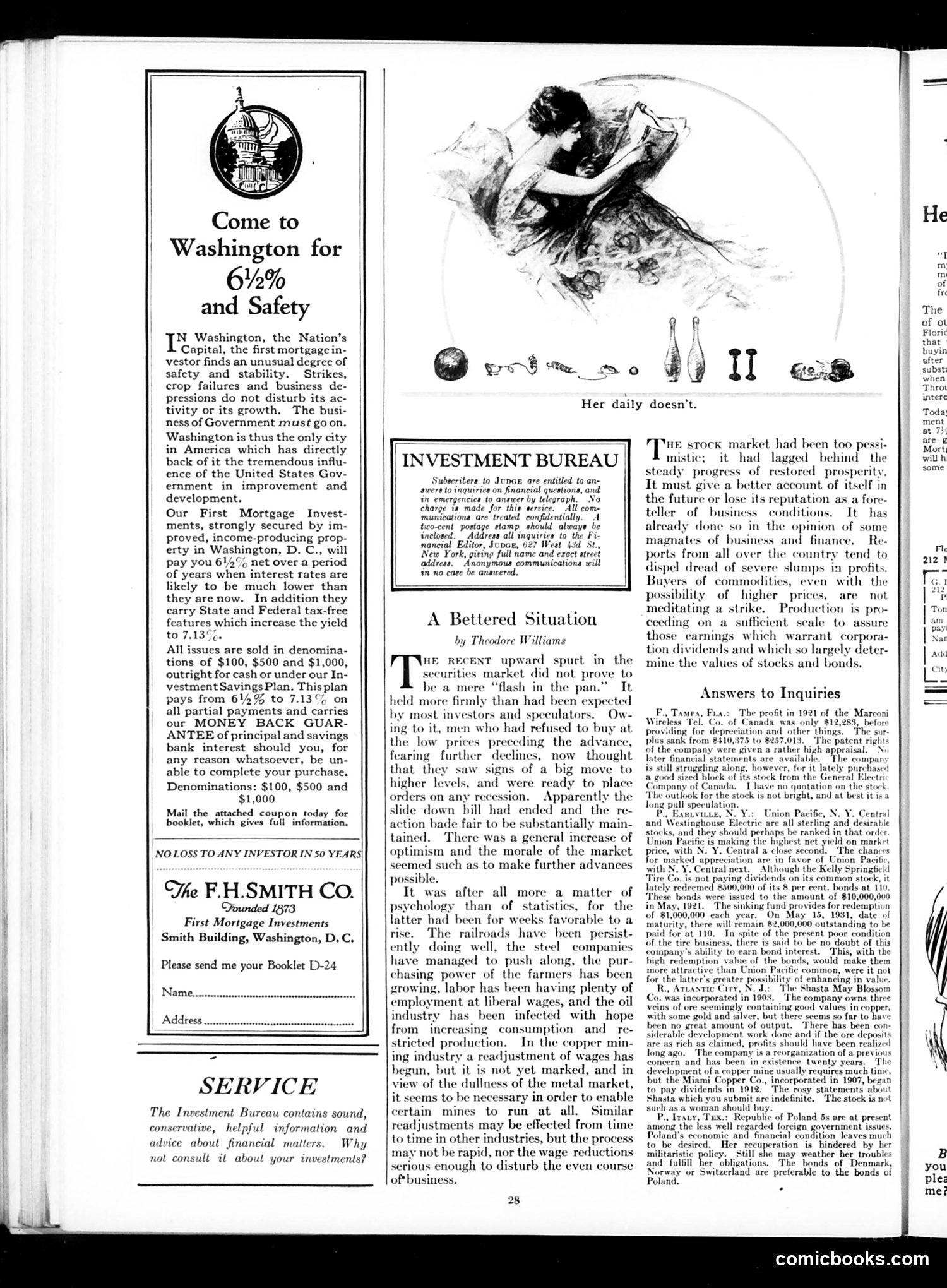
This page is primarily **advertising and financial content** rather than political satire. The main elements are: **Left side:** An F.H. Smith Co. investment advertisement promoting first mortgage investments in Washington, D.C., promising 6½% returns with a "money-back guarantee." It exploits the perceived safety of the nation's capital, arguing government activity ensures stability even during economic downturns. **Center:** A decorative illustration (unrelated to the ads) showing a woman reclining, with small objects below labeled "Her daily doesn't" — likely a humorous caption about household items she doesn't use. **Right side:** An "Investment Bureau" advice column and Theodore Williams's article "A Bettered Situation," discussing recent stock market recovery and optimistic economic indicators (railroad performance, steel companies, agricultural wages, oil industry). The page reflects post-war economic optimism and the era's investment culture, with advertising leveraging confidence in government institutions.
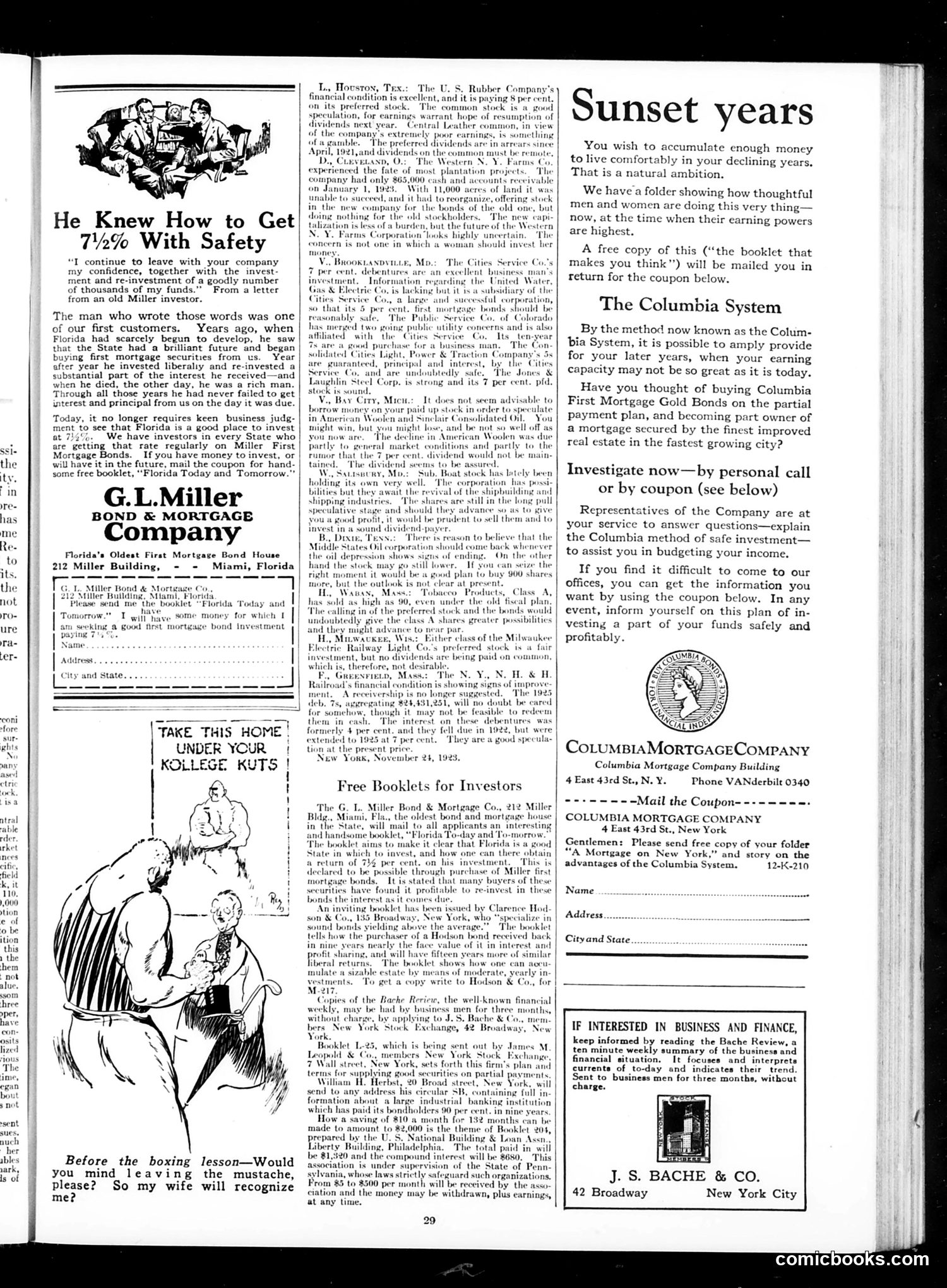
This page primarily consists of **financial advertisements** rather than political satire. The main content promotes investment vehicles—particularly Florida real estate bonds and mortgages—targeting middle-class investors during what appears to be the early 1920s Florida real estate boom. The small cartoon at bottom left is a **domestic humor sketch**: a man about to receive boxing lessons asks the instructor to leave his mustache intact so his wife will recognize him without it. This plays on the era's association of mustaches with masculine identity and the joke of disguise through grooming. The "Kollege Kuts" illustration above advertises a college-themed barber service, using period slang ("kollege") common in advertising of that era. The substantial text discusses investment opportunities in various American companies (electric railways, oil corporations, steel companies), reflecting the optimistic investment culture of the 1920s before the market crash. The ads emphasize "safety" repeatedly—a selling point for conservative investors. No clear political satire or caricature of specific political figures appears on this page.
This satirical poem mocks human hypocrisy about truthfulness. Pepsmith Pond is presented as a paragon of honesty—someone known throughout the county for his integrity and reverence for truth. However, the joke reveals him as a shameless liar when it suits him. The satire works through contrast: Pepsmith is genuinely truthful about his tea business (boring, verifiable facts), which earns him a sterling reputation. But when gossiping about his ancient car, he spins obvious tall tales—claiming it climbs hills where other cars "lie down and die" and travels 67 miles on three gallons of gas. The narrator sees through these exaggerations immediately. Mason's point: people aren't honestly virtuous or dishonest—they're selectively honest. Pepsmith uses his earned credibility from minor truths to peddle obvious fabrications, showing that "truth" is situational. The final line suggests once reputation is damaged by lies, it's hard to recover, yet people keep lying anyway.
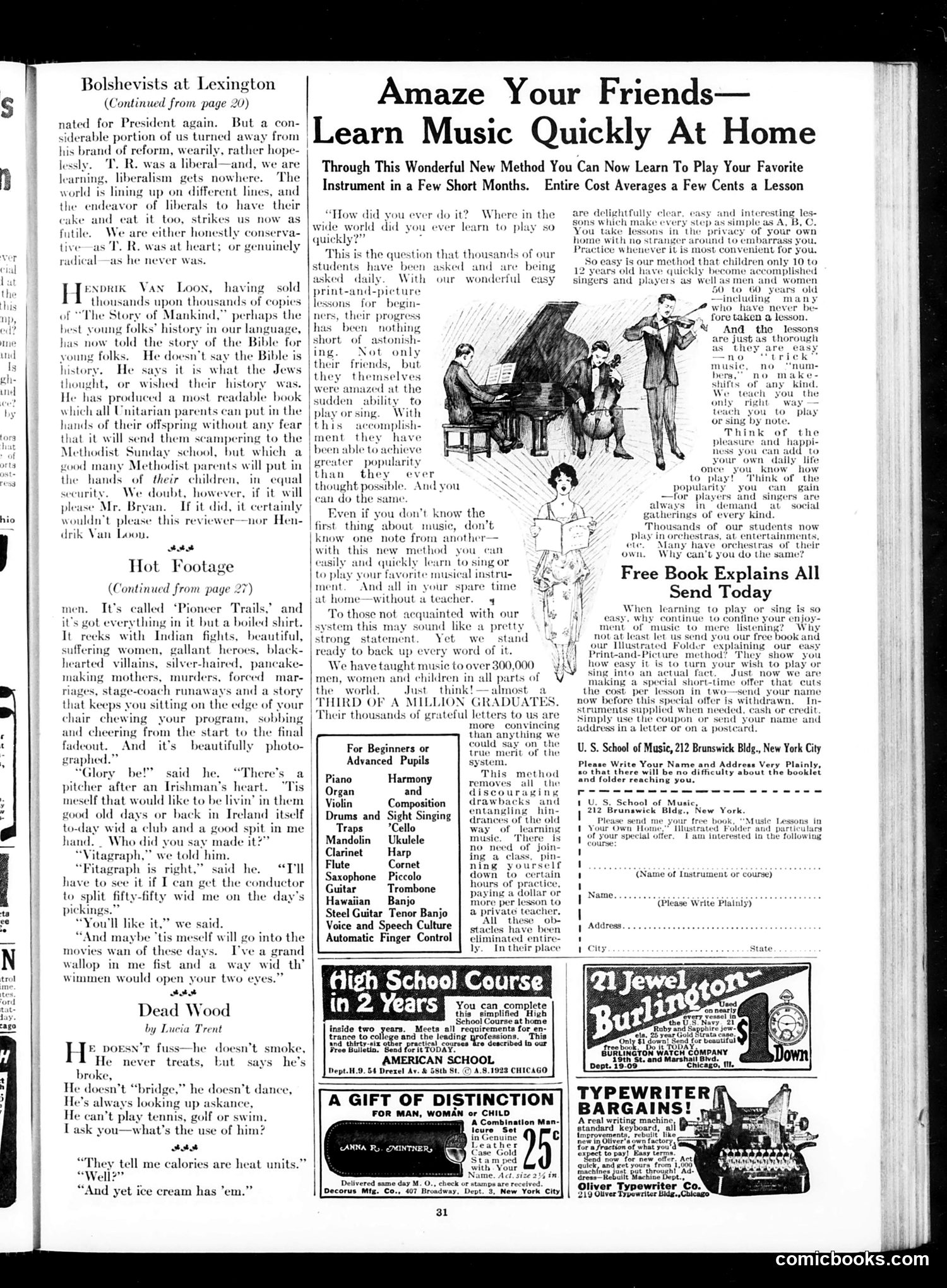
This page contains primarily **advertisements and light humor columns** rather than political cartoons. The main content includes: 1. **"Bolshevists at Lexington"** (continued article): Commentary on Theodore Roosevelt's political evolution, suggesting his "liberal" reformism has become outdated. The piece critiques his inconsistency—claiming he's neither genuinely conservative nor radical. 2. **"Hot Footage"** and **"Dead Wood"** (humor columns): Short comic pieces about movies and a useless man, respectively—typical period entertainment commentary. 3. **Large advertisement**: "Amaze Your Friends—Learn Music Quickly At Home," promoting a music instruction method claiming students can learn in "a few short months" for minimal cost. The page is primarily **commercial**, with the humor columns being mild social observation rather than sharp satire. The Roosevelt criticism is the closest to substantive political content, but it's a reflective essay rather than visual satire. The overall tone is early 1920s middlebrow entertainment and advertising.
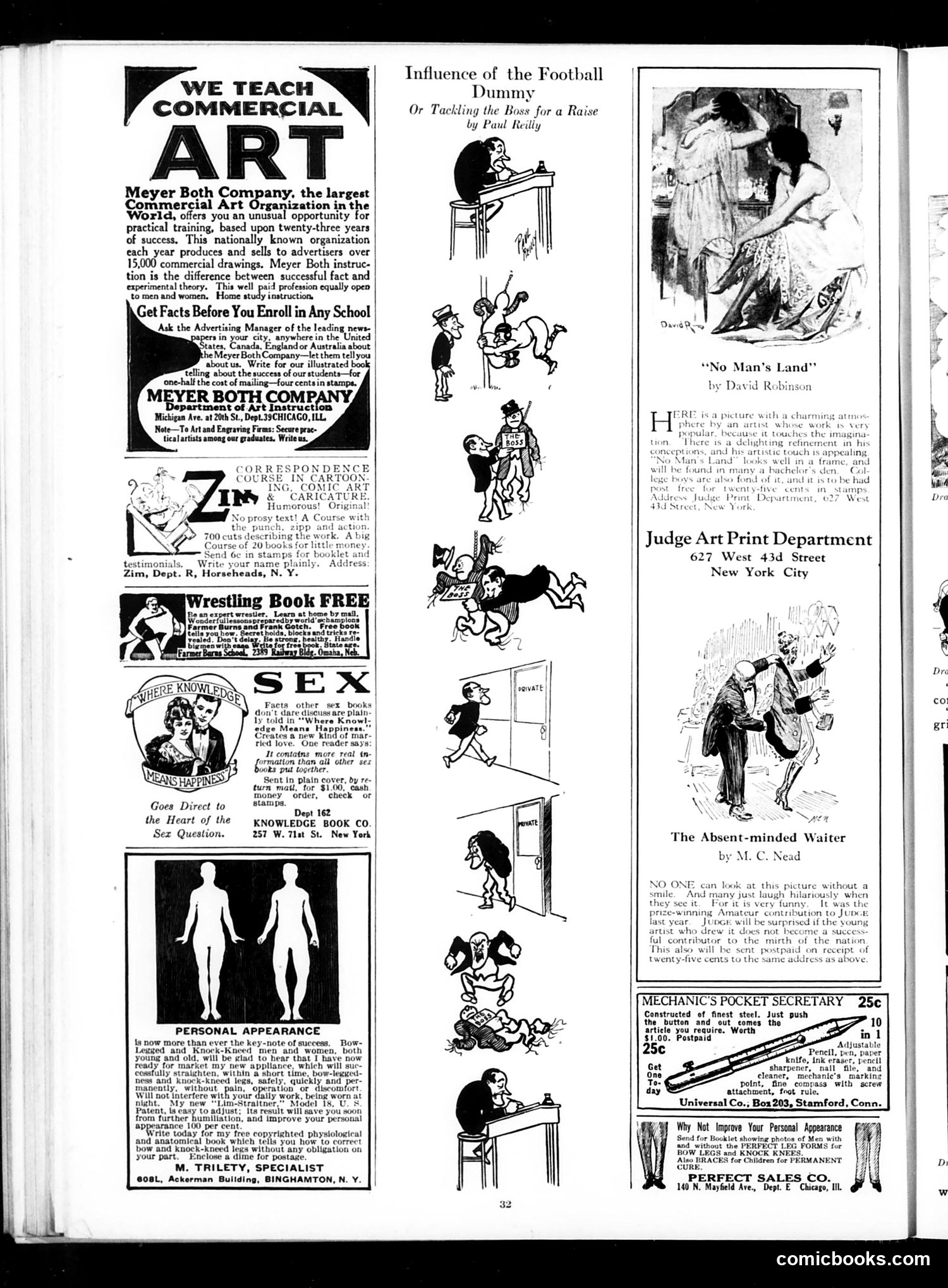
This page from *Judge* magazine (a satirical publication) mixes editorial cartoons with period advertisements reflecting early 20th-century American anxieties and commerce. **The central cartoon** "Influence of the Football Dummy" by Paul Reilly depicts an office scene where an employee uses a football dummy as a prop to practice tackling the boss—literally demonstrating "tackling the boss for a raise." The satire mocks workplace timidity: employees need courage (symbolized by football training) to negotiate with management. **Surrounding advertisements** reveal the era's social preoccupations: ads for correcting "bow-legs" and "knock-knees," sex education books marketed discreetly, and commercial art training programs. These ads target insecurity and self-improvement, suggesting Americans were anxious about physical appearance and social advancement. **The cartoons below**—"No Man's Land" and "The Absent-minded Waiter"—are credited as prize-winning amateur contributions, indicating *Judge* solicited reader submissions. This page exemplifies how satirical magazines combined humor with commercial messaging, reflecting period concerns about personal appearance, sexual knowledge, and economic mobility.
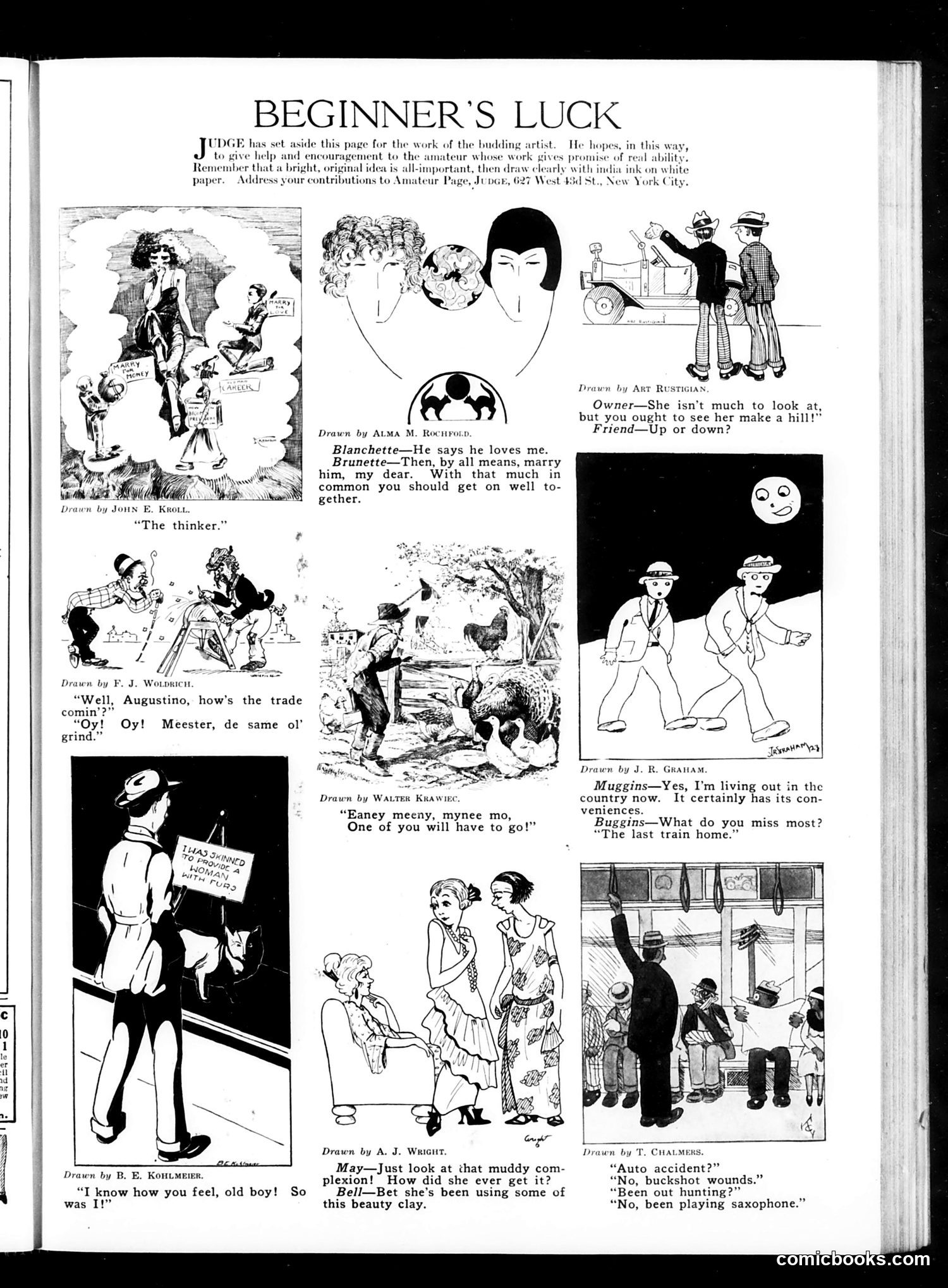
This page showcases amateur cartoonists' work on everyday social humor. The jokes target early 20th-century life: **Key cartoons include:** - A dialogue between "Augustino" and "Meester" about trade being "the same ol' grind"—depicting working-class immigrant characters (suggested by accented English) complaining about monotonous labor. - A joke about a woman's "muddy complexion" caused by "beauty clay"—mocking dubious cosmetic products marketed to women. - Domestic humor: a couple discussing whether a car will go "up or down a hill"; another about missing "the last train home" from country living. - A saxophone player mistaken for a hunting accident victim with "buckshot wounds"—satirizing the instrument's novelty and poor reputation in polite society. The page's introduction explains Judge offers space to amateur artists with "bright, original" ideas, encouraging submissions. The humor is genteel, focusing on vanity, class differences, and consumer culture rather than sharp political satire.
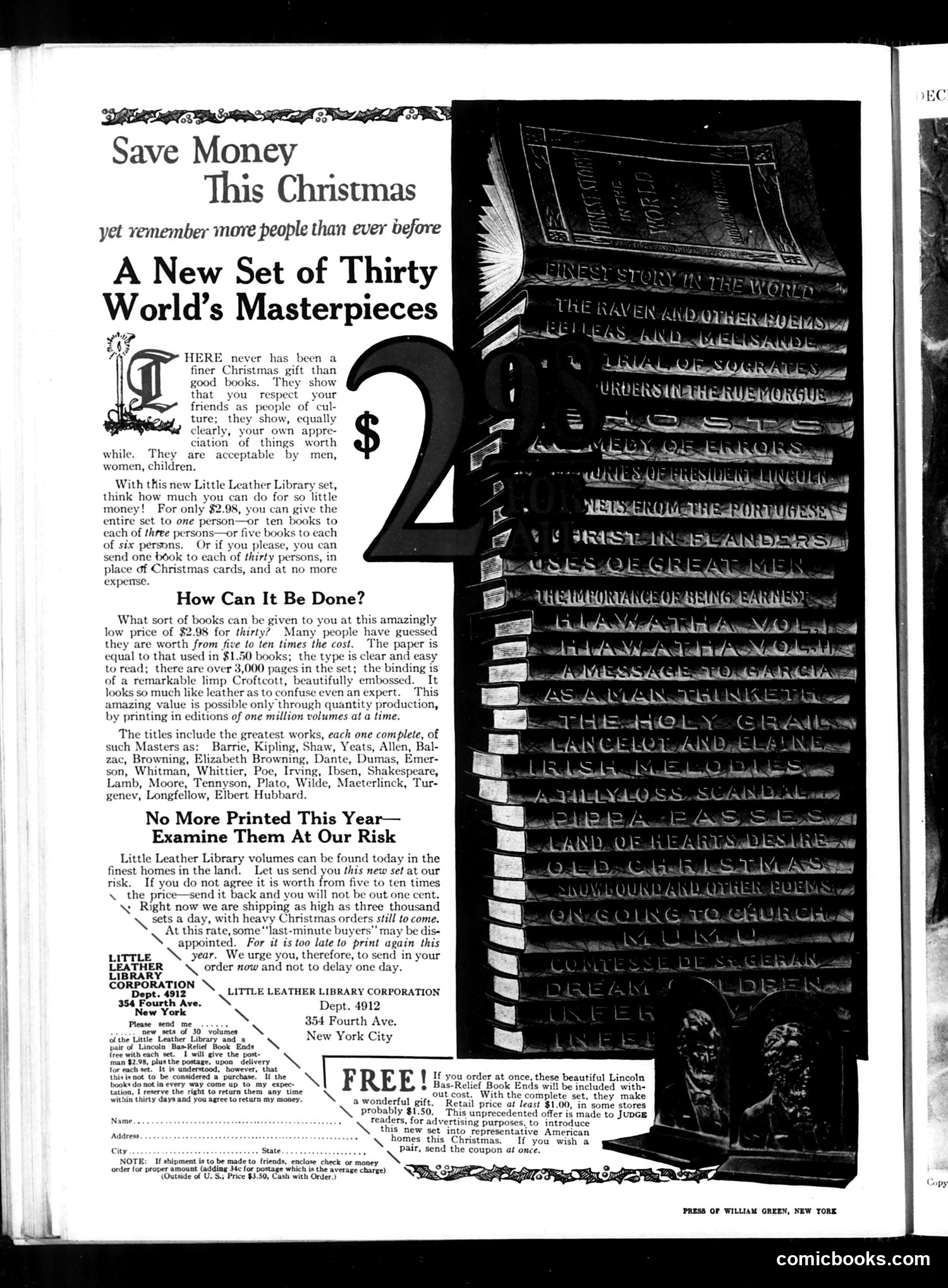
This is primarily a **Christmas advertisement** for the Little Leather Library—a budget book set collection—rather than satire or political cartooning. **The Product**: A set of 30 classic literary works (Shakespeare, Dante, Browning, Poe, etc.) selling for $2.98, marketed as an affordable Christmas gift for cultured people. **The Pitch**: The ad emphasizes value through mass production economics—claiming books worth "$5 to $10" are available cheaply. It appeals to givers wanting to appear cultivated while spending little money. **The "Joke"** (if any): The implicit satire is gentle—that one can gift high culture affordably, and that even last-minute buyers desperate to seem refined can do so for under $3. The accompanying image shows a stack of these leather-bound classics to visually demonstrate the offer. **Context for modern readers**: This reflects early 20th-century American consumer culture, where mass-produced "classics" democratized literature. The ad assumes books signal status and education—a marketing strategy targeting middle-class aspirations. There is **no political cartoon** on this page—it's purely commercial advertising.