
Judge, 1923-12-01 · page 20 of 36
Judge — December 1, 1923 — page 20: what you’re looking at
What you’re looking at
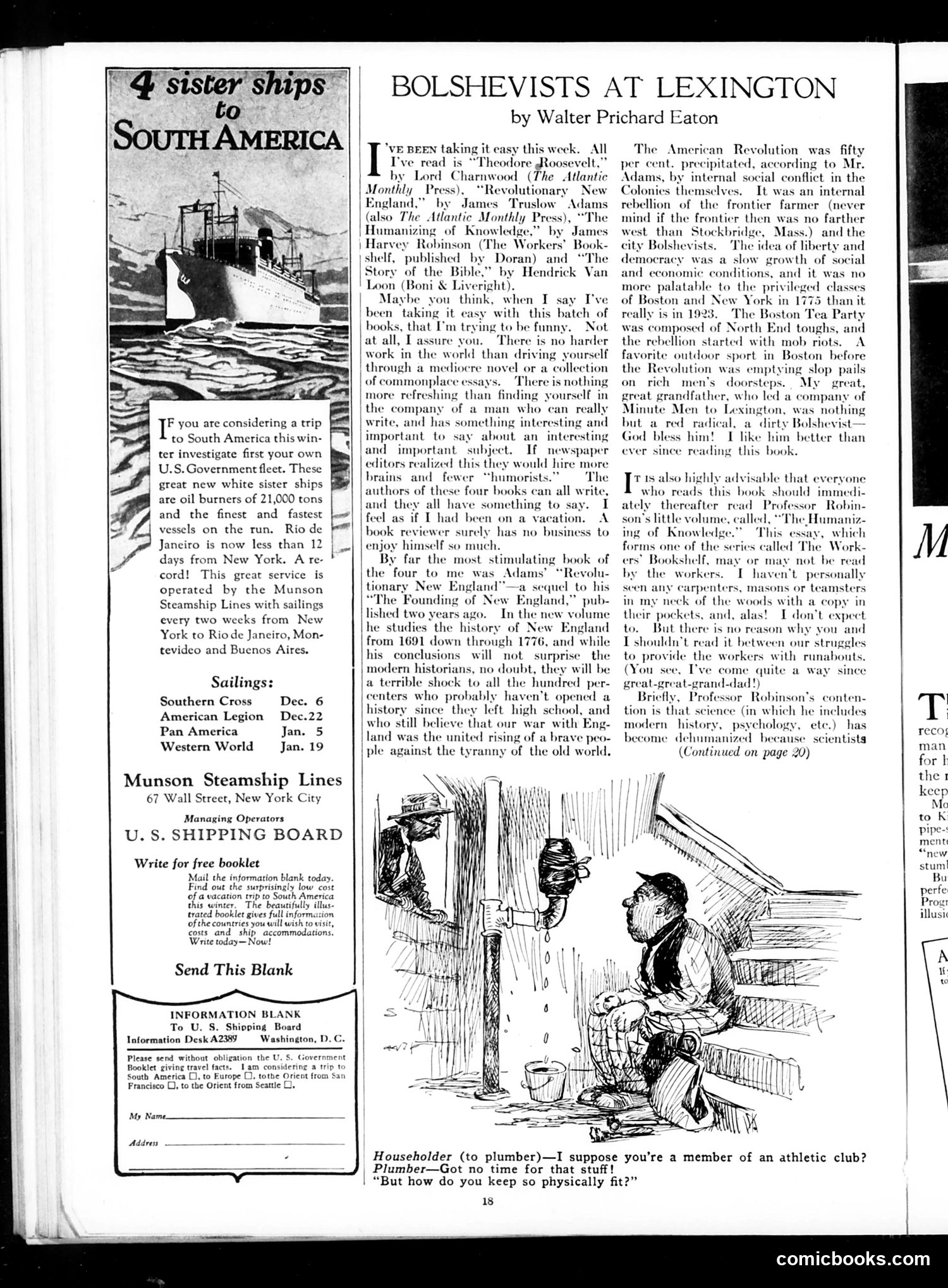
This page contains **two distinct elements**: a shipping advertisement and a book review essay. **The Advertisement** (left side) promotes U.S. government-operated steamships to South America, emphasizing their speed and luxury as tourism draws. **The Essay** (right side) by Walter Prichard Eaton reviews books about American history, particularly James Truslow Adams' *Revolutionary New England*. Eaton's key argument is provocative: the American Revolution wasn't simply colonists unified against British tyranny, but rather an **internal class conflict**. He argues it was a "rebellion of the frontier farmer" against "city Bolshevists" (wealthy urban elites). Eaton draws a parallel to his own time, noting that in 1775—like in the present (post-WWI era)—democracy and liberty were unpopular with Boston and New York's privileged classes. **The cartoon** below shows a plumber refusing an athletic club member's suggestion to join, illustrating working-class dismissal of elite recreational culture. Together, these pieces reflect 1920s anxieties about class conflict and whether America's founding ideals truly represented universal equality or elite interests.
📄 Transcribed text from this page (OCR, searchable)
Machine-transcribed from the original scan — historical spelling and the odd misread are preserved.
E you are considering a trip to South America this win- ter investigate first your own U.S.Government fleet. These | great new white sister ships are oil burners of 21,000 tons and the finest and fastest Rio de Janeito is now less than 12 vessels on the run. days from New York. A re- cord! operated by the Munson Steamship Lines with sailings every two weeks from New York to Riode Janeiro, Mon- tevideo and Buenos Aires. This great service is Sailings: Southern Cross Dec. 6 American Legion Dec.22 Pan America Jan. 5 Western World Jan. 19 Munson Steamship Lines 67 Wall Street, New York City Managing Operators U.S. SHIPPING BOARD Write for free booklet Mail the information blank today. Find out the surprisingly low cost of a vacation trip to South America this winter. he beautifully illus- trated booklet gives full informax of the countries you will wish to visit, costs and ship accommodations. Write today Now! Send This Blank INFORMATION BLANK To U. S. Shipping Bi Information Desk A2389 Please send without obligation the U. S. Gover Booklet giving travel facts. Iam considering a trip t South America (), to Europe O, tothe Orient from San Francisco (), to the Orient from Seattle O, My Name. Address, — I've read is “Theodore Roosevelt,” | by Lord Charnwood (The Atlantic | Monthly Press), “Revolutionary | England,” by James Truslow Ac | (also The Atlantic Monthly Press), {Humanizing of Knowledge,” by ) Harvey Robinson (The Workers’ shelf, published by Doran) and Story of the Bible,” by Hendrick Van ' Loon (Boni & Liveright). Maybe you think, when I say I’ve been ‘taking it easy with this batch of books, that I'm trying to be funny. at all, T assure you. There is no harder | work in the world than driving yourself | through a mediocre novel or a collection of commonplace essays. There is nothing more refreshing than finding yourself in the company of a man who can really | write, and has something interesting and important to say about an_ interesting and important subject. If newspaper editors realized this they would hire more brains and fewer “humorists.” The authors of these four books can all write, and they all have something to say. I feel as if I had been on a vacation. A book reviewer surely has no business to enjoy himself so much. By far the most stimulating book of |the four to me was Adams’ *Revolu- | tionary New Englanc a sequel to his “The Founding of New England,” pub- lished two years ago. In the new volume he studies the history of New England from 1691 down through 1776, and while |his conclusions will not surprise the | modern historians, no doubt, they will be |a terrible shock to all the hundred per- |eenters who probably havent opened a |history since they left high school, and who still believe that our war with Eng- land was the united rising of a brave peo- | ple against the tyranny of the old world. I ‘VE BEEN taking it easy this week. All New Plumber—Got no time for that stuff! 18 by Walter Prichard Eaton BOLSHEVISTS AT LEXINGTON The American Revolution was fifty per cent. precipitated Adams, by internal social conflict in the Colonies themselves. It was an internal rebellion of the frontier farmer (never mind if the frontier then was no farther west than Stockbridge, Mass.) and the city Bolshevists. ‘The idea of liberty and democracy was a slow growth of social and economic conditions, and it was no more palatable to the privileged classes of Boston and New York in 1775 than it ally is in The Boston Tea Party composed of North End toughs, and the rebellion started with mob riots. A favorite outdoor sport in Boston before the Revolution was emptying slop pails on rich men’s doorsteps.. My great, great grandfather, who led a company of Minute Men to Lexington, was nothing but a red radical, a dirty Bolshevist— God bless him! I like him better than ever since reading this book. cording to Mr. r 1s also highly advisable that everyone who reads this book should immedi- at thereafter read ssor Robin- son’s little volum Phe Humaniz- ing of Knowledg: which forms one of the series called The Work- ers’ Bookshelf, may or may not be read by the workers. [haven't personally seen any carpenters, masons or teamsters in my neck of the woods with a copy in their pockets, and, alas! I don’t expect to. But there is no reason why you and I shouldn't read it between our struggles to provide the workers with runabouts. (You see, Pye come quite a way since great-great-grand-dad!) Briefly, Professor Robinson's conten- tion is that science (in which he includes modern history, psychology, etc.) has become dehumanized because scientists (Continued on page 20) Householder (to plumber)—I suppose you’re a member of an athletic club? | “But how do you keep so physically fit?” man for | the 1 keep Mo to k pipe- ment “new stum| Bu perfe Prog: illusi A i to comicbooks.com