
Judge, 1923-12-01 · page 11 of 36
Judge — December 1, 1923 — page 11: what you’re looking at
What you’re looking at
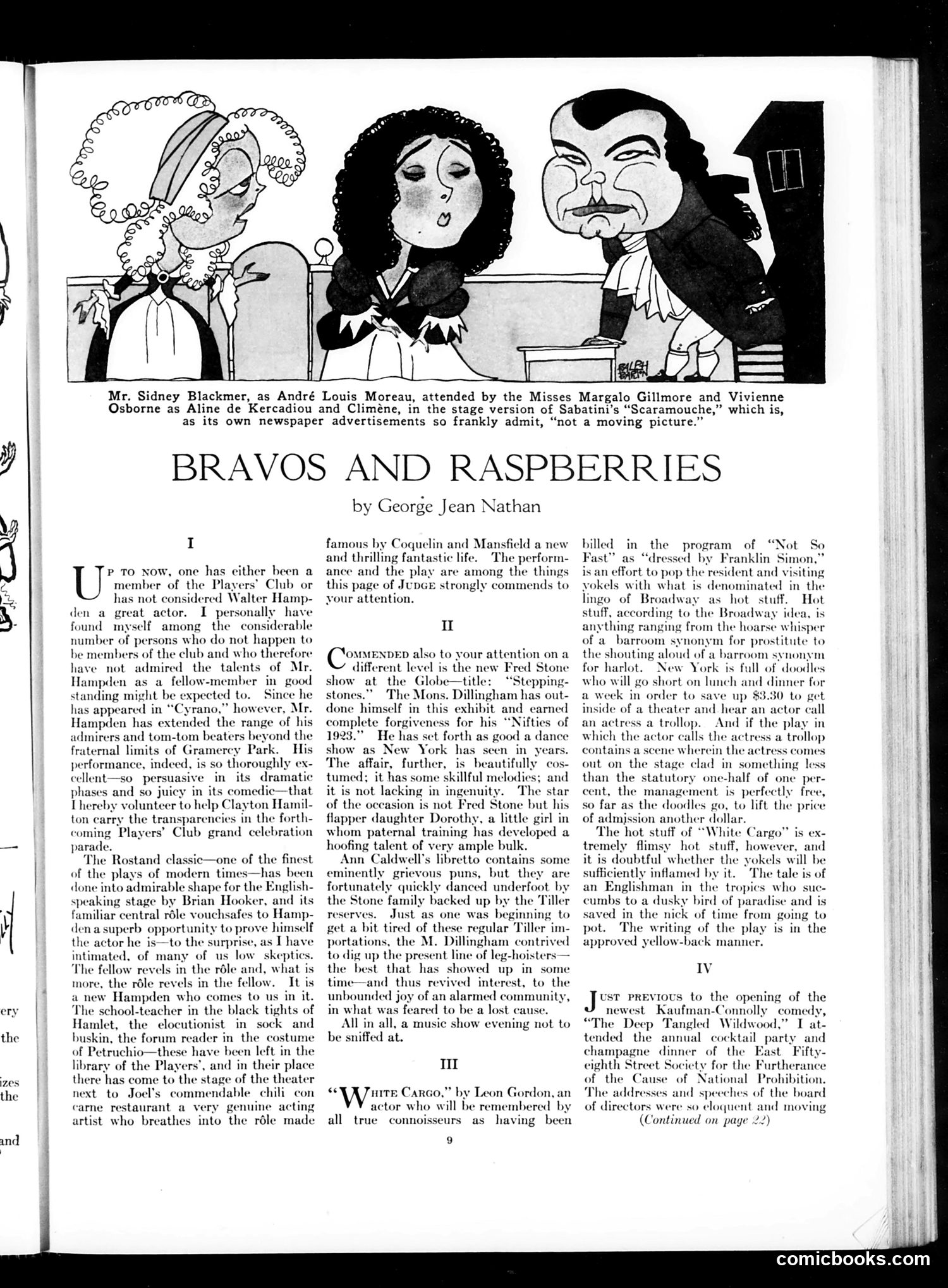
This page reviews theatrical productions from the 1920s. The cartoon at top caricatures **Sidney Blackmer** and actresses **Margalo Gillmore** and **Vivienne Osborne** in the stage adaptation of *Scaramouche*—with a satirical jab that the advertisement ironically admits it's "not a moving picture" (implying stage versions were inferior to or competing with film). The text reviews three shows: 1. **Walter Hampden in *Cyrano de Bergerac***: Nathan praises Hampden's performance, noting this outsider to the exclusive Players' Club has won over even skeptics through genuine artistry. 2. **Fred Stone in *Stepping Stones*** at the Globe: Commended for skillful dancing and choreography, though the real star is Stone's daughter Dorothy, whose "ample bulk" of talent overshadows her father. 3. ***White Cargo*** by Leon Gordon: Dismissed as sensationalist "hot stuff" designed for unsophisticated audiences. The page exemplifies Judge's theatrical criticism—witty, snobbish, and concerned with artistic merit versus commercial pandering.
📄 Transcribed text from this page (OCR, searchable)
Machine-transcribed from the original scan — historical spelling and the odd misread are preserved.
l Mr. Sidney Blackmer, as André Louis Moreau, attended by the Misses Margalo Gillmore and Vivienne Osborne as Aline de Kercadiou and Climéne, in the stage version of Sabatini’s “Scaramouche,” which is, as its own newspaper advertisements so frankly admit, “not a moving picture.” BRAVOS AND RASPBERRIES I l P TO Now, one has either been a member of the Players’ Club or has not considered Walter Hamp- den a great actor. I personally have found myself among the considerable number of persons who do not happen to be members of the club and who therefore have not admired the talents of Mr. Hampden as a fellow-member in good standing might be expected to. Since he has appeared in “Cyrano,” however, Mr. Hampden has extended the range of his admirers and tom-tom beaters beyond the fraternal limits of Gramercy Park. His performance, indeed, is so thoroughly ex. cellent—so_ persua: in its dramat phases and so juicy in its comedic—that Thereby volunteer to help Clayton Hamil- ton carry the transparencies in the forth- coming Players’ Club grand celebration parade. The Rostand classic—one of the finest of the plays of modern times—has been done into admirable shape for the English- ST ing stage by Brian Hooker, and its familiar central réle vouchsafes to Hamp- dena superb opportunity to prove himself the actor he is—to the surprise, as I have intimated, of many of us low. skeptics. The fellow revels in the réle and, what is more, the réle revels in the fellow. It is a new Hampden who comes to us in it. The school-teacher in the black tights of Hamlet, the elocutionist in sock and buskin, the forum reader in the costume of Petruchio—the been left in the library of the Players’, and in their place there has come to the stage of the theater next to Joel’s commendable chili con carne restaurant a very genuine acting artist who breathes into the réle made by George Jean Nathan famous by Coquelin and Mansfield a new and thrilling fantastic life. The perform- ance and the play are among the things this page of JupGe strongly commends to your attention. II CCommtennen also to your attention on a different level is the new Fred Stone show at the Globe—title: “Stepping- stone The Mons. Dillingham has out- done himself in this exhibit and earned complete forgiveness for his ‘‘Nifties of 1923.” He has set forth as good a dance show New York has seen in years. The affair, further, is beautiful tumed; it has some skillful melodies; and it is not lacking in ingenuity. The star of the occasion is not Fred Stone but his flapper daughter Dorothy, a little girl in whom paternal training has developed a hoofing talent of very ample bulk. Ann Caldwell’s libretto contains some eminently grievous puns, but they are fortunately quickly danced underfoot. by the Stone family backed up by the Tiller reserves. Just as one was beginning to get a bit tired of these regular Tiller im- portations, the M. Dillingham contrived to dig up the present line of leg-hoisters the best that has showed up in some time—and_ thus revived interest, to the unbounded joy of an alarmed community, in what was feared to be a lost cause. All in all, a music show evening not to be sniffed at. cos- Til Wire Carco,” by Leon Gordon, an actor who will be remembered by all true connoisseurs as having been 9 billed in the program of “Not So Fast” as “dressed by Franklin Simon,” is an effort to pop the resident and visiting yokels with what is denominated in the lingo of Broadway as hot stuff. Hot stuff, according to the Broadway idea, is anything ranging from the hoarse whisper of a barroom synonym for prostitute to the shouting aloud of a barroom synonym for harlot. New York is full of doodles who will go short on lunch and dinner for a week in order to save up $3.30 to get inside of a theater and hear an actor call an actress a trollop. And if the play in which the actor calls the actress a trollop contains a scene wherein the actress comes out on the stage clad in something less than the statutory one-half of one per- cent, the management is perfectly free, so far as the doodles go, to lift the price of admission another dollar. The hot stuff of “White Cargo” is ex- tremely flimsy hot stuff, however, and it is doubtful whether the yokels will be sufficiently inflamed by it. The tale is of an Englishman in the tropics who suc- cumbs to a dusky bird of paradise and is saved in the nick of time from going to pot. The writing of the play is in the approved yellow-back manner. IV UsT PREVIous to the opening of the newest. Kaufman-Connolly comedy, “The Deep Tangled Wildwood,” I at- tended the annual cocktail part champagne dinner of the East eighth Street Society for the Further: of the Cause of National Prohibition. The addresses and speeches of the board of directors were so eloquent and moving (Continued on page 22) comicbooks.com