
Judge, 1923-12-01 · page 3 of 36
Judge — December 1, 1923 — page 3: what you’re looking at
What you’re looking at
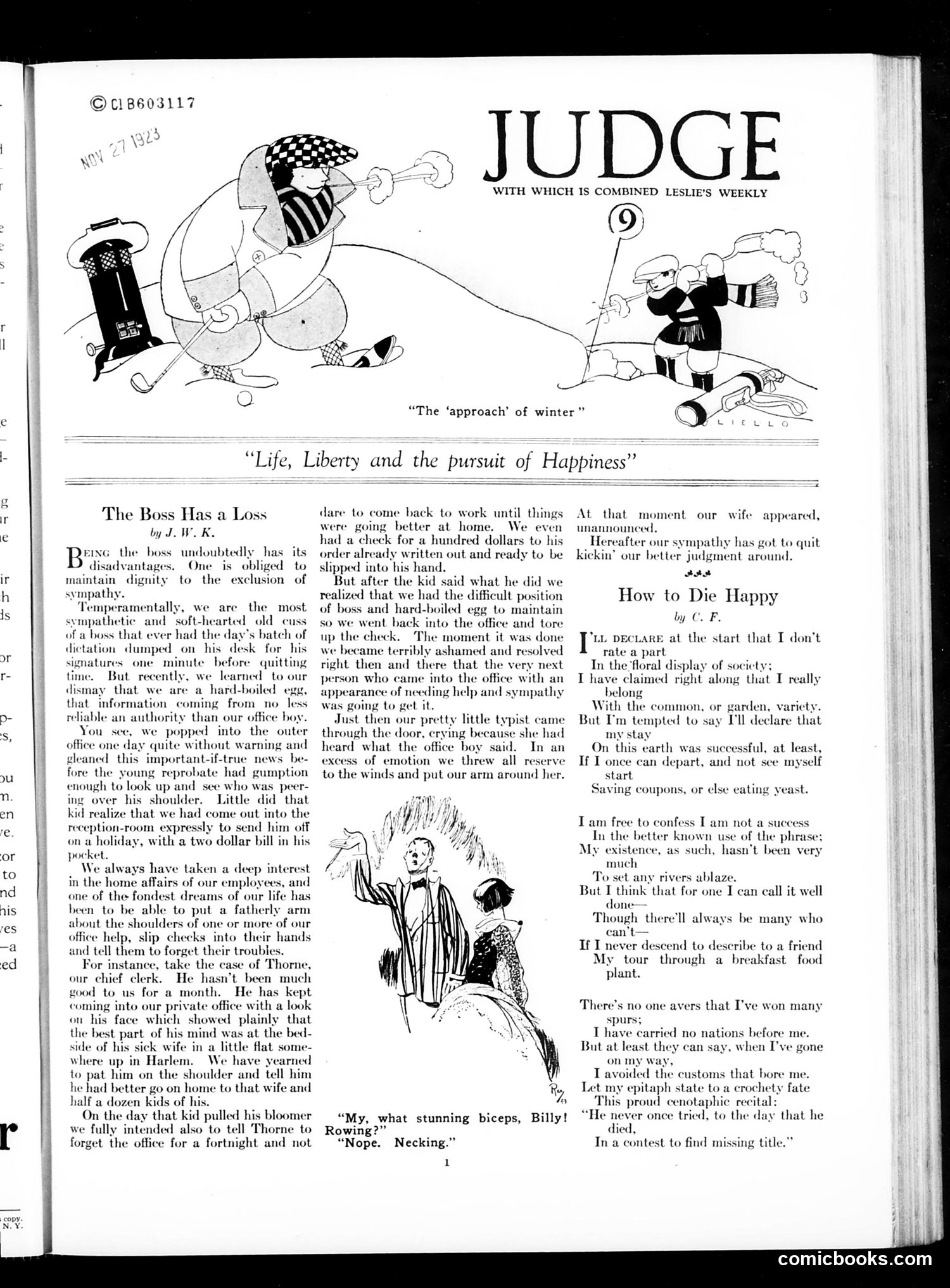
This 1925 Judge magazine page contains two distinct pieces: **"The Boss Has a Loss"** (left) is a humorous office story about workplace sympathy. When the boss's clerk loses money, the office staff unexpectedly rallies around him—suggesting even hard-nosed businessmen have soft hearts. **"How to Die Happy"** (right) is a satirical poem mocking social pretension and material success. The author declares happiness comes not from wealth or status ("I don't rate a part / In the local display of society") but from freedom, variety, and simple pleasures. The accompanying illustration shows a woman gesturing dramatically, emphasizing the poem's ironic tone about rejecting conventional ambitions. The top cartoon, "The approach of winter," depicts ice-fishing scenes—winter recreation imagery typical of Judge's seasonal humor. Together, these pieces reflect 1920s concerns about authenticity versus social climbing.
📄 Transcribed text from this page (OCR, searchable)
Machine-transcribed from the original scan — historical spelling and the odd misread are preserved.
©)8603117 “Life, The Boss Has a Loss by JW. K. Bux: the boss undoubtedly has its disadvantages. One is obliged to maintain dignity to the exclusion of sympathy. ‘Temperamentally, we are the most sympathetic and soft-hearted old cuss of a boss that ever had the day's batch of dictation dumped on his desk for his signatures one minute before quitting time. But recently, we learned to our dismay that we are a hard-boiled egg, that information coming from no. less reliable an authority than our office boy. You see, we popped into the outer office one day quite without warning and gleaned this important-if-true news be- fore the young reprobate had gumption enough to look up and see who was peer- ing over his shoulder. Little did that kid realize that we had come out into the reception-room expressly to send him off on a holiday, with a two dollar bill in his pocket. We always have taken a deep interest in the home affairs of our employees, and one of the fondest dreams of our life has been to be able to put a fatherly arm about the shoulders of one or more of our office help, slip checks into their hands and tell them to forget their troubles. For instance, take the case of Thorne, our chief clerk. He hasn’t been much good to us for a month. He has kept coming into our private office with a look on his face which showed plainly that the best t of his mind was at the bed- side of h k wife in a little flat some- where up in Harlem. We have yearned to pat him on the shoulder and tell him he had better go on home to that wife and half a dozen kids of his. On the day that kid pulled his bloomer we fully intended also to tell Thorne to forget the office for a fortnight and not “The ‘approach’ of winter” Liberty and the pursuit of Happiness” >» JUDGE WITH WHICH IS COMBINED LESLIE’S WEEKLY dare to come back to work until things were going better at home. We even had a check for a hundred dollars to his order already written out and ready to be slipped into his hand. But after the kid said what he did we realized that we had the difficult position of boss and hard-boiled egg to maintain so we went back into the office and tore up the check. The moment it was done we became terribly ashamed and resolved right then and there that the very next person who came into the office with an appearance of needing help and sympathy was going to get it. Just then our pretty little typist came through the door, erying because she had heard what the o} aid. In an excess of emotion we threw all reserve to the winds and put our arm around her. “My, what stunning biceps, Billy! Rowing?” “Nope. Necking.” 1 At that moment unannounced, Hereafter our sympathy has got to quit kickin’ our better judgment around. Rad How to Die Happy by C.F. I™ DECLARE at the start that I don’t rate a part In the ‘floral display of society; T have claimed right along that I really belong With the common, or garden, variety. But I'm tempted to say I'll declare that my stay On this earth was successful, at least, If I once can depart, and not see myself start Saving coupons, or else eating yeast. our wife appeared, I am free to confess Tam not a success In the better known use of the phrase: My existence, as such, hasn't been very much To set any rivers ablaze. But I think that for one I can call it well done— Though there'll always be many who can’t— If I never descend to describe to a friend My tour through a breakfast food plant. There’s no one avers that I’ve won many spurs; T have carried no nations before me. But at least they can say, when I’ve gone on my way, T avoided the customs that bore me. Let my epitaph state to a crochety fate This proud cenotaphic rec “He never once tried, to the « died, In a contest to find missing title.” ay that he comicbooks.com