
A complete issue · 36 pages · 1923
Judge — November 24, 1923
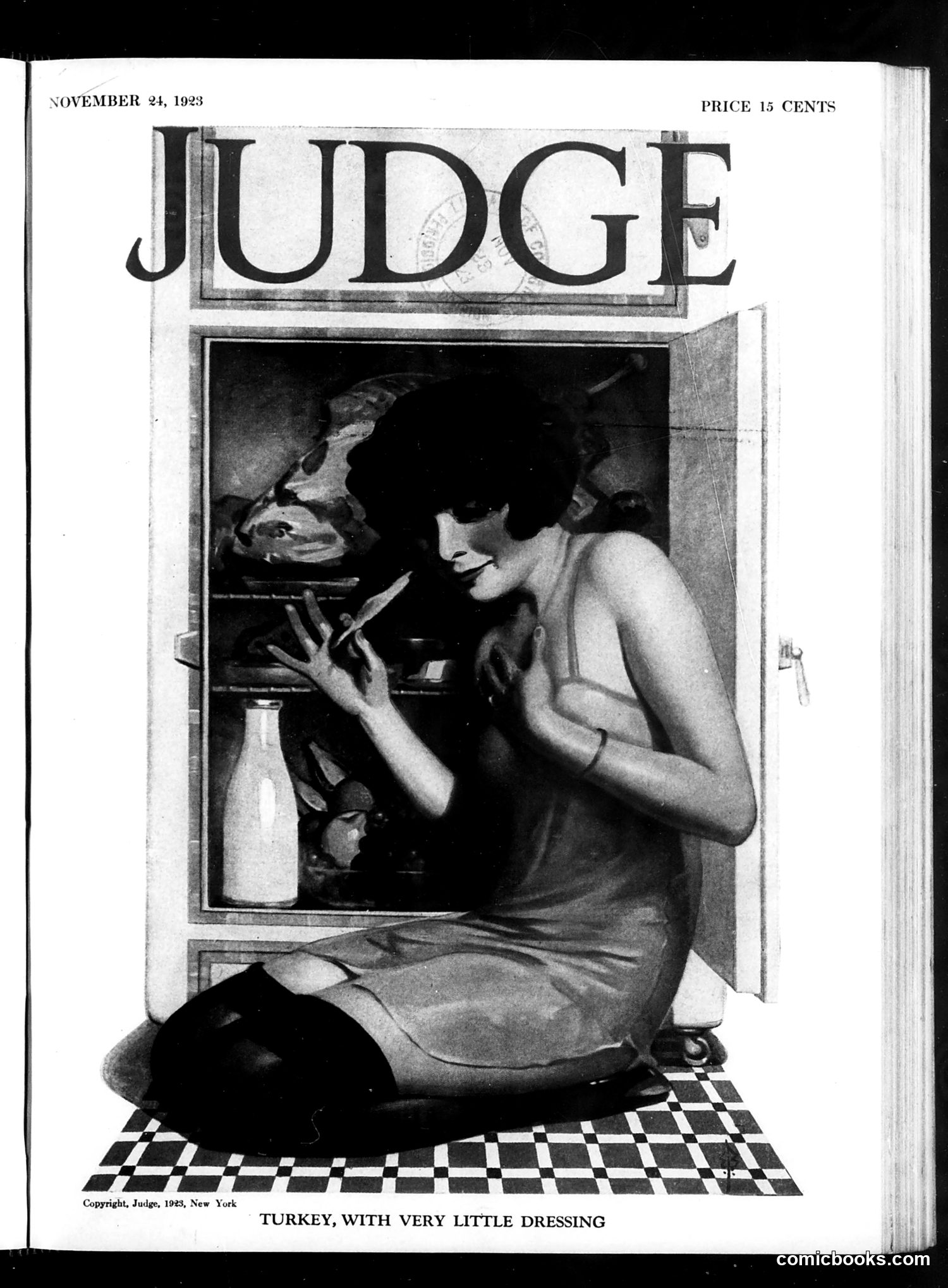
This cover features a woman in a kitchen, sitting on the floor and looking into an open oven. The caption reads "Turkey, with Very Little Dressing." The joke is a visual pun playing on the double meaning of "dressing"—both a culinary sauce/stuffing and clothing. The woman is depicted with minimal clothing (appearing to wear only undergarments), creating the humor: she is literally a "turkey with very little dressing" in the sense of wearing very little clothing, while appearing to prepare the traditional Thanksgiving dish. This reflects 1920s attitudes toward women's fashion and the era's flapper culture, where shorter skirts and more revealing styles were considered scandalous by conservative standards. The humor relies on this contemporary social tension around women's changing appearance.
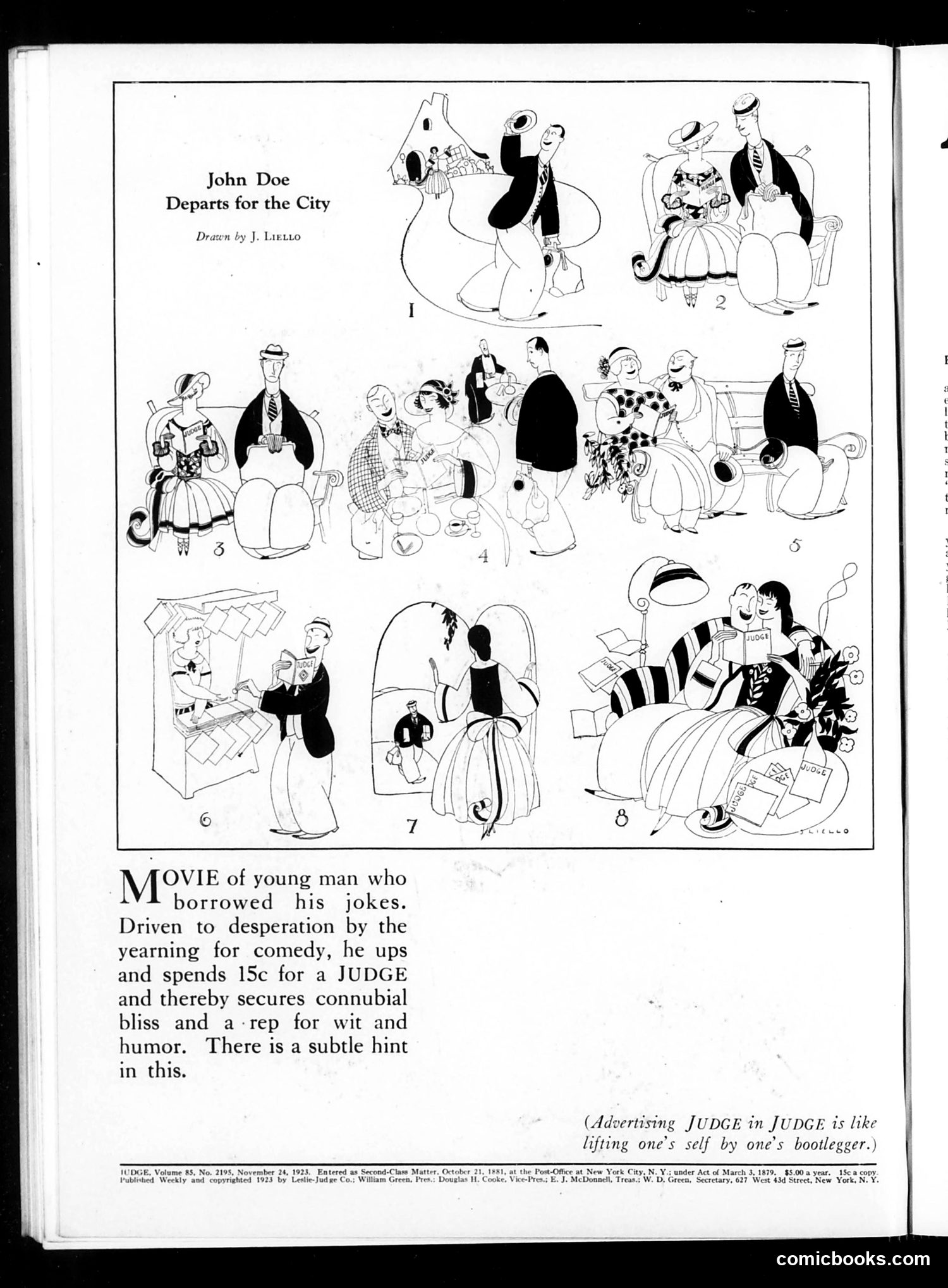
This is a humorous comic strip drawn by J. Liello about a young man ("John Doe") who borrows jokes from a judge and goes to the city seeking comedic success. According to the caption, he spends 15 cents on a "Judge" magazine to acquire "wit and humor" for connubial bliss and reputation. The eight sequential panels show John's journey through increasingly absurd situations—from domestic scenes to what appears to be a chaotic finale involving scattered papers and physical comedy. The advertisement tagline jokes that reading Judge magazine is "like lifting one's self by one's bootlegger"—a Prohibition-era reference suggesting the magazine provides an intoxicating escape or uplift. The satire mocks both the young man's desperation for borrowed wit and the magazine's promise of comedic solutions.
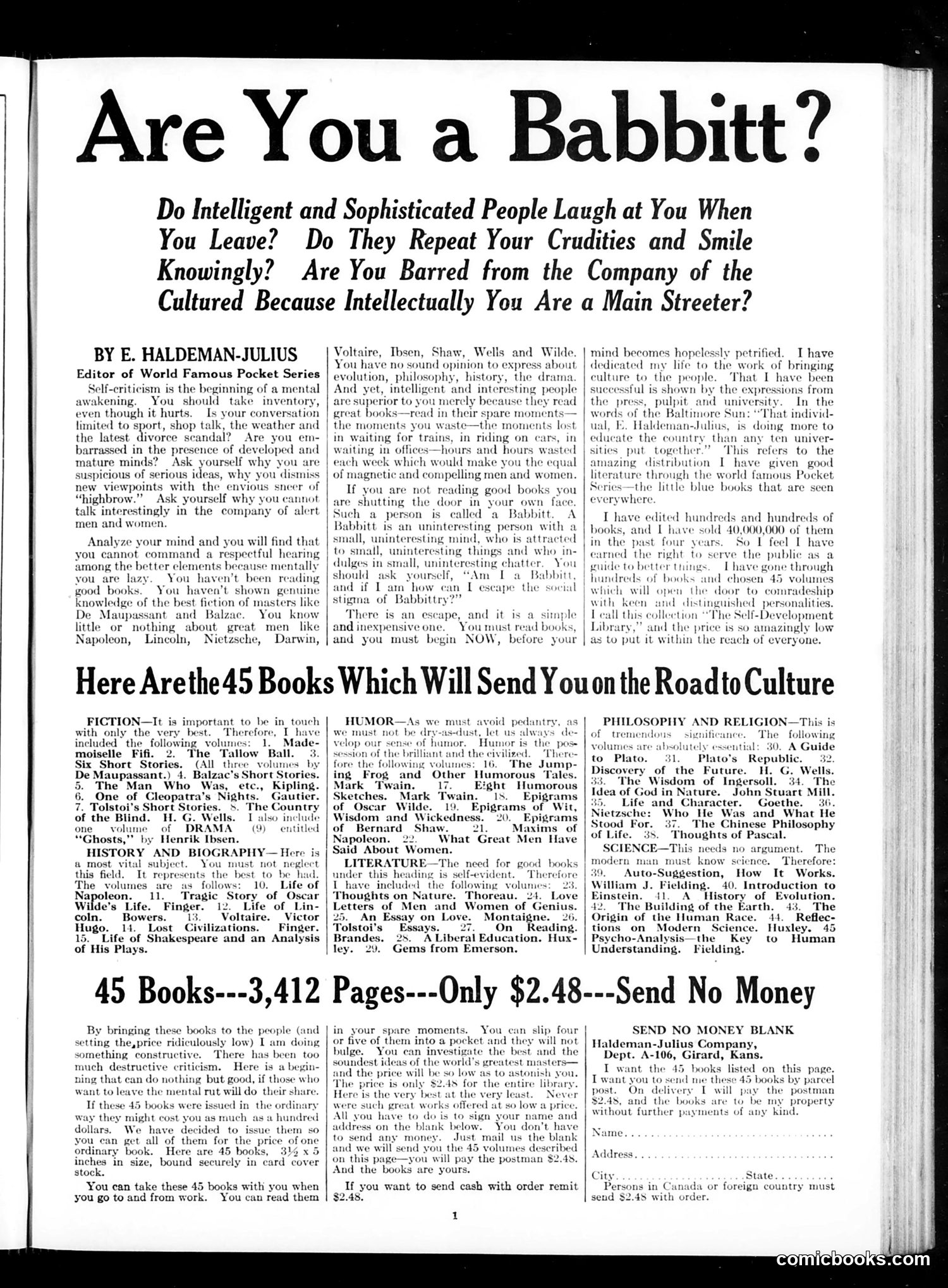
This page is primarily **advertising**, not political satire. It promotes a 45-book "pocket series" collection for $2.48, marketed as a cure for intellectual inadequacy. The satirical framing device is the headline "Are You a Babbitt?"—referencing Sinclair Lewis's 1922 novel about an unthinking, conformist businessman. The ad mocks people dismissed as intellectually shallow ("Main Streeters"), suggesting they can elevate themselves through reading classics by authors like Plato, Shakespeare, and Darwin. The humor targets both the insecure consumer desperate to appear cultured and the pretentious gatekeepers who judge them. It's fundamentally a **self-help advertisement disguised as social commentary**—offering affordable culture as status improvement for the aspirational middle class of the 1920s-30s era.
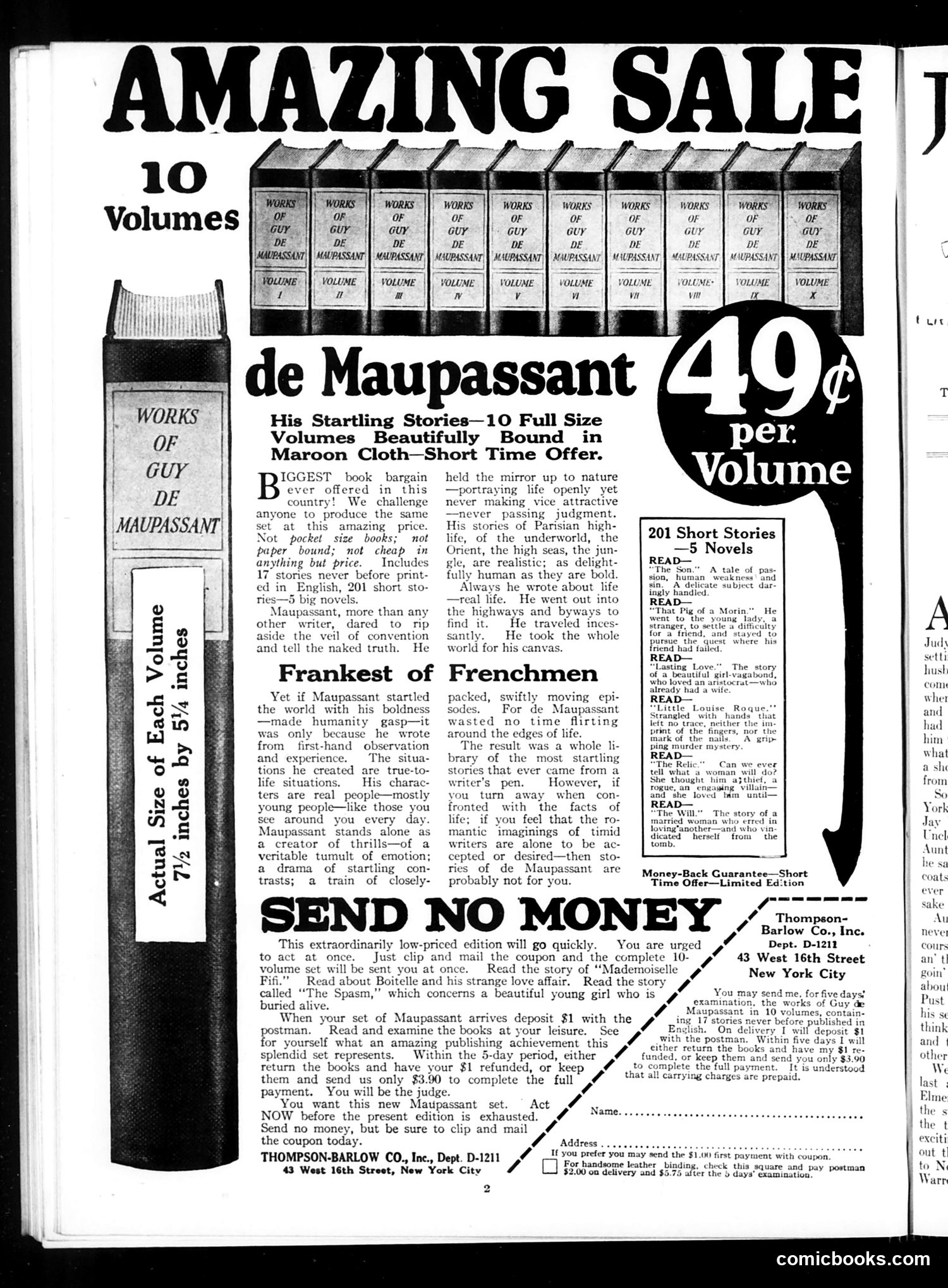
This page is primarily **advertising, not political satire**. It promotes a book collection of Guy de Maupassant's works—10 volumes of his short stories offered at 49 cents per volume by Thompson-Barlow Co. The ad emphasizes Maupassant's reputation for bold, realistic storytelling that "dared to rip aside the veil of convention and tell the naked truth." It highlights his famous stories like "Frankest of Frenchmen" and notes his unflinching portrayal of Parisian life and human nature. The actual content is a straightforward mail-order offer: readers could send $1 as a deposit, examine the books, and either complete payment or return them. This represents early 20th-century direct-mail marketing, not political commentary. The page contains no identifiable political cartoons or social satire.
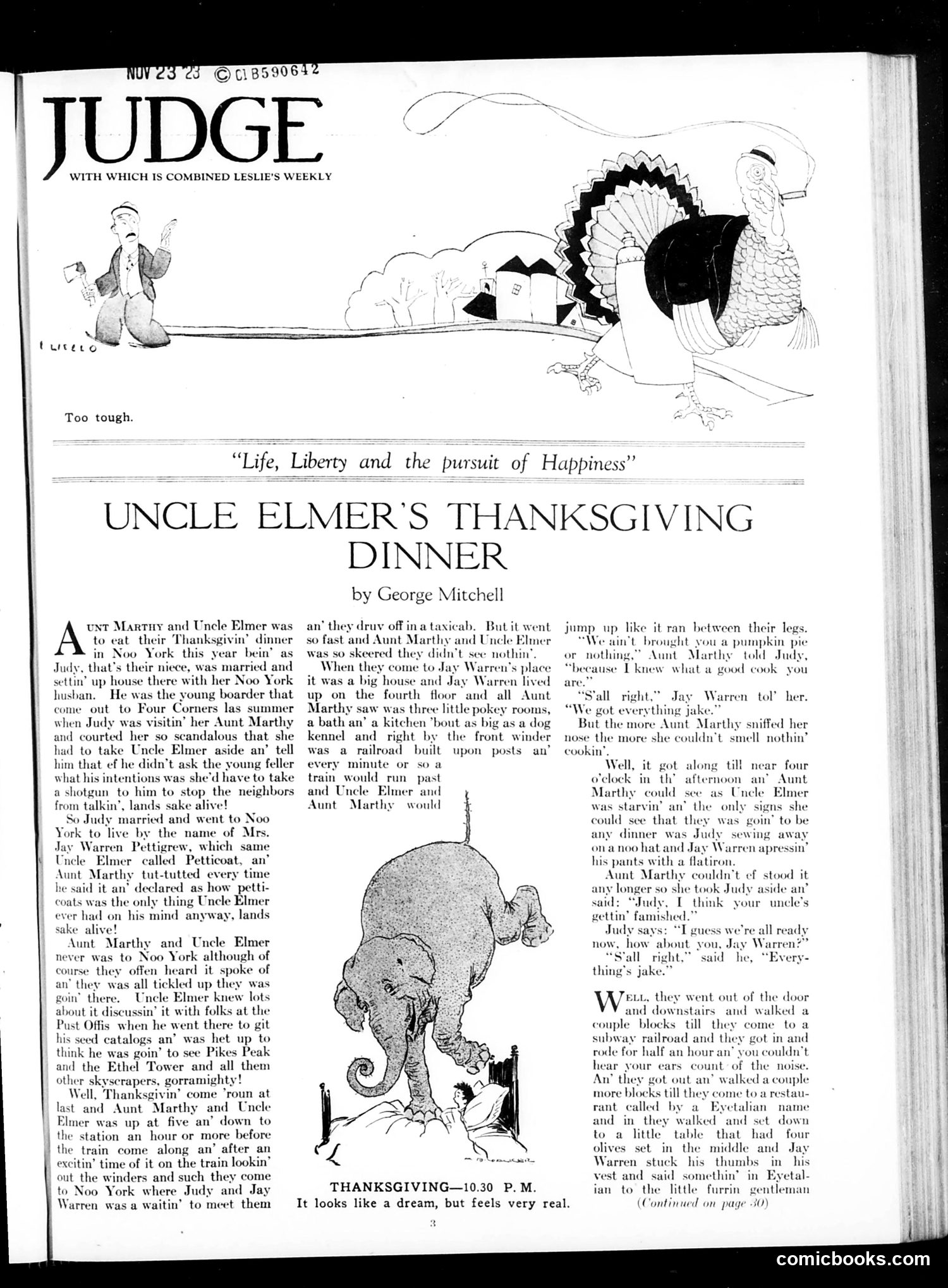
This page features a humorous short story by George Mitchell about a working-class Thanksgiving in early 1900s New York. The cartoon illustration depicts an oversized turkey appearing to tower over or intimidate human figures—likely satirizing the economic strain of affording a proper holiday dinner. The story itself concerns Uncle Elmer and Aunt Marthy's modest circumstances in "Noo York," where they struggle to host Thanksgiving dinner. The narrative humor stems from class-based struggles and the gap between holiday expectations and working-class reality. The main cartoon uses the turkey as a visual gag, exaggerating its size to emphasize either the cost burden or the challenge of obtaining quality provisions for poor urban families during the holiday season.
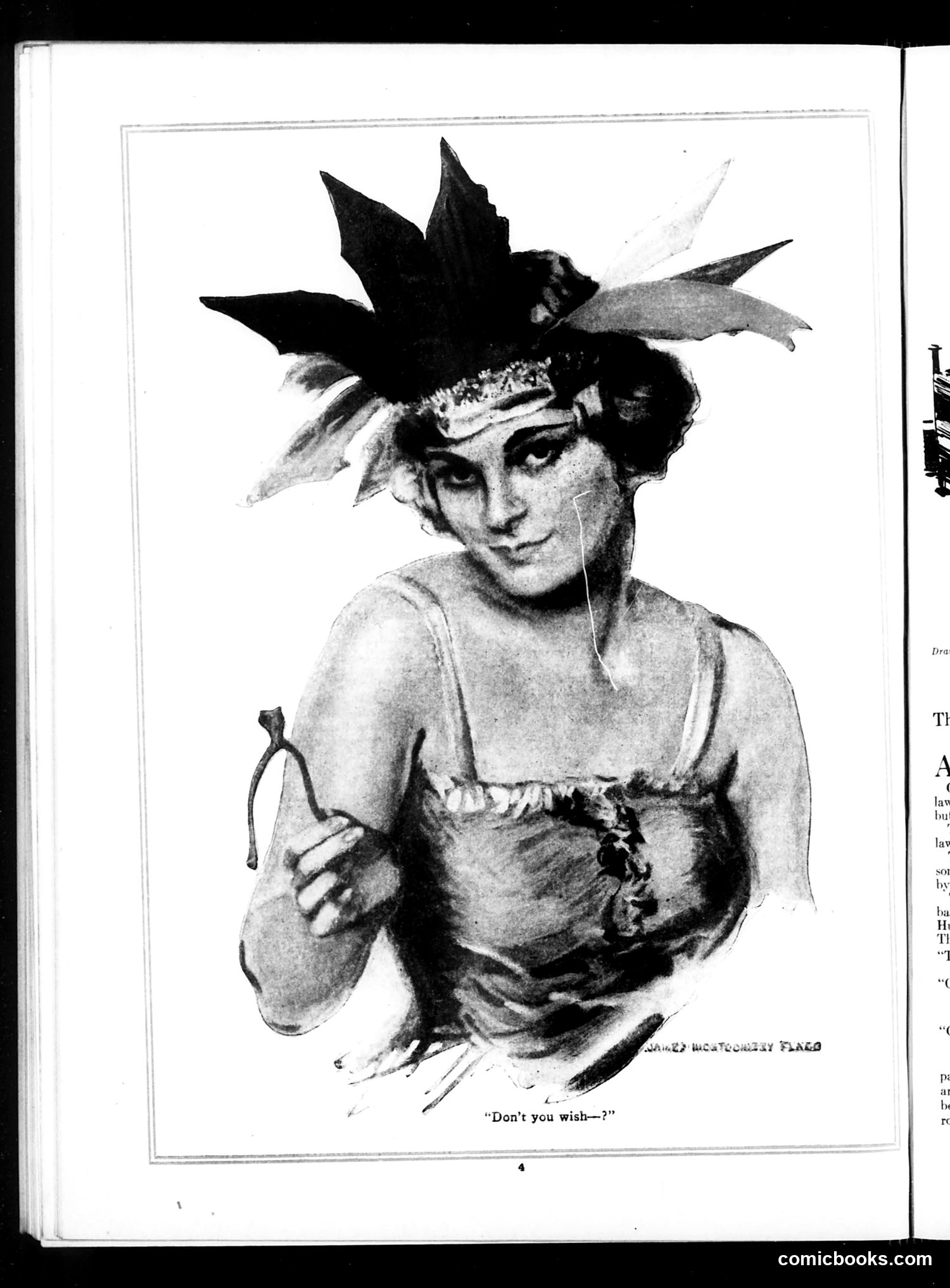
This is an illustration titled "Don't you wish—?" showing a woman in an elegant dress wearing an elaborate feathered headdress and holding what appears to be a lorgnette (opera glasses). The artwork is credited to "ALLIED McCORMACK FLACH" at the bottom. Without additional OCR text from the page's article or context, I cannot definitively identify the specific political or social reference. However, the style and presentation suggest this is likely satirizing fashionable society or commenting on women's fashion and aspirations of the early 20th century. The rhetorical question "Don't you wish—?" implies the cartoon makes a pointed social commentary about desire, wealth, or status among readers, probably relating to contemporary fashion trends or social climbing. The specific target remains unclear without the accompanying article text.
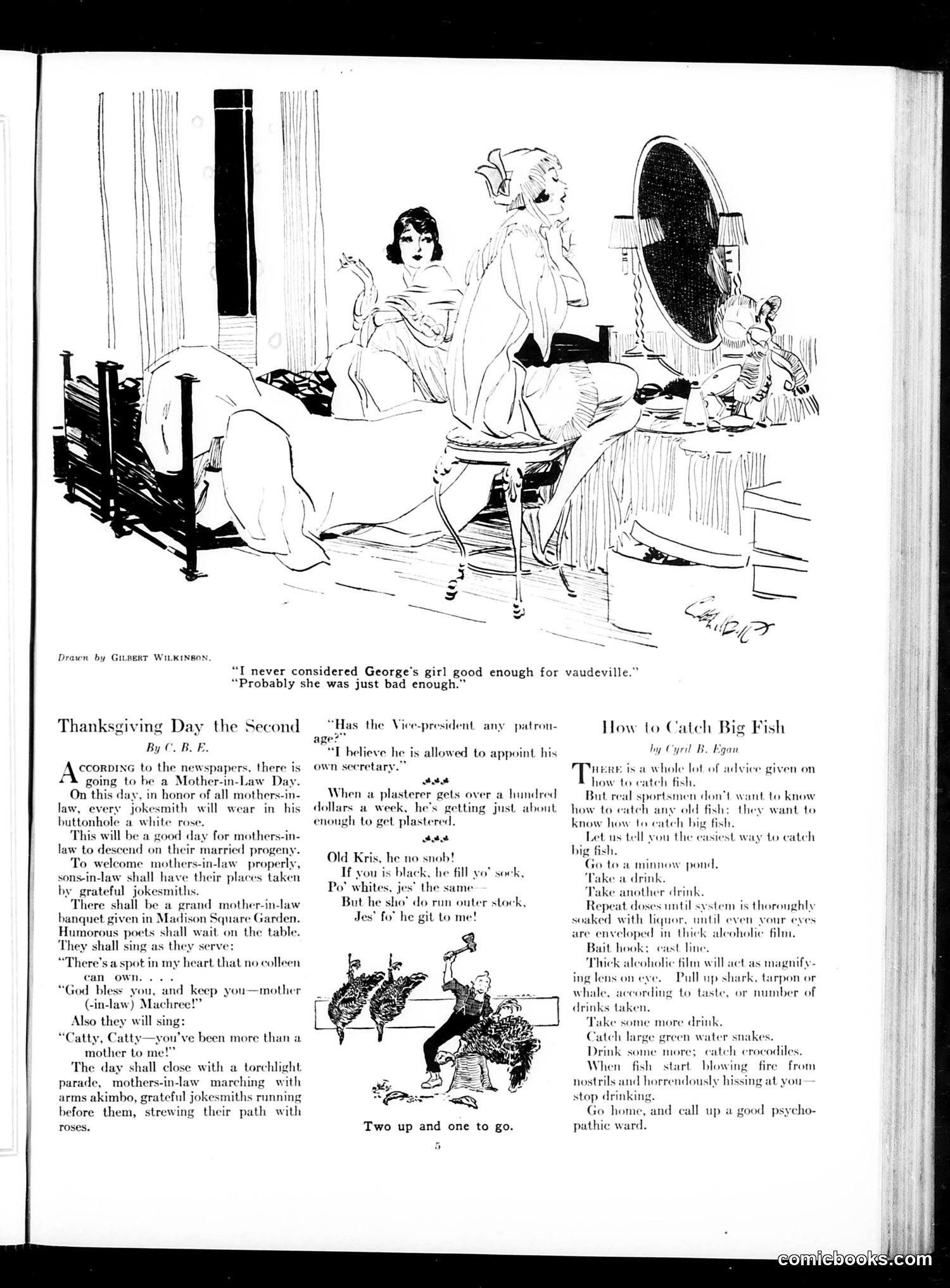
This page contains three satirical pieces from Judge magazine: **Top cartoon**: A joke about a showgirl's talent—the humor relies on a double meaning of "bad," suggesting the girl was morally loose rather than professionally incompetent for vaudeville (stage entertainment). **"Thanksgiving Day the Second"**: Satirizes the American tradition of mother-in-law jokes by proposing an absurdist holiday celebrating mothers-in-law instead. The piece mocks how pervasive and formulaic these jokes were in popular humor, suggesting that jokesmiths would celebrate the holiday with elaborate ceremonies while sons-in-law flee. This reflects early 20th-century comedy's obsession with ridiculing in-law relationships. **"How to Catch Big Fish"**: A humorous advice column that's actually satirizing excessive drinking. The "method" involves getting progressively drunk until the fisherman hallucinates (seeing snakes and crocodiles), then seeking psychiatric care. It's social commentary disguised as fishing humor, mocking alcohol consumption. All three pieces use exaggeration and absurdist logic typical of Judge's satirical style.
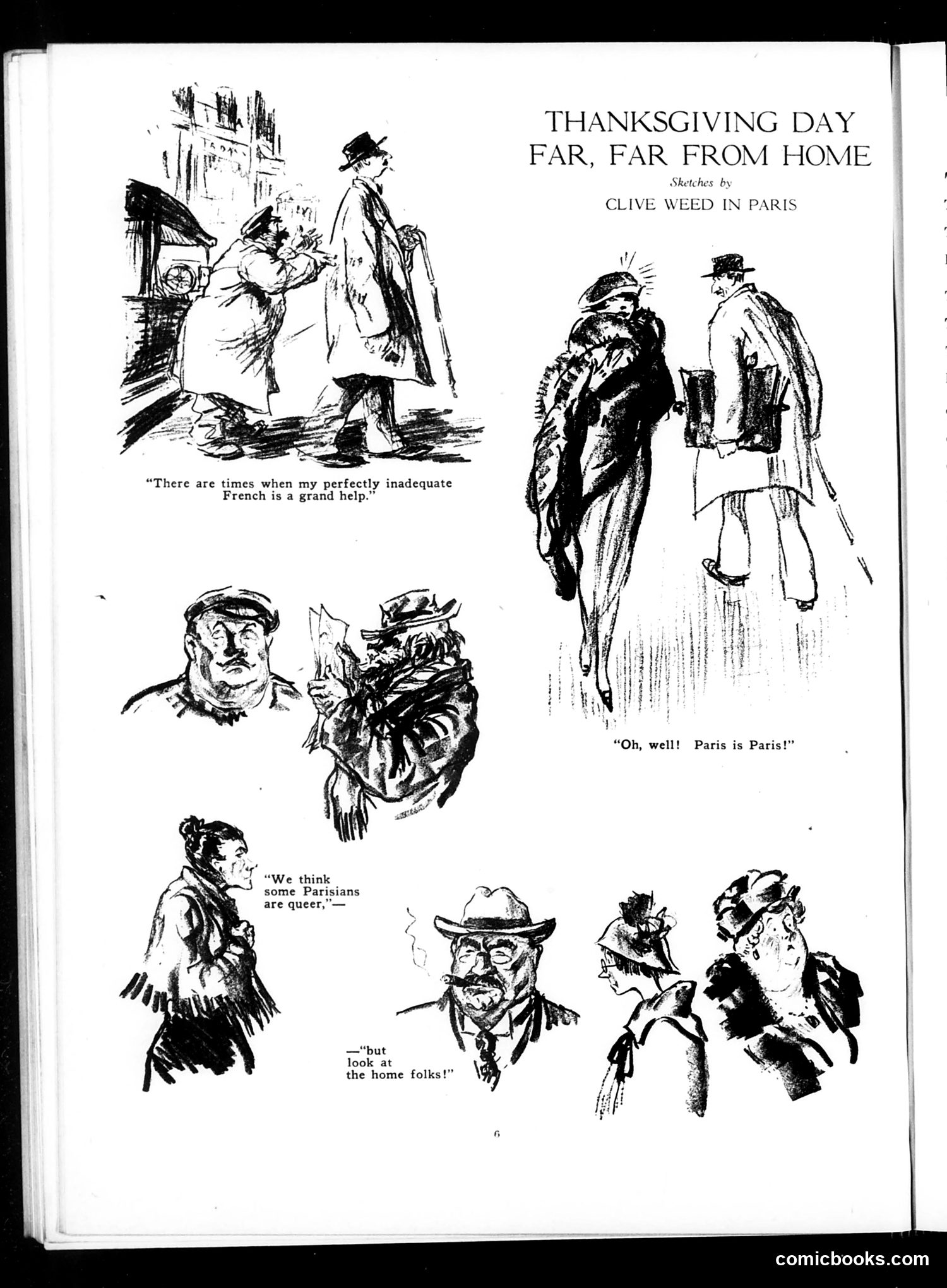
This page presents satirical sketches by Clive Weed depicting American expatriates celebrating Thanksgiving in Paris. The humor contrasts American homesickness with Parisian indifference to the holiday. The sketches show various character types: Americans struggling with language barriers ("my perfectly inadequate French"), trying to recreate home traditions abroad, and encountering bemused or dismissive French locals. The dialogue—"Paris is Paris!" and "We think some Parisians are queer"—suggests mutual cultural bewilderment. The final caption's punchline ("but look at the home folks!") implies that Americans abroad may find Parisians strange, yet Americans back home are equally peculiar—a commentary on cultural relativity and the universal oddness of human behavior regardless of nationality. The overall satire gently mocks both American expatriate sentimentality and cultural superiority, while celebrating the holiday's displacement from its traditional home context.
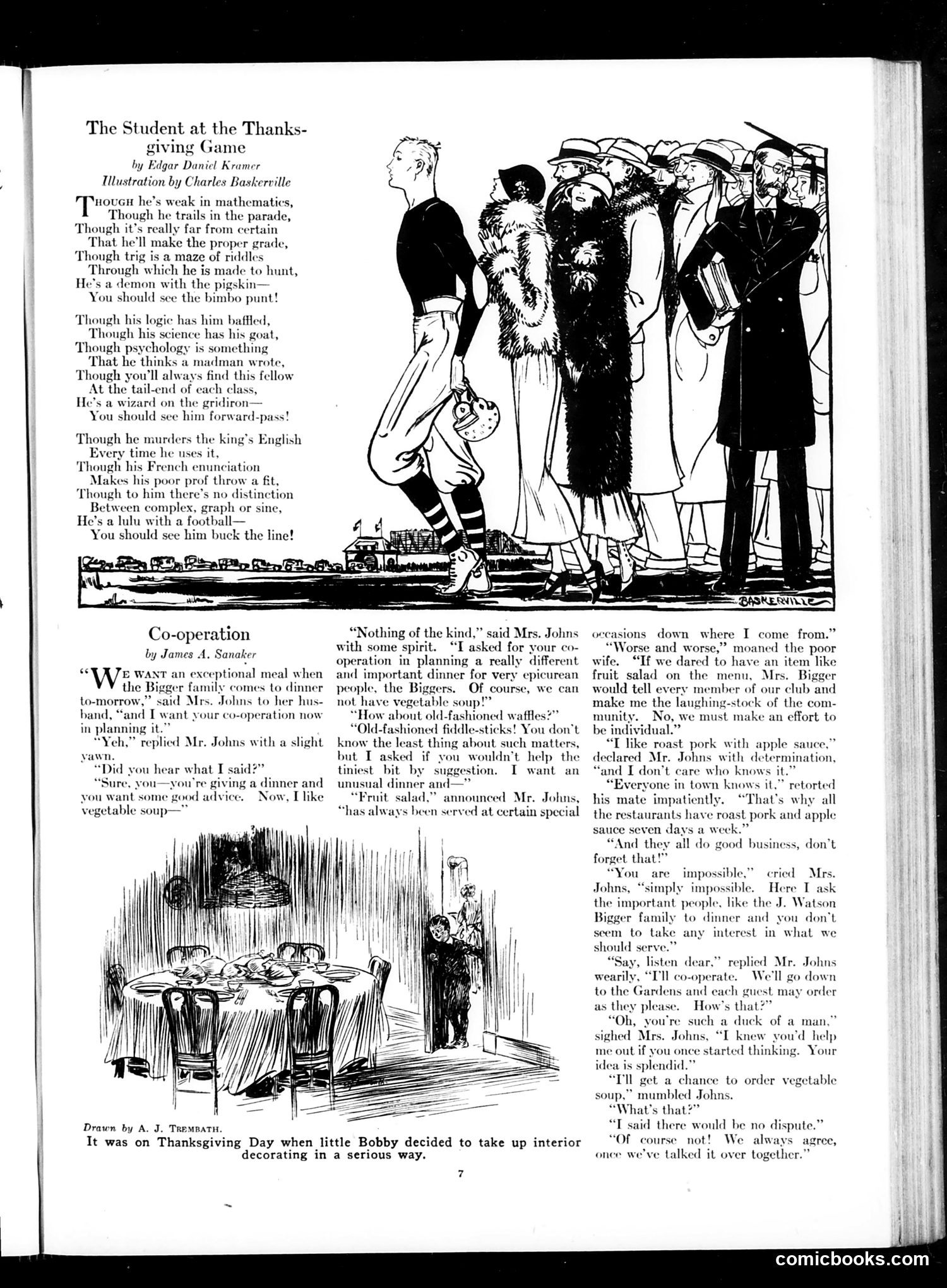
**"The Student at the Thanksgiving Game"** satirizes the academic underachiever who excels athletically. The poem mocks a college student who fails mathematics, logic, science, psychology, and languages but is a football star ("demon with the pigskin"). The humor lies in the contrast: his intellectual incompetence is irrelevant because his athletic prowess makes him a campus hero. This reflects early 20th-century American values prioritizing sports success over academics. **"Co-operation"** depicts marital negotiation around Thanksgiving dinner planning. Mrs. Johns wants an impressive meal for important guests (the Biggers), but Mr. Johns keeps suggesting ordinary options (vegetable soup, old-fashioned waffles, roast pork). The satire shows how husbands resist their wives' social ambitions while pretending to cooperate. Mrs. Johns ultimately gets her way through manipulation, and Mr. Johns ironically suggests ordering vegetable soup anyway—the very thing he initially opposed.
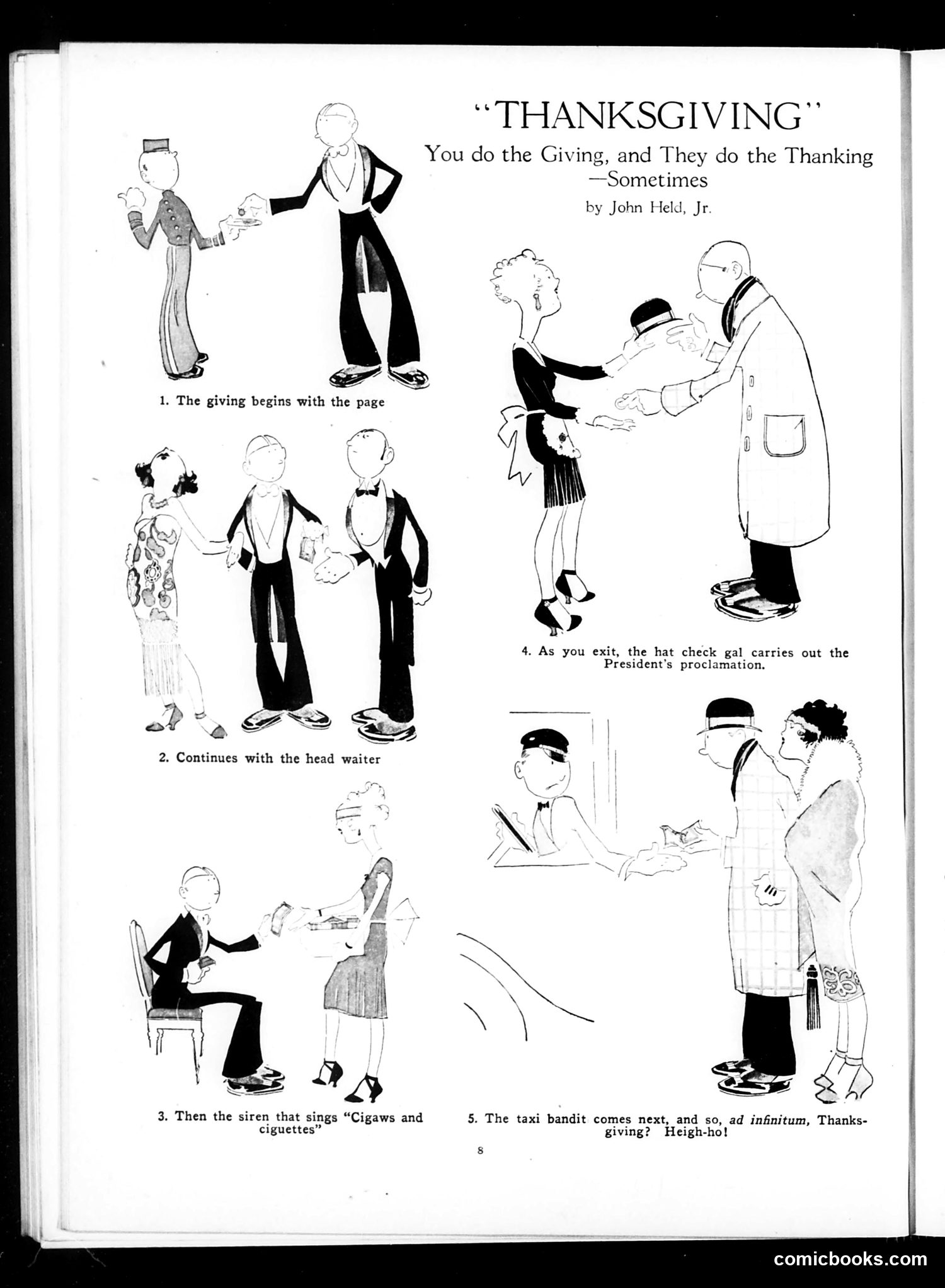
This satirical cartoon by John Held, Jr. mocks the commercialization of Thanksgiving. The joke depicts a wealthy man's "giving" throughout the holiday: he tips various service workers (page boy, head waiter, "siren" entertainer, hat check attendant, taxi driver) in sequence. The satire's point: despite the President's proclamation about gratitude and charitable giving, Thanksgiving has become merely transactional—the giver expects thanks from service workers compensated through tips, perpetuating an endless cycle ("ad infinitum") of obligatory gratitude rather than genuine thanksgiving. The subtitle captures the cynicism: "You do the Giving, and They do the Thanking—Sometimes," suggesting the thanks are performative, not sincere.
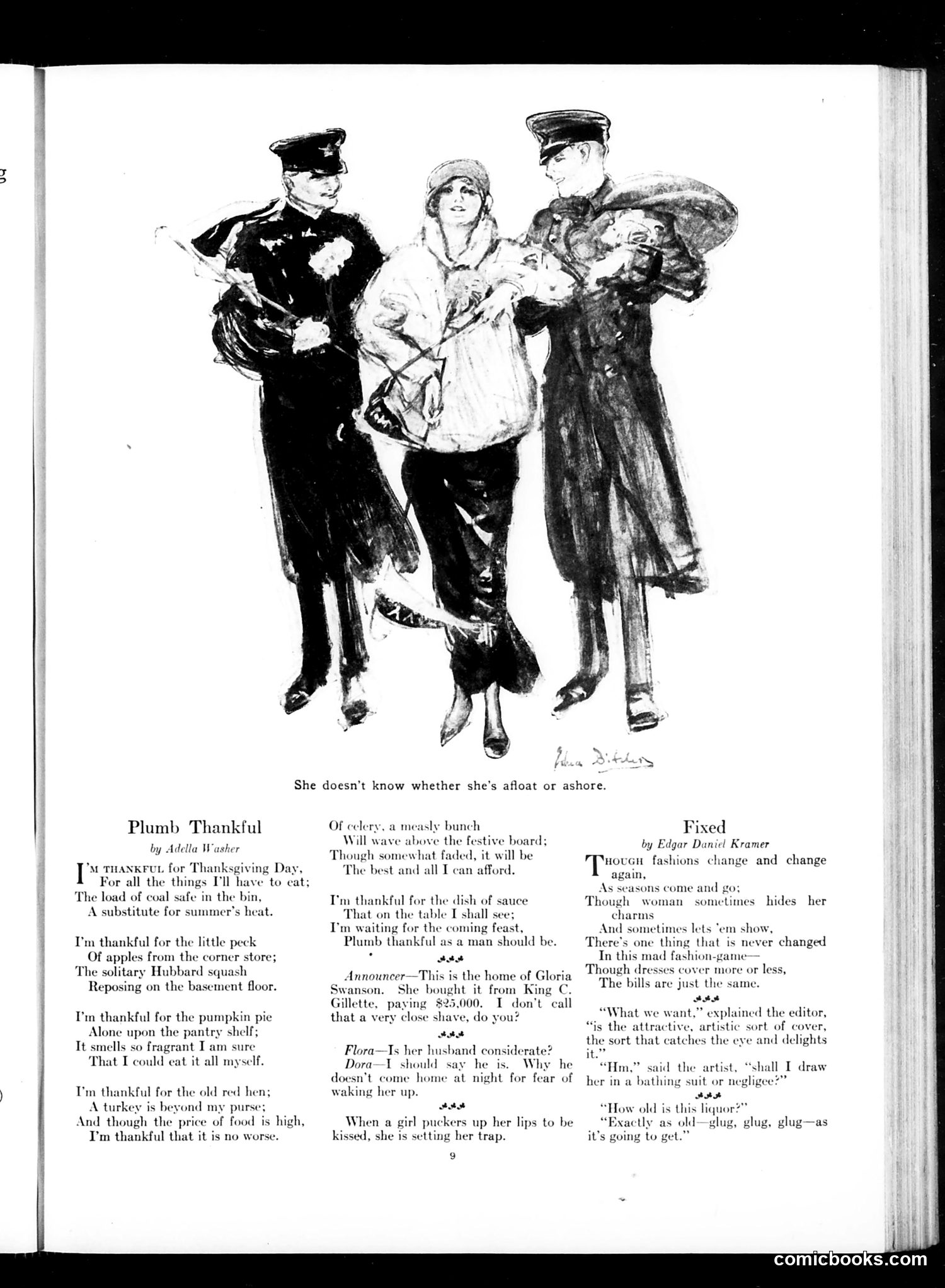
This Judge magazine page contains three satirical pieces reflecting early 20th-century social concerns: **"Plumb Thankful"** satirizes economic hardship during what appears to be a period of scarcity or poverty. The speaker expresses gratitude for meager Thanksgiving provisions—a single squash, measly celery bunch, one pumpkin pie—making dark humor of deprivation. The contrast between traditional holiday abundance and actual scarcity mocks both the cheerfulness expected of the poor and the economic inequality of the era. **The cartoon** (top) depicts a fashionable woman flanked by two military officers, with the caption "She doesn't know whether she's afloat or ashore"—likely satirizing women's confusion about wartime circumstances or social upheaval. **"Fixed"** jokes that despite fashion's constant changes, women's clothing expenses remain eternally high—a timeless complaint about gendered consumer spending. The page's humor relies on economic anxiety, fashion obsession, and gender stereotypes typical of early-to-mid 20th century American satire.
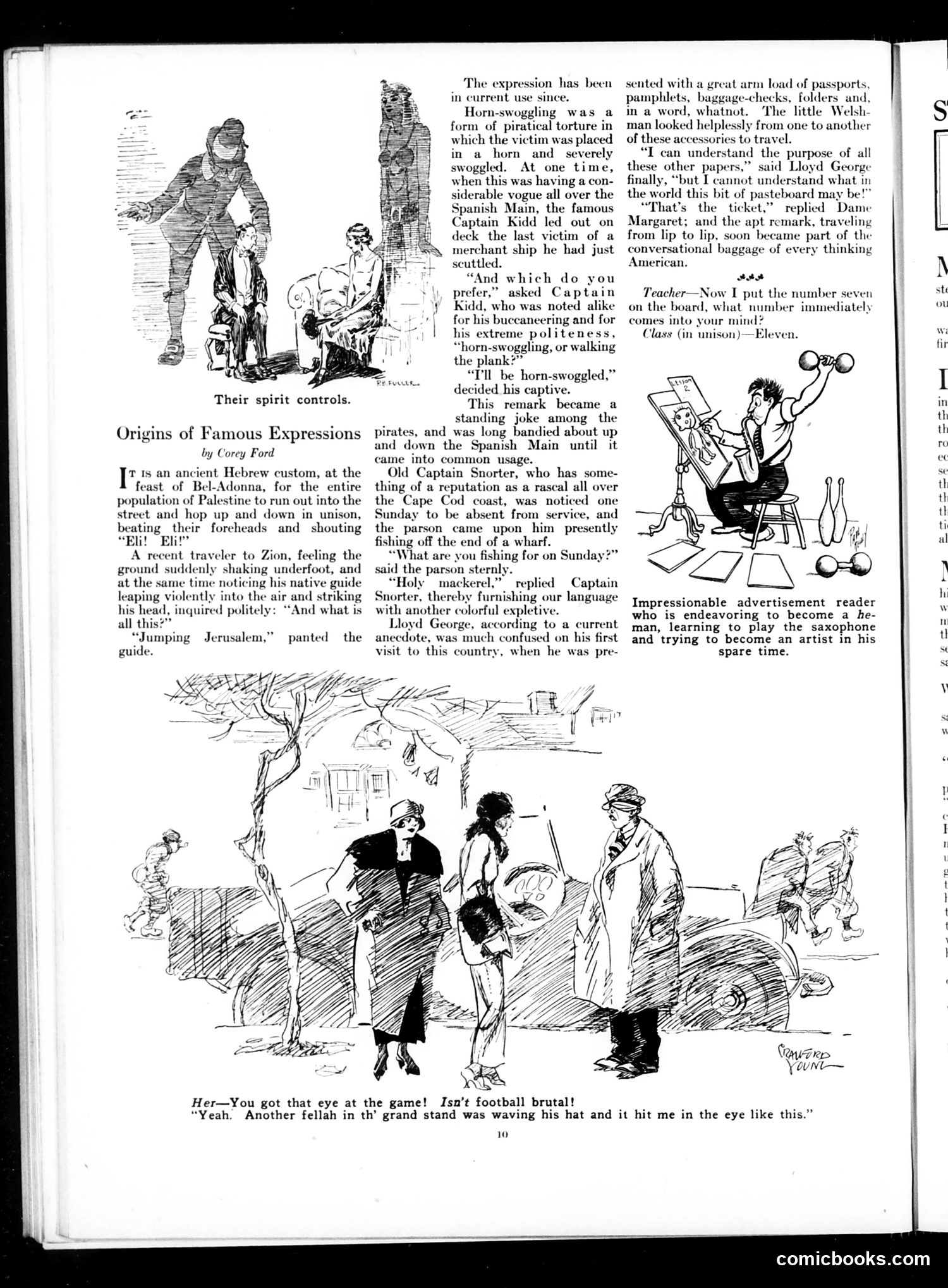
This satirical article humorously invents fake etymologies for common American slang expressions. Corey Ford creates absurd origin stories to mock how people uncritically accept popular sayings without questioning their actual sources. The examples include: "Jumping Jerusalem" (supposedly from Hebrew customs), "horn-swoggled" (attributed to pirate Captain Kidd), "Holy mackerel" (credited to a Cape Cod character named Snorter), and "that's the ticket" (falsely linked to Lloyd George's visit to America). The humor works through exaggeration and obvious fabrication—these clearly aren't real origins. The piece satirizes Americans' tendency to accept folk etymologies and celebrity anecdotes as fact without verification. The bottom cartoon about a football game eye-injury is unrelated to this article, serving as filler content typical of Judge magazine's layout.
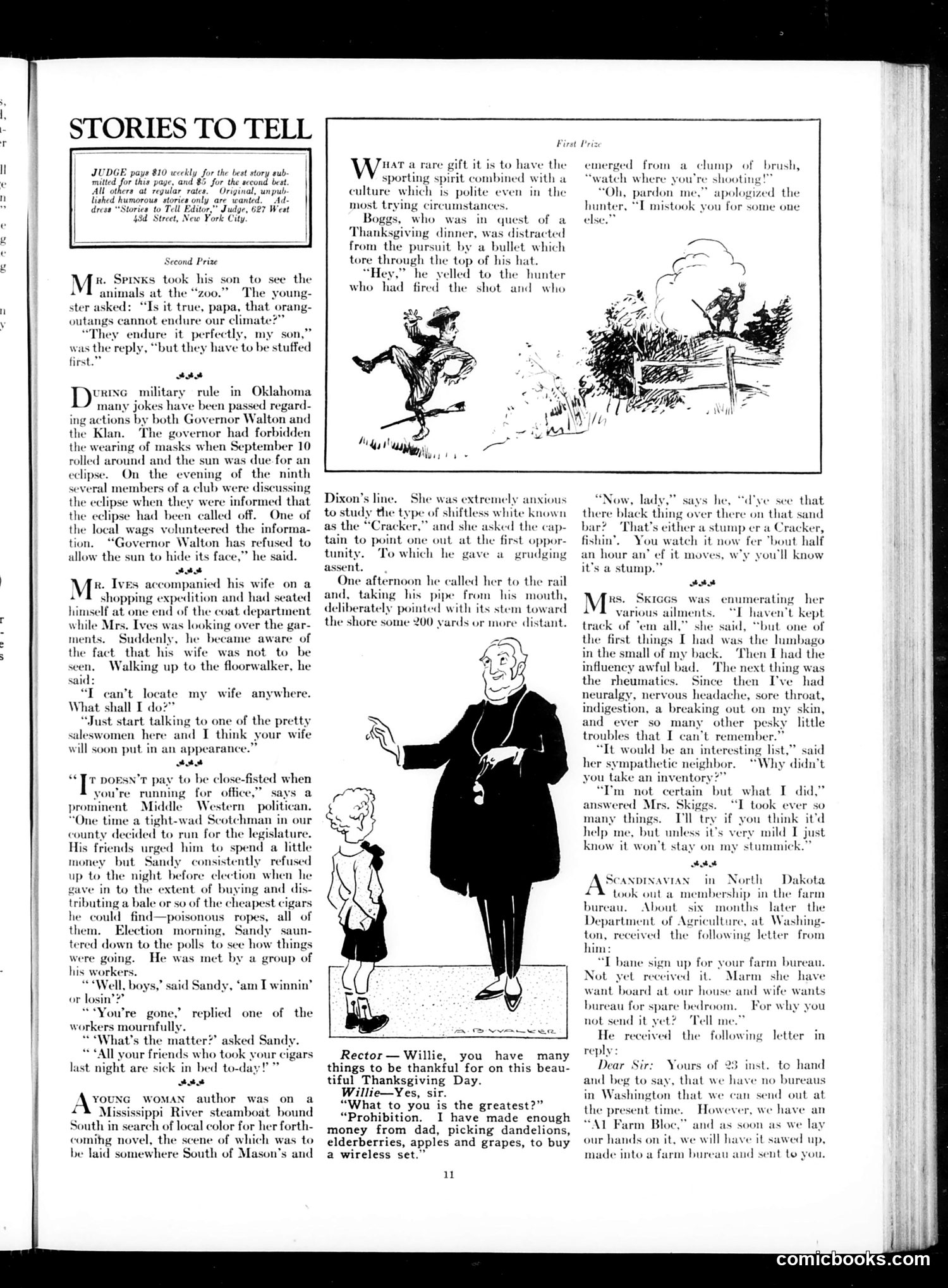
This page collects humorous short stories submitted to Judge magazine's weekly competition ($10 for first prize, $5 for second). The cartoons and anecdotes satirize American social types and current events: **Governor Walton reference**: A joke about Oklahoma's martial-law governor forbidding masks during a 1921 solar eclipse—mocking his authoritarian control by suggesting he even prevents celestial events. **"Cracker" stereotype**: A story about a Southern riverboat captain pointing out a "shiftless white" person of the Appalachian type—reflecting period class and regional prejudices. **Prohibition-era humor**: A child boasts of earning money through farm work to buy a wireless set, crediting "Prohibition" (implying bootlegging income nearby). **Gender/marriage comedy**: Standard jokes about wives shopping and tight-fisted politicians. The content reflects 1920s American humor: regional caricatures, class anxieties, Prohibition-era references, and domestic comedy. Most jokes rely on stereotypes now considered offensive.
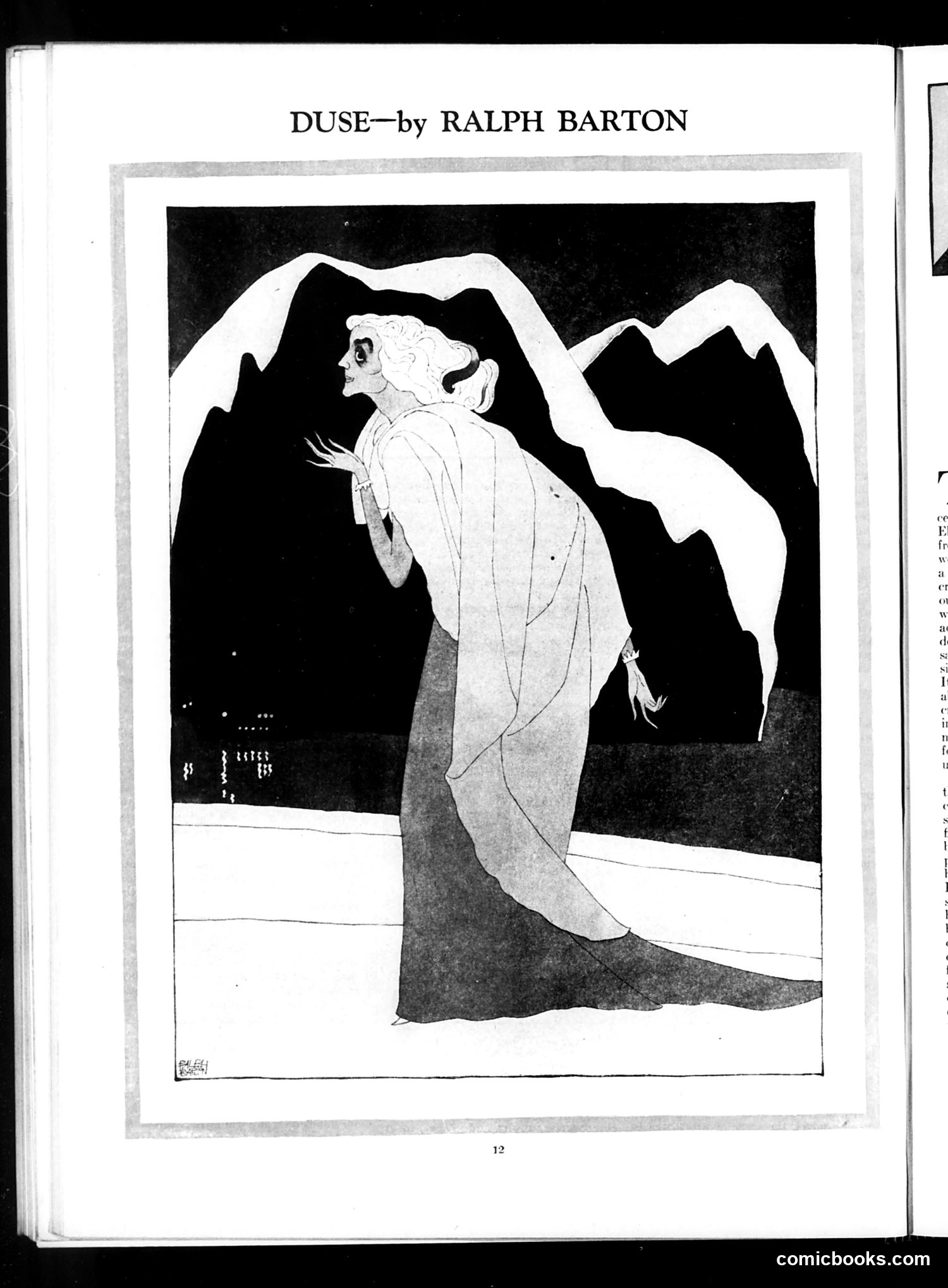
This is an illustration by Ralph Barton titled "Duse," likely depicting the renowned Italian actress Eleonora Duse. The artwork shows a elegant woman in a flowing, draped garment in profile, standing against a dramatic mountainous landscape with stark black and white contrasts. The style is characteristic of early 20th-century high society illustration. Rather than political satire, this appears to be a cultural commentary celebrating theatrical artistry. Duse was one of the era's most acclaimed actresses, known for her dramatic intensity and classical roles. Barton's illustration captures her with elongated, sophisticated proportions typical of his fashionable society portraiture—presenting her as a figure of artistic refinement rather than mockery.
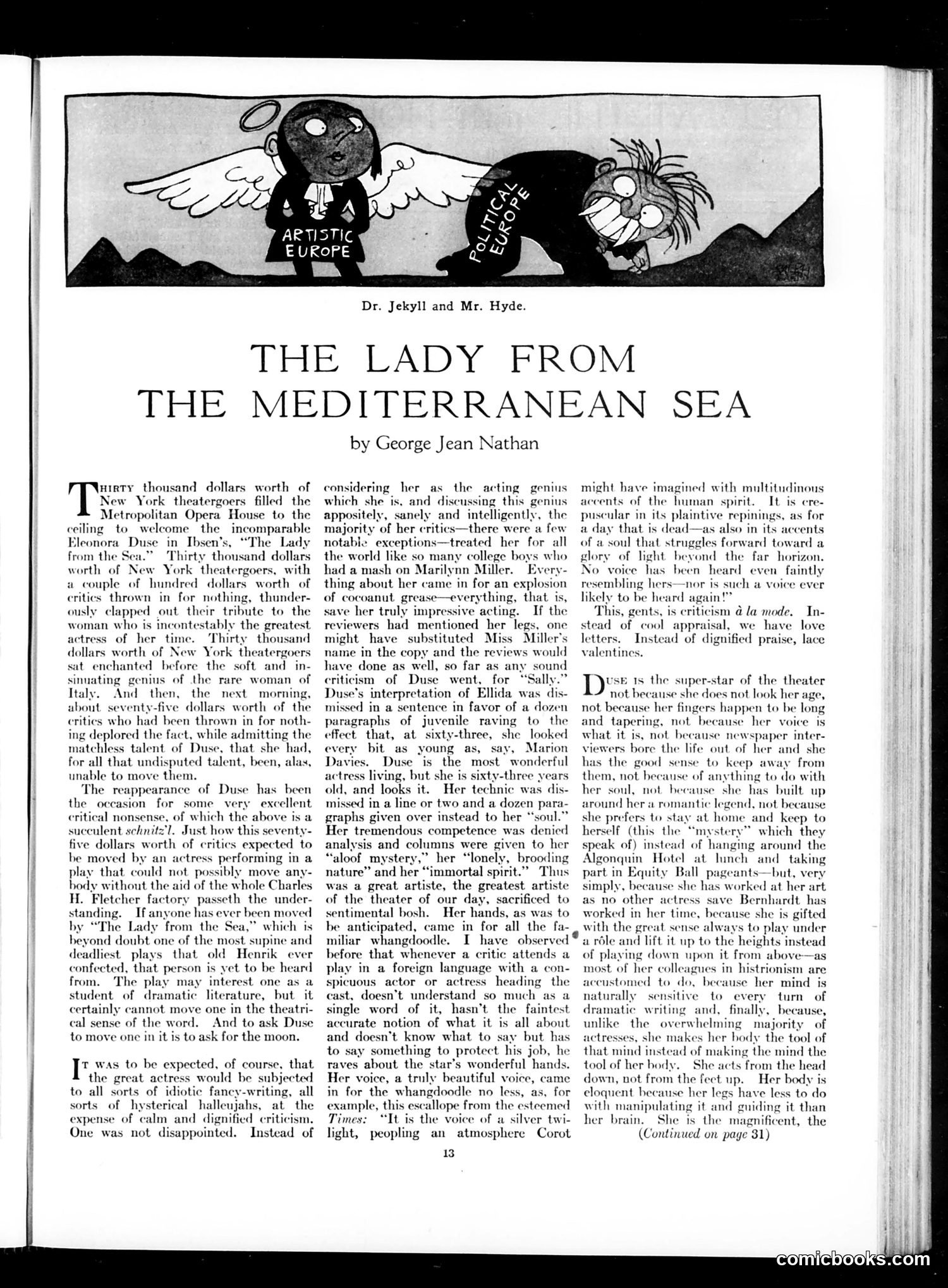
The cartoon contrasts two figures labeled "Artistic Europe" (angelic) and "Folic Europe" (demonic), satirizing European cultural hypocrisy. The accompanying article by George Jean Nathan critiques American theater critics' coverage of Italian actress Eleonora Duse's performance in Ibsen's "The Lady from the Sea." Nathan argues that critics—despite praising Duse as the era's greatest actress—dismissed her actual *acting* in favor of sentimental gushing about her "soul," "mystery," and physical appearance (particularly her legs and hands). The satire targets critics who claim cultural sophistication ("Artistic Europe") while actually demonstrating superficiality and emotional excess ("Folic Europe")—they praise great art while failing to engage its substance intelligently. Nathan suggests they'd have been equally moved by chorus girl Marilynn Miller, exposing their lavish but meaningless rhetoric as a substitute for genuine critical analysis.
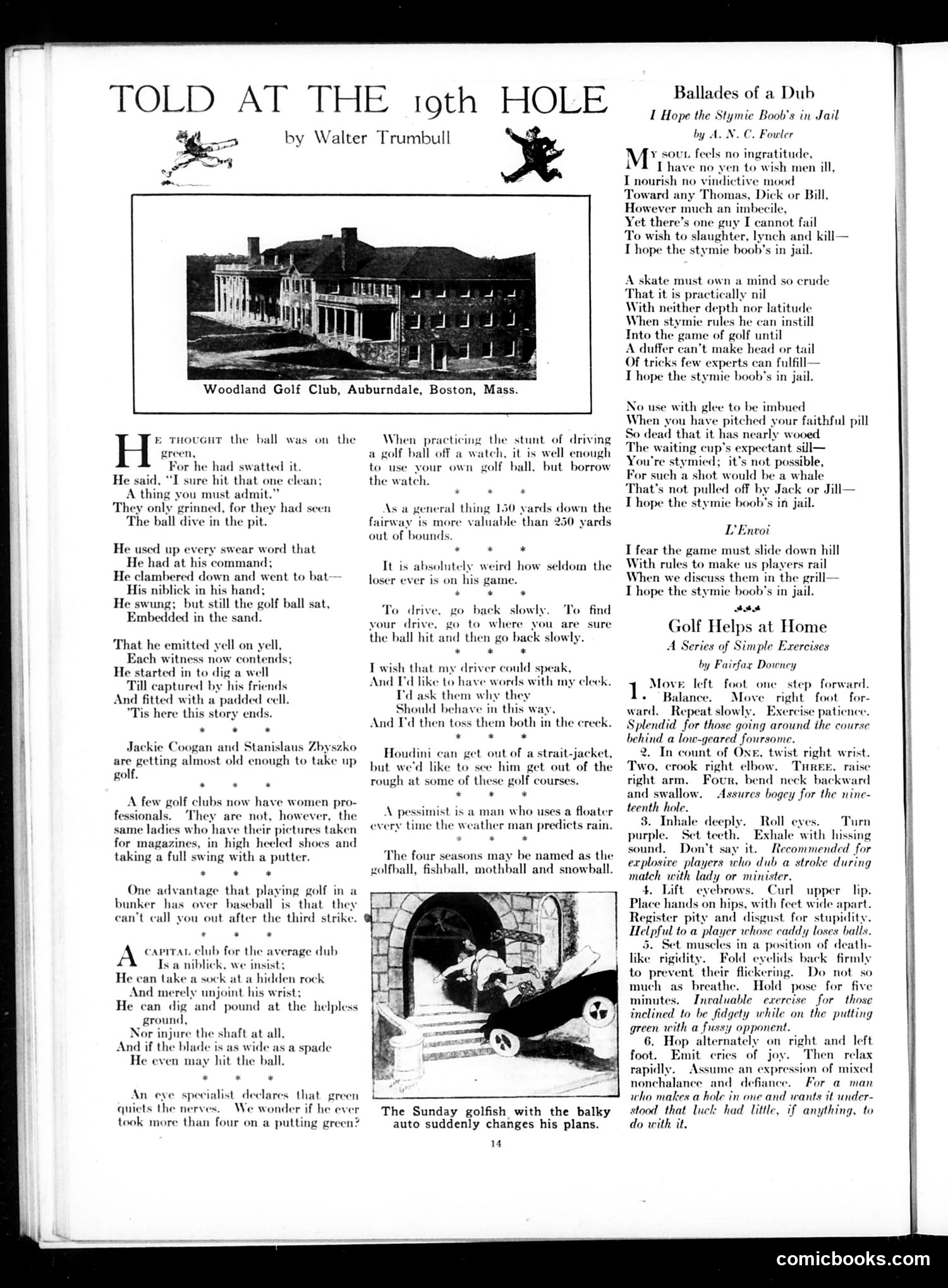
This page from Judge magazine presents golf humor targeting early 20th-century recreational golfers. The main content includes: **"Told at the 19th Hole"** (by Walter Trumbull): A narrative poem about a golfer who badly mishits a ball into a pit, then has a complete tantrum—swearing profusely and requiring a "padded cell" to contain him. The humor relies on exaggeration of golf frustration and the absurdity of losing composure over a sport. **"Ballades of a Dub"** (by A.N.C. Fowler): Satirical verse expressing rage at the "stymie" rule—an obsolete golf regulation where an opponent's ball could block your shot. The speaker fantasizes about imprisoning whoever invented this rule. **"Golf Helps at Home"**: Instructional exercise tips. The satire targets golf's capacity to provoke irrational anger in otherwise civilized people. References to "Jackie Coogan and Stanislaus Zbyszko" (a child actor and wrestler) suggest even celebrities might take up golf. The overall tone mocks the game's maddening nature and players' overwrought reactions.
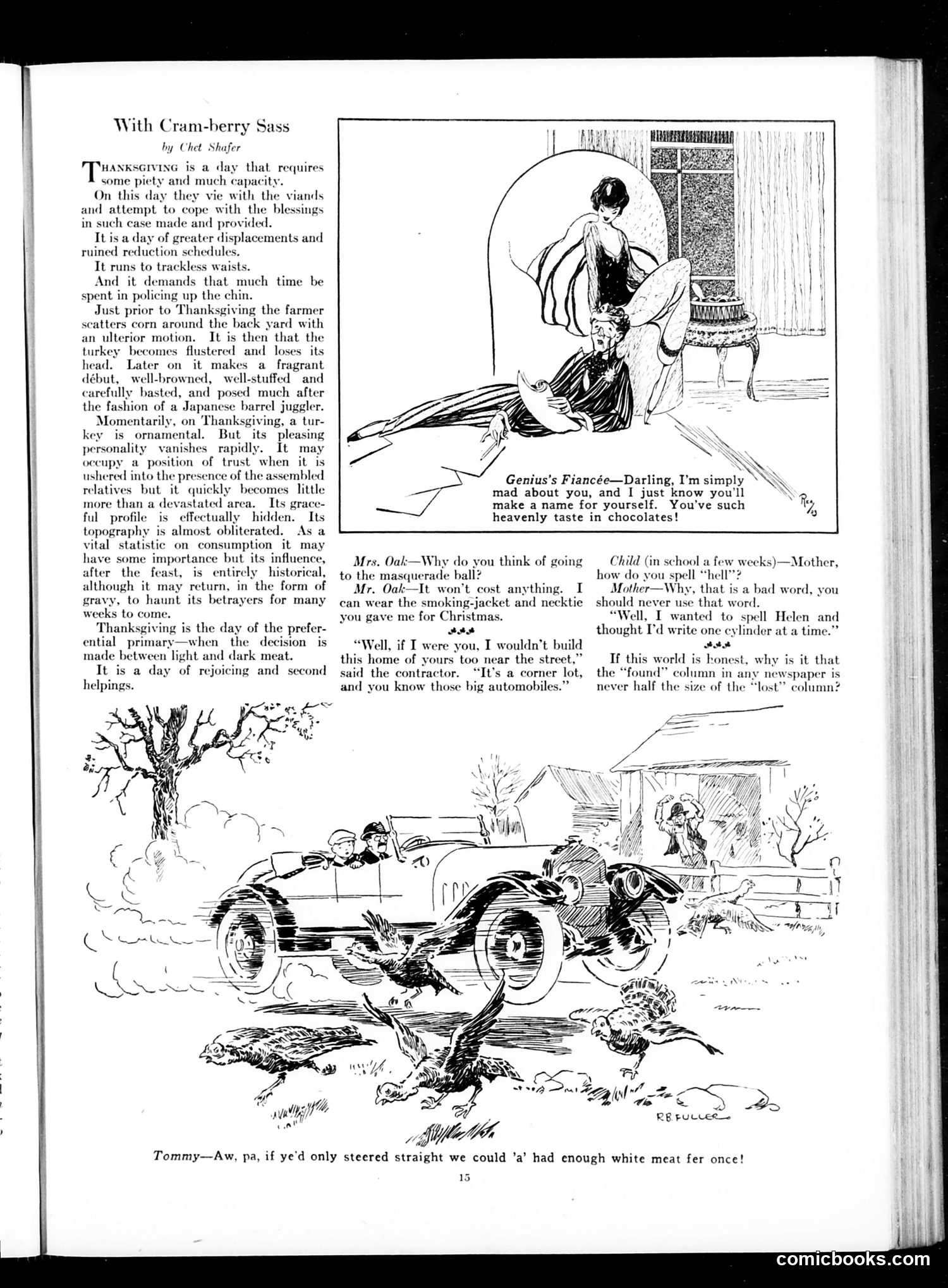
This page contains multiple short humorous pieces about Thanksgiving and everyday life, typical of Judge magazine's satirical format. The main essay by Chet Shafer humorously describes Thanksgiving's chaos: the turkey's journey from farm to table, the mess of eating, and the social ritual of choosing between light and dark meat. It's gentle satire on the holiday's actual disorder beneath its ceremonial veneer. The illustrated vignettes mock various domestic situations: a woman flattering her fiancé's taste in chocolates (ironic given his mediocre choices); a contractor warning against corner lots due to reckless automobiles; a child's innocent spelling confusion about "Helen"; and editorial commentary on newspapers carrying more "lost" than "found" notices—suggesting urban chaos or human carelessness. The bottom cartoon shows a car accident, with a child complaining they could've had white meat if the driver hadn't swerved—dark humor about automobile dangers, a topical concern in this era of increasing car traffic and accidents.
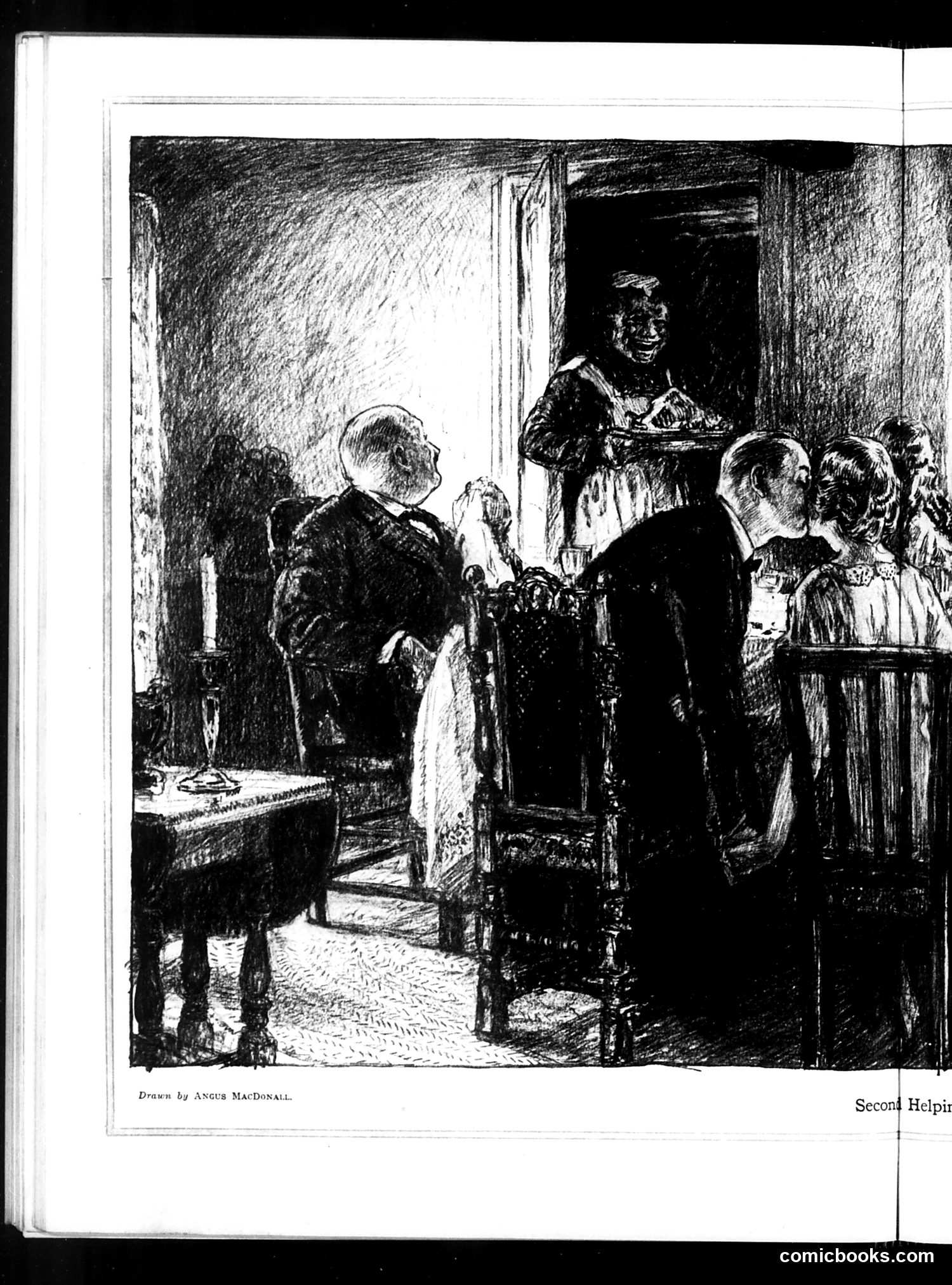
This appears to be a political or social cartoon drawn by Angus MacDonall for *Judge* magazine, though the OCR text is incomplete ("Seconf Helpi" appears corrupted). The sketch depicts what seems to be an official or formal interior scene—possibly a government office or formal reception. Several figures in formal dress are present, with one bald man prominently featured on the left. A woman in the doorway (upper right) appears to be serving or attending to the group, suggesting a domestic or service context. Without the complete caption or title, I cannot definitively identify the specific figures or the exact political/social commentary intended. The formal setting and formal attire suggest commentary on officialdom or high society, but the precise subject remains **unclear** from the image and corrupted text alone.
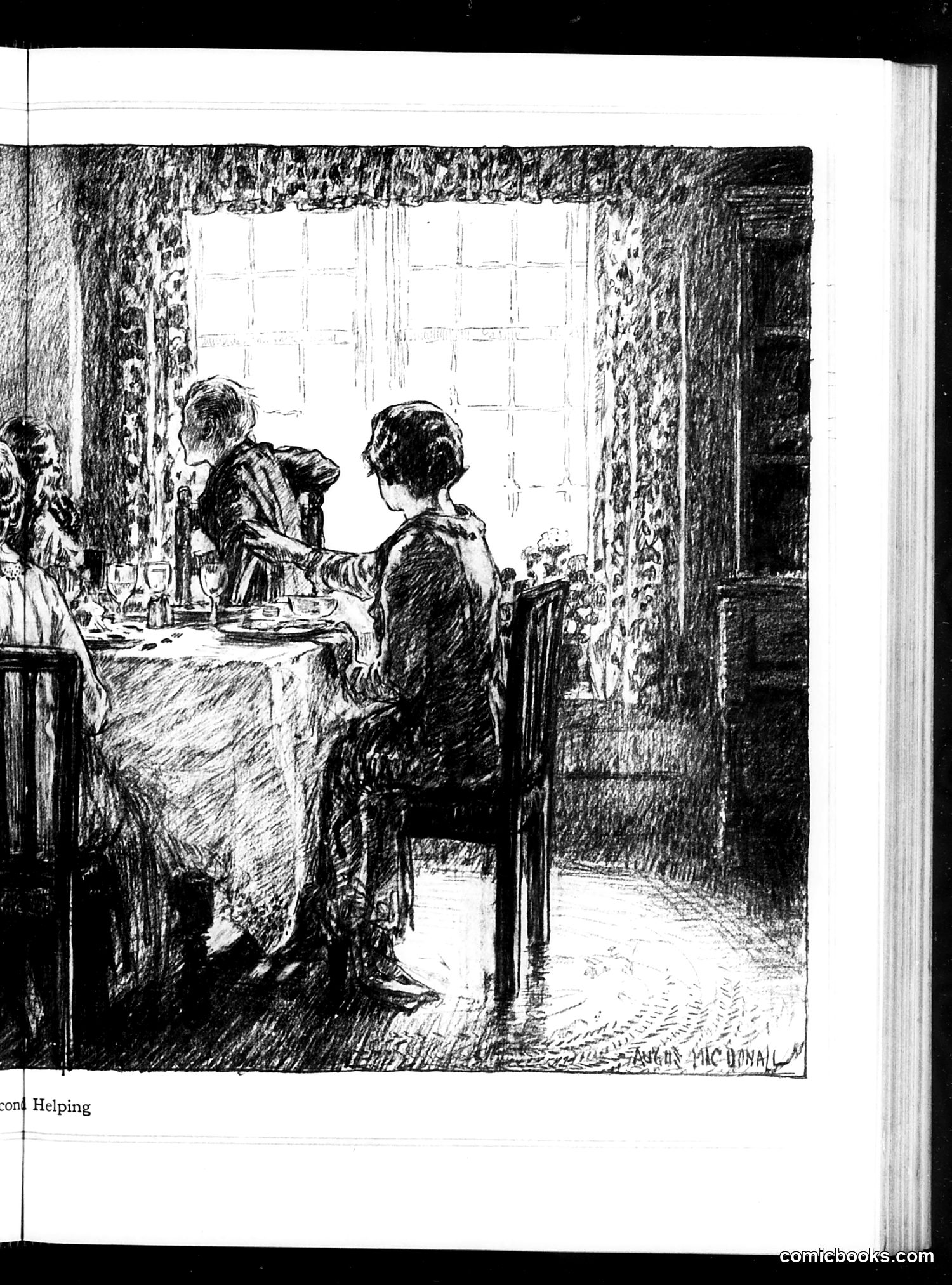
This sketch from *Judge* magazine depicts a domestic dinner scene with social commentary. The image shows a woman seated at a table with dining implements and glassware, while a man stands beside her in what appears to be an elegant room with ivy-covered walls and a window. The partial caption reads "on Helping," though the full context is unclear from the visible text. Based on the composition and *Judge*'s satirical focus, this likely comments on gender roles or domestic labor—possibly satirizing either a man's reluctance to assist with household duties or ironically praising minimal male domestic participation. The artist's signature appears to read "MacDonald" or similar. Without the complete caption, the specific social critique remains ambiguous.
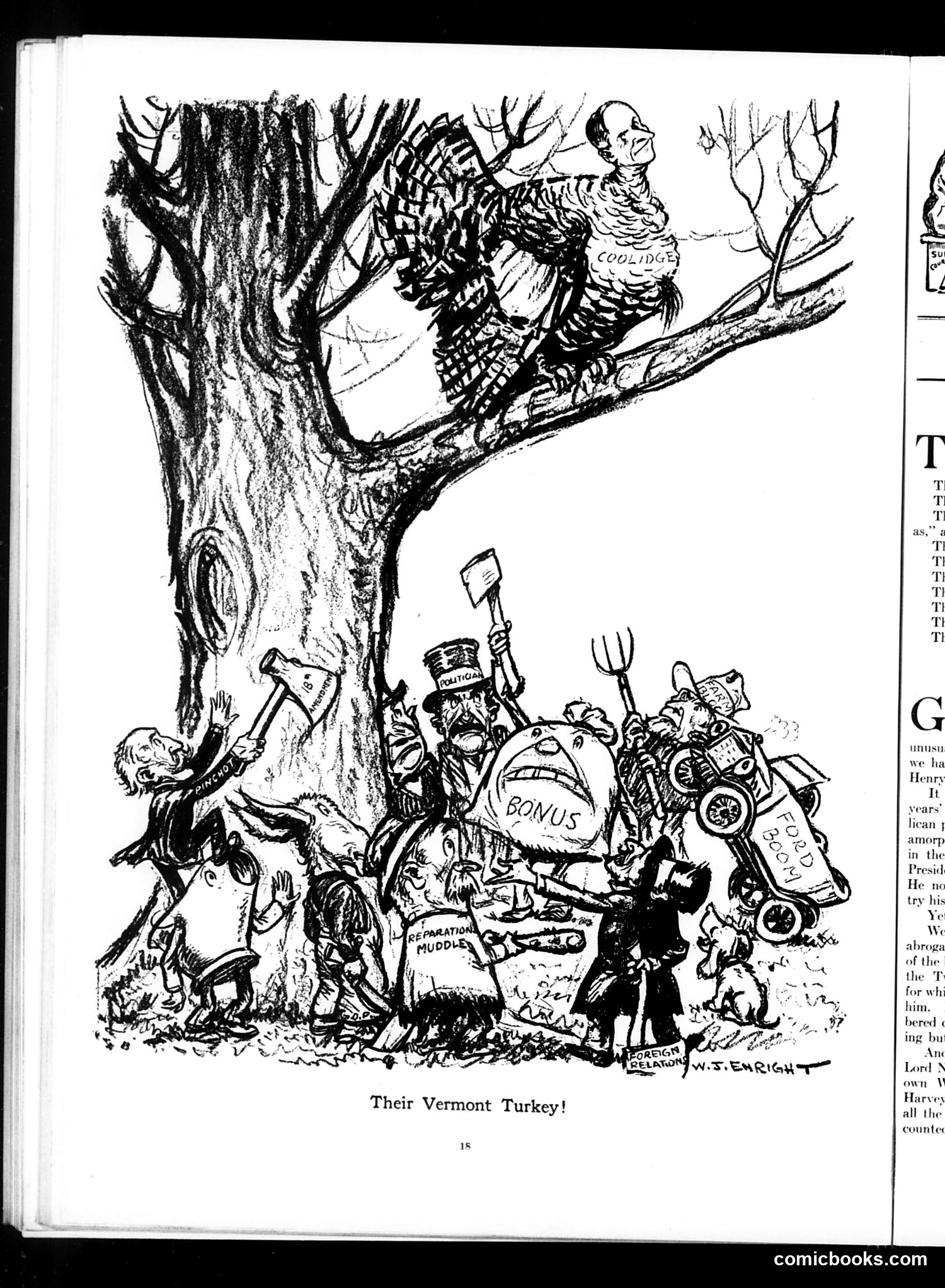
This political cartoon, signed by W.S. Enright, depicts a bare tree labeled "Coolidge" at the top with various figures scrambling around its base. The figures appear to represent political interests and constituencies fighting over resources, with visible labels including "Bonus," "Reparations," and "Foreign Relations." The satire suggests President Calvin Coolidge (who was from Vermont, hence "Vermont Turkey") as a resource being competed for by different political factions and interest groups. The cartoon criticizes how various constituencies—veterans seeking bonuses, those concerned with war reparations, and those focused on foreign policy—were all making competing demands on the Coolidge administration. The title's reference to a "turkey" implies the president was seen as something to be picked apart or exploited by these various interests.
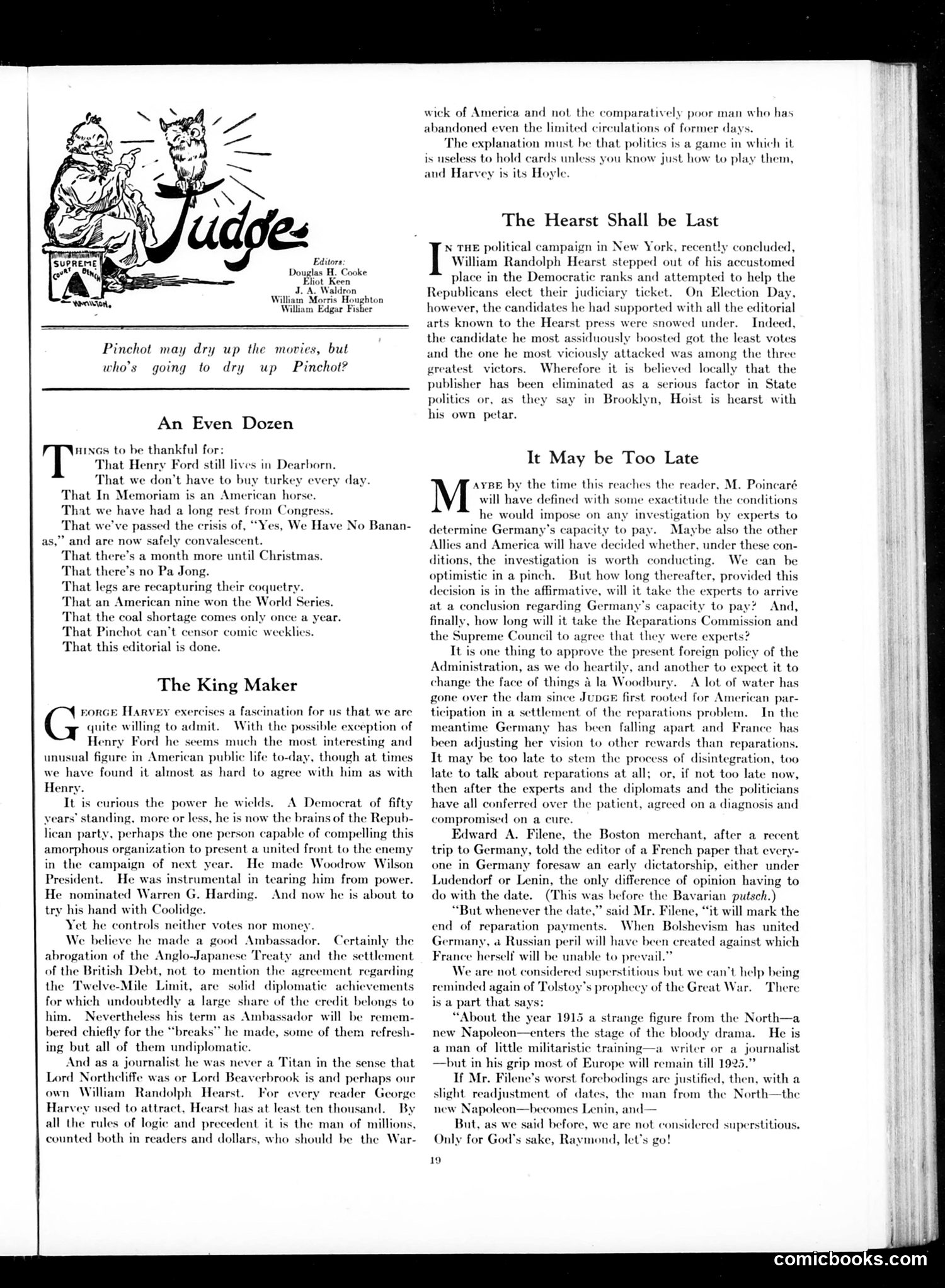
The page features two main satirical pieces about prominent American figures: **"The King Maker"** lampoons **George Harvey**, a Democratic politician wielding surprising influence over Republican leadership. The text notes his power to make and unmake presidents (Wilson, Harding, now Coolidge), yet he controls "neither votes nor money." The satire's point: Harvey succeeds through political skill and media savvy despite lacking the resources of rivals like **William Randolph Hearst**, who commands vast newspaper circulation but proves ineffectual in politics. Harvey, by contrast, understands "how to play" the political game—he's politics' "Hoyle" (rulebook). **"The Hearst Shall be Last"** mocks Hearst's failed 1922 New York judicial campaign. Despite mobilizing his editorial power for Republican candidates, those he backed lost decisively while his opponents won. The pun ending ("Hoist is hearst with his own petar"—hoisted by his own petard) suggests Hearst's newspaper influence now counts for nothing in actual politics. The masthead joke about **Pinchot** (likely Gifford Pinchot, conservationist) references his censorship conflicts with entertainment media.
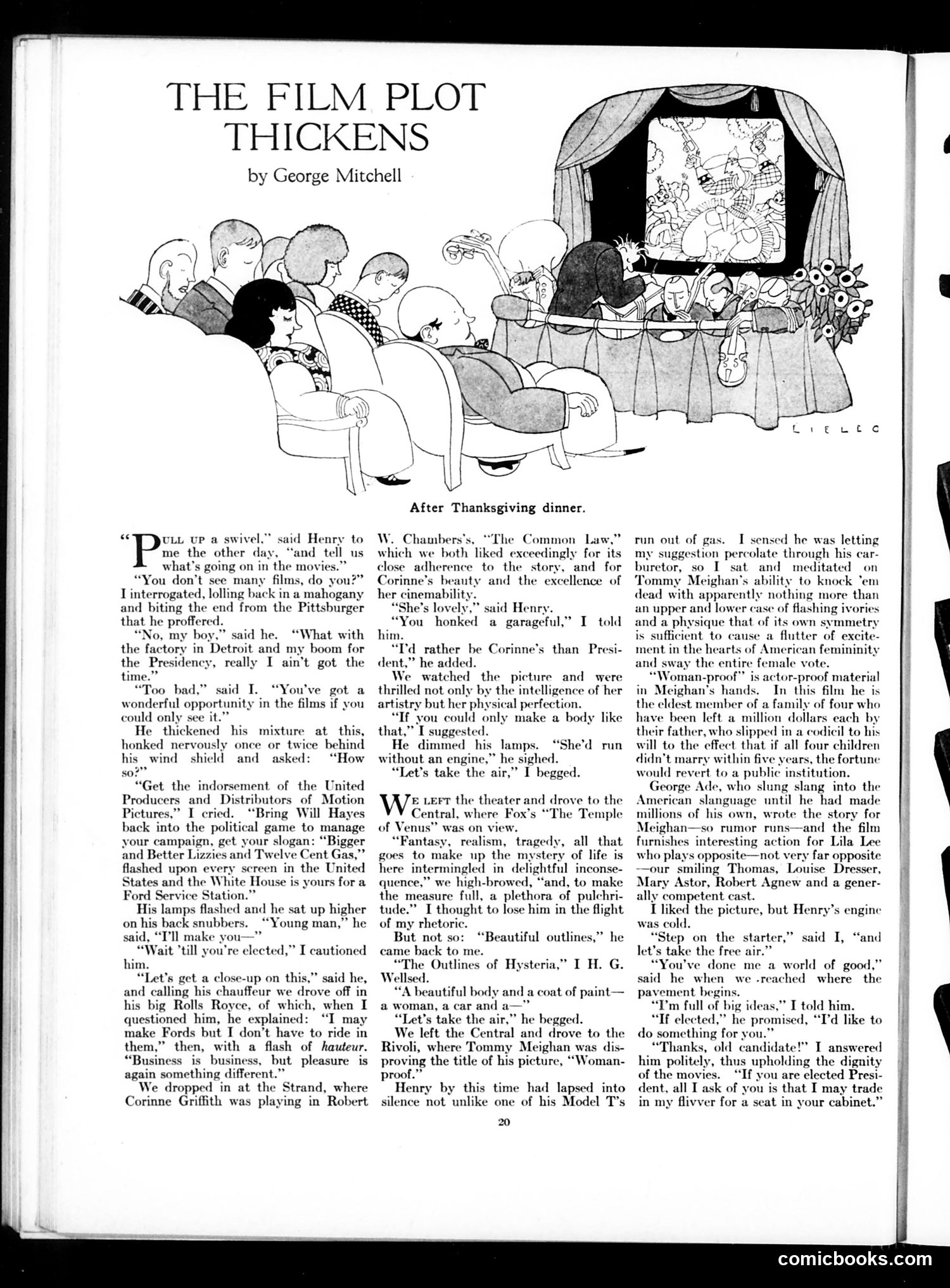
This satirical piece by George Mitchell mocks the intersection of Hollywood celebrity and political aspiration. The narrator encounters a wealthy industrialist with presidential ambitions who lacks time for cinema. The joke: the narrator suggests he could secure the presidency by getting endorsements from the film industry and using movie stars in his campaign—treating electoral politics as if it were a film production requiring "Will Hayes" (the film industry's censor/authority figure) as a campaign manager. The piece ridicules how movies and their stars—Corinne Griffith, Tommy Meighan—dominate American culture so thoroughly that political success seemingly requires their backing. It satirizes both the perceived power of Hollywood and the absurdity of a businessman-politician prioritizing starlets over substantive governance, revealing early-1920s anxieties about celebrity culture's influence on democracy.
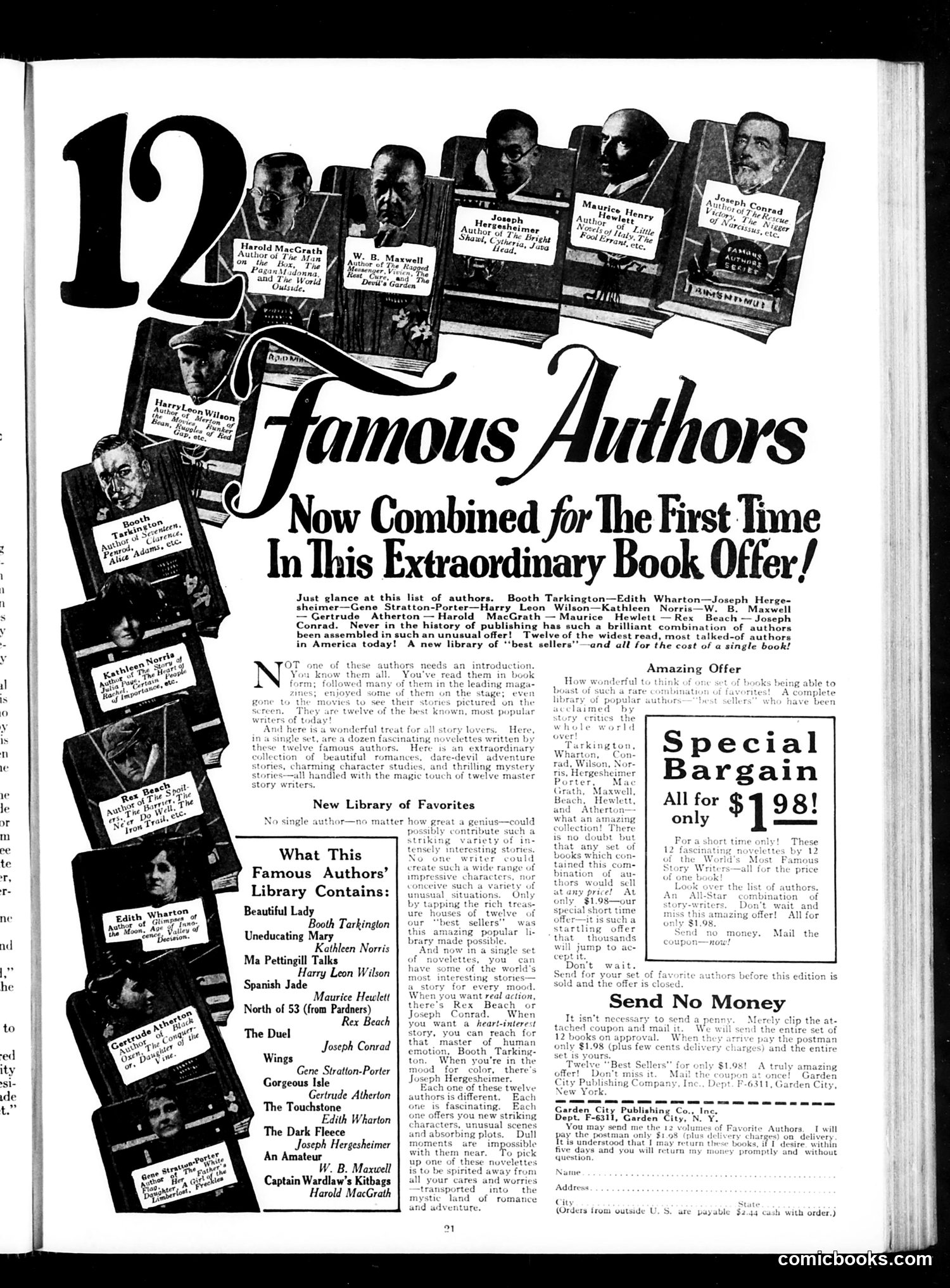
This is **not a cartoon or satire page**, but rather a **book club advertisement** from Judge magazine. The page promotes a "New Library of Favorites"—a mail-order book collection offering 12 works by famous contemporary authors (Booth Tarkington, Edith Wharton, Joseph Conrad, Gene Stratton-Porter, and others) for $1.98. The portraits along the left side are genuine photographs of these celebrated early-20th-century authors, not caricatures. The "extraordinary" angle is marketing: this claims to be the first time these prestigious writers' works were combined in a single affordable package. The appeal targets middle-class readers who wanted access to "best sellers" and "masters of human emotion" without paying full price for individual volumes. The no-money-down offer and money-back guarantee were standard direct-mail sales tactics of the era. There is no satire or political content—this is straightforward advertising using the magazine's platform to reach its educated readership.
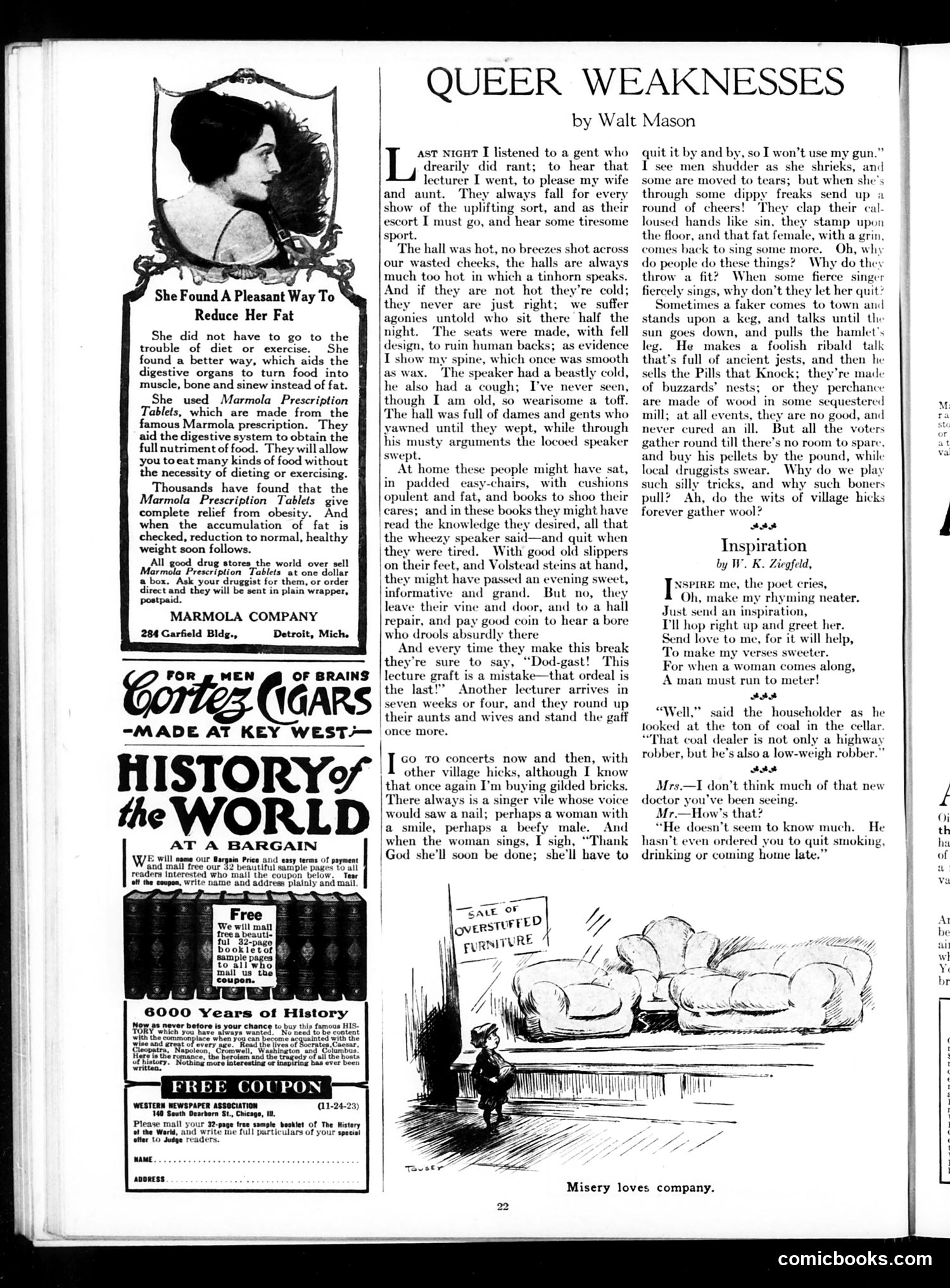
This satirical poem mocks the futility of attending tedious public lectures and concerts. The speaker complains about enduring a dreary male lecturer with a cold who drones on in an uncomfortably hot hall with poorly-designed seats. He resents being dragged along by his wife and aunt to these "uplifting" cultural events. The satire's point: people voluntarily subject themselves to discomfort and boredom at public lectures, when they could stay home in comfort reading or relaxing. Yet they keep attending—and paying—for the same tedious experience repeatedly. The poem ridicules both the pretentious nature of these events and the audiences' compulsion to attend them despite complaining. The accompanying small cartoon about "Misery loves company" reinforces this theme of people gathering despite unhappiness.
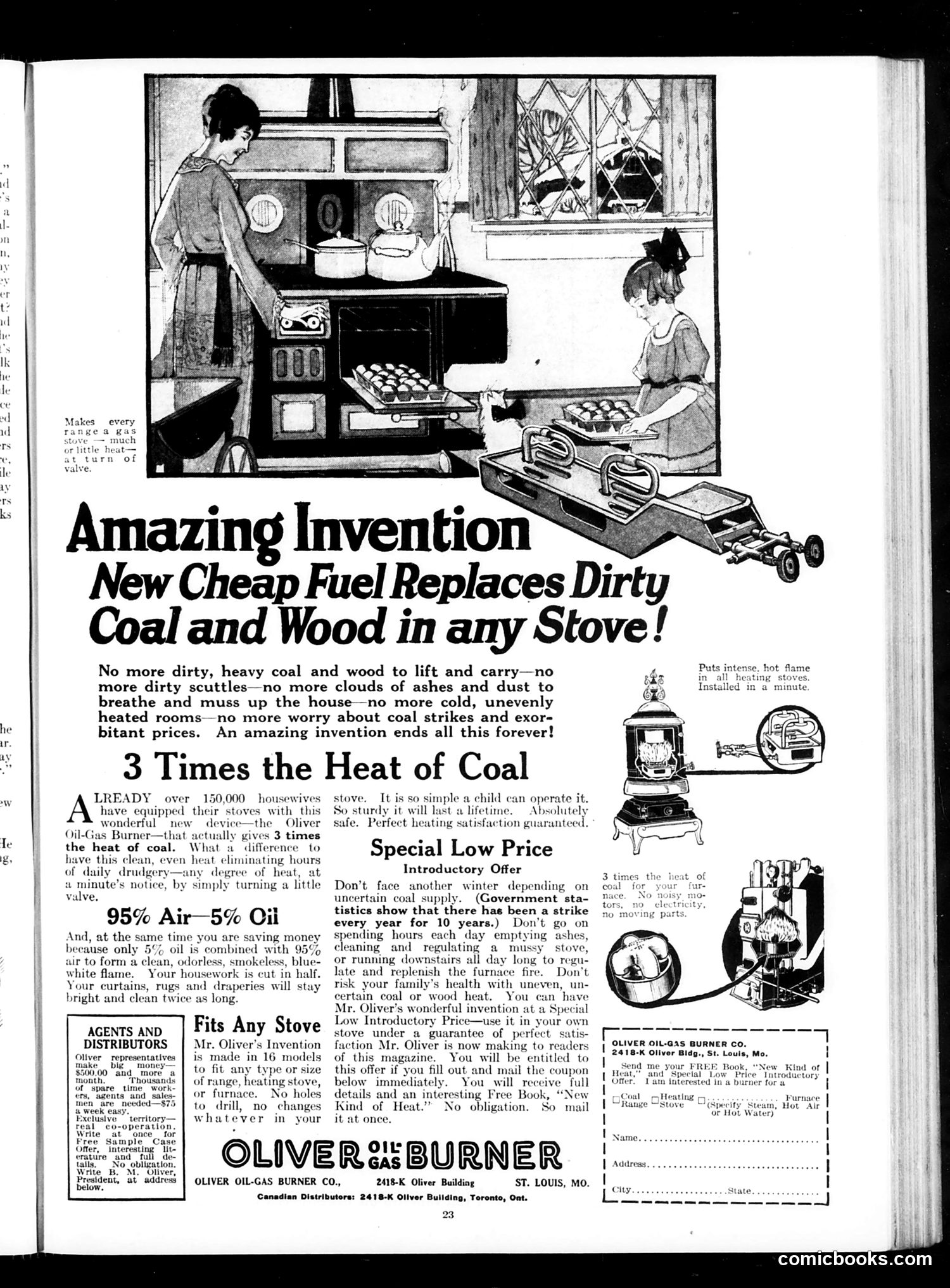
This page is **primarily an advertisement**, not editorial satire. It promotes the Oliver Oil-Gas Burner, a heating device marketed as a revolutionary replacement for coal and wood stoves. ## The Sales Pitch The ad targets early-20th-century housewives by emphasizing relief from domestic drudgery: no more heavy coal to carry, ash clouds, or unpredictable heating. The illustration shows women using the burner while maintaining clean homes—a significant selling point when coal-burning created constant soot. ## Historical Context The ad references **coal strikes** and supply uncertainty, indicating labor unrest was disrupting home heating during this period. The claim of "3 times the heat of coal" at a "special low introductory price" is typical early advertising hyperbole. The composition of "95% Air—5% Oil" emphasizes efficiency to appeal to cost-conscious consumers concerned about exorbitant fuel prices. ## Why in Judge? Judge magazine accepted advertisements to fund publication. This appears to be a full-page paid advertisement rather than satirical content, though Judge's typical readership—educated, middle-class—matches the product's target market perfectly.
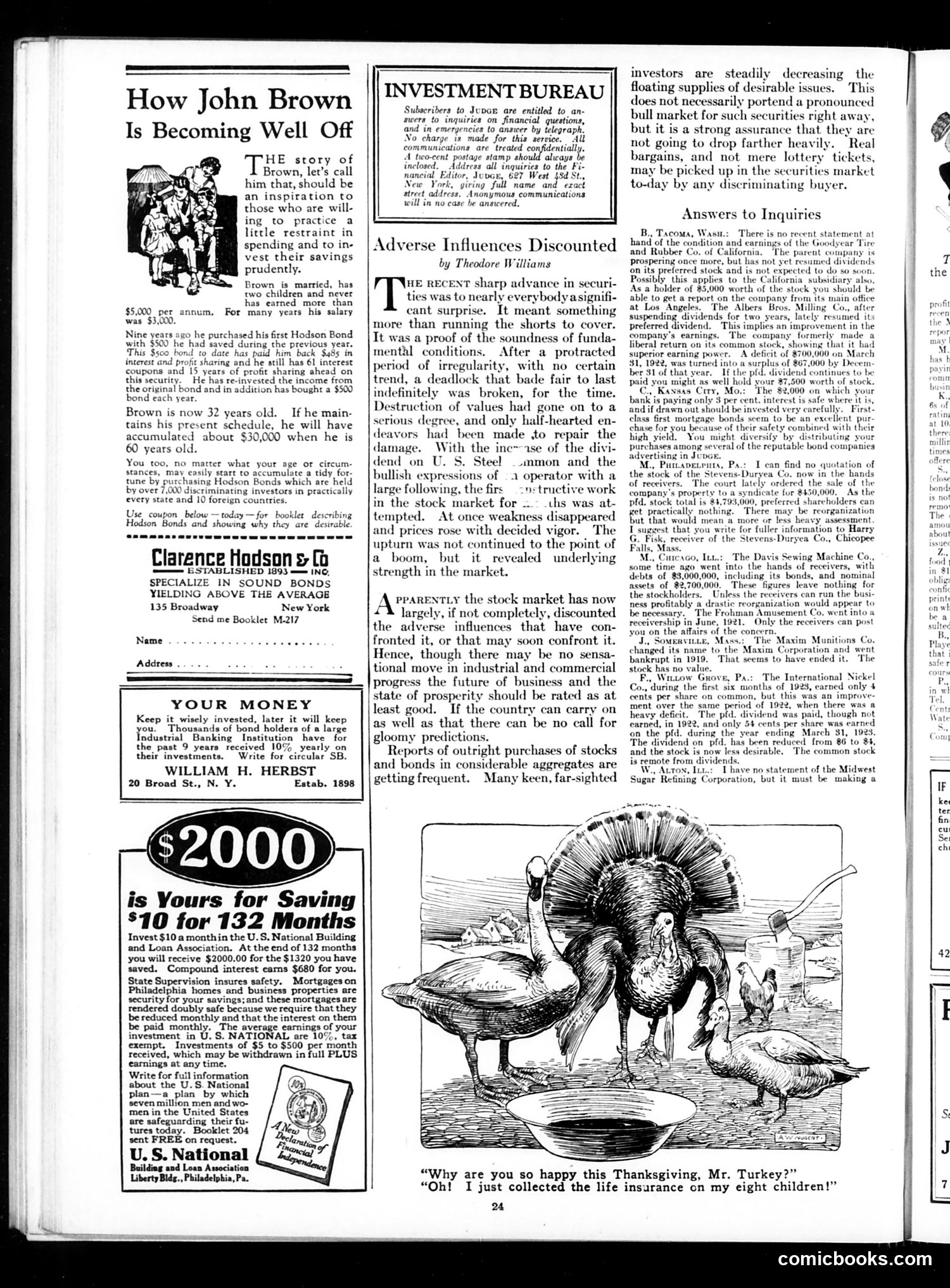
This page is primarily **financial advertising and investment advice**, not political satire. The main content features three investment pitches: 1. **"How John Brown Is Becoming Well Off"** — a narrative advertisement for Hodson Bonds, using an everyman character to demonstrate how modest monthly savings ($500/year) compound into substantial wealth ($30,000 by age 60). 2. **Investment Bureau** — Judge magazine's service offering financial advice to subscribers. 3. **"Adverse Influences Discounted"** — an article by Theodore Williams discussing recent stock market recovery and bond values. 4. **Two competing savings schemes** — advertisements from William H. Herbst and U.S. National Building and Loan Association, both promoting 10% returns through bonds and mortgages. The **cartoon at bottom** is unrelated: it shows a turkey being congratulated on life insurance collected on "eight children," a simple joke playing on the bird's large brood. The page reflects **early 20th-century financial optimism** and the promotion of bonds and savings accounts as paths to middle-class prosperity—before the 1929 crash.
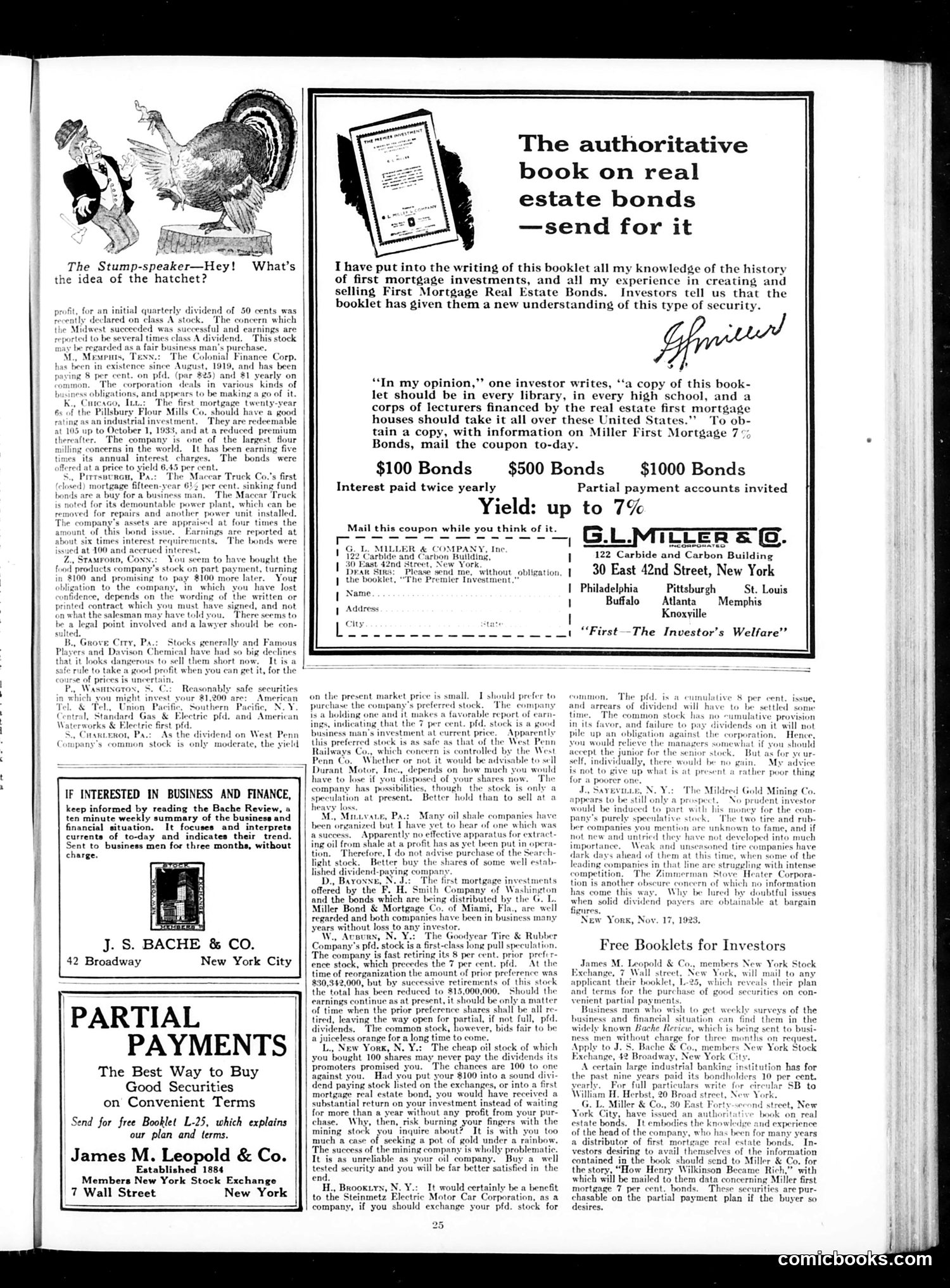
This is a 1920s-30s financial advice page from *Judge* magazine, dominated by investment advertisements rather than satire. The small cartoon at top-left shows a "stump-speaker" (politician giving speeches) asking "What's the idea of the hatchet?"—likely referencing President Coolidge's famous association with frugality, though the joke's specific context is unclear. The page's real content is serious advertising: multiple financial firms (G.L. Miller & Co., James M. Leopold & Co., J.S. Bache & Co.) pitch bonds and securities to readers, promising yields "up to 7%." This reflects pre-Depression investment enthusiasm. The advice columns discuss stock portfolios and dividend strategies—ordinary 1930s financial guidance now historically significant as evidence of market confidence before the 1929 crash. The page reveals how *Judge* mixed humor with earnest financial instruction for its educated, affluent readership.
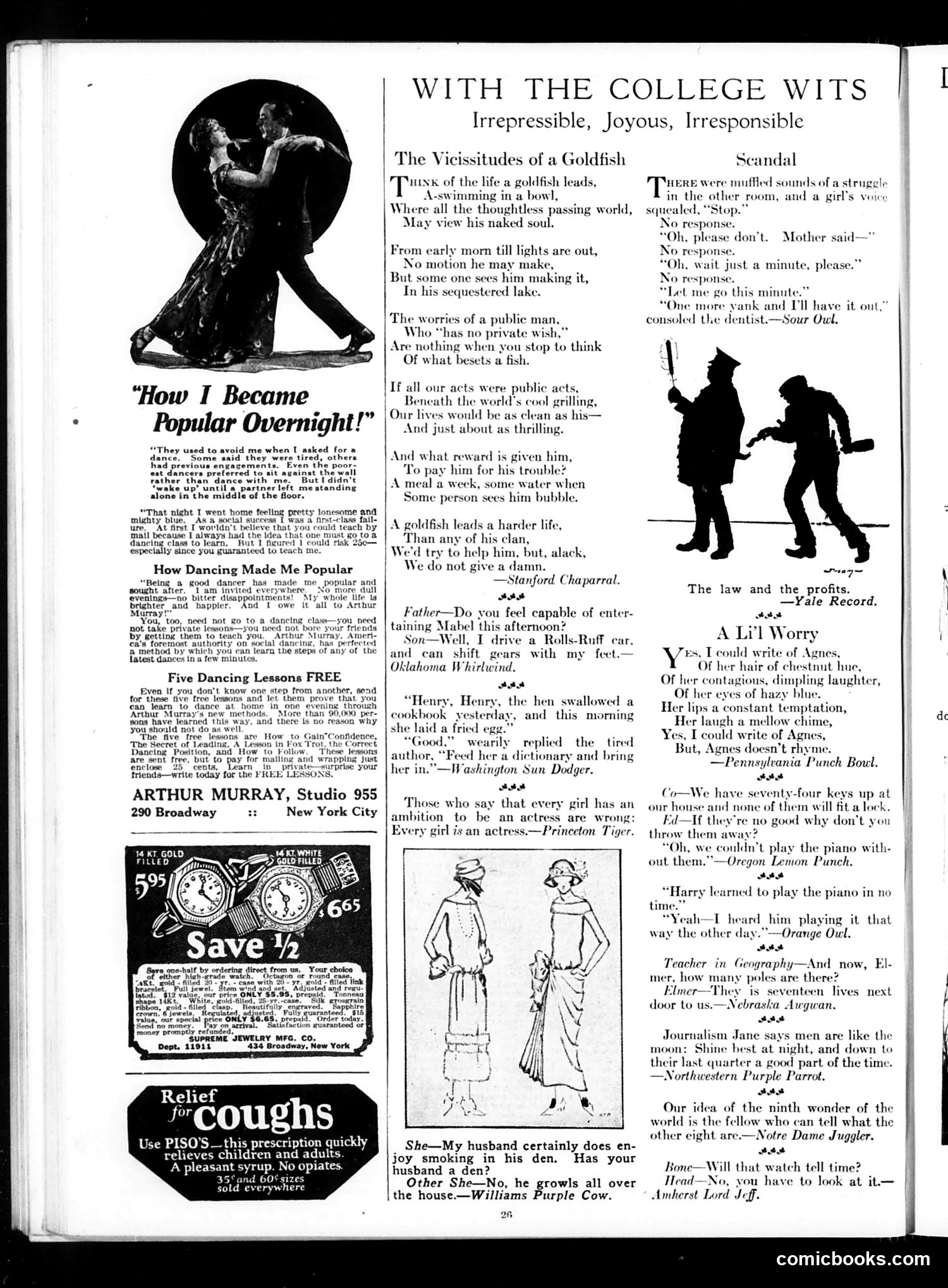
This page from Judge magazine combines satirical humor with advertisements. The main content includes: **"How I Became Popular Overnight"** advertises Arthur Murray's dancing lessons, featuring a testimonial claiming dance instruction transformed the author's social life. This reflects 1920s-30s anxieties about popularity and social acceptance through consumerism. **"The Vicissitudes of a Goldfish"** is a poem satirizing public figures who lack privacy, comparing their loss of anonymity to a goldfish in a bowl. It comments on how celebrities cannot escape scrutiny. **"With the College Wits"** section contains brief jokes and witticisms from college publications. These include humorous quips about dating, family life, and social situations—standard college humor reflecting young adult anxieties. The page emphasizes leisure, romance, and social status as primary concerns. Advertisements for jewelry, dance lessons, and cough medicine suggest targeted marketing toward middle-class readers seeking self-improvement and entertainment during the interwar period.
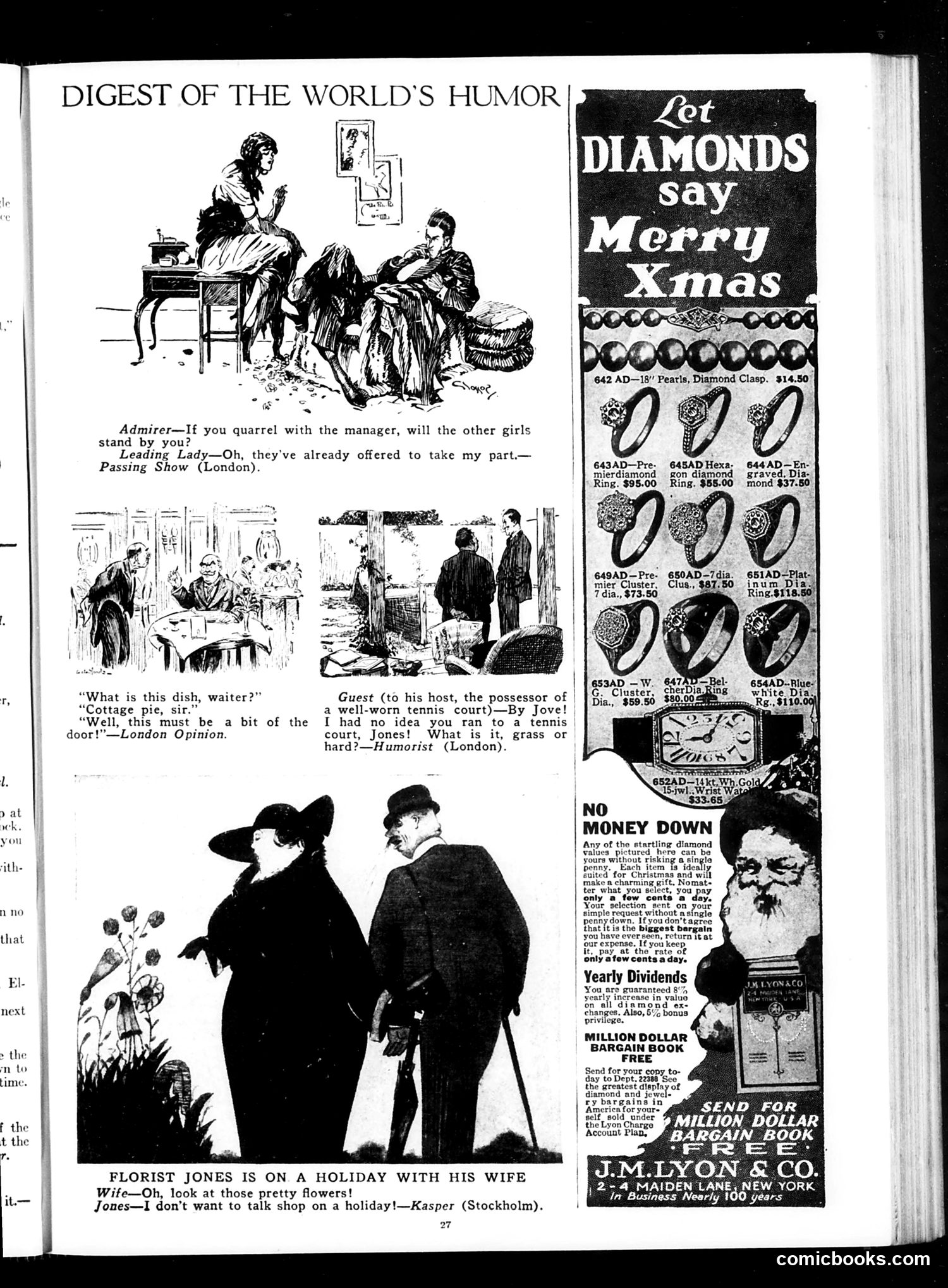
This page combines satirical humor cartoons with a diamond jewelry advertisement. **Top cartoons** feature brief jokes from international publications (London Opinion, Humorist, Kasper). They use wordplay and misunderstandings—a waiter's "cottage pie" confusion, a tennis court owner's grass-versus-hard surface ambiguity, and a florist refusing to discuss flowers on holiday. **Main cartoon** shows "Florist Jones on Holiday," illustrating the relatable tension between professional and personal life—Jones wants to escape work discussions even during leisure time with his wife. **Right side** is a substantial advertisement for J.M. Lyon & Co.'s diamond jewelry, emphasizing affordability through a "no money down" payment plan (just "a few cents a day") and guaranteeing yearly value increases. This reflects 1920s-era consumer credit marketing, making luxury goods accessible to middle-class buyers through installment purchasing. The page exemplifies Judge's mix of light international humor with commercial advertising—typical magazine content of the era.
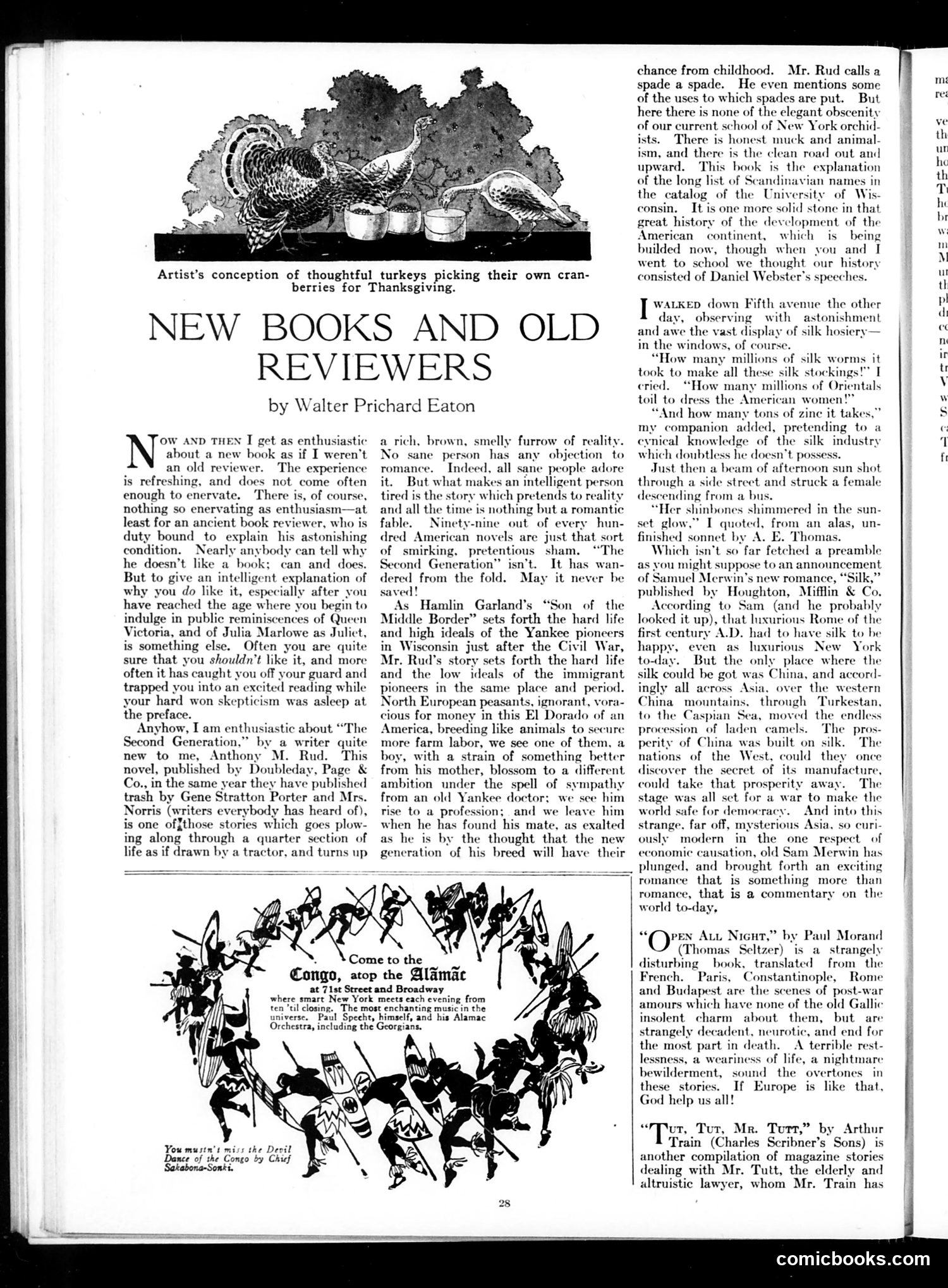
The top illustration depicts turkeys actively harvesting cranberries—an anthropomorphized, absurdist image. The satire is straightforward: it's a humorous Thanksgiving-season joke playing on the irony that turkeys, traditionally the main course of the holiday meal, are shown contentedly gathering side dishes for their own consumption. The cartoon treats the birds as if they have agency and self-awareness, which of course they don't. This appears designed as light holiday humor for Judge magazine's readers rather than pointed political satire—a whimsical commentary on the gap between the romantic imagery of Thanksgiving (animals "choosing" to participate in the feast) and the reality of the holiday's meat-centered traditions. The joke relies on audience recognition of both Thanksgiving customs and the absurdity of the premise.
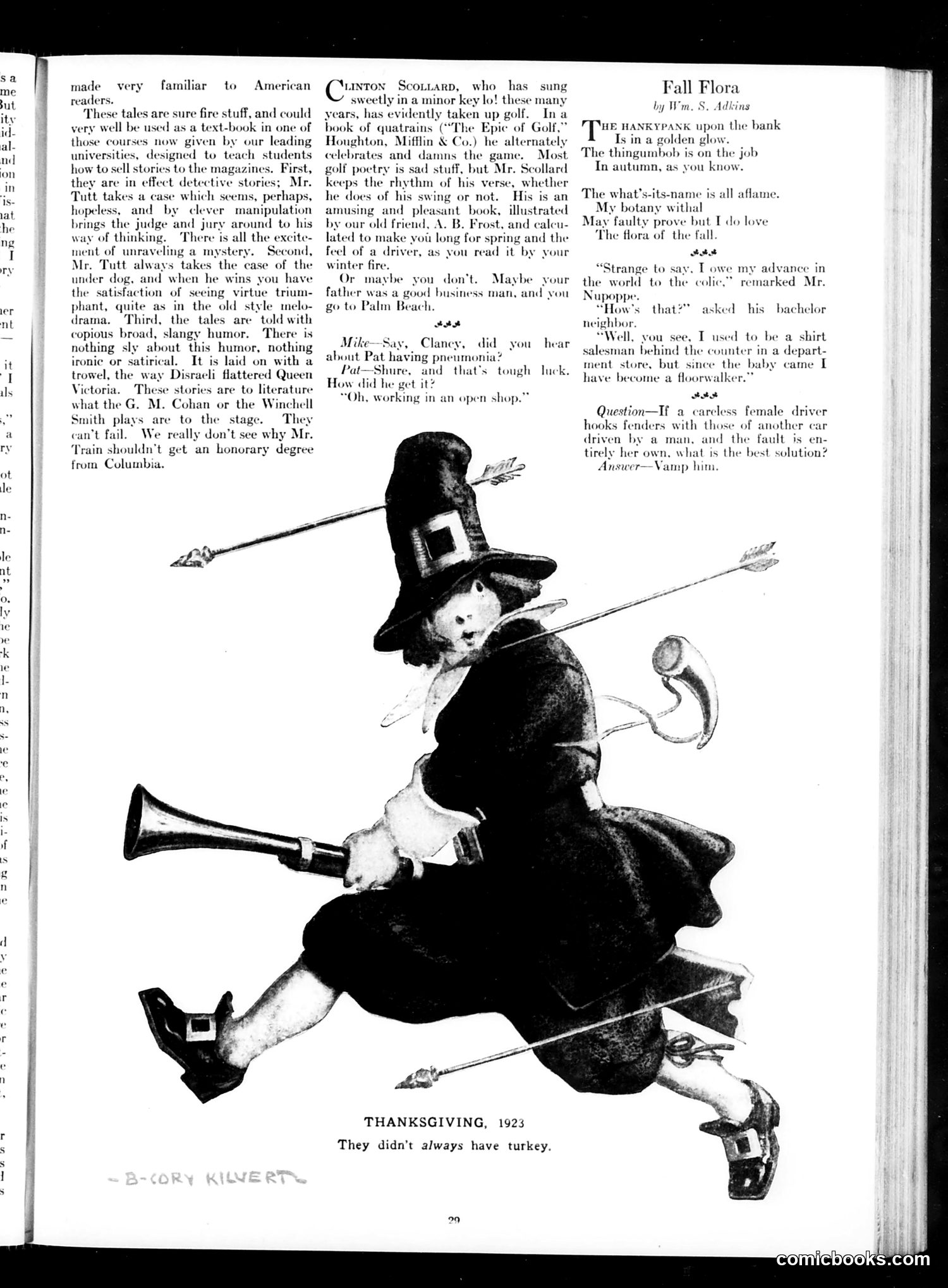
This is a humorous illustration by B. Cory Kilvert depicting a whimsical Pilgrim or colonial-era figure in absurdly exaggerated motion—leaping dramatically with hat, horn, and various implements flying. The caption's joke is straightforward: it's a satirical remark that early American settlers didn't always enjoy turkey at Thanksgiving, so the elaborate, comedic chaos of the figure suggests the scrambling or improvisation that may have characterized early holiday meals. The cartoon reflects 1920s magazine humor—light, visual, and punny rather than deeply political. It plays on American mythology about the Pilgrims and the first Thanksgiving, treating it as comedic fodder for light social commentary on holiday traditions. The page also contains literary reviews, brief anecdotes ("Mike and Pat"), and lighter humor columns typical of *Judge* magazine's miscellaneous content.
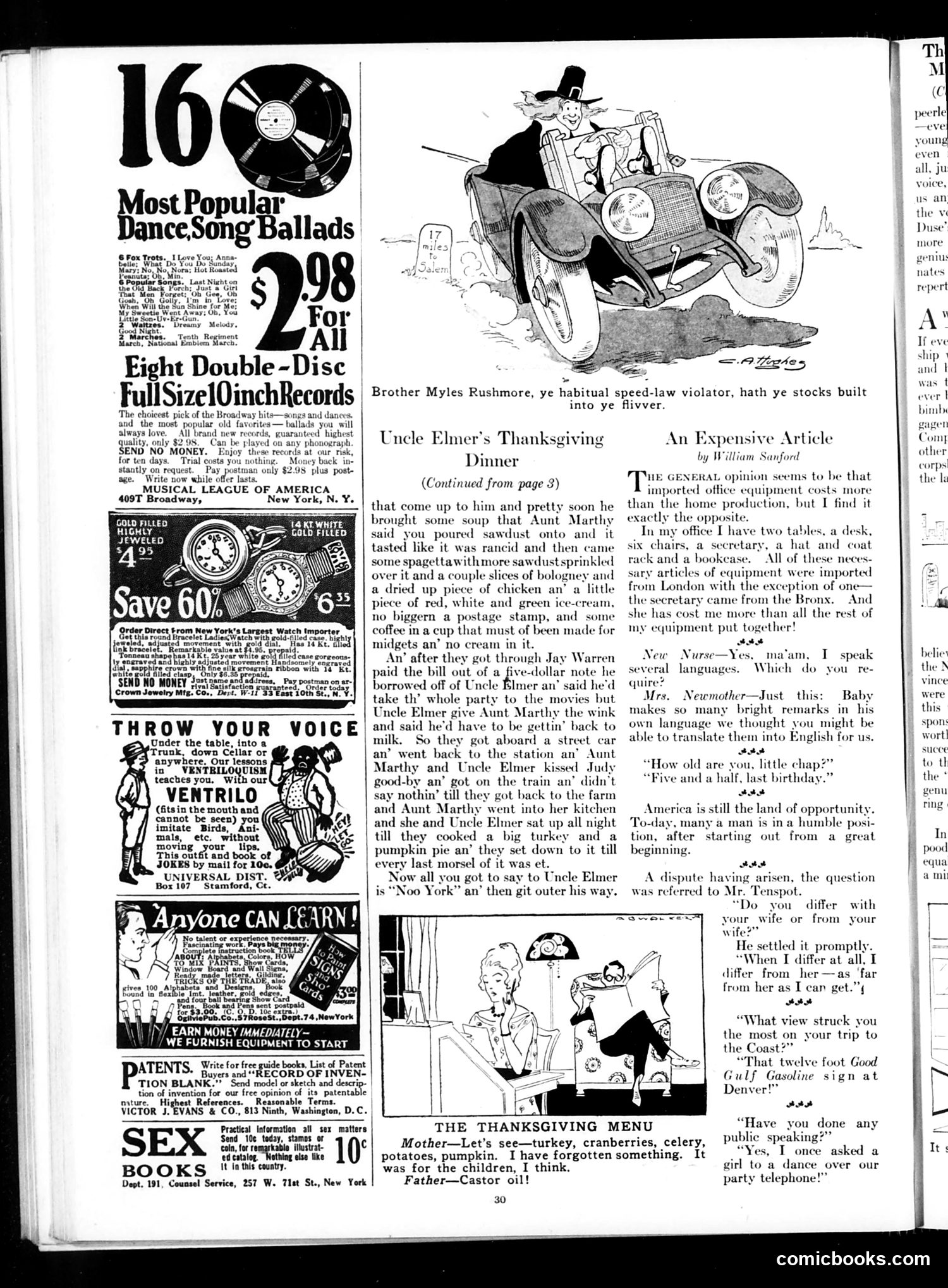
This page from Judge magazine (a satirical weekly) contains several distinct elements: **Main Cartoon**: The top illustration satirizes traffic law violators, depicting "Brother Myles Rushmore" as a reckless driver with phonograph records built into his car, suggesting his speeding is as relentless and mechanical as a record player. **"Uncle Elmer's Thanksgiving Dinner"** (continued story): A humorous narrative about a rural character's disastrous NYC visit. The satire mocks both city dining (poor-quality restaurant food served to unsophisticated visitors) and rural provincialism (Elmer's preference for home cooking). **"An Expensive Article"** (by William Sanford): An essay comparing imported versus domestic office furniture, arguing contrary to popular belief that imported goods aren't necessarily superior. **Advertisements**: The page is dense with period mail-order ads selling phonograph records, ventriloquism kits, patent services, and sex education books—typical early 20th-century direct-response marketing. The overall tone reflects 1920s American humor: satirizing modern conveniences, rural-urban cultural friction, and consumer culture simultaneously.
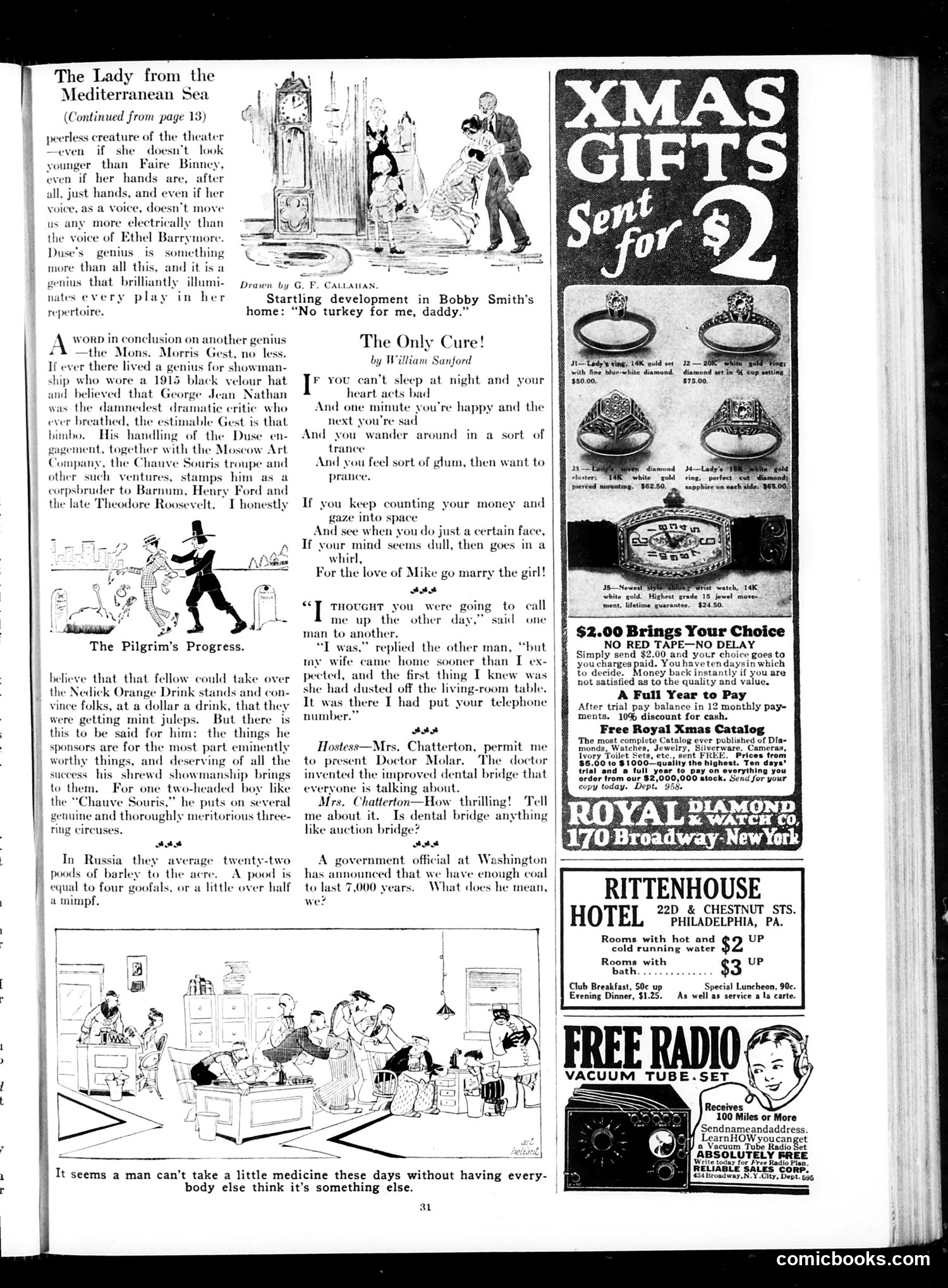
This page from Judge (likely early 1920s) contains several satirical pieces: **"The Lady from the Mediterranean Sea"** discusses Eleonora Duse, the renowned Italian actress, and impresario Morris Gest's theatrical management. The article praises Duse's genius while gently mocking Gest's ability to promote anything—comparing him to Barnum and Theodore Roosevelt—though acknowledging his ventures are worthwhile. **"The Only Cure!"** is a humorous poem suggesting marriage as treatment for insomnia and emotional instability—typical early-20th-century romantic sentiment. **The cartoon** shows a domestic scene where a man admits he dusted furniture after finding his wife's telephone number, implying he was avoiding calling her—gentle marital satire. **"The Pilgrim's Progress"** cartoon (bottom) depicts a crowded household scene with the caption about medicine, suggesting people assume any ailment in others is illness rather than normal behavior. The page is primarily satirical commentary on entertainment, relationships, and social observation rather than hard political satire. Advertisements for jewelry, hotels, and radio sets fill the right column.
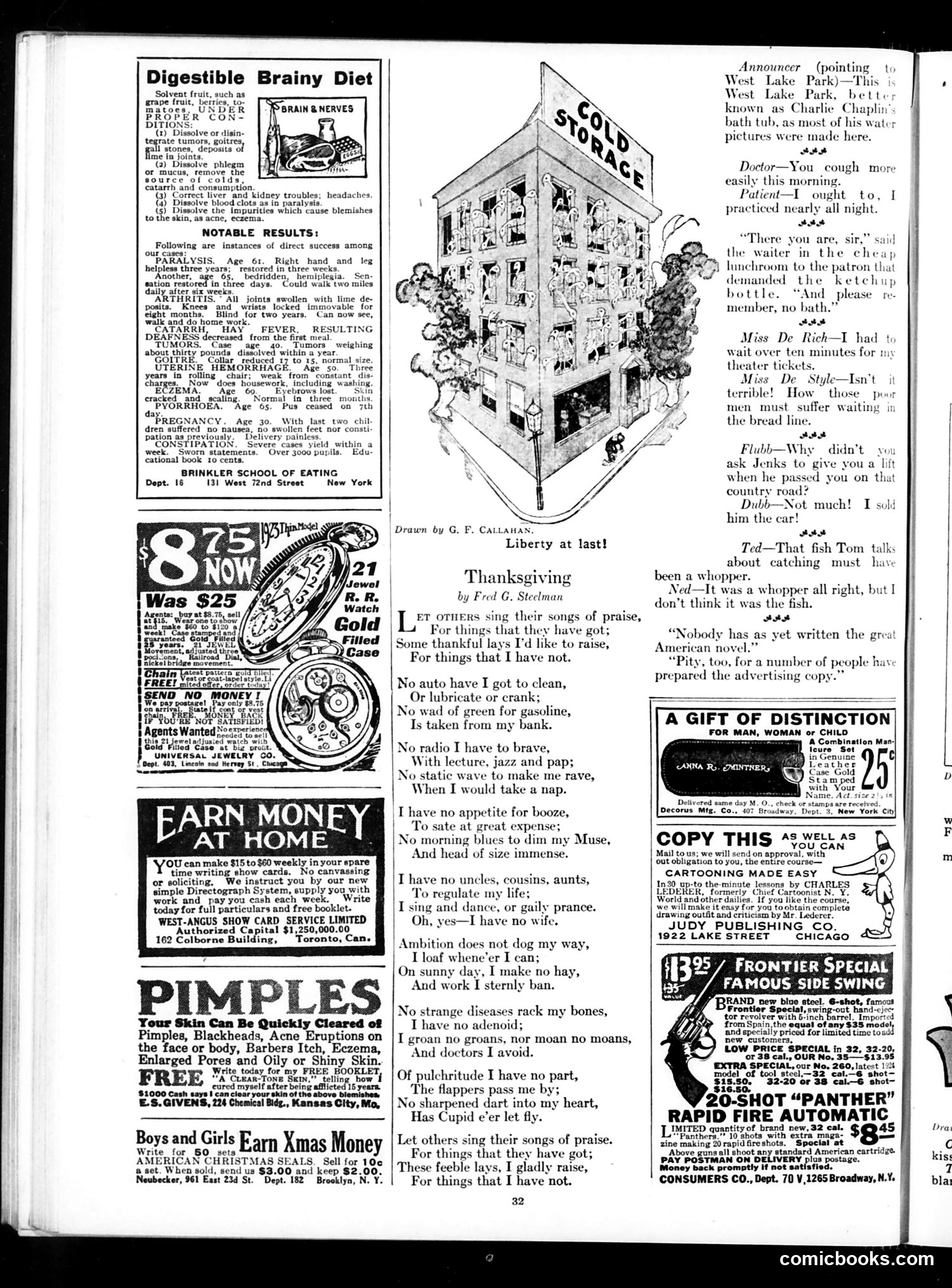
This page contains primarily **advertisements and light humor** rather than political satire. The main content includes: **"Liberty at Last!" Cartoon:** A humorous poem by Fred G. Steelman celebrating what one *lacks* rather than possesses—no automobile maintenance costs, no radio static, no wife, no ambition. It's gentle domestic satire, poking fun at modern conveniences and marital obligations that burden others. The joke reflects 1920s anxieties about consumerism and technology's obligations. **Advertisements:** The page is dominated by ads for dubious patent medicines (the "Digestible Brainy Diet" promising to dissolve tumors and cure paralysis), jewelry, show-card writing schemes, and skin treatments—typical of Judge's era when such pseudoscientific claims were standard advertising. The cartoon draws by G. F. Callahan shows a "cold storage" building, likely illustrating the poem's themes of avoiding modern burdens. This is **light comedy about middle-class life**, not political commentary.
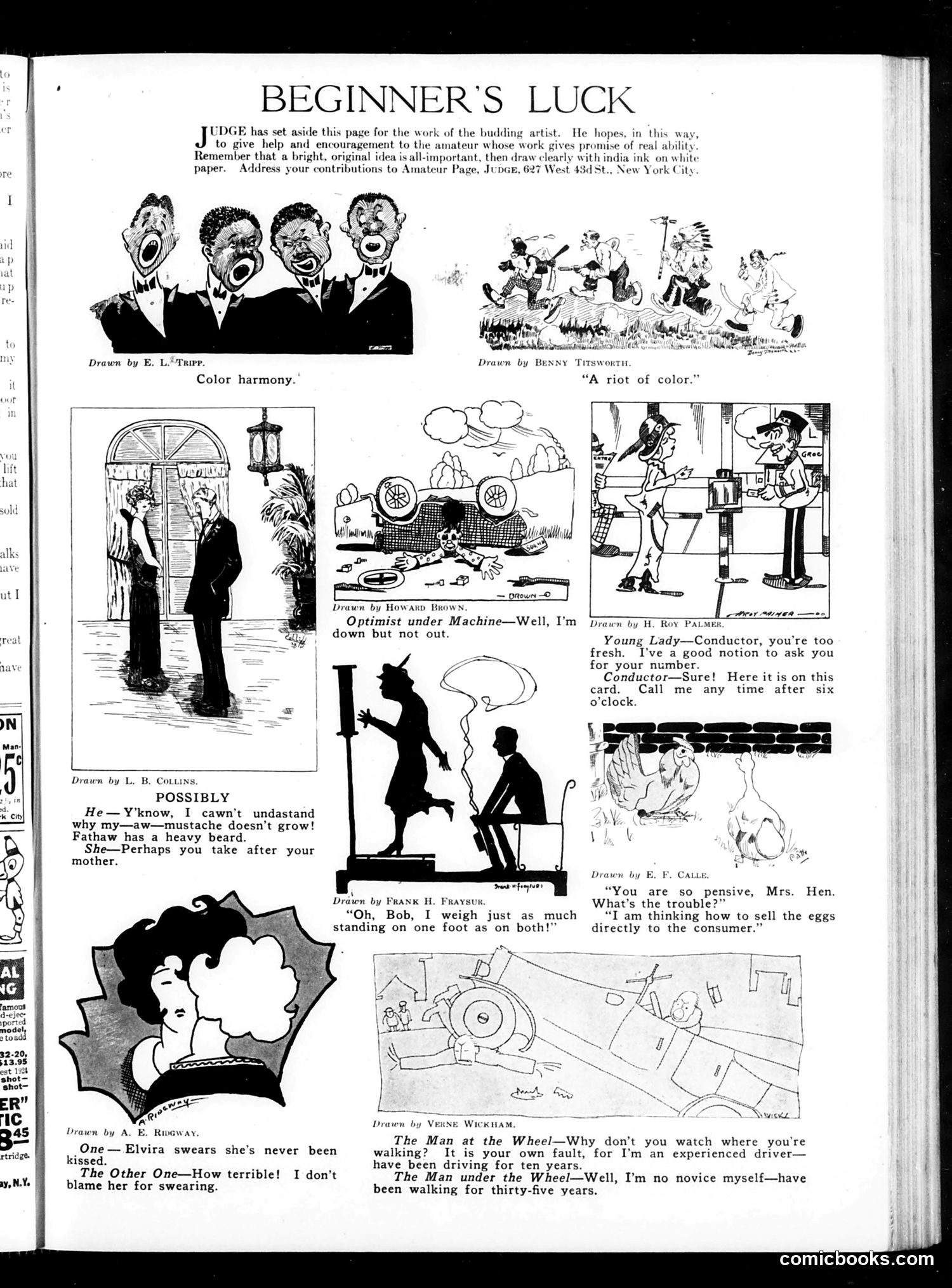
This is a showcase page for amateur cartoonists, featuring ten short comic strips with sight gags and punchlines typical of early 20th-century humor. The jokes rely on wordplay and ironic reversals: a mustache won't grow (perhaps hereditary), a conductor flirts with a young woman, a chicken struggles to market eggs directly, and a driver and pedestrian argue about who caused their accident—each claiming experience (10 vs. 35 years). A few cartoons use physical humor: men standing on machines, silhouettes of people in absurd positions. The "Color harmony" and "Riot of color" strips appear to be visual puns about artistic technique itself. The satire is gentle and domestic, targeting everyday social situations and human vanity rather than politics. Judge's editors positioned this page to encourage amateur submissions while entertaining readers with accessible, family-friendly comic scenarios.
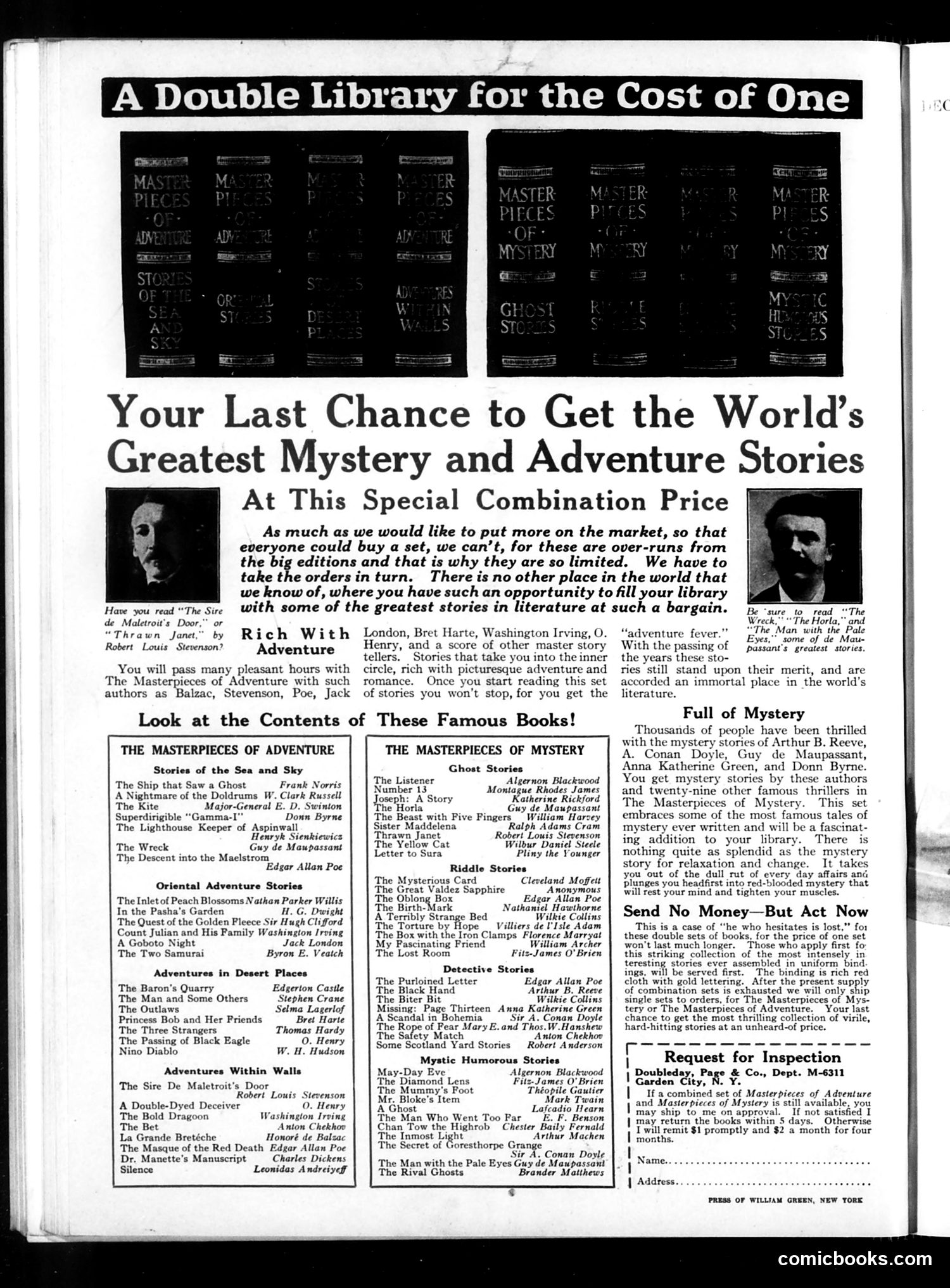
This page is **primarily advertising**, not satire or political commentary. It promotes a mail-order book collection called "The Masterpieces of Adventure" and "The Masterpieces of Mystery"—two-volume sets featuring classic short stories by canonical authors (Poe, Stevenson, O. Henry, Conan Doyle, etc.). The ad uses urgency marketing ("Your Last Chance," "Limited," "Send No Money—But Act Now") typical of early 20th-century direct mail. The two small portrait photographs at top likely show famous authors, though they're too dark to identify clearly. The content is straightforward: lists of included stories, appeals to readers' desire for quality literature at bargain prices, and a tear-off order form. There is no political satire visible—this is a Judge magazine page devoted to commercial advertising rather than editorial cartooning or commentary.