
Judge, 1923-11-24 · page 30 of 36
Judge — November 24, 1923 — page 30: what you’re looking at
What you’re looking at
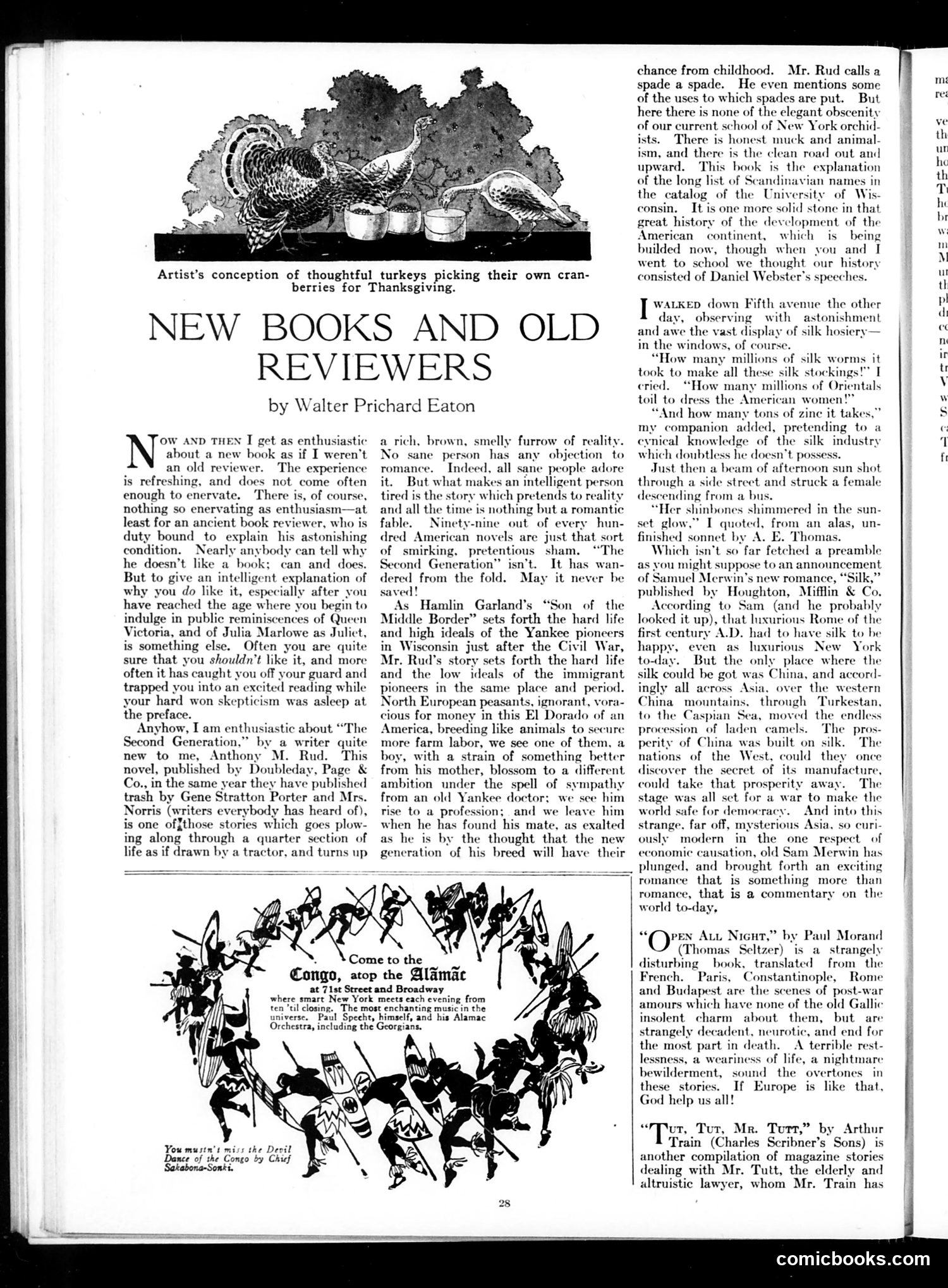
The top illustration depicts turkeys actively harvesting cranberries—an anthropomorphized, absurdist image. The satire is straightforward: it's a humorous Thanksgiving-season joke playing on the irony that turkeys, traditionally the main course of the holiday meal, are shown contentedly gathering side dishes for their own consumption. The cartoon treats the birds as if they have agency and self-awareness, which of course they don't. This appears designed as light holiday humor for Judge magazine's readers rather than pointed political satire—a whimsical commentary on the gap between the romantic imagery of Thanksgiving (animals "choosing" to participate in the feast) and the reality of the holiday's meat-centered traditions. The joke relies on audience recognition of both Thanksgiving customs and the absurdity of the premise.
📄 Transcribed text from this page (OCR, searchable)
Machine-transcribed from the original scan — historical spelling and the odd misread are preserved.
Artist’s conception of thoughtful turkeys picking their own cran- berries for Thanksgiving. NEW BOOKS AND OLD REVIEWERS by Walter Prichard Eaton ) J AND THEN I get as enthusiastic about a new book as if I weren't an old reviewer. The experience is refreshing, and does not come often enough to enervate. There is, of course, nothing so enervating as enthusiasm—: least for an ancient book reviewer, who is duty bound to explain his astonishing condition. Nearly anybody can tell why he doesn’t like a boo ‘an and does. But to give an intelligent explanation of why you do like it, especially after you have reached the age where you begin to indulge in public reminiscences of Queen Victoria, and of Julia Marlowe as Julict, is something else. Often you are quite sure that you shouldn’t like it, and more often it has caught you off your guard and trapped you into ited reading while your hard won skepticism was asleep at the preface. Anyhow, I am enthusiastic about “The Second Generation,” by a writer quite new to me, Anthony M. Rud. This novel, published by Doubleday, Page & Co., in the same year they have published trash by Gene Stratton Porter and Mrs. Norris (writers everybody has heard of), is one offthose stories which goes plow. ing along through a quarter section of life as if drawn by a tractor, and turns up You mustn't miss the Devil Dance of the Congo by Chief Sakabona-Sonki. Come to the Congo, atop the Alamac at 71st Street and Broadway where smart New York meets each evening from ten 'til closing. The most enchanting music in the universe. Paul Specht, himself, and his Alamac Orchestra, including the Georgians. a_rich, brown, smelly furrow of reality. No sane person has any objection. to romance. Indeed, all sane people adore it. But what makes an intelligent person tired is the story which pretends to reality the time is nothing but a romantic Ninety-nine out of every hun- dred American novels are just that sort of smirking, pretentious sham. “The Second Generation” isn’t. It has wan- dered from the fold. May it never be saved! As Hamlin Garland’s “Son of the Middle Border” sets forth the hard life and high ideals of the Yankee pion in Wisconsin just after the Civil War, Mr. Rud’s story sets forth the hard life and the low ideals of the immigrant pioneers in the same place and period. North European peasants, ignorant, vora- cious for money in this El Dorado of an America, breeding like animals to secure more farm labor, we see one of them, a boy, with a strain of something better from his mother, blossom to a different ambition under the spell of sympathy from an old Yankee doctor; we see him rise to a profession; and we leave him when he has found his mate, as exalted as he is by the thought that the new generation of his breed will have their chance from childhood. Mr. Rud calls a spade a spade. He even mentions some of the uses to which spades are put. But here there is none of the elegant obscenity of our current school of New York orchid- is There is honest muck and animal- ism, and there is the clean road out and upward. This book is the explanation of the long list of Scandinavian names in the catalog of the University of Wis- consin. It is one more solid stone in that great history of the devclopment of the American continent, which is being builded now, though when you and I went to school we thought our history consisted of Daniel Webster's speeches. I WALKED down Fifth avenue the other day, observing with astonishment and awe the vast display of silk hosiery — in the windows, of course. “How many millions of silk worms it took to make all these silk stockings!” I cried. “How many millions of Oric toil to dress the American womer “And how many tons of zine it takes,” my companion added, pretending to a cynical knowledge of the silk industry which doubtless he doesn’t possess. Just then a beam of afternoon sun shot through a side street and struck a female descending from a bus. “Her shinbones shimmered in the sun- set glow,” I quoted, from an alas, un- finished sonnet by A. E. Thomas. Which isn’t so far fetched a preamble u might suppose to an announcement Samuel Merwin’s new romance, “Silk,” published by Houghton, Mifflin & Co. According to Sam (and he probably looked it up), that luxurious Rome of t first century A.D. had to have silk to be happy, even as luxurious New York to-day. But the only place where the silk could be got was China, and accord- ingly all across Asia, over the western China mountains, through Turkestan, to the Caspian Sea, moved the endless procession of laden’ camels. The pros- perity of China was built on silk. The nations of the West, could they once discover the secret of its manufacture, could take that prosperity away. The stage was all set for a war to make the world safe for democracy. And into this strange, far off, mysterious Asia, so curi- ously modern in the one respect of economic causation, old Sam Merwin has plunged, and brought forth an exciting romance that is something more than romance, that is a commentary on the world to-day, N Aut Nicut,” by Paul Morand (Thomas Seltzer) ‘is a strangely disturbing book, translated from the French. Paris, Constantinople, Rome and Budapest are the scenes of post-war amours which have none of the old Gallic insolent charm about them, but are strangely decadent, neurotic, and end for the most part in death. A terrible rest- lessness, a weariness of life, a nightmare bewilderment, sound the overtones in these stories. If Europe is like that, God help us all! “T: tT, Tut, Mr. Tort,” by Arthur Train (Charles Scribner’s Sons) is another compilation of magazine stories dealing with Mr. Tutt, the elde altruistic lawyer, whom Mr. Train has comicbooks.com