
Judge, 1923-11-24 · page 21 of 36
Judge — November 24, 1923 — page 21: what you’re looking at
What you’re looking at
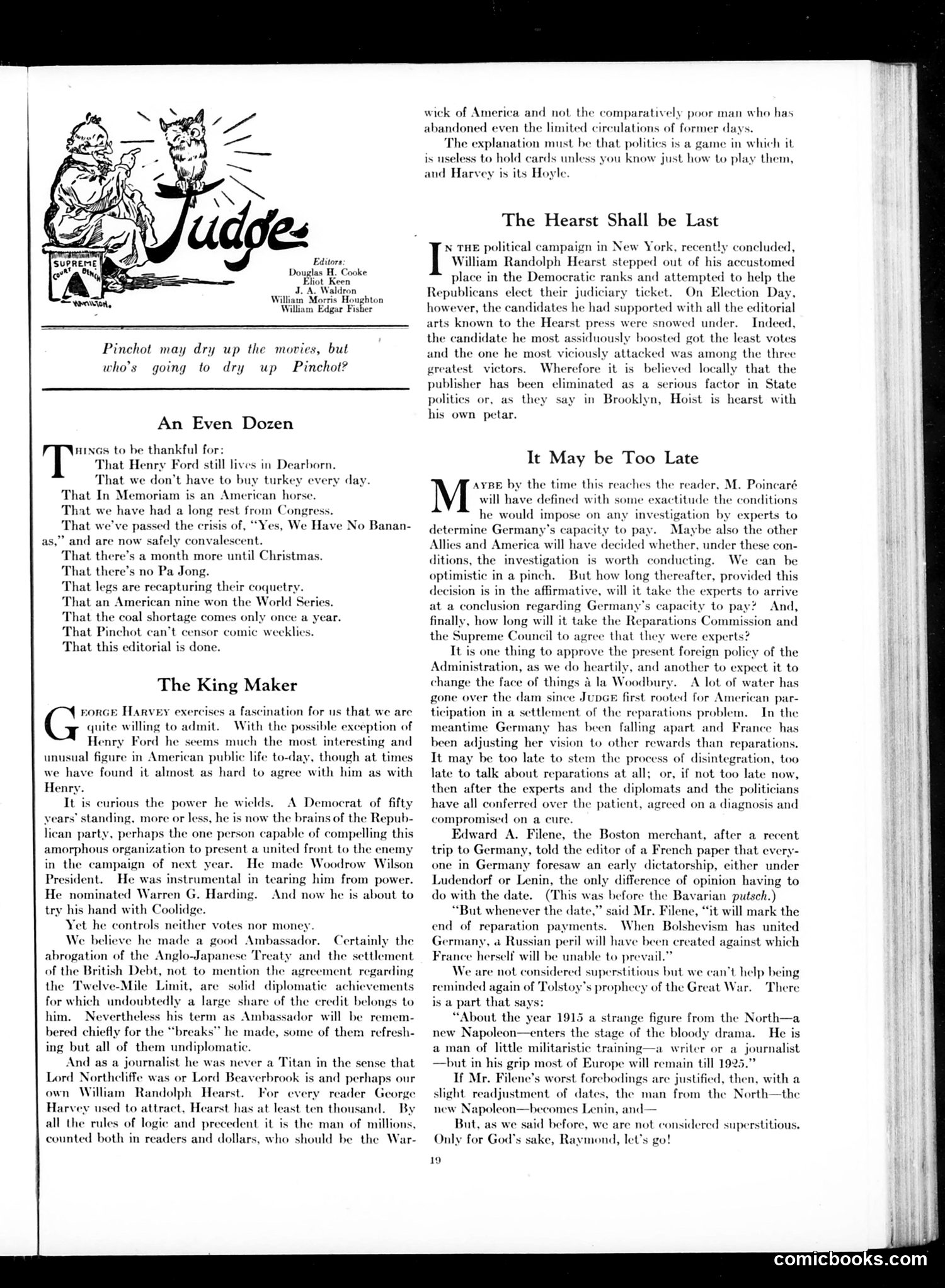
The page features two main satirical pieces about prominent American figures: **"The King Maker"** lampoons **George Harvey**, a Democratic politician wielding surprising influence over Republican leadership. The text notes his power to make and unmake presidents (Wilson, Harding, now Coolidge), yet he controls "neither votes nor money." The satire's point: Harvey succeeds through political skill and media savvy despite lacking the resources of rivals like **William Randolph Hearst**, who commands vast newspaper circulation but proves ineffectual in politics. Harvey, by contrast, understands "how to play" the political game—he's politics' "Hoyle" (rulebook). **"The Hearst Shall be Last"** mocks Hearst's failed 1922 New York judicial campaign. Despite mobilizing his editorial power for Republican candidates, those he backed lost decisively while his opponents won. The pun ending ("Hoist is hearst with his own petar"—hoisted by his own petard) suggests Hearst's newspaper influence now counts for nothing in actual politics. The masthead joke about **Pinchot** (likely Gifford Pinchot, conservationist) references his censorship conflicts with entertainment media.
📄 Transcribed text from this page (OCR, searchable)
Machine-transcribed from the original scan — historical spelling and the odd misread are preserved.
Douglas H. Cooke William Morris William Edgar Pinchot may dry up the movies, but who's going to dry up Pinchot? An Even Dozen HINGS to be thankful for: That Henry Ford still lives in Dearborn. That we don’t have to buy turkey every day. In Memoriam is an American horse. we have had a long rest from Congress. we've passed the crisis of, “Yes, We Have No Banan- are now safely convalescent. a month more until Christmas. at there’s no Pa Jong. at legs are recapturing their coquetry. That an American nine won the World Series That the coal shortage comes only once a y That Pinchot can’t censor comic weeklies. That this editorial is done. That The King Maker FORGE Harvey exercises a fascination for us that we are G quite willing to admit. With the possible exception of Henry Ford he seems much the most interesting and unusual figure in American public life to-day, though at times we have found it almost as hard to agree with him as with Henry. It is curious the power he wields. A Democrat of fifty ars’ standing, more or less, he is now the brains of the Repub- ican party, perhaps the one person capable of compelling this amorphous organization to present a united front to the enemy in the campaign of next year. He made Woodrow Wilson President. He was instrumental in tearing him from power. He nominated Warren G. Harding. And now he is about to try his hand with Coolidge. Yet he We be e he made a good Ambassador. abrogation of the Anglo-Japanese ‘Treaty of the British Debt, not to mention the the Twelve-Mile Limit, controls neither votes nor money v Certainly the and the settlement wreement regarding solid diplomatic achievements for which undoubtedly a large share of the credit belongs to him. Nevertheless his term as Ambassador will be remem- bered chiefly for the “breaks” he made, some of them refresh- ing but all of them undiplomatic. And as a journalist he was never a Titan in the sense that Lord Northcliffe was or Lord Beaverbrook is and perhar own William Randolph Hearst. Harvey used to attract, Hearst has at least ten thousand. By all the rules of logie and precedent it is the man of millions, counted both in readers and dollars, who should be the War- our For every reader George wick of America and not the comparatively poor man who has abandoned even the limited circulations of former days. The explanation must be that politics is a game in which it is useless to hold cards unless you know just how to play them, and Harvey is its Hoyle. The Hearst Shall be Last N THE political campaign in New York, recently concluded, I William Randolph Hearst stepped out of his accustomed place in the Democratic ranks and attempted to help the Republicans elect their judiciary ticket. On Election Day, however, the candidates he had supported with all the editorial arts known to the Hearst press were snowed under. Indeed, the candidate he most assiduously boosted got the least votes and the one he most viciously attacked was among the three victors. Wherefore it is believed locally that the publidher hag been eliminated as a serious factor in State polities or, as they say in Brooklyn, Hoist is hearst with his own petar. It May be Too Late AYBE by the time this reaches the reader, M. Poinc will have defined with some exactitude the conditions he would impose on any investigation by experts to determine Germany’s capacity to pay. Maybe also the other Allies and America will have decided whether, under these con- ditions, the investigation is worth conducting. We can be optimistic in a pinch. But how long thereafter, provided this decision is in the affirmative, will it take the experts to arrive at a conclusion regarding Germany's capacity to pay? And, finally, how long will it take the Reparations Commission and the Supreme Council to agree that they were experts? It is one thing to approve the present foreign policy of the Administration, as we do heartily, and another to expect it to change the face of things 4 la Woodbury. A lot of water has gone over the dam since JupGE first rooted for American par- ticipation in a settlement of the reparations problem. In the meantime Germany has been falling apart and France has been adjusting her vision to other rewards than reparations. It may be too late to stem the process of disintegration, too late to talk about reparations at all; or, if not too late now, then after the experts and the diplomats and the politicians have all conferred over the patient, agreed on a diagnosis and compromised on a cure. Edward A. Filene, after a recent trip to Germany, told the editor of a French paper that every- one in Germany foresaw an early the Boston merchant, dictatorship, either under Ludendorf or Lenin, the only difference of opinion having to do with the date. (This was before the Bavarian putsch.) “But whenever the date,” said Mr. Filene, “it will mark the end of reparation payments. When Bolshevism has united Germany, a Russian peril will have been created against which France herself will be unable to prevail.” We are not considered superstitious but we can’t help being reminded again of Tolstoy's prophecy of the Great War. There is a part that say: “About the year 1915 a strange figure from the North—a poleon—enters the stage of the bloody dram: He is a man of little militaristic training—a writer or a journalist —but in his grip most of Europe will remain till 192. If Mr. Filene’s worst forebodings are justified, the mn, with a slight readjustment of dates, the man from the North—the Napoleon—becomes Lenin, and— é said before, we are not considered superstitious. Only for God's sake, Raymond, let's go! comicbooks.com