
Judge, 1923-11-24 · page 12 of 36
Judge — November 24, 1923 — page 12: what you’re looking at
What you’re looking at
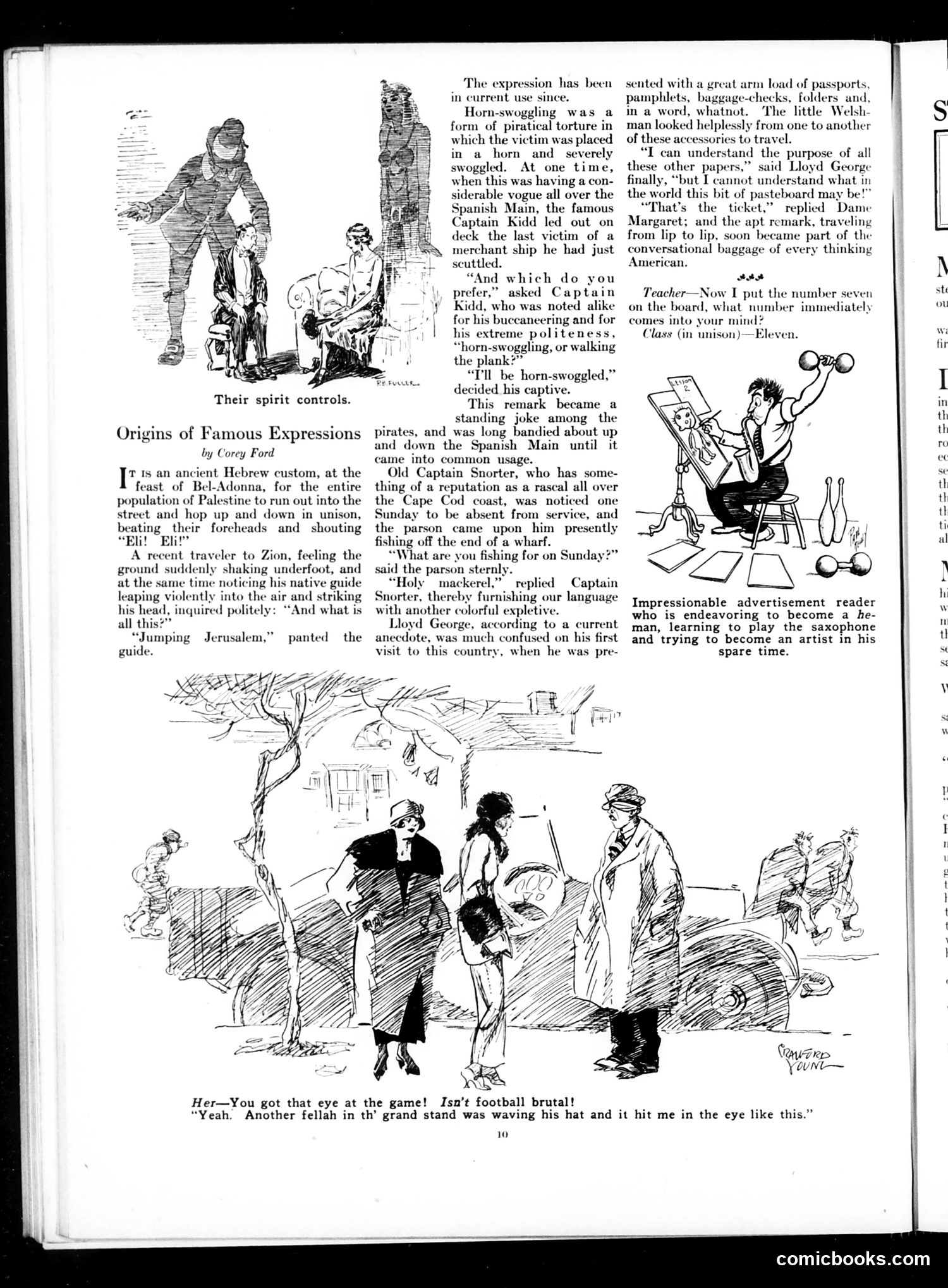
This satirical article humorously invents fake etymologies for common American slang expressions. Corey Ford creates absurd origin stories to mock how people uncritically accept popular sayings without questioning their actual sources. The examples include: "Jumping Jerusalem" (supposedly from Hebrew customs), "horn-swoggled" (attributed to pirate Captain Kidd), "Holy mackerel" (credited to a Cape Cod character named Snorter), and "that's the ticket" (falsely linked to Lloyd George's visit to America). The humor works through exaggeration and obvious fabrication—these clearly aren't real origins. The piece satirizes Americans' tendency to accept folk etymologies and celebrity anecdotes as fact without verification. The bottom cartoon about a football game eye-injury is unrelated to this article, serving as filler content typical of Judge magazine's layout.
📄 Transcribed text from this page (OCR, searchable)
Machine-transcribed from the original scan — historical spelling and the odd misread are preserved.
Their spirit controls. Origins of Famous Expressions by Corey Ford T 1s an ancient Hebrew custom, at the feast of Bel-Adonna, for the entire population of Palestine to run out into the street and hop up and down in unison, beating their foreheads and shouting A recent traveler to Zion, feeling the ground suddenly shaking underfoot, and at the same time noticing his native guide leaping violently into the air and striking his head, inquired politely: “And what is all th “Jumping Jerusalem,” panted the guide. The expression has been in current use since. Horn-swoggling was a form of piratical torture in which the victim was placed in a horn and_ severely swoggled. At one time, when this was having a con- siderable vogue all over the Spanish Main, the famous Captain Kidd led out on deck the last victim of a merchant ship he had just scuttled. “And which do you prefer,” asked Captain Kidd, who was noted alike for his buccaneering and for his extreme politeness “horn-swoggling, or walking the plank?” “Tl be horn-swoggled,” decided his captive. This remark became a standing joke among the pirates, and was long bandied about up and down the Spanish Main until it came into common usage. Old Captain Snorter, who has some- thing of a reputation as a rascal all over the Cape Cod coast, was noticed one Sunday to be absent from service, and the parson came upon him presently fishing off the end of a wharf. “What are you fishing for on Sunday said the parson sternly. “Holy _ mackerel,” Snorter, thereby furnishing our language with another colorful expletive. Lloyd George, according to a current anecdote, was much confused on his first visit to this country, when he was pre- replied Captain wk Her—You got that eye at the game! Isn’t football brutal! . | “Yeah. Another fellah in th’ grand stand was waving his hat and it hit me in the eye like this.” 10 sented with a great arm load of passports, pamphlets, baggage-checks, folders and, in a word, whatnot. he little Welsh man looked helplessly from one to another ies to travel. 1 the purpose of all ese other papers,” said Lloyd George finally, “but I cannot understand what in the world this bit of pasteboard may be!” “That's the ticket,” replied Dame Margaret; and the apt remark, traveling from lip to lip, soon became part of the conversational baggage of every thinking American. eee Teacher—Now I put the number seven on the board, what number immediately comes into your mind? Class (in unison) —Eleven. Impressionable advertisement reader who is endeavoring to become a he- man, learning to play the saxophone and trying to become an artist in his spare time. comicbooks.com