
Judge, 1923-11-24 · page 15 of 36
Judge — November 24, 1923 — page 15: what you’re looking at
What you’re looking at
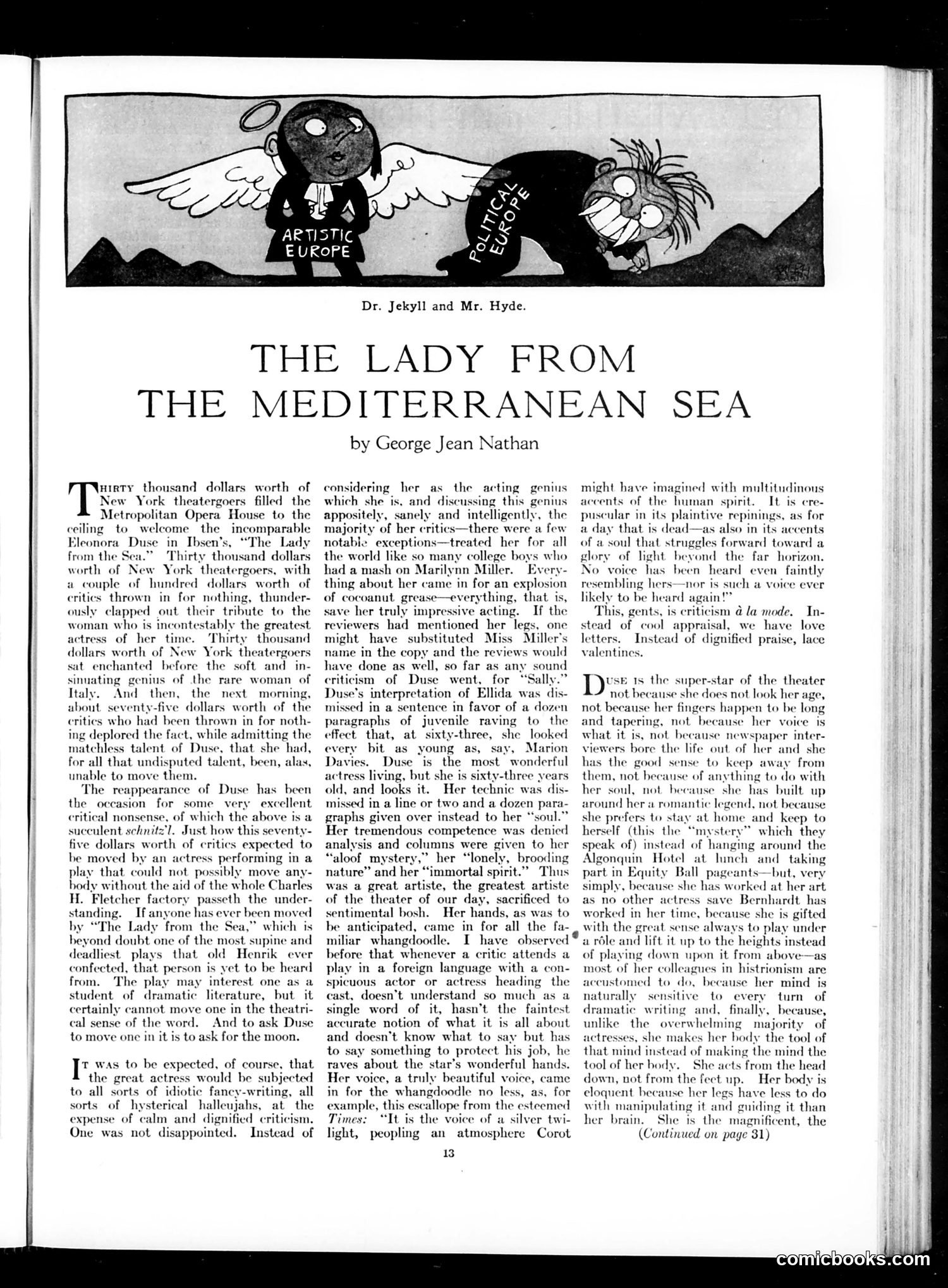
The cartoon contrasts two figures labeled "Artistic Europe" (angelic) and "Folic Europe" (demonic), satirizing European cultural hypocrisy. The accompanying article by George Jean Nathan critiques American theater critics' coverage of Italian actress Eleonora Duse's performance in Ibsen's "The Lady from the Sea." Nathan argues that critics—despite praising Duse as the era's greatest actress—dismissed her actual *acting* in favor of sentimental gushing about her "soul," "mystery," and physical appearance (particularly her legs and hands). The satire targets critics who claim cultural sophistication ("Artistic Europe") while actually demonstrating superficiality and emotional excess ("Folic Europe")—they praise great art while failing to engage its substance intelligently. Nathan suggests they'd have been equally moved by chorus girl Marilynn Miller, exposing their lavish but meaningless rhetoric as a substitute for genuine critical analysis.
📄 Transcribed text from this page (OCR, searchable)
Machine-transcribed from the original scan — historical spelling and the odd misread are preserved.
ARTISTIC EU ROPE |_Y Dr. Jekyll and Mr. Hyde. THE LADY FROM THE MEDITERRANEAN SEA [ser thousand dollars worth of New York theatergoers filled the Metropolitan Opera House to the ceiling to. welcome the incomparable Eleonora Duse in Ibsen’s, “The Lady from the Sea.” Thirty thousand dollars worth of New York theatergoers, with a couple of hundred dollars worth of critics thrown in for nothing, thunder- ously clapped out their tribute to the woman who is incontestably the greatest actress of her time. Thirty thousand dollars worth of New York theatergoers sat enchanted before the soft and in- sinuating genius of the rare woman of Italy. And then, the next- morning, about seventy-five dollars worth of the critics who had been thrown in for noth- ing deplored the fact, while admitting the matchless talent of Duse, that she had, for all that undisputed talent, been, alas, unable to move them. The reappearance of Duse has been the occasion for some very excellent critical nonsense, of which the above is a succulent schnitz'l. Just how this seventy- five dollars worth of critics expected to be moved by an actress performing in a play that could not possibly move any- body without the aid of the whole Charles H. Fletcher factory passeth the under- standing. If anyone has ever been moved by “The Lady from the Sea,” which is beyond doubt one of the most supine and deadliest. plays that old) Henrik ever confected, that person is yet to be heard from. The play may interest one as a student of dramatic literature, but it certainly cannot move one in the theatri- cal sense of the word. And to ask Duse to move one in it is to ask for the moon. [7,885.20 be expected. of course, that the great actress would be subjected to all sorts of idiotic fancy-writing, all sorts of hysterical halleujahs, at the expense of calm and dignified criticism, One was not disappointed. Instead of by George Jean Nathan considering her as the acting genius which she is, and discussing this genius appositely, sanely and intelligently, the majority of her critics—there were a few notable exceptions—treated her for all the world like so many college boys who had a mash on Marilynn Miller. Every. thing about her came in for an explosion of cocoanut grease—everything, that is, save her truly impressive acting. If the reviewers had mentioned her legs, one might have substituted Miss Miller's name in the copy and the reviews would have done as well, so far as any sound criticism of Duse went, for ally.” Duse’s interpretation of Ellida was dis- missed in a sentence in favor of a dozen paragraphs of juvenile raving to the effect. that, at sixty-three, she looked every bit as young as, say, Marion Davies. Duse is the most wonderful actress living, but she is sixty-three years old, and looks it. Her technic was dis- missed in a line or two and a dozen pars graphs given over instead to her “soul Her tremendous competence was denied analysis and columns were given to her “aloof mystery,” her “lonely, brooding nature” and her “immortal spirit.” Thus was a great artiste, the greatest artiste of the theater of our day, sacrificed to sentimental bosh. Her hands, as was to be anticipated, came in for all the f miliar whangdoodle. I have observed before that whenever a critic attends a play in a foreign language with a con- spicuous actor or actress heading the t, doesn’t understand so much as a ingle word of it, hasn’t the faintest accurate notion of what it is all about and doesn’t know what to but has to something to protect his job, he raves about the star’s wonderful hands. Her voice, a truly beautiful voice, came in for the whangdoodle no less, as, for example, this escallope from the esteemed Times: “It is the voice of a silver twi- light, peopling an atmosphere Corot 13 might have imagined with multitudinous accents of the human spirit. It is ere- puscular in its plaintive repinings, as for a day that is dead—as also in its accents of a soul that struggles forward toward a glory of light beyond the far horizon. No voice has been heard even faintly resembling hers—nor is such a voice ever likely to be heard again!” This, gents, is criticism d@ la mode. In- stead of cool appraisal, we have love letters. Instead of dignified praise, lace valentines. D™ 1s the super-star of the theater not because she does not look her age, not because her fingers happen to be long and tapering, not because her voice is what it is, not because newspaper inter- viewers bore the life out of her and she has the good sense to keep away from them, not because of anything to do with her soul, not heeause she has built up around her a romantic legend, not because she prefers to stay at home and keep to herself (this the “mystery” which they speak of) instead of hanging around the Algonquin Hotel at hinch and taking part in Equity Ball pageants—but, very simply, because she has worked at her art as no other actress save Bernhardt has worked in her time, because she is gifted with the great sense always to play under a role and lift it up to the heights instead of playing down upon it from above—as most of her colleagues in histrionism are accustomed to do, because her mind is nati sensitive to every turn of dramatic writing and, finally, because, unlike the overwhelming majority of actresses, she makes her body the tool of that mind instead of making the mind the tool of her body. She acts from the head down, not from the fect up. Her body is eloquent hecause her legs have less to do with manipulating it and guiding it than her brain. She is the magnificent, the (Continued on page 31)