
A complete issue · 36 pages · 1923
Judge — May 5, 1923
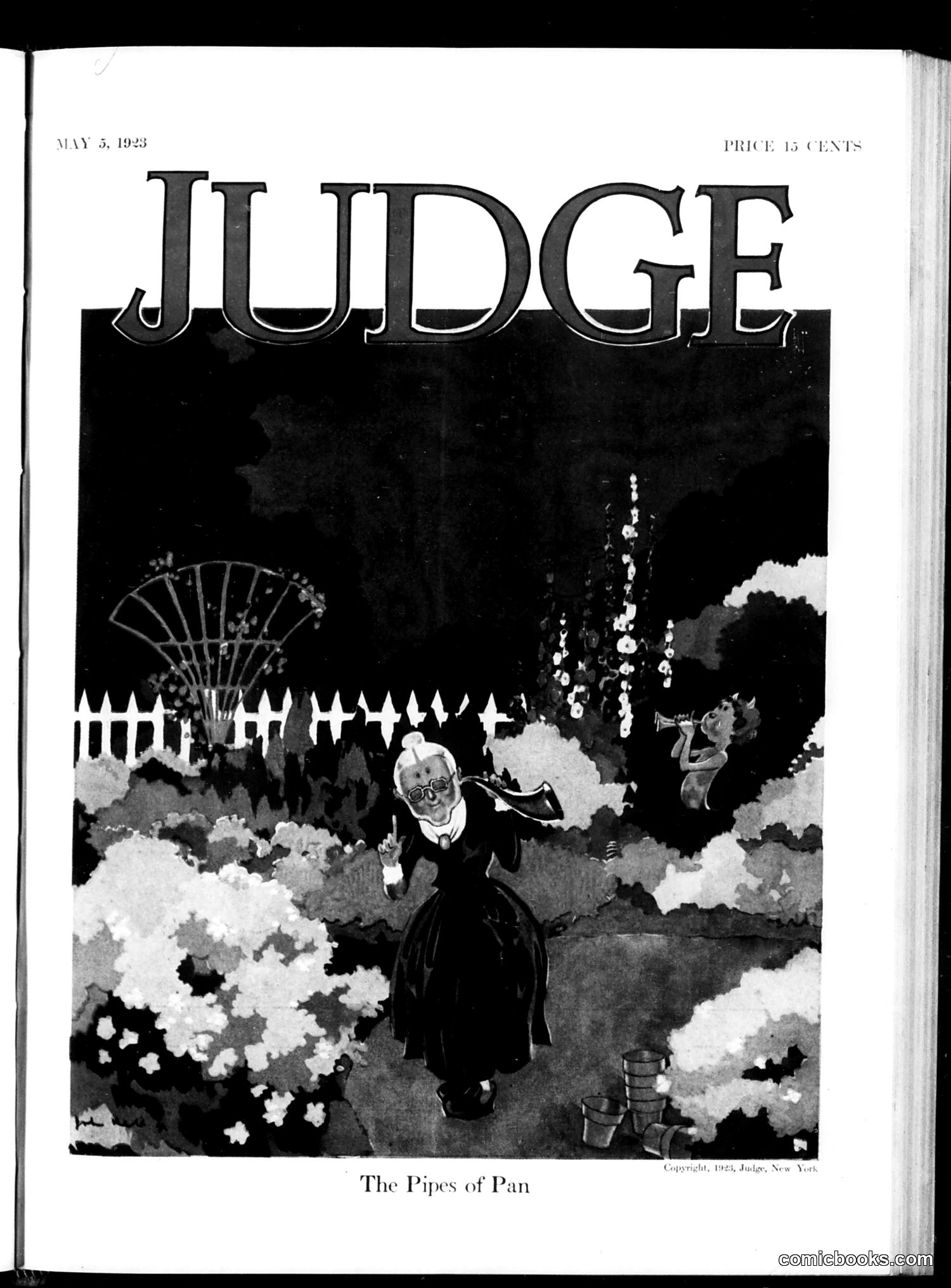
This illustration depicts an elderly woman in a garden playing pipes, surrounded by blooming flowers. The title references the classical mythology of Pan, the god of nature and shepherds, whose pipes (the "Panpipes") were said to have magical, life-giving properties. The image appears to be a whimsical, allegorical celebration of spring and nature's renewal—the woman as a Pan-like figure coaxing flowers to bloom through her music. Without additional context from the magazine's text or surrounding content, the specific satirical or political meaning is unclear. It may simply be seasonal artwork celebrating spring, or possibly an advertisement. The classical mythology reference was popular in 1920s illustration.
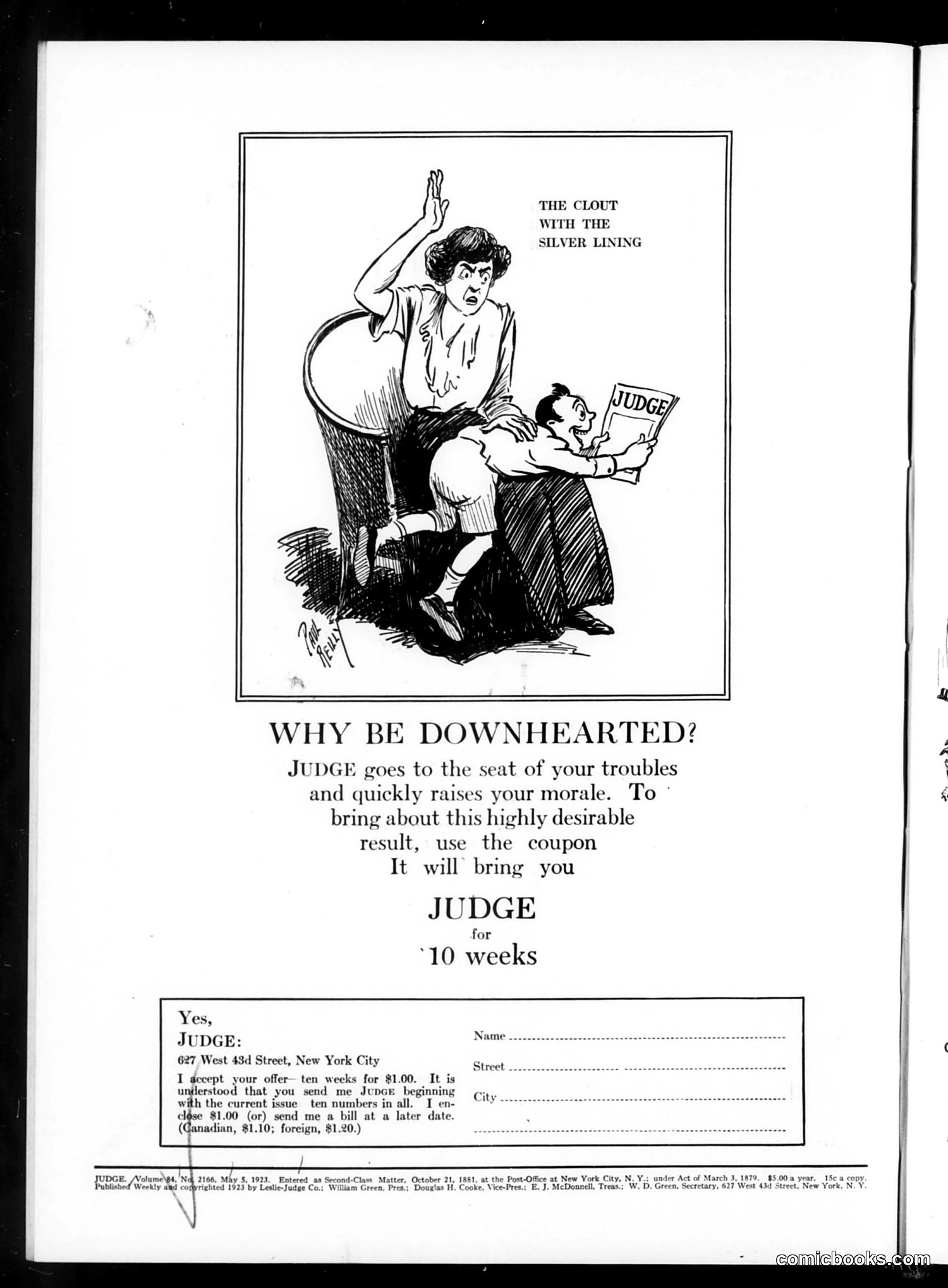
This page is primarily an **advertisement for Judge magazine** itself, not political satire. The illustration titled "The Clot with the Silver Lining" depicts a woman comforting a distressed man holding a "Judge" publication. The ad's message is straightforward: Judge magazine aims to lift readers' spirits when they're discouraged or depressed. The copy promises that reading Judge "goes to the seat of your troubles and quickly raises your morale." The subscription offer at bottom invites readers to obtain Judge for 10 weeks for $1.00, positioning the magazine as an affordable mood-lifter during difficult times. This reflects Judge's self-marketing as comedic entertainment designed to provide psychological relief to its audience.
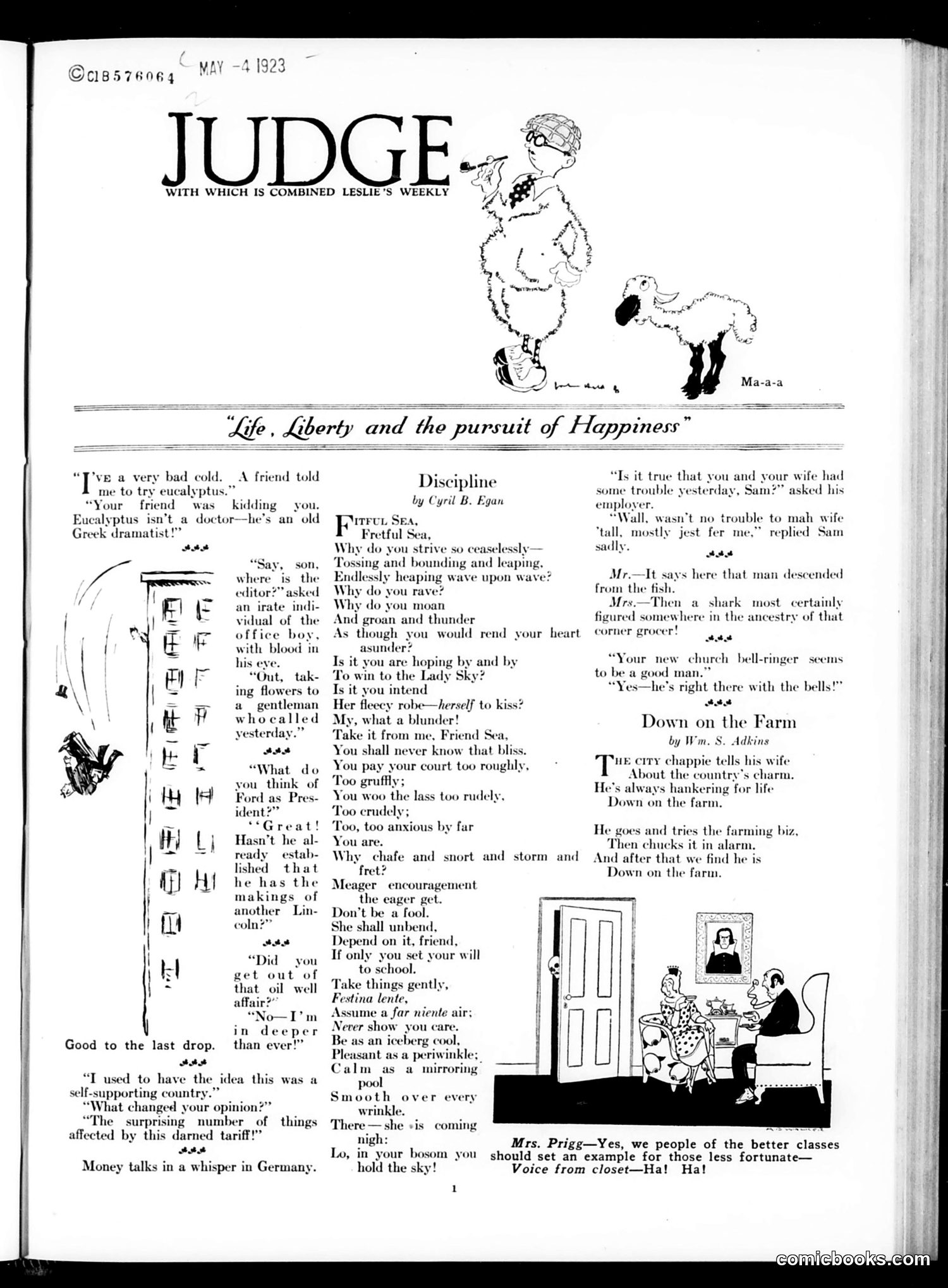
This page contains humor pieces and poetry rather than political cartoons. The content includes: **"Discipline"** by Cyril B. Egan—a poem mocking excessive naval discipline, critiquing rigid hierarchical demands ("Why do you rave?") and suggesting such strictness is counterproductive. **"Down on the Farm"** by Wm. S. Adkins—verse lampooning an urban man attempting farming, finding it bewildering and alarming. **The cartoon** shows a domestic scene where a wife tells her husband they should set an example for "less fortunate" classes—likely satirizing upper-class pretension about moral leadership while maintaining social distance ("Voice from closet—Ha! Ha!"). The overall theme mocks rigid authority, rural incompetence among city folk, and class hypocrisy—typical Judge magazine subjects of the 1920s.
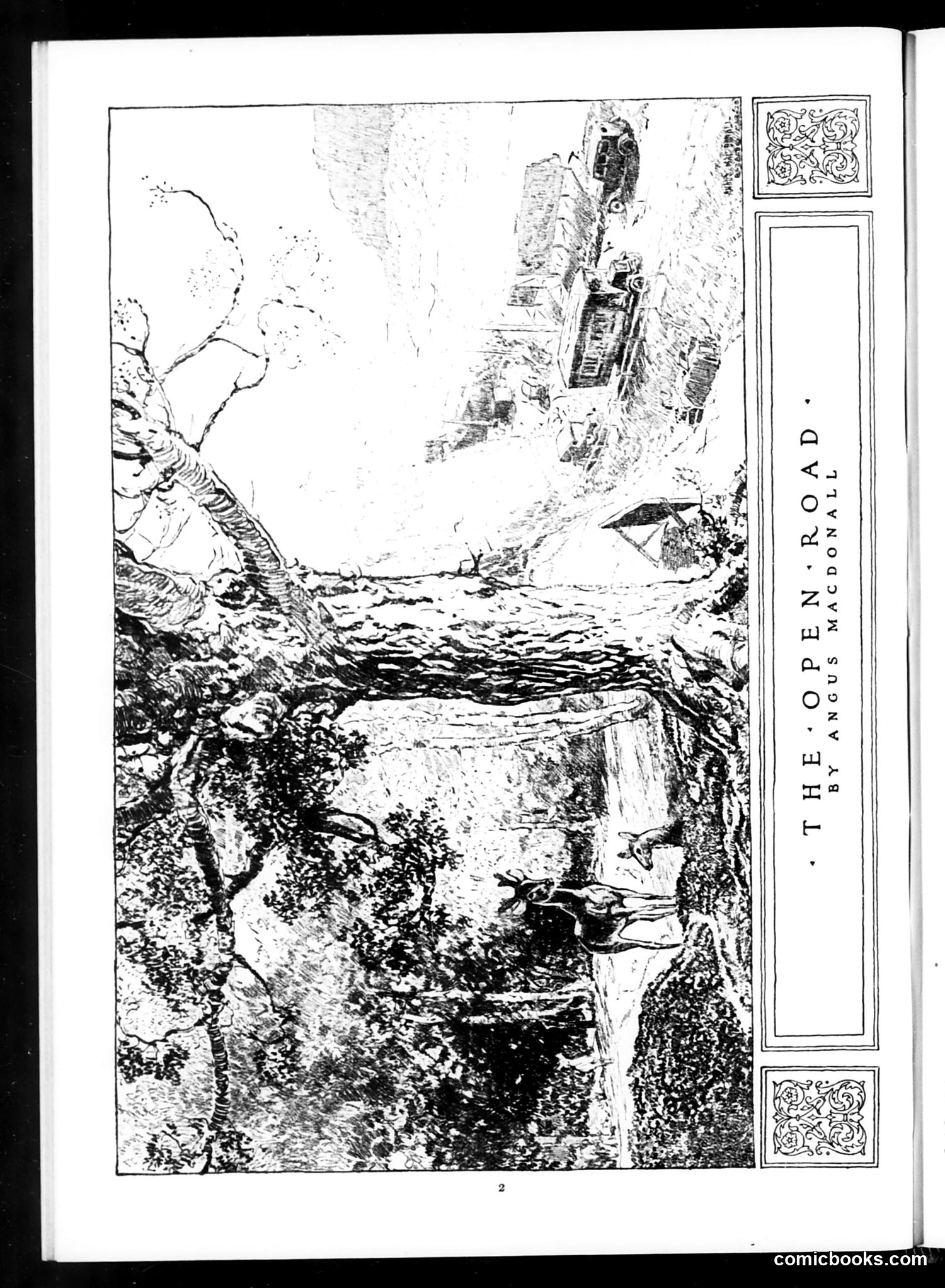
I can see this is a page from Judge magazine showing a black and white illustration titled "THE OPEN ROAD" credited to "BY ANGUS McDONALL." The image depicts a rural or mountainous landscape with what appears to be a fallen log or barrier across a path, with various natural elements and possibly figures in the scene. However, the image quality and reproduction make it difficult to discern specific details clearly enough to identify particular political figures, specific historical references, or the precise satirical intent. The title "The Open Road" suggests commentary on accessibility or freedom of movement, possibly a social or political critique, but I cannot confidently identify the specific figures, caricatures, or historical context being referenced without clearer visibility of details. To provide accurate historical analysis, I would need either a higher-resolution image or additional contextual information about the publication date.
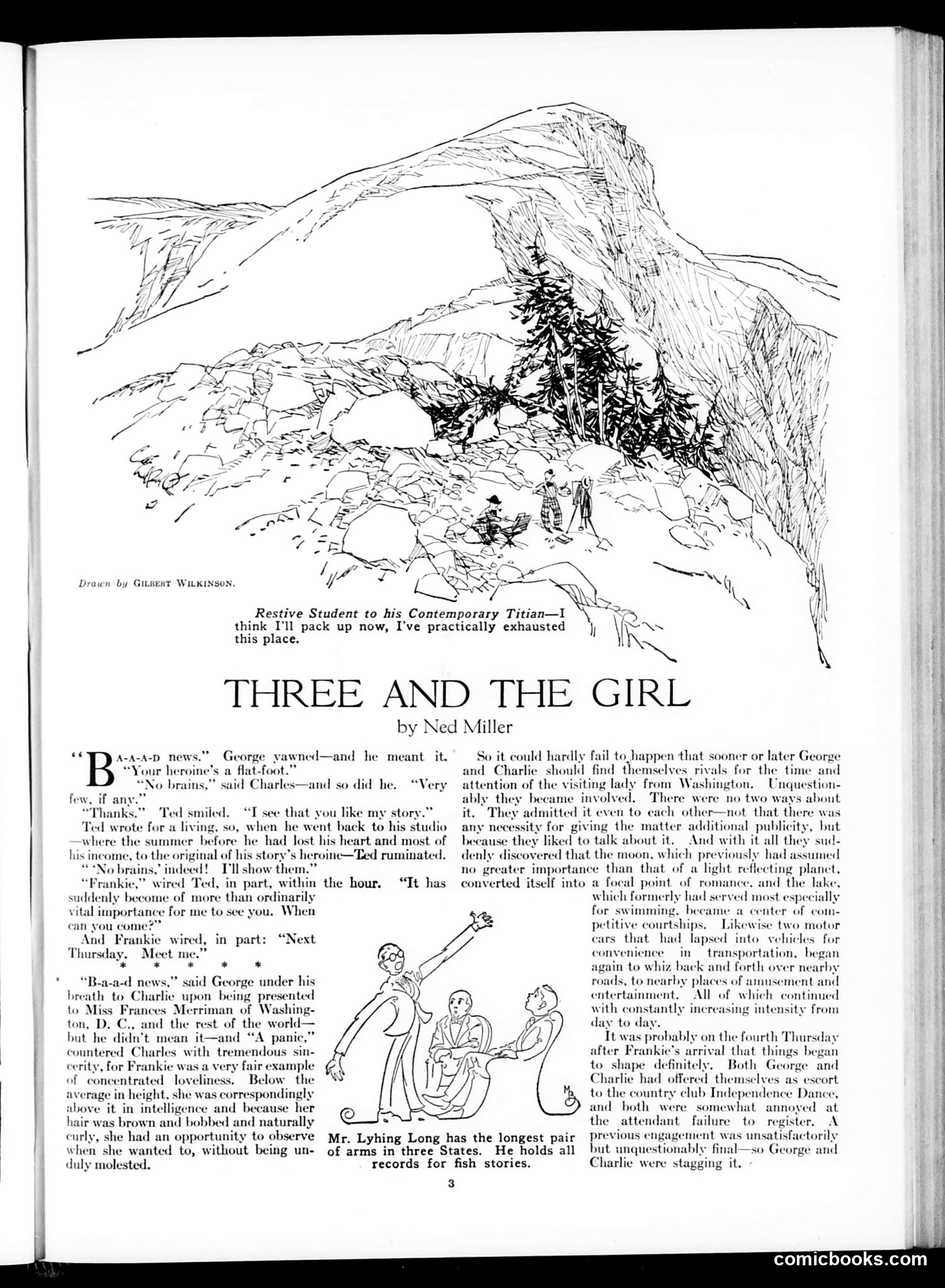
This page contains the opening of a short story rather than political satire. The narrative concerns George, Charlie, and an unnamed visiting lady from Washington. The plot hinges on a romantic competition: George and Charlie both court the woman's attention through increasingly elaborate outings—motor cars, amusement parks, and an Independence Day dance. The illustration by Gilbert Wilkinson depicts a rocky landscape with evergreen trees, likely representing an outdoor excursion venue. The story's humor derives from the escalating romantic gestures and the woman's apparent indifference to both suitors' efforts. This appears to be entertainment content rather than political commentary, focusing on romantic comedy tropes typical of Judge magazine's fiction offerings.
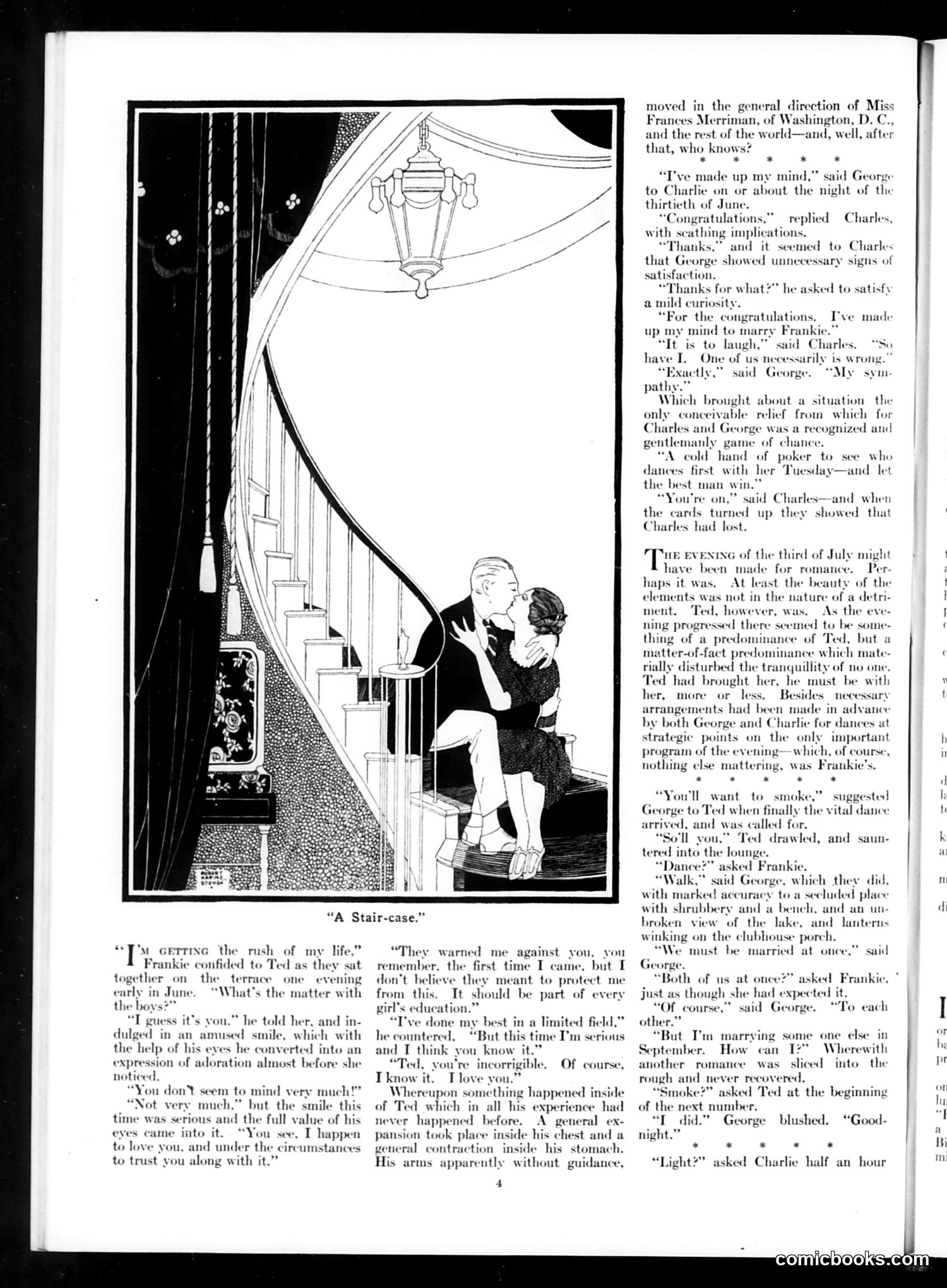
This page from Judge magazine contains a romantic narrative rather than political satire. The illustration titled "A Stair-case" depicts a couple on an interior staircase in an intimate moment. The surrounding text is a serialized romance story involving characters named Frankie, George, Charles, and Ted, discussing wedding plans and romantic entanglements. The cartoon's title is a pun—"stair-case" (physical location) doubles as "stair-case" (romantic escalation/progression). This appears to be entertainment content rather than political commentary, reflecting Judge's broader mission as a humor and lifestyle magazine alongside its satirical pieces. The sophisticated illustration style and domestic subject matter suggest this targeted the magazine's middle-to-upper-class readership.
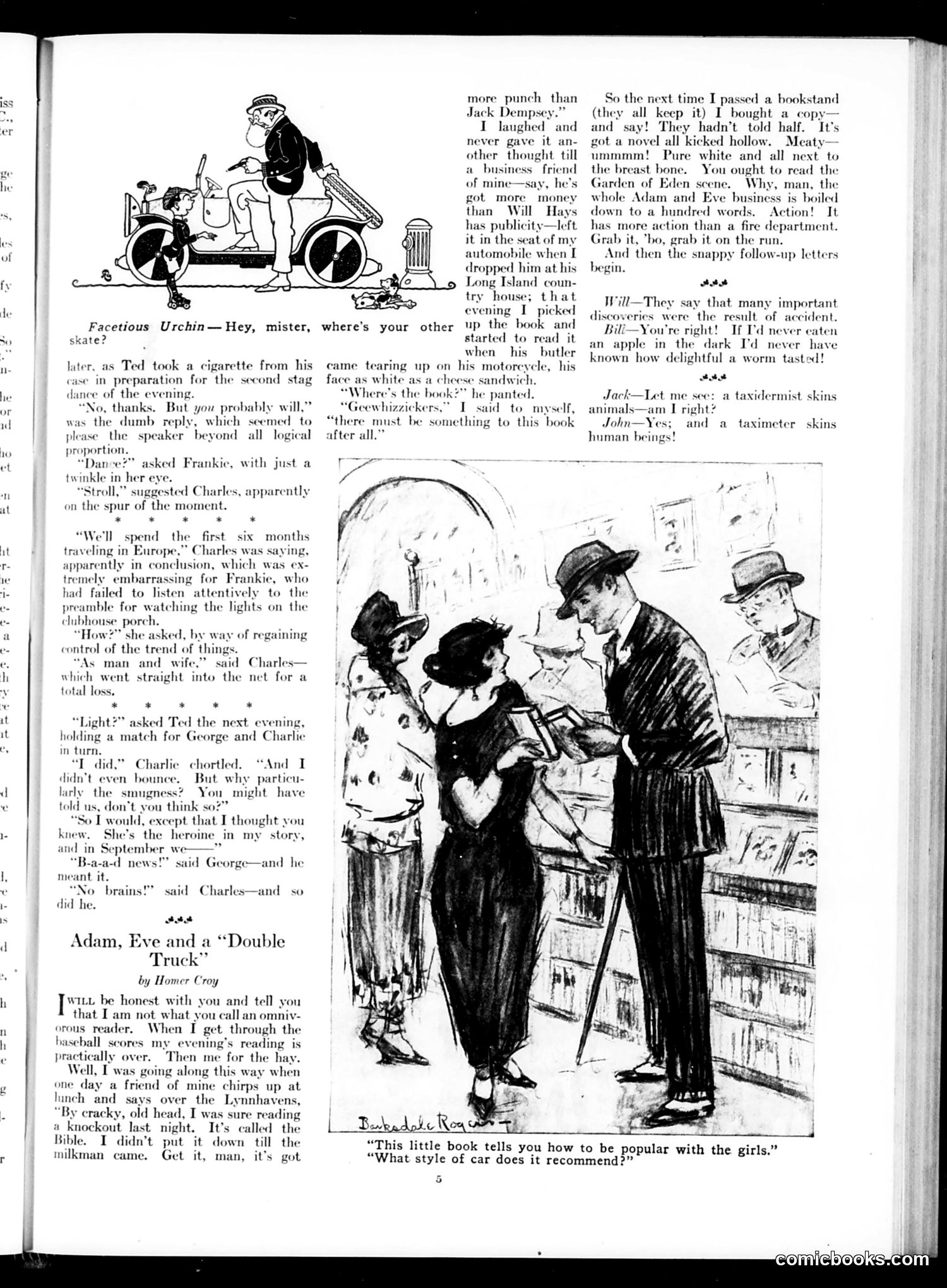
This page contains two distinct pieces of 1920s humor: **Top Section: "Facetious Urchin"** depicts a romantic comedy involving characters at a country club. The dialogue satirizes upper-class courtship conventions—particularly how a woman named Frankie pretends inattention while a suitor named Charles awkwardly proposes European travel. The humor targets the stilted social performances of wealthy young people and their transparent emotional games. **Bottom Section: "Adam, Eve and a 'Double Truck'"** by Homer Croy mocks the Bible's sudden popularity as entertainment reading. A character discovers the biblical Genesis account as gripping modern literature, praising its "action" and "punch" compared to Jack Dempsey (a famous boxer). The follow-up witticisms make crude sexual double-entendres about Adam, Eve, apples, and the Garden of Eden—treating scripture as sensational pulp fiction. Both pieces reflect 1920s attitudes: urbanized skepticism toward traditional morality, fascination with modern consumer culture, and irreverent treatment of once-sacred subjects. The cartoons ridicule both romantic pretension and false piety.
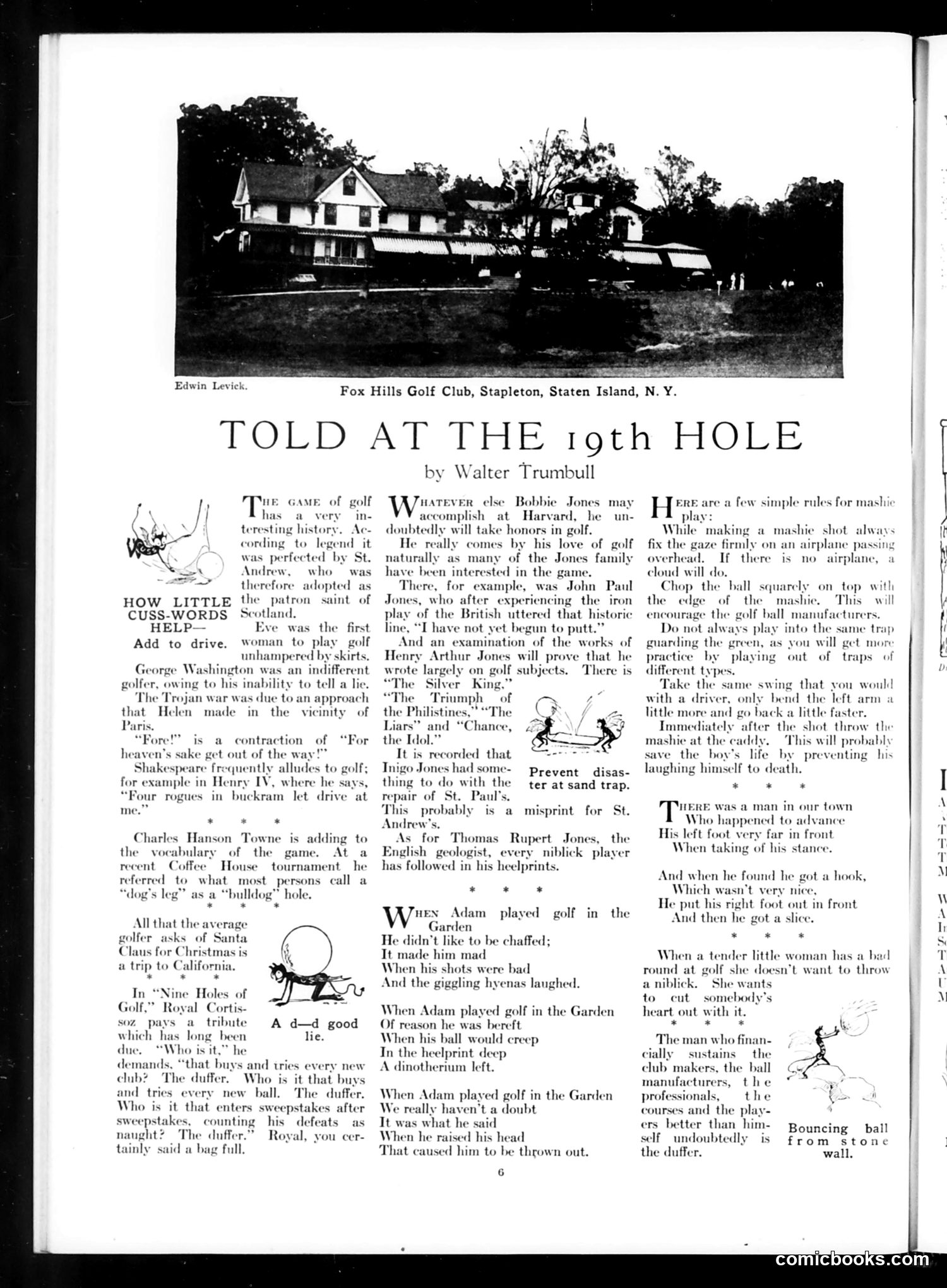
This page from *Judge* magazine presents humorous golf anecdotes and practical tips, centered on the 19th hole (the bar where golfers gather after play). The content includes: **Main humor pieces:** Comic verses about Adam playing golf in the Garden of Eden (a play on golf's historical origins and Adam's expulsion), and rhyming anecdotes about various golfers—including someone named "Bobbie Jones" at Harvard, likely referencing the famous golfer Bobby Jones. **Running joke:** A repeated bit defining "the duffer" as the golfer "who buys and tries every new club" and "enters sweepstakes after sweepstakes, counting his defeats." **Practical advice:** Tips on mashie shots (mid-range golf strokes) and sand trap technique. **Overall tone:** Gentle satire of golf culture and golfer behavior—the obsessive equipment-buyer, the frustrated amateur, the gender dynamics (the woman golfer who wants emotional revenge). It's lighthearted sports humor targeting an affluent readership familiar with country clubs.
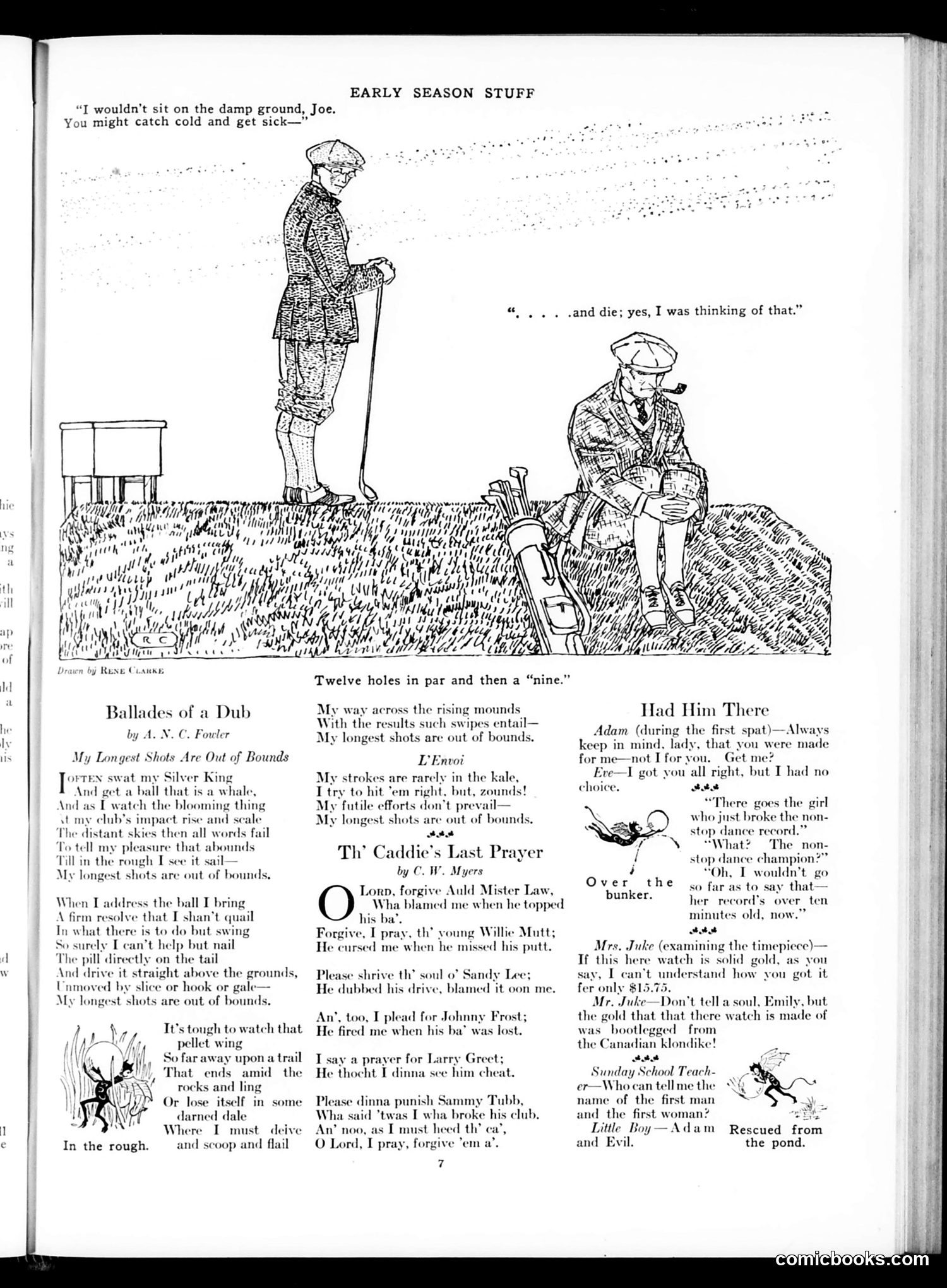
This is a humor page from *Judge* magazine featuring golf-themed comedy. The main cartoon shows two golfers on a course—one standing (giving unsolicited health advice about sitting on damp ground), the other seated and apparently indifferent. The caption's punchline is that the seated golfer was already thinking about catching cold and dying, suggesting he's so discouraged by his poor golf performance that he welcomes illness. The page contains several golf-related poems and short jokes, including "Ballades of a Dub" (mocking a terrible golfer whose longest shots always go out of bounds) and "Th' Caddie's Last Prayer" (a Scottish dialect poem where a caddie prays for forgiveness from all the golfers he's worked for, each blaming him for their mistakes). The other jokes are unrelated—Adam and Eve banter, a non-stop dancer, and a bootlegged watch—typical filler content. The overall theme is early-season golf humor, common leisure-class entertainment for *Judge*'s affluent readership.
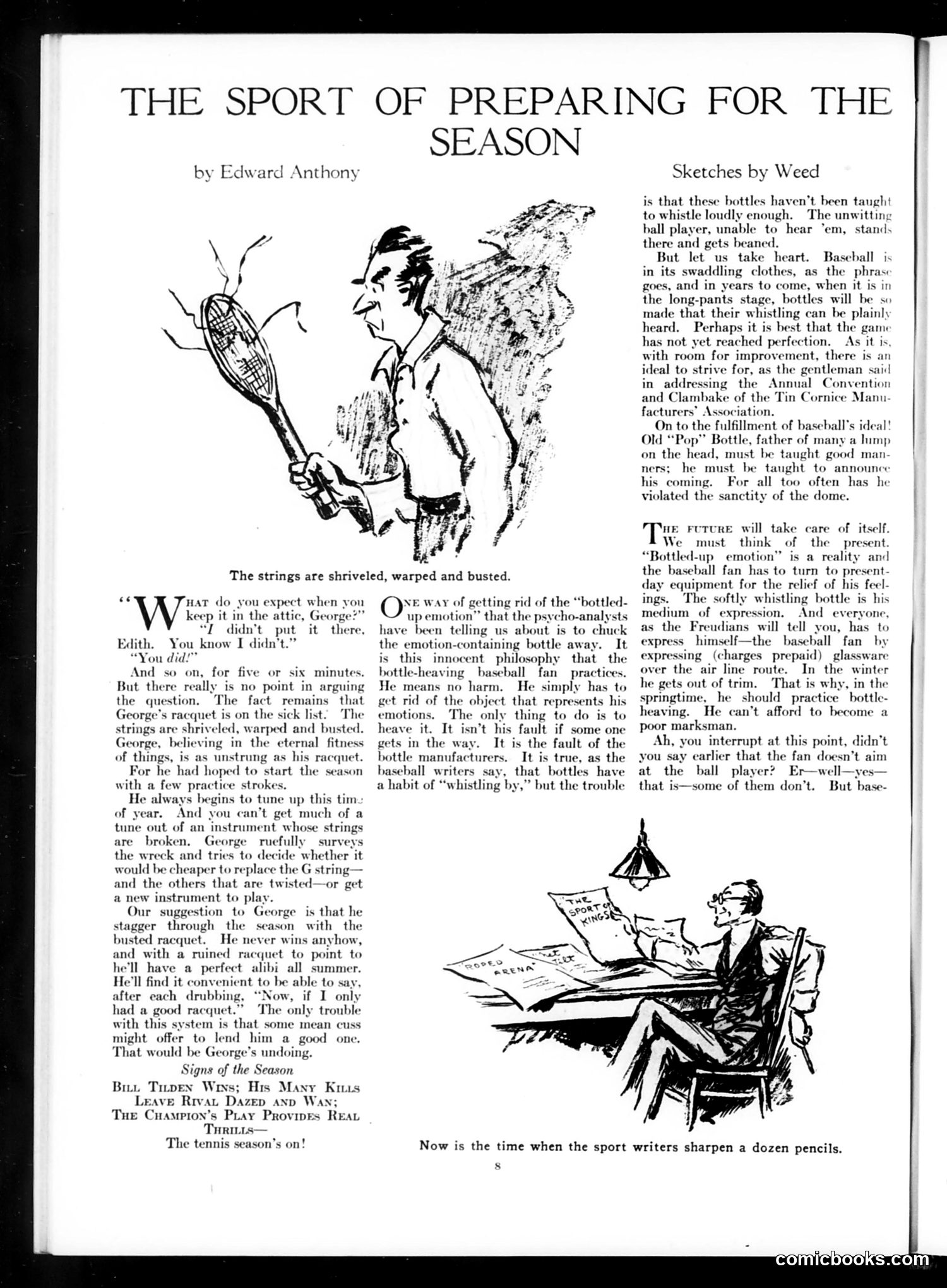
This satirical piece by Edward Anthony mocks the rituals of spring sports preparation. The main cartoon shows a domestic quarrel between George and Edith over a tennis racquet left deteriorating in the attic—its strings "shriveled, warped and busted." The satire works on two levels: first, it pokes fun at married couples' petty blame-shifting over household neglect. More cleverly, it suggests George use his broken racquet as a permanent *alibi* for losing tennis matches all season—a commentary on how people rationalize failure. The second article humorously addresses baseball fans' dangerous habit of throwing bottles at players they dislike. It adopts the pseudo-serious tone of psychoanalysis and industrial improvement, proposing that bottle manufacturers design bottles that "whistle" loudly enough to warn players. This satirizes both contemporary psychoanalytic fads and the era's apparent casual acceptance of fan violence in baseball.
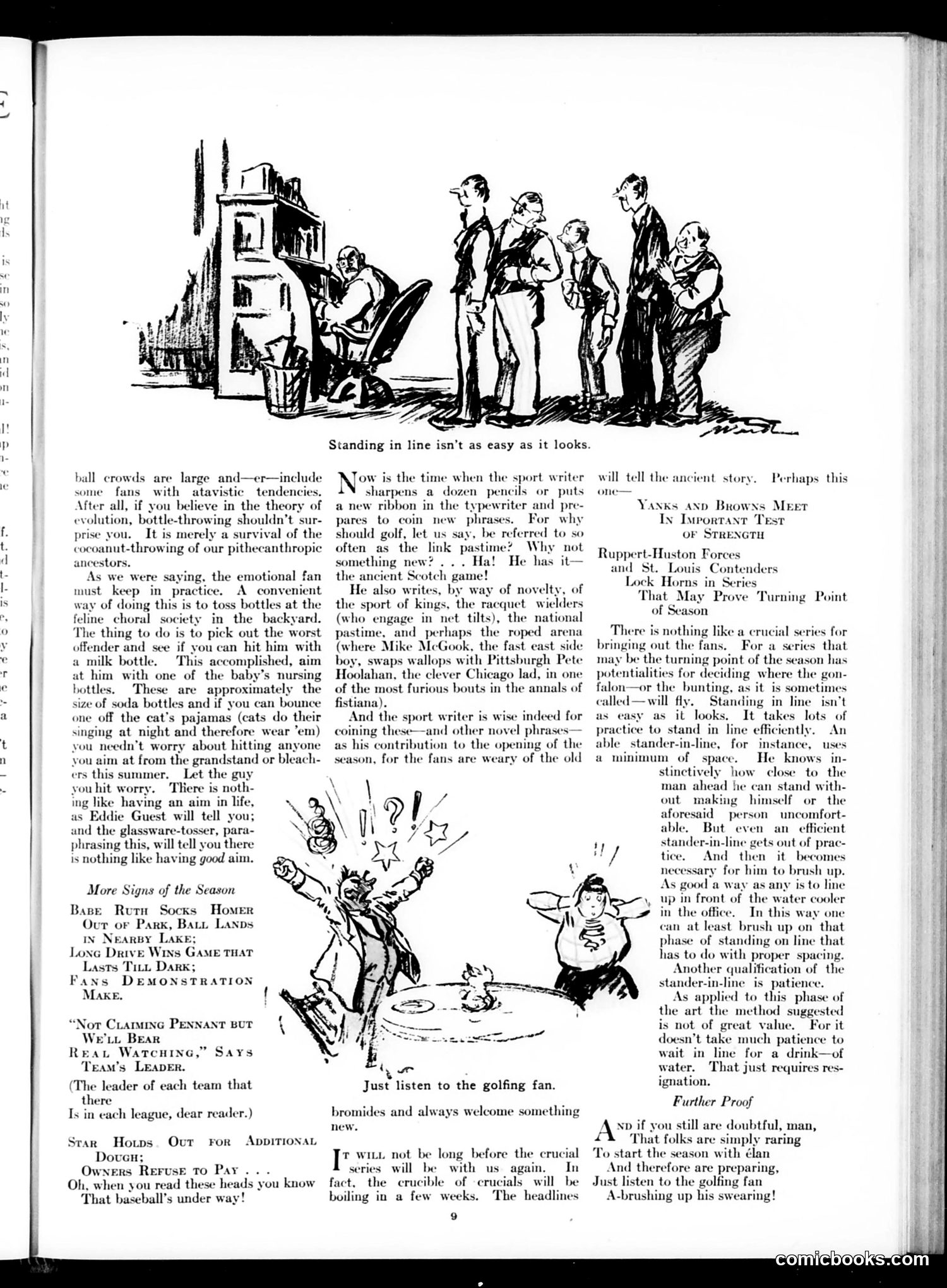
This page satirizes baseball season preparation and fan behavior, circa early 20th century. **The Main Cartoon** ("Standing in line isn't as easy as it looks") depicts fans queuing outside a ballpark, mocking the difficulty of maintaining orderly lines—a humorous jab at working-class baseball crowds. **The Content** is primarily satirical commentary on: 1. **Fan behavior**: The text jokes that emotional fans practice "aim" by throwing bottles at targets (cats, nursing bottles) between seasons, sarcastically attributing this to Darwinian "atavistic tendencies"—implying baseball fans are evolutionarily primitive. 2. **Sports journalism clichés**: The article ridicules sportswriters for exhausted phrases ("the ancient Scotch game" for golf, "the roped arena" for boxing) while coining new ones for the upcoming season. 3. **Baseball anticipation**: References to the Yanks-Browns series and the Ruppert-Huston forces (likely the Yankees ownership) frame the crucible sports moment arriving. The humor targets both rowdy fans and pretentious sportswriting conventions through exaggeration and mock-serious tone.
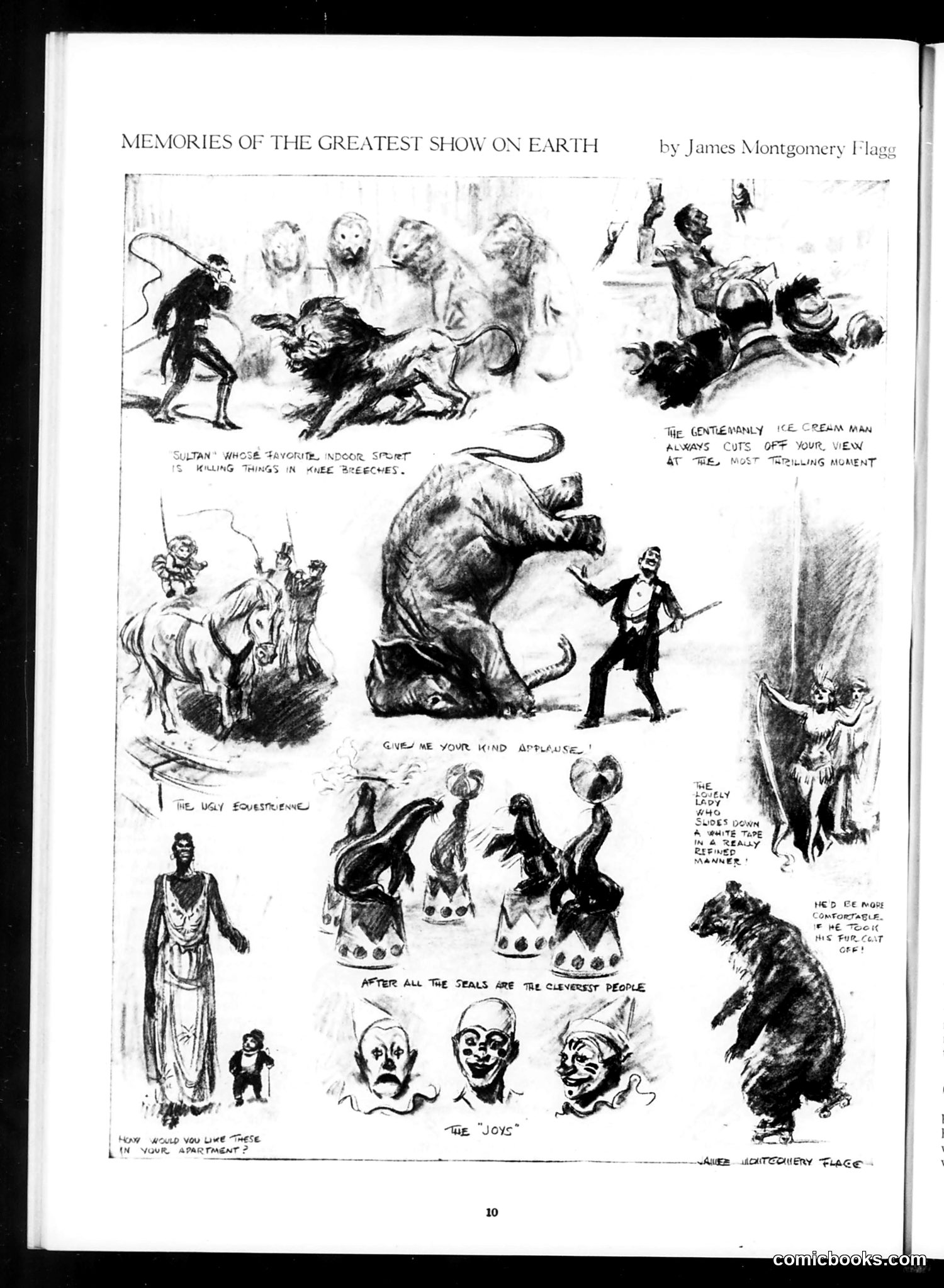
This is a humorous illustrated essay by James Montgomery Flagg satirizing the circus experience. Rather than attacking a political figure, it mocks universal annoyances of attending the circus—particularly P.T. Barnum's famous traveling show. The sketches depict: a "Sultan" doing an indoor sport in knee-breeches; an ice cream vendor blocking views at crucial moments; trained seals performing; a hippopotamus; clowns ("The Joys"); and various circus acts. The final panel humorously asks how readers would like to keep circus animals in their apartment. The satire targets not politics but circus culture itself—the crowds, vendors, questionable acts, and the spectacle's absurdities. It's gentle social commentary on American entertainment and consumer behavior, poking fun at both the circus industry and audiences who tolerate its inconveniences and dubious attractions.
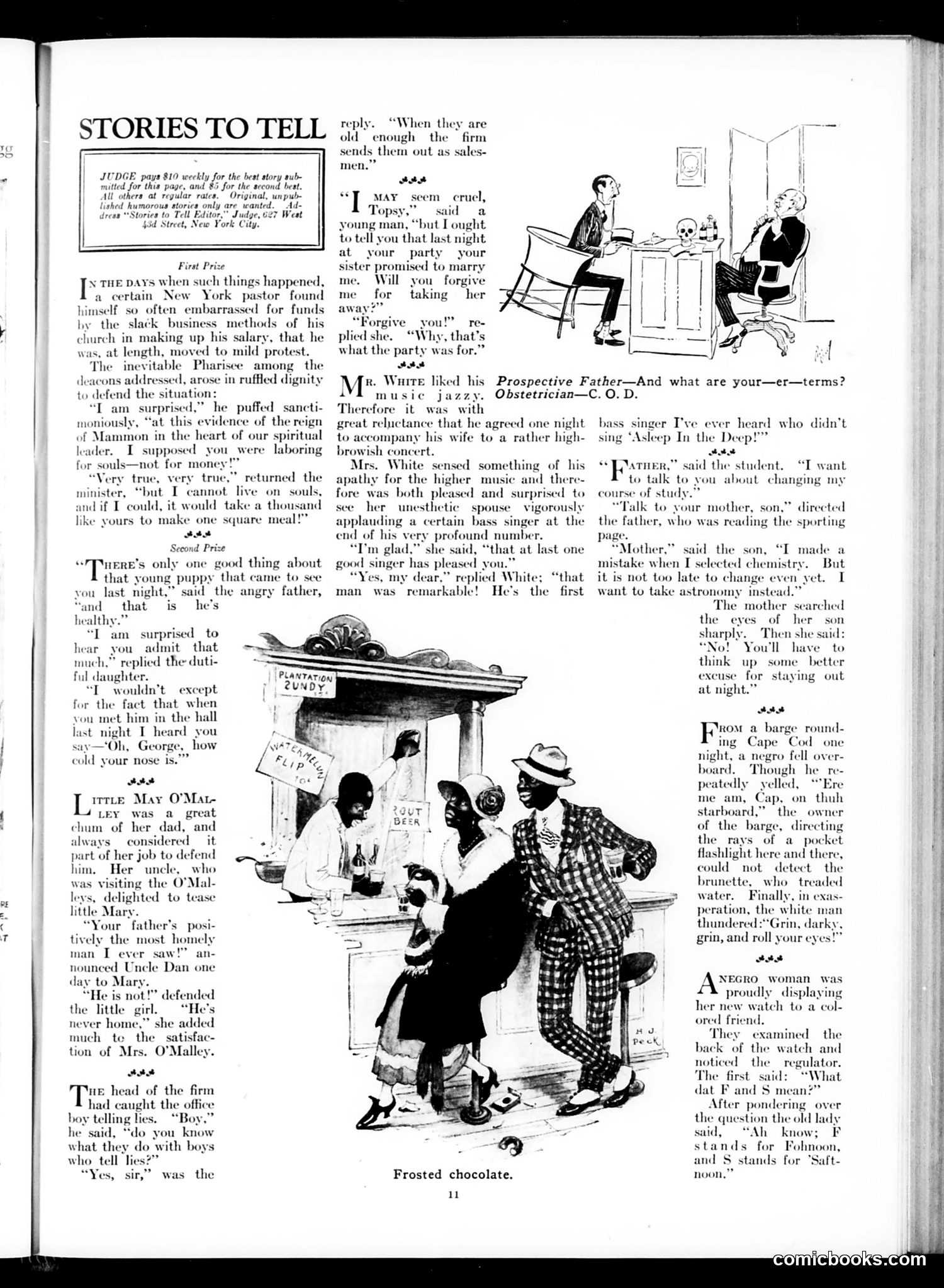
This page collects brief humorous anecdotes submitted by readers to Judge's humor competition. The content reflects early-20th-century American social attitudes and comic conventions. **Key stories include:** - A pastor embarrassed by church funding shortfalls—satirizing both clergy financial struggles and the hypocrisy of wealthy church members - A father's complaint about his daughter's boyfriend—standard domestic comedy - A child's accidental compliment about her father never being home—gentle family humor - A racial joke about a Black man overboard ("Ere me am, Cap") using stereotypical dialect—reflecting the casual racism of the era - A medical humor cartoon captioned "Frosted chocolate," depicting what appears to be a birthing scene with racial caricatures—deeply offensive by modern standards - Dating and courtship humor reflecting period anxieties about young people's behavior The illustrations use exaggerated caricature typical of early Judge cartoons. The overall tone is light domestic satire aimed at middle-class readers, though some content reveals the era's deeply embedded racial prejudices.
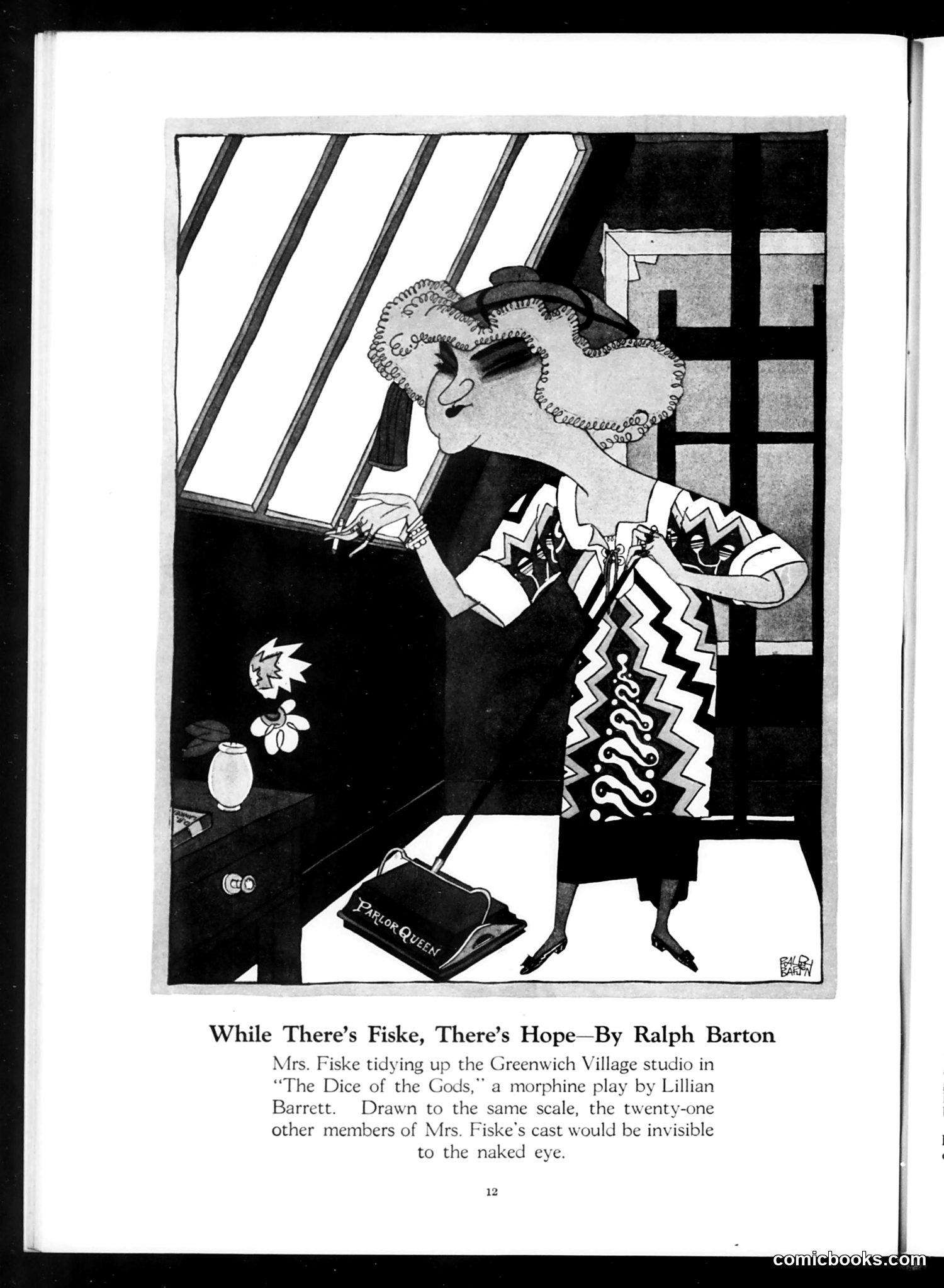
This Ralph Barton cartoon satirizes **Mrs. Fiske**, a prominent early 20th-century actress, performing in Lillian Barrett's play "The Dice of the Gods"—described as a "morphine play," suggesting it dealt with drug addiction. The satire's point: The caption notes that if drawn to scale with Mrs. Fiske, the other 21 cast members would be invisible. This mocks Mrs. Fiske's dominating stage presence and reputation for overshadowing her fellow actors. The cartoon visually exaggerates her theatrical grandeur in a Greenwich Village studio setting, emphasizing how she commanded attention and seemingly dwarfed ensemble casts. The title's wordplay—"While There's Fiske, There's Hope"—plays on the common phrase "while there's life, there's hope," suggesting her star power was the production's only saving grace.
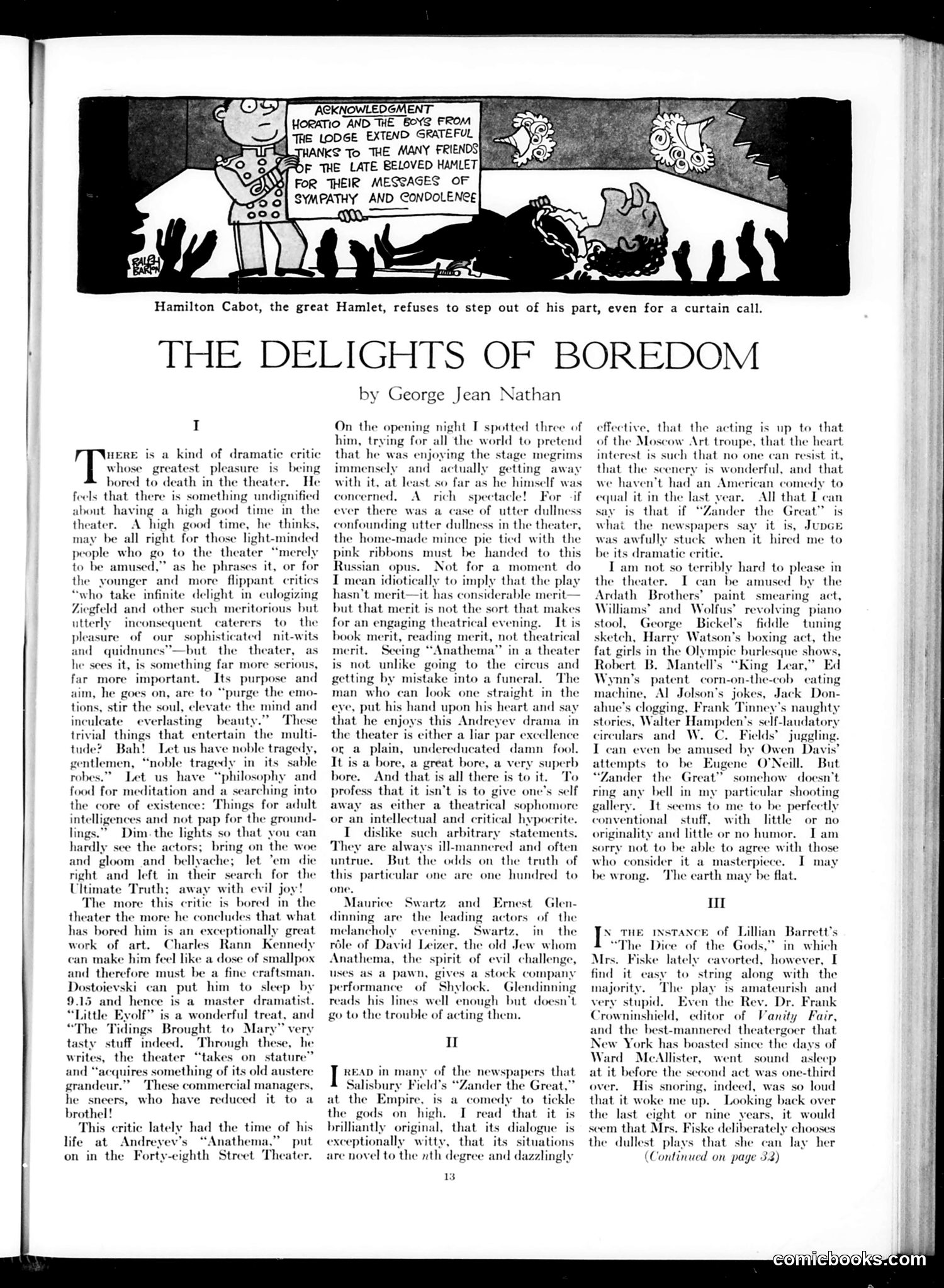
The cartoon depicts **Hamilton Cabot**, described as "the great Hamlet," refusing to break character even for a curtain call—a visual joke about theatrical pretension. The article satirizes a specific type of drama critic who equates boredom with artistic merit. Nathan mocks critics who believe serious theater must be joyless, gloomy, and intellectually taxing to be worthwhile. He names examples: Charles Rann Kennedy and Dostoevski are praised by such critics precisely *because* they're tedious. Nathan's prime target is **Andreyev's "Anathema,"** performed at the Forty-eighth Street Theater, which he deems genuinely boring but artistically merit-less for theater (though readable as literature). He ridicules pretentious critics who attended opening night, claiming anyone who genuinely enjoys it is "either a liar par excellence or a plain, undereducated damn fool." The satire targets intellectual snobbery in theater criticism—the assumption that entertainment and sophistication are mutually exclusive.
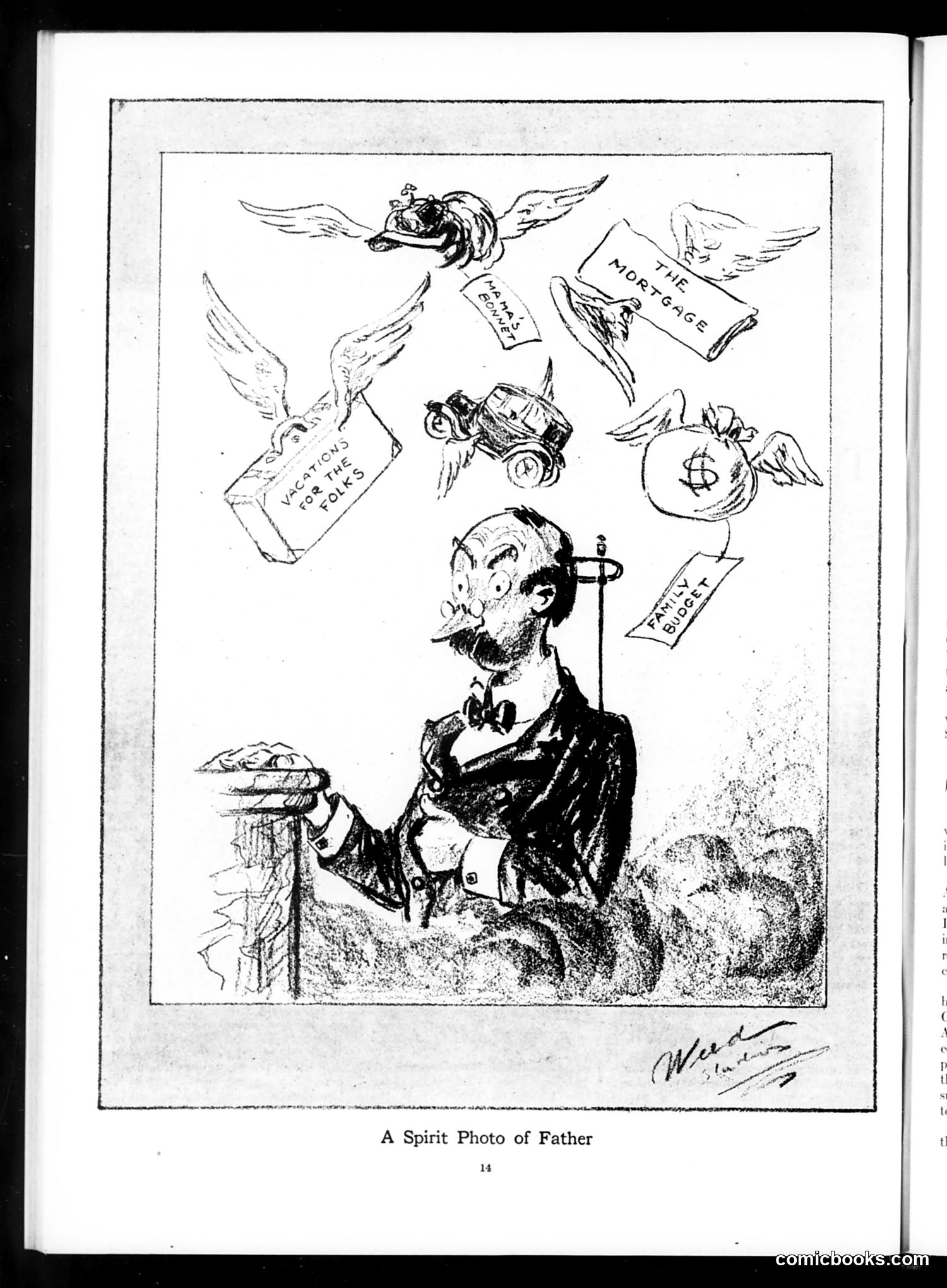
This cartoon satirizes **spiritualism and séances**—late 19th/early 20th-century phenomena where people claimed to contact the dead through mediums. The bearded man (likely representing a gullible believer or wealthy mark) peers upward at "spirit photographs"—floating winged objects labeled with financial concepts: "Vacations for Fools," "The Mortgage," "Last Expense," and a money bag with dollar sign. The joke mocks how spiritualist mediums exploited clients by claiming to capture images of deceased relatives, while the cartoonist suggests the real "spirits" appearing are actually the client's financial burdens and debts—far more tangible than any ghostly apparition. It's commentary on both spiritualist fraud and human gullibility during an era of widespread belief in occult phenomena.
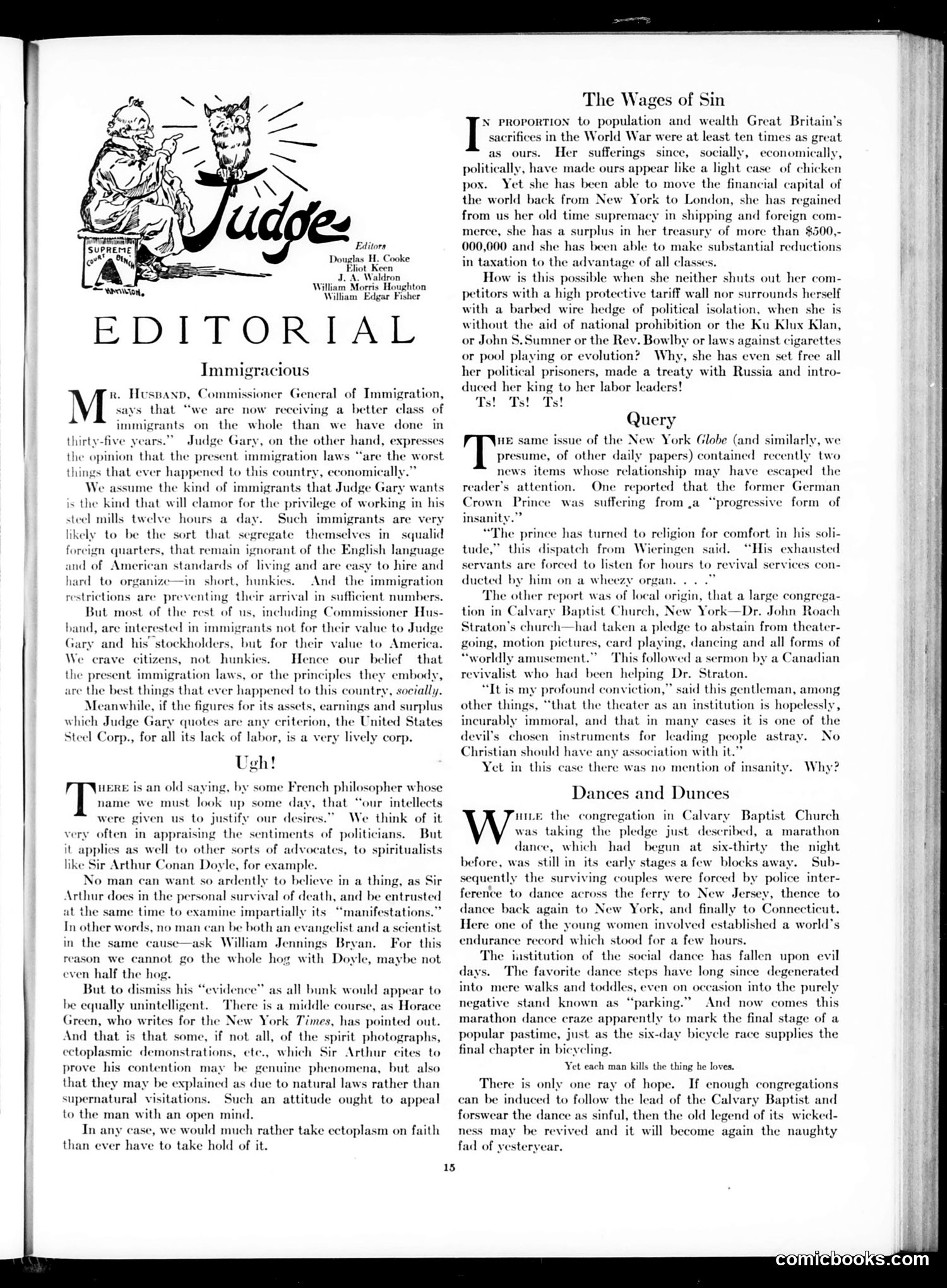
This editorial page from Judge magazine contrasts two debates about American policy: **"Immigracious"** attacks Judge Gary (U.S. Steel executive) for wanting cheap, exploitable immigrant labor. The satire notes the contradiction: Gary claims immigration laws harm business, but U.S. Steel remains profitable. The editors argue immigration restrictions serve the public good—preventing a desperate underclass—while Gary only cares about worker availability and low wages. **"The Wages of Sin"** sarcastically compares Britain and America. Despite Britain's massive WWI sacrifices, she recovered economically without America's protectionist tariffs, Prohibition, or the Ku Klux Klan. The passage mocks American moral crusades (evolution bans, cigarette laws, the KKK) as ineffective or hypocritical while Britain pragmatically traded with Russia and reconciled with labor. The implication: America's restrictive policies don't actually deliver promised results. Both editorials defend open policies (immigration, free trade, labor rights) against conservative restrictions, reflecting Judge's progressive stance during this era.
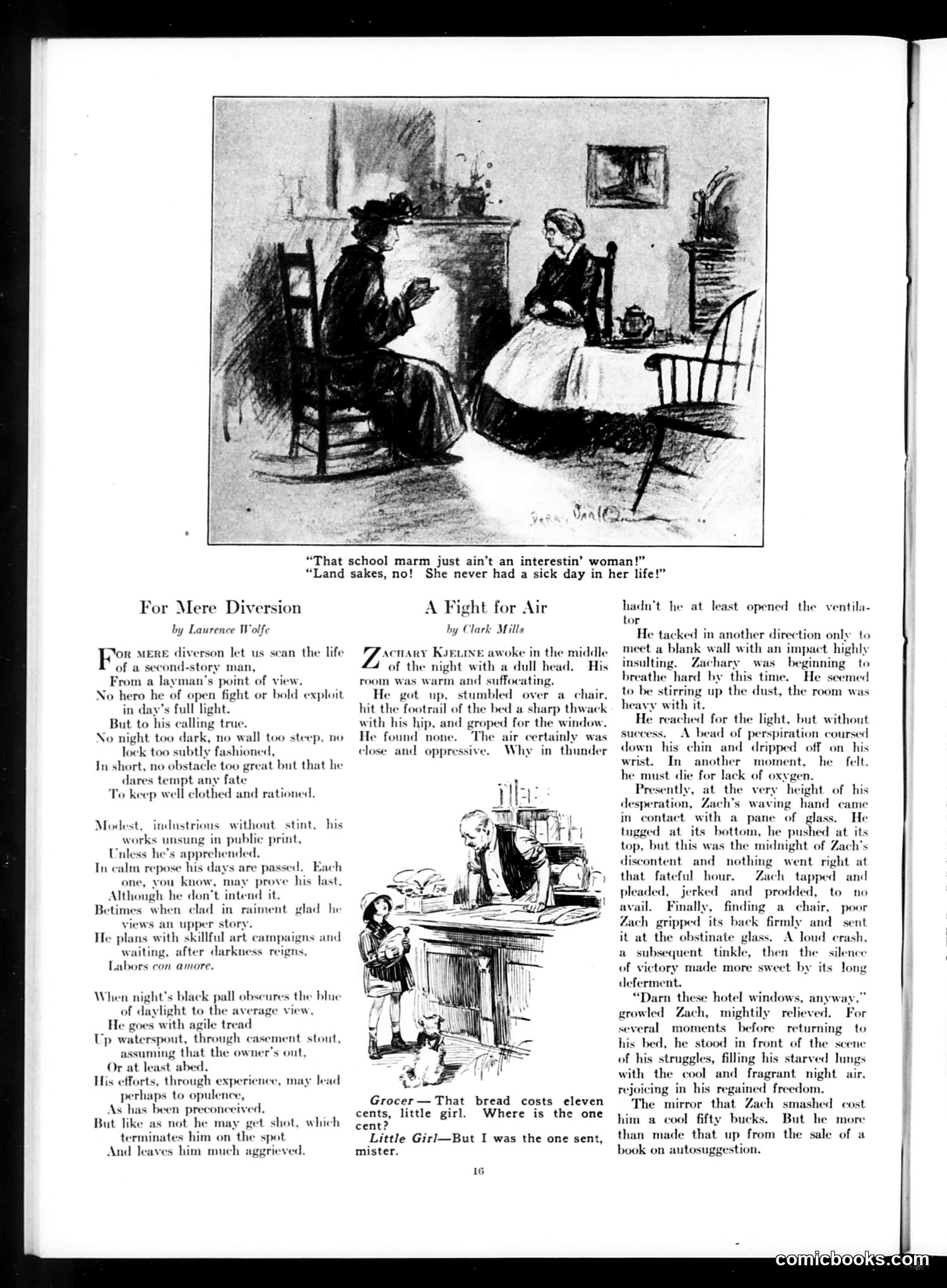
This Judge magazine page contains two satirical stories and a cartoon joke about turn-of-the-century life. **The cartoon** (top) depicts a domestic conversation where a woman dismisses a schoolteacher as uninteresting, despite her claiming the teacher "never had a sick day in her life." The satire mocks how society undervalued teachers—viewing them as dull and unremarkable despite their reliability and dedication. **"For Mere Diversion"** romanticizes a burglar's life in mock-heroic verse, depicting second-story men as skilled artisans working "con amore." The joke: this criminal lifestyle, while perhaps leading to wealth, often ends with arrest or death—hardly romantic. **"A Fight for Air"** tells of a man suffocating in a sealed hotel room who desperately breaks a window (actually a mirror) to escape. The punchline: he's charged $50 for the damage, which he recovers by selling a "book on autosuggestion"—satirizing the period's fad self-help literature. The bottom item is a joke about a grocer shortchanging a girl.
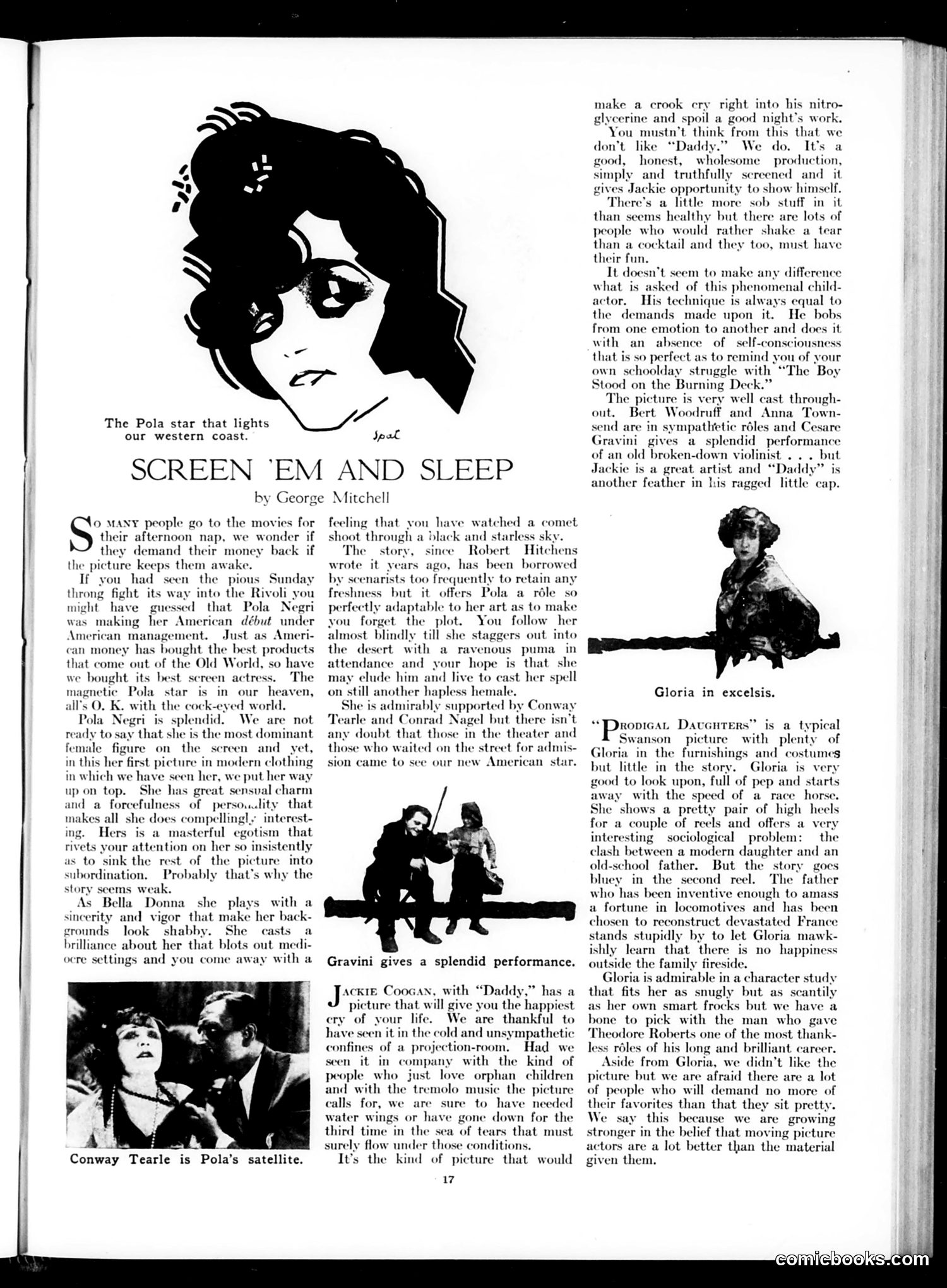
This page reviews several 1920s films, with particular emphasis on **Pola Negri**, a major European silent film star making her American debut. The headline's joke is that movies are so boring audiences use them for naps. The main article praises Negri's "sensual charm" and "masterful egotism" in *Bella Donna*, claiming her star power compensates for a weak plot. She's described as the real draw—audiences lined up specifically to see "our new American star," implying fascination with importing European talent. Secondary reviews cover *Daddy* (a child-actor vehicle) and *Pioned* (about modern sociological issues). The critic appreciates *Daddy* as wholesome entertainment but notes excessive sentimentality could overwhelm viewers. The tone reflects 1920s attitudes: amazement at acquiring European film talent like "products from the Old World," and assumptions about audiences' emotional responses to orphans and tearjerkers—revealing period tastes in entertainment.
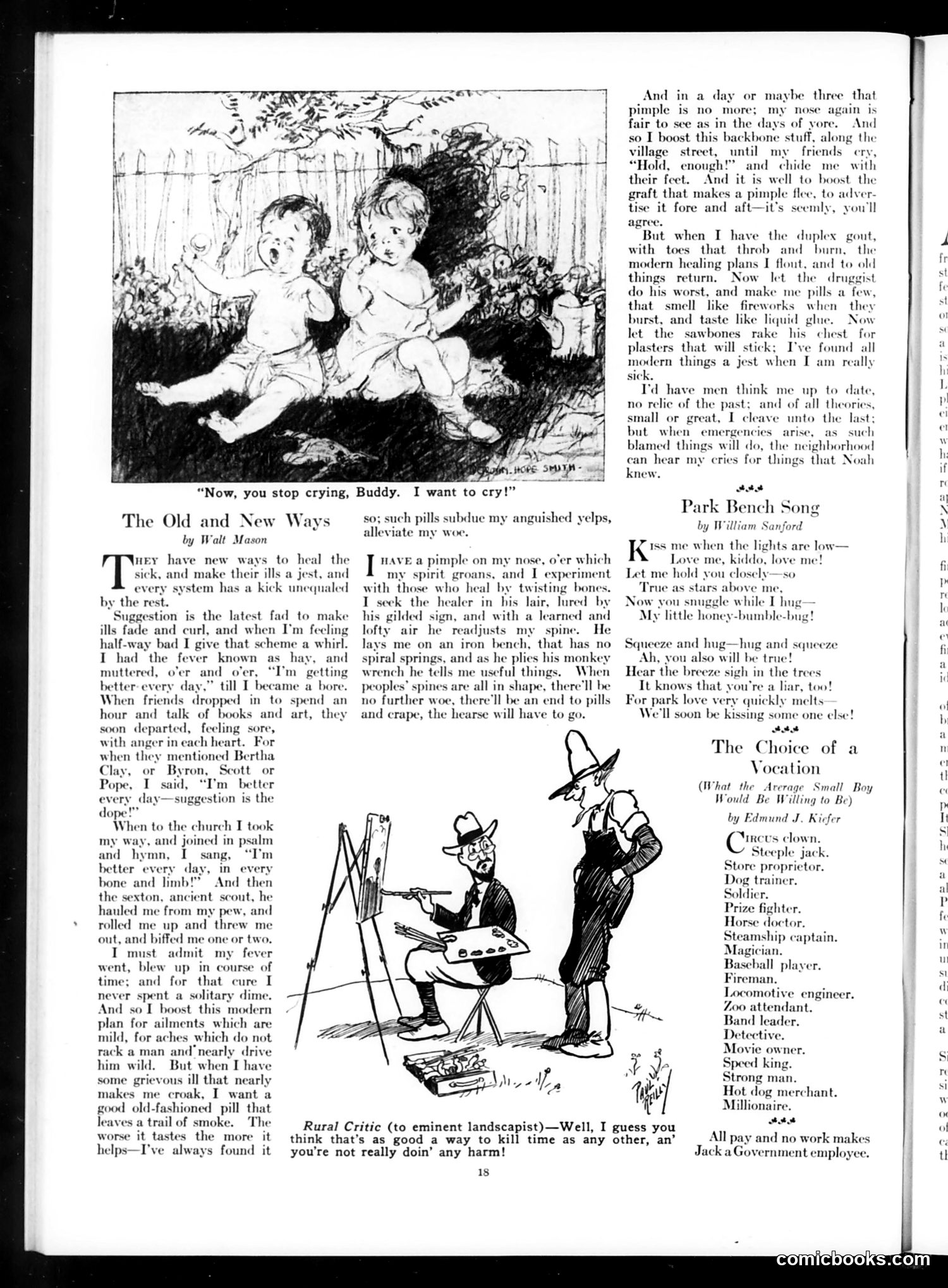
This page satirizes the early 20th-century American obsession with "modern" medical fads and alternative treatments. Walt Mason's poem mocks the culture of suggestion-based healing and chiropractics—trendy pseudosciences that promised miraculous cures. The satire works on two levels: First, Mason ridicules gullible people who enthusiastically evangelize these treatments (becoming "bores" to friends). Second, he reveals the hypocrisy—when truly suffering from serious illness (gout), he abandons modernity for old-fashioned pills and traditional doctors, proving these fads work only for minor ailments or psychology. The cartoon of the "Rural Critic" watching a landscape painter reinforces this theme: legitimate work versus time-wasting nonsense. The final irony: Mason admits modern treatments succeed only through placebo effect ("suggestion"), undercutting their entire premise. This reflects genuine Progressive Era anxieties about medical quackery and consumer gullibility during a period of rapid healthcare commercialization.
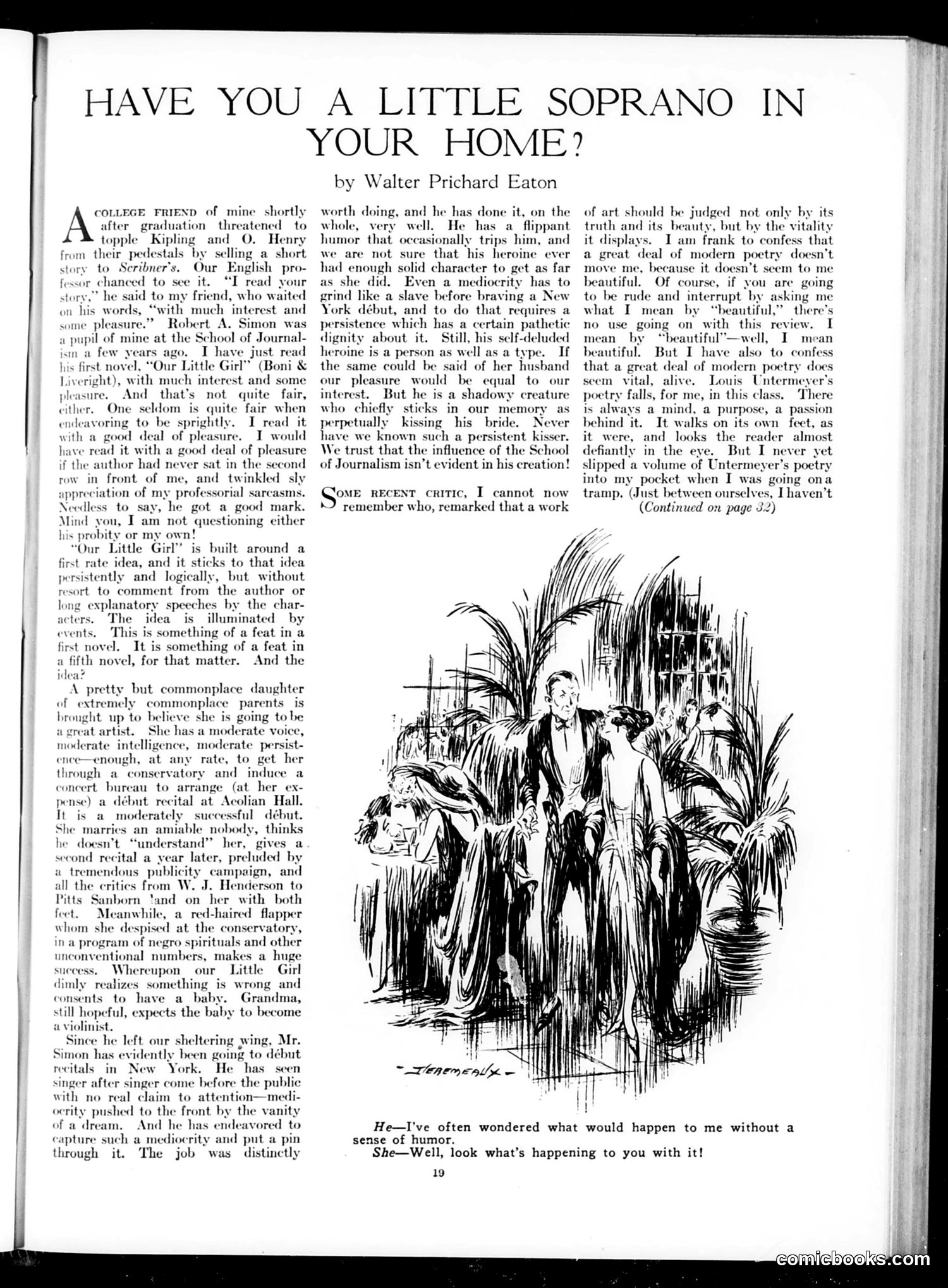
This page reviews Robert A. Simon's novel *Our Little Girl*, a satire about an aspiring opera singer with mediocre talent whose parents delude themselves into supporting her career. The illustration depicts a family gathered around a young woman singing, likely the "little soprano" of the title. The review praises Simon for capturing "such a mediocrity and put a pin through it"—mocking the pretensions of untalented performers pushed into the spotlight by vanity and parental expectations rather than genuine ability. The satire targets early 20th-century concert culture: wealthy families financing unsuccessful debut recitals at prestigious venues like Aeolian Hall for daughters with only "moderate" voice and intelligence. The heroine's grandmother expects the baby to become a violinist—suggesting generational delusion about artistic talent. The critique reflects contemporaneous anxiety about commercialized arts and the gap between mediocre performers and genuinely talented artists who succeed without such artificial promotion.
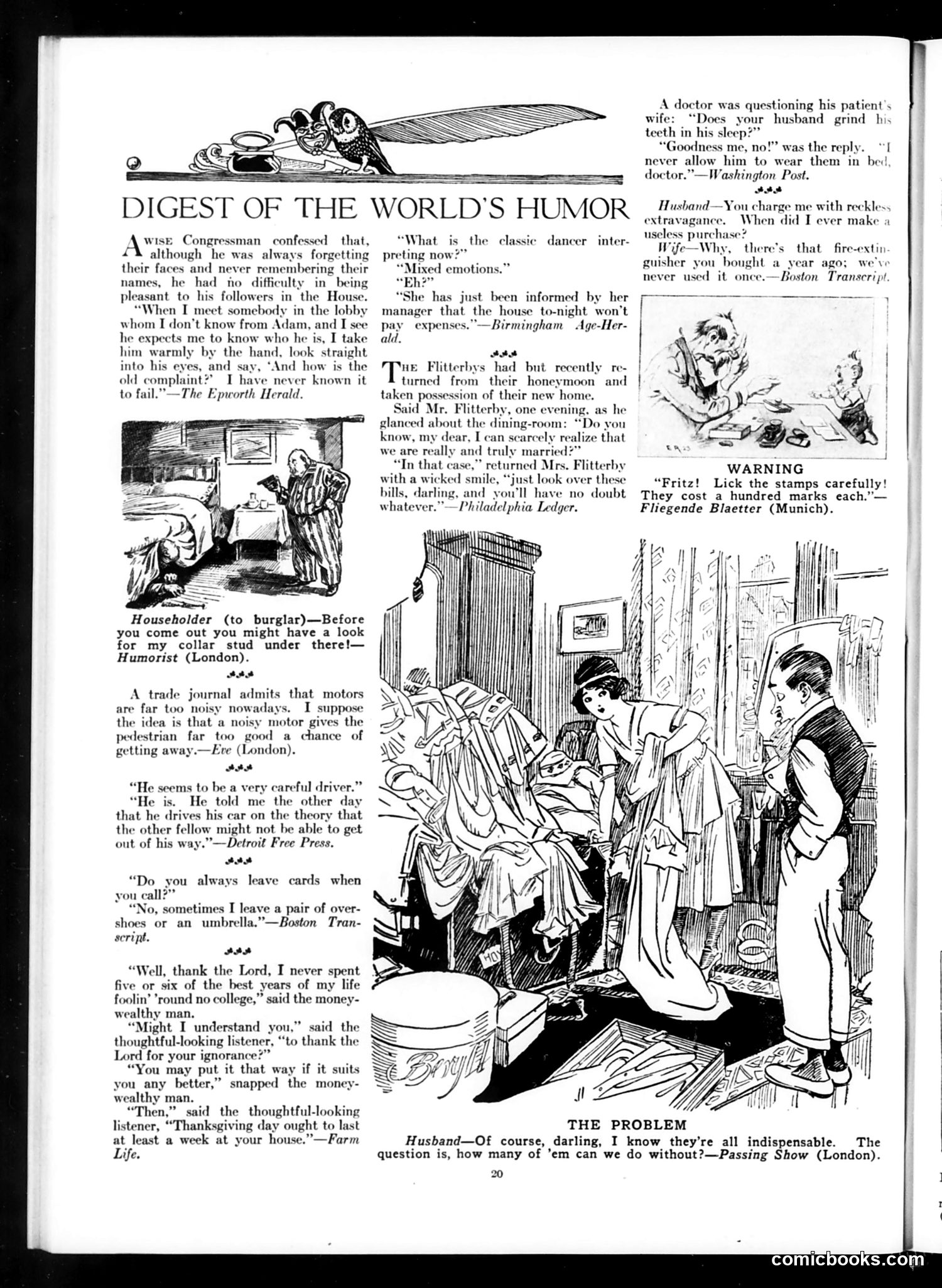
This page from Judge presents a "Digest of the World's Humor"—a collection of short jokes and comic observations from various publications, arranged around illustrations. The content reflects early 20th-century domestic life concerns: a congressman's forgetfulness about constituents' names, marital tensions over household purchases and expenses, and gender dynamics. One joke addresses a woman dancer's "mixed emotions" after learning her theater won't cover expenses—satirizing performers' financial precarity. The main illustration shows a domestic scene where a well-dressed man presents bills to his wife, implying she's responsible for household overspending—reflecting contemporary anxieties about women's consumption and marital finances. A warning in German references German inflation ("hundred marks"), suggesting this page includes international humor selections. The bottom cartoon jokes about married couples' indispensability—a commentary on domestic dependency and the difficulty of eliminating household expenses or roles. Overall, the page documents period humor about marriage, class, commerce, and gender roles in early 20th-century society.
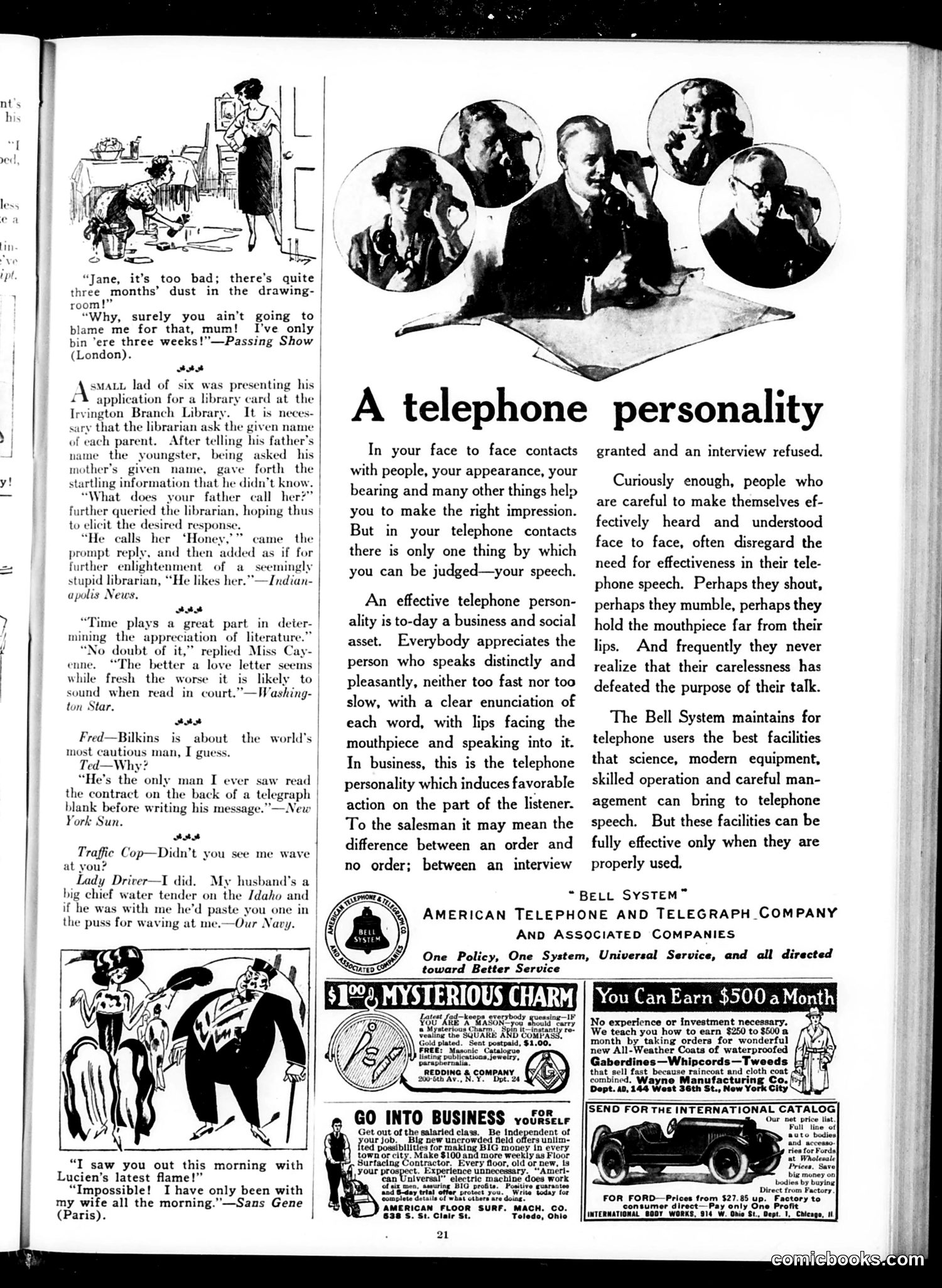
This page combines **humor pieces and advertising** from an early-20th-century Judge magazine. The **cartoons** are brief, domestic jokes: a maid denying responsibility for dust, a boy calling his mother "Honey" (implying his father does the same), and a woman driver claiming her husband wouldn't let her acknowledge a traffic cop's wave. The **main feature** is a Bell System advertisement disguised as editorial content, titled "A telephone personality." It argues that since phone calls lack visual cues (appearance, bearing), **speech alone determines impressions**—pronunciation, pace, and mouthpiece positioning matter for business success. This reflects early-20th-century anxieties about telephone technology as a new medium requiring etiquette training. The page illustrates how **advertising infiltrated editorial space**: the Bell System used "public service" messaging to promote telephone use as a professional necessity, while smaller ads below hawked various schemes (mail-order catalogs, floor contracting). The humor is genteel, domestic, and assumes middle-class readers concerned with propriety.
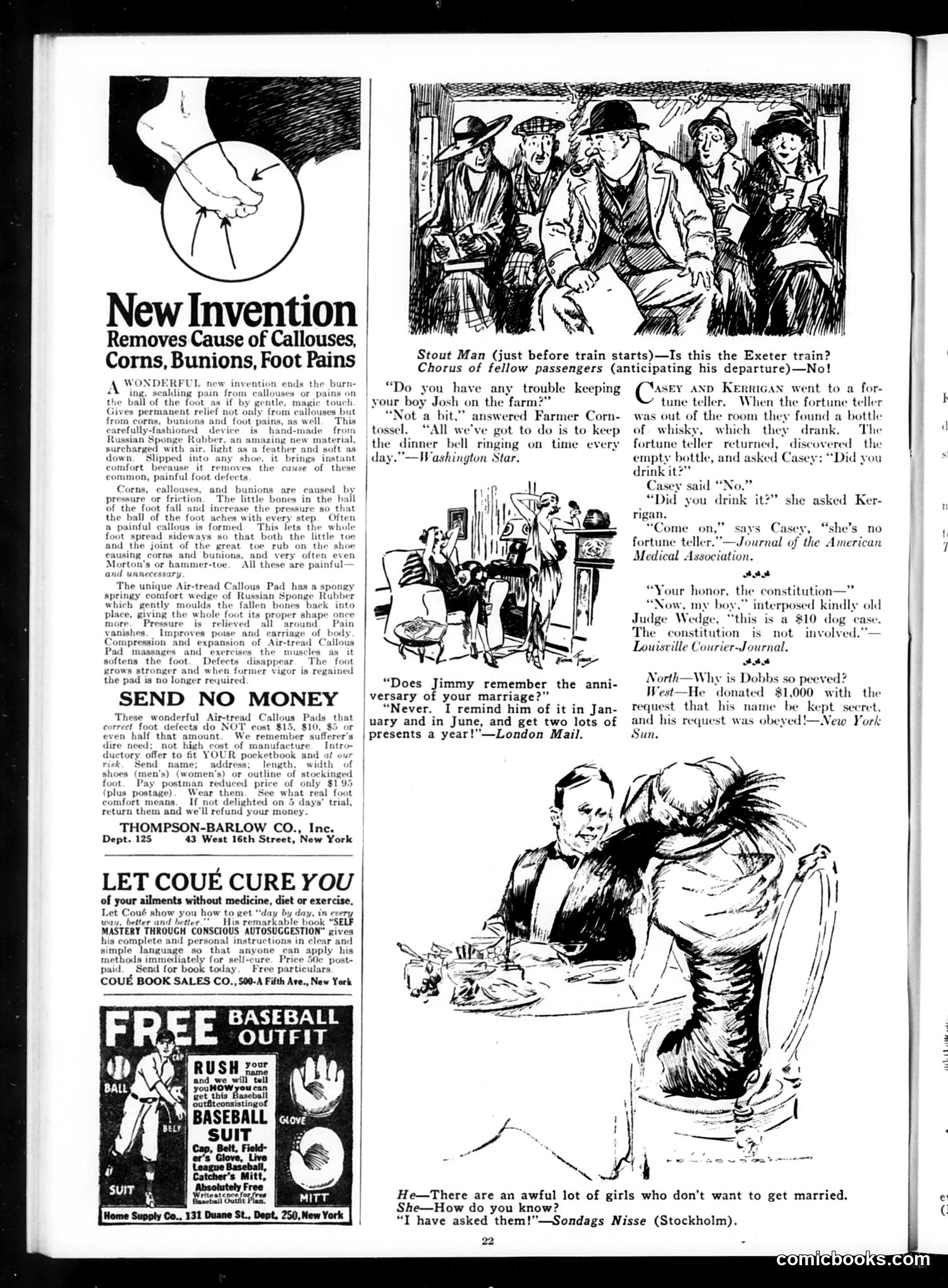
This page mixes period advertisements with short humorous anecdotes typical of early 20th-century American magazines. **Advertisements** occupy the left column, promoting dubious remedies: foot pads claiming to cure callouses and bunions, and "Let Coué Cure You" (referencing Émile Coué's autosuggestion movement, popular then). A free baseball outfit ad targets boys. **The cartoon and jokes** are brief, genteel humor: - A stout man boarding a train; passengers quickly deny it's the Exeter train, anticipating his departure - A fortune teller anecdote where two men drink her whisky; she asks who drank it—both deny it - A judge dismissing a constitution argument in a $10 dog case - A man who donated $1,000 anonymously - A man who reminds his wife of their anniversary twice yearly to get "two lots of presents" - A final joke about unmarried women (the punchline: a man learned this by asking them) The humor relies on light misanthropy, petty deceptions, and domestic complaint—reflecting genteel magazine humor of the era.
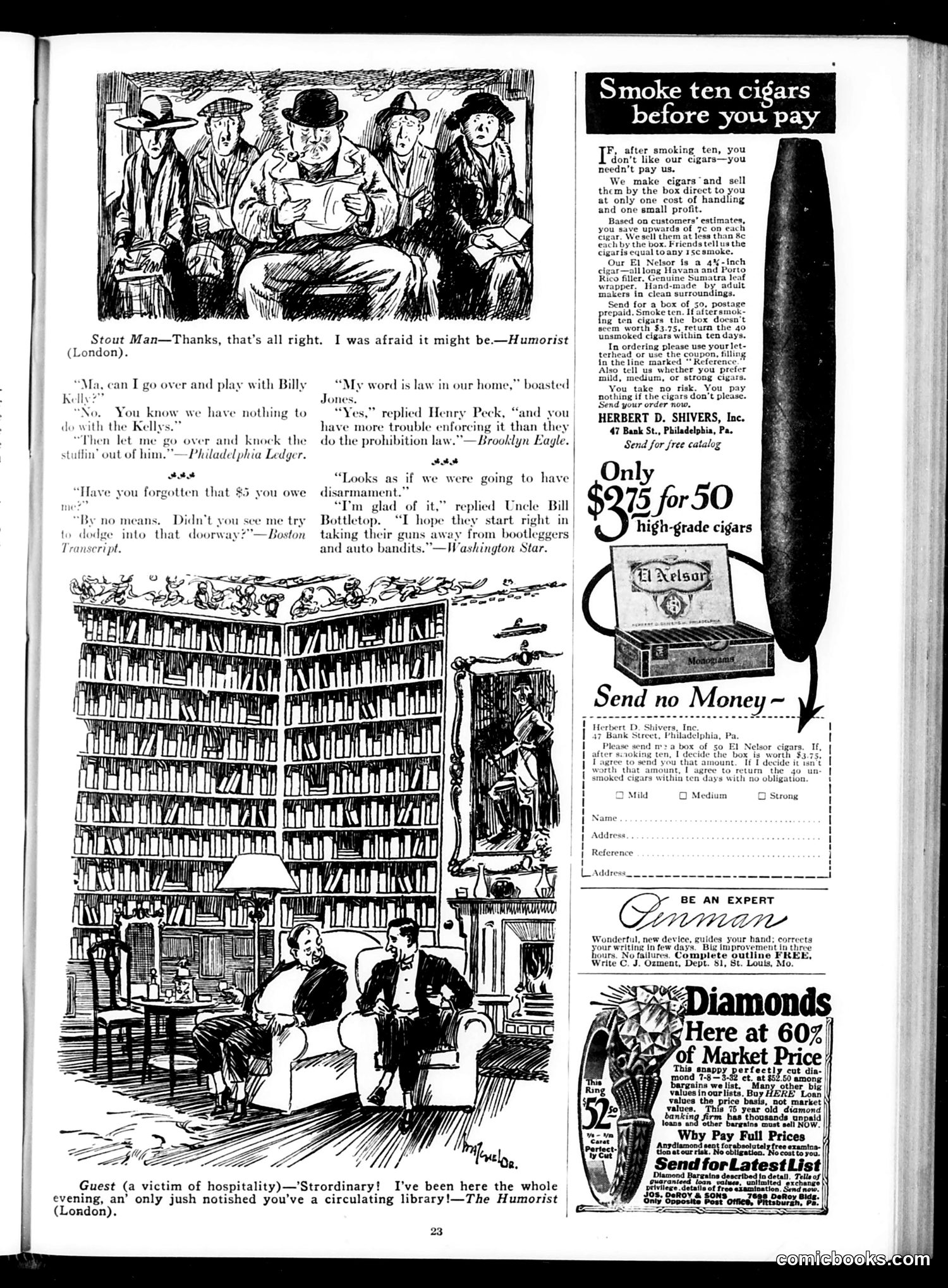
This page contains **primarily advertisements** mixed with brief satirical humor pieces typical of Judge magazine's format. The **cartoons** feature: - A "Stout Man" expressing relief about cigars (likely a pun on being "stout") - Family dialogue scenes satirizing Prohibition-era tensions: a child asking to play with "Billy Kelly," parents debating enforcement of prohibition laws, and a man boasting about his home authority while his wife contradicts him - A guest amazed to discover his host's extensive library during an evening visit **Social context**: These jokes reference **Prohibition** (the 1920s ban on alcohol), mocking both its difficulty to enforce and domestic power dynamics around rule-making. The library joke plays on hospitality expectations. **Advertisements** dominate the right side, selling **El Nelson cigars** ($3.75 for 50), a **handwriting/penmanship course**, and **diamonds at discount prices**—typical mail-order pitches from this era. The page reflects 1920s American consumer culture and Prohibition-era social tensions.
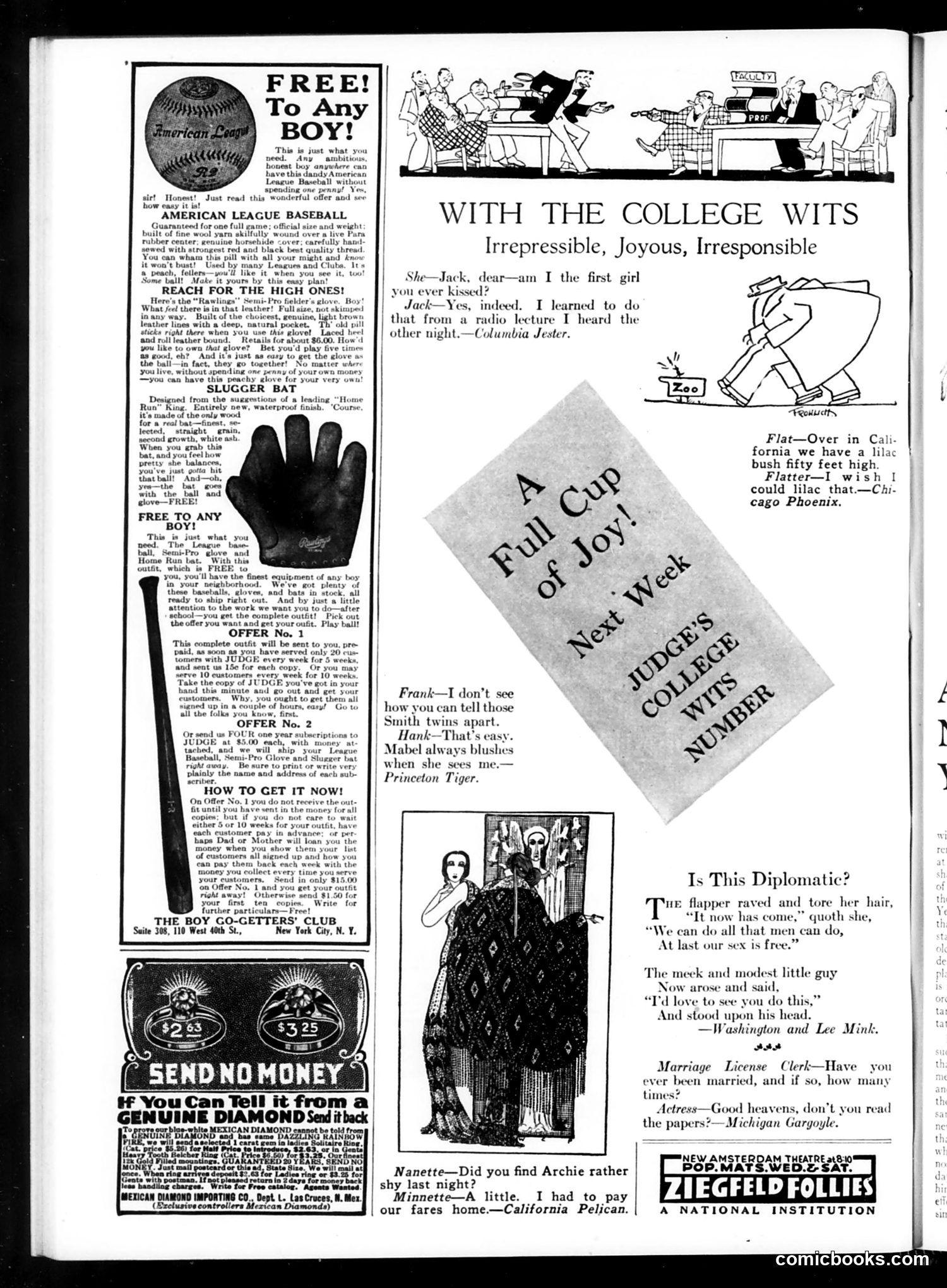
This page from *Judge* magazine (a satirical publication) contains several distinct elements: **Left Side - Baseball Equipment Advertisement**: A promotional offer targeting boys, promising free baseball equipment (glove, bat, ball) in exchange for selling magazine subscriptions. This reflects early 20th-century marketing strategies using youth labor. **Right Side - "College Wits" Section**: A collection of brief jokes from college humor magazines (Columbia Jester, Princeton Tiger, etc.), typical of *Judge's* format of reprinting collegiate humor. The jokes are mild, focusing on dating mishaps and romantic awkwardness—standard flapper-era humor. **"Is This Diplomatic?" Poem**: A satirical response to 1920s feminism, depicting a flapper claiming gender equality, then being humiliated by a man's challenge. The satire mocks women's liberation aspirations through slapstick. The page primarily functions as **light entertainment and advertising**—no serious political commentary is evident. The underlying social attitudes reflect conventional 1920s views about gender roles and youth consumer culture.
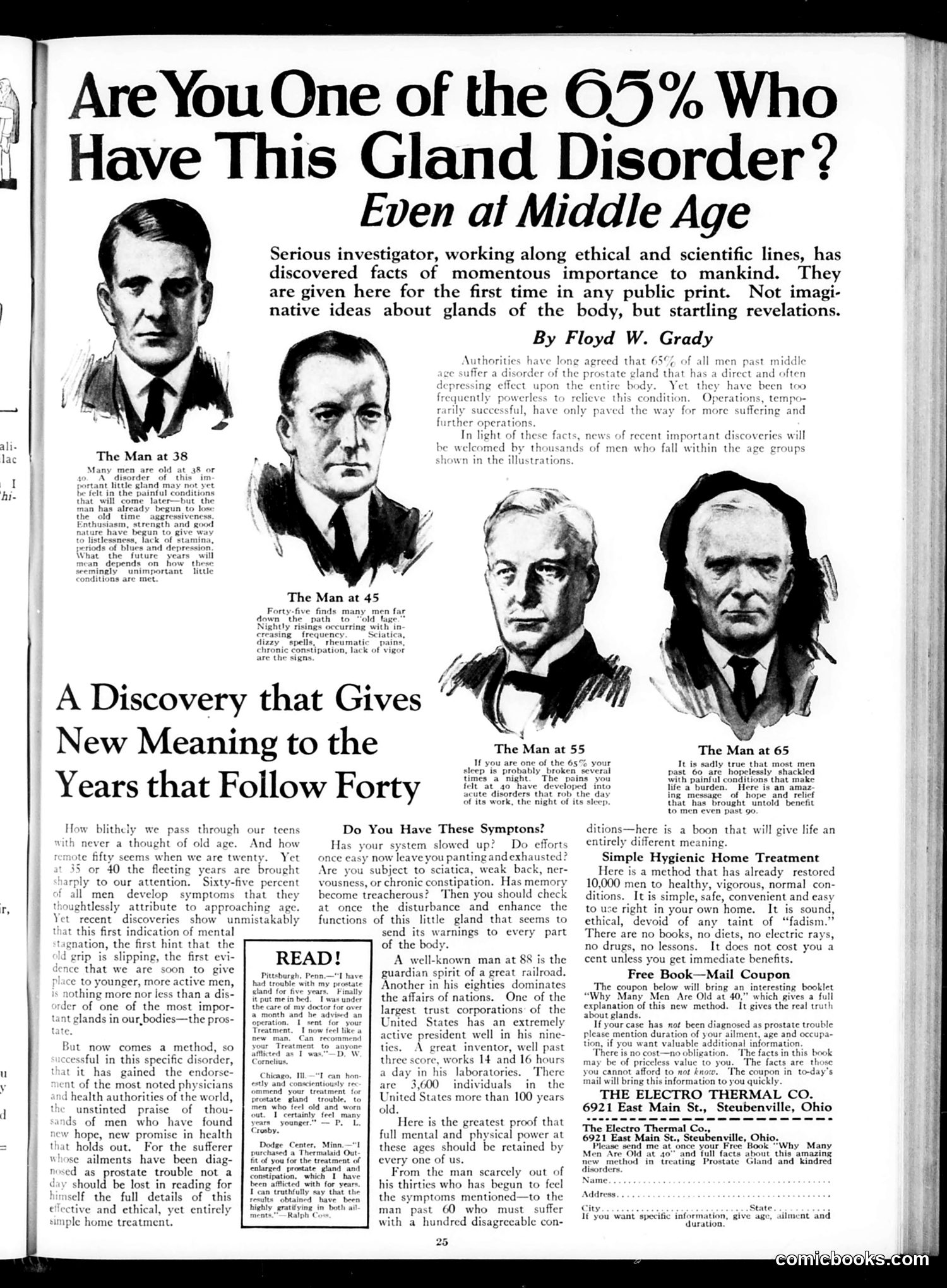
This page is primarily **medical advertising disguised as journalism**, targeting middle-aged men with anxiety about aging and sexual/reproductive decline. The "article" by Floyd W. Grady presents a pseudo-scientific claim that 65% of men over 40 suffer from prostate gland disorder, illustrated with five portrait sketches showing men's supposed deterioration from age 38 to 65. The accompanying text lists vague symptoms (fatigue, constipation, weak memory, "sciatica") deliberately broad enough to apply to most aging men. The real purpose emerges at the bottom: **The Electro Thermal Co.** advertises a mail-order "home treatment" for prostate problems, promising restoration without drugs, surgery, or medical supervision. This represents early-20th-century **patent medicine marketing**—exploiting male anxieties about aging and virility through pseudo-medical authority. Judge magazine apparently accepted such advertisements despite its satirical reputation, suggesting either financial need or acceptance of such advertising as normal for the era. The "free book" coupon is the sales hook typical of direct-mail medicine schemes of this period.
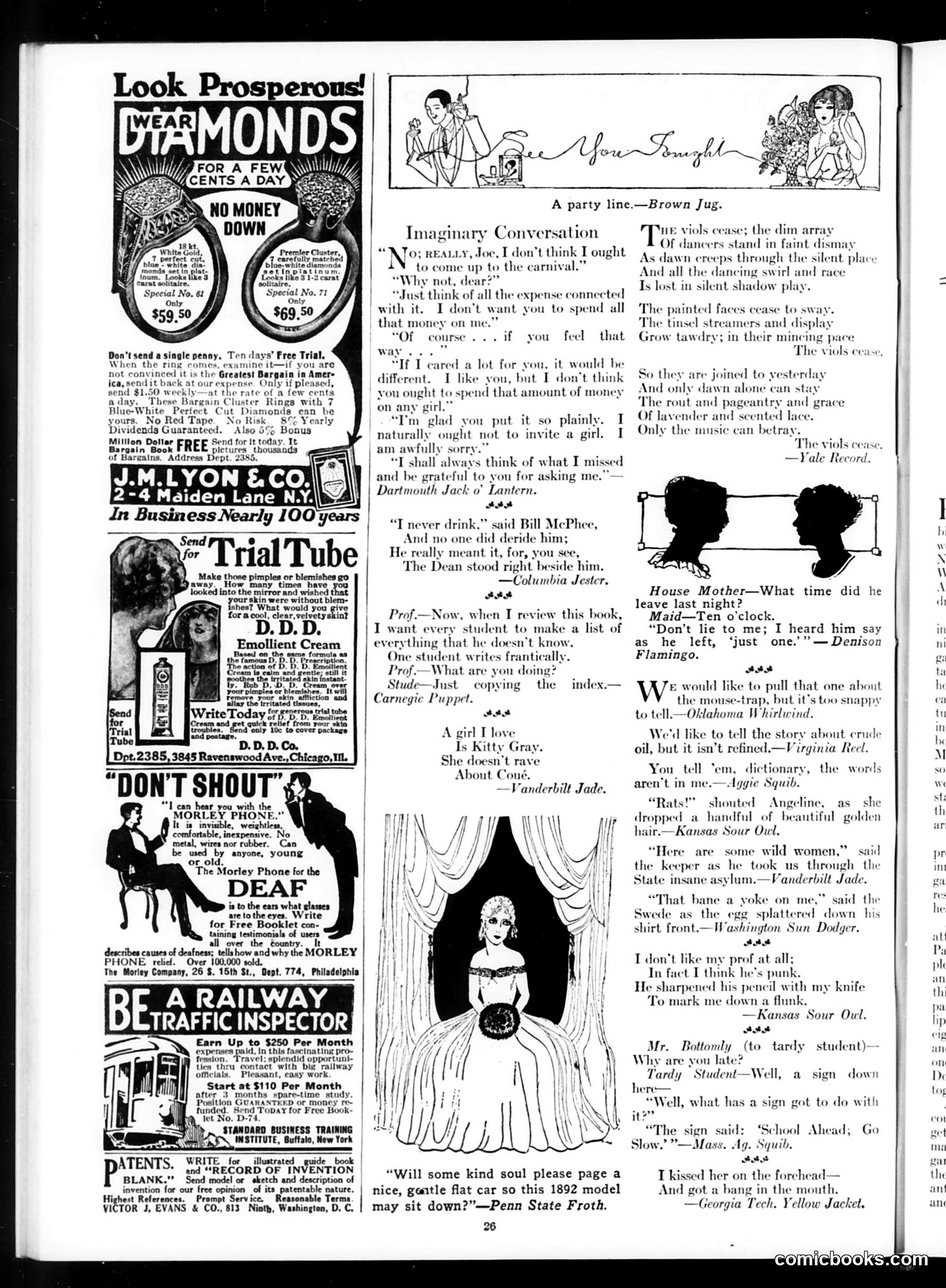
This page is primarily **advertising and humor content** rather than political satire. The left column features multiple commercial ads (diamond rings, skin cream, hearing aids, phones for the deaf, railway inspector training, patents) typical of 1920s magazines. The right side contains **college humor and light social satire** from various university publications (Dartmouth, Columbia, Vanderbilt, Yale, Penn State, etc.). The "Imaginary Conversation" depicts a **courtship negotiation** where a young woman discourages her suitor from spending money on a carnival date—she refuses his financial generosity, which he misinterprets as modesty rather than genuine disinterest. Other jokes target **academic life** (professors, tardy students) and include scattered witticisms about drinking, romance, and student behavior. The poetry excerpt about "viols" reflects **Jazz Age melancholy** about nightlife's transience. This appears to be a standard Judge issue mixing commercial messaging with genteel collegiate humor—nothing overtly political, mostly reflecting 1920s dating customs and university culture.
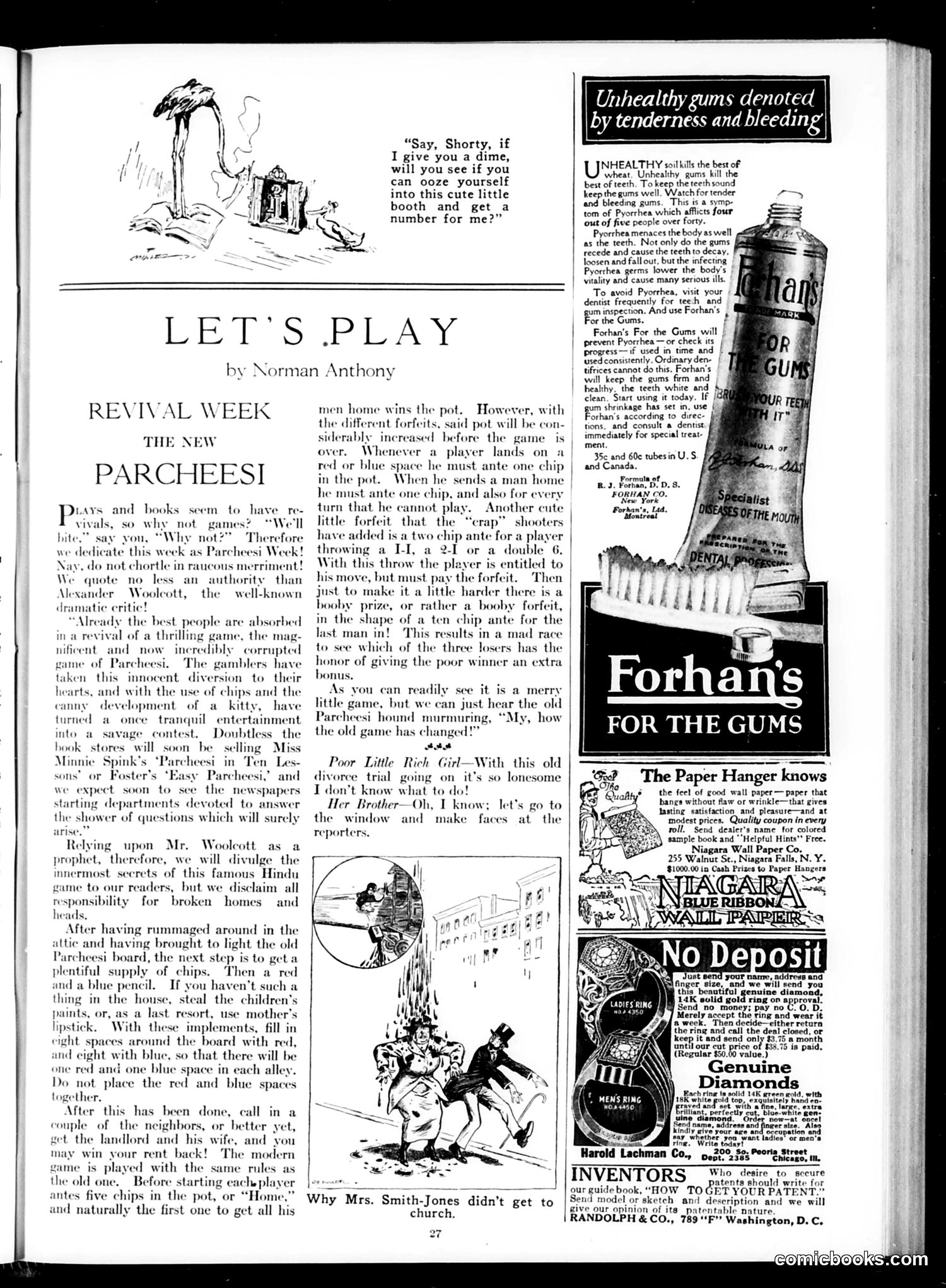
This page from Judge magazine contains two main pieces of satirical content: **"Let's Play" by Norman Anthony** is a humorous revival of the board game Parcheesi, presented as a gambling activity among adults. The satire mocks how "respectable people" have corrupted an innocent children's game by adding betting chips, forfeits, and high stakes—turning it into a serious gambling enterprise with potential to ruin homes and finances. The quote from theatrical critic Alexander Woolcott lends false authority to the joke. **The cartoon captioned "Why Mrs. Smith-Jones didn't get to church"** depicts a woman at a fortune-teller's booth seeking a number (likely for gambling or lottery purposes), suggesting that superstition and gambling temptations distract people from religious obligations. The page's advertisements—for Forhan's toothpaste, wall paper, and other products—are standard period commercials unrelated to the editorial content. The overall satire critiques 1920s-era social vice: gambling's creeping normalization and its grip on American life, even among respectable classes.
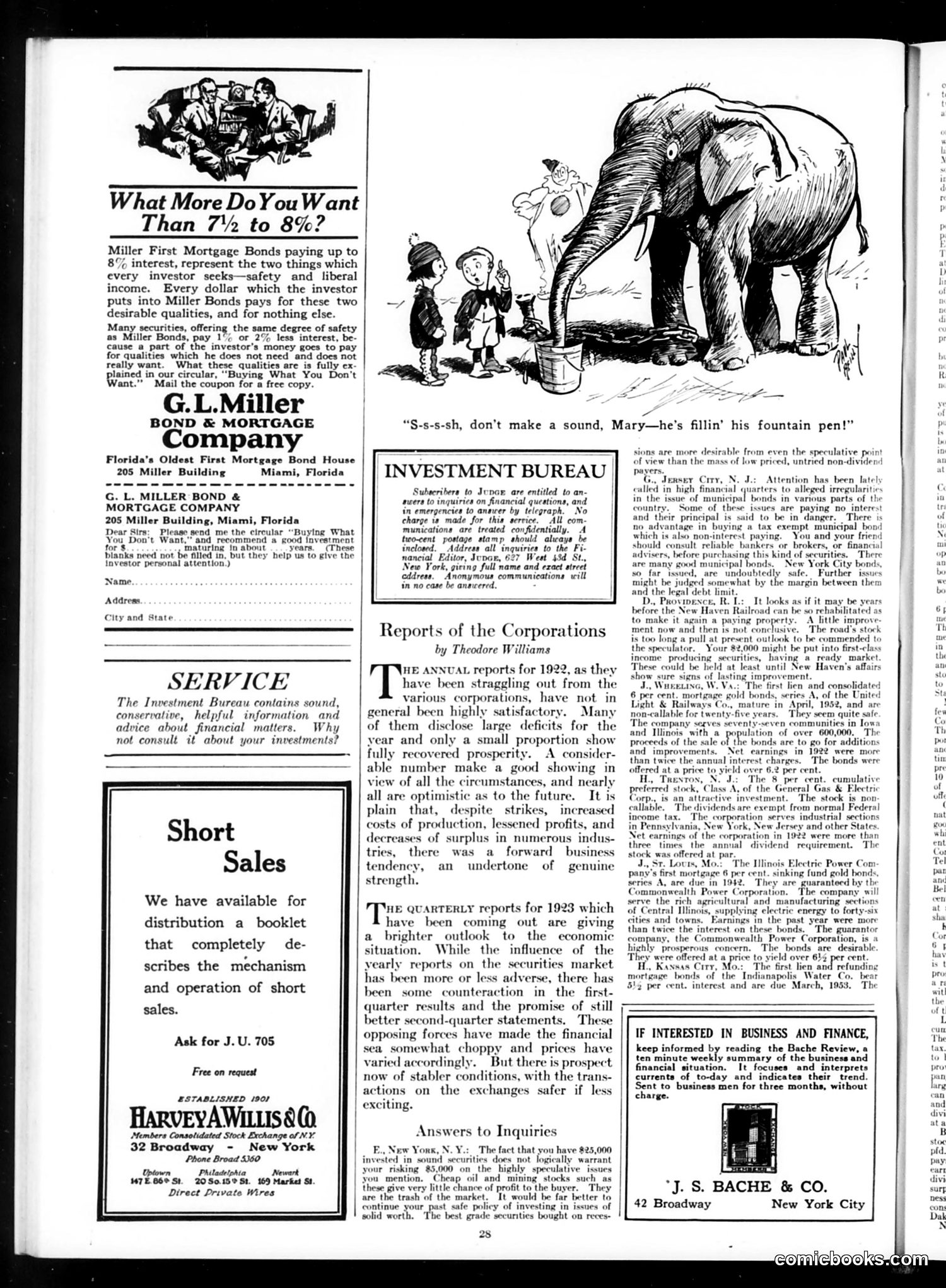
This page is primarily **advertisements and financial advice columns**, not political satire. The main cartoon shows two children approaching an elephant filling its fountain pen—a visual pun on the phrase "What more do you want?" that appears in G.L. Miller's bond advertisement above it. The page's content focuses on **1920s investment advice**: Miller Bond Company advertises mortgage bonds offering 7½-8% returns; Harvey Willis & Co. promotes short sales; and Theodore Williams analyzes 1922-1923 corporate reports, noting mixed results but "genuine strength" in business tendency. The "Answers to Inquiries" section warns against speculative investments in "cheap oil and mining stocks," recommending safer securities instead. This reflects post-WWI economic uncertainty and the era's growing investment culture targeting middle-class readers seeking reliable income sources.
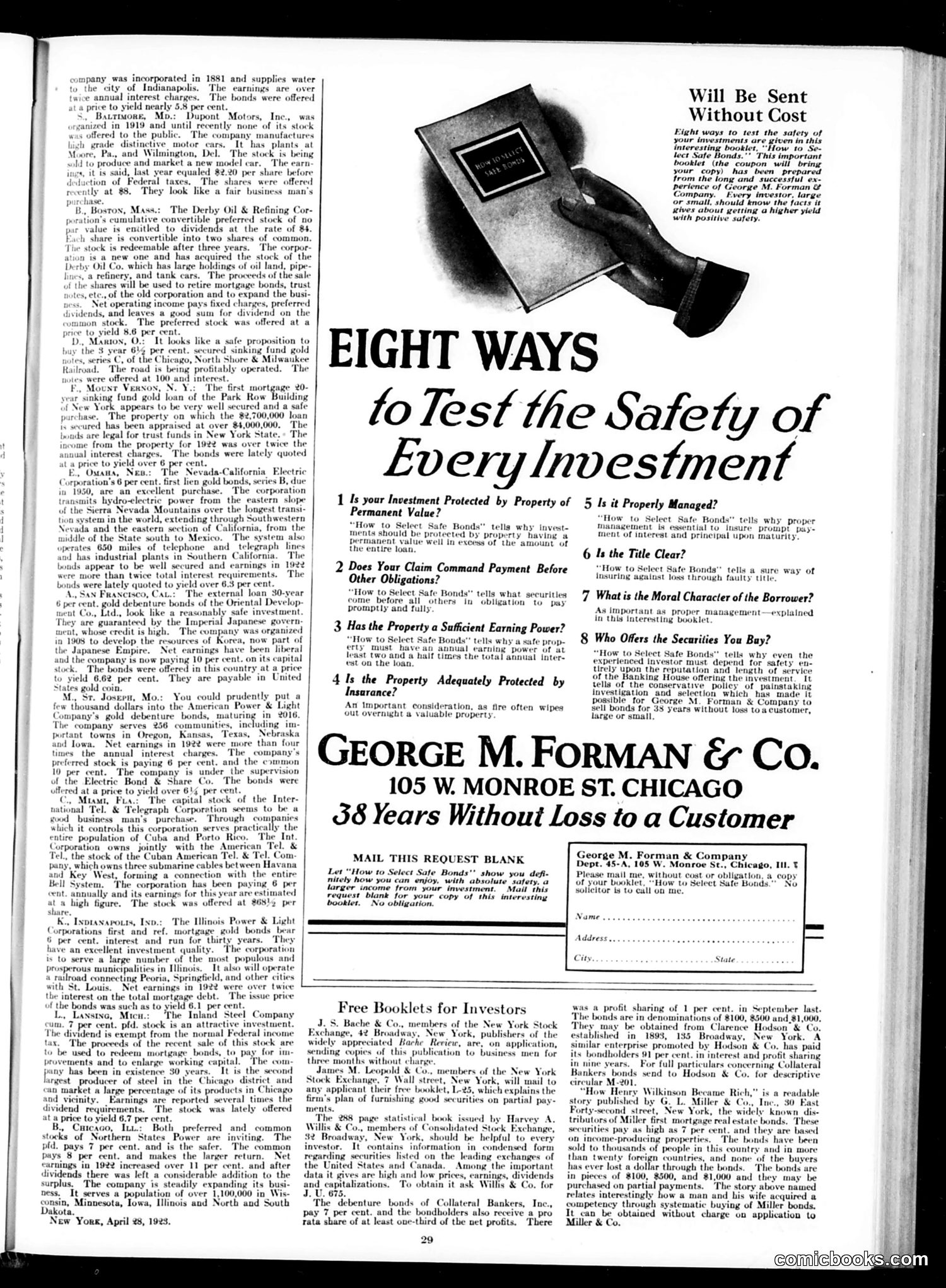
This page is primarily **advertising and financial promotion**, not satire or political commentary. It features a George M. Forman & Co. investment advisory advertisement promising "Eight Ways to Test the Safety of Every Investment." The top-left contains brief financial commentary on various corporations' bonds and stocks—including Dupont Motors, Derby Oil & Refining, and various utility and railroad companies. This reflects early 1920s investment discussion (dated April 20, 1923). The large central image shows a simple illustration of what appears to be a safe or protective container—visual metaphor for "safe investments." **The point**: This is a direct-mail advertisement offering free investment guidance booklets to readers, reassuring them about bond safety during an era when investment fraud was common. It's not satirical—it's earnest financial marketing typical of Judge's revenue model, using the magazine's educated readership as targets for investment advice services.
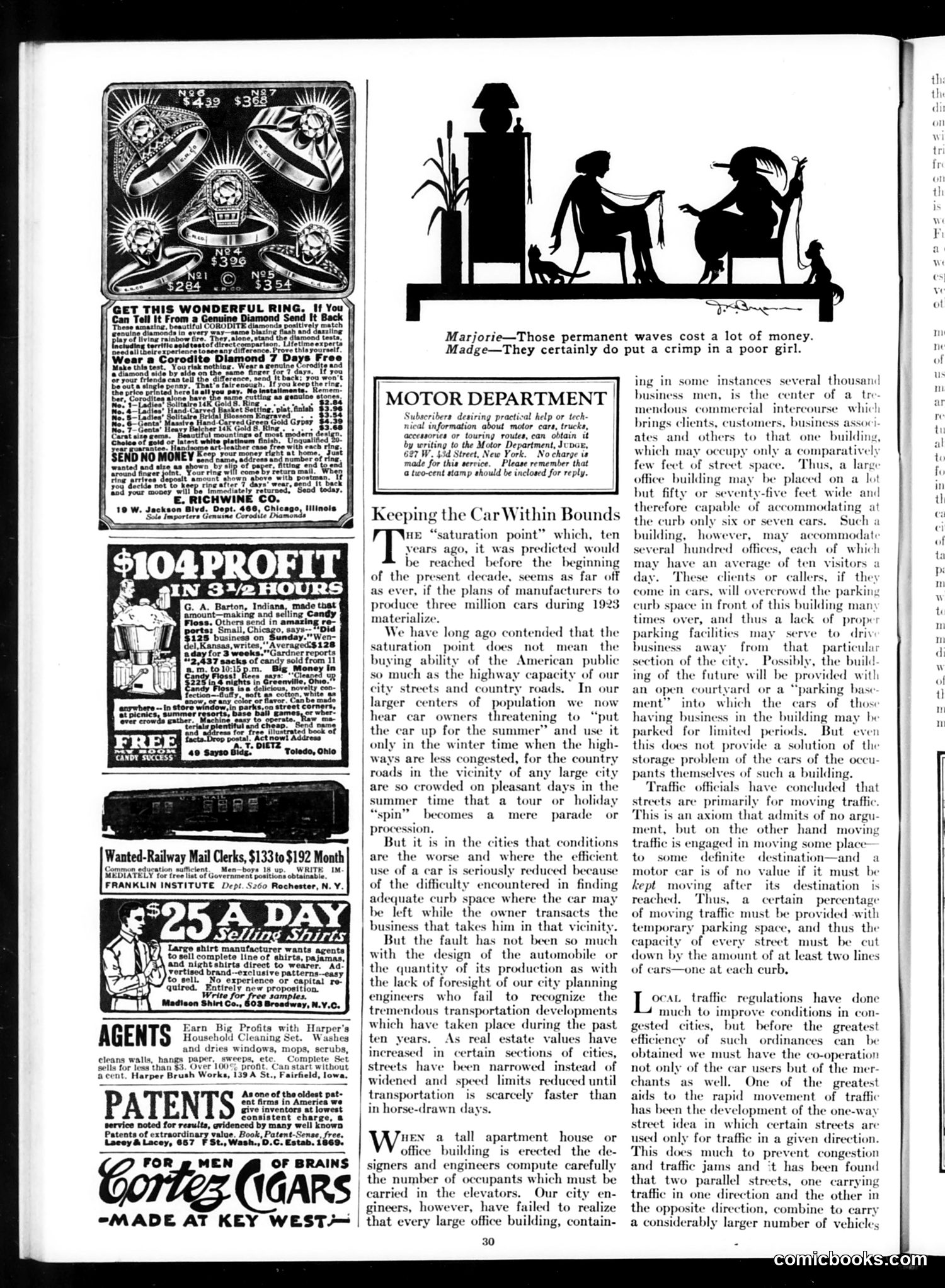
This page contains primarily **advertisements and a brief satirical exchange**, rather than political cartoons. The only humor piece is the **"Marjorie and Madge" dialogue** (top right silhouette). It's a gentle pun: Marjorie comments that permanent waves are expensive; Madge replies they "put a crimp in a poor girl"—a double meaning playing on both the hairstyling term "crimp" and financial hardship. The bulk of the page consists of **classified advertisements** typical of 1920s Judge magazine: job postings (railway clerks, shirt sales agents), patent services, household products, and cigars. These ads reflect the magazine's commercial revenue model. The longer article, "**Keeping the Car Within Bounds**," discusses urban traffic congestion and parking problems caused by automobile proliferation—a contemporary concern as car ownership expanded in the 1920s. It argues city planners failed to anticipate transportation needs. No identifiable political figures or major satirical commentary appears on this page. It's representative of Judge's mixed content format: advertising-heavy with light humor and practical articles.
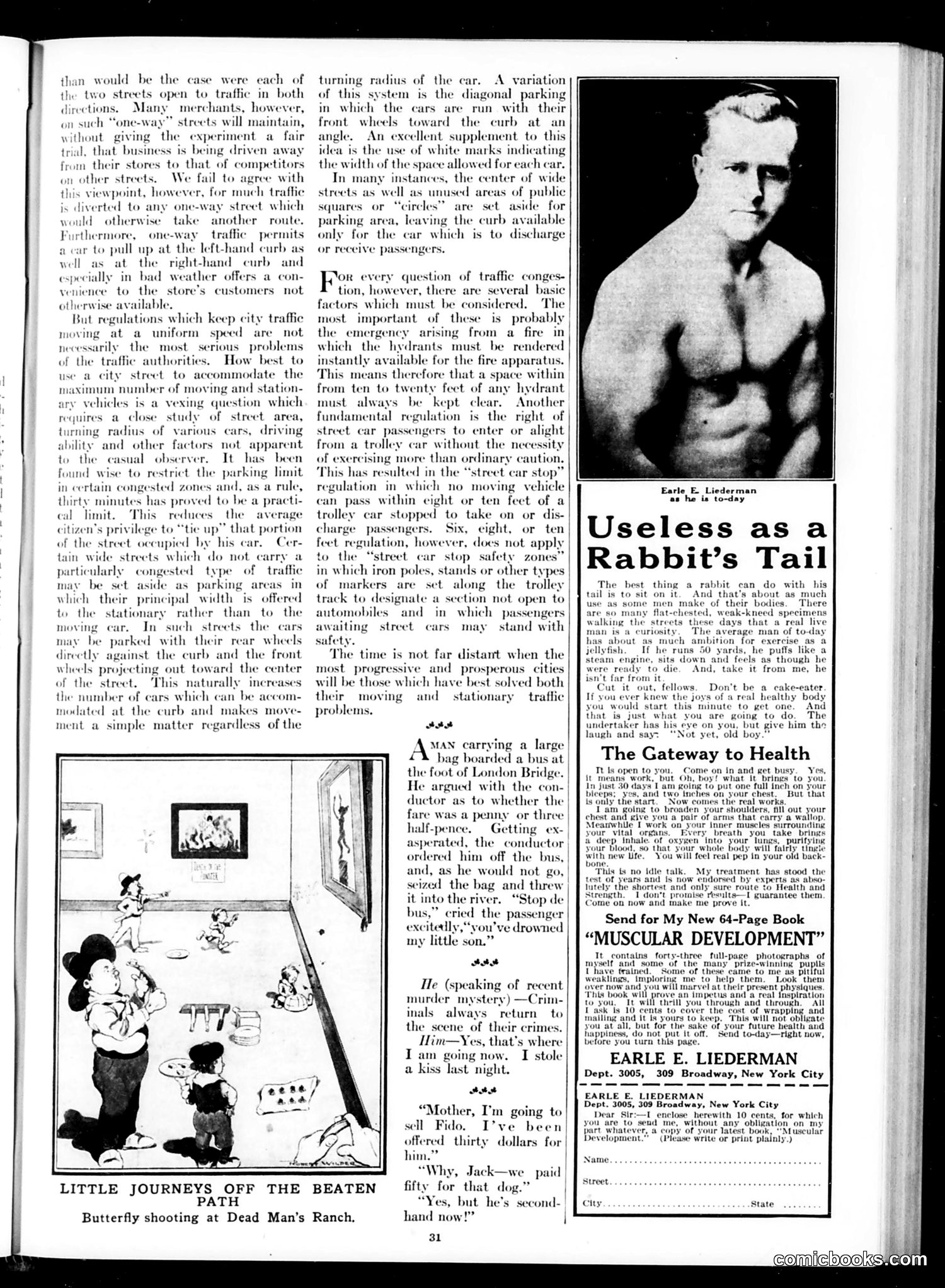
This page contains primarily **serious civic/editorial content**, not satire. The bulk consists of a technical article analyzing urban traffic management—discussing one-way streets, parking regulations, fire hydrant clearance zones, and trolley car safety. The single cartoon, titled "**Little Journeys Off the Beaten Path: Butterfly Shooting at Dead Man's Ranch**," depicts what appears to be a humorous domestic scene of people (likely a family) conducting outdoor activities. Without additional context about the ranch or date, the specific reference is unclear, though it seems a lighthearted illustration unrelated to the traffic discussion. The page also features advertisements, including one for "Muscular Development" by Earl E. Liederman (a bodybuilder), and various small anecdotes in the margins. **This is not primarily satirical content**—it's a straightforward civic-planning discussion typical of early 20th-century American magazines addressing modern urban challenges.
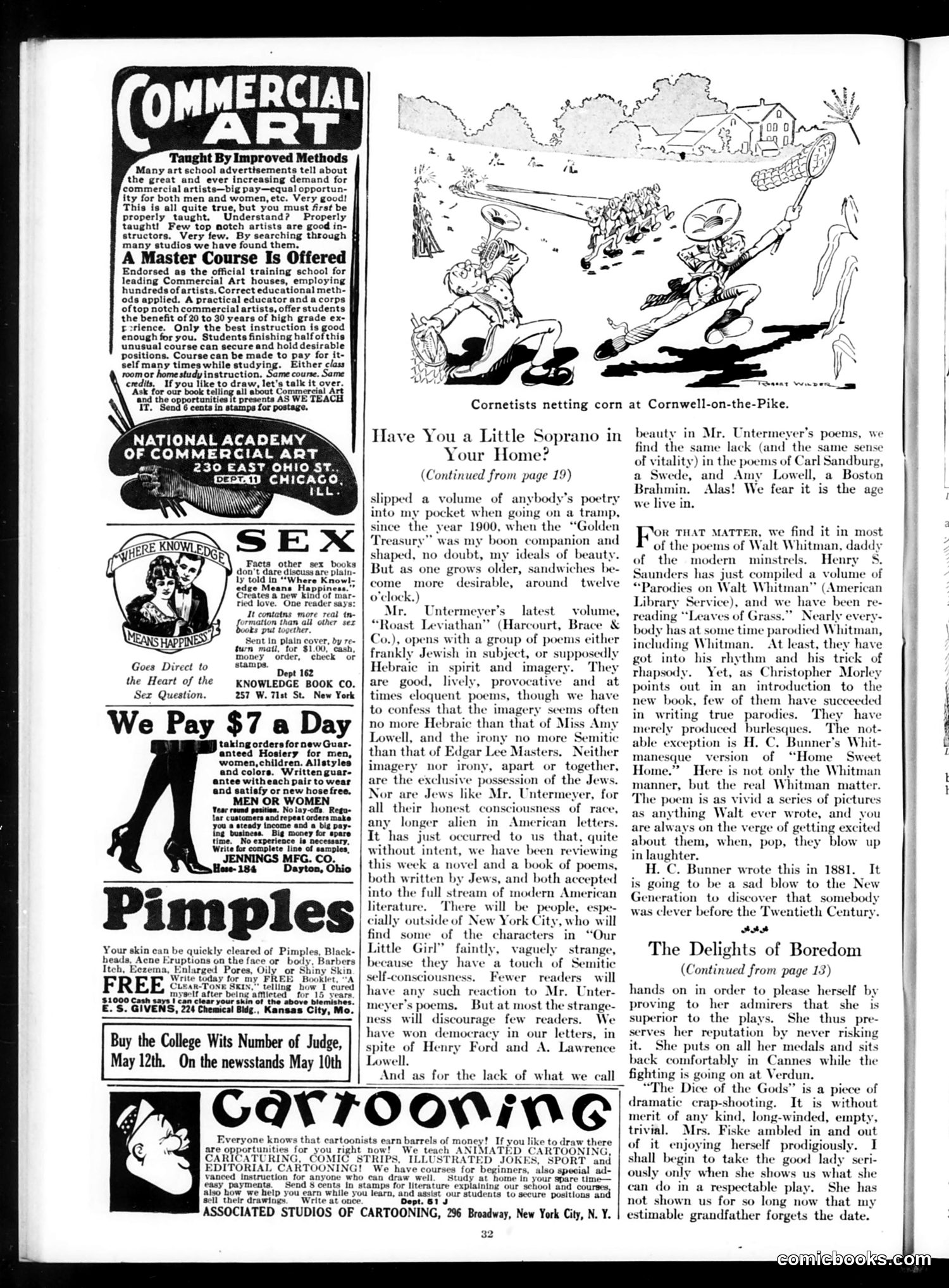
This page from *Judge* magazine features various advertisements mixed with literary commentary about poet Louis Untermeyer's work "Roast Leviathan." **The Main Text ("Have You a Little Soprano in Your Home?"):** The essay discusses Untermeyer's new volume of poems, many dealing with Jewish themes. The author praises the work while noting that Jewishness isn't exclusive to Jewish writers—that both Jewish poets reviewed this week (likely including Amy Lowell or another contemporary) have "won democracy in our letters, in spite of Henry Ford and A. Lawrence Lowell," referring to prominent antisemites of the era. **The Cartoon (top right):** Shows corn-husking figures at "Cornwell-on-the-Pike"—an apparently lighthearted rural scene. **The Advertisements:** Mostly self-improvement and product pitches: art school training, sex education books, pimple cures, and jobs paying $7/day—typical of period *Judge*. The literary discussion is notable as tacitly anti-antisemitic commentary for 1920s America, acknowledging Jews' full participation in American letters despite contemporary prejudice.
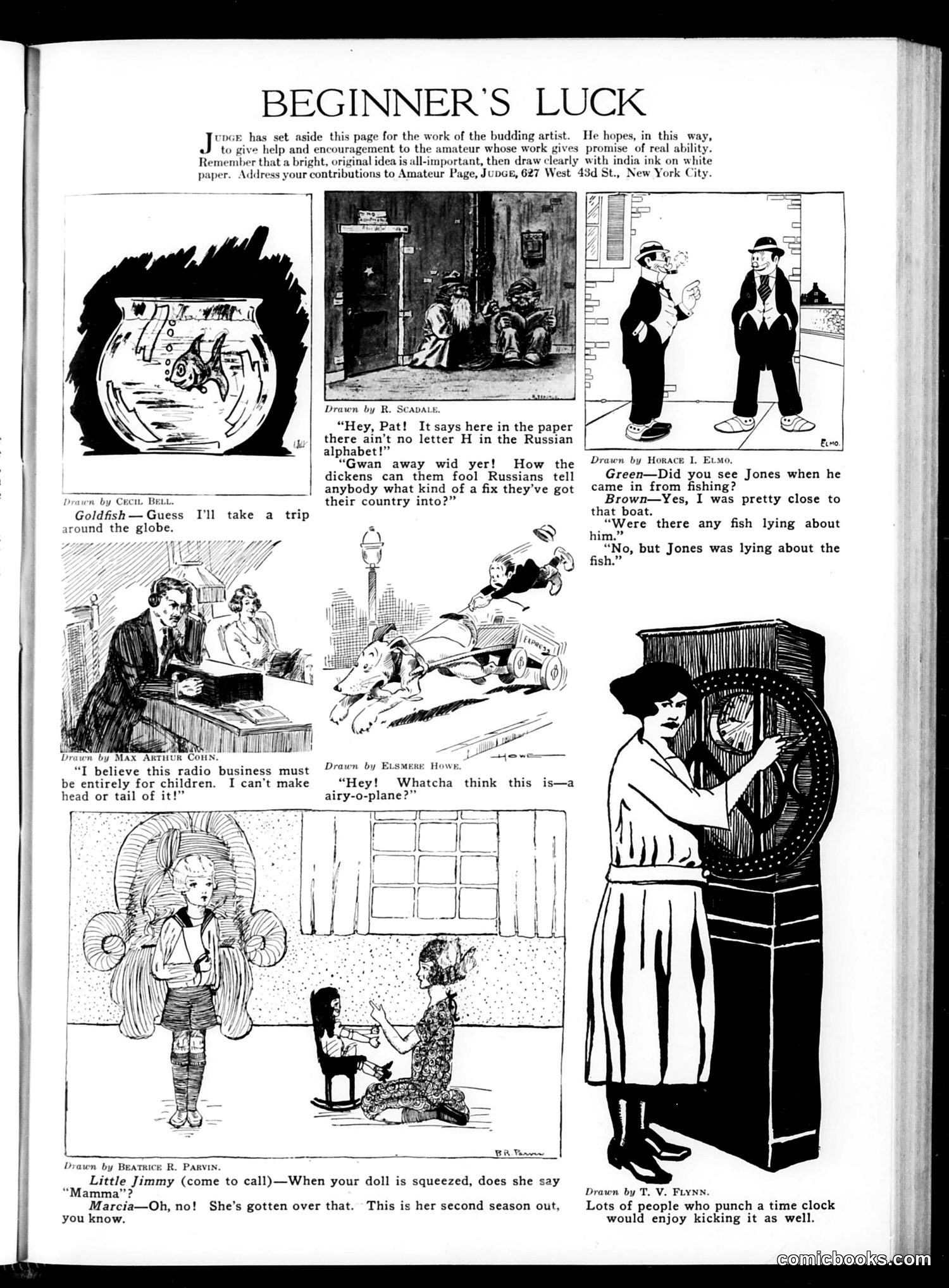
This page showcases amateur cartoonists, featuring six brief comic strips with gentle humor targeting early 20th-century audiences: **Notable cartoons include:** 1. **Russian alphabet joke** (Scadale): Irish immigrants mock Russian language, playing on xenophobic stereotypes about foreign alphabets and political instability—likely referencing post-Bolshevik Revolution concerns. 2. **Radio confusion** (artist unclear): An older person finds new radio technology incomprehensible, reflecting generational anxiety about modern technology. 3. **Doll with attitude** (Parvin): A child's doll no longer says "Mama"—suggesting changing toy fashions or children's evolving play preferences. 4. **Fishing lie** (Elmo): Plays on the classic joke that fishermen exaggerate their catches. 5. **Time clock complaint** (Flynn): Workers resent workplace discipline, a relatable workplace gripe. The page's editorial note encourages amateur submissions, positioning these as examples of promising beginner work. The humor is mild, domestic, and accessible to general readers—reflecting Judge's mid-market satirical approach.
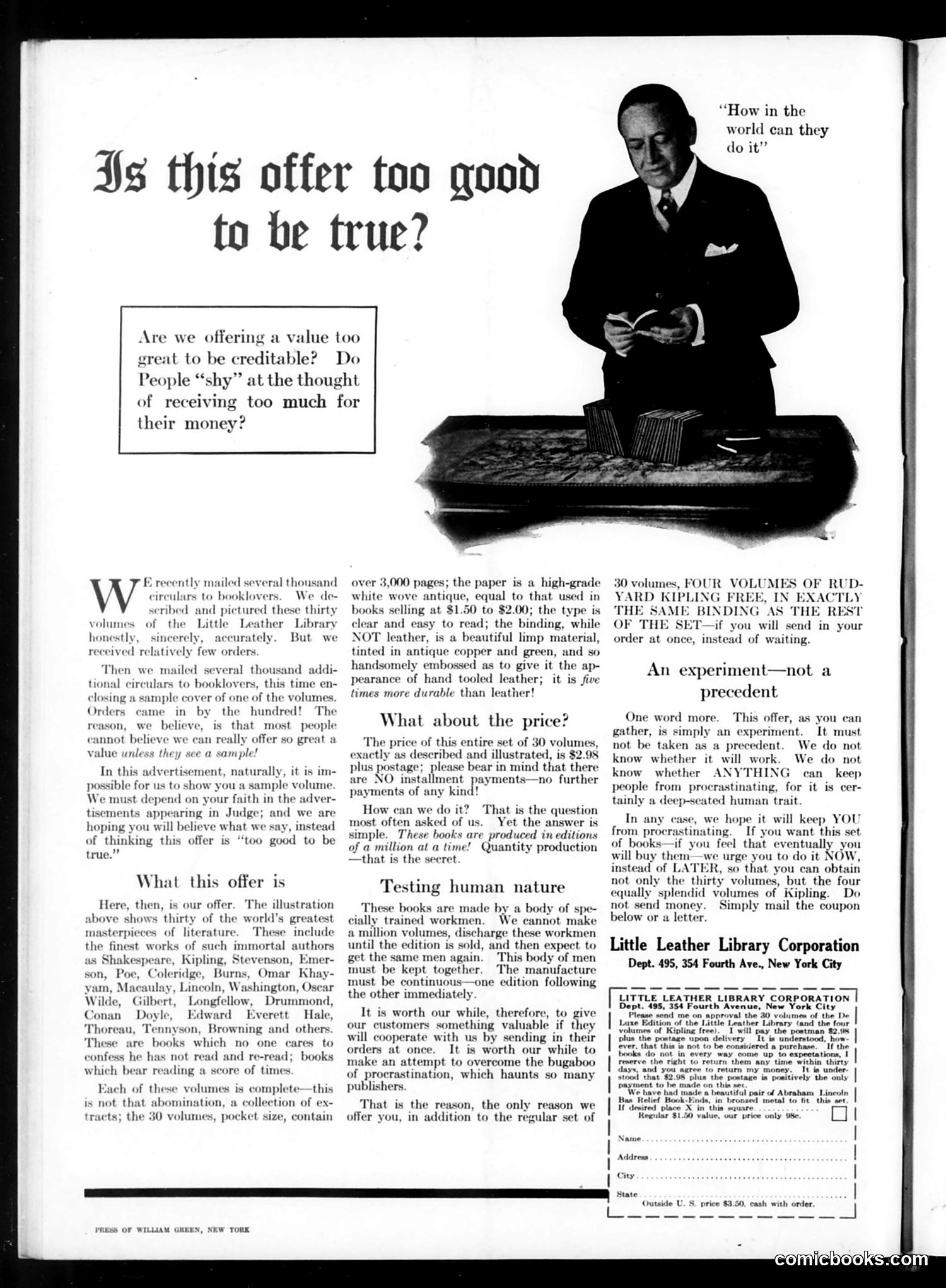
This is a **book club advertisement**, not a political cartoon. The page promotes the "Little Leather Library"—a 30-volume set of classic literature (Shakespeare, Kipling, Poe, etc.) selling for $2.98 plus postage, with four bonus Kipling volumes as incentive. The illustration shows a skeptical man asking "How in the world can they do it?"—reflecting genuine consumer doubt about the offer's legitimacy. The ad addresses this directly, explaining that the company previously mailed circulars but received few orders until they sent an actual sample volume, which dramatically increased response. The company acknowledges the psychological barrier: people assume "too good to be true" offers are scams. They justify the low price through mass production (one million at a time) and continuous manufacturing, allowing them to offer genuine value. The ad frankly admits this is an "experiment" to combat procrastination—not a permanent precedent. This reflects early 20th-century direct-mail marketing psychology and consumer skepticism toward unsolicited offers.