
Judge, 1923-05-05 · page 33 of 36
Judge — May 5, 1923 — page 33: what you’re looking at
What you’re looking at
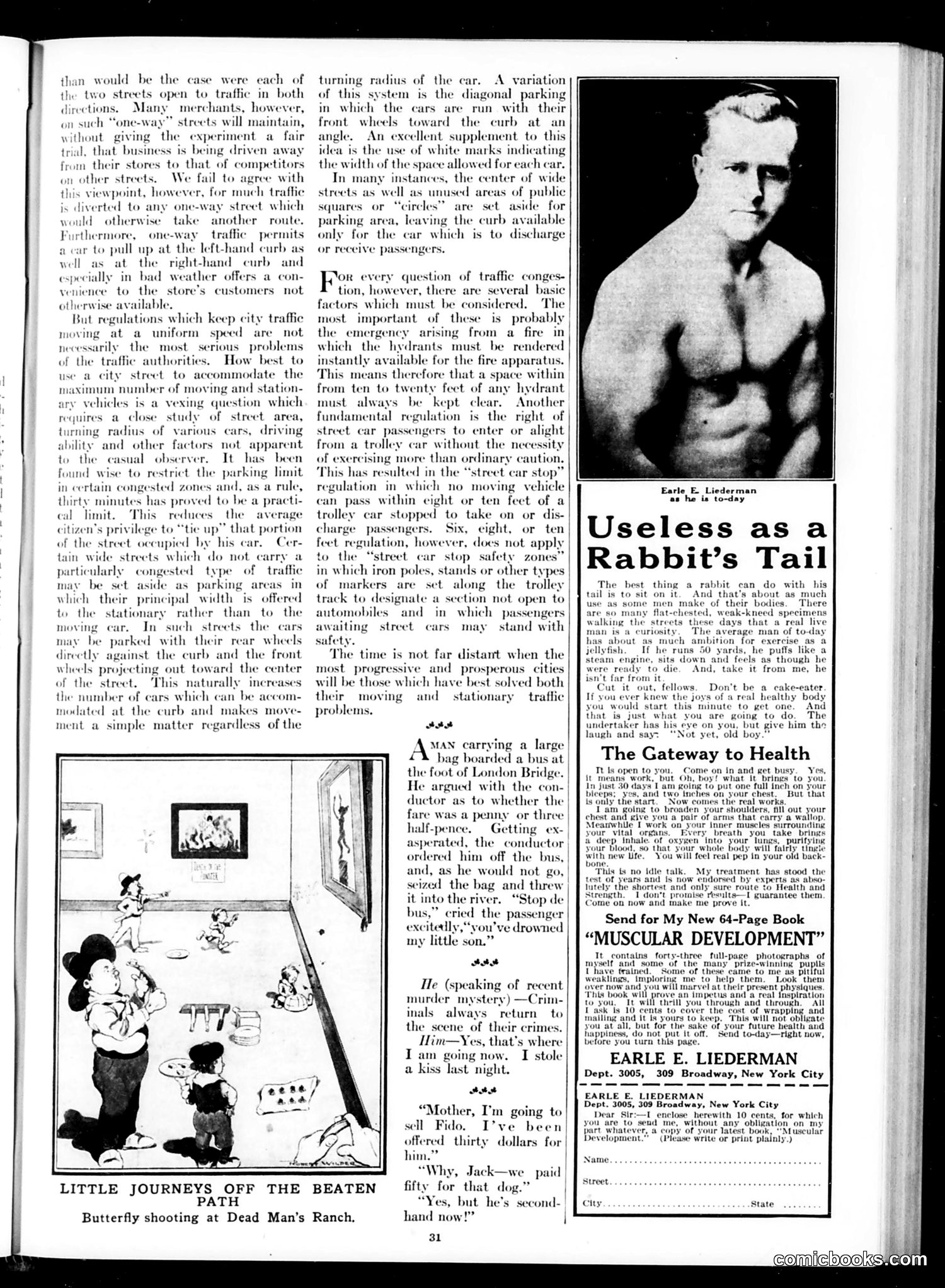
This page contains primarily **serious civic/editorial content**, not satire. The bulk consists of a technical article analyzing urban traffic management—discussing one-way streets, parking regulations, fire hydrant clearance zones, and trolley car safety. The single cartoon, titled "**Little Journeys Off the Beaten Path: Butterfly Shooting at Dead Man's Ranch**," depicts what appears to be a humorous domestic scene of people (likely a family) conducting outdoor activities. Without additional context about the ranch or date, the specific reference is unclear, though it seems a lighthearted illustration unrelated to the traffic discussion. The page also features advertisements, including one for "Muscular Development" by Earl E. Liederman (a bodybuilder), and various small anecdotes in the margins. **This is not primarily satirical content**—it's a straightforward civic-planning discussion typical of early 20th-century American magazines addressing modern urban challenges.
📄 Transcribed text from this page (OCR, searchable)
Machine-transcribed from the original scan — historical spelling and the odd misread are preserved.
than would be the were each of the two streets open to traffic in both however, case directions. Many merchants, on such “one-way” streets will maintain, without giving the experiment a tral, that business is being driven from their stores to that of competitors on other streets. We fail to agree with this viewpoint, however, for much traflic is diverted to any one-way street which would otherwise — ti nother route. Furthermore, one-way traffic permits ir to pull up at the left-hand curb as well as at) the right-hand curb and especially in’ bad weather offers a con- venience to the store’s customers not otherwise available. But regulations which keep city traffie moving at a uniform speed are not necessarily the most serious problems of the traffic authorities. How best to use a city street to accommodate the maximum number of moving and station- vehicles is a vexing question which requires a study of street are: turning radius of various cars, driving ability and other factors not apparent to the casual ver. Tt has been found wise to restrict the parking limit in certain congested zones and, as a rule, close obse thirty minutes has proved to be a pract cal limit. This reduces the average citizen's privilege to “tie up” that portion Cer- ry 2 of the street occupied by his ca tain wide streets which do not particularly congested — ty of traffic may be set aside as parking areas. in which their principal width is offere to the stationary rather than to. the moving car. In such streets the cars may be parked with their rear wheels directly against the curb and the front wheels projecting out toward the center of the street. This naturally increases the number of ears which can be accom- modated at the curb and makes move- ment a simple matter regardless of the turning radius of the car. A variation of this system is the diagonal parking in which the cars are run with their front wheels toward the curb at an An excellent. supplement to this a is the use of white marks indicating the width of the space allowed for each car. In many instances, the center of wide streets as well i used areas of public squares or “ci are set-aside for parking area, leaving the ailable only for the ear which is to discharge or receive passengers, oR every question of traffic conges- tion, however, there are several factors which must be considered, basic The most important of these is probably the emergency arising from a fire in which the hydrants must be rendered instantly available for the fire apparatus. This means therefore that a space within from ten to twenty feet of any hydrant must always be kept clear. Another fundamental regulation is the right of street car passengers to enter or alight from a trolley car without the necessity of exercising more than ordinary caution. This has resulted in the “street car stop” regulation in which no moving vehicle can pass within eight or ten fect of a trolley car stopped to take on or dis- charge passengers. Six, eight, or ten feet regulation, however, does not apply t to the “street car stop. safety zone in which iron poles, stands or other types of markers are set along the trolley track to designate a section not open to automobiles and in which passengers awaiting street. cars may stand with safety. The time is not far distart when the most progressive and prosperous cities will be those which have best solved both their moving and stationary — traffic problems. set Awan carrying a large hag boarded a bus at LITTLE JOURNEYS OFF THE PATH Butterfly shooting at Dead Man’s Ranch, He argued with the con- ductor as to whether the fare was a penny or three half-pence. Getting ex asperated, the conductor ordered him off the bus, and, as he would not go, s d the bag and threw it into the river. “Stop de bus,” cried the passenger excitedly,“you’ve drowned my little son.” sas He (speaking of recent murder mystery) —Crim- inals always return to the scene of their crimes. Him—Yes, that’s where I am going now. TI stole “Mother, I'm going to sell Fido. I’ve been offered thirty him.” “Why, Jack—we paid fifty for that dog.” “Yes, but he’s second- hand now!” 31 BEATEN the foot of London Bridge. | dollars for | Earle E. Liederman ‘as he is to-day Useless asa Rabbit’s Tail The best thing a rabbit can do with his tail is to sit on it. And that's about as much use as some mer eof their bodies. | There are so many flat-chested, walking the streets these man is a curiosity, The av real live n of to-day has about as much ambition for exercise as jellyfish. If he runs 50 yards, he puffs li steam engine, sits down and feels as though he were ready to die, And, take it from me, he isn’t far from it Cut it out, fellows, Don't be a cake-eater If you ever knew the joys of a real healthy body you would start this minute to get one. And that is just what you are going to do, The taker has his eye on you, but give him the and sayz "Not yet, old bo; Yes, But that and give you whe I work vital organs. ‘deep Inhale. of “oxy ya muscles surrounding h_you take. brings ft pur lungs, purifying whole body will fatrly tin ite Ith a T guarantee the t 3 promise results me prove it Strength Come on now and make Send for My New 64-Page Book “MUSCULAR DEVELOPMENT” full- three myself and some of the many pupils T have trained. Some of these came to me as pitiful eaklings, imploring to help them. Look them nd you will marvel t physiaues, his will nt obligate ur future health and nd to-day—right now, happiness,’ do not put tt before you turn this page. EARLE E. LIEDERMAN Dept. 3005, 309 Broadway, New York City EARLE E. LIEDERMAN Dept. 3005, 309 Broadway, New York City —I enclose herewith 10 cents, for which ny obligation on. my jar Name. Street chy State