
Judge, 1923-05-05 · page 15 of 36
Judge — May 5, 1923 — page 15: what you’re looking at
What you’re looking at
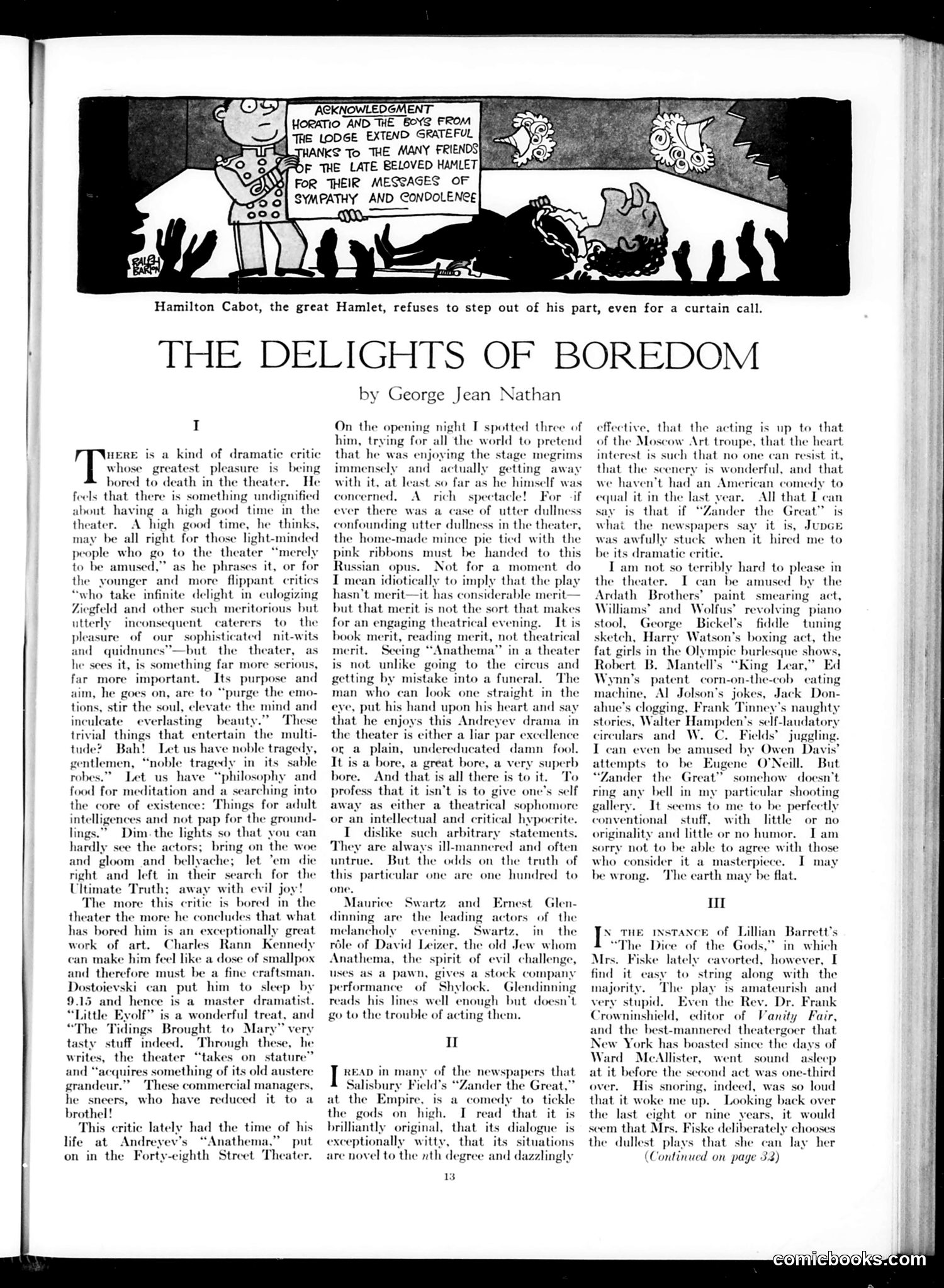
The cartoon depicts **Hamilton Cabot**, described as "the great Hamlet," refusing to break character even for a curtain call—a visual joke about theatrical pretension. The article satirizes a specific type of drama critic who equates boredom with artistic merit. Nathan mocks critics who believe serious theater must be joyless, gloomy, and intellectually taxing to be worthwhile. He names examples: Charles Rann Kennedy and Dostoevski are praised by such critics precisely *because* they're tedious. Nathan's prime target is **Andreyev's "Anathema,"** performed at the Forty-eighth Street Theater, which he deems genuinely boring but artistically merit-less for theater (though readable as literature). He ridicules pretentious critics who attended opening night, claiming anyone who genuinely enjoys it is "either a liar par excellence or a plain, undereducated damn fool." The satire targets intellectual snobbery in theater criticism—the assumption that entertainment and sophistication are mutually exclusive.
📄 Transcribed text from this page (OCR, searchable)
Machine-transcribed from the original scan — historical spelling and the odd misread are preserved.
"ACKNOWLEDGA HORATIO AND THE BOYS FROM TRE LODGE EXTEND GRATEFUL ANKS To THE MANY FRIENDS): OF THE LATE BELOVED HAMLET has Hamilton Cabot, the great Hamlet, refuses to step out of his part, even for a curtain call. THE DELIGHTS OF BOREDOM I HERE is a kind of dramatic critic [ whose greatest pleasure is being bored to death in the theater. He Is that there is something undignified about having a high good time in the theater. A high good time, he thinks, may be all right for those light-minded people who go to the theater “merely to be amused,” as he phrases it, or for the younger and more flippant. crities “who take infinite delight in culogizing Ziegfeld and other such meritorious but utterly inconsequent caterers to the pleasure of our sophisticated —nit-wits and quidnunes’—but the theater, as he sees it, is something far more serious, far more important. Its purpose and aim, he goes on, are to “purge the emo- tions, stir the soul, elevate the mind and ate everlasting beauty.” These i things that entertain the multi- tude? Bah! Let us have noble tragedy, gentlemen, “noble tragedy in its sable us have “philosophy and food for meditation and a searching into the core of existence: Things for adult intelligences and not pap for the ground- lings.” Dim. the lights so that you can hardly see the actors; bring on the woe and gloom and bellyache; let ’em die right and left in their search for the Ultimate Truth; away with evil joy! The more this critic is bored in the theater the more he concludes that what has bored him is an exceptionally great work of art. Charles Rann Kennedy can make him feel like a dose of smallpox and therefore must be a fine craftsman. Dostoievski can put him to sleep by 9.15 and hence is a master dramatist. “Little Eyolf” is a wonderful treat, and “The gs Brought to Mary” very tasty stuff ind Through these, he writes, the theater “takes on stature” and “acquires something of its old austere grandeur.” These commercial r ers, he sneers, who have reduced it to a brothel! This critic lately had the time of his life at Andreyev’s “Anathema,” put on in the Forty-eighth Street Theater. robes.” Le by George Jean Nathan On the opening night T spotted three of him, trying for all the world to pretend that he was enjoying the stage megrims immensely and actually getting away with it, at least so far as he himself was concerned, A rich spectacle! For -if ever there was a case of utter dullness confounding utter dullness in the theater, the home-made mince pie tied with the pink ribbons must be handed to. this Russian opus. Not for a moment do I mean idiotically to imply that the play hasn't merit—it has considerable merit— but that merit is not the sort that makes for an engaging theatrical evening. It is book merit, reading merit, not theatrical merit. Seeing “Anathema” in a theater is not unlike going to the circus and getting by mistake into a funeral. The man who can look one straight in the ‘ye, put his hand upon his heart and say that he enjoys this Andreyev drama in the theater is either a liar par excellence or a plain, undereducated damn_ fool. It is a bore, a great bore, a very superb bore. And that is all there is to it. To profess that it isn’t is to give one’s self away as either a theatrical sophomore or an intelle and critical hypocrite. islike such arbitr: statements. They always ill-mannered and often untrue. But the odds on the truth of this particular one are one hundred to one, Maurice Swartz and Ernest Glen- dinning are the leading actors of the melancholy evening. Swartz, in the role of David Leizer, the old Jew whom Anathema, the spirit of evil challenge, uses as a pawn, gives a stock company performance of Shylock. Glendinning reads his lines well enough but doesn’t go to the trouble of acting them. II I READ in many of the newspapers that Salisbury Field’s “Zander the Great,” at the Empire, is a comedy to tickle the gods on high. I read that it is brilliantly original, that its dialog exceptionally witty, that its situations are novel to the nth degree and dazzlingly 13 effective, that the acting is up to that of the Moscow Art troupe, that the heart interest is such that no one can resist it, that the scenery is wonderful, and that we haven't had an American comedy to equal it in the last year. All that I say is that if nder the Gre what the newspapers say it is, JupGEe was awfully stuck when it hired me to be its dramatic critic. I am not so terribly hard to please in the theater. I can be amused by the Ardath Brothers’ paint smearing act, Williams’ and Wolfus’ revolving piano stool, George Bickel’s fiddle — tuning sketch, Harry Watson’s boxing act, the fat girls in the Olympic burlesque shows, Robert B. Mantell’s “King Lear,” Ed Wynn's patent corn-on-tl ating machine, Al Jolson’s jokes, Jack Don- ahue’s clogging, Frank Tinney’s naughty stories, Walter Hampden’s self-laudatory circulars and W. C. Fields’ juggling. I can even be amused by Owen Davis’ attempts to be Eugene O'Neill. But “Zander the Great” somehow doesn’t ring any bell in my particular shooting gallery. It seems to me to be perfectly conventional stuff, with little or no originality and little or no humor. I am sorry not to be able to agree with those who consider it a masterpiece. I may be wrong. The earth may be flat. WI I 2 INSTANCE of Lillian Barrett's re Dice of the Gods,” in) which Mrs. Fiske lately cavorted, however, I find it easy to string along with the majority. The play is amateurish and very stupid. Even the Rev. Dr. Frank Crowninshield, editor of Vanity Fair, and the best-mannered theatergoer that New York has boasted since the s of Ward McAllister, went sound leep at it before the second act was one-third over, His snoring, indeed, was so loud that it woke me up. Looking back over the last eight or nine years, it would seem that Mrs. Fiske deliberately chooses the dullest plays that she can lay her (Continued on paye 32)