
Judge, 1923-05-05 · page 32 of 36
Judge — May 5, 1923 — page 32: what you’re looking at
What you’re looking at
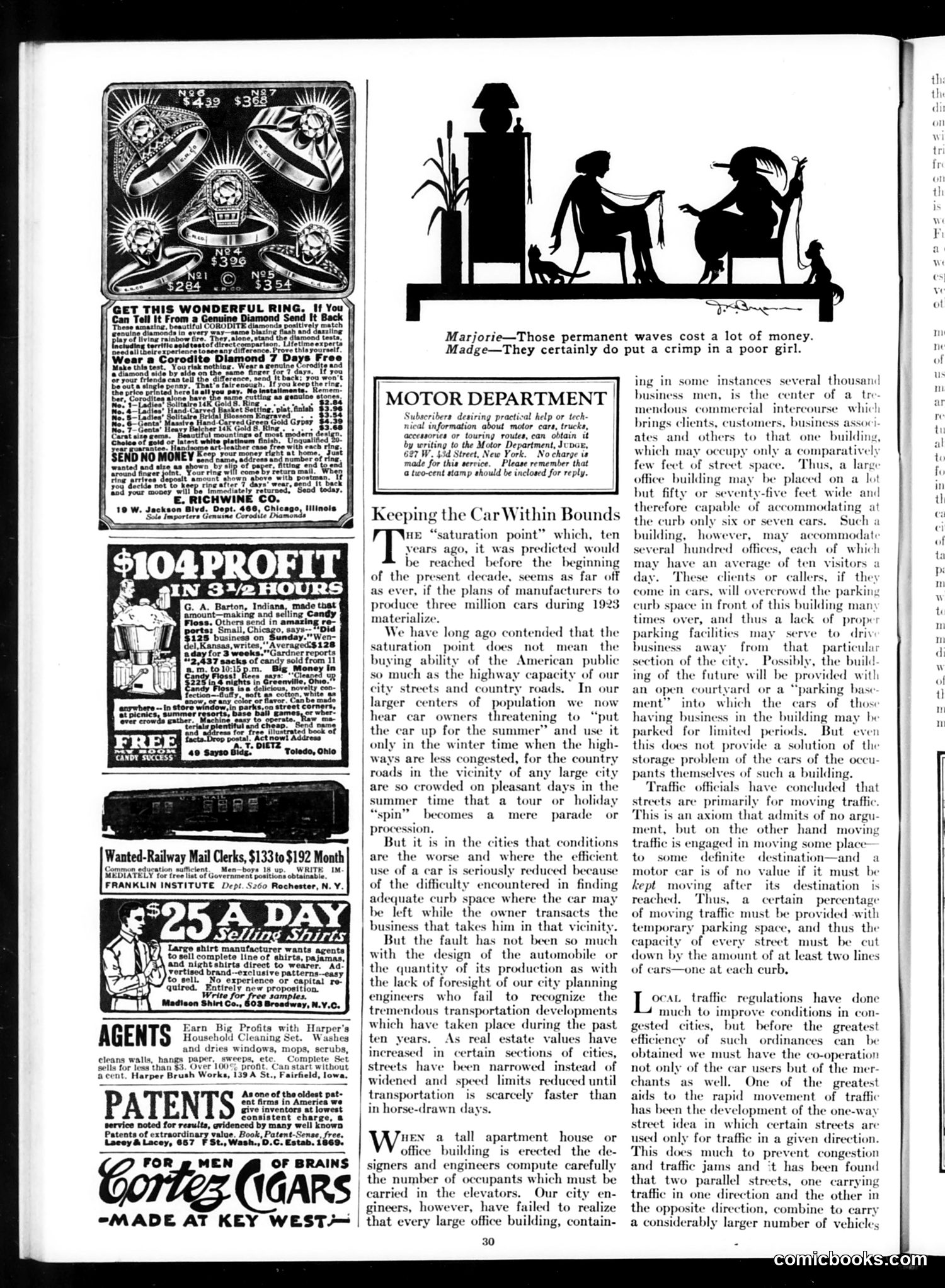
This page contains primarily **advertisements and a brief satirical exchange**, rather than political cartoons. The only humor piece is the **"Marjorie and Madge" dialogue** (top right silhouette). It's a gentle pun: Marjorie comments that permanent waves are expensive; Madge replies they "put a crimp in a poor girl"—a double meaning playing on both the hairstyling term "crimp" and financial hardship. The bulk of the page consists of **classified advertisements** typical of 1920s Judge magazine: job postings (railway clerks, shirt sales agents), patent services, household products, and cigars. These ads reflect the magazine's commercial revenue model. The longer article, "**Keeping the Car Within Bounds**," discusses urban traffic congestion and parking problems caused by automobile proliferation—a contemporary concern as car ownership expanded in the 1920s. It argues city planners failed to anticipate transportation needs. No identifiable political figures or major satirical commentary appears on this page. It's representative of Judge's mixed content format: advertising-heavy with light humor and practical articles.
📄 Transcribed text from this page (OCR, searchable)
Machine-transcribed from the original scan — historical spelling and the odd misread are preserved.
mond is by Sanegens sods can tell the differen: era eat Geautoe eae a9 SEND NO ghOleY Eyres, as ittiog end tend fd ro mail. Wh day for 3 weeks." BSMLS7 sack of cant veld fr 2,3, (2105p. Bie, money operat ceed feria ¢ goleioos ate ey fates Salty, soft an cotton, white: ta = Sr Ravors Gabe sad insite leg darne Sie ore SER acting eany tp gonna Ham oe. tedhfrent for fens ostrated bank of Berman naires mw moe Toledo, Ohio CANDY SUCCESS Wanted-| Railway Mail Clerks, $133 to $192 Month ommon education sufficient. Men—boys 18 up. WRITE IM SEEDIATELY tor free lst of Government ponttions obtainabte FRANKLIN INSTITUTE Dept. S260 Rochester, N. Y. Large shirt manufacturer wants agente sell complete line of shirts, pajamas, and night sbirte direct to weare! Ve es Farn Big Profits with Harper's Household Cleaning Set. Pc and dries windows, mops, scrubs, 3 Comptete AGENTS As one of the oldest pi ent firms in Amerie PATENTS : noted for results, gvidenced by many well known Pater of extraordinary value, Book, Patent-Sense, free. Lacey Lacey, 057 F St., Wash.,0.C. Estab. 1869: OF BRAINS FoR MEN 1GARS “MADE AT KEY WEST— Sa — Marjorie—Those permanent waves cost a lot of money. Madge—They certainly do put a crimp in a poor girl. OTOR DEPARTMENT | Subscribers desiring practical help or teck- nical information about motor care, trucks, accessories or touring routes, can obtain it by writing to the Motor Department, coax, 627 W. 43d Street, New York. No charge is made for this service. Please remember that @ two-cent stamp should be inclosed for reply. Keeping the Car Within Bounds aturation point” which, ten go, it was predicted would before the beginning of the present decade, seems as far off ever, if the plans of manufacturers to | produce three million cars during 1923 | mate! We have long ago contended that the saturation point does not mean the buying ability of the ican public much as the highw streets and country roads. In our larger centers of population we now hear car owners threatening to “put up for the summer” and use it y in the winter time when the high- s are less congested, for the country roads in the vicinity of any large city are so crowded on pleasant days in the summer time that a tour or holiday “spin” becomes a mere parade or procession, But it is in the cities that conditions | are the worse and where the efficient | use of a car is seriously reduced because of the difficulty encountered in finding adequate curb sp where the car may be left while the owner transacts the business that takes him in that vicinity. But the fault has not been so much with the design of the automobile or the quantity of its production as with the lack of foresight of our city planning engineers who fail to recognize the tremendous transportation developments which have taken place during the past ten years. As real estate values have increased in certain sections of cities, streets have been narrowed instead of widened and speed limits reduced until transportation is scarcely faster than in horse-drawn days, HEN a tall apartment house or office building is erected the de- signers and engineers compute carefully the number of occupants which must be carried in the elevators. Our city en- gineers, however, have failed to reali | that every large office building, contain- 30 ing in some instances several thousan: business men, is the center of a tre mendous commercial intercourse which brings clients, customers, business assoc ates and others to that one building, which may occupy only a comparatively few feet of street space. Thus, a larg: office building may be placed on a lot but fifty or seventy-five feet wide and therefore capable of accommodating at the curb only six or seven cars. Such a building, however, 1 accommodat: seve hundred offices, each of which may | an average of ten visitors a day. These clients or callers, if they come in cars, will overerowd the parking curb space in front of this building man. times over, and thus k of prop: parking facilities may to driv business away from particular section of the city. Possibly, the build ing of the future will be provided with an open courtyard or a “parking bas: ment” into which the cars of | thos: having business in the building may be parked for limited periods. But this does not provide a solution of the storage problem of the cars of the occu- pants themselves of such a building. Traffic officials have concluded that streets are primarily for moving traffic This is an axiom that admits of no a ment, but on the other hand mo traffic is engaged in moving some place- to some definite destination—and motor car is of no value if it must be kept moving after its destination is reached. Thus, a certain percentage of moving traffic must be provided with temporary parking space, and thus the capacity of every street must be cut down by the amount of at t two lines of cars—one at each curb, Lo traffic regulations have done much to improve conditions in con- gested cities, but before the greatest ¢flicieney of such ordinances ca obtained we must have the co-operation not only of the users but of the mer- chants well. One of the greatest aids to the rapid movement of traffic has been the development of the one street idea in which certain streets are used only for traffic in a given direction. This does much to prevent congestion and traffic jams and ‘t has been found that two carallel streets, one carrying traffic in one direction and the other in the opposite direction, combine to carry a considerably larger number of vehicles even as