
Judge, 1923-05-05 · page 21 of 36
Judge — May 5, 1923 — page 21: what you’re looking at
What you’re looking at
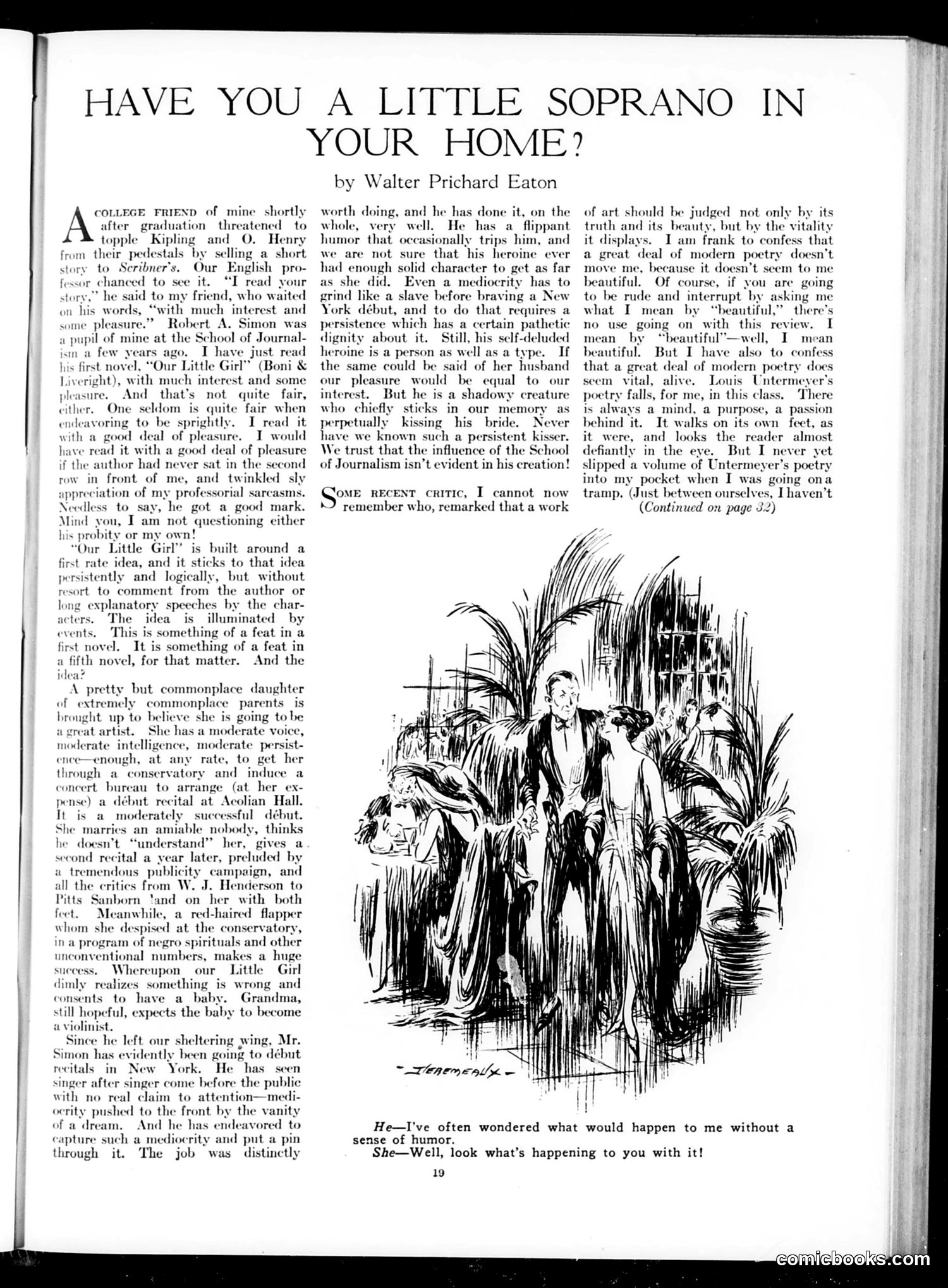
This page reviews Robert A. Simon's novel *Our Little Girl*, a satire about an aspiring opera singer with mediocre talent whose parents delude themselves into supporting her career. The illustration depicts a family gathered around a young woman singing, likely the "little soprano" of the title. The review praises Simon for capturing "such a mediocrity and put a pin through it"—mocking the pretensions of untalented performers pushed into the spotlight by vanity and parental expectations rather than genuine ability. The satire targets early 20th-century concert culture: wealthy families financing unsuccessful debut recitals at prestigious venues like Aeolian Hall for daughters with only "moderate" voice and intelligence. The heroine's grandmother expects the baby to become a violinist—suggesting generational delusion about artistic talent. The critique reflects contemporaneous anxiety about commercialized arts and the gap between mediocre performers and genuinely talented artists who succeed without such artificial promotion.
📄 Transcribed text from this page (OCR, searchable)
Machine-transcribed from the original scan — historical spelling and the odd misread are preserved.
HAVE YOU A LITTLE SOPRANO IN YOUR HOME? OLLEGE FRIEND of mine. shortly r graduation threatened to opple” Kipling and O. Henry from their pedestals by selling a short y to Scribner's. Our English pro- or chanced to see it. “I read your y,” he said to my friend, who waited “with much interest and Robert. A. Simon wa t the School of Jour ism a few years ago. I have just read his first novel, “Our Little Girl” (Boni & Liveright), with much interest and some pleasure. And that’s not quite fair, cither. One seldom is quite fair when endeavoring to be sprightly. I read it good deal of pleasure. I would it with a good deal of pleasure ithor had never sat in the second row in front of me, and twinkled sly appreciation of my professorial sarcasms. Needless to say, he got a good mark. Mind you, I am not questioning either his probity or my own! Our Little Girl’ is built around a first rate idea, and it sticks to that idea persistently and logically, but without resort to comment from the author or 1 his words, pleasur a pupil of mine long explanatory speeches by the char- acte idea is illuminated by events. This is something of a feat in a first novel. a fifth novel, for that matter. idea? It is something of a feat in And the \ pretty but commonplace daughter extremely commonplace parents is ‘ought up to believe she is going to be t artist. She has a moderate voice, oderate intelligence ute persist- ence—enough, at to get her through a conservatory luce a concert bureau to arrange (at her ex- pense) a début recital at Acolian Hall. It is a moderately successful dél She marri amiable nobody, tt he doesn’t “understand” her, gives a second recital a year later, preluded by tremendous publicity campaign, and all the critics from W. J. Henderson to Pitts Sanborn ‘and on her with both fect. Meanwhile, a red-haired flapper whom she despised at the conservatory, in a program of negro spirituals and other nventional numbers, makes a huge Whereupon our Little Girl dimly realizes something is wrong and consents to have a baby. Grandma, still hopeful, expects the baby to become a violinist. Since he left our sheltering jwing, Mr. Simon has evidently been going to début recitals in New York. He has seen singer after singer come before the public with no real claim to attention—medi- pushed to the front by the vanity n. And he has endea capture such a mediocrity and put a pin through it. The job was distinctly by Walter Prichard Eaton worth doing, and he has done it, on the whole, He has humor that occasionally trips him, we are not sure that his heroine 3 had enough solid character to get as far as she did. n a mediocrity has to grind like a slave before braving a New York début, and to do that requires a persistence which has a certain pathetic dignity about it. ill, his self-deluded heroine is a person as well as a type. If the same could be said of her husband our pleasure would be equal to our interest. But he is a shadowy creature who chiefly sticks in our memory as perpetually kissing his bride. Never have we known such a persistent kisser. We trust that the influence of the School of Journalism isn’t evident in his creation! Gove RECENT critic, I cannot now J remember who, remarked that a work of art should be judged not only by its truth and its ity, but by the it displays. I am frank to confess that a great deal of modern poetry doesn’t move me, because it doesn’t seem to me beautiful. Of course, if you are going to be rude and interrupt by asking me what I mean by “beautiful,” there's no use going on with this review. I mean by “beautiful”’—well, I mean beautiful. But I have also to confess that a great deal of modern poetry does seem vital, alive. Louis Untermeyer's poetry falls, for me, in this class. There is always a mind, a purpose, a passion behind it. It walks on its own feet, as it were, and looks the defiantly i going ona into my pocket when I Thaven’t tramp. (Just between ourse (Continued on page He—I've often wondered what would happen to me without a sense of humor. She—Well, look what’s happening to you with it! 19