
Judge, 1923-05-05 · page 19 of 36
Judge — May 5, 1923 — page 19: what you’re looking at
What you’re looking at
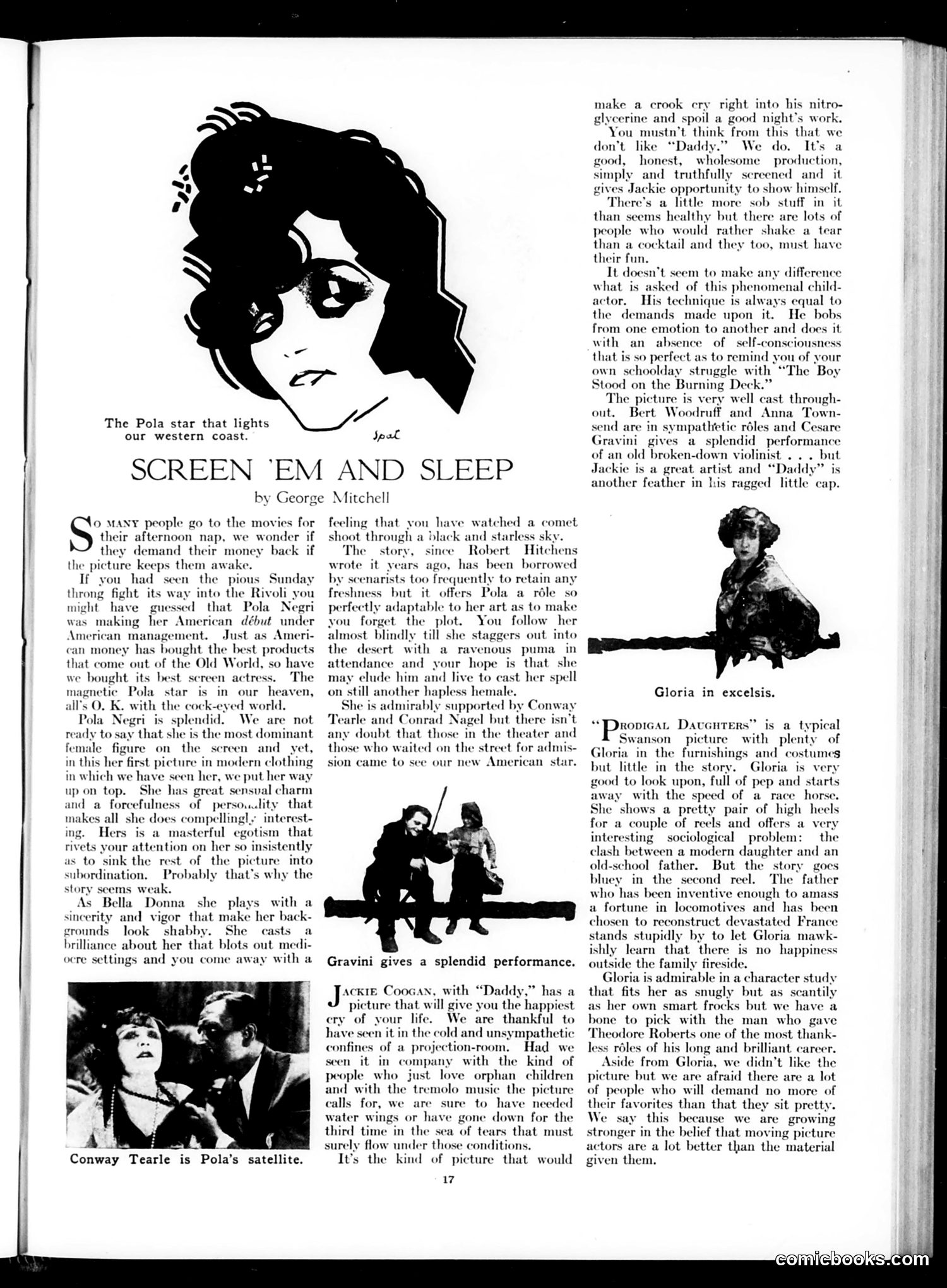
This page reviews several 1920s films, with particular emphasis on **Pola Negri**, a major European silent film star making her American debut. The headline's joke is that movies are so boring audiences use them for naps. The main article praises Negri's "sensual charm" and "masterful egotism" in *Bella Donna*, claiming her star power compensates for a weak plot. She's described as the real draw—audiences lined up specifically to see "our new American star," implying fascination with importing European talent. Secondary reviews cover *Daddy* (a child-actor vehicle) and *Pioned* (about modern sociological issues). The critic appreciates *Daddy* as wholesome entertainment but notes excessive sentimentality could overwhelm viewers. The tone reflects 1920s attitudes: amazement at acquiring European film talent like "products from the Old World," and assumptions about audiences' emotional responses to orphans and tearjerkers—revealing period tastes in entertainment.
📄 Transcribed text from this page (OCR, searchable)
Machine-transcribed from the original scan — historical spelling and the odd misread are preserved.
The Pola star that lights our western coast. SCREEN ‘EM AND SLEEP by George Mitchell S MANY people go to the movies for their afternoon nap, we wonder if they demand their money back if the picture keeps them awake. If you had seen the pious Sunday throng fight its way into the Rivol might have guessed that Pola was making her American début under American management. Just as Ameri- can money has bought the best products that come out of the Old World, so have we bought its best screen actress. The magnetic Pola star is in our heaven, all's O. K. with the cock-eyed world. Pola N is splendid. We » not ready to say that she is the most dominant female figure on the screen and yet, in this her first picture in modern clothing in which we have seen her, we put her way upon top. She has great sensval charm and a forcefulness of persoulity. that makes all she does compellingly interest ing. Hers is a masterful egotism that rivets your attention on her so insistently as to sink the rest of the picture into subordination, Probably that’s why the story seems weak. As Bella Donna she plays with a sincerity and vigor that make her back- grounds look shabby. She casts a brilliance about her that blots out medi- ocre settings and you come away with a Conway Tearle is Pola’s satellite. feeling that you have watched a comet shoot through a black and starless sky. The story, since Robert Hitchens wrote it years ago, has been borrowed by scenarists too frequently to retain any freshness but it offers Pola a réle so perfectly adaptable to her art as to make you forget the plot. You follow her almost blindly till she staggers out into the desert with a ravenous puma in attendance and your hope is that she may elude him and live to cast her spell on still another hapless hemale. She is admirably supported by Conway Te: and Conrad Nagel but there isn’t any doubt that those in the theater and those who waited on the street for admis- sion came to see our new American. star. Gravini gives a splendid performance. Jae Coocan, with “Daddy,” has a picture that will give you the happiest cry of your life. We are thankful to have seen it in the cold and unsympathetic confines of a pre ion-room. Had we seen it in company with the kind of people who just love orphan children and with the tremolo music the picture calls for, we are sure to have needed water wings or have gone down for the third time in the sea of tears that must surely flow under those conditions. It’s the kind of picture that would 17 make a crook ery right into his nitro- rine and spoil a good night's work. yu mustn't think from this that we don’t. like “Daddy.” We do. It's a good, honest, wholesome production, ud truthfully screened and. if to show himself. There's a little more sob stuff in it than seems healthy but there are lots of people who would rather shake a tear than a cocktail and they too, must have their fun. It doesn’t seem to make any difference what is asked of this phenomenal child- actor. His technique is always equal to the demands made upon it. He bobs from one emotion to another and does it with an absence of. self-consciousness that is so perfect as to remind you of your own schoolday struggle with’ “The ‘Boy Stood on the Burning Deck. The picture is very well cast through- out. Bert Woodruff and Anna Town- send are in sympatlretic roles and Cesare iravini gives a splendid performance un old broken-down violinist... but ackie is a great artist and “Daddy” is another feather in his ragged little eap. opportunity Gloria in excelsis. “Provcat Daveuters” is a typical Swanson picture with plenty of Gloria in the furnishings and costumes but little in the story. Gloria is very good to look upon, full of pep and starts away with the speed of a race horse. She shows a pretty pair of high heels for a couple of reels and offers a very esting sociological problem: — the ‘lash between a modern daughter and an old-school father. But the story goes bluey in the second reel. The father who has been inventive enough to amass a fortune in locomotives and has been chosen to reconstruct devastated France stands stupidly by to let Gloria mawk- ishly learn that there is no happiness outside the family fireside. Gloria is admirable in a cha that fits her as snugly but as her own smart frocks but we hav bone to pick with the man who gave ‘Theodore Roberts one of the most thank- less réles of his long and brilliant Tr. Aside from Gloria, we didn’t like the picture but we are afraid there are a lot of people who will demand no more of their favorites than that they sit pretty. We say this because we growing stronger in the belief that moving picture actors are a lot better than the material given them, are