
A complete issue · 36 pages · 1923
Judge — February 24, 1923
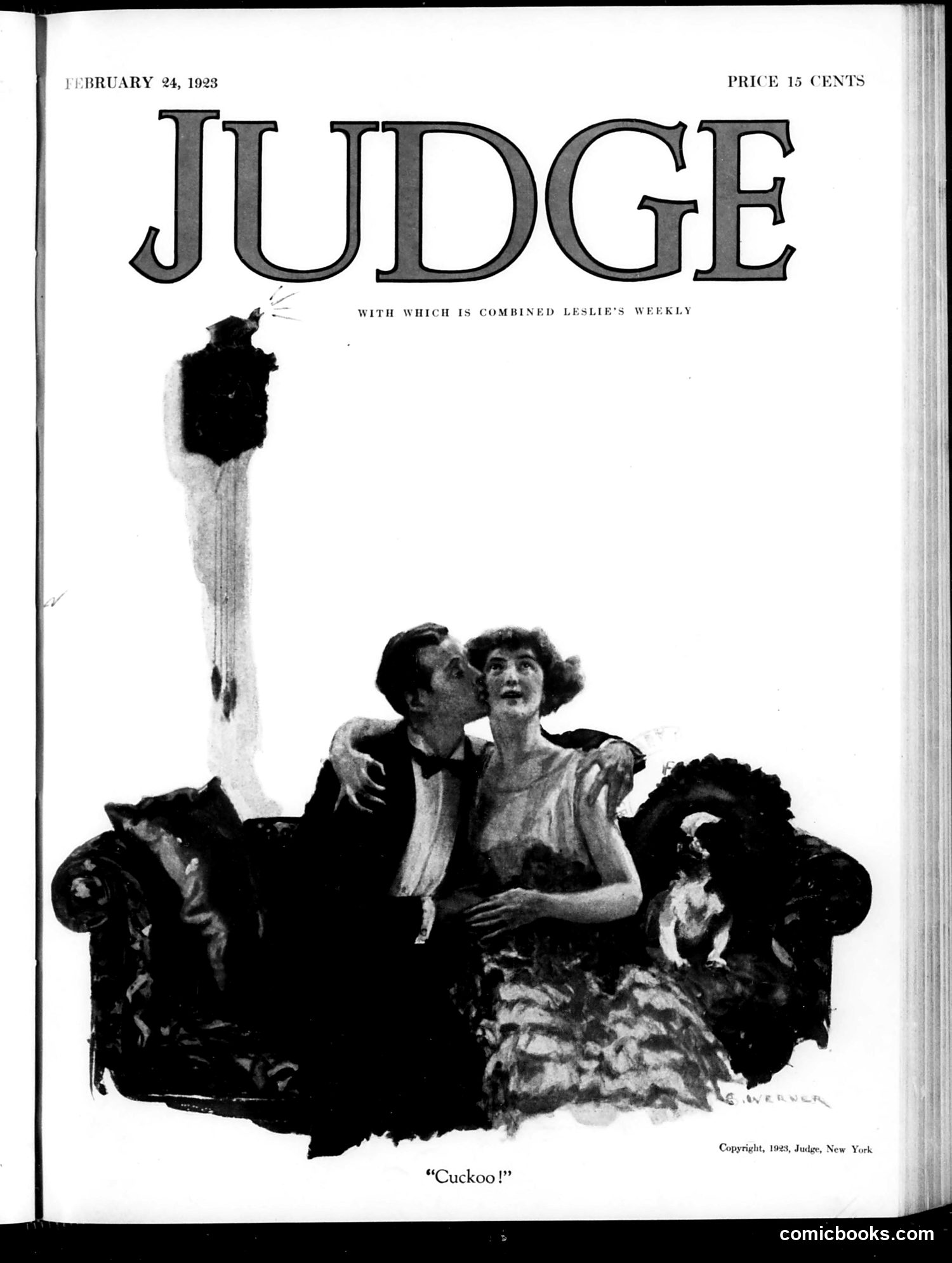
This cartoon depicts a couple on a decorative sofa, both looking upward with alarm or surprise at a bird perched above them on what appears to be a curtain rod or architectural element. The bird is shown dripping downward, creating a visual mess. The title "Cuckoo!" operates as a double entendre: it references both the bird itself and the slang term meaning "crazy" or "insane." The cartoon likely satirizes domestic life or marital situations—suggesting either that something absurd has occurred in their home, or making a commentary about the couple's own mental state. The messy dripping effect suggests literal or figurative chaos. Without additional context, the specific social commentary remains unclear, though it appears to be gentle domestic humor typical of 1920s satirical magazines.
This page is primarily a **subscription advertisement for Judge magazine** rather than a political cartoon. The illustration shows a figure from behind, appearing to be running or in motion, wearing striped clothing and a headband. The text reads: "Aw, Gee! Some folks can't take a joke." This suggests the ad is promoting Judge's satirical humor, implying that subscribing will expose readers to jokes and commentary that some people find offensive or uncomfortable. The subscription offer requests ten weeks for $1.00, with a tear-off form for name, street, and city/state information. The address given is "627 West 43rd Street, New York City." Without additional context, the specific figure or reference being caricatured remains **unclear**.
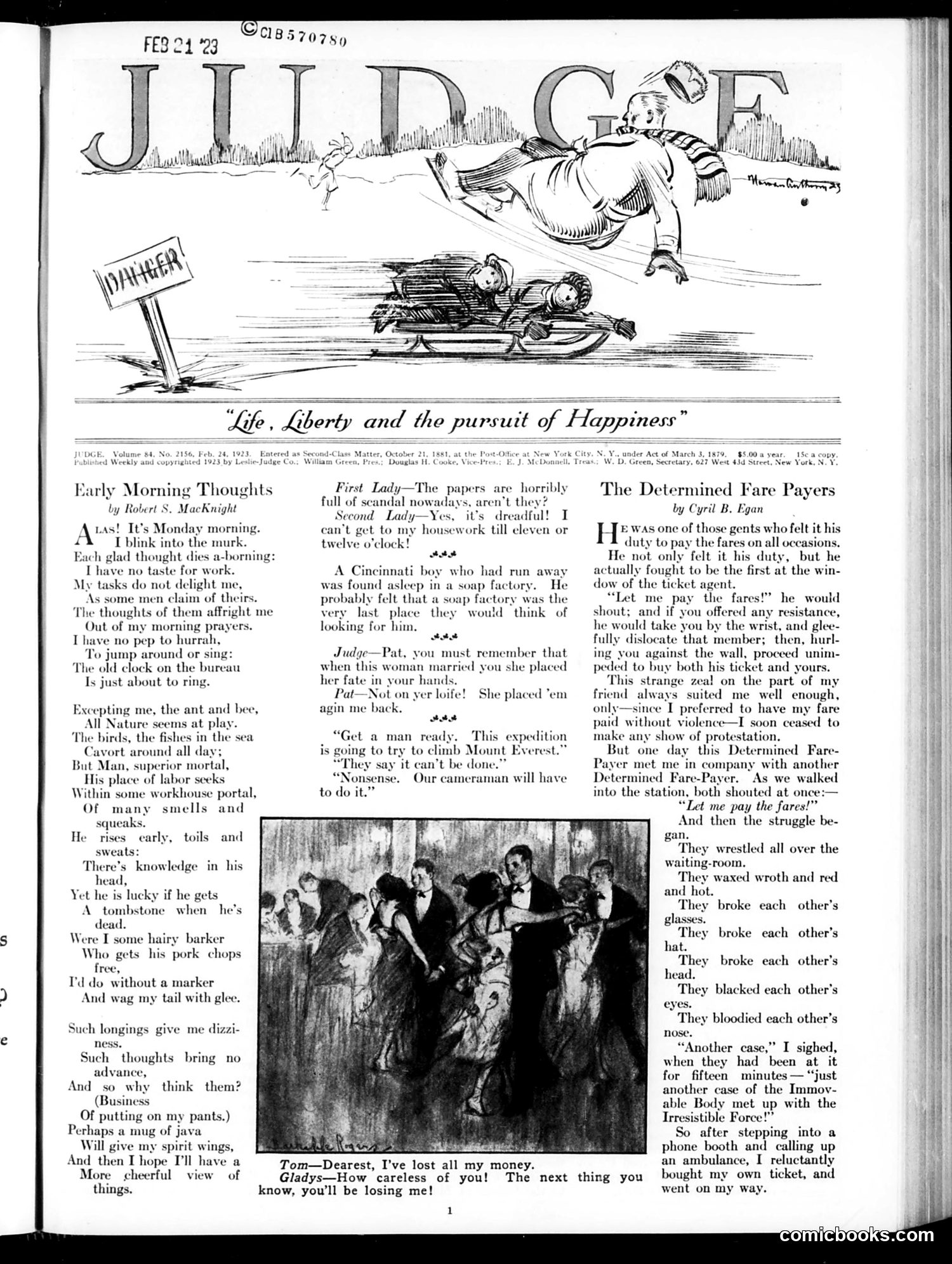
The main cartoon depicts a rotund figure diving into water while two smaller figures on a sled flee below, with a "DANGER" sign visible. The title "Life, Liberty and the pursuit of Happiness" appears to be ironic commentary. The page includes several satirical pieces: **"Early Morning Thoughts"** by Robert S. MacKnight is a poem satirizing working-class drudgery and class inequality. **"The Determined Fare Payers"** by Cyril B. Egon mocks passengers violently fighting over public transit fares, with the accompanying illustration showing people brawling in what appears to be a station waiting room. The bottom vignette shows a woman ("Gladys") telling a man ("Tom") she's lost his money, setting up a domestic comedy scenario. The overall theme appears to satirize post-WWI American social anxieties around class, wealth, and civility.
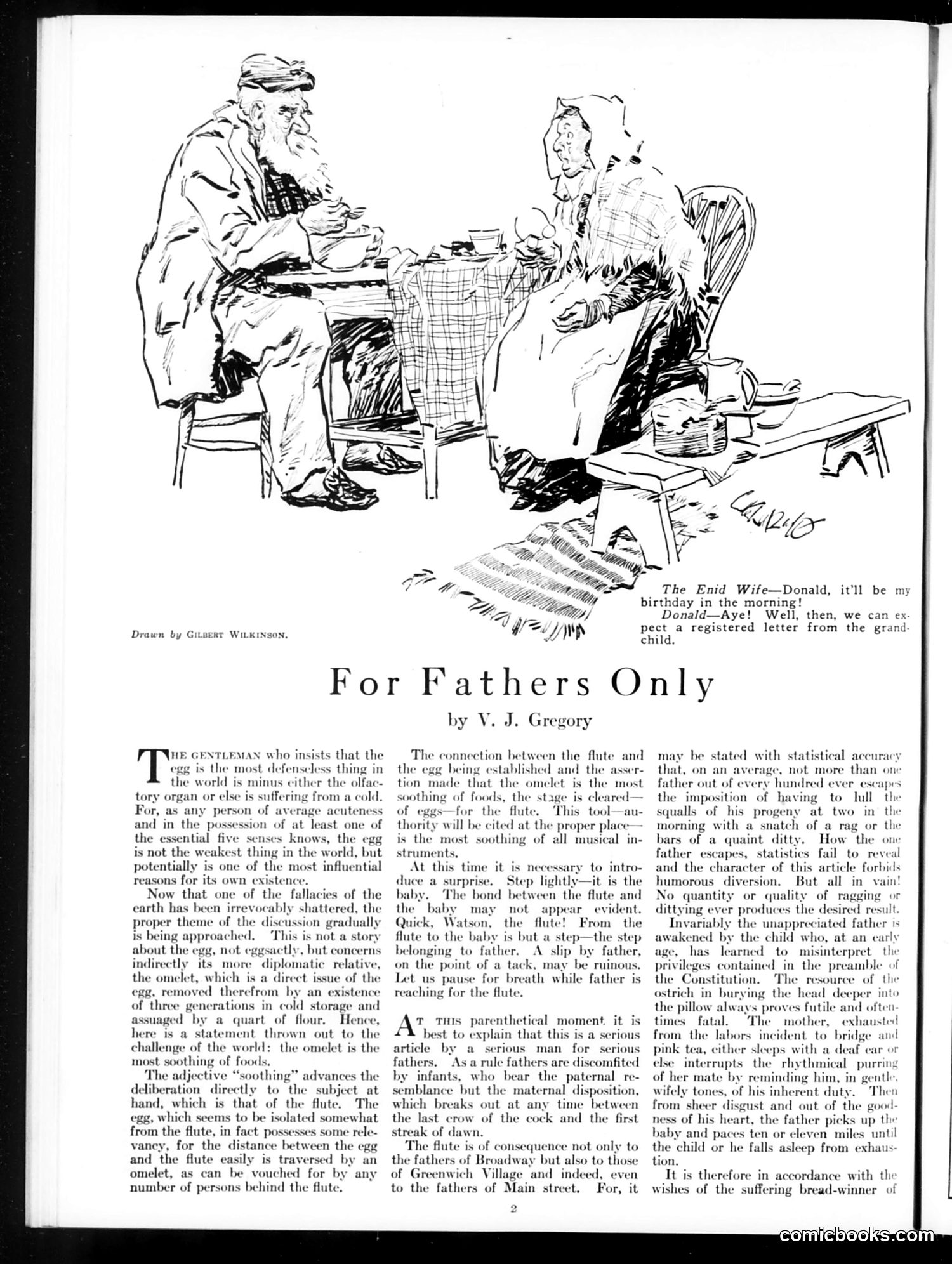
This 1920s satirical article uses humor to address paternal anxiety about childrearing. The cartoon depicts a father and mother in domestic conversation, with the caption showing the wife announcing the child's birthday will arrive tomorrow and suggesting they obtain a "registered letter from the grandchild." The satire targets the "modern father" — portrayed as anxious and eager to avoid responsibility. Gregory's text mocks fathers who expect their children to be "soothed" by flutes and who believe in rigid, impersonal parenting methods. The broader joke critiques how fathers distance themselves from childcare, treating it as something requiring formality rather than genuine engagement. The piece advocates for active paternal involvement and emotional presence in raising children, positioning this as countercultural advice for its time.
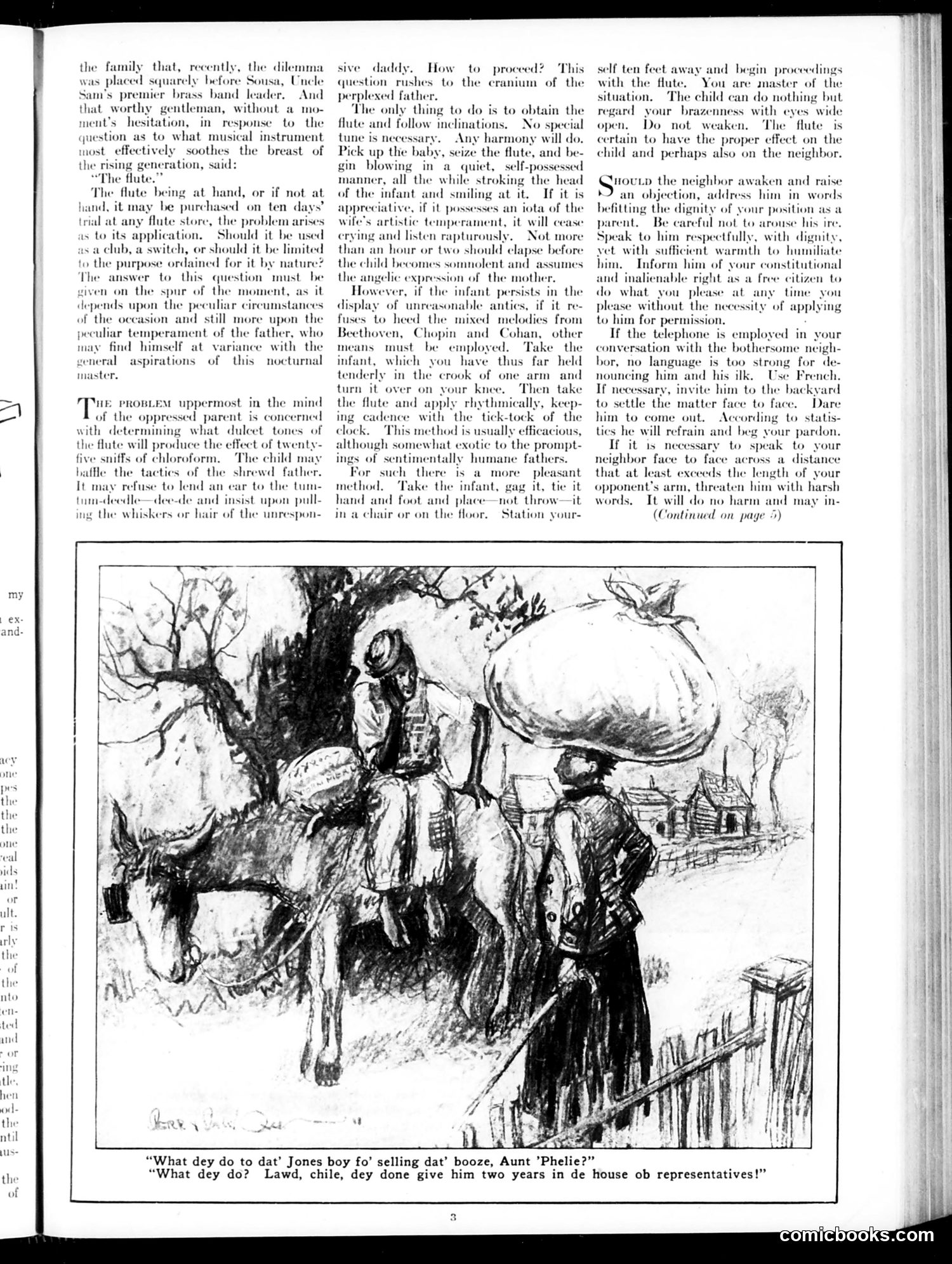
This cartoon satirizes political corruption in the early 20th century American South. The dialogue depicts an elderly Black woman ("Aunt 'Phelie'") asking a young Black boy about his father Jones, who has apparently been imprisoned for selling bootleg liquor. The boy replies that Jones received "two years in de house ob representatives"—a pun conflating jail time with political office. The joke mocks Southern politicians by suggesting they're indistinguishable from criminals: serving in the House of Representatives is presented as equivalent to serving prison time. This reflects Judge magazine's progressive editorial stance critiquing Southern political corruption and Jim Crow-era governance. The rural setting and dialect comedy were typical of the era's satirical style.
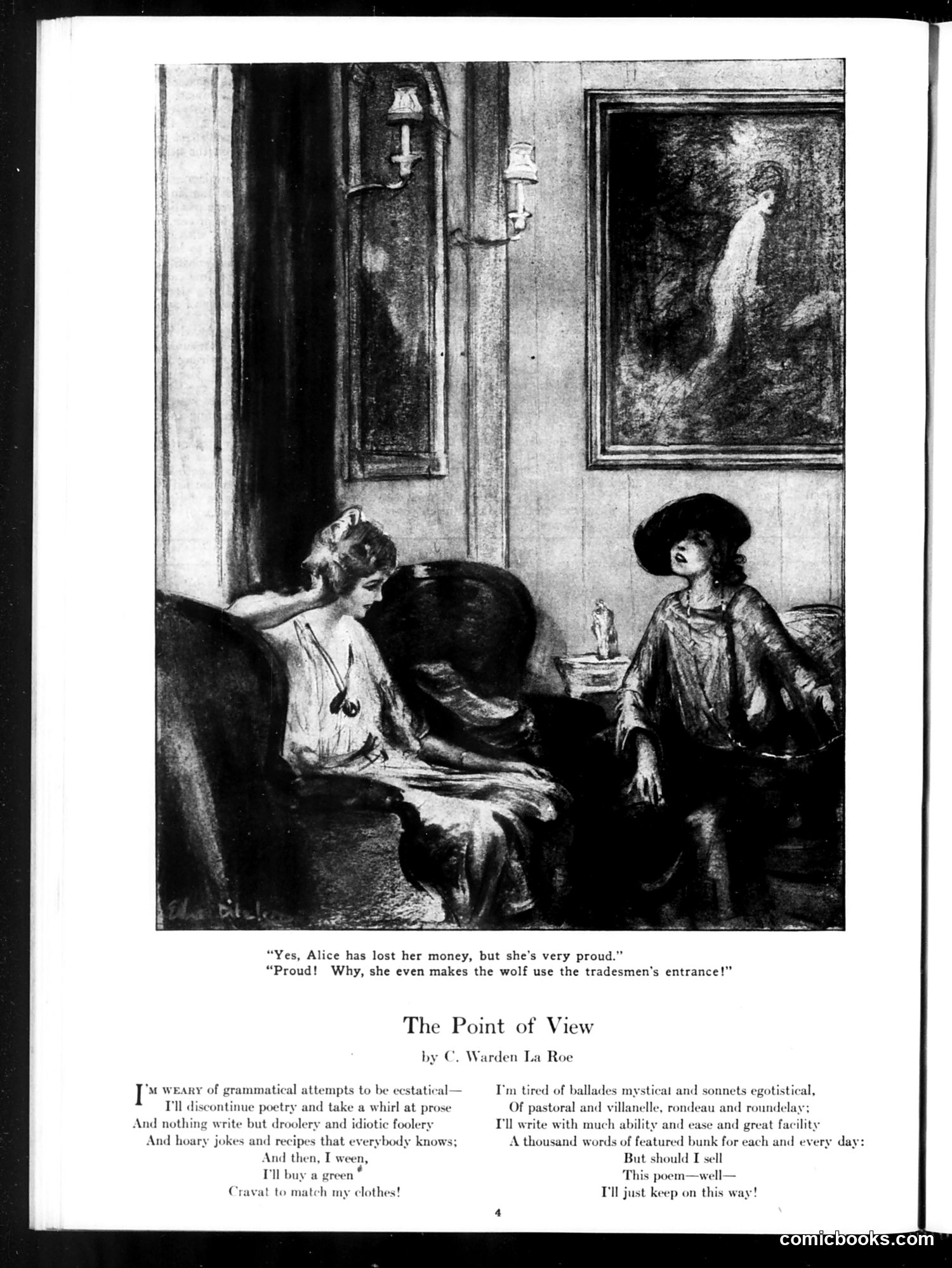
This satirical piece critiques artistic pretension. Two women discuss "Alice," who has lost her money but remains "very proud"—so proud she "even makes the wolf use the tradesmen's entrance!" The accompanying poem mocks poets who claim artistic integrity while pursuing commercial success. The speaker denounces "grammatical attempts to be ecstatical" and "dull droosery and idiocy" in poetry, then admits to abandoning such principles: they'll write commercially viable "featured bunk" daily rather than sell the poem itself, keeping "on this way!" The satire targets artists and writers who publicly espouse high standards but privately compromise for financial survival—a common hypocrisy Judge frequently lampooned.
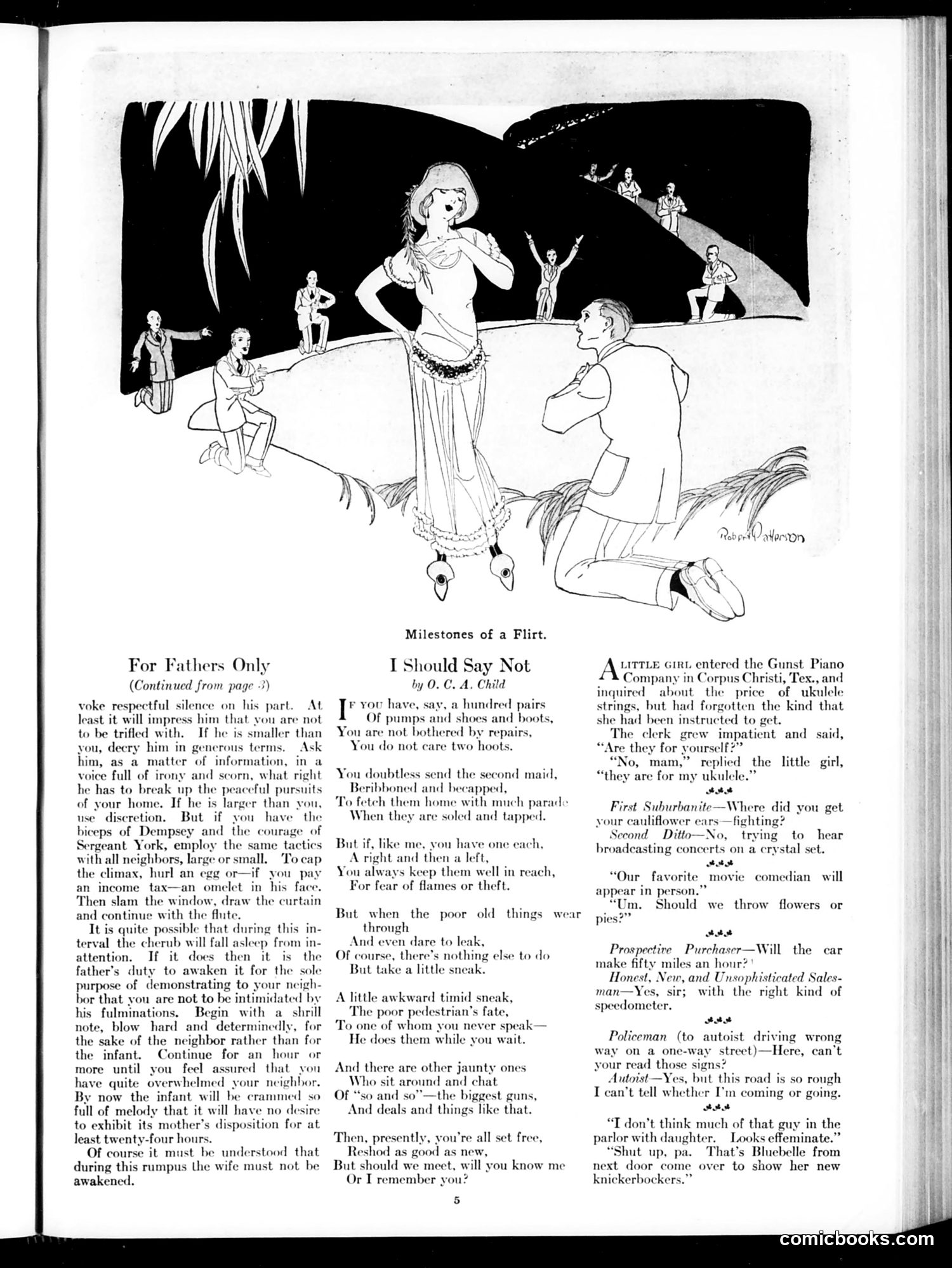
This page contains several unrelated satirical pieces typical of 1920s Judge magazine humor. The main cartoon "Milestones of a Flirt" depicts a woman in an elegant dress surrounded by male admirers in what appears to be a theatrical or circus setting. The accompanying poem by O.C.A. Child satirizes wealthy women's casual attitude toward shoe repair—those with many pairs care nothing about maintenance, while poorer women must carefully preserve their single pair. The humor targets class differences and female vanity. Below are brief comic vignettes mocking contemporary concerns: radio reception on crystal sets, movie attendance, automobile salesmen's deception about speedometers, and traffic law enforcement. The final joke plays on a father's disapproval of his daughter's new "knickerbockers" (baggy pants), which he mistakes for an effeminate visitor—satirizing generational conflict over changing women's fashion in the 1920s. The "For Fathers Only" article (continued from previous page) humorously advises men on handling crying infants and neighbor complaints through aggressive flute-playing.
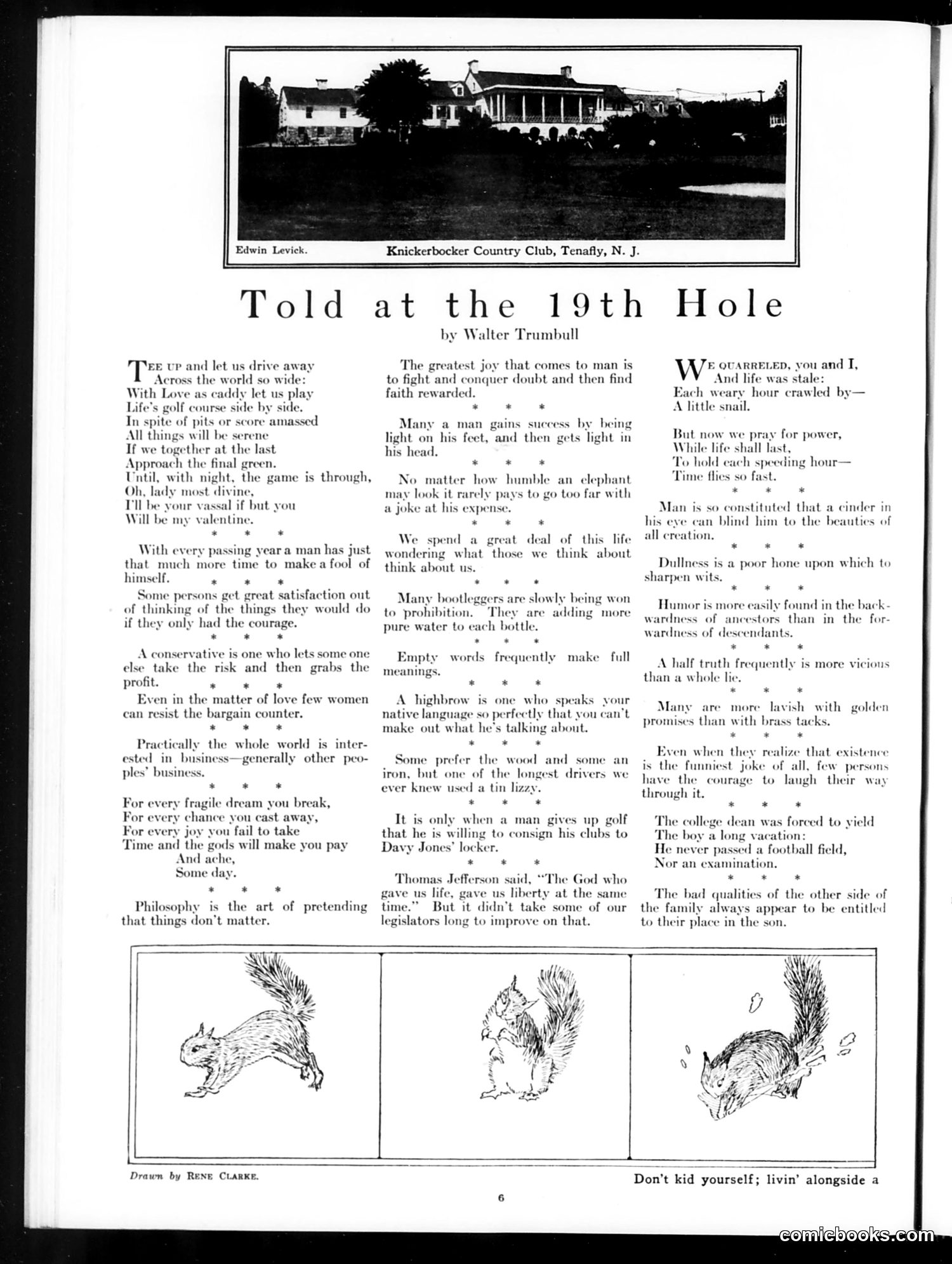
This page presents philosophical aphorisms and light social satire typical of Judge magazine's humor column format. The title references the "19th hole"—golf parlance for the clubhouse bar where golfers gather after play—suggesting casual, after-dinner conversation. The text comprises witty observations mocking human nature and contemporary society. Notable targets include: bootleggers (during Prohibition) "adding more pure water" to alcohol; highbrows who speak perfectly but incomprehensibly; and politicians who improved upon Jefferson's liberty ideals (likely referencing Prohibition legislation itself). The three small sketches by René Clarke depict squirrels in humorous poses, unrelated to the text. The overall tone is genteel cynicism—poking fun at vanity, self-deception, and social pretense rather than mounting serious political critique. The Knickerbocker Country Club photograph establishes the upper-class setting where such witticisms would circulate.
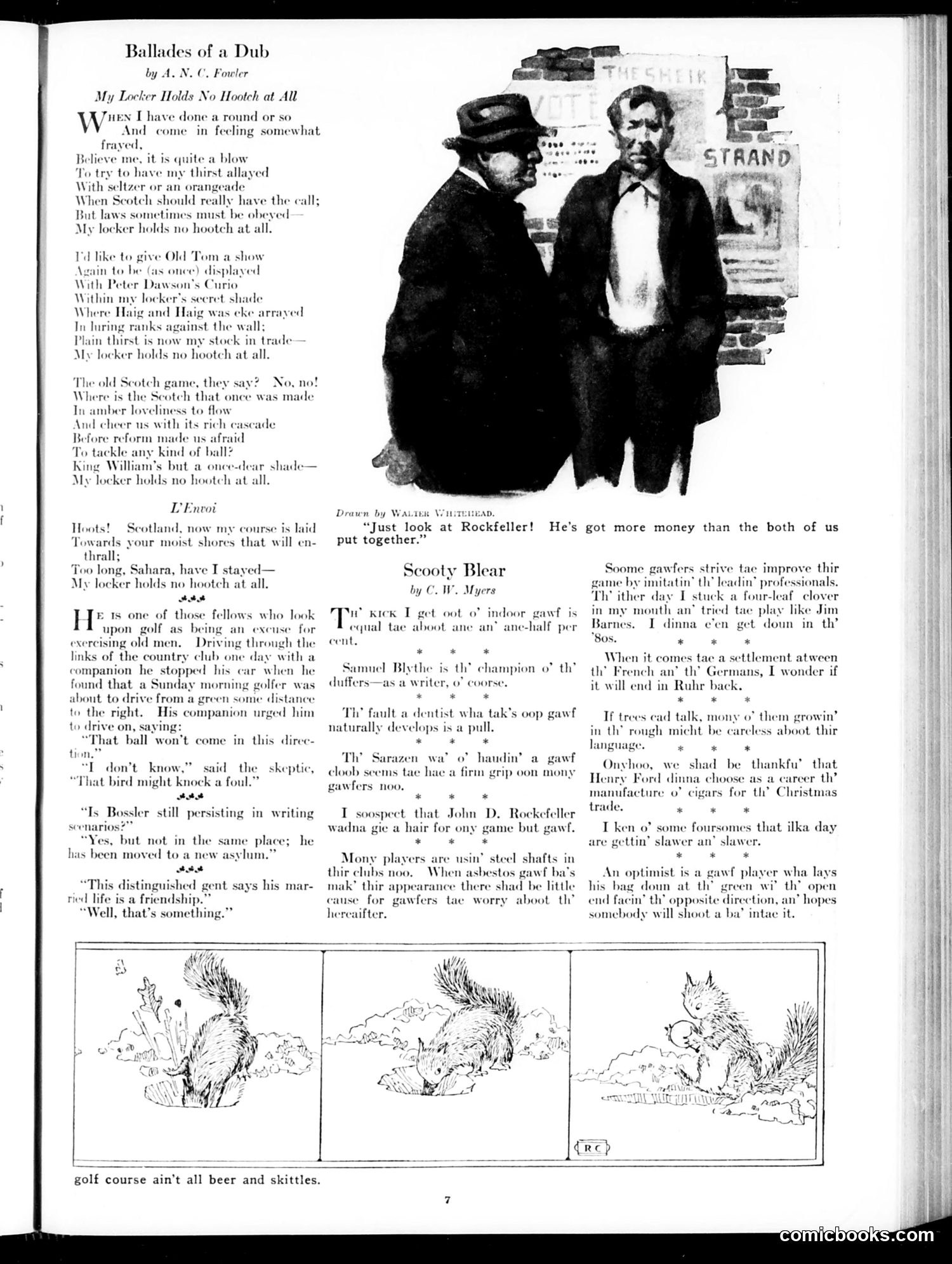
This Judge magazine page satirizes **Prohibition-era frustration**. The main poem "My Locker Holds No Hootch at All" laments the inability to keep alcohol in one's locker, naming specific Scotch whiskeys (Old Tom, Peter Dawson's, Haig and Haig, King William's) that are now forbidden. The speaker nostalgically contrasts Scotland's former "amber loveliness" with his current dry circumstances, concluding he must emigrate to find alcohol. The illustration shows two well-dressed men outside what appears to be a hotel or establishment, with one captioning "Just look at Rockefeller! He's got more money than the both of us put together"—likely suggesting wealth allows circumventing Prohibition's restrictions. The "Scooty Blear" golf column uses Scottish dialect to make satirical observations about golfers and celebrities, including a joke about John D. Rockefeller's wealth. Together, these pieces mock Prohibition's enforcement while suggesting the wealthy could still access forbidden liquor.
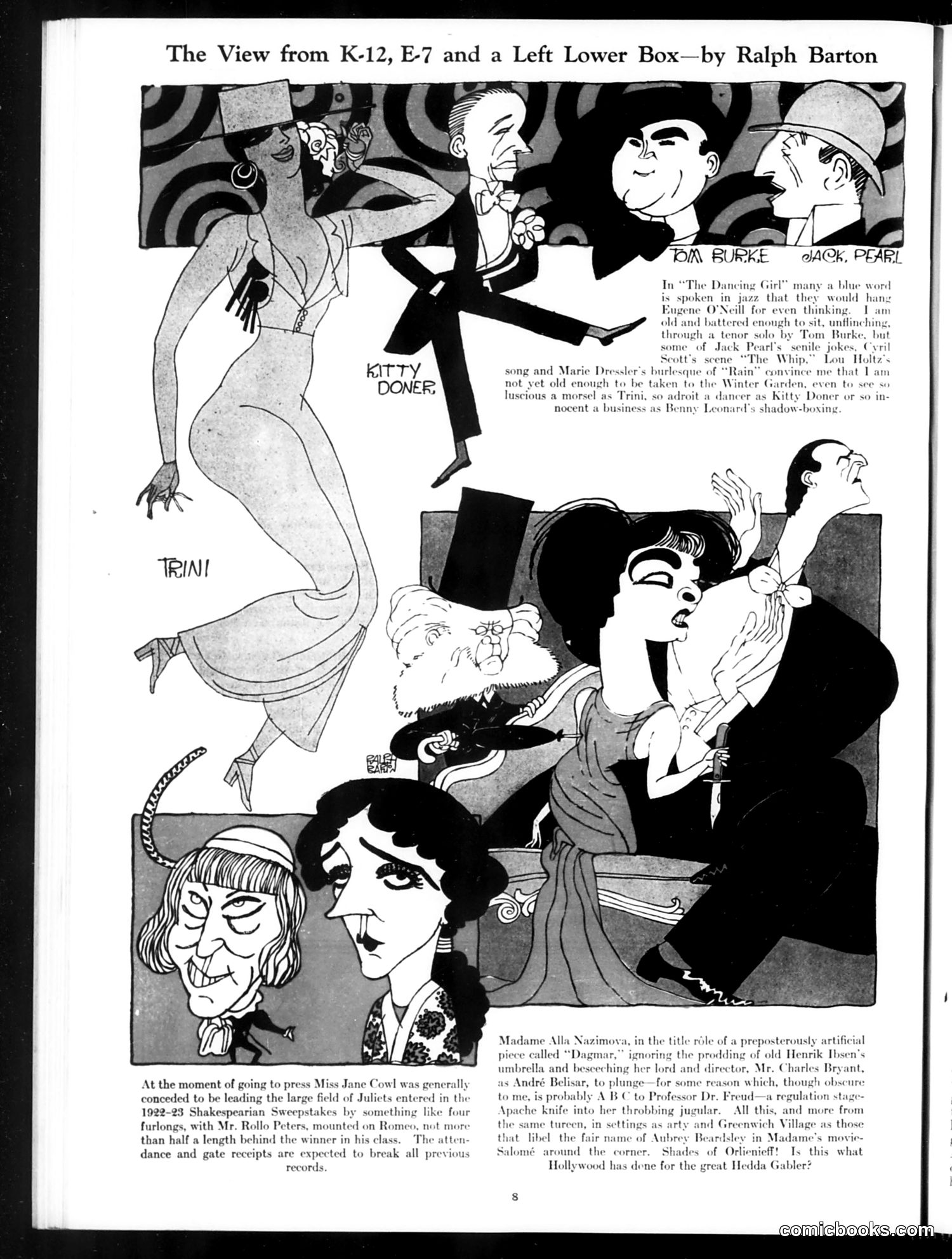
This is a theatrical review/satire by prominent cartoonist Ralph Barton. The caricatures appear to target performers and productions from Broadway's 1922-23 season. **Identified figures:** "Kitty Doner" (a dancer), Jack Pearl (comedian known for vaudeville acts), Tom Burke, Cyril Scott, Lou Holtz, Marie Dressler, and Madame Alla Nazimova (Russian actress in the title role of "Dagmar"). **The satire:** Barton mocks various theatrical performances he's recently seen—criticizing their quality and age-appropriateness. He suggests the shows are mediocre yet drawing large audiences. The exaggerated caricatures are typical of Barton's style, emphasizing unflattering facial features for comic effect. **Modern context:** This requires knowledge of 1920s Broadway performers and shows now largely forgotten. The satire relies on topical theater criticism rather than political commentary—it's entertainment industry gossip rendered as social criticism about theatrical taste.
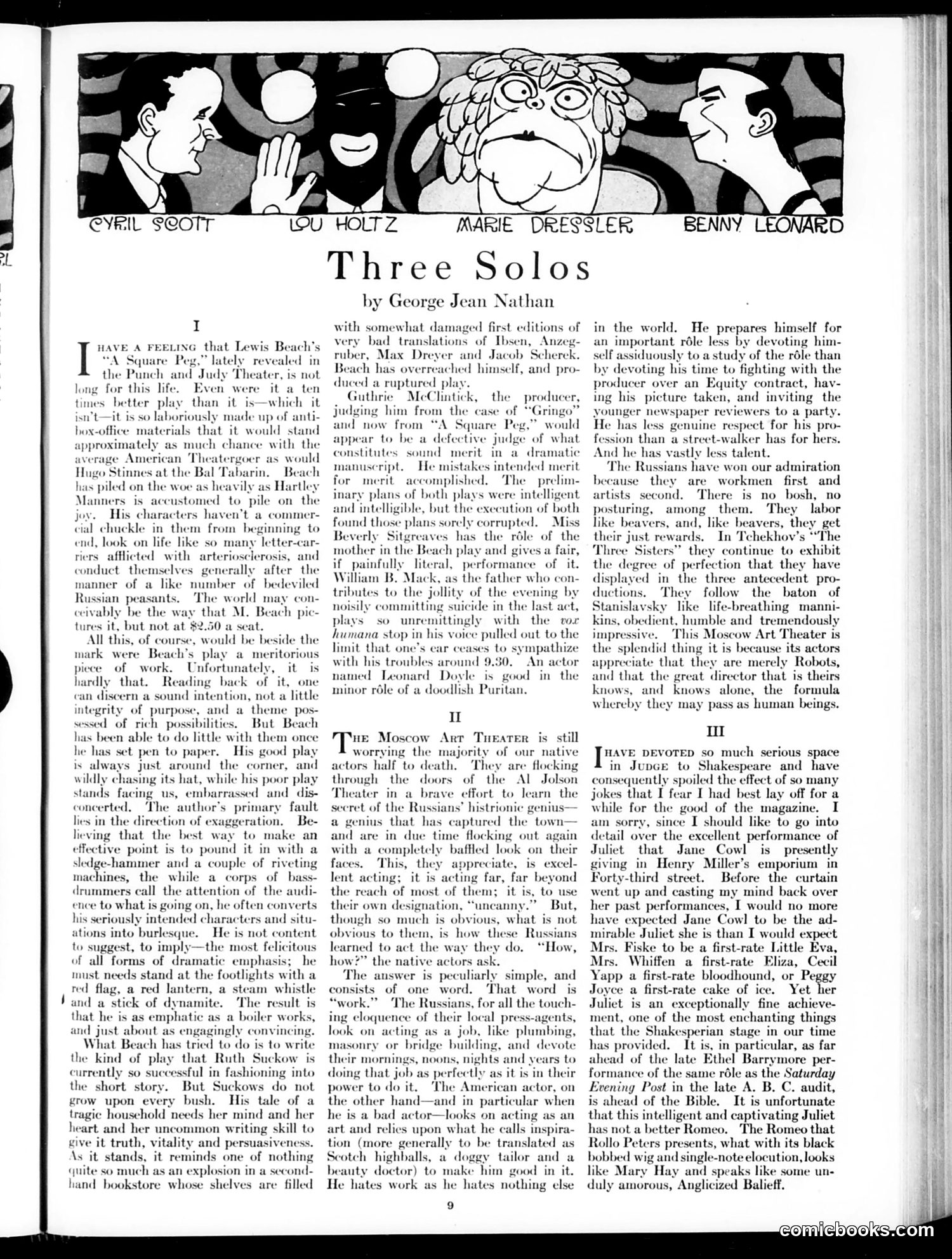
This page from Judge contains a theater criticism essay by George Jean Nathan reviewing three plays, accompanied by caricatures of four performers at the top. **The Caricatures:** The header shows Cyril Scott, Lou Holtz, Marie Dressler, and Benny Leonard—performers likely appearing in the reviewed productions. **The Criticism:** Nathan savagely critiques Lewis Beach's play "A Square Peg," claiming Beach mistakes *intended* merit for actual merit. He accuses Beach of heavy-handed exaggeration, comparing the work to "an explosion in a second-hand bookstore." Nathan argues Beach overwrites, constantly announcing his points rather than subtly suggesting them—like using sledgehammers and dynamite when finesse is needed. The review also criticizes producer Guthrie McClinctick's judgment and praises Beverly Sitgreaves's performance while mocking William B. Mack's overwrought suicide scene. **The Point:** This is standard theatrical criticism—acerbic, witty commentary on contemporary Broadway production. Nathan's style exemplifies Judge's sophisticated cultural commentary for educated readers evaluating contemporary theater.
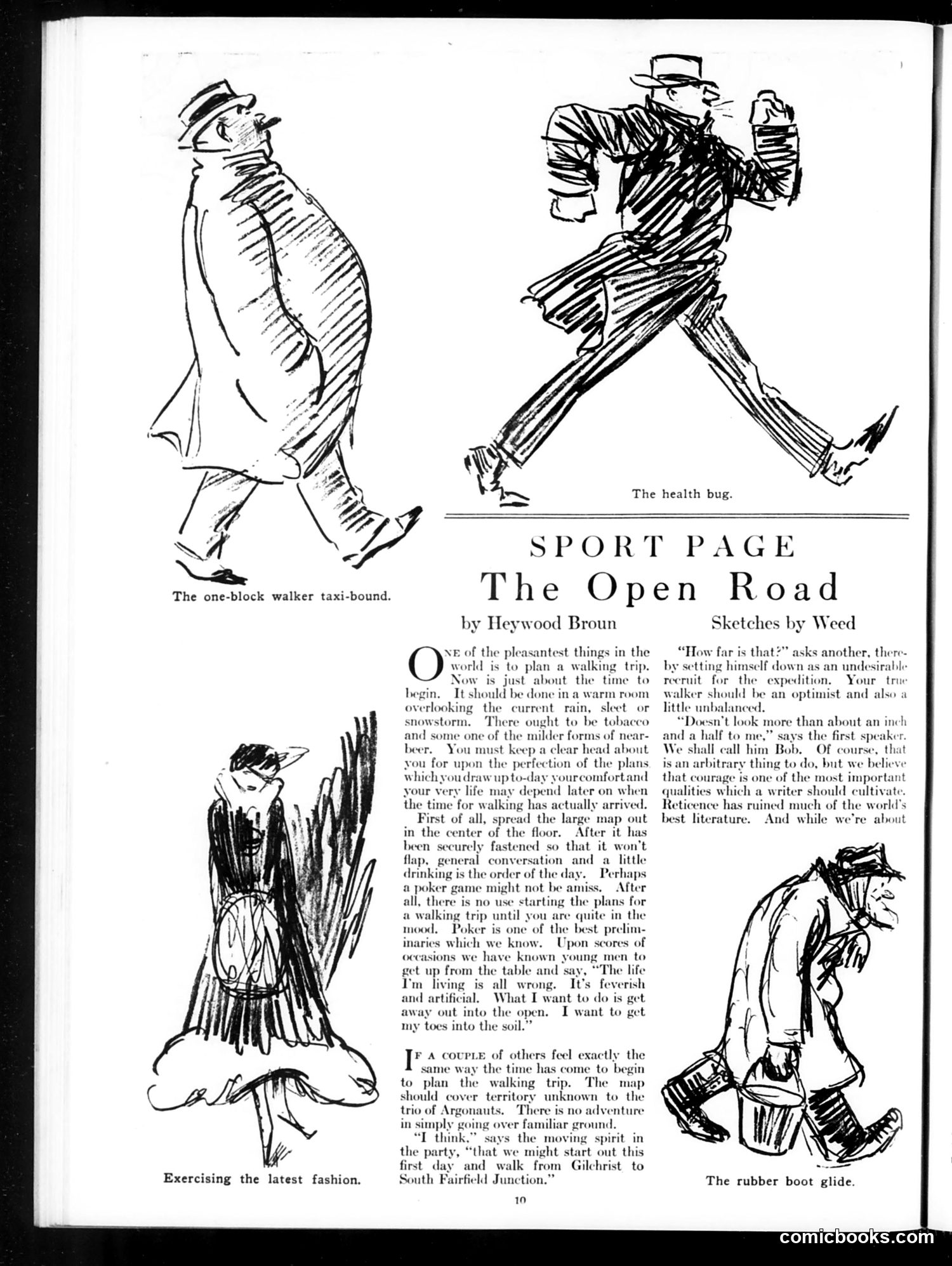
This is a humorous piece by Heywood Broun about planning walking trips. The satirical drawings by Weed illustrate the absurdity of different "walking enthusiasts": **The figures represent types:** - "The one-block walker taxi-bound" - someone who talks big about walking but takes a cab after one block - "The health bug" - a fitness-obsessed person - "Exercising the latest fashion" - someone doing it for trendy reasons rather than genuine interest - "The rubber boot glide" - poorly equipped for actual hiking **The satire:** The article mocks how modern urbanites romanticize "getting back to nature" through walking trips. They plan elaborate expeditions while sitting indoors drinking and playing poker, argue about distances, lack genuine outdoor experience, and ultimately lack the practical commitment or physical capability for real hiking. The joke targets the gap between fashionable aspirations and actual follow-through—a timeless critique of armchair adventurers.
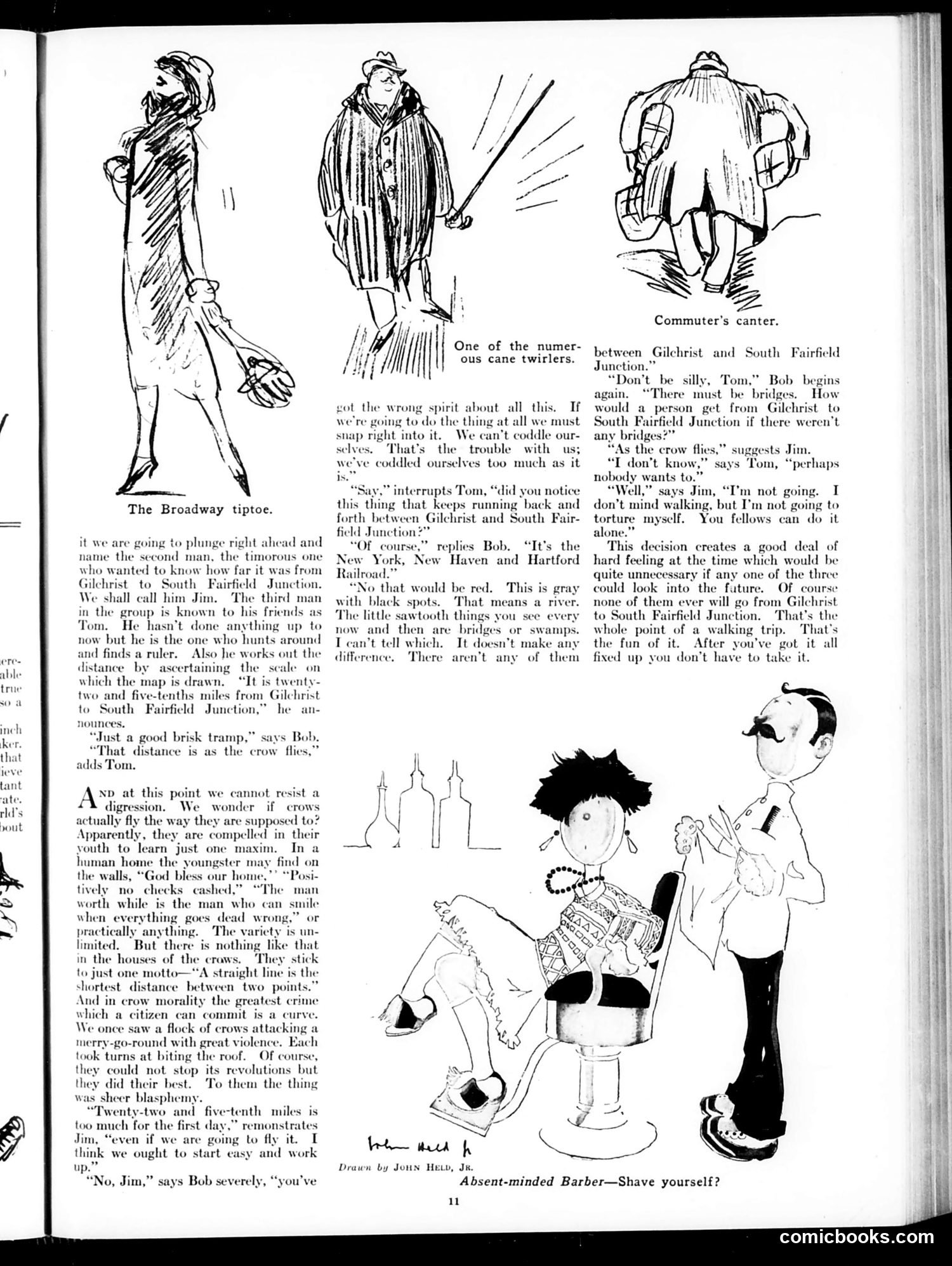
This page contains two separate pieces of satire from Judge magazine: **"Commuter's Canter"** (main text): A humorous sketch about three men planning a walking trip from Gilchrist to South Fairfield Junction (Connecticut locations). The joke mocks overcomplicated trip planning: Bob wants to walk 22.5 miles, Tom insists on measuring with a map ruler, Jim worries about distance, and ultimately *none of them actually go*. The satire targets the type of people who obsess over logistics and planning but never execute their plans. The digression about crows reinforces absurdist humor. **"The Broadway Tiptoe"** and **"Absent-minded Barber"** (illustrations): Quick visual gags. The first depicts an exaggerated walking posture. The second shows a barber offering to let a customer shave themselves—likely mocking distracted service workers or the absurdity of hiring someone who won't do their job. The overall theme: satirizing the gap between intention and action, and the pretensions of certain urban types (commuters, Broadway characters).
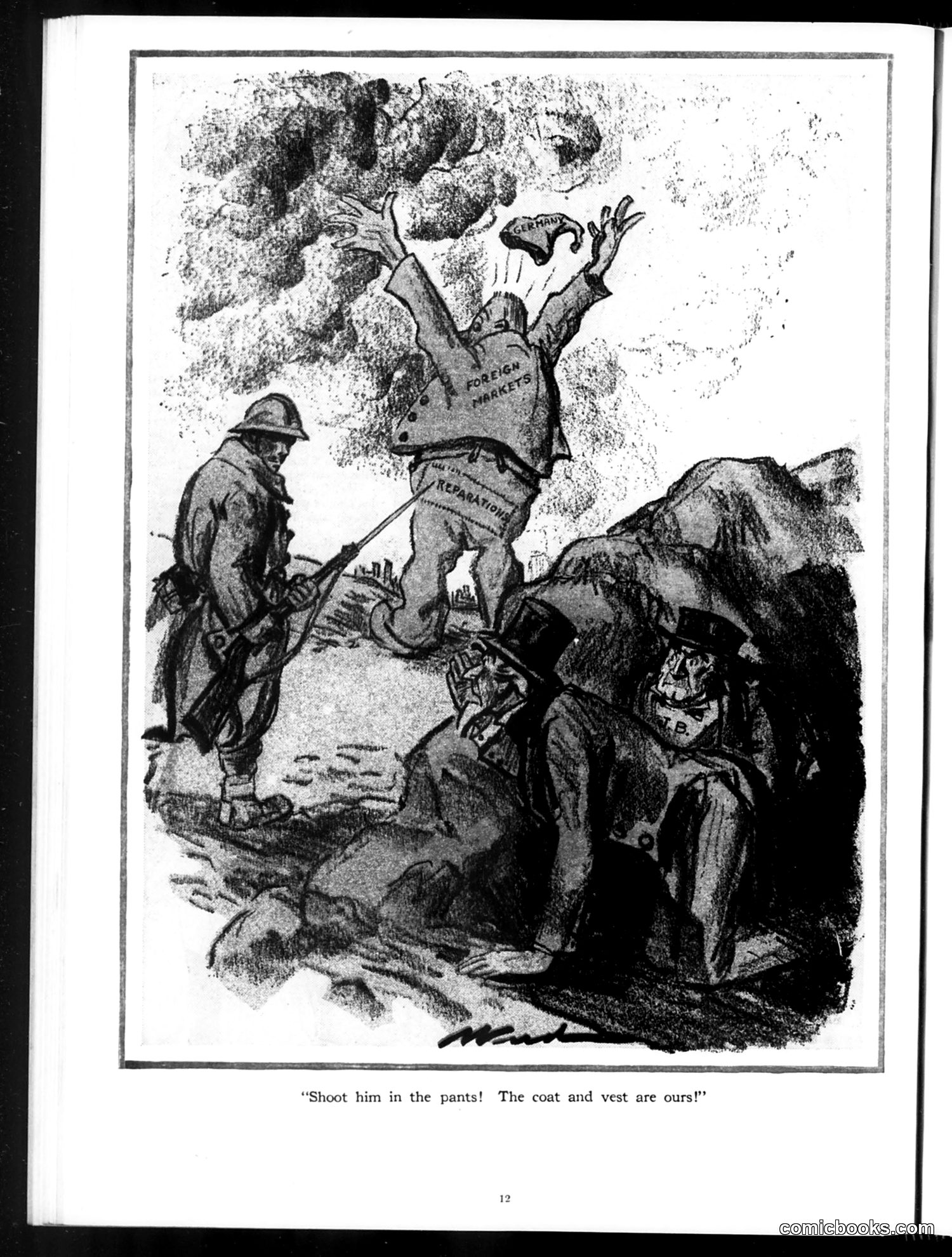
This is a satirical cartoon from *Judge* magazine depicting soldiers or military figures attempting to strip a tall figure labeled "Foreign Interference" of his clothing. The central figure has text on his garments including what appears to be "Foreign" and "Reparations." The cartoon satirizes post-WWI international politics, likely commenting on debates over German reparations and foreign intervention. The soldiers represent Allied nations seeking to extract wealth/resources ("the coat and vest are ours"), while the violent instruction to "shoot him in the pants" suggests both literal and figurative attacks on an enemy. The satire critiques how Allied powers were treating defeated nations—depicted as robbery disguised as military justice. The specific historical moment and nations involved remain unclear without additional context.
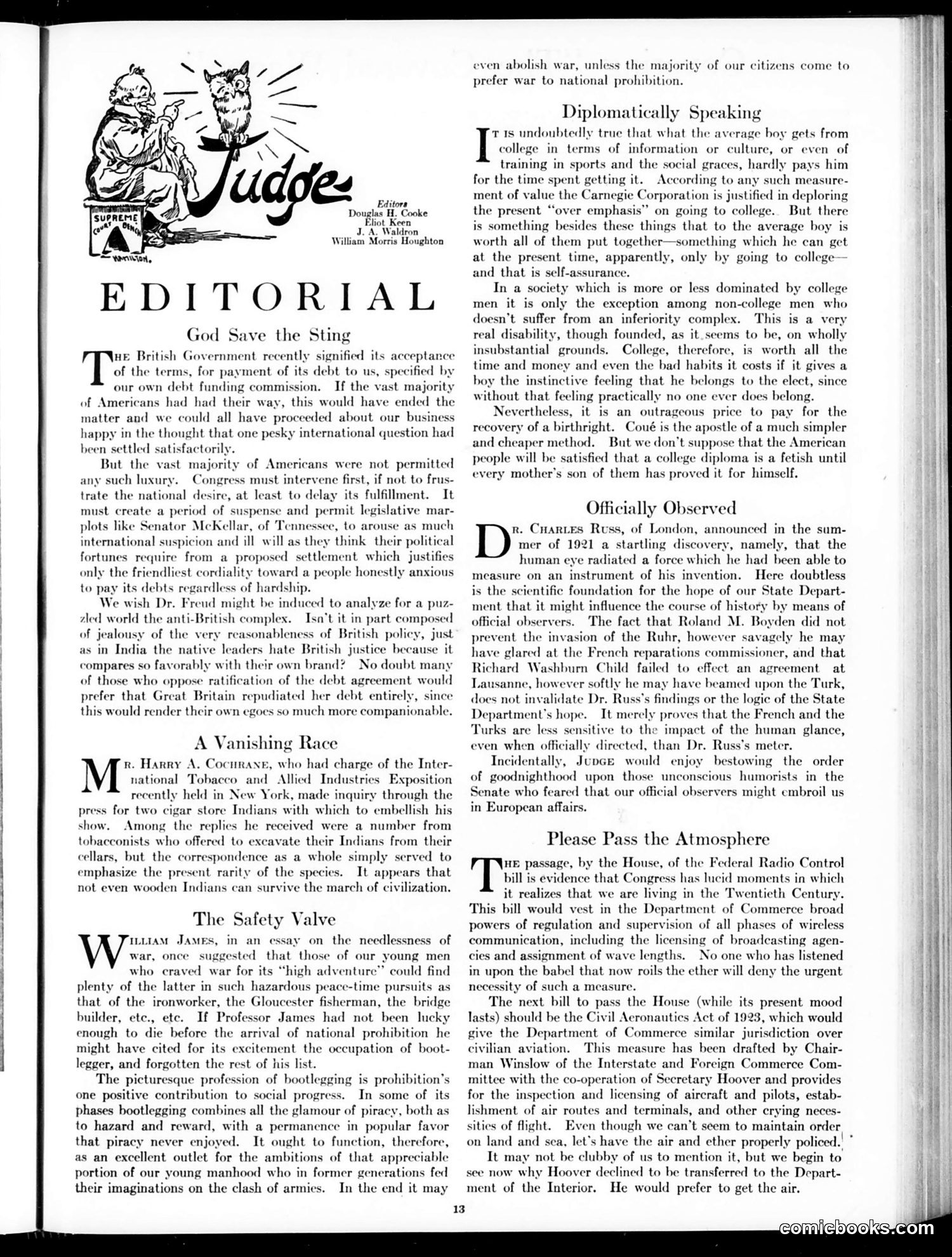
This editorial page from Judge magazine (likely 1920s-early 1930s, based on references) contains several political commentaries: **Main Cartoon**: Shows a baby and a fox-like figure labeled "Judge," illustrating the magazine's satirical stance. **"God Save the Sting"**: Criticizes Congress for delaying British war debt settlement despite public approval. The editors sarcastically invoke Freud to explain American anti-British sentiment, attributing it to jealousy of Britain's reasonableness and justice. **"A Vanishing Race"**: Comments on the disappearance of wooden cigar-store Indian figures—a tongue-in-cheek lament that even these artifacts cannot survive "civilization's march." **"The Safety Valve"**: Argues bootlegging (illegal alcohol production during Prohibition) provides young men the "adventure" they'd otherwise seek in war—a darkly humorous defense of prohibition's unintended consequence. **"Diplomatically Speaking"** and other sections defend college education and federal radio regulation. The page reflects 1920s American debates: debt diplomacy, Prohibition's effects, and technological regulation.
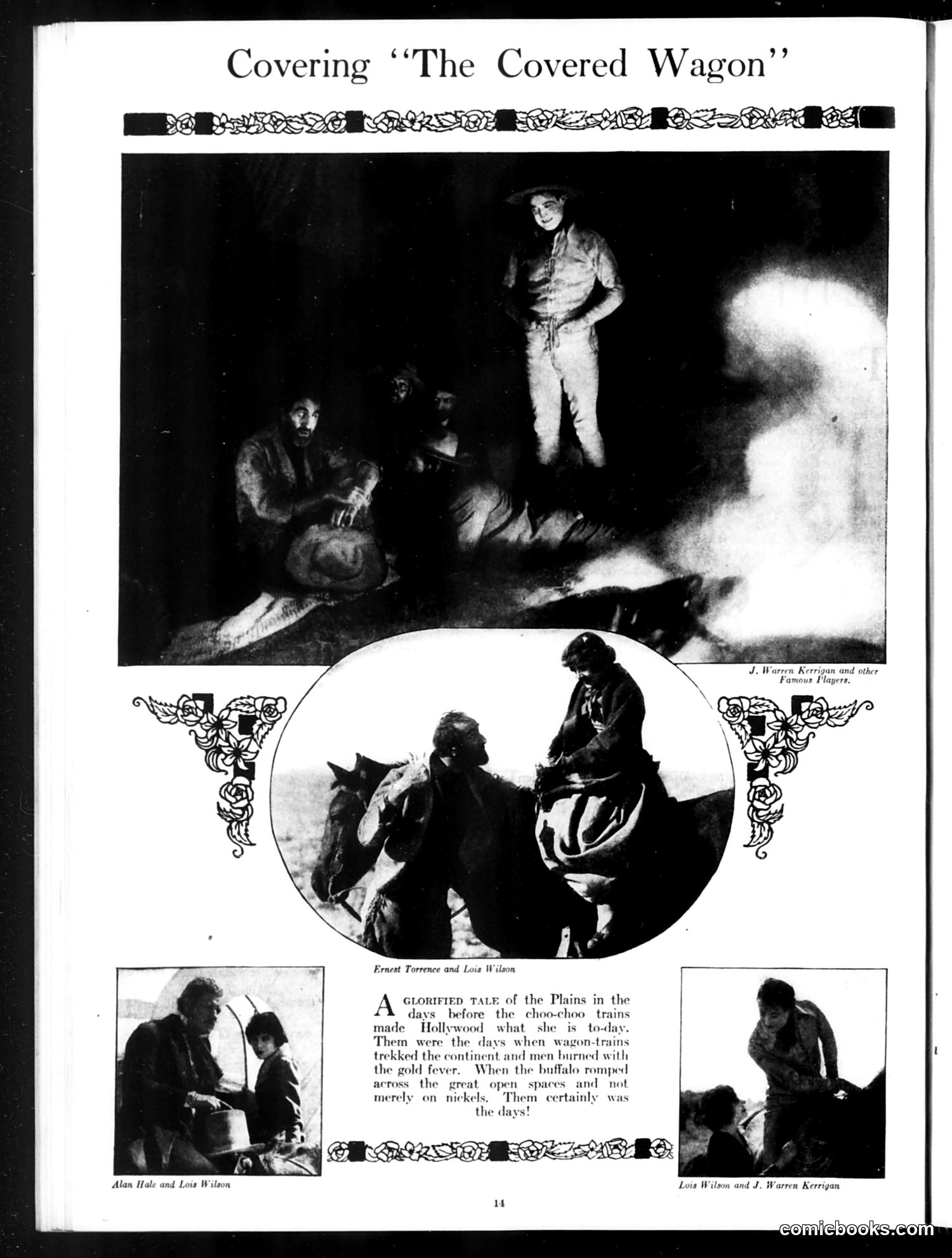
This page reviews **"The Covered Wagon,"** an early Hollywood Western film. The text celebrates the pre-railroad era of American westward expansion, romanticizing wagon trains, gold prospecting, and buffalo herds. The satire is mild: the folksy dialect ("Them were the days") gently mocks Hollywood's nostalgic glorification of frontier life. The reference to buffalo "not merely on nickels" jokes that these animals now exist primarily as images on currency rather than living on the plains. The images show cast members including **Ernest Torrence, Lois Wilson, and Alan Hale** in period costume. This appears to be promotional coverage for a major studio production—*The Covered Wagon* was a significant 1923 film. Judge's tone is affectionate rather than critical, treating the film's romanticization of manifest destiny and frontier adventure as amusing period nostalgia rather than problematic ideology.
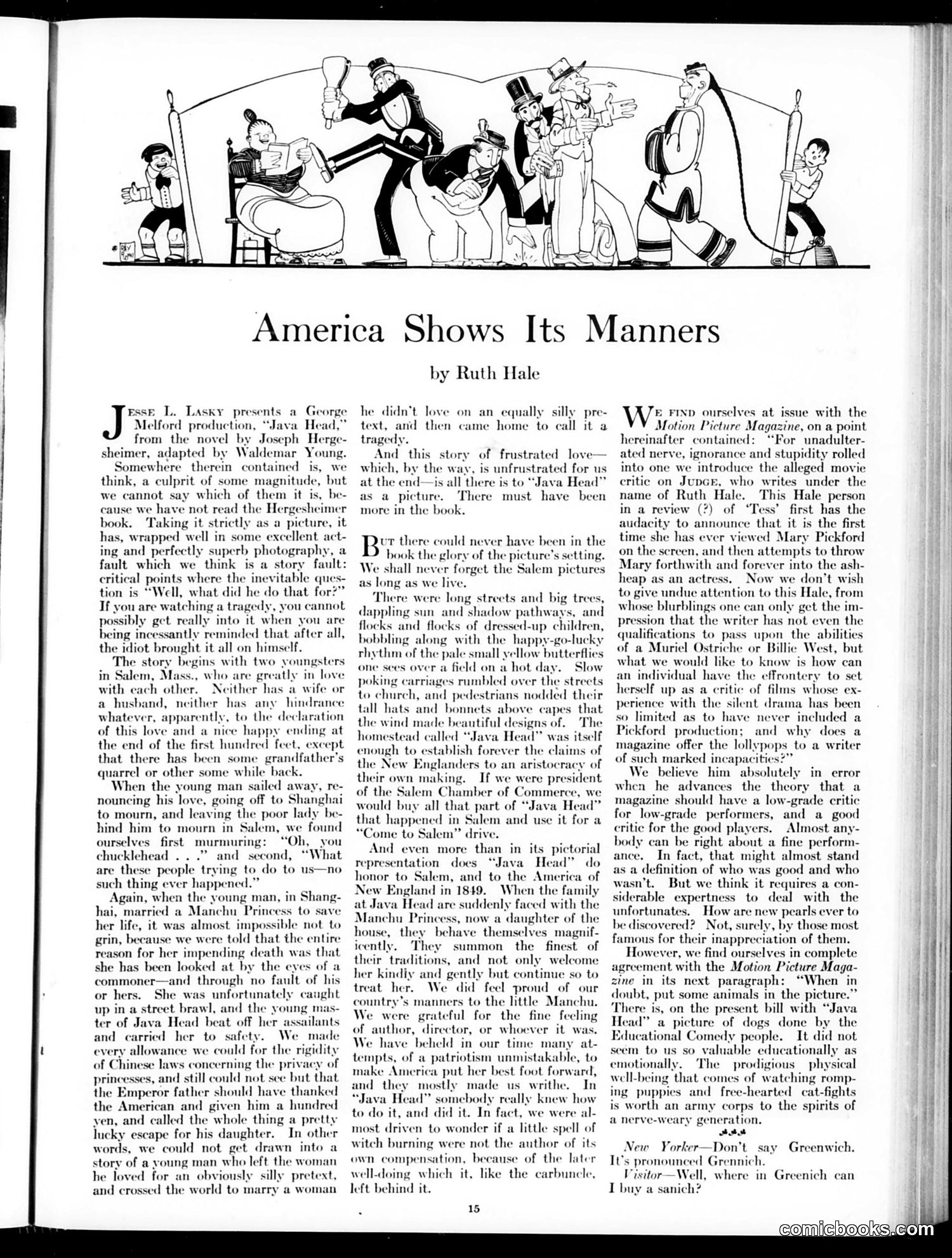
This is a film review by Ruth Hale of "Java Head," a 1921 Paramount production. The cartoon header depicts various figures engaged in chaotic behavior—fighting, drinking, playing instruments—illustrating American social conduct. Hale critiques the film's melodramatic plot (a man abandons his Salem, Massachusetts sweetheart to marry a Manchu princess in Shanghai, then returns) as unintentionally comedic. She finds the lovers' separation and his prejudiced reasoning laughably unconvincing, noting audiences cannot emotionally invest when characters act irrationally. However, Hale praises the film's *actual* achievement: its beautiful cinematography of 1849 Salem and—notably—its depiction of New England aristocrats graciously welcoming the Asian princess into their home. She frames this acceptance as reflecting America's best manners and traditions, appearing to position the film as a progressive statement about cross-cultural hospitality, regardless of its melodramatic failings.
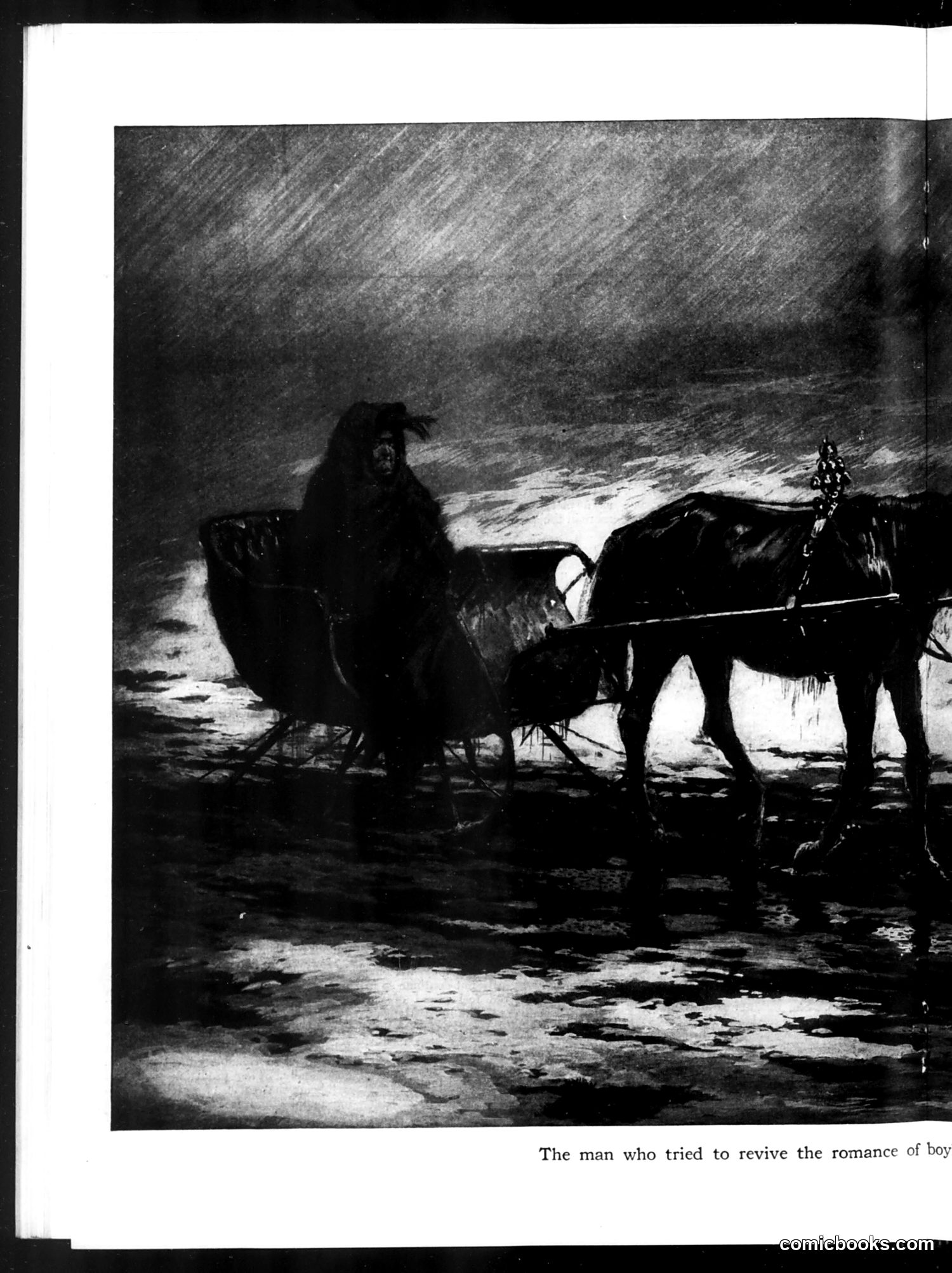
This appears to be a caption from *Judge* magazine accompanying a silhouetted illustration of a horse-drawn sleigh in a winter landscape. The incomplete caption reads: "The man who tried to revive the romance of boy[hood]..." The image depicts a solitary figure in a sleigh being pulled by a horse through snow, rendered in dark silhouette against a lighter snowy background. The romantic, nostalgic mood—the winter setting, the old-fashioned sleigh, the isolated figure—suggests the cartoon is satirizing someone's attempt to recapture youthful experiences or sentiments through outdated means. Without the complete caption or additional context, the specific target of this satire is unclear, but the general joke appears to mock sentimental nostalgia or the futility of recreating past romance through antiquated methods.
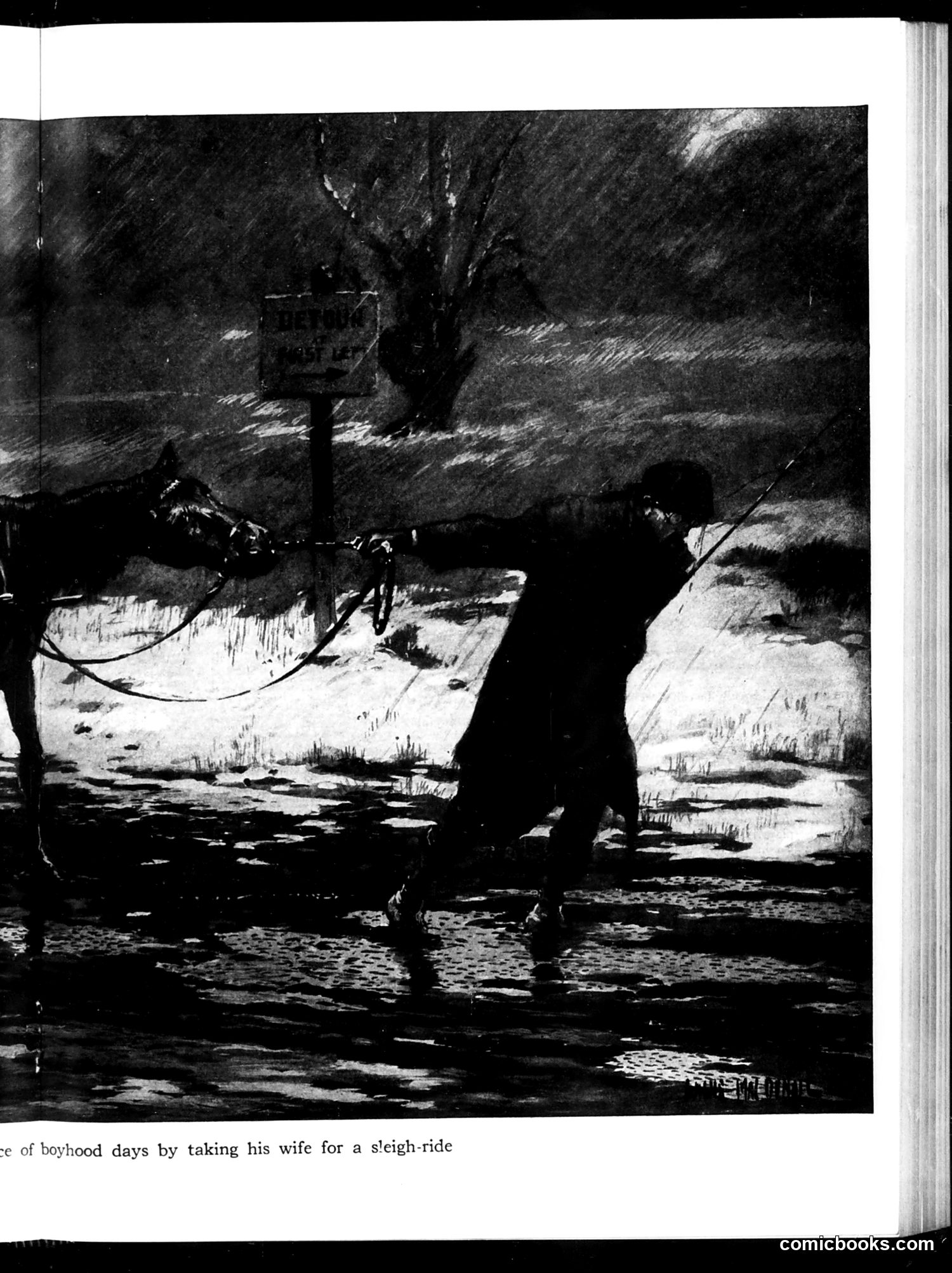
This appears to be a fragment from a Judge magazine article or caption about recapturing "boyhood days by taking his wife for a sleigh-ride." The black-and-white photograph shows a silhouetted figure with a horse and sleigh in a snowy landscape. The image quality and composition suggest this is documenting an actual winter recreational activity rather than a political cartoon. The caption's humor likely plays on the contrast between nostalgic, carefree boyhood experiences versus adult married life—the joke being that a man tries to recreate youthful fun by involving his wife in a sleigh ride. Without seeing the full article context or additional pages, the specific satirical point remains unclear, though it appears to comment on masculinity, nostalgia, or marital dynamics in early 20th-century America.
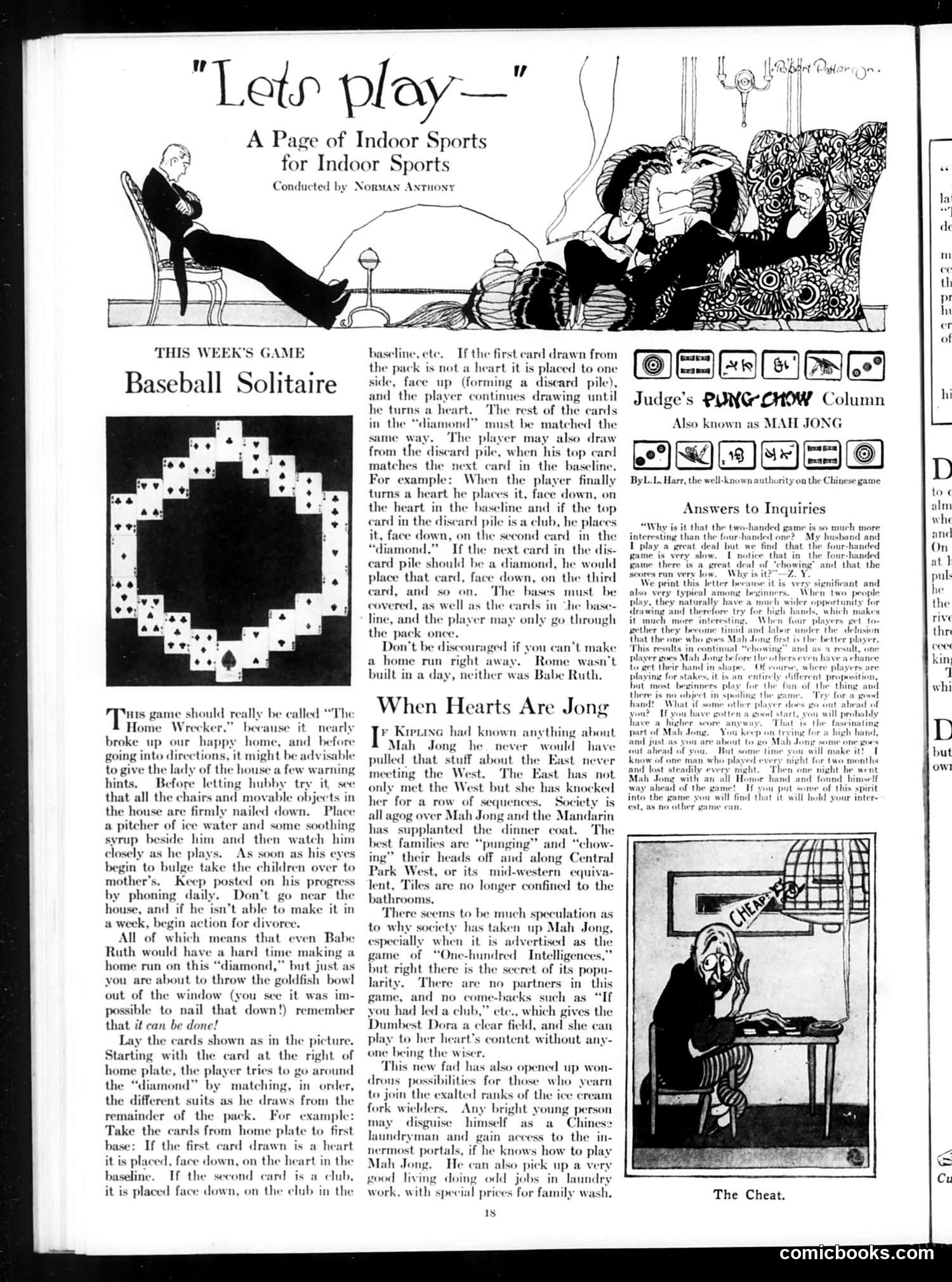
This page from *Judge* presents humorous indoor game instructions and social commentary typical of early 20th-century satirical magazines. **"Baseball Solitaire"** is a mock card game presented as marital chaos. The joke: a husband playing solitaire becomes so absorbed and frustrated that he may destroy the house, requiring the wife to remove children and threaten divorce. The repeated warnings ("nail down furniture," "keep water nearby") exaggerate masculine frustration over a simple card game. The reference to "Babe Ruth" grounds it in contemporary sports culture, suggesting even the greatest baseball player couldn't master this frustrating solo game. **"When Hearts Are Jong"** satirizes the craze for Mah Jong, the Chinese tile game then fashionable among wealthy American society women. The satire mocks: (1) women claiming intellectual sophistication while playing a "dumb" game, (2) the game's appeal to those wanting to appear intelligent without actual effort, and (3) a snobbish social climbing opportunity—anyone posing as a Chinese laundryman could infiltrate high society if they learned the game. The humor targets both gendered assumptions about women's intelligence and ethnic stereotyping.
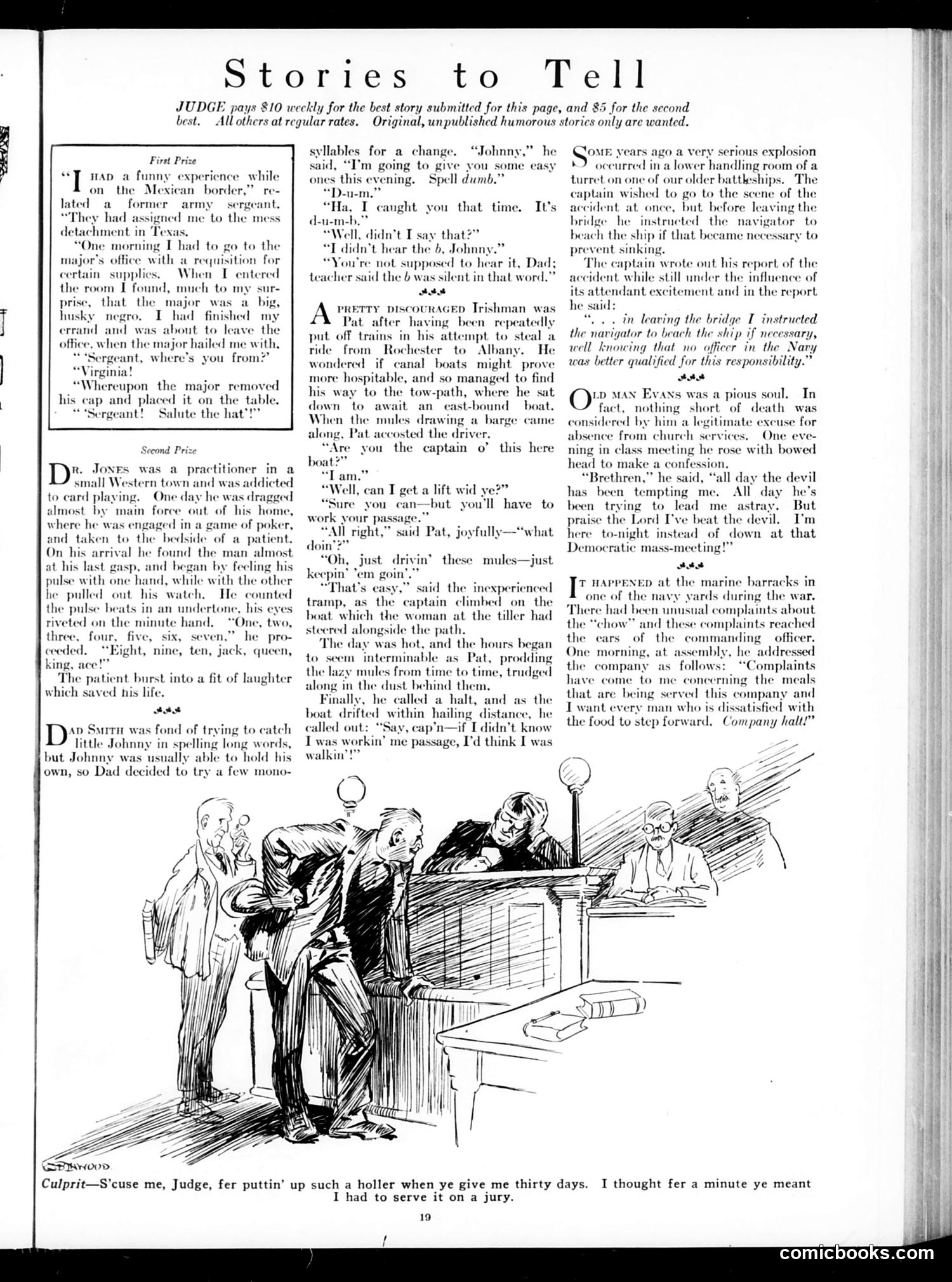
This page contains several humorous short stories with the header "Stories to Tell," a regular Judge magazine feature paying writers $10 for the best submission. The **cartoons and stories satirize** various social types: 1. **Army mess sergeant story**: Mocks military absurdity—a major demands the sergeant salute his hat rather than him, playing on rigid military protocol taken to ridiculous extremes. 2. **Country doctor story**: Jokes about an absent-minded physician so absorbed in counting pulse beats that he unconsciously counts like playing cards ("jack, queen, king"), accidentally curing his dying patient through laughter. 3. **Irish immigrant story**: Stereotypes an Irish laborer attempting to stow away on a canal boat, using dialect humor. He misunderstands "captain" and "passage," displaying comic ignorance. 4. **Navy battleship story**: Describes a captain's report containing an accidental double entendre about beaching a ship, exploiting bureaucratic awkwardness. 5. **Religious devotion story**: Presents Old Man Evans as comically pious, prioritizing church attendance over health concerns. The humor relies heavily on **period stereotypes, wordplay, and social observation** typical of early 20th-century American satire.
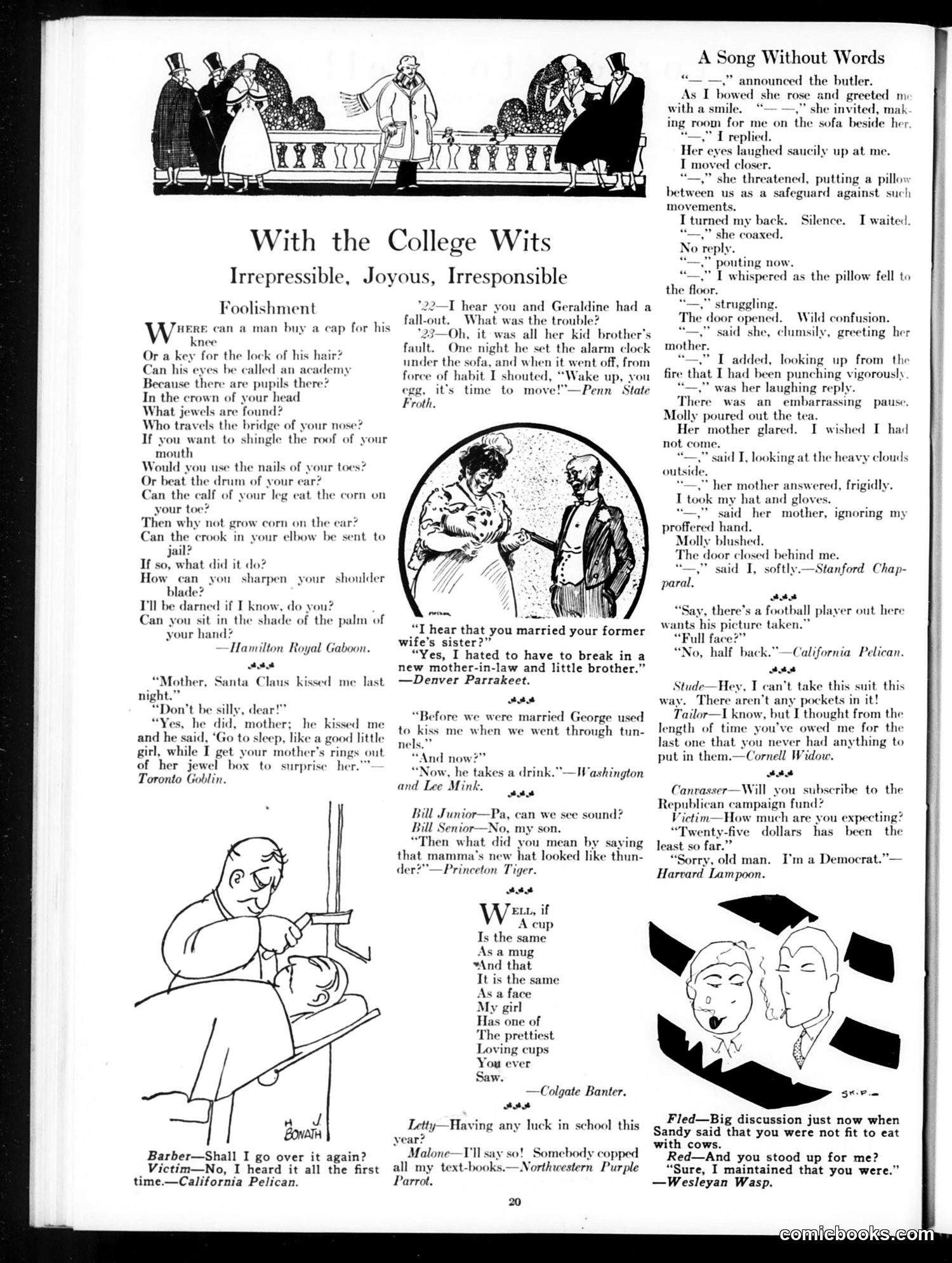
This page collects humorous wordplay and jokes sourced from college humor magazines (Penn State Froth, Princeton Tiger, Cornell Widow, etc.). The content reflects early 20th-century collegiate wit. **The main cartoons:** - A barber joke about repetitive haircuts - A man performing acrobatics with a cane (accompanying a riddle section) - Two illustrated profiles of laughing faces at bottom right **The satirical content** targets: - Pretentious wordplay and puns (anatomy-based riddles: "nails of your toes," "drum of your ear") - Marital absurdities (a man marrying his ex-wife's sister to avoid training a new mother-in-law) - Domestic comedy (alarm clocks under sofas causing confusion) - College-boy banter about appearance and morality - Political indifference ("I'm a Democrat" as a punchline deflecting donation requests) **The "Song Without Words"** narrative describes awkward courtship interrupted by an intrusive mother—relatable middle-class romantic embarrassment. The humor emphasizes clever wordplay over substance, reflecting Jazz Age college culture's emphasis on irreverent, witty youth.
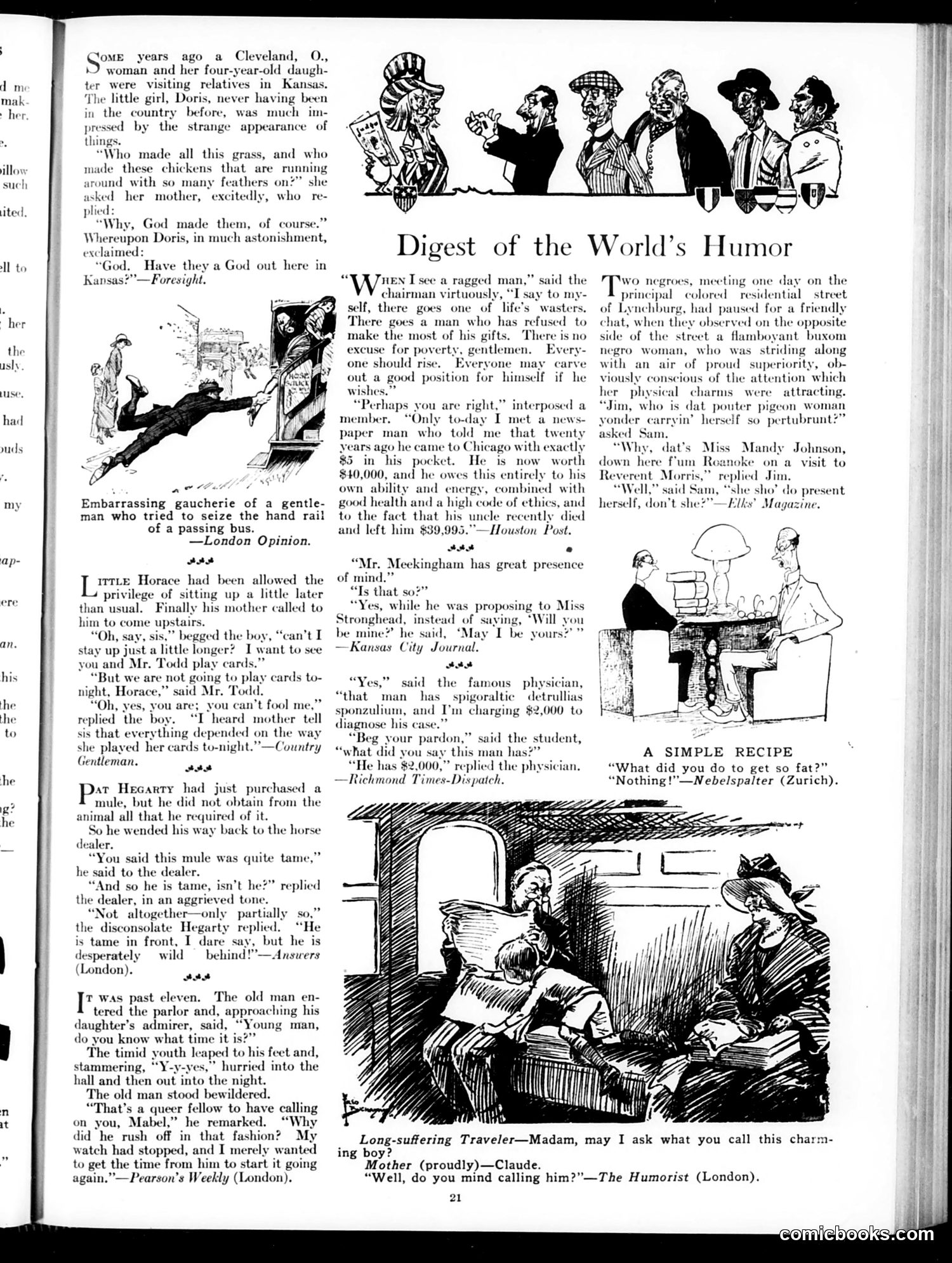
This page collects humorous anecdotes from various sources, primarily showcasing period attitudes and social dynamics: **Main cartoons/stories:** 1. **Child's innocence**: A four-year-old girl from Cleveland, visiting Kansas, questions whether God exists there too—satirizing rural/urban cultural differences. 2. **Social embarrassment**: A gentleman awkwardly attempts to grab a bus handrail, illustrated as physically comedic mishap. 3. **Racial caricature**: Two Black men observe a woman, using exaggerated dialect ("dat pouter pigeon"). This reflects the era's endemic racist humor in mainstream publications. 4. **Domestic/courtship humor**: Stories about a boy wanting to stay up late, a man buying a partially-wild mule, and a suitor misinterpreting a father's question about the time—all playing on misunderstandings and social awkwardness. 5. **"Simple Recipe" cartoon**: A mother proudly describes her overweight child's weight gain to a visitor. The page represents early 20th-century American humor: largely innocent domestic situations mixed with casual racial stereotyping considered acceptable for mainstream audiences then.
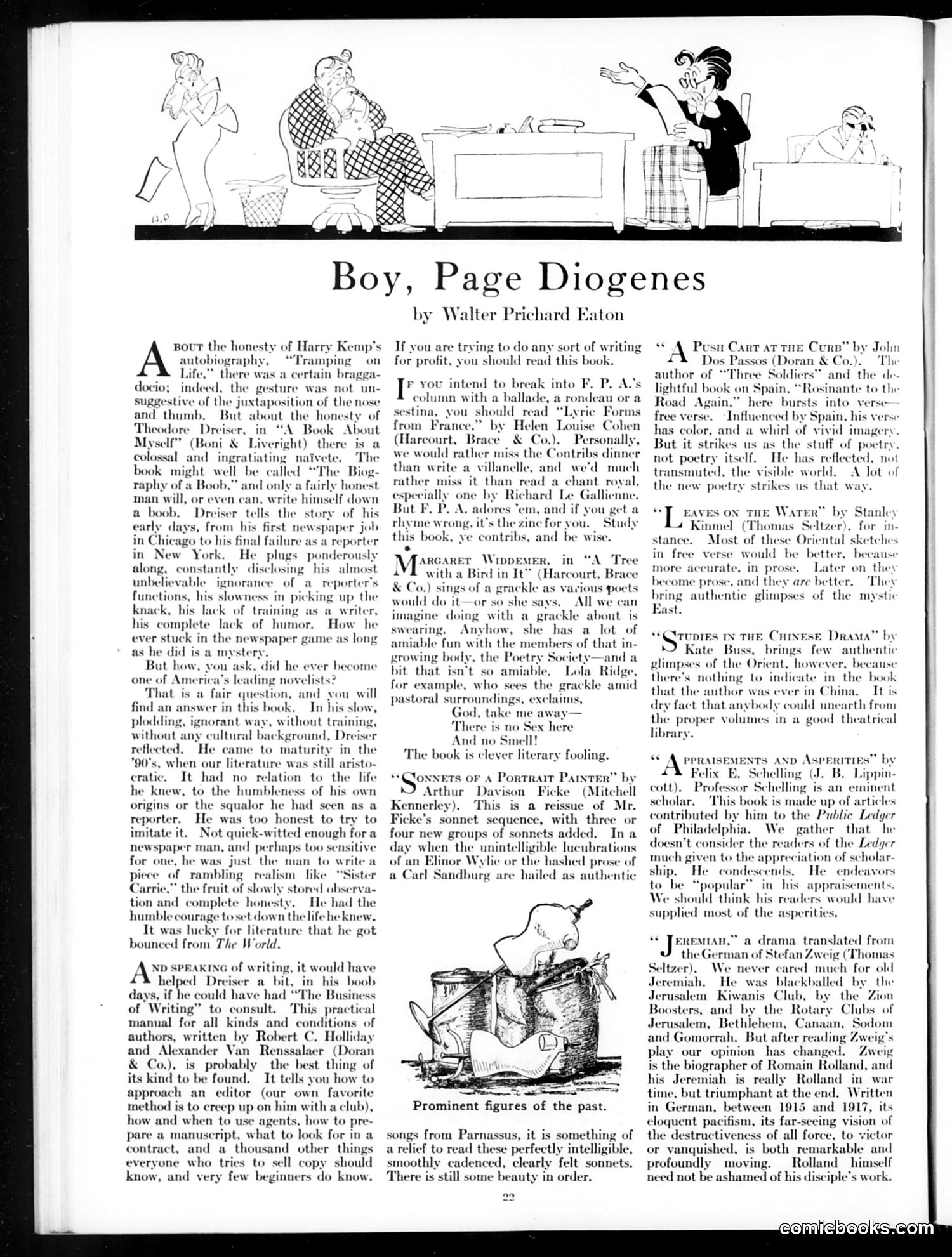
This is a book review column, not a political cartoon. The illustration at top is decorative, showing a domestic scene unrelated to the content below. **What's Being Discussed:** Walter Prichard Eaton reviews several literary works, primarily Theodore Dreiser's autobiography. The key point: Dreiser succeeded *despite* lacking conventional training or cultural sophistication. Writing in the 1920s, Eaton praises Dreiser's honest, unpolished realism—his willingness to write about working-class life he actually knew rather than imitating the aristocratic literature that dominated earlier American letters. **The Satire:** The subtle humor targets literary pretension. Eaton mocks precious poetry trends (Elinor Wylie, Carl Sandburg) while defending Dreiser's ungainly but truthful approach. He jokes about approaching editors "with a club" and pokes fun at overly clever modernist poetry. **Historical Context:** This reflects 1920s debates about American literature's shift from genteel tradition toward realism and modernism—Dreiser represented authenticity over refinement.
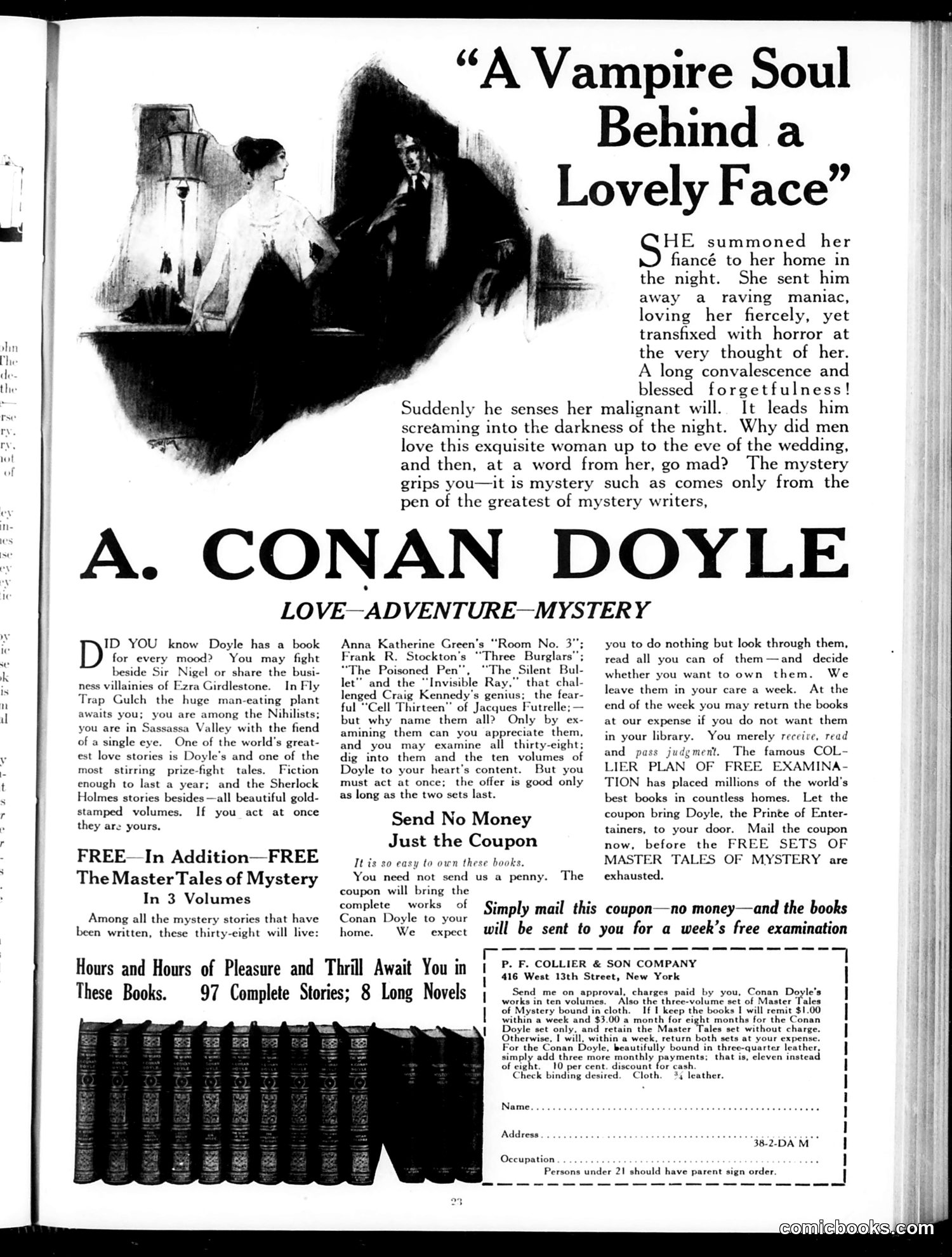
This page is **primarily a book advertisement**, not political satire. It promotes P.F. Collier & Son Company's collections of works by Arthur Conan Doyle and a companion "Master Tales of Mystery" set. The dramatic illustration and headline ("A Vampire Soul Behind a Lovely Face") serve as marketing copy, depicting a mysterious, supernatural narrative to entice readers—likely evoking Doyle's reputation for mystery and suspense writing. The text emphasizes Doyle's versatility across genres: adventure, romance, mystery, and science fiction. The advertisement uses an innovative "free examination" sales strategy—readers could request books on approval without payment, keeping them if satisfied or returning them at the company's expense. This was a novel direct-mail marketing approach for the era. The page reflects early 20th-century publishing and consumer culture: prestigious leather-bound collections, installment payment plans, and aggressive marketing targeting educated middle-class readers seeking "hours of pleasure and thrill."
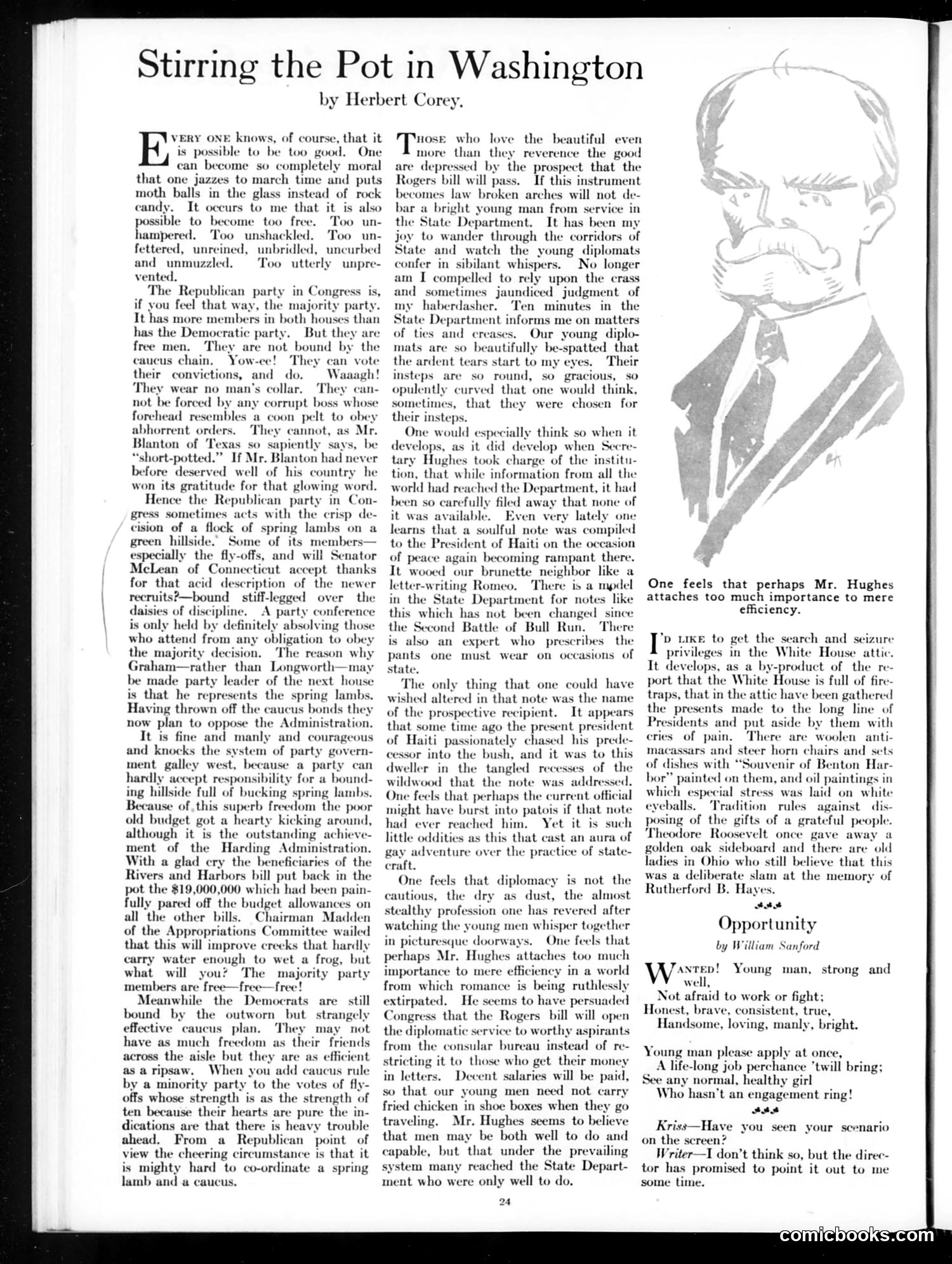
This is a political commentary by Herbert Corey satirizing Republican Party dysfunction in Congress. The piece uses the metaphor of "spring lambs" to mock Republican representatives who, freed from party discipline (the "caucus chain"), act chaotically and unpredictably—like uncontrolled animals rather than organized legislators. Corey contrasts this with Democrats, who remain bound by the "caucus plan" but function efficiently as a result. The satire targets specific issues: the Rivers and Harbors bill's wasteful $19 million reinsertion into the budget, and the Rogers bill regarding State Department hiring standards for diplomats with "broken arches." The caricature on the right appears to be a diplomat or State Department figure, likely Secretary Hughes (referenced in the text), embodying the article's critique of diplomatic pretension and inefficiency. The essential joke: Republican freedom has become anarchic chaos, while Democratic discipline maintains order—inverting typical party stereotypes for comic effect.
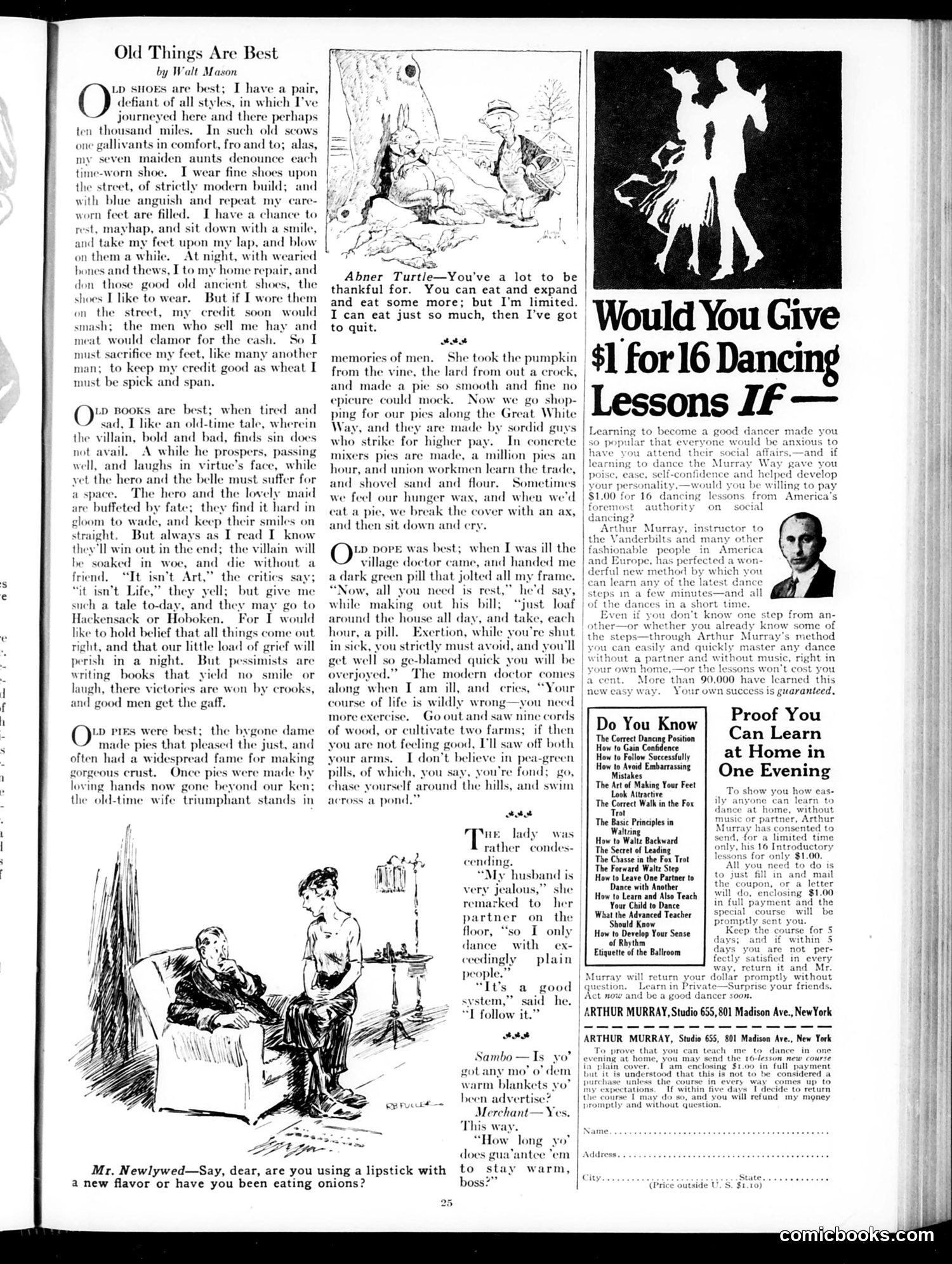
This page from *Judge* contains primarily **nostalgic essays by Walt Mason** rather than political cartoons. The main content is a poem titled "Old Things Are Best," which romanticizes outdated items—worn shoes, old-fashioned books with moral lessons, homemade pies, and village doctors—contrasting them unfavorably with modern equivalents that prioritize profit and efficiency. The small cartoons illustrate these themes. One shows a couple where the husband resents his wife dancing only with "exceedingly plain people" to avoid jealousy. Another depicts a merchant and customer discussing warm blankets, using dialect humor typical of the era. The page's satire targets **modernity itself**: mass production, labor unions (derided in the pie section), modern medicine's emphasis on exercise over rest, and commercialism. This reflects early 20th-century conservative nostalgia—a common *Judge* theme—lamenting industrialization's replacement of craftsmanship and simpler living. The advertisements for dancing lessons alongside this content create ironic contrast.
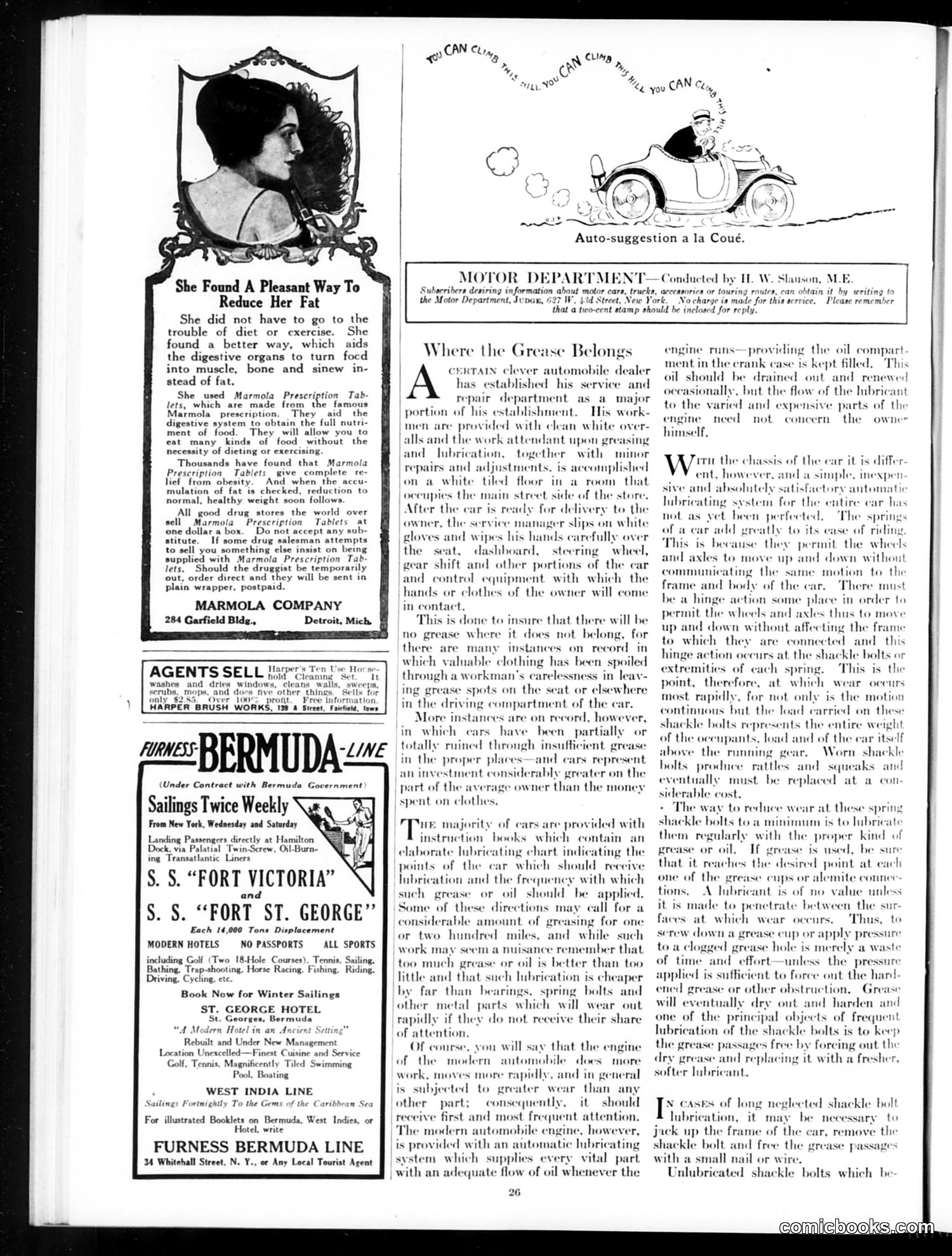
This page is primarily **advertisements and instructional articles** rather than political satire. The main cartoon appears top-right: "Auto-suggestion à la Coué," depicting a man in a car repeatedly chanting "YOU CAN CLIMB THE HILL" while driving uphill. This references **Émile Coué**, a French psychologist famous for the auto-suggestion method (positive self-talk), popular in the 1920s. The joke satirizes the fad by suggesting willpower alone won't make a car climb hills—mechanical power matters more. The left page features a weight-loss advertisement for **Marmola Prescription Tablets**, promoting them as an easy alternative to dieting or exercise. The bulk of the page contains practical **automotive maintenance advice** about proper greasing and lubrication procedures—not satire but instructional content aimed at car owners. The remaining advertisements promote **Bermuda cruise lines, hotels, and brushes**. This is a typical Judge magazine layout mixing humor, advertisements, and practical information.
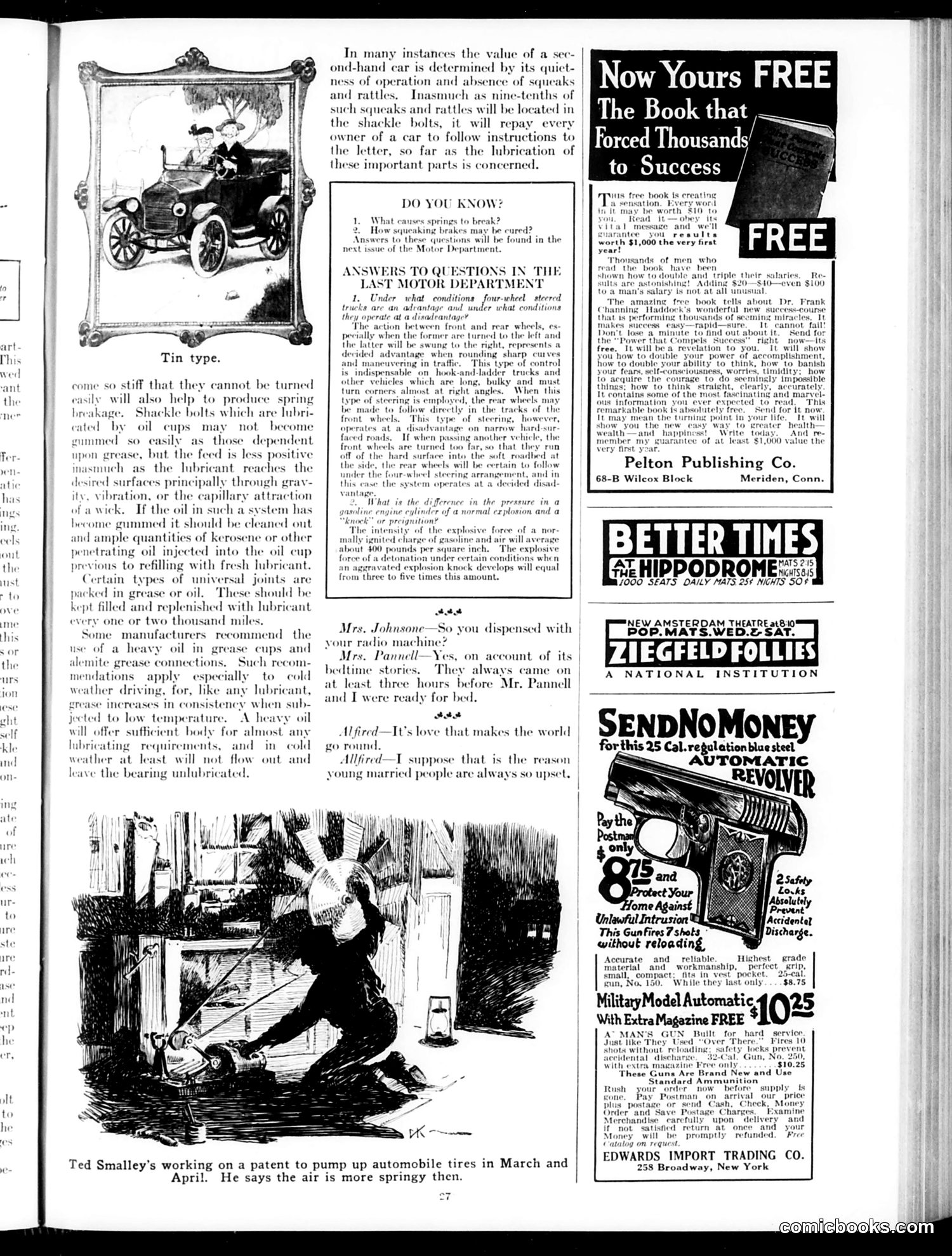
This page is primarily **advertising and technical content** rather than political satire. The main cartoon shows **Ted Smalley working on a patent to pump up automobile tires**, with a visual pun: he claims "the air is more springy then" in March/April—the humor being that spring air is literally "springier." The left column contains serious **automotive maintenance advice** about lubricating automobile parts, particularly shackle bolts and universal joints. The right side features **period advertisements** (circa 1920s-1930s based on styling): - A "success manual" book offer - Hippodrome theater promotion - Ziegfeld Follies advertisement - An "Automatic Revolver" gun for $8.75 - A military model automatic pistol There is **no significant political or social satire** on this page. The single cartoon is a mild mechanical/seasonal pun rather than commentary. This appears to be a typical mixed-content issue combining technical information with commercial advertisements.
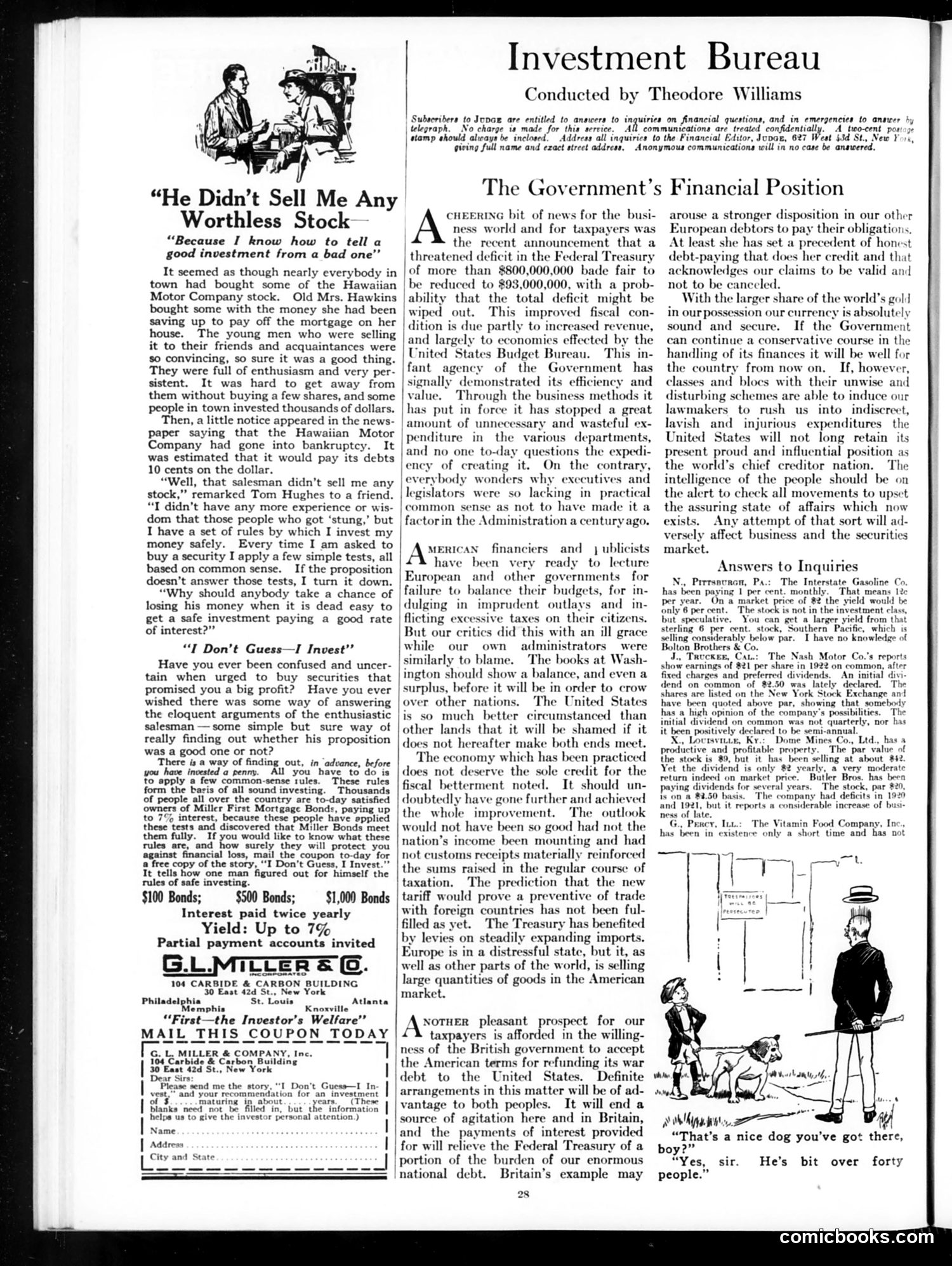
This page satirizes investment fraud and financial naivety in early 20th-century America. The main cartoon shows a confident man boasting that a salesman "didn't sell me any worthless stock"—implying he possesses special investment wisdom others lack. The satirical point is that he's deluding himself; his "rules" are presented as common sense, yet many townspeople lost their savings on Hawaiian Motor Company stock that went bankrupt, paying only 10 cents per dollar. The G.L. Miller & Company advertisement co-opts this narrative, claiming their bonds offer "safe investing" through simple "rules"—essentially selling the same false confidence the cartoon mocks. The irony is sharp: the page simultaneously ridicules gullible investors while advertising bonds using their own reasoning against them. The economic commentary section discusses Federal Treasury deficits and international debt repayment, reflecting post-WWI fiscal concerns.
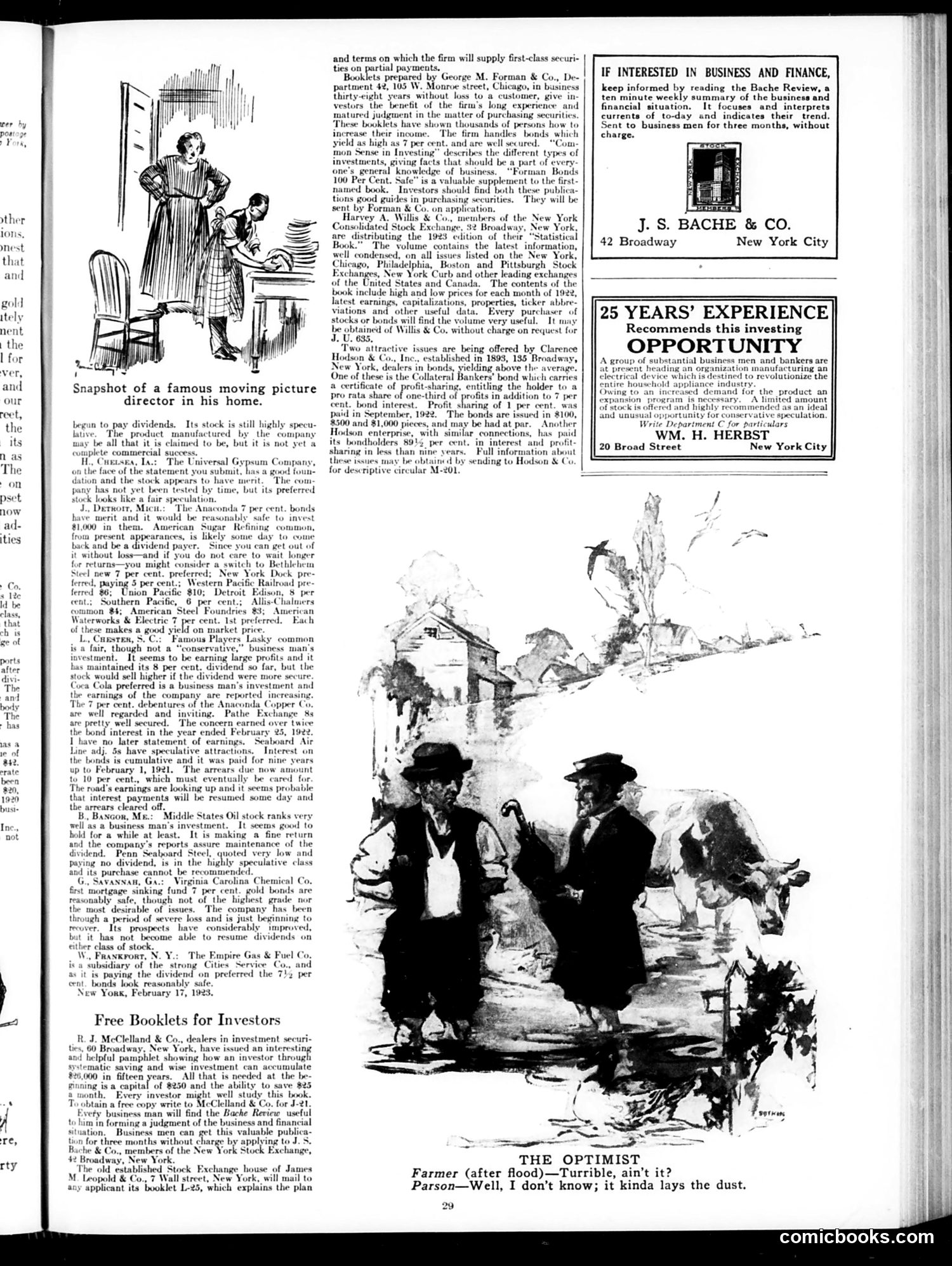
This single-panel cartoon depicts a farmer surveying storm damage to his farm buildings and crops. The caption reads: "Farmer (after flood)—Turrible, ain't it? Parson—Well, I don't know; it kinda lays the dust." **The joke**: The parson responds to the farmer's complaint about devastating flood damage with absurd optimism, finding a silver lining (dust reduction) in the disaster. This satirizes naive or disconnected optimism—particularly the tendency of clergy or privileged individuals to find trivial "bright sides" to working people's genuine hardships. The cartoon mocks blind positivity in the face of real suffering, a common theme in satirical publications of the 1920s. The page also contains investment advice columns and advertisements, typical of Judge's mixed content format during this era.
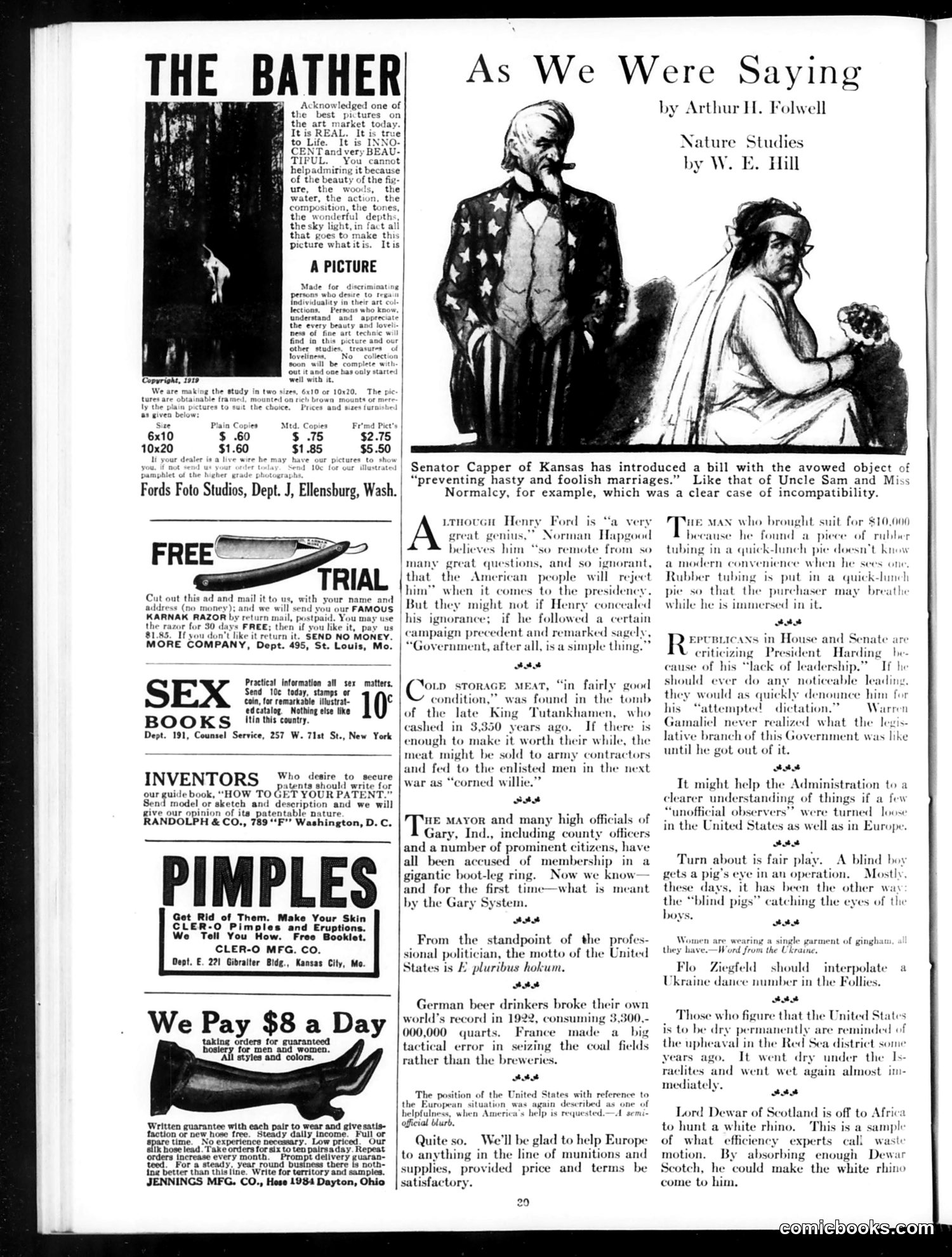
This is primarily a page of **short satirical commentaries** by Arthur H. Folwell, interspersed with period advertisements. The cartoons and jokes target 1920s American politics and social issues: **Key References:** - **Senator Capper's marriage bill**: Satirized as hypocritical, comparing it to the incompatible union of "Uncle Sam and Miss Normalcy" (likely referencing Harding's "return to normalcy" campaign slogan). - **Henry Ford**: Mocked as a "genius" yet ignorant on major questions, suggesting Ford shouldn't run for president despite his wealth. - **Gary, Indiana "System"**: A bitter joke about corruption—municipal officials caught in bootlegging rings during Prohibition. - **President Harding**: Criticized by Congress for lacking leadership, yet would be attacked if he actually led—highlighting partisan gridlock. The page reflects post-WWI American cynicism about government incompetence, Prohibition-era corruption, and political hypocrisy. The surrounding advertisements (sex education books, patent services, pimple cream) reveal the magazine's broad, working-class readership.
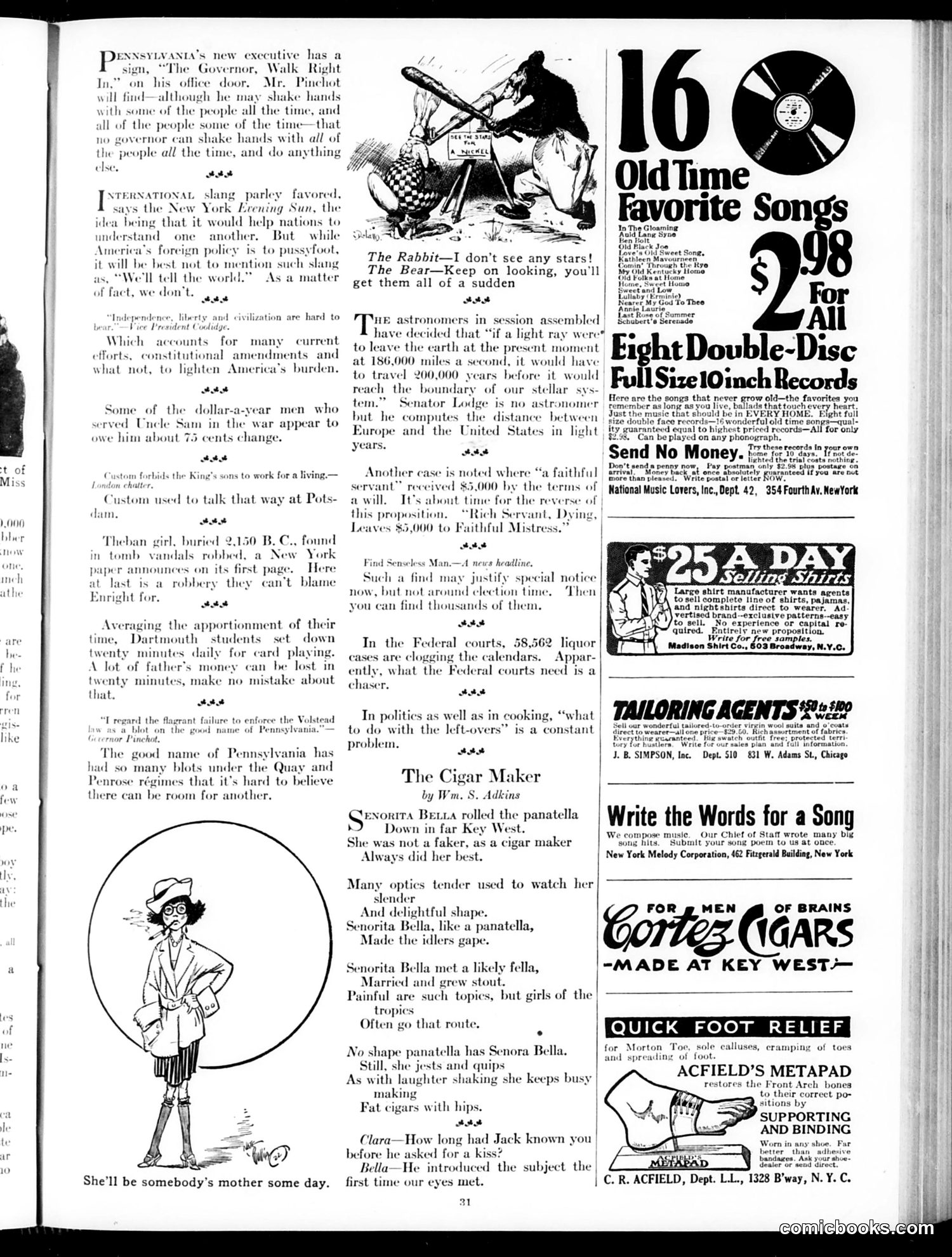
This page mixes light humor with political jabs typical of Judge magazine. The main illustrated poem, "The Cigar Maker" by Wm. S. Adkins, tells of Senorita Bella, a cigar roller in Key West who was attractive and fit when young ("like a panatella"), but grew stout after marriage. The joke: she now makes cigars "with hips"—a crude visual pun on her changed physique. The scattered one-liners above satirize contemporary politics and figures. One targets Pennsylvania Governor **Pinchot**, mocking that his state's reputation is already so damaged by previous scandals (under political bosses Quay and Penrose) that "there can be room for another" scandal. Another jabs **Senator Lodge** for his Cold War rhetoric about distance between Europe and America. The humor relies on readers' familiarity with these political figures and recent Pennsylvania corruption. The page is mostly advertisements for records and other products—typical Judge format mixing editorial content with revenue.
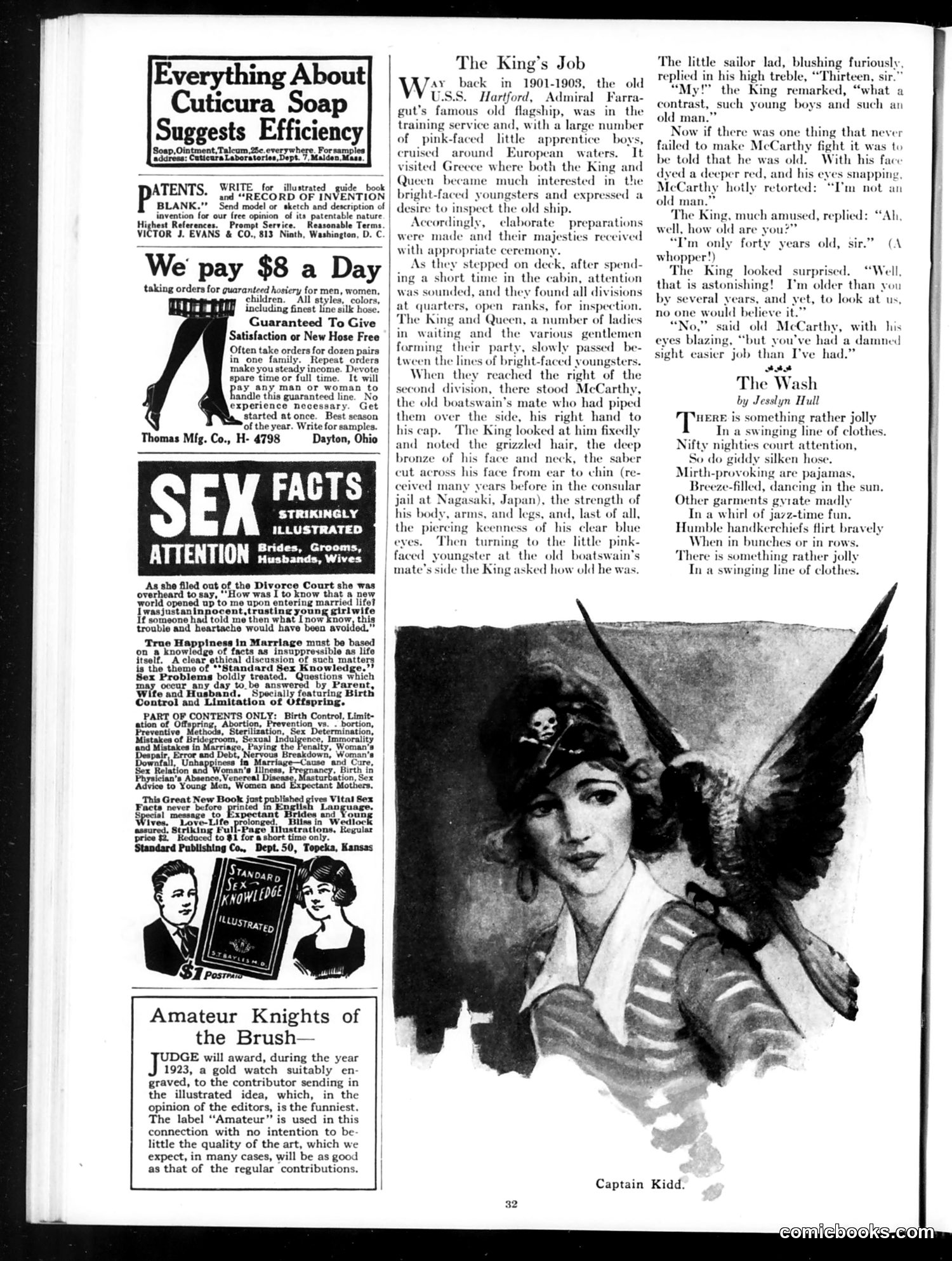
This page is primarily **advertising and filler content** rather than political satire. The main elements include: **Advertisements:** - Cuticura Soap (top left) - Patent services - Hosiery sales ($8/day commission) - "Standard Sex Knowledge" book (center-left) — a marriage/sex education manual addressing divorce, birth control, and marital problems **Editorial Content:** - "The King's Job" (top right) — an anecdotal story about a European King visiting the USS Hartford naval ship around 1901-1908, inspecting young apprentices and encountering an aging boatswain - "The Wash" by Jocelyn Hall — a brief poem about laundry day - "Amateur Knights of the Brush" (bottom) — announcement of a 1923 Judge contest for humorous illustrated submissions **Notable Image:** A dramatic photograph labeled "Captain Kidd" showing what appears to be a theatrical or costume figure. The page reflects 1920s concerns: marriage education, career opportunities, and naval nostalgia. It lacks coherent satirical purpose, functioning mainly as a revenue-generating miscellany.
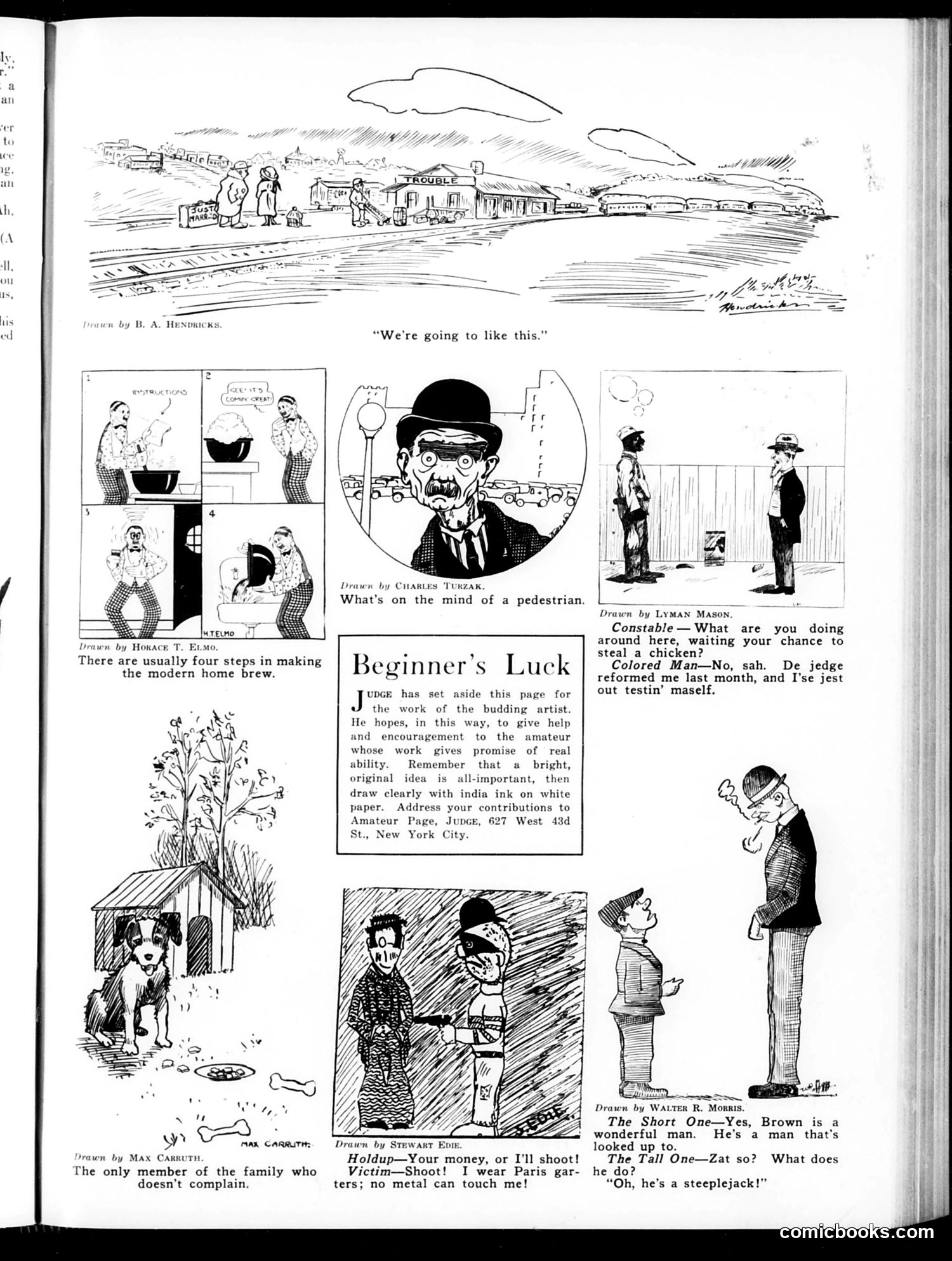
This page from *Judge* contains several unrelated humor cartoons reflecting 1920s American life: **"Modern Home Brew"** satirizes Prohibition-era illegal alcohol production, showing the four steps of making bootleg liquor at home—a common practice after alcohol became illegal in 1920. **"The Only Member..."** shows a dog content while the human family complains, a simple domestic humor joke about pet satisfaction versus human dissatisfaction. **"Pedestrian's Mind"** depicts a man worried about traffic—likely referencing anxieties about increasingly busy streets with automobiles. **"Holdup"** plays on the fashion detail that Paris garters (men's sock holders) contained metal, making them bulletproof—absurdist humor about an armed robbery thwarted by clothing. **"Constable"** uses a racial stereotype (dialect-heavy speech) in a joke about a Black man on probation proving his reformation by resisting chicken theft temptation. **"The Short One"** is a height-based pun: Brown is "looked up to" because he's a steeplejack (works on tall structures), not because he's respected. The page also announces a section for amateur comic submissions.
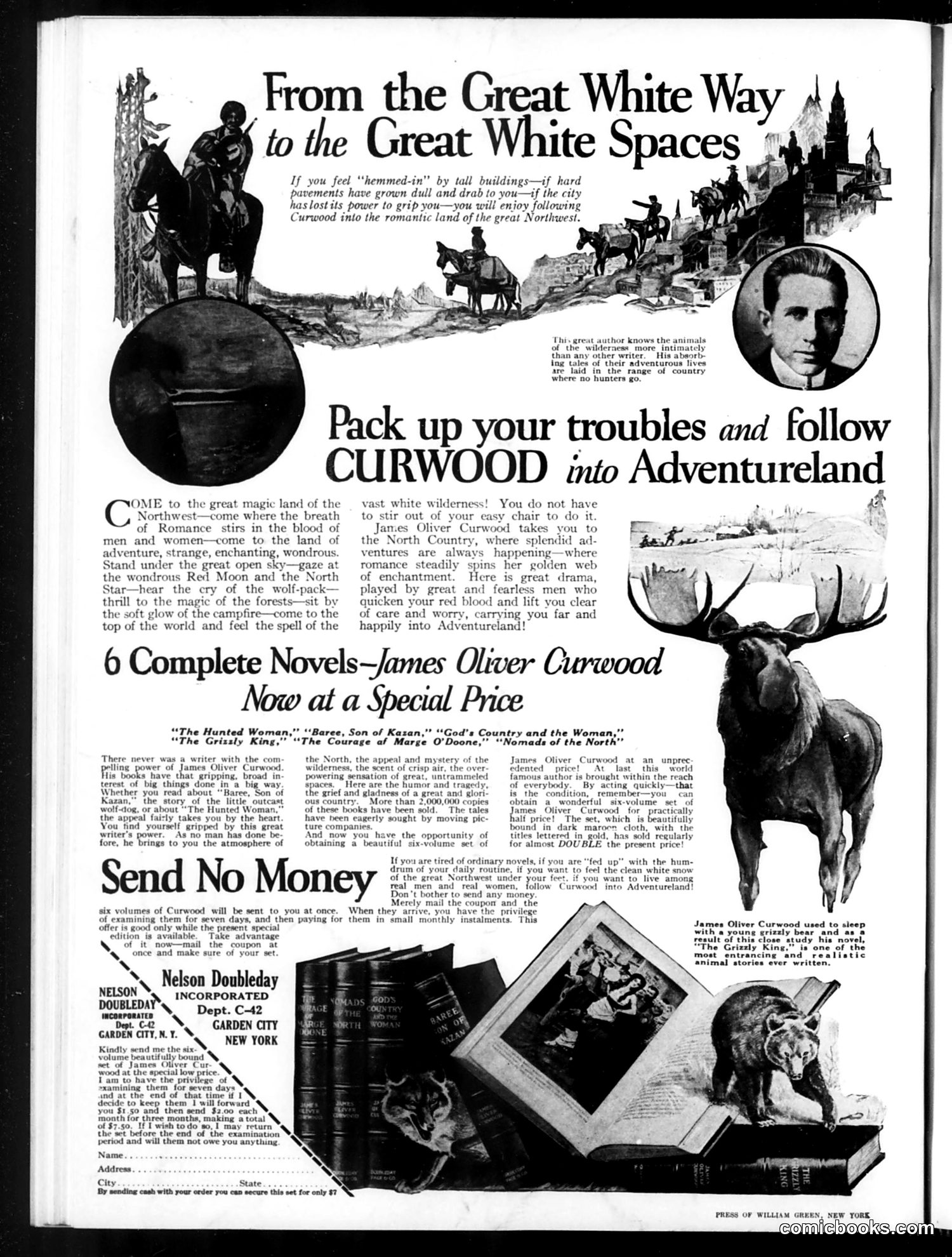
This is primarily a **book advertisement**, not a political cartoon. It promotes James Oliver Curwood's six-volume novel collection about wilderness adventure in the Canadian North. The ad uses escapist rhetoric appealing to urban readers tired of city life—promising romance, wild animals, and "great fearless men" in untamed nature. This reflects early 20th-century nostalgia for frontier life as industrialization intensified. The circular portrait (right side) appears to be Curwood himself, positioned as an authority on wilderness because he "knows the animals...intimately." The dramatic illustrations—moose, bear, wolves, frontier scenes—reinforce the adventure fantasy. The "Send No Money" offer was a common sales tactic: examine the books free for seven days, then pay in installments. The emphasis on affordability ("Special Price," "DOUBLE the present price") suggests marketing to middle-class readers. The page reflects **early advertising psychology**: selling escape from modern urban constraints through romantic narratives about nature and masculine adventure.