
Judge, 1923-02-24 · page 11 of 36
Judge — February 24, 1923 — page 11: what you’re looking at
What you’re looking at
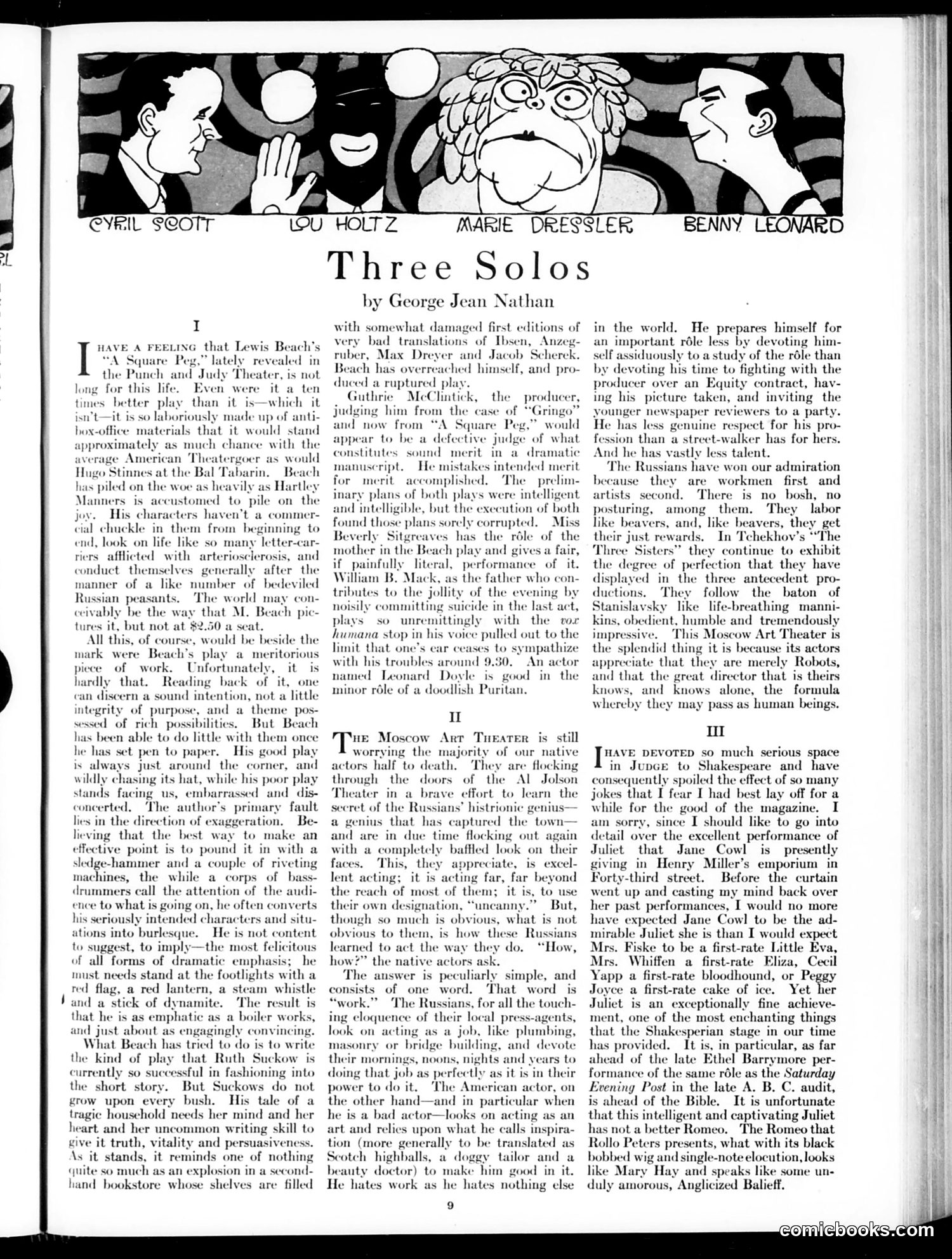
This page from Judge contains a theater criticism essay by George Jean Nathan reviewing three plays, accompanied by caricatures of four performers at the top. **The Caricatures:** The header shows Cyril Scott, Lou Holtz, Marie Dressler, and Benny Leonard—performers likely appearing in the reviewed productions. **The Criticism:** Nathan savagely critiques Lewis Beach's play "A Square Peg," claiming Beach mistakes *intended* merit for actual merit. He accuses Beach of heavy-handed exaggeration, comparing the work to "an explosion in a second-hand bookstore." Nathan argues Beach overwrites, constantly announcing his points rather than subtly suggesting them—like using sledgehammers and dynamite when finesse is needed. The review also criticizes producer Guthrie McClinctick's judgment and praises Beverly Sitgreaves's performance while mocking William B. Mack's overwrought suicide scene. **The Point:** This is standard theatrical criticism—acerbic, witty commentary on contemporary Broadway production. Nathan's style exemplifies Judge's sophisticated cultural commentary for educated readers evaluating contemporary theater.
📄 Transcribed text from this page (OCR, searchable)
Machine-transcribed from the original scan — historical spelling and the odd misread are preserved.
I HAVE A FEELING that Lewis Bi I “A Square Peg,” lately reveal the Punch and Judy Theater, long for this life. Even were it times better play than it. is—wh isn’t—it is so laboriously made up o| box-office materials that it would s much cha approximat Hugo Stinnes at the Bal Tabarin. has piled on the woe as heavily as H Manners is accustomed to pile joy. His characters cial chuckle in them from begin end, look on life like so many lette WU HOLTZ each’s led in is not a ten ich it f anti- stand ace with the would Beach artley om the vt a commer- ing to or-car- riers afflicted with arteriosclerosis, and conduct themselves generally aft manner of a like number of bec Russian peasants. ceivably be the tures it, but not ) a seat. All this, of course, would be besic mark were Beach’s play a merit piece of work. Unfortunately, hardly that. y that M. Beac the Viled The world may con- h pic- le the orious. it is Reading back of it, one can discern a sound intention, not a little integrity of purpose, and a theme sessed of rich possibilities. But has been able to do little with then he has set pen to paper. His gooc is always just around the corner wildly chasing its hat, while his poo stands facing us, embarrassed anc concerted. The author's. primary lies in the dir on of exaggeration. > pos- Beach n once 1 play > and r play 1 dis- fault Be- lieving that the best way to make an effective point is to pound it in with sledge-hammer and a couple of riveting machines, the while a corps of drummers call the attention of the ence to what is going on, he often cor his seriously intended characters anc ations into burlesque. He is not cx to suggest, to imply—the most fe bass- audi- averts, 1 situ- omtent tous of all forms of dramatic emphasis; he must needs stand at the footlights with a red flag, a red lantern, a s and a stick of dynamite that he is and just about as engagingly convir What Beach has tried to do is to the kind of play currently so suc short story. But Suckows dc grow upon every bush. His tale tragic household needs her mind an now > resi T ‘ssful in it truth, vitality and persuasive \s it stands, it reminds one of no‘ histle ult is a boiler works, acing. write that Ruth Suckow is shioning into » not of a d her heart and her uncommon writing skill to ness. thing quite so much as an explosion in a second- hand bookstore whose shelves ar filled MARIE DRESSLER Three Solos by George Jean Nathan with somewhat damaged first editions of very bad translations of Ibsen, Anzeg- ruber, Max Dreyer and Jacob Scherek. Beach has overreached himself, and pro- duced a ruptured play. Guthrie McClintick, the] judging him from the case of * and now from “A Square appear to be a defective judge of what constitutes sound merit in dramatic manuscript. He mistakes intended merit for merit) accomplished. The — prelim- inary plans of both plays were intelligent and intelligible, but the execution of both found those plans sorely corrupted. Miss Beverly Sitgreaves has the réle of the mother in the Beach play and gives a fair, if painfully lite ‘rformance of it. William B. Mack : father who con- tributes to the jollity of the evening by noisily committing suicide in the last act, plays) so unremittingly with the vor humana stop in his voice pulled out to the limit that one’s ear ceases to sympathize with his troubles arounc named Leonard Doyle is g minor réle of a doodlish Puritan. Il HE Moscow Art Tuearter is still worrying the majority of our native actors half to death. They are flocking through the doors of the Al Jolson ‘Theater in a brave effort to learn the sret of the Russians’ histrioni nius— mnius that has captured the town— and are in due time flocking out again with a completely baffled look on their faces. This, they appreciate, is excel- lent acting; it is acting far, beyond the reach of most of them; it is, to use their own designation, “uncanny.” But, though so much is obvious, what is not obvious to them, is how these Russians learned to act the way they do. “How, how?” the native actors ask. The auswer is peculiarly simple, and consists of one word. That word is work.” ‘The Russians, for all the touch- ing eloquence of their local press-agents, look on acting as a job, like plumbing, masonry or bri building, and devote their mornings, noons, nights and doing that job as perfectly as it i power to do it. The American the other hand—and in particu he is a bad actor—looks on acting as an art and relies upon what he calls inspira- tion (more generally to be translated as Scotch highballs, a doggy tailor and a beauty doctor) to make him good in it. He hates work as he hates nothing else 9 vducer, ingo” would in the world. He prepares himself for an important réle less by devoting him- self assiduously to a study of the réle than by devoting his time to fighting with the producer over an Equity contract, hav- ing his picture taken, and inviting the younger newspaper reviewers to a party. He has less genuine respect for his pro- fession than a street-walker has for hers. And he has vastly less talent. ‘The Russians have won our admiration because they are workmen first’ and artists second. There is no bosh, no posturi among them. They labor like t rs, and, like beavers, they get their just rewards. In Tchekhov’s *’The Three Sisters” they continue to exhibit sree of perfection that they have displayed in the three antecedent. pro- ductions. They follow the baton of Stanislavsky like life-breathing manni- kins, of t, humble and tremendously impressive. This Moscow Art Theater is the splendid thing it is because its actors appreciate that they are merely Robots, and that the great director that is theirs knows, and knows alone, the formula whereby they may pass as human beings. Tl [= DEVOTED so much serious space in JupGe to Shakespeare and have consequently spoiled the effect of so many jokes that I fear I had best lay off for a while for the good of the magazine. I am sorry, since I should like to go into detail over the excellent performance of Juliet that Jane Cowl is presently giving in Henry Miller’s emporium in Forty-third street. Before the curtain went up and casting my mind back over her past performances, I would no more have expected Jane Cowl to be the ad- mirable Juliet she is than I would expect Mrs. Fiske to be a first-rate Little Eva, Mrs. Whiffen a first-rate Eliza, Cecil Yapp a first-rate bloodhound, or Peggy Joyce a first-rate cake of ice. Yet her Juliet is an exceptionally fine achieve- ment, one of the most enchanting things that the Shakesperian stage in our time has provided. It is, in particular, as far ahead of the late Ethel Barrymore per- formance of the same réle as the Saturday Evening Post in the late A. B. C. audit, is ad of the Bible. It is unfortunate that this intelligent and captivating Juliet has not a better Romeo. The Romeo that Rollo Peters presents, what with its black bobbed wig and single-note elocution, looks like Mary Hay and speaks li duly amorous, Anglicized Balieff.