
Judge, 1923-02-24 · page 15 of 36
Judge — February 24, 1923 — page 15: what you’re looking at
What you’re looking at
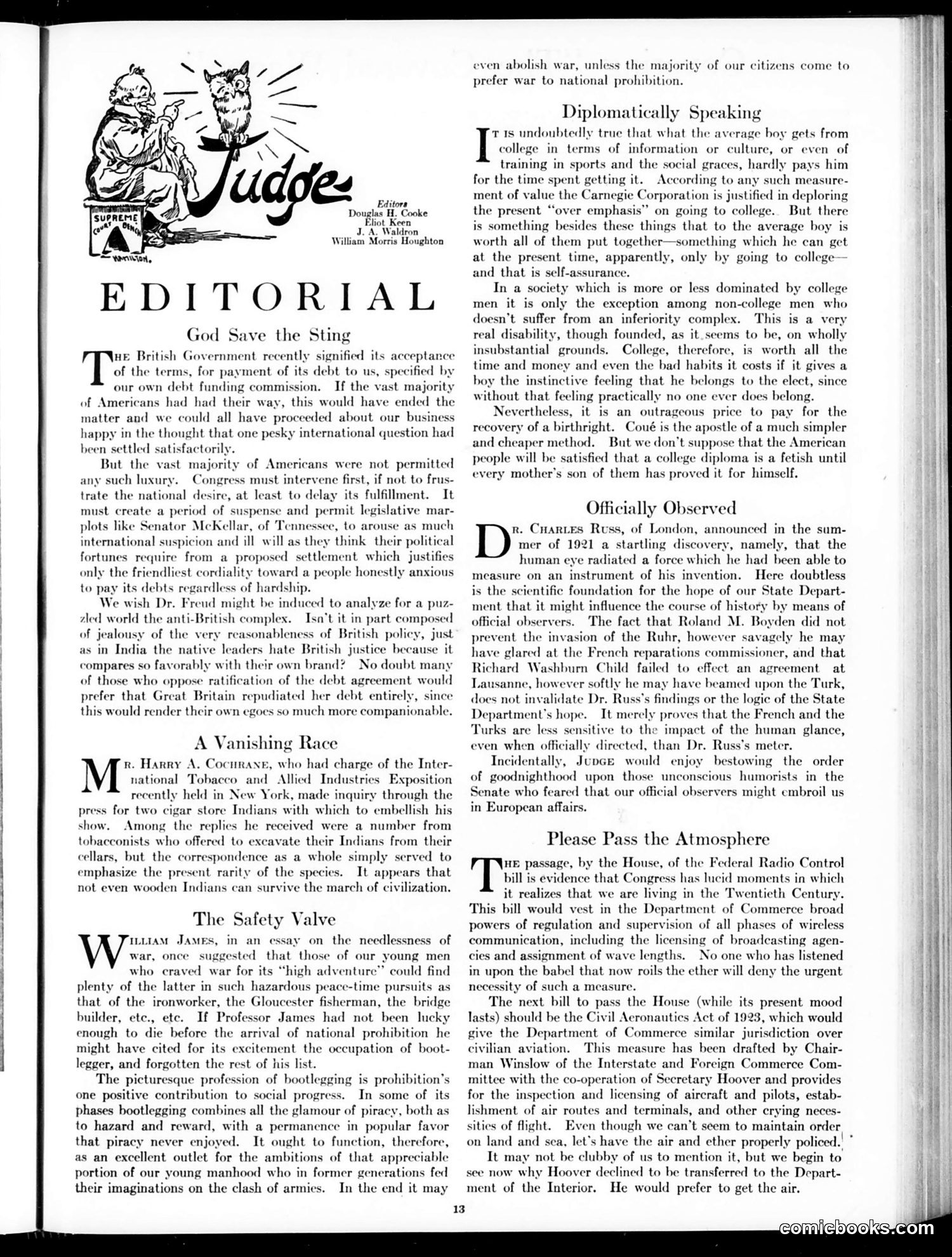
This editorial page from Judge magazine (likely 1920s-early 1930s, based on references) contains several political commentaries: **Main Cartoon**: Shows a baby and a fox-like figure labeled "Judge," illustrating the magazine's satirical stance. **"God Save the Sting"**: Criticizes Congress for delaying British war debt settlement despite public approval. The editors sarcastically invoke Freud to explain American anti-British sentiment, attributing it to jealousy of Britain's reasonableness and justice. **"A Vanishing Race"**: Comments on the disappearance of wooden cigar-store Indian figures—a tongue-in-cheek lament that even these artifacts cannot survive "civilization's march." **"The Safety Valve"**: Argues bootlegging (illegal alcohol production during Prohibition) provides young men the "adventure" they'd otherwise seek in war—a darkly humorous defense of prohibition's unintended consequence. **"Diplomatically Speaking"** and other sections defend college education and federal radio regulation. The page reflects 1920s American debates: debt diplomacy, Prohibition's effects, and technological regulation.
📄 Transcribed text from this page (OCR, searchable)
Machine-transcribed from the original scan — historical spelling and the odd misread are preserved.
Editors Douglas Sooke Eliot Keen A, Waldron William Morris Houghton EDITORIAL God Save the Sting HE British Government recently signified its acceptance of the terms, for payment of its debt to us, spec our own debt funding commission. If the vast majority of Americans had had their way, this would have ended the matter and we could all have proceeded about our business happy in the thought that one pesky international question had been settled satisfactorily. But the vast majority of Americans were not permitted any such luxury. Congress must intervene first, if not to frus- trate the national desire, at least to delay its fulfillment. It must create a period of suspense and permit legislative mar- plots like Senator McKellar, of Tennessee, to arouse as 1 international suspicion and ill will as they think their poli proposed settlement which justifie lity toward a people honestly anxious fortunes require from only the friendliest cord to pay its debts regardless of hardship. We wish Dr. Freud might be induced to analyze for a puz- zled world the anti-British compl Isn’t it in part composed of jealousy of the very reasonableness of British policy, just as in India the native leaders hate British justice because it compares so favorably with their own brand? No doubt many of those who oppose ratification of the debt agreement would prefer that Great Britain repudiated her debt entirel this would render their own egoes so much more companionable. since A Vanishing Race r. Harry A. Cocurane, who had charge of the Inter- M national Toba and Allied Industries Exposition recently held in New York, made inquiry through the press for two cigar store Indians with which to embellish his Among the replies he received were a number from e their Indians from their s a whole simply served to 5 ppears that ation. show, tobacconists who offered to e: cellars, but the corresponde emphasize the present rarity of the spec not even wooden Indians can survive the march of civ The Safety Valve LLIAM JAMES, in an essay on the needlessness of ar, once suggested that those of our young men who craved war for its “high adventure” could find plenty of the latter in such hazardous peace-time pursuits as that of the ironworker, the Gloucester fisherman, the bridge builder, ete., etc. If Professor James had not been lucky enough to die before the arrival of national prohibition he might have cited for its itement the occupation of boot- legger, and forgotten the rest of his list. The picturesque profession of bootlegging is prohibition’s one positive contribution to social progress. In some of its phases bootlegging combines all the glamour of piracy, both as to hazard and reward, with a permanence in popular favor that piracy never enjoyed. It ought to function, therefore, as an excellent outlet for the ambitions of that appreciable portion of our young manhood who in former generations fed their imaginations on the clash of armies. In the end it may 13 even abolish war, unless the majority of our citizens come to prefer war to national prohibition. Diplomatically Speaking T 1s undoubtedly true that what the average boy gets from college in terms of information or culture, or even of training in sports and the social graces, hardly pays him for the time spent getting it. According to any such measure- ment of value the Carnegie Corporation is justified in deploring the present “over emphasis” on going to college. But there is something besides these things that to the average boy is worth all of them put together—something which he can get at the present time, apparently, only by going to college and that is self-assuranc In a society which is more or less dominated by college men it is only the exception among non-college men who doesn’t suffer from an inferiority complex. This is a very real disability, though founded, as it.seems to be, on wholly insubstantial grounds. College, therefore, is worth all the time and money and even the bad habits it costs if it gives a hoy the instinctive feeling that he belongs to the elect, since without that feeling practically no one ever does belong. Nevertheless, it is an outrageous price to pay for the recovery of a birthright. Coué is the apostle of a much simpler and cheaper method. But we don’t suppose that the American people will be satisfied that a college diploma is a fetish until every mother’s son of them has proved it for himself. Officially Observed r. Cuartes Russ, of London, announced in the sum- mer of 1921 a startling discovery, namely, that the human eye radiated a force which he had been able to measure on an instrument of his invention. Here doubtless is the scientific foundation for the hope of our State Depart- ment that it might influence the course of history by means of official observers. The fact that Roland M. Boyden did not prevent the invasion of the Ruhr, however savagely he may have glared at the French reparations commissioner, and that Richard Washburn Child failed to effect an agreement at Lausanne, however softly he may have beamed upon the Turk, does not invalidate Dr. Russ’s findings or the logic of the State Department's hope. It merely proves that the French and the Turks are less sensitive to the impact of the human glance, even when officially directed, than Dr. Russ’s meter. Incidentally, JupGe would enjoy bestowing the order of goodnighthood upon those unconscious humorists in the Senate who feared that our official observers might embroil us in European affairs. Please Pass the Atmosphere Th passage, by the House, of the Federal Radio Control bill is evidence that Congress has lucid moments in which it realizes that we are living in the Twentieth Century. This bill would vest in the Department of Commerce broad powers of regulation and supervision of all phases of wireless communication, including the licensing of broadcasting agen- cies and assignment of wave lengths. No one who has listened in upon the babel that now roils the ether will deny the urgent necessity of such a measure. The next bill to pass the House (while its present mood lasts) should be the Civil Aeronautics Act of 1923, which would give the Department of Commerce similar jurisdiction over ci aviation. This measure has been drafted by Chair- man Winslow of the Interstate and Foreign Commerce Com- mittee with the co-operation of Secretary Hoover and provides for the inspection and licensing of aircraft and pilots, estab- lishment of air routes and terminals, and other erying neces- sities of flight. Even though we can’t seem to maintain orde on land and sea, let’s have the air and ether properly policed.’ It may not be clubby of us to mention it, but we begin to see now why Hoover declined to be transferred to the Depart- ment of the Interior. He would prefer to get the air.